229
AGROBIOLOGICAL AND TECHNOLOGICAL CHARACTERISTICS OF
SOME GRAPEVINE VARIETIES AND CLONES GROWN IN SERBIA
ZORAN PRŽIĆ, NEBOJŠA MARKOVIĆ
Department for viticulture, Faculty of Agriculture University of Belgrade, Serbia E-mail: [email protected]
In Serbia under the vineyards is about 22 149 hectares from that area 17482 hectares is under vine and 4667 hectares under table varieties. The most common wine varieties are Cabernet sauvignon (8.49%), Merlo (8.14%), Limberger (4.65%), Pinot noir (3.2%), Prokupac (3.33%), Italian riesling (13.94%), Riesling rhine (8.01%), Chardonnay (6.76%) and Sauvignon blanc (4.59%). Among table varieties Muscat hamburg with 52.83% is the most common, followed by Victoria (7.94%), Moldova (7%), Cardinal (5.92%) and others.
Over the past twenty years grapevine assortment has been significantly expanded through: introduction of other varieties and clones (mainly from France and Italy), with creation of new varieties at Faculty of Agriculture University of Belgrade and with clonal selection of Serbian origin varieties. Through big number of breeding programs, 23 table and 9 wine grape varieties were created, while 12 new clones of autochthonous Prokupac variety were recognized by the Genetic Resources Department of the Ministry of agriculture, forestry and water Management.
Keywords: variety, clone, introduction, testing
INTRODUCTION
Varietal structure in most Serbian vineyards in earlier years was mainly reduced to several introduced grape varieties (Cabernet sauvignon, Merlo, Pinot noir, Sauvignon blanc, Chardonnay, Rkaciteli ...) or to a less to autochthonous varieties Prokupac and Smederevka (Marković, 2012).
In the last twenty years grapevine assortment in Serbia has been significantly expanded through introduction of varieties and clones of international varieties, creation of new varieties and through clonal selection of autochthonous varieties. New varieties or clones were introduced from largest vineyard centers in Italy, France and Germany. The greatest contribution to creation of new varieties was given by Department of Viticulture Faculty of Agriculture University of Belgrade where is created 32 grape varieties (9 wine and 23 table varieties).
The autochthonous grape variety in Serbia has been reduced to several varieties which, according to earlier systematizations, consisted mainly of varieties for table and quality wines (Prokupac, Smederevka, Bagrina, Začinak, Tamjanika ....). Recent research has found that in Serbia there are numerous variations of these varieties with high technological potential, which would also be classified into the category of varieties for high quality wines (Živković et al., 2016).
230
PR 20 (Markovic et al, 2013a, b, c). In addition to Prokupac, intensive research and clonal selection is also being done on Smederevka, Začinak and Bagrina varieties.
Introduced varieties and clones, as well as new created and recognized clones, have a test procedure related to folow parameters:
1. testing of resistance to low temperatures
2. phenology (BBCH identification
key-Biologiche Bundesantalt
Bundessorten amt and Chemical
industry)
3. number of developed shoots
4. fertility (number and % of fertil and non-fertil shoots; number of inflorescence; fertility coeficinets-potential, relativ and absolute) 5. mechanical composition of cluster and berries
6. mass of pruning shoots
7. content of sugar and total acids in must 8. anthocyan content in bery skin
9. yield
a) INTRODUCED VARIETIES AND CLONES
The bigest number of clones was tested for next wine varieties: Cabernet sauvignon: french clones-191, 337, 685, italian clones-R5, VCR 7, VCR 8, VCR 11, VCR 489; Cabernet franc: french clones-214, 326, 327, 330, 409, 623, 678, italian clones-VCR 10; Pinot noir: french clones-113, 114, 115, 165, 459, 667, 777, 779, 792, 828, 870, 871, 872, 927, 943, Italian clones-R4, VCR 9, VCR 18; Merlo: french clones-181, 184, 343, 347, 519, italian clones-R3, R12, R18, VCR1, VCR489; Sauvignon blanc: french clones-107, 108, 159, 161, 242, 316, 317, italian clones-ISV F3, ISV F5, R3, VCR 236, VCR 237; Chardonnay: italian clones-ISV 1, ISV 4, ISV 108, R8, VCR 4, VCR 10,
VCR 435, VCR 436, french clones-75, 76, 95, 96, 117, 121, 277, 548; Clairette de Gascogne: french clones-68, 208; Colombard: french clones-551, 552, 553, 625, 605, 606, 608, 609; Folle blanche: french clone-281; Marselan: french Clone-980; Muscat a petits grains: french clones-453, 454, 455; Ugni blanc: french clone-384 and Viognier: french clone-642. Of table varieties Prima, Ora, Danlas, Lival and Victoria had a significant position (Markovic, 2003; Markovic & Przic, 2016).
Introduced varieties and clones are suitable for different agro-ecological conditions of Serbia and were high values in testing process of tested quantitative and qualitative parameters (Pržić, 2014; Marković et al., 2016, 2017) and in accordance with results of other authors who are examined part of introduced varieties in agroecological conditions of other countries (Jones & Davis, 2000; Kennedy et al., 2001; Matthews et al., 2005; Fregoni, 2010; Jones, 2010).
b) NEW CREATED VARIETIES
231
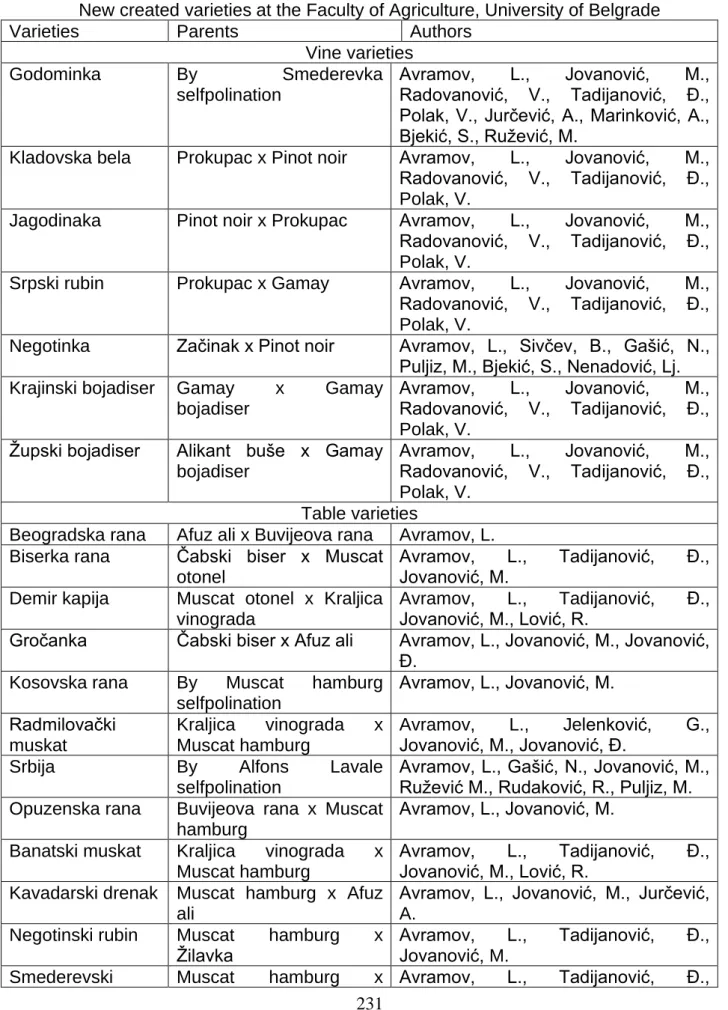
Table 1. New created varieties at the Faculty of Agriculture, University of Belgrade
Varieties Parents Authors Vine varieties
Godominka By Smederevka selfpolination
Avramov, L., Jovanović, M., Radovanović, V., Tadijanović, Đ., Polak, V., Jurčević, A., Marinković, A., Bjekić, S., Ružević, M.
Kladovska bela Prokupac x Pinot noir Avramov, L., Jovanović, M., Radovanović, V., Tadijanović, Đ., Polak, V.
Jagodinaka Pinot noir x Prokupac Avramov, L., Jovanović, M., Radovanović, V., Tadijanović, Đ., Polak, V.
Srpski rubin Prokupac x Gamay Avramov, L., Jovanović, M., Radovanović, V., Tadijanović, Đ., Polak, V.
Negotinka Začinak x Pinot noir Avramov, L., Sivčev, B., Gašić, N., Puljiz, M., Bjekić, S., Nenadović, Lj. Krajinski bojadiser Gamay x Gamay
bojadiser
Avramov, L., Jovanović, M., Radovanović, V., Tadijanović, Đ., Polak, V.
Župski bojadiser Alikant buše x Gamay bojadiser
Avramov, L., Jovanović, M., Radovanović, V., Tadijanović, Đ., Polak, V.
Table varieties
Beogradska rana Afuz ali x Buvijeova rana Avramov, L. Biserka rana Čabski biser x Muscat
otonel
Avramov, L., Tadijanović, Đ., Jovanović, M.
Demir kapija Muscat otonel x Kraljica vinograda
Avramov, L., Tadijanović, Đ., Jovanović, M., Lović, R.
Gročanka Čabski biser x Afuz ali Avramov, L., Jovanović, M., Jovanović, Đ.
Kosovska rana By Muscat hamburg selfpolination
Avramov, L., Jovanović, M.
Radmilovački muskat
Kraljica vinograda x Muscat hamburg
Avramov, L., Jelenković, G., Jovanović, M., Jovanović, Đ.
Srbija By Alfons Lavale selfpolination
Avramov, L., Gašić, N., Jovanović, M., Ružević M., Rudaković, R., Puljiz, M. Opuzenska rana Buvijeova rana x Muscat
hamburg
Avramov, L., Jovanović, M.
Banatski muskat Kraljica vinograda x Muscat hamburg
Avramov, L., Tadijanović, Đ., Jovanović, M., Lović, R.
Kavadarski drenak Muscat hamburg x Afuz ali
Avramov, L., Jovanović, M., Jurčević, A.
Negotinski rubin Muscat hamburg x
232
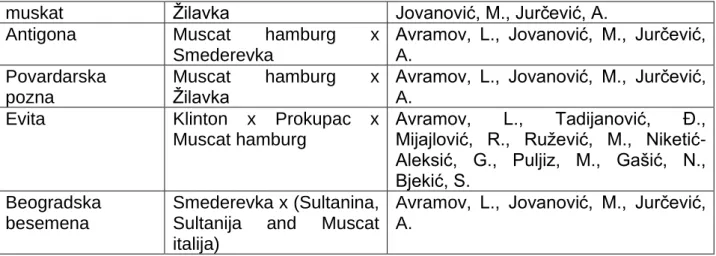
muskat Žilavka Jovanović, M., Jurčević, A. Antigona Muscat hamburg x
Smederevka
Avramov, L., Jovanović, M., Jurčević, A.
Povardarska pozna
Muscat hamburg x Žilavka
Avramov, L., Jovanović, M., Jurčević, A.
Evita Klinton x Prokupac x Muscat hamburg
Avramov, L., Tadijanović, Đ., Mijajlović, R., Ružević, M., Niketić-Aleksić, G., Puljiz, M., Gašić, N., Bjekić, S.
Beogradska besemena
Smederevka x (Sultanina, Sultanija and Muscat italija)
Avramov, L., Jovanović, M., Jurčević, A.
Table 2 Technological characteristics of newly created varieties
Varieties Cluster mass (g)
Ripening epoch Sugar content (%)
Total acid content (g/l)
Vine varieties
Godominka 150-200 end of II beginning of III 20-24 5-7 Kladovska bela 130-200 III 18-22 8-10 Jagodinaka 100-150 III 18-22 7-8 Srpski rubin 180-300 III 18-20 5-9 Negotinka 150-180 II 21-22 6-8 Krajinski bojadiser 200-300 III 18-22 7-9 Župski bojadiser 120-190 III 18-21 8-11
Table varieties
Beogradska rana 200-220 end of July 15-17 5-6 Biserka rana 100-110 with Julski muscat 14-16 5-6 Demir kapija 120-290 end of July 14-16 6-7 Gročanka 175-290 end of July 16-18 6-7 Kosovska rana 200-350 4-5 days before Queen
of vineyards
15-17 6-7
Radmilovački muskat 170-280 2-3 days before Queen of vineyards
15-17 6-7
Srbija 150-400 3 decade of July 14-18 5-6 Opuzenska rana 100-160 very early 15-17 7-8 Banatski muskat 200-290 I 14-16 5-6 Kavadarski drenak 350-400 end of III beginning of IV 16-18 7-8 Negotinski rubin 300-350 end of III beginning of IV 16-18 5-6 Smederevski muskat 250-400 III 18-19 6-7 Antigona 260-400 IV 18-20 6-7 Povardarska pozna 300-400 IV 15-17 7-8 Evita 300-450 III 19-21 8-11 Beogradska
besemena
233
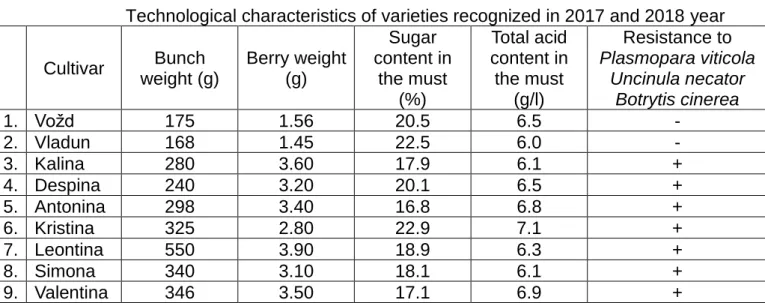
During 2017 and 2018 year, eight varieties of grapevine were recognized by Genetic Resources Department of the Ministry of agriculture, forestry and water Management, including two wine and six table varieties. In table 3 it is show parental combinations of crosing, while table 4 it is show main technological
characteristics of new recognized varieties.
Table 3.
Recognized varieties at the Faculty of Agriculture in 2017 and 2018
Cultivar Purpose Color Year of
recognition Origin
1. Vožd wine black 2017 Začinak x Prokupac 2. Vladun wine black 2017 Merlot x Župski bojadiser 3. Kalina table white 2017 Muscat Hamburg x SV 12375 4. Despina table white 2017 SV 18315 x Muscat Hamburg 5. Antonina table black 2017 Muscat Hamburg x Seedling108 6. Kristina table black 2018 Muscat Hamburg x Seedling 108 7. Leontina table black 2018 Muscat Hamburg x SV 12375 8. Simona table black 2018 Seedling 113 x Muscat Hamburg
Table 4.
Technological characteristics of varieties recognized in 2017 and 2018 year
Cultivar Bunch weight (g)
Berry weight (g)
Sugar content in
the must (%)
Total acid content in the must
(g/l)
Resistance to
Plasmopara viticola
Uncinula necator
Botrytis cinerea
234
a) CLONAL SELECTION
Prokupac is autochthonous red wine variety of Serbia with unspecified exact origin, but is assumed to spread from Prokuplje area and around Aleksandrovac Zupski (Zirojevic, 1964). According to some data, this variety was cultivated at the time, but also before Cara Lazar, to be suppressed in the last few decades by the introduced varieties, especially to Frankovka variety, which had to replace Prokupac, because had improved technological characteristics. Prokupac can find under synonyms: Kameničarka, Rekovacka crnka, Nikodimka, Rskavac, Prokupka and Niševka. It is characterized by medium to strong vigor and fertility manifested on both well and poor fertile soils. Prokupac shoots are developed and strong with upright growth and can be grown on lowe training systems. It is a high fertile variety, the lowest buds on shoot are very fertile. It is suitable short pruning were gives excellent yield. Some clones of this variety are characterized by increased resistance to Botritis cinerea. Prokupac wines are refreshing and suitable for making wines such as rose and strong colored wines (Avramov and Zunic, 2001; Zunic, 2010).
The significance of Prokupac is great, bearing in mind that this variety participated in crossbreeding of several parental combinations where as a result are created varieties Župljanka, Kladovka bela, Jagodinka, Serbian ruby and Evita. So far, 12 clones of the Prokupac variety have been recognized by the Ministry of Agriculture of the Department of Genetic Resources under the designations: PR 2, PR 6, PR 8, PR 9, PR 10, PR 11, PR 12, PR 13, PR 16, PR 17 , PR 19, PR 20.
Most of tested clones were tested to presence of different viruses, 23 recognized and potentially recognized clones had "natural free virus status". Naturally virus-free clones can be used to further multiply and produce certified planting material, which would contribute to their rapid expansion into regular
winemaking (Markovic et al., 2012; Markovic et al., 2017).
Description of recognized Prokupac clones
PR 2
Authors: Marković Nebojša, Nakalamić Aleksandar, Jović Slobodan. Clone was recognized in 2010. It is characterized by large, medium-compacted cluster with mass up to 250.6 g. Berry is round, medium-sized. Participation of epidermis in berry is 4.29% and mesocarp 93.03%. Up to 22.6% of sugar and 6.7 g/l of total acids are accumulated in the must. Clone with bigg yield potential.
PR 6
Authors: Marković Nebojša, Nakalamić Aleksandar, Jović Slobodan. Clone was recognized in 2010. The average mass of cluster is 188.0 g, the length of cluster is 14.36 cm and width is 6.84 cm. Cluster is medium compact, with large lenticels on berries. Berry skin is abundantly sprinkled. It is characterized by a higher percent of seeds in berry- 2.23% (3.28 seeds/berries) and with lower participation of skin in berry-3.50%. In must accumulated 22% of sugar and 6.22 g/l of total acids.
PR 8
Authors: Marković Nebojša, Nakalamić Aleksandar, Jović Slobodan, Cvetković Radoslav. Clone was recognized in 2010. Cluster is medium-sized, berry is round. In grape juice it accumulates 18.6% of sugar and 7 g/l of total acids.
PR 9
235
mesocarp 91.95%. Acumulated19.32% of sugar and 8.02 g/l of total acids in must.
PR 10
Authors: Marković Nebojša, Nakalamić Aleksandar, Jović Slobodan, Žunić Dragoljub. Clone was recognized in 2010. It is characterized by compacted clusters with mass of 194 g. Berries are with large lenticels noticeable on the berries. Cluster is 12.7 cm long and 7.4 cm wide, contains in average 88.6 berries. Weight of the berry is 2.35 g. It is characterized by a high percentage of epidermis in berry-5.53% and seeds-2.98%. Acumulated 17% of sugar and 8.12 g/l of total acids in must. Yielding clone, had ripening time several days later than other clones.
PR 11
Authors: Marković Nebojša, Nakalamić Aleksandar. Clone was recognized in 2010. Cluster is compact, mass 170 g, medium-sized berries with noticeable tiny lenticels per cuticle. Participation of epidermis is 5.39%, of seeds 2.30 and mesocarp 92.3%. Length of cluster is 12.94 cm and width is 7.81 cm. In grape juice accumulate 19% of sugar and 6.43 g/l of total acids.
PR 12
Authors: Marković Nebojša, Nakalamić Aleksandar. Clone was recognized in 2010. Cluster is medium compact, with large lenticels clearly visible on berries. Mass of cluster is 217 g, length is 13.24 cm and its width 6.40 cm. It is characterized by a high content of berries in cluster (99.76%), as well as mesocarp in berry (93.76%), which indicates a higher juice yield. In grape juice it accumulate 21.38% of sugar and 6.79 g/l of total acids.
PR 13
Authors: Marković Nebojša, Nakalamić Aleksandar, Cvetković Radoslav. Clone was recognized in 2010. It is characterized by a compact cluster, mass 170 g, berries are small and different in size. Epidermis is thiny. In
must acumulated 19.4% of sugar and 8.2 g/l of acid.
PR 16
Authors: Marković Nebojša, Pržić Zoran, Zorica Ranković Vasić, Saša Matijašević. Clone was recognized in 2015. It has a very large cluster of 245 g. Berry is round, medium-sized (2.17 g), with thick cuticles. Berry has in average 1.27 seeds, participation of epidermis in berry is 4.59% and mesocarp 93.30%. In must accumulated 22.4% of sugar and 6.5 g/l of total acids.
PR 17
Authors: Marković Nebojša, Pržić Zoran, Zorica Ranković-Vasić, Saša Matijašević. Clone was recognized in 2015. Mass of cluster is 202 g, length of cluster is 12.24 cm and width is 6.93 cm. Berry is round, medium-sized. Cluster has a high content of berries- 96,22%. Participation of epidermis is 5.41%, seeds 2.7% and mesocarp 91.89%. Weight of one berry is 2.22 g. In must accumulated 18.38% of sugar and 7.5 g/l of total acids.
PR 19
Authors: Marković Nebojša, Przić Zoran, Zorica Ranković-Vasić, Saša Matijašević. Clone was recognized in 2015. Cluster is compact, berries are round with clear lenticels. Mass of the cluster is 188 grams, length 14.36 and width 6.84 cm. Clone is characterized by a higher seed participation in berry-2.23% (3.28 seeds / berry). Percent of mesocarp in berry is 94.27%. It is characterized by a high degree of sugar accumulation in must 22.05%, and it accumulate 6.22 g/l of total acids.
PR 20
236 CONCLUSION
Changing varietal composition with introduction of new varieties and clones significantly completes offer in Serbian variety list, as well as in other countries in region that show interest in new varieties and clones. Especially since need for autochthonous assortment is often mentioned in professional circles, as interest on autochthonous assortment as well as on newly created grapevine varieties at agricultural faculties in Belgrade and Novi Sad, has increased on world vine market.
It is necessary to ensure implementation of new created varieties
and recognized clones in Serbian viticulture in coming period through scientific and professional approach. Considering agroecological conditions and economic and technological characteristics viewed through biological and chemical composition of grapes and wines, adequate reonization of new varieties and clones in Serbian vineyards is completed. This creates an appropriate basis for production of wines with a protected geographical origin of autochthonous and newly created varieties.
ACKNOWLEDGEMENTS
This paper was realized as a part of the project (TR 31063): Application of new genotypes and technological innovation in fruit and grape production financed by the Ministry of Education and Science of the Republic of Serbia within the framework of the technological project research for the period 2011-2019.
BIBLIOGRAPHY
1. Avramov, L., Žunić, D. (2001).
Posebno vinogradarstvo, Faculty
of agriculture Belgrade.
2. Fregoni, M. (2010). Le aree viticole storiche nel mondo: i loro vitigni, la loro protezione e la
tipicita dei vini in esse ottenuti. VIII
International Terroir Congres. Soave (VR), Italy, 2(5):3-22.
3. Jones, G.V. (2010). Climate, grape, and wine: Structure and
suitability in a changing climate.
Acta Hortic. 931, 19-28 .
4. Jones, G., Davis, R. (2000).
Climate influences on grapevine phenology, grape composition, and wine production and quality for
Bordeaux, France. American
Journal of Enology and Viticulture, 51(3):249-261.
5. Kennedy, J. A., Hayasaka, Y., Vidal, S., Waters, E. J., Jones, G.
(2001). Composition of grape skin
proanthocyanidins at different
stages of berry development.
Journal of Agricultural and Food Chemistry, 49, pp. 5348-5355.
6. Matthews, M. A., Nuzzo, V.
(2005). Berry Size and Yield Paradigms on Grape and Wines
Quality. Acta Horticulturae.
754:423-436.
7. Marković, N., Pržić, Z., Rakonjac,
V., Todić, S., Ranković-Vasić, Z., Matijašević, S., Bešlić, Z. (2017).
Ampelographic characterization of
Vitis cv “Prokupac” clones by
multivariate analysis. Romanian
Biotechnological Letters, Vol. 22(5): 12868-12875.
8. Marković, N., Pržić, Z., Todić, S.,
Ličina, V., Niculescu, M., Tešević, V. (2017). Variation of
structural bunch and berries
indicators and physico-chemical
wine properties of Cabernet
sauvignon cv. under influence of defoliation and harvest time in
agroecological conditions of
central Serbia. Annals of the
237
9. N. Marković, Z. Przić, V. Tesević,
A. Vuković, D. Mutavdzić, M. Vujadinović, M. Ruml (2016).
Variation of aromatic compounds in 'Cabernet Sauvignon' wine under the influence of different weather conditions and harvest
dates. Acta Hortic. 1139:701-708
10. Marković, N., Pržić, Z. (2016).
Technological characteristics of
Black Magic, Victoria, Mikele
palieri and Muscat Hamburg table
varieties grown at Oplencu. Book
of abstracts.
11. Marković Nebojša (2012).
Tehnologija gajenja vinove loze.
Zadužbina Svetog manastira Hilandara.
12. Marković, N., Atanacković, Z. (2013a). Fertility Variation of Prokupac Cultivar Under Influence
of Different Rootstocks.
Agroznanje 14(2):171-178.
13. Marković, N., Atanacković, Z.,
Ranković-Vasić, Z. (2013b).
Uvometric and technological
characteristics of Prokupac clones
42/1, 43/2 and 43/6. Proceedings
of International Symposium for Agriculture and Food-IV Macedonian Symposium for Viticulture and Wine Production 198-205.
14. Marković, N., Atanacković, Z. (2013c). Uvometric and technological clonal variation of
Serbian black wine cultivar
Prokupac. 36th World Congress of
vine and wine: “ Vine and Wine between Tradition and Modernity” Bucharest – Romania. Proceedings of the 36th World Congress of vine and wine.
15. Marković, N., Atanacković, Z.,
Ranković-Vasić, Z. (2012).
Rootstocks influence on the
assimilation surface and vegetative
potential of Prokupac grape
cultivar. 2nd Symposium on
horticulture in Europe. Angers, France. Book of Abstracts 184.
16. Marković Nebojša (2003).
Investicion i projekat za
podizanje i eksploataciju 3,7 ha
vinograda i privođenja zemljišta
kulturi za podizanje 9,8 ha
vinograda. Investicioni projekat.
17. Pržić, Z. (2015). Influence of partial defoliation on content of major aromatic and flavonoid complex compounds in grapes and wine. Ph thesis, Faculty of agriculture University in Belgrade. 18. Živković, J., Šavikin, K., Zdunić,
G., Gođevac, D., Marković, N. Pržić, Z., Menković, N. (2016).
Influence of bunch morphology on quality of wines produced from clones of grape variety Prokupac
J. Serb. Chem. Soc. 81(8):883– 895.
19. Zirojević, D. (1964).
Ampelografska ispitivanja odlika
Prokupca u cilju njegove selekcije,
Savez poljoprivrednih inženjera i tehničara Jugoslavije-Zavod za vinogradarstvo i vinarstvo u Nišu, 18:1-96.
20.Žunić, D., Garić, M. (2010).
Posebno
vinogradarstvo-ampelografija II, Poljoprivredni