113
STUDY OF SOME PEPPER GENOTYPES (
Capsicum annuum
L.
) UNDER
THE CONDITIONS OF THERMAL AND WATER STRESS IN THE
SOUTHERN AREA OF OLTENIA
PINTILIE IOAN (1), CIUCIUC ELENA (1), TOMA VASILE (1), NOVAC MIHAELA GABRIELA (1), CROITORU MIHAELA (1), PARASCHIV ALINA-NICOLETA (1) (1)Research and Development Station for Plant Culture on Sands Dabuleni, 207170, Călăraşi, Petre Banita street, no. 217, Dolj county, Romania;
e-mail: [email protected]
Keywords: genetic resources, genotype, cultivar.
ABSTRACT
In recent years increasingly many
spoken of global climate change,
desertification and aridity in many areas, such as the sandy soils in southern of the Oltenia area. Starting from the idea that the negative effect of temperature and water stress factors can be reduced by scientific and technological progress, it
requires the collection and evaluation of genetic resources vegetable, adapted of conditions from southern Oltenia. In this regard, at CCDCPN Dăbuleni were followed in the crop 4 cultivation of domestic pepper (Capsicum annuum L.):
Isalnita 85 V, Andrada, Isalnita – Rovine,
Amaradia.
INTRODUCTION
The southern Oltenia sands area is an area with a tradition in cultivating vegetable species, an area subject to desertification and aridization as a result of global climate change. The average air temperature has been increasing since 1985. The multiannual average temperature was 10.9 ° C in 1994, increasing to 11.3 ° C in 2013. Regarding the pluviometric regime, the tendency is insignificant decreasing.
Taking into account these considerations, it is necessary to cultivate
pepper genotypes adapted to the heat and water stress. It is necessary to evaluate the autochthonous germplasm fund in order to identify genotypes possessing these characteristics, which will be used in the improvement works in order to create cultivars adapted to the conditions of thermal and water stress.
This paper seeks to respond to these requirements, enhancing the behavior of autochthons pepper cultivars in the conditions of thermal stress and water stress from RDSPCS Dabuleni.
MATERIALS AND METHODS
For the achievement of the proposed objectives, it have been studied, under thermal and water stress
conditions, 4 sweet pepper cultivars created at SCDL Işalniţa (table 1).
Table 1
The cultivars of sweet peppers studied at RDSPCS Dabuleni
Crt. no.
The cultivar Position of the fruit on the plant
The shape of the fruit
Fruit color at technical maturity
Fruit color at physiological maturity 1 Ișalnița 85
V
pendulum conical green-yellowish red
2 Andrada upright conical green-yellowish red 3
Ișalnița-Rovine
pendulum prismatic yellow-greenish red
114
The experience was bifactorial: - Factor A with two graduations of the irrigation regime: a1 – irrigation with
small watering norms, in critical moments and a2 – irrigation according to the
specific technology for sweet pepper culture on sands;
- Factor B: the four cultivars of sweet peppers, presented in Table 1.
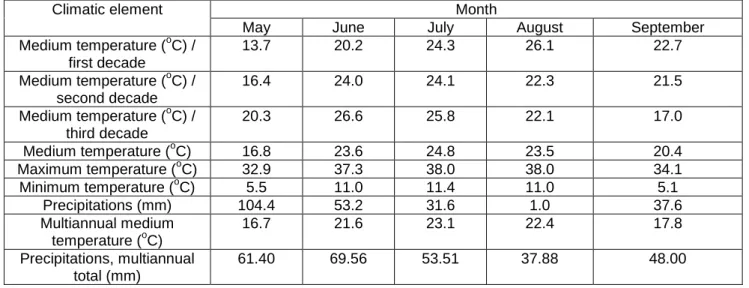
The climatic conditions between May and September 2016 are shown in Table 2.
Table 2
Climatic conditions between May and September 2016, recorded at the RDSPCS Dabuleni weather station
Climatic element Month
May June July August September Medium temperature (oC) /
first decade
13.7 20.2 24.3 26.1 22.7
Medium temperature (oC) / second decade
16.4 24.0 24.1 22.3 21.5
Medium temperature (oC) / third decade
20.3 26.6 25.8 22.1 17.0
Medium temperature (oC) 16.8 23.6 24.8 23.5 20.4 Maximum temperature (oC) 32.9 37.3 38.0 38.0 34.1 Minimum temperature (oC) 5.5 11.0 11.4 11.0 5.1
Precipitations (mm) 104.4 53.2 31.6 1.0 37.6 Multiannual medium
temperature (oC)
16.7 21.6 23.1 22.4 17.8
Precipitations, multiannual total (mm)
61.40 69.56 53.51 37.88 48.00
The irrigation regime used is shown in Table 3.
Table 3
Date of watering applied to the sweet pepper experience (Dăbuleni 2016)
Irrigation regim Month
May June July August September
a1
23.05 24.06 08.07
20.07
03.08 15.08 29.08
12.09 23.09
a2
23.05 30.05
10.06 17.06 24.06
01.07 08.07 11.07 19.07 22.07 26.07 29.07
03.08 06.08 10.08 12.08.
15.08 19.08 23.08 29.03
02.09 06.09 09.09 12.09 16.09 23.09 27.09
115
RESEARCH RESULTS
Analyzing the climatic data in Table 2, it follows that the rainwater regime was raised in May, 104.4 mm, declining in June, July and August. August was a very droughty month, when the precipitations were only 1.0 mm, increasing in September to 37.6 mm. As a result, the number of waterings was higher in July, August and September: for a1 level two waterings were applied in
July and September and 3 waterings in August, with a norm of 200 m3 water / ha / 1 watering, and for a2 level the number
of waterings was much higher, 7 in July and September and 8 in August, the most droughty month.
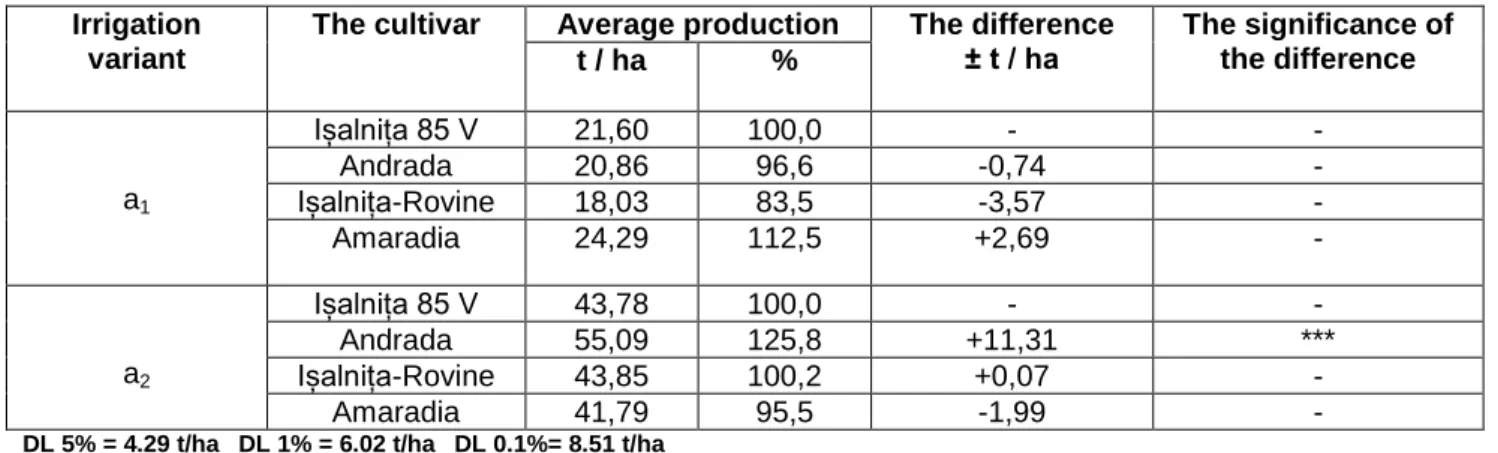
The irrigation regime influenced the growth and development of sweet pepper cultivars subject of the study. The lack of water during the vegetation period influenced the level of total average productions. Following the data in Table 4, there is no big differences between varieties within the same irrigation level. In the case of the first irrigation variant, a1, all cultivars achieved a total low
production of 18.03 t / ha at Isalnita - Rovine and 24.29 t / ha at Amaradia, the differences from the Isalnita 85V cultivar being small, without statistical assurance.
Table 4
Total production of the sweet pepper according to the irrigation variant and cultivar
Irrigation variant
The cultivar Average production The difference ± t / ha
The significance of the difference t / ha %
a1
Ișalnița 85 V 21,60 100,0 - -
Andrada 20,86 96,6 -0,74 -
Ișalnița-Rovine 18,03 83,5 -3,57 -
Amaradia 24,29 112,5 +2,69 -
a2
Ișalnița 85 V 43,78 100,0 - -
Andrada 55,09 125,8 +11,31 ***
Ișalnița-Rovine 43,85 100,2 +0,07 -
Amaradia 41,79 95,5 -1,99 -
DL 5% = 4.29 t/ha DL 1% = 6.02 t/ha DL 0.1%= 8.51 t/ha
In the second irrigation variant, a2,
the total production is high, 41.79 t / ha for the Amaradia cultivar and 55.09 t / ha for Andrada, with a production difference compared to the control variant of 11,31 t / ha, statistically ensured difference, being very significant, positive.
Depending on the cultivar and the irrigation variant (Table 5), comparing the cultivars of the two variants of irrigation, the production differences are
highlighted. It can be noticed that in the case of normal irrigation (a2) the total
recorded productions are almost double compared to the reduced irrigation variant (a1), values ranging from +17.50 t / ha for
116
Table 5
Total production of the sweet pepper according to the cultiuvar and the irrigation variant
The cultivar Irrigation variant
Average production The difference
± t / ha The significance of the difference t / ha %
Işalniţa 85 V a1 21,60 100,0 - -
a2 43,78 202,7 +22,18 ***
Andrada a1 20,86 100,0 - -
a2 55,09 264,1 +34,23 ***
Işalniţa-Rovine a1 18,03 100,0 - -
a2 43,85 243,2 25,82 ***
Amaradia a1 24,29 100,0 - -
a2 41,79 172,0 17,50 ***
DL 5% = 4.29 t/ha DL 1% = 6.02 t/ha DL 0.1%= 8.51 t/ha
Table 6
Total sweet pepper production according to the interaction of the irrigation regim and cultivar (axb)
Comparison Total production (t/ha) The difference
± t / ha The significance of the difference
a2b1-a1b1 43.78 - 21.60 23.18 **
a2b2- a1b1 55.09 - 21.60 33.49 *** a2b3- a1b1 43.85 - 21.60 22.25 ** a2b4- a1b1 41.79 - 21.60 20.19 **
a2b1-a1b2 43.78 - 0.86 22.92 **
a2b2- a1b2 55.09 - 20.86 34.23 *** a2b3- a1b2 43.85 - 20.86 22.99 ** a2b4- a1b2 41.79 - 20.86 20.93 **
a2b1-a1b3 43.78 - 18.03 28.75 **
a2b2- a1b3 55.09 - 18.03 37.06 *** a2b3- a1b3 43.85 - 18.03 25.82 ** a2b4- a1b3 41.79 - 18.03 23.76 **
a2b1-a1b4 43.78 - 24.29 19.49 **
a2b2- a1b4 55.09 - 24.29 30.80 ** a2b3- a1b4 43.85 - 24.29 19.56 **
a2b4- a1b4 41.79 - 24.29 17.5 **
DL 5%=5.77 t/ha DL 1%=7.53 t/ha DL 0.1%=33,14 t/ha
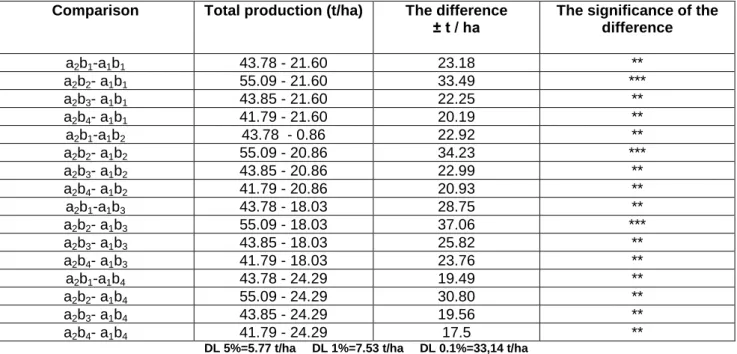
The data presented in Table 6 highlight the interaction of the two factors, irrigation regime (A) and cultivars (B). It can be noticed that all differences in total productions of each cultivar from the irrigation variant a2 versus each cultivar in
the irrigation variant a1 are positive,
statistically assured. In all comparisons, the Andrada cultivar differs from other cultivars, recording values of +30.80 t / ha to +37.06 t / ha.
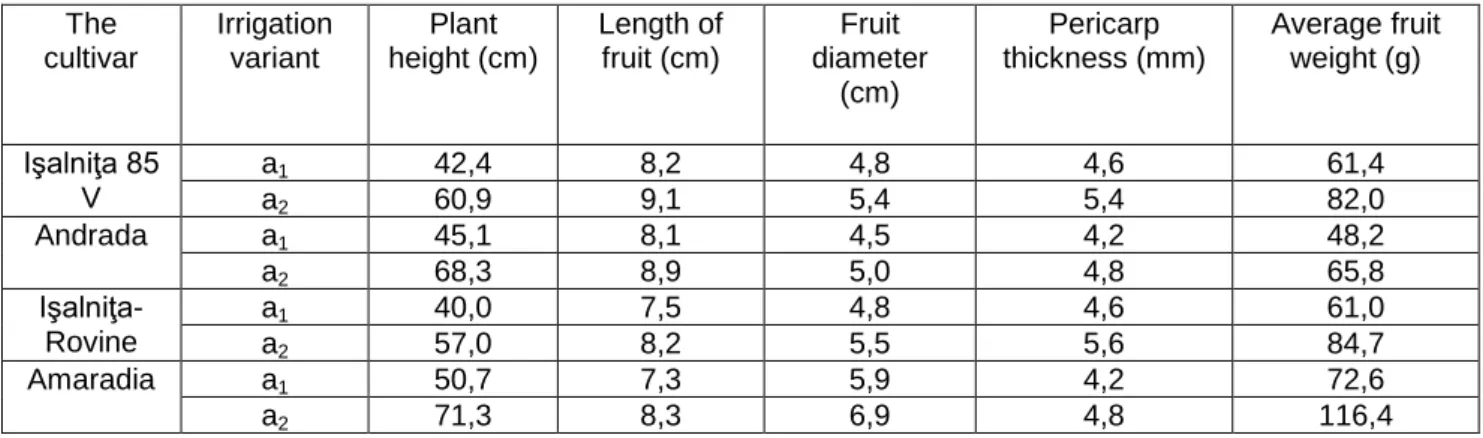
The irrigation regime influences the growth and development of pepper plants (Table 7).
117
Table 7
The influence of the irrigation regime on the growth and development of plants and fruits at the sweet pepper
The cultivar
Irrigation variant
Plant height (cm)
Length of fruit (cm)
Fruit diameter
(cm)
Pericarp thickness (mm)
Average fruit weight (g)
Işalniţa 85 V
a1 42,4 8,2 4,8 4,6 61,4
a2 60,9 9,1 5,4 5,4 82,0
Andrada a1 45,1 8,1 4,5 4,2 48,2
a2 68,3 8,9 5,0 4,8 65,8
Işalniţa-Rovine
a1 40,0 7,5 4,8 4,6 61,0
a2 57,0 8,2 5,5 5,6 84,7
Amaradia a1 50,7 7,3 5,9 4,2 72,6
a2 71,3 8,3 6,9 4,8 116,4
It can be noticed that in the case of the reduced irrigation variant, a1, the
plants are less developed, the average height of the plants being lower than at the plants with the normal irrigation variant, differences of approximately 20 cm for each cultivar. The size and weight
of the fruits also underwent alterations; in the case of reduced irrigation the fruits were smaller and with a lower average weight. The thickness of the pepper fruit pericarp, a quality element, has higher average values at the variant with normal irrigation regime.
CONCLUSIONS
1. The irrigation regime influences the level of total production at the sweet pepper cultivars studied at RDSPCS Dabuleni, the production being double in the case of the variant with normal irrigation compared to the variant with reduced irrigation.
2. In the case of the reduced irrigation variant, all cultivars suffered, the recorded productions being small and of poor quality. The Amaradia cultivar recorded the highest yield of 24.29 t / ha, showing resistance to the water stress.
3. Cultivars Isnalita 85V, Andrada and Amaradia under reduced irrigation conditions have achieved a total production of over 20.0 t / ha, showing an adaptation to the conditions of water stress.
4. On a normal irrigation, all cultivars recorded high yields of over 40.0 t / ha, the Andrada cultivar recording 55.09 t / ha, with a difference from the control variant statistically insured.
BIBLIOGRAPHY
1. Ceapoiu N .,1968 – Metode statistice aplicate în experienţele agricole
şi biologice. Editura Agro-Silvică,
Bucureşti.
2. Cristea M.,1988 – Evaluarea si utilizarea resurselor genetice vegetale.
Editura Academiei RSR, București 1988. 3. Csillery G., 1984 – Genetic resourses on the Capsicum genus.
International meeting – Paprika breeding
on production in Hungary: 60-70.
4. Ifrim Aurelia, 2003 – Cercetări
privind comportarea unor specii și cultivare de plante legumicole pe solurile nisipoase de la Dăbuleni. Lucrări științifice ale Stațiunii de Cercetare – Dezvoltare pentru Cultura Plantelor pe
Nisipuri. SITECH 2003, XV: 165-172.
5. Pintilie I., 1996 – Linii noi de ardei gras create la SCPL Işalniţa.
118
6. Pintilie I., 2005 – Pepper's breeding at SCDL Işalniţa – Dolj.
Bulentinul USAMV Cluj – Napoca, 62:
138-139.
7. Pochard E., Palloix A., Daubeze A.M., 1992 – Le piment. Amélioration des especes végétales cultivées. INRA Paris.
8. Săulescu N. A., Săulescu N.
N., 1967 – Câmpul de experienţă. Editura Agro-Silvică, Bucureşti.
9. Toma Vasile, Ciuciuc Elena, Croitoru Mihaela, Ploae Marieta, Pintilie Ioan, Novac Mihaela Gabriela, 2014 – Tehnologia de cultivare a ardeiului gras în tunele joase pe solurile nisipoase. Tehnologia de cultivare a plantelor
legumicole pe solurile nisipoase. SITECH