MJCCA9 – 747 ISSN 1857-5552 e-ISSN 1857-5625
Received: August 29, 2017 DOI: 10.20450/mjcce.2018.1287
Accepted: March 28, 2018 Original scientific paper
APPLICATION OF
LACTOBACILLUS CASEI
01
AND OLIGOFRUCTOSE-ENRICHED INULIN IN AYRAN
Tanja Petreska Ivanovska1*, Zoran Zhivikj1, Liljana Bogdanovska2, Kristina Mladenovska3, Lidija Petrushevska-Tozi1
1
Institute of Applied Biochemistry, Faculty of Pharmacy, Ss. Cyril and Methodius University, Mother Theresa 47, 1000 Skopje, Republic of Macedonia
2
Institute of Applied Chemistry and Pharmaceutical Analyses, Faculty of Pharmacy, Ss. Cyril and Methodius University, Mother Theresa 47, 1000 Skopje, Republic of Macedonia
3
Institute of Pharmaceutical Technology, Faculty of Pharmacy,
Ss. Cyril and Methodius University, Mother Theresa 47, 1000 Skopje, Republic of Macedonia [email protected]
This study aimed to develop a probiotic/synbiotic ayran with a sufficient number of live bacteria Lactobacillus casei 01 (L. casei 01) during the product shelf-life. Under conditions of refrigerated storage for 15 days, probiotic survival and organic acid (lactic, acetic, propionic and butyric acid) production were evaluated. Simultaneously, pH, titratable acidity, total solids, and carbohydrate, protein, fat and mineral contents of the samples were examined. Overall results of the chemical analyses indicated the quality of the prepared samples to be comparable with the conventional ayran used as a matrix for probi-otic/synbiotic supplementation. L. casei 01 survived better in ayran containing synbiotic chitosan–Ca– alginate microparticles compared to samples enriched with non-encapsulated probiotic alone or with synbiotic (L. casei 01 + oligofructose-enriched inulin), followed by increased production of lactic, acetic and propionic acid. Probiotic/synbiotic ayran may contribute to a healthy diet for consumers, while the sample enriched with microencapsulated formulation is advantageous in terms of probiotic activity.
Keywords: probiotic ayran; synbiotic ayran; synbiotic microparticles; Lactobacillus casei 01; oligofructose-enriched inulin
ПОДГОТОВКА НА ФУНКЦИОНАЛЕН АЈРАН СО LACTOBACILLUS CASEI 01 И ИНУЛИН ЗБОГАТЕН СО ОЛИГОФРУКТОЗА
Цел на ова истражување беше подготовка на пробиотски/синбиотски ајран кој во периодот на употреба на производот ќе содржи терапевтско ниво на витални клетки на пробиотикот Lactobacillus casei 01 (L. casei 01). Во текот на 15 дена чување на примероците во фрижидер беа анализирани виталноста на пробиотикот и продукцијата на органски киселини со кратки низи (млечна, оцетна, пропионска и бутерна киселина). Паралелно со овие анализи во примероците беа определени следниве параметри: pH, титрациски ацидитет, суви материи, како и содржината на протеини, масти, јаглехидрати и минерали. Севкупната хемиска анализа покажа дека квалитетот на подготвените примероци соодветствува со квалитетот на конвенционалниот ајран применет како матрикс за пробиотско односно синбиотско збогатување. Ајранот подготвен со синбиотските цитозан-Ca-алгинатни микрочестички се карактеризира со најдобри функционални својства, поголема виталност на пробиотикот и продукција на органски киселини во споредба со примероците збогатени со неинкапсулиран пробиотик или синбиотик (L. casei 01 + инулин збогатен со олигофруктоза) и затоа може да биде дел од здравата исхрана на потрошувачите.
1. INTRODUCTION
Fermented dairy products, probiotics and prebiotics have gained increased interest recently. They act as supports to host physiology by regulat-ing the gut microbiota composition and stability. Implementation of nutritional concepts for modu-lating gut microbiota dysbiosis by administration of probiotic enriched food may contribute to health improvement as well as to reductions in allergic disease symptoms, metabolic syndrome related diseases and gastro-enterological diseases [1]. Consumption of probiotic milks provides health benefits well beyond the starting products [2]. In this respect, good ACE-inhibitory activity and an-tioxidant properties in vitro were reported for the strain Lactobacillus casei 01 combined with inulin in sheep milk ice cream [3]. Administration of ayran containing 8.5–8.9 log CFU g–1 L. casei 01 and 1.5% oligofructose-enriched inulin was found to alleviate colonic inflammation and to increase
fecal lactobacilli counts in the
trinitrobenzenesulfonic (TNBS) acid model of rat colitis[4]. In a randomized, double-blind, placebo-controlled study, L. casei 01, provided to women with rheumatoid arthritis at a dosage of 108 CFU per capsule daily for a period of 8 weeks, signifi-cantly decreased the disease activity score and im-proved the inflammatory status of patients by regu-lating the proportion between pro- and anti-inflammatory cytokines [5]. In general, probiotic products should contain at least 106–107 live mi-croorganisms per g or ml at the expiry date to exert their therapeutic effects [6]. Hence, the most im-portant aspect of a probiotic is to remain viable during processing and storage of the food product, and after administration to survive and multiply in the host and to provide its health benefits. Devel-opment of probiotic dairy products implies differ-ent technological operations, such as adding of antioxidants or glucose oxidase to minimize the exposure of the cells to oxygen and to increase their stability [7]. Viability loss, which is caused by light, pressure and high temperatures and the presence of oxygen, moisture and salts, may be significantly reduced by immobilization or micro-encapsulation of the probiotic bacteria in a poly-mer matrix [8]. Microencapsulation is an advanta-geous approach used to improve probiotic viabil-ity, allowing diffusion of molecules essential for cell metabolism, such as nutrients, oxygen and growth factors into the matrix [8], thereby support-ing the viability of the cells and the outward diffu-sion of waste products. In addition, microencapsu-lation could also enable controlled and targeted
release, by depositing the entrapped cells across the small and large intestine [9]. Among common-ly used microencapsulation techniques, such as extrusion, emulsion and spray-drying, the last technique is often applied due to its low cost, the ability to process large volumes of solutions on a continuous basis, and the manufacture of smaller particles with more homogenous size distribution [10], suitable to be used in the food industry.
Ayran is traditional Turkish non-alcoholic fermented dairy drink. It can be prepared at home by addition of water to yogurt, or industrially pro-duced with addition of Streptococcus thermophilus and L. delbrueckii subsp. bulgaricus to standard-ized milk for fermentation [11]. According to the Turkish Food Codex [11], ayran is a fresh product with a limited shelf-life (10–15 days) that contains at least 2.8 g protein, 6 g fat-free solids per 100 ml, and fat no lower than 1.8, 0.8 and 0.15 g for full fat, semi-skimmed and skimmed product, respec-tively. Ayran as a fermented product is easily di-gestible and it is considered valuable due to the high content of vitamins and calcium [12]. En-richment of ayran with health-promoting com-pounds such as probiotics and/or prebiotics may further increase the functional value of the product. In addition, probiotic ayran can easily be accepted by the consumers due to the inherent connection of lactic acid bacteria to dairy products. Prebiotics are compounds reported to have positive effects on the viability of probiotics applied in food products and on the physicochemical attributes of the products [3, 13]. ‘Synbiotic’ refers to a synergism between probiotics and prebiotics. Adding of hydrocolloid prebiotics such as inulin [14] may improve the consistency by reducing the syneresis (serum sepa-ration) which is a common occurrence during stor-age of ayran [15]. In general, a functional food product design considers several aspects, such as functional properties of the product, sensory ap-peal, shelf-life, physicochemical stability, health claim approval and safety evaluation [16]. Consid-ering these, development of a probiotic- or synbiotic enriched food with favorable physico-chemical and sensory attributes is a challenge from the scientific and industrial standpoint.
chi-tosan–Ca–alginate microparticles were prepared. Synbiotic chitosan–Ca–alginate microparticles used in this study were developed and optimized in our previous work [17].
2. EXPERIMENTAL
2.1. Material
Freeze-dried probiotic culture of Lactobacil-lus paracasei subsp. paracasei (Lactobacillus casei 01) was provided from Chr. Hansen, Hoersholm, Denmark. Commercially available ayran (Zdravje Radovo, Macedonia) was used for probiotic/synbiotic sample preparation. Synergy 1, a mixture of oligofructose (DP 2–8) and long-chain inulin fraction (DP 10–60) (Orafti-Rue L. Maréchal, Tienen, Belgium) was applied as prebi-otic. Sodium alginate (Protanal LF 10/60 LS, fG 35–45%) (IMCD, FMC BioPolymer, Ayrshire, UK) and chitosan with deacetylation degree 5 and low iscosity 3 ( iscosity of 10 mg g–1 solu-tion in acetic acid 20–100 mPa s, Mw 150 kDa) (France Chitine, Marseille, France) were used as encapsulating agents. The cross-linking agent CaCl2, MRS broth, MRS agar and peptone water were supplied by Merck, KGaA, Darmstadt, Ger-many. All reagents were of analytical grade.
2.2. Preparation of synbiotic chitosan–Ca–alginate microparticles
Synbiotic chitosan–Ca–alginate microparti-cles were prepared according to the method de-scribed by Petreska Ivanovska et al. [17]; namely, an overnight-inoculated probiotic in MRS broth at 37 °C to a cell load ca. 12 log CFU ml–1 was added to a mixture containing alginate ( 0 mg g–1) and prebiotic (15 mg g–1). Then, on the same day, the synbiotic alginate suspension was spray-dried (Büchi Mini Spray Dryer B-290, Switzerland) at inlet temperature 1 0 °C, outlet temperature 5 ± 3 °C, flow rate 6 ml min–1, nozzle diameter 0.7 mm, aspirator pressure 90% and atomizer pressure 600 Nl h–1. Dried powder samples were slowly added to a 50 mg g–1 CaCl2 and 5 mg g–1 chitosan dis-solved in 1% v/v acetic acid, under continuous stir-ring. The microparticles were allowed to stir on a magnetic stirrer for at least 3 h at 5 °C. Then, the particles were separated by centrifugation at 1500 × g for 10 min, rinsed with sterile saline solution and then freeze-dried at 0.070 mbar and –50 °C for 24 h (FreeZone Freeze Dry System, Labconco, Kansas City, USA). Experimental design using a polynomial regression model at the 2nd level was
applied to optimize the microparticulate formula-tion considering physicochemical (particle size, zeta-potential, Ca-content) and functional proper-ties (viability of the probiotic during microencap-sulation and in simulated gastrointestinal condi-tions). The entrapment efficiency of the micro-particles of optimal formulation was 89.5 ± 1.2%. Cationic microparticles were prepared (zeta-poten-tial, +19.04 ± 0.3 mV), with a spherical, but also flattened disk shape, narrow size distribution (d50 8.6 ± 0.3 μm) and 11.3 ± 0.13 log CFU g–1 viable cells of L. casei 01 after freeze-drying [17].
2.3. Preparation of probiotic/synbiotic ayran samples
Commercial ayran was used to prepare three samples enriched with: (i) the probiotic L. casei 01 alone, (ii) L. casei 01 in combination with Synergy 1 and (iii) synbiotic (L. casei 01 + Synergy 1) loaded chitosan–Ca–alginate microparticles. All the samples were placed into sterile Erlenmeyer flasks and inoculated with an equivalent cell count of the probiotic strain (approximately 9.5 log CFU ml–1) and prebiotic (15 mg g–1) in non-encapsulated or non-encapsulated form. Ayran samples enriched with probiotic and synbiotic and a sample of the commercial ayran used as a control sample were stored in a refrigerator at °C for 15 days. Qualitative and quantitative analyses of prepared ayran samples were performed at predetermined time intervals during the shelf-life of the commer-cial ayran.
2.4. Chemical analyses
The pH measurements (PB-11 Sartorius, Goettingen, Germany) of ayran samples were done simultaneously with the viability assays at day 1, 3, 5, 7, 10 and 15 during the shelf-life of the product ayran.
Titratable acidity was determined by acid-base titration using 0.1 mol l–1 NaOH with phenol-phthalein (ACS Reagent, Merck, KGaA, Darm-stadt, Germany) as indicator [18]. To calculate the acidity of the samples, Eq. (1) was used:
, (1)
where V is the volume of NaOH used for neutrali-zation of the acidity.
sam-ple and lid, was heated at 103 ± °C, cooled in a desiccator and weighed until the difference be-tween the two successive weightings did not ex-ceed 1 mg. The results were expressed as grams of total solids per 100 g of sample.
Fats were quantified using graduated glass butyrometers for direct measurement of fat in dairy products according to the Gerber method [19]. Sul-furic acid (RD 1.820–1.825) was used to separate fat from proteins in the butyrometer. In order to facilitate the separation of fat on the surface of the samples, amyl alcohol (Alkaloid, Skopje, Macedo-nia) was used.
Protein concentration was measured based on the method described by Bradford [20], using the Coomassie protein assay reagent and bovine serum albumin as a standard. Prior to protein quan-tification, the pH of ayran samples was adjusted to 3.8 using 50% solution of lactic acid (Sigma-Aldrich, St. Louis, USA). Then, the samples were centrifuged (7200 rpm; 10 min) and the pH of the collected supernatants was readjusted to 7.0. Af-terwards, the samples were recentrifuged at 7200 rpm for 10 min [21], and the protein concen-tration in the obtained supernatants was measured at 595 nm (Perkin Elmer UV/VIS Spectrometer, Lambda 16, Arizona, USA).
Quantitative analysis of total carbohydrates was carried out using the phenol sulfuric acid method. In hot acidic medium, glucose is dehy-drated to hydroxymethyl furfural which reacts with phenol to produce a yellow-brown colored product. The samples were first hydrolyzed with 2.5 mol l–1 HCl, in a boiling water bath for 3 h. Cooled sam-ples were neutralized with solid sodium carbonate and centrifuged [22]. Afterwards, to a set of solu-tions with known glucose concentrasolu-tions of 0.2, 0.4, 0.6, 0.8, and 1 mg per 1 ml, as well as the sample solutions adjusted to a total volume of 0.2 ml with distilled water, 0.2 ml of phenol and 1 ml of 96% sulfuric acid were added. The solutions were mixed for 10 min, placed in a water bath at 25–30 °C for 0 min and the absorbance measured at 490 nm (Perkin Elmer UV/VIS Spectrometer, Lambda 16, Arizona, USA).
Atomic absorption spectrometry was used to quantify Na, K and Ca in the ayran samples. Prior to analysis, samples were digested with concen-trated nitric acid (25 mg ml–1) in a water bath heat-ed at 60–70 °C.
2.5. Microbiological analysis
Viability of L. casei 01 was determined us-ing a plate-count method after mixus-ing of 1 ml of
the sample with 9 ml of peptone water and then serially diluted. MRS agar supplemented with ancomycin (1 μg ml–1) (Sigma-Aldrich, St. Louis, USA) was used for enumeration of L. casei 01 af-ter 3 days of anaerobic incubation at 37 °C. Vancomycin-sensitive L. bulgaricus and S. thermophilus used as starters in ayran fermentation were grown on MRS agar acidified to 5.4 [23]. For samples containing synbiotic microparticles, bacte-rial enumeration was performed, conducting the same procedure after releasing the entrapped cells from the microparticles [24]; namely, 1 g of the microparticles was re-suspended in 9 ml of phos-phate buffer (0.1 mol l–1, pH 7) and homogenized on a magnetic stirrer for 10 min. Enumeration of viable cells was performed in triplicate and the average of the results expressed as CFU per ml of sample. The obtained results calculated in CFU ml– 1
were converted to log CFU ml–1.
2.6. Determination of organic acid concentration
The concentration of lactic acid and short chain fatty acids (SCFAs) in ayran samples was determined using an HPLC system (Agilent Tech-nologies 1200, Palo Alto, USA) and ultraviolet detection at 210 nm. The methods described by Wang et al.[25] and Zhao et al.[26] were used to quantify lactic and acetic acid, and propionic and butyric acid, respectively. For acid extraction, 2 ml of 0.5 mol l–1 H2SO4 were added to a 2 ml aliquot of the sample, thoroughly mixed for 30 s and cen-trifuged (12 000 rpm; 15 min). Supernatants were filtered through 0. 5 μm membrane (Minisart RC 25, Sartorius Stedim Biotech, GmbH, Goettingen, Germany). To analyze lactic and acetic acid, sam-ples were loaded onto a thermostatically controlled reverse phase column (250 mm × .6 mm, 5 μm, Discovery HS C 18, Supelco Park, Bellefonte, PA, USA) set at 40 °С and eluted with 0.005 mol l–1 H2SO4 at flow rate of 1 ml min–1. For analyses of propionic and butyric acid, a mixture of phosphate buffer solution (15 mmol l–1, pH 2.1)–methanol (85:15, v/v) was used at a rate of 1.5 ml min–1. Concentrations of lactic, acetic, propionic and bu-tyric acids in the samples were calculated using the standard curves plotted for each acid.
2.7. Statistical analysis
3. RESULTS AND DISCUSSION
3.1. Chemical properties of ayran samples
Respective changes of chemical parameters examined in ayran samples (pH, titratable acidity, total solids, and carbohydrate, protein, fat and min-eral contents) during the storage period corre-sponding to the shelf-life of the conventional prod-uct are given in Table 1.
The significant increase in acidification during refrigerated storage of yogurts, known as post-acidification, is likely to reduce the probiotic viability. However, the reduction in pH values was insignificant in all samples during 15 days of cold storage, as well as the difference in pH changes among the samples (p > 0.05), showing no excess of acidity when probiotic was added. In the same way, the titratable acidity was in an increasing trend, as expected, for these two parameters are inversely related to each other [13].
T a b l e 1
Chemical properties of ayran samples
Samples
Parameters Days Control
ayran
L. casei-enriched ayran
L. casei+Synergy 1-enriched ayran
Encapsulated L. casei+Synergy 1-enriched ayran
pH 1 .6±0.0 .5±0.0 .5±0.0 .6±0.03
15 .5±0.0 . ±0.03 . ±0.0 .5±0.03
TA (% l.a.) 1 0.6±0.03 0.7±0.05 0.7±0.0 0.7±0.03
15 0.7±0.0 0. ±0.05 0. ±0.05 0.7±0.0
TS (%) 1 .0±0.1 7.9±0.36 9. ±0.55 9. ±0.50
15 . ±0.15 . ±0. 0 10. ±0.50 10. ±0.60
Fats (%) 1 1.0±0.00 1.0±0.00 1.0±0.00 1.0±0.00
15 1.0±0.00 1.0±0.00 1.0±0.00 1.0±0.00
Proteins (%) 1 . ±0.10 . ±0.07 .9±0.03 . ±0.0
15 3.0±0.10 .9±0.06 .9±0.03 .9±0.07
Carbohydrates (%) 1 .9±0.01 .6±0.03 3.3±0.0 3.1±0.10
15 3.0±0.01 .7±0.05 3.5±0.0 3.3±0.1
Na (g 100 ml–1) 1 0. ±0.0 0. ±0.05 0. ±0.0 0. ±0.0
15 0. ±0.0 0. ±0.0 0. ±0.0 0. ±0.05
K (mg 100 ml–1) 1 9.9±1.0 13. ±1. 5 10. ±1.10 11.5±1. 0
15 9.0±0. 3 .7±0.6 7. ±0.63 9. ±0. 0
Ca (mg 100 ml–1) 1 10.0±0.63 9.3±0. 3 9.1±0. 0 .0±1.
15 .5±0.75 7.5±0.63 .0±0.75 7.0±0.00
Values are represented as mean ± standard de iation (n = 3). The data were subjected to two-way ANOVA and the signifi-cance of the difference between means was determined using GraphPad Software Prism post-test. Significant differences (p < 0.05) between the samples and after 15 days of cold storage were not detected. TA: titratable acidity; TS: total solids; l.a.: lactic acid.
In addition, titratable acidity in all examined samples was within the range of 0.64–0.77% of lactic acid, which is in accordance with the regula-tion given in the Turkish Food Codex [11] for titratable acidity of the product ayran.
Insignificant difference in total solids was found among ayran samples, but higher values were obtained for prebiotic-supplemented samples compared to control and/or samples containing probiotic only. Increase in total solids due to added inulin or oligofructose improved viscosity and firmness of fermented milks [14, 27]. Syneresis in ayran often increases to 30% [12]; hence, oligofructose-enriched inulin could have had an
effect in the reduction of syneresis. These experi-ments were left for further research.
Certain Lactobacillus casei strains have been demonstrated to be able to remove the choles-terol from the media and to incorporate it into the cellular membrane [28], which may cause changes in fat content. The amount of fats in all ayran sam-ples was 1%, both before and after storage (Table 1). These values are in agreement with the fat con-tent declared for the conventional product, satisfy-ing the criterion given in the Turkish Food Codex [11] of no less than 0.8 g fat per 100 ml for half-fat ayran.
Commercial ayran contains 3.0% carbohy-drate. Lower carbohydrate content in the sample containing non-encapsulated L. casei 01 (2.6– 2.7%) compared to the control sample (3.0%) could be due to the ability of probiotic cells to use the carbohydrates as nutrients for their survival. Carbohydrate content higher than 3.0% was found in ayran samples containing non-encapsulated (3.3 to 3.5%) and encapsulated (3.1 to 3.3%) synbiotic, as a result of the carbohydrate structure of the prebiotic. Slower release of the encapsulated prebi-otic into the medium is probably the reason for the lower carbohydrate content found in the sample containing encapsulated synbiotic compared to that containing non-encapsulated synbiotic.
The lyophilized powder of L. casei 01 was found to contain sodium, potassium and calcium in our preliminary investigations of the probiotic cells. The sodium measurements evaluated both the possible effect of metabolic activities of L. casei 01 on the product, and the influence of added microparticles that were previously prepared using sodium alginate, chitosan and calcium chloride on
the sodium level in ayran. Additionally, the meas-urements for calcium were conducted to investi-gate the influence of chitosan–Ca–alginate microparticles on the calcium content of the prod-uct itself. In the case of liberation of sodium ions into the medium, increased sodium may stimulate the separation of the serum in ayran and reduce the system stability. An increased amount of sodium was reported to be a stimulator of syneresis [15]. However, sodium content in all samples measured during storage complied with the declared salt con-tent in the conventional product of 0.4%, indicat-ing good stability of the functional ayran samples. Results have shown a decreasing trend of potassi-um and calcipotassi-um concentrations that followed the reduction of these parameters observed in control ayran during storage (Table 1). The decreased amount of potassium and calcium during the stor-age period compared to control ayran is probably due to interactions between added compounds and the medium. The exception was the increased cal-cium content during storage of the sample contain-ing chitosan–Ca–alginate microparticles as a result of continuous calcium release from the microparticulate system.
3.2. Survival of L. casei 01 in ayran
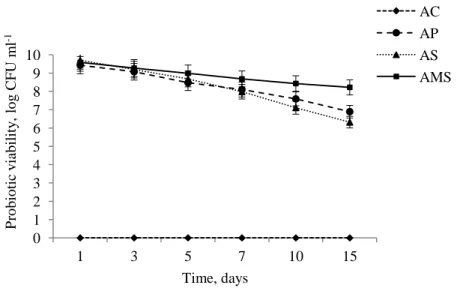
In order to evaluate the ability of free and encapsulated L. casei 01 to survive in ayran during the shelf-life of the product, storage stability assays were performed at °C.Results are shown in Fig-ure 1.
Fig. 1. Probiotic iability in ayran samples during 15 days storage at °C.
AC – conventional ayran; AP – L. casei 01 enriched ayran; AS – L. casei 01 and Synergy 1 enriched ayran: AMS – ayran enriched with encapsulated L. casei 01 and Synergy 1.
0 1 2 3 4 5 6 7 8 9 10
1 3 5 7 10 15
P
ro
b
io
ti
c
v
iab
il
it
y
,
lo
g
C
F
U
m
l
-1
Time, days
AC
AP
AS
Encapsulated L. casei 01 showed higher via-bility compared to free probiotic cells during the storage period of ayran samples. At the end of the storage, the viability of non-encapsulated cells was reduced for 2.54 and 3.38 logs in ayran containing L. casei 01 alone and in ayran containing L. casei 01 and oligofructose-enriched inulin, respectively, while viability loss of encapsulated cells was 1.21 log cycles. The better survival rate of encapsulated L. casei 01 is probably enabled by double encapsu-lation due to the chitosan coating making the struc-ture of highly porous alginate particles denser. Im-proved stability of chitosan-coated alginate parti-cles provided better probiotic viability during in-corporation and storage in foods [30, 31].
An increase of one log cycle in the viability of L. acidophilus 547 encapsulated in chitosan-coated alginate microparticles by extrusion when compared to the free yogurt cells after 4 weeks of refrigerated storage has been reported [32]. Viabil-ity of L. plantarum BLO11 encapsulated in algi-nate particles coated with chitosan using an emul-sion method showed a decline of only 0.55 log af-ter 38 days of cold storage of yogurt [30]. Some recent studies [31, 33, 34] also revealed that mi-croencapsulation improved the viability of probi-otic cells added to yogurts when compared to the free cells, investigating different probiotic strains, microencapsulation techniques and encapsulating materials. Alginate beads coated with chitosan containing L. acidophilus, L. reuteri or their mix-ture promoted the lactobacilli stability and thus viability in yogurt [31].
In our study, a surprising result was that non-encapsulated L. casei 01 survived better upon storage of ayran samples when it was added alone compared to non-encapsulated L. casei 01 com-bined with oligofructose-enriched inulin. The be-havior of the probiotic may be influenced by the source of the prebiotic and/or food matrix. In addi-tion, the probiotic strain itself may be insufficient in enzymes that efficiently hydrolyze the prebiotic into low-molecular sugars serving as substrates for the cells. Subsequently, the prebiotic could not be used efficiently by the probiotic cells incorporated into the matrix, while at the same time it may in-crease the osmotic pressure in the medium and negatively affect the probiotic survival.
3.3. Production of organic acids in functional ayran samples
Lactic acid bacteria, such as the strains of L. delbrueckii subsp. bulgaricus and Streptoccocus thermophilus, which are often used in yogurt
man-ufacture, produce lactic acid from lactose when added to milk. These strains are not of human origin, could be destroyed in the gut and are not able to colonize the human intestine. Lactic acid bacteria known to possess probiotic properties can be incorporated into food products along with yo-gurt cultures in such a way as to increase the pro-duction of lactic acid. Hence, changes in produc-tion of lactic acid and SCFAs (acetic, propionic and butyric acid), which can be also produced into the medium due to the saccharolytic activity of probiotic cultures, were determined in probiotic and synbiotic ayran samples and compared to the control sample.
Lactic acid and SCFAs are positively corre-lated to certain nutritional and functional properties of the products. The typical but likable taste of fermented dairy products is a consequence of the presence of lactic acid, which is known to enhance the sensory and nutritional profile of the products. SCFAs, mainly acetate, propionate, butyrate and lactate as important intermediates in the formation of SCFAs have been found to alter gut integrity and to possess anti-inflammatory, antimicrobial and anticarcinogenic effects, thus playing signifi-cant roles in the maintenance of gut and immune homeostasis [35].
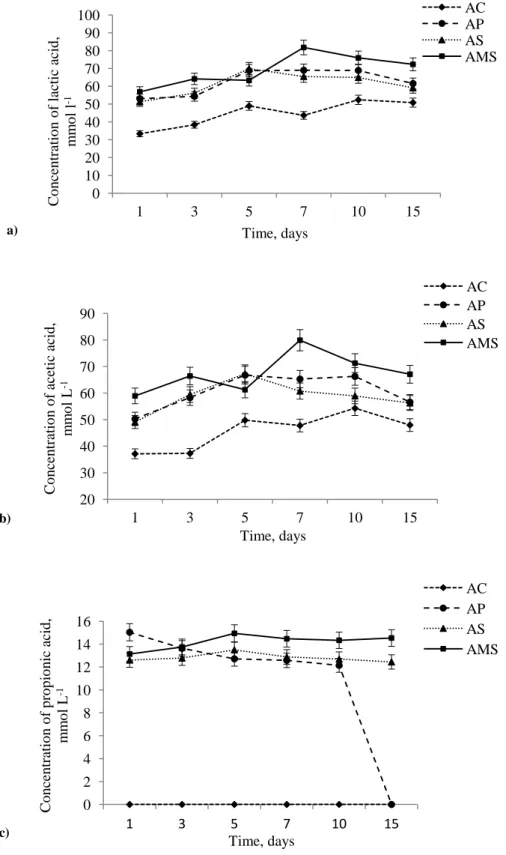
containing non-encapsulated synbiotic showed lower lactic and acetic acid production. This is consistent with the finding of lower cell viability in the sample containing non-encapsulated synbiotic. Our results are in contradiction to those reported
by Donkor et al. [36] who noticed that production of lactic and acetic acid was significantly higher when inulin was added to the yogurt samples con-taining L. acidophilus L10 or L. paracasei L26.
Fig. 2. Concentration of lactic acid (a), acetic acid (b) and propionic acid (c) in ayran samples during 15 days storage at °C. AC – conventional ayran; AP – L. casei 01 enriched ayran; AS – L. casei 01 and Synergy 1 enriched ayran:
AMS – ayran enriched with encapsulated L. casei 01 and Synergy 1.
0 10 20 30 40 50 60 70 80 90 100
1 3 5 7 10 15
C
o
n
ce
n
tr
atio
n
o
f
lactic
ac
id
,
m
m
o
l
l
-1
Time, days
AC AP AS AMS
20 30 40 50 60 70 80 90
1 3 5 7 10 15
C
o
n
ce
n
tr
atio
n
o
f
ac
etic
ac
id
,
m
m
o
l
L
-1
Time, days
AC AP AS AMS
0 2 4 6 8 10 12 14 16
1 3 5 7 10 15
C
o
n
ce
n
tr
atio
n
o
f
p
ro
p
io
n
ic
ac
id
,
m
m
o
l
L
-1
Time, days
AC AP AS AMS a)
b)
The prebiotic oligofructose-enriched inulin did not positively influence the in-situ production of lactic, acetic and propionic acids in our study. However, inulin is resistant to digestion in the up-per GIT and reaches the colon intact where it can be fermented by resident saccharolytic microbiota, followed by the production of SCFAs. Higher pro-duction of lactic and acetic acid in ayran with mi-croencapsulated synbiotic compared to samples containing non-encapsulated probiotic or synbiotic over all storage periods confirmed the protective role of encapsulation in the maintenance of viabil-ity and metabolic activviabil-ity of L. casei 01 in ayran. The relatively low propionic acid concentrations measured in functional ayran samples instead of its absence in control ayran are also inconsistent with the report by Donkor et al. [36], who found that mixed yogurt cultures produced more propionic acid in the absence of probiotics. The opposite ob-servation may due to the metabolic specificity of the probiotic strain, or to possible interactions be-tween the probiotic and yogurt cultures. Donkor et al. [36] determined low concentrations of butyric acid in probiotic/synbiotic yogurts containing L. acidophilus L10 or L. paracasei L26 and inulin or Hi-maize, while in probiotic/synbiotic ayran con-taining L. casei 01 and Synergy 1, no production of butyric acid was observed. However, the production of butyrate is possible after consumption, after the probiotic or synbiotic has reached the large bowel.
4. CONCLUSIONS
In this study, new probiotic/synbiotic dairy drinks containing therapeutic levels of viable and active cells of Lactobacillus casei 01 were devel-oped. Ayran samples enriched with synbiotic microparticles have the main advantage in terms of probiotic survival and increased production of lac-tic, acetic and propionic acid. This newly devel-oped product gained functional properties, while retaining the quality of conventional ayran and may be offered to consumers as a part of a healthy diet. Future perspectives include consumer ac-ceptance studies as an essential part of the design process of each food product, while the impact of such a product enriched with compounds beneficial for health on overall consumer perception should also be tested.
Acknowledgments.This research was financially
sup-ported by the Ministry of Education and Science of the Repub-lic of Macedonia (Project No. 13–3583/1). The authors would like to express gratitude to Orafti Beneo Group and to IMCD (UK) for the donation of Orafti® Synergy 1 (L. Maréchal, Tienen, Belgium), and sodium alginate (Protanal 10/60 LS, FMC BioPolymer, USA), respectively.
REFERENCES
[1] C. Ceapa, H. Wopereis, L. Rezaїki, M. Kleerebezem, J. Knol, R. Oozeer, Influence of fermented milk products, prebiotics and probiotics on microbiota composition and health, Best Pract. Res. Clin. Gastroenterol., 27(1), 139– 155 (2013). DOI: 10.1016/j.bpg.2013.04.004
[2] M. L. Marco, D. Heeney, S. Binda, C. J. Cifelli, P. D. Cotter, B. Foligné, M. Gänzle, R. kort, G. Pasin, A. Pihlanto, E. J. Smid, R. Hutkins, Health benefits of fer-mented foods: microbiota and beyond, Curr. Opin. Biotechnol., 44, 94–102 (2017).
DOI: 10.1016/j.copbio.2016.11.010
[3] C. F. Balthazar, H. L. A. Silva, E. A. Esmerino, R. S. Rocha, J. Moraes, M. A. V. Carmo, L. Azevedo, I. Camps, Y. K. D. Abud, C. Sant’Anna, R. M. Franco, M. Q. Freitas, M. C. Silva, R. S. L. Raices, G. B. Escher, D. Granato, C. S. Ranadheera, F. Nazarro, A. G. Cruz, The addition of inulin and Lactobacillus casei 01 in sheep milk ice cream, Food Chem., 246, 464–472 (2018). DOI: 10.1016/j.foodchem.2017.12002
[4] T. Petreska Ivanovska, K. Mladenovska, Z. Zhivikj, M. Jurhar Pavlova, I. Gjurovski, T. Ristoski, L. Petrushevska-Tozi, Synbiotic loaded chitosan-Ca-alginate microparticles reduces inflammation in the TNBS model of rat colitis, Int. J. Pharm., 527, 126–134 (2017). DOI: 10.1016/j.ijpharm2017.05.049
[5] E. Vaghef-Mehrabany, B. Alipour, A. Homayouni-Rad, S. K. Sharif, M. Asghari-Jafarabadi, S. Zavvari, Probi-otic supplementation improves inflammatory status in patients with rheumatoid arthritis, Nutrition, 30, 430– 435 (2014). DOI:10.1016/j.nut.2013.09.007
[6] S. Nualkaekul, D. Lenton, M. T. Cook, V. V. Khutoryanskiy, D. Charalampopoulos, Chitosan coated alginate beads for the survival of microencapsulated
Lactobacillus plantarum in pomegranate juice,
Carbohydr. Polym., 90(3), 1281–1287 (2012). DOI: https://doi.org/10.1016/j.carbpol.2012.06.073 [7] A. L. D. Batista, R. Silva, L. P. Cappato, C. N. Almada,
R. K. A. Garcia, M. C. Silva, R. S. L. Raices, D. B. Arellano, A. S. Sant’Anna, C. A. Conte Junior, Quality parameters of probiotic yogurt added to glucose oxidase compared to commercial products through microbiolog-ical, physico-chemical and metabolic activity analyses,
Food Res. Int., 77, 627–635 (2015). DOI: 10.1016/j.foodres.2015.08.017
[8] G. Mitropoulou, V. Nedovic, A. Goyal, Y. Kourkoutas, Immobilization technologies in probiotic food produc-tion, J. Nutr. Metab., 2013, 1–15 (2013).
DOI: http://dx.doi.org/10.1155/2013/716861
[9] M. T. Cook, G. Tzortzis, D. Charalampopoulos, V. V. Khutoryanskiy, Microencapsulation of probiotics for gastrointestinal delivery, J. Control. Release,162, 56–67 (2012). DOI: 10.1016/j.jconrel.2012.06.003.
[10] T. Petro ić, V. Nedo ić, S. Dimitrije ić-Branko ić, B. Bugarski, C. Lacroix, Protection of probiotic microor-ganisms by microencapsulation, Chem. Ind. Chem. Eng. Q., 13(3), 169–174 (2007).
DOI: 10.2298/CICEQ0703169P.
[12] F. Altay, F. Karbancioglu-Gϋler, C. Daskaya-Dikmen, D. Heperkan, A review on traditional Turkish fermented non-alcoholic beverages: microbiota, fermentation pro-cess and quality characteristics, Int. J. Food Microbiol., 167(1), 44–56(2013).
DOI: 10.1016/j.ijfoodmicro.2013.06.016.
[13] R. P. S. Oliveira, A. C. R. Florence, R. C. Silva, P. Perego, A. Converti, A. L. Gioeilli, M. N. Oliveira, Ef-fect of different prebiotics on the fermentation kinetics, probiotic survival and fatty acids profiles in non-fat synbiotic fermented milk, Int. J. Food Microbiol.,
128(3), 467–472 (2009). DOI:
10.1016/j.ijfoodmicro.2008.10.012.
[14] R. P. De Souza Oliveira, P. Perego, M. N. De Oliveira, A. Converti, Effect of inulin as prebiotic and synbiotic interactions between probiotics to improve fermented milk firmness, J. Food Eng., 107(1), 36–40(2011). DOI: 10.1016/j.jfoodeng.2011.06.005.
[15] A. Köksoy, M. Kiliç, Effects of water and salt le el on rheological properties of ayran, a Turkish yoghurt drink,
Int. Dairy J., 13,835–839 (2003).
DOI: dx.doi.org/10.1016/S0958-6946(03)00103-1. [16] D. Granato, G. F. Branco, A. G. Cruz, J. A. F. Faria, N.
P. Shah, Probiotic dairy products as functional foods,
Compr. Rev. Food Sci. Food Safety,9,455–470 (2010). DOI:10.1111/j.1541-4337.2010.00120.x.
[17] Т. Petreska Ivanovska, L. Petrushevska-Tozi, A. Grozdanov, R. Petkovska, J. Hadjieva, E. Popovski, T. Stafilov, K. Mladenovska, From optimization of synbiotic microparticles prepared by spray-drying to de-velopment of new functional carrot juice, Chem. Ind. Chem. Eng. Q., 20(4),549–564 (2014).
DOI: 10.2298/CICEQ130218036P.
[18] AOAC, Official Methods of Analysis Chemists, 15th ed. Association of Official Analytical Chemists – AOAC, Virginia, Arlington, USA (1990).
[19] D. H. Kleyn, J. M. Lynch, D. M. Barbano, M. J. Bloom, M. W. Mitchell, Determination of fat in raw and pro-cessed milks by the Gerber method: collaborative study,
J. AOAC Int., 84(5), 1499–1508 (2001).
[20] M. M. Bradford, A rapid and sensitive method for the quantitation of protein using the principle of protein-dye binding, Anal. Biochem., 72(1–2), 248–254 (1976). DOI: 10.1016/0003-2697(76)90527-3.
[21] D. Pan, Y. Guo, Optimization of sour milk fermentation for the production of ACE-inhibitory peptides and puri-fication of a novel peptide from the whey protein hydrolisate, Int. Dairy J., 20,472–479 (2010).
DOI: 10.1016/j.idairyj.2010.01.007.
[22] B. O. Al-Abdulkarim, M. S. Osman, M. A. I. El-Nadeef, Determination of chemical composition, and storage on dried fermented goat milk product (Oggtt), J. Saudi Soc. Agric. Sci., 12, 161–166 (2013).
DOI: https://doi.org/10.1016/j.jssas.2012.11.003. [23] A. Galat, J. Dufresne, J. Combrisson, A. Thépaut, L.
Boumghar-Bourtchai, M. Boyer, C. Fourmestraux, Nov-el method based on chromogenic media for discrimina-tion and selective enumeradiscrimina-tion of lactic acid bacteria in fermented milk products, Food Microbiol., 55, 86–94 (2016). DOI: https://doi.org/10.1016/j.fm.2015.11.005. [24] T. Y. Sheu, R. T. Marshall, H. Heymann, Improving
survival of culture bacteria in frozen desserts by
microentrapment, J. Dairy Sci. 76(7), 1902–1907 (1993). DOI: https://doi.org/10.3168/jds.S0022-0302(93)77523-2.
[25] Y. C. Wang, R. C. Yu, H. Y. Yang, C. C. Chou, Sugar and acid contents in soymilk fermented with lactic acid bacteria alone or simultaneously with bifidobacteria,
Food Microbiol. 20(3), 333–338 (2003). DOI: 10.1016/S0740-0020(02)00125-9.
[26] J. C. Zhao, Z. A. Guo, J. H. Chang, W. J. Wang, Study on reversed-phase high performance liquid chromatog-raphy separation condition and determination method of organic acids, Se Pu19(3), 260–263 (2001).
[27] F. P. De Castro, T. M. Cunha, P. J. Ogliari, R. F. Teófilo, M. M. C. Ferreira, E. S. Prudêncio, Influence of different content of cheese whey and oligofructose on the properties of fermented lactic beverages: Study using response surface methodology, LWT-Food Sci. Technol., 42, 993–997 (2009). DOI:10.1016/j.lwt.2008.12.010. [28] F. Miremadi, F. Sherkat, L. Stojanovska,
Hypocholaesterolemic effect and anti-hypertensive properties of probiotics and prebiotics: a review. J. Funct. Foods, 25, 497–510 (2016). DOI: 10.1016/j.jff.2016.06.016.
[29] C. Koçak, Y. K. A şar, B. Tamuçay, A comparative study on the production methods of ayran, Gıda31(4), 225–231(2006).
[30] G. Z. Brinques, M. A. Z. Ayub, Effect of microencapsu-lation on survival of Lactobacillus plantarum in simu-lated gastrointestinal conditions, refrigeration, and yo-gurt, J. Food Eng. 103(2), 123–128 (2011).
DOI: https://doi.org/10.1016/j.jfoodeng.2010.10.006. [31] A. García-Ceja, E. Mani-López, E. Palou, A.
López-Malo, Viability during refrigerated storage in selected food products and during simulated gastrointestinal con-ditions of individual and combined lactobacilli encapsu-lated in alginate or alginate-chitosan, LWT-Food Sci. Technol., 63(1), 482–489 (2015).
DOI: http://dx.doi.org/10.1016%2Fj.lwt.2015.03.071. [32] W. Krasaekoopt, B. Bhandari, H. C. Deeth, Survival of
probiotics encapsulated in chitosan-coated alginate beads in yoghurt from UHT- and conventionally treated milk during storage, LWT-Food Sci. Technol. 39, 177– 183 (2006). DOI: 10.1016/j.lwt.2004.12.006.
[33] P. Chaikham, Stability of probiotics encapsulated with Thai herbal extracts in fruit juices and yoghurt during re-frigerated storage, Food Biosci. 12, 61–66(2015). DOI: 10.1016/j.fbio.2015.07.006.
[34] M. C. E. Ribeiro, K. S. Chaves, C. Gebara, F. N. S. Infante, C. R. F. Grosso, M. L. Gigante, Effect of micro-encapsulation of Lactobacillus acidophilus LA-5 on physicochemical, sensory and microbiological character-istics of stirred probiotic yoghurt, Food Res. Int., 66, 424–431(2014). DOI: 10.1016/j.foodres.2014.10.019. [35] J. Tan, C. McKenzie, M. Potamitis, A. N. Thornburn, C.
R. Mackay, L. Macia, The role of short-chain fatty acids in health and disease, Adv. Immunol., 121, 91–119 (2014). DOI: 10.1016/B978-0-12-800100-4.00003-9. [36] O. Donkor, S. Nilmini, P. Stolic, T. Vasiljevic, N. P.