Article
Design, Simulation and Hardware Implementation of
Shunt Hybrid Compensator using Synchronous
Rotating Reference Frame Based Control Technique
R. Balasubramanian1, K. Parkavi kathirvelu1, R. Sankaran1 and Rengarajan Amirtharajan1,*1 SEEE, SASTRA Deemed University, Tirumalaisamudram, Thanjavur, India * Correspondence: [email protected]; Tel.: +91-4362-264101-Extn3737
Abstract: This paper deals with the design, simulation and implementation of shunt hybrid compensator to maintain the power quality in 3-phase distribution networks feeding different types balanced and unbalanced nonlinear loads. The configuration of the compensator consists of a selective harmonic elimination passive filter, a series connected conventional 6-pulse IGBT inverter, acting as the active filter terminated with a dc link capacitor. The theory and modelling of the compensator based on current harmonic components at the load end and their decomposition in d-q axis frame of reference are utilized in the reference current generation algorithm. Accordingly, the source current waveform is made to follow the reference current waveform using a high frequency carrier based controller. Further, this inner current control loop is supported by a slower outer voltage control loop for sustaining desirable dc link voltage. Performance of the compensator is evaluated through MATLAB simulation covering different types of loads and reduction of harmonic currents and THD at the supply side along with excellent regulation of dc link voltage are confirmed. The performance of a hybrid compensator designed and fabricated using the above principles is evaluated and corroborated with the simulation results.
Keywords: Harmonics; Hybrid power filter; Active power filter; Power quality; Total harmonic distortion.
1. Introduction
One major area of research that has gained attention in recent times is maintaining power quality of distribution systems. The power quality issues arise due to the widespread usage of processed power in industrial applications and commercial/domestic usage [1-3]. For example, variable speed drives are implemented through power modulators which consist of high power controlled/uncontrolled rectifiers feeding variable voltage and variable frequency multiphase inverters. Similarly, commercial power consumption is characterised by appliances like computers, photocopiers, fax machines along with fluorescent and CFL lamps. All the above represent nonlinear loads, resulting in lower supply side power factor and waveform distortion, indicated by harmonic components in voltage and current. The adverse effect of harmonics includes heating and extra losses, saturation and mal-functioning of distribution transformers, interference with communication signals, damages to consumer utilities and in extreme cases the failure of supply-side equipment [4].
The initial steps towards mitigation of the above problems were focused on the low power factor at the supply side only, whereby a passive power filter (PPF) connected in shunt compensates for the lagging reactive current, which was extended with selective harmonic elimination. The disadvantage of this approach is insensitivity with load current changes and fluctuations in supply side voltage. The filter performance also depends on the load power factor, which may be variable, depending on the loading conditions of the motor load [5]. As a means of overcoming these problems, various active compensator topologies comprising of series and shunt elements have been proposed which have gained wide acceptance. However, some of the disadvantages like high initial and operating cost and also the need for maintaining a high dc link voltage have limited the application of pure shunt active power filter in medium and high power installations [6-7]. As a result, the stage was set for
development of shunt hybrid power filters (HPF) which represent a judicious combination of both passive and active power filters (APF). The various hybrid compensator configurations are (i) Series active power filter and shunt passive power filter (ii) Shunt active power filter and shunt passive power filter (iii) A series combination of passive power filter and active power compensator connected in shunt with the system. The series element in configuration (i) has to be rated for maximum load current and is not flexible for many applications. The configuration (ii) with two independent compensators in parallel requires both blocks to be rated at the supply voltage leading to high dc link capacitor voltage rating [8-10].
In comparison, the third topology where the passive power filter elements appear in series with the standard active power filter circuitry poses important advantages in terms of reflecting nearly zero impedance of the passive power filter for load current harmonics and at the same time high impedance for system side voltage harmonics. Further, it leads to absorbing the fundamental voltage component across the passive power filter, thereby reducing the voltage rating of the dc link capacitor to only the harmonic components which are to be suppressed. Accordingly, the rating and cost of the capacitor and the power semiconductor switches in the compensator are considerably reduced [8]. Further, this topology is effective in preventing system resonance, reducing switching noise and avoidance of any circulating current in the compensator.
The control requirements for all configurations involving active power filter boils down to the generation of reference current waveform, switching and triggering timings for semiconductor switches to match the source current and also for maintaining the desired voltage across the dc link capacitor. Accordingly, a variety of control schemes supported by related algorithms have been reported in the literature [11-20]. Time domain methods provide fast response, compared with frequency domain methods. Accordingly, many authors have proposed control techniques such as instantaneous reactive power theory, synchronous rotating reference frame theory, sliding mode controller, neural network techniques and feedforward control to improve the performance of both active as well as hybrid filters.
In this paper the third topology has been utilised, where the passive power filter is designed with the aim of 5th and 7th selective harmonic elimination along with an active power compensator connected in series. The active component of the compensator is modelled in the stationary abc frame of mains and further transformed to the rotating dq frame to avoid time dependence of parameters to reduce the control complexity. A control technique using PI controller, based on decoupled currents is used to inject currents from the compensator to ensure tracking of the reference waveform [13-14, 21]. An independent outer control loop using another PI controller regulates the dc link voltage for sustained operation of the compensator. The parallel combination of 5th and 7th tuned pa ssive harmonic filters connected in series with active filter configuration, the fundamental voltage of the system is mainly drops on the PPF capacitor not in the APF. Hence, the APF dc link voltage has been reduced with an objective of APF voltage rating reduction. The passive filter parameters present in this topology not only function as harmonic filter but also act as a filter for the switching ripples present in the system. Finally, the entire power and control circuits are fabricated, where the FPGA development kit SPARTAN-6 has been employed as the controller. Further, the performance improvement of the supply system along with the fabricated compensator has been evaluated by carrying out by a series of experiments on a prototype system and the results are presented covering different loading conditions.
2. System Configuration of Hybrid Compensator
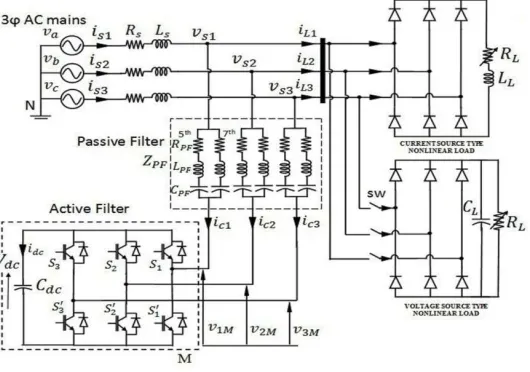
operated such that the distortion currents generated due to nonlinear loads are confined within the PPF and do not flow in the ac supply mains. The fundamental voltage drop across passive power filter components permits shunt APF to operate at low dc link voltage. The 3-phase source voltage, the voltage at the point of common coupling, load and compensator currents are denoted as vsabc, vs123, iL123 and ic123 respectively and shown individually in Fig.1.
Figure 1. Configuration of the shunt hybrid compensator 2.1. Modeling of Shunt Hybrid Power Compensator
By applying Kirchhoff’s laws in Fig. 1, the following equations in differential form in stationary three phase reference frame are obtained, where the RPFeq, LPFeq and CPFeq are equivalent parameter values of the 5th and 7th selective harmonic filters.
PFeq
ck kM MN ckPFeq ck
PFeq
sk dt R i C i dt v v
di L
v 1
(1)
where, k=1,2,3 represent the three phases.
Differentiation of equation (1) to eliminate the integral term yields
dt dv dt dv i C dt di R dt i d L dt
dv kM MN
ck PFeq ck PFeq ck PFeq
sk 1
2 2
(2) Assuming balanced three phase supply voltage yields
vs1+vs2+vs3 = 0
Summing the three equations included in (1) for k=1, 2, 3 and assuming nonexistence of the zero sequence current into 3-wire system [16] results in
3 1 3 1 k kM MN v v (3)
The switching function
C
k [12] of the kth leg of the inverter is the state of the power semiconductor devicesS
kand'
k
S
and is defined as On is S and Off is S if Off is S and On is S if C k k k k k ' ' , 0 , 1 (4)
Thus, with
v
kM
C
kV
dc and differentiation of the same leads to
3 1 3 1k k dc
MN C V
dt d dt
dv
(6)
Substitution of equations (5) and (6) into (2) and rearranging the same yields
dt dv L dt dV C C L i L C dt di L R dt i d sk PFeq dc m m k PFeq ck PFeq PFeq ck PFeq PFeq ck 1 3 1 1 1 3 1 2 2
(7)
Defining the switching state function as,
n
m m
k
nk C C
q 3 1 3 1
where, n = 0 or 1.
In other words, the vector qn depends on the parameters C1, C2, C3 through a matrix transformation given below indicating the interaction among the three phases [15].
3 3 2 1 2 1 1 1 2 1 1 1 2 3 1 C C C q q q 2 1 n n n (8) dt dv L dt dV q L i L C dt di L R dt i d sk PFeq dc nk PFeq ck PFeq PFeq ck PFeq PFeq
ck 1 1 1
2 2 (9)
The capacitor current
i
dc
i
c1
i
c2
i
c3 and is related to Vdc bydc dc
dc i
C dt
dV 1
(10)
Expressing the dc link capacitor current idc in terms of the switching and compensator currents the following equation is obtained
123
3 1 123 1 1 c T
k nk ck dc n
dc
dc q i
C i q C dt dV
(11)
In the nonexistence of zero sequence currents, the variables ic3 and qn3 can be eliminated by the substitution of ic3 = -(ic1+ic2) and qn3 = -(qn1+qn2) so that the equation (11) for the modelling of the capacitor is modified as follows.
2 1 2
1 1
1 2 2
21 c n n dc c n n dc
dc q q i
C i q q C dt dV (12)
The complete model of the shunt hybrid power compensator in abc reference frame is indicated by the equations (9) and (12).
2.2. Equations in dq Frame
The model given by (9) and (12) is transformed into synchronous orthogonal frame using the transformation matrix [13]
3 4 sin 3 2 sin sin 3 4 cos 3 2 cos cos 3 2 123 dq T (13)where tand ω represents the mains frequency.
Since
123
dq
T is orthogonal,
1231 dqT =
Tdq123Tand equation (12) can be written as
dq
dq
T ndq dq dc
dc T q T i
C dt
dV 1 123 123
dc
ndq dq i q C 1 (14)On the other hand, equations (9) can be written as
12
12
12
12
122 2 1 1 1 s PFeq dc n PFeq c PFeq PFeq c PFeq PFeq c v dt d L dt dV q L i L C i dt d L R i dt
d
The three-phase current with the absence of zero sequence components can be converted into d-q frame using reduced transformation matrix. Applying the transformations in ed-quation (15) the complete d-q frame dynamic model of the system is obtained as follows;
q d dc nd q PFeq d PFeq PFeq q PFeq d PFeq d
PFeq dt v
dv dt dV q i R i C L dt di L dt di R dt i d
L
2 2 1
2 2 (16) d q dc nq d PFeq q PFeq PFeq d PFeq q PFeq q
PFeq dt v
dv dt dV q i R i C L dt di L dt di R dt i d
L
2 2 1
2 2 (17) q nq d nd dc
dc dt q i q i dV
C
(18)
The role of
i
d in equation (16) is interpreted as the component for meeting the switching lossesin the compensator, whereas the component iq is utilised to supply reactive power and maintain
the dc link voltage across the capacitor for sustain the compensator action.
It is specifically noted that this set of equations (16) - (18) contain nonlinear terms involving the control variables qnd and qnq. Accordingly, the implementation of this control strategy is termed as nonlinear control technique by many authors in the literature [12, 15-16].
2.3. Control of Harmonic Currents
Based on the load and compensator models presented in Section 2.2, the control problem is formulated with the objective of minimising supply side current harmonics and improving the power factor. Also, for maintaining the performance during load fluctuations, it is also necessary to maintain a desired dc-link capacitor voltage. The control law is derived using the following approach.
Rewriting equations (16) and (17) in a more convenient form, we get
q d dc nd q PFeq q PFeq d PFeq PFeq d PFeq d
PFeq dt v
dv dt dV q i R dt di L i C L dt di R dt i d
L
2 1 2
2 2 (19) d q dc nq d PFeq q PFeq q PFeq PFeq q PFeq q
PFeq dt v
dv dt dV q i R dt di L i C L dt di R dt i d
L
2 1 2
2 2
(20) The control variables ud and uq are defined as
q d dc nd q PFeq q PFeq
d dt v
dv dt dV q i R dt di L
u 2
(21) d q dc nq d PFeq d PFeq
q dt v
dV dt dV q i R dt di L
u 2
(22)
Using the idea of decoupling the current harmonic components for the purpose of tracking the reference current, the error signals id id* id and iq iq*iq are generated and processed through a pair of PI controllers [12, 14] to obtain ud and uq signals which are given below.
* d
i
andi
q* are the reference currents deduced from the load current, id and iq are the actual compensator currents. K i K i dt
ud Pd I d
K i K i dt uq Pq I q
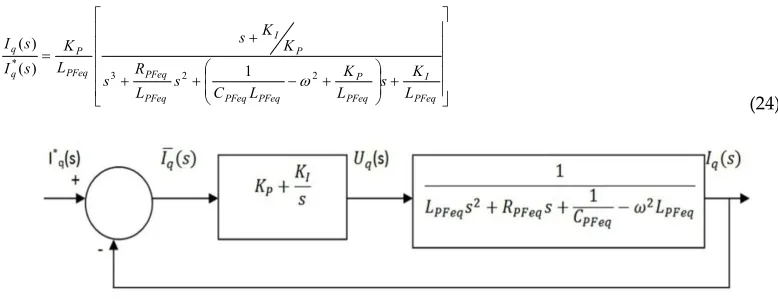
From equations (19) and (20) we obtain the transfer function as follows
2 2 1 1 ) ( ) ( ) ( ) ( PFeq PFeq PFeq PFeq PFeq q q d d L C s L R s L s U s I s U s I (23)
PFeq I PFeq P PFeq PFeq PFeq PFeq P I PFeq P q q L K s L K L C s L R s K K s L K s I s I 2 2 3 * 1 ) ( ) ( (24)
Figure 2. Structure of Current Control Loop for iq and id
From equations (21) and (22) the control variables of the proposed system are defined by the following equations. dt dV u v dt dV i R dt di L q dc d q d q PFeq q PFeq nd
2
(25) dt dV u v dt dV i R dt di L q dc q d q d PFeq d PFeq nq
2
(26) The above equations represent both the decoupled linear compensation part and cancellation of nonlinearity.
2.4 DC link voltage Control
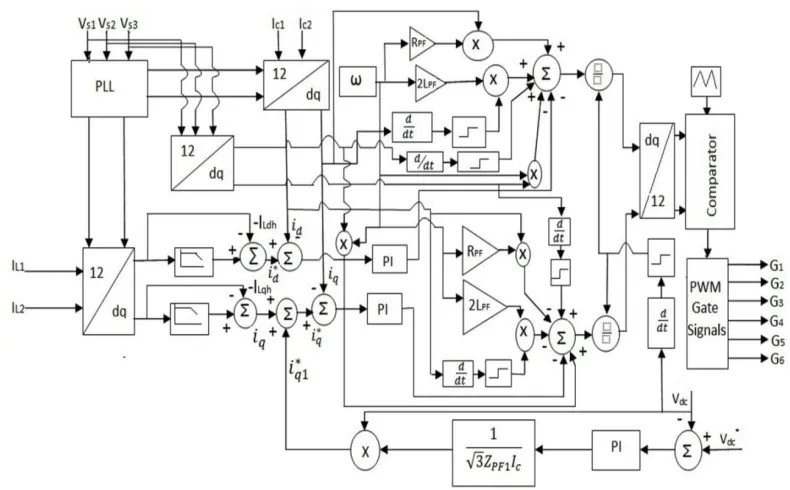
The capacitor in the APF does not need any external dc source but gets charged through the rectifier action of the built-in reverse diodes across the six IGBT’s. The power loss in the capacitor and switching losses in the inverter have to be met by the active component id of the compensator current from the mains, while the component iq supplies the reactive power stored in the capacitor. The power losses in this circuit can reduce the dc link capacitor voltage, thereby weakening the function of the active filter. Hence, it is necessary to maintain the voltage across the dc link capacitor at a designed reference value by an additional voltage regulator, which modifies the PWM signals appropriately. This regulator is implemented by using a PI controller [12], which processes the error between the reference voltage V*dc and the actual capacitor voltage Vdc. The parameters of PI regulator are chosen in such a way that the dc voltage is maintained around its desired value. The design values for the PI controller parameters have been obtained following the approach suggested by Salem Rahmani et al. [13-14]. The overall transfer function of this controller is incorporated as a subsystem in the simulation schematic.
The control scheme of the proposed hybrid power compensator is shown in Fig. 3 where, the
various signals such as Vdc , V*dc , id, iq, id*and iq*are processed using equations (25) to (27) to
Figure 3. Control structure of the Shunt Hybrid Compensator
2.5. Simulink Model of the Shunt Hybrid Power Compensator
Fig. 4 shows the Simulink schematic of the power distribution system along with the proposed shunt hybrid power compensator, which translates the entire system equations presented in Section 2 into functional blocks in the Simulink model. The nonlinear load has been modelled using a 3-phase full bridge diode rectifier feeding RL and RC loads separately as subsystems and connected to the three phase mains. At the source side, a resistor-inductor combination is used to represent the line impedance of each phase before PCC. The unbalance case in the nonlinear load has been formed by connecting a single phase diode rectifier feeding RL load between phase-1 and ground. The hybrid filter consists of a parallel connection of selective 5th and 7th harmonic elimination passive filters as depicted in Fig.1 along with APF. The entire system simulation is carried out in a discrete mode, variable step size with ode45 (Dormand-Prince) solver.
3. Simulation Results
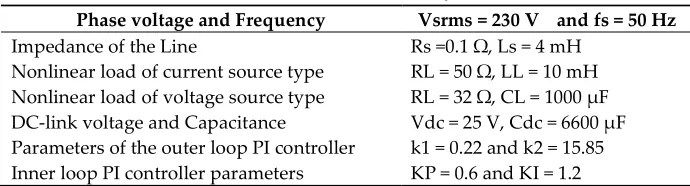
Table 1Parameters of the System
Phase voltage and Frequency Vsrms = 230 V and fs = 50 Hz Impedance of the Line Rs =0.1 Ω, Ls = 4 mH
Nonlinear load of current source type RL = 50 Ω, LL = 10 mH Nonlinear load of voltage source type RL = 32 Ω, CL = 1000 µF DC-link voltage and Capacitance Vdc = 25 V, Cdc = 6600 µF Parameters of the outer loop PI controller k1 = 0.22 and k2 = 15.85 Inner loop PI controller parameters KP = 0.6 and KI = 1.2
To evaluate the performance of the shunt HPF controlled by the proposed control algorithm, Simulink based schematic was created so as to operate from 400 V, 50 Hz supply. The load consists of a set of balanced and unbalanced nonlinear loads, which are selectively connected for successive simulation runs. In this work, the performances of the compensator corresponding to the following loads are analysed: (i) 3-phase rectifier feeding RL load; (ii) 3-phase rectifier feeding RC load; (iii) Dynamic load variation and (iv) Unbalanced load. Table 1 indicates the specification of the system parameters used in the simulation.
3.1 Performance of Shunt HPF to the Nonlinear Load of Current Source Type
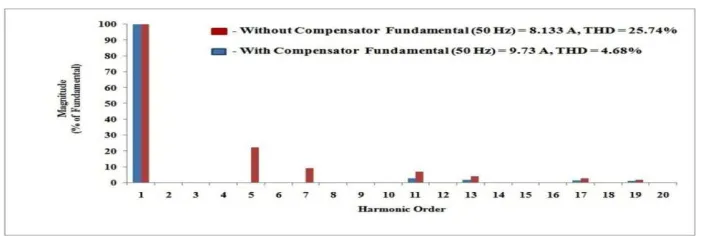
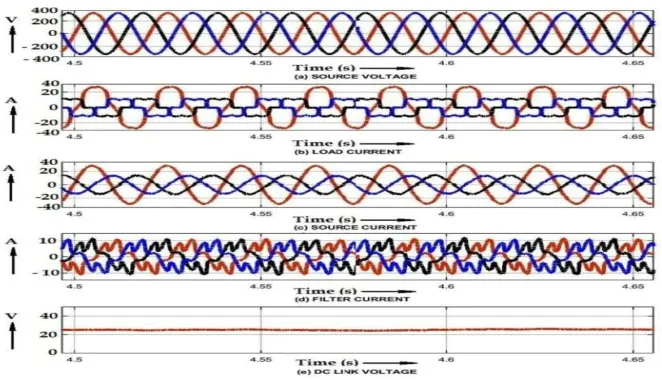
The 3-phase mains supply a diode bridge rectifier, whose output is wired to a balanced R-L load, which imposes a typical nonlinearity, resulting in harmonic currents at the supply end. The proposed hybrid shunt compensator is wired at PCC as shown in Fig.1. The results are shown in Figs. 5(a)-(e) covering the waveforms of the supply voltage, currents of the load, source current after compensation, currents of the compensator and dc link voltage respectively. The waveform depicts that the supply current waveform is almost sinusoidal after compensation and the dc link capacitor voltage is maintained constant. Fig.6 depicts the simulation results covering the harmonic spectrum of the supply current before and after compensation. The results indicate that the THD of the supply current is reduced from 25.74% without compensator to 4.68% with compensator. It is seen that the proposed control strategy with shunt HPF can mitigate the current harmonics present in the supply system within the limit specified by IEEE 519-1992 standards.
Figure 6. FFT analysis of the Supply Current with and without Compensator
3.2 Varying Three Phase Rectifier Fed RL Load
Since the load in a distribution system can vary concerning time, it is essential to verify the suitability of the designed filter under varying load conditions. The simulation results for sudden change of load current from 9.74 A(rms) to 17.17 A at t= 4s and restoration of the same to the previous value at t= 4.25s are presented in Figs. 7(a)-(e) covering source voltage, load current, source current, compensator current and dc link voltage waveforms respectively. The THD of the supply current before step change in the load current has been improved from 25.74% without compensator to 4.55% with compensator. Similarly, after a step change in the load current, the supply current THD has been reduced from 23.06% to 4.14% with compensator. In both the cases the compensator is capable of maintaining the THD of the source side current within the limit specified by the IEEE 519-1992 standards. It is observed from the Figs. 7(e) and (c) that the compensator is able to maintain the dc link voltage as constant and supply current waveforms to be sinusoidal.
Figure 7. Response of the Compensator to Sudden Change of Load Current
The load in the simulation schematic is replaced by an R-C circuit with parameter values as shown in Table.1 and the simulation is executed to obtain the performance of the compensator. Figs. 8(a)-(e) show the source voltage, load current, supply current after compensation, compensator current and dc link voltage waveforms respectively. It is observed from the figures that the dc link voltage of the compensator is maintained constant during compensation, and the supply current variation approaches a sinusoidal waveform. Fig.9 shows the harmonic spectrum of line currents from mains before and after compensation. It shows that the THD of the source current is reduced considerably from 27.49 % to 4.08 %.
Figure 8. Performance of Compensator for Voltage Source Type Nonlinear load
Figure 9. Harmonic Spectrum of Supply Current before and after Compensation
3.4 Varying Three Phase Rectifier Fed RC Load
10(a)-(e). These depict the supply voltage, load current, supply current after compensation, compensator current and the dc link voltage respectively. The obtained results indicate that the desirable features in the performance of the hybrid filter are maintained even after the step changes in the load within a very short time. The THD of the source current has been reduced from 27.49% without compensator to 3.46% with compensator before the step change is made in the load current. Similarly, the THD has been reduced from 20.91% to 4.77% after the step change. It is seen that the compensator operation reduces the harmonic content within a THD of 5%, in addition to maintaining a steady dc link voltage.
Figure 10. Performance of the Compensator for Variation in 3-phase Rectifier fed RC Load
3.5. Unbalanced Loading Condition
Figure 11.Performance of the Compensator to the Unbalanced Nonlinear Load
has been reduced from 24.61% to 4.88%. It is seen from the obtained results that the proposed control method with shunt hybrid compensator effectively compensates the harmonic distortion present in the supply current under unbalanced loading conditions.
4. Hardware Fabrication
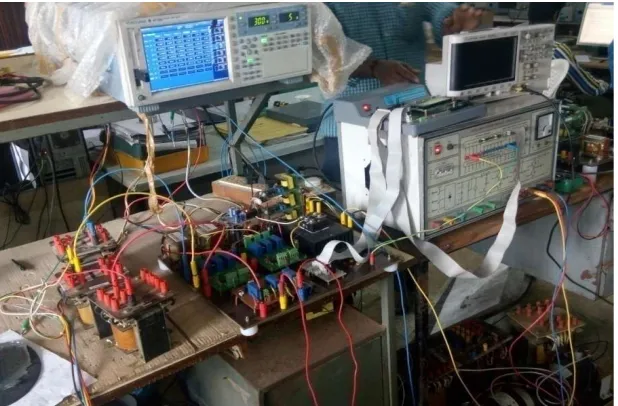
A prototype of the distribution system along with the passive and active parts of the hybrid compensator has been fabricated and experimental work on the same was carried out. Fig.12 shows the overall setup of the experimental work. The active filter part of the prototype has been developed using intelligent power module PEC16DSMO1. The IPM consists of a three phase six-pulse inverter with six IGBT semiconductor power switches and is controlled in real time based on the software control program from the SPARTAN-6 FPGA development board. These IGBT switches are capable of operating at high frequencies of the carrier waveform up to 20 kHz.
Figure 12. Experimental Setup
4.1. Hardware Results & Discussion
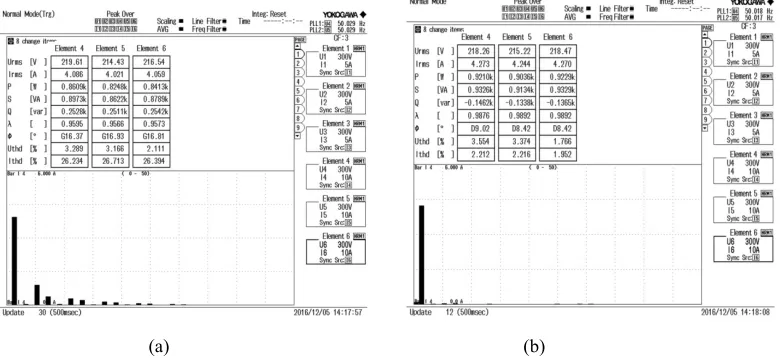
A series of experiments involving different types of loads and their dynamic variations have been conducted, and the performance of the compensator has been evaluated. A six-channel YOKOGAWA Power Quality Analyser has been used to capture the signals such as supply voltage, source current, load current, compensator current and dc link voltage.
4.1.1. Performance of the Compensator for Current Source Type Nonlinear Load
Figure 13. Hardware Response of the Compensator for Current Source Type Load
(a) (b)
Figure 14. FFT Spectrum of Source Current (a) Before Compensation (b) After Compensation
4.1.2. Performance of the Compensator for Varying Current Source Type Nonlinear Load
Figure 15. Performance of the Compensator for Time-Varying Current Source Type Nonlinear Load
4.1.3. Performance of the Compensator for Voltage Source Type Nonlinear Load
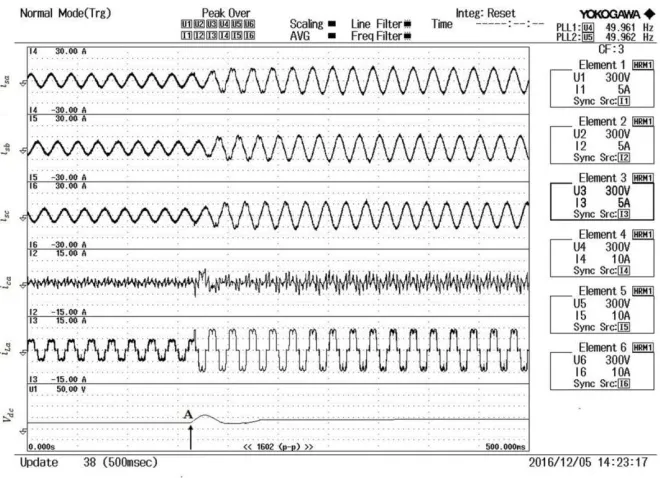
The performance of the compensator for voltage source type nonlinear load has been experimentally verified by connecting the nonlinear load in the three phase supply system. Fig.16 shows the three phase source currents of all phases individually, compensator current of one phase, the Load current of one phase and dc link voltage respectively. It is seen that the supply current after compensation is sinusoidal without distortion and the dc link voltage of the compensator is also maintained constant.
Figure. 16. Performance of the compensator for Voltage Source Type Nonlinear Load
(a) (b)
Figure. 17. FFT Spectrum of Source Current (a) Before Compensation (b) After Compensation
4.1.4. Performance Comparison and Discussion
Table 2. Comparison of the Performance of Various Control Techniques
Control Methods
SRF Theory
based Nonlinear Control for SHAPF
p-q Theory based Control for SHAPF [22]
(Balasubramanain and Palani, 2016)
SRF Theory Based Control for SHAPF [23] (Day and Mekhilef, 2014)
Parallel Connected
SHAPF [24]
(Bhattacharya et al., 2012)
THD%
3-Phase Rectifier fed RL load
4.6 4.32 - 4.3
THD%
3-Phase Rectifier fed RC load
4.08 4.15 - -
Unbalanced
load % THD 2.29 to 4.80 - 1.18 to 2 4.5 to 4.7
DC link
voltage
25 V APF rating is
less
50 V APF rating is
moderate
220 V
APF rating is more APF rating is less 26 V
5. Conclusions
A 3-phase hybrid compensator scheme discussed in this paper is configured with 5th and 7th selective harmonic elimination passive filter in series with an active filter in the form of an IGBT based PWM inverter, triggered using a control algorithm, based on a synchronously rotating reference frame in the d-q axis. The overall objective is to improve the steady state power factor and to ensure dynamic harmonic compensation at the supply side of 3-phase mains. Accordingly, the entire system is simulated using SIMULINK and the results are presented, covering a set of nonlinear loads. The simulation results indicate the effectiveness of the compensator topology and versatility of the control scheme for meeting the requirements of a set of nonlinear loads. It is seen that significant reduction of source current THD is obtained within limits specified by IEEE 519-1992 standard along with excellent regulation of the dc link voltage.
A series of experiments were carried out using the above prototype along with alternate nonlinear loads and the overall performance of the hybrid filter where recorded using six channels DSO. The THD values as measured by the DSO over a series of experiments are found to be closely matching with corresponding THD values obtained during simulation for all loading conditions. It is further verified that the experimental results compared favourably with the simulation waveforms, thereby validating the simulation model. The experimental results confirm the effectiveness of the synchronously rotating reference frame based control strategy for the hybrid compensator scheme to achieve source side current harmonics reduction and power factor improvement to near unity.
Supplementary Materials: All the information is available in the manuscript.
Author Contributions: “conceptualization, R.B. and K.P.; methodology, R.B. and K.P.; software, R.B. and K.P.; validation, R.B., K.P.; and R. S; formal analysis, R.B.; investigation, R.B. and K.P.; data curation, R.B., and K.P.,; writing—original draft preparation, R.B., K.P., R. S and R.A.,; writing—review and editing, R. S and R.A.,; supervision, R. S and R.A.
Funding: This research received no external funding.
Acknowledgments: Authors wish to express their sincere thanks to acknowledge SASTRA Deemed University, Thanjavur, India for extending infrastructural support to carry out this work.
References
1. Peng, F. Z. Harmonic sources and filtering approaches. IEEE Ind. Appl. Mag.2001, 7, 18– 25, doi:10.1109/2943.930987.
2. Surya Santoso., Mark F. McGranaghan., Roger C. Dugan., H. Wayne Beaty.; Electrical Power Systems Quality, Third Edition 2012 McGraw-Hill Education ISBN 9780071761550
3. Singh, B.; Singh, B. N.; Chandra, A.; Al-Haddad, K.; Pandey, A.; Kothari, D. P. A review of three-phase improved power quality AC-DC converters. IEEE Trans. Ind. Electron.2004, 51, 641– 660.10.1109/TIE.2004.825341
4. Wagner, V. E.; Balda, J. C.; Griffith, D. C.; McEachern, A.; Barnes, T. M.; Hartmann, D. P.; Phileggi, D. J.; Emannuel, A. E.; Horton, W. F.; Reid, W. E.; others Effects of harmonics on equipment. IEEE Trans. Power Deliv.1993, 8, 672–680.10.1109/61.216874
5. Das, J. C. Passive filters-potentialities and limitations. IEEE Trans. Ind. Appl.2004, 40, 232– 24110.1109/PAPCON.2003.1216916
6. Singh, B.; Al-Haddad, K.; Chandra, A. A review of active filters for power quality improvement. IEEE Trans. Ind. Electron.1999, 46, 960–971.
7. Akagi, H. New trends in active filters for power conditioning. IEEE Trans. Ind. Appl.1996, 32, 1312–1322. 8. Lam, C.-S.; Wong, M.-C. Design and control of hybrid active power filters; Springer, 2014;
9. Singh, B.; Verma, V.; Chandra, A.; Al-Haddad, K. Hybrid filters for power quality improvement. IEE Proceedings-Generation, Transm. Distrib.2005, 152, 365–378.
10. Rivas, D.; Morán, L.; Dixon, J. W.; Espinoza, J. R. Improving passive filter compensation performance with active techniques. IEEE Trans. Ind. Electron.2003, 50, 161–170.
11. Samadaei, E.; Lesan, S.; Cherati, S. M. A new schematic for hybrid active power filter controller. In Applied Power Electronics Colloquium (IAPEC), 2011 IEEE; 2011; pp. 143–148.
12. Mendalek, N.; Al-Haddad, K.; Fnaiech, F.; Dessaint, L. A. Nonlinear control technique to enhance dynamic performance of a shunt active power filter. IEE Proceedings-Electric Power Appl.2003, 150, 373–379.
13. Rahmani, S.; Hamadi, A.; Mendalek, N.; Al-Haddad, K. A new control technique for three-phase shunt hybrid power filter. IEEE Trans. Ind. Electron.2009, 56, 2904–2915.
14. Rahmani, S.; Mendalek, N.; Al-Haddad, K. Experimental design of a nonlinear control technique for three-phase shunt active power filter. IEEE Trans. Ind. Electron.2010, 57, 3364–3375.
15. Zouidi, A.; Fnaiech, F.; Al-Haddad, K. Voltage source inverter based three-phase shunt active power filter: Topology, Modeling and control strategies. In Industrial Electronics, 2006 IEEE International Symposium on; 2006; Vol. 2, pp. 785–790.
16. Mendalek, N.; Al-Haddad, K. Modeling and nonlinear control of shunt active power filter in the synchronous reference frame. In Harmonics and Quality of Power, 2000. Proceedings. Ninth International Conference on; 2000; Vol. 1, pp. 30–35.
17. Balasubramanian, R.; Sankaran, R.; Palani, S. Simulation and performance evaluation of shunt hybrid power filter using fuzzy logic based non-linear control for power quality improvement. S{\=a}dhan{\=a}2017, 42, 1443–1452.
18. Palandöken, M.; Aksoy, M.; Tümay, M. Application of fuzzy logic controller to active power filters. Electr. Eng.2004, 86, 191–198.
19. Dey, P.; Mekhilef, S. Current controllers of active power filter for power quality improvement: A technical analysis. automatika2015, 56, 42–54.
20. Unnikrishnan, A. K.; TG, S. J.; Manju, A. S.; Joseph, A.; others Shunt hybrid active power filter for harmonic mitigation: A practical design approach. Sadhana2015, 40, 1257–1272.
21. Chauhan, S. K.; Shah, M. C.; Tiwari, R. R.; Tekwani, P. N. Analysis, design and digital implementation of a shunt active power filter with different schemes of reference current generation. IET Power Electron.2013, 7, 627–639.
22. Balasubramanian, R.; Palani, S. Simulation and performance evaluation of shunt hybrid power filter for power quality improvement using PQ theory. Int. J. Electr. Comput. Eng.2016, 6, 2603–2609.