86
STRATEGIES FOR DEVELOPING MANGROVE
ECOTOURISM IN RIAU PROVINCE, INDONESIA
Musadad11& Mariaty Ibrahim2 1,2Universitas Riau, Pekanbaru.
ABSTRACT
Mengkapan Mangrove Ecotourism, located in Siak Regency, Riau Province, was once visited by a large number of visitors soon after it was opened for public in 2015. Nevertheless, since the beginning of 2016, the number of visitors has been drastically dropped. One of the causes of this unfortunate condition is that there is no established planning to guide the development of the mangrove ecotourism. Therefore, this study was aimed to formulate strategies for developing the Mengkapan Mangrove Ecotourism by using the SWOT analysis. The data was collected through conducting interviews with related stakeholders, distributing questionnaires to them, and performing field observations. The collected data was then analyzed inductively to capture the key strategy alternatives. Based on the results of SPACE Matrix and SWOT Matrix, this study formulates the following priority strategies: diversifying tourist attractions and promoting them massively by using online media, creating tour packages, and making a cooperation with travel agents.
Keywords: Mangrove Ecotourism, Development Strategy, SWOT Analysis
INTRODUCTION
Coastal areas are one of Indonesia’s national development priorities. These outermost regions receive great attention from the government in terms of economic equality and social welfare development. Therefore, it can be understood that the current government development programs are more focused on remote and outermost (coastal) areas, especially outside Java Island. There are various aspects and potentials of a coastal region that can be used as development capital, one of which is tourism potential.
One of the coastal tourism areas that has the potential for being an economic driver of the local community is Mengkapan Mangrove. This ecotourism area is located in Sungai Apit district, Siak Regency, Riau Province. Sungai Apit Sub-district itself is included as one of the clusters of the Regional Tourism Development Master Plan (RIPPDA) of Siak Regency, which is specifically projected for the development of coastal or marine tourism (RIPPDA Kabupaten Siak, 2012). Therefore, the mangrove tourism destinations located on Sungai Apit are declared as the leading ecotourism of Siak Regency and receive special attention from the local government.
87
Tourism has a huge impact on the regional economy. It is also able to create a multiplier effect, i.e. the potential to create other businesses, both on a micro and macro scale. In addition, the strategic sector is expected to encourage and attract other sectors to be integrated into improving the economy of a region. As happened in Mengakapan Mangrove Ecotourism, the tourism development in this area is expected to have a positive impact not only for the local community but also for the local government.
Not only beneficial to the economy, tourism, especially nature-based ones, also has a positive effect on ecosystem sustainability if it is well and professionally managed. In this case, Hall, et al. (2011) has confirmed that the relationship between tourism and conservation is a mutually beneficial relationship and this has been widely discussed by experts. The current development in Mengkapan Ecotourism Mangrove is also expected to be able to support the efforts of mangrove forest conservation.
Figure 1
Visitors taking photos using a drone in Mengkapan Mangrove
Source: siakkab.go.id
Mengkapan Mangrove Ecotourism was just exposed in 2016. Therefore, programs to support tourism in the area have not long begun. As a result, large tourism potential has not been maximally developed. In addition, this mangrove is managed independently by the surrounding community through the Sustainable Mangrove Group in collaboration with PT EMP Malacca Strait, a private oil mining company operating near the area. Therefore, formulating the strategy for developing Mengkapan Mangrove Ecosystem is very important and urgent. Therefore, the purpose of this study is to formulate the grand strategy for developing Mengkapan Mangrove Ecotourism. To reach the goal, this study first examined the internal and external factors of Mengkapan Mangrove Ecotourism as a strategy for tourism development must accommodate these two factors.
88
requires a development strategy to increase tourism benefits for conservation issues and empower local communities.
Tourism development can be defined as a sequence of efforts to embody the combination in the practice of various tourism resources by integrating all aspects outside tourism itself which have indirect or direct connection to the permanence of tourism development (Swarbrooke, 2002).
This study has two contributions, i.e. theoretical contribution and practical contribution. Theoretically, this study can enrich the theory of development strategies for mangrove ecotourism. Practically, this study can be used as an additional reference for stakeholders engaging in mangrove tourism, especially Mengkapan Mangrove Ecotourism, to developing sustainable tourism programs.
Ecotourism is a form of nature tourism that has principles on education and tourism aspects. Therefore, in a tourist destination applying the concept of ecotourism, visitors must gain these two aspects. In addition to enjoying various attractions, they also need to get enlightenment about ecosystem education such as ways of conservation, various flora and fauna, and management system. More specifically, the notion of ecotourism as explained by The Ecotourism Society is a form of travel to natural areas that is performed with the aim of conserving the environment and preserving the lives and welfare of the local population (Handriana & Ambara, 2016). Thus, a tourist trip to the object of ecotourism must have a role in conserving nature while contributing to the prosperity of the community living around the area.
Regarding the stakeholders to be engaged in tourism development, Gunn (2007) explains that tourism development has to include the following three sectors, i.e. the profit sector, the business sector, and the governmental sector. The non-profit sector means non-non-profit entities such as youth organization, professional organization, and ethnic group but have an important role and devotion to tourism development. The business sector delivers the needs and wants of tourists such as food and beverage, transportation services, entertainment, and laundry. The governmental sector serves to issue and execute policies (regulations and laws).
89
developing sustainable tourism in Bangladesh. He found that to make sustainable tourism in Bangladesh, strategies have to be focused on ensuring the security and safety, economic benefits, ecological conservation, educating people on the importance of sustainable tourism, and infrastructure. Moreover, Nurlena & Musadad (2019) suggests that aspects that must be taken into consideration in tourism planning include key attractions, tourism potentials, and development planning.
From the previous studies on ecotourism development, especially that in Indonesia, this study differs in in terms of the management. Mengkapan Mangrove is totally managed by the locals. Other stakeholders only support the management of the mangrove ecotourism by providing financial assistance (oil mining company) and training (Tourism Office of Siak Regency). This locally-managed mangrove ecotourism marks the distinctive issue of this study.
METHODOLOGY
The data in this study were collected via structured interviews with people involving and understanding the dynamics of Mengkapan Mangrove Ecotourism, including the Head of Destination Section of Tourism and Culture Office of Siak Regency, the head of local management (Pokdarwis), the head of a non-profit organization involving in Mengkapan Mangrove, a community leader, and some tourists. These actors were purposively selected by considering their vital roles in the development of Mengkapan Mangrove. The questionnaire was divided into 4 segments, i.e. strength, weakness, opportunity, and threat (SWOT) of Mengkapan Mangrove Ecotourism. This questionnaire was formulated by making a comprehensive literature review of mangrove ecotourism and experimental field observations in Mengkapan Mangrove. The questions in the questionnaire were then assigned by an agreement level by using the 5-Likert scale. The interviewees were asked to give responses to each question in the questionnaire. Their responses were then given scores that represented their perceptions. Finally, the author made a database in Microsoft Excel 2016 and all respondents' scores were analyzed by calculating all responses in the questionnaires. Before the SWOT analysis, the IFAS (Internal Factor Analysis Summary) and EFAS (External Factor Analysis Summary) analysis were first performed (Rangkuti, 2009). After creating a SWOT matrix diagram, then the grand strategy can be formulated.
RESULTS AND DISCUSSION
Key Stakeholders in Mengkapan Mangrove Ecotourism
The dynamics taking place in Mengkapan Mangrove, i.e. from the very beginning of its development, the heyday, until the decline in its tourism activities, cannot be separated from the stakeholders engaging in it. Therefore, this study identifies the key stakeholders in Mengkapan Mangrove Ecotourism as follows.
a. Siak Tourism Office
90
of Siak to visit the Mangrove in 2016. This activity was exposed in the media at that time. In addition, the Tourism Office also provided training to the existing Pokdarwis (local tourism management).
b. Local Tourism Management (Pokdarwis) of Mengkapan Village
As the tourism management of Mengkapan Mangrove, the Pokdarwis of Mengkapan Village has done many efforts to develop tourism in their village such as promotion through social media, building tourist facilities, improving tourist attractions, and managing tourist visits. To provide foods for visitors, some members of Pordarwis open several stalls located before the mangrove gate.
c. The people of Mengkapan village
The local community plays an important role in helping Pokdarwis members such as constructing facilities at the tourist site. They also provide parking lots when many visitors arrive.
d. PT. Malacca Strait.
This oil drilling company is located not far from Mengkapan Mangrove. The company plays an important role in developing mangrove ecotourism. At the beginning of tourism development, this company donated wooden bridges to tourism activities. In addition, the company also organized several CSR programs to Mengkapan Mangrove, such as planting mangrove seedlings. It can be said that the operational fund of tourism management at Mengkapan Mangrove is also supported by this company.
e. NGOs
Several NGOs are working on Mengkapan Mangrove Ecotourism, but the most influential one is PKSM (Self-Supporting Forestry Extension Agents). In addition to planting mangrove seedlings and promoting mangrove ecotourism, they also conduct advocacy such as awareness of environmental preservation and empowerment of the local economy.
Figure 2
A wooden bridge to explore Mengkapan Mangrove
91
Analyses of Internal Strategic Factors and External Strategic Factors
The first stage in formulating a development strategy, according to Rangkuti (2009), is to conduct data analysis for internal and external strategic factors, better known as IFAS and EFAS. According to the questionnaire results, the SWOT analysis was then performed using an external factor evaluation matrix and an internal factor evaluation matrix to establish strategy priorities.
Internal Factor Analysis Summary (IFAS)
As many as 13 internal strength and weakness factors are weighted for IFAS. The weight given for 6 strength factors ranges from 0.058 to 0.089. The beauty and uniqueness of Mengkapan Mangrove and the good condition of the roads get the highest priority scores. Conversely, 7 weakness factors have a range of weight between 0.069 and 0.089. Lack of promotional efforts, less optimum role of Pokdarwis, and inadequate facilities receive maximum weight and highest score. The total score for IFAS is 5.55. The IFAS results are summarized as the internal factor analysis matrix as shown in Table 1 as follows.
Table 1
Internal Strategic Factors
Strengths Weight Rating Score
S1 The beauty and uniqueness of Mengkapan Mangrove. 0.089 3 0.28 S2 Involvement of the local community in management. 0.089 3 0.25 S3 Good roads to reach Mengkapan Mangrove. 0.084 3 0.29
S4 Free entrance fee. 0.058 2 0.12
S5 Easy to access. 0.069 3 0.21
S6 Having conservation efforts. 0.076 2 0.18
Weaknesses Weight Rating Score
W1 Less varied attractions. 0.069 2 0.17
W2 Lack of promotional efforts. 0.081 3 0.23
W3 No professional guide. 0.076 2 0.18
W4 Lack of security for visitors. 0.069 2 0.16
W5 Low visitors’ length of stay. 0.071 3 0.19
W6 Inadequate facilities. 0.081 3 0.24
W7 Less optimal role of Pokdarwis. 0.089 3 0.23
1 2.71
Source: processed from the questionnaire survey results, 2018
External Factor Analysis Summary (EFAS)
92
maximum weight as a threat. In total, the EFAS score is 2.91. The EFAS results are illustrated as an external factor analysis matrix as illustrated in Table 2 below.
Table 2
External Strategic Factors
Opportunities Weight Rating Score
O1 Opportunity for job creation. 0.077 3 0.21 O2 Environmental conservation efforts. 0.084 3 0.22 O3 Increased visitors’ interest in local tourism. 0.079 3 0.22 O4 Efforts in promoting tourism. 0.077 3 0.26 O5 The increasing trend towards nature-based tourism. 0.077 4 0.27 O6 Cooperation with tour and travel agents. 0.069 3 0.19 O7 Educational tourism development. 0.079 3 0.22
Threats Weight Rating Score
T1 Degradation of environmental quality. 0.082 3 0.26 T2 Vulnerable to natural disasters. 0.072 3 0.18 T3 Existence of competitors or other similar tourist destinations. 0.077 3 0.26 T4 Instability in social and economic conditions. 0.069 3 0.21 T5 Overlapping management authority. 0.067 3 0.17 T6 Lack of funding for management. 0.089 3 0.23
1 2.91
Source: processed from the questionnaire survey results, 2018
SWOT Analysis
To compile the strategic factors of the tourist destination of Mengkapan Mangrove Ecotourism, it requires a tool named the SWOT Matrix. With this matrix, the external opportunities and threats are adjusted to the internal strengths and weaknesses. Thus, there are 4 possible alternative strategies generated from this matrix (Rangkuti, 2009), i.e.
a. S-O Strategy: use all strengths to seize and take advantage of the greatest opportunities.
b. S-T Strategy: utilize strengths to overcome threats.
c. W-O Strategy: use opportunities by minimizing weaknesses. d. W-T Strategy: minimize weaknesses and avoid threats.
93 Table 3 The SWOT Matrix IFAS
EFAS
Strengths (S) Weaknesses (W)
1. The beauty and uniqueness of Mengkapan Mangrove. 2. Involvement of the local
community in management. 3. Good roads to reach
Mengkapan Mangrove. 4. Free entrance fee. 5. Easy to access.
6. Having conservation efforts.
1. Less varied attractions. 2. Lack of promotional
efforts.
3. No professional guide. 4. Lack of security for
visitors.
5. Low visitors’ length of stay.
6. Inadequate facilities. 7. Less optimal role of
Pokdarwis. O pp or tu ni tie s ( O )
1. Opportunity for job creation.
2. Environmental conservation efforts. 3. Increased visitors’
interest in local tourism. 4. Efforts in promoting
tourism.
5. The increasing trend towards nature-based tourism.
6. Cooperation with tour and travel agents. 7. Educational tourism
development.
S – O Strategy W – O Strategy
1. Promote tourist attractions by utilizing ICT
2. Develop educational tourism
3. Create tour packages 4. Make cooperation with
travel agents
5. Open micro businesses for souvenirs and culinary products
1. Plant the types of mangroves that do not yet exist in the area 2. Increase the number of tourist
facilities and infrastructure 3. Diversification of tourism
products Th re at s ( T )
1. Degradation of environmental quality. 2. Vulnerable to natural
disasters.
3. Existence of competitors or other similar tourist destinations.
4. Instability in social and economic conditions. 5. Overlapping
management authority. 6. Lack of funding for
management.
S – T Strategy W – T Strategy
1. Establish a monitoring and evaluation system that involves the community and related stakeholders
2. Perform mangrove rehabilitation
3. Disseminate information on mangrove ecosystem understanding
1. Improve environmental conservation
training/education
2. Provide financial assistance from the government
3. Determine the mangrove area as a conservation area
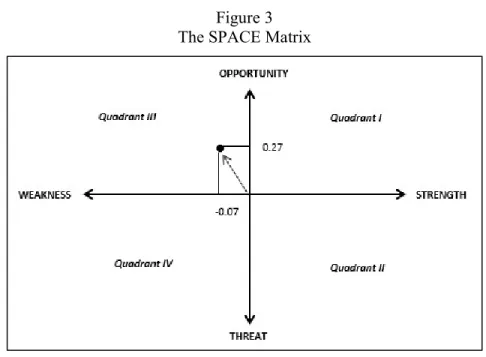
To determine the position of the development strategy, SPACE (Strategic Position and Action Evaluation) Matrix is then created. With this matrix, a development strategy can be indicated whether using an aggressive, conservative, defensive, or competitive approach (Rumanti & Syauta, 2013).
Position of Internal Factors Position of External Factors
Strengths = 1.32
94
Thus, the SPACE matrix for the position of the development strategy of Mengkapan Mangrove Ecotourism is as follows.
Figure 3 The SPACE Matrix
According to the SPACE Matrix, it can be seen that the point lies in quadrant III which means conservative. When a strategy lies in a conservative position, what must be done is to include market penetration, concentric diversification, product development, and market development (Rumanti & Syauta, 2013).
Conclusions
95 ACKNOWLEDGMENTS
The authors would like to express their sincere gratitude to LPPM Universitas Riau for the Dosen Muda Research Scheme Grant 2018.
REFERENCES
Hall, C.M., James, M. and Baird, T. (2011). Forests and trees as charismatic mega-flora: implications for heritage tourism and conservation. Journal of Heritage Tourism 6(4), 309–323.
Handriana, T. and Ambara, R. (2016). Responsible Environmental Behavior Intention of Travelers on Ecotourism Sites. Tourism and Hospitality Management, 22(2) 135-150.
Henri, Hakim, and Batoro. (2017). Ecotourism Development Strategy of Pelawan Forest in Central Bangka, Bangka Belitung. Journal of Indonesian Tourism and Development Studies, 5(3) 145-154
Karlina, E. (2016). Strategi Pengembangan Ekowisata Mangrove di Kawasan Pantai Tanjung Bara, Kutai Timur, Kalimatan Timur. Jurnal Penelitian Hutan dan Konservasi Alam, 12(2) 191-208
Mondal, M. S. H. (2017). SWOT Analysis and Strategies to Develop Sustainable Tourism in Bangladesh. UTMS Journal of Economics 8 (2): 159–167
Nurlena, N. and Musadad, M. (2019). The Development of Nostalgia Tourism in Yogyakarta, Indonesia. International Journal of Engineering & Technology, 8(1.9), 430-433
Rangkuti, F. (2009). Analisis SWOT: Teknik Membedah Kasus Bisnis. Jakarta: PT. Gramedia
RIPPDA Kab Siak 2012
Rumanti, A.A. and Syauta, K.J. (2013). Determining Strategies Based on Strategic Position Analysis in Small and Medium Enterprise. International Journal of Information and Education Technology, 3(4), 442-447
Simanjuntak, Suryanto, and Wijayanto. (2015). Development Strategy of Mangrove Tourism in Kemujan Island, Karimunjawa. Diponegoro Journal of Maquares, 4(1) 25-34
Swarbrooke, J. (2002). The development and management of visitor attractions, 2nd edn. Oxford: Butterworth Heinemann
Umam, Sudiyarto, and Winarno. (2015). Strategi Pengembangan Ekowisata Mangrove Wonorejo Surabaya. Jurnal AGRARIS, 1(1) 38-42