ISSN 2476-7611
15 *Corresponding Author. Mail. [email protected]
Tell: +989126946153
Numerical analysis of metal oxide nanoparticles effects on
permeability of hydraulic structures
Ali sheykhi Garousi1* Farinaz zamani2
1- master of civil Engieering, Islamic Azad University, Maragheh Branch, Maragheh ,Iran. 2- master of civil Engieering University of Samen, Razavi Khorasan ,Iran.
Received: 12, October, 2018 Accepted: 16, November, 2018 Online Published: 09, March, 2019
Abstract
The concrete permeability coefficient of the heavy water tank of nuclear reactors is very important in concrete structures of hazardous liquids tanks. Therefore, metal oxide nanoparticles effects on the permeability of hydraulic structures were numerically analyzed in this research. The experiments of this project and the obtained results were examined. In this project, 36 samples (18 cube samples and 18 cylindrical samples) for the control mixture design and more than 75 samples with different percentages of nanoparticles (0.5, 0.1, and 0.15% nano metal oxide) were prepared. The obtained results from the experiments showed that the permeability coefficient of concrete samples containing titanium nanoparticles reduced by increasing nanomaterial replacement percentage and reached to minimum in replacement of 0.1%. This is because using nanoparticles could fill the tiny and even nano-sized pores of concrete according to the tiny structure of concrete and presence of pores in nano size and reduce concrete permeability by providing the condensed structure.
Keywords: nanoparticles, metal oxide, permeability, hydraulic structures
1. INTRODUCTION
Attention and focus on nanoparticles performance have increased in many fields and one of the important parameters used in all types of concrete in hydraulic structures than the ordinary structures is its durability. Because concrete durability particularly exposed to water becomes significantly important. Concrete durability depends on the destructive reactions during the structure lifetime in the concrete structure. In addition, all of these reactions happen by permeating into the concrete in any way. In other words, concrete permeability control can increase concrete durability. Therefore, permeability and the effective factors on it must be studied to study the on concrete durability. Using nanoparticles in concrete and in the gap between aggregates and hydrated crystals make the concrete homogenous and filled. If nanoparticles are distributed in concrete mix design well, it can increase the concrete fluidity [1]. In addition, providing a proper mix design is so sophisticated based on execution condition for the sophistication in concrete behavior and its specifications caused by a change in the quality and quantity of the materials and dominant conditions of the problem. This sophistication is seen more by increasing the number of effective parameters on the problem such as bulk concrete [2]. Permeability and leakage both are the mentioned factors in the used concrete in hydraulic structures. Permeability is defined as a permeated water volume moving along the concrete in the specific time. Permeability depends on the size and amount of pores and micro and capillary cracks in the external layers. The main difference between the permeability and leakage is a water stream mechanism [3]. Wen water head determines the water stream in permeability, capillary forces have a very important role in leakage. Capillary action is a material ability to extract another material from its inside.
Capillaries are formed during processing. They are unwanted thin tubes staying after the evaporation of the concrete extra water. The existence of porosity in the concrete is determinant because water and various chemical materials move inside or outside through this porosity. Some pores have a high concentration of the alkaline hydroxide solution [4]. Pores insides are filled by such solutions in some specific conditions fully. Bigger pores are usually empty particularly the ones near the concrete level and are exposed to evaporation or the concretes with a low ratio of water to cement ratio (w/c) [5].
Studies have shown that adding nanoparticles of metal oxides such as SiO2, Fe2O3, TiO2, and Al2O3 to cement mortar can improve the concrete mechanical properties [6]. This is for the high ratio of surface to volume [7-10].
16
2. LITERATURE
Li et al. (2018)examined the preparation and mechanical properties of nano alumina composites and reported that using nanomaterials in the concrete changes and improves compressive and tensile strength, concrete strength for time variation, and accelerates the speed of resistance [1]. Monteiro et al. (2009) concluded in their research that Pozzolan reaction rate depends on the accessible surface for a reaction. Nano silica provides the essential ability for Pozzolan reaction for having a high specific surface. Therefore, adding a little amount of this material significantly increase the compressive and tensile resistance of light concrete. Studying SEM images also shows the consistency and density of most nano-SiO2 samples compared to the control sample [2]. Khoshakhlagh et al. (2012) tested the effects of Fe2O3 nanoparticles on the permeability and evaluation of high self-compacting strength concrete. Results of this research showed that resistance and permeability of the concrete samples improved by adding Fe2O3 nanoparticles to the cement mortar up to 4% [3]. Maria et al. (2010) reported in their research that the significant mechanical properties of carbon nanotubes make them ideal candidates to use in the cement composites with high performance. The effective distribution of multi-walled carbon nanotubes with various lengths is done by ultrasonic energy in water [4]. Meng et al. (2012) in their research studied the effect of nano particles on the mechanical specification of cement mortar. The test results showed when titanium nanoparticles are replaced by cement the mortar strengths increases allot in initial ages. It explicitly reduces the fluidity and strength of mortars in older ages. The compressive strength of cement mortar containing 5% or 10% by weight of cement increases by about 45%. [5]. Lu et al. (2017) showed in their research that Montmorillonite is mostly used as a filler or reinforce in polymer-clay nanocomposites. However, hydrophilic montmorillonite microparticles can’t be used directly as a concrete reinforcement because the absorbed water in interlayers and silicate layers expand significantly. Therefore, they can be used to modify the microstructure and mechanical properties of cement and concrete mortar [6]. Riyahi and Nazari (2011) tested the thermal and mechanical properties of concrete including nanoparticles in different treatments, in this test, nanoparticles with mean size of 15 nm were relatively replaced by Portland cement, and samples are processed in water and lime water for various ages. The results showed that the processed samples in the saturated line water with nanoparticles up to 2% can improve the compressive strength and stiffing time of the produced concrete [7]. Moreover, Riyahi and Nazari (2011) examined the effect of nanoparticles on measuring the concrete permeability and strength in various treatment conditions. In this test, nanoparticles with mean size of 15 mm were relatively replaced by Portland cement and treated in water and saturated lime water for specific ages [8]. Nazari and Riyahi (2012) reported that having tiny size as added nano materials to the
concrete are the filler of the existed spaces in the concrete. This action of nanoparticles reduces the concrete efficiency. The results show that using superplasticizers and slag powders in the cement mortar is useful to modify the fluidity and strength of cement mortar including , , , , and nanoparticles because the superplasticizers have the properties of distributive properties [9]. Zang et al. (2015) studied the effect of nano-silica slurry to modify recycled aggregate concrete (RAC). RAC was used in three beams in a real project with the natural aggregate concrete (NAC), modified and non-modified RAC. The useful effect of the nano-silica slurry was licensed on RAC mechanical properties. It was shown in the supervision of in situ pressure in light of goa for RAC cracks after modification that the strength has improved [10]. In Negahdari et al. (2015) research, the effect of lime water was examined on the strength and water absorbed percentage of the mixed nanoparticle. Portland cement was replaced by various amounts of nanoparticles with mean size of 15 nm, and samples were treated in water and saturated lime water in the specific ages. Concrete with advanced strength and permeability was produced using nanoparticle up to 2% [8]. The results show that samples including nanoparticles have a significantly higher strength in all treating ages than the ordinary samples without nanoparticles. A part of the replaced cement by nanoparticles reduced the water absorption percentage in concrete samples [13]. Jee (2018) examined the strength behavior against water permeability and micro structure of the concrete containing nano in his research using water permeability test on samples with 28-day strength and showed that the presence of nano improves the concrete strength against the water permeability. In addition, results of ESEM test showed that concrete micro structure of nano structure has more uniformed and compact structure than the ordinary ratios [14]. Sanfa et al. (2013) in their research defined the formulation of mortars with nanoparticles based on the rheology and measurement of flow table to reduce pollutants in and structures. This shows the proper efficiency of the mortar. The maximum permitted amount of additives to the cement mortars is limited when the ratio of superplasticizers and water to cement ratio is constant [14].
3. CONSUMED MATERIALS
17
wavelength (400-700nm). Thus, these particles are not able to reflect the visible light. When the produced nanoparticles have a tiny size, the absorbed wavelength is a function of particles size [12].
Titanium dioxide
The structure of the used Tio2 in all samples of this
project were bought from Pishgaman Nano Mavade Iranian Co. whose physical and chemical properties are shown in table 1&2.
Table 1: chemical compounds of TiO2 nanoparticles
Table 2: physical properties of TiO2 nanoparticles
Tio2 Oxide (Tio2, 80 vol% anatase + 20 vol% rutile)
Purity%
Nanoparticles size Specific surface area Weight reduction percentage by drying Weight reduction percentage by combustion
99+% 20 nm 10 – 45 m2/gr 0.48% 0.99%
Appearance White powder
ZnO nanoparticle
ZnO nanoparticle is one of the highly used minerals mentioned by researchers for its physical and chemical properties. The specific properties of ZnO nanoparticles include high chemical stability, low dielectric constant, high catalytic activity, absorption of red and ultraviolet light and, most importantly, antibacterial properties.
Consumed cement
The used initial materials to produce Type II cement of Sufian Cement Factory is shown in comparison to the standard cement.
The used water in fabricating the samples of this project was from urban water supply network concrete laboratory of Tabriz University.
Consumed cement: the standardized consumed cement is based on ASTM standard and publication 302. The used cement aggregation in the dissertation is in accordance with Table 3.
Table 3: The used cement aggregation in the project
Water to cement ratio and metal oxide nanoparticles: samples were considered as following in this research in mix design.
Water to cement ratio: 1-W/C= 0.45:1 2-W/C=0.48 3-W/C=0.54:3
Metal oxide nanoparticle replacement percentage: 1- replacement%= 0.05%
2- replacement%=0.1% 3- replacement%=0.15%
The rock materials were as following to examine the specification and properties of the various tests of rock materials on the selected aggregates: The density of each of the coarse-grained and fine-grained materials in the SSD state and in dry state was measured using existing standards and their values were determined:
Testing gravel value
Gravel value was tested on three selected samples for the mix design of samples, and the following results were obtained:
Sample 1: S.E= 94% Sample: S.E= 93.5% Sample 3: S.E=94.5%
And totally, value of the mixed gravel based on the mean of three samples was considered 94%.
Coarse-rock material (aggregate)
The only choice of preparing the materials was by the province aggregate production factories. Various samples were prepared from various factories of the province in this research and were transferred to the laboratory. After granulation tests and essential tests to determine the quality of the materials, the washed river aggregate of Tabriz Anbia mine were selected and used.
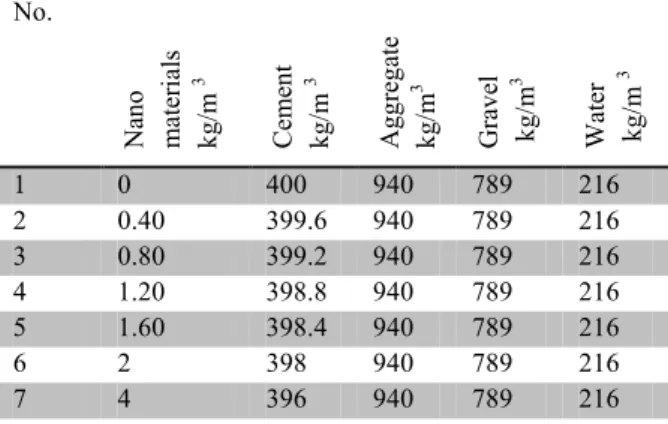
Mix design of the concrete samples (Table 4)
The concrete samples were combined based on ACI211 regulation by weight method. In this research, the cement grade is 400 kg/m3. The ratio of coarse to
fine rock materials is 1:1. The biggest size is 19 mm and the total weight of the mixture is 2345 kg/m3. Table 4 shows the mix design of the concrete samples with w/c=0.54 as an example.
Table 4: mix design of the concrete samples with w/c=0.54 No. Na no m ateria ls kg /m 3 Ce m en t kg /m 3 Ag gre ga te kg /m 3 Gra ve l k g/m 3 Wate r k g/m 3
1 0 400 940 789 216
2 0.40 399.6 940 789 216
3 0.80 399.2 940 789 216
4 1.20 398.8 940 789 216
5 1.60 398.4 940 789 216
6 2 398 940 789 216
7 4 396 940 789 216
18
8 4.4 395.6 940 789 216
The order and manner of cobcrete sample mix is based on ASTMC192 standard [15-17]. Table 5 and table 6 shows the samples mx design with three various water ratios of water to cement
Table 5: zinc oxide samples mix design
Table 6: titanium oxide samples mix design
The following samples are broken down under the hydraulic jack and the final load is recorded on them. The final strength is obtained by division of the final load on the sample cross section.
A
P
(1)
P: the applied load on the sample A: the sample cross section and
is compressive stressConcrete permeability test
Permeability coefficient is the concrete characteristics to obtain the proper information about the microstructure and quality of concrete. The surface coverage of the concrete is the first priority of the concrete structures that protect the armatures from corrosion. Therefore, the surface area is exposed to oxygen gas, carbonic gas, and water from the armature corrosion view. Permeability of carbonic gas and water fluids changes the concrete structure. Thus, the test is not repeatable for this two. It seems that oxygen gas is the most proper fluid to test the concrete permeability.
As measurement system, samples were put inside the permeability measurement system and oxygen valve is opened, and the pressure is adjusted by the pressure regulator ( 6 atm). Then the exhaust gas from the capsule with the specified discharge to hit the bottom to the test samples and the amount of gas outflow from the test samples is recorded by the bubble flow measurement system [14]:
kth
d
2
(3-3)In which,
: concrete porosity t= pressure applying time k= permeability coefficient h= equal height to water column d= read permeability depthPermeability tests against water
The fabricated concretes now for the hydraulic projects have low permeability and conduction of this test and k determination is not possible directly. Therefore, it is tried to measure the water permeability depth in this test and obtain k value which is not so reliable by a series of empirical relations(Table 7).
Table 7: division of concrete non-permeability quality based on water permeability coefficient [7]
Co
nc
re
te
non
-pe
rm
ea
bil
it
y
co
efficie
nt
Ve
ry
we
ak
Wea
k
m
ed
iu
m
Go
od
ve
ry
g
oo
d
Ex
ce
ll
en
t
pe
rm
ea
bil
it
y
co
efficie
nt
(
m
/s)
m
ore
th
an
10
-6
10
-6 -10
-7
10
-7 -10
-8
10
-8 -10
-9
10
-9 -10
-10
les
s th
an
10
-10
Permeability coefficient test row Zinc oxide
nanoparticle replacement %
Water to cement
ratio
1 0 0.48
2 0 0.54
3 0 0.60
4 0.05 0.48
5 0.05 0.54
6 0.05 0.60
7 0.1 0.48
8 0.1 0.54
9 0.1 0.60
10 0.15 0.48
11 0.15 0.54
12 0.15 0.60
row titanium oxide nanoparticle
replacement %
Water to cement ratio
1 0 0.48
2 0 0.54
3 0 0.60
4 0.05 0.48
5 0.05 0.54
6 0.05 0.60
7 0.1 0.48
8 0.1 0.54
9 0.1 0.60
10 0.15 0.48
11 0.15 0.54
19
75 cylindrical samples were prepared in 5*15 cm dimensions (3 samples for every 3 ratios of water to cement for each of the nano-oxide ratios of titanium and zinc oxide for each of the ages of 7 and 28 days) to test the permeability coefficient of various concrete mixtures. The mean of 3 obtained coefficient for each ratio of water to cement was recorded 045 as the mix design strength. This article shows the results of mix design with water to cement ratio of 0.45 that was better than the results of other compressive strength. The obtained results from tests are shown in table 8 and 9.
Table 8: results of concrete samples permeability coefficient with zinc oxide
Design code Control 0.05 0.1 0.15
28-day permeability
coefficient (m/s) 9*10
-15
7.
2*
10
-15
5.
8*
10
-15
3.
21
*1
0
-15
7- day permeability
coefficient (m/s) 8.7*
10
1
6.
72
*1
0
1
5.
15
*1
0
1
3.
61
*1
0
1
Table 9: results of concrete samples permeability coefficient with titanium oxide
Design code Control 0.05 0.1 0.15
28-day permeability coefficient (m/s)
8.
9*
10
-15
3.
11
*1
0
-16
3.
3*
10
-16
3.
79
*1
0
-16
7- day permeability
coefficient (m/s) 8.6*
10
1
3.
21
*1
0
-15
3.
86
*1
0
-15
3.
92
*1
0
-15
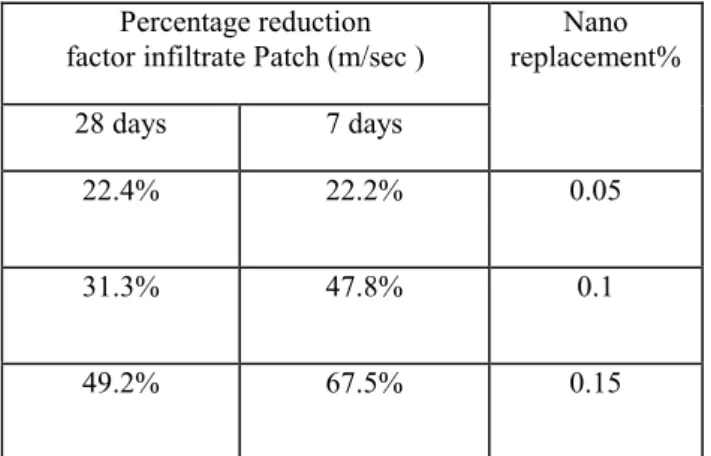
Table 10 shows the permeability coefficient reduction percentage than the control sample. In this relation, shows permeability coefficient reduction percentage of concrete samples. The obtained numbers in this table are calculated and recorded using formula (1).
(1)
Table (10): permeability coefficient reduction percentage of concrete samples containing zinc oxide
Percentage reduction factor infiltrate Patch (m/sec )
Nano replacement%
28 days 7 days
22.4% 22.2% 0.05
31.3% 47.8% 0.1
49.2% 67.5% 0.15
Table (11): permeability coefficient reduction percentage of concrete samples containing titanium
oxide Percentage reduction
factor infiltrate Patch (m/sec ) replacement% Nano
28 days 7 days
21.2% 21.45% 0.05
30.4% 46.8% 0.1
48.1% 66.3% 0.15
It is concluded based on table 11 that the permeability coefficient of concrete samples containing titanium reduced by replacing the nanomaterials and reached to minimum level by replacing 0.1%. Because using the nanoparticles could fill the very tiny porosities of the concrete event in the nano size according to the micro structure of concrete and existence of pores in nano size and reduces the concrete permeability by making the condensed structure. However, replacing more than 1% nanoparticles has a negative effect on the concrete mechanical strength according to the results of tables. Because the extra replacement of nanoparticles more than the optimum level changes these particles into mass inside the concrete and makes pores inside the cement which negatively influence on the concrete permeability.
3. CONCLUSION
20
projects that concrete permeability coefficient is very important is the concrete fabricated by water to cement ratio of 0.45 and 0.1% of metal oxide nanoparticles. It was observed from the tests and obtained results for the concrete compressive strength that the concrete samples fabricated by water to cement ratio of 0.45 and 0.1% metal oxide nanoparticles have more compressive strength than the other mix designs because of the following reasons: metal oxide nanoparticles react with calcium hydroxide and as a result, this reaction produces a dense C-S-H gel that causes the concrete to be condensed and thus improves the properties of the ordinary concrete. According to the very high specific surface area of metal nanoparticles and so very high surface energy, the metal nanoparticles act like an atom core and make a strong adhesion with the hydrated cement. As a result, the hydration process will continue and compressive strength will increase for the high reactivity of metal oxide nanoparticles. It is suggested based on the results of this article to use 0.1% cement weight replacement by metal oxide nanoparticles in concrete mix design in structures of Hazardous liquid reservoirs and heavy water reservoirs of atomic reactors that the low permeability coefficient of concrete is very important. 0.1% cement weight is replaced by metal oxide nanoparticles in concrete mix designs in concrete structures such as public shelters, trenches, and structures that have concrete mechanical strength (tensile and compression) more important than concrete permeability. Eventually, it is suggested to use metal oxide nanoparticles on the concrete properties near the chemical materials and in alkaline and acidic environments.
FUNDING/SUPPORT
Not mentioned any Funding/Support by authors. ACKNOWLEDGMENT
Not mentioned.
AUTHORS CONTRIBUTION
This work was carried out in collaboration among all authors.
CONFLICT OF INTEREST
he author (s) declared no potential conflicts of interests with respect to the authorship and/or publication of this paper.
References
1. Negahdary, M., Chelongar, R., Zadeh, S. K., & Ajdary, M. (2015). The antioxidant effects of silver, gold, and zinc oxide nanoparticles on male mice in in vivo condition. Advanced biomedical research, 4. [Scholar]
2. Monteiro, P. J., Kirchheim, A. P., Chae, S., Fischer, P., MacDowell, A. A., Schaible, E., & Wenk, H. R. (2009). Characterizing the nano and micro structure of
concrete to improve its durability. Cement and
Concrete Composites, 31(8), 577-584. [Scholar]
3. Khoshakhlagh, A., Nazari, A., & Khalaj, G. (2012). Effects of Fe2O3 nanoparticles on water permeability and strength assessments of high strength self-compacting concrete. Journal of Materials Science &
Technology, 28(1), 73-82. [Scholar]
4. Konsta-Gdoutos, M. S., Metaxa, Z. S., & Shah, S. P. (2010). Multi-scale mechanical and fracture characteristics and early-age strain capacity of high
performance carbon nanotube/cement
nanocomposites. Cement and Concrete
Composites, 32(2), 110-115. [Scholar]
5. Meng, T., Yu, Y., Qian, X., Zhan, S., & Qian, K. (2012). Effect of nano-TiO2 on the mechanical properties of cement mortar. Construction and
Building Materials, 29, 241-245. [Scholar]
6. Lu, Z., Dai, J., Song, X., Wang, G., & Yang, W. (2008). Facile synthesis of Fe3O4/SiO2 composite nanoparticles from primary silica particles. Colloids and Surfaces A: Physicochemical and Engineering
Aspects, 317(1-3), 450-456. [Scholar]
7. Riahi, S., & Nazari, A. (2011). Physical, mechanical and thermal properties of concrete in different curing media containing ZnO2 nanoparticles. Energy and
Buildings, 43(8), 1977-1984. [Scholar]
8. Bittnar, Z., Bartos, P. J., Nemecek, J., Smilauer, V., & Zeman, J. (Eds.). (2009). Nanotechnology in Construction: Proceedings of the NICOM3. Springer Science & Business Media. [Scholar]
9. Livingston, R. A. (2006). Neutron scattering methods for concrete nanostructure characterization. In Nanotechnology in construction: proceedings of the
NICOM2 (2rd international symposium on
nanotechnology in construction). RILEM Publications
SARL (pp. 115-24). [Scholar]
10. Nazari, A., & Riahi, S. (2011). The effects of Cr2O3 nanoparticles on strength assessments and water permeability of concrete in different curing media. Materials Science and Engineering: A, 528(3), 1173-1182. [Scholar]
11. Björnström, J., Martinelli, A., Matic, A., Börjesson, L., & Panas, I. (2004). Accelerating effects of colloidal nano-silica for beneficial calcium–silicate–hydrate formation in cement. Chemical Physics Letters, 392(1-3), 242-248. [Scholar]
12. Shah, S. P., Konsta-Gdoutos, M. S., Metaxa, Z. S., & Mondal, P. (2009). Nanoscale modification of cementitious materials. In Nanotechnology in Construction 3 (pp. 125-130). Springer, Berlin, Heidelberg. [Scholar]
13. Sanchez, F. (2009). Carbon nanofibre/cement composites: challenges and promises as structural materials. International Journal of Materials and
21
14. Najigivi, A., Khaloo, A., & Rashid, S. A. (2013). Investigating the effects of using different types of SiO2 nanoparticles on the mechanical properties of binary blended concrete. Composites Part B:
Engineering, 54, 52-58. [Scholar]
15. ASTM C192/C192M. (2012). Standard practice for making and curing concrete test specimens in the laboratory. [Scholar]
16. Alimoradi, S., Hable, R., Stagg-Williams, S., & Sturm, B. (2017b). Strategies to Maximize P Recovery and Minimize Biochar Formation from Hydrothermal Liquefaction of Biomass. Proceedings of the Water Environment Federation, 2017(3), 529-536.[Scholar]
17. Alimoradia, S., Stohr, H., Stagg-Williams, S., & Sturm, B. (2018). Effect of temperature on recalcitrant dissolved organic nitrogen (rDON) concentration: Application of thermochemical treatment of biosolids. Proceedings of the Water Environment Federation, 2018(14), 2093-2099. [Scholar]
![Table 7: division of concrete non-permeability quality based on water permeability coefficient [7]](https://thumb-us.123doks.com/thumbv2/123dok_us/8078981.2140400/4.892.117.402.591.920/table-division-concrete-permeability-quality-based-permeability-coefficient.webp)