ANALYSIS ON
PROMOTION AND THE
INFLUENCE OF
SOCIAL
M
EDIA INR
ESTAURANTI
NDUSTRY, U
BUD, B
ALI, I
NDONESIAKomang Ratih Tunjungsari, Putu Eka Wirawan Sekolah Tinggi Pariwisata Bali Internasional (STPBI) [email protected], [email protected]
ABSTRACT
The activities of promotion can be varied nowadays as the Internet technology has been developed to get information in real time. Digital promotion, such as from website and social media, is common to use to promote product and services, such as food and beverages in the restaurant including the services. The restaurant industry in Ubud has been growing since the start of the tourism in Ubud, Bali. Moreover, the promotion activities also need to be enhanced due to development of the technology. This research will discuss further the analysis of promotion and the influence of social media to influence the decision-making process of the customers to eat food in Ubud. The aim of this research was to investigate the marketing trend in promoting restaurant in Ubud. Besides, the author aimed to find the relation between the use of social media for the restaurant to influence the decision-making process of the customers to find food in Ubud. Since Ubud is a touristic area in Bali, Indonesia, the competition of the restaurant industry should have the attention of the restaurants’ owners and managers. This research used descriptive analysis method to answer the research questions and collecting both secondary and primary data through literature review, observation, interview, and questionnaires. Based on our research, we found that digital promotion, such as social media marketing through social networks (Instagram, Facebook, Tripadvisor, and Website) could enhance the number of the customers in restaurants in Ubud.
INTRODUCTION
Since tourism development in Bali blooms, the tourist accommodation and other amenities established to support the tourism and hospitality industry in Bali. Tourism is one of the productive sectors in contributing the GDRP in Bali. As it is found by Ghani et.al (2013, p. 14), that the Trade, Hotel and Restaurants counted as the largest contributors for Gross Domestic Regional Product (GDRP) about 29% and followed by agricultural, livestock, forestry and fishery then services, finances and other sectors. Ubud is one of the sub-districts in Gianyar regency, that is assigned as one of the touristic places in Bali and very famous for its artists and its palace. Ver Berkmoes et.al. (n.d, p. 312) described Ubud as a place which offers good restaurants and café combined with workshop of local artists and provide some ancient temples, ancient villages with preserved rice fields.
LITERATURE REVIEW Promotion
According to Kotler and Armstrong (2014), marketing mix is blending the marketing tools to response the need of the market and it consists of 4 (four) P’s namely, product, price, place and promotion. Dang (2014) said that to promotion is the way to increase the consumer’s awareness about product, increasing the sales, and creating brand loyalty. Kotler et. al (2013) said that promotion deals with the ways of communicating the product to customers and attract them to involve the decision-making process to purchase the product. There are several promotions activities mentioned in, such as personal selling, advertising, sales promotion, collateral materials tools, direct marketing, interactive online promotion (such as web, digital media and social media), events and experiences and public relations.
Kotler et. al in Puumala and Heliste (2014) cited the term of digital marketing is the management and execution of marketing using electronic devices and digital media such as web, email, interactive TV, wireless media, mobile technology or any digital media, in conjunction with digital data from a range of databases and software applications. According to National Restaurant Association in US (2014, p.28), marketing goes digital and targeting customer should be differed by the ages. The ages 18-34 years old the group of ages who are the most receptive to social media marketing and electronic marketing.
Social Media
up into promising service tools for marketing managers in developing long-term trust for their brands.
According to Stelzner (2013), there are two major findings of the relation between the social media and marketers. First, social media is indicated important for their business agreed by the 86% of the marketers in 2013. Second, reasoning the first finding above, about 88% of marketers want to know the most effective social media to be applied as one of the strategies to engage with their customers. According to a study by Euromonitor (2014), social media and social networks are very popular in Indonesia especially Facebook with more than 63 million accounts and Twitter within 29 million active users in 2013. Other types of social media sites are Instagram and Path that gained popularity among high-income urbanites (Euro monitor, 2014).
AIDA Model
The abbreviations of AIDA consists of several words namely, attention, interaction, desire and action. According to Rofiq, Arifin and Wilopo (2012), the term of attention means a marketer should understand to attract people’s attention with a powerful words or image. According to Amstrong, and Kotler (2001), there are three elements that should be fulfilled to get people’s attention from the words or the picture, such as meaningful, believable and distinctive. Interests is a step when a marketer enable to create attractiveness of the information media by explaining the benefit and new innovation of the product that might see as uniqueness of the product. Desire is when the customers willing to have the products, and as a marketer already targeted the customers to create the need to buy for the customers. Action is the last step to decide the customer want to buy the product. (Rofiq, Arifin and Wilopo, 2012, p. 2-3).
Restaurants Industry in Ubud
need of the tourists to survive in the high competition of the restaurant industry. It is also described previously in the Introduction section about the number of the visitors to Ubud increase since 2009. Moreover, the number of the restaurant also grows from 343 restaurants in 2013 into 355 restaurants in 2014. It can be concluded that there are 12 restaurants built in one year and the number of the restaurants in Ubud showing competitiveness in the restaurant industry to target the market.
METHODOLOGY
Data collection instruments or research instruments means the techniques or tools used to collect data such as observation, questionnaires, and interview (Fitzpatrick and McCarthy (2016). Firstly first, authors discuss promotion then continued into following descriptions of AIDA model applied in the promotion activities in social media. Lastly, promotion in social media activities involves the decision-making process of customers to visit the restaurant in Ubud, as it is shown the flowing chart of research framework in Figure 1 below.
This study will use both of these two types of data collection in which will be specified below. Primary data can be achieved through several methods, such as sampling procedures, exploratory methods, survey methods and observation (Pride et. al, 2012). While Saunders, Lewis and Tornhill (2012) explained types of secondary data generally for examples; documentary (text and non-text), survey (censuses, continuous or regular surveys, ad hoc surveys), and multiple sources (snapshot and longitudinal).
the respondents who already experienced dining in restaurant in Ubud and using social media as the influencer to go to restaurant in Ubud. Furthermore, authors also use interview with the restaurant’s management to answer the first research question.
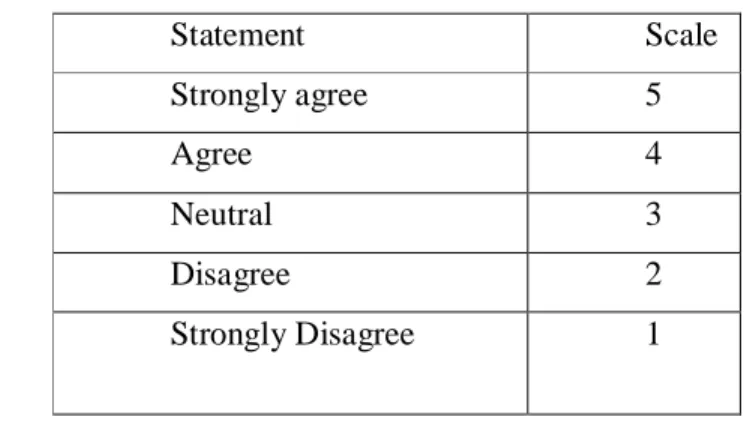
Table 1. Lykert scale
Statement Scale
Strongly agree 5
Agree 4
Neutral 3
Disagree 2
Strongly Disagree 1
FINDINGS AND DISCUSSION
According to the first research question about the analysis strategy, that held through observation and interview with the management of the restaurant in Ubud. There are 15 restaurants in Ubud (Tropical Seafood, Café Vespa, Casa Luna, Hujan Locale, Coffee Bali Harum, Toro Sushi, Warung Madu, Warung Barbeque Iga and Bebek, Urbana Restaurant, Café Bunute, Batanwaru Café, Bollero Restaurant, Sawah Indah Restaurant, D’Alas Restaurant and Kedai Ramen) interviewed previously regarding about the type of the offline promotion strategy and online promotion strategy. Among all of social media, Facebook has been the most frequently used by the restaurant to promote their product has been answered by 9 restaurants out of 15 restaurants. Besides, Instagram also gained attention from 7 restaurants since it is said the customers get easier to check the location of the restaurant and see the ambiance of the restaurant.
restaurant industry in Ubud still applies traditional promotional strategy via off-line promotion strategy such as cooperating with travel agent and guide still chosen by the restaurants’ management. Besides, spreading brochures, name card and approaching the travel guide also become several ways to connect with the customers.
Table 2. Results of Demographic and the Uses of Social Media N
o.
Statements Number of
Respondents
1 Ages
18-22
15
23-27
13
28-32
6
>37 yo
1
2. Gender
Male
19
Female
17 3. Frequently used Social media by Respondents
1
Path
1
20
24 4. Social Media Used by the Restaurants in Ubud
9
1
5. Respondents using social media to find references in Ubud
Yes, (including TripAdvisor)
30
No
6
6. Social Media used by the Respondents to find restaurant references in Ubud
31
5
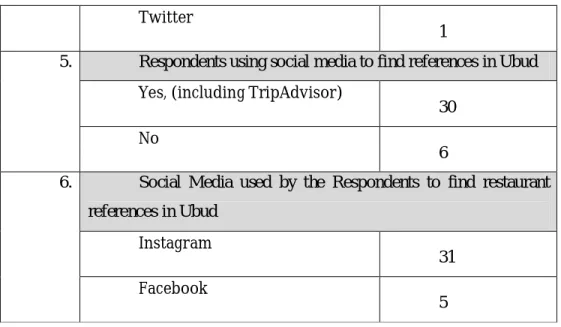
Table 2 shows us the demographics of the respondents and the utilization of the social media in promoting restaurant industry in Ubud. Mostly, the ages of the respondents are in productive ages between 18 years old until 32 years old, only one respondents’ ages 37 years old. From the total 36 (thirty-six) respondents, 19 (nineteen) respondents are males and the rest 17 (seven teens) are females. The result shows the number of social media that use frequently by the respondents is Facebook about 24 respondents and 20 respondents choose Instagram, while the others choose Path and Twitter. The Table 3 below describes less than 10% of the name of restaurant in Ubud that has been visited by the respondents and own social media to communicate the restaurants’ product (service and goods).
Table 3. Restaurant’s with Social Media Visited by Respondents
Restaurant in Ubud
Number s
1. Nasi Ayam Kedewatan 2
2. Babi Guling Ibu Oka 2
3. Bebek Tepi Sawah 6
5. Café Pomegranate 1
6. Casa Luna 1
7. Copper Ubud 1
8. Clear Café Ubud 1
9. Hujan Locale 3
10. Kakiang Bakery 2
11. Locavore 1
12. Moksa 1
13. Nuris 1
14. Pizza Bagus 4
15. Pundi Restaurant 1
16. Rondji Restaurant 2
17. Pulau Kelapa 3
18. Swept Away 2
19. XL Shisa Lounge 1
About 80.6% (30 respondents) agree to use social media to find reference to restaurants in Ubud. However, about 16.7% (6 respondents) choose not to use social media in searching place to eat in Ubud and the rest choose other. Surprisingly most of them using Instagram to explore the restaurants in Ubud and it is shown by 86.1% (31 respondents) of the respondents while the rest 13.9% (5 respondents) using Facebook to discover restaurant’s references in Ubud.
Answering the second research question, authors set questionnaires with 6 statements and before counting and classifying the results using a Likert scale, authors need to measure the interval of each score from one (1) the lowest until (5) the highest scores as it is shown below.
Score Minimum : (number of the respondents) x lowest score : 36 x
1 = 36
The interval = Score Maximum – Score Minimum
180 – 36 = 28.8
From the interval, then the authors divide the interval of the
score as shown below in Table 4. There are 6 (six) statements based on
the AIDA model according to the relevancy of social media within the
promotions definition. The result of the interval accounted 28.8 in each
score of the note.
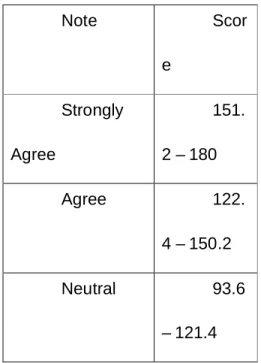
Table 4. Interval of the score
Note Scor
e
Strongly
Agree
151.
2 – 180
Agree 122.
4 – 150.2
Neutral 93.6
Disagree 64.8
– 92.6
Strongly
Disagree
36 –
63.8
It is shown in Table 5, most of the dimension of AIDA model ranged between the score classification in ‘agree’. For example, the first statement about attention says social media give information about the product of the restaurants in Ubud with the total score 135. It means the first statement can be included in the interval of the agreement. Moreover, the second dimension of interest in AIDA model, which are presented in the second, third and fourth question also shows the score of the interval ranged from 135, 133 and 136. The third dimension, interest, exposed in the fifth question and the interval scored in 134. Last dimension in AIDA model, action, shown in the sixth question about the decision-making process and the influence of social media to buy and eat food in the restaurant in Ubud, ranged in interval 126 and still classified as agreeing with the statement.
Nowadays, social media and marketing can be combined and create the term of Social Media Marketing (SMM). Neti (2011) believed that, SMM could help to grow the customer’s satisfaction through using social media as the interactive session within the customers by listening to their feedback whilst identifying the customers. Through SMM, the business organization could also identify the peer of a group that will be targeted as it could be adjusted.
companies, influencers, prospects and customers, using different kinds of online platforms. (Marketing Sherpa, 2009)
Table 5. The results of AIDA Statements
Statements
TOTA L
1. Social media give information about the product of the
restaurant in Ubud 135
2. The pictures shown in the restaurant’s social media
account are attractive 136
3. Social Media could create image of the restaurant’s brand 133 4. Social media account makes you easier to know
promotion information from the restaurant 136
5. The social media account could influence your appetite 134 6. Social Media influence your decision-making process to
buy food in Restaurant in Ubud? 126
Moreover, as written in Lee, Xiong and Hu (2012) Ellison believe that Facebook is a valuable platform to be used with highly interactive capabilities. According to Pellikka (2014) Instagram is a social media platform aimed towards, sharing pictures and short video clips within the locations as well. The pictures or video clips could be liked, commented and mentioned or popularized through #hashtag. Similarly to other social media platforms, the content uploaded by the SMM team can be shared to another service such as Facebook and Twitter. Through hashtag, it is very easy to find similar information from it is written in hashtag.
V. CONCLUSION AND SUGGESTION
social media that people can share the picture, location, comments and short video in the real time. It is should be considered for the restaurant industry to maintain their digital promotion to attract customers until influence their decision-making process to buy the product of the restaurant through AIDA model and optimizing the use of social media. Supporting by the growing restaurant industry in Ubud, it is necessary for the restaurant management to keep their promotion online. The awareness of social media marketing by the restaurants in Ubud could create competitiveness among the restaurants in Bali.
Since every social network (Facebook, Instagram, Twitter, Path and Tripadvisor) has their own ways to promote, the restaurants’ manager or the sales and marketing manager of the restaurant should utilize these social networks according to their own rule to obtain the targeted market. Segmenting the job description of each social network might be necessary to apply when the restaurant needs more network to promote the restaurants. For example in Facebook, the restaurant can create the fan page to communicate their new menu or their happy hour’s promo. The restaurants also can be promoted by differing their target in the sponsored publicity in Facebook. Whereas Instagram, can attract beautiful pictures and attached the location and hashtag to make the most recognized worldwide.
REFERENCES
[1] Armstrong, G. and Kotler, P. (2001). Prinsip-prinsip pemasaran jilid 1 (Edisi Kedelapan). Jakarta: Erlangga.
[2] Berg, B. L. (2001). Qualitative research methods for the social sciences. United States: Allyn & Bacon.
[4] Burns, A.C and Bush, R.F. (2003). Marketing research applications (4th ed.). Hall: Pearson Prentice.
[5] Dang, T. (2014). The success of applying marketing mix 4s in vietnamese dairy industry: vinamilk – a typical case. Degree Thesis. Arcada
[6] Euromonitor. (2014). Consumer lifestyle in Indonesia. Passport International.
[7] Fitzpatrick, J. J. And Mccarthy, G. (2016). Nursing Concept Analysis: Applications to research and practice. New York: Springer.
[8] Ghani, J., Mawardi, I., Rashdi, A., Van Garderen, G., Weisenberger, T. (2013). Microeconomics of Competitiveness: Bali Taste Paradise. Retrieved from http://www.isc.hbs.edu/resources/courses/moc-course-at-harvard/Documents/pdf/student-projects/Indonesia_Tourism_2013.pdf
[9] Hunt, T. (2009). The whuffie factor: using the power of social networks to build your business. New York: Crown Business.
[10] Khanlari, A. (2015). Strategic customer relationship management in the age of social media. USA : IGI Global.
[11] Kotler, P. and Armstrong, G. (2014). Principles of Marketing: global edition (15th ed.). Pearson Education Limited.
[13] Lee, W., Xiong, L., Hu, C. (2012). The effect of Facebook users’ arousal and valenve on intention to go to festival: Applying an extension of the technology acceptance model. International Journal of Hospitality Management, 3 (2012), 819-827.
[14] Marketing Sherpa (2009). Social media marketing & PR: benchmark guide. Retrieved from http://www.marketingsherpa.com/exs/SocialMM09excerpt.pdf
[15] Neti, S. (2011). Social Media and Its role in Marketing. International Journal of Enterprise Computing and Business Systems, 1 (2), 1-15.
[16] Nurjaya, I.W. (2011).Persepsi wisatawan mancanegara terhadap potensi pariwisata di Kelurahan Ubud, Kabupaten Gianyar. Thesis. Universitas Udayana.
[17] Pellikka, H. (2014). Gamification in social media. Master Thesis. University of Oulu, Oulu. 20 April 2014.
[18] Puumala, T. and Heliste, P. (2014). Social media marketing communications plan for a B2B company. Degree in International Business. Oulu University of Applied Sciences.
[19] Rofiq, A., Arifin, Z., and Wilopo. (2012) . Pengaruh penerapan AIDA (Attention, Interest, Desire, Action) terhadap keputusan pembelian. Universitas Brawijaya
[20] Stelzner, M.A. (2013). How marketers are using social media to grow
their business. Retrieved from
http://www.socialmediaexaminer.com/SocialMediaMarketingIndustryReport2 013.pdfaccessed, 03 November 2015.
[22] Snape, D. and Spencer, L. (2003). The foundations of qualitative research, in RITCHIE, Jane and LEWIS, Jane (eds). Qualitative Research Practice: a guide for social science researchers and students. Sage Publications, Ltd. London, 1-23.
[23] Veal, A. J. (2011). Research methods for leisure and tourism: A practical guide (4thed). Prentice Hall: England.
[24] Ver Berkmoes, R. et.al, (no date). Indonésie (4th ed.). Lonely Planet.
Retrieved fromhttps://wisuda.unud.ac.id/pdf/1012025032-2-bab%20i.pdf