The Unicode Standard
Version 8.0 – Core Specification
To learn about the latest version of the Unicode Standard, see http://www.unicode.org/versions/latest/. Many of the designations used by manufacturers and sellers to distinguish their products are claimed as trademarks. Where those designations appear in this book, and the publisher was aware of a trade-mark claim, the designations have been printed with initial capital letters or in all capitals.
Unicode and the Unicode Logo are registered trademarks of Unicode, Inc., in the United States and other countries.
The authors and publisher have taken care in the preparation of this specification, but make no expressed or implied warranty of any kind and assume no responsibility for errors or omissions. No liability is assumed for incidental or consequential damages in connection with or arising out of the use of the information or programs contained herein.
The Unicode Character Database and other files are provided as-is by Unicode, Inc. No claims are made as to fitness for any particular purpose. No warranties of any kind are expressed or implied. The recipient agrees to determine applicability of information provided.
Copyright © 1991–2015 Unicode, Inc.
All rights reserved. This publication is protected by copyright, and permission must be obtained from the publisher prior to any prohibited reproduction. For information regarding permissions, inquire at http://www.unicode.org/reporting.html. For information about the Unicode terms of use, please see http://www.unicode.org/copyright.html.
The Unicode Standard / the Unicode Consortium ; edited by Julie D. Allen ... [et al.]. — Version 8.0 Includes bibliographical references and index.
ISBN 978-1-936213-10-8 (http://www.unicode.org/versions/Unicode8.0.0/) 1. Unicode (Computer character set) I. Allen, Julie D. II. Unicode Consortium. QA268.U545 2015
ISBN 978-1-936213-10-8 Published in Mountain View, CA August 2015
9
Chapter 2
General Structure
2
This chapter describes the fundamental principles governing the design of the Unicode Standard and presents an informal overview of its main features. The chapter starts by placing the Unicode Standard in an architectural context by discussing the nature of text representation and text processing and its bearing on character encoding decisions. Next, the Unicode Design Principles are introduced—10 basic principles that convey the essence of the standard. The Unicode Design Principles serve as a tutorial framework for under-standing the Unicode Standard.
The chapter then moves on to the Unicode character encoding model, introducing the con-cepts of character, code point, and encoding forms, and diagramming the relationships between them. This provides an explanation of the encoding forms UTF-8, UTF-16, and UTF-32 and some general guidelines regarding the circumstances under which one form would be preferable to another.
The sections on Unicode allocation then describe the overall structure of the Unicode codespace, showing a summary of the code charts and the locations of blocks of characters associated with different scripts or sets of symbols.
Next, the chapter discusses the issue of writing direction and introduces several special types of characters important for understanding the Unicode Standard. In particular, the use of combining characters, the byte order mark, and other special characters is explored in some detail.
The section on equivalent sequences and normalization describes the issue of multiple equivalent representations of Unicode text and explains how text can be transformed to use a unique and preferred representation for each character sequence.
Finally, there is an informal statement of the conformance requirements for the Unicode Standard. This informal statement, with a number of easy-to-understand examples, gives a general sense of what conformance to the Unicode Standard means. The rigorous, formal definition of conformance is given in the subsequent Chapter 3, Conformance.
General Structure 10 2.1 Architectural Context
2.1 Architectural Context
A character code standard such as the Unicode Standard enables the implementation of useful processes operating on textual data. The interesting end products are not the charac-ter codes but rather the text processes, because these directly serve the needs of a system’s users. Character codes are like nuts and bolts—minor, but essential and ubiquitous com-ponents used in many different ways in the construction of computer software systems. No single design of a character set can be optimal for all uses, so the architecture of the Uni-code Standard strikes a balance among several competing requirements.
Basic Text Processes
Most computer systems provide low-level functionality for a small number of basic text processes from which more sophisticated text-processing capabilities are built. The follow-ing text processes are supported by most computer systems to some degree:
• Rendering characters visible (including ligatures, contextual forms, and so on) • Breaking lines while rendering (including hyphenation)
• Modifying appearance, such as point size, kerning, underlining, slant, and weight (light, demi, bold, and so on)
• Determining units such as “word” and “sentence”
• Interacting with users in processes such as selecting and highlighting text • Accepting keyboard input and editing stored text through insertion and deletion • Comparing text in operations such as in searching or determining the sort
order of two strings
• Analyzing text content in operations such as spell-checking, hyphenation, and parsing morphology (that is, determining word roots, stems, and affixes) • Treating text as bulk data for operations such as compressing and
decompress-ing, truncatdecompress-ing, transmittdecompress-ing, and receiving
Text Elements, Characters, and Text Processes
One of the more profound challenges in designing a character encoding stems from the fact that there is no universal set of fundamental units of text. Instead, the division of text into
text elements necessarily varies by language and text process.
For example, in traditional German orthography, the letter combination “ck” is a text ele-ment for the process of hyphenation (where it appears as “k-k”), but not for the process of sorting. In Spanish, the combination “ll” may be a text element for the traditional process of sorting (where it is sorted between “l” and “m”), but not for the process of rendering. In English, the letters “A” and “a” are usually distinct text elements for the process of render-ing, but generally not distinct for the process of searching text. The text elements in a given
General Structure 11 2.1 Architectural Context
language depend upon the specific text process; a text element for spell-checking may have different boundaries from a text element for sorting purposes. For example, in the phrase “the quick brown fox,” the sequence “fox” is a text element for the purpose of spell-check-ing.
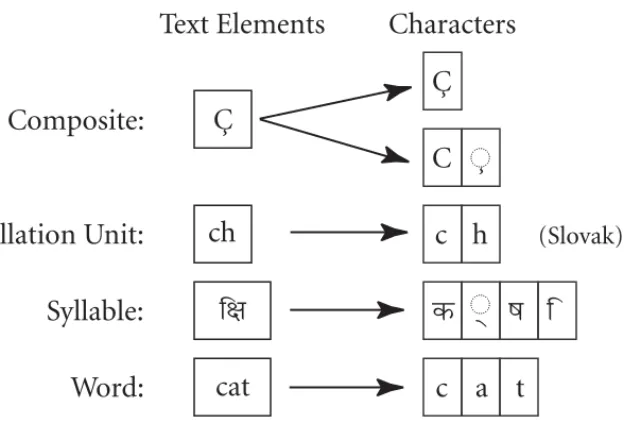
In contrast, a character encoding standard provides a single set of fundamental units of encoding, to which it uniquely assigns numerical code points. These units, called assigned characters, are the smallest interpretable units of stored text. Text elements are then repre-sented by a sequence of one or more characters.
Figure 2-1 illustrates the relationship between several different types of text elements and the characters used to represent those text elements.
The design of the character encoding must provide precisely the set of characters that allows programmers to design applications capable of implementing a variety of text cesses in the desired languages. Therefore, the text elements encountered in most text pro-cesses are represented as sequences of character codes. See Unicode Standard Annex #29, “Unicode Text Segmentation,” for detailed information on how to segment character strings into common types of text elements. Certain text elements correspond to what users perceive as single characters. These are called grapheme clusters.
Text Processes and Encoding
In the case of English text using an encoding scheme such as ASCII, the relationships between the encoding and the basic text processes built on it are seemingly straightforward: characters are generally rendered visible one by one in distinct rectangles from left to right
Figure 2-1.
Text Elements and Characters
Text Elements
Characters
Ç
ch
cat
C
¸
Ç
c
h
c a t
(Slovak)
Composite:
Collation Unit:
Syllable:
Word:
@
@
General Structure 12 2.1 Architectural Context
in linear order. Thus one character code inside the computer corresponds to one logical character in a process such as simple English rendering.
When designing an international and multilingual text encoding such as the Unicode Stan-dard, the relationship between the encoding and implementation of basic text processes must be considered explicitly, for several reasons:
• Many assumptions about character rendering that hold true for the English alphabet fail for other writing systems. Characters in these other writing sys-tems are not necessarily rendered visible one by one in rectangles from left to right. In many cases, character positioning is quite complex and does not pro-ceed in a linear fashion. See Section 9.2, Arabic, and Section 12.1, Devanagari, for detailed examples of this situation.
• It is not always obvious that one set of text characters is an optimal encoding for a given language. For example, two approaches exist for the encoding of accented characters commonly used in French or Swedish: ISO/IEC 8859 defines letters such as “ä” and “ö” as individual characters, whereas ISO 5426 represents them by composition with diacritics instead. In the Swedish lan-guage, both are considered distinct letters of the alphabet, following the letter “z”. In French, the diaeresis on a vowel merely marks it as being pronounced in isolation. In practice, both approaches can be used to implement either lan-guage.
• No encoding can support all basic text processes equally well. As a result, some trade-offs are necessary. For example, following common practice, Unicode defines separate codes for uppercase and lowercase letters. This choice causes some text processes, such as rendering, to be carried out more easily, but other processes, such as comparison, to become more difficult. A different encoding design for English, such as case-shift control codes, would have the opposite effect. In designing a new encoding scheme for complex scripts, such trade-offs must be evaluated and decisions made explicitly.
For these reasons, design of the Unicode Standard is not specific to the design of particular basic text-processing algorithms. Instead, it provides an encoding that can be used with a wide variety of algorithms. In particular, sorting and string comparison algorithms cannot
assume that the assignment of Unicode character code numbers provides an alphabetical ordering for lexicographic string comparison. Culturally expected sorting orders require arbitrarily complex sorting algorithms. The expected sort sequence for the same characters differs across languages; thus, in general, no single acceptable lexicographic ordering exists. See Unicode Technical Standard #10, “Unicode Collation Algorithm,” for the standard default mechanism for comparing Unicode strings.
Text processes supporting many languages are often more complex than they are for Eng-lish. The character encoding design of the Unicode Standard strives to minimize this addi-tional complexity, enabling modern computer systems to interchange, render, and manipulate text in a user’s own script and language—and possibly in other languages as well.
General Structure 13 2.1 Architectural Context
Character Identity. Whenever Unicode makes statements about the default layout behav-ior of characters, it is done to ensure that users and implementers face no ambiguities as to which characters or character sequences to use for a given purpose. For bidirectional writ-ing systems, this includes the specification of the sequence in which characters are to be encoded so as to correspond to a specific reading order when displayed. See Section 2.10, Writing Direction.
The actual layout in an implementation may differ in detail. A mathematical layout system, for example, will have many additional, domain-specific rules for layout, but a well-designed system leaves no ambiguities as to which character codes are to be used for a given aspect of the mathematical expression being encoded.
The purpose of defining Unicode default layout behavior is not to enforce a single and spe-cific aesthetic layout for each script, but rather to encourage uniformity in encoding. In that way implementers of layout systems can rely on the fact that users would have chosen a particular character sequence for a given purpose, and users can rely on the fact that implementers will create a layout for a particular character sequence that matches the intent of the user to within the capabilities or technical limitations of the implementation. In other words, two users who are familiar with the standard and who are presented with the same text ideally will choose the same sequence of character codes to encode the text. In actual practice there are many limitations, so this goal cannot always be realized.
General Structure 14 2.2 Unicode Design Principles
2.2 Unicode Design Principles
The design of the Unicode Standard reflects the 10 fundamental principles stated in
Table 2-1. Not all of these principles can be satisfied simultaneously. The design strikes a balance between maintaining consistency for the sake of simplicity and efficiency and maintaining compatibility for interchange with existing standards.
Universality
The Unicode Standard encodes a single, very large set of characters, encompassing all the characters needed for worldwide use. This single repertoire is intended to be universal in coverage, containing all the characters for textual representation in all modern writing sys-tems, in most historic writing syssys-tems, and for symbols used in plain text.
The Unicode Standard is designed to meet the needs of diverse user communities within each language, serving business, educational, liturgical and scientific users, and covering the needs of both modern and historical texts.
Despite its aim of universality, the Unicode Standard considers the following to be outside its scope: writing systems for which insufficient information is available to enable reliable encoding of characters, writing systems that have not become standardized through use, and writing systems that are nontextual in nature.
Because the universal repertoire is known and well defined in the standard, it is possible to specify a rich set of character semantics. By relying on those character semantics, imple-mentations can provide detailed support for complex operations on text in a portable way. See “Semantics” later in this section.
Table 2-1.
The 10 Unicode Design Principles
Principle Statement
Universality The Unicode Standard provides a single, universal repertoire. Efficiency Unicode text is simple to parse and process.
Characters, not glyphs The Unicode Standard encodes characters, not glyphs. Semantics Characters have well-defined semantics.
Plain text Unicode characters represent plain text.
Logical order The default for memory representation is logical order.
Unification The Unicode Standard unifies duplicate characters within scripts across languages.
Dynamic composition Accented forms can be dynamically composed.
Stability Characters, once assigned, cannot be reassigned and key properties are immutable.
Convertibility Accurate convertibility is guaranteed between the Unicode Standard and other widely accepted standards.
General Structure 15 2.2 Unicode Design Principles
Efficiency
The Unicode Standard is designed to make efficient implementation possible. There are no escape characters or shift states in the Unicode character encoding model. Each character code has the same status as any other character code; all codes are equally accessible. All Unicode encoding forms are self-synchronizing and non-overlapping. This makes ran-domly accessing and searching inside streams of characters efficient.
By convention, characters of a script are grouped together as far as is practical. Not only is this practice convenient for looking up characters in the code charts, but it makes imple-mentations more compact and compression methods more efficient. The common punc-tuation characters are shared.
Format characters are given specific and unambiguous functions in the Unicode Standard. This design simplifies the support of subsets. To keep implementations simple and effi-cient, stateful controls and format characters are avoided wherever possible.
Characters, Not Glyphs
The Unicode Standard draws a distinction between characters and glyphs. Characters are the abstract representations of the smallest components of written language that have semantic value. They represent primarily, but not exclusively, the letters, punctuation, and other signs that constitute natural language text and technical notation. The letters used in natural language text are grouped into scripts—sets of letters that are used together in writ-ing languages. Letters in different scripts, even when they correspond either semantically or graphically, are represented in Unicode by distinct characters. This is true even in those instances where they correspond in semantics, pronunciation, or appearance.
Characters are represented by code points that reside only in a memory representation, as strings in memory, on disk, or in data transmission. The Unicode Standard deals only with character codes.
Glyphs represent the shapes that characters can have when they are rendered or displayed. In contrast to characters, glyphs appear on the screen or paper as particular representations of one or more characters. A repertoire of glyphs makes up a font. Glyph shape and meth-ods of identifying and selecting glyphs are the responsibility of individual font vendors and of appropriate standards and are not part of the Unicode Standard.
Various relationships may exist between character and glyph: a single glyph may corre-spond to a single character or to a number of characters, or multiple glyphs may result from a single character. The distinction between characters and glyphs is illustrated in
Figure 2-2.
Even the letter “a” has a wide variety of glyphs that can represent it. A lowercase Cyrillic “Ò” also has a variety of glyphs; the second glyph for U+043F cyrillic small letter pe shown in Figure 2-2 is customary for italic in Russia, while the third is customary for italic in Ser-bia. Arabic letters are displayed with different glyphs, depending on their position in a
General Structure 16 2.2 Unicode Design Principles
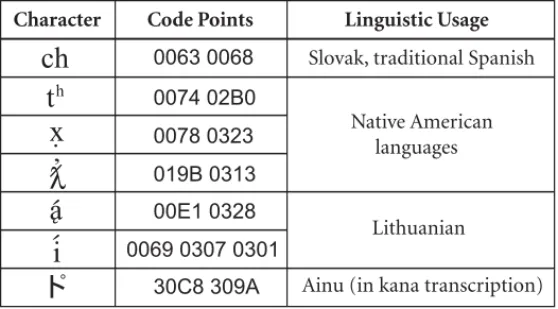
word; the glyphs in Figure 2-2 show independent, final, initial, and medial forms. Sequences such as “fi” may be displayed with two independent glyphs or with a ligature glyph. What the user thinks of as a single character—which may or may not be represented by a single glyph—may be represented in the Unicode Standard as multiple code points. See
Table 2-2 for additional examples.
For certain scripts, such as Arabic and the various Indic scripts, the number of glyphs needed to display a given script may be significantly larger than the number of characters encoding the basic units of that script. The number of glyphs may also depend on the orthographic style supported by the font. For example, an Arabic font intended to support the Nastaliq style of Arabic script may possess many thousands of glyphs. However, the character encoding employs the same few dozen letters regardless of the font style used to depict the character data in context.
A font and its associated rendering process define an arbitrary mapping from Unicode characters to glyphs. Some of the glyphs in a font may be independent forms for individual
Figure 2-2.
Characters Versus Glyphs
Table 2-2.
User-Perceived Characters with Multiple Code Points
Glyphs
Unicode Characters
U+0041
latin capital letter a
U+0066
latin small letter f
+ U+0069
latin small letter i
U+0061
latin small letter a
U+0647arabic letter heh
U+043F
cyrillic small letter pe
0063 0068 0074 02B0 0078 0323 019B 0313 00E1 0328 0069 0307 0301 30C8 309A Native American languages Lithuanian
Ainu (in kana transcription) Slovak, traditional Spanish
General Structure 17 2.2 Unicode Design Principles
characters; others may be rendering forms that do not directly correspond to any single character.
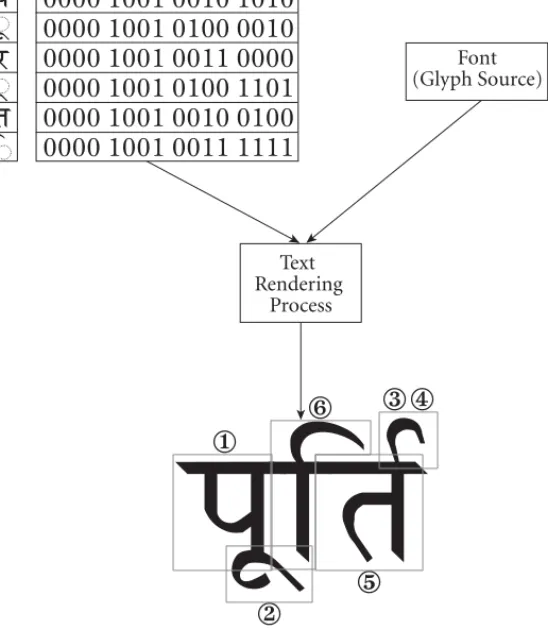
Text rendering requires that characters in memory be mapped to glyphs. The final appear-ance of rendered text may depend on context (neighboring characters in the memory rep-resentation), variations in typographic design of the fonts used, and formatting information (point size, superscript, subscript, and so on). The results on screen or paper can differ considerably from the prototypical shape of a letter or character, as shown in
Figure 2-3.
For the Latin script, this relationship between character code sequence and glyph is rela-tively simple and well known; for several other scripts, it is documented in this standard. However, in all cases, fine typography requires a more elaborate set of rules than given here. The Unicode Standard documents the default relationship between character sequences
Figure 2-3.
Unicode Character Code to Rendered Glyphs
Text Character Sequence
Text Rendering
Process
Font (Glyph Source)
0000 1001 0010 1010
0000 1001 0100 0010
0000 1001 0011 0000
0000 1001 0100 1101
0000 1001 0010 0100
0000 1001 0011 1111
General Structure 18 2.2 Unicode Design Principles
and glyphic appearance for the purpose of ensuring that the same text content can be stored with the same, and therefore interchangeable, sequence of character codes.
Semantics
Characters have well-defined semantics. These semantics are defined by explicitly assigned character properties, rather than implied through the character name or the position of a character in the code tables (see Section 3.5, Properties). The Unicode Character Database provides machine-readable character property tables for use in implementations of pars-ing, sortpars-ing, and other algorithms requiring semantic knowledge about the code points. These properties are supplemented by the description of script and character behavior in this standard. See also Unicode Technical Report #23, “The Unicode Character Property Model.”
The Unicode Standard identifies more than 100 different character properties, including numeric, casing, combination, and directionality properties (see Chapter 4, Character Properties). Additional properties may be defined as needed from time to time. Where characters are used in different ways in different languages, the relevant properties are nor-mally defined outside the Unicode Standard. For example, Unicode Technical Standard #10, “Unicode Collation Algorithm,” defines a set of default collation weights that can be used with a standard algorithm. Tailorings for each language are provided in the Unicode Common Locale Data Repository (CLDR); see Section B.6, Other Unicode Online Resources. The Unicode Standard, by supplying a universal repertoire associated with well-defined character semantics, does not require the code set independent model of internationaliza-tion and text handling. That model abstracts away string handling as manipulainternationaliza-tion of byte streams of unknown semantics to protect implementations from the details of hundreds of different character encodings and selectively late-binds locale-specific character properties to characters. Of course, it is always possible for code set independent implementations to retain their model and to treat Unicode characters as just another character set in that con-text. It is not at all unusual for Unix implementations to simply add UTF-8 as another char-acter set, parallel to all the other charchar-acter sets they support. By contrast, the Unicode approach—because it is associated with a universal repertoire—assumes that characters and their properties are inherently and inextricably associated. If an internationalized application can be structured to work directly in terms of Unicode characters, all levels of the implementation can reliably and efficiently access character storage and be assured of the universal applicability of character property semantics.
Plain Text
Plain text is a pure sequence of character codes; plain Unicode-encoded text is therefore a sequence of Unicode character codes. In contrast, styled text, also known as rich text, is any text representation consisting of plain text plus added information such as a language iden-tifier, font size, color, hypertext links, and so on. For example, the text of this specification, a multi-font text as formatted by a book editing system, is rich text.
General Structure 19 2.2 Unicode Design Principles
The simplicity of plain text gives it a natural role as a major structural element of rich text. SGML, RTF, HTML, XML, and T
E
X are examples of rich text fully represented as plain text streams, interspersing plain text data with sequences of characters that represent the addi-tional data structures. They use special conventions embedded within the plain text file, such as “<p>”, to distinguish the markup or tags from the “real” content. Many popular word processing packages rely on a buffer of plain text to represent the content and imple-ment links to a parallel store of formatting data.The relative functional roles of both plain text and rich text are well established: • Plain text is the underlying content stream to which formatting can be applied. • Rich text carries complex formatting information as well as text context. • Plain text is public, standardized, and universally readable.
• Rich text representation may be implementation-specific or proprietary.
Although some rich text formats have been standardized or made public, the majority of rich text designs are vehicles for particular implementations and are not necessarily read-able by other implementations. Given that rich text equals plain text plus added informa-tion, the extra information in rich text can always be stripped away to reveal the “pure” text underneath. This operation is often employed, for example, in word processing systems that use both their own private rich text format and plain text file format as a universal, if limited, means of exchange. Thus, by default, plain text represents the basic, interchange-able content of text.
Plain text represents character content only, not its appearance. It can be displayed in a var-ity of ways and requires a rendering process to make it visible with a particular appearance. If the same plain text sequence is given to disparate rendering processes, there is no expec-tation that rendered text in each instance should have the same appearance. Instead, the disparate rendering processes are simply required to make the text legible according to the intended reading. This legibility criterion constrains the range of possible appearances. The relationship between appearance and content of plain text may be summarized as follows:
Plain text must contain enough information to permit the text to be rendered legibly, and nothing more.
The Unicode Standard encodes plain text. The distinction between plain text and other forms of data in the same data stream is the function of a higher-level protocol and is not specified by the Unicode Standard itself.
Logical Order
The order in which Unicode text is stored in the memory representation is called logical order. This order roughly corresponds to the order in which text is typed in via the key-board; it also roughly corresponds to phonetic order. For decimal numbers, the logical order consistently corresponds to the most significant digit first, which is the order expected by number-parsing software.
General Structure 20 2.2 Unicode Design Principles
When displayed, this logical order often corresponds to a simple linear progression of char-acters in one direction, such as from left to right, right to left, or top to bottom. In other circumstances, text is displayed or printed in an order that differs from a single linear pro-gression. Some of the clearest examples are situations where a right-to-left script (such as Arabic or Hebrew) is mixed with a left-to-right script (such as Latin or Greek). For exam-ple, when the text in Figure 2-4 is ordered for display the glyph that represents the first character of the English text appears at the left. The logical start character of the Hebrew text, however, is represented by the Hebrew glyph closest to the right margin. The succeed-ing Hebrew glyphs are laid out to the left.
In logical order, numbers are encoded with most significant digit first, but are displayed in different writing directions. As shown in Figure 2-5 these writing directions do not always correspond to the writing direction of the surrounding text. The first example shows N’Ko, a right-to-left script with digits that also render right to left. Examples 2 and 3 show Hebrew and Arabic, in which the numbers are rendered left to right, resulting in bidirec-tional layout. In left-to-right scripts, such as Latin and Hiragana and Katakana (for Japa-nese), numbers follow the predominant left-to-right direction of the script, as shown in Examples 4 and 5. When Japanese is laid out vertically, numbers are either laid out verti-cally or may be rotated clockwise 90 degrees to follow the layout direction of the lines, as shown in Example 6.
The Unicode Standard precisely defines the conversion of Unicode text from logical order to the order of readable (displayed) text so as to ensure consistent legibility. Properties of directionality inherent in characters generally determine the correct display order of text. The Unicode Bidirectional Algorithm specifies how these properties are used to resolve directional interactions when characters of right-to-left and left-to-right directionality are
Figure 2-4.
Bidirectional Ordering
Figure 2-5.
Writing Direction and Numbers
Please see page 1123.
1123ページをみてください。
General Structure 21 2.2 Unicode Design Principles
mixed. (See Unicode Standard Annex #9, “Unicode Bidirectional Algorithm.”) However, when characters of different directionality are mixed, inherent directionality alone is occa-sionally insufficient to render plain text legibly. The Unicode Standard therefore includes characters to explicitly specify changes in direction when necessary. The Bidirectional Algorithm uses these directional layout control characters together with the inherent direc-tional properties of characters to exert exact control over the display ordering for legible interchange. By requiring the use of this algorithm, the Unicode Standard ensures that plain text used for simple items like file names or labels can always be correctly ordered for display.
Besides mixing runs of differing overall text direction, there are many other cases where the logical order does not correspond to a linear progression of characters. Combining charac-ters (such as accents) are stored following the base character to which they apply, but are positioned relative to that base character and thus do not follow a simple linear progression in the final rendered text. For example, the Latin letter “Ï” is stored as “x” followed by com-bining “Δ; the accent appears below, not to the right of the base. This position with respect to the base holds even where the overall text progression is from top to bottom—for example, with “Ï” appearing upright within a vertical Japanese line. Characters may also combine into ligatures or conjuncts or otherwise change positions of their components radically, as shown in Figure 2-3 and Figure 2-19.
There is one particular exception to the usual practice of logical order paralleling phonetic order. With the Thai, Lao, Tai Viet, and New Tai Lue scripts, users traditionally type in visual order rather than phonetic order, resulting in some vowel letters being stored ahead of consonants, even though they are pronounced after them.
Unification
The Unicode Standard avoids duplicate encoding of characters by unifying them within scripts across language. Common letters are given one code each, regardless of language, as are common Chinese/Japanese/Korean (CJK) ideographs. (See Section 18.1, Han.)
Punctuation marks, symbols, and diacritics are handled in a similar manner as letters. If they can be clearly identified with a particular script, they are encoded once for that script and are unified across any languages that may use that script. See, for example, U+1362
ethiopic full stop, U+060F arabic sign misra, and U+0592 hebrew accent segol. However, some punctuation or diacritical marks may be shared in common across a num-ber of scripts—the obvious example being Western-style punctuation characters, which are often recently added to the writing systems of scripts other than Latin. In such cases, char-acters are encoded only once and are intended for use with multiple scripts. Common sym-bols are also encoded only once and are not associated with any script in particular. It is quite normal for many characters to have different usages, such as comma “,” for either thousands-separator (English) or decimal-separator (French). The Unicode Standard avoids duplication of characters due to specific usage in different languages; rather, it duplicates characters only to support compatibility with base standards. Avoidance of duplicate encoding of characters is important to avoid visual ambiguity.
General Structure 22 2.2 Unicode Design Principles
There are a few notable instances in the standard where visual ambiguity between different characters is tolerated, however. For example, in most fonts there is little or no distinction visible between Latin “o”, Cyrillic “o”, and Greek “o” (omicron). These are not unified because they are characters from three different scripts, and many legacy character encod-ings distinguish between them. As another example, there are three characters whose glyph is the same uppercase barred D shape, but they correspond to three distinct lowercase forms. Unifying these uppercase characters would have resulted in unnecessary complica-tions for case mapping.
The Unicode Standard does not attempt to encode features such as language, font, size, positioning, glyphs, and so forth. For example, it does not preserve language as a part of character encoding: just as French i grec, German ypsilon, and English wye are all repre-sented by the same character code, U+0059 “Y”, so too are Chinese zi, Japanese ji, and Korean ja all represented as the same character code, U+5B57 %.
In determining whether to unify variant CJK ideograph forms across standards, the Uni-code Standard follows the principles described in Section 18.1, Han. Where these principles determine that two forms constitute a trivial difference, the Unicode Standard assigns a single code. Just as for the Latin and other scripts, typeface distinctions or local preferences in glyph shapes alone are not sufficient grounds for disunification of a character. Figure 2-6
illustrates the well-known example of the CJK ideograph for “bone,” which shows signifi-cant shape differences from typeface to typeface, with some forms preferred in China and some in Japan. All of these forms are considered to be the same character, encoded at U+9AA8 in the Unicode Standard.
Many characters in the Unicode Standard could have been unified with existing visually similar Unicode characters or could have been omitted in favor of some other Unicode mechanism for maintaining the kinds of text distinctions for which they were intended. However, considerations of interoperability with other standards and systems often require that such compatibility characters be included in the Unicode Standard. See Section 2.3, Compatibility Characters. In particular, whenever font style, size, positioning or precise glyph shape carry a specific meaning and are used in distinction to the ordinary charac-ter—for example, in phonetic or mathematical notation—the characters are not unified.
Dynamic Composition
The Unicode Standard allows for the dynamic composition of accented forms and Hangul syllables. Combining characters used to create composite forms are productive. Because the process of character composition is open-ended, new forms with modifying marks may be created from a combination of base characters followed by combining characters. For
Figure 2-6.
Typeface Variation for the Bone Character
General Structure 23 2.2 Unicode Design Principles
example, the diaeresis “¨” may be combined with all vowels and a number of consonants in languages using the Latin script and several other scripts, as shown in Figure 2-7.
Equivalent Sequences. Some text elements can be encoded either as static precomposed forms or by dynamic composition. Common precomposed forms such as U+00DC “Ü”
latin capital letter u with diaeresis are included for compatibility with current stan-dards. For static precomposed forms, the standard provides a mapping to an equivalent dynamically composed sequence of characters. (See also Section 3.7, Decomposition.) Thus different sequences of Unicode characters are considered equivalent. A precomposed char-acter may be represented as an equivalent composed charchar-acter sequence (see Section 2.12, Equivalent Sequences).
Stability
Certain aspects of the Unicode Standard must be absolutely stable between versions, so that implementers and users can be guaranteed that text data, once encoded, retains the same meaning. Most importantly, this means that once Unicode characters are assigned, their code point assignments cannot be changed, nor can characters be removed.
Characters are retained in the standard, so that previously conforming data stay confor-mant in future versions of the standard. Sometimes characters are deprecated—that is, their use in new documents is strongly discouraged. While implementations should con-tinue to recognize such characters when they are encountered, spell-checkers or editors could warn users of their presence and suggest replacements. For more about deprecated characters, see D13 in Section 3.4, Characters and Encoding.
Unicode character names are also never changed, so that they can be used as identifiers that are valid across versions. See Section 4.8, Name.
Similar stability guarantees exist for certain important properties. For example, the decom-positions are kept stable, so that it is possible to normalize a Unicode text once and have it remain normalized in all future versions.
The most current versions of the character encoding stability policies for the Unicode Stan-dard are maintained online at:
http://www.unicode.org/policies/stability_policy.html
Convertibility
Character identity is preserved for interchange with a number of different base standards, including national, international, and vendor standards. Where variant forms (or even the
Figure 2-7.
Dynamic Composition
A
¨
0041 0308
$
→
Ä
General Structure 24 2.2 Unicode Design Principles
same form) are given separate codes within one base standard, they are also kept separate within the Unicode Standard. This choice guarantees the existence of a mapping between the Unicode Standard and base standards.
Accurate convertibility is guaranteed between the Unicode Standard and other standards in wide usage as of May 1993. Characters have also been added to allow convertibility to sev-eral important East Asian character sets created after that date—for example, GB 18030. In general, a single code point in another standard will correspond to a single code point in the Unicode Standard. Sometimes, however, a single code point in another standard corre-sponds to a sequence of code points in the Unicode Standard, or vice versa. Conversion between Unicode text and text in other character codes must, in general, be done by explicit table-mapping processes. (See also Section 5.1, Data Structures for Character Conversion.)
General Structure 25 2.3 Compatibility Characters
2.3 Compatibility Characters
Conceptually, compatibility characters are characters that would not have been encoded in the Unicode Standard except for compatibility and round-trip convertibility with other standards. Such standards include international, national, and vendor character encoding standards. For the most part, these are widely used standards that pre-dated Unicode, but because continued interoperability with new standards and data sources is one of the pri-mary design goals of the Unicode Standard, additional compatibility characters are added as the situation warrants.
Compatibility characters can be contrasted with ordinary (or non-compatibility) characters in the standard—ones that are generally consistent with the Unicode text model and which would have been accepted for encoding to represent various scripts and sets of symbols, regardless of whether those characters also existed in other character encoding standards. For example, in the Unicode model of Arabic text the logical representation of text uses basic Arabic letters. Rather than being directly represented in the encoded characters, the cursive presentation of Arabic text for display is determined in context by a rendering sys-tem. (See Section 9.2, Arabic.) However, some earlier character encodings for Arabic were intended for use with rendering systems that required separate characters for initial, medial, final, and isolated presentation forms of Arabic letters. To allow one-to-one map-ping to these character sets, the Unicode Standard includes Arabic presentation forms as compatibility characters.
The purpose for the inclusion of compatibility characters like these is not to implement or emulate alternative text models, nor to encourage the use of plain text distinctions in char-acters which would otherwise be better represented by higher-level protocols or other mech-anisms. Rather, the main function of compatibility characters is to simplify interoperability of Unicode-based systems with other data sources, and to ensure convertibility of data. Interoperability does not require that all external characters can be mapped to single Uni-code characters; encoding a compatibility character is not necessary when a character in another standard can be represented as a sequence of existing Unicode characters. For example the Shift-JIS encoding 0x839E for JIS X 0213 katakana letter ainu to can simply be mapped to the Unicode character sequence <U+30C8, U+309A>. However, in cases where no appropriate mapping is available, the requirement for interoperability and convertibil-ity may be met by encoding a compatibilconvertibil-ity character for one-to-one mapping to another standard.
Usage. The fact that a particular character is considered a compatibility character does not mean that that character is deprecated in the standard. The use of most compatibility char-acters in general text interchange is unproblematic. Some, however, such as the Arabic positional forms or other compatibility characters which assume information about partic-ular layout conventions, such as presentation forms for vertical text, can lead to problems when used in general interchange. Caution is advised for their use. See also the discussion of compatibility characters in Unicode Technical Report #20, “Unicode and Markup Lan-guages.”
General Structure 26 2.3 Compatibility Characters
Allocation. The Compatibility and Specials Area contains a large number of compatibility characters, but the Unicode Standard also contains many compatibility characters that do not appear in that area. These include examples such as U+2163 “IV” roman numeral
four, U+2007 figure space, U+00B2 “2” superscript two, U+2502 box drawings
light vertical, and U+32D0 circled katakana a.
There is no formal listing of all compatibility characters in the Unicode Standard. This fol-lows from the nature of the definition of compatibility characters. It is a judgement call as to whether any particular character would have been accepted for encoding if it had not been required for interoperability with a particular standard. Different participants in character encoding often disagree about the appropriateness of encoding particular charac-ters, and sometimes there are multiple justifications for encoding a given character.
Compatibility Variants
Compatibility variants are a subset of compatibility characters, and have the further charac-teristic that they represent variants of existing, ordinary, Unicode characters.
For example, compatibility variants might represent various presentation or styled forms of basic letters: superscript or subscript forms, variant glyph shapes, or vertical presenta-tion forms. They also include halfwidth or fullwidth characters from East Asian character encoding standards, Arabic contextual form glyphs from preexisting Arabic code pages, Arabic ligatures and ligatures from other scripts, and so on. Compatibility variants also include CJK compatibility ideographs, many of which are minor glyph variants of an encoded unified CJK ideograph.
In contrast to compatibility variants there are the numerous compatibility characters, such as U+2502 box drawings light vertical, U+263A white smiling face, or U+2701
upper blade scissors, which are not variants of ordinary Unicode characters. However, it is not always possible to determine unequivocally whether a compatibility character is a variant or not.
Compatibility Decomposable Characters
The term compatibility is further applied to Unicode characters in a different, strictly defined sense. The concept of a compatibility decomposable character is formally defined as any Unicode character whose compatibility decomposition is not identical to its canonical decomposition. (See Definition D66 in Section 3.7, Decomposition, and the discussion in
Section 2.2, Unicode Design Principles.)
The list of compatibility decomposable characters is precisely defined by property values in the Unicode Character Database, and by the rules of Unicode Normalization. (See
Section 3.11, Normalization Forms.) Because of their use in Unicode Normalization, com-patibility decompositions are stable and cannot be changed once a character has been encoded; the list of compatibility decomposable characters for any version of the Unicode Standard is thus also stable.
General Structure 27 2.3 Compatibility Characters
Compatibility decomposable characters have also been referred to in earlier versions of the Unicode Standard as compatibility composite characters or compatibility composites for short, but the full term, compatibility decomposable character is preferred.
Compatibility Character Versus Compatibility Decomposable Character. In informal discussions of the Unicode Standard, compatibility decomposable characters have also often been referred to simply as “compatibility characters.” This is understandable, in part because the two sets of characters largely overlap, but the concepts are actually distinct. There are compatibility characters which are not compatibility decomposable characters, and there are compatibility decomposable characters which are not compatibility charac-ters.
For example, the deprecated alternate format characters such as U+206C inhibit arabic
form shaping are considered compatibility characters, but they have no decomposition mapping, and thus by definition cannot be compatibility decomposable characters. Like-wise for such other compatibility characters as U+2502 box drawings light vertical or U+263A white smiling face.
There are also instances of compatibility variants which clearly are variants of other Uni-code characters, but which have no decomposition mapping. For example, U+2EAF cjk
radical silk is a compatibility variant of U+2F77 kangxi radical silk, as well as being a compatibility variant of U+7CF9 cjk unified ideograph-7cf9, but has no compatibility decomposition. The numerous compatibility variants like this in the CJK Radicals Supple-ment block were encoded for compatibility with encodings that distinguished and sepa-rately encoded various forms of CJK radicals as symbols.
A different case is illustrated by the CJK compatibility ideographs, such as U+FA0C cjk
compatibility ideograph-fa0c. Those compatibility characters have a decomposition mapping, but for historical reasons it is always a canonical decomposition, so they are canonical decomposable characters, but not compatibility decomposable characters. By way of contrast, some compatibility decomposable characters, such as modifier letters used in phonetic orthographies, for example, U+02B0 modifier letter small h, are not
considered to be compatibility characters. They would have been accepted for encoding in the standard on their own merits, regardless of their need for mapping to IPA. A large number of compatibility decomposable characters like this are actually distinct symbols used in specialized notations, whether phonetic or mathematical. In such cases, their com-patibility mappings express their historical derivation from styled forms of standard letters. Other compatibility decomposable characters are widely used characters serving essential functions. U+00A0 no-break space is one example. In these and similar cases, such as fixed-width space characters, the compatibility decompositions define possible fallback representations.
The Unicode Character Database supplies identification and mapping information only for compatibility decomposable characters, while compatibility variants are not formally iden-tified or documented. Because the two sets substantially overlap, many specifications are written in terms of compatibility decomposable characters first; if necessary, such
specifi-General Structure 28 2.3 Compatibility Characters
cations may be extended to handle other, non-decomposable compatibility variants as required. (See also the discussion in Section 5.19, Mapping Compatibility Variants.)
General Structure 29 2.4 Code Points and Characters
2.4 Code Points and Characters
On a computer, abstract characters are encoded internally as numbers. To create a complete character encoding, it is necessary to define the list of all characters to be encoded and to establish systematic rules for how the numbers represent the characters.
The range of integers used to code the abstract characters is called the codespace. A particu-lar integer in this set is called a code point. When an abstract character is mapped or
assigned to a particular code point in the codespace, it is then referred to as an encoded char-acter.
In the Unicode Standard, the codespace consists of the integers from 0 to 10FFFF16, com-prising 1,114,112 code points available for assigning the repertoire of abstract characters. There are constraints on how the codespace is organized, and particular areas of the codespace have been set aside for encoding of certain kinds of abstract characters or for other uses in the standard. For more on the allocation of the Unicode codespace, see
Section 2.8, Unicode Allocation.
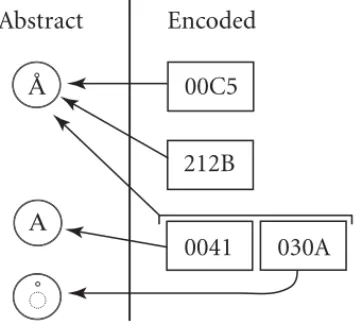
Figure 2-8 illustrates the relationship between abstract characters and code points, which together constitute encoded characters. Note that some abstract characters may be associ-ated with multiple, separately encoded characters (that is, be encoded “twice”). In other instances, an abstract character may be represented by a sequence of two (or more) other encoded characters. The solid arrows connect encoded characters with the abstract charac-ters that they represent and encode.
When referring to code points in the Unicode Standard, the usual practice is to refer to them by their numeric value expressed in hexadecimal, with a “U+” prefix. (See
Appendix A, Notational Conventions.) Encoded characters can also be referred to by their
Figure 2-8.
Abstract and Encoded Characters
Abstract
Encoded
00C5
212B
General Structure 30 2.4 Code Points and Characters
code points only. To prevent ambiguity, the official Unicode name of the character is often added; this clearly identifies the abstract character that is encoded. For example:
U+0061 latin small letter a U+10330 gothic letter ahsa
U+201DF cjk unified ideograph-201df
Such citations refer only to the encoded character per se, associating the code point (as an integral value) with the abstract character that is encoded.
Types of Code Points
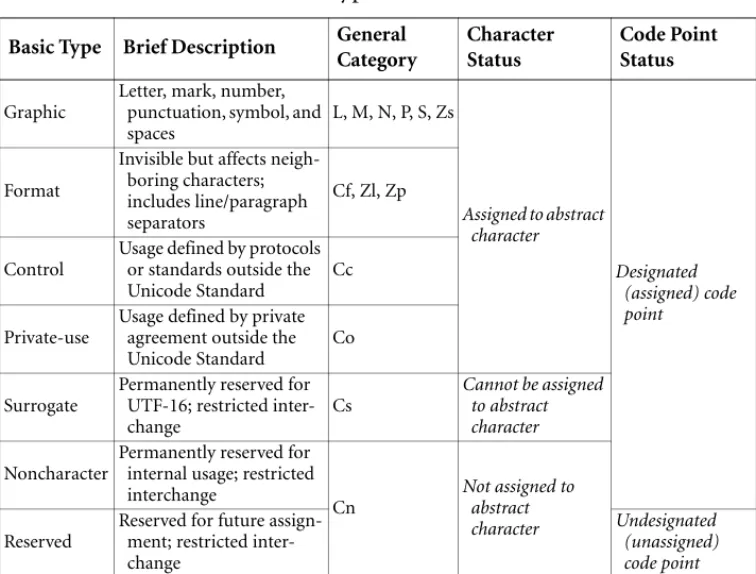
There are many ways to categorize code points. Table 2-3 illustrates some of the categoriza-tions and basic terminology used in the Unicode Standard. The seven basic types of code points are formally defined in Section 3.4, Characters and Encoding. (See Definition D10a, Code Point Type.)
Not all assigned code points represent abstract characters; only Graphic, Format, Control and Private-use do. Surrogates and Noncharacters are assigned code points but are not assigned to abstract characters. Reserved code points are assignable: any may be assigned in
Table 2-3.
Types of Code Points
Basic Type Brief Description General Category Character Status Code Point Status Graphic
Letter, mark, number, punctuation, symbol, and spaces L, M, N, P, S, Zs Assigned to abstract character Designated (assigned) code point Format
Invisible but affects neigh-boring characters; includes line/paragraph separators
Cf, Zl, Zp
Control
Usage defined by protocols or standards outside the Unicode Standard
Cc
Private-use
Usage defined by private agreement outside the Unicode Standard
Co
Surrogate
Permanently reserved for UTF-16; restricted inter-change Cs Cannot be assigned to abstract character Noncharacter
Permanently reserved for internal usage; restricted interchange Cn Not assigned to abstract character Reserved
Reserved for future assign-ment; restricted inter-change
Undesignated (unassigned) code point
General Structure 31 2.4 Code Points and Characters
a future version of the standard. The General Category provides a finer breakdown of Graphic characters and also distinguishes between the other basic types (except between Noncharacter and Reserved). Other properties defined in the Unicode Character Database provide for different categorizations of Unicode code points.
Control Codes. Sixty-five code points (U+0000..U+001F and U+007F..U+009F) are defined specifically as control codes, for compatibility with the C0 and C1 control codes of the ISO/IEC 2022 framework. A few of these control codes are given specific interpreta-tions by the Unicode Standard. (See Section 23.1, Control Codes.)
Noncharacters. Sixty-six code points are not used to encode characters. Noncharacters consist of U+FDD0..U+FDEF and any code point ending in the value FFFE16 or FFFF16— that is, U+FFFE, U+FFFF, U+1FFFE, U+1FFFF, ... U+10FFFE, U+10FFFF. (See
Section 23.7, Noncharacters.)
Private Use. Three ranges of code points have been set aside for private use. Characters in these areas will never be defined by the Unicode Standard. These code points can be freely used for characters of any purpose, but successful interchange requires an agreement between sender and receiver on their interpretation. (See Section 23.5, Private-Use Charac-ters.)
Surrogates. Some 2,048 code points have been allocated as surrogate code points, which are used in the UTF-16 encoding form. (See Section 23.6, Surrogates Area.)
Restricted Interchange. Code points that are not assigned to abstract characters are subject to restrictions in interchange.
• Surrogate code points cannot be conformantly interchanged using Unicode encoding forms. They do not correspond to Unicode scalar values and thus do not have well-formed representations in any Unicode encoding form. (See
Section 3.8, Surrogates.)
• Noncharacter code points are reserved for internal use, such as for sentinel val-ues. They have well-formed representations in Unicode encoding forms and survive conversions between encoding forms. This allows sentinel values to be preserved internally across Unicode encoding forms, even though they are not designed to be used in open interchange.
• All implementations need to preserve reserved code points because they may originate in implementations that use a future version of the Unicode Standard. For example, suppose that one person is using a Unicode 7.0 system and a sec-ond person is using a Unicode 6.0 system. The first person sends the secsec-ond person a document containing some code points newly assigned in Unicode 7.0; these code points were unassigned in Unicode 6.0. The second person may edit the document, not changing the reserved codes, and send it on. In that case the second person is interchanging what are, as far as the second person knows, reserved code points.
General Structure 32 2.4 Code Points and Characters
Code Point Semantics. The semantics of most code points are established by this standard; the exceptions are Controls, Private-use, and Noncharacters. Control codes generally have semantics determined by other standards or protocols (such as ISO/IEC 6429), but there are a small number of control codes for which the Unicode Standard specifies particular semantics. See Table 23-1 in Section 23.1, Control Codes, for the exact list of those control codes. The semantics of private-use characters are outside the scope of the Unicode Stan-dard; their use is determined by private agreement, as, for example, between vendors. Non-characters have semantics in internal use only.
General Structure 33 2.5 Encoding Forms
2.5 Encoding Forms
Computers handle numbers not simply as abstract mathematical objects, but as combina-tions of fixed-size units like bytes and 32-bit words. A character encoding model must take this fact into account when determining how to associate numbers with the characters. Actual implementations in computer systems represent integers in specific code units of particular size—usually 8-bit (= byte), 16-bit, or 32-bit. In the Unicode character encoding model, precisely defined encoding forms specify how each integer (code point) for a Uni-code character is to be expressed as a sequence of one or more Uni-code units. The UniUni-code Standard provides three distinct encoding forms for Unicode characters, using 8-bit, 16-bit, and 32-bit units. These are named UTF-8, UTF-16, and UTF-32, respectively. The “UTF” is a carryover from earlier terminology meaning Unicode (or UCS) Transformation Format. Each of these three encoding forms is an equally legitimate mechanism for repre-senting Unicode characters; each has advantages in different environments.
All three encoding forms can be used to represent the full range of encoded characters in the Unicode Standard; they are thus fully interoperable for implementations that may choose different encoding forms for various reasons. Each of the three Unicode encoding forms can be efficiently transformed into either of the other two without any loss of data.
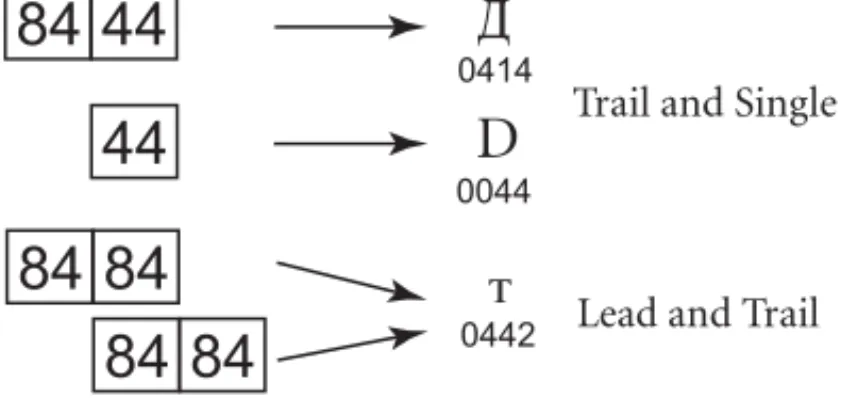
Non-overlap. Each of the Unicode encoding forms is designed with the principle of non-overlap in mind. Figure 2-9 presents an example of an encoding where overlap is permitted. In this encoding (Windows code page 932), characters are formed from either one or two code bytes. Whether a sequence is one or two bytes in length depends on the first byte, so that the values for lead bytes (of a two-byte sequence) and single bytes are disjoint. How-ever, single-byte values and trail-byte values can overlap. That means that when someone searches for the character “D”, for example, he or she might find it either (mistakenly) as the trail byte of a two-byte sequence or as a single, independent byte. To find out which alternative is correct, a program must look backward through text.
The situation is made more complex by the fact that lead and trail bytes can also overlap, as shown in the second part of Figure 2-9. This means that the backward scan has to repeat until it hits the start of the text or hits a sequence that could not exist as a pair as shown in
Figure 2-9.
Overlap in Legacy Mixed-Width Encodings
84
44
44
84 84
84 84
D
0442 0414 0044Trail and Single
General Structure 34 2.5 Encoding Forms
Figure 2-10. This is not only inefficient, but also extremely error-prone: corruption of one byte can cause entire lines of text to be corrupted.
The Unicode encoding forms avoid this problem, because none of the ranges of values for the lead, trail, or single code units in any of those encoding forms overlap.
Non-overlap makes all of the Unicode encoding forms well behaved for searching and com-parison. When searching for a particular character, there will never be a mismatch against some code unit sequence that represents just part of another character. The fact that all Unicode encoding forms observe this principle of non-overlap distinguishes them from many legacy East Asian multibyte character encodings, for which overlap of code unit sequences may be a significant problem for implementations.
Another aspect of non-overlap in the Unicode encoding forms is that all Unicode charac-ters have determinate boundaries when expressed in any of the encoding forms. That is, the edges of code unit sequences representing a character are easily determined by local exam-ination of code units; there is never any need to scan back indefinitely in Unicode text to correctly determine a character boundary. This property of the encoding forms has some-times been referred to as self-synchronization. This property has another very important implication: corruption of a single code unit corrupts only a single character; none of the surrounding characters are affected.
For example, when randomly accessing a string, a program can find the boundary of a character with limited backup. In UTF-16, if a pointer points to a leading surrogate, a sin-gle backup is required. In UTF-8, if a pointer points to a byte starting with 10xxxxxx (in binary), one to three backups are required to find the beginning of the character.
Conformance. The Unicode Consortium fully endorses the use of any of the three Unicode encoding forms as a conformant way of implementing the Unicode Standard. It is impor-tant not to fall into the trap of trying to distinguish “UTF-8 versus Unicode,” for example. UTF-8, UTF-16, and UTF-32 are all equally valid and conformant ways of implementing the encoded characters of the Unicode Standard.
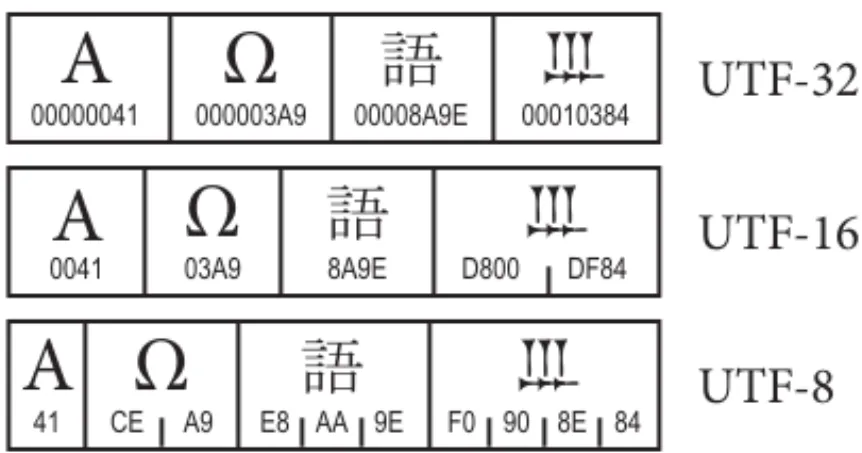
Examples. Figure 2-11 shows the three Unicode encoding forms, including how they are related to Unicode code points.
In Figure 2-11, the UTF-32 line shows that each example character can be expressed with one 32-bit code unit. Those code units have the same values as the code point for the char-acter. For UTF-16, most characters can be expressed with one 16-bit code unit, whose value
Figure 2-10.
Boundaries and Interpretation
84 84 84 84 84 84 44
?? ...
D
0414 0044
General Structure 35 2.5 Encoding Forms
is the same as the code point for the character, but characters with high code point values require a pair of 16-bit surrogate code units instead. In UTF-8, a character may be expressed with one, two, three, or four bytes, and the relationship between those byte val-ues and the code point value is more complex.
UTF-8, UTF-16, and UTF-32 are further described in the subsections that follow. See each subsection for a general overview of how each encoding form is structured and the general benefits or drawbacks of each encoding form for particular purposes. For the detailed for-mal definition of the encoding forms and conformance requirements, see Section 3.9, Uni-code Encoding Forms.
UTF-32
UTF-32 is the simplest Unicode encoding form. Each Unicode code point is represented directly by a single 32-bit code unit. Because of this, UTF-32 has a one-to-one relationship between encoded character and code unit; it is a fixed-width character encoding form. This makes UTF-32 an ideal form for APIs that pass single character values.
As for all of the Unicode encoding forms, UTF-32 is restricted to representation of code points in the range 0..10FFFF16—that is, the Unicode codespace. This guarantees interop-erability with the UTF-16 and UTF-8 encoding forms.
Fixed Width. The value of each UTF-32 code unit corresponds exactly to the Unicode code point value. This situation differs significantly from that for UTF-16 and especially UTF-8, where the code unit values often change unrecognizably from the code point value. For example, U+10000 is represented as <00010000> in 32 and as <F0 90 80 80> in UTF-8. For UTF-32, it is trivial to determine a Unicode character from its UTF-32 code unit rep-resentation. In contrast, UTF-16 and UTF-8 representations often require doing a code unit conversion before the character can be identified in the Unicode code charts.
Preferred Usage. UTF-32 may be a preferred encoding form where memory or disk storage space for characters is not a particular concern, but where fixed-width, single code unit access to characters is desired. UTF-32 is also a preferred encoding form for processing characters on most Unix platforms.
Figure 2-11.
Unicode Encoding Forms
UTF-32
UTF-16
UTF-8
00000041A
000003A9Ω
00008A9E 00010384 0041 03A9 8A9E D800 DF84A
Ω
41 CE A9 E8 AA 9E F0 90 8E 84A Ω
General Structure 36 2.5 Encoding Forms
UTF-16
In the UTF-16 encoding form, code points in the range U+0000..U+FFFF are represented as a single 16-bit code unit; code points in the supplementary planes, in the range U+10000..U+10FFFF, are represented as pairs of 16-bit code units. These pairs of special code units are known as surrogate pairs. The values of the code units used for surrogate pairs are completely disjunct from the code units used for the single code unit representa-tions, thus maintaining non-overlap for all code point representations in UTF-16. For the formal definition of surrogates, see Section 3.8, Surrogates.
Optimized for BMP. UTF-16 optimizes the representation of characters in the Basic Multi-lingual Plane (BMP)—that is, the range U+0000..U+FFFF. For that range, which contains the vast majority of common-use characters for all modern scripts of the world, each char-acter requires only one 16-bit code unit, thus requiring just half the memory or storage of the UTF-32 encoding form. For the BMP, UTF-16 can effectively be treated as if it were a fixed-width encoding form.
Supplementary Characters and Surrogates. For supplementary characters, UTF-16 requires two 16-bit code units. The distinction between characters represented with one versus two 16-bit code units means that formally UTF-16 is a variable-width encoding form. That fact can create implementation difficulties if it is not carefully taken into account; UTF-16 is somewhat more complicated to handle than UTF-32.
Preferred Usage. UTF-16 may be a preferred encoding form in many environments that need to balance efficient access to characters with economical use of storage. It is reason-ably compact, and all the common, heavily used characters fit into a single 16-bit code unit.
Origin. UTF-16 is the historical descendant of the earliest form of Unicode, which was originally designed to use a fixed-width, 16-bit encoding form exclusively. The surrogates were added to provide an encoding form for the supplementary characters at code points past U+FFFF. The design of the surrogates made them a simple and efficient extension mechanism that works well with older Unicode implementations and that avoids many of the problems of other variable-width character encodings. See Section 5.4, Handling Surro-gate Pairs in UTF-16, for more information about surrogates and their processing.
Collation. For the purpose of sorting text, binary order for data represented in the UTF-16 encoding form is not the same as code point order. This means that a slightly different comparison implementation is needed for code point order. For more information, see
Section 5.17, Binary Order.
UTF-8
To meet the requirements of byte-oriented, ASCII-based systems, a third encoding form is specified by the Unicode Standard: UTF-8. This variable-width encoding form preserves ASCII transparency by making use of 8-bit code units.
Byte-Oriented. Much existing software and practice in information technology have long depended on character data being represented as a sequence of bytes. Furthermore, many