Executive summary
The evolution of the U.S. health care system from volume- to value-based care (VBC) is under way, spurred by factors including unsustainable costs, a push for improved outcomes, and the desire for more value for money spent. While this evolution impacts multiple health care stakeholders, VBC cannot work without the participation of physicians. How are physicians faring in the inevitable shift to a value-based world? What resources, capabilities, and skills do they think could help put them on a path to success in VBC?
The Deloitte Center for Health Solutions 2014 Survey of U.S. Physicians,a nationally representative survey of 561 physicians, examines current and expected levels of VBC engagement and what physicians need to feel more confident about VBC participation. This report provides physicians and health organizations partnering in VBC initiatives (health systems, hospitals, health plans, and other stakeholders) insights to increase physician success in a VBC world.1
Anticipating that value-based payment models will likely equal about 50 percent of their total compensation in the next 10 years, physicians are aware that the shift to VBC is happening and inevitable. But they are reluctant to participate, preferring the status quo, and concerned about the consequences of financial risk (e.g., being held accountable for things out of their control).
Physicians desire to acquire or increase their VBC skills and business knowledge, and to expand their use of health information technology (HIT).2 In addition, they identify a number of resources, capabilities, and skills they feel are necessary for success in a VBC environment. For example, from health organizations partnering in VBC, physicians seek expanded clinical support capabilities, enabling technology, HIT, and access to non-physician staff to coordinate patient care. Physicians also want support to manage risk and protect financial interests.
In our view, physician success in a value-based world impacts all health care stakeholders because of physicians’ integral role in health care delivery. As VBC becomes a more significant aspect of their income, physicians likely will choose to work with health systems that fully and fairly enable an equitable approach to compensation. Partners, therefore, may need to move quickly to attract and support physicians by providing them with the clinical and business resources they need; doing so could enhance collaboration and, potentially, lead to market advantages over time.
Preparing for the inevitable:
The path to physician success
in a value-based world
Perspectives from the Deloitte Center for Health Solutions
2014 Survey of U.S. Physicians
What is value-based care?
Value-based care (VBC) describes an array of strategies to obtain better value for health care spending. Clinical initiatives and delivery models focus on getting more coordinated, higher quality care at reasonable costs. Provider payment models involving bonuses and penalties are aligned to cost, quality, and outcomes measures. Participating in VBC initiatives requires different capabilities and resource investments for physicians, health systems/hospitals, and health plans. However, common to VBC initiatives is the need to:
• Consider expanding partner relationships • Be both clinically and financially data-driven
• Have access to actionable information, analytics, and tools that provide a comprehensive view of a patient’s care, whether it is provided in a hospital, in outpatient settings, or at home.
2
Physicians identify resources,
capabilities, and skills they need
to be successful in the VBC world
Physicians seek expanded clinical support capabilities, greater use of HIT, and access to non-physician staff
Physicians identify expanded clinical support capabilities, information technology, and access to non-physician staff as the most important capabilities needed to support them in VBC (Figure 1). Rankings of needed capabilities depend somewhat on whether survey respondents are primary care physicians (PCPs) or specialists, and by their work setting and other practice characteristics. These priorities are significantly (at p =.05) more common among PCPs, physicians in academic or research settings, and among those who prefer value-based payment models: • Expanded clinical support capabilities:
- 50 percent of PCPs versus 33 percent of non-surgical specialists
- 49 percent of those in an academic/research setting versus 33 percent of independents who contract with multiple plans/hospitals
- 51 percent of those who prefer value-based payment models versus 37 percent of those who prefer traditional payment models
• Information technology tools:
- 34 percent of PCPs and 37 percent of non-surgical specialists versus 20 percent of surgical specialists • Access to non-physician staff:
- 35 percent of physicians in practice 10 years or less versus 22 percent of physicians in practice 21-30 years
Figure 1. Ranking of importance of work-provided resources/capabilities to support VBC
Percentage responding highly important (rank of “1” or “2”) work-provided resources/capabilities to support VBC Responses of 10% or less not labeled
Source: Deloitte Center for Health Solutions: 2014 Survey of U.S. Physicians
Total respondents PCPs Surgical specialists Non-surgical specialists Other Expanded clinical support capabilities
(e.g., care coordination, access to registry, patient engagement tools) Access to more patients Access to non-physician staff to provide clinical care and care coordination Ability to negotiate third-party payer contracts Information technology tools (e.g., electronic health records) Access to latest medical equipment and facilities Access to capital Administrative capabilities Governance
40%
31% 34% 20% 37% 31%
35% 27%
31% 28%
29%
25%
24% 13% 31% 27% 26%
13% 20% 30%
18% 22%
14%
11% 12% 12%
18% 11% 15%
25% 29% 23% 22%
Preparing for the inevitable: The path to physician success in a value-based world 3
Physicians seek value-based payment models that are structured fairly and support in managing risk
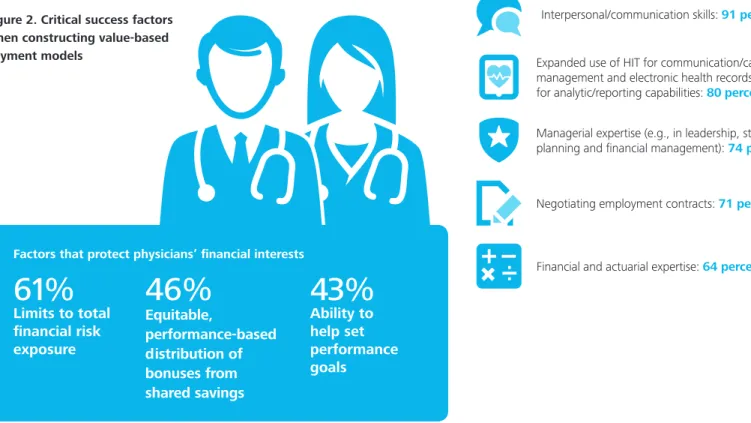
Physicians’ key factors in choosing a value-based payment model are those which protect their financial interests (Figure 2). PCPs (49 percent) also want information to identify and manage high-cost patients.
Physicians want to improve their business knowledge and expand their use of HIT
Given the health care system’s transition to VBC and the practice of medicine’s evolution, physicians were asked which skills are important for them to possess to successfully practice medicine in the future. Physicians report the following as important:
Figure 2. Critical success factors when constructing value-based payment models
Interpersonal/communication skills: 91 percent
Financial and actuarial expertise: 64 percent Negotiating employment contracts: 71 percent Managerial expertise (e.g., in leadership, strategy planning and financial management): 74 percent Expanded use of HIT for communication/care management and electronic health records (EHR) for analytic/reporting capabilities: 80percent
61%
Limits to total
financial risk
exposure
46%
Equitable,
performance-based
distribution of
bonuses from
shared savings
43%
Ability to
help set
performance
goals
4
High recognition that change is afoot
Physicians expect that about 50 percent of their compensation in the next 10 years will be value-based
Value-based payment models in 10 years will likely comprise about 50 percent of physicians’ total compensation. These findings hold true across physician type, region, years in practice, practice size, and practice type.
Reluctance to participate in VBC
Physicians prefer the status quo in how they are paid and in their work setting
Physicians report low levels of compensation through performance bonuses and incentive payments. Over half (52 percent) of all physicians report having 10 percent or less of their compensation from these sources in the past 12 months and expect the same to be true for the next 12 months. One in three physicians is currently ineligible to receive a performance bonus. Thus, performance bonuses are not a major impact on total compensation.
Traditional payment models – salary with or without bonus potential (61 percent) and fee-for-service payments (FFS) payments (44 percent) – are the most common current physician payment models. The most common value-based payment models are rewards-value-based, shared savings arrangements for PCPs (13 percent), and procedural/chronic episode-based payments for surgeons (16 percent) and non-surgical specialists (13 percent).
Moreover, the majority (78 percent) of physicians are content with the status quo, preferring traditional payment models over value-based payment models (22 percent) (see next page). However, PCPs are more likely to prefer value-based payment models while surgical specialists and physicians in practice 31 or more years are more likely to prefer traditional payment models.
Among the types of value-based payment models, FFS plus a monthly care coordination fee (11 percent) is the most preferred payment model, while capitation payments for physician, pharmacy, hospital, and other services (1 percent) and penalty-based shared savings (0 percent) are the least preferred payment models.
Physicians also prefer the status quo in their work setting, ranking the ideal places to practice VBC as:
• Single-specialty independent: 28 percent • Academic medical center: 17 percent • Multi-specialty independent: 16 percent • Integrated delivery system: 15 percent • Concierge group that does not accept
insurance: 15 percent Definitions of physician payment models
• Traditional payment models include fee-for-service payments (FFS) or salary with or without bonus potential
• Value-based payment models include:
- FFS payments combined with a monthly care coordination fee
- Bundled payments: one payment for all the services around a particular patient’s treatment or episode of care – paid to a physician or to a hospital which then pays the physician from that bundle
- Procedural episode-based payments and/or complex and chronic disease management episode-based payments (this option was only presented to specialists in the survey)
- Shared savings arrangements where a physician is rewarded if patients have better-than-average quality/cost outcomes
- Shared savings arrangements, where a physician is penalized if patients fail to have better-than-average quality/cost outcomes
- Capitation payments per-patient-per-month (PPPM) covering physician-related services
- Capitation payments PPPM covering payment for pharmacy, hospital, and other services as well as physician-related services
Preparing for the inevitable: The path to physician success in a value-based world 5
Primary care physicians more likely than specialists to prefer value-based payment models
Physicians preferring
value-based payment models
Physicians preferring traditional payment models
Total respondents 22% 78%
Physician type
PCP
Surgical specialist Non-surgical specialist Other
44%† 17% 31% 8%
24% 31%† 39% 6%
Years in practice
10 or less 11-20 21-30 31 or more
38% 23% 25% 14%
36% 22% 17% 25%†
† Statistical significant difference at p =.05 level.
Percentage responding most preferred (rank of “1”) compensation type. Note, classification of traditional and value-based payment models was done in data analysis (refer to earlier definitions of physician payment models for details). Source: Deloitte Center for Health Solutions: 2014 Survey of U.S. Physicians
6
Physicians’ greatest concerns with value-based payment models center on fairness
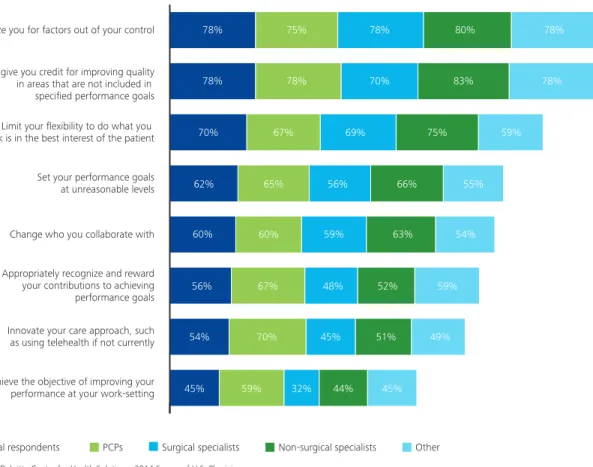
Physicians are most concerned that value-based payment models may penalize them for factors out of their control and not capture quality improvements achieved outside of performance goals (Figure 3). The majority (78 percent) of physicians agree with both of these statements. These two concerns had the greatest agreement across all types of physicians, although the specific percentages varied somewhat.
Respondents are less likely to agree that value-based payment models could lead to positive effects, such as innovative care approaches and improving performance, but about half of physicians do report that these changes could occur.
Figure 3. Greatest concerns with value-based payment models
Penalize you for factors out of your control Not give you credit for improving quality in areas that are not included in specified performance goals Limit your flexibility to do what you think is in the best interest of the patient Set your performance goals at unreasonable levels Change who you collaborate with Appropriately recognize and reward your contributions to achieving performance goals Innovate your care approach, such as using telehealth if not currently Achieve the objective of improving your performance at your work-setting
78% 75% 78% 80% 78%
78% 83%
70% 78%
78%
70% 67% 69% 75% 59%
55% 66%
56% 65%
62%
60% 60% 59%
56% 67% 48%
54% 70% 45%
45% 59% 32% 44%
63% 54%
59%
49%
45% 51%
52%
Total respondents PCPs Surgical specialists Non-surgical specialists Other
Preparing for the inevitable: The path to physician success in a value-based world 7
Considerations: Strategies and resources
to support participation and success
To boost physicians’ participation in VBC, health care partners should consider building physician-centered strategies around the clinical and business resources identified for VBC success:Expanded clinical support capabilities
Physicians may need clinical and technical support to take a balanced, end-to-end approach to delivering patient care while also competing on value. Partners can provide care coordination, registry access, patient engagement tools, and care model pathways.
Comprehensive HIT
Integrated HIT – EHR, informatics, analytics, reporting, and a rules engine – may allow physicians to more effectively treat patients and manage risk. Using EHR and analytics, high-risk patients can be identified and actively managed. Physicians can test which actions/interventions could best improve quality, cost, and health outcomes performance, especially for high-risk patients, using predictive models. HIT can also allow for physicians to communicate, share, coordinate, and engage seamlessly with multiple stakeholders for improved care management. Lastly, HIT can support the management of financial metrics and risk; for example, through activity-based cost accounting and outcomes tracking.
Access to non-physician staff
New team and workforce models, including access to non-physician staff, can help non-physicians to provide clinical care and coordination/management, and help patients address a broad range of issues. Additionally, these staff can help provide care and coordination outside of office visits.
Managerial expertise and business knowledge
Partners can help physicians improve business management and organizational skills to operate in a VBC environment. Evaluating contracts, leading care coordination activities, and managing partner relationships can be taught through formal courses and on-the-job training.
Value-based payment models that are structured fairly
Transparent governance models with clear decision-making guidelines can help to address how risk is shared between the partner and physician. Accountability/responsibility protocols for each stakeholder at each stage of care can help assure that physicians get credit for improving quality. Giving physicians influence over performance goals can also help to address fairness issues.
8
Appendix: Survey objectives and
methodology
Since 2011, the Deloitte Center for Health Solutions has annually surveyed a nationally representative sample of the U.S. physician population to assess experiences, actions, and attitudes about health care. The 2014 survey examines value-based care, the future of medicine, the impact of health reform, and health information technology (HIT).
In 2014, a random sample of U.S. primary care and specialist physicians was selected from the American Medical Association’s (AMA) master file of physicians. Invitation letters describing the nature of the survey and
honorarium were mailed to physicians via postal mail (Appendix Figure 1). Those interested in participating were directed to a website where the web-based questionnaire was completed online. The survey took approximately 22 minutes to complete. Survey data were collected June 2-23, 2014, and 561 physicians completed the survey. Data are weighted to reflect the national distribution of physicians in the AMA master file by years in practice, gender, region, and medical specialty. The margin of error is +/- 3.89 percent at the .95 confidence level.
Appendix Figure 1. Survey sample composition
PCPs Surgical specialists
Non-surgical specialists
Other* TOTAL
Total completed surveys 105 140 196 120 561
Total invitation letters sent
Letters mailed 3,261 5,211 7,296 4,839 20,607 Post office-returns† 80 171 213 233 697
Additional information
Surveys completed
over quotas 0 45 44 0 89 Incomplete surveys 11 20 28 4 63 Ineligible surveys 5 6 35 25 71
† as of July 9, 2014
* Other physician type is comprised of Anatomic/Clinical Pathology, Occupational Medicine, Public Health and General Preventive Medicine, and Other (i.e., some other specialty not listed)
Endnotes
1. This report provides insight into physicians’ current and expected levels of VBC engagement and identifies the resources, capabilities, and skills they need to feel more confident about their participation. Forthcoming publications on physician perspectives about health care reform and the future of the medical profession, and physician perspectives on HIT, will be available at www.deloitte.com/centerforhealthsolutions.
Preparing for the inevitable: The path to physician success in a value-based world 9 Contacts
To begin a discussion or for more information, please contact:
Mitch Morris, MD
Vice Chairman
National Health Care Provider Lead Deloitte LLP
M. Scott Kolesar
Principal
Value-Based Care Practice Leader Deloitte Consulting LLP [email protected]
Sonal Kathuria, MS, MBA
Director Health Plans
Deloitte Consulting LLP [email protected]
Sarah Thomas, MS
Research Director
Deloitte Center for Health Solutions Deloitte Services LP
Contact information
To learn more about the Deloitte Center for Health Solutions, its projects, and events, please visit
www.deloitte.com/centerforhealthsolutions
Deloitte Center for Health Solutions 555 12th St. NW
Washington DC 20004 Phone 202-220-2177 Fax 202-220-2178 Toll free 888-233-6169
Email [email protected]
Web www.deloitte.com/centerforhealthsolutions
Advisors
Robert B. Williams, MD, MIS
Director
Health Care Providers Deloitte Consulting LLP [email protected]
Kenneth J. Abrams, MD, MBA
Director
Health Care Providers Deloitte Consulting LLP [email protected]
Harry Greenspun, MD
Director
Deloitte Center for Health Solutions Deloitte Services LP
Bruce Green, MD
Director and Chief Federal Medical Officer Deloitte Consulting LLP
Mike Van Den Eynde, MBA
Director Health Plans
Deloitte Consulting LLP [email protected]
R. T. (Terry) Hisey
Principal Life Sciences
Deloitte Consulting LLP [email protected]
Authors
Elizabeth L. Stanley, MPH
Research Manager
Deloitte Center for Health Solutions Deloitte Services LP
Mitch Morris, MD
Vice Chairman
National Health Care Provider Lead Deloitte LLP
Leslie Korenda, MPH
Research Manager
Deloitte Center for Health Solutions Deloitte Services LP
Acknowledgements
We would also like to thank Sheryl Coughlin, Wendy Gerhardt, Kathryn Robinson, and the many others who contributed to the preparation of this report.
Follow @DeloitteHealth on Twitter To download a copy of this report, please visit www.deloitte.com/us/valuebasedworld
About the Deloitte Center for Health Solutions
The source for health care insights: The Deloitte Center for Health Solutions (DCHS) is the research division of Deloitte LLP’s Life Sciences and Health Care practice. The goal of DCHS is to inform stakeholders across the health care system about emerging trends, challenges, and opportunities. Using primary research and rigorous analysis, and providing unique perspectives, DCHS seeks to be a trusted source for relevant, timely, and reliable insights.
Copyright © 2014 Deloitte Development LLC. All rights reserved. Member of Deloitte Touche Tohmatsu Limited
This publication contains general information only and Deloitte is not, by means of this publication, rendering accounting, business, financial, investment, legal, tax, or other professional advice or services. This publication is not a substitute for such professional advice or services, nor should it be used as a basis for any decision or action that may affect your business. Before making any decision or taking any action that may affect your business, you should consult a qualified professional advisor.
Deloitte shall not be responsible for any loss sustained by any person who relies on this publication.
As used in this document, “Deloitte” means Deloitte LLP and its subsidiaries. Please see www.deloitte.com/us/about for a detailed description of the legal structure of Deloitte LLP and its subsidiaries. Certain services may not be available to attest clients under the rules and regulations of public accounting.