HAL Id: lirmm-01083516
https://hal-lirmm.ccsd.cnrs.fr/lirmm-01083516
Submitted on 17 Nov 2014HAL is a multi-disciplinary open access archive for the deposit and dissemination of sci-entific research documents, whether they are pub-lished or not. The documents may come from teaching and research institutions in France or abroad, or from public or private research centers.
L’archive ouverte pluridisciplinaire HAL, est destinée au dépôt et à la diffusion de documents scientifiques de niveau recherche, publiés ou non, émanant des établissements d’enseignement et de recherche français ou étrangers, des laboratoires publics ou privés.
Outerplanar obstructions for matroid pathwidth
Athanassios Koutsonas, Dimitrios M. Thilikos, Koichi Yamazaki
To cite this version:
Athanassios Koutsonas, Dimitrios M. Thilikos, Koichi Yamazaki. Outerplanar obstruc-tions for matroid pathwidth. Discrete Mathematics, Elsevier, 2013, 315-316, pp.95-101. �10.1016/j.disc.2013.10.007�. �lirmm-01083516�
Outerplanar Obstructions for Matroid Pathwidth
Athanassios Koutsonasa,1, Dimitrios M. Thilikosa,b,2, Koichi Yamazakic aDepartment of Mathematics, National and Kapodistrian University of Athens,
Panepistimioupolis, GR-15784 Athens, Greece
bAlGCo project-team, CNRS, LIRMM, France c
Department of Computer Science Faculty of Engineering, Gunma University
Gunma, Japan
Abstract
For each non-negative integer k, we provide all outerplanar obstructions for the class of graphs whose cycle matroid has pathwidth at most k. Our proof combines a decomposition lemma for proving lower bounds on matroid pathwidth and a relation between matroid pathwidth and linear width. Our results imply the existence of a linear algorithm that, given an outerplanar graph, outputs its matroid pathwidth.
Keywords: matroids, obstructions, pathwidth, outerplanar graphs.
1. Introduction
The notions of pathwidth and branchwidth are fundamental graph pa-rameters that appear in many topics of discrete mathematics and algorithms. The counterpart of branchwidth on matroids has been introduced by Geelen and Whittle in [6] and was extensively studied in [6, 15, 10, 14, 11, 5]. How-ever, not much is known for the counterpart of this parameter on matroids. The pathwidth of a matroid was defined by Geelen, Gerards, and Whittle
Email addresses: [email protected](Athanassios Koutsonas),
[email protected](Dimitrios M. Thilikos),[email protected](Koichi Yamazaki)
1
Supported by the project “Support of Research” of the National and Kapodistrian University of Athens (project code: 10812).
2Co-financed by the European Union (European Social Fund – ESF) and Greek
na-tional funds through the Operana-tional Program “Education and Lifelong Learning” of the National Strategic Reference Framework (NSRF) - Research Funding Program: “Thalis. Investing in knowledge society through the European Social Fund”.
in [7] (see also [9]) and was extensively studied in the work of Kashyap [13] in the context of trellis state-complexity of linear codes. Also, connected matroids of pathwidth at most 3 have been studied in [8, 1].
Given a class of matroids M, we define its obstruction set obs(M) as the set of all minor-minimal matroids not inM(similarly, we defineobs(G) for the case whereG is a class of graphs). We define Pk as the class of all matroids of pathwidth at most k. In this paper, we study the set obs(Pk) and we characterize, for every k, all members of obs(Pk) that are cycle matroids of outerplanar graphs.
Following Kashyap [13], we define the matroid-pathwidth (in short: µ-pathwidth) of a graph as the pathwidth of its cycle matroid. As observed in [13], the pathwidth and the µ-pathwidth of a graph are different param-eters, while the pathwidth can be computationally reduced toµ-pathwidth. In this paper we show that several structural characteristics of the path-width of acyclic graphs are transferred to the µ-pathwidth of outerplanar graphs. In particular, we define an operation, called fusion for “joining together” triples of matroids and we prove a structural result (Lemma 3) that provides a way to construct matroids of pathwidh at least k+ 1 from matroids of pathwidth at least k. Our result can be seen as the matroid-analogue of the operation defined in [19] (see also [20, 17, 3]) for the case of the pathwidh of graphs (see also [12] for related recent results for the parameter of linear rank-width).
Using our structural lemma, we prove the existence of a bijection between acyclic obstructions for linear-width (a parameter very similar to the path-width for graphs) and the outerplanar obstructions of µ-pathwidth. This gives a precise characterization of all members of obs(Pk) that are cycle matroids of outerplanar graphs. A byproduct of our results is that the µ-pathwidth of outerplanar graphs can be computed in linear time.
2. Definitions and Preliminaries
Given a graphG, we denote byV(G) its vertex set and asE(G) its edge set. We consider graphs that may have loops or multiple edges. If a graph has no multiple edges or loops we call it simple. For any set of vertices S⊆V(G), we denote byG[S] the subgraph of Ginduced by the vertices in S. Accordingly, for a set of edges F ⊆ E(G), we define G[F] = (V(F), F) whereV(F) =S
e∈Fe. In addition, we define by F =E(G)−F.
We use the term plane graph for a planar graph along with an embed-ding of it in the sphereS0 without crossings. To simplify notations, we do not distinguish between a vertex of the graph and the point of S0 used in
the drawing to represent the vertex or between an edge and the open line segment representing it. We denote byF(G), the set of faces of this embed-ding, i.e. the connected components ofS0\G, (that are open sets of S0). A planar graphGisouterplanar if it has an embedding on the sphereS0 such that all its vertices lie on the boundary of a single face, calledouter face.
Given two graphs H and G, we write HG and callH a minorof G, ifH can be obtained by a subgraph of Gafter a series of edge contractions. We also use the notation G∗ to denote an embedding of the dual graph of G.
Matroids and cycle matroids of graphs. Given a matroidM, we use the nota-tionsE(M) andI(M) for its elements and the collection of its independent sets respectively. We also callE(M) theground setofM. Moreover, follow-ing the notation of [16], we denote by B(M) the collection of the maximal independent sets, the bases of M and C(M) the collection of the minimal dependent sets, the circuits of M. It is known (see e.g., [16]) that any of the collections I(M), B(M) or C(M) suffices to describe a matroid Mon an element setE(M).
Thecycle matroid of a graphG, denoted asM(G), hasE(G) as ground set, while its independent sets are the sub-forests ofG. On the other hand, a matroid that is isomorphic to a cycle matroid of a graph is calledgraphic. Given a matroid M, the matroid whose ground set isE(M) and whose collection of bases is {E(M)−B : B ∈ B(M)} is called the dual of the matroid Mand is denoted byM∗.
Let Mbe a matroid and X, Y ⊆ E(M) subsets of its ground set. The matroidM\X={E(M)−X, I ⊆(E(M)−X) :I ∈ I(M)}and the matroid
M/Y = [M∗\Y]∗ are the deletion of X and the contractionof Y from the
matroid M, respectively. IfX ={e} then we simply write M\einstead of
M\{e}– likewise for the contraction of a single element. A matroid K is a minorof a matroidMifK =M\X/Y for someX, Y ⊆E(M).
The matroid connectivity functionλ: 2E(M)→Nis defined as follows:
λM(X) =rM(X) +rM(X)−rM(E(M))
whereX =E(M)−X and r is the rank function ofM, i.e. rM(X) is the
maximum cardinality of an independent set ofX in M.
A matroid that for every pair of distinct elements of its ground set has a circuit containing both of them is calledconnected. This implies that the cycle matroid of a 2-connected graph is connected. It is also easy to check that if a matroidM is connected andF ⊆E(M), then λM(F) = 0 only if
Another useful property of connectivity is the following:
Fact 1 ([22]). Let e be an element of a connected matroid M. Then at least one ofM/eand M\eis connected.
Given two matroidsM1 and M2 on disjoint ground sets, we denote by
M1 ⊕ M2 their direct sum, i.e. the matroid (E(M1)∪E(M2),I(M1)∪
I(M2)).
We continue with the definition of two dual operations on matroids which will play an important role in the proofs of the next section. If an element is not contained in a base of a matroid, then it is called loop, while if it is in every base is called coloop. Then, given two matroids M1 and M2
withE(M1)∩E(M2) ={e} wheree is neither a loop or a coloop in these matroids, the series connection of M1 and M2, denoted by S(M1,M2), is the matroid with element set E(M1\e)∪E(M2\e)∪e0, where e0 is an element not inE(M1) or E(M2) and whose collection of circuits is:
CS = C(M1\e)∪ C(M2\e)∪
{(C1−e)∪(C2−e)∪e0:e∈Ci∈ C(Mi) for i= 1,2}. Subsequently, theparallel connectionofM1andM2denoted byP(M1,M2) is the matroid [S(M∗
1,M∗2)]∗. Properties of series and parallel connection include many attractive features. As example the classes of graphic matroids and connected matroids are closed under these operations – for a further study see also [16]. We will need the following property from [2]:
Fact 2. Let N1,N2 be two matroids where E(N1)∩E(N2) = {e}. Then, P(N1,N2)/e= (N1/e)⊕(N2/e).
Matroid Pathwidth. Given a layout L= (e1, . . . , em) ofE(M), we define µ-widthM(L) = max{λM({e1, . . . , ei})|1≤i≤m−1}.
According to the definition of [7] thepathwidth of a matroidM, denoted by pw(M), is the minimum k for which there exists a layoutL= (e1, . . . , em) of its elements such thatµ-widthM(L)≤k.
The matroid pathwidth of a graphG(or simplyµ-pathwidth) is defined as the pathwidth of its cycle matroid and it is denoted asµ-pw(G), in other words:
µ-pw(G) =pw(M(G)). We will need the following simple lemma:
Lemma 1. Theµ-pathwidth of a graph is equal to the maximumµ-pathwidth of all its biconnected components.
Proof. Let {C1, . . . , Cr} be the biconnected components of a graph Gand E1, . . . , Er the corresponding edge sets. Then, for i = 1, . . . , r it holds that rM(Ei) +rM(Ei) = r(M), where by M is denoted the cycle matroid
of G. This implies that the value of the connectivity function of a set of edges belonging to the same component, is irrelevant from the rest of the biconnected components. This implies that if µ-width(Li) ≤ k for i= 1, . . . , r, where Li is a layout ofEi, then for the concatenationL of all these layouts it also holds µ-width(L)≤k.
3. A Decomposition of Matroids
Let M1,M2,M3 be connected matroids on disjoint edge sets and for each of them pick an elementei ∈E(Mi), i= 1,2,3. The uniform matroid
U1,3 with elements {e1, e2, e3} shares one common element with each of the three matroids: E(U1,3)∩E(Mi) ={ei}. We callfusion ofM1,M2,M3 on the elements{e1, e2, e3} the matroid
M=S(S(S(U1,3,M1),M2),M3)
and we denote it byfusion(M1,M2,M3, e1, e2, e3). It is easy to check that this matroid is also connected. The elements e1, e2, e3 on which the fusion takes place will be referred to asbridge elements.
The series connections in the definition ofMinvolve the three elements ofU1,3 which implies that the order in which the connections are performed is irrelevant. Consider now the matroidS(S(U1,3,M1),M2) one step before the composition of the final matroid M. Let M(1) and M(2) be matroids isomorphic toU1,2whereE(M(1)) ={e
1, e3}andE(M(2)) ={e2, e3}. Keep-ing in mind that U1,3 is isomorphic to P(M(1),M(2)) we can observe the following:
Observation 1. The matroidP(S(M(1),M
1), S(M(2),M2))is isomorphic to the matroidS(S(U1,3,M1),M2).
In order to estimate the pathwidth of the fusion of three given matroids we need the following lemma about the connectivity function of a matroid formed by a series connection:
Lemma 2. LetM1,M2 be connected matroids withE(M1)∩E(M2) ={e} and M = S(M1,M2). For any two sets F1, F2 where F1 ⊆ E(M1) and F2 ⊆E(M2\e) it holds that
λM(F1∪F2)≥λM1(F1) +λM2\e(F2)
Proof. Let M−i = Mi\e, i = 1,2. Since M1,M2 are both connected matroids it follows that their series connection Mis also connected. From the connectivity of Mi, we obtain that r(Mi) = r(M−i ), i = 1,2. Also, from the connectivity of M it follows that r(M) = r(M \e). Notice that
M=S(M1,M2) implies that M\e=M−1 ⊕ M−2, which, in turn, implies that r(M) = r(M1) +r(M−2). From the definition of the connectivity function λ and the last equality, it is enough to prove that for any two subsetsF1⊆E(M1), F2 ⊆E(M−2),
rM(F1∪F2) ≥ rM1(F1) +rM−2(F2) (1) rM(F1∪F2) ≥ rM1(F1) +rM−2(F2) (2)
Towards a contradiction, suppose thatrM(F1∪F2)< rM1(F1)+rM−2(F2) and letB1, B2 be bases ofF1, F2 respectively. Then B1∪B2 should contain a circuitC inM. Moreover, sinceB1∩B2 =∅ the circuit C has elements from both B1, B2 – as otherwise it would contradict their choice as bases. Contracting the elements ofM−2 inM will force the existence of a circuit C1 ⊆ C ∩E(M1) = B1 in M/E(M−2) = M1 which contradicts that B1 is a base in M1 and completes the proof of (1). Then (2) easily follows from (1) by the symmetry of the connectivity function λand the fact that F1∪F2=F1∪F2 (recall that F1∩F2 =∅).
We are now ready to prove the main structural result of this paper. Lemma 3. Let M be a matroid that is obtained by the fusion of three con-nected matroids Ma,Mb,Mc. Then it holds that
pw(M)≥min{pw(Ma),pw(Mb),pw(Mc)}+ 1.
Proof. We will prove that, for any layoutL= (e1, . . . , em) of the element set E(M) ofM, there is anq ∈ {1, . . . , m−1}such thatλM({e1, . . . , eq})≥k+1 wherek= min{pw(Ma),pw(Mb),pw(Mc)}.
We denote by ea, eb, ec ∈E(M) the bridge elements of the fusion asso-ciated with the matroids Ma,Mb,Mc respectively and, for simplicity, we use the notation Ea = E(Ma), Eb = E(Mb) and Ec = E(Mc). Assume
w.l.o.g. thate1 ∈Ea. Likewise, we assume that the last, inL, elemente`of E(M)\Ea belongs inEc. Note then that all edges of Eb appear in Lafter e1 ∈Ea and beforee`∈Ec.
By the definition of fusion follows thatM/(Ea∪Ec) =Mb. Consider the matroidM0 =M/(E
b\eb) and observe thatM0 =S(S(U1,3,Ma),Mc). Let Lb = (ep1, . . . , eps) be the restriction ofLinE(Mb). Aspw(Mb)≥k, there
is anh∈ {1, . . . , s−1}such thatλMb(Fb)≥k, whereFb={ep1, . . . , eph} ⊆
Eb. LetF0 ={ej ∈L|ej 6∈Eb and j < ph}.
Observe now that F0 ⊆ Ea ∪Ec and {e1, . . . , eph} = Fb ∪F
0. Since
E(M0\eb) =Ea∪Ec, it also holds thatF0⊆E(M0\eb). From Observation 1, M0 can be seen as a parallel connection of two matroids on the elementeb. This, together with Fact 2 implies thatM0/e
b is not connected. By Fact 1, it follows that the matroidM0\eb is connected.
By the connectivity of M0\eb and the fact that e1 ∈ F0, e` 6∈ F0 we obtain that λM0\e
b(F
0) ≥ 1. Observe finally that M0 ∩ M
b = {eb} and
M=S(M0,Mb). Applying Lemma 2 implies that λM(Fb∪F0)≥k+ 1. As
{e1, . . . , eph}=Fb∪F
0, we can chooseq=p
h.
4. µ-Pathwidth and Linear Width
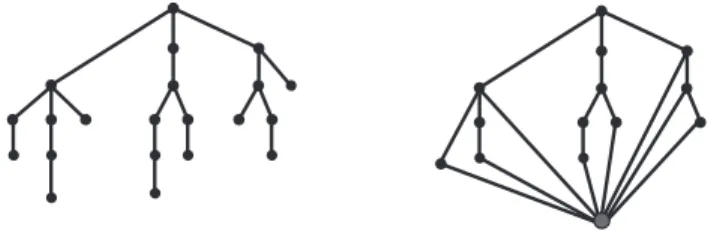
LetT be the set of all trees. We define the functionφthat maps trees to graphs such that for everyT ∈ T,φ(T) is the graph obtained if we identify all the leaves of T to a single vertex (see Figure 1 for an example). We denote the new vertex as thejoin-vertex ofφ(T).
Figure 1: An example of the application of the functionφ.
Observe that if G is a 2-connected outerplanar graph, then its dual H belongs to the classφ(T), where its join-vertex corresponds to the outer face ofG.
Let Gbe a graph. For any set of edges F ⊆E(G) we denote by ∂G(F) the set of vertices of the graph that are incident with an edge inF and also
with an edge inE(G)\F. The boundary function δG(F) of the graph G is defined asδG(F) =|∂G(F)|. We define the linear widthof a graphGas the minimum integer k for which there exists a layout L = (e1, . . . , em) of the edge setE(G), such with max{δG({e1, . . . , ei})|1≤i≤m−1} ≤kand we write lw(G)≤k.
Given a graph G and an edge set F ⊆ E(G) as before, we denote by σG(F) the number of the connected components of G[F]. We will need the following well known fact (see, e.g. [16, 15, 6]).
Fact 3. Let G be a connected graph and F ⊆ E(G). Then λM(G)(F) = δG(F)−σG(F)−σG(F) + 1.
Using this fact we can prove the following relation between the linear width of a treeT and theµ-pathwidth of φ(T).
Lemma 4. For every tree T, it holds that µ-pw(φ(T))≤lw(T).
Proof. Let F be an edge set in E(T), where F 6= ∅ and F 6= E(T). By the definition of the function φ, the tree T and the graph H = φ(T) share a common edge set. Note that only inner vertices ofT contribute to δT(F) and observe that the corresponding vertices of H, with the possible addition of the vertex v, into which the leaves of T merged, are the ones that contribute toδH(F); i.e. δH(F)≤δT(F) + 1. From Fact 3, we obtain that λM(H)(F) = δH(F)−σH(F)−σH(F) + 1 ≤ δH(F)−1 ≤ δT(F). It is straightforward now to conclude that given any sequence of E(T) that results tolw(T)≤`, the same sequence results toµ-pw(H)≤`.
We recursively define the parameterized family of trees Tk, for any non-negative integerk, as follows:
• LetT0 contain the tree obtained by the 1-subdivision of K2.
• Fork≥1,Tk contains any tree that can be obtained by the following procedure: Take three (not necessarily distinct) members ofTk−1, add a new vertex and connect it with some non-leaf vertex in each of these three trees. As long as a leaf in the resulting graph has a neighbour of degree 3, delete this leaf.
For an example of the above construction, see Figure 2 (only two of the four members of the classT2 are depicted in Figure 2).
We denote byLkthe class of graphs with linear-width at mostk. Linear-width is a parameter defined in [21] and studied in [4, 20]. While it differs
Figure 2: The classesT0,T1, and part ofT2.
by at most one from the more known parameter of pathwidth, it is more easy to study in our context because of the strong similarity of its definition to the one of µ-pathwidth.
The acyclic obstructions for Lk are determined by the following result (see Theorem 29 in [20]).
Proposition 1. For every non-negative integer k, obs(Lk)∩ T =Tk. 5. Obstructions for µ-Pathwidth
For each non-negative integer k, we define Hk = φ(Tk), i.e. a graph H belongs to the classHk, iff H=φ(T) for some T ∈ Tk (see Figure 3).
Figure 3: The setsH0,H1, and part ofH2.
Let now G1, G2, G3 be three disjoint 2-connected graphs and vi, ui ∈ V(Gi) a pair of distinct vertices for i = {1,2,3}. We call u-fusion of the graphsG1, G2, G3 on the given pairs of vertices the graph Gconstructed as follows:
a) For i = {1,2,3} if the vertices vi, ui are adjacent in Gi, then delete the edge{vi, ui} inGi (in case{vi, ui} is a multiple edge, delete only one of its copies).
b) Identify verticesv1, v2, v3 to a single vertexv, take a new vertexunot inG1,G2 orG3, and add the edges {u1, u},{u2, u}and {u3, u}.
Figure 4: Theu-fusion operation.
Notice that G is 2-connected by construction. We will call the vertices v, u base vertex and top vertex of the resulting graph respectively and the three edges incident to ubridge edgesinG.
Lemma 5. Let G be a u-fusion of three disjoint 2-connected graphsG1, G2 andG3. Then µ-pw(G)≥min{µ-pw(G1), µ-pw(G2), µ-pw(G3)}+ 1. Proof. For i = 1,2,3 let us denote by vi, ui ∈ V(Gi) the pair of vertices involved in theu-fusion of the three graphs. Consider for each graphGi the graphG+i which has the same vertex set asGi and edge setE(G+i ) =E(Gi) ifei ={vi, ui} ∈ E(Gi) or else E(Gi+) =E(Gi)∪ei. Clearlyµ-pw(G+i ) ≥ µ-pw(Gi) for i= 1,2,3.
Recall that, by its definition, a matroid formed as a fusion of three graphic matroids is itself graphic as the class of graphic matroids is closed under series connection. By construction, the cycle matroid ofGis isomor-phic to the matroid obtained by the fusion of the cycle matroids of the graphs G+1, G+2, G3+ on the elements e1, e2, e3. Then, the application of Lemma 3 yields thatµ-pw(G)≥min{µ-pw(G1), µ-pw(G2), µ-pw(G3)}+ 1. We will use Lemma 5 to prove the following lemma:
Lemma 6. Let H be a graph in Hk for some non-negative integerk. Then H is an obstruction for µ-pathwidth less or equal tok.
Proof. Following the standard course for a proof of an obstruction set let us first attend to the value of the µ-pathwidth of a given graph in Hk. Notice that µ-pw(C2) = 1 and that, for any k ≥ 1, every graph in Hk is 2-connected, i.e. its cycle matroid is connected. Since every graph in
Hk is a u-fusion of three graphs of the class Hk−1, by applying inductively Corollary 5 it follows that for any integer k ≥ 0, all graphs in Hk have µ-pathwidth at least k+ 1. On the other hand a graph in Hk has clearly µ-pathwidth at mostk+ 1, as otherwise its image inTkoverφ−1 would have
also linear width more thank+ 1 by Lemma 4. Summarizing, all graphs in
Hk fork≥0 haveµ-pathwidth equal tok+ 1.
Consider now such a graphH inHk and also the treeT =φ−1(H). For an edge e in E(H) = E(T), we examine the graph H/e and the tree T /e. Since T belongs in Tk all leaves have neighbors of degree 2 and therefore T /e is again a tree with the same number of leaves. Moreover, both T /e and the cycle matroid of H/eare connected. It follows that H/e=φ(T /e) and hence by Lemma 4, µ-pw(H/e) ≤ k, as T is an obstruction for linear width of at mostk.
Similarly, we examine the graph H\eand the treeT\e. Since the cycle matroid M(H\e) is not connected, it does not hold that H\e = φ(T\e). However, each connected blockMiinM(H\e) is the cycle matroid ofφ(Ti), whereTi is a minor ofT\e. In any case, again Lemma 4 immediately implies thatµ-pw(H\e)≤k.
Conversely, we will prove that if the dual of a biconnected outerplanar graph is an obstruction toµ-pathwidth then it belongs to the familyHk. Lemma 7. Let H be the dual of a biconnected outerplanar graph that is an obstruction for µ-pathwidth at most k. Then H∈ Hk.
Proof. To a contradiction, suppose thatHdoes not belong to the familyHk. SinceHis an obstruction forµ-pathwidth at mostk, surelyµ-pw(H)≥k+1 and Lemma 4 implieslw(T)≥k+1, for the corresponding treeT =φ−1(H). Thus it contains a minor T0 T such that T0 ∈ Tk+1. Consider now H0 = φ(T0) and observe that H0 H; a contradiction since by definition H0∈ Hk+1.
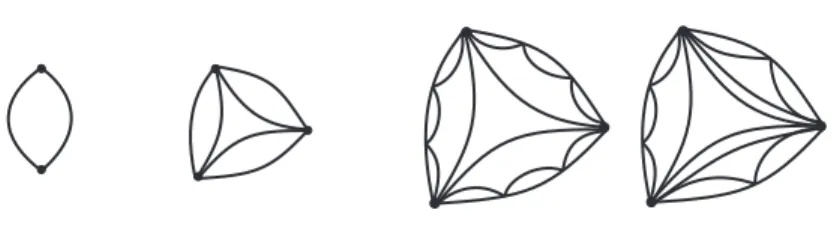
For every non-negative integer k, we define H∗k as the class of all duals of the graphs in Hk (see Figure 5). The previous two lemmata, along with Lemma 1, imply the main result of our paper.
Theorem 1. For every non-negative integerk, the setH∗
kis the obstruction set for the class outerplanar graphs with µ-pathwidth at most k.
The theorem reveals a bijection between the acyclic obstructions for linear width and the outerplanar obstructions for µ-pathwidth. This also gives a way to lower bound the size ofPk. Copying the counting made in [19] (see also [20]), it follows that|obs(Pk)| ≥(k!)2.
Another consequence of our results is the following.
Corollary 1. Let G be a biconnected outerplanar graph and letT be a tree such thatG∗ =φ(T). Then µ-pw(G) =lw(T).
Figure 5: The setsH∗
0,H∗1 and part ofH2∗.
The later implies the existence of a linear time algorithm for the com-putation of theµ-pathwidth of outerplanar graphs:
Corollary 2. There exists a linear algorithm that, given an outerplanar graph, outputs its µ-pathwidth.
Proof. Let G be an outerplanar graph. Let also G1, . . . , Gr be its bicon-nected components andH1, . . . , Hr their corresponding duals. Let
k= max{lw(φ−1(Hi))|i= 1, . . . r}.
The linear-width of trees can be computed in linear time, using a straight-forward adaptation of the linear algorithm of [18] for computing the path-width of a graph. Therefore, from Corollary 1 and Lemma 1 we have that µ-pw(G) =k.
[1] Brian Beavers and James Oxley. Constructive characterizations of 3-connected matroids of path width three. Eur. J. Comb., 29(7):1643– 1661, 2008.
[2] Thomas H. Brylawski. A combinatorial model for series-parallel net-works. Trans. Amer. Math. Soc., 154:1–22, 1971.
[3] J. A. Ellis, I. H. Sudborough, and J. S. Turner. The vertex separa-tion and search number of a graph. Information and Computation, 113(1):50–79, 1994.
[4] Fedor V. Fomin, Pinar Heggernes, and Rodica Mihai. Mixed search number and linear-width of interval and split graphs. Networks, 56(3):207–214, 2010.
[5] J. F. Geelen, A. M. H. Gerards, N. Robertson, and G. P. Whittle. On the excluded minors for the matroids of branch-width k. J. Combin. Theory Ser. B, 88(2):261–265, 2003.
[6] James F. Geelen, A. M. H. Gerards, and Geoff Whittle. Branch-width and well-quasi-ordering in matroids and graphs. J. Combin. Theory Ser. B, 84(2):270–290, 2002.
[7] Jim Geelen, Bert Gerards, and Geoff Whittle. On Rota’s conjecture and excluded minors containing large projective geometries.J. Combin. Theory Ser. B, 96(3):405–425, 2006.
[8] Rhiannon Hall, James Oxley, and Charles Semple. The structure of 3-connected matroids of path width three. European J. Combin., 28(3):964–989, 2007.
[9] Rhiannon Hall, James Oxley, Charles Semple, and Geoff Whittle. Fork-decompositions of matroids. Adv. in Appl. Math., 32(3):523–575, 2004. [10] Illya V. Hicks and Nolan B. McMurray, Jr. The branchwidth of graphs and their cycle matroids. J. Combin. Theory Ser. B, 97(5):681–692, 2007.
[11] Petr Hlinˇen´y. The Tutte polynomial for matroids of bounded branch-width. Combin. Probab. Comput., 15(3):397–409, 2006.
[12] Jisu Jeong, O joung Kwon, and Sang il Oum. Excluded vertex-minors for graphs of linear rank-width at most k. In Natacha Portier and Thomas Wilke, editors, 30th International Symposium on Theoreti-cal Aspects of Computer Science (STACS 2013), volume 20 of Leib-niz International Proceedings in Informatics (LIPIcs), pages 221–232, Dagstuhl, Germany, 2013. Schloss Dagstuhl–Leibniz-Zentrum fuer In-formatik.
[13] Navin Kashyap. Matroid pathwidth and code trellis complexity. SIAM J. Discrete Math., 22(1):256–272, 2008.
[14] Daniel Kr´al’. Computing representations of matroids of bounded branch-width. In Wolfgang Thomas and Pascal Weil, editors, STACS 2007, volume 4393 of LNCS, pages 224–235. Springer Berlin / Heidel-berg, 2007.
[15] Fr´ed´eric Mazoit and St´ephan Thomass´e. Branchwidth of graphic ma-troids. In Surveys in combinatorics 2007, volume 346 ofLondon Math. Soc. Lecture Note Ser., pages 275–286. Cambridge Univ. Press, Cam-bridge, 2007.
[16] James G. Oxley. Matroid theory. Oxford Science Publications. The Clarendon Press Oxford University Press, New York, 1992.
[17] T. D. Parsons. Pursuit-evasion in a graph. In Proceedings Internat. Conf., Western Mich. Univ., Kalamazoo, Mich., 1976, Theory and ap-plications of graphs, pages 426–441. Lecture Notes in Math., Vol. 642. Springer, Berlin, 1978.
[18] Konstantin Skodinis. Construction of linear tree-layouts which are op-timal with respect to vertex separation in linear time. J. Algorithms, 47(1):40–59, 2003.
[19] Atsushi Takahashi, Shuichi Ueno, and Yoji Kajitani. Minimal acyclic forbidden minors for the family of graphs with bounded path-width. Discrete Mathematics, 127(1/3):293–304, 1994.
[20] Dimitrios M. Thilikos. Algorithms and obstructions for linear-width and related search parameters. Discrete Applied Mathematics, 105:239–271, 2000.
[21] Robin Thomas. Tree-decompositions of graphs. Lecture notes, School of Mathematics. Georgia Institute of Technology, Atlanta, Georgia 30332, USA, 1996.
[22] W. T. Tutte. Connectivity in matroids.Canad. J. Math., 18:1301–1324, 1966.