Using SIP Protocol for Bi-directional Push-to-Talk
Mechanism over Ad-Hoc Network
Shih-yi Chiu
Graduate Inst. of Networking and Communication Eng. Chao Yang Univ. of Tech., Taichung, Taiwan
Lin-huang Chang
Graduate Inst. of Networking and Communication Eng.
Chao Yang Univ. of Tech., Taichung, Taiwan
[email protected]
摘要
在通訊科技發達的今日,隨著技術的進步及 電信業者的推波助瀾之下,使得人們隨處都可 以使用行動設備,而電信業者也無不互相競 爭,推出許多便民的服務,其中,按即說機制
(PoC, Push-to-talk over cellular)更是大家廣為
使用的技術。再者,網際網路廣為應用,網路 頻寬與品質的提高,加速了應用層面之推廣,
而VoIP更是為人們愈來愈廣範的使用,在本篇
論文中,透過IETF所制定之SIP標準,我們將
針對隨意式網路(Ad hoc)之環境下,使用虛擬
SIP伺服器(Pseudo SIP server)之概念,並且有 別於一般電信業者的按即說系統,我們在分封 交換網路中提出雙向按即說機制,使得使用者 能夠任意加入及離開單一或多群組,無需事先 的撥號,只需按下按鈕則可與群組內的使用者 互相溝通。透過這樣的環境及機制建構,大大
提高了語音的便利性,在軍事、救災…等環境
提供了完整的即時語音解決方案。
Abstract
In the recent years, computer technology and telecommunication grown so fast that mobile devices are easy to be used. Telecommunications industry also innovates many services to catch user’s eyes. Push-to-Talk(PPT) mechanism is one of the popular services. On the other hand, due to the popularity of Internet and the increase of network bandwidth and quality of service, voice over Internet protocol(VoIP) is popular now. In this paper, we propose Push-to-Talk mechanism over Ad hoc network using SIP. Different from other VoIP applications, this mechanism combine Pseudo SIP Server in Ad-hoc network environment. Users can create or join any one of group at they own choice. After joining in one group, one button push will transfer voice
immediately without infrastructure. This mechanism provides an efficient communication for rescue or military applications.
Keyword: VoIP, Pseudo SIP server, Push-to-Talk, bi-directional, Ad-hoc
1. Introduction
In those years, telecommunication industry development is fast. Telecommunication 2G or 2.5G is widespread, and 3G is developed today. Those enterprises do their best to try to catch people’s eyes, no matter coverage or diversification services. From view point of the functionality, phone call and short message are common functions over cellular phone. Dictionary service or GPRS may be combined in the future. In 2004, many telecommunication industry established the Push-to-Talk(PTT) or called PoC(Push-to-Talk over cellular)[1] mechanism. The PoC service is popular and becomes the one of the most important services that we use.
Push-to-talk mechanism originated from the radio system. Before using the radio, we need to set all radio devices to the same channel, then the devices will receive sound signal when we push the “speak” button within the covered range. From another view, this is a half-duplex mechanism. But when using the PoC system, users need to be in the same group, and then transfer voice with GPRS. PoC have some advantages, but most important is that PoC does not require adjusting channels and can use full-duplex data transfer.
Internet advances faster than we could imagine. There are many applications that we use everyday, such as WWW(World Wide Web), E-mail, which are evolved to multimedia transfer.
Those applications make our life more convenient, and use high-speed and quality network environment. How to transfer transitional services into packet switch network is popular issue that needs to be discussed further. VoIP is one of most important issues that need to be studied.
If we want to transfer VoIP packets over the Internet, signaling exchange is important. IETF defined SIP(Session Initiation Protocol)[10] in 2002, and solved the signaling problem of voice translation. SIP can initiate, modify, and terminate voice session, as well as inviting Uni-cast or Multicast conference. SIP is different than H.323[5] because it is a simple and flexible protocol, integrated with RTP and RTCP for voice transfer in an infrastructure network.
In this study, we proposed the bi-directional push-to-talk mechanism over ad hoc network. Different from the Internet, Ad hoc is a Non-Infrastructure environment. Our push-to-talk mechanism also integrated Pseudo SIP Server[12] in the transfer layer. In this mechanism, user can join or leave PTT groups, and press one button for voice transmission. This mechanism is useful for usage by rescuers or military.
In this paper, we will introduce the PTT background in Section 2, and discuss relate works in Section 3. Other sessions will present the system architecture, functions and analysis. At the last, conclusions will be proposed.
2. Backgrounds
2.1 Voice over Internet Protocol(VoIP)
Internet is now a mature technology with high bandwidth and quality. In the past, Internet was only used for text or image transfer. Researches in the past decade studied the transfer of multimedia over the Internet. So, how to use telecommunication over Internet protocol is a topic for this study.
H. 323 is the ITU-T recommendation for multimedia communications protocol over packet-switched networks. This protocol integrated telecom, image, and video. But the waste packets obstructed its prevalence. Another signaling protocol is recommended by IETF, instead of H. 323, it is used on VoIP signaling protocol. SIP is a signaling protocol used for
initiating, modifying and terminating voice sessions in the application layer. Because SIP is only a signaling protocol, it must work with another voice or text transmission protocol, such as RTP and RTCP, and use SDP(session description protocol) to describe multi-session.
Over the past years, numerous studies on SIP were published. How to improve voice transfer is one of most important issues. Among which, how to create a voice conference[6] is the focus of IETF recently. In this study, we proposed the push-to-talk mechanism base on non-infrastructure network. It can transfer voice immediately by using one button.
2.2 Ad hoc VoIP system
Internet integrated servers, switches, and clients use those devices to transfer message in a packet-switch environment. SIP was also developed in this kind of network. Whether register or forward data, those packets need SIP proxy server to process.
To transfer voice data over a non-infrastructure environment, it needs ad hoc network or Mobile Ad Hoc Network(MANET), which are not easy to reach. Because SIP is a Client/Server architecture, to use SIP to transfer voice data, it relies on an integrated mechanism for this environment.
It is difficult to discover users and services over ad hoc network. But many studies were conducted on transmission VoIP over ad hoc network, such as modifying SIP protocol[8] or service discovery[9]. But modified SIP protocol is not compatible with SIP user agent. In this study, we used Pseudo SIP Server[12] proposed in our previous study to deal the SIP signaling without the need to modify SIP protocol. Most importantly, it can find users correctly over the ad hoc network.
3. Related works
In this section, we will discuss some relate works, and introduce Pseudo SIP Server proposed in our previous study.
3.1 Using Ad hoc routing mechanism
The advantage of this mechanism[4] is to combine ideas from the group, allow users to join
or leave MPRs(Multi-Point relay) voluntarily, and reduce signaling exchange and power consumption. MPRs can also deal with group problem successfully. For the voice control problem, they can define control message by start or stop push-to-talk session.
In practice, the focus is on packet size and hop count measure. But there are drawbacks in this study. First, we used packet generator instead voice transfer; second, this design is not easily fit with SIP user agent.
3.2 Time stamp of RTP mechanism
[3] proposed an push-to-talk mechanism using Timestamp of RTP header and buffer, and transferred voice packet by broadcast.
When pressing the push-to-talk button, voice data will be transferred in this node’s transmission range. First, request packet is sent to obtain transmission time, then the timestamp field is rewritten, and the time of this device is written. At least, broadcast can be used to transmit voice in this node’s transmission range, and other nodes can recognize the timestamp and play the voice in order.
In this study, we proposed the push-to-talk mechanism using timestamp filed of RTP header. But it also has some problems. First, this design is not easily fit with SIP user agent; second, this mechanism can transfer voice data over the node’s transmission range, but routing and forwarding are still issues to be considered.
3.3 Pseudo SIP server
In the last decade, many studies focused on the transmission of VoIP over ad hoc network[8][9]. One of the most important issues was services and user discovery in this special network. How to use VoIP without modifying SIP user agent is a topic to be researched in this study.
This study [12] proposed the user and services discovery mechanism based on the Subscribe and State Presence to deal with signaling exchange in ad hoc network.
Pseudo SIP Server has two phases. First, it multicasts REGISTER message when receiving message from the user agent, then another user
agent replies ACK by unicast. Second, SUBSCRIBE and NOTIFY is used to deal with user discovery, and handle user list exchange at the same time. At last, users can establish phone call without considering the environment they are using.
4. System architecture
As discussed before, we also need to solve problems of grouping and bi-directional conversation. In this study, we used URI, URI-list[2] and RTP extension header to deal with bi-directional push-to-talk mechanism, and proposed an easy way to use VoIP over the ad hoc network. We will discuss the system architecture and Pseudo SIP Server’s mobility management below.
4.1 System design
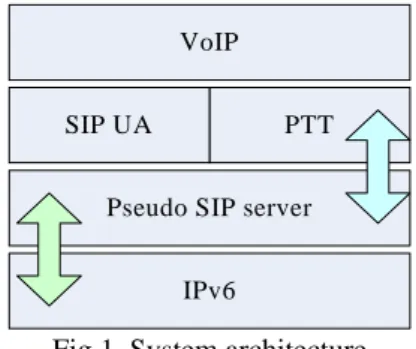
Fig. 1 shows our system architecture, which includes four parts: 1) VoIP Application, 2) User Agent and Push-to-Talk(PTT), 3) Pseudo SIP Server, 4) IPv6.
VoIP
SIP UA PTT
Pseudo SIP server
IPv6
Fig 1. System architecture
PTT and SIP UA are in the same layer, and focus on supporting the voice streaming and signaling exchange with Pseudo SIP Server. In the data transfer layer, Pseudo SIP Server is the major user discovery and signaling exchange device.
Beside, we used IPv6 in the network layer. IPv6 not only has many of IP addresses but also has self-addressing function. Users need to set an address when using IPv6 in the ad hoc environment.
4.2 Mobility mechanism
In the ad hoc network, users can join or leave the group voluntarily. This situation was considered in this study, and functions were
added to deal with it.
First, we assumed that the user turned on the Push-to-talk function. In Fig. 2, User A stores REGISTER in cache, when B sends multicast REGISTER message, A receives REGISTER message from cache and sends by unicast. Then the user list is synchronized.
Multicast
Uni-Cast
User B REGIST ER sip:[fe80::202:6fff:fe09:b1da] SIP /2.0
Via: SIP /2.0/UDP
[fe80::202:6fff:fe09:b1da]:5062;branch=z9hG4bK1C5FA913 CSeq: 1829 REGIST ER
T o: "9005" <sip:9005@[fe80::202:6fff:fe09:b1da]> Expires: 900
From: "9005" <sip:9005@[fe80::202:6fff:fe09:b1da]> Call-ID: 125084713@[fe80::202:6fff:fe09:b1da] Cont ent -Length: 0
User-Agent: kphone/4.2 Event: registration Allow-Events: presence Cont act : "9005"
<sip:9005@[fe80::202:6fff:fe09:b1da]:5062;t ransport =udp>; methods="INVIT E, MES SAGE, INFO, SUBSCRIBE, OP T IONS, BYE, CANCEL, NOT IFY, ACK, REFER"
User A
Fig 2. REGISTER mechanism
From another view, when users move in the transmission range, we may wait for the Expire Time, but this is not a satisfactory solution. We can immediately set a trigger to discover the user information actively. As shown in Fig 3, Pseudo SIP Server will search the user list when UA sends INVITE message. If it finds the user, it would forward an INVITE message, otherwise, it would multicast REGISTER message. If it cannot find the user again, Pseudo SIP Server will reply 404 Not Found message
Receive INVIT E from UA
Find the User? Yes Froward INVIT E
message
Mult icast REGIST ER message
No
Find the User? Yes
Pseudo SIP Server
SIP /2.0 404 Not Found
Fig 3. User advertisement flow chart
5. System analysis
In this study, we used SIP protocol, Instance-ID[7], and URL-list to propose a push-to-talk mechanism over the ad hoc network. The details are described as follows.
5.1 Push-to-Talk mechanism
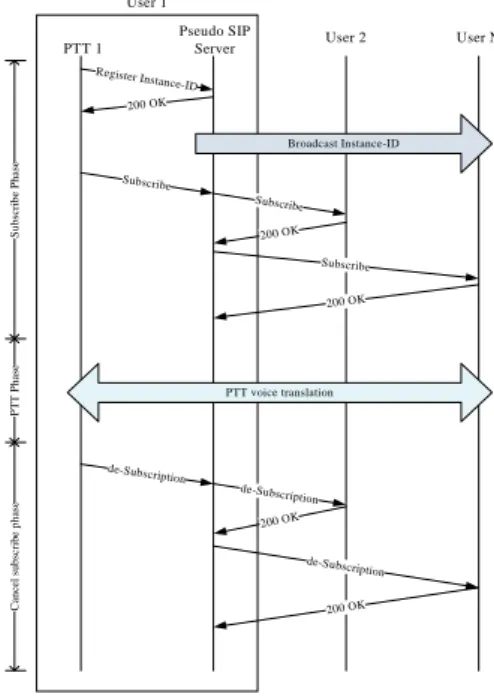
Fig 4 is the flowchart of the push-to-talk mechanism proposed in this study. It includes 3 phases, which are Subscribe phase, Push-to-talk
phase, and de-Subscription phase. In Subscribe phase, UA establishes an Instance-ID and registers to Pseudo SIP Server. Instance-ID is used for group identification. Instance-ID is then broadcasted in the ad hoc network. Next, Pseudo SIP Server subscribes another SUBSCRIBE message with Instance-ID using URI-List mechanism. If other users reply to this message, then a group is created.
PTT 1
Pseudo SIP Server User 1
User 2 User N
Register Instance-ID 200 OK Broadcast Instance-ID Subscribe Subscribe Subscribe 200 OK 200 OK
PTT voice translation
de-Subscription
de-Subscription
de-Subscription
200 OK
200 OK S u b scri b e P h as e PT T P h as e C anc el su bs cr ib e pha se
Fig. 4 System flow chart
In the Push-to-talk phase, when users press the Push-to-talk button, Instance-ID is transferred with the RTP extension header. When RTP packets arrive, push-to-talk mechanism recognizes the Instance-ID in the RTP extension header. If this Instance-ID is correct, voice will be broadcasted. Lastly, de-Subscription is sent if users want to leave the group.
5.2 Instance-ID
How to define a Push-to-talk group is an important issue. It means that users need to know what message is sent from the group they joined.
Fig 5. Example of Instance-ID INVITE sip:[ff02::e%wi0]:8060 SIP/2.0
Via: SIP/2.0/UDP [fe80::2e0:81ff:fe2e:c643%wi0]:8060 From: sip:shihyi@[fe80::2e0:81ff:fe2e:c643%wi0]:8060 To: sip:[ff02::e%wi0]:8060;tag=e882ad
Call-Id: 151f6ad41e574@[fe80::2e0:81ff:fe2e:c643%wi0]:8060 CSeq: 1 REGISTER
Content-Length: 0
Contact: sip:shihyi@[fe80::2e0:81ff:fe2e:c643%wi0]:8060; reg-id=1;+sip.instance="<urn:uuid:00000000-0000-0000-0000-000A 95A0E128>"
Instance-ID is proposed for NAT transversal[11], and it is used in this study for group identification. UA establishes a random series and transmits with SIP’s contact field. In Fig 5, SIP UA sends INVITE message to request Instance-ID. The goal is to make sure the group is unique.
5.3 URL-List
After obtaining the group identification, users can subscribe as they want. In this part of push-to-talk mechanism, we used URI-List to reduce signaling exchange, put URI of the users in the URI-List, and transmitted SUBSCRIBE message to users, as shown in Fig. 6.
Fig 6. Example of URI-List
URI-List carries URL for the XML message, and places URI between <list></list>. When Pseudo SIP Server receives this kind of message, it parses the syntax, and reduces signaling exchange in the ad hoc environment.
5.4 RTP extension header
At last, we used RTP to transmit voice data. The only difference is that we used RTP extension header for group identification, and placed Instance-ID into RTP extension header, as shown in Fig. 7.
Push-to-Talk_ID 40
PTT: 00000000-0000-0000-0000-000A95A0E128
0 | 1 | 2 | 3 | 4 | 5 | 6 | 7 | 8 | 9 | 0 | 1 | 2 | 3 | 4 | 5 | 6 | 7 | 8 | 9 | 0 | 1 | 2 | 3 | 4 | 5 | 6 | 7 | 8 | 9 | 0 | 1 0 | 0 | 0 | 0 | 0 | 0 | 0 | 0 | 0 | 0 | 1 | 1 | 1 | 1 | 1 | 1 | 1 | 1 | 1 | 1 | 2 | 2 | 2 | 2 | 2 | 2 | 2 | 2 | 2 | 2 | 3 | 3
Fig 7. RTP extension header
Fig. 6 is an RTP extension header, when users transfer voice, Pseudo SIP Server places
Instance-ID into the extension header. When another user receives the RTP header, Push-to-talk identifies the packets to be played or dropped.
In this paper, we propose push-to-talk mechanism using pseudo SIP server over ad hoc network. Different traditional push-to-talk system, we focus on bi-directional mechanism and it will compatible any one of regular SIP UA. Also an easy way to transmission voice data.
6. Conclusion
Telecommunication is stable with quality of service nowadays. Push-to-talk gradually becomes one of the popular functions for VoIP. In this paper, we proposed the push-to-talk mechanism with bi-directional design in the VoIP system. With the design of pseudo SIP server, we further integrated Instance-ID, URI-List and RTP extension header to handle signaling exchange. Our design provides an easy and efficient transmission of voice data.
In the future, we will focus on the voice identification to distinguish different groups during transmission. The total solution with integrated applications and functions will be the next step.
7. Acknowledgement
The authors would like to thank the support from National Science Council of Republic of China, Taiwan. Under contract number NSC 94-2219-E-324-001
8. Reference
[1] Commeon, Ericsson, Motorola, Nokia, Siemens, “Push-to-Talk over Cellular(PoC)”, PoC Release 2.0 Specification, May 2004 [2] G. Camarillo and A. Johnston, “Conference
Establishment Using Request-Contained Lists in the Session Initiation Protocol(SIP)”, draft-ietf-sipping-uri-list-conferencing-05(wor k in progress), February 2006.
[3] C. Gan, Y. Lin and Y. Laio, “Ad-hoc Based Push-to-Talk Service”, Proceedings of Mobile Computing 2006, p. 493-496, Feng Chia Univ., Tai-Chuang, Taiwan, Mar. 13, 2006 [4] A. Hafslund, T. Hoang; O. Kure,
“Push-to-talk applications in mobile ad hoc
.. ...
<?xml version="1.0" encoding="UTF-8"?> <resource-lists
xmlns="urn:ietf:params:xml:ns:resource-lists"
xmlns:cp="urn:ietf:params:xml:ns:capacity"> <list>
<entry uri="sip:bill@[ fe80::2e0:81ff:fe2e:c643%wi0]" cp:capacity="to" />
<entry uri="sip:joe@[fe80::2e0:81ff:fe2e:c644%wi0]" cp:capacity="cc" />
<entry uri="sip:ted@[fe80::2e0:81ff:fe2e:c645%wi0]" cp:capacity="bcc" />
</list>
networks”, Vehicular Technology Conference, vol. 4, pp. 2410-2414, June 2005.
[5] ITU, "Packet-based Multimedia
Communications Systems," Technical Report ITU-T H.323, Version 3, International Telecommunication Union, 1999.
[6] A. Johnston, O. Levin, “Session Initiation Protocol Call Control – Conferencing for User Agents”,
draft-ietf-sipping-cc-conferencing-07(work in progress), June 2005.
[7] C. Jennings and R. Mahy, “Managing Client Initiated Connections in the Session Initiation Protocol (SIP)”, draft-ietf-sip-outbound-02 (work in progress), March 2006.
[8] H. Khlifi, A. Agarwal, J-C. Grégoire, "A Framework To Use SIP in Ad-Hoc Networks", Proceedings of IEEE 2003 Canadian Conference on Electrical and Computer Engineering, pp. 985-988. May 2003.
[9] S. Leggio, J. Manner, A. Hulkkonen, K. Raatikainen, "Session Initiation Protocol Deployment in Ad-Hoc Networks: A Decentralized Approach", Proceedings of the International Workshop on Wireless Ad-Hoc Networks (IWWAN2005), May 23 - 26, 2005, London, UK.
[10] J. Rosenberg, H. Schulzrinne, G. Camarillo, A. Johnston, J. Peterson, R. Sparks, M. Handley, E. Schooler, " SIP: Session Initiation Protocol ", IETF Request for Comments 3261, June 2002.
[11] J. Rosenberg, J. Weinberger, C. Huitema and R. Mahy, "STUN- Simple Traversal of User Datagram Protocol (UDP) Through Network Address Translators (NATs)", RFC 3489, March 2003.
[12] 莊坪達, 邱仕益, 張林瑝, “使用整合式
SIP探索與事件通知機制之Ad Hoc VoIP系
統”, Proceedings of Mobile Computing 2006, p. 630-636, Feng Chia Univ., Tai-Chuang, Taiwan, Mar. 13, 2006.