* Corresponding author. Tel: 919 541 4830; fax: 919 541 2157. Email address: [email protected]
1
Published in
Biomass
and
Bioenergy
33 (2009) 294–305
1.
Introduction
Approximately half of the world’s human population depends on burning solid fuels for cooking, boiling water, and heating. Solid fuels include wood, charcoal, coal, crop residues, other biomass, animal dung, and various wastes. The WHO (World Health Organization) estimates that more than 1.5 million people prematurely die each year due to exposure to the smoke and other air pollutants from burning solid fuels [1]. Millions more people suffer with difficulty in breathing, stinging eyes, and chronic respiratory disease. Women and children are disproportionately affected, because they tend to spend more time close to cook stoves. WHO identifies indoor smoke from solid fuels among the top 10 health risks, and
indoor air pollution is responsible for an estimated 2.7 percent of the global burden of disease [2].
The PCIA (Partnership for Clean Indoor Air) was launched at the World Summit on Sustainable Development in Johannesburg in September 2002 to address the enormous environmental health risks faced by people who burn solid fuels for their household energy needs. This voluntary partnership is bringing together more than 160 governments, public and private organizations, multilateral institutions, industries, and others to increase the use of affordable, reliable, clean, efficient, and safe home cooking and heating practices. PCIA information is available via the Internet at http://www.pciaonline.org. The work described in this publication was designed to support PCIA activities. ABSTRACT Keywords: PCIA Partnership for Clean Indoor Air Fuel wood Lump charcoal Garment waste Water Boiling Test CO2 CO Total hydrocarbon PM2.5
In this study, 14 solid‐fuel household cook stove and fuel combinations, including ten stoves and four fuels, were tested for performance and pollutant emissions using a WBT (Water Boiling Test) protocol. Results from the testing showed that some stoves currently used in the field have improved fuel efficiency and lower pollutant emissions compared with traditional cooking methods. Stoves with smaller‐mass components exposed to the heat of fuel combustion tended to take lesser time to boil, have better fuel efficiency, and lower pollutant emissions. The challenge is to design stoves with smaller‐mass components that also have acceptable durability, affordable cost, and meet user needs. Results from this study provide stove performance and emissions information to practitioners disseminating stove technology in the field. This information may be useful for improving the design of existing stoves and for developing new stove designs. Comparison of results between laboratories shows that results can be replicated between labs when the same stove and fuel are tested using the WBT protocol. Recommendations were provided to improve the ability to replicate results between labs. Implications of better solid‐fuel cook stoves are improved human health, reduced fuel use, reduced deforestation, and reduced global climate change.
Solid
Fuel
Household
Cook
Stoves:
Characterization
of
Performance
and
Emissions
James
J.
Jetter,
a*and
Peter
Kariher
ba
Office
of
Research
and
Development,
National
Risk
Management
Research
Laboratory,
U.S.
Environmental
Protection
Agency
(E305
02),
Research
Triangle
Park,
North
Carolina
27711,
USA
2 A literature survey was conducted, and we found that many solid‐fuel stoves have been tested for performance and emissions [3‐19]. Smith et al. [10] found “that solid biomass fuels are typically burned with substantial production of PIC (products of incomplete combustion).” PICs include non‐CO2
(carbon dioxide) greenhouse gases and particles that affect global climate change as well as toxic air pollutants that adversely affect human health. Smith et al. also found that so‐ called “improved” stoves that were tested had improved fuel efficiency but actually had worse PICs emissions than traditional stoves. Stoves with improved fuel efficiency reduce fuel use and reduce deforestation, but higher emissions are of concern for health and for climate change. Better stoves have been developed to reduce emissions and improve fuel efficiency, but test results have not previously been reported in the peer‐reviewed scientific literature.
Objectives of this study were to:
1. determine if some cook stoves have improved fuel efficiency and lower pollutant emissions compared with the traditional 3‐stone fire.
2. provide useful cook stove performance and emissions information to PCIA partners and others disseminating stove technology in the field.
3. compare test results using the Water Boiling Test (WBT) protocol with a PCIA partner, Aprovecho Research Center (ARC), Cottage Grove, Oregon.
2.
Experimental
2.1 Stoves tested Stoves that were tested in this study are shown in Figure 1. Four of the 10 stoves were variations of the “rocket” stove design. Many variations of the rocket stove have been developed by ARC and other PCIA partners, such as Stoves A, D, G, and J that are described below. A rocket stove has an opening on one side near the bottom of the stove for fuel to be inserted and for air to enter the combustion chamber. Draft is created by the large temperature difference between the air entering the bottom of the stove and the hot combustion gases exiting from the top of the vertical combustion chamber. Some rocket stoves have a metal skirt around the sides of the pot for improved heat transfer from the hot combustion gases to the pot. Following are descriptions of the stoves shown in Figure 1:
(A) Ecostove. The Ecostove is the only stove tested that has a chimney and a flat steel plate top for grilling foods or making tortillas. The vented Ecostove has been shown to reduce indoor air pollution compared to unvented traditional wood fires [20]. The Ecostove’s rocket combustion chamber is constructed from “baldosa” ceramic tiles that are locally available in Central America, and the combustion chamber is surrounded by insulation such as wood ash, pumice, or
vermiculite. The stove that was tested had vermiculite insulation.
(B) VITA stove. The VITA (Volunteers in Technical Assistance) stove [21] provides a shield around the fire that may be beneficial during windy conditions, and a skirt around the sides of the pot improves heat transfer from the hot combustion gases to the pot. Fuel wood is burned on a grate on the bottom of the stove. The same stove was tested by ARC, so results could be compared. VITA stoves have been widely used in the field.
(C) UCODEA charcoal stove. The Urban Community Development Association (UCODEA), Kampala, Uganda, charcoal stove has a metal body with a ceramic liner and grate to hold the hot charcoal. Two doors on the side near the bottom of the stove can be used to control the amount of air that flows up through the grate to the burning charcoal.
(D) WFP rocket stove. This rocket stove was developed by ARC for the United Nations World Food Programme (WFP). Metal food containers are used as materials of construction. The combustion chamber is constructed from sheet metal and is surrounded by insulation such as wood ash, pumice, or vermiculite. The stove that was tested had vermiculite insulation and had a pot skirt. The relatively low mass of the stove minimizes heat loss and results in higher temperature combustion to reduce pollutant emissions. However, the sheet metal combustion chamber becomes red‐hot during operation, so the stove deteriorates rapidly compared to other stoves that were tested. The WFP rocket stove typically must be repaired or replaced after about three months of daily use. A similar stove was tested by ARC, so results could be compared. WFP rocket stoves have been widely used in the field, particularly in refugee camps.
(E) 3‐stone fire. The most commonly used traditional method of cooking is the 3‐stone fire. A cooking pot is placed on three stones, and a fire is made in the center of the stones under the pot. Fuel wood sticks are pushed into the center of the fire, so the ends of the sticks burn. A 3‐stone fire was tested as a baseline for performance and emissions. The dimensions of the three bricks used as stones and the standard cooking pot were identical to those used by ARC, so results could be compared.
(F) Philips stove. Royal Philips Electronics of the Netherlands is currently testing this stove in India. The Philips Model HD4010 stove has a cylindrical, stainless‐steel combustion chamber, a small electric fan, a rechargeable battery, and a thermoelectric generator. The battery provides electrical power to the fan during start‐up when the stove is cold, and the thermoelectric generator recharges the battery and powers the fan when the stove is hot. A relatively small amount of primary air is injected into the fuel in the bottom of the combustion chamber and a relatively large amount of secondary air is injected into the burning gases in the top of the combustion chamber. Air flow provided by the fan keeps the combustion chamber from overheating while the air is preheated before it is injected into the combustion chamber. During operation of the stove, small pieces of solid fuel are
3
Figure 1 – Stoves tested: A. Ecostove, B. VITA, C. UCODEA charcoal, D. WFP rocket, E. 3stone fire, F. Philips, G. 6brick rocket,
H. Lakech charcoal, I. NLS, J. UCODEA rocket
stove and the bottom of the pot. Compared to other stoves tested, shorter pieces of fuel must be used for the Philips stove. The same stove model was tested by ARC, so results could be compared.
(G) 6‐brick rocket stove. The 6‐brick rocket stove developed by ARC has a combustion chamber made of insulative bricks that are light enough to float on water. The lightweight bricks were designed to minimize heat loss compared to heavier materials and to increase the lifetime of the stove compared to the lifetime of rocket stoves with metal combustion chambers. The six bricks form a combustion chamber with a hexagonal cross‐sectional area. Many variations of the 6‐ brick stove are used in the field, but the stove that was tested was made with a pot skirt and with a metal bucket to contain the six bricks. 6‐brick rocket stoves have been widely used in refugee camps in Africa.
(H) Lakech charcoal stove. The Lakech stove has a metal body with a ceramic liner and grate to hold the hot charcoal. Compared with the UCODEA charcoal stove, the Lakech stove is smaller both in height and in volume of the charcoal holder. A door on the side near the bottom of the stove can be used to control the amount of air that flows up through the grate to the burning charcoal. The Lakech stove is widely used in Ethiopia.
(I) NLS (New Lao Stove). The NLS was designed for burning wood and charcoal, but it has been observed that the NLS is sometimes used for burning garment waste from factories in Cambodia, and the stove was tested with only garment waste fuel in this study. The NLS has a metal body with a ceramic grate for burning fuel. A ceramic piece between the grate and pot is removable for adding fuel during operation of the stove.
(J) UCODEA rocket stove. The UCODEA rocket stove has a metal body with a cylindrical, ceramic combustion chamber and an
integral pot skirt. An aluminum pot that fits the skirt is provided with the stove.
2.2 Fuels tested
Fuels were analyzed for moisture content using ASTM Standard Method D4442‐92 [22], and fuels were analyzed for heat of combustion using ASTM Standard Method ASTM D5865‐04 [23]. The following five fuels were used in the tests:
Kiln‐dried Douglas fir This is a consistent fuel wood that is usually used by ARC, and this fuel was selected for comparison of results with ARC. Douglas fir used by ARC and used in this study was obtained from the same source.
Air‐dried Red oak This was selected because it is similar to hardwoods used in the field. High‐resin pine This is found in the core of pine logs
and stumps. This fuel was selected as a charcoal starter, because it is often used in the field, although many other fuels are used to start charcoal. Charcoal Wood lump charcoal, rather than
compressed briquettes, was used in the tests, because lump charcoal is typically used in the field.
Garment waste Garment waste was obtained from a factory in Cambodia. This fuel was selected because it was observed being used in cook stoves in the field. A B C D E F G H I J
4 2.3 Test system The test system consisted of a hood for collecting emissions from the stoves, an air duct for sampling air pollutants, and a blower for drawing air through the hood and duct. Air flow was adjusted so that all emissions were collected by the hood, but the velocity of air currents near the stove was less than 0.25 m s‐1 to minimize the effect on performance of the stove.
Air velocity in the duct was measured using the pitot tube traverse method, and air mass flow was determined by measurements of air velocity, temperature, and pressure.
2.4 Sampling and analysis
Gaseous pollutant emissions were measured with CEMs (continuous emission monitors). CO2 emissions were
measured with a Horiba Model VIA‐510 nondispersive infrared (NDIR) CEM. Carbon monoxide (CO) emissions were measured with a California Analytical Instruments Model 200 NDIR CEM. Total hydrocarbon (THC) emissions were measured with a California Analytical Instruments Model 300‐HFID flame ionization detection (FID) CEM.
Particulate matter with an aerodynamic diameter less than 2.5 micrometers (PM2.5) emissions were measured using
the filter method. Integrated samples of PM2.5 were
isokinetically sampled and collected on Teflo® Teflon
membrane filters using a University Research Glassware (URG) size‐selective cyclone and filter pack. Samples were collected during each of the three phases of the WBT protocol, described below. Filters were equilibrated at 35 percent relative humidity and 23˚C and were weighed before and after sampling with a Mettler‐Toledo UMX2 microbalance.
PM (particulate matter) emissions were measured with a Dekati Model 97‐2E Electrical Low‐Pressure Impactor (ELPI) real‐time particle size spectrometer. The ELPI measured real‐time particle size distribution and concentration in the size range from 30 nm to 10 µm. Results for real‐time PM will be reported in a subsequent publication.
PM was also collected on quartz fiber filters, and organic carbon (OC) and elemental carbon (EC) were measured by evolved methane gas analysis using a Sunset Laboratories Model 4L thermal‐optical carbon analyzer following NIOSH Method 5040 [24]. Exhaustive details of the method have been provided by Birch and Cary [25, 26] and Chow et al. [27]. Results for OC/EC PM will be reported in a subsequent publication.
2.5 Test protocol
The Water Boiling Test (WBT) stove performance test protocol was initially developed by VITA [28] and was refined by the University of California‐Berkeley in collaboration with ARC and other stove researchers. The WBT, Version 1.5 [29] was used in this study to measure performance and to simultaneously measure emissions during operation of the stoves. Bailis et al. [29] describe the protocol as follows: “While the test is not intended to replace other forms of stove assessment, it is designed to be a simple method by which stoves made in different places and for different cooking
applications may be compared by a standardized and replicable protocol.”
The WBT protocol consists of the following three phases:
1. High power, cold start: the first phase begins with the stove, standard test pot, and water at room temperature, and the stove is operated until the water reaches boiling temperature.
2. High power, hot start: the second phase begins immediately after the first phase with the stove hot and with the pot refilled with water at room temperature. The stove is operated until the water reaches boiling temperature. Results for the cold start and hot start can be compared to identify differences in performance between a cold and hot stove.
3. Low power: the third phase begins immediately after the second phase with the stove, pot, and water hot. The stove is operated to maintain the water temperature just below the boiling point, and results can be compared to identify differences in performance between low‐power and high‐power operation of the stove.
For all three phases of the WBT protocol, measurements include the mass of fuel used, the mass of charcoal produced or consumed, the mass of water in the pot at the beginning and end of the test phase, temperature of the water, and time. Pollutant emissions were simultaneously measured during each phase of the WBT protocol. Stoves were carefully operated during the tests. Fuel wood was consistently fed into the fire by hand, so that the ends of the sticks burned. The Philips stove used smaller pieces of fuel wood and was easily operated following instructions that came with the stove. Charcoal stoves required little attention during operation other than occasionally adding more charcoal. The NLS/garment waste stove/fuel combination required much attention as the fast‐burning fuel had to be constantly fed into the fire during the tests.
The WBT test protocol was designed for wood‐burning cook stoves, but it was also used for the two charcoal stoves that were tested, with the following three modifications:
1. At the beginning of the cold start phase of the test, 50 g of high‐resin pine was used to light the charcoal. The heat of combustion energy and moisture content of the high‐resin pine were included in the calculations for the WBT. After one minute, the fire was burning well, and the pot was placed on the stove. Charcoal was added to the stove as needed during the test. Emissions measured during the cold start phase included the relatively high PM emissions and relatively low CO emissions.
2. Charcoal stoves produce a large amount of smoke during a cold start. For this reason, stoves are typically started outdoors and are brought indoors only after the charcoal is hot and stops smoking. Although the hot charcoal produces little smoke, it produces large amounts of CO, so charcoal stoves should only be used in very well ventilated areas. At
5 the beginning of the hot start phase of the test, the hot charcoal left from the cold start phase of the test was weighed and was left in the stove. Charcoal was added to the stove as needed during the hot start phase. Emissions measured during the hot start phase included the low PM emissions and relatively high CO emissions.
3. The measured heat of combustion and moisture content of the charcoal were used in all calculations for the three phases of the WBT protocol.
3.
Results
and
discussion
Results of the fuel analysis are shown in Table 1. Measured moisture content and heat of combustion values for the fuels were used in the WBT protocol to calculate thermal efficiency and specific fuel consumption. Moisture content on a wet basis for the kiln‐dried Douglas fir was 9.6 percent, compared to a value of 9.3 percent for the same batch of fuel measured by ARC 6 weeks before testing began. Moisture content for the air‐dried Red oak was 10.0 percent and 11.4 percent for two batches that were used for testing. Red oak logs were obtained with a moisture content of 16‐21 percent, but after the logs were cut, split, and air‐dried for 5 months, the moisture content decreased to the values shown.
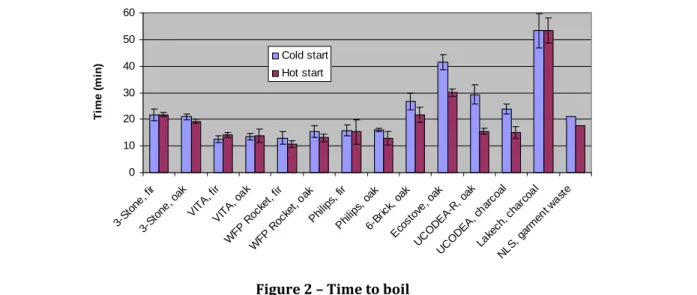
Time to boil from both cold start and hot start for the 14 stove/fuel combinations is shown in Figure 2. Error bars show the standard deviation for the three replicate tests that were performed. Error bars are not shown for the NLS/garment waste stove/fuel combination, because the available fuel was sufficient for only one test. The starting temperature of the water in the pot varied during the testing, but the results were normalized to a starting temperature of 25˚C using the following equation: Δt = (tf – ti) x (Tb – 25) /
(Tb – Ti) where Δt = time to boil, tf = final time, ti = initial time,
Tb = boiling temperature (˚C), and Ti = initial temperature
(˚C).
For additional performance and emissions test results, see the online version of this article at the PCIA web site: www.pciaonline.org/research. Figures in the electronic version have a format that is similar to that of Figure 1. In each figure, results are shown for the 14 stove/fuel combinations that were tested. Results are shown for the three phases of the WBT for thermal efficiency, specific fuel consumption, CO2 emissions, CO emissions, CO/CO2 ratio,
THC emissions, and PM2.5 emissions.
Thermal efficiency is the ratio of the energy used for heating and evaporating water in the pot to the energy released by burning the fuel. Thermal efficiency can be a misleading indicator of performance, because in some cases, a stove may waste fuel by producing steam while achieving a high thermal efficiency. The WBT protocol specifies that specific fuel consumption, as well as thermal efficiency, be reported. Specific fuel consumption is the mass of dry fuel required to produce a unit of output. For the high‐power phases of the WBT protocol, a unit of output is a liter of boiling water at the end of the test, and for the low‐power phase, a unit of output is a liter of water at a temperature near boiling at the end of the test. An under‐powered stove will tend to have a high specific fuel consumption in the high‐ power phases of the WBT protocol, because more steam is produced as the water gradually approaches boiling temperature. An over‐powered stove will tend to have a high specific fuel consumption in the low‐power phase, because more steam is produced when the water is closer to or at boiling temperature. Specific fuel consumption is an indicator of a stove’s fuel efficiency and controllability in the high‐ and low‐power phases of the WBT. “Temperature corrected” specific fuel consumption is reported in this study, as specified in the WBT protocol. The correction normalizes specific fuel consumption to account for differences in initial water temperatures.
All emissions results were normalized to a starting temperature of 25˚C for the water in the pot. The CO/CO2
ratio is an indicator of the quality of combustion, with lower CO/CO2 ratios indicating better combustion, although under
some conditions, PM emissions can be relatively high when CO emissions are relatively low. In the electronic version of this article,1 THC emissions are reported in units of mass
using the molecular weight of methane, 16.04 g mol‐1.
Results are summarized for easier comparison in Tables 2‐4. The 14 stove/fuel combinations are listed in rows, and comparisons of attributes for the 3 phases of the WBT are shown in columns. Comparisons between stoves are indicated by five symbols that correspond to five tiers from the data shown in the figures. Tiers were selected to maximize the number of comparisons with significant differences between symbols shown in the tables. However, not all differences between symbols are significant, because of overlapping error bars in the figures. See Figure 2 and figures in the electronic version of this article1 for greater
1 http://www.pciaonline.org/research
Table
1
–
Fuel
analysis
Fuel
Moisture Content,
Wet Basis (percent)
Moisture Content,
Standard Deviation (percent)
Heat of Combustion
(kJ kg
‐1)
Kiln‐dried Douglas fir
9.6
0.46
19,498
Air‐dried Red oak
Batch 1: 10.0
Batch 2: 11.4
Batch 1: 0.35
Batch 2: 0.40
19,098
Lump charcoal
5.2
0.0
31,981
Garment waste
3.9
NA – one sample tested
17,989
High‐resin pine
6
0 10 20 30 40 50 60 3-St one , fir 3-St one , oak VITA, fir VITA , oak WF P Ro cket , fir WF P R ocket , oa k Phili ps, f ir Phi lips, oak 6-Br ick, oak Ecos tove, oa k UC OD EA-R, oak UC OD EA, ch arcoal Lake ch, char coal NLS, g arme nt w aste T im e ( m in ) Cold start Hot start
Figure
2
–
Time
to
boil
detail. Statistically significant differences between stoves are indicated when error bars do not overlap. Performance is compared in Table 2. CO emissions and CO/CO2 ratios are
compared in Table 3. THC and PM2.5 emissions are compared in Table 4. Following is a discussion of results for each stove. 3.1. 3stone fire Compared with other stoves that were tested, the 3‐stone fire took a time to boil that was quite good, but not as fast as three of the stoves. Thermal efficiency, specific fuel consumption, and emissions tended to be in the middle of the ranges for all stoves tested. The 3‐stone fire required more attention to operate than any of the other wood‐fueled stoves that were tested, and it is recognized that 3‐stone fires tend to have lower fuel efficiency and higher emissions in the field.
3.2. VITA stove
Compared with the 3‐stone fire, the VITA stove had a faster time to boil. At high power, the VITA stove had better thermal efficiency and better specific fuel consumption compared to the 3‐stone fire. The VITA stove achieved better performance because of its improved heat transfer efficiency, not because of improved combustion efficiency. At high power, the VITA stove had emission rates (emissions per time) that were similar to the 3‐stone fire, but total emissions were lower, as shown in the tables, because of the VITA stove’s shorter time to boil. The VITA stove is a relatively simple, low‐cost stove that has benefits over the traditional 3‐ stone fire.
3.3. WFP rocket stove
Compared to the 3‐stone fire, the WFP rocket stove had a faster time to boil, better thermal efficiency, lower specific fuel consumption, and lower emissions of all pollutants measured. Compared with other wood‐burning stoves that were tested, the WFP rocket stove had excellent overall performance and low pollutant emissions. This stove is
lightweight, has low cost, and is easy to operate, but the combustion chamber has a short lifetime compared to other stoves.
3.4. Philips stove Compared to the 3‐stone fire, the Philips fan stove took lesser time to boil, had better thermal efficiency, lower specific fuel consumption, and lower emissions of all pollutants measured. Of the stoves that were tested, the Philips stove had the best overall performance and the lowest pollutant emissions. At low power, the Philips stove had significantly lower emissions of CO compared to all other stoves tested. At low power, the Philips stove had better thermal efficiency with oak than with fir fuel wood, but it had lower emissions with fir. Compared with other wood‐fueled stoves tested, the Philips stove had significantly lower PM2.5 emissions. The
Philips stove produced only a small amount of visible smoke during the cold start, and the measured PM2.5 emissions were
lower during the hot start than during the cold start. Of the wood‐burning stoves that were tested, the Philips stove required the least attention during operation. This stove was very easy to operate, and it performed flawlessly during testing, but it is expected to be more expensive than other stoves tested, and shorter pieces of fuel must be used in the Philips stove.
3.5. 6brick rocket stove
Compared to the 3‐stone fire, the 6‐brick rocket stove took a longer time to boil from a cold start, although time to boil from a hot start was nearly the same. Compared to the 3‐ stone fire, the 6‐brick rocket stove had lower thermal efficiency and higher specific fuel consumption at low power. The lack of better performance was likely caused by the relatively high thermal mass of the 6‐brick rocket stove. Although the stove was constructed from ceramic material light enough to float on water, the total mass of the stove tested was 13.8 kg. An advantage of the 6‐brick stove over the 3‐stone fire was its lower emissions of all pollutants
7
Table
2
–
Stove
performance
except PM2.5 in the low‐power phase of testing. The 6‐brick stove is also relatively low cost if made from locally available materials. 3.6. Ecostove The Ecostove took the longest time to boil among the wood‐ burning stoves and had the largest mass among all the stoves tested. This stove has a steel griddle top that is useful for making tortillas and frying foods, but it is not well suited for boiling water or cooking with a pot. Heat is conducted away from the pot by the griddle, and heat transfer through the plate to the pot is inefficient compared to other designs. During testing, the griddle became red‐hot in a small area directly above the combustion chamber, and the pot was placed on this hot area. As the griddle became red‐hot, the surface became slightly concave, so the pot did not make good contact with the center of the heated area. This stove could be improved for boiling water and for cooking food in pots by providing a removable disk in the griddle to enable the bottom of the pot to be directly exposed to the hot combustion gases. The Ecostove could be more fairly compared to other griddle stoves used for tortilla making and frying foods using a test protocol different from the WBT, such as the Controlled Cooking Test (CCT) [30]. The Ecostove had much lower thermal efficiency, and much higher specific fuel consumption, especially for the cold start, compared with
the other stoves tested, likely because of its large mass and the inefficient heat transfer between the griddle top and the pot, as discussed above. The Ecostove’s CO/CO2 emission
ratios were similar or better compared to the 3‐stone fire, but the total emissions were higher for the Ecostove, because of the Ecostove’s longer time to boil. The Ecostove may have had better combustion efficiency than the open fire, but heat transfer efficiency was better for the 3‐stone fire. Although the Ecostove had relatively high pollutant emissions, the Ecostove’s chimney greatly reduces pollutants in the living space of a residence.
3.7. UCODEA rocket stove
Compared to the 3‐stone fire, the UCODEA rocket stove took a longer time to boil from a cold start and a faster time to boil from a hot start. The longer time to boil from a cold start was likely caused by the thermal mass of the ceramic combustion chamber. Compared to the 3‐stone fire, the UCODEA stove had similar or lower thermal efficiency, similar fuel consumption at high power, and higher fuel consumption at low power. Pollutant emissions were generally lower for the UCODEA rocket stove. This stove might be improved if the combustion chamber had a lower thermal mass.
UCODEA, charcoal Lakech, charcoal UCODEA-R, oak Ecostove, oak 6-Brick, oak Philips, oak Philips, fir WFP Rocket, oak WFP Rocket, fir VITA, oak VITA, fir 3-Stone, oak 3-Stone, fir Hot start Cold start Hot start Cold start Hot start Cold start Low power High Power Low power High power High power
Specific fuel consumption Thermal efficiency
Time to boil Better --- worse
8
Table
3
–
Stove
CO
emissions
and
CO/CO
2ratio
3.8. Charcoal stoves
Compared to all stoves tested, the UCODEA and Lakech charcoal stoves had low specific fuel consumption at high power, and the lowest fuel consumption at low power, due to the higher energy per mass of the charcoal fuel compared to the other fuels. Compared to most of the wood‐burning stoves tested, the two charcoal stoves had high emissions of CO. Both the charcoal stoves both produced a large amount of visible smoke during the cold start, and both stoves had much higher measured THC and PM2.5 emissions during the
cold start than during the hot start. Both charcoal stoves had very low PM2.5 emissions during the hot start and low power
phases. The process of charcoal making produces additional pollutant emissions that are not accounted for in this comparison.
3.9. UCODEA charcoal stove
Compared to the 3‐stone fire, the UCODEA charcoal stove took a similar time to boil from a cold start, and a lesser time to boil from a hot start. Compared to the Lakech charcoal
stove, the UCODEA stove had higher thermal efficiency at high power, and similar thermal efficiency at low power. Compared to the Lakech stove, the UCODEA stove had similar or lower emissions of pollutants. The UCODEA stove was taller than the Lakech stove, and the additional height may have provided more air draft for better combustion and lower emissions.
3.10. Lakech charcoal stove
Compared to all stoves tested, the Lakech charcoal stove took the longest time to boil. This stove had a smaller charcoal holder compared with the UCODEA charcoal stove. The Lakech stove appears to have been designed for lower power cooking applications, and it could be more fairly compared to other low‐power stoves using a smaller amount of water with the WBT protocol. The Lakech charcoal stove had CO emissions that were approximately twice as high as the UCODEA charcoal stove in the hot start test phase, and CO emissions were the highest of all stoves tested in the hot start. The Lakech stove may have performed better if it was tested with a smaller amount of water.
Low power NLS, garment waste Lakech, charcoal UCODEA, charcoal UCODEA-R, oak Ecostove, oak 6-Brick, oak Philips, oak Philips, fir WFP Rocket, oak WFP Rocket, fir VITA, oak VITA, fir 3-Stone, oak 3-Stone, fir Hot start Cold start Hot start Cold start Low power High Power High power CO/CO2 ratio CO emissions Better --- worse
9
Table
4
–
Stove
THC
and
PM
2.5emissions
3.11. NLS / garment waste
Compared to the 3‐stone fire, the NLS/garment waste stove/fuel combination took a similar time to boil, but the stove required constant feeding of the lightweight, fast‐ burning fuel during the test. This stove/fuel combination had the highest THC emissions at high power, most likely because of incomplete combustion of the mixture of natural and synthetic fibers in the garment waste fuel. The NLS/garment waste combination also had the highest emissions of PM2.5 at both high and low power. The NLS stove was not tested with the fuels it was designed for, wood and charcoal, but the NLS stove is sometimes used for burning garment waste, and this fuel produced very high emissions of the pollutants that were measured. It is likely that the emissions from garment waste contain other toxic pollutants that were not directly measured in the study. The burning of garment waste and other waste materials for household energy use is an issue that needs further study, and interventions are needed to discourage this hazardous practice. 3.12. Stove comparisons Three stoves (VITA, WFP rocket, and Philips) took lesser time to boil from both cold start and hot start compared with the baseline 3‐stone fire. These three stoves had combustion chambers with less mass compared to other stoves tested. The UCODEA rocket and UCODEA charcoal stoves took lesser times to boil from the hot start, but not from the cold start, compared with the 3‐stone fire. Both UCODEA stoves were constructed with ceramic parts with more mass compared to the three stoves that took lesser times to boil. The 6‐brick rocket stove and the Ecostove also took relatively longer times to boil and were constructed with relatively high thermal mass parts. Ceramic materials are often used in stoves because they are locally available, have low cost, and have a long service life, but when ceramic materials absorb heat, energy is diverted from the cooking task. When stoves are used for space heating in residences during cold weather, large mass may be desirable, because the stoves will continue to provide heat after the fire burns out. However, when stoves are used in tropical regions, heating of residences is usually undesirable.
ARC researchers have commented that improving heat transfer efficiency in a rocket stove mainly reduces boiling Low power NLS, garment waste Lakech, charcoal UCODEA, charcoal UCODEA-R, oak Ecostove, oak 6-Brick, oak Philips, oak Philips, fir WFP Rocket, oak WFP Rocket, fir VITA, oak VITA, fir 3-Stone, oak 3-Stone, fir Hot start Cold start Hot start Cold start Low power High Power High power PM2.5 emissions THC emissions Better --- worse
10 time and fuel use, while improving combustion efficiency mainly reduces emissions. ARC recommendations for improving heat transfer efficiency include the use of well‐ designed pot skirts, optimization of the gap between the stove top and pot, and optimization of the combustion chamber height. Recommendations for improving combustion efficiency include the controlled feeding of the fuel wood into the fire during operation of the rocket stove, attention to fuel moisture content, and control of air flow through the grate in the bottom of the combustion chamber.
A comparison of results between U.S. EPA (Environmental Protection Agency) and ARC is shown in Table 5. ARC results will be reported by ARC in a subsequent publication. In the table, time taken to boil was calculated by averaging the cold‐start and hot‐start values. Fuel use, CO emission, and PM emission were calculated by averaging the cold‐start and hot‐start values and then adding the low‐ power values. Results were analyzed to determine if apparent differences were statistically significant. A common statistical method using critical values of t‐distributions was employed, as described in detail by Rao [31]. It was assumed that populations were approximately normally distributed and population variances were not equal. Due to the small sample sizes (n=3) for all populations, and the relatively large standard deviations, no statistical differences between labs were found at the 95 percent confidence level, except the fuel use for the Philips stove was found to be statistically different between labs.
In Table 5, results for the 3‐stone fire varied, likely because the performance of the 3‐stone fire is very dependent on operator technique. Results for the VITA stove showed relatively good agreement, as the same stove and fuel combination was tested by both laboratories. Results for the WFP Rocket stove show apparent differences, although the differences were not statistically significant at the 95 percent confidence level using the method described above. EPA tested a WFP Rocket stove with a 2 cm shorter combustion chamber that may have performed better than the stove tested by ARC, because small differences in dimensions of stoves can make large differences in performance. Results for the Philips stove showed relatively good agreement, as the same model stove was tested, and the performance of the Philips stove was less dependent on operator technique than
other stoves, although fuel use was statistically different at the 95 percent confidence level.
Comparison of results between EPA and ARC laboratories shows that results can be replicated between labs when the same stove and fuel are tested using the WBT protocol. Ability to replicate results between labs could be improved by:
• detailed documentation of stove operation technique
• consistent training of stove operators
• specifications for the fuel and for fuel preparation • improved specifications and quality control for
stove dimensions and materials
The Philips stove is manufactured to close tolerances, but other stoves are produced completely or partially by hand to inexact tolerances and dimensions. Variation in dimensions between stoves can cause variation in performance between stoves in the lab and in the field. For some stoves, design guidelines are published, but exact specifications are not available.
For all stoves tested, time taken to boil was similar for kiln‐dried Douglas fir and air‐dried red oak. Results show that for some stoves tested under some conditions, there were differences in performance and emissions for kiln‐dried Douglas fir compared to air‐dried red oak fuel wood, but the differences were generally small, and one fuel wood did not appear to have a consistent advantage over the other. Kiln‐ dried Douglas fir is a very consistent fuel that is used by ARC, but it may not be readily available in other locations.
Results demonstrate that the WBT protocol is a useful tool for comparing stoves; however, conditions in the field are often different than conditions in the laboratory. For comparing stove performance in the field, the CCT [30] and the Kitchen Performance Test (KPT) [32] protocols are available.
In the field, stoves that are not carefully operated will likely have lower efficiency, higher fuel consumption, and higher emissions compared to stoves carefully operated for laboratory tests. The charcoal stoves required very little attention during operation, so emissions in the field may be very similar to emissions in the laboratory. However, the
Table
5
–
Comparison
of
results
between
EPA
and
ARC
(±
standard
deviation)
Time
to
Boil
(min)
Fuel
(g)
Use
(g)
CO
Emissions
PM
(g)
Emissions
Stove,
Fuel
EPA
ARC
EPA
ARC
EPA
ARC
EPA
ARC
3‐Stone, fir
21.7
(±1.5)
26.7
(±9.9)
852
(±147)
(±416)
1126
61
(±5.5)
56
(±10)
3.9
(±0.6)
2.4
(na)
VITA, fir
13.4
(±1.1)
14.0
(±2.7)
630
(±48)
(±68)
668
31
(±13)
43
(±8.5)
2.6
(±0.7)
2.2
(na)
WFP Rocket, fir
11.9
(±1.8)
22.3
(±5.4)
447
(±28)
(±141)
699
19
(±8.1)
14
(±1.5)
1.4
(±0.3)
1.3
(na)
Philips, fir
15.6
(±3.3)
13.9
(±0.5)
460
(±50)
(±34)
614
5
(±1.3)
6
(±0.6)
0.3
(±0.2)
0.3
(±0.07)
11 comparison in this study did not take into account the labor required, the energy lost, and the emissions produced in the process of making the charcoal from wood. The 3‐stone fire required more attention to operate than any of the other wood‐fueled stoves that were tested, and it is recognized that 3‐stone fires tend to have lower fuel efficiency and higher emissions in the field. For any stove, education and training on operation in the field is important to maximize performance and minimize emissions. Of the wood‐burning stoves that were tested, the Philips stove required the least attention during operation.
Results show that some stoves have improved fuel efficiency and lower pollutant emissions compared with the traditional 3‐stone fire. Implications of increased efficiency and lower emissions are improved human health, reduced fuel use, and reduced deforestation. Recent studies [33, 33] indicate that residential solid‐fuel use has a greater impact on global climate change than previously considered, so improved stoves may also play a role in mitigating climate change.
4.
Conclusions
Results from this study showed that some cook stoves have improved fuel efficiency and lower pollutant emissions compared with the traditional 3‐stone fire. Stoves with smaller‐mass components exposed to the heat of fuel combustion tended to have faster time to boil, better fuel efficiency, and lower pollutant emissions. The challenge is to design stoves with smaller‐mass components that also have acceptable durability, affordable cost, and meet user needs.
Results from this study provide stove performance and emissions information to PCIA partners and others disseminating stove technology in the field. This information may be useful for improving the design of existing stoves and for developing new stove designs.
Comparison of results between EPA and ARC laboratories shows that results can be replicated between labs when the same stove and fuel are tested using the WBT protocol. Recommendations were provided to improve the ability to replicate results between labs.
Examination of the results demonstrates the value of comparing performance and emissions based on cooking tasks simulated by the three phases of testing in the WBT protocol. Additionally, emission factors are useful for modeling emissions from fuel‐use data, and emission rates are useful for modeling indoor air concentrations of pollutants. Further analyses of emission factors, emission rates, carbon balances, PM size distributions, PM real‐time data, and the elemental carbon/organic carbon (EC/OC) content of PM emissions will be reported in a subsequent publication.
Acknowledgements
The authors thank Nordica MacCarty, Damon Ogle, and Dean Still of ARC for sharing valuable knowledge of stoves and stove testing. Brenda Doroski and John Mitchell of the U.S.
EPA provided essential support for the project. Zhishi Guo and Ronald Mosley of the U.S. EPA provided helpful advice on the technical approach used in this study. Russell Logan of ARCADIS operated the stoves for most of the tests.
Supplemental
data
Supplementary data associated with this article can be found on the PCIA web site at: http://www.pciaonline.org/research.
References
[1] Rehfuess E. Fuel for Life: Household Energy and Health. Geneva, Switzerland: World Health Organization; 2006. [2] The World Health Report 2002: Reducing Risks, Promoting Healthy Life. Geneva, Switzerland: World Health Organization; 2002. [3] Mumford JL, Harris DB, Williams K, Chuang JC, Cooke M. Indoor air sampling and mutagenicity studies of emissions from unvented coal. Environ. Sci. Technol. 1987; 21: 308‐11. [4] Smith KR, Khalil MAK, Rasmussen RA, Thorneloe SA, Manegdeg F, Apte M. Greenhouse Gases from Biomass and Fossil Fuel Stoves in Developing Countries: A Manila Pilot Study. Chemosphere 1993; 26: 479‐505. [5] Ballard‐Tremeer G, Jawurek HH. Comparison of five rural, wood‐burning cooking devices: efficiencies and emissions. Biomass Bioenergy 1996; 11(5): 419‐30. [6] Gupta S, Saksena S, Shankar VR, Joshi V. Emission factors and thermal efficiencies of cooking biofuels from five countries. Biomass Bioenergy 1998; 14: 547‐59. [7] Oanh NTK, Reutergårdh LBR, Dung NT. Emission of polycyclic aromatic hydrocarbons and particulate matter from domestic combustion of selected fuels. Environ. Sci. Technol. 1999; 33(16): 2703‐9. [8] Zhang J, Smith KR. Emissions of carbonyl compounds from various cookstoves in China. Environ. Sci. Technol. 1999; 33(14): 2311‐20. [9] Zhang J, Smith KR, Uma R, Ma Y, Kishore VVN, Lata K, et al. Carbon monoxide from cookstoves in developing countries: 1.Emission factors. Chemosphere Global Change Sci. 1999; 1: 353‐66. [10] Smith KR, Uma R, Kishore VVN, Lata K, Joshi V, Zhang J, et al. Greenhouse Gases from Small‐Scale Combustion Devices in Developing Countries, Phase IIa, Household Stoves in India. Washington, D.C.: U.S. Environmental Protection Agency, Office of Research and Development, EPA/600/R‐00/052; June 2000. [11] Zhang J, Smith KR, Ma Y, Ye S, Weng X, Jiang F, et al. Greenhouse gases and other pollutants from household stoves in China: A database for emission factors. Atmos. Environ. 2000; 34(26): 4537‐49.
12 [12] Venkataraman C, Rao GUM. Emission factors of carbon monoxide and size‐resolved aerosols from biofuel combustion. Environ. Sci. Technol. 2001; 35(10): 2100‐7. [13] Bhattacharya SC, Albina DO, Salam PA. Emission factors of wood and charcoal‐fired cookstoves. Biomass Bioenergy 2002; 23: 453‐69. [14] Oanh NTK, Nghiem LH, Phyu YL. Emission of polycyclic aromatic hydrocarbons, toxicity, and mutagenicity from domestic cooking using sawdust briquettes, wood, and kerosene. Environ. Sci. Technol. 2002; 36(5): 833‐9. [15] Venkataraman C, Negi G, Sardar SB, Rastogi R. Size distributions of polycyclic aromatic hydrocarbons in aerosol emissions from biofuel combustion. J. Aerosol Science 2002; 33(3): 503‐18. [16] Tsai SM, Zhang J, Smith KR, Ma Y, Rasmussen RA, Khalil MAK. Characterization of non‐methane hydrocarbons emitted from various cookstoves used in China. Environ. Sci. Technol. 2003; 37: 2869‐ 77. [17] Chen Y, Bi X, Mai B, Sheng G, Fu J. Emission characterization of particulate/gaseous phases and size association for polycyclic aromatic hydrocarbons from residential coal combustion. Fuel 2004; 83: 781‐90. [18] Chen Y, Sheng G, Bi X, Feng Y, Mai B, Fu J. Emission factors for carbonaceous particles and polycyclic aromatic hydrocarbons from residential coal combustion in China. Environ. Sci. Technol. 2005; 39(6): 1861‐7. [19] Oanh NTK, Albina DO, Ping L, Wang X. Emission of particulate matter and polycyclic aromatic hydrocarbons from select cookstove‐fuel systems in Asia. Biomass Bioenergy 2005; 28: 579‐90. [20] Charron D. The Ecostove – getting rid of nearly 90% of kitchen wood smoke. In: Boiling Point. London, United Kingdom: HEDON Household Energy Network 2005; (50): 12‐3. [21] Baldwin SF. Instructions for Building a VITA Stove. In: Biomass Stoves: Engineering Design, Development, and Dissemination. Arlington, Virginia: Volunteers In Technical Assistance; 1987, p. 72‐7. [22] ASTM D4442‐92(2003) Standard Test Methods for Direct Moisture Content Measurement of Wood and Wood‐Base Materials. West Conshohocken, Pennsylvania: ASTM International; 2003. [23] ASTM D5865‐04 Standard Test Method for Gross Calorific Value of Coal and Coke. West Conshohocken, Pennsylvania: ASTM International; 2004. [24] National Institute for Occupational Safety and Health (NIOSH) Method 5040 for carbon in diesel particulate matter. In: NIOSH Manual of Analytical Methods [NMAM]. 4th ed. Publication 94‐113. Atlanta, Georgia: NIOSH; August 1994. [25] Birch ME, Cary RA. Elemental carbon‐based method for occupational monitoring of particulate diesel exhaust: methodology and exposure issues. Analyst 1996; 121: 1183‐90. [26] Birch ME, Cary RA. Elemental carbon‐based method for monitoring occupational exposures to particulate diesel exhaust. Aeros. Sci. Techno. 1996; 25: 221‐41. [27] Chow JC, Watson JG, Pritchett LC, Pierson WR, Frazier CA, Purcell RG. The DRI thermal/optical reflectance carbon analysis system: description, evaluation and applications in U.S. air quality studies. Atmos. Environ. 1993; 27A (8): 1185‐201. [28] Testing the Efficiency of Wood‐burning Cookstoves: International Standards. ISBN 0‐86619‐229‐8. Arlington, Virginia: Volunteers In Technical Assistance; 1985. [29] Bailis R, Ogle D, Still D, Smith KR, Edwards R. The Water Boiling Test (WBT), Version 1.5. Berkeley, California: University of California‐Berkeley; August 20, 2004. [30] Bailis R. Controlled Cooking Test (CCT), Version 2.0. Berkeley, California: University of California‐ Berkeley; January 2007. [31] Rao PV. Statistical Research Methods in the Life Sciences. Pacific Grove, CA: Brooks/Cole; 1998, p. 139‐141. [32] Bailis R, Smith KR, Edwards R. Kitchen Performance Test (KPT), Version 3.0. Berkeley, California: University of California‐Berkeley; January 2007. [33] Bond T, Venkataraman C, Masera O. Global atmospheric impacts of residential fuels. Energy Sustainable Development 2004; 7(3): 20‐32. [34] Venkataraman C, Habib G, Eiguren‐Fernandez A, Miguel AH, Friedlander SK. Residential Biofuels in South Asia: Carbonaceous Aerosol Emissions and Climate Impacts. Science 2005; 307: 1454‐6.
13
Additional
Figures
0.0 0.1 0.2 0.3 0.4 0.5 0.6 3-St one , fir 3-S ton e, oak VITA , fir VITA , oak WF P R ock et, fi r WFP Roc ket, o ak Philip s, fir Phi lips, o ak 6-B rick, oak Ecos tove, oak UC OD EA -R, o ak UC OD EA , cha rcoal Lake ch, c har coal NL S, ga rmen t wast e Fr a c ti on Cold start Hot start
Figure 3 – Thermal efficiency, high power 0.0 0.1 0.2 0.3 0.4 0.5 0.6 3-St one , fir 3-St one , oa k VITA , fir VITA , oa k WF P Ro cket , fir WF P R ocke t, oa k Phi lips , fir Phili ps, oak 6-Br ick, oak Ecos tove , oa k UC OD EA-R, oak UC OD EA, ch arco al Lakec h, ch arco al NLS, garm ent wa ste Fra c ti on Figure 4 – Thermal efficiency, low power
14 0 50 100 150 200 250 300 350 3-St one , fir 3-St one , oak VIT A, fi r VITA , oak WFP Rock et, fir WFP Rock et, oak Philip s, fi r Philip s, o ak 6-Br ick, oak Ecos tove , oak UC OD EA -R, o ak UC OD EA , charc oal Lake ch, c har coal NLS, gar men t wa ste S F C ( g /lit e r) Cold start Hot start Figure 5 – Specific fuel consumption (SFC), high power
0 25 50 75 100 125 150 175 200 3-S tone , fir 3-Sto ne, oa k VIT A, f ir VITA , oak WF P Ro cket , fir WF P Roc ket, oa k Phil ips, fir Phili ps, oa k 6-Br ick, oak Ecos tove , oa k UC ODE A-R , oa k UC OD EA , ch arco al Lake ch, ch arcoa l NLS, gar men t wa ste S F C ( g /li te r) Figure 6 – Specific fuel consumption (SFC), low power
15 0 500 1,000 1,500 2,000 2,500 3-St one, fir 3-S tone , oak VIT A, f ir VITA , oak WFP Rock et, fir WFP Rock et, oak Philip s, fir Phil ips, oa k 6-B rick, oak Ecos tove , oa k UC OD EA -R, oa k UC OD EA , cha rco al Lak ech , char coal NLS, gar me nt w aste CO 2 (g ) Cold start Hot start Figure 7 – CO2 emissions, high power
0 200 400 600 800 1,000 1,200 1,400 1,600 1,800 3-St one, fir 3-S tone , oa k VIT A, fi r VITA , oak WF P Ro cket , fir WFP R ock et, o ak Philip s, fi r Philip s, oa k 6-Br ick, oak Ecos tove, oa k UC OD EA -R, oak UC OD EA, cha rcoal Lake ch, c har coal NLS, gar men t was te CO 2 ( g ) Figure 8 – CO2 emissions, low power
16 0 20 40 60 80 100 120 3-St one, f ir 3-S tone, oa k VIT A, fi r VIT A, o ak WFP Roc ket, f ir WFP Rock et, oak Philip s, fi r Phi lips, o ak 6-Bri ck, oak Ecos tove , oak UCO DE A-R , oak UC OD EA , ch arc oal Lakec h, c har coal NLS, gar men t was te CO ( g ) Cold start Hot start Figure 9 – CO emissions, high power
0 10 20 30 40 50 60 3-St one , fir 3-St one , oak VITA , fir VITA , oak WFP Rock et, fi r WF P R ocke t, oa k Philip s, fi r Philip s, oa k 6-Br ick, oak Ecosto ve, oak UC OD EA-R, oak UC OD EA, ch arc oal Lake ch, c harc oal NLS , gar me nt w aste CO ( g )
17 0.00 0.05 0.10 0.15 0.20 0.25 0.30 3-St one, f ir 3-S ton e, oa k VIT A, fi r VITA , oak WF P Ro cke t, fir WF P Roc ket, o ak Philip s, fir Phi lips, oak 6-Br ick, oak Ecos tove , oak UC ODE A-R , oa k UCO DEA , cha rcoal Lake ch, char coal NLS, garm ent w aste CO /C O 2 Ra ti o Cold start Hot start
Figure 11 – CO/CO2 ratio, high power
0.00 0.05 0.10 0.15 0.20 0.25 3-St one, fir 3-St one, oak VITA , fir VITA , oak WFP Ro cket , fir WFP Ro cket, o ak Philip s, fi r Philip s, o ak 6-B rick, oa k Ecos tove , oak UC OD EA-R, oak UC ODE A, ch arc oal Lak ech , ch arc oal NLS , garm ent wa ste CO /C O 2 Ra ti o