After the Wall: Cinema and the Memory of Communist Repression in the Reunified Germany
By J. Zach Rachuba
Senior Honors Thesis German Language and Literature University of North Carolina at Chapel Hill
April 8th, 2016
Approved:
Dr. Christina Wegel, Thesis Advisor
Dr. Gabriel Trop, Reader
Acknowledgements
I would like to offer my sincere thanks and gratitude to my thesis advisor, Dr. Christina Wegel, for generously offering me her time, effort, and encouragement throughout the writing of this thesis.
Introduction
As German reunification continues into its third decade, ever-‐fewer Germans
can claim direct historical memory of life under the dictatorship that once ruled the
country’s east. German society’s understanding of this painful segment of its past is
increasingly second-‐hand; and the cultural work of portraying and remembering the
shadowy regime of the German Democratic Republic is beginning to fall on mass
media and entertainment. Film, literature, and popular culture, rather than personal
memory, inform how modern Germans perceive the old regime in the east: which
elements are most important and memorable, and whose stories are told. Film, by
providing a direct visual rendering of the lost world of German communism, affords
a crucial glimpse into modern Germany’s understanding of the Stasi tyranny that
once ruled much of the country. The messages, tropes, and stories told in cinema
mold the image younger generations hold of the former East Germany. The
cosmopolitan, diverse, and socially conscious but market-‐capitalist Federal Republic
stands in stark contrast to the repressive and secretive Soviet-‐bloc regime that once
stood in the east. Understanding the image modern Germans hold of the defunct
Stasi state is enlightening not just for the purposes of exploring modern German
society and culture, but in learning how human beings cope through art with
immense oppression and terror after-‐the-‐fact.
By examining three separate pieces of film art from the post-‐Wende era, this
thesis will endeavor to glean how Germany in the 21st century remembers the
struggle(s) against, and perpetration of, the repressive regime of the former East
subject will differ with the director—but the presence of overarching, common
themes in the post-‐reunification cinema of East Germany helps reveal modern
German understandings of the country’s Cold War past. How and why were
individuals targeted by state violence? How did individuals survive and resist
tyrant? How is guilt assigned for the regime’s crimes against its targets? The issue of
complicity—the overlap between victim and perpetrator, and the grey area
surrounding those who were both tacitly involved in state repression but also
victimized thereby—is another key element of post-‐reunification GDR cinema. In
such an authoritarian and conformist society, some individuals inevitably were
caught in the regime’s crosshairs. What forms of resistance did they undertake, and
how did they persevere in the face of sometimes crushing oppression?
Several more prominent recent films have been selected to offer a broad
view of issues pertaining to repression and society in East Germany. Barbara is a
story of individual struggle and perseverance against smothering oppression; how
those ensnared and trapped by the tentacular state could find ways to make their
lives better and more fulfilling in the face of adversity and oppression. Barbara
shows the everyday trials and hardships faced by those targeted and singled out by
authorities, and how such persons navigated and circumvented oppression.
Conversely, Das Leben der Anderen, while spotlighting how dissenters and
non-‐conformists struck out against tyranny, also explores state agents and enforcers
themselves: their motivations, personalities and backgrounds. Barbara and Das
Leben der Anderen introduce modern Germans to both sides of the shadowy, feared
response to Das Leben der Anderen. Ultimately, the state and its enforcement arm
were not a faceless, grey monolith; but a collective of real people; fallible human
beings with beliefs, desires, and biases who chose to act in the name of authority
either out of conviction or more nefarious personal ends.
Zwei Leben, the third film, is linked to Das Leben der Anderen, as it also deals
with questions of culpability and the underlying psychology and motivations that
drove state actors to behave as they did. Unlike the other two films, which portray
tyranny while it was ongoing, Zwei Leben examines the lingering trauma of
oppression after-‐the-‐fact: the mixed feelings of shock and euphoria that
accompanied the fall of the regime, the horror of many East Germans who learned of
their family’s complicity in surveillance, and the forgotten victims of state violence
who were erased by history.
The historical experience of the millions of people who lived in the former
East Germany can never be fully encapsulated by any one film, but cinema offers a
vital window into the popular memory of East German communism and the Stasi
state.
Chapter 1:
Barbara
Summary and Introduction
Barbara, directed by Christian Petzold, takes place in 1980 East Germany and
follows several weeks in the life of a doctor—Barbara (Nina Hoss), the film’s
namesake—who has been transferred to a remote rural hospital as a punishment
for submitting an application to leave the country. Having previously worked in the
elite and prestigious Charité hospital in Berlin, Barbara plans to illegally flee the
country with the help of a smuggler to live with her lover, Jörg (Mark Waschke) in
West Germany.
Barbara must clandestinely plan her escape by meeting with liaisons who
give her money and relay messages from her lover, all while being watched and
terrorized by Schütz (Rainer Bock), an agent of the Staatssicherheit secret police,
who organizes surprise raids on her apartment and surveils her through a network
of informants. Barbara begins to develop a friendship that adopts romantic
overtones with her fellow doctor and work overseer Dr. André Reiser (Ronald
Zehrfeld), who is known to have been blackmailed into being a Stasi informant, but
whose true loyalty is unclear. During her assignment to the clinic, Barbara meets
several teenaged youth whose lives have been shattered by the regime’s ruthless
quest for conformity. One of these, Stella (Jasna Fritzi Bauer), is a pregnant young
girl and an internee of the brutal youth work camp Torgau, who looks to Barbara for
help and solace.
In the process of preparing for her escape, Barbara realizes that living in the
housewife, and thus also her ability to help other victims of the communist
dictatorship. On the night of her planned escape, Stella unexpectedly arrives at
Barbara’s apartment, having made an escape from Torgau. She and Barbara head to
the sea to rendezvous with the smuggler, where Barbara heroically sacrifices her
place on the smuggler’s watercraft to allow Stella to take her place.
A somber yet inspiring film, themes of isolation, resilience, state violence,
torn loyalty, and moments of key decision are heavy throughout the work. At the
film’s outset, Barbara wants only to flee the country to unite with her lover—but in
her capacity as a doctor in the rural ward, she sees a chance for fulfillment in caring
for her young patients. Petzold skillfully crafts a compelling storyline for the film,
exploring both personal and societal issues in East Germany, ranging from the
historical experience of the 1980s to comparing Eastern and Western gender
relations and the Soviet bloc’s dearth of consumer goods.
Through artful cinematography and the exploration of an array of deep and
pertinent themes, Petzold explores how disloyal residents of the former East
Germany navigated a hostile state and society, revealing the internal conflicts and
difficult choices they often faced.
Petzold as a Director
Petzold as a director offers a rather fitting biographical vantage point for the
portrayal of East German society. Petzold visited the DDR during family trips to see
relatives, and in his work on the topic he somewhat muddies the traditional Cold
War dichotomy between the promising, individualistic West and the drab,
and personal autonomy and choice. This is seen in Barbara’s case as she is pulled
between her desire for freedom from state repression offered by the West and her
attachment to her work and independence in the East.
In two interviews Petzold gave on planning and shooting Barbara, Petzold
discusses his goals and motivations in crafting the film. Clear parallels exist between
Barbara and Petzold’s other works, such as Yella, which often feature persecuted
characters and an otherworldly, ghostly air (Fisher, 139). Petzold is clearly no
hardline anti-‐communist Cold Warrior hoping to blacken the memory of East
Germany. Although he certainly does not defend the harsh ideology of the East, he
avoids wholesale condemnation of all aspects the former Democratic Republic.
Indeed, Petzold admits that he considered himself a communist when he was at film
school in 1980s West Berlin—although he admits this was “mainly to provoke [his]
parents” (Fisher, 153).
In Petzold’s interview with Jaimey Fisher, he postures Barbara as a response
to what he sees as the largely grey and gloomy depiction of East Germany in the
blockbuster hit Das Leben der Anderen. Per Petzold, he wanted to portray an “East
Germany that had colors“1 (Fisher, 140). In some ways, this more neutral stance
offered by Barbara’s director, who saw the inner workings of the Democratic
Republic firsthand, offers a particularly enlightening view of both East German
society and the place of dissidence therein. By avoiding clichés and tropes about
East German life and the Cold War, Petzold can more accurately depict the real
experience of those like Barbara who suffered under state repression. Even in this
more evenhanded presentation of the Cold War, the brutality and ruthlessness of
the SED regime is nonetheless wholly damning.
Petzold’s favored cinematic tools, discussed briefly in both interviews,
include the use of sound—such as long periods of relative quiet without dialogue—
and both environmental and non-‐diegetic auditory cues like the cawing of crows or
clacking of a typewriter. Solitude, too, is a frequent motif, as Barbara is almost
always shown either in isolation or in the presence of only a few other people. The
lack of music and emphasis on environmental noise in his films is part of an effort to
focus on sensual stimulus: per Petzold “[i]t’s important that we get back to hearing
the world again” (Ratner, 20). Meaningful and clear symbolism, reinforced by subtle
background effects, characterizes Petzold’s cinematography.
Environmental cues and stimuli, a pervading sense of tension and
apprehension, and the relative seclusion faced by Barbara convey the film a gloss of
almost ghostly eeriness. A certain sense of frustration arises in the viewer, as the
film spends a great deal of time showing Barbara in her personal life, but never
directly reveals great detail about her internal thoughts and motivations. In this
backdrop, the viewer is able to view Barbara’s internal conflicts as if through a
veil—observing them, but never quite understanding them discretely.
Numerous small, aesthetic symbolic choices are also apparent in the film. The
protagonist’s very name—“Barbara Wolf”—is doubly emblematic of rugged
individualism. The German name “Barbara” derives from Barbaren; barbarians—the
quintessential outsiders who are anathema to the established society. Wolves, too,
through her strong will and her machinations to escape the country, defy Schütz,
and aid Stella.
Scene Analysis
From the beginning, Petzold
brings Barbara’s more everyday forms
of defiance—her blunt, direct
personality, and her refusal to placate
her overseers with pleasant
interaction—into central focus. This
motif begins in the very first scene of
the film. The aerial, far-‐removed angle of the camera shot in the opening segment
gives the clip a sense of clandestineness and unwelcome observation.
As the first scene unfolds, no time is wasted in quickly introducing the film’s
key figures of Barbara, Schütz, and André. The scene shows Barbara smoking on the
park bench, overlooked by André—her work supervisor—and Schütz, the Stasi
agent assigned to oversee her. The viewer immediately senses that the two men
somehow hold authority over Barbara, given the fact that they are watching her
through the window from above, and also that Barbara strongly resents the
situation she is in. Barbara is aware she is being watched, given her furtive, darting
eyes, yet obstinately smokes a cigarette, showing up at the latest possible moment
to her first day at a new work placement. For the viewer first encountering Barbara,
her demeanor appears curt, insolent, and even spiteful as she stiffly whips around Figure 1: 00:02:09: The viewer's first impression of
her cigarette and glances contemptuously at the upstairs window where the two
men are standing. Her body language and gesticulations are clearly hostile and
defiant, as she uses both abrupt, standoffish motions and unwelcoming, closed
mannerisms like folded arms and legs while lighting and smoking her cigarette—
something she knows that Schütz sees. These small acts of contempt are tools
Barbara uses in lieu of more direct means to frustrate her captors.
Though the camera angle is positioned above and away from Barbara, her
subtle movements—like the sound of gravel under her step, or the sound of fabric
rustling as she crosses her legs—are clearly audible, and are much louder in the film
even from far away than they would have been closeby in reality. As the scene
transitions, the clacking of a typewriter plays unexplained in the background,
though none is visible in the scene, evoking the typing of Barbara’s Stasi profile or
Akte—a poignant subliminal refrence to the meticulous recordkeeping of the Stasi.
Each subtle but exagerrated sensory stimulus further establishes the all-‐
encompassing and uncomfortable surveillance that will define the whole film.
Schütz is immediately portrayed as a
shadowy and cunning character. He is first
positioned slouching near the back of the
room in which he and André are watching
Barbara; and he stands behind André
looking over his shoulder, conveying a sense of eery omnipresence. He is wearing
questions about her—despite the two never having been seen together yet in the
film, implying that he is well aware of the details of her dossier.
André, with his soft tone of voice and gentle half-‐smile, appears sympathetic
but otherwise opaque as a character. He, like Barbara, is smoking a cigarette,
establishing a small but noteworthy connection between the two. It is not
immediately clear whether he is merely being informed about Barbara’s new
placement in his work unit by Schütz, or if André works more regularly with him to
surveil certain workers. Schütz is presented with a strong air of cold, arrogant
officialdom, as he smears Barbara as “pouty”; and when asked by André about
Barbara’s personal life—and whether she lives alone—Schütz responds clinically
and matter-‐of-‐factly that “[Barbara’s] incarceration caused her circle of friends to
disintegrate”. André’s semblance of being torn between his official duty to Schütz
and sympathy for Barbara will be central to both André’s character and his
relationship with Barbara.
Petzold’s quick and substantive introduction of three of the most prominent
characters in the film sets the pace for much of the rest of the plot, such as the
ambiguous relationship between Reiser and Barbara and the constant hostility, both
direct and subtle, between Barbara and Schütz—and the state he represents.
Underpinning the entire film is the ruthless and omnipresent state
repression visited upon disloyal elements like Barbara. In her case, this repression
is manifested as random apartment raids, professional blackmail, being spied upon
by neighbors, and general opprobrium. The most vivid and lengthiest depictions of
showing the invasive surveillance that “white collar” citizens suspected of disloyalty
faced.
The other principle victim of direct
state repression in the film was Stella. The
violence faced by Stella is even starker
and crueler than that faced by Barbara,
although it is only shown briefly. Stella’s
suffering was more physical and directly
violent; as an uneducated young girl, the regime saw her as less valuable than the
physician Barbara. While Stella is first brought into the ward for treatment, she is
manhandled and cajoled by two grown policemen and forced down upon a table for
examination—who only let go at Barbara’s behest. This marks the beginning of
Barbara’s protective role over the girl, a dynamic that Petzold describes in his
interview with Ratner as “companionable” and “a rebirth [for Barbara]”, but he goes
on to insist that rather than Barbara representing a parental figure to the orphaned
Stella, the two “make a kind of unspoken pact, but it’s no mother-‐daughter pact”
(Ratner, 6).
One brief segment shows the
unforgiving and Spartan work
conditions faced by Stella and other
youth at Torgau as they dredge a bog
with pitchforks, watched by armed
guards and attack dogs. This scene serves largely to show the extremes of the Figure 3: 00:11:36 After two Volkspolizisten
strongarm Stella into the clinic, Barbara diffuses the situation.
socialist regime’s cruelty: although the situation faced by Barbara was oppressive
and nerve-‐wracking, the authorities sometimes were much harsher. In the scene at
Torgau clearing the swamp, two Russian pilots performing a parachuting exercise
provide Stella a chance to run as the guards are distracted by the display—seizing
the moment, she darts off into the woods. Within seconds, the piercing sound of
alarm whistles and German shepherds barking disrupts the quietness of Stella’s
footsteps through the woods, but the girl manages to escape under the camp’s tall
border fence lined with barbed wire (although not without injury). The final
seconds of the segment, showing Stella in her work uniform running into an open
field, having just cleared the work camp’s perimeter, is a powerful image,
showcasing the free spirit of dissenters who refused to be crushed even under dire
circumstance.
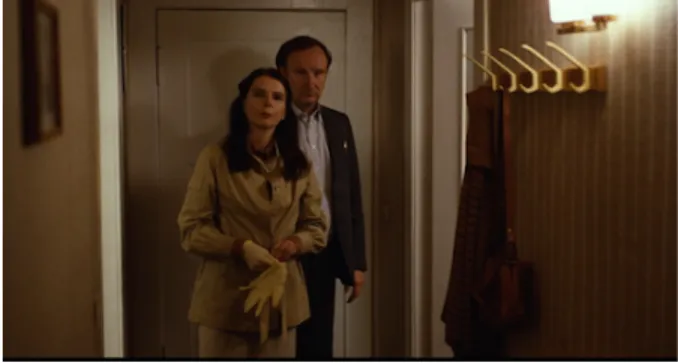
Twice throughout the film, Barbara’s apartment is searched by Stasi agents
while she is present, evoking the literally intimate nature of communist repression.
These moments signify the extreme lengths to which the communist authorities
would go to snuff out the smallest chance of resistance or dissidence, or in Barbara’s
case, any clue about plans to leave the country. The first search was motivated by
Barbara being discovered biking alone at night, a seemingly innocuous activity that
was enough to earn retaliation for anyone like Barbara under suspicion by the
authorities.
The short, successive scenes in this segment of the first raid provide an
encapsulation of the cat-‐and-‐mouse game experienced by active dissidents of the
deserted government restaurant, where she meets with a waiter in the lavatory
(which the viewer infers has been prearranged), who gives her a sealed message
and some Deutschmarks. The segment cuts to Barbara traveling on a trolley, where
she reads the message (detailing where to hide the money in the envelope), and she
must discard it immediately by ripping it up and throwing it out of the window: the
camera repeatedly cuts to briefly show a group of unknown men sitting in the
trolley, underscoring the anxiety created by the constant fear of being discovered
while undertaking any kind of questionable activity. As dusk approaches, Barbara
bikes to a large crucifix near the coast (the viewer can hear the sea and wind) to
deposit the money for purposes not immediately clear to the viewer. As she does so,
the wind blows turbulently in the background, knocking over Barbara’s bike, a clear
environmental indicator foreshadowing the troubles to come.
As Barbara bikes home in the night, she is stopped by Schütz, who is driving a
car. He abruptly and aggressively accelerates and brakes just in front of Barbara’s
bicycle, causing her to almost crash. The segment cuts to Barbara’s apartment,
where Schütz has summoned his Stasi
coworkers to thoroughly search
Barbara’s dwelling, belongings and
also her person. Barbara stands by the
door as a gloved, anonymous man
ruffles through the pockets of the
clothes in her closet. A female agent
arrives, heralded by the sound of a shrill doorbell that breaks the scene’s Figure 5: Screen at 00:09:33: The foreboding and
uncomfortable silence, to conduct a strip search. The Stasi woman is shown tersely
and forcefully putting on rubber gloves, uttering only “Kommen Sie, bitte” (“Come
this way, please”).
Throughout the scene, sounds from the environment—the crumpling of
paper, the chirping of crickets—are significantly louder than typical, creating a
fragile and anxious suspense that is abruptly interrupted by the intrusion of Schütz.
The eerie silence and general lack of dialogue in the scenes helps establish the
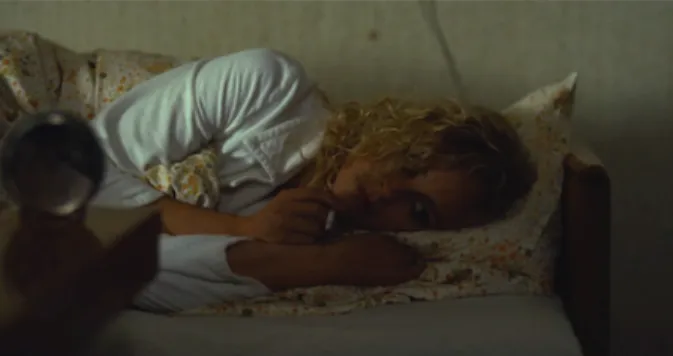
semblance of inhumanity and cruelty experienced by Barbara. The segment ends
with a brief scene of Barbara clutching herself in bed the next morning, jittering and
tightly grasping a cigarette, clearly
deeply jarred and disturbed by the
episode.
The violation of the home by
government agents is purposely
distressing and uncomfortable for the
viewer. Nothing (and no one) in
society was sacred or safe from state scrutiny—not even personal effects, private
living spaces, or the body, including the most intimate areas. Toward the end of the
film, immediately after Stella escapes from Torgau, the authorities again arrive
unexpectedly at Barbara’s apartment to conduct another search. This moment once
again captures Petzold’s use of sound, as the ominous and exaggerated cry of a crow
pierces the otherwise quiet scene just before the Stasi arrive. The second search
scene pushes its depiction of the invasiveness of the Stasi’s method’s further, Figure 6: Screen at 00:19:46: The next morning, Barbara
showing the gruff and relentless way that state officials demanded total compliance
from their targets. The scene cuts
to Barbara’s bathroom, where she
is forced to undergo a strip search.
The female Stasi assistant (the
same as in the first search scene)
barks unsettling orders such as
“Hair down!” and “Bend forward—
legs apart!” This was after Barbara pled to not have to undergo such a violating
procedure again, to no avail.
Complicating Barbara’s motives as the plot develops is her evolving
relationship with Jörg and the future she expects after escaping the country.
Barbara’s relationship with Jörg is ultimately not thoroughly explored in the film,
even though it is the initial source of conflict by leading Barbara to file an emigration
application. Their relationship is left relatively undetailed and juxtaposed against
more pressing elements of the plot, like Barbara’s sense of duty in the clinic and
strong sense of personal autonomy. The two are ultimately only shown together
twice—once in a secret conjugal meeting in the woods, and once in a hotel for
foreigners—and have relatively short
conversation.
One of Barbara’s clandestine visits
with her lover at the Interhotel is
ultimately a turning point in the outcome Figure 7: Screen at 1.09.46: Petzold’s depiction of the literally intimate surveillance is purposely intensely uncomfortable
of the film, inducing Barbara to remain behind in the East. One night, Barbara
ventures to Interhotel, the East German hotel meant for foreigners staying in the
country, to rendezvous with Jörg, who is ostensibly in the country to conduct
business. The scene is telling of potential problems in the two’s relationship and
Barbara’s conception of her life in the West.
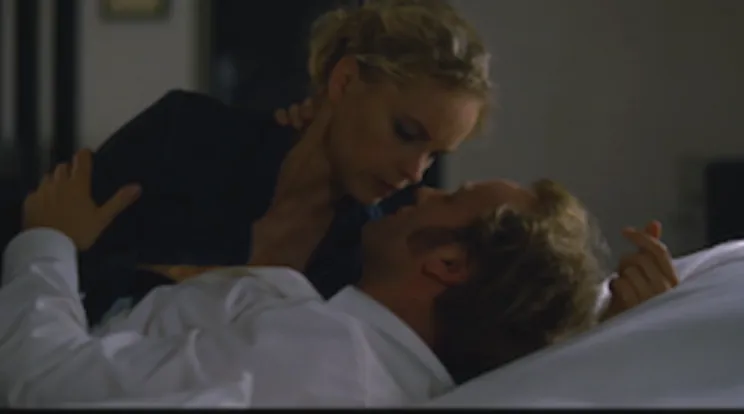
As Barbara climbs through the window to Jörg’s room and the two begin to
become intimate, they overhear moaning from the next room over. Jörg whispers
cheekily that “Gerd [his business
partner] met a girl,” to which
Babrara replies “She wants to get
to the West.”2 Although it is clear
Barbara does want to leave the
country and be with her lover, a
decisive moment occurs when
Jörg is about to leave the room to meet with his business partner and he informs her
that she can soon sleep in every day; she will not have to work—he earns enough
money as a businessman for them both. Given the strong sense of independence and
proud sense of individualism Barbara displays throughout the film, her silent and
sterile response—she turns stiff and stares at him coldly—shows that although she
hates life in East Germany, her work as a physician is central to her sense of
fulfillment.
This facet of Barbara and Jörg’s relationship is a reflection of Petzold’s
criticisms of the West: While Petzold emphasizes that the East certainly was far
more politically repressive, Petzold reserves some rebuke for the culture of West
Germany, criticizing its relatively less egalitarian gender roles. Ratner’s own short
analysis of the film includes a keen insight; namely that although the East is
generally portrayed as dismal and miserable, and the West as free and appealing,
the East German man André represents the better angels of East German society,
whereas the West German man Jörg in some respects represents the flaws of the
West: “André values [Barbara’s] work; Jörg does not. Petzold shows the couple
awkwardly lying down fully clothed or Barbara perched girlishly on Jörg’s lap,
wordlessly emphasizing the housewifey role that probably awaits” (Ratner, 2).
While the two lie together, Jörg mentions the possibility of his moving to East
Germany, which generates a visceral reaction from Barbara—she tells him curtly
and disgustedly “You’re insane;” that “One can’t be happy in this country.”3 Here the
sense for Barbara of being trapped between her obligation as a doctor and her
contempt for the regime becomes particularly apparent, culminating when it
becomes clear that fleeing the country may mean that she will be pressured to adopt
a domestic role as a housewife. Indeed, when Jörg tells her the exact time and date
planned for the escape, her response is “Ah, I’m scheduled for work then!”4
This scene in the hotel room is the only in which background music is
playing: a slow, intoxicating, and flirtatious elevator tune lulls in the background,
which Jörg abruptly turns off as he sits down on the bed to discuss the future with
Barbara. Like the sudden end of the intoxicating tune, the reality revealed by Jörg
and Barbara’s conversation was, at least partially, the end of the dream that Barbara
had imagined for herself in the West.
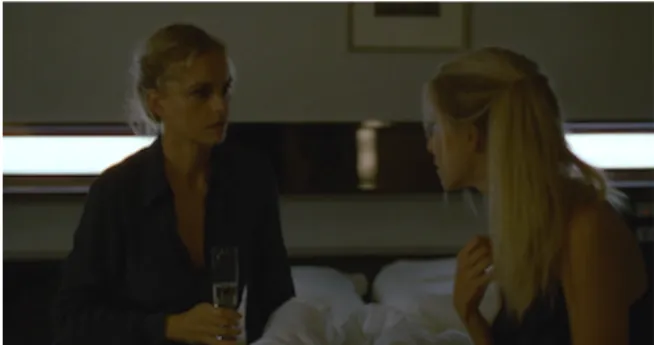
In the segment after which Jörg
leaves the hotel room to attend a
meeting, a young and attractive woman,
Steffi (Susanne Bormann), slips into
Barbara’s room. She and Barbara begin
to have a conversation. It is strongly
implied that Steffi is a prostitute, but she says that her client has told her that he
loves her, and wants to buy her a ring and bring her to the West. Steffi shows
Barbara a ring catalogue filled with images of engagement rings, but Barbara is
largely silent: Steffi seems to have changed how she views her own relationship
with Jörg, as it seems as if his motive may just be to find a housewife. Petzold
touched on this topic in his interview with Ratner: “Jörg is a little like Captain Smith
with Pocahontas; he comes into a country and gets himself a woman. These men
saw themselves as a hero, an agent, and a fantastic man, [m]any went to the GDR for
a romance they could end any time [with] the built-‐in excuse that they just wouldn’t
come back or she couldn’t come over” (19).
Conclusion
Exploring the daily challenges of dissidents (such as house raids and being
unsure of who was an informant), means of resistance (caring for the downtrodden
and refusing to be psychologically broken), and societal themes (economic Figure 10: Screen at 1:04:15: The shrewd and
problems, gender norms), Barbara crafts a surprisingly broad and informative
representation of life in the East in its relatively short 105 minute runtime. Barbara
is largely the inverse of the next film to be examined in this analysis—Das Leben der
Anderen. While Barbara initially despises the East and yearns to leave, she
ultimately comes to accept her role as doctor as a means to personal independence
and a way to provide a shimmer of hope to others suffering under the yoke of
communist tyranny. In Das Leben der Anderen, the roles and trajectories of the
central characters are inverted. Rather than a dissident learning to find solace by
helping other targets of the regime, a once zealous Stasi captain becomes
increasingly disillusioned with the system he once supported, and begins to use his
role to actively undermine the surveillance state.
Chapter 2:
Das Leben der Anderen
Summary and Introduction
Florian Donnersmarck’s 2006 Das Leben der Anderen, the next film of this
analysis, both contrasts and dovetails cleanly with Barbara, examining many of the
same historical realities, but often through the lens of the socialist state, vis-‐à-‐vis its
enforcers, rather than through its subjects and victims. While Barbara was a lesser
known (but nonetheless critically acclaimed) work, Das Leben der Anderen (2007),
directed by Florian von Donnersmarck, is among—if not the single most—
prominent film in the reunification era concerning the Stasi surveillance state. Von
Donnersmarck’s blockbuster embodies the modern German conception of the
surveillance state: ruthless, omnipresent and unforgiving, yet riddled with
corruption and intrigue.
Das Leben der Anderen is, like Barbara, set in the final decade before the
Wende, the 1980s (with a concluding scene in the early 1990s, shortly after
reunification)—but in urban East Berlin, rather than the sleepy East German
province. At the outset of the film, Gerhard Wiesler (Ulrich Mühe)—a hardened,
doctrinaire captain in the communist secret police force, the Staatssicherheit—
encourages his superiors to open an investigation against Dreyman, a seemingly
loyal playwright who arouses Wiesler’s instinctive suspicions. The communist
minister for culture, Hempf (Thomas Thieme), acquiesces, but for ulterior reasons:
The minister hopes to blackmail Christa-‐Maria Sieland (Martina Gedeck), an
illustrious actress and Dreyman’s lover, into having an affair with him, ultimately
(Sieland’s painkiller addiction leaves her liable to professional blackmail.) The Stasi
install a full surveillance system in Dreyman’s apartment, manned by Wiesler, who
becomes intimately ensnared in the details of Dreyman’s private life.
Wiesler becomes increasingly disillusioned as he learns of his superiors’
corrupt motivations for Dreyman’s surveillance. When Dreyman’s friend and fellow
author, Albert Jerska (Volkmar Kleinert), commits suicide after being forbidden
from writing due to his nonconformity, Dreyman anonymously pens a sensational
exposé in the West German magazine Spiegel about suicide in the German
Democratic Republic. Wiesler, disgusted with the ruthlessness and corruption of the
repressive system he had supported, decides to falsify his reports and creates an
alibi for Dreyman at great personal risk. Eventually, Hempf and Grubitz (Wiesler’s
Stasi superior, played by Ulrich Tukur) begin to suspect Dreyman of their own
accord—and increase their pressure on Christa-‐Maria, threatening her with a
lifetime ban on performing should she not comply and betray Dreyman. Cracking
under pressure, she reveals the location of the smuggled typewriter Dreyman used
to write his exposé, and the Stasi raid Dreyman’s apartment—but not before
Wiesler had managed to remove it from its hiding place. Sieland, dismayed at her
actions, runs into the street and commits suicide by jumping in front of a car.
Grubitz cannot prove Wiesler’s complicity in shielding Dreyman, but the former
captain is condemned to a lowly paper-‐pushing job opening mail envelopes in the
ministry basement until the collapse of communism some years later.
At the film’s end after the fall of the regime, Dreyman (who was never aware
Wiesler had extensively fabricated his official Stasi reports in order to protect him—
though Dreyman knows Wiesler only by his Stasi anonym used in the documents. He
dedicates a novel in gratitude to the mysterious agent.
Stylistic, Thematic, and Character Analysis
Like Barbara, Donnersmarck examines two themes central to the post-‐
Wende cinema of East Germany: the issue of complicity; the blurred distinction
between victims and perpetrators within the communist state; and the forms that
individual perseverance, resistance, and reawakening took in the face of suffocating
oppression and tyranny. While the two films have considerable thematic overlap,
the presentation and style of the two diverge radically. Barbara’s more
individualized, ad hoc, “believable” narrative of individual suffering under the SED
regime contrasts with the more Hollywood approach of Donnersmarck, who offers a
broader view of East German society than is seen in Barbara, but employs and
exaggerates common tropes about the East. By presenting a Stasi agent who had
second thoughts, Donnersmarck stretches the limits of realism to both portray
different echelons of the surveillance state while leaving room for questions of
morality—how even former evildoers, like a Stasi captain, can come to be redeemed
in their humanity.
Contrasted with Das Leben der Anderen, Barbara’s presentation of Stasi
members was far more condemning and unambiguous—there was no change of
heart; no human dualism—just unflinching, doctrinaire enforcers and their targets.
The only human dimensions of Stasi terror were embodied in the wavering André,
This representation of the capacity for remorse in state repressors by von
Donnersmarck has become iconic to the film, and its largest singular source of
controversy and criticism. Donnersmarck does not mollify the ruthless corruption
and exploitation committed by some powerful Stasi officials—but he leaves open
the idea that even in such individuals, hope for redemption still remains, vis-‐à-‐vis
Wiesler’s evolution.
While Petzold criticized Donnersmarck for his sometimes hackneyed
portrayal of the Democratic Republic as a universally miserable dystopia devoid of
all happiness, others have singled out his portrayal of the Stasi apparatus as
somewhat misleading or ahistorical. Germanist Mary Beth Stein writes “von
Donnersmarck’s GDR is populated almost exclusively with Stasi perpetrators and
victims … Estimates suggest that approximately one to two percent spied on another
one to two percent of the population …. The repressive nature of the SED regime is
overdrawn, not so much by the exaggeration of the methods of the MfS … but by the
exclusion of East Germans who neither supported nor resisted the regime” (Stein,
569). Certainly, the SED regime was capable of ruthless methods and tyranny, but
the situation shown in the film was not typical of everyday society.
Perhaps the most inaccurate element of the plot was the plausibility of
Wiesler’s sudden conversion after decades of service: “[T]here has been no evidence
in the 185 km of Stasi files .. that there was ever an officer who concealed evidence
to help a dissident as Wiesler does in this film” (Dueck, 600). Joachim Gauck,, who
formerly headed the management of the old Ministerium archives after reunification,
depiction of Stasi tactics and organization as largely true to reality (Gauck, “Ja, so
war es!”)5.
Das Leben der Anderen also diverges with Petzold in its more systemic
portrayal of state repression. While Barbara focuses upon the everyday effects and
travails of Stasi oppression upon the life of one individual, Das Leben der Anderen
offers a more comprehensive view of how the surveillance state functioned as a
system, both for its participants and subjects. Viewers are introduced to every
echelon of the communist state’s elaborate repression apparatus, from the film’s
opening scene in a classroom for new Stasi recruits, to the sinister motivations of
top officials; the savvy strategies used by state targets to avoid detection, and the
secretive technical means used in state surveillance. Von Donnersmarck also
explores the world of artists and writers in the German Democratic Republic, and
how dissenting artists were often suffocated by crushing censure and punishment
for deviating from the state’s proscribed limits on their expression.
The forms of resistance against the state authorities portrayed in Das Leben
are also more concrete and political in comparison to those featured in Barbara—
while Barbara is motivated by a simple desire to be left alone and make her own
choices, Dreyman is moved to sedition because of his anger at censorship and the
curtailment of artistic freedom, and the regime’s cover-‐ups of the country’s suicide
epidemic. Repercussions for deviance are similar: Career blackmail, like Barbara’s
5 “Einige meiner Freunde werden den Film deshalb nicht mögen, werden sagen, ein
forced transfer to a drab countryside clinic, is again a prominent plot element, in the
vein of Jerska’s suicide and the blackmailing of Christa-‐Maria-‐Sieland’s.
Von Donnersmarck, unlike Petzold, provides a more complete view of the
motivations and machinations of both perpetrator and victim of state repression,
emphasizing how the tentacular Stasi meticulously infiltrated every aspect of its
targets’ lives—physically, professionally, and personally. An entire quasi-‐industry
developed around maintaining files about every pertinent detail of citizens’ lives,
stored in large-‐scale government record offices, shown briefly in a clip of gigantic
sorting machines in the Stasi headquarters. Cameras and auditory wires were
clandestinely installed to monitor living quarters and possible meeting areas, and
telephone calls and written communication were often intercepted. Dreyman’s own
neighbor was warned of dire consequences should she let slip that her neighbor was
under suspicion. More relevant to the film’s plot than the actual means of
surveillance was the motivations for it in Dreyman’s particular case: the twisted
desire of an official to rape and coerce sex from a subordinate, and to prevent the
outside world’s knowledge of the fact that conditions in the country were so dire
that many citizens were driven to suicide.
As it concerns the two main protagonists, Barbara and Wiesler could to some
extent be considered one another’s foil; yet both parallel one another in intriguing
ways. Both sacrifice the futures they had planned for themselves to protect others,
as Barbara allows Stella to escape in her place, and Wiesler torpedoes his own
career to protect Dreyman. Indeed, the parallels can broadly be understood as
his film as a response to Donnersmarck’s blockbuster. Barbara was considered a
disloyal element by her own state, yet also someone who came to accept living in a
dreary and hostile society through the fulfillment she gained by assisting others;
Wiesler was a ruthless enforcer for the state who came to sabotage the very system
he had once supported when exposed to its true face. Their trajectories are each
other’s inverse.
While some of the most poignant moments in Barbara feature characters as
victims of state violence and repression, some of the most memorable scenes in Das
Leben der Anderen reverse this paradigm, showing the machinations of those who
perpetrate state repression: the bugging of an apartment; the intimidation and
silencing of Dreyman’s neighbor who is aware of his surveillance; government
agents gathered in offices, discussing which psychological profile their targets fit so
as to better destroy them; the ruthless threats and torture visited upon suspects in
drab interrogation rooms. The two films taken together provide a fairly
comprehensive overview of both the methodology and the human costs of the
socialist regime’s enforcement and surveillance arm in the former East Germany.
Just as Das Leben der Anderen offers a fuller view of the surveillance state, the
film offers a more complete and legible view into its protagonists’ motives and
psyches than does Barbara. Wiesler’s transformation, the central theme of the film,
is displayed as somewhat punctuated; ushered in by distinct moments in the plot. In
a general sense, Wiesler’s conversion might be interpreted as a condemnation of
revealed to grant only the opposite, corrupted by greedy elites who abused their
power.
Stylistically, the tempo of von Donnersmarck’s work is far faster and fuller
than Petzold’s. Von Donnersmarck eschews Barbara’s long periods of calm and
solitude for a more hectic, fuller plotline with far more dialogue. The causal chain of
events that drive Wiesler’s actions is clearly portrayed, as are his internal feelings;
and Das Leben der Anderen’s 2 hour, 18 minute running time is over a half hour
longer than the 1 hour, 45 minute Barbara. Von Donnersmarck also employs music
and sound far more traditionally than does Petzold, frequently inserting emotionally
wrenching background scores to intensify the film’s mood.
Also noteworthy is the unyieldingly gloomy, austere presentation of East
Berlin as a gray morass of chipped concrete and urban decay. The film is noticeably
devoid of color, with backgrounds swathed in gray and brown, and characters are
usually shown as frumpily dressed. Little greenery or nature is seen in the film, in
stark contrast to the verdant settings seen in Barbara—drably decorated
apartments, Spartan offices, and decaying concrete streets and buildings are the
primary setting of Donnersmarck’s picture. True to history, the consumer goods
shown like automobiles and televisions were shown as subpar, retrograde and
scarce.
Scene Analysis
At the film’s beginning, the cruelty of both Wiesler personally and the East
German state seem at their peak, occurring before Wiesler’s internal revolution and
opening scene features Wiesler using a previously recorded interrogation as an
instruction tool for a new class of Stasi inductees. Wiesler is shown grilling the man
he is interrogating about having helped an acquaintance flee to the West—and
though the man initially resists, he finally cracks under pressure after hours of sleep
deprivation and when his family is threatened with arrest and separation. With no
regard for the man’s wellbeing, Wiesler is, in that moment, the essence of the cold,
unwavering communist state. Wiesler coldly remarks that the “enemies of
socialism” are conniving and sneaky. When a new recruit protests this sleep
deprivation used during interrogations as “inhumane” (unmenschlich), Wiesler
marks an “x” on that recruit’s profile in his notes. This scene, though ultimately not
consequential to the remaining plotline of the film, encases the cold, unforgiving
role of state enforcer that Wiesler initially embodies.
The film is careful to not leave
the viewer unfamiliar with the
technical “how” of the way Stasi
suspects were meticulously watched.
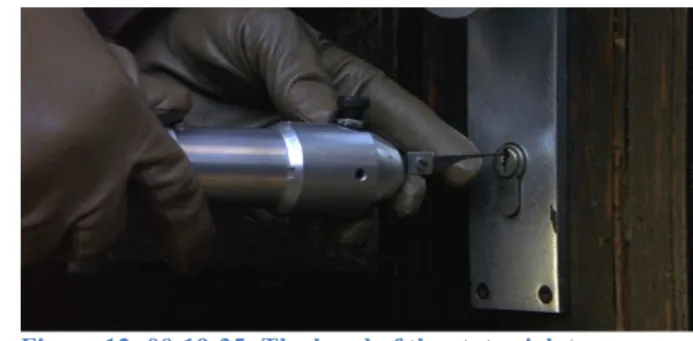
The systematic bugging [1] of
Dreyman’s apartment provides a neat encapsulation of Stasi tactics. As in Barbara,
living spaces—effectively state property—were not exempt from surveillance and
search. Digging through personal
effects and the physical
implantation of bugs into the