Assessment of Retail Clinics in the Context of the Triple Aim
By Heidi Harkins
A Master’s Paper submitted to the faculty of the University of North Carolina at Chapel Hill
in partial fulfillment of the requirements for the degree of Master of Public Health in
the Public Health Leadership Program
Chapel Hill Fall 2013
Date
Abstract
The Triple Aim recommends that improvements to the US health care delivery system focus on the three interdependent goals of high quality care, reduced per capita cost and improved population health (Berwick, Nolan, & Whittington, 2008). Significant challenges exist to accomplish these improvements; however, Berwick, Nolan and Whittington (2008) identify some promising innovations that have the potential to disrupt the current primary health care service model. One of the innovations recognized is the retail clinic model of health care delivery. The number of retail clinics has increased rapidly since the first clinic opened in 2000. Retail clinics offer health care services for diagnoses of specific acute illnesses, as well as vaccinations and preventive care, typically within a retail setting such as Walmart, Target, pharmacy or grocery store. The clinics are sometimes referred to as convenient care clinics to reflect their
patient-centric access to care - no appointment is required, weekend and evening hours are offered, and wait times are shorter than at traditional health care facilities. One approach to externally evaluate the performance of retail clinics is to examine them within the triple aim framework of quality of care, per capita cost and population health. Metrics to evaluate health care services for each triple aim goal have been
Introduction
Much attention has been paid to the triple aim concept developed in 2008 by the Institute for Healthcare Improvement. In describing the triple aim, Berwick, Nolan and Whittington (2008) present the case that health care organizations should focus efforts on the three interdependent goals of high quality care, reduced per capita cost and improved population health to promote overall improvements to the US health care system (Berwick et al., 2008). Several facets of the healthcare delivery system’s current organization make it challenging to meet these goals. First, supply-driven demand (as opposed to demand-driven supply) has been the norm in health care service delivery. Services provided to patients are determined by the availability of physicians and supplies, rather than by the need for the services. However, health outcomes often do not improve in communities with high availability of hospital beds and services
(Dartmouth Atlas of Health Care, 2008). Second, health care services have been organized around convenience for physicians, instead of convenience for patients. Third, competition to drive change is limited since historically, health care has been dominated by large hospital systems. Fourth, a lack of knowledge exists about the overall coordination of the multi-faceted health system (Berwick et al., 2008). These challenges have made large-scale improvements to current health care delivery services difficult.
specific diagnoses typically within a retail setting such as Walmart, Target, pharmacy or grocery store. Services include care for acute illnesses such as colds, ear infection, flu and sore throats, as well as vaccinations and preventive care. Retail clinics are
sometimes referred to as convenient care clinics to reflect their patient-centric access to care - no appointment is required and the clinic is open during weekend and evening hours. Retail clinics differ from urgent care facilities because retail clinics are staffed by mid-level professionals (usually a nurse practitioner), offer defined and limited services, and are located with a pharmacy (Cassel, 2012).
Retail clinic strategic models are not organized around, and do not promote measurement of, the Triple Aim goals. Instead, satisfying customer need and delivering services in a customer-centric fashion drives the business strategy on which retail clinics are organized. However, a number of goals inherent in that business model overlap the triple aim goals. Retail clinics address at least three of the four challenges to health care service delivery improvements described by Berwick, Nolan and
Whittington (2008). Retail clinics are satisfying client desires for convenient and
accessible delivery of health care services and therefore, by design, are patient-centric and provide demand-driven supply, thereby addressing the first two challenges. As an alternative model to hospital-based health care delivery, they are providing a
Retail Clinic Growth and Trends
Retail clinics are a relatively new stakeholder in health care delivery but have the potential to transform how individuals use the health care system. The number of retail clinics has grown robustly since the first clinics opened in Minnesota in 2000. A Deloitte Center for Health Solutions report indicates that approximately 1,100 retail clinics were operating in July 2009 (Deloitte Center for Health Solutions, 2009). This number represents rapid growth from 2005, when only about 60 clinics were open. Growth slowed between 2008 and 2009 and some retail clinics were closed. Slow growth between 2008 and 2009 was attributed to the downturn in the US economy and the expected business cycle seen in any new industry (McKinlay & Marceau, 2012).
Deloitte Center for Health Solutions projected a growth rate between 10 and 15 percent for the years 2010 to 2012, and then as high as 30 percent from 2013 to 2014 (Deloitte Center for Health Solutions, 2009). Although retail clinic growth is strong, visits to retail clinics still make up a small percentage of overall outpatient visits. Approximately 6 million visits were made to retail clinics in 2009, compared with 117 million visits to emergency departments and 577 million visits to physician offices (Mehrotra & Lave, 2012).
Solutions, 2009). Other surveys show lower retail clinic use. For example, the 2007 Health Tracking Household Survey reports that 2.3 percent of American families had visited a retail clinic (Tu & Cohen, 2008). A RAND Corporation report explains the variability in utilization reports as a result of differences in the makeup of the population surveyed, the time span of the specific survey, and survey question wording (Weinick, Pollack, Fisher, Gillen, & Ateev, 2010). Regardless of the true utilization data, the number of retail clinics is increasing, which provides more exposure for this model of health care service delivery to potential clients.
Current reports of patient satisfaction are high and a variety of surveys report the reasons individuals choose retail clinics for health care services (Hunter, Weber,
Morreale, & Wall, 2009; Wang, Ryan, McGlynn, & Mehrotra, 2010). Patients cite several factors in their decision to visit a retail clinic, with convenience as the primary reason for selecting a retail clinic over a different type of care facility. 10.6% of the population lives within a 5-minute drive of a retail clinic and retail clinics are open during evening and weekend hours (Rudavsky, 2009). Patients with a primary care provider (PCP) often visit a retail clinic for a specific service because they are unable to schedule a timely appointment with their PCP (Wang et al., 2010). Also, wait time at retail clinics is shorter than that at other health care facilities such as the emergency department (ED) or urgent care (Mehrotra, Wang, Lave, Adams, & McGlynn, 2008; Patwardhan, Davis, Murphy, & Ryan, 2012; 2013). Additionally, prices at retail clinics are
Many insurance companies currently cover the services provided by retail clinics. Implementation of health care exchanges and Medicaid expansion as part of the Patient Protection and Affordable Care Act (ACA) is expected to provide health insurance to an additional 16 million individuals (Rudavsky, 2009). Having insurance provides
individuals with choices on where they receive health care services. If the trend of high patient satisfaction with retail clinic services continues, it is expected that more visits will be made to retail clinics as more Americans have exposure and access to retail clinics and insurance coverage for the visit (Cassel, 2012).
Measuring the Triple Aim
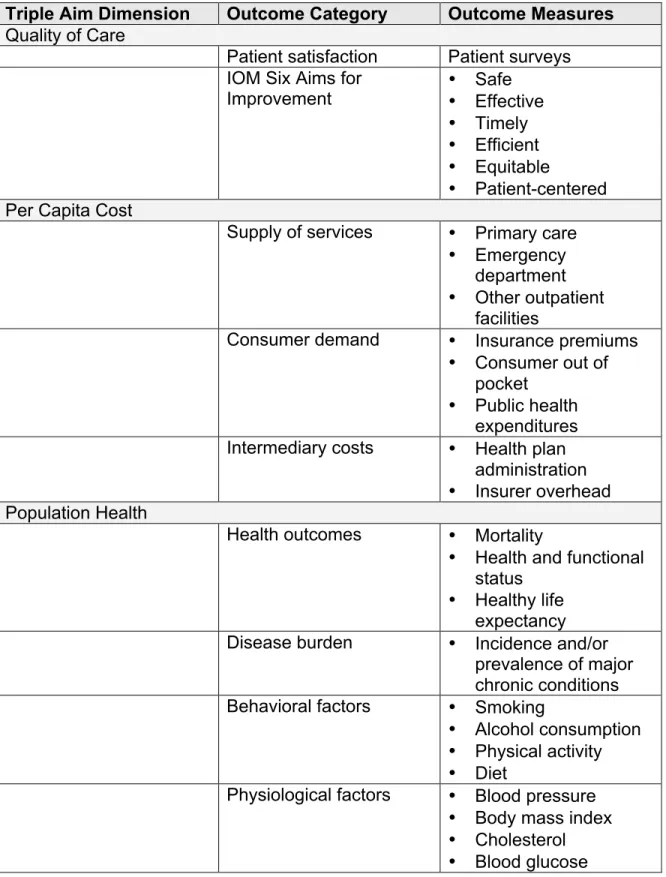
Determining the effectiveness of retail clinics within a triple aim framework requires the ability to measure care quality, monetary costs and population health impact. The Institute for Healthcare Improvement produced a guide that recommends accessible data sources and outcome measures with which to assess each of the three triple aim components, as shown in Table 1 (Stiefel & Nolan, 2012). The guide stresses that the menu of potential measures are only suggestions and should be used by
distinguish between outcomes and process measures and between population and project measures, and (4) benchmark data for comparison (Stiefel & Nolan, 2012).
Retail clinics have one large advantage as subjects for triple aim measurement. Most retail clinics use electronic medical records (EMR) to store and track their patient services and this data is essential to meeting the four NQF evaluation principles
Although published studies of retail clinic data are limited, it is important to assess what is known. As specific outcome measures are described in this paper, challenges in attaining retail clinic metrics for each of the triple aim components will be identified.
Triple Aim Component One: Quality of Care
The IHI Guide to Measuring the Triple Aim recommends two outcomes measures to measure care quality: patient surveys and metrics that reflect the Institute of
Medicine’s six aims for quality health care (safety, effectiveness, timeliness, efficiency, equity and patient-centeredness), as shown in Table 1 (Stiefel & Nolan, 2012). Quality of care represents an area where there is significant overlap between the implicit goals of retail clinics and those of the triple aim framework. For example, retail clinics will need to meet and maintain high standards of patient-centeredness and patient
satisfaction in order to recruit and retain clients. Retail clinics will also need to convince potential clients of their safety, effectiveness, efficiency and equity in order to grow their business.
Data that compares quality of care at retail clinics with other health care settings is limited. A literature search for “retail clinics” or “convenient care clinics” and “quality” returned four results. A literature search for “retail clinics” or “convenient care clinics” with each of the six IOM aims produced no results. Generally, results from the
published data indicate that quality of care at retail clinics was as high or higher than comparable services at other health care providers. However, the value of the
interest.
The most extensive study used 14 quality indicators to compare quality of care between retail clinics, physician offices, urgent care centers and emergency
departments (Mehrotra, 2009). The study focused on episodes of care for three common acute illnesses: otitis media, pharyngitis, and urinary tract infection. The quality indicators primarily examined adherence to recommended clinical guidelines for specific episodes of care. This analysis provides data on two of the IHI recommended quality measures, safety and equity of care. Aggregate quality scores of 15,170
episodes of care matched for age, sex, comorbid conditions and income were similar between retail clinics, physician offices, and urgent care centers. Aggregate quality scores were lower for ED episodes of care. This study indicates that the quality of care, based on adherence to recommended clinical guidelines, was as good at retail clinics than quality of care provided at physician offices and urgent care facilities, and was higher than that at ED facilities. Additionally, analysis of individual quality scores for each of the 14 measures showed that the retail clinic quality scores were equal to or higher than those at the other care delivery settings. Higher individual quality scores indicate greater adherence to clinical guidelines at the retail clinics for all procedures analyzed, not just for a few procedures that then averaged as a higher score in the aggregate analysis.
Another study, although less extensive, also looked at retail clinics adherence to evidence-driven protocols. Woodburn, Smith, and Nelson (2007) reported on
particular clinical guideline was selected because past studies show that treatment for patients who present with a sore throat is not consistent within health care delivery services. 70% of adults who visit a primary care physician are treated with antibiotics even though only 5 – 10% of adults are diagnosed with positive streptococci that would require antibiotics (Linder & Stafford, 2001). The authors reviewed 57,331 retail clinic EMR records of patients for whom acute pharyngitis was evaluated. The appropriate guideline for prescribing or withholding antibiotics was followed for 99% of the patients seen, indicating very high protocol adherence within this particular retail clinic
organization (Woodburn, Smith, & Nelson, 2007). Thus, retail clinics perform well for adherence to standard protocols as a quality measure. It should be noted that the three authors were employed by the retail clinic MinuteClinic during the time of researching and writing the article.
The Minnesota health plan HealthPartners compared frequency of follow-up visits for specific episodes of care initiated in a retail setting with frequency of follow-up visits initiated from a primary care office, urgent care facility, or emergency department (Thygeson, Van Vorst, Maciosek, & Solberg, 2008). The follow-up visits could occur in any other care facility. The study authors hypothesized that higher quality of care would result in fewer follow up visits. This comparison relied on claims data for five conditions commonly seen at retail clinics. Visits for conditions that were initiated at retail clinics resulted in a 2% higher visit follow-up for the same episode of care, relative to other care settings. Although this is an intriguing result, it is difficult to interpret the
the 2% higher rate of follow-up visits after a retail clinic visit could mean that the care was not as effective and more patients required follow-up visits. However, the result could also indicate that retail clinics referred some patients appropriately for additional care not provided at MinuteClinic.
The fourth study looked at two Healthcare Effectiveness Data and Information Set (HEDIS) quality measures to assess pediatric care at a large, multisite retail clinic system (Jacoby, Crawford, Chaudhari, & Goldfarb, 2011). Specifically, the authors examined testing and treatment of children with urinary tract infection and sore throat complaints. The results for the HEDIS measures were then compared with benchmark industry standards reported by the National Committee for Quality Assurance (NCQA). An electronic medical records review showed a 92.7% compliance rate at the retail clinic for appropriate testing of children with sore throats, greater than the NCQA 90th percentile. The retail clinic setting achieved an 88.4 % compliance rate for appropriate treatment of children with UTI, approximately the NCQA 70th percentile. Thus,
adherence to these two HEDIS measures within this retail clinic system was in the top 10% and in the top 30% of all facilities, respectively, for these conditions. The results of this study also need to be considered in the context that Take Care Health Systems, now owned by Walgreens, funded the study.
The medical community has voiced concern about the quality of care provided by retail clinics. For example, both the American Academy of Pediatrics and the American Academy of Family Physicians have indicated reservations about the quality of care received by patients from retail clinics, particularly the potential for disrupting care coordination (Weinick et al., 2010). Care coordination is an important part of medical treatment and affects four of the recommended quality of care metrics - safety,
timeliness, effectiveness, and patient-centeredness. Very little data is available to provide information on whether the medical community’s concerns are valid. One recent study compared continuity of care for patients who used retail clinics and those who did not within a large group family practice (J. E. Rohrer, Angstman, Garrison, Maxson, & Furst, 2013). Continuity of care was measured as the percentage of visits to PCPs made by patients. The authors found that on average, patients who use a retail clinic tend to see their PCP less. However, the authors also note that this measure of continuity is outdated and may not be an accurate reflection of care continuity with current health care delivery services since team-based care, phone calls and email use were not captured in the study. Therefore, the impact of retail clinics on overall
continuity of care remains a question.
will impact the overall health of individuals. Continued studies are required in order to analyze the health of retail clinic clients over time. In addition, more studies are needed to investigate efficiency of care since efficient care requires communication and
collaboration among a variety of providers, which is a challenge throughout health care delivery.
Triple Aim Component Two: Per Capita Costs
Stiefel and Nolan (2012) organize the health care cost components into three categories: the supply of services by providers at primary care, emergency department, and other outpatient facilities; consumer demand (e.g. insurance premiums, consumer out of pocket, public health expenditures); and an intermediary cost group consisting of health plan administration costs and insurer overhead, as shown in Table 1. Claims data are the most accessible data to measure the cost of health services and this data provide numbers for the provider-billed costs and out-of-pocket consumer payments. Claims data can also be used to analyze the use and commensurate costs of hospital services by the insured population. Hospital and ED utilization rate and cost are also frequently used to represent costs of uninsured individuals who access health services. However, claims data and hospital/ED utilization does not include administrative and public health costs and, therefore, does not represent total cost of care (Stiefel & Nolan, 2012).
comparing cost per episode of care, retail clinic services are less expensive than similar services at other primary care facilities, urgent care, or emergency department
(Mehrotra et al., 2008; J. Rohrer, Angstman, & Furst, 2009).
It is important to consider not just cost per episode of care, but also the cost of care over time, since overall care costs will be determined by the utilization of services over time. If retail clinics provide a lower cost per episode of care but patients visit the retail clinic more often per diagnosis, then overall costs will be higher for retail clinics. An analysis that used 2005 and 2006 claims data for a single health plan showed significant savings per episode of care for retail clinics when compared with similar episodes at physician offices, urgent care centers and emergency departments
(Mehrotra et al., 2009). Cost savings was also seen for laboratory and imaging services provided at retail clinics. Importantly, the lower per episode cost did not increase
utilization. Follow-up visits for visits originating in a retail clinic, physician office or urgent care facility followed a similar pattern. More follow-up visits were seen for visits that originated in an emergency department. Based on this one study, costs based on overall utilization were lower for retail clinics than at other care facilities.
status. The lower cost of care for individuals who used a retail clinic was the result of lower overall medical spending, particularly for physician office visits and hospital care. This reflected fewer physician office and ED visits and fewer days in the hospital at a lower rate. There was no significant difference between pharmacy costs for the retail clinic and non-retail clinic groups (Sussman et al., 2013).
Although the number of studies and the time period included in the studies are limited, all existing data that examines both cost per episode of care and cost for overall utilization indicate that retail clinics are less expensive facilities in which to receive medical services. These studies do not account for administrative overhead or public health costs, and therefore do not represent total cost of care.
The completed studies that show that retail clinics lower the cost of health care delivery are encouraging. Future longitudinal studies are required to assess potential lack of coordination of care on the overall health care costs. This lack of coordination includes both that with other providers as well as with community public health
programs that can support an individual’s health. However, it is necessary to consider that this coordination of care is a challenge within the traditional delivery services of primary care as well. Therefore, it is important that future studies of retail clinics include a comparison with the cost of care at traditional facilities.
Triple Aim Component Three: Population Health
the facility through which the health care is delivered. Therefore, the population
measured for a retail clinic will be the group of individuals served by the clinic (Hacker & Walker, 2013).
In addition to the challenge of identifying the population, measuring the health impact on a particular population can also present challenges. Population health can be defined broadly to include public, as well as clinical health. The broader definition
incorporates the public services collaboration that improves health outcomes (Kindig, 2008). Kindig (2008) argues for a population health definition that goes beyond the triple aim and points to the future evolution of clinical care payment systems as
evidence for this broader definition. Specifically, as the payment structure for clinical care evolves from a fee-for-service model to one that includes innovations such as global payments, it may be necessary for organizations like Accountable Care
Organizations to more effectively collaborate with organizations that provide non-clinical services that impact the health of community members. However, as discussed in Kindig’s commentary, expanding the definition of population health will require the ability to gather and analyze data about patient health, collaboration among community
agencies, the public health system, and clinical services, as well as funding to sustain the collaboration (Kindig, 2008). Retail clinics depend on the fee-for-service model and, therefore, currently have no direct financial incentive to collect extensive data on, or coordinate care for, their clients.
functional status, healthy life expectancy, disease burden, smoking, physical activity, diet, blood pressure, body mass index, cholesterol, and blood glucose level. Of these outcome measures, the behavioral and physiological factors such as smoking, physical activity, diet, blood pressure, body mass index, cholesterol and blood glucose level are the most straightforward for retail clinics to report. Measurement of these factors can be used to partially assess how well retail clinics are addressing population health.
Unfortunately, like care quality and cost assessment, assessment of the impact of retail clinics on population health is difficult because only limited data is publicly available, even for behavioral and physiological metrics. Although electronic health records are used by most retail clinics, few published studies exist that use the data captured within the records. A PubMed search using the parameters of “retail clinic” and “population health” returned no results. Additional PubMed searches with “retail clinic” and each of the suggested metrics listed above returned no results. Therefore, impact on other aspects of population health will need to be used to assess retail clinics.
visited alternative, but higher cost, facilities: 16% to the ED and 11% to urgent care (Wang et al., 2010). Because retail clinics provide more accessible and affordable care than the ED and urgent care facilities, this study indicates that uninsured individuals use them more readily to receive care. Longitudinal comparison studies will be required to determine if and how receiving the retail clinic services impacts the health of a
population over time.
fax, email and phone are the means through which health care providers share data between facilities and organizations, including retail clinics.
When considering retail clinic impact in the context of population health, it is important to account for several retail clinic models, each of which is integrated
differently into the existing health care structure. Each unique model brings a different ability to coordinate care and interact with other clinical and public health organizations. Pollack, Gidengil, and Mehrotra (2010) describe the three model types as integrated, hybrid and independent, depending on the respective relationship of the retail clinic with other health care providers. In the integrated model, retail clinics are owned and
operated by existing health care providers. Among the three relationships, the integrated model provides the greatest capacity for collaboration and sharing of electronic medical information between the retail clinic and other providers. In the hybrid model, retail clinics and medical facilities establish a formal working relationship. Although not a prerequisite for a hybrid relationship, the retail clinic and medical facility often share an electronic medical record, thus increasing the potential for full
information sharing and care collaborating. In the independent model, retail clinics are owned and operated by private companies. There is no electronic sharing of medical information in this model and any care collaboration between the clinic and other provides requires additional time and energy. There is potential that in the future, integrated retail clinics could enhance the services provided at patient-centered medical homes by providing quick and convenient access for some medical services.
retail clinic and PCMH providers, this could lead to improved population health (Pollack, Gidengil, & Mehrotra, 2010).
Future State of Retail Clinics
The retail clinic model is developing within a volatile health care service delivery environment. Success of the model will depend on a variety of interdependent factors. An important factor to determine retail clinic success or failure will be the impacts of ACA implementation on health care service delivery, although it is difficult to predict the specific impact of the ACA on retail clinics. ACA implementation will change the
numbers of insured and uninsured individuals in each state. An increase in the number of insured individuals could potentially increase the viability of retail clinics if the public continues to view the care at retail clinics favorably. ACA implementation could also lessen the availability of primary care physicians, if more insured individuals translates into more individuals seeking care from traditional health care facilities. A shortage of primary care physicians could result in a higher level of difficulty of individuals receiving care at traditional health care facilities and, thus, more individuals seeking care from mid-level professionals at retail clinics.
clinics. Another factor that could impact success of retail clinics is the implementation of technology through the HITECH Act. Implementation of the HITECH Act will improve the potential to share electronic medical records among providers, thus incorporating retail clinics into the overall health care delivery system.
The current retail clinic health care service delivery model is far from complete and is evolving as opportunities are recognized. For example, Walgreens is currently expanding their suite of services into testing for cholesterol, high density lipoprotein, blood glucose and A1C (Walgreens introduces daily testing for cholesterol, blood glucose and A1C at more than 1,400 stores in 33 states and Washington, D.C.). The
Centers for Disease Control and Prevention (CDC) has taken notice of retail clinic potential and recently launched a pilot program for delivery of HIV testing through retail clinics (CDC - blogs - CDC works for you 24/7 blog – CDC looks ahead: 13 public health issues in 2013; Robert Wood Johnson Foundation). There is also expansion
beyond clinical care as pharmacists begin to run employee health programs at worksite locations (Lenz, 2013).
Conclusions
Assessment of retail clinics within the context of the triple aim framework of care quality, cost and population health provides a general sense of the success of retail clinics in delivering health care services. However, because retail clinics are relatively new players within health care service delivery, independent studies are limited in number and scope. Future studies will be required in order to fully assess the evolving role of retail clinics within the existing health care service delivery system.
safe, effective, timely, equitable and patient-centered, at least for the specific diagnoses at the clinics included in the studies. Although these early quality of care studies are encouraging, much remains unknown about how high quality of care for specific
diagnoses at retail clinics will impact the overall health of individuals. Continued studies are required in order to analyze the health of retail clinic clients over time and to
investigate efficiency of care, since efficient care requires communication and collaboration among a variety of providers.
All existing data that examines both cost per episode of care and cost for overall utilization indicate that retail clinics are less expensive facilities in which to receive medical services. Longitudinal studies are required to assess potential lack of
coordination of care on the overall health care costs. This lack of coordination includes both that with other health care service providers as well as with potential community public health programs that can support an individual’s health.
Population health is the most challenging of the three triple aim components to define and measure. Because longitudinal studies of retail clinic patients have not been conducted, it is difficult to know how these clinics are impacting the overall health of the individuals who use them. Implementation of the HITECH Act will improve the potential to share electronic medical records among providers, including retail clinics, and by incorporating them into the overall health care delivery system could impact population health.
clients with their patient-centric services, transparent costs, and value of care. It could be that the competition and example of care value provided by retail clinics are
Table 1. Suggested Outcome Measures for Triple Aim Assessment
Triple Aim Dimension Outcome Category Outcome Measures Quality of Care
Patient satisfaction Patient surveys IOM Six Aims for
Improvement •• Safe Effective
• Timely • Efficient • Equitable
• Patient-centered
Per Capita Cost
Supply of services • Primary care • Emergency
department
• Other outpatient
facilities
Consumer demand • Insurance premiums
• Consumer out of
• Public health
expenditures Intermediary costs • Health plan
administration
• Insurer overhead
Population Health
Health outcomes • Mortality
• Health and functional
status
• Healthy life
expectancy Disease burden • Incidence and/or
prevalence of major chronic conditions Behavioral factors • Smoking
• Alcohol consumption • Physical activity • Diet
Physiological factors • Blood pressure
Note: Adapted from “A Guide to Measuring the Triple Aim: Population Health,
References
Ahmed, A., & Fincham, J. E. (2010). Physician office vs retail clinic: Patient preferences in care seeking for minor illnesses. Annals of Family Medicine, 8(2), 117-123. doi:10.1370/afm.1052
Berwick, D. M., Nolan, T. W., & Whittington, J. (2008). The triple aim: Care, health, and cost. Health Affairs, 27(3), 759-769. doi:10.1377/hlthaff.27.3.759
Cassel, C. K. (2012). Retail clinics and drugstore medicine. JAMA : The Journal of the American Medical Association, 307(20), 2151-2152. doi:10.1001/jama.2012.3966;
10.1001/jama.2012.3966
CDC - blogs - CDC works for you 24/7 blog – CDC looks ahead: 13 public health issues
in 2013. Retrieved 9/17/2013, 2013, from
http://blogs.cdc.gov/cdcworksforyou24-7/2013/01/cdc-looks-ahead-13-public-health-issues-in-2013/
Dartmouth Atlas of Health Care. Supply-sensitive care. Retrieved 10/04/2013, 2013, from http://www.dartmouthatlas.org/keyissues/issue.aspx?con=2937
Deloitte Center for Health Solutions. (2009). Retail clinics: Update and implications. Retrieved 9/30/2013 from http://www.deloitte.com/assets/Dcom-UnitedStates/Local Assets/Documents/us_chs_RetailClinics_111209.pdf
Hunter, L., Weber, C., Morreale, A., & Wall, J. (2009). Patient satisfaction with retail health clinic care. Journal of the American Academy of Nurse Practitioners, 21, 565-570.
Jacoby, R., Crawford, A., Chaudhari, P., & Goldfarb, N. (2011). Quality of care for 2 common pediatric conditions treated by convenient care providers. American Journal of Medical Quality, 26(1), 53-58.
Kindig, D. (2008). Beyond the triple aim: Integrating the nonmedical sectors.
Lenz, T. (2013). Pharmacists improving health at the worksite. Pharmacy Review, XX(X), 1-3.
Linder, J., & Stafford, R. (2001). Antibiotic treatment of adults with sore
throat by community primary care physicians: A national survey, 1989-1999. Journal of the American Medical Association, 286(10), 1181-1186.
McKinlay, J. B., & Marceau, L. D. (2012). From cottage industry to a dominant mode of primary care: Stages in the diffusion of a health care innovation (retail clinics). Social Science & Medicine (1982), doi:10.1016/j.socscimed.2012.04.039
Mehrotra, A., Liu, H., Adams, J., Wang, M., Lave, J., Thygeson, M., et al. (2009). Comparing costs and quality of care at retail clinics with that of other medical settings for 3 common illnesses. Annals of Internal Medicine, 151, 321-328.
(Project Hope), 31(9), 2123-2129. doi:10.1377/hlthaff.2011.1128;
10.1377/hlthaff.2011.1128
Mehrotra, A., Wang, M. C., Lave, J. R., Adams, J. L., & McGlynn, E. A. (2008). Retail clinics, primary care physicians, and emergency departments: A comparison of patients' visits. Health Affairs, 27(5), 1272-1282. doi:10.1377/hlthaff.27.5.1272
Mehrotra, A. (2009). Comparing costs and quality of care at retail clinics with that of other medical settings for 3 common illnesses. Annals of Internal Medicine, 151(5), 321. doi:10.7326/0003-4819-151-5-200909010-00006
National Quality Forum. (2011). Guidance for measure testing and evaluating scientific acceptability of measure properties; National Quality Forum.
Patwardhan, A., Davis, J., Murphy, P., & Ryan, S. F. (2012; 2013). Comparison of waiting and consultation times in convenient care clinics and physician offices: A cross-sectional study. Journal of Primary Care & Community Health, 4(2), 124-128. doi:10.1177/2150131912450030
Pollack, C., Gidengil, C., & Mehrotra, A. (2010). The growth of retail clinics and the medical home: Two trends in concert or in conflict? Health Affairs, 29(5), 998-1003.
Robert Wood Johnson Foundation. CDC pilot trains pharmacists and retail clinic staff to provide testing for HIV/AIDS. Retrieved 9/22/2013, 2013, from
Rohrer, J., Angstman, K., & Furst, J. (2009). Impact of retail walk-in care on early return visits by adult primary care patients: Evaluation via triangulation. Quality
Management in Health Care, 18(1), 19-24.
Rohrer, J. E., Angstman, K. B., Garrison, G. M., Maxson, J. A., & Furst, J. W. (2013). Family medicine patients who use retail clinics have lower continuity of care. Journal of Primary Care & Community Health, 4(2), 150-153.
doi:10.1177/2150131912471683
Rudavsky, R. (2009). The geographic distribution, ownership, prices, and scope of practice at retail clinics. Annals of Internal Medicine, 151(5), 315. doi:10.7326/0003-4819-151-5-200909010-00005
Stiefel, M., & Nolan, K. (2012). A guide to measuring the triple aim: Population health, experience of care, and per capita cost; Innovation Series white paper. Cambridge,
MA 02138: Institute for Healthcare Improvement.
Sussman, A., Dunham, L., Snower, K., Hu, M., Matlin, O., Shrank, W., et al. (2013). Retail clinic utilization associated with lower total cost of care. American Journal of Managed Care, 19(4), 148-157.
Walgreens introduces daily testing for cholesterol, blood glucose and A1C at more than
1,400 stores in 33 states and washington, D.C. Retrieved 9/18/2013.
http://www.medicalnewstoday.com/releases/224024.php
Wang, M. C., Ryan, G., McGlynn, E. A., & Mehrotra, A. (2010). Why do patients seek care at retail clinics, and what alternatives did they consider? American Journal of Medical Quality : The Official Journal of the American College of Medical Quality,
doi:10.1177/1062860609353201
Weinick, R., Pollack, M., Fisher, M., Gillen, E., & Ateev, M. (2010). Policy implications of the use of retail clinics. Santa Monica, CA: RAND Corporation.