Lindsay J. Conway. Content Analysis of a Choir’s Score Annotations: Characterizing Annotations and Assessing a Coding Scheme. A Master’s Paper for the M.S. in Library Science degree. November, 2014. 66 pages. Advisor: Ericka Patillo
Previous research has found that annotations Western classical musicians create in their sheet music during ensemble rehearsal play a key role in fostering group coordination during music performance. Despite their important role in musicians’ information interactions with sheet music and with each other, a dearth of research exists regarding musicians’ annotations. This study conducted a content analysis of annotations that singers in a 100-voice choir created in 158 copies of music while rehearsing two pieces. More than 2,600 annotations were identified and classified according to a coding scheme previously developed by the most extensive study of musicians’ score annotations to date. This study characterized choristers’ annotations using the coding scheme. This paper offers an assessment of the coding scheme, suggestions for an improved research design, and ideas for future research of musicians’ score annotations.
Headings:
Annotations
Music literature
Content analysis
Information sharing
Information resources -- Use studies
CONTENT ANALYSIS OF A CHOIR’S SCORE ANNOTATIONS:
CHARACTERIZING ANNOTATIONS AND ASSESSING A CODING SCHEME
by
Lindsay J. Conway
A Master’s paper submitted to the faculty of the School of Information and Library Science of the University of North Carolina at Chapel Hill
in partial fulfillment of the requirements for the degree of Master of Science in
Library Science.
Chapel Hill, North Carolina
November 2014
Approved by
Table of Contents
Content Analysis of a Choir’s Score Annotations: Characterizing Annotations and
Assessing a Coding Scheme ... 2
Literature Review ... 3
Previous Research on Score Annotations ... 3
Annotations and Coordination of Music Performance ... 7
Score Annotation Research and the Development of Digital Music Systems ... 13
Research Justification ... 17
Research Questions and Goals ... 17
Methodology ... 19
Summary ... 19
Epistemological Justification for the Research Design ... 19
Access, Feasibility, and the Decision to Use the Musical Scores ... 23
Sampling ... 26
Data Analysis Framework ... 29
Data Collection Procedure ... 35
Data Analysis ... 37
Results ... 42
Introduction ... 42
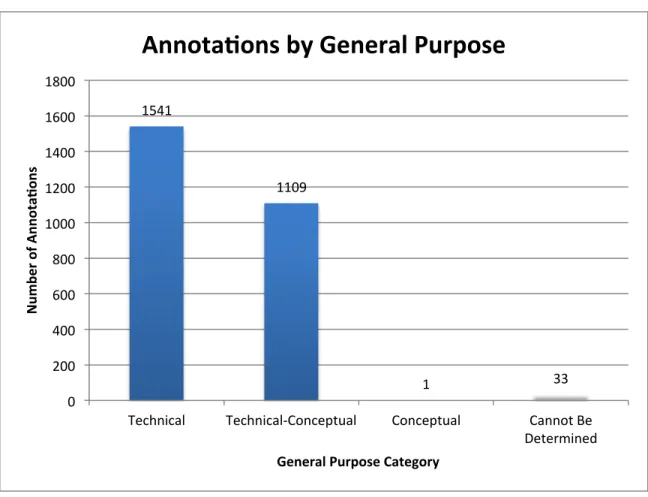
Annotation General Purpose ... 43
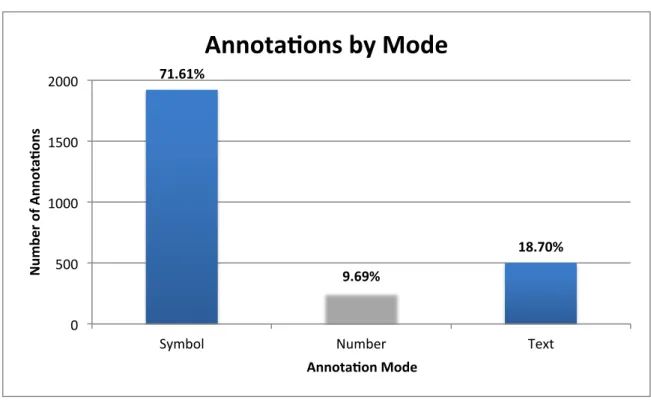
Annotation Mode ... 44
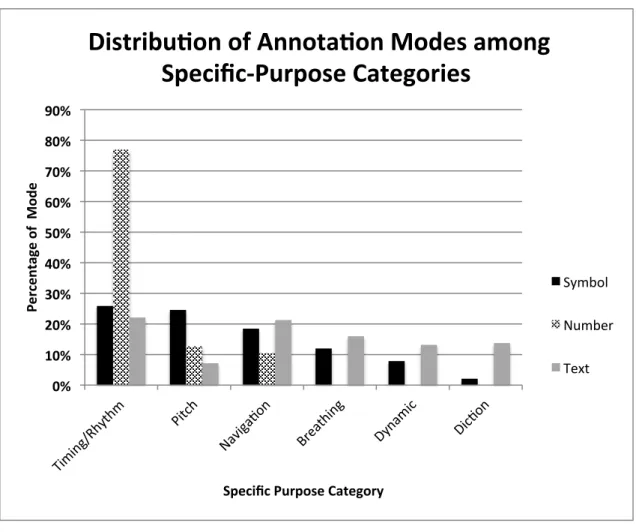
Annotation Specific Purpose ... 46
Comparison of Voice Parts ... 48
Annotation Quantity ... 49
Discussion ... 52
Assessment of the Data Analysis Framework ... 52
Improvements to the Research Design ... 56
Suggestions for Future Studies ... 58
Content Analysis of a Choir’s Score Annotations: Characterizing Annotations and
Assessing a Coding Scheme
The goal of this research study was to observe the characteristics of annotations
that members of a large choir created in their scores during ensemble rehearsal. To date,
Megan A. Winget's 2006 dissertation research is the largest ethnographic study of how
performing musicians create and use annotations in their scores. The study presented in
this paper sought to yield data and findings that could be compared with those from
Winget's research. Additionally, this study utilized Winget’s score annotation coding
frame in order to assess its suitability for studying score annotations in a different
context and to propose improvements to it. Although Winget’s research remains the most
extensive study to date, a review of the literature revealed that knowledge of musicians'
annotation practices is valuable to the development of a variety of digital systems that
support musicians and that further research in this area would be welcome. This study
sought to contribute to knowledge of how musicians annotate their music so that digital
systems developed in the future will better support musicians’ annotative activities.
Additionally, past studies of musicians' annotative practices have used instrumentalists
rather than vocalists as the population under study or as the prospective user group of a
digital music system. The research presented in this paper therefore sought to enrich the
research on musicians’ score annotations by investigating the character of choristers’
Literature Review
Previous Research on Score Annotations
The most extensive ethnographic study to date of musicians’ score annotations
comes from the field of library and information science (Kaastra, 2011). This research
study sought to characterize the information interaction between Western classical
musicians and their printed music by examining the annotations that musicians created in
their scores. The study regarded musicians’ score annotations as artifacts of the
musicians’ interaction with the musical score, their “primary information object”
(Winget, 2008a, p. 1878). As Winget explained:
The goal of this research project was to explore the ways in which musicians interact with their written music; how a variable work like a performed musical piece is realized for a unique performance; and how musicians’ interactions and interpretations, as evidenced by their annotations on their written music, affect the final product (2008a, p. 1878).
Winget’s study was exploratory in nature and sought to yield descriptive data regarding
the following qualities of score annotations: creation and use; object characteristics; and
meaning and utility (Winget, 2008a, p. 1880). Additionally, the study sought to
investigate how musicians’ skill level, ensemble type, and ensemble role affected their
information interaction with their musical scores, as reflected by their score annotations.
To this end, Winget’s study participants included musicians from six different types of
instrumental ensemble that performed Western art music: amateur orchestra,
semiprofessional orchestra, professional orchestra, amateur chamber ensemble,
semiprofessional chamber ensemble, and professional chamber ensemble.
In order to investigate the research questions posed by this exploratory study,
Winget’s research drew upon three different methods. First, informal observations of
and meaningful background for interpreting the data produced by content analysis of the
score annotations (Winget, 2008a, p. 1880). Second, the musical scores from each
ensemble were collected and the annotations that musicians had made in them were
analyzed and classified according to a coding frame that Winget designed during data
collection and analysis (Winget, 2008a, p. 1883). Finally, semi-structured interviews of
22 musicians served several important purposes: (a) they provided an understanding of
the rehearsal, performance, and annotation processes; (b) insights gleaned from the
interviews contributed to the development of the coding frame used for content analysis
of the musical scores; (c) the interviews allowed the researcher to clarify the meaning and
purpose of individual score annotations; and (d) the interviews provided insight into the
musicians’ creation, use, and perceived value of score annotations (Winget, 2008a, p.
1880-1). Data collection for the orchestral ensembles was incomplete because it was not
possible to collect all scores from the amateur orchestra and because the professional
orchestra's scores had already been annotated by the semi-professional orchestra. For this
reason, some of the findings were based primarily on data gathered from the scores of the
chamber musicians (Winget, 2008a, p. 1889).
After analyzing the data resulting from observations, interviews, and content
analysis, Winget concluded that “musician annotations are created through the problems
or breakdowns in communication that happen in their attempt to work together to
perform a musical piece. Musician focus is on collaboration, coordination, and
interaction" (2008a, p. 1893). Winget’s study analyzed and classified more than 25,000
individual score annotations and found that 78% of these annotations had a purely
annotations were symbolic, rather than numeric or textual. 1 Beyond these observations,
the study found that (1) chamber musicians tend to create more annotations than
orchestra musicians; (2) second violinists created more annotations compared to the other
types of chamber musicians; (3) the more highly skilled ensembles tended to create more
annotations than the less-skilled ensembles; and (4) although in general musicians are not
formally taught how to annotate their scores, their annotations tend to be standardized
and consistent (Winget, 2008a, p. 1893).
Working during the same timeframe as Winget, Kaastra has also closely
examined the role of score annotation in Western art music performance, although she
did not originally set out with this intent. In her 2008 study titled Systematic Approaches
to the Study of Cognition in Western Art Music Performance, Kaastra’s project was to
identify and apply methods of studying music performance informed by both cognitive
psychology and musicology. Coming from her background of extensive musical
education and training, Kaastra sought to develop a method of studying cognition in
music performance that remained “phenomenologically resonant with instrumental
practice” (2008, p. ii). In particular, Kaastra focused on the role of musicians’ physical
gestures (including conversation, body motion, and instrumental play) in fostering
musical understanding between musicians as they perform a work of music.
In order to observe closely the physical gestures and cognitive processes
implicated in music performance, Kaastra carried out an observational case study of the
collaboration between two musicians who rehearsed and performed a piece of Western
art music composed for two flutes. The research process entailed observing and video
recording all rehearsals and the final performance and then minutely analyzing data
from the video recordings, employing grounded theory methodology to investigate the
role that physical gestures played in promoting musical understanding between the
flutists during their collaboration (Kaastra, 2008, p. ii).
Although Kaastra initially chose to focus on the musicians’ physical gestures,
she observed in the course of data collection that additional mechanisms were equally
important for “cultivating and maintaining a sense of ensemble” between the musicians
(2008, p. 67). She observed that the flutists “had been marking the score to facilitate
counting and coordination…counting and marking the score played a huge role in their
experimentation with the music” (2008, p. 57). Her data analysis revealed that the
musicians relied heavily on annotations they created in their scores, particularly to mark
beats and dynamics (2008, p. 67): “Throughout the rehearsal process, the flutists penciled
beat marks on the score so that they could listen to each other and coordinate the rhythms
between parts” (2008, p. 91). Drawing upon Herbert H. Clark’s joint activity theory for
the study of language, Kaastra ultimately identified four domains of coordination devices
that musicians use to negotiate musical meaning in the activity of music performance: (1)
the score, (2) annotations musicians add to the score, (3) real-time bodily movements,
and (4) general principles of ensemble performance. Regarding the domain of score
annotation, Kaastra wrote:
The pencil marks are ‘keys’ to understanding some of the indexical problems of performing the score. The vertical lines help the flutists to line up their parts. The triangles remind them to keep the same internal subdivisions. The curved arrows remind them of their goal to continue the momentum through the rests (2008, p. 108).
Kaastra subsequently revisited the data collected during the study of gesture in
supported cognitive and meta-cognitive processes of music performance. She presented
this research in an article describing the role of musicians’ score annotations in
coordinating Western Art Music (WAM) performance, drawing upon theory from the
field of distributed cognition (Kaastra, 2011, p. 675). The data for this analysis of score
annotations consisted of the videotaped rehearsal and performance process from her case
study research, as well as the musicians’ annotated scores from the study. Kaastra wrote
of her procedure: “I observed each annotation as it was made in the rehearsals, including
the playing, stoppage of play, and conversation that accompanied each mark. I then
classified the marks based on the reason they were used” (2011, p. 677).
Kaastra’s analysis of the flutists’ annotations resulted in a framework for
classifying score annotations based on “their function in supporting cognitive and
meta-cognitive processes of performance in relation to the printed score” (2011, p. 675). This
framework includes three classes of annotation:
1. Visual salience: annotations that “make existing aspects of the score more
visually salient for performance” (Kaastra, 2011, p. 677)
2. Repair/correction: annotations that repair or correct “some aspect of the score, or
a cognitive process implied by the score” (Kaastra, 2011, p. 678)
3. Performance anchors annotations that “hold and link internal and external
performance processes” (Kaastra, 2001, p. 678)
Annotations and Coordination of Music Performance
Drawing upon theory from the field of communication studies, Winget
conceptualized the scores that musicians use in rehearsal and performance as boundary
idea that helps people from different communities build a shared understanding” that
facilitates effective communication across community boundaries (Winget, 2008a, p.
1878). The following quotation from Winget (2008a) further illuminates the concept of a
boundary object:
As Star and Griesemer define them in their seminal article, boundary objects “inhabit several intersecting social worlds,” and “satisfy the informational requirements of each of them” (Star & Griesemer, 1989). Instead of demanding full comprehension by every member of a community, “boundary objects serve as a point of mediation and negotiation around intent” (p. 1879).
In the context of music performance, the score as boundary object helps people
from different communities (e.g., a composer, a conductor, different ensembles,
individual members of the same ensemble) develop a shared understanding of the musical
ideas embodied in the score. During the rehearsal process, the score helps musicians
communicate about those musical ideas in order to establish their performance
goals--what the ensemble aims to achieve in its performance of the musical work. Within this
theoretical framework, annotations that musicians create in their scores are
conceptualized as “markers of interaction with boundary objects” (Winget, 2008a, p.
1885).
Just as a boundary object facilitates communication among members of
different communities, Winget conceptualized Western art music performance as a
communicative event and situated the musical score boundary object in the context of a
communication model representing musical performance. She defined a model of
communication to represent the transmission of musical ideas among the different actors
involved in the performance event, which is facilitated by the musical score boundary
object. Winget describes this relationship between the musical score boundary object and
…the musical score was considered the primary means of communication across boundaries—it is the means by which the composer communicates with the conductor and the musicians; the conductor with the musicians; and the musicians amongst themselves. On another level, the score is the means by which the
composer/musician unit communicate aurally with the audience (2008a, p. 1882).
As this quotation suggests, Winget’s communication model conceptualized the
score as a boundary object facilitating a linear, hierarchical communicative event
whereby musical ideas are conveyed from the composer’s mind to the ears of listeners,
ultimately. This event has the following structure: Composer è [score editor, if present] è [conductor/interpretive leader, if present] è performing musician(s) è listener(s). In
this model of communication representing musical performance, the composer notates his
or her musical ideas as a means of sharing them with others, in this case through written
symbolic notation that has become standardized over the course of the history of Western
art music. After composition, a score editor may produce a published version of the score
with annotations that seek to clarify the composer’s intentions, especially if the musical
practices of the composer’s epoch have become obscured by time. Then, if an ensemble
has an interpretive leader, such as the conductor of a choir, this leader studies the score
and makes decisions regarding how to express the composer’s musical ideas in the
context of a particular performance. The leader then communicates these interpretive
decisions to the ensemble during rehearsal. Ensemble members also communicate with
their colleagues during the rehearsal process. If an ensemble does not have a designated
interpretive leader, then the musicians collaborate on making interpretive decisions
during rehearsal. Finally, the ensemble communicates its interpretation of the composer’s
work to listeners through its performance (Winget, 2008a, p. 1882).
Within this model, the score serves as a boundary object by giving the different
communicate while rehearsing the performance. Winget describes how musicians’
score annotations were conceptualized within the study’s theoretical framework, writing:
This research project considered interaction between musician and written music as a form of communication, with the annotations providing evidence of that communicative event, essentially marking spots where some “breakdown” has occurred, requiring clarification, augmentation, or modification of the written instructions (2008a, p. 1882).
Although her original model emphasized the linear, top-down structure of
communication in music performance, Winget observed during her study that the
musicians’ interactions with their written music (captured in their score annotations) shed
light on the importance of annotations for lateral communication among musicians in
ensemble performance. Ultimately, Winget observed, annotations reflected not only how
musicians interacted with their printed sheet music but how they interacted with each
other as an ensemble. More specifically, as a boundary object, the score supported
communication among musicians by fostering a shared understanding of the ensemble’s
shared performance goals, thereby enabling coordination of individual efforts and
ensemble cohesion. Score annotations created by individuals facilitated successful group
work (Winget, 2008a, p. 1890). Winget writes of this enriched perspective on score
annotations:
The annotations in this augmented model represent a more complex interaction between musicians than had been supposed at the outset of this project. The original communication model conceived of annotations primarily as a personal directive to “get it right.” Although annotations still have personal ramifications, the importance of “getting it right” is better understood in light of coordinative group work rather than as an individual task. A member of an ensemble does make annotations in order to play correctly, but only because other members of the group rely on consistency in order to achieve reliable group performances over time (2008a, p. 1890).
The observations that Winget made concerning score annotations and ensemble
boundary object: “This research is based on the assumption that the musical score
works as a standardized-form type boundary object, providing standardized methods,
procedures, and vocabularies to communicate common processes and goals to various
groups within an orchestra or ensemble” (2008a, 1882). Unpacking this definition in the
context of Winget’s study, standardized Western art music notation provides the
standardized procedures and vocabularies that musicians use to communicate about
performance goals that the ensemble will work towards through their combined efforts.
An example of a shared performance goal would be to perform a crescendo at a certain
point in a piece. A crescendo requires the combined efforts of the ensemble in order to
occur; if only one member increases volume, the effect is unnoticeable at best, distracting
at worst. Rather, a crescendo achieves its effect as the result of all ensemble members (or
a defined subset of the ensemble) increasing volume gradually and simultaneously,
coordinating their individual efforts. This crescendo goal could be refined to specify the
particular beat on which volume will start to increase, the rate at which volume will
increase, the point at which volume will reach its zenith, and approximately how loud
that pinnacle will be (e.g., forte; fortissimo). Performing such a complex, collective
musical gesture requires coordination in the ensemble so that each member takes the
correct action at the correct time in order to create the overall desired effect. If a singer
creates an annotation in her score to remind her to perform the crescendo (i.e., when and
how much to increase her volume), this annotation at once captures the ensemble’s
shared performance goal of creating a crescendo as well as the individual action she must
take to contribute to the goal. A key function of score annotations, Winget points out, is
to coordinate individual actions in order to produce collective actions that achieve the
Winget’s assertion regarding the role that score annotation plays in
facilitating coordinated interaction among ensemble musicians is based on patterns she
observed in the score annotations. She noted that a musician’s score tended to be more
heavily annotated if that musician’s part was:
responsible for bringing together different aspects of a piece (the second violin often has twice as many annotations as anyone else). Annotation decreases when there is less need of successful interaction (solos for example, or in the case of the first violin carrying the melody) (2008b, p. 9).
First, Winget observed a pattern in the score annotations of second violin chamber
musicians. Her content analysis of score annotations revealed that in the three chamber
ensembles that participated, the second violinists as a group created 20% more
annotations on average compared to the other instrumentalists in the chamber ensembles
(i.e., first violin, viola, and cello). This observation led Winget to gather more
information about the role of the second violin part during follow-up interviews with
chamber musicians. These participants informed her that in Western art music repertoire
for string quartet, the second violin part typically has a complex interaction with the
“outer” parts, frequently reinforcing the tempo established by the cello and
complimenting the melody carried by the first violin. The essence of the second violin
part lies not in its musical line taken in isolation but rather in the ways it interacts with
the other musical lines to produce interesting harmonic and rhythmic events (Winget,
2008a, p. 1891). The epitome of the second violin part is interaction with the surrounding
musical voices and its role, Winget argued, is “managing the collaboration” of the
ensemble: “The second violin is the glue that holds the quartet together. Everyone
depends on the second violin being consistent, and because annotations help to ensure
To reinforce this point, Winget offers the example of the typical role of the
first violin in a chamber ensemble. The first violin is typically responsible for playing the
melody of the piece, “which is easier to memorize, and less dependent on successful
interaction with other members of the group,” who are responsible for complimenting the
melody and following the first violinist’s lead (Winget, 2008a, p. 1891). Thus, Winget
argues, first violinists did not create as many score annotations compared to other
chamber musicians because the success of their part depended on their individual
execution of the melody, while the other parts were responsible for following their lead
and interacting with the melodic line.
Considering the observations Winget made concerning the first and second
chamber violinists, it is not surprising that she also found that musicians who played solo
passages did not annotate those sections of their scores as heavily as sections where they
played as part of the ensemble. Winget posited that this finding could be attributed to the
idea that success in these passages depended less on coordination with other musicians
and more on individual execution: “…during these virtuoso phrases or sections, these
instruments are often playing alone, so the need to ‘get it right,’ is purely individual. This
suggests that annotations, in this context, have a specifically collaborative character”
(2008b, p. 9). The pattern that Winget observed in how solo passages were annotated
supports the finding that a key function of score annotation is to facilitate coordinated
action toward shared ensemble goals.
Score Annotation Research and the Development of Digital Music
Systems
Since the first design specification for a digital music stand was published in 1996
functionality by people who have designed and developed digital systems that support
music performance, music education, and score libraries. Knowledge of how musicians
annotate their music has informed the design and development of these systems. In
particular, the fact that Winget's (2006) score annotation research has been cited by
developers of digital music stands, digital music education systems, and digital score
libraries shows that research into musicians' annotations is valuable to a variety of
research and development endeavors and that more research in this area would be
welcome, especially considering that Winget's dissertation remains the largest
ethnographic study of performing musicians' score annotations to date.
Digital Music Stands. Researchers in the Department of Electrical and Computer
Engineering at McGill University developed a system called Open Orchestra, a digital
system that provides a musician with an immersive simulation of practicing with a full
orchestra, combining the benefits of ensemble rehearsal with the convenience and
personalization of solo practice (Olmos et al., 2012, p. 55). The researchers cite Winget’s
(2008a) research for their understanding of the importance of score annotations for
coordinating collaboration among orchestra musicians (Olmos et al., 2012, p. 59). This
recognition of the importance of musicians’ score annotations to the rehearsal process
influenced major decisions that the developers made when designing Open Orchestra’s
user interface. The developers decided to use a tablet-based digital music stand as the
primary user interface and they decided to provide a stylus for user input--in addition to
touch-screen input--specifically to afford users a level of "writing efficiency and control"
similar to that of a pen for creating annotations in the score (Olmos et al., 2012, p. 59-60).
Digital Systems for Music Education and Collaboration. Winget's research also
education platform in which score annotations play a key role. As a product of her
research, Winget offered a series of recommendations to inform the design of digital
systems that support score annotation (2008a, p. 1895-6). Researchers at the University
of Reunion Island used these recommendations to develop a design for a Web-based
music education platform that would support adding multimedia annotations to digital
scores, among other functions (V. Sébastien, D. Sébastien, & Conruyt, 2009, p. 3). For
example, in the description of their system design the researchers specifically cited
Winget’s recommendation that digital annotation tools maintain a clear distinction
between original score content and user-created annotations (Sébastien et al., 2009, p. 6).
After publishing their initial design idea, the researchers then developed a
prototype for this system, called @-MUSE (Annotation platform for MUSical
Education). The goal of the system was to provide online music lessons that are
generated dynamically in response to a student’s progress and interests, rather than
requiring that the student complete a linear sequence of lessons. In their system
description, the researchers cited Winget’s (2008a) study, stating that one of the ideas
that guided their design was that @-MUSE should allow musicians to interact with digital
scores in a manner similar to how they interact with printed music because musicians’
scores support memory and information sharing (V. Sébastien, D. Sébastien, & Conruyt,
2011, p. 386). The researchers concluded that score annotation played a key role in
musicians’ learning and sought to design a system that took advantage of the pedagogical
value of score annotation. The @-MUSE platform would generate music lessons
accompanied by score annotations designed to help the student. At the same time, the
student wants to improve and then suggest lessons and exercises to develop those skills
(Sébastien et al., 2011, p. 394).
Digital Score Libraries. Finally, score annotations themselves have been proposed as
the potential basis for a digital library. Orchestral Bowings Online is a prototype for a
digital library of orchestral bowing annotations developed by Barbara Barnett-Stewart,
who was then an intern at the Philadelphia Orchestra’s Riccardo Muti Library and a
graduate student in library and information science at Rutgers University. The library’s
goal would be to offer access to public-domain orchestral scores with bowing annotations
already written in. Barnett-Stewart argued that this collection of annotated scores would
be helpful, for example, if an ensemble were performing a particular piece for the first
time. The ensemble may not have the resources or time available to create bowing
annotations for the entire string section, so scores that already contain bowing
annotations would provide a valuable starting point for the ensemble (Barnett-Stewart,
2013, p. 2). Barnett-Stewart cited Winget’s research in her explanation of the value and
feasibility of Orchestral Bowings Online. She noted that many of the musicians Winget
(2008a) interviewed were willing to share their annotations with other musicians and that
many of the interviewed musicians expressed a belief in the enduring value of score
annotations beyond their original context of creation and use as resources for future
generations of musicians and music scholars (Barnett-Stewart, 2013, p. 2-3).
The descriptions of the digital music systems described above indicate that the
developers considered score annotation a key functionality to provide and that they
considered the way musicians annotate important to their design decisions. Their citations
in learning how best to support score annotation functions and that they would
welcome additional research into musicians’ score annotations to inform their design
decisions.
Research Justification
Further research in the area of musicians’ score annotations is justified for two
primary reasons:
• Winget’s 2006 study remains the most extensive study of performing musicians’
score annotation practices to date, indicating that a dearth of research persists in
this area and that research should continue in order to generate more knowledge
about musicians’ score annotations. This study sought to be part of that effort by
investigating the same phenomenon that Winget did (i.e., the score annotations
that musicians create during ensemble rehearsal) but in a different context.
• The fact that Winget’s research has been cited by developers of various digital
music systems suggests that additional research in this area would be welcome to
developers of these systems. Furthermore, the fact that Winget's research was
cited by developers of digital systems suggests that research into analog score
annotation is valuable to system developers who wish to translate analog score
annotation successfully to the digital realm.
Research Questions and Goals
• To use Winget’s (2006) coding frame in order to ascertain whether it could be
applied successfully in a context different from that in which it was originally
developed.
• To generate suggested improvements for Winget’s (2006) coding frame.
Additionally, this study sought to address the following research questions:
• What are the annotation object characteristics of the score annotations created by
a large choir during ensemble rehearsal? The following annotation object
characteristics will be assessed:2
o Annotation Mode: in which mode were the annotations created--text,
symbol, or number? Which mode was most prevalent and which mode
was least prevalent?
o Annotation Specific Purpose: which specific purposes were present in the
choir’s annotations? What were the most common and least common
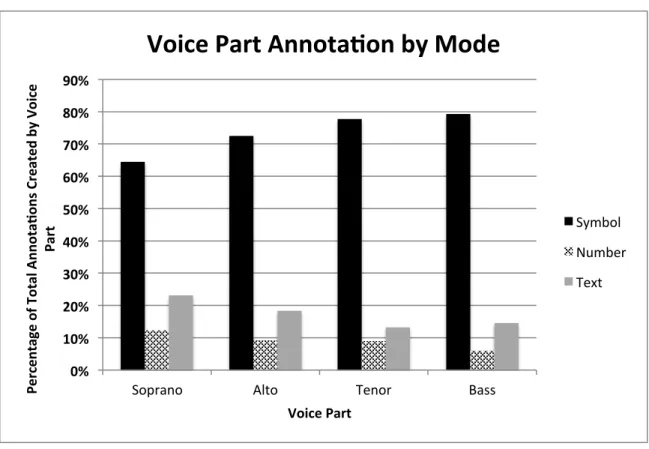
specific purposes for the choir’s annotations?
o Annotation General Purpose: how many of the choir’s annotation’s were
technical, technical-conceptual, and conceptual?
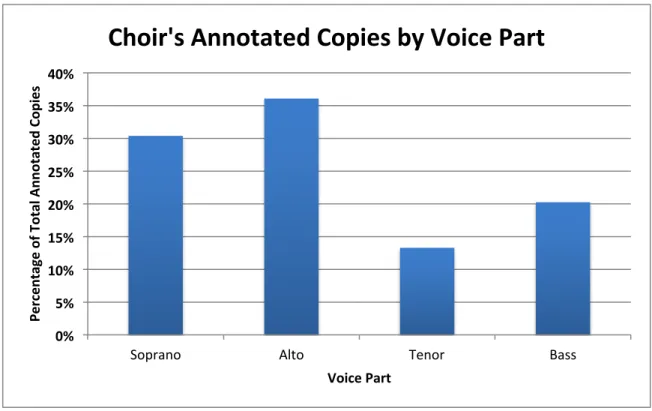
o What were the annotation object characteristics of annotations created by
individual sections of the choir (soprano, alto, tenor, and bass)? How
many annotations did each section create, and how heavily did each
section annotate its music?
Methodology
Summary
This research study consisted of conducting a content analysis of the annotations
that members of a large choir created in their copies of two choral works that they had
previously performed. The choir that created the annotations is non-professional and
community-based, has approximately 100 singers (both men’s and women’s voices), and
performs mostly sacred, classical Western choral works. The two choral works examined
during content analysis were selected purposively from the choir’s library of sheet music.
The content analysis reviewed 158 copies of sheet music and identified more than 2,600
individual annotations. Each annotation was recorded in a spreadsheet and classified
according to the data analysis framework developed by Winget’s study of score
annotations (Winget, 2006; Winget, 2008a). The data recorded in the spreadsheet were
then quantitatively analyzed in order to describe object characteristics of the choir’s
annotations and to compare annotations made by subsections of the choir to each other.
Epistemological Justification for the Research Design
The goal for this research was to learn about how musicians interact with their musical
scores. Wildemuth and Spurgin have observed that “[t]he primary foci of [the
information and library science] field are recorded information and people’s relationships
with it” (2009, p. 297). Grounded in the field of information and library science, this
study conceptualized the relationship between a musician and a musical score as an
information interaction, wherein the musical score is an information object containing
information that a musician interacts with when rehearsing and performing a musical
researching it are based on the dissertation of Megan Winget. As Winget did in her
study, this research conceptualized the annotations that musicians create in their musical
scores as products of musicians’ interaction with their scores (2008a, p. 1878). In order to
learn about how musicians interact with the information in their scores, this study focused
on analyzing the score annotations that musicians created, which reflect their interactions
with the score.
This approach is consistent with the field of information and library science’s
justification for examining documents and artifacts as a means of learning about people’s
information behaviors. As Wildemuth explains, “[p]eople often leave traces of their
behavior in the documents they create or on the artifacts with which they interact…Thus
existing documents or traces of physical evidence may be a source of data about people’s
information behaviors” (2009, p. 158). A musical score can be conceptualized as a
document in the sense that its primary feature is an “inscribed text” (in this case the
“text” is musical notation) that contains an “intentional message, fulfilling a particular
purpose of its creator” (Wildemuth, 2009, p. 159). The creator in this case would be a
composer, most often.
Wildemuth goes on to explain that “[a]s people interact with information, they often
leave physical traces of their behavior behind” (2009, p. 160). These physical traces are
considered artifacts of people’s information interaction behavior. In the context of this
study, musicians interact with the information contained in a document (i.e., a musical
score), and the annotations they create in this document can be interpreted as artifacts of
their information interaction with the document. Studying musicians’ score annotations,
then, is a way to learn about how musicians interact with the information contained in
the information contained in their scores but with other information sources involved
in the rehearsal process as well. For example, Winget observed in her research that
musicians’ annotations reflect their interactions with their fellow musicians “in their
attempt to work together to perform a musical piece” (2008a, p. 1893). Similarly, Kaastra
(2008) identified score annotations as one of four domains of ensemble coordination in
music performance. Studying annotations as artifacts of information interactions that
occur during the rehearsal process is therefore a valid means by which to characterize
musicians’ interactions with information in their scores as well as to gain insight into how
musicians manage information interactions as they coordinate their efforts as an
ensemble.
Musicians’ score annotations are considered accretion artifacts, since they are left
behind or “deposited” on the document. The annotations analyzed in this study are
considered “natural” artifacts since the musicians created them during their normal
rehearsal activities without any influence or control from the research study, which
relates to a strength of using documents and artifacts as data sources: the unobtrusive
quality of the research (Wildemuth, 2009, p. 160). As Wildemuth explains, when
documents and artifacts are the data sources, “the process of data collection will not
influence their content in the same way that more intrusive methods (such as interviewing
someone or directly observing her) have an effect on the information behaviors being
studied” and, therefore, “at least in some instances, this type of data could be a more
accurate representation of the phenomenon of interest than data collected through
self-report” (2009, p. 158). Although directly observing musicians annotating their scores
during rehearsal or interviewing them regarding their annotation practices would have
scores and the annotations therein was the most valid method of analyzing the physical
qualities of the annotations themselves, as physical trace data.
Although examining artifacts of the musicians’ information interactions had the
advantage of being unobtrusive, it is important to note that triangulation is critical when
documents and artifacts are data sources. As Wildemuth clearly advises, “In essentially
every study, data obtained from documents or artifacts will need to be analyzed in
combination with data obtained using other methods” (2009, p. 161). The absence of
triangulation and the sole reliance upon content analysis of documents and their artifacts
is a weakness in the design of this research study and restricts the types of questions that
this research can address with validity. Indeed, the exclusive use of content analysis of
the score annotations confines the results mostly to the realm of description, addressing
questions of what and how many, instead of being a valid way to reveal the purpose of
the annotations or the underlying motivations that the musicians had for creating them—
questions of how and why. Nonetheless, the method can validly investigate questions
such as how heavily different ensembles (or subsets of an ensemble) annotate their
scores, the distribution of annotations in a score, whether annotations tend to be textual,
symbolic, or numeric, and, in many cases, the musical concept the annotation primarily
relates to (dynamics or tempo, for example). However, the annotations themselves are
relatively ambiguous with respect to their underlying motivation, and ascribing them
meaning and purpose required a significant amount of interpretation on the part of
researcher during content analysis. As a result, the researcher’s perspective was
thoroughly integrated into the data collection and analysis, although, as Wildemuth notes
“…to interpret the meaning of a document correctly, the researcher must know quite a bit
In the absence of triangulation, the ambitions of the current study were tempered
with respect to the types of questions it could address with validity. Its goal was to
describe the characteristics of annotations that choristers created in their scores during
ensemble rehearsal. Despite the limited scope of this study’s aims, part of its contribution
lies in adding depth to Winget’s project by studying the same phenomenon (score
annotation) in a different population (choristers) in order to make comparisons of score
annotation characteristics. Winget (2006) studied score annotations created by a variety
of instrumental ensembles, while this study examined the annotations of a large choir and
sought to compare the characteristics of annotations Winget observed among
instrumentalists with characteristics of the choristers' annotations.
Access, Feasibility, and the Decision to Use the Musical Scores
The research design of this study must also be situated in the context of the issues of
access and feasibility. The researcher has a background of musical education and training
in Western classical piano and voice, including numerous years of choral singing. She
had previously sung with a large community choir in the Research Triangle region of
North Carolina and had established a good rapport with the choir’s management
personnel. The researcher also possessed familiarity with the choir’s library of sheet
music, patterns of sheet music use, and rehearsal practices. Consequently, when the
researcher learned of Winget’s (2006) research and decided to launch a related study, the
choir in which she had previously sung presented itself naturally as a possibility for
access to an ensemble and its annotated sheet music. The researcher did consider the
possibility of studying multiple ensembles (as Winget did) in order to compare the
ensemble of 16 voices compared to a 100-voice choir); however, the researcher would
not feasibly have been able to control important variables, such as the piece of music
rehearsed or the amount of rehearsal time devoted to the piece, in order to make valid
comparisons between the groups.
Having decided to study the annotation characteristics of one large choir, the researcher
then considered questions of which method(s) to apply in order to study the choir’s score
annotations. One possible method would have been to observe choristers during ensemble
rehearsal as they created annotations. However, several obstacles precluded this method.
First, the choir’s size (approximately 100 voices) would have made observation of all the
singers’ annotative practices impractical and would have necessitated sampling of the
population. However, selection of a sample of individual singers for scrutiny during
rehearsal would have been highly intrusive; the researcher could reasonably expect
singers to annotate very differently under direct observation compared to normal
rehearsal circumstances. Additionally, the method of participant observation would have
confined the researcher’s observations to one small section of the choir and would not
have yielded a representative assessment of the annotation characteristics of the choir as a
whole. The researcher concluded that observation of singers during rehearsal may have
yielded insights regarding the role of score annotation in the choir’s rehearsal practices
and about the role of the conductor in annotation creation. However, such observation
would not have enabled close study of the characteristics of choristers’ individual
annotations. Consequently, observational methods were not employed in this study,
although the researcher’s previous experience singing in the choir significantly
influenced the process of data collection.
annotation practices would have been another method of studying the choir’s score
annotations. Interviews with individual choristers would have been an effective means of
answering questions related to annotation purpose and meaning, since these qualities
were often difficult to discern just by looking at the physical characteristics of the
annotations themselves. Making judgments about the purpose and meaning of singers’
annotations required extensive interpretation on the part of the researcher (discussed
below), and interviews with individual singers may have allowed for clarification of
annotations that the researcher found ambiguous in meaning and purpose. Although
interviews with individual singers regarding their annotations could have enabled a more
valid assessment of annotation purpose and meaning, the time involved in arranging
interviews ultimately precluded their use in this study.
As described above, in this study musical scores were conceptualized as
documents containing information that musicians interacted with during ensemble
rehearsal, and annotations that musicians created in their scores were conceptualized as
artifacts of the information interactions that occurred during ensemble rehearsal.
Considering the theoretical stance adopted in this study, it was deemed appropriate to
subject the score annotations to content analysis, since in the academic field of
information and library science documents and artifacts are frequently analyzed using
some form of content analysis (Wildemuth, 2009, p. 161). Moreover, content analysis of
score annotations was a method utilized in Winget’s (2006) research, which is the most
extensive analysis to date of musicians’ score annotation practices (Kaastra, 2011).
Undertaking content analysis of the choir’s score annotations was therefore considered an
appropriate method for addressing research questions regarding annotation characteristics
annotations usually take—text, symbol, or number; annotation patterns of subsets of
the ensemble).
To conclude, in view of what was feasible within the timeframe available for the
study and in the interest of closely examining visually salient characteristics of individual
annotations, it was decided that content analysis of score annotations created by the choir
would be the method employed in this study, despite the disadvantages of using artifact
analysis in isolation. The choir’s management personnel granted the researcher access to
the choir’s library of sheet music for the purpose of analyzing the annotations therein.
Sampling
Sampling in this study refers to the selection of choral works from the choir’s sheet
music library for use in the content analysis. The sampling method used in this study was
purposive rather than random. The researcher established criteria in order to produce a
data sample conducive to investigating the study’s research questions. As Zhang and
Wildemuth have noted, “…samples for qualitative content analysis usually consist of
purposively selected texts, which can inform the research questions being investigated”
(2009, p. 309). It is important to emphasize that, due to the sampling method, this study’s
findings are not generalizable to a larger population of content—in this case, score
annotations (Spurgin & Wildemuth, 2009, p. 298).
The research concerns that the data sample was designed to address were twofold.
First, the focus of this study was score annotations because these annotations are artifacts
of information interactions that occur in a very specific context. This context is the
ensemble rehearsals during which musicians prepare to perform a musical work for a
rehearsal space, the conductor, the anticipated audience, etc.) is unique to each
individual instance of performance. Annotations are artifacts of the information
interactions that occur during a particular cycle of rehearsal and performance, and they
are unique reflections of their performance context. Although annotations from many
different performances can accumulate over time in sheet music, this study was interested
not in accumulated annotations but rather annotations that reflect a single instance of
rehearsal and performance and the information interactions that occurred in that instance.
Additionally, much of the research and development of digital music performance
systems aims to support musicians during rehearsals, so it was deemed important to study
artifacts from an individual rehearsal process, rather than annotations generated over a
period of time through different performances and by different people.
The second major research concern that governed sampling was an interest in
comparing the annotations of subsections of the choir (i.e., sopranos, altos, tenors, and
basses) to each other. The implications of this consideration for the data sample are
described in detail below.
The researcher ultimately established the following criteria that guided the selection of
pieces from the choir’s sheet music library for the data sample:
• The piece had been used only by the choir of interest. This criterion was important because the sheet music in the choir’s library is utilized by several
different choirs. The researcher therefore verified to the best of her ability that the
two pieces in the data sample had been performed only by the choir under study.
The researcher consulted electronic records of the choir’s past performances and
the choir’s management personnel in order to verify that only the choir of interest
• The piece had been performed by the choir only once. As described above,
this criterion was necessary because the score annotations were being studied as
reflections and products of information interactions that occurred during a specific
instance of rehearsal and performance. Pieces that had been used more than once
would have contained annotations that reflected multiple performances.
Additionally, the interest researcher’s in comparing the annotation characteristics
of different sections of the choir (i.e., soprano, alto, tenor, and bass) made it
important to capture one performance instance in order to be able to compare
singers who had collaborated during the same performance process. Additionally,
for pieces that had multiple previous uses, it may have been difficult to identify
the vocal line in which an individual annotation was made. The sheet music
library’s physical organization was helpful with respect to this criterion because
pieces are generally arranged in the order the choir acquired them, and newer,
less-used pieces are consequently in an easily identified location. Again, the
researcher utilized electronic records of the choir’s past performances and
consulted the choir’s management personnel to verify that, to the best of her
knowledge, the choir had performed the sampled pieces on only one previous
occasion.
• The piece was notated so that each vocal line was printed on a separate staff
throughout most of the piece. This criterion facilitated identification of the vocal
part in which an annotation appeared so that voice parts could be compared to
each other in terms of the characteristics of their annotations. It was important to
be able to identify easily which voice part an annotation was anchored in, and this
• The sample consisted of two different pieces from the library. It was hoped
that utilizing two pieces in the data sample would mitigate the effect that an
individual piece's style or difficulty level would have on the character of the
choir’s annotations. The risk of using only one piece was that the characteristics
of the annotations could be attributed in large part to characteristics of the music
itself. Using multiple pieces as data sources allowed the study to investigate the
character of the annotations themselves rather than the annotations exclusively in
the context of a particular piece.
Based on the above criteria, the data sample ultimately consisted of two pieces
that strongly contrasted in style and level of difficulty. Between the two pieces, there
were 229 total copies, and 158 of these copies contained annotations.
Data Analysis Framework
Once the content analysis method was selected for studying the choir’s score
annotations, a data analysis framework was required to code the annotations according to
salient characteristics related to the study’s research interests. The researcher elected to
use an existing data analysis framework that Megan A. Winget developed through
content analysis of more than 25,000 score annotations (2006). As Zhang and Wildemuth
have noted, “[c]ategories and a coding scheme can be derived from three sources: the
data, previous related studies, and theories” (2009, p. 311). This study used an existing
framework for two primary reasons. First, using Winget’s framework would facilitate
making comparisons between the results of her study and the results of this study. Zhang
and Wildemuth go on to explain that “[t]he adoption of coding schemes developed in
research findings across multiple studies” (2009, p. 311). Therefore, Winget’s
framework was chosen in the interest of comparability. Secondly, Winget’s framework
was used in this study in order to assess a) whether it could be applied successfully in a
context different from that in which it was originally developed and b) what changes
might improve the framework for use in the future. The Discussion section of this paper
presents an evaluation of the framework and suggested modifications.
When the decision was made to apply Winget’s framework to this study, the researcher
also decided to attempt to apply it following Winget’s code definitions and examples as
closely as possible. This effort required that the researcher thoroughly understand
Winget’s codes (a) in order to code in a manner consistent with Winget and (b) so that
when the researcher encountered novel annotations for which there was no explicit
guidance from Winget the researcher could make coding decisions that were consistent
with Winget’s examples and definitions. To this end, the researcher closely studied
Winget’s code definitions and examples and reviewed them during data collection. This
amounted to a sort of “coder training” that the researcher did in order to enter the same
“mental frame of reference” as Winget so that coding would be consistent with hers as
much as possible (Spurgin & Wildemuth, 2009, p. 301).
This paper provides a description of the data analysis framework. However, since this
study sought to replicate Winget’s coding and apply her definitions as faithfully as
possible, readers are referred to Winget’s dissertation for the most accurate and complete
description of the framework (Winget, 2006).
The data analysis framework consists of classifying each score annotation according to
three annotation object characteristics: annotation mode, annotation general purpose, and
to convey information” (Winget, 2006, p. 60). Three annotation modes were taken into
account for this study: symbolic, textual, and numeric. These categories are mutually
exclusive, requiring that annotations that appear to combine multiple modes in one
conceptual unit be “split up” for analysis.3 An annotation is classified according to
whether it is represented as text (characters A-Z), number (characters 0-9), or symbol
(i.e., any character that is neither text nor number). Additionally, in this study an
annotation was classified as symbolic if a singer had drawn a circle around elements
printed in the score.
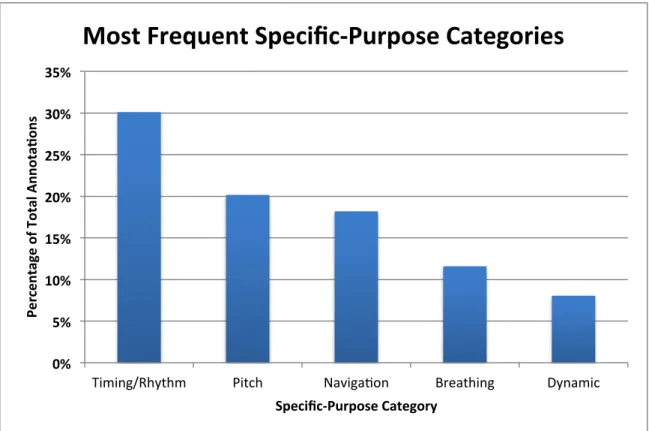
The second parameter is specific purpose. Specific purpose refers to the particular
aspect of ensemble performance that the annotation relates to and can also be interpreted
as the particular impetus that motivated the singer to create the annotation. This category
is meant to capture the specific musical purpose of the annotation. For example, if a
singer drew a check mark symbol between two notes, this symbol typically indicates that
the singer wants to remind herself to breathe at that time in the music. The annotation’s
mode is symbolic and its specific purpose is “breathing.” Breathing and diction do not
appear to have been specific-purpose categories in Winget’s original framework (2006).
However, the researcher added them in order to suit the context of this study, since
breathing and diction are important aspects of music performance for singers. Similarly,
“fingering” was a specific-purpose category not used in this study, since fingering is an
aspect of instrumental rather than vocal performance. Examples of the different
specific-purpose categories are provided below in Tables 1-3.
The last parameter of annotation classification is general purpose. An annotation has a
general purpose that is technical, technical-conceptual, or conceptual. The categories
are based on the degree to which an annotation relates to physical actions involved in
music performance. Technical annotations provide explicit instruction for how to
translate the score’s musical notation into a physical action (e.g., take a breath; put these
fingers here; move the bow like this; turn the page quickly; watch the conductor). A
technical annotation directly translates into a concrete physical action the musician takes.
Examples of technical annotations are provided in Table 1.
As Winget (2008a) defined this category:
Technical annotations were defined as those that are specifically concerned with the physicality of performing the piece: which fingers to place on which strings (fingering), how to hold and pull the bow across the strings (bowing), where to look or what to listen for (attentive notes), what notes to play (pitch), how to begin and end playing those notes (articulation), and how to navigate through the piece (navigation). These annotations have an immediate, physical, and specific meaning… All of these annotations relate to the physical transformation of performance: how to translate what is written into what is played (p. 1883).
Table 1
Technical Annotations
Specific Purpose Transcription Examples Mode
Attentive [star] Symbol
[eyeglasses] Symbol
“be ready” Text
Breathing ✔ [check mark drawn between
two notes, conveying “breathe here”]
Symbol
“N.B.” [written between two notes, meaning “don’t breathe here”]
Text
Diction [slash drawn through the letter
“r” of the word “prayer” printed in score lyrics]
Symbol
“Mah” [written beneath the word “my” printed in score to convey an altered vowel
sound]
Navigation [writing in measure numbers] Number
“Thither” [written in the margin after the last measure of the page to indicate the first word at the top of the
following page, in order to negotiate a page turn]
Text
[notating a pitch in the margin after the last measure on the page in order to indicate the first pitch the singer will have to sing immediately following the page turn. This helps the singer negotiate the page turn]
Symbol
Pitch [circle drawn around new key
signature]
Symbol
é[up arrow drawn immediately left of note, indicating the pitch is higher than the singer thinks it is]
Symbol
"1/2" [written between two notes separated by a minor second (or half step) interval]
Number
[circle drawn around two notes separated by a perfect fifth interval]
Symbol
“5th” [written between two
notes separated by a perfect fifth interval]
Text
The technical-conceptual category is more nebulously defined:
Technical-conceptual annotations have a level of abstraction not present in the purely technical annotations... Specifically, technical-conceptual annotations include timing/rhythm, dynamics, and contextual information, both
performer must take to make coordination and reliable repetition possible, the technical-conceptual annotations are more general, and often involve the
coordinative and interpretative efforts of the entire performing ensemble (Winget, 2008a, p. 1884).
However, it is readily apparent that specific purposes such as dynamics and timing
involve coordinated action on the part of the entire ensemble. Performing a crescendo,
for example, requires not only that individual musicians adjust the volume of their
playing (or singing) but that the group coordinate its increase in volume so that it occurs
at the rate specified by the score and the conductor. Similar group coordination is
required for performing changes in tempo and for keeping subsections of the group
rhythmically aligned with each other so that one subsection is not “dragging” the tempo
or accelerating it. Table 2 provides examples of technical-conceptual annotations.
Table 2
Technical-Conceptual Annotations
Specific Purpose Transcription Examples Mode
Dynamic “f” [meaning forte] Text
< [crescendo dynamic wedge]
Symbol
Timing/Rhythm “SLOW” Text
“1” [written above a note to show where this beat falls]
Number
Informational Contextual “WTH weak sauce” [reflects
the singer’s personal attitude towards an aspect of the piece]
Text
Representational Contextual [circle drawn around notes in
a vocal line other than the annotator’s own vocal line]
Symbol
[arrow drawn from a note in a different vocal line to a note in the annotator’s vocal line]
Symbol
The last general-purpose category, conceptual, is characterized by its distance
thinking. Winget defines this category as annotations that reflect a way to
conceptualize the music (e.g., "feroce" or "lyrical") but do not translate explicitly into a
physical action. These annotations reflect how a musician thinks about the music on a
purely abstract level. Of course, these abstract ideas influence how the musician
physically executes the music, but they are not explicit instructions for what to do
physically. For example, a musician may write “Get mad!” to capture an emotion she
wants to express through her playing. Additionally, annotations related to phrasing reflect
how musicians conceptualize the structure of a piece of music but do not explicitly
indicate how they will play the music (Winget, 2008a, p. 1884-5). Table 3 provides
examples of conceptual annotations.
Table 3
Conceptual Annotations
Specific Purpose Transcription Example Mode
Emotive “Get mad!” Text
“lyrical” Text
Phrasing [brackets or slurs drawn
around a group of notes]
Symbol
Data Collection Procedure
Data collection began with an initial “trial period” before the data sample and choice of
data analysis framework were finalized. This trial period consisted of coding 34
annotations from two pieces (one of which was not included in the final data sample)
using Winget’s (2006) framework and codes presented in Kaastra (2011). As a result of
this trial period, the sampling criteria and choice of a data analysis framework were
according to Winget’s framework.
The data collection procedure consisted of the following steps:
• For each copy of a piece, the copy was given a cursory examination to ensure that
it had been previously used (i.e., there were annotations present for analysis). If
there were no annotations present, the copy was set aside and not included in the
content analysis.
• If annotations were present, the copy was assigned a number, which was written
in pencil on the back of the copy.
• Then, for each annotation that appeared in the copy, a row in a spreadsheet was
created in order to record its classification using the data analysis framework as
well as additional descriptive metadata (listed below).
• Each annotation was classified according to its annotation mode, specific purpose,
and general purpose (described above). These classifications were recorded in the
spreadsheet..
• The following additional metadata were also recorded in the spreadsheet for each
annotation in order to facilitate data collection and analysis:
o Annotation ID number: an automatically generated number unique to each
annotation.
o Copy number: the copy number of the piece in which the annotation
appeared.
o Piece title: the title of the piece in which the annotation appeared.
o Bar number: the measure number(s) in which the annotation appeared.
o Voice part: the vocal line in which the annotation appeared (soprano, alto,
o Annotation transcription: a visual approximation of the annotation.
Annotations that took the form of text or numbers were copied verbatim,
while symbolic annotations were approximated as closely as possible
based on the characters available in Microsoft Excel.
In addition to using a spreadsheet to record each annotation, the researcher also
maintained an extensive research journal throughout the course of the study in order to
document selecting the data analysis framework, determining criteria for the data sample,
selecting the data sample, learning how to use Winget’s framework, and decisions the
researcher made regarding how to apply the framework when there was no clear, explicit
guidance from Winget’s examples or definitions. This research journal was highly
important because it documented the researcher’s coding decisions and the reasoning
behind them for reference later in the data collection process.
Several measures that could have improved the validity of this study’s results were not
incorporated into its research design. The Discussion section of this paper presents
suggested improvements to the research design.
Data Analysis
Before presenting the results of the content analysis, it is important to discuss the
nature of the products of this study. The content analysis method employed in this study
incorporated qualitative aspects, such as purposive sampling and data collection that
integrated the researcher’s subjectivity. However, the resulting data is quantitative in
character. The manner in which Winget’s data analysis framework was employed enabled
counting of features of the content. The researcher was able to quantify how many