PROBLEM BASED LEARNING ANDTHE
CONSTRUCTION OF AN SLP CURRICULUM
Robert Fourie
Dept. Speech and Hearing Sciences, College of Medicine and Health, University College, Cork, Ireland
j... ...' W ~ rn r ...w ...w \Abstract
I
Problem Based Learning (PBL)isa learner-centered,smallgrouplearningpedagogythat emphasizesknowl-
edgeas an emergent and socially constructed property of learners'relationships to information; and which
is thought to bridge some of the issues related to the theory-practice gap in professional education. The
current paperaimstoexplore the philosophical groundings ofthis method, some ofthe research pertaining
to its use in SLP curricula;and practical suggestionsfor its application, based on the author's experiences of
implementing this method in a new SLP curriculum at University College Cork (UCC), Republic of Ireland.
Morespecifically,thispaperexaminesthetheoreticalbasisforPBL,problemconstructionandsuggestionsfor
how the method can be incorporated into an SLP curriculum at tertiary level.
Keywords:
Problem Based Learning (PBL), Teaching and Learning, Curriculum development.
Background and Philosophical Groundings of PBL
T
here is too much information out thereand our students are being overloaded with more facts than they will ever be able to remember in practice. This sentiment was expressed in the medical community as early as 1913 when Osier noted that medical curricula were growing at a phenomenal rate (Osier, 1913). Following Osier’s comments, it became widely recognized that learners simply memorized facts for examinations, but then soon afterwards, iforgot this information (Wood, 2004). Moreover,(traditional models of education in the W est were at this time influenced by behaviourist accounts of learning such as those of Thorndike (1906) that focuseid on modelling, demonstration and reinforcement of jcloser attempts to match an ideal fixed fact or skill (Saettler, 1990). Such an approach assumed that reality was knowable, and that the learner’s response could be objectively judged as right or wrong according to clear criteria.This epistemology was reflective of the philosophy of Realism that dominated much of the 2 0 th century. Realism focused on the universal elements that constitute reality; but more importantly, stressed that these universals existed independent of the linguistic, cognitive and social practices of people (Miller, 2005). Influenced by Platonic thought, Realism assumed that information was “particulate” in nature and that these “particles” of knowledge could be delivered to learners, bit by bit. Accordingly, the sign o f someone who had learned sufficiently was their ability to return this information in an examination. This was
proof that the learner’s “inner reality” reflected the outer truth of reality. The implications of such an epistemology were that instruction should focus on clear transmission of information; and that learning constituted successful memorization o f facts (Bonk & Cunningham, 1998). Also heavily influenced by Descartes, who believed that any complex problem could be understood by reducing it to its elemental constituents, Realist epistemologies have generally promoted the study of ever smaller, or specialist segments for the purposes of constructing an understanding of the natural world.
To date, SLP departments have generally reflected this epistemology, by providing a modular, subject-based approach to delivering a curriculum. This distributed approach to curricular design is illustrated by taught subjects being situated across the university, with learners attending courses in linguistics, anatomy, physiology, audiology and education, in departments unaware of the curricular goals of SLP departments; and with limited explicit integration of these courses into a coherent whole. Consequently, it has been left up to SLP learners to somehow assimilate and synthesize these units of information into a meaningful gestalt for themselves; and then apply this to clinical situations.
Symbolic Interactionism on the other hand, as an
Author Contact: Dept. Speech and Hearing Sciences, University College Cork, Brookfield Health Sciences Complex, College Road, Cork, Ireland
Tel: + 35321 4 9 0 1 5 3 8 E-mail: [email protected]
THE SOUTH AFRICAN JOURNAL OF COMM UNICATION DISORDERS, V O L 55 2008 77
ep
ro
du
ce
d
by
S
ab
in
et
G
at
ew
ay
u
nd
er
li
ce
nc
e
gr
an
te
d
by
th
e
Pu
bl
is
he
r (
da
te
d
20
12
alternative epistemology, developed in opposition to Realism (Blumer, 1969); and formed the basis o f many qualitative research methodologies. This humanistic philosophy presented humans as intersubjective; constructing their identities by using their imaginations to make meaningful interpretations o f events, with each other, through language, and within a social context. Such a philosophy applied to learning, implied that knowledge was relational and dependent on how well the learner was able to interact with information and other people to generate knowledge. Symbolic Interactionism was reminiscent and influenced by John Dewey who argued for the active participation of learners in the process of learning (Dewey, 1929).
The implication o f Symbolic Interactionism, as applied to learning, was that knowledge represented iterative relationships to socially mediated information; and that the goal of education, rather than to feed learners with “particles” of information, might be to foster a relationship in the learner to facts and information. Consequently, Symbolic Interactionism seeded the Constructivist approach to teaching and learning (Palincsar, 1998). From this perspective, learning was a process of entering into an active relationship with information which occurred in a network of social and cultural contexts (Palincsar, 1998). Constructivists therefore rejected the view that knowledge is situated in the learner; instead holding that knowledge could be better conceived o f as arising from interaction with information in a social context.
Carl Rogers, in the early 1950’s, enlarged on this concept by applying his client-centred theories to the arena of education and advocated for university learners to become more active in the acquisition of knowledge (Rogers, 1961). Rogers advocated a system in which learners collaborated on what they needed to know, worked together to attain that knowledge, and used it to accomplish something. From this Constructivist perspective, knowledge was more relational; knowledge was actively pursued and constructed; and was conceived of as a field of interaction, rather than an object that can be consumed and known. Like all relationships, knowledge could grow and change; it was dynamic and challenging to the individual, rather than being static, unchanging and merely additive in nature.
A relational understanding of knowledge allowed for change and dynamic growth of information, in the sense that learning was not simply the acquisition of a fact. From the Constructivist perspective, the learner was not a passive consumer o f information (Palincsar, 1998). Instead, the learner had an attitude to a fact; was not uncritical in the understanding of a fact; and evaluated a fact from the perspective of previous information and relationships with other bodies of knowledge, within a social context (Savery 8c Duffy, 2001). For this reason, learners were seen to need opportunities to apply information within a community of practice. Knowledge was negotiated and tested in context; and knowledge and learning were seen as social (Palincsar, 1998). Moreover, explaining one’s thought and understanding of a topic in an interactive situation enabled a deeper processing of information (Bereiter 8c Scardamalia, 1989). And thus, the social dimensions of communication therefore facilitate the growth of deep knowledge (Palincsar,
1998).
Problem Based Learning (PBL)
P B L endorses a constructivist epistemology inasmuch as the learner constructs knowledge in a social context, rather than having it passed on to them (Haith-Cooper, 2000). The development o f P BL occurred in reaction to discontent with how medical learners were taught in Canada (Barrows, 1996). Barrows explains that teachers at McMaster University Medical School in Hamilton Ontario in the 1960s decided to experiment with new methods of teaching that incorporated ideas from various previous theorists. Accordingly, P B L developed with a number of core characteristics as follows:
(i) Learner centeredness (ii) Small group learning (iii) Facilitation by tutors
(iv) Interacting with iconic problems (v) Problems facilitate knowledge and skills (vi) Self-directed learning (Barrows, 1996). In addition, P BL as a method, recognized the relational and discursive nature o f learning. Firstly, from the perspective o f the relationship between the learner and information and secondly, from the perspective of the social relationships in which such knowledge was constructed. Moreover, P BL allowed learners to actively:
(i) Create meanings from evidence, facts and information,
(ii) Negotiate the meanings these facts had in relation to a specific learning outcome,
(iii) Co-construct meanings in a social milieu (Hmelo-Silver 8c Barrows, 2006).
This meant that learners provided the power for the process of learning; learning was owned by learners; and learning occurred in a realistic social context that better emulated a real-life work environment than the classroom lecture, in which the learner was a passive and uncritical recipient of the lecturer’s dictated notes. It therefore located the learner in a particular active relationship to information which was dynamic and ever-changing. In this student driven learning, learners drive the discussion, while the PBL facilitator scaffolds the process o f learning (Collins, Brown 8c Newman, 1989).
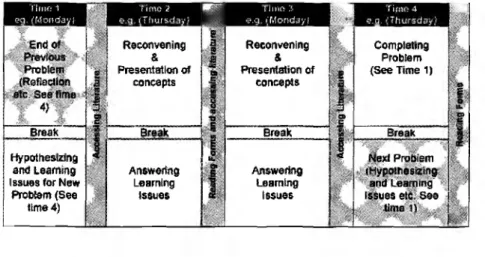
More specifically, P B L is a methodology for teaching and learning that involves active, small group learning that focuses on investigating and explaining a meaningful problem (Barrows, 2000). Learners meet in small groups of seven to nine individuals and are facilitated by a P B L facilitator. Essentially, a problem is a narrative or artefact that triggers enquiry and the growth of knowledge. On analyzing the problem, learners identify the relevant information provided in the problem; and this allows the learners to meaningfully represent the problem, so that a process o f hypothesizing can ensue (Hmelo-Silver, 2004). This means that learners try to predict what the issues and consequences of the problem might be, prior to formal study. This process of hypothesizing leads naturally to defining knowledge deficiencies which
78 | DIE SUID-AFRIKAANSETYDSKRIF VIR KOMMUNIKASIE-AFWYKINGS, V O L 55, 2008
ep
ro
du
ce
d
by
S
ab
in
et
G
at
ew
ay
u
nd
er
li
ce
nc
e
gr
an
te
d
by
th
e
Pu
bl
is
he
r (
da
te
d
20
12
P R O B LE M B AS E D L E A R N IN G A N D T H E C O N S T R U C T IO N OF A N SLP C U R R IC U L U M
become the learners’ “learning issues”, and which fuel the process of self-directed learning (Hmelo-Silver,2004). Once learning issues have been set, learners leave the tutorial and access literature over the next few days. This literature may provide solutions to the learning issues and may help the learners confirm or disconfirm their hypotheses (Hmelo- Silver, 2004). On reconvening a few days later in a tutorial, learners are provided with opportunities for in-depth discussions of their findings. These discussions foster the application of their new-found knowledge to the problem trigger, their hypotheses and their learning issues (Barrows, 2000). During this process, notes are taken on a blackboard and learners make attempts to answer their learning issues. Finally, at the completion of a problem, learners hand in academic journals which are essentially short essays that reflect the synthesis of knowledge that occur in tutorials and which demonstrate the learners’ practical application of their learning to the characters and elements in the problem. These partly replace lecture notes on the topic in question. P BL therefore achieves a number o f goals in relation to learning:
0) The development of a professional
knowledge base (ii) Problem solving skills
(iii) Life long self-directed learning (iv) Social collaboration
(v) Motivation to learn (Barrows 8c Kelson, 1995).
In an SLP curriculum,a set o f problems elicits a part, but preferably the entire curriculum. This means that the faculty involved in the delivery of such a curriculum, need to decide in consultation with statutory professional bodies and other departments, how widely the P B L curriculum can be incorporated into the overall SLP curriculum. Ideally, all aspects of an SLP curriculum could be delivered using an integrated PBLj approach. This means that psychology, linguistics, communication disorders, audiology, education, neurology and physiology might all be delivered as a series of coherent problem triggers that are integrated to form a complete curriculum. This may not be entirely achievable; but in the author’s 'experience it is sufficient to incorporate some of the disciplinesj -and parts of the essential aspects of others. However, when a discipline other than SLP, such as psychology is involved in such an approach, then its modules should reflect this inclusion within the SLP curriculum; and therefore, an associated reduction in formal psychology lecturing contact. In other words, P B L should not double student workload or contact.
In line with a constructivist epistemology of learning, each problem would incorporate a number o f subject areas simultaneously, rather than simply embodying a different subject area in each problem. According to Barrows (1998), P BL should aim to facilitate the acquisition of knowledge on a deep level thus developing clinical problem solving; and that this could be attained by integrating various disciplines into each problem. Curriculum developers should work collaboratively with other disciplines to incorporate the relevant aspects into the SLP curriculum.
Thus, P B L is essentially an interdisciplinary venture involving the social collaboration of lecturing staff, adjunct lecturers (PBL facilitators), learners and different faculties. Such collaboration can have positive spin offs such as interdisciplinary research and community development.
Research In P B L for SLP curricula
There are only a few studies evaluating the utility of PBL in the field of SLP; but these are mostly related to the student experience. For example, Murphy (2004) studied 1st and 2nd year SLP learners’ experiences of P BL in the context o f a psychology curriculum using a questionnaire. Murphy reported that learners experiencing this curriculum, valued both the team work and involvement in in-depth learning; but perceived the method as increasing their expected workload. This finding by Murphy might be explained by learners being used to passive learning as experienced in other more traditional courses or an unreported addition of P B L to a standard psychology lecturing curriculum. In addition, Murphy’s participants felt that interpersonal communication was somewhat awkward between some learners new to this method (Murphy, 2004). Leahy, Dodd, Walshe 8c Murphy (2006) conducted a similar attitudes study with 2nd, 3rd and 4th year students in addition to M Sc learners in SLP curricula in two centres; one in Ireland and another in the UK. These researchers reported descriptive statistics indicating 71% of their two participant samples believed that P B L was relevant to practice, but only 58% believed that P B L was sufficient for preparation to practice. It is not clear from these studies how various disciplines were integrated into the P BL curriculum; or if this method was incorporated only into a single module. Fourie and Fletcher (2006) conducted a questionnaire study to evaluate learners’ attitudes to P BL following a foundation year in a newly formed SLP curriculum, in which communication disorders, psychology and linguistics were mostly delivered in an integrated PBL format; with a few supplementary workshop-type lectures for practical skills such as phonetic transcription and language analysis. Twenty three respondents completed an anonymous questionnaire indicating agreement or disagreement on visual analogue scales (VAS) eliciting attitudinal constructs in relation to their experience of PBL. Participants in this study generally agreed that they enjoyed group sharing and discussion and agreed that P BL engendered critical and clearer thinking, self-directed learning and the improvement o f communication skills in a group context. However, participants were equivocal with regards to their attitudes to the differential contributions of members in a group, mutual support and resource sharing. In summary, most o f the SLP studies assessing learner experiences, generally seem to agree that learners perceive benefits and some shortcomings o f the P B L method. Furthermore, as Colliver (2002) notes, widely reported student satisfaction and preference for PBL in the field of medicine, does not guarantee practitioner competence.
There are no extant studies in the field of SLP education clearly differentiating the academic and clinical outcomes of traditional learning versus PBL. Relevant research outside o f the discipline, mainly focuses on knowledge competency following exposure to P BL (Koh, Khoo, Wong and Koh,
THE SOUTH AFRICAN JOURNAL OF C OM M UNICATION DISORDERS, VOL. 55 2008 | 79
ep
ro
du
ce
d
by
S
ab
in
et
G
at
ew
ay
u
nd
er
li
ce
nc
e
gr
an
te
d
by
th
e
Pu
bl
is
he
r (
da
te
d
20
12
2008); and there have been controversies in relation to whether PBL results in a weaker knowledge base in medical students (Colliver, 2002; Vernon 8c Blake, 1993). Koh and colleagues (2008), in a recent systematic review assessing 15 controlled studies meeting their inclusion criteria, determined that while learners graduating from PBL curricula perceive themselves as having less knowledge than their non-PBL schooled peers, that there was no evidence to support this. Moreover, their study provided evidence that PBL had positive effects on both the social and cognitive dimensions of physician practice. Readers are referred to Koh and colleagues’ interesting analysis of pre-existing literature on P BL outcomes in the medical education literature (Koh, et al., 2008).
Constructing a P B L curriculum
The following description is based on the author’s experience and understanding of developing a PBL curriculum for a Cork-based SLP programme in Ireland, which was based on an earlier University of Hong Kong curriculum, modified and “Hibernosized” for the Irish context. These ideas for constructing a P BL curriculum are not intended to be prescriptive; but instead to provide suggestions for how PBL might be incorporated, in whole or in part, into an SLP curriculum.
The Curriculum Matrix
A departmental curriculum committee, prior to developing a set of problems for an SLP curriculum, needs to develop a curriculum matrix that will help organize and systematize the curricular content of a course (Barrows, 1994). A curriculum matrix is a set of carefully defined learning areas for each year of the entire SLP curriculum. Learning areas for the entire curriculum need to be decided upon prior to devising problems; and these learning areas need to be associated into similar ‘knowledge groups’. For example, phonology and motor speech disorders in childhood could be grouped into a family o f learning areas relating to expressive problems in the paediatric population. In this way, a taxonomy o f learning areas should be devised by a curriculum committee.
Learning areas in SLP are the major subdivisions of the core topics of SLP. In some SLP curricula, the first year consists of a general introduction to communication disorders, while the second and third years incorporate paediatric and adult areas of an SLP curriculum respectively. Devising a curriculum matrix should be based on the general topics pertinent to SLP that accrediting bodies have determined to be the main areas of learning for the profession. Essentially, a curriculum committee, based on local norms, can decide exactly what areas of knowledge need to be accessed by learners, so that they can become SLPs. Often, such information may already exist in documents pertaining to the curricular goals of an SLP programme; or they can be distilled from lists o f learning outcomes based on Bloom’s (1956) taxonomy, appropriate to a particular programme. The following is a sample of a core topic and its associated learning areas in year one.
1) Phonology (Year 1):
Normal development o f speech during pre-school years
Relationship between speech and social development in early years
Phonological processes
Risk factors for delayed and disordered speech
In addition, a number o f learning outcomes, based on Bloom’s original (1956) taxonomy, can be stipulated for these learning areas. For example, the following learning outcomes are associated with the above topic and learning areas:
Learners should be able to:
Describe the typical development of speech sounds,
Explain, with examples what is a phonological process,
Distinguish between typical and atypical phonological processes,
Appreciate the psychosocial effects o f speech impairment in an affected child.
The above learning areas and learning outcomes are appropriate for an introductory level course. However, at a second year level, further learning areas might be added to a topic in a way that reflects the developmental level of the learner:
Phonology (Year 2): Intelligibility
Analysis of child phonology
Relationships between child and adult phonology
Contribution of vowel errors to intelligibility
Assessment and treatment of consonant and vowel processes
The associated learning outcomes for these learning areas in the second year might include:
I Perform a consonantal relational analysis of a paediatric speech sample.
Interpret phonological analyses for the purpose of
designing intervention. ' |
Calculate Percentage Consonants Correct (PCC) in a speech sample
Calculate Percentage Words Correct (PWC) in a speech sample
Classify vowels into their various phonetic and phonological categories
Calculate Percentage Vowels Correct (PVC) in a speech sample
Compare summary measures to normative data. /
Each program may differ according to the specific emphasis it has. Also, learning areas should not include only communication disorders. Learning areas should incorporate cognate areas pertinent to communication disorders. The following are examples o f such learning areas:
80 | DIE SUID-AFRIKAANSETYDSKRIF VIR KOMMUNIKASIE-AFWYKINGS, V O L 5 5 ,2 0 0 8
ep
ro
du
ce
d
by
S
ab
in
et
G
at
ew
ay
u
nd
er
li
ce
nc
e
gr
an
te
d
by
th
e
Pu
bl
is
he
r (
da
te
d
20
12
P R O B LE M B A S E D L E A R N IN G A N D THE C O N S T R U C T IO N OF A N SLP C U R R IC U L U M
the scientific method
linguistic theories of child language development psycholinguistic models of speech and language processing
developmental theories in psychology phonetics and IPA transcription grammatical analysis
learning, memory and cognition
the neurology of speech, language and hearing
Once a comprehensive set of learning areas and associated learning outcomes have been determined for each year of a curriculum, the learning areas can be distributed throughout a number of problems that will form the focus for learning during the academic semester. The curriculum committee needs to decide what learning areas should be contained in each problem; and these learning areas need to be clustered in plausible ways. However, it is important that there is some unexpected pairing of learning areas in order to create surprise and to reflect the unpredictability o f clinical practice in SLP. So for example, a problem on “Neurogenic voice disorders” may be paired with “the construction and enactment of intervention”. A problem on closed head injury might contain learning issues pertaining to the “social and psychological consequences of closed head injury” together with the learning issue of “evidence based practice”. Thus problems have content which is related in a non-linear and often surprising way, which may reflect the realities of practice. Examples of plausible pairings include
Attention deficit disorders and medical anthropology
Stammering and personality theory
Specific language impairment and measurement of intelligence ,
Personal adjustment counselling & neurogenic
voice
J
Laryngeal cancer and lifespan psychology of late middle-age I .
Cleft palate and the psychology of disfigurement On a more practical level, once learning areas have been outlined, a curriculum committee needs to know how many problems they need for each year of study and how those problems will be divided into the semester structure o f the college. Some SLP programs incorporating PBL, include more learning areas in fewer problems, while other programs have more problems with fewer learning areas in each. I f the curriculum committee decides for example, to have fifteen problems per year, they need to decide what the focus of each year will be. So for example, first year may be a general introduction to paediatric and adult communication and development; with second year focusing on paediatric disorders of communication; and third year focussing on adult disorders of communication. This depends on how the faculty understands the developmental sequence of learning for their learners.
Typically, each, member of a curriculum committee becomes a “case manager” and is assigned a number of problems to devise, manage and regularly update,
according to their general areas of expertise. Part-time staff or independent consultants can also be involved in this process with responsibility for possibly fewer cases in more specialized topics. In addition, case managers can work together to incorporate different aspects of a complex topic into a single problem. It is important however, that case managers have some experience in the areas covered in the problem, so that the problem trigger can be written from experience and therefore have ecological validity; or can be taken from a real case, and made anonymous for the purposes of confidentiality. Also, if the case manager has experience in the learning areas covered in the problem, it is more likely that he or she will have access to data and artefacts relevant to the problems. So for example, a problem containing reference to acquired profound hearing loss in adulthood may need to include audiograms and other electrophysiological data. Once case managers have been assigned, it is their responsibility to construct a problem or problems that relates to the learning areas they have been allocated. However, problems need to be carefully constructed and it is therefore necessary to examine what a problem is in a little closer detail.
What is a Problem?
Before entering into definitions of the problem in the context of PBL, it is relevant to examine the notion of “problem” generically. Essentially, a problem is an anomaly that calls for explanation or response; and is therefore a challenge to responsibility. Accordingly, a problem presents an opportunity to apply old knowledge and in the process, synthesize new knowledge. Thus a problem carries within it the potential for transformation. However, a problem implies an expenditure of energy: effort is required to create a transformation. I f something did not involve effort, or was properly understood then it would not be a problem. Therefore, a problem can also be seen as a kind of gateway to knowledge and personal transformation that involves personal effort.
A significant portion of what is discussed in a PBL tutorial involves conversation around a textual trigger or problem; although videos, live clients and other artefactual objects can also be used. A problem is usually a state or an event, and its structure can be easily reflected within a narrative framework. In the context o f PBL, a problem is for all intents and purposes, an interesting, meaningful and educationally relevant narrative and it consists of events that need to be explained (Norman & Schmidt, 1992). Problems should be “ill-defined”, complex and reflective of the real world. Carder, Willingham and Bibb (2001) explain that “ill- defined” means that a problem does not have a specific single solution; thus reflecting the reality of practice. However, it is a trigger that is amenable to discussion and the making of meaning. Such discussions mostly involve the analysis of text and it is therefore important to understand what makes various aspects of such narrative texts meaningful or salient to learners.
In the context of communication disorders, a problem is a plausible and ecologically valid story about either a client with a communication or swallowing disorder; and/or about an SLP, with the purpose of bringing to the learner’s attention, experiences that might be salient to the practice
THE SOUTH AFRICAN JOURNAL OF COMM UNICATION DISORDERS, V O L 55 2008 81
ep
ro
du
ce
d
by
S
ab
in
et
G
at
ew
ay
u
nd
er
li
ce
nc
e
gr
an
te
d
by
th
e
Pu
bl
is
he
r (
da
te
d
20
12
of SLP. Therefore, a problem has an explicit purpose: It enables learners to construct the various facets of what it means to be an SLP, in a particular context. It is therefore designed to evoke the meanings, professional values and knowledge that SLPs need to set in motion to perform their profession. The problem is therefore an exemplar of an SLP issue relevant to becoming an SLP, told as a story or part of a story. In PBL, such contexts for learning are stories that are constructed as a “problem”.
The Problem As Narrative
The work of the SLP is transformative and therefore involves stories o f change. Thus, the problem trigger may be identified as a meaning-generating narrative - and as a narrative, it will follow the laws of narrative discourse. Thus, every problem is framed as a story and is constructed according to a story grammar: It has a beginning, a middle and an end, like any good story does.
It is necessary to understand what makes these stories meaningful to learners. Stories are complex and non-linear, reflecting the complex nature of society. It is this complexity that makes humans love stories. This is evidenced by the value we place on television, cinema, radio, the reading of novels. Thus it makes sense to present information and a context for learning in the framework of a story. Symbolic Interactionism (Blumer, 1969) predicts that we are relational beings, looking for patterns of information in order to construct our own stories and to make meanings of the things we experience.
Story Grammars for Problem Construction
The construction of a story is not that straightforward, particularly when that story is textual. Thorndyke (1977) argued for a propositional-structural model o f stories: that stories have their own grammar and consistent internal structures. Thorndyke outlined the structure o f a story as consisting of a setting, which is the character list located in time and space; a theme, which is an event with a goal; a plot, which is a problem or a series of problems containing attempts to solve problems; and finally a resolution which is a specific event/state. These components were stated as rules in the format:
Story => Setting + Theme + Plot + Resolution
Thorndyke described his narrative schema as a “frame” with its abstract components instantiated by specific details. Stein and Glenn (1979) has a slightly different way of formalizing the story grammar. Their story was structured according to the following format:
Story=>Setting + Initiating Event + Internal Response + A ttem pt + Consequence
In this grammar, which is framed slightly differently to Thorndyke’s frame, the plot is subsumed by greater specification from the perspective of the actors in the story and the theme o f the story is absorbed into the setting. There are a number of other story grammars, but these two represent the most commonly referenced story grammars and would be familiar to SLPs working on discourse in language therapy.
It is not sufficient to specify the abstract components of a story. It is also important that these components are held together in a coherent manner (Carroll, 1994). Therefore, sentences need to “tie” together sufficiently and make appropriate anaphoric reference to indexed members of the narrative. Indeed, the degree to which the reader will appropriately assimilate information in a text, will depend in part on how the reader processes that informational content (Chambliss, 1995). The adequate processing of information will depend on a number of factors, some of which are intrinsic to the learner and others o f which will be dependent on the text presented to the learner.
Textual Narrative Considerations
Before engaging with text, there are a number of attributes of learners that will determine how they interact with textual problems. Firstly, it is necessary that learners have a need for cognition which can be defined as a “tendency to engage in and enjoy thinking” (Cacioppo 8c Petty, 1982, p. 116). Secondly, topic interest refers to how likely a learner will have positive affect in relation to particular content (Renninger, 2000); and thus the significance of such material is probably mediated by the learner’s value system and affective experience (Hidi 8c Baird, 1988). Moreover, learners who have personal interest in the topic, are more likely to process information in text (Hidi, 1990). These intrinsic factors intervene in the likelihood of learners to engage with text. On the other hand, factors extrinsic to the learner and located within the structure of text also have a mediating role in how textual problems are processed.
“Interestingness” refers to how well learners will respond to a text (Hidi 8c Baird, 1988). For example, textual information which is highly interesting is more easily recalled than text o f less interest (Shirey 8c Reynolds, 1988). Schank (1979) was one of the first researchers to discuss interestingness in the context of discourse processing. According to Schank, material is more interesting when it is non-normative, such as when things don’t go according to expectation; when there is missing information which causes puzzlement and when the themes elicit “absolute interest”, i.e. they are of an archetypal nature, such as death1, sex and power (Schank, 1979). However, it is important to recognise that while text can be made artificially interesting; this may not necessarily facilitate important generalizations;1 instead it may detract from such important processes, (Garner, Alexander, Gillingham, Kulikowich 8c Brown,, 1991). Therefore, when constructing problems, the author needs to make problems interesting; but not in a manner that may detract from their meaningfulness, in relation to communication disorders.
Dole and Sinatra (1998) state that motivation in learners to engage with text is determined by their dissatisfaction with their current state o f knowledge, the personal relevance the information has for them, its social context and their own need for cognition. These researchers hypothesize that there is an interaction between learner characteristics and with characteristics of the text that result in meaningful engagement with the text. They suggest that text should be coherent, plausible, interesting and rhetorically compelling.
Dissatisfaction with the current state of knowledge is referred to as cognitive dissonance (Festinger, 1957;
82 | DIE SUID-AFRIKAANSETYDSKRIFVIR KOMMUNIKASIE-AFWYKINGS, VOL. 5 5 ,2 0 0 8
ep
ro
du
ce
d
by
S
ab
in
et
G
at
ew
ay
u
nd
er
li
ce
nc
e
gr
an
te
d
by
th
e
Pu
bl
is
he
r (
da
te
d
20
12
P R O B LE M B AS E D L E A R N IN G A N D T H E C O N S T R U C T IO N OF A N SLP C U R R IC U L U M
Neighbour, 1992). In the context of learning, cognitive dissonance is a psychological state in which the learner feels dissatisfaction at not knowing. Savery and Duffy (2001) call this cognitive “conflict”and state that this conflict determines what the learner will focus on and what prior knowledge the learner will invoke as relevant to constructing new knowledge. The problem should therefore induce in learners a need to want to find out. An individual experiencing cognitive dissonance, feels motivated to reduce it and to engage in behaviours reducing this dissonance. Therefore, an incongruity between the learner’s previous understanding and current experience are what drives learning (Palincsar, 1998). Therefore, cognitive dissonance prompts the learner to find out; and it is essential for the accommodation o f new ideas and information. Cognitive dissonance is similar to a need for cognition, in that it motivates behaviour, but is more goal-directed. While a need for cognition is an intrinsic individual trait that probably cannot be modified externally, cognitive dissonance is a state which can be induced in the learner by providing the learner with information that challenges understanding or creates a sense of puzzlement or questioning. According to Perret-Clermont, (1980) it is this “cognitive conflict created by social interaction” (p. 12) where intellectual strides are made. This cognitive dissonance results in pertinent questions; and it is this questioning that is made explicit in the inventory o f learning issues which learners formulate prior to accessing literature and making enquiry. Without this invoked sense of needing to know, the self-directed learning process is rudderless.
Relevance and Ecological Validity
The case manager should devise a problem that is ecologically valid. This refers to whether a problem is plausible, structured and coherent (Gonzalez 8c Salmoni, 2008). This means that the problem should be interesting, but not full o f distracting facts; it should be relevant to the curriculum; and it should contain supporting data and artefacts to corroborate and accentuate the ideas it aims to draw out in the learner. The problem is written in such a way that it will create a series of cognitive dissonances in learners that will inevitably lead them to ask relevant questions to answer their uncertainties. In order to write a plausible problem, the case manager needs not only to have some experience in that particular field, but also to be guided by evidence and literature in the fields covered by the learning areas.
The Professional Socialization o f Learners through Narrative
I f problems are not very carefully constructed to show faithfulness to complex issues in the life of clients and patients, they can inadvertently transmit unwanted assumptions, values and beliefs to learners (Kenny 8cBeagan, 2004), that are neither advantageous to the profession of SLP, nor effective for the multifaceted treatment of clients and patients. While learners need to be exposed to problems that will closely resemble their future occupational situation (Dolmans, 1997), problems and case histories can depersonalize the client, reducing and separating the client into a list of symptoms (Anspach, 1988). Such a list may be useful to the practitioner as the end of a process o f interview and assessment, but is not representative of what learners
will encounter when dealing with clients (Kenny 8c Beagan, 2004).
In fact, narratives presenting clients as a distilled list of symptoms may effectively distort the client’s life by situating them out o f time and context. In addition, the use of certain linguistic features may create further problems. For example, the use of the passive voice, imbues authoritative and factual status to the omitted practitioner (Anspach, 1988); for example: “The client was assessed”, and “the PALPA was administered”. Other linguistic markers might encode scepticism regarding client narratives, for example: “the client claims”, or “the client reports”. Passive sentences used together with such sceptical descriptors transmit an attitude that the practitioner is in control and that the client’s story is not to be trusted. Kenny 8c Beagan illustrate the power of language in a problem statement from a medical curriculum:
For example, in one case, after a patient “was referred to a respirologist”, he “underwent bronchoscopy”. Shortly afterwards a “chest X-ray showed a 50% pneumothorax” so “a chest tube was inserted”. He “was admitted to hospital” where “the chest tube continued to bubble”.
Here no one performed the bronchoscopy (let alone cleaned the bronchoscope, wheeled the patient into the room, or cleaned up afterward); no one took the X-ray, or read it; no one inserted the chest tube; no one admitted the patient, nor did the patient enter the hospital himself. The most active agents here were the X-ray showing, and the chest tube bubbling! (Kenny 8c Beagan, 2004, pp. 1073 - 1074).
Kenny and Beagan (2004) further point out that the presence of the client as an actual real person who experiences impact is often omitted in problems and they further imply that such characterizations may ultimately erode the learners’ ethical sensitivities. They recommend the use of live clients where possible, the use of dense texts (containing richly detailed information about the client), the use o f video, web technologies, photographs, transcripts and diary entries, among other things, to more richly portray the complexities of real live clients.
Professional and Inter-disciplinary Issues
In addition to issues regarding the self-directed learning process of learners and how the problem should be structured, there are other issues to consider in the development of problem triggers for an SLP curriculum. The fact that SLP is practice-oriented and governed by statutory bodies and legal parameters in most countries, means that the set of problems in an entire curriculum should be reflective of the typical principles and practices an SLP would need in the field as outlined by the statutory bodies. However, no curriculum can ever cover every aspect of knowledge pertinent to the field o f SLP. This is because the fields of communication disorders, psychology, linguistics and physiology pertinent to speech disorders is so vast and ever-expanding. This is partly due to the explosion of available information in an information age dominated by the internet. Indeed, the drive to attempt to cover every possible piece of information
THE SOUTH AFRICAN JOURNAL OF COMM UNICATION DISORDERS, VOL. 55 2008 | 83
ep
ro
du
ce
d
by
S
ab
in
et
G
at
ew
ay
u
nd
er
li
ce
nc
e
gr
an
te
d
by
th
e
Pu
bl
is
he
r (
da
te
d
20
12
relevant to a topic is part of a Realist epistemology. But, it is not possible to cover everything. Nevertheless, it is possible to expose learners to core exemplars of essential knowledge pertinent to the practice of SLP that might facilitate an intelligent and critical evaluation of available information. There is therefore, to some extent, a tension between compulsory components of a curriculum and the facilitation of an intelligent and critical attitude to knowledge that is the essence of the SLP; and which facilitates life long learning.
Unfortunately, a curriculum committee can become divided along Realist/Constructivist epistemologies and it is therefore important that PBL does not become divisive in the delivery of SLP curricula. To this end, it is important to find a middle ground between process and content. The role of the P BL curriculum designers is therefore to devise problems that will simultaneously serve as core exemplars of factual knowledge, while evoking the principled attitudes, cognitions and activities of the SLP working in a field which is not always typical or linear; and indeed changing rapidly.
Evaluating Current Suitable Literature
In a pure P B L approach, learners are left to find appropriate literature pertinent to their learning issues, themselves. While this is basic to the spirit of enquiry based learning, it may not always be appropriate for professional courses, particularly if there is not excellent library support. Although P B L is loosely based on principles of adult learning, many professional undergraduate programs deliver curricula to 17 and 18 year old learners. Such individuals may have achieved legal adulthood in most countries, but most individuals at this age are still teenagers. Although they may be cognitively mature, they may not have the adult experience or affective maturity to properly evaluate the level of reading that would be expected of them. In addition, learners from certain secondary schools may have been over-coached into graduation; resulting in learners who despite high achievement on final leaving certificate examinations, find it difficult to responsibly source, evaluate and apply academic information. For this reason, the current author recommends that first and second year learners be recommended prescribed texts to evaluate and read, while simultaneously be encouraged to bring their own researched material to tutorials. Later in third or fourth year, learners should know the level of reading required, and will also have matured into adulthood proper. They can then be at least partly expected to find the appropriate literature for achieving their academic goals.
Therefore, each case manager needs to prescribe appropriate texts, and this involves evaluating current literature relevant to the learning areas. Case mangers can recommend academic papers and expository texts that either cover the individual learning areas or the specific combination of learning areas, or both. This entails a robust attempt to assess the current available literature and to make decisions on what literature would be suitable to the learners’ developmental level. To this end, the case manager has to find relevant scientific literature that illuminates the learning areas contained in the problem. This can be time-consuming, but is absolutely essential to not only present a plausible problem for learners, but one that will highlight current issues in the field pertaining to
the problem. The implication of this is that problems can become stale or dated, as new evidence is produced in the scientific literature. Accordingly, one of the duties of the case manager is to continually evaluate the relevance and up-to-datedness of the problems he or she manages and this can be achieved by annual intra-faculty curricular committee meetings. Such meetings, while labour intensive also serve to enable departments to continually revise and improve their curriculum annually. In this way, problems remain fresh and will elicit issues that are current and relevant to the learner.
Introductory text-book chapters and secondary sources are often more digestible to first year learners who may need simpler and easier expository texts. Similarly, case managers need to consider that learners may be second language users of English, in which most SLP texts are published. The issue of cognitive academic language proficiency (CALP) is particularly important in this regard (Cummins, 1984, 1986); and case managers need to carefully select texts that are not too difficult for second language users; as this may be disempowering within any learning process. However, the P BL process allows students to express their difficulties with texts and allows those within the group, with a better grasp of a particular text, to share their insights and understanding with other members of the P BL group. As learners progress, texts which are a little more advanced can be prescribed.
Also, there is no harm in presenting learners with texts which are a little beyond their current developmental level. Vygotsy (1978) discusses the principle of working within the learner’s zone of proximal development (ZPD). ZPD is a level of difficulty just a litde advanced from the learner’s current state of understanding. I f material is presented that is too easy, learners will lose interest (particularly if they have a strong need for cognition) and conversely, if the material is too advanced for the learner, they will not feel capable o f understanding and will give up on the text. It is therefore important that the case manager carefully select texts which will challenge learners but neither bore them nor over-challenge them.
A list of recommended (or compulsory) readings for each problem can then be provided to learners for evaluating and informing the learning issues raised in P BL tutorials. The devising of a coherent set of problems is the first step in
devising a P BL curriculum. j
Problem Sample
The following is an example of a problem written by the current author, according to this schema. It is situated in a third year curriculum focussing on adult communication disorders and has been “South Africanised” to suit local contexts:
Voice Spasms, or “After ukufa komyeni warni.”
Case Manager: Dr. R. Fourie ^
lhandi was a 2 7 -year-old postal clerk who worked in Randburg. Thandi had a personal tragedy in which her beloved husband had been killed in an MVA; and which some professionals believed had resulted in a voice problem. An E N T referred Thandi to an SLP.
84 | DIE SUID-AFRIKAANSETYDSKRIF VIR KOMMUNIKASIE-AFWYKINGS, VOL. 5 5 ,2 0 0 8
ep
ro
du
ce
d
by
S
ab
in
et
G
at
ew
ay
u
nd
er
li
ce
nc
e
gr
an
te
d
by
th
e
Pu
bl
is
he
r (
da
te
d
20
12
P R O B LE M B AS E D L E A R N IN G A N D T H E C O N S T R U C T IO N OF A N SLP C U R R IC U L U M
It also had become obvious to Ihandi and her family that her voice had deteriorated quite severely after her loss because they kept having to ask her to repeat herself due to her weak and strained voice. A psychologist's report stated that besides the death of her husband\ there were no other obvious psychopathological factors at play in Ihandis case. Since there were no obvious causal factors besides Ihandi's husband's death, and the report from the E N T stating that there was no evidence o f any kind of physiological pathology, Dr. Mary Nthebe, an SLP practicing near Ihandi in Randburg, diagnosed afunctional voice disorder. Ihandi then commencedfor voice therapy with D r Nthebe, four months after her husband’s death. But Dr. Nthebe realized after three sessions that Ihandi’s voice problem seemed intractable.
A t first the voice was weak and intermittent, and Ihandi complained that she felt there was "something stuck in her throat like a “small ifishbone kanje. After ukufa komyeni wami”. Throat clearing did not release her voice and gradually the voice became more strained and started showing an intermittent strangled harsh quality. D r Nthebe referred back to the E N T who again, couldfind no obvious organic causes. It was at this time that the E N T diagnosed, with the assistance of a specialist SLP trained in electroglottography (EGG), the presence of Adductor Spasmodic Dysphonia (see
data).
Ihandi went back to Dr. Nthebe, feeling very demoralised after the new diagnosis because firstly, she believed her family “thought it was all in her head” and this was upsetting fo r her: “Do they think l a m a hypochondriac? Awu ngiphe amandla, Nkosi yami”. She felt nobody understood what it was like fo r her. Secondly, she wanted to know why the doctors wanted her to try Botulism as a medicine. "Surely that will kill me”, said Ihandi, “but maybe that will be good. I can join my beloved husband ezulwini. Akekho onjengaye”. D r Nthebe understood that Ihandi meant Botulinum toxin (BOTOX) treatment fo r spasmodic dysphonia, and felt worried aboutlhandi’s mental health. Dr. Nthebe looked down at her report from the specialist SLP and wondered how his report could possibly have any real meaning in relation to Ihandi’s suffering. This is what she looked at:
E G G Dear Dr. Nthebe
The peaks o f the waves in this E G G represent the closure part o f the vibratory cycle o f the vocal folds;
while the "valleys” represent the open part of the vibratory cycle. By using standard measurements of the E G G graph above, and using the formula CQ = t C / ( t C + tO) I have determined that Ihandi’s vocal folds have a 0.7 closed quotient, indicating possible
adductor spasmodic dysphonia. Kind regards
fannie Vermeulen, SLP
Dr. Nthebe decided to make some Rooibos tea to share with her client, to help calm Ihandi’s mind, before explaining the issues to her distressed client.
Product: Role play Dr. Nthebe’s
conversation with Thandi. Learning Issues
In the above problem, the following may represent questions or learning issues learners might come up with as pertinent to the problem:
W hat is spasmodic dysphonia? W hat is a functional voice disorder?
Why did the SLP first think the problem was functional?
How can an SLP differentiate between two types of voice disorder?
How does a functional voice disorder differ from spasmodic dysphonia?
W hat is electroglottography and how does it work? W hat is the significance of the closed quotient and the E G G graph?
W hat is the role of the E N T in the diagnosis of voice disorders and how do these two professions work together?
What, if any, are the neurological bases of spasmodic dysphonia?
Why is B O T O X used with Spasmodic Dysphonia? How can the SLP answer the client’s concerns about the problem being “all in her head”?
W hat is the role of the psychologist in voice disorders? W hat is the role of the SLP in relation to counselling the client?
Once hypotheses have been made about the problem and learning areas have been formulated, learners can access the literature in a meaningful way. Reading alleviates the cognitive dissonances learners experience as they resolve the questions raised in the learning issues. Once learners have accessed online resources and relevant expository texts available in the campus libraries (or provided by the department), the learners are ready to discuss what they have learned with each other. Learners evaluate the literature and find resources to be brought to the tutorial for discussion. It is at this point that the P B L facilitator could help the learners evaluate the quality of the information in relation to the requirements o f the profession.
Evaluating the Problem Prior to Learner Exposure Once case managers have completed designing a problem, they might want to ask the following questions of the problem, to determine whether it is suitable for the program:
THE SOUTH AFRICAN JOURNAL OF COM M UNICATION DISORDERS, VOL. 55 2008 | 85