RICHARD M. HALL. Reductions of Hepatis A Virus, Echovirus 1, Poliovirus 1 and MS-2 in Miniature Soil Columns. (Under the Direction of Dr. Mark D. Sobsey)
The removal of viruses from wastewater or groundwater is a public health concern for land disposal of wastes. Hepatitis A virus (HM175), echovirus 1 (V239), poliovirus l
(LSc) and coliphage MS-2 seeded into groundwater or primary
effluent were dosed onto miniature soil columns (1 in.
diameter x 4 in. deep) incubated at 5°C or 25°C 16 times
over 8 weeks (1 in./dose). Few or no viruses were detected
in Cecil clay column effluents for either suspending media
or temperature (>99.98% reduction). Virus removal in Ponzer
organic muck columns was not as efficient (30-98%). Virus
removal was greater at 25°C than at 5°C and water quality
did not influence removal. Hepatitis A virus and MS-2 were
generally reduced less than the other viruses. Substantial
amounts of all viruses were recovered from the soil columns
after dosing ceased. Virus penetration into columns was
greater in Ponzer than in Cecil soil. The substantial
breakthrough of viruses in Ponzer column effluents indicates
that soils rich in organic material may not be suitable for
ACKNOWLEDGEMENTS
I would like to thank Dr. Mark D. Sobsey for the
contribution of his support and expertise to this research.
I also owe thanks the staff and students of the
Environmental Virology Laboratory for their assistance, ideas and support. Dr. Michael J. Symons' assistance with the statistical analysis is greatly appreciated.
Most of all, I thank my wife, Susan, for her patience
and encouragement.
This investigation was conducted as part of a research program supported by co-operative agreement No. CR810509
Chapter
I. Introduction ... 1
II. Literature Review ... 3
III. Materials and Methods... 28
IV. Results... 37
V. Discussion... 53
VI. Conclusions... 63
APPENDIX A... 65
APPENDIX B... 67
The role of enteric viruses in waterborne disease
outbreaks is well documented (Craun, 1985; 1980; 1979; Craun; and McCabe, 1973; Taylor et al., 1974).
Contaminated, insufficiently treated groundwater is
responsible for over half of such reported outbreaks (Craun, 1985; Craun and McCabe, 1973). Viral pathogens have been identified in about 9% of these instances, but the actual
proportion may be much higher because the etiological agent
is often undetected (Craun, 1985). Of all viruses
identified in waterborne outbreaks. Hepatitis A virus (HAV)
is most often diagnosed in patients, but only recently has HAV actually been recovered from the groundwater supply
during an HAV outbreak (Sobsey et al., 1985). Other studies
in which enteric viruses have been isolated from soils and
groundwater down-gradient from septic tank leachfields (Vaughn et al., 1983), and beneath slow rate sewage irrigation sites (Goyal et al., 1984) show that viral
contamination of groundwater supplies is a genuine public health concern. Gerba (1987) reviewed many cases of the isolation of enteric viruses from groundwater or wells
groundwater on a barrier island in North Carolina, where the required vertical separation between discharge and the water
table is only 3 0 cm.
Concern for the public health arises from the fact that half of the US populace depends on groundwater for its
drinking water. In rural areas this figure rises to 95%
(Bitton and Gerba, 1987). The potential for microbial pollution of groundwater is not soley a rural problem. As of 1978, there were 27 US counties containing at least
50,000 domestic septic systems (Geraghty and Miller, 1978).
Factors which influence viral contamination of
groundwater have been studied in model and field systems, and there are several recent reviews of the subject (Bitton, 1975; Gerba, 1984; Sobsey and Shields, 1988; and others). However, much of the work has been done using model viruses, and relatively little with HAV. This is important because HAV survives much longer in the environment than other
enteric viruses (Sobsey et al., 1986). This study of model soil-water systems compares retention and survival of
hepatitis A virus, strain HM175 to other human viruses,
specifically poliovirus 1, strain LSc 2ab, and echovirus 1,
strain V239, and to bacteriophage MS-2, while varying soilBecause many components of soil-water systems
influence virus adsorption, transport, and survival, much research has been devoted to evaluating their relative importance. Investigators have found that virus
aggregation, the amount of dissolved and particulate organic matter, physical and chemical soil properties, hydraulic conditions, microbial activity, water quality, virus type and strain, and temperature strongly influence the fate of
viruses.
Aggregation and association of particulates. Enteric
viruses are colloidal particles and as such are subject to three mechanisms of removal from fluid passing through
granular media: straining at particle surfaces or contacts
between adjacent particles; sedimentation due to velocity decreases as water percolates through soil; and adsorption
due to virion-soil physico-chemical interactions (McGauhy
1968; Montgomery, 1985). Single, unassociated virions are
too small for the first two mechanisms to significantly remove them from water. Adsorption is probably the most
important mechanism of virus removal. Virus adsorption to
the degree of colloid aggregation is governed by the balance
between attractive Van der Waals' forces and either
attractive or repulsive electrostatic forces of the particles and their attendant surrounding ionic double layers. For large viral aggregates and solids-associated viruses ( e.g., viruses in wastewater (Bitton, 1975)), the
first two mechanisms are probably more important (McGauhy, 1968). Hurst et al. (1980b) found that the sludge layer which accumulated above the soil of a rapid infiltration basin for sewage disposal and the top 2.5 cm. of soil
contained most of the recovered virsues, probably because
most of the viruses were initially solids-associated or were adsorbed to the sludge layer as the wastewater percolated
into the basin.
The surfaces of virions are heterogeneous, containing carboxyl and amino groups which will exhibit positive,
negative or no net charge depending on the surrounding fluid. Adjacent to the colloidal surface are ions in solution that bear opposite charge to that of the surface
and partially neutralize it. These counterions occur in two layers, the dense Stern layer approximately 5 nm. thick
(Stern, 1924) and a more diffuse Gouy layer which may extend
300nm. into the solution (Gouy, 1910; 1917; Chapman, 1913;(Montgomery, 1985). Weak attractive forces between neutral, nonpolar molecules or the London-van der Waal forces are generated by instantaneous dipole moments within the molecules and vary inversely with the sixth power of distance between the particles (London, 1930). The
reconciliation of the repulsive and attractive interactions among particles is explained by the DVLO theory of colloid
stability formulated by Verwey and Overbeek (1918).
Increasing the concentration of counterions by
changing pH or increasing ionic strength decreases the
distance at which the apparent surface charge of a particle is zero, allowing particles to approach each other more
closely. As the distance between particles shrinks, van der Waal forces dominate and the particles sorb.
Although other electrical forces could conceivably influence adsorption, an analysis by Murray (1978) found that the only significant contribution to thermodynamic
equilibrium free energy of adsorption in a poliovirus-metal
oxide system were repulsive double layer and attractive van
der Waal's forces. This has been illustrated by other adsorption studies. At low solution pH, below the isoelectric points of most viruses, capsid amino and carboxyl moieties are positively charged. Most membrane
tend to adsorb to the solids (Gerba, 1984; Bitton, 1975,
Keswick and Wagner, 1978; Wallis et al., 1979; Gerba et al, 1975; Bitton, 1975). Conversely, desorption of viruses
(elution) tends to be favored at high pH where both virus and solids are negatively charged (Wallace et al., 1979; Gerba, 1979; Gerba et al., 1975; Mandel, 1971; Keswick and
Wagner, 1978).
It has been observed that some high pH eluents are not very efficient (Farrah and Bitton, 1978; 1979; Wait and
Sobsey, 1983; Farrah et al., 1981; Shields and Farrah, 1983). This phenomenon was attributed this to hydrophobic interactions. An analysis of the protein coat of MS-2 showed that it consists of long hydrophobic sequences
interspersed with 4 or 5 hydrophylic sections (Zerda, 1981). Even though a protein will arrange itself with hydrophobic lengths interior to the hydrophylic sequences, some of the hydrophobic side-chains will still be exposed (Tanford,
1979). Thus, the virion surface will contain both hydrophobic and hydrophylic moieties. Hydrophobic
interactions occur because more energy is required to
solubilize a lipid in water than in another lipid. This
energy expense is related to the entropy decrease required
in water for dissolution of apolar compounds (Kauzmann,
filter/MS-was eluted from the membrane filters.
Certain ions, termed chaotropes, when hydrated, have
been shown to be associated with large entropy increases
(Hatefi and Hanstein, 1969; Kauzmann, 1959; Frank and Evans, 1945). Frank and Evans (1945) hypothesized that all alkali
and halide ions, except Li"^ and F~ appear to "depolymerize"
water in the region surrounding the ion. In essence, ions and their immediately adjacent water molecules act as
impenetrable "microscopic icebergs" whose molecules are aligned differently than the surrounding water. Larger cations with lower charge density influence correspondingly larger volumes of water around the ion. The effect is also seen for other large, monovalent anions (N03~, C104~, SCN~). These anions form bonds with water that are less polar than the hydrogen bonds of water itself, making the water more lipophylic (Hatefi and Hanstein, 1969; Greyson, 1967) and promoting virus solvibility. Cations are smaller and less polarizable, presumably because of electron deficiency
(Greyson, 1967), and form bonds with water that are about equal in strength to water-water hydrogen bonds (Greyson, 1967; Walrafen, 1966; 1962). Antichaotropic agents, large,
multivalent ions (Ca"*""*", Mg"*"*", citrate) or small monovalent
hydrophobic moieties (Hatefi and Hanstein, 1969; Greyson,
1967) which are on the surface of viruses.
Soil and Water pH. Because the pH of water will strongly affect the surface of the virus particles, we may expect
that adsorption of viruses to soils will be at least
partially pH dependent. As pH of solutions drop, ionizable groups on capsid surfaces become increasingly protonated. Minerals present in soils, chiefly silicates or
aluminosilicates whose surfaces are dominated by negative oxygen atoms, will remain negatively charged as indicated by their generally low isoelectric potentials. Adsorption will be enhanced. As pH rises, the minerals will remain
negatively charged, but viral surfaces will deprotonate to the point of a net negative charge, just above the
isoelectric point of the virus. Then, adsorption will no
longer be favored.
These effects have been observed many times in the laboratory. Drewry and Eliason (1968) found that
bacteriophages Tl, T2, and ±2 adsorbed to soils better at lower pH. Soil pH significantly correlated with the rate of
phage 0X174 adsorption to five soils in experiments reported
by Burge and Enkiri (1978), Goyal and Gerba (1979) reported soils possessing a saturated pH less than 5 were the best
adsorbers in a study of 9 soils and 14 types and strains of
viruses and that pH was the most important soil property
adsorbed better at lower pH to 8 soil or soil components suspended in settled sewage. Soil cores dosed with seeded sewage effluent at several pH values best retained
poliovirus at pH 5.5, the lowest value studied (Duboise et al., 1979). Subsequent elution and migration of the
retained viruses was least at low pH. Adsorption studies (Taylor et al., 1980) of poliovirus 2 to 5 soils or soil components was greater below the isoelectric point of the
virus than above. The authors also noted that each material
had a narrow range of pH in which a transition from high to low adsorption occured. Adsorption was poor above pH 9.
Ions and Ionic Strength. When the electrochemical double
layers (ECDL) of colloids are compressed the particles can approach one another more closely, increasing the likelihood of adsorption. This compression can be accomplished by both increasing the ionic strength of the suspending fluid
and by substituting multivalent ions for monovalent ions at the same ionic strength. Carlson et al. (1968) found that increasing the concentration of NaCl or CaCl2 promoted adsorption of phage T2 to three clays, and that CaCl2 was ten times more efficient than the sodium salt in promoting
adsorption. Bitton et al. (1976a) showed that Al"*""^ better
coliphage adsorption in soil columns, Lefler and Kott (1978)
found that decreasing Ca"^"*" concentration in the percolating
solution decreased virus retention. In this instance the
presence of the divalent calcium was 50 times as effective
as was Na"*" in promoting retention in the columns.
Schaub et al. (1974) reported that virus adsorption to clay was enhanced by CaCl2. The effects of pH and
electrolytes on virus adsorption to five soil materials was investigated by Taylor et al. (1981). Where pH favored adsorption, increasing electrolyte concentration also
increased adsorption. Both cation valence and concentration increases enhanced poliovirus adsorption to a 2.5 meter deep soil column studied by Lance and Gerba (1984). The addition of AICI3 to the virus-sewage suspensions halved the depth to which poliovirus penetrated the soil to 40 cm. Sobsey et
al. (1980) noted that Mg"*""^ augmented virus adsorption to
soil. Other data document similar effects of cationic
valence and ionic strength on virus adsorption.
Just as increasing valence and ionic strength
increases adsorption, the opposite is true. Duboise et al. (1979) suggested that low conductivity desorbed phage T7
from soil columns when the virus was recovered from
deionized water rinses of the columns. Lance and colleagues (Lance and Gerba, 1984; 1980; Lance et al., 1976) observed that poliovirus penetrated deeper into soil columns when
deionized water applications mobilized the virus. Further application of secondary effluent caused resorption of the
virus to the soil.
Hurst et al. (1980b) also found that most viruses were
retained in the top few centimeters of soil. Whether virus
seeded cores were rinsed with either sewage or rainwater made little difference on the overall distribution of
viruses within the cores. However, they noted that small
bands of virus migrated into the columns following rinses
and that the migration was deeper in rainwater rinsed
columns than in sewage rinsed columns.
In the field viruses have been recovered from
groundwater beneath sites of land application of sewage
following a heavy rainfall (Wellings et al., 1974; 1975).
The authors suggested that the large volume of low
conductivity rain (71 cm.) caused desorption and migration
of the viruses and that this might be occurring in other
instances of groundwater contamination.
Duboise et al. (1976) correlated high poliovirus 1 titers in effluents of sandy forest soil cores with low
conductivity of effluent waters. Ionic gradients generated by sequentially flooding the cores with dechlorinated
(1979; 1980) showed virus migration through sandy soil columns was facilitated by artificial rainwater rinses.
These results were confirmed on a larger scale by Funderberg et al. (1979; 1981). Recovery of poliovirus 1,
reovirus 3 and 0X174 from the column effluents of 8 soils
corresponded with low effluent conductivity induced by alternate distilled water and secondary effluent flooding cycles. They also noted a redistribution of viruses at
different levels within the columns after a simulated
rainfall.
Consistent with the above results Sobsey et al. (1986)
found that hepatitis A virus, echovirus 1, and poliovirus 1
were all eluted from miniature soil columns by simulated
rainfall.
Organic Material. Studies show that waterborne organic substances tend to inhibit virus adsorption to soils by
competing for adsorption sites (Gerba, 1984). Proteinaceous organic matter and fetal calf serum interfered with
adsorption of phage T2 and encephalomyocarditis virus, respectively, in two early studies (Carlson et al., 1968; Schaub and Sagik, 1975). Bitton and coworkers (1976a;b) showed that organic substances present in "cypress dome water", secondary effluent highly colored by naturally
occurring organic acids, compromised adsorption of coliphage
the same sandy soil taken from the cypress dome. Dome water
eluted virus from the soil columns.
Scheuerman et al (1979) reported enhanced adsorption by a soil core leached with 10 pore volumes of water. The
colored leachate from these columns inhibited the adsorbtive
ability of another soil column. The color was due to materials in the size range of humic and fulvic acids. Additional evidence that organic materials inhibit virus adsorption to soils was compiled others (Lo, 1970; Bixby and O'Brien, 1979; Lo and Sproul, 1977). Bixby and O'Brien
(1979) found that phage MS-2 complexed with fulvic acid, possibly by a viral amino acid-fulvic carboxyl link. Dizer et al. (1984) reported better enterovirus adsorption by sand columns when the viruses were suspended in tertiary sewage
effluent than in secondary effluent.
Wastewater or soil organics reduced reovirus
adsorption to soils or soil materials (Moore et al., 1982).
Adsorption of 0X174 to 5 soils was least in the soil with
the greatest organic carbon content.
More recently Sobsey et al. (1986) reported that hepatitis A virus and echovirus 1 adsorbed to kaolinite better from secondary effluent than from primary effluent, although poliovirus 1 showed no such difference. Also, none of the three viruses exhibited adsorption differences
Gerba (1979) noted that of 14 viruses studied only echovirus 1, strain V239 adsorption was significantly negatively
correlated with soil organic content. Lance and colleagues (Lance et al., 1980; Gerba and Lance, 1978) reported no difference in poliovirus adsorption by sandy loam from
primary or secondary effluents.
Soil type. Many studies show the importance of soil type in adsorbing and retaining viruses from waters passing through their pore spaces. An early study by Laak and McLean (1967) found that poliovirus 3 was best removed from oxidation pond effluents by columns of sandy loam (7% clay), followed by
"garden soil" (3.3% organics) and least removed by sand. These findings were generally upheld by later workers.
Drewry and Eliason (1967) recognized the importance of clay in adsorption of viruses. Burge and Enkiri (1978) found that 0X174 adsorption to 4 of 5 soils was positively correlated with organic content, cation exchange capacity, and specific surface area. The latter two characters are
related to overall clay content (Vaughn and Landry, 1983).
The fifth soil had a much higher organic carbon content and the authors concluded that the organics blocked adsorption
sites.
unsaturated soil columns, reported that Norfolk sandy clay loam removed poliovirus 1 much more efficiently than
Lakeland sand, Fripp sand or Ponzer organic muck.
Scheuerman et al. (1979b) reported that humic materials in a muck soil interfered with poliovirus adsorption to muck
columns and that the leachate also interfered with
poliovirus adsorption in sandy soil columns.
A later report by Sobsey et al. (1986) demonstrated
greater retention of HAV, poliovirus 1, and echovirus 1 by
columns of FM sandy loam than by Corolla sand. The same study found that, in general, kaolinite and
kaolinite-containing Cecil clay loam better adsorbed the three viruses
than Corolla sand, FM sandy loam, and Ponzer organic muck.
Soil pH has also been found to be an important factor in adsorption and retention studies. Burge and Enkiri
(1978) reported that adsorption of 0X174 was negatively
correlated with pH in five soils. Goyal and Gerba (1979)
also found that soils with a pH less than 5 were better adsorbers of enteroviruses. But Moore and colleagues (1981) found that substrate pH, surface area, and composition did not influence poliovirus 2 adsorption.
always, enhanced HAV, poliovirus 1 and echovirus 1 survival over soil free conditions. Generally, the clay soils
conferred more protection than sand or organic muck. That study also showed greater retention of HAV and poliovirus 1 by FM sandy loam than by Corolla sand, although echovirus 1 did not show this behavior. An earlier study in the same laboratory (Sobsey et al., 1980) showed that 8 different soils or soil materials variably affected poliovirus 1 and reovirus 3 survival. There was generally better survival in finer textured and kaolinitic materials.
Reovirus was also studied by Moore et al. (1981).
They found that adsorption to various soil materials ranging from sand to organic muck to montmorillonite was followed by significant and rapid inactivation. Silica and iron oxide was not found to inactivate poliovirus 1 upon adsorption,
but oxides of aluminum, manganese, and copper did in a study
reported by Murray and Laband (1979).
Temperature. There are many reports on the affects of
temperature on virus survival, adsorption and transport in soil-water systems. Bagdasaryan (1964) found that five
different types and strains of enteroviruses survived longer
at 3-10°C than at 18-23°C in both sterile and non-sterile
soils. An early study by Dimmock (1967) on poliovirus
proposed a bipartite model of inactivation of picornaviruses
based on temperature. At low temperatures (less than 44°C)
viral RNA, while at high temperatures the inactivation rate is greater and associated with capsid structural changes. It is likely that virus inactivation occurs by the low temperature mechanism or by other means because most soils rarely get warmer than 44°C.
Yeager and O'Brien (1979) found that coxsackievirus Bl and poliovirus 1 inactivation strongly corresponded to a higher temperature regardless of the suspending medium. In natural soil systems temperature increases are accompanied by microbial activity increases, but in sterile systems virus survival is inversely proportional to temperature for many different virus types (Sobsey et al., 1986; Lefler and Kott, 1974; and Hurst et al., 1980). In nonsterile systems inactivation increases with temperature, but increased soil aerobic microbial activity may play an important role (Hurst et al., 1980). In two studies Sobsey et al. (1986; 1980)
noted that in nonsterile conditions virus survival decreased
for poliovirus 1, HAV, echovirus 1, and reovirus 3.
Bagdasaryan (1964) reported that two strains of poliovirus 1, echovirus 7 and 9 and coxsackievirus B3 showed shorter survival times at 18-23°C than at 3-10° in sterile and
nonsterile soil samples.
Field studies confirm these laboratory data. Tierney et al. (1977) and Larkin et al. (1976) reported that 99% poliovirus inactivation in soil that had been flooded with
than in summer (2-3 days). Hurst et al. (1980b) concluded
that the rate of indigenous virus inactivation in rapid
infiltration basins was less in winter than in the fall due
primarily to temperature.
Soil moisture and hydraulic loading. The amount of soil moisture and its rate of movement through soil affect virus
survival and transport through a soil horizon. Bagdasaryan
(1964) found that five different enteroviruses survived at least 3 times longer in soils with 10% water than in dry
soil. Lefler and Kott (1978) reported little difference in
poliovirus inactivation rates between saturated and "dry"
soil samples. Kott (1988) recently reported that phage f2
and poliovirus survived 217 and 77 days, respectively in dry
sand at room temperature.
Sagik et al. (1978) found that poliovirus 1 survived
better in soils maintained at 15 and 25 per cent water, with
99% inactivation in 7-8 and 10-11 weeks, respectively, than
in drying soil. As moisture levels dropped from 13% to
0.6%, 99% inactivation occurred in 1 week. Yeager and
O'Brien (1979a) saturated sand and sandy loam with river
water, groundwater or septic tank liquor; spiked the samples
with poliovirus 1 or coxsackie Bl; and allowed some of the
samples to dessicate. Neither virus was recovered from dry
samples (>99.999% inactivation) but there were significant levels of virus in the wet samples. In a comparison of
also reported that there was a steep rise in the
inactivation rate as moisture content decreased from 2.9% to 1.2%.
Hurst et al. (1980a) found that virus survival was
least near the soil saturation point betweeen 15 and 25 per cent, and was greater at lower and higher moisture levels.
It should be noted that the lowest moisture level studied
was 5%, so that these results don not necessarily contradict
those reported above.
Another study by Hurst et al. (1980b) found that under field conditions poliovirus 1 and echovirus 1 were
inactivated more rapidly when the soil dried out more
quickly. Similarly, Sadovski et al. (1976) reported that no
viruses were detected in soil irrigated with wastewater 15 days post irrigation as the soil moisture content fell from
16% to 3%.
In studies of sludge applied to soils and left
outdoors Bitton and colleagues (Bitton et al., 1984; 1981)
reported that enteroviruses in seeded sludge were
inactivated more than four times as rapidly in the dry fall
season than in wet winter conditions.
Virus inactivation in wet and dry soils may proceed by
more than one mechanism, according to results of a study by
Yeager and O'Brien (1981). In nonsterile soils, both dry
capsids. Intact RNA was found in dried, sterile soils, but
whole capsids were recovered only from the wet soils.
Just as virus survival is generally higher in wet
versus dry soil conditions, virus transport generally is
greater when larger amounts of fluid penetrate soils. An
explanation for the latter was proposed by Lance and Gerba
(1984) and Ijance et al. (1976), who suggested that when soil
was drained or during unsaturated flow, the film of water
surrounding soil was thinner, forcing closer proximity of
soil and virus, thus enhancing adsorption. The former study
found shallower penetration of virus during unsaturated flow
as opposed to saturated flow.
The same authors (Lance et al., 1976; Lance and Gerba,
1980) found that there was some breakpoint flow rate above
which virus adsorption to soils decreases. This may be due
to water movement mainly through large soil pores,
precluding oppurtunities for adsorption.
Robeck et al. (1962), similarly reported that
hydraulic loading was inversely related to poliovirus
retention in sand columns dosed with seeded tapwater. Also,
using poliovirus Vaughn et al. (1981) reported a field study
in which viral contamination of groundwater was least at
very low infiltration rates (0.5-1.0 cm/hr) during
and 75-100 cm/hr. Green and Cliver (1974) dosed sand
columns with poliovirus-spiked septic tank liquor and found that greater removal of virus occurred under unsaturated
flow than saturated flow.
Microbial and related chemical activity of soil. In
general, aerobic microbial activity at temperatures between
10°C and 37°C impairs virus survival. Bagdasaryan (1964)
found that enterovirus survival on sterile and nonsterile
soils improved with sterility and lower temperatures, but that sterility was probably more important. Sobsey et al.
(1980) studied rates of inactivation in suspensions of
settled sewage and reovirus 3 and poliovirus 1 in 8
different soils at 20°C and found that the time required for
2 logio reductions in virus titer was usually shorter in nonsterile than in sterile preparations. A later study of groundwater, primary effluent and secondary effluent
suspensions of poliovirus 1, echovirus 1 and HAV in 6 soils
or soil materials showed no differences between sterile and
nonsterile samples at 5°C. At 25°C more than one half the
samples showed decreased survival in nonsterile conditions.
Hurst et al. (1980a) found that aerobic microbial
activity at 23°C had the most pronounced deleterious effect
on virus survival. At 37°C, the effect was observed but may
have been partially mitigated by increased thermal
A subsequent study by Hurst (1988) showed that more rapid
inactivation of poliovirus occurred in aerobic nonsterile conditions than in aerobic sterile or anaerobic sterile or nonsterile conditions at the same three temperatures.
Removal of radioactive reovirus 1 in model slow sand filtration beds was studied by McConnell et al. (1984) who
recovered no infectious reovirus in effluents or in the bed
media. They found no difference between clean but not
sterile and ripened beds indicating that virus inactivation
proceeded independently of microbial density or was not dependent upon the presence of microorganisms.
However, there have been differences reported in
poliovirus structural changes after inactivation in sterile
and nonsterile soils (Yeager and O'Brien, 1979). This may
be related to soil moisture content. In both sterile and
nonsterile wet soils, RNA was probably degraded before it was disassociated from the capsids, but capsid components
were recovered. Capsid components were not found in dried soils, and RNA was found intact in sterile, dried soils but not in the nonsterile soils.
There is other evidence that microorganisms play a role in the inactivation of viruses. Poliovirus quickly
adsorbed to activated sludge solids, but loss of infectivity
(1974) found that enterovirus inactivation was faster in
nonsterile rather than sterile-filtered lakewater held under similar conditions. Similarly, laboratory strains of
Pseudomonas aeruginosa and Bacillus subtilis or their
metabolites caused the inactivation of some enteroviruses
(Herrmann and Oliver, 1973; Cliver and Herrmann, 1972). In all three studies viral proteins were degraded and used as substrates by these bacteria. Lipson and Stotsky (1985) reported that Bacillus subtilis exhibited antiviral properties and that it and Serratia marsescans grew when
reovirus 3 was the sole carbon source.
Virus type and strain. Viruses are variously affected by
their physical and chemical environment, and differences observed in virus survival in, adsorption to and transport in soils arise that can be traced to type and strain of
virus.
Bagdasaryan (1964) noted that echovirus 7 and poliovirus 1, strain Lugovskoi survived longer than
poliovirus 1 strain LSc 2ab, echovirus 9 and coxsackie B3 under identical conditions. Two studies by Sobsey et al.
(1980; 1986) showed that although virus survival was quite uniform at low temperatures, there were real differences among HAV, poliovirus 1, echovirus 1, and reovirus 3
survival at 25°C. Hepatitis A virus survived longer than
other viruses suspended in soils and sterile and nonsterile
Bacteriophage f2 survived longer than poliovirus in dry or saturated sand (Lefler and Kott, 1974).
Coxsackievirus A9 was inactivated very rapidly but
coxsackievirus 33 survived comparatively well in experiments by Hurst et al. (1980a) using several enteric viruses in sewage-wetted sandy soil. Another study by Hurst et al.
(1980b) showed, however, that poliovirus 1 and echovirus 1 survived similarly under field conditions in a rapid
infiltration basin.
Goyal and Gerba (1979) and Gerba et al. (1980)
compared 29 different types and strains of enteroviruses,
rotavirus and bacteriophages in batch adsorption experiments and found definite type and strain differences in the
results. They found a high degree of variability by strain in echovirus 1 adsorption to a sandy loam. They also
reported that the viruses could be segregated into three groups by degree of adsorption to soils and that "group I"
viruses were more influenced by certain soil characters than
the other viruses. In addition, they concluded that no single virus would be an adequate model for the adsorptive responses of all other viruses.
A contemporary study by Landry et al. (1979) found
that poliovirus 1, strain LSc, was not a suitable model for
adsorption and elution of enteroviruses. There were
the different strains of poliovirus l that were adsorbed to sandy soil cores or columns and subsequently eluted.
The studies by Sobsey et al. (1980; 1986) on HAV, poliovirus 1, echovirus 1 and reovirus 3 confirm that adsorption to soils and retention by soil columns varies with virus type. Viruses that adsorb well tend to remain in soil columns. The three sets of studies above all support the conclusion that echovirus 1, strain V239 and poliovirus 1, strain LSc represent the range of enterovirus adsorption to soils. Poliovirus 1, strain LSc, is a "good" adsorber that is not easily eluted while echovirus 1, strain V239, is poorly adsorbed by soils and more readily eluted.
There are studies which suggest that batch adsorption studies do not predict the behavior of viruses in field or even in model field conditions. Hurst et al. (1980b)
contrasted their findings from a field study of echovirus 1, strain Farouk, and poliovirus 1, strain LSc, at a rapid
infiltration basin with their group's laboratory batch studies. In the field the poliovirus did not migrate as deep into the soil as did the echovirus, contrary to the
predictions of the batch studies. They theorized that this may have been due to adsorption to soil before infiltration.
Lance et al. (1982) compared the movement in 2.5 meter deep soil columns of poorly adsorbing echovirus 1 and
Above the 40 cm. depth in the columns, echovirus 29 and the poliovirus showed very similar adsorption patterns, but less
echovirus 1 was found here. Below the 40 cm. mark all three
viruses showed similar elution patterns. The authors
concluded that differences observed in enterovirus adsoptive and retentive behavior in laboratory conditions are probably insignificant under field conditions.
The foregoing summary has shown the reported effects of temperature, pH, soil type, organic matter, water
composition, microbial activity, hydraulic loading, soil
moisture, virus association with or adsorption to solids,
and virus type and strain on virus fate and transport in
soils. Poliovirus 1, strain LSc, and echovirus 1, strain V239, appear to represent two broad groups of enteric
viruses found in wastewater. These viruses have been
studied extensively in a wide variety of soil types.
Hepatits A virus has not been so extensively studied, but there is evidence that HAV is very persistent in the
environment (Sobsey et al., 1986). In addition, the proposed model enterovirus, coliphage MS-2, has not been directly compared to HAV in a wide variety soil types.
In this study, MS-2 and HAV behavior patterns will be compared to one another and to those of poliovirus 1 and
echovirus l under very different conditions. The soils
chosen, Ponzer organic muck (80% organic material) and Cecil
in terms of virus adsorption properties. Temperatures of
5°C and 25°C reflect seasonal near-surface water
temperatures in temperate regions. Where sewage is applied to the land, primary effluent reflects the properties of dosed wastewaters, while groundwater is the receiving water. This study will establish the behavior of HAV in organic-rich and clayey soil columns, compare it to the broad
variety of enteric viruses, and examine the utility of MS-2
Groundwater and Sewage. Groundwater from the major aquifer in the North Carolina Piedmont was obtained from a deep residential well located in the southeast section Chapel Hill, North Carolina (Hillside Drive, off Mt. Carmel Church
Rd.). An outside spigot was opened and the lines allowed to thoroughly flush before the sample was collected. The
sewage was a 24hr primary effluent composite obtained from
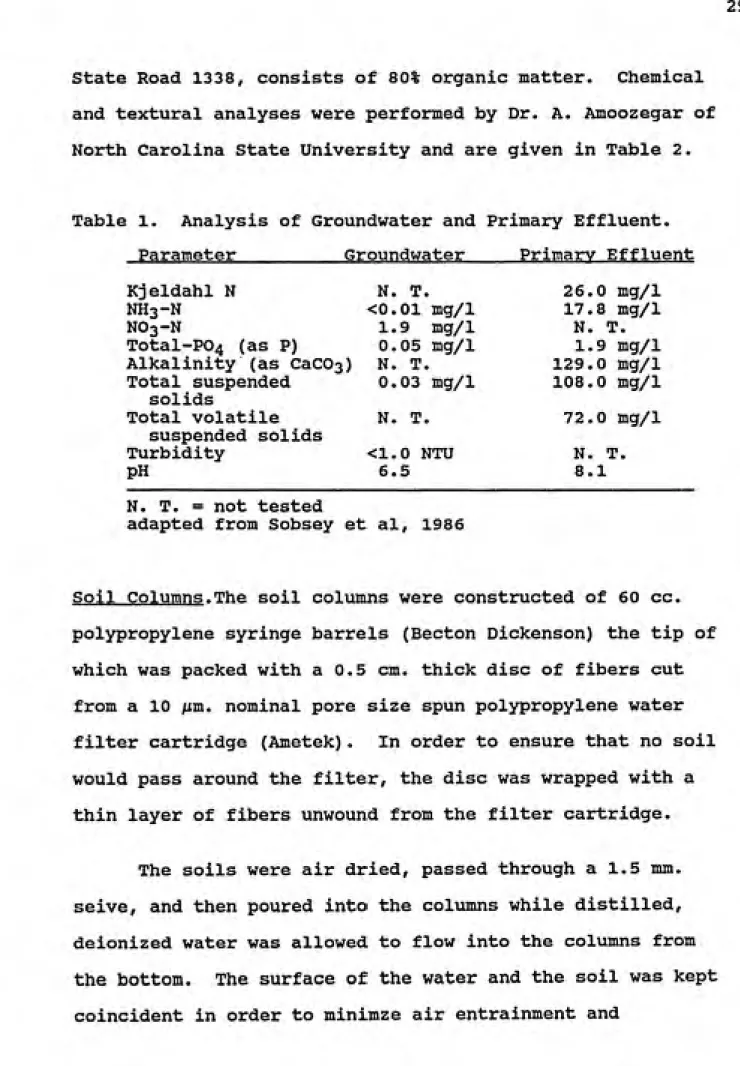
the Orange Water and Sewer Authority wastewater treatment plant on Mason Farm Road, Chapel Hill, North Carolina. Water analyses are included in Table 1. The samples were
aliquoted into daily column doses and stored frozen at -20C.
Soils. Two North Carolina soils were chosen that
represent very different compositions and textures. Cecil
clay, a typical Piedmont soil composed of 52% kaolinitic clay, and 25% sand-sized particles, was collected near
Raleigh, North Carolina. Ponzer organic muck, which was
collected in Hyde County, North Carolina one half mile south
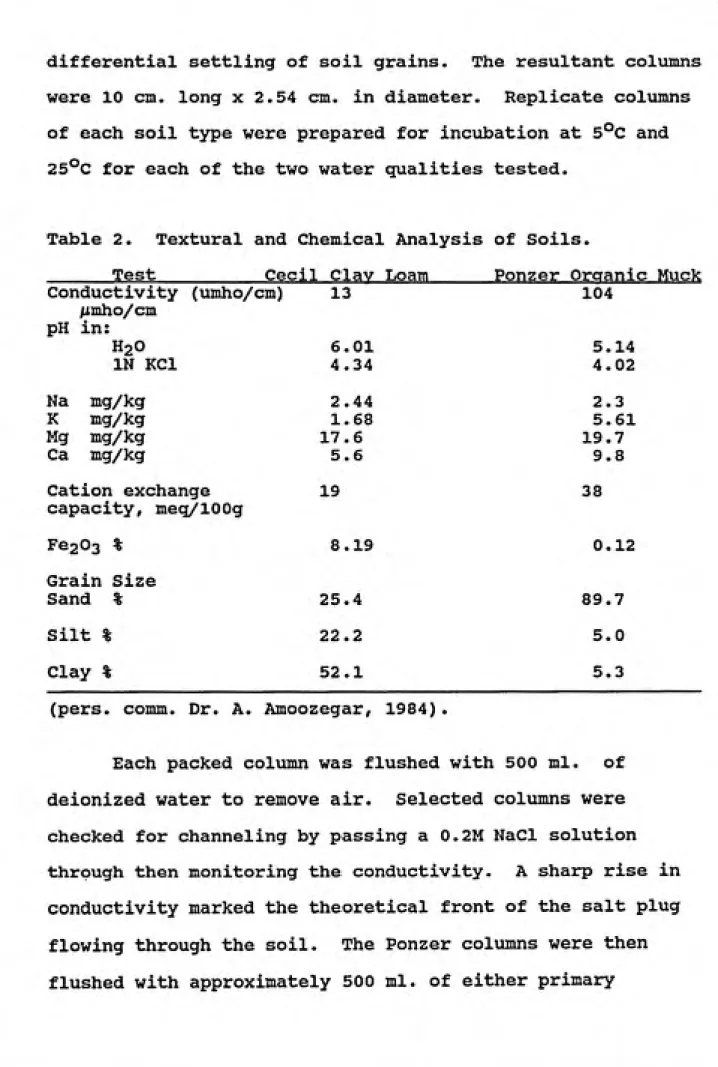
State Road 1338, consists of 80% organic matter. Chemical and textural analyses were performed by Dr. A. Amoozegar of North Carolina State University and are given in Table 2.
Table 1. Analysis of Groundwater and Primary Effluent.
Parameter_________Groundwater_____Primary Effluent
Kjeldahl N N. T.
NH3-N <0.01 mg/1
NO3-N 1.9 mg/1
Total-P04 (as P) 0.05 mg/1
Alkalinity (as CaCOs) N. T.
Total suspended 0.03 mg/1
solids
Total volatile N. T.
suspended solids
Turbidity <1.0 NTU
pH 6.5
26. 0 mg/1 17. 8 mg/1
N. r
r. 1. 9 mg/1 129. 0 mg/1 108. 0 mg/1 72. 0 mg/1
N. r
r.
8.1
N. T. = not tested
adapted from Sobsey et al, 1986
Soil Columns.The soil columns were constructed of 60 cc.
polypropylene syringe barrels (Becton Dickenson) the tip of which was packed with a 0.5 cm. thick disc of fibers cut
from a 10 /im. nominal pore size spun polypropylene water filter cartridge (Ametek). In order to ensure that no soil
would pass around the filter, the disc was wrapped with a
thin layer of fibers unwound from the filter cartridge.
The soils were air dried, passed through a 1.5 mm. seive, and then poured into the columns while distilled,
deionized water was allowed to flow into the columns from
Conductivity (umho/cm) 13
Aimho/cm
pH in:
H2O 6.01
IN KCl 4.34
Na mg/kg 2.44
K mg/kg 1.68
Mg mg/kg 17.6
Ca mg/kg 5.6
differential settling of soil grains. The resultant columns were 10 cm. long x 2.54 cm. in diameter. Replicate columns
of each soil type were prepared for incubation at 5°C and
25°C for each of the two water qualities tested.Table 2. Textural and Chemical Analysis of Soils.
______Test__________Cecil Clay Loam______Ponzer Organic Muck 104
5.14 4.02 2.3 5.61 19.7
9.8 Cation exchange 19 38
capacity, meq/lOOg
Fe203 % 8.19 0.12
Grain Size
Sand % 25.4 89.7 Silt % 22.2 5.0
Clay % 52.1 5.3
(pers. comm. Dr. A. Amoozegar, 1984).
Each packed column was flushed with 500 ml. of
deionized water to remove air. Selected columns were
checked for channeling by passing a 0.2M NaCl solution
through then monitoring the conductivity. A sharp rise in
conductivity marked the theoretical front of the salt plug
effluent or groundwater, while the Cecil columns were
flushed with about 250 ml. of either fluid. The smaller
volume was used on the Cecil columns because of the
potential for the suspended solids in the primary effluent to clog the top of the soil columns. After the columns drained, the bottoms were capped and they were stored overnight at experimental temperatures prior to beginning
the experiment.
Experimental Protocol. Each experiment lasted 53 days. The
columns received a 13.5 ml. (1 areal inch) dose of virus-seeded ground water or primary effluent twice per week for a
total of 16 doses. Ten-fold dilutions of the column
influents were made separately for each virus added to the
water sample, and were stored at -70°C. The dosed columns
were allowed to drain into 15 ml. sterile polypropylene centifuge tubes overnight until 13.5 ml. of effluent was recovered. The top centimeter of the Cecil columns was stirred to assist drainage. After collection was complete,
0.5 ml of column effluent was diluted ten-fold into
appropriate diluent for each virus and stored at -70°C. The
pH of effluents was monitored and mean pH of column
effluents are given in Table 22.
After a dosing experiment was concluded, the columns were cut into thirds and two one-gram samples were removed
material was reweighed to determine dry solids content and this weight was subtracted from the wet weight to estimate
moisture content (Table 23). The other sample was vortex
mixed with 5 ml of sterile, 2M NaN03/3% beef extract to elute viruses from the soil (Wait and Sobsey, 1983, Caton,
1986). Ten-fold dilutions were made into appropriate
dilution media for each virus, and the samples were then
stored at -70°C until assay. In experiment 1 there was a
six week delay between the end of the experiment andharvesting the soil columns, but in later experiments the
columns were harvested within 24 hours of collection of the
last effluent.
Virus Propagation and Assay. Three enteroviruses. Hepatitis A virus, strain HM175 (HAV), Poliovirus type l, strain LsC
(Polio) and Echovirus type 1, strain V239 (Echo), and RNA bacteriophage MS2 (ATCC #15597-B1) were the test viruses.
HAV was grown in a persistently infected continuous cell lined derived from African green monkey kidney cells, BS-C-1. Infected cells were seeded into 850 sq. cm. roller
bottles containing 150 ml. Eagle's Minimum Essential Medium
(MEM) with 10% Fetal calf serum (FCS). The bottles were
incubated at 37°C for 2 weeks on a roller apparatus, at
which time the growth medium was drained and reserved. Onehundred fifty ml. of fresh MEM with 2% FCS was added. After
2 more weeks the maintenance medium was drained and
trypsin. One fourth of the cells were seeded into fresh roller bottles while the remainder were harvested for virus stock.
Spent media was concentrated by adjusting the pH to 7.2, increasing the NaCl concentration to 0.3M and
precipitating the virus with 12% polyethylene glycol 8000
(PEG) for12-18 hours at 4°c. The PEG precipitate was then
centrifuged at eoooxg for 30 minutes, the pellet was
resuspended in a small volume of phosphate buffered saline (PBS) and the virus was extracted with CHCI3 five times.
The harvested cells were suspended in a small volume of PBS and homogenized with an equal volume of CHCI3 to extract HAV. The homogenate was centrifuged at 9000xg for
10 minutes at 4°C. The aqueous supernatant was reserved for
virus stock and the pellet reextracted four more times with PBS to obtain additional virus stock.
HAV was assayed by the radioimmunofocus assay (RIFA)
(Lemon et al., 1983) which is analogous to the conventional plaque assay (Dulbecco, 1952). Instead of reading plaques
or loci of infection directly, the infected monolayers are
exposed to 125j labelled IgG. Dark foci of infection can be
counted against a light background of uninfected cells in
autoradiographs on exposed X-ray film.
cell line derived from African Green Monkey Kidney (AGMK) cells. Newly confluent BGMK monolayers were infected at low multiplicity of infection and allowed to incubate until
complete cytopatology was observed, usually 2-4 days post infection. Cell lysis was completed by 3 freeze-thaw cycles. Crude stocks were made from the lysate by Freon
(trichlorotrifluoroethane) extraction, in which equal
volumes of lysate and Freon were homogenized, followed by
centrifugation at 5000xg for 20 minutes at 4°C. The aqueous
supernatant was concentrated with an Amicon YM30
ultrafilter. Virus titers were quantified by a standard
plaque assay as described by Sobsey et al (1978). The same methods were used to produce and titrate echovirus type I except that MA104 cells, a continuous cell line derived from Rhesus Monkey kidneys, were the hosts.
Escherichia coli C3000 (ATCC 15597), the host for coliphage MS-2, was grown in Tryptone Yeast extract broth. For stock virus production, turbid, log phase broth cultures were inoculated with MS-2 at low MOI and incubated until the broth cleared, typically 8-12 hours. Cell debris was
sedimented by centrifugation and the supernatent reserved as a crude stock. Conventional double agar layer plaque assays
(Adams 1959) were used to quantify the virus.
Statistical Methods. All computations were performed
1-2-3 2.0 spreadsheet program or Systat 4.0 statistical package
or on a Texas Instruments TI-60 calculator.
Virus titers were computed in all samples by summing plaque counts in replicate dishes at the most countable dilution(s) of a sample and dividing by the total volume of the plated sample. The titer was then multiplied by the
appropriate factor to arrive at the total infectious units
of virus in column influent and effluent samples, and in soil samples.
No statistical tests were performed on Cecil column daily effluents because only two samples had any detectable viruses, so that all Cecil column daily effluent titers were at or below the limits of detection, which varied from 50 to
10 infectious units per milliter.
Daily logio reductions were computed by taking the logio of the ratio of the virus appearing in the column effluent for that day to the mean of 16 daily doses applied to that column. For each virus type and all experimental conditions the daily log reductions were regressed against time, except for day 0, using multiple regression. The
resultant slopes and intercepts were analyzed in post-hoc
hypothesis tests to determine the effects of the
experimental variables and any interaction between them. The mean daily virus reductions were also calculated by
reductions below the detection limit. The mean daily reduction and virus retention and recovery data were
analysed in a multivariate analysis of variance and post hoc tests were conducted to test the effects of experimental variables. Inter-virus comparisons were made using a modification of the profile analysis technique (Morrison,
Appendix B contains data tables showing results of daily reductions, recoveries and distributions of viruses for replicate columns.
Daily Viral Reductions in Dosed Soil Columns. Responses of
viruses to passage through miniature soil columns are
sxunmarized in Tables 3 and 4 as mean log^o reductions for
each virus and experimental condition. Virus concentration
in column effluents (N^) were divided by the mean virus
concentrations (Nq) applied to the columns and expressed as
logio values. For Ponzer columns these data are also
summarized as regressions of logio(Nt/No) versus time for
each column because for some conditions virus reductions
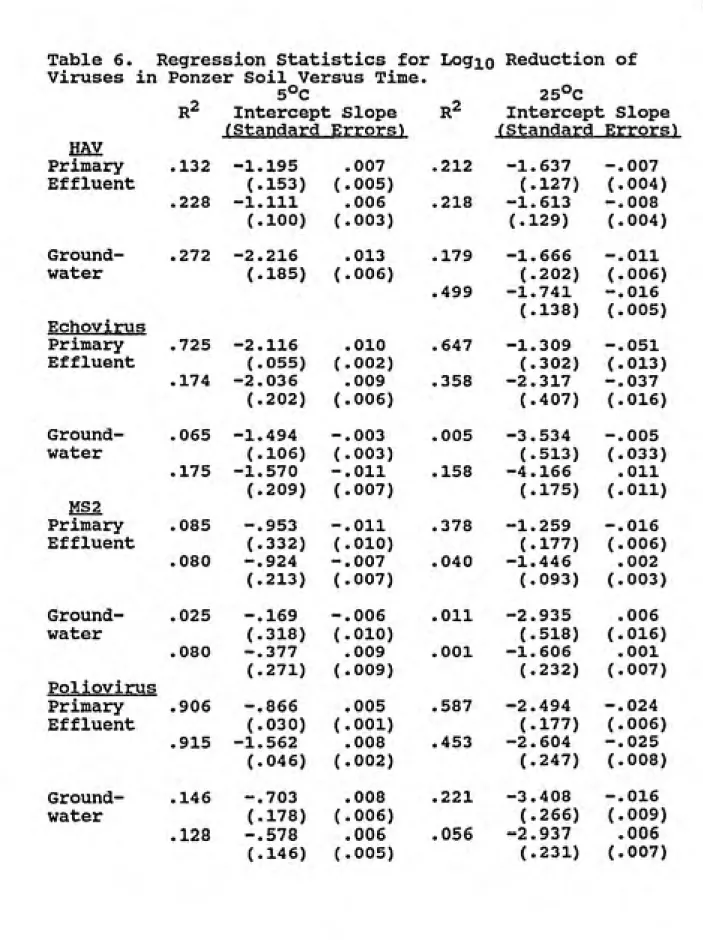
appeared to change over time. Table 5 lists the intercepts
and slopes with standard errors of these regressions for
each Ponzer soil column. The slope of the regression line
and its standard error indicate the change in virus reduction over time. The slopes are generally close to
zero, and usually have low R^ values indicating little
reductions of viruses across virus type, temperature, water
quality and soil type.
Cecil Clay Columns. Only two pfu of virus were recovered
from two of the 128 samples collected from Cecil clay
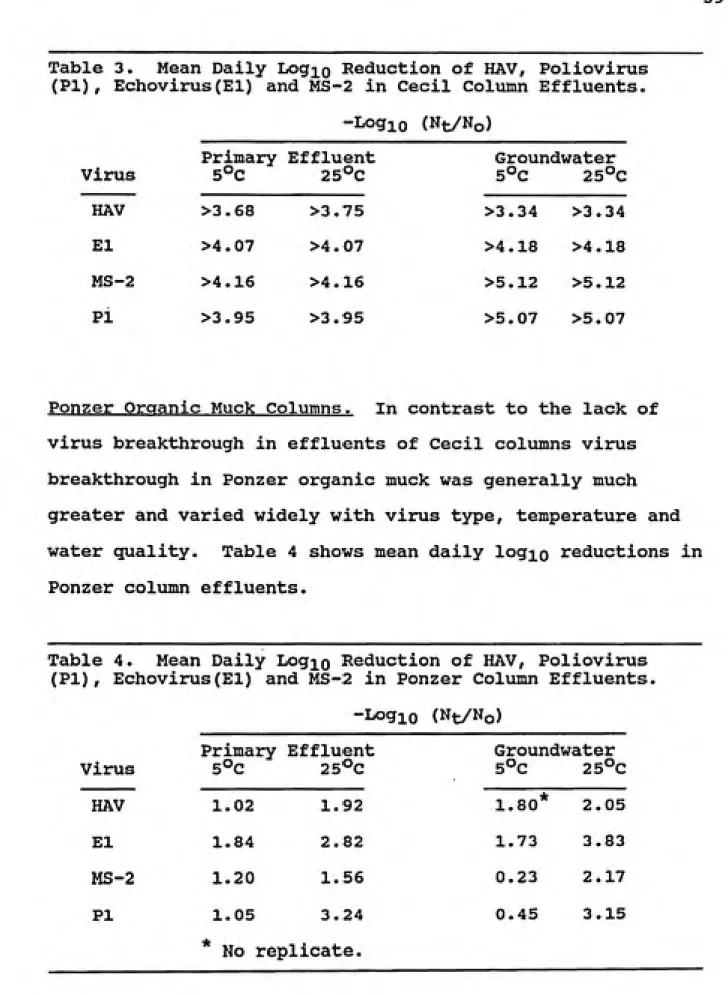
coliimns. Apparent differences in tabulated values for virus
reduction (Table 3) among the Cecil columns reflects only
the sensitivity of the assays and the initial virus
population density. Although the four viruses were seeded into the groundwater and primary effluent in theoretically
equal amounts of 5 x 10^ infectious units per ml, the actual
virus titers varied. Virus assay sensitivity varied because it was not always possible to use the same amount of
inoculum in the plaque assays or the RIFA. It is clear that virtually no virus breakthrough occurred in Cecil clay
columns under any of the conditions tested, and that the
effects of temperature, water quality and virus type could
Table 3. Mean Daily Log^o Reduction of HAV, Poliovirus (PI), Echovirus(El) and MS-2 in Cecil Column Effluents.
-Logio (Nt/No)
Virus
Primary 5°C
Effluent
25°C
Groundwater
5°C 25°C
HAV >3.68 >3.75 >3.34 >3.34 El >4.07 >4 .07 >4.18 >4.18 MS-2 >4.16 >4.16 >5.12 >5.12 PI >3.95 >3.95 >5.07 >5.07
Ponzer Organic Muck Columns. In contrast to the lack of
virus breakthrough in effluents of Cecil columns virus breakthrough in Ponzer organic muck was generally much greater and varied widely with virus type, temperature and
water quality. Table 4 shows mean daily logio reductions in
Ponzer column effluents.
Table 4. Mean Daily Log^o Reduction of HAV, Poliovirus (PI), Echovirus(El) and MS-2 in Ponzer Column Effluents.
-LogiO (Nt/No)
Virus
Primary 5°C
Effluent
25°C
Groundwater
5°C 25°C
HAV 1.02 1.92 1.80* 2.05
El 1.84 2.82 1.73 3.83
MS-2 1.20 1.56 0.23 2.17
Pi 1.05 3.24 0.45 3.15
For all virus types tested mean log^o reductions were
greater at 25°C than at 5°C in both groundwater and primary
effluent. The differences in virus reduction were not
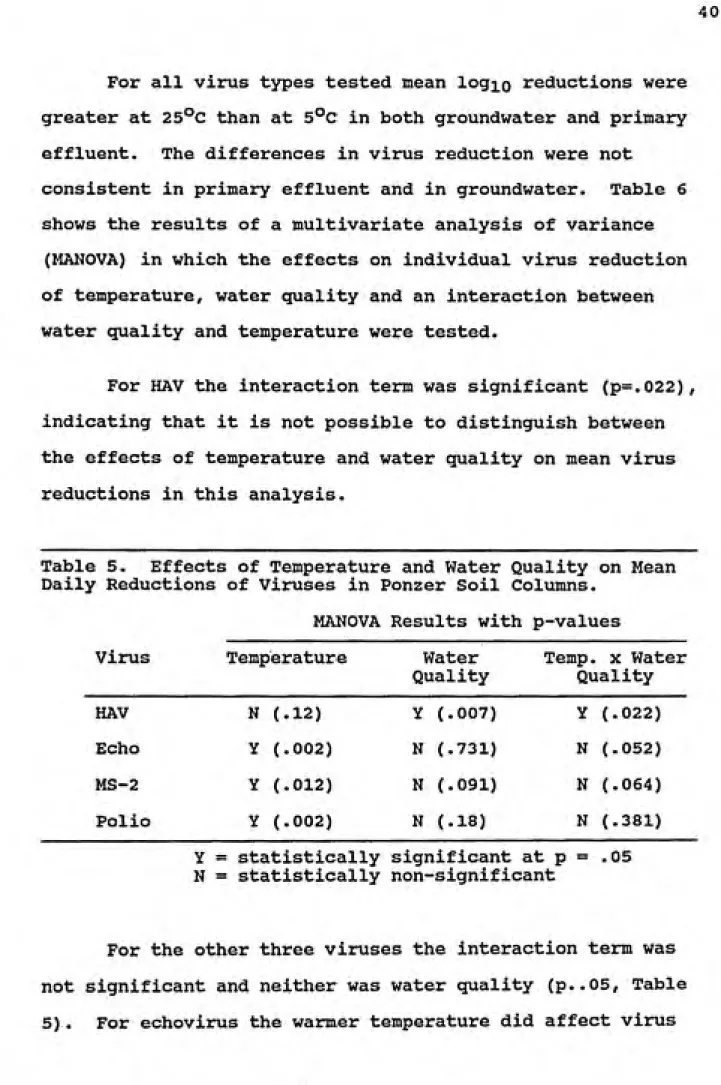
consistent in primary effluent and in groundwater. Table 6 shows the results of a multivariate analysis of variance
(MANOVA) in which the effects on individual virus reduction of temperature, water quality and an interaction between water quality and temperature were tested.
For HAV the interaction term was significant (p=.022), indicating that it is not possible to distinguish between the effects of temperature and water quality on mean virus reductions in this analysis.
Table 5. Effects of Temperature and Water Quality on Mean
Daily Reductions of Viruses in Ponzer Soil Columns. MANOVA Results with p-values
Vimis Temperature Water
Quality
Temp. X Water Quality
HAV N (.12) Y (.007) Y (.022)
Echo Y (.002) N (.731) N (.052)
MS-2 Y (.012) N (.091) N (.064)
Polio Y (.002) N (.18) N (.381)
Y = statistically significant at p = .05 N = statistically non-significant
For the other three viruses the interaction term was
not significant and neither was water quality (p..05, Table
reduction in the Ponzer columns (p=.002). In primary
effluent there were .98 logio fewer Echoviruses in 25°C
column effluents than at 5°C, while in groundwater the
difference was 2.1 logio units.
Temperature was also the only significant variable
influencing poliovirus reductions (p=.002). In primary
effluent at 5°C the mean reduction was 1.05 log^o versus
3.24 logio units at 25°C. In groundwater poliovirus
reductions were only .45 log^o units at 5°C and 3.15 logio
at 25°C. For bacteriophage MS-2, mean reductions in primary
effluent changed from 1.2 logio at 5°C to 1.56 logio at
25°C. In groundwater phage reductions were .23 logio ^"^ 5°C
and 2.17 logio at 25°C.
Temperature also apparently influenced the reduction
of viruses over time. In Ponzer columns dosed with primary
effluent, the slopes of the regressions of daily virus reductions versus time for the three human viruses were
steeper at 25°C than at 5°C, indicating a decrease in virus
breakthrough over time (Table 6). MS-2 did not display this
behavior. In Ponzer columns dosed with groundwater only HAV
and poliovirus slopes steepened at 25oC. As shown in Table
6 there was considerable variability in the regression data, and statistical interaction between temperature and waterquality made the effects of temperature on the slope of the
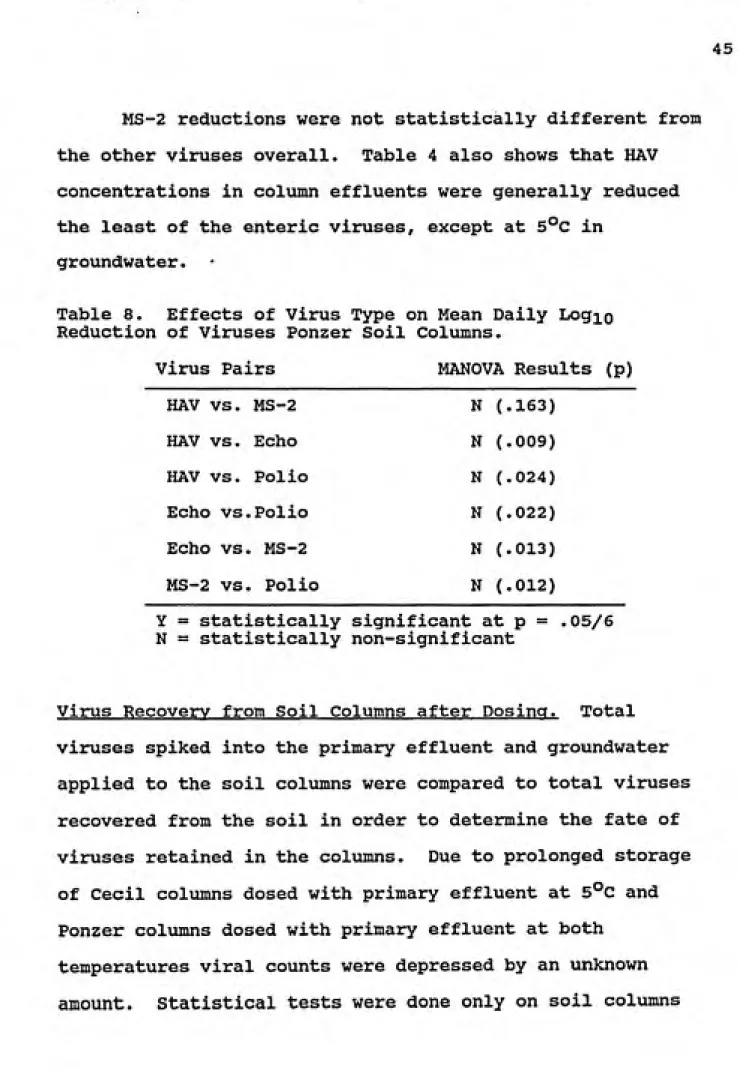
The MANOVA was also used to detejrmine inter-viral
reduction differences. It was not possible to compare all viruses simultaneously due to the small number of samples. Table 8 shows the results testing each combination of virus pairs for differences in mean log^o reductions while
Table 6. Regression Statistics for Logio Reduction of
Viruses in Ponzer Soil Versus Time.
5°C 25°C
r2 Intercept Slope r2 Intercept Slope ^Standard Errors) rStandard Errors) HAV
Primary .132 -1.195 .007 .212 -1.637 -.007 Effluent (.153) ('.005) (.127) ('.004)
.228 -1.111 .006 .218 -1.613 -.008
(.100) ('.003) (.129) (:.004)
Ground- .272 -2.216 .013 .179 -1.666 -.011 water (.185) ([.006)
.499
(.202) (
-1.741
(.138) (
;.006)
-.016
'.005)
Echovirus
Primary .725 -2.116 .010 .647 -1.309 -.051 Effluent (.055) ('.002) (.302) ( .013)
.174 -2.036 .009 .358 -2.317 -.037
(.202) {'.006) (.407) ( .016)
Ground- .065 -1.494 -.003 .005 -3.534 -.005 water (.106) ('.003) (.513) ( .033)
.175 -1.570 -.011 .158 -4.166 .011
(.209) ('.007) (.175) ('.Oil)
MS2
Primary .085 -.953 -.011 .378 -1.259 -.016 Effluent (.332) ( .010) (.177) ( .006)
.080 -.924 -.007 .040 -1.446 .002
(.213) ( .007) (.093) ( .003) Ground- .025 -.169 -.006 .011 -2.935 .006 water (.318) ( .010) (.518) ( .016)
.080 -.377 .009 .001 -1.606 .001
(.271) ( .009) (.232) ( .007) Poliovirus
Primary .906 -.866 .005 .587 -2.494 -.024 Effluent (.030) ( .001) (.177) ( .006)
.915 -1.562 .008 .453 -2.604 -.025
(.046) 1 .002) (.247) ( .008)
Ground- .146 -.703 .008 .221 -3.408 -.016 water (.178) ('.006) (.266) (:.009)
.128 -.578 .006 .056 -2.937 .006
Table 7. Effects of Temperature and Water Quality on the Slope and Intercept of HAV and Echovirus Log Reduction Regressions for Ponzer Organic Muck Columns.
Virus Variable F-Statistic (Probability) Multivariate Univariate
HAV
TEMP 63.225(.016)
slope 145.800( .001)
intercept .297( .624)
WQ 99.047(.010)
slope .022( .891)
intercept 235.8951 .001)
TEMPxWQ 97.157(.010)
slope 13.889( .034)
intercept 175.4681 .001)
ECHO
TEMP 29.736(.011)
slope .021( .892)
intercept 11.832( .026)
WQ 16.141(.025)
slope .021( .892)
intercept 6.245( .067)
TEMPxWQ 33.408(.009)
slope .348( .587)
intercept 18.664 1 .012)
MS 2
TEMP 4.821(.116)
slope .011( .922)
intercept 11.119( .029)
WQ 1.164(.423)
slope 2.990( .159)
intercept .1381 .729)
TEMPxWQ 2.414(.237)
slope 0.0(1)
intercept 5.435( .080)
POLIO
TEMP 30.569(.010)
slope 14.851( .018)
intercept 81.493( .001)
WQ 1.559(.343)
slope 3.213( .148)
intercept .014( .913)
TEMPxWQ 6.757(.077)
slope 2.900( .164)
MS-2 reductions were not statistically different from
the other viruses overall. Table 4 also shows that HAV
concentrations in column effluents were generally reduced the least of the enteric viruses, except at 5°C in
groundwater.
Table 8. Effects of Virus Type on Mean Daily Log^o
Reduction of Viruses Ponzer Soil Columns.
Virus Pairs MANOVA Results (p)
HAV vs. MS-2 N (.163)
HAV vs. Echo N (.009)
HAV vs. Polio N (.024) Echo vs.Polio N (.022)
Echo vs. MS-2 N (.013)
MS-2 vs. Polio N (.012)
Y = statistically significant at p = .05/6 N = statistically non-significant
Virus Recovery from Soil Columns after Dosing. Total viruses spiked into the primary effluent and groundwater
applied to the soil columns were compared to total viruses
recovered from the soil in order to determine the fate of
viruses retained in the columns. Due to prolonged storage
of Cecil columns dosed with primary effluent at 5°C and
Ponzer columns dosed with primary effluent at both temperatures viral counts were depressed by an unknown
dosed with groundwater so that interpretation of virus retention is not confounded by the effects of storage.
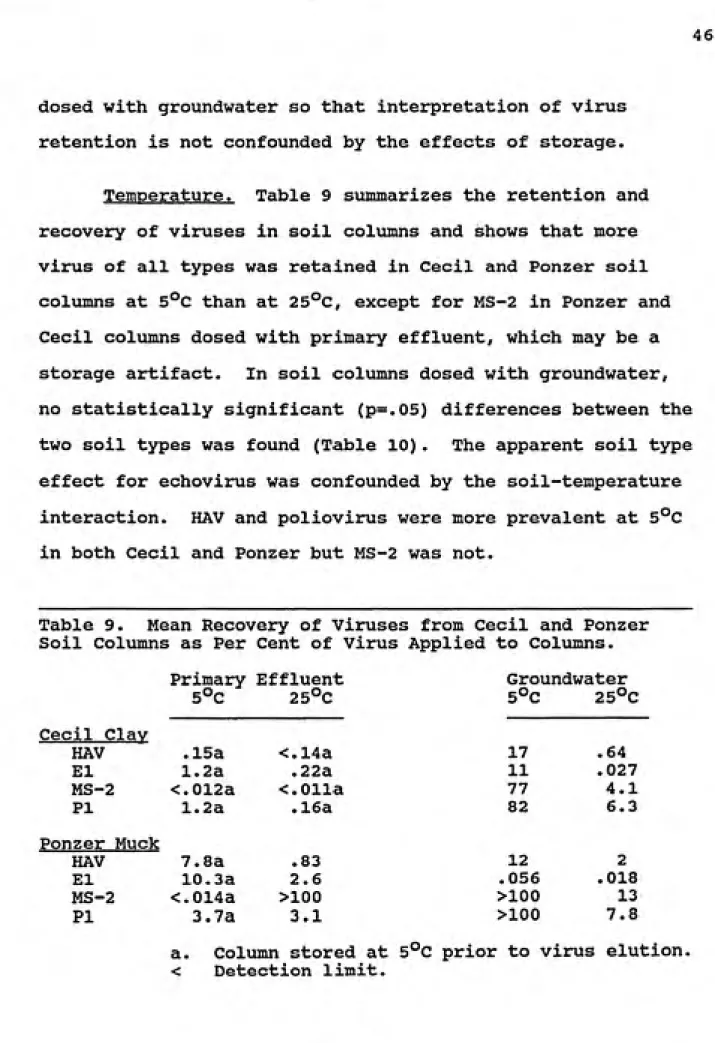
Temperature. Table 9 summarizes the retention and
recovery of viruses in soil columns and shows that more
virus of all types was retained in Cecil and Ponzer soil
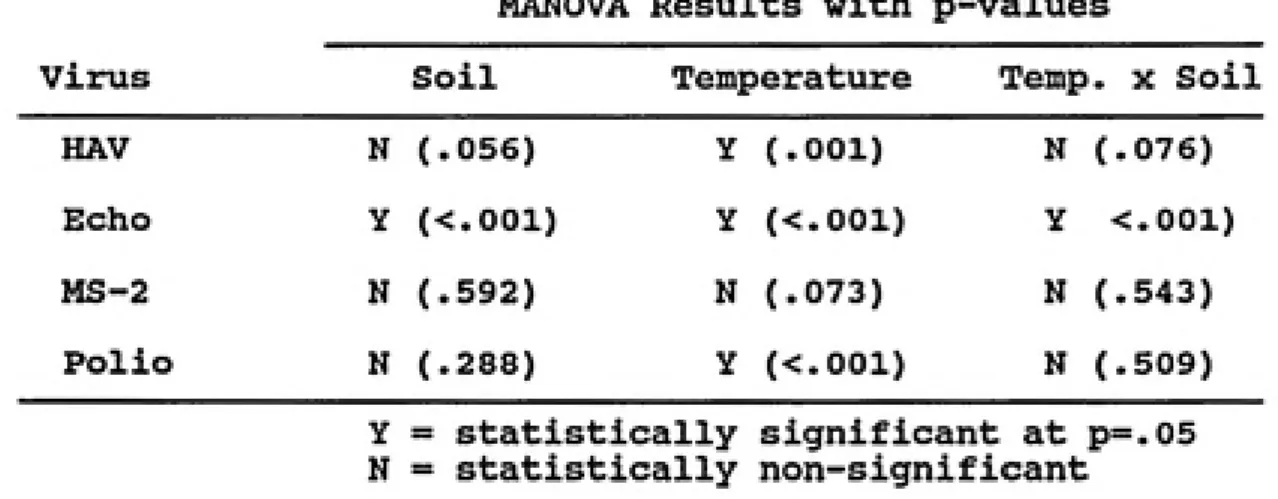
columns at 5°C than at 25°C, except for MS-2 in Ponzer and Cecil columns dosed with primary effluent, which may be a storage artifact. In soil columns dosed with groundwater, no statistically significant (p=.05) differences between the two soil types was found (Table 10). The apparent soil type effect for echovirus was confounded by the soil-temperature interaction. HAV and poliovirus were more prevalent at 5°C
in both Cecil and Ponzer but MS-2 was not.
Table 9. Mean Recovery of Viruses from Cecil and Ponzer
Soil Columns as Per Cent of Virus Applied to Columns.
Primary Effluent 5°C 25°C
Cecil Clav
HAV .15a <.14a
El 1.2a .22a
MS-2 <.012a <.011a
PI 1.2a .16a
Ponzer Muck
HAV 7.8a .83
El 10.3a 2.6
MS-2 <.014a >100
PI 3.7a 3.1
Groundwater
5°C 25°C
17 .64
11 .027
77 4.1
82 6.3
12 2
.056 .018 >100 13 >100 7.8
a. Column stored at 5°C prior to virus elution.
Table 10. Effects of Temperature and Soil Type on Retention
and Recovery of Viruses in Cecil and Ponzer Columns Dosed
with Groundwater.
MANOVA Results with p-values
Virus Soil Temperature Temp. X Soil
HAV N (.056) Y (.001) N (.076)
Echo y (<.001) Y (<.001) Y <.001)
MS-2 N (.592) N (.073) N (.543)
Polio N (.288) Y (<.001) N (.509)
Virus Type Effects. The six possible virus pairs were compared to determine if their retention and recovery patterns were different from one another. When MS-2 was contrasted with each of the three enteroviruses, no
significant differences (p=.008) were detectable (Table 11) But the three enteroviruses were distinct (p<.008) when compared individually. Generally, recovery of viruses was
MS-2 = Polio > HAV > Echo.
Table 11. Effects of Virus Type on Retention and Recovery
of Viruses in Cecil and Ponzer Columns Dosed with
Groundwater.
Virus Pairs MANOVA Results (p)
MS-2 vs. HAV N (.174)
MS-2 vs. Echo N (.1)
MS-2 vs. Polio N (.811)
Echo vs. Polio y (<.001)
HAV vs. Echo Y (.002)
HAV vs. Polio Y (<.001)
Y = statistically significant at p=.05/6 N = statistically non-significant
Very little virus was recovered from Cecil columns
that had been dosed with primary effluent and stored at 5°C
groundwater and processed immediately upon completion of the
experiment (Table 9). In corresponding Ponzer columns (5°C,
primary effluent or groundwater), HAV recovery was 7.8% and12%, respectively. MS-2 and poliovirus recovery was much
less in the primary effluent dosed Ponzer columns than in the groundwater dosed columns (Table 9). However, more
echovirus was recovered from the stored columns (10.3%) than
from the promptly processed columns.
Distribution of Viruses in Soil Columns. After the column dosings were completed column soils were partitioned into
thirds, the viruses eluted from the soils, and the recovered
virus tabulated. By setting the total virus recovered to
100%, it is possible to compare the distribution of viruses
in different parts of the columns. This is necessary
because some columns were stored at 5°C for six weeks prior
to analysis and viruses undoubtedly died off during that time. In order to consider this data it is necessary to assume that the viral die off rates were equal.
The percent distribution of viruses within columns is
shown in Table 12. Also shown is the amount of virus
recovered from the columns relative to the amount applied. No HAV or MS-2 was recovered from Cecil columns which had
been dosed with primary effluent. No MS-2 was recovered
from Ponzer columns dosed with primary effluent at 5°C.
Table 12. Distribution of Viruses in Soil Columns as Per
Cent of Viruses Recovered from Soil.
Soil Primary Effluent Groundwater
Temp HAV Echo MS-2 Polio HAV Echo MS-2 Polio
Ponzer
T 44 27 ND 24 73 48 20 43
5°C M 43 31 ND 29 18 6 63 34
B 13 40 ND 47 9 46 17 23
% applied 7.8 10 <.01 3.7 12 .06 56 91
T 24 96 40 74 34 39 55 39
25°C M 49 1 57 20 33 13 27 34
B 27 3 3 6 33 48 18 27
% applied .8 2.6 32 3.1 2 .02 13 7.8
Cecil
T ND 99 ND 98 93 96 98 98
5°C M ND <1 ND 2 7 4 2 2
B ND <1 ND <.5 <.2 <.12 <.01 <.05
% applied <.15 1.2 <.01 1.2 17 11 77 82
T ND 98 ND 94 22 68 41 13
25°C M ND 1 ND <3 71 16 59 87
B ND 1 ND <3 7 19 <.4 <.3
% applied <.14 .2 <.01 .2 .6 .03 2.1 6.3 ND Not detected in either replicate.
< Not detected in one replicate•
T Top third. M Middle third. B Bottom third.
% applied Per cent of total virus. applied to column
Cecil columns generally contained at least 93% of the virus in the top 3-4 cm. of the column. In groundwater at 25°C at least 84% of all viruses were recovered from the upper two thirds of the columns. This apparent deeper
penetration of virus may be an artifact due the overall much
lower levels of virus recovery (.03-6.3%) compared to the 5oC columns (10.9-82%). Generally, virus recovery from
except for Ponzer columns dosed with primary effluent at 25°C, where only HAV was evenly distributed.
virus distribution within the columns did not
consistently vary with water quality , temperature or virus type.
Column Effluent pH. Table 13 gives the mean pH of column effluents. At warmer temperatures both primary effluent and
groundwater developed lower pH, perhaps in response to
elevated microbial activity. At 5°C in Cecil, primary
effluent and groundwater column effluents were pH 5.66 and
5.55, respectively. At 25°C the pH dropped to 5,26 and
5.11, respectively. In Ponzer the trend was the same but
the pH values were approximately 0.4 pH units lower, which
corresponds to the difference in soil pH as listed in Table 2.
Soil Moisture Levels. Soil moisture levels are listed
in Table 14. Cecil clay generally retained more
interstitial water due to its finer texture. Percent water
Table 13. Mean pH of Soil Column Effluents
Primary Effluent
Temp______Ponzer______________Cecil
5°C
25°C
5°C
25°C
5.17 5.66
4.8
Groundwater
5.26
5.13 5.55
4.92 5.11
Table 14. Mean percent soil moisture of soil columns,
Primary Effluent
_________Temp_____Ponzer______________Cecil
5°C 37.6 37.2 25°C 38.3 44.4
Groundwater
DISCUSSION
From the preceeding results it is clear that virus
reduction and fate in dosed soil columns was related to
several factors. Virus type,soil type, temperature, and water quality (e. g. differences in salt content, microbial
activity, suspended solids and organic matter content
between groundwater and primary effluent) all affected virus
adsorption, survival and transport in soil.
In this study soil moisture was adequate to prevent dessication of viruses, ranging from 33.3% to 44.4%. Column effluent pH was quite uniform, ranging from pH 4.9-5.6.
There was so little difference in these data that their
impact on survival and transport in soil could not be evaluated. The pH levels were in a range that generally promotes virus adsorption to solids in water and soil
(Sobsey et al., 1980; Duboise et al., 1979; Goyal and Gerba,
1979). Viruses generally show decreased survival in soils at or below the saturation point, but the moisture levels in
these columns have not been reported to cause virus inactivation (Sobsey and Shields, 1988).
Cecil clay loam columns allowed a total of only two infectious units of virus to break through in column
effluents, whereas substantial breakthrough occurred in
1 and HAV were extensively adsorbed to Cecil but not to
Ponzer over a range of pH and water qualities. In the later study HAV displayed more adsorption to Ponzer than did the
other enteroviruses.
The difference in organic matter content of soil types in this study is great and may influence virus breakthrough
and recovery data. Poliovirus is considered a generally good adsorber compared to echovirus (Gerba et al., 1981;
1979), and column studies by Sobsey et al. (1986) and Nasser et al. (1989) showed less poliovirus in effluents than
echovirus. However, Sobsey et al. (1986) report neither
poliovirus nor echovirus showed even moderate adsorption to
Ponzer. In an earlier column study (Sobsey et al., 1980)
poliovirus reductions in Ponzer columns at 20°C were
intermediate between the 5°C and 25°C reductions in this report under the same conditions. Scheuerman et al. (1979b) reported 82-92% retention of poliovirus in muck soil columns dosed with seeded secondary effluent or groundwater.
Reports by Gerba et al. (1981; 1979) in which
poliovirus 1 was reported to be a good adsorber compared to echovirus 1 and MS-2 also showed that adsorption of the latter two viruses was sensitive to soil pH and organic content. None of those soils contained over 4.2% organic material (Gerba and Goyal,1978; Hurst, 1988). In contrast,
were done with FM sandy loam and Corolla sand, neither of which have appreciable organic matter content. The very high organic matter content of Ponzer may account for the differences in viral reduction patterns from those reported
for sandier soils (Scheuerman et al., 1979b). In addition, Bixby and O'Brien (1979) found that MS-2 infectivity could be reversibly masked by complexation with fulvic acid. Infectivity was regained by treatment with 3% beef extract at pH 9. It is possible that soluble organic material
present in Ponzer column effluents differentially complexed or masked infectivity of the test viruses, but Hickey (1982) reported little poliovirus infectivity loss in the presence of up to 30 mg/L humic or fulvic acid.
There also were differences in distribution of viruses
within soil columns based on soil type. Often >90% of the virus was found in the top 3-4 cm. of the Cecil columns. In
Ponzer columns the viruses were more evenly distributed. This concurs with virus adsorption patterns in Ponzer and Cecil soil suspensions (Sobsey et al., 1986), and is
reflected in the lack of detectable virus in Cecil column
effluents and the substantial virus breakthrough in Ponzer
columns.