COMMUNITY INVOLVEMENT: A Study of Voluntary Community Service by Family Physician Faculty
By
M. Brian Hemphill, MD
A Master's Paper submitted to the faculty of The University of North Carolina at Chapel Hill
In partial fulfillment of the requirements for The degree ofMaster of Public Health in
The Public Health Leadership Program
Chapel Hill
COMMUNITY INVOLVEMENT: A Study of Voluntary Community
Service by Family Physician Faculty
Abstract
Purpose: To create a typology of community volunteerism among faculty family physicians in North Carolina, and to identify the factors that facilitate and obstruct the ability of physicians to participate in community service
Methods: Family practice residencies were identified by their membership in the American Medical Association's Fellowship and Residency Electronic Interactive Database (FREIDA). Individual programs were contacted, and a total of 189 Family Practice Physicians in the state of North Carolina were identified and surveyed regarding various aspects of community service. The survey included sections on past medical exposure to community service, current physician attitudes toward community service, specific participation in community service activities, and influences affecting community service participation.
Results: A total of 104 family physicians responded (55%). Out of 25 potential community service activities, respondents participated in a mean of 13.2
activities (SO 5.2). The highest participation occurred in the volunteer civic service domain and the lowest participation occurred in the volunteer advocacy/lobbying domain. There was a statistically significantly negative correlation between debt load and amount of volunteer activities. Previous exposure in medical school and/or residency did not appear to predict
subsequent volunteerism, as measured by the 25 community service activities.
Conclusions: A typology was created delineating specific volunteer activities. The activities were grouped into types of volunteer service (health-related and lay service). According to the survey, faculty family physicians are generally in favor of including community service as a potential tenure consideration. Debt load is inversely proportional to volunteerism, especially among physicians less than 45 years old with at least $10,000 debt upon medical school graduation. The results of the study raise awareness concerning current roles, rewards, facilitators, and barriers to physicians' involvement in community service.
COMMUNITY INVOLVEMENT: A Study of Voluntary Community
Service by Family Physician Faculty
INTRODUCTION
Community service has long been a part of American society. Every year,
approximately ninety million Americans volunteer in their communities, and the
value of their time has been estimated to be around $200 billion dollars. 1
President Bush echoed American sentiment regarding community service when
he introduced the Citizen Service Act of 2002, a bipartisan legislation that
enhances national service programs. In response to this act, President Bush
stated, "'Increasing opportunities for all Americans to participate in meaningful
service activities is a priority of this Administration."' 2 This call for volunteerism is
underscored by the recent creation of the USA Freedom Corps by the current
administration. 3
In the medical profession, there is a similar commitment to community
service. Indeed, there is an intrinsic appeal to the idea that physicians should be
inextricably linked to their community. 4 James E. Davis, past president of the
American Medical Association, advocated that community service is the hallmark
of the medical profession. He stated that throughout history, physicians have
served their communities as purveyors of medical knowledge. In addition,
physicians have contributed to the community through professional and lay
service. s
Much has been written concerning issues surrounding physicians
practicing in their communities. Studies have been conducted assessing the
retention of rural physicians, the evolution of community-oriented primary care,
the training of medical students and residents in primary care, and the facilitators
and barriers that surround each of these issues. However, there is a dearth of
published data concerning physicians' voluntary involvement in community
activities. Furthermore, there are very few publications that discuss the role of
physicians as community advocates. The few studies that have been conducted
describe various aspects of health-related volunteerism but say little about lay
volunteer service (ie service in which the physician is primarily active in
community service as a citizen, not as a professional.) 6, ?, s, e
I
Community-Oriented Primarv Care
Community-oriented primary care traces its roots from Sidney Kark, who
fashioned the term to describe his approach to clinical medicine in South Africa
and Israel beginning in the 1950s. 10, 11 In 1982, Fitzhugh Millan introduced the
term to the US medical public. He cited previous accomplishments by Dr. Kark
as evidence of the potential success of COPC in the United States, especially in
underserved communities. 12
Although COPC has been defined with different labels in different settings,
the underlying concepts are similar. 11-15 Community-oriented primary care calls
1) the linkage of primary care with public health tools, 2) the linkage of primary
care with awareness and understanding of the community which it serves, and 3)
a theoretical base that views health and illness as resulting from factors at all
levels of human organization (from the molecular up to the community and
societal levels).
Community-oriented primary care brings together individual, family, and
community health care. Partnerships are developed between health care
agencies and the community they serve in order to properly identify health
problems. As stated by Yach et al, and re-iterated by Dr. Kark, health care
should be provided "'in communities, for communities, and with communities."' 10,
16
The importance of COPC to the discipline of family medicine was
underscored in 1999 when the Academic Family Medicine Organizations
Residency Education Subcommittee and the Board of Directors of the
Association of Family Practice Residency Directors recommended that all family
medicine residency programs incorporate COPC into the general curriculum. 1s, 17
As stated under section Ill, "Community Competencies," they recommend that all
family practice residents should understand COPC, all family practice residencies
should incorporate COPC, and all family practice residents should be capable of
assessing the health needs of a community, developing interventions, and
assessing the outcome. 17
Currently, studies have indicated that family practice residencies, faculty,
and private family practice physicians fall short of the expectations of the
community medicine curriculum and 86% reported that community medicine is a
required rotation. 1s Another study conducted in 1994 reported that 25% of family
practice program directors and 75% of private physicians had never heard of
COPC. The low rates may overestimate the actual familiarity with COPC, as
non-responders probably have less interest or less knowledge about the subject.
12, 18
According to the previous study, obstacles to incorporating COPC into
communities include the practicality of COPC, time and logistical issues
concerning implementation, financing, and lack of methodology. A qualitative
question found that many respondents cited a need for "practical, inexpensive,
The late David E. Rogers MD, former president of the Robert Wood
I
quick and resource-efficient methods of applying COPC." 12Johnson Foundation, cited several reasons why COPC has not spread. Dr.
Rogers implicates the rewards system as a major barrier in the proper
implementation of COPC (and by natural extension, the increased prevalence of
volunteerism). The structure of the current financing of health care does not
encourage a community-oriented approach. Instead, financial incentives steer
newly-minted physicians into medical subspecialties, often in large, urban
centers. Furthermore, there is less prestige in the "old country doc" than most
other areas of medical specialty, thereby discouraging possible medical school
Four Community Domains of Primary Care
Medical volunteerism is but one way physicians are active in the
community. Recently, researchers have constructed a paradigm identifying four
distinct community domains of primary care practice in both work-related and
volunteer-related settings. Physician actions within the domains are defined as
follows: 1) participating in health activities in the community, 2) paying attention
to sociocultural aspects of patient care, 3) appropriately using the community's
health resources, and 4) participating and assimilating into the community. 4
However, there are no current studies analyzing the specific activities within
community service that physicians participate. Furthermore, there are no current
I
studies that analyze either the attitudes of physicians toward volunteer j
T
community service or the influences that affect decisions to participate in
community service. My study applies to the fourth domain, as the survey is
designed to delve into the specific ways that physicians participate and
assimilate into the community through volunteer service. 1s. 4
Few studies in the past ten years have analyzed the depth or breadth of
health-related and lay volunteer service. The purpose of this study is to create a
typology of community volunteerism among faculty family physicians in North
Carolina, and to identify the factors that facilitate or obstruct the ability of
METHODS
This research study attempts to answer the following questions:
Research Question 1: What is the scope of volunteer activity among faculty
family physicians in the state of North Carolina?
Research Question 2: What are the factors that facilitate or obstruct community
service among faculty family physicians in the state of North Carolina?
2a: Will previous training in medical school and/or residency be
associated with a greater breadth of current volunteer community service?
2b: Among recent graduates of residency programs, will debt load
deleteriously affect the breadth of current volunteer service?
Research Question 3: What are the attitudes of tenured professors concerning
community service as a potential consideration for promotion?
Selection Criteria
A total of 489 family physicians were identified for sampling. The study
consisted of two arms-the total population of faculty family physicians in the
state of North Carolina (189), and a random sample of 300 private family
~--Association of Family Physicians (-1700 members). The faculty arm of the
survey was the current basis for data analysis.
Family practice residencies were identified by their membership in the
American Medical Association's Fellowship and Residency Electronic Interactive
Database (FREIDA). The programs included UNC-Asheville, UNC-Chapel Hill,
Carolinas-Charlotte, Northeast Medical Center-Concord, Duke University, Duke
University-Fayetteville, Greensboro, East Carolina (Greenville),
UNC-Hendersonville, Carolinas-Monroe, UNC-Wilmington, and Wake Forest
University. Residency program coordinators were individually contacted, and
they provided comprehensive lists of full-time faculty for inclusion. These lists
were corroborated with individual family practice websites, all of which included
comprehensive lists of current faculty.
Once the comprehensive faculty list was created, it was checked with the
NCAFP list. All faculty names were eliminated from the NCAFP list, and 300
names were subsequently randomly selected for inclusion in the second arm of
the study.
Research Design
Developed in February, 2002, the survey is a collaborative effort by four
family practice faculty (two tenured, two non-tenured), two research associates,
piloted to five faculty and five private physicians, and their feedback resulted in
changes before the first mailing commenced.
The survey consists of four sections. The first section is a series of 16
questions concerning past and present community service exposure as well as
current attitudes about volunteerism. This section is scored on a 5-point Likert
scale, ranging from "strongly agree" (score of 1) to "strongly disagree" (score of
5) in response to the questions. The second section of the survey is a series of
25 questions regarding the scope of community service. This section is divided
into 9 "volunteer civic service" questions, 4 "volunteer youth service" questions, 8
tenure-related questions, and 4 advocacy/lobbying questions. The response
variable is a forced-answer "have done in the past two years, have done in my
career but not in the past two years, have never done." The third section is a
series of 8 questions regarding influences, both past and present, which might
make the respondent more or less likely to perform community service. The
answers are scored on a 5-point Likert scale, ranging from "more likely to
perform service" (score of 1) to "less likely to perform service" (score of 5). The
fourth section is a series of demographic questions as well as questions
concerning tenure, National Health Service Corps participation, practice setting,
private/public medical school, etc. The answers vary from dichotomous
responses to continuous variables. The two surveys differed only in one
question regarding knowledge of the mission statement at the respondent's
A volunteer index was generated to quantify the breadth of service among
the respondents. The index was created by awarding a point for each defined
community service activity the respondent had participated during his or her
lifetime. There were 25 potential values so the scores could range from 0 to 25,
thereby creating a continuous outcome variable for subsequent analysis. All of
the questions are delineated in tables 3 and 4.
Data Collection
During the course of the data collection phase, two separate mailings and
I
one reminder were delivered for both arms of the survey. In order to increase
reliability for subsequent analyses between the two arms, I coordinated the
mailings on the same days and created identical codebooks for both projects.
Another investigator entered the numeric data for the non-faculty survey, and
there was regular communication between the other investigator and myself
regarding potential outliers as they arose during data entry between the two arms
of the survey. The numeric data were entered in EXCEL and imported into
SPSS version 10 for subsequent analysis. Data were collected so that the
procedures could be reproduced by other investigators regarding this topic. The
surveys, the EXCEL spreadsheets, and the SPSS coding and re-ceding of
variables were all written to be easily and correctly analyzed for future
Of the 194 questionnaires sent, 5 were discarded because either the
respondent was not a family practice physician or the potential survey candidate
~-was no longer with the program. Of the remaining 189 questionnaires sent, 104
responded, for a 55% response rate, all of which were included in the formal
analysis.
RESULTS
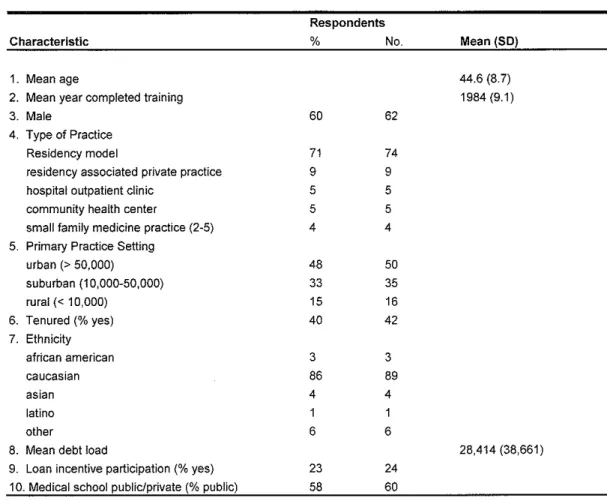
Respondents have been in practice for a mean of 15 years (range 1-28
years), and are an average of 45 years old (range 30-67). From table 1, the
average debt was approximately $28,000 upon graduation from medical school
I
with a median of $12,000, not adjusted for inflation. Approximately one-fifth of all
respondents participated in some form of loan incentive program, and about 60%
attended a public medical school. Roughly half of the respondents practiced in
an area with greater than 50,000 people, and over 85% identified themselves as
Caucasian.
The Likert-response statements are divided into four categories: 1)
previous exposure to community service, 2) current familiarity with community
service, 3) current environment of community service, and 4) respondents'
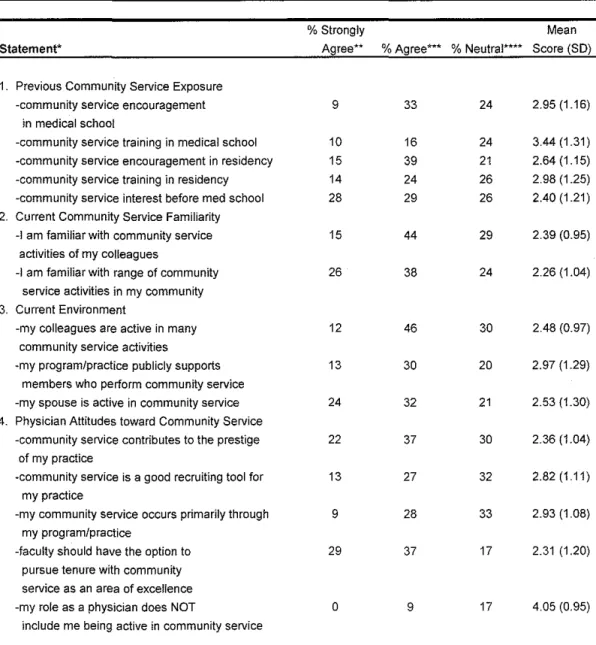
current attitudes toward community service (table 2). Among the previous
exposure category, residency training appears to expose physicians to more
community service than medical school training, although the differences are not
L
agree" that their medical school and residency programs exposed them to
community involvement.
Overall, only 43% agree that their programs publicly support members
who perform community service, yet almost 60% agree that community service
contributes to the prestige of their programs. A strong majority of respondents
agree that community service should be an area of excellence in promotion
considerations (65%). There was consistent disagreement with the statement
that the role of a physician does not include community service-39% "strongly
disagree" and another 38% "disagree."
Health-related activities are categorized into 1) volunteer civic service, 2)
volunteer educational/professional service, and 3) volunteer advocacy/lobbying,
I
and are ranked in lifetime participation frequency for each section in table 3.
Overall, respondents report high activity in civic service-over 60% have given
health-related talks in the past two years and 91% have previously participated in
health fairs. Only one-third of respondents report having served a leadership
position in a health organization, but 98% report membership in professional
organizations. Less than 10% of respondents have published an article on
community service in the past two years, and only 16% have published a
community service article in their lifetime. Regarding advocacy, two-thirds of
respondents have participated in some form of health-related media campaign,
and almost one-half have written a column or editorial on a health-related issue.
For lay community service (ie service in which the physician is primarily
mentored non-medical students in summer service projects, and approximately
40% have led a church or other faith-based service program. Another 40% have
led a local youth organization and coached a children's sports team (table 4).
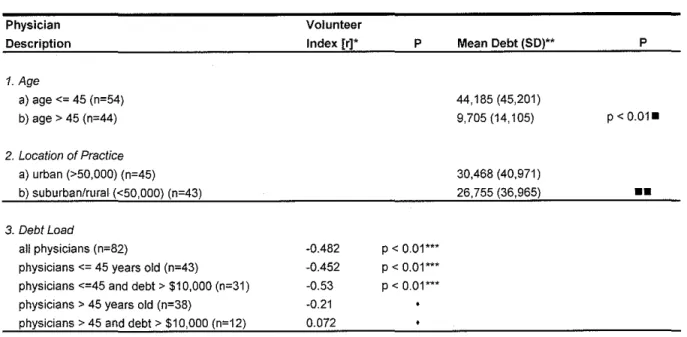
In response to one of my original research questions, a Pearson
Correlation was conducted comparing debt load with breadth of service
(volunteer index). The volunteer index was generated by summating all 25
potential community service activities (table 5). Each of the 25 variables was
-dichotomized. For each of the activities, one point was given for "have ever
done" and no points were given for "have never done." When summated this
created a dependent, continuous variable. The scores ranged from 2 to 24 items
I
(median 13; mean 13.2, SO 5.2). A Spearman Correlation was also conducted
because of the non-parametric nature of debt load (median $38,661; mean
$28,414); thereby increasing the internal validity of the results. For the entire
sample, there is a negative correlation between debt load and breadth of service
(r=-0.482, p<0.01 ). In other words, as debt load increases, the breadth of service
decreases. Among physicians less than 45 years old and post-medical school
debt greater than $10,000, the negative association is even more pronounced
(r=-.530, p<.01). Among physicians greater than 45 years old, there is no
statistically significant association between the two variables. Table 5 also
shows a statistically significant difference between debt load among physicians
less than 45 years old ($44, 185) and physicians greater than 45 ($9,705).
Regarding the research question about potential community exposure in
Independent Sample T-tests were performed on four survey questions. The
questions address previous medical school and residency exposure to
community service. Likert scale responses were dichotomized into "agree" (1
and 2) and "disagree" (3, 4, and 5) and modeled with the volunteer index mean
(table 6). In all cases, there is no statistically significant association between the
means of each of the four categories.
DISCUSSION
Although few studies delineate the scope of medical volunteerism,
advocates have written articles about the importance of such service in the
community. The National Organization of Physicians Who Care calls for
volunteer service by physicians in communities as a way of preserving equality in
medicine. Under their recommendation, physicians would occasionally donate
their services in their communities without reimbursement, and would
subsequently let the community know that this is part of the Physicians Who
Care plan. 21 Dr. James E. Davis called for physicians to tithe their time for the
benefit of the American people, asking for four hours a week serving the public,
and challenging physicians' organizations to encourage the implementation of
such service. s Dr. George D. Lundberg, past editor of the Journal of the
American Medical Association, reminds us of the original American Medical
Association's code of ethics, written in 1846. This code emphasizes relief of pain
individuals in indigent circumstances, professional services should be cheerfully
and freely accorded."' gin 1987, the AMA House of Delegates approved as policy
"'that the AMA urge all physicians to share in the care of indigent patients."' g
Principle 3-6b of the Health Policy Agenda for the American People states "'All
health care facilities and health professionals should fulfill their social
responsibility for delivering high quality health care to those without the resources
to pay."' g
There are many positive indirect consequences to service. Patients are
reminded that physicians' first motivation is public service, thereby improving the
physician-patient relationship. s Physicians are more astute to the problems
surrounding their community. As stated by one volunteer physician, '"Because I
see how my patients live, they seem to think I'm different from other doctors, that
my advice is more practical .... The more I learn about the kinds of grocery stores
my patients have in their neighborhoods and the kinds of facilities they have for
exercise, the more productive advice I can offer."' 21
The examples cited demonstrate that the medical community deems
community service a worthy and necessary component of physician practice.
Research on community practice of physicians is limited. A recent study
revealed that 58% of pediatricians self-reported current or past participation in
community-based activities outside of clinical practice. Over half of the
respondents were currently involved in community-based activities. The
(26%), clinical practice (24%), school system and church activities (29%), and
other (17%). Most of the community volunteers were practicing clinicians. 7
In my study, volunteer civic service was a substantial component of
community service-94% of respondents have given a health-related talk to a
community group, 91% have participated in a health fair, and 86% have worked
with a community group on a health problem (table 3).
As further evidence of community involvement, nearly every chapter of the
American Academy of Pediatrics has a pediatrician appointed as a facilitator to
work with public health workers, social workers, teachers, parents, and others to
develop systems to improve health care. The most often cited impediment to
becoming involved was lack of time, followed by family obligations, and lack of
awareness. 7
The "lack of time" obstacle also applies to volunteer service within a
clinical practice. Currently, there are a shrinking number of private physicians
who volunteer to teach medical students in various communities around the
country. As a representative sample, the dropout rate among volunteer
community physicians affiliated with the University of Washington was 25% in
one year. 22 A survey assessing the barriers for volunteer medical preceptors showed that 63% of responders cited increasing workload over the past five
years as a major obstacle in continuing precepting. One-half of the respondents
stated that they had less time for each patient encounter. This group were
significantly more likely to agree with the statement, "'I am considering
i-The University of Washington study reveals a troubling trend, as the study
group represents a subset of physicians who are self-motivated volunteers.
Exterior forces pressuring physicians' time-commitments are discouraging those
physicians with altruistic intentions to eliminate volunteer precepting altogether.
However, the physicians in this study identified positive factors (protected time,
positive recognition, etc) that would significantly attract them to participate in the
volunteer preceptorship program. 22
While barriers to medical volunteerism still exist, there is currently a shift
of attitudes taking place in both the public health and medical academic
communities. Academic health centers are being challenged to reassess the
way they prepare public health officials for the communities they will serve. 23-25 Academic health centers are moving toward more community-based education,
clinical care, and service in response to the financiers of medical education. An
initiative put forth by the Association of Schools of Public Health (ASPH) calls for
implementing more practice-oriented components in the public health curriculum.
23
A current example of changing academic attitudes toward these roles and
rewards can be found at Michigan State University College of Osteopathic
Medicine. As of 1994, Douglas Wood, the dean, was considering giving
academic credit to medical students who volunteer, whether in health-related or
lay service. '"They'll be better physicians if they understand the lives of their
When considering issues of promotion and tenure, it is important to
understand the attitudes of the practicing physicians who would be affected by
changes in favor of community service. In my study, respondents were asked
whether faculty should have community service as an area of tenure
consideration--29% strongly agreed and 37% agreed, and only 18% disagreed.
This statement indicates that physicians are in favor of changing physician roles
and rewards in favor of community service. This is further underscored by the
University of Washington study. When asked what were the major positive
factors concerning the retention of volunteer preceptors, protected time was
result in more involvement in community service.
i
among the most important. 22ln both my study and the University of Washington
study, the attitudes of physicians cite that changes in academic policy would
Investigators have previously shown that community service training in
medical school and residency among physicians is associated with subsequent
involvement in a broad range of community-related activities. 19 Using the results
of this previous study, I hypothesized that previous medical training and
exposure would result in a similar trend among faculty family physicians. As
seen in table 6, medical school and residency training showed a similar
association, but did not reach statistical significance. There are many potential
explanations for the disparity of results. The previous study was much more
intensive in analyzing this issue. Factor analysis was conducted to increase
internal validity, highly specific questions were designed to target nuances of
further delve into the topic. In contrast, my study only included four questions
concerning this topic. Each of the four questions were dichotomized, thereby
making it more difficult to show statistical significance. Another possible
explanation for the disparity concerned the problem of self-reported data, and the
recall bias that is associated with surveys. The previous study also attempted to
adjust for an important possible confounder-the possibility that medical schools
and residencies that are strong in community service exposure are pre-selected
L
by community-service oriented medical students. With a small sample size,
there was no adjusting for this confounder in my study.
As previously stated, there are many cited barriers to community service
I
participation. Another barrier to participation in community service may revolve
around the perceived effect medical school debt has on subsequent community
service. Although there have been no previous studies on this issue, there have
been studies thataddressed whether debt influences medical students' decisions
on where to practice and whether or not to subspecialize. 27, 2s
In my study, there was a negative association between medical school
debt and the respondent's stated number of volunteer service activities (r =
-0.482; p < 0.01). As seen in table 5, the gap increased in physicians less than 45
years old who accrued greater than $10,000 debt upon graduation from medical
school (r = -0.53; p < 0.01). I hypothesize that physicians less than 45 are more
likely to feel the effects of post-graduate debt load; furthermore, those with
relatively minor debt loads probably do not place much emphasis on this factor
statistically significant difference in debt load between physicians over 45 and
physicians 45 and younger ($44,000 in younger physicians vs. $9,700 in older
physicians). Furthermore, when analyzing each of these cohorts (the two age
groups) in Pearsons and Spearmans correlations, the statistical significance
drops for those physicians over 45. From these results, it appears physician age
acts as an effect modifier in all physicians who accrued more than $10,000 debt
out of medical school. In other words, when stratifying for age among those
physicians with greater than $10,000 debt, the negative association is more
statistically significant for those specific physicians under the age of 45 years old.
A possible interpretation of these results is that young physicians with a baseline
debt of at least $10,000 are more affected by the relatively short period of time
I
between the distribution of the survey and their completion of medical school. A
shorter period time translates into less opportunity to pay off the debt, thereby
creating an incentive to do more paid work and less volunteer service.
A limitation of this interpretation is the lack of confounder adjustment as
well as the lack of inflation adjustment. Respondents were instructed to report
medical school debt upon graduation. Although the price of medical education
has been increasing, this trend is somewhat diluted by the concomitant rise in
inflation. This has not been accounted for in the analysis. Reporting trends of
older physicians may be different from younger physicians. This would fit the two
criteria for a confounder-1) the variable (reporting trends) affects both the
potential confounder occurs in different proportions among the two comparison
groups.
Other study limitations involve the creation of the volunteer index.
Currently, there has been no attempt to rank the 25 community service markers.
This variable assumes each of the 25 markers count equally towards generating
a "volunteer index," even though serving as chair of a committee is clearly more
involved than serving on a committee. Another compromise to the internal
validity of the study involves the lack of a quantifier concerning the amount of
participation within each of the 25 markers.
Much has been written concerning issues surrounding physicians
I
~practicing in their communities. Studies have been conducted assessing the
retention of rural physicians, the evolution of community-oriented primary care,
the training of medical students and residents in primary care, and the facilitators
and barriers that surround each of these issues. However, there is a dearth of
published data concerning physicians' voluntary involvement in community
activities. Furthermore, there are very few publications that discuss the role of
physicians as community advocates. Few studies in the past ten years have
analyzed the depth or breadth of health-related and lay volunteer service. The
purpose of this study was to create a typology of community volunteerism among
faculty family physicians in North Carolina, and to identify the factors that
facilitate or obstruct the ability of physicians to participate in community service.
Medical volunteerism is an important part of the physician's role in the
community service, and their attitudes regarding service reflect a strong
commitment beyond the traditional physician-patient relationship. This study was
designed to explore these issues, as well as facilitators and barriers to service. A
typology has now been created. The next step is to explore the feasibility of
influencing public policy through legislation, individual primary care residency
programs, and current physician incentives in order to better serve communities
through service.
t--Table 1~--Characteristics of Physicians Responding to Survey (n=104)
Respondents
Characteristic % No. Mean (SD)
1. Mean age 44.6 (8.7)
2. Mean year completed training 1984(9.1)
3. Male 60 62
4. Type of Practice
Residency model 71 74
residency associated private practice 9 9
hospital outpatient clinic 5 5
community health center 5 5
small family medicine practice (2-5) 4 4 5. Primary Practice Setting
urban (> 50,000) 48 50
~
~
'
suburban (1 0,000-50,000) 33 35
rural(< 10,000) 15 16
6. Tenured(% yes) 40 42
7. Ethnicity
I
african american 3 3
caucasian 86 89
J
asian 4 4
Iatino 1 1
other 6 6
8. Mean debt load 28,414 (38,661)
9. Loan incentive participation (%yes) 23 24 10. Medical school public/private (% public) 58 60
Table 2---lnfluences and Attitudes about Community Service among Responding Physicians, n=104
%Strongly Mean
Statement* Agree** %Agree*** % Neutral**** Score (SD)
1. Previous Community Service Exposure
-community service encouragement 9 33 24 2.95 (1.16)
in medical school
-community service training in medical school 10 16 24 3.44 (1.31) -community service encouragement in residency 15 39 21 2.64 (1.15) -community service training in residency 14 24 26 2.98 (1.25) -community service interest before med school 28 29 26 2.40 (1.21) 2. Current Community Service Familiarity
-1 am familiar with community service 15 44 29 2.39 (0.95) activities of my colleagues
-1 am familiar with range of community 26 38 24 2.26 (1.04) service activities in my community
3. Current Environment
-my colleagues are active in many 12 46 30 2.48 (0.97) community service activities
-my program/practice publicly supports 13 30 20 2.97 (1.29) members who perform community service
-my spouse is active in community service 24 32 21 2.53 (1.30) 4. Physician Attitudes toward Community Service
-community service contributes to the prestige 22 37 30 2.36 (1.04) of my practice
-community service is a good recruiting tool for 13 27 32 2.82 (1.11) my practice
-my community service occurs primarily through 9 28 33 2.93 (1.08) my program/practice
-faculty should have the option to 29 37 17 2.31 (1.20) pursue tenure with community
service as an area of excellence
-my role as a physician does NOT 0 9 17 4.05 (0.95)
include me being active in community service
* Based on Likert Scale with 1 = strongly agree, 2=agree, 3=neutral, 4=disagree, 5=strongly disagree **Total of respondents who answered "1"
***Total number of respondents who answered "2" ****Total number of respondents who answered "3"
Table 3--Health Related Activities of Academic Family Physicians
%Recent %Total
Service Activity Type Participation (no.)* Participation (no.)**
1. Volunteer Civic SeNice
-Giving health-related talks to community groups 62.5 (65) 94.1 (96) -Participating in health fair or local health/crisis hotline 39.6 (40) 91.1 (92) -Working with community group on local health problem 62.1 (64) 86.4 (89) -Working with community group on state/nat! health problem 29.1 (30) 53.4 (55)
2. Volunteer Educational/Professional SeNice
-Teaching medical or other health-related students 89.9 (89) 100 (99) -Member of one or more professional organizations 97.0 (96) 98 (97)
-Serving on committee of local, state, 54.5 (54) 76.8 (76)
t-t=
or national health organization '
-Serving on Board of Directors for local, state, 30.3 (30) 44.4 (44) or national health organization
I
-Committee chair of local, state, 18.2 (18) 32.3 (32)
or national health organization
-Serving as elected officer for local, state, 12.1 (12) 31.3(31)
I
or national health organization
1
-Working in international medical service (ie Doctors 9.2 (9) 28.6 (28) Without Borders, medical missionary, etc)
-Published article in peer-reviewed journal 9.1 (9) 16.2(16) on community service
3. Volunteer Advocacy/Lobbying
-Interviewed on radio, television, or for 31.3 (31) 66.7 (66) local newspaper on community health or
other issues
-Lobbied government officials on community health 30.6 (30) 58.2 (57) or other issues
-Writing a column or editorial in local media on a community 15.2 (15) 43.4 (43) health or other issue
-Giving testimony before legislative body (ie town, council} 9.1 (9) 25.3 (25) on community health or other issue
Table 4--Lay Community Service Activities of Academic Family Physicians*
Community Service Activity
1. Mento ring students in summer service projects 2. Serving on Board of Directors of local, state,
or national service organization 3. Leading a church or other faith-based
service program
4. Leading a local youth organization (ie boy/girl scouts) 5. Coaching or sponsoring children's sports team
6. Member of a civic club or society (ie kiwanis, junior league) 7. Receiving a grant for service related activity
8. Serving as an officer of local, state, or national service agency
* Defined as non-health related community service ** Defined as within the last two years of practice ***Defined as participation in activity in lifetime
%Recent
Participation (no.)**
25.2 (26) 35.1 (36)
22.3 (23)
68 (7) 8.7 (9) 10.8 (11) 16.8 (17) 9.1 (9)
%Total
Participation {no.)***
61.2 (63) 49.5 (51)
40.8 (42)
37.9 (39)
35.9 (37)
.
33.3 (34) 30.7 (31)
L
25.1 (25) ~
Table § •• Relationships Involving Scope of Community Service
Physician Volunteer
Description Index [r]' p Mean Debt (SO)"'*
1. Age
a) age<= 45 (n=54) 44,185 (45,201)
b) age> 45 (n=44) 9,705 (14, 105)
2. Location of Practice
a) urban (>50,000) (n=45) 30,468 (40,971)
b) suburban/rural (<50,000) (n=43) 26,755 (36,965)
3. Debt Load
all physicians (n=82) -0.482 p < 0.01*** physicians <= 45 years old (n=43) -0.452 p < 0.01 *** physicians <=45 and debt> $10,000 (n=31) -0.53 p < 0.01 ... physicians > 45 years old (n=38) -0.21
physicians> 45 and debt> $10,000 (n=12) 0.072
*Based on Pearson's Correlation (parametric test)
**Based on Independent Samples T-test using "mean debt upon medical school graduation" as outcome variable ***p < 0.01 also achieved with Spearman's Correlation (non-parametric test)
• No statistically significant association with Pearson's or Spearman's •comparison between a) and b) using Independent Samples T·test
••No statistical significance when comaring a) and b) using Independent Samples T-test
p
Table 6··Relationships Involving Previous Medical Exposure and Scope of Community Service
Previous Community Service Exposure*
1. community service encouragement in medical school
agree (n=39) disagree (n=51)
2. community service training in medical school
agree (n=23) disagree (n=66)
3. community se!Vice encouragement in residency
agree (n=49) disagree (n=41)
4. community seNice training in residency
agree (n=34) disagree (n=56)
*Based on Likert Scale, where 1 and 2 = agree and 3, 4, and 5 = disagree
**Based on Independent Samples T·test with agree/disagree as categorical variables •No statistical significance
Volunteer
Index Mean (SO) ..
13.08 (4.84) 13.37 (5.58)
14.74 (4.74) 12.68 (5.37)
13.33 (4.81) 13.15 (5.73)
14.02 (4.67) 12.47 (5.72)
REFERENCES
1. http://www.cato.org/testimony/. 1996, Cato Institute website.
2. http://www.cns.gov/news/pr/052402.html. 2002, Corporation for National and Community Service News.
3. http://usafreedomcorps.gov. 2002.
4. Pathman, D.E., Steiner, B.D., Williams, E., and Riggens, T. (1998). The four community dimensions of primary care. The Journal of Family Practice, 36 (4): 293-303).
5. Davis, James E. (1988). Let's Work Together! A call to america's physicians and the public we serve. Journal of the American Medical Association, 260 (6): 834-836.
6. Godkin, Michael A. (1993). Community advocacy, physician roles, and medical education. Family Medicine, 25 (3): 170-171.
7. Brown, J., Westrick, M.C., Rushton, F.E., Siegel, C., and LaMont,
R.
(1995) Colorado pediatricians' involvement in community activities. Western Journal of Medicine, 163 (5): 451-453.8. Kleinman, L.C. (1991). Health care in crisis-a proposed role for the individual physician as advocate. Journal of the American Medical Association, 265: 1991-1992.
9. Lundberg, G.D. and Bodine, L. (1987). Fifty hours for the poor. Journal of the American Medical Association, 258 (21): 3157.
10. Kark, S.L., Kark, E., and Abramson, J.H. (1993). Commentary: in search of innovative approaches to international health. American Journal of Public Health, 83 (11): 1533-1536.
11. Millan, F. (1982). Sounding Board: community-oriented primary care. An agenda for the '80s. The New England Journal of Medicine, 307 (17): 1076-1078.
12. Williams, R., and Foldy, S.L. (1994). The state of community-oriented primary care: physician and residency program surveys. Family Medicine, 26 (4): 232-237.
13. Longlett, S.K., Phillips, D.M., and Wesley, R.M. (2002). Prevalence of community-oriented primary care knowledge, training, and practice. Family Medicine, 34 (3): 183-189.
14. Rogers, D.E., (1982). Community-oriented primary care. Journal of the American Medical Association, 248 (13): 1622-1625.
15. Plescia, M., Konen, J., and Lincourt, A. (2002). The state of community medicine training in family practice residency programs. Family Medicine, 34 (3): 177-182.
16. Yach, D., and Tollman, S.M. (1993). Public health initiatives in South Africa in the 1940s and 1950s: lessons for a post-apartheid era. American Journal of Public Health, 83: 1043-1050.
17. http://afprd.org/actplan/actplan.html, 1999. Association of Family Practice Residency Directors.
18. Fowler, F.J. SuNey research methods. Newbury Park. California: Sage Publications. 1988: 49.
19. Steiner, B., Pathman, D.E., Jones, B., Williams, E., and Riggens, T. (1999). Primary care physicians' training and their community involvement. Educational Research and Methods, 31 (4): 257-262.
20. Bronow, R.S., Beltran, R.A., Cohen, S.C., Eliiot, P.T., Goldman, G.M., and Spotnitz, S.G. (1991). The physicians who care plan: preserving quality and equitability in american medicine. Journal of the American Medical Association, 265 (19): 2511-2515.
21. White, 0. (1994). Facing burnout? Try this. Medical Economics, September 12, 1994: 77-82.
22. Vath, B. E., and Schneeweiss, R. (2001). Volunteer physician faculty and the changing face of medicine. Western Journal of Medicine, 174: 242-246.
23. Aday, L.A., and Quill, B. E. (2000). A framework for assessing practice-oriented scholarship in schools of public health. Journal of Public Health Management Practice, 6 (1): 38-46.
24. Institute of Medicine. The Future of Public Health. Washington, DC: National Academy Press, 1988.
25. Calleson, Diane. (1998). Community-campus partnerships: a study of the involvement of academic health centers in their surrounding communities. Dissertation from North Carolina State University.
26. Fulkerson, P.K., and Wang-Cheng, R. (1997). Community-based faculty: motivation and rewards. Family Medicine, 29 (2): 105-107.
27. Pathman, D.E., Konrad, T.R., and Ricketts, T.C. (1994). Education and retention of rural physicians. Health Services Research, 29 (1): 39-58.