Six Month Post-Operative Appointment in a Cohort of Gastric Bypass
Patients
By
Kelly
A.
Machovec
A thesis submitted to the University of North Carolina at Chapel Hill in
partial fulfillment of the requirements for the degree of Master of Public
Health in the Public Health Leadership Program
Chapel Hill
2005
Patients
By
Kelly A Machovec
A
thesis submitted to the University of North Carolina at Chapel Hill in
partial fulfillment of the requirements for the degree of Master of Public
Health in the Public Health Leadership Program
Chapel Hill
2005
Machovec 1
Introduction
Gastric bypass is an increasingly popular treatment for morbid obesity,
especially in smaller medical centers and community clinics. Evidence-based
guidelines for gastric bypass post-operative follow-up are needed to help
minimize complications from this high-risk surgical procedure. Long term
outcomes research to develop such guidelines is lacking, and future research is
especially needed to explore important patient-related factors needed for a
successful post-operative follow-up protocol.
We performed a systematic review of relevant studies and the results of a
data analysis addressing appointment keeping behavior in gastric bypass
patients in the University of North Carolina Hospitals Department of
Gastrointestinal Surgery. We then conducted a stuffy to examine patient-level
factors associated with no-show behavior at the 6 month post-operative
appointment at a tertiary care hospital. Our goal was to determine if an
association existed between non-attendance at the 6 month post-operative
follow-up appointment and out-of-pocket patient expenses due at that
appointment.
Importance of Follow up for Gastric Bypass Patients
Long term follow up after gastric bypass procedures is important for three
main reasons, discussed in this section.
Post-surgical complications
Serious surgical complications can result from gastric bypass procedures.
Complications are typically classified as early- versus late-occuring. Early
complications may include incisional hernias, intra-abdominal adhesions,
F
~---'L
infection, thrombo-embolism, and anastomotic leak 1• Replacement of open procedures with laparoscopic technique has reduced some of these
complications, but increases the chances of internal hernias with small intestine
strangulation 1• Most late (occurring more than 30 days post-operatively) surgical complications, including anastomatic leak, are no longer a concern by 6 months,
although patients are still at risk for gastric outlet obstruction. Thus, close
follow-up in the immediate post-operative period is critical for timely identification of
early and late complications from surgery.
Malabsorption and nutritional compromise
Because of the restrictive and malabsorptive nature of the procedure,
nutrient and biochemical deficiencies are common and may be very serious.
Patients are at risk for iron, vitamin 812, folate and calcium deficiencies after gastric bypass procedures2. Depending on the specific type of gastric bypass,
patients may also be at risk for protein and fat-soluble vitamin (vitamins A, D, E
and K) deficiencies2•
One study of gastric bypass patients found that more than 44% had low
hemoglobin, ferritin and iron four years post-operatively3• The American Society
of Bariatric Surgery estimates that the incidence of iron deficiency or anemia is
14-16% after roux-en-y gastric bypass. Reasons for iron deficiency include
reduced acid secretion of the stomach, leading to reduced ability to absorb iron
effectively, and removal of the duodenum and proximal jejunum, where iron is
typically absorbed2 Even if patients take vitamin supplements containing iron, it
may not be sufficient to correct the deficiency, especially in menstruating
~-::
!_
Thiamine deficiency is also multifactorial. The acidic environment of the
proximal duodenum allows maximum thiamine absorption, so reduction of the
stomach into a gastric pouch and removal of the proximal duodenum puts
patients at risk for thiamine deficiency. Further, multiple case reports in the
literature describe thiamine deficiency due to persistent post-surgical vomiting.
Researchers are concerned that clinically asymptomatic, untreated thiamine
deficiency may lead to Wernicke's encephalopathy, which is irreversible.
Administration of supplemental thiamine can prevent these negative sequelae in
patients who are regularly evaluated for thiamine deficiency".
Removal of the part of the stomach that secretes intrinsic factor, required
for vitamin B12 absorption, results in vitamin B,2 deficiency". Body stores of vitamin B12 are not sufficient to compensate for lack of absorption. One study estimates that 12-33% of patients who undergo gastric bypass have vitamin B12 deficiency4• Unfortunately, patients may not have symptoms of this deficiency
until late in the process. Blood levels of vitamin B12 must be followed in patients who have had gastric bypass procedures to prevent irreversible neurologic
damage due to long term B12 deficiency 2
•
People who undergo gastric bypass procedures are also at risk for bone
metabolic abnormalities. Removal of the duodenum and proximal jejunum
prevents efficient uptake of calcium2. Vitamin D is absorbed primarily in the
jejunum and ileum, which are mostly intact after the procedure, but low intake of
fat may prevent adequate uptake of vitamin D, a fat soluble vitamin. Deficient
vitamin D worsens calcium malabsorption. In turn, low levels of blood calcium
stimulate parathyroid hormone to increase release of calcium stores from bone.
Coates et al. looked at patients 9 months after having gastric bypass procedures
and found that compared to baseline, pre-operative values, patients had reduced
f-bone mineral density in the hip (7.7 +/- 4.8%), trochanter (9.3 +/- 5.7%) and total
body (1.6 +/-
2.0%t
The losses were statistically significant in all threemeasurements. Further, the majority of these patients had abnormal calcium
and vitamin D levels 4 years post-operatively, despite increased dietary calcium
and vitamin D intake. Of note, these patients had normal levels of parathyroid
hormone5.
In contrast, Marceau et al. found no significant changes in bone density in
a cohort of gastric bypass patients 4-10 years post-operatively". However, these
patients were followed very closely to avoid metabolic deficiencies, and were
aggressively supplemented when needed, underscoring the importance of long
term follow-up in gastric bypass patients6•
Minimal evidence base available to guide practice
Gastric bypass is increasingly common, but its effectiveness for sustained
weight loss has not been demonstrated conclusively. Some reports show that
gastric bypass is superior to other treatments for obesity at one year, by which
time most patients can expect to lose 65-75% of excess body weight, but long
term follow-up data are lacking. Most studies of gastric bypass patients report
outcomes at 1-2 years; very few studies follow patients to 5-15 years, and even
then, attrition is very high. Institutions that use this procedure as a treatment for
obesity need to maintain long-term follow up to measure long-term effectiveness
and to capture late outcomes and complications.
In fact, the American Society for Bariatric Surgery (ASBS) includes
follow-up requirements in their guidelines for granting privileges in bariatric surgery7.
ASBS requires that credentialed bariatric surgery programs demonstrate
complications of bariatric procedures. Further, ASBS requires that bariatric
surgery centers have a system to follow up at least 50% of patients with
restrictive procedures and at least 75% of patients with malabsorptive
procedures for at least five years7.
The Society of American Gastrointestinal and Endoscopic Surgeons
(SAGES) also emphasizes the long term consequences of surgical treatment for
obesity, and states that patients must be followed for life to provide nutritional
counseling and biochemical surveillance8 They recognize the benefit of a
multi-disciplinary approach, including medical management of comorbidities, dietary
and exercise counseling, nursing care and psychological assistance. Moreover,
SAGES recommends that management of comorbidities post-operatively should
be undertaken by a practitioner familiar with bariatric procedures8
Systematic Review of the Literature
We conducted a systematic review of the literature to identify important
patient-oriented factors that might be associated with poor attendance at
post-operative follow-up visits in patients who have gastric bypass surgery.
Selection of Articles
The Medline/Pubmed database was searched for the terms "no-shows,"
"care utilization bariatric surgery," "barriers to care access cost," "bariatric
surgery follow-up," "out-of-pocket expense" and "out of pocket expenditure."
Searches were limited to English language articles published since 1990.
All abstracts were reviewed, and articles that focused on psychiatric or
pediatric populations were excluded, because clinical characteristics of these
examining no-show behavior for colonoscopy, Pap smear, mammogram and
colposcopy appointments were also excluded because they focus on preventive
medical care. Bibliographies were hand-searched, and articles that appeared to
be relevant to our hypothesis (e.g. articles with "appointment-keeping" or
"no-show" in the title) were reviewed. Case reports, review articles and editorials
were excluded.
The only search term that yielded articles used in this paper was
"no-shows." The search resulted in ten articles examining reasons for missed clinic
appointments (Table 1). Three articles employed cross-sectional design, three
were qualitative, and 4 were case-series. Five articles examined patients in
primary care settings; the remaining articles examined patients in specialty clinics
(diabetes, gastroenterology, high risk obstetrics, HIV, systemic lupus
erythematous).
Appraisal of Literature Exploring Patient Appointment Keeping Behavior
Internal Validity Ratings
Table 2 presents quality ratings for each of the ten articles classified
according to study design (cross-sectional, qualitative and case-series). The ten
articles identified in the search were assigned quality ratings by the primary
reviewer (KM) using a 0-3-point scale checklist (O=poor, 1=fair, 2=good,
3=excellent) for each of the categories described below, i.e., setting and study
populations, measurement methods and/or tools, statistical analysis and overall
reporting of results (Table 2).
Selection of the study population was evaluated according to whether the
source population was adequately described and whether the study population
was representative of the source population. All ten studies received good or
excellent ratings on describing the source population, but only two studies
received good or excellent ratings on whether the study population represented
the source population9·10•
Eight studies received poor or fair quality ratings due to selection bias, especially
concerns about volunteer bias. For several studies, a significant number of
subjects declined to participate, return a questionnaire or telephone call, or could
not be reached11·12•13•14·1s These behaviors clearly could have been related to
the reasons for the missed clinic appointments. Also, studies that chose only
selected days to recruit patients received lower quality rating scores if they did
not state a systematic method for choosing those selected days13·16·17.
Measurements
Measurements were evaluated based on means of data collection and
identification of data collectors. Studies received higher quality scores if the
authors adequately described the methods of data collection, including
questionnaires or interview questions used. Reliability and validity of instruments
was an important factor in measurement quality score assignment. Studies also
received higher scores for identifying the data collectors.
Only one study received an excellent score for means of data collection 18 Five studies received good scores for means of data collection9·10·15•16•17• These
studies received higher quality scores for data collection because they employed
audited charts of a subsample of the study population to confirm accuracy and
found that 3.8% of the data were incorrectly recorded10•
Mirotznik et al. developed a questionnaire to explore the application of the
Health-Belief Model to appointment keeping behavior15. The authors provided a
detailed description of methods used to develop the questionnaire. They also
described the process of evaluating the instrument for social desirability as well
as reliability and construct validity. While their questionnaire had face validity, it
was not tested in another population, so its accuracy and precision is uncertain.
The remaining four studies received poor or fair scores for quality of
measurements. Three studies utilized interview questions or written
questionnaires to assess reasons for non-attendance12•13•11• Lacy et al. developed an open-ended interview guide to assess patient's personal
experiences of missed appointments and access to care, but this instrument was
not tested for validity or reliability11. Murdock et al. mailed a questionnaire to
patients who missed appointments, but did not describe the questionnaire 12• Telephone calls were placed to patients who did not return questionnaires; the
authors list the questions asked but do not describe the script for the telephone
call or who made the calls 12• Campbell et al. also called patients to inquire reasons for missed appointments; these authors provide a description of the
purpose of the interview questions but do not actually list the nine questions
asked13.
Measurements were not blinded for any of the studies reviewed. While
this was a concern regarding the potential for incorrect or manipulated data, we
expected data coding and entry errors to be randomly distributed between both
groups of patients (i.e. patients who did/did not miss appointments). Two studies
received good quality ratings for identifying the data collectors13•18 The
remaining studies received poor quality ratings for this category.
Overall, in synthesizing the quality scores for means of data collection and
blinding and identification of data collectors, only one study receives a quality
rating of good18 The remaining nine studies receive quality ratings of poor to fair
because of measurement bias that could weaken internal validity of the studies.
Statistical Analysis and Confounding
Quality of analysis was based on the use of appropriate statistical
methods and the potential for confounding of the results. None of the studies
received a quality score of 3 (excellent) for the analysis because all had high
potential for confounding, due to the study designs. In five studies, statistical
analysis included regression models to predict no show behavior controlled for
covariates 10,14,15,17,18.
Nine studies received a score of good for appropriate analysis. One
study received a fair rating because the analysis was not well described and
therefore could not be fully evaluated16.
The studies differed in analysis of results. Five studies compared
characteristics of patients who missed appointments versus patients who did not
miss appointments9·10•15·16•18• Four studies described characteristics of patients
who missed appointments only11•12·13·14.
Results
Age
Age is consistently associated with appointment-keeping behavior, with
younger patients generally missing more appointments (Table 1 )9·10•14•16•17•18•
L.
~-This trend appears to be linear throughout adulthood, with the oldest patients
keeping the most appointments. No studies found absence of a correlation
between age and appointment keeping behavior.
Race and Sex
Three studies found that frequency of missed appointments was
significantly associated with race, with African Americans or blacks more likely to
miss appointments10•14•18• However, the relationship between race and
frequency of missed appointments was not adjusted for potential confounders in
these studies. Race may be helpful to predict frequency of missed appointments
as a covariate in a regression model10• Sex is not associated with frequency of
missed appointments16·18•
Cost
Cost appeared to be involved in patient's decisions to attend
appointments. Mirotznik et al. found that among systemic lupus erythematous
(SLE) patients at an Arthritis Clinic in Brooklyn, the perceived cost of doctor visit
negatively correlated with past and future appointment keeping (p<0.01 )15• In a
linear regression model, perceived cost of doctor visits was associated with
prospective (p<0.05) and retrospective (p<0.01) appointment keeping behavior,
when controlling for general health motivation, perceived susceptibility to SLE,
perceived severity of SLE and perceived benefit of doctor visits 15.
Karter et al. found that the amount of copayment affected appointment
keeping behavior in a cohort of diabetes patients in the Kaiser Permanente
system in California9. Compared to patients with no copay, patients with $1-5 or
$6-1 0 co pay had a 1 0% greater odds of missing more than 30% of appointments;
~-
L
r---L
!
!
patients with greater than $10 copay had a 30% greater odds of missing more
than 30% of appointments9. Patients living in what the researchers classified as
a "high poverty area" had a 50% greater odds of missing more than 30% of
appointmentse.
Type of Insurance
The relationship between insurance type and appointment keeping
behavior is undetermined. Three studies examined the relationship in family
practice clinics. Smith and Yawn found that using private insurance as a
reference, people receiving traditional medical assistance (e.g. traditional
Medicaid) were less likely to miss appointments (OR 0.7), while people receiving
managed care medical assistance were more likely to miss appointments (OR
1.1 ); these results were unadjusted10. Majeroni et al. found that patients with
Medicaid managed care and private managed care had higher rates of missed
appointments after adjusting for sex, race and age (P<0.001)18. However,
Cashman et al. found that insurance type was not significantly associated with
number of missed appointments when controlling for age and psychological
conditions 17.
Other Reasons
Results of the qualitative studies suggested additional reasons why
patients miss appointments. Lacy et al. found that 65% of patients interviewed
identified emotional barriers to keeping appointments 11. These patients indicated
that negative feelings about going to see a doctor outweighed their perceived
benefit of the appointment. The authors also concluded that overall, patients do
r
r
,--L
not understand the appointment scheduling system, and do not realize that
missing an appointment depletes clinic resources 11•
Studies by Murdock et al. and Campbell et al. found that the most
frequent reason for missing clinic appointments was that the patient forgot (30%
and 18%, respectively)12•13; Campbell et al. also found that 29% identified lack of transportation as a reason for missing clinic appointments 13•
Summarv of Internal Validitv
The overall quality of the articles analyzed in this systematic review was
fair to good. The most significant problem affecting internal validity of these
studies was the potential for selection bias. Most studies provided clear
definitions of their source population, but did not adequately sample from that
population to create a representative study population. A second problem is
potential for measurement bias. Lack of blinding of data collectors and lack of
description of measurement tool were common problems. Finally, all studies had
high potential for confounding as a result of the study designs (cross-sectional,
descriptive/qualitative and case-series).
External Validitv of Findings from the Systematic Review: Generalizability to
Gastric Bypass Populations
External validity of the findings from the systematic review as they relate
to post-operative follow-up in gastric bypass patients is discussed in this section.
Quality ratings for external validity were not assigned.
The majority of the articles appraised in this systematic review concern
patient appointment-keeping behavior in primary care clinics. The relevance of
some of these studies to gastric bypass patients is uncertain, since primary care
L
t
\t-I
clinic patients seek appointments for a much wider variety of reasons than gastric
bypass patients. Unlike some primary care clinic patients who seek care for
acute concerns, the gastric bypass patients in our study returning to the surgeon
at the 6 month post-operative visit for surveillance purposes. During the 6 month
follow-up visit, the surgeon inquires about progress with diet and exercise,
helping to troubleshoot with any problems faced by the patient. The surgeon
checks the wound incision to ensure appropriate healing. Blood work, including
a complete blood count, total iron and vitamin B12, is also completed to monitor for nutritional or metabolic deficiencies.
However, primary care clinic patients who are seen for maintenance of
chronic diseases, including diabetes, osteoporosis and hypertension are likely to
resemble gastric bypass patients in several ways. Perceptions about disease,
especially "silent" diseases like hypertension, may influence a patient's decision
to attend an appointment. Further, patients may feel that they are making solid
lifestyle changes but are not seeing results. For example, diabetic patients may
be making good dietary changes and exercising more frequently, but may not be
losing weight or experiencing improvement in blood glucose levels. Perceptions
of the severity of disease and utility of treatment likely influence a patient's
decision to visit with a physician.
Primary care patients with chronic diseases may be very similar to
post-operative gastric bypass patients in terms of appointment keeping behavior. By
the 6 month post-operative visit, gastric bypass patients may feel that they are
making progress with weight loss and lifestyle changes, including diet and
exercise. Patients may not feel ill, even if they are experiencing vitamin
deficiencies or metabolic abnormalities. This feeling of well-being may contribute
Alternatively, patients may feel that they are not making good progress by
the 6 month post-operative visit. A patient who has not lost the amount of weight
she expected to lose might feel that the procedure has failed her or that she has
failed in some way. She might not want to return to the surgeon because of the
perception that she did not meet "expected" weight loss or lifestyle change goals.
Patients may have barriers to good weight loss progress that are not being
addressed; patients also may have unrealistic expectations of the procedure at
such an early time point (6 months post-operatively).
Unfortunately, the studies from primary care clinics did not differentiate
between patients with appointments for acute versus chronic concerns, so the
applicability of results to post-operative gastric bypass populations cannot be
determined. However, other studies included in the review examined behaviors
of chronic disease populations. Mirotznik et al. examined patients with systemic
erythematous lupus, a chronic disease that requires on-going surveillance even if
the patient is not experiencing symptoms 15• Catz et al. examined patients with
HIV, another chronic disease that requires on-going surveillance14• HIV is
associated with social stigma and marginalized populations, and these social
factors may make H IV patients less similar to gastric bypass patients.
Defining the Problem of Follow-up after Gastric Bypass Surgery: UNC
Hospitals Department of Gastrointestinal Surgery
UNC Hospitals Department of Gastrointestinal Surgery has been
conducting gastric bypass procedures since 2000. Patients are carefully
selected pre-operatively, following National Institutes of Health (NIH) guidelines
for selecting patients who meet criteria for weight loss surgery19• Our policy is
Machovec 15
the first post-operative year, patients are instructed to follow-up at least every 12
months.
Patients are not responsible for any out-of-pocket payment or
co-insurance up to 90 days post-operatively. Charges for this 90 day period, termed
the "global period," are included as part of the procedure charge. Therefore,
patients do not have to pay out-of-pocket for post-operative care until 90 days
after surgery. The 3 month post-operative visit sometimes occurs during this 90
day global period.
The bariatric team at UNC Hospitals noticed that all patients attend the 2
week post-operative appointment, but recognized a decrease in patient
appointment attendance after this period. We chose to focus on the 6 month
post-operative appointment for two reasons. First, all patients are outside of the
global period, so all patients are responsible for payment for the visit, according
to their insurance type and provider. Second, attendance at the 6 month
appointment is likely a marker of future appointment compliance; that is, patients
who do not attend the 6 month appointment may be less likely to attend the 12
month post-operative appointment. We wanted to explore factors that may be
associated with loss to follow-up at this early period. We hypothesize that
out-of-pocket expenses are associated with patient non-attendance.
Methods
Subjects
When patients interested in gastric bypass contact the Department of G I
Surgery at UNC Hospitals, the nurse (Karen Colton, R.N. [KC]) conducts an initial
assessment, following a standardized form. The nurse gathers the patient's
name, mailing address, telephone number, age and self-reported weight and
t
L
r
r-r
t--height. UNC Hospitals does not perform gastric bypass procedures on
candidates who are more than 55 years old or weigh more than 450 pounds.
The nurse also asks for the patient's insurance type and policy number. The
nurse contacts the insurance company to ensure that gastric bypass procedures
are covered under their policy; patients also have the option to pay out of pocket.
The nurse sends the patient an information packet that must be filled out by the
patient and the patient's primary care physician. The primary care physician
must agree to participate in the patient's post-operative care, including following
the patient's medication requirements and micronutrient levels post-operatively.
Each patient must also have nutritional and psychiatric consults prior to the
procedure. Informed consent is obtained from all patients who meet eligibility
criteria and agree to participate in the study. The research protocol has been
reviewed and approved by the University of North Carolina Institutional Review
Board.
Once a patient has fulfilled these criteria, the patient may schedule an
appointment with a Gl Surgery fellow. Patients are warned of the risks of the
procedure and are told that they are expected to follow-up at 2 weeks and 3, 6
and 12 months operatively, and then yearly after that. At each
post-operative follow-up visit, the patient is weighed. The attending physician (TF)
sees each patient and discusses lifestyle changes, including progress with diet
and exercise regimen. The physician answers any questions that patients have.
The physician checks each patient's incision wound. Blood work, including a
complete blood count, vitamin B12 and total iron levels are drawn to monitor nutritional status. The 6 month post-operative visit takes approximately 10-15
Data Collection
Outcome Variable Measurements
In our study, we are interested in the association between out-of-pocket
expenses and patient attendance at the 6 month post-operative visit. The
outcome variable in our study is missed versus attended 6 month post-operative
appointments. Missed versus attended appointment data were gathered from a
master patient list; this list is updated by the clinic nurse (KG), and contains
patient name, age, sex, BMI before surgery and at each post-operative follow up
appointment, town/zip code and insurance provider.
In the Gl Surgery clinic, patients schedule a given follow-up appointment
at the time of the previous appointment. For example, patients schedule the 6
month post-operative visit at the time of their 3 month post-operative visit. Two
weeks prior to a scheduled appointment, patients receive an appointment
reminder slip in the mail.
At the end of a given clinic day, the nurse (KG), attending physician (TF)
and fellows look at the schedule to determine which patients missed
appointments. The attending physician documents via dictation note that a given
patient missed an appointment. Attempts to contact the patient to reschedule
appointments are sometimes made, but not for every patient. Currently, the
department does not have a system to contact patients who miss appointments.
Patients who attend appointments have their weight at that appointment entered
into the master patient sheet; a missed appointment is indicated on the master
patient sheet by a blank space under the column "6 Mo Visit."
A financial planner in the Department of Surgery (Joellen Buckio)
conducted a payment history search of the patient database for all gastric bypass
patients since July 1, 2000. The search produced the charges, adjustments and
net amount owed for every patient who has had a gastric bypass procedure or
had an outpatient appointment in the bariatric surgery clinic since July 1, 2000.
The charges for each appointment do not include fees for laboratory services
used at that appointment; patients are billed for laboratory fees separately.
Therefore, laboratory costs were not included in this analysis. Patients in this
study with an outstanding balance at the time of their 6 month follow-up were not
required to pay the balance at the time of their appointment, so these charges
were not included in this analysis.
For patients who attended their 6 month follow-up appointment, we
determined the net amount owed by that patient. Knowing the patient's
insurance provider, we estimated the amount of payment owed or
co-insurance rate. The copayment for that co-insurance company, or the co-co-insurance
rate multiplied by the amount owed, was the out-of-pocket expense for each
patient.
For patients who missed their 6 month follow-up appointment, we used an
estimate of what their out-of-pocket expenses would have been. For each
insurance provider, we determined the amount of co-payment that the insurance
provider charges for a post-operative visit. Many times, we deduced this
information using the co-payment amounts or co-insurance rates for other
patients with the same insurance provider who attended their 6 month follow-up
appointment.
Patient names and medical record numbers are kept by the attending
physician (TF) in a database for gastric bypass patients. Each time a new
patient is scheduled for gastric bypass surgery, the clinic nurse (KC) collects the
patient's name, sex, address (city/town and zip code), pre-operative weight and
insurance provider from the computerized medical database system.
Pre-operatively, all patients are weighed, in clothing, on a Scaletronics digital scale.
Patient height is measured using a height bar that is part of the digital scale.
This information is kept in a master patient list. Patient's weights at the 2 week
and 3, 6 and 12 month post-operative follow-up appointments are also recorded
on this master list.
Patient city/town and zip code was put into MapQuest online to calculate
approximate distance from UNC Hospitals, in miles.
Statistical Analysis
Descriptive statistics are used to report age, distance from UNC
Hospitals, pre-operative BMI, sex, race and out-of-pocket expenses for patients
who missed appointments versus patients who kept appointments for the 6
month post-operative visit. Bivariate statistics analyzed associations between
appointment keeping behavior, out-of-pocket expenses and covariates.
Chi-squares tests were used to describe the relationship between missed
appointments and sex and missed appointments and race. Two sample t-test
with unequal variance was used to evaluate the association between
appointment keeping behavior and out of pocket expenses, age, distance from
UNC Hospitals and pre-operative BMI. Statistical significance was defined as
P-value <0.05.
r-}
~-
L--L
~
Results
Study Subjects
One hundred eighty-nine patients had gastric bypass procedures at UNC
Hospitals from July 2000 through May 2005. Of these patients, five were
deceased at the time of their 6 month follow-up appointment. Two patients were
officially discharged from the practice (e.g. moved out-of-state). Data were
missing for one patient. One patient was not able to attend the 6 month
appointment due to Guillain-Barre syndrome. Twenty-five patients did not have 6
month follow-up appointments before May 1, 2005, which was the time of data
analysis. Therefore, the final study population comprised 155 patients.
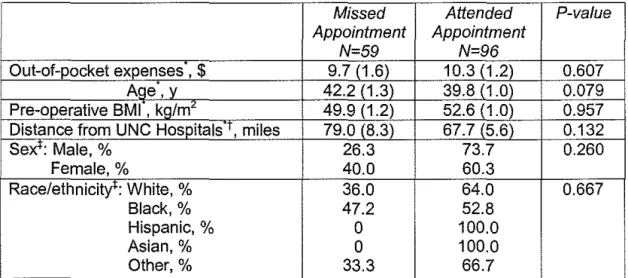
Characteristics of the study population are provided in Table 3. Mean
age was 40.7 years (range 20-65). One hundred thirty-six subjects were female,
nineteen were male. One hundred fourteen subjects classified themselves as
white, 36 as black, one as Asian, one as Hispanic, and three as other. Average
pre-operative BMI was 51.6 kg/m2 (range 32.6-83.3). Subjects traveled an
average distance of 76.3 miles (range <1-740) to UNC Hospitals. When
excluding the distance value for the subject who traveled 7 40 miles, the average
distance is 72.0 miles (range 0-329.9). Ninety-six patients attended the 6-month
post-operative appointment; fifty-nine did not attend. The average out-of-pocket
expense due at the time of 6 month appointment was $10.07 (range 0-61 ).
Association Between Attendance and Covariates
Bivariate statistical analysis did not show a statistically significant
relationship between attendance at the 6 month post-operative appointment and
any of the patient characteristics (Table 4 ). The association between age and
older patients being Jess likely to attend the 6 month post-operative appointment.
Insurance type was not associated with attendance at the 6 month post-operative
appointment (P=0.845). Out-of-pocket expenses were not associated with
attendance at the 6 month post-operative appointment (P=0.607).
Table 3. Characteristics of gastric bypass study population.
Characteristic Value
Age, mean (SD), yo 40.7 (10.0)
Pre-operative BMI, mean (SD), kg/m" 51.6 (9.4) Distance from UNC Hospitals, mean (SD), miles 76.3 (79.3)
Sex, Female, n (%) 136 (87.7)
Male, n (%) 19(12.3)
Race/ethnicity, White, n (%) 114 (73.6)
Black, n (%) 36 (23.2)
Hispanic, n (%) 1 (0.65)
Asian, n (%) 1 (0.65)
Other, n (%) 3 (1.9)
6 Month Appointment Attendance, Attended, n (%) 96 (61.9) Missed, n (%) 59 (38.1)
Table 4. Analysis of association between missed versus attended appointment and potential predictors of attendance.
Missed Attended P-value
Appointment Appointment
N=59 N=96
Out-of-pocket expenses ,
$
9.7 (1.6) 10.3 (1.2) 0.607Age,y 42.2 (1.3) 39.8 (1.0) 0.079
Pre-operative BMI , kg/m" 49.9 (1.2) 52.6 (1.0) 0.957 Distance from UNC Hospitals·T, miles 79.0 (8.3) 67.7 (5.6) 0.132
Sex+: Male, % 26.3 73.7 0.260
Female,% 40.0 60.3
Race/ethnicity': White, % 36.0 64.0 0.667
Black,% 47.2 52.8
Hispanic,% 0 100.0
Asian,% 0 100.0
Other,% 33.3 66.7
. .
Two-sample !-test used to measure assoc1alton between the m1ssed vs. attended appo~ntmenl and the following variables: out-of-pocket expenses, age, pre-operative BMI and distance.
toistance from UNC hospitals missed appointment n=58, attended appointment n=96; one value was dropped because it was a statistical outlier.
tchi-square tests used to measure association between appointment attendance and sex and race.
Fischer's exact test was used to evaluate statistical significance for race because of small sample
Discussion
The purpose of our study was to describe associations between patient
level factors and appointment keeping behavior for the 6 month post-operative
appointment. The long term goal of this project is to determine potential reasons
why patients fail to follow-up so that we can design an intervention to ensure that
patients are getting the care they need after this serious procedure.
Our study did not show an association between attendance at the 6
month post-operative follow-up appointment and out-of-pocket expenses due at
the appointment. Financial reasons for missed appointments have significant
face validity, especially when patients are driving to UNC Hospitals from an
average distance of 76.3 miles. Our study could not explore other potential
reasons why patients did not return for the 6 month follow-up appointment. Our
methods did not include assessment of health perceptions and experiences of
our patients, such as how they view their weight loss progress and whether or
not this may have affected the decision to return to the surgeon for treatment.
Patients may have unrealistic expectations of weight loss progress, and this may
affect their decision to return for follow-up. For example, a patient who expected
to lose 25% of excess body weight within a few months of having the gastric
bypass procedure but who did not achieve this amount of weight loss may be
hesitant to return to the clinic for follow-up. Such a patient rnay feel as if she/he
failed the procedure, or that the surgery team will be disappointed with their
weight loss progress. Alternatively, a patient may feel that the procedure failed
her, or that the surgery team did not perform the procedure correctly and that is
why she has not lost weight. Patients may also have expected improvement in
or resolution of comorbidities, such as diabetes, by the time of their appointment.
Patients rnay harbor unrealistic weight loss expectations even after repeatedly
r
L
r
r
i
!being told that the weight loss process may be slow, and that only 50-75% of
excess weight is lost in the first 1-2 years after the procedure.
Excellent weight loss progress may also be a reason for failing to
follow-up. A patient who is not having a difficult time with diet and exercise changes
and who is losing weight rapidly may not feel that he has to follow-up. The
patient may feel well physically, and decide that there is no reason to attend the
visit
Knowledge of the content of the 6 month post-operative follow-up visit
may help discern reasons why patients miss this appointment At the UNC
Hospitals Gl Surgery Clinic, the gastric bypass 6 month post-operative follow-up
appointment takes approximately 10-15 minutes. The patient is weighed and
informed of their weight loss progress. The attending physician (TF) sees each
patient and reviews progress with diet and exercise, The physician also checks
the incision wound(s), often healed by this time, At the end of the visit, the
patient is sent to the laboratory to have blood drawn to have iron, vitamin 812
and complete blood cell counts checked, From the perspective of the patient, the
interactions during the appointment may seem unnecessary, Patients also may
not understand the purpose of blood draws at every follow-up visit
Considering these potential reasons why patients choose not to return for
the 6 month post-operative up visit, it may be useful to evaluate our
follow-up schedule, Patients are instructed to follow-follow-up regularly during the first
post-operative year and then yearly afterward because of the potential for nutritional
and metabolic deficiencies and for late surgical complications. The bariatric
surgery team is responsible for following patients because they are the experts
the 6 month follow-up appointment could be conducted by a primary care
physician.
All patients who undergo gastric bypass procedures at UNC Hospitals are
required to have a referral form filled out by their primary care physician. The
primary care physician must agree to participate in the follow-up care of the
patient. Primary care physicians manage the obesity-related comorbidities of the
patient, including diabetes, hypertension, coronary artery disease, GERD and
sleep apnea. Patients usually see their primary care physician more frequently
than the bariatric team; the primary care physician's office is often closer to the
patient's home, and visits usually have a lower copayment rate than specialty
surgery clinic. Thus, primary care providers may be well-equipped to follow
patients once they are 6 months post-operative.
Study Strengths and Limitations
To our knowledge, this is the first study to examine follow-up in
post-operative gastric bypass populations. All patients who have had gastric bypass
procedures at UNC Hospitals since July 2000, were living at the time of their 6
month follow-up appointment and could be contacted were included in this study.
Data collectors were blinded to the purpose of our study. We recognize the
importance of post-operative follow-up to ensure good patient outcomes.
Our study has several limitations. First, we used an existing data set to
begin exploration of the problem of loss to follow up, and were limited by our
data, which did not include any subjective patient-oriented or physician-oriented
factors. Second, our hypothesis assumes that patients were aware of any
out-of-pocket expenses due at the six month post-operative visit before the actual visit.
for post-gastric bypass surveillance. Even though each patient had a primary
care physician at the time of referral for the procedure, they may not have had
that same physician at the time of the six month post-operative appointment.
Summary and Future Studies
Maintaining post-operative follow-up is an essential component to
ensuring the long term health of patients who have had gastric bypass
procedures. We conducted a systematic literature review to inform a follow-up
study of gastric bypass patients in the UNC Department of Gl Surgery,
specifically addressing reasons for lack of attendance at the 6 month
postoperative visit. We found limited evidence exists to explain reasons for poor
follow-up in our particular patient population. However, studies of follow-up in
other patient populations indicate that younger age, higher perceived cost of a
doctor visit and higher amount of copayment due at the time of the visit may be
reasons for lack of appointment attendance.
Our study of gastric bypass patients at UNC Hospitals did not find that
attendance at the 6 month post-operative appointment was significantly related to
out-of-pocket expenses due at the time of the appointment. Based on these
findings, we plan to expand our current study with patient and primary care
physicians surveys to further explore this topic. Patient surveys may uncover
reasons for lack of attendance and may help guide future post-operative care.
Primary care physician surveys may help discern the role that these physicians
are able to play in the care of post-operative gastric bypass patients.
I thank Dr. Margaret Gourlay for her encouragement and expertise throughout the thesis writing process. I also thank Dr. Timothy Farrell for helping me to develop this topic, and for support and guidance in completing the project. Karen Colton, R.N., provided the patient demographic data, and Joellen Buckio was instrumental in helping me gather and understand the financial data that was the core of this project. Finally, thanks to Dr. Russ Harris and Dr. Diane Calleson for guidance throughout the writing process.
References
1
Sundbom M and Gustawson S. Bariatric Surgery. Clinics in Dermatology. 2004;22:325-331.
2 Alvarez-Leite Jl. Nutrient deficiencies secondary to bariatric surgery. Current
Opinion in Clinical Nutrition and Metabolic Care. 2004;7:569-575.
3 Skroubis G, Sakellaropoulos G, Pouggouras K, Mead N, Nikiforidis G,
Kalfarentzos F. Comparison of nutritional deficiencies after Roux-en-Y gastric bypass and after biliopancreatic diversion with Roux-en-Y gastric bypass. Obesity Surgery. 2002; 12:551-558.
4
Brolin RE, Jeung M. Survey of vitamin and mineral supplementation after gastric bypass and biliopancreatic diversion for morbid obesity. Obesity Surgery. 1999;9:150-154.
5 Coates PS, Fernstrom JD, Fernstrom MH, Schauer PR, Greenspan SL. Gastric
bypass surgery for morbid obesity leads to an increase in bone turnover and a decrease in bone mass. Journal of Clinical Endocrinology and Metabolism. 2004;89: I 061-1065.
6 Marceau P, Biron S, Lebel S, Marceau S, Hould FS, Simard S, Dumont M,
Fitzpatrick LA. Does bone change after biliopancreatic diversion? Journal of Gastrointestinal surgery. 2002;6:690-8.
7 American Society for Bariatric Surgery. Guidelines for Granting Priviledges in
Bariatric Surgery. Available at: http://www.asbs.org/html/guidelines.html. Accessed 2 May 2005.
8 The Society for American Gastrointestinal and Endoscopic Surgeons.
Guidelines for the Clinical Application of Laparoscopic Bariatric Surgery. Available at: http://www.sages.org/publications.html. Accessed 2 May 2005.
9 Karter AJ, Parker MM, Moffet HH, Ahmed AT, Ferrara A, Lui JY, Selby JV.
Missed appointments and poor glycemic control: an opportunity to identify high-risk diabetic patients. Medical Care. 2004;42:110-115.
10 Smith CM, Yawn BP. Factors associated with appointment keeping in a family
practice residency clinic. The Journal of Family Practice. 1994;38:25-29.
r
L
I
r
Machovec 27
11
Lacy NL, Paulman A, Reuter MD, Lovejoy B. Why we don't come: patient perceptions on no-shows. Annals of Family Medicine. 2004;2:541-547.
12
Murdock A, Rodgers C, Lindsay H, Tham TCK. Why do patients not keep their appointments? Prospective study in a gastroenterology outpatient clinic. Journal of the Royal Society of Medicine. 2002;95:284-286.
13
Campbell JD, Chez RA, Queen T, Barcela A, Patron E. The no-show rate in a high-risk obstetric clinic. Journal of Women's Health and Gender-Based
Medicine. 2000;9:891-895.
14 Catz SL, McClure JB, Jones GN, Brantley PJ. Predictors of outpatient medical
appointment attendance among persons with HIV. AIDS Care. 1999; 11:361-373.
15
Mirotznik J, Ginzler E, Zagon G, Baptiste A. Using the Health Belief Model to explain clinic appointment-keeping for the management of a chronic disease condition. Journal of Community Health. 1998;23: 195-210.
16
Weingarten N, Meyer DL, Schneid JA. Failed appointments in residency practices: who misses them and what providers are most affected? Journal of the American Board of Family Practice. 1997; 10:407-411.
17
Cashman SB, Savageau JA, Lemay CA, Ferguson W. Patient health status and appointment keeping in an urban community health center. Journal of Health Care for the Poor and Underserved. 2004;15:474-488.
18
Majeroni BA, Cowan T, Osborne J, Graham BP. Missed appointments and Medicaid managed care. Archives of Family Medicine. 1996;5:507 -511.
19
National Institutes of Health. Gastrointestinal Surgery for Severe Obesity. Available at: http://consensus.nih.gov/cons/084/084 statement.htm. Accessed 20 April2005.
t
F
L
L
"---Study Authors, Design Population
Year
Lacey, Qualitative Urban, university affiliated family 34 patients selected Open~ended interview guide developed by Reasons for non~attendance (% of sample Paulman, and chart practice outpatient clinic adult, English~ authors reporting this reason):
Reuter and review speaking patients
Lovejoy, 2004 12~15 minute patient interviews to assess Emotional barriers, such as negative feelings Sex: patient's personal experiences of missed about seeing doctor (65%)
32 women, 2 men appointments
Perception that clinic staff does not respect Age: mean 40 y Retrospective chart review to determine respondent's time or opinions (44%)
patients' missed versus kept appointments Race/Ethnicity:
58% African-Am. 37% Euro-Am. 4% Hispanic-Am.
Murdock, Descriptive, University-affiliated gastroenterology All living patients Mailed questionnaire to all patients who Reasons for non-attendance (percent of sample Rogers, Cross- clinic in urban Belfast, Northern who missed missed appointments, and telephoned patients reporting this reason):
Lindsay and sectional Ireland appointments during who did not return questionnaires
Tham 2002 27 consecutive Forgot to attend or cancel (30%)
Inclusion: all living patients who clinics (n=1 00) Questionnaire designed to determine: No reason (26%) missed appointments during 27 • why referred to Gl clinic Clerical errors (10%) consecutive clinics Sex: NR if patient missed appointment before Feeling better (8%)
Age: NR if patient was new or returning Fear of junior medical staff (3%} i
Race/Ethnicity: NR • why patient did not keep appointment Inpatient in hospital at time of appointment (3%) '
Other (20%) '
Campbell, Qualitative Tertiary care outpatient clinic for All patients who did Nurse case manager called patient within 24 Reasons for non-attendance (percent of sample Chez, Queen, indigent, high-risk obstetric patients not return for follow- hours after missed appointment to interview reporting this reason):
Barcelo and up appointments patients
Patron 2000 during 3 separate Lack of transportation (29%)
one month intervals Interview tool was 9 close ended questions Scheduling problems (19%) in 1g98-1999 developed by authors designed to determine: Forgot or overslept (18%) (n=261) • reason for missing appointment Sick child/relative (10%)
• if patient knows why her pregnancy is Lack of childcare (1 0%) Sex: 100% women high risk Financial reason (4%) Age: NR • effect complications could have on
Race/Ethnicity: NR pregnancy outcome
• if patient believes that attending clinic will improve outcome
Moffet, sectional plan membership demographic data
Ahmed, who had at least Primary care ~hysician vs. specialist vs. no PCP
Ferrera, Lui, one outpatient visit Automated outpatient and pharmacy records assigned: NS Selby 2004 in 2000; excluded used to gather information on potential
patients with confounders, including chronic medical Women vs. men: NS missing values conditions
Living in poverty area: 1.5x greater odds of poor Sex: 47.6% women appointment keeping behavior
Age: mean 60.8 y
Capay amount (compared to $0 capay): • $1-5 capay 1.1 x greater odds of poor
appointment keeping behavior
• $6-10 capay 1.1x odds poor appointment keeping behavior
>$10 capay 1.3x odds poor appointment keeping behavior
Smith and Cross- Family Practice residency clinic of Patients who kept or Patient schedule database used to gather Appointment keeping varied by age: Yawn 1994 sectional Hennepin County Medical Center, missed a scheduled appointment data 0-19 y 72.7% kept appointments
Minnesota appointment with 20-39 y 69.3% kept appointments
physicians April- Mainframe computer system and manual chart 40-59 y 80.4% kept Patients who kept or missed a June 1991 (n=4669) audits used to collect demographic 60+ y 89.9% kept scheduled appointment with characteristics
physicians April-June 1991 Sex:NR Odds of appointment keeping by insurance type Age: NR (using private insurance as reference}: Race/Ethnicity: NR 0.7x odds for traditional medical assistance
1.1x odds for managed care medical assistance
Predictive model:
Among people >16 yo, type of insurance, race and aae predict appointment-keeoina behavior Weingarten, Cross- Family Medicine Institute, Augusta, Patients scheduled Hospital computer system and clinic schedule Appointment keeping associated with age and Meyer and sectional ME, an outpatient practice of Maine- for appointments sheets used to gather information on kept insurance type
Schneid 1997 Dartmouth family practice residency during 36 randomly versus missed appointments, sex, DOB, and
selected months in insurance status P for trend:
1995 (n=3962 P=0.0001 for age (older more likely to keep
scheduled visits, n appts)
patients NR) P=0.0001 for insurance type
Brantley 1999 participate (n=160) Medical record review to gather medical data R = 0.02 for months HIV +, p NS
Sex:46.5% female Psychological batteries: BHS, ISEL, WROCS' 15% appointment no-show rate for Caucasians, 30% for minorities, p<0.0001
Age: NR
Multiple Regression Model:
Race/Ethnicity: Age and race predict% no-show appointments
66% Afr-Am (p<0.01)
32% Caucasian 2% Hispanic
Mirotznik, Case-series Arthritis Clinic at SUNY Brooklyn Patients with SLE Developed questionnaire using HBM When adjusted for other HBM variables, general Ginzler, enrolled in Arthritis definitions; tested reliability and construct health motivation (P<0.01 ), perceived benefits of Zagon and clinic> one year, validity of questionnaire in this population only visits (P<0.05) and perceived costs of visits
Baptiste 1998 with> one (P<0.01) associated with appointment keeping
appointment in past Abstracted data from clinic files: 12 months measure 3 years; excluded retrospective and 6 month prospective
210 patients who appointment keeping behavior Perceived costs of doctor visit correlated with 12 died, moved away month retrospective% appts kept, r=-0.21, or were mentally p<0.01 and with 6 month prospective % appts incapable (n=153) kept, r=-0.24, p<0.01
Sex: 95% female Linear regression models: perceived costs of dr visits sign associated with 12 month retrospective Age: mean 42.39 y (p<0.01) and 6 month prospective (P<0.05)% of
scheduled appts kept, when controlled for Race/Ethnicity: general health motivation, perceived susceptibility 8% White to SLE, perceived severity of SLE, and perceived
70% Afr-Am benefits of doctor visits
18% Hispanic 1% Asian 3% other
Osborne and Graham 1996
Cashman, Case-series Savageau,
Lemay and Ferguson 2004
'NR = not reported. tNs = not significant. 'BHS, ISEL, WROCS =
'HBM = Health Belief Model.
Inclusion: every 51h medical record,
alphabetically; patients who had been seen at least twice in previous 18 months
Urban Family Pract'1ce Community Health Center in New England
Inclusion: patients scheduled during selected week in February 1999
Sex: insurance, #missed appts, #kept appts blacks than whites in all age groups except >75
41% male yo
Age: mean 30 y Medicaid managed care and private managed care have higher miss rates after adjusting for Race/Ethnicity: sex, race and age (P<0.001)
67% AfruAm 24% White
465 patients Audited charts of patients scheduled during Number of scheduled appointments (P 0.000), selected week in February 1999, and patient age (P=O.OOO), and number of Sex: examined patient appointment keeping psychological conditions (P=0.009) associated 71% female behavior during an 18 month period, Aug with number of missed appointments
1998-Feb 2000
Age: mean 42 y Gender, insurance, distance from practice, Also gathered sociodemographics, chronic provider type, number of diagnosed physical Race/Ethnicity: health problems, substance abuse from conditions, obesity not associated with number of 34% White medical charts missed appointments when controlling for all
10% Afr-Am other factors in model
a. Cross-sectional studies
Karter, Parke!, Moffet et al.,
2004 Smith and Yawn 1994 Neingarten Meyer and Schneid 1997
b. Qualitative studies.
Murdock, Rogers, Lindsay and
et
Paulman, Reuter and
2004
3
3
2
3 2 0 2 3 13
3 2 0 2 3 13
1 0 0 2 3 8
Table 2 (Continued). Quality ratings for studies in systematic review. Each study was rated 0-3 for each category, with O=poor, 1=fair, 2=good,3=excellent.
Catz, McClure, 3 1 1 0 2 3 10 Jones and
1999
Mirotznik, 3 1 2 0 2 2 10
Ginzler, Zagon and Baptiste
1998
Majeroni, 3 1 3 2 2 2 13
Cowall, Osborne and Graham 199
Cashman, 3 1 2 0 2 1 9