Iqbal Muhammad, Asmawi Moch, Tangkudung James,Dlis Firmansyah, Saputra Surya Adi. Interactive Multimedia Development in Futsal Basic Techniques. Journal of Education, Health and Sport. 2019;9(10):121-131. eISSN 2391-8306. DOI http://dx.doi.org/10.5281/zenodo.3491207
http://ojs.ukw.edu.pl/index.php/johs/article/view/7582
The journal has had 5 points in Ministry of Science and Higher Education parametric evaluation. § 8. 2) and § 12. 1. 2) 22.02.2019. © The Authors 2019;
This article is published with open access at Licensee Open Journal Systems of Kazimierz Wielki University in Bydgoszcz, Poland
Open Access. This article is distributed under the terms of the Creative Commons Attribution Noncommercial License which permits any noncommercial use, distribution, and reproduction in any medium, provided the original author (s) and source are credited. This is an open access article licensed under the terms of the Creative Commons Attribution Non commercial license Share alike.
(http://creativecommons.org/licenses/by-nc-sa/4.0/) which permits unrestricted, non commercial use, distribution and reproduction in any medium, provided the work is properly cited.
The authors declare that there is no conflict of interests regarding the publication of this paper.
Received: 25.09.2019. Revised: 30.09.2019. Accepted: 16.10.2019.
Interactive Multimedia Development
in Futsal Basic Techniques
Muhammad Iqbal
1, Moch Asmawi
2, James Tangkudung
2,
Firmansyah Dlis
2,
Surya Adi Saputra
11.
STKIP Kusumanegara
2.
Universitas Negeri Jakarta
ABSTRACT
The purpose of this research is to develop some basic techniques and makeup products in the form of variations of exercises and training videos so that they can Easily be learned by the general public. In this study using the Research and Development Adopted method from borg and gall. The needs analysis was Carried out with 35 subjects as students who had passed the futsal course. Small group test with a sample of 12 people with good results then proceed to the large group stage with a sample of 40 people with good results and Proceeds to a PACT test with a total of 2 people and Obtained good results and can be used in actual practice.
Based on the hypothesis testing and calculation criteria Obtained Sig. = 0036 <, it can be concluded that H0 is rejected. Thus, it was concluded that there were significant differences in the results of the posttest and pretest between before and after treatment being given interactive multimedia, where the results of the posttest effectiveness test were higher than Reviews those of the pretest.
Based on this information it can be said that the interactive multimedia-based interactive skills playing futsal training the model is effective and can improve skills playing futsal. Based on the results of the study it can be concluded that the futsal-based interactive multimedia models developed playing skills training has significant effectiveness.
Background
"Futsal" started in 1930 when Juan Carlos Ceriani, a teacher in Montevideo, Uruguay, created a version of indoor football for recreation in YMCAs. This new sport was originally developed for playing on basketball courts, and a rule book was published in September 1933. The Football was already highly popular in the country and after Uruguay won the 1930 World Cup and gold medals in the 1924 and 1928 Summer Olympics, it Attracted even more practitioners. Ceriani's goal was to create a team game that could be played indoor or outdoor but that was similar to football. Ceriani, writing the rule book, took as examples the principles of football (the possibility to touch the ball with every part of the body except for the hands), and he took rules from other sports too: from the number of team basketball players (five) and the game duration (40 actual minutes); from water polo the rules about the goalkeeper; from team handball for the field and goal sizes. The YMCA Immediately spread the game throughout South America. It was Easily played by everyone, everywhere, and in any weather condition, without any difficulty, helping players to stay in shape all year round. Reviews These reasons convinced João Lotufo, a Brazilian, to bring this game to his country and adapt it to the needs of physical education. Initially, the rules were not uniform. In 1956, the rules were modified by Habib Maphuz and Luiz Gonzaga de Oliveira Fernandes within the YMCA of São Paulo, Brazil to allow seniors to Compete. Luiz de Oliveira wrote the Book of Rules of Futsal in 1956, then Adopted Also at the international level. In 1965, the Confederacion Sudamericana de Fútbol de Salón [pt] (South American Futsal Confederation) was formed, consisting of Uruguay, Paraguay, Peru, Argentina and Brazil. Shortly after, a unique tournament was organized. It Attracted some interest in South American media, the which regularly Began to follow futsal. In particular, it was the journalist José Antônio Inglêz who passionately Contributed to the rapid spread of the game, as well as being credited as the man who coined the name "Futsal" to define the sport.
Futsal is a game that is almost the same as football in general, but there are some basic techniques that are different from soccer. Because this is the shape of the field is small and the number of players is small Compared to football. Futsal stands for the word fútbol (soccer) and sala (room) from Spanish or futebol (Portugal / Brazil) and salon (France). This sport forms a player to always be ready to receive and feed the ball quickly intervening in the pressure of the opponent's game. There is Often a defeat in one team Because The initial foundation is not built firmly, meaning that the same thing with football in futsal Also has basic techniques that must be mastered by every player. Even basic techniques in futsal will be successive or in a short time will continue to experience repetition, so it is natural that even more rapid fatigue Occurs. At the student level It is also not necessarily the existence of good skills in playing futsal sports, this is based on one's interests to the level of mere hobbies. To learn this basic technique depends on the habits and perseverance of each individual.
But the fact that many occur in the field after the researcher observes students, especially STKIP Kusumanegara Jakarta, has a degree of difficulty in understanding and practicing basic movements or basic futsal techniques. This was evidenced when the researcher conducted an initial test each time giving a futsal course to Determine the level of mastery of the basic techniques of each student. After several times the author of the Gave an overview of using interactive multimedia, there was an increase of. Therefore, The writer wants to develop basic techniques of futsal training using interactive multimedia. The purpose of this development is that anyone who wants to know both basic techniques and some basic engineering Easily exercises can be understood Because It can be seen on a TV screen and can be set or can be selected desired.
Centuries ago, such as printed books, to telecommunications media such as, sound recorded on cassettes, videos, television, CD and learning through the internet (e-learning) (Nuno, Atalaia, Rebelo, Carolino, and Vaz, 2015) .With the perkembangna technology, visual and non-visual information learning information can be simulated more realistically and easily into the memory of the students in various ways. The use of a wide variety of learning resources is possible using the latest technology. With the advancement of technology the students will more easily accept and process the information into a knowledge (Avelar et al., 2008).
The results of the needs analysis that Researchers have done is by distributing questionnaires to students who are members of the Student Activity Unit (SMEs) futsal at STKIP Kusuma Negara in Jakarta, the results show that 1) of 35 students 100% of students said the trainer had never Provided interactive multimedia to help practice, 2) out of 35 students 48.57% of students stated that the models used by trainers when practicing was still not varied, 3) out of 35 students 100% stated that there was a need to develop futsal skills training models, 4) out of 35 students 100% felt the need the development of interactive multimedia futsal skills training models. Whereas based on the results of observations made by Researchers during training, it is Necessary to find the media to practice in the form of interactive video and multimedia,
The hope of Researchers with the existence of a new thing in the world of futsal will help students, students or coaches to continue to make their athletes Become more accomplished Because they see how enthusiastic the community is currently providing support to Reviews their children to take courses or practice sites that are scattered in various regions and cities. big city.
In the world of students can still be used multimedia, plus more low-level students who are not skilled in mastering all the techniques in the futsal branch. At the student level Certain It is also not that there are good skills in playing futsal, this is based on one's interest to the level of mere hobbies. To learn this basic technique depends on each individual's habits and perseverance. But the fact that a lot happens Researchers in the field after the make observations on students, especially STKIP Kusumanegara Jakarta, there is a level of difficulty in understanding and practicing basic motion or the basic techniques of futsal. This is evidenced when Researchers conduct initial tests every time they give futsal courses to Determine the level of mastery of the basic techniques of each student.
Therefore the author wants to develop basic techniques of futsal training using interactive multimedia. The purpose of this development is that anyone who wants to know both basic techniques or some basic technical exercises Easily can be understood Because they can be Viewed on a TV screen and can be set or can be chosen as desired.
Based on the description in the above background, this study focused on the Interactive Multimedia Development in Futsal Basic Techniques at STKIP Kusumanegara.
Purpose
The purpose of this research is to develop some basic techniques and makeup products in the form of variations of exercises and training videos so that they can Easily be learned by the general public. The results of this study are expected to provide information specifically for 1. The coaches and coaches of futsal branches.
2. The futsal athletes in order to really understand the basic techniques provided by the coach and their usefulness can be Tirrenus.
3. Physical education teachers as additional insights, especially in futsal sports.
4. The general public who are interested in adding scientific treasures in fostering the younger generation of futsal sports through interactive multimedia.
Method.
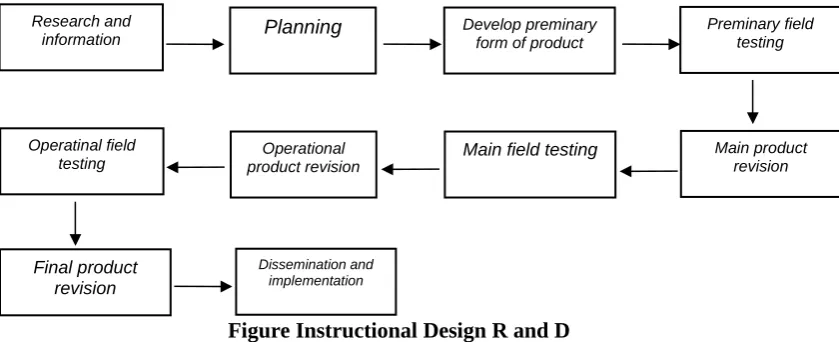
[image:4.595.98.518.167.338.2]This is research and development (R & D) Method, the next step is to do the stages in the development of the models. Research and development of this model of using the steps of developing a model of developed by Borg and Gall Theory. Or it can be Described in terms of stages of development schemes as shown below:
Figure Instructional Design R and D
source:Walter R. Borg and Meredith D. Gall, Educational Research: An Introduction, 4th Edition. (New York: Longman Inc., 1983)
In this research the model of development is a process used to develop and validate learning products. Research by Nana Syaodih Sukmadinata development is a process or steps to develop a new product or improve existing products, the which already can be accounted. Research and development in this study using a model of development of Research & Development (R & D) with a flow chart that consists of seven steps, among others:
1. First time specified is an ideas that will be developed, to gather information as a rationale for making the concept.
2. Making the learning models (product design), the shape of the design is a model of a form of exercise.
3. A product revision, the revision Carried out by the expert concerned. 4. Production of the prototype, being done with futsal practice models.
5. The test prototype, testing of the subject field in both the trial phase I and phase II trials.
6. The second product revisions, revisions were made by experts, in order to Obtain a perfect expert.
7. Reproduction, improvement of product to get the final product is expected.
Research development of this the model consists of three phases, with steps description design explanation has been modified and aligned with the purpose and conditions of the actual research, Cleary as illustrated in the following table:
Research and
information Planning Develop preminary form of product Preminary field testing
Operatinal field
testing product revisionOperational Main field testing Main product revision
Final product revision
Tables and Steps Stage Development Research
stage Step Activity
Pre-Development 1 a. Initial Data collection
b. Preparation of research proposals
c. analysis of needs
2 a. learning plan
Development 3 a. learning
4 Formative evaluation:
a. Early trials (1)
Expert evaluation of Phase I (Expert juggement) with futsal experts and learning experts of physical education. Initial repair (1)
5 a. Early trials (2)
Expert evaluation stage II (Expert juggement) with futsal experts and learning experts of physical education.
b. Initial repair (2)
Application 6 a. field trials
Evaluation by the limited scale of 30 respondents
7 Revised Product
Implementation / dissemination
production Model Production
Data analysis
Data collected during needs analysis, expert validation: exercises, medium, and small, large group trials in the form of qualitative data, the observations and suggestions as well as qualitative input and the data in the form of questionnaires and Also results of effectiveness tests. Qualitative Data is Analyzed when the data collection takes place and after the data collection is completed, by summarizing the the data to select a key and important things, then presenting the data so that it is easy to understand According to what is happening and planning further work. The next work is drawing Conclusions and verifications roomates are new findings in the form of descriptive (Sugiyono, 2009a).
Taking general Conclusions on the basic technical skills training model of playing futsal as a whole the results of the validation of the test subjects, then used a qualitative descriptive analysis with established criteria, as in the table below
Table Descriptive Analysis Validation Criteria Subject Subject (Source adapted from Hariyoko: 2012).
PERCENTAGE PERCENTAGE
80% - 100% EXERCISE MODELS USED ARE VERY WORTH
60% - 79.99% WORKING MODELS USED
50% - 59, 99% MODELS USED ARE WORTH LESS AND NEED TO BE REVISED
0% - 49, 99% EXERCISE MODELS ARE NOT WORTH IT USED AND NEED TO
BE REVISED
Results
After the futsal skills training models are compiled and designed on the print media, the next research collects various materials such as audio, text, images, animation, and video that are used to produce interactive multimedia futsal skills training. In this interactive multimedia product, there are 72 models in the form of animation, text, audio, and video at varying speeds, and there are Also additional menus such as home, quizzes, exit, instructions, heating, cooling, game rules and development profiles.
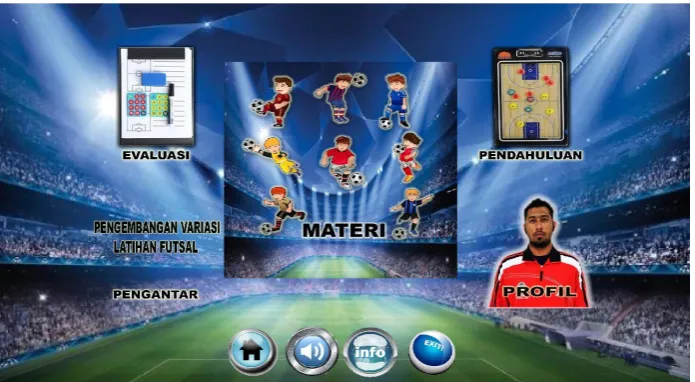
[image:6.595.125.473.242.433.2]This interactive multimedia product was developed using autoplay media studio 8.0 software. in the process of making this an interactive multimedia Several components combine, Including text, flash, images, audio, video, and interactive software creator. In the end the multimedia product is packaged in *. Exe form on the VCD. The following is an interactive multimedia product display of Futsal skills training models
Figure Display Main Menu Interactive Multimedia Futsal Skills Exercise (Source: researcher)
Display in the image above is a multimedia display on the main page / Home menu. This menu is the initial menu when the user opens the application after being bumped by the bumper / opening. In this main menu Including Several menus are presented, materials, development profiles, evaluation questions, instructions for use, rules of the game and are equipped with supporting navigation buttons Including the exit button and the on / off music button. To open the menu content, users simply left-click once on the desired menu.
The display in the image above is a multimedia display on the developer's profile menu. This menu contains information about the product development in the form of flash on the left and videos on the right. This menu presents Also Several of the main menus, material, profile development, evaluation, heating, instructions for use, and is equipped with navigation buttons supporting Including the exit button and the button. To open the menu content, users simply left-click once on the desired menu.
Display Menu Instructions for Use of Interactive Multimedia Futsal Skills Training (Source: researcher)
See in the picture above is a multimedia display on the menu usage instructions. This menu contains information about the contents of models of practice, and there is a critically important information for users regarding the product being developed. This menu is also served several other main menu, material, profile development, evaluation, heating, instructions for use, rules of the game and is equipped with the navigation key supporters include exit button and the button. To open the content menu, the user simply left-click once on the desired menu.
See in the picture above is a multimedia display on the menu material. This menu contains six main buttons. At each key will go to the specific model in accordance with the instructions provided. To view the details of content models, users can simply make a single left-click on the desired model. This menu is also served several other main menu, material, profile development, evaluation, instructions for use, rules of the game and is equipped with the navigation key supporters include exit button and the button. To open the content menu, the user simply left-click once on the desired menu.
Display Menu One Futsal Skills Training Materials (Source: researcher)
See in the picture above is a multimedia display on one of the main menu kicking a model material lower streak in pairs. Appears on the display model information contained in text form is processed into a FAQ so that it can expand and hide automatically when you click on the left. While on the right side is a box for displaying terliha video practice models .. This menu is also served several other main menu, material, profile development, evaluation, instructions for use, rules of the game and is equipped with pen navigation buttons [another key support between exit and Tombo , To open the content menu, the user simply left-click once on the desired menu.
The models developed include recognition of ball skills, passing skills, shooting skills, dribling skills, chipping skills, and heading skills. With a number of 72 variations of the training models. There are four variables play Evaluating learning assessment experts on the technology developed namely interactive multimedia; multimedia graphic design, Animation and sound effects, a combination of sound and video images, and ease of use. Based on the the data presented above, the results show that the interactive multimedia product of this futsal skills training models Obtained a total score (X) of 271 from the maximum score (Xi) 288 with a percentage of 94.04, the which means that overall the product good meets the criteria so that it can be used on actual learning.
Based on the evaluation of futsal experts on the developed training models, the results show that the product of this futsal skills training models is feasible for use in actual learning, seen from the four play-assessment variables namely; the completeness of the training models, the accuracy of the training models related to futsal skills, the accuracy of the description of each model and the accuracy of the video. The results Showed that the product of this futsal skills training models Obtained a total score (X) of 413 from the maximum score (Xi) 432 with a percentage of 95.60 the which means that the overall product meth good criteria, so that it could be used in actual learning.
No
. item X Xi Percentage categories
1 Completeness of training models in increasing
student knowledge and skills 3.75 4 93.75 valid
2 Determination of training models futsal skills with
concepts 3.67 4 91.67 valid
3 Determination of description on each models 3:50 4 87.50 valid
4 Video accuracy 3.75 4 93.75 valid
5 Multimedia graphic design 3.75 4 93.75 valid
6 Animated graphics and sound effects 3.67 4 91.67 valid
7 Combination of images, sounds and videos 3.75 4 93.75 valid
8 Ease of Use 3:50 4 87.50 valid
total 29.33 32
Average 91.67
The following table shows the results of a large group trial of a variety of models of multimedia-based interactive training futsal Obtained from 60 students
No
. item X Xi Percentage categories
1 Completeness of training models in increasing
student knowledge and skills 3.77 4 94.17 valid
2 Determination of training models futsal skills with concepts 3.73 4 93.33 valid
3 Determination of description on each models 3.73 4 93.33 valid
4 Video accuracy 3.67 4 91.67 valid
5 Multimedia graphic design 3.70 4 92.50 valid
6 Animated graphics and sound effects 3.70 4 92.50 valid
7 Combination of images, sounds and videos 3.77 4 94.17 valid
8 Ease of Use 3.80 4 95.00 valid
total 29.87 32
Average 93.33
pretest posttest
0 20 40 60 80 100
63
92
a diagram of the average pretest and postest futsal skills
Based on the Data Obtained from the gain score calculation, the average gain score is 0.78, the which means that the product developed has Contributed to the high level of the futsal training process.
Discussion / Conclusions.
Based on the Data Obtained, from the results of field trials and discussion of the results of the study can be concluded through this interactive multimedia-based futsal skills training model of students can learn and carry out exercises Effectively and efficiently in mastering both theoretical and practical material ,
Based on the Conclusions Obtained, some suggestions can be conveyed as follows: this product development is a printed book and VCD futsal skills training models can be used as a reference or additional reference for trainers, teachers, students and lecturers of futsal basic motion courses. The interactive multimedia skills training models based futsal contains a variety of training models and guidelines for Reviews their implementation in a Concise and easy to understand manner so it is highly recommended for students or athletes to be utilized in exploring futsal skills training well.
This development product is a printed book and a VCD model of futsal playing skills training that can be used as a reference or additional reference for coaches, students and lecturers supporting TP Futsal courses. Models of futsal playing skills based on interactive multimedia contain a variety of training models and implementation guidelines in a short and easy to understand manner so that it is strongly recommended for students or athletes to be utilized in exploring futsal playing skills well. Based on this information it can be said that the interactive multimedia based interactive futsal playing skills training model is effective and can improve futsal playing skills. Based on the results of the study it can be concluded that the futsal-based interactive multimedia playing skills training model developed has significant effectiveness. In disseminating development products to a broader target, researchers provide suggestions, including: Before being distributed, this product should be rearranged for the better, both about the packaging, appearance and contents of the product material being developed. The interactivity of the application to make it easier for users to operate should be a special concern before being distributed. In developing this research further, the researcher has several suggestions, as follows. for research subjects it should be done on broader subjects, both athletes and futsal clubs. The results of the development of books and VCD models of futsal playing skills training can be disseminated to all futsal clubs in Indonesia.
Thus the suggestions for the use, dissemination, and further product development for the development of interactive multimedia based Futsal playing skills training models.
REFERENCES
Abdulkadir Ateng, Principle and Foundation of Physical Education Jakarta: Ministry of Education and Culture P2TK Directorate General of Higher Education, 1992
AFC, AFC Coaching Youth Hanbook For Boys & Girls aged 13-20 Kuala Lumpur, AFC 2006 Arif S. Sadiman, Educational Media Understanding, Developing and Utilizing it, Jakarta: Rajawali Press. 2011
Asim, "Steps for Research Development", Research Methodology for Development of Malang Education and Learning: Malang State University, 2001
Borg. W. R & Gall, M. D, Education Research: An Introduction New York: Longman, 1983 Bruce Joyce, Marsha Weil, and Emily Calhoun. Models of Teaching Boston: Pearson Education: 2009
Cheryl A. Coker, Motor Learning and Control for Practitioners USA: The McGraw-Hill Companies, 2004
Eko Hariyanto, Physical Education Development of Learning Music for Children with Autism Jakarta: UNJ 2011
James Tangkudung and Wahyuningtiyas Puspitorini, Sports Coaching, Training Achievement Edition II Sports Jakarta: Intelligent Jaya 2012
Justinus Lhaksana, Engineering and Strategy Futsal Modern, Depok: Be Champion 2012
Meredith D. Gall Gall Walter R. Joyce P. Borg, Educational Research An Introduction to Seventh Edition New York: University of Oregon, 2003
Mick Critchell, Michigan's Warm Ups for Soccer A Dynamic Approach, Reedswain Publishing, 2002
Park Jin-Hoon, Heather Wilde, Charles H. Shea (2015), Part-Whole Practice of Movement Seque nces. Routletge, Texas: Department of Health and Kinesiology at Texas A & M University, Vol. 36, No. 1, 51-61.
Cassie Wilson, Scott Simpson, Joseph Hamill (2009), Movement Coordination Patterns In Triple Jump Training Drills, Routledge. Amherst: University of Massachusetts, 2009; 27 (3): 277-282.