The overall goal of this project is the development of new catalytic strategies for the construction of carbon-carbon bonds. Specific interests are in the formation of aryl-sp3 hybridized carbon-carbon bonds via C-H alkylation of arenes and heteroarenes with alkyl iodides, resulting in the formation of small molecules with polycyclic aromatic cores. This kind of bond connection is prevalent in a wide range of natural products with significant value, as highlighted in Figure 1.
Figure 1. Highlighted in red are the aryl-sp3 carbon-carbon bonds which are proposed to be possible using this chemistry. Aripiprazole (Abilify), and Clopidogrel (Plavix) are two of the top 200 brand name drugs by retail dollars in the US in 2012.1
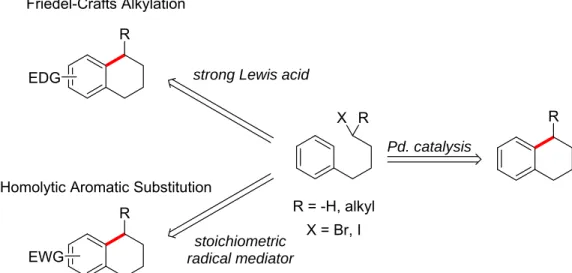
Traditionally this kind of bond connection has been accomplished using Friedel-Crafts alkylation or homolytic aromatic substitution. Friedel-Crafts alkylations, which operate by an electrophilic aromatic substitution mechanism with a carbocation, have a number of
of strong Lewis acid. The arenes used in the reaction are required to be electron rich so that they can attack the carbocationic electrophile. Additionally, there is the possibility of rearrangement in the substrates upon the formation of a carbocation. After a single alkylation to an arene, the resultant product is slightly more reactive than the starting material, and polyfunctionalization can readily occur. Lastly, Friedel-Crafts alkylations are not always tolerant of function groups such as alcohols and amines. The strong Lewis acids can interact with these functionalities and cause side reactions or shut down the reaction completely.2 This large number of disadvantages greatly limits the scope of Friedel-Crafts alkylations.
Homolytic aromatic substitution, which operates by a nucleophilic radical attack on the arene, has a different set of disadvantages. The first being the requirement of a radical initiator to produce the radical that will attack in to the arene. Some radical initiators, such as tributyltin hydride, are highly toxic and extra care must be taken that no trace amounts are left in the product. Additionally, homolytic aromatic substitution reactions require an electron poor arene or heteroarene, and the radical attacking in to the arene must be a sufficiently electron rich radical.3
X R R
R
EDG
R
Pd. catalysis
R = -H, alkyl Friedel-Crafts Alkylation
Homolytic Aromatic Substitution
X = Br, I
strong Lewis acid
stoichiometric radical mediator
EWG
It is evident that each of the traditional methods for C-H activation leaves significant room for improvement and expansion. More recently there have been advances in palladium-catalyzed C-H activation to make similar bond connections. The Fagnou group reported an intramolecular C-H arylation reaction to form aryl-aryl bonds using palladium catalysis.4 The reaction had a broad substrate scope and relatively mild reaction conditions. This showed that similar bond connections to what we are looking to make are possible. The Sanford group has reported an intermolecular C-H perfluoroalkylation to form aryl-sp3 carbon-carbon bonds using palladium catalysis.5 This reaction requires perfluoroalkyl iodides, which are activated alkyl iodides, to achieve good results. In this work we are looking to use unactivated alkyl iodides in an intramolecular fashion to achieve C-H activation to form aryl-sp3 carbon-carbon bonds.
In the Alexanian lab, preliminary results were obtained for the palladium-catalyzed C-H alkylation of an aromatic system using a primary, malonate-tethered iodide substrate (Figure 3). Once these results were obtained, the next step was to optimize the reaction conditions through an investigation of the catalyst system, ligand, base, solvent, and temperature.
EtO2C CO2Et
I
10 mol % Pd(PPh3)4 2 equiv K3PO4 0.5 M PhH
130 °C R = H, 56% Yield
R= OMe, 46% Yield R= CF3, 25% Yield
R When
R
EtO2C CO2Et
Figure 3. Preliminary results for the palladium-catalyzed C-H alkylation of aromatic systems. The data presented in Data Table I contains the optimization conditions tested to arrive at the final conditions. The optimized conditions for this reaction resulted in a 91% yield of
that the reaction can be completed under a radical pathway, but the results using the palladium-catalyzed system are more than twice as good. If the reaction is run under control conditions without palladium, then as expected there is no product formation.
Data Table I. Optimization of Reaction Conditions
Entry Deviations Yielda
1 None 91%
2 1.1 equiv DLP, Benzene, No Base or Pd 42%
3 No Pd(PPh3)4 0%
4 Pd(dppf)Cl2 substituted for Pd(PPh3)4 20%
5 Benzene substituted for PhtBu 73%
6 Xylenes substituted for PhtBu 45%
7 K3PO4 substituted for PMP 50%
If the catalyst ligand is changed to 1,1'-bis(diphenylphosphino)ferrocene dichloride then there is a large decrease in yield. This ligand was chosen in hopes that it would decrease the amount of β-hydride elimination side product. This is because the bidentate ligand clogs the open
coordination spot of palladium more than in tetrakis(triphenylphosphine)palladium. While it was successful in decreasing the formation of the β-hydride elimination side product, it also
drastically reduced the formation of the desired product. This is thought to occur because to form the desired product, hydride elimination is proposed to take place. As a result of this, the β-hydride elimination side product was suppressed, but so too was product formation. When exploring the solvent system, if benzene or xylenes are used instead of tert-butyl benzene, then
increases. This happens because the xylenes have abstractable protons allowing for the formation of the reduction side product more easily. Lastly if an inorganic base is used in place of an organic base, the yield also decreases. However this was not found to be true across the entire substrate scope, as the optimal base is very substrate dependent.
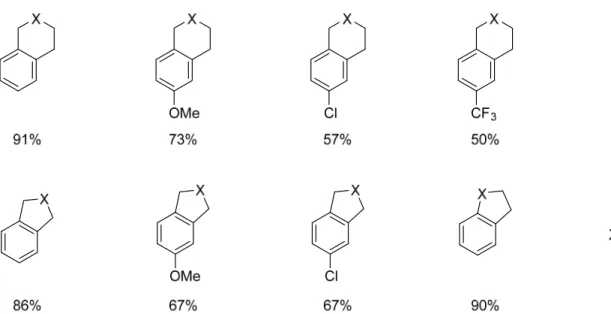
The substrate scope of this reaction includes a range of alkyl iodides. The first set of substrates that I have been involved in synthesizing includes the primary alkyl iodides with malonate moieties in the alkyl chain tether. The malonate in the tether is useful in providing a Thorpe-Ingold effect to force the alkyl iodide closer to the arene, where it should react in an intramolecular fashion. The extent of this effect can be seen in Figure 4, where once the
malonate is moved from the second position to the first position of the tether with respect to the arene, there is a decrease in yield by 38%. Because the Thorpe-Ingold effect has been moved further from the reactive end of the alkyl chain, the effect is not as strong and a sharp decrease in yield is seen. This is not seen when the malonate is moved from the second to the first position in the 5-membered ring substrates because the Thorpe-Ingold effect is still within two carbons of the reaction site.
In an attempt to increase the substrate scope and expand the synthetic utility of this reaction, we sought to synthesize a range of heterocycles. Unfortunately, the dihydrobenzopyran derivative products were not able to be accessed in good yields; however, the
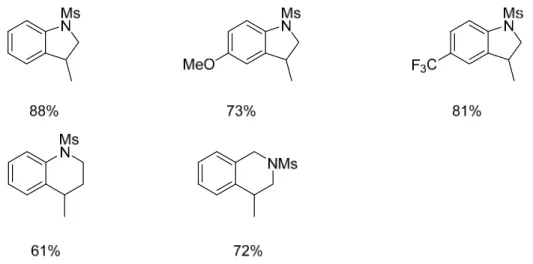
tetrahydroquinoline substrates were achieved with moderate yields of 30-31%. In an effort to increase the yield of these reactions, we went back to test secondary alkyl iodides with sulfonamide tethers. The choice to use secondary iodides was made because there were large amounts of β-hydride elimination side product and reduction side product, and we were looking to minimize those. It was thought that the less reactive intermediates could direct more substrate towards the desired product. The results (Figure 5) show that both 5 and 6-membered
heterocycles were formed in good yield. Additionally, there is a Thorpe-Ingold effect seen in the 6-membered heterocycle substrates. When the sulfonamide is in the second position of the tether the yield is 11% more compared to in the first position of the tether. It is also interesting to note that when using secondary iodides the reaction only needs to be heated to 100°C to achieve product.
Figure 5. Secondary Alkyl Iodide Substrate Scope with Sulfonamide Tethers
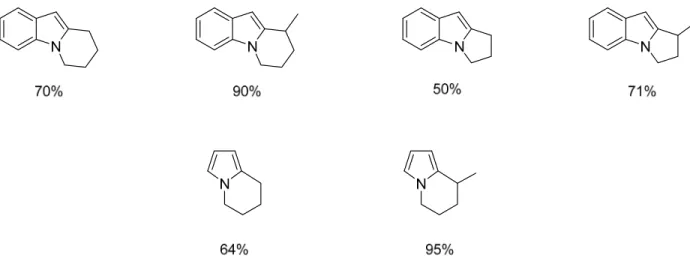
see if the trends exhibited in the previous substrates continue. As evident in the results (Figure 6), the secondary iodides produce the best results for both the indole and pyrrole derivative substrates. The primary alkyl iodides do still cyclize with good yield. As in the previous
substrates, these only need to be heated to 100°C to get formation of product. Additionally these are the only substrates with methylene tethers that result in product formation. This is thought to be due to the lower aromatic stabilization energy of the substrates which is more easily broken.
Figure 6. Heteroaromatic Iodide Substrate Scope
Figure 7. Possible mechanism for Palladium-Catalyzed C-H Alkylation of Aromatic Systems The only mechanistic study that has been done so far was a TEMPO experiment. To the standard reaction conditions, 1 equivalent of the persistent radical trap TEMPO was added, and the results were 60% TEMPO adduct product in the place of the iodide, and 35% starting material. From this data, the conclusion is drawn that there is a radical that forms at the position of the iodide on the alkyl chain tether. In the future additional reactions should be run with enantioenriched iodides, where stereoablation is expected with the formation of a radical species. Additionally, substrates which are meta-substituted on the arene would give insight in to any kind of regioselectivity of the reaction when subject to the reaction conditions.
The palladium-catalyzed C-H alkylation of aromatic systems has proven to be a
is clear from these results that the desired transformation is possible under the conditions explored here.
References
1. Vitaku, E.; Ilardi, E. A.; Njardarson, J. T. Top 200 Pharmaceutical Products by US Retail
Sales in 2012. 2013
2. Rueping, M.; Nachtsheim, B.J. Beilstein J. Org. Chem. 2010, 6, No. 6.
3. Bowman, W.R.; Storey.; J.M.D. Chem. Soc. Rev. 2007, 36, 1803-1822.
4. Campeau, L.C.; Parisien, M.; Jean, A.; Fagnou, K. J. Am. Chem. Soc. 2006, 128,
581-590.