The Rise of Global Sports NGOs
by
Aleksander (Sasha) Huryn Seymore
Honors Thesis
Submitted in partial fulfillment for Honors in Global Studies
The University of North Carolina at Chapel Hill May 2015
Approved by:
_______________________________________ Advisor: Jonathan Weiler
Table of Contents
Chapter One: Introduction, Approach, Background, and Scope of Thesis………...………pg. 3
Chapter Two: Literature Review……….pg. 13
Chapter Three: Overview of Sports-Based NGOs, Philanthropy, and Corporate Giving………..…pg. 29
Chapter Four: A Comparison of Soccer for Peace and Seeds of Peace……….pg. 48
Chapter Five: Conclusions……….……..pg. 64
Appendix……….…….…….………...pg.67
Chapter One
Introduction, Approach, Background, and Scope of Thesis
In 778 BC, three kings of ancient Greece met to discuss the upcoming Olympic Games, and out of their meeting the tradition of the "Ekecheiria" or "Truce" was established. During the truce period, the athletes and their families—as well as ordinary pilgrims—could travel in total safety to participate in or attend the Olympic Games and return afterwards to their respective countries. It was a sacred message, pronounced throughout Greece—and one of the first recorded instances that sport was used for conflict resolution (Toohey, 2007 p.65). This was only the beginning of sport being used as a tool for change. The Ancient Mesoamerican game of Ōllamaliztli served as a way to defuse or resolve conflicts through a ballgame instead of a battle, and over time it would serve to resolve competition and conflict within the society (Taladoire, 2001, p.97-115). More recently, baseball was used as a way to relieve tension between the US and Japan after World War II, bringing the two nations together through a common passion (Price, 2010).
The past 30 years have seen a tremendous rise in the use of sports as a means to resolve conflicts—especially by the United Nations. In October 1993, UN resolution 48/11 revived the long dead tradition of Olympic Truces (Lemke, 2012). In 2001, the UN introduced its Office on Sport for
recently, on April 6th, 2014, the world celebrated its first ever International Day of Sport for Development and Peace (Lemke, 2012).
At the forefront of this endeavor are governmental organizations, or NGOs. NGOs are non-profit, voluntary citizens' groups that are task-oriented and driven by people with a common interest, performing a variety of service and humanitarian functions. Sports NGOs perform a similar role, only using sports as their focal point for service and humanitarian interactions—and they currently seem to be booming in size and scope. According to Howard Brodwin, founder of North America’s largest sports NGO directory (sportsandsocialchange.org), there has been a significant increase in the number of organizations on his site in recent years, to a total of 483. Though this cannot be directly equated to an increase in sports NGOs (as many were in existence prior to joining the directory), it does suggest an increase in the number of organizations large enough to request a directory listing.
Approach
I answer these questions in a three-pronged approach. First, I completed a broad survey into the landscape of soccer-based NGOs. I have chosen soccer based NGOs because soccer is by far the world’s largest sport, and with approximately 3.5 billion fans, it dominates the global sports scene (Beauchamp, 2014). With over 250 million players in over 200 countries, it is an area where many could find common ground, and is the logical sport to choose when looking for one to represent sports NGOs (Beauchamp, 2014). I conducted interviews with members of 13 different soccer based NGOs, chosen for their responsiveness and diversity of location, to determine the main themes surrounding these organizations existence and the skills they teach. I have chosen Alive and Kicking (Kenya), GOALS (Haiti), Pure Game (US), Pass It Forward (US), Yuwa (India), Homeless World Cup (Europe; network of 70 different countries), G-Football (Nepal), Soccer Without Borders (Nicaragua), Kicking Across Carolina (Israel/Palestine), Girls Kick It (Uganda), Banda Bola Sports Foundation (Malawi), Soccer for Peace (Israel/Palestine), and Ubuntu Sports Endeavors (South Africa). I focus on the impetus for founding these organizations, the biggest challenges faced by each, the skills they believe that soccer can provide, and the impact that these organizations hope to make on their communities. This information will help inform the purpose and scope of sports NGOs as a whole.
deciding to give time, funding, and other resources to NGOs. This should help sports NGOs alter their practices to best fit donor preferences and attract the funding needed to accomplish their goals.
Finally, to get a clear picture of the difference in an organization that uses sport, I took an in-depth look into two particular NGOs, one sports based and one not. Both focused on a similar area and used similar methods, and neither organization has religious or political affiliations. Both of these organizations focus on Israel/Palestine, and work towards a lasting peace in the region through the formation of friendships and relationships among individuals on the conflicting sides.
I have chosen the Israeli-Palestinian conflict—and soccer within that conflict specifically—for a number of reasons. First, Israel is a multicultural state composed of a majority of Jewish citizens but with a sizable Arab minority. Most citizens are spread across the country in small to medium sized villages, villages typically populated with only Jewish or only Arab residents. In the larger cities (like Jerusalem, Haifa, and Tel-Aviv), Jews and Arabs live together, but even then typically in separate neighborhoods. There are few socio-political links between the two populations, as their children tend to go to separate schools and the adults rarely interact socially (Lidor, Blumenstein, 2012). This situation, combined with the long term political conflict between Jews and Arabs living in Gaza and the West Bank, has created decades of political and social tension between the two.
well as consent to the idea that Jews and Arabs can play together. What is missing is collective participation on a grassroots level, as well as an emphasis on how this cooperation could translate to other areas of life. Jews and Arabs do not often play together in youth or lower level leagues, and when they do, there is no discussion about how their cooperation on the soccer field can translate to life off the field. Soccer NGOs can fill this void, intentionally uniting both groups at the youth level, and starting the dialogue about how the groups can work together.
These results speak a good deal on whether or not soccer does have transformational power— though they by no means answer the question, and there is still substantial room for improvement. Do these changed attitudes remain over time? How do they convince the 38% whose attitude towards the “other” group didn’t change? Why didn’t those attitudes change, and why were Arab children less likely to have a change in perception? Does it have anything to do with where the children are from? My thesis originally set out to help answer those questions. The Director of Soccer for Peace allowed me to help draft the survey for the 2014 camp and agreed to provide the results. Unfortunately, for a variety of logistical reasons, the complete survey I developed with Soccer for Peace was not able to be
implemented. However, I was able to obtain the results from a comparable survey from Seeds of Peace, and after comparing the results, was able to show why Soccer for Peace believes in soccer as its tool for change. I was also able to take a closer look at Soccer for Peace through its website and other public articles, interview leaders and members of Soccer for Peace concerning their organization, and travel to a Soccer for Peace fundraiser in New York. These experiences gave me sufficient background into why the organization believes so strongly in soccer as a means of conflict resolution, as well as the specific methods and practices it uses to reach members of the community.
with the physical games as supporting structures (as opposed to the other way around), and it includes girls to a much greater extent. In addition, Seeds of Peace has much greater financial resources than Soccer for Peace, and may be focused more on creating peace and dialogue through “elite” members who can complete applications and speak English rather than the lower-income and less educated youth that Soccer for Peace might target. These similarities—with key differences—make Seeds of Peace an excellent case to compare to Soccer for Peace. As such, I’ve been able to highlight certain aspects that Soccer for Peace does well and not so well, and provide both evidence for sports as a method of change as well as evidence for best practices in sports NGOs.
Background
While in this thesis I argue that sports have the potential to act as a societally significant force for change, not everyone believes so—or that soccer in Israel is the best place to try and observe that change (Donnelly 2007, Darnell 2012). There are a number who believe that sports are too basic and barbaric to create peace, as George Orwell once famously stated “Serious sport has nothing to do with fair play. It is bound up with hatred, jealousy, boastfulness, disregard of all rules and sadistic pleasure in witnessing violence: in other words it is war minus the shooting” (Orwell, 1945). In addition, there are those who see sports as simply impotent (Donnelly 2007, Darnell 2012). Peter Donnelly, working for the Sport for Development and Peace International Working Group, concluded that interventions that focus only on sport participation are unlikely to produce long-term beneficial effects, because sports reach too small of a population, and within that population it does too little to change attitudes and actions (Donnelly, 2007). In “Sport for Development and Peace: A Critical Sociology”, Simon Darnell agrees, and questions the belief that sports can offer a “solution” to enduring conflicts (Darnell, 2012). Both
involved and make an impact, but this is a rather marginal impact. Darnell endorses the significance of sports as a tool, but certainly critiques its ability to change perceptions.
These are valid concerns, but I believe that they tend to underestimate the broader reach that sports can have, and ignore the emotional impact of sports on participants and spectators. Watching, playing, or coaching sport is indisputably the most popular leisure activity in the world, not just for children and youth, but for men and women of all ages (Kvalsund, 2014). It can be enjoyed by people in the role of players, but also as coaches, administrators, and spectators—allowing for an even broader range of influence. Sports then address both the body and emotions—parts of human beings that are often forgotten in peace building. Sustainable conflict transformation means that you also address the participant’s feelings, and sports allow for joy and fun as well as rage and sadness (UN Office for the Coordination of Humanitarian Affairs, 2006). As large percentages of populations participate, sports operate on a grassroots level, and “can be a low entry point for people who are skeptical about peace and cohesion” (Kvalsund, 2014). By offering a fun game that all sides can enjoy, sports open the door to work with people who may be against dialogue or nonviolent conflict resolution.
Evidence for these effects can be found throughout sports role in history. After World War II, baseball was instrumental in healing relations between the US and Japan (Price, 2010). Soccer has been shown to be beneficial in case studies in both Liberia (Lofa, 2007) and the Balkans (OFFA, 2013). And, in the country to which Israel is most often (unfairly or not) compared—South Africa—rugby was
once there was only despair. It is more powerful than governments in breaking down racial barriers. It laughs in the face of all types of discrimination.” (Mandela, 2000).
However, the most important reason that sports should be given a serious place in the discussion on conflict resolution is the impact that it is having around the world today. As discussed previously, in recent years the UN has dramatically increased its use of sports in peace projects. In “Sport for Development, Peace, and Social Justice,” Robert Schinke and Stephanie Hanrahan discuss the benefits that sports can offer pockets of society, and even introduce the term sport development (SD) as they describe sports projects around the world where those involved might learn behaviors and values that later spur changes (such as in the case of a shift from violence to peace). To take a case that is recent and relevant, from 2000-2003 the World Sports Peace Project held soccer camps in Israel with Christian, Jewish, and Muslim youth that were reported to have been very successful at changing attitudes and perceptions (Whitfield, 2006).
Thesis Scope
More important than providing evidence for sports as a method of change, however, my data yields practical conclusions for sports NGOs worldwide. For example, my comparison of Soccer for Peace and Seeds of Peace concludes that sports NGOs are successful in changing attitudes because they use an already commonly loved and understood activity to unite opposing sides, rather than putting each side in an entirely new setting and attempting to use new or different activities. I then recommend a change in policy for other NGOs, and advocate for a greater focus on using activities that are already known to both conflict sides. The same comparison also points towards the educational components of each camp as invaluable to their success, because of the focus on dialogue and learning. I then
Chapter Two
Literature Review
The purpose of this literature review is to engage with current research concerning sports as a method for conflict resolution. As there has been a relatively recent rise in the use of sports by NGOs and governments in conflict resolution, there was not an extensive set of research to draw from on sports specifically. However, there is a good deal of literature assessing NGOs more broadly, and I will start there and then narrow down to sports. In addition, sports are certainly not a new development in international diplomacy, and there is plenty of discussion surrounding Israel that deserves attention in this review. More specifically, I will put the purpose of Soccer for Peace in perspective by detailing the history of Israel/Palestine, and then discuss conflict resolution NGO effectiveness before moving on to the current concerns and optimism surrounding sports as a tool for peace.
Why is there a need in Israel/Palestine?
In Chapter One, I outlined why soccer in Israel/Palestine is an excellent area to study conflict resolution. However, I did not provide any substantial background into why there is a conflict—and therefore a need for sports NGOs—in Israel/Palestine in the first place. As such, I will now outline the history of the conflict, current relations, and soccer’s place within those relations so that the overarching purpose of Soccer for Peace can be seen.
Historical Conflict
national aspiration for the Jewish people. As anti-Semitism spread throughout Europe prior to World War II, these migrations only increased—much to the consternation of the lands Arab inhabitants (Ciment, 1997).
After World War II and the Holocaust, sympathy for the Jewish people increased—and
resistance from the Arab inhabitants only grew. The British held a mandate to administer the lands, but they soon grew tired of the violence, and decided to withdraw (Ciment, 1997). As a response, on November 29, 1947, the U.N. General Assembly adopted a resolution recommending the adoption and implementation of a “partition plan” (Ciment, 1997). The plan recommended the creation of
independent Arab and Jewish States and a Special International Regime for the City of Jerusalem. When Israel declared itself an established state in May 1948, the surrounding Arab states invaded and
immediately attacked Israeli forces and several Jewish settlements (Deebs, 2013). The conflict soon evolved into the 1948 Arab-Israeli war. After the war, the land was divided into three areas: Israel, Gaza, and the West Bank, with Gaza and the West Bank holding the majority of the 711,000 refugee
Palestinian Arabs that were displaced during the war (Ciment, 1997). All of the land was controlled by Israel.
From this point on, there has been an unending cycle of conflict and tense peacetimes between the two sides, with borders and policies shifting throughout the decades. From the Jewish point of view, after 2,000 years of exile and persecution, culminating in one of the greatest massacres in human history, Jews have finally returned home, reviving a dead language and founding a nation in the process. This is a miraculous achievement, and God has obviously blessed them (Dowty, 2012). In the view of the Palestinian Arabs (and almost the entire Arab world), an indigenous people has been dispossessed and exiled by Americans and Europeans, and Palestinians are the quintessential victims of Western
Current Relations
Israeli Jews and Palestinian Arabs are currently in a series of peace talks led by US Secretary of State John Kerry—and the talks look to be going absolutely nowhere. When Kerry began the peace talks, he proposed a two-state solution and said that his aim was a “final-status agreement” within nine months (e.g. by the end of April 2014). This did not happen, and he has long since curbed that grand ambition (“Economist”, 2014).
From the Israeli side, the Israeli Prime Minister Binyamin Netanyahu tentatively agreed to a Palestinian state to co-exist alongside Israel about five years ago. However, right wingers throughout Israel—and even within his own party—argue that a Palestinian state would “threaten the existence of a Jewish state.” From their point of view, a refusal makes sense. As things are, Israel is strong and the Palestinian movement weak. If there was a Palestinian state, it would be “virtual rather than real for some time to come” (“Economist”, 2014). However, “no thoughtful Israeli can be sure it would remain so for ever,” and that certainly would not bode well for Israel (“Economist”, 2014).
both sides, it can be difficult to see how sports could play an effective role. My thesis shows how sports have the potential to possibly effect change on such a stage by highlighting the work that sports can do on a grassroots relational level.
Soccer in Israel/Palestine
How does this historical information and current relations relate to soccer’s ability to create change in the region? First, due to the long standing nature of the conflict, wounds run deep—and grievances have run for decades. Soccer for Peace does not operate in the West Bank or Gaza Strip, but the sentiments are the same. Also, due to how the conflict developed, both groups see themselves as a victim—the Jews as victims of the Holocaust and millenniums of anti-Semitism, continued by the hostility of the Arab nations surrounding them, and the Arabs as victims of Western imperialism that stole from them their rightful homeland (Lidor, Blumenstein, 2012). Neither group lives or consistently interacts with the other (Lidor, Blumenstein, 2012), and given their different cultures, languages, and histories, it would be easy to ignore their common humanity. Soccer holds a unique place in the lives of both Arab and Jewish culture, and is by far the most played and watched sport in the region (Kvalsund, 2014). It could potentially serve as the common language with which the two sides could communicate, or the vehicle through which they could acknowledge their common humanity.
soccer in their country (Kugelmass, Sorek, 2007). In addition, when Arab teams do well in upper levels of soccer, such as when Ittihad Abna Sakhnin soccer club became the first Arab team to win the Israeli National Cup in May 2004 (Lidor, Blumenstein, 2012), it provides Arab sports journalists a chance to build a sense of national Arab pride. It “undermines the basic assumptions of the hegemonic definition of Israeli identity,” helping to highlight to both Arabs and Jews the diversity within their society
(Kugelmass, Sorek, 2007).
Conflict Resolution NGOs
In order to understand the effectiveness of sports NGOs, it is important to understand NGOs in
conflict resolution as a whole. Since the end of the Cold War, non-governmental organizations have
become significantly more prominent (Stein 2012,Barnes 2006, Richmond 2003). By far the most
important reason for this increased prominence is that the number and importance of NGOs has
multiplied exponentially (Smith and Lipsky, 1993; Gordenker and Weiss,1996). Along with that
increase in number of NGOs is an increase in the kinds of NGOs that developed. Prior to the end of
the Cold War, only large NGOs with religious affiliations would attempt any sort of mediation or
conflict resolution (Gordenker and Weiss, 1996). Post-Cold War, a new type of NGO, specializing in
conflict prevention and resolution, and operating independently of states and the United Nations,
became active in the field (Stein, 2012). These new “conflict resolution NGOs”, now having been
active for approximately two decades, have accumulated a number of successes and criticisms
which are important to understand when analyzing the subset of conflict resolution NGOs that are
Criticisms of Conflict Resolution NGOs
The simple fact that an NGO is working on a problem does not mean that it will be solved, especially in the area of conflict resolution. It is even possible for the activities of NGOs to perpetuate conflict (Nesbit, 2013). For this reason, there are a number of criticisms surrounding these NGOs, from the fact that NGOs require money for operational costs and salary expenses to the idea that NGOs take over the resolution process and leave out local stakeholders (Kenes 2013, Menkhaus 2000). However, the three main criticisms that have evolved around conflict resolution NGOs: a lack of accountability, an inability to work effectively with local governments, and an excess of competition from too many NGOs.
governments, and from the UN system, create serious problems for diplomats and policymakers alike who look to NGOs to carry out conflict-resolution interventions." (Natsios, 1997)
These concerns are certainly valid. NGOs often do have a tough time working with local governments, and as Howard Brodwin from sportsandsocialchange.org states, “probably the biggest challenge we face is getting NGOs to work together instead of trying to solve the exact same problem with 12 independent solutions” (Brodwin, 2014). However, sometimes this role as de-facto
representatives of the US government can be a benefit. During the 1994 Liberian Civil War, a
peacemaking NGO called the Institute for Multi-Track Diplomacy (IMTD) held a meeting among all of the warring parties. In the meeting, each group blamed part of their struggles on the actions of the United States 150 years prior. IMTD ambassador John McDonald then proceeded to give an unofficial apology on behalf of the United States, and this proved to be a turning point in the peace efforts, as now all sides could focus on more present current issues. For political reasons, an official representative of the United States government could never have issued such an apology, but an NGO was there to fill the void (Baharvar, 2001).
tensions through sports at the grassroots level, they are really only effective in stage three, where many of the concerns about lack of accountability and ability to work with local governments do not apply. As Nesbit states, “It is this environment (the third stage) that NGOs can have a huge impact. Their most important actions take place at the grassroots level where they engage in empowering the people and helping them to transform their attitudes and institutions” (Nesbit, 2013). As such, though conflict resolutions as a whole can encounter many problems, most of these do not directly relate to ones in the sports realm.
Strengths of Conflict Resolution NGOs
Though there are a number of criticisms regarding conflict resolution NGOs, there are also a number of strengths inherent to NGOs that make them excellent means for resolving conflicts. First, the independence and autonomy that make NGOs worrisome from a regulation standpoint can also be viewed as one of their greatest strengths (Fadzel, 2004). This means that NGOs are often perceived as neutral, and unlike official governmental or diplomatic channels, NGOs do not have any political
constraints in communicating with both parties in a conflict (Fadzel, 2004). Next, the local viewpoint that is criticized for giving NGOs a narrow view of the problem also often gives them an insider knowledge that is highly valuable (Joseph, 2003). As local actors, most NGOs are well versed in the history of a conflict, and have a deep understanding of the conflicting parties’ local cultures (Joseph, 2003). They can display compassion and understanding on both sides of the conflict, and build on a reservoir of good will that no other actor has (Fadzel 2004, Joseph 2003). In addition, NGOs are in a good position to sponsor collaborative networks in the peace process.
leaders (local leaders and community developers) (Lederach, 1999). NGOs are able to work with all three leadership levels, and can create cooperation that others often cannot (Marshall, 2000). Finally, one of an NGO’s greatest strengths is that they can work at a grassroots level. It is often assumed that leadership takes the public ‘mood’ regarding a conflict into consideration, and that the calculations of political and military leaders therefore can be altered by the public. (Söderström, 2008). According to Jenny Soderstrom, “If public opinion is not in favour of a peaceful settlement, the leadership might be reluctant to negotiate a peace accord, out of fear of losing popular support.” (Söderström, 2008).NGOs are then needed to create a critical mass of people who want peace in order to allow politicians to work towards this peace (Huth & Allee 2002).
While many of the criticisms of conflict NGOs as a whole do not necessarily apply to sports NGOs, almost all of their strengths—especially their independence, their local viewpoint, and their work at the grassroots level—are utilized by sports NGOs. This only further contributes to the idea that sports are a natural method to bring about conflict resolution.
Discussions of Sports as a Method of Change
Cautious Views of Sport
As discussed in the previous chapter, both Simon Darnell and Peter Donnelly question sports’ impact, and propose that by itself sport cannot produce a successful intervention. To fully utilize the development potential of sport, they argue, it needs to be integrated into existing governmental
programs targeted towards peace. Sports are neither broad enough nor effective enough in their efforts to create substantial changes (Darnell 2012, Donnelly 2007). However, the most damaging charge to the case for sports as a means for conflict resolution is not that it is ineffective, but that it in itself causes violence. It is suggested that outside of wartime, sports is perhaps the only setting in which acts of interpersonal aggression are not only tolerated but enthusiastically applauded by society (Russell, 1993). Soccer famously had a role in igniting a brief war fought by El Salvador and Honduras in 1969. Though it was fought over land reform in Honduras and immigration and demographic problems in El Salvador, the “Soccer War” in part began because of tensions after World Cup qualifying matches between the two nations("El Salvador", 2014). In addition, the Handbook of Research on Sports Psychology warns that those interested in sports “need to be acutely aware of the negative specter of aggression and violence. This applies equally to participant behavior and spectator behavior” (Thirer, 1993). How can sports be effective as a means to peace when they so easily lead to conflict? Why would we want to place historic enemies in a setting that has been known for violence?
NBA players were “thugs” or “punks” (Helin, 2013). However, this was the only such fight of the 2004 season—which included a total of 1,230 regular season games (Abbott, 2014). This means that in the 2004 NBA season there were violent brawls in less than 0.08 percent games—not a high figure if all NBA players are “thugs.” In addition, I believe that in a controlled sports NGO setting that percentage would be even lower. So, while these concerns are certainly obstacles to be aware of when running a sports NGO, they are nevertheless obstacles that can be overcome.
Optimistic Views of Sport
First, it is difficult to consider sports impotent given their historical track record. As detailed by Nicholas Griffin’s book “Ping Pong Diplomacy: The Secret History Behind the Game that Changed the World,” ping pong was used as a tool to thaw relations between the United States and China, eventually leading to a historic visit to China by U.S. president Richard Nixon. (Griffin, 2014). In 1971, during the 31st World Table Tennis Championships in Nagoya, Japan, US table tennis player Glenn Cowan missed his team bus. As Cowan looked for his bus, a Chinese playerwaved to him to get on the Chinese team bus—where he was greeted by Zhuang Zedong, the best Chinese player and three-time world champion. Zedong presented him with a silk-screen portrait of the Huangshan Mountains, and when the Chinese team and Cowan walked off the bus, journalists who were following the Chinese team took photographs were there to take pictures (Griffin, 2014). The site of Chinese athletes with American ones garnered remarkable international attention, and led to the entire American team’s invitation to tour China. This was just the break required to start improving US-China relations, and quickly led to President Nixon’s visit. This was one of the most significant international policy shifts of the 20th century, and was realized
only through the symbolism of sport.
describes the rather unique role that baseball played in his essay inside The politics of baseball : essays on the pastime and power at home and abroad, and mentions that “In many instances, baseball was the only medium in which Americans and the vanquished could communicate effectively. Americans found the game a cheap and easy way to break down some of the cultural barriers between them and the peoples of the occupied nations” (Price, 2010). This was especially true in post-war Japan, as six years of war had left a natural tension and no way to bridge that psychological and emotional gap. So the US began a series of postwar tours to Japan with varying levels of “baseball pros” (Price, 2010). Lefty O’Doul, who led the first postwar tour of American baseball players in 1949, said “so many of my friends in Japan got killed in the war. So many. Awful. Right after the war I went back. I wanted to, because I knew if we brought a baseball team over there it would help cement friendship between them and us” (Price, 2010). From almost all accounts, cement friendships it did, and it has generally been considered a resounding success (Ishii 2004, Engel 2014). The tours were met with cheering crowds in almost every Japanese city, and today baseball is Japan’s most popular sport—even more popular than its “national sport,” sumo wrestling (Gillette and Staples, 2006). Importantly for my thesis, baseball provided an outlet and commonality that both nations could understand. To quote Nobuske Kishi, Japanese prime minister in 1958, “Only through the medium of the game of baseball could we [the people of Japan and the United States] have this kind of understanding” (Price, 2010). This example of baseball aiding in conflict resolution between Japan and the US after World War II helps to show how sports can work on a macro-scale. By providing a common medium, sports help to bring understanding to people who may not be able to connect though any other method. Sports NGOs attempt to use this same principle in their operations.
effective), and they can often turn to aggression. Though violence is rare, some believe this sort of “fake violence” is a good outcome, and helps to prevent real violence off the field (Cannon 1915, Memon 2012). In 1915, Dr. Walter Cannon of Harvard proposed that athletics served as a substitute for war, satisfying the emotions of man that demand the excitement of conflict and leading to a more peaceful world (Cannon, 1915). In more recent times, there have been arguments that the “proxy wars” for Olympic medals between the US and USSR (and more recently, the US and China) have done much to quell actual tensions (Memon, 2012).
Though this “fake violence” theory may explain some of the reason why sports are not
harbingers of violence, but rather peace, I think the answer lies closer to how sports are used. Sports are a social tool, and they can lead to a variety of emotions. In an excerpt from Aggression:A Social Learning Analysis, Albert Bandura states “aggression will occur in sports where an athlete’s generalized
society, and therefore the most violence would occur when the Catholic Celtics play the Protestant Rangers. In 1980, after the Celtics defeated the Rangers 1-0 at the Scottish Cup final, hundreds of fans rioted on the pitch—leading to the ban of alcohol at all Scottish stadiums (Dunning, 1999). This can be seen in the United States as well, where some of the most intense spectator violence occurred along racial lines. In 1910, Jack Johnson, an African American boxer, beat James Jeffries, a white, and then-undefeated heavyweight champion of the world, leading to race riots in cities all across the United States (Gorn, 1993).
That violence is prevalent around sporting events is indisputable. However, these acts of violence have only been seen in the context of competitive professional sports—and reach intense levels only when competing social groups are pitted against one another, like Protestants and Catholics in Scotland or blacks and whites in the United States. In the context of a sports NGO that is dedicated to creating peace through sports, however, these types of situations are carefully controlled. Instead of inciting violence by pitting two opposing groups against one another, sports NGOs carefully construct situations in which opposing sides must work together instead of compete. The violence surrounding sports is apparent, but I believe it is more of a testament to the power that sport can have, and how that power can could be used for unity within the restraints of a sports NGO.
describe these new projects (Shinke and Hanrahan, 2012). While a record number of UN peacekeepers in Africa have failed to prevent fresh spasms of violence (Raghaven, 2014), more support is being given to soccer reconciliation projects in Liberia (Lofa, 2007). The US Army demonstrated that soccer could be effective in the Middle East through “Operation Soccer Ball”, where soldiers provided soccer balls to children in Iraq. From the US army’s website, “Soccer has become a very effective way for American forces to overcome the language and culture barrier with the Iraqi people and start building friendships that could change the future.” (Pariante, 2008). Air Force Major Ravi Chaudhary, director of operations of the project, said "The soccer ball is an incredible medium for building relationships with the future of Iraq, the kids. No translator required. We're instant friends. The political challenges just seem to fall away” (Pariante, 2008). But the most convincing evidence is the plethora of NGOs that currently run peace programs and claim success—often with data to back them up. From Israel (Peres Center for Peace, 2014) to Northern Ireland to Cyprus to New Orleans to South Africa (PeacePlayers International, 2014) to Jordan (Generations for Peace, 2014) to Monaco (Peace and Sport, 2014), sports NGOs have been shown to have programs with successful track records.
Chapter Three
Overview of Sports-Based NGOs, Philanthropy, and Corporate Giving
The past 30 years have seen a tremendous rise in the use of sports as a means to resolve conflicts. At the forefront of this effort are sports NGOs, working at a grassroots level and attempting to use sports to bind together communities. However, we must ask the question, why are sports used in these situations? What is it about sports that lead them to be used, and are they effective? In this section, I take a look into the overall sports NGO landscape, in order to determine the purpose of the sports NGO industry, the scope of what sports NGOs are attempting to accomplish, and the best practices that a sports NGO could use to accomplish its goals.
free and have no discernible downside, most well-developed sports NGOs are listed—including all thirteen of the NGOs I interviewed in the second part of this section.
Next, I found twenty-five different soccer-based NGOs on sportsandsocialchange.org, selecting organizations based on their diversity of location and with no consideration to their purpose (e.g. whether they were intended for conflict resolution or economic development, etc.) and reached out through email to all of them. Thirteen responded, and I interviewed the leader of each NGO to
determine the main themes surrounding why these organizations exist and what skills they teach. One trend that was clear from the beginning of my interviews was that every organization suffered from a lack of funding for their projects. However, over the past two decades, there has been a strong increase in the amount of giving from foundations and corporations. As such, I decided that a practical area to investigate would be trends in the way these foundations and corporations give to NGOs and the best manner for NGOs to procure this giving. I’ve collected this information, both on trends as well as data on the three biggest sports charitable givers (Nike, Adidas, and Under Armour) and drawn conclusions— however; I have saved my conclusions on corporate funding for Chapter Five.
Overview of Sports-Based NGOs
Howard Brodwin and sportsandsocialchange.org
resources and opportunities for those seeking connections with social change and cause-related organizations in the global sports community (Author’s Interview, Howard Brodwin, Executive Director, SportsandSocialChange.org, Phone Interview, July 7,2014). Currently, sportsandsocialchange.org is the largest sports NGO directory in North America, with 483 registered organizations. Internationally, they rank far behind the UK-based “Beyond Sport” with a database of NGOs at close to 2,200 as well as the Swiss-based “International Platform for Sport and Development.” The “International Platform for Sport and Development” has profiles for both individuals and organizations in their directory, and show 561 organizations and 4,200 individuals. However, this discrepancy is largely a result of
sportsandsocialchange.org’s focus on organizations and donors in the US and Canada, while the other two organizations have a much larger international focus. The organizations that register on
sportsandsocialchange.org may work in the US or internationally, and may be based in the US or internationally—but the majority are based in the US or Canada. This North American focus may limit the number of NGOs listing peace as their main objective, as organizations that work more directly in conflict areas (such as Israel, Northern Ireland, Kosovo, or Jordan) may not be based in North America or list themselves in a North American directory. This does not mean that the directory is not useful, but the information on conflict resolution sports NGOs will be limited.
After my discussion with Mr. Brodwin, he provided me data on the site from a report created by a 2013 intern with administrative access to the exact numbers of NGOs. I then supplemented this data with a manual search of their directory to determine the sports used and causes served by each NGO listed, and I came away with a few clear conclusions:
over recent years. This rise in registered organizations does not necessarily indicate that there has been an exactly similar rise in the number of sports NGOs, as some of the new
registrations were simply existing organizations deciding to register, while some new organizations have yet to register. Sports NGOs gain access to a network of individuals interested in volunteering for and donating to their organization, as well as expertise in social enterprise development, digital strategy, marketing and public relations campaigns, and corporate partnership development—all for free. However, organizations must fill out a registration form to be listed, and this hurdle (as well as a general unawareness that the site exists) may keep some organizations out. Despite this, it should be seen as a decent proxy for the number of sports NGOs in existence.
2) A relatively small portion of sport NGOs are involved in conflict resolution, or even use sport as a method to break down social barriers. As shown in figure one, only 4 percent of
registered organizations cite peace-building as a primary cause for their existence, and a similarly small proportion (4 percent) list that their organization helps to break racial barriers
32
Figure 1: Sport NGO Cause
(sportand-socialchange.org)
Animal Welfare Arts
Disability Issues (11%) Disaster Relief
Economic Development Education (15%) Environment Health (27%)
Housing and Homelessness Human Rights
Hunger Literacy Peace (4%) Poverty
Race and Equality (4%) Senior Issues
and create equality within the society that they work. This is in contrast to the much larger percentages that list health (27 percent), education (15 percent), and disability issues (11 percent) as main causes. While I would agree that there are likely less peace-building sports NGOs, I would also contend that there are significantly less peace building organizations in this graphic for two reasons. First, there are less global locations in which peace projects can operate as compared to health or education, so the number will be smaller. Second, as previously mentioned, sportandsocialchange.org is a North American based site, and
organizations that work more directly in conflict areas may not be based in North America and list themselves in a North American directory.
3) Soccer is the most common sport utilized by NGOs, especially by NGOs whose cause is peace. Sports NGOs listed in sportsandsocialchange.org utilized 72 different sports, with soccer as the most popular at 18 percent. This was not an overwhelming margin, as 16 percent of organizations used basketball and 15 percent football. However, when looking at organizations that listed peace as their main cause, soccer was utilized in a whopping 61 percent, a wide margin over any other sport.
The dominance of soccer in peace building organizations could have a number of explanations, including the relatively non-violent nature of the sport, its accessibility to people in conflict situations, and the simple fact that it is the world’s most popular sport (Dunning). However, regardless of why soccer is most prominent in sports NGOs that work towards peace, it is clear that a study of peace sports NGOs should have a clear slant towards soccer.
effort to understand how soccer skills games help with conflict resolution, it is helpful to first understand soccer NGOs and their missions for social change.
Interviews with Soccer NGO Leaders
In order to best understand soccer as a method of change, I interviewed the leaders of thirteen different soccer based NGOs. I chose Alive and Kicking (Kenya), GOALS (Haiti), Pure Game
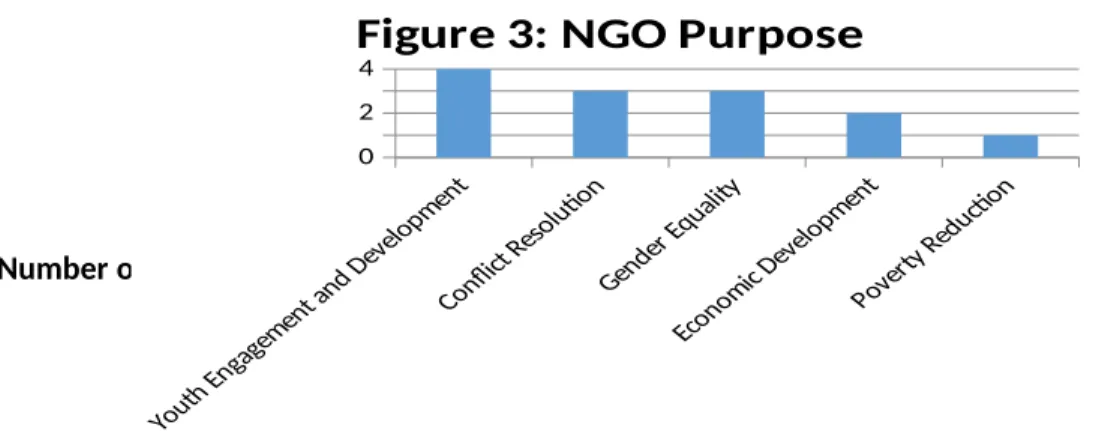
Though these organizations were chosen for their responsiveness and diversity of location, I still collected a fairly diverse range of organizations in terms of purpose:
With each organization, I posed the questions:
1. How did your organization get started?
2. What is the biggest challenge in operating your organization?
3. What do you believe are some of the life skills that playing soccer teaches? 4. Where is your greatest need that could be improved?
With this information, I was able to draw several conclusions concerning soccer and sports NGOs.
1) These organizations were typically created due to a personal experience with a societal issue and/or personal experiences with the game of soccer. When I posed the question of how each organization got its start, the responses fit very cleanly (and were spread out very evenly) into three categories: those whose founder had an intense personal experience with a societal issue and believed soccer could help solve it, those whose founder had an intense personal experience with soccer and then believed it could solve a societal issue, and those Number of NGOs
0 2 4
whose founder had an intense personal experience with both and believed soccer could help solve the societal issue. While I believe all three scenarios are legitimate reasons for founding an organization, I was slightly concerned with the existence of multiple
organizations that were created due to the founders’ personal experience with sport and then adapted to help solve a societal issue. As described in previous chapters, one criticism leveled against sport NGOs is that they are created more for the founders benefit than the recipients—that they are a result of a love of sports and not actual problem solvers. While this data does not definitely prove anything, it does leave open the possibility that these organizations were founded because of an individual love of soccer and a desire to help others rather than because they have been proven effective.
2) While there are a number of operational challenges facing soccer NGOs, the greatest is an increasingly crowded soccer landscape. While a few organizations reported that
increase in competition among NGOs significantly decreases the fraction of donations allocated to NGO programs and instead increases the fraction of donations allocated to promotional expenditures (Castaneda).
This problem was nearly universal among the NGOs I interviewed. I heard a number of different solutions to the problem, but the one I found most convincing came from Mr. Brodwin of sportsandsocialchange.org. As Brodwin mentioned, “what this space really needs is more consolidation…as there is quite a bit of redundancy in programs, and in a tight economy we also find orgs fighting for the same donor. What would be great are some “mergers and acquisitions” in the sports NGO space.” I definitely agree with this assessment. While society may benefit from competition among for-profit businesses, it makes no sense for non-profits with the same ultimate goal to waste resources competing for donor dollars. While the feasibility of large sports NGO mergers has yet to be proven, I believe this is certainly an interesting potential area for greater study.
3) These organizations believe soccer teaches a number of life skills, mainly teamwork, dedication, and the ability to resolve conflicts:
Team work Dedi catio n Confl ict-re solu tion Lead ersh ip Com mun icatio n Gend er Eq
ualit y Confi denc e Healt hy Li
festy le 0 2 4 6 8 10 12
might not otherwise learn. GKI uses football training to build confidence and make members feel valued and important.” The final clear takeaway from this data was that seven organizations highlighted conflict-resolution as an important life skill to be taken from the game of soccer, even though only three organizations were specifically “peace” NGOs. This speaks to the idea that soccer is recognized as a way to learn how to resolve conflicts, even by those not in conflict situations.
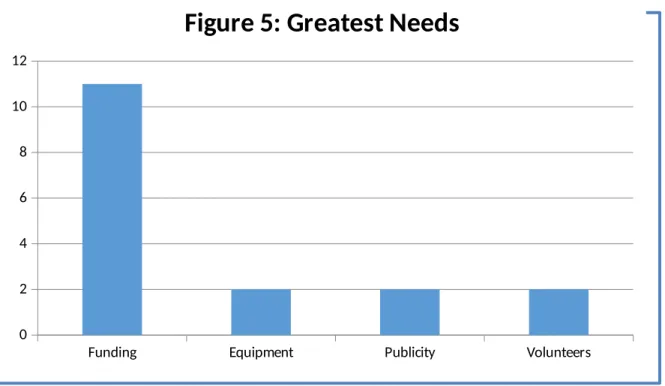
4) By far the greatest need for every organization was funding. When asked what their greatest need that could be improved was, the results were very clear:
Funding Equipment Publicity Volunteers
0 2 4 6 8 10 12
While this is certainly not a surprising result, as almost any organization—for-profit or non-profit—would likely cite more funding as their greatest need, it does provide an obvious area to help these organizations improve. Some might be helped—as Mr. Brodwin
suggested—through merging with similar organizations, reducing the competition for donors and increasing organizational efficiency. However, for some NGOs this is not
possible. Therefore, finding greater funding for these NGOs could be one of the best ways to help these organizations better accomplish their goals.
Through these interviews with soccer NGO leaders, we can draw a number of different
conclusions. However, the most obvious was that the soccer landscape is increasingly crowded and as a result these organizations are often challenged for funding. As such, my next section of chapter three will address this problem, providing recommendations for how these organizations can identify and secure additional sources of funding.
Trends in Global Philanthropy
likely place funding as one of their greatest—if not the greatest—issues that they face. I suggest this could be useful for sports NGOs, as the lessons learned from an overall look at how NGOs can best fund their projects are directly applicable to NGOs involved in sports.
NGOs earn the majority of their funding from four main sources: governments, private
individuals, foundations, and corporations (“Key Facts on Foundations’ Public Policy-related Activities”). My analysis for these next sections will focus on foundations and corporations, primarily because they have shown a clear and measurable increase in recent years in the amount that they give ("Foundations in the game"). All NGOs would do well to take advantage of this trend, and sports NGOs are certainly included.
Foundation Giving
Figure 6: Decade Established:
Foun-dations With Assets >$1million
As seen in figure six, close to two-thirds of larger foundations were established in the past two decades. This increase in large foundations has likely driven a large part of the increase in foundation giving, a yearly increase of over nine percent—much higher than inflation over the same period (“Key
1940-1989
1990-1999 2000-2010
47
39
Billions of Dollars
31
12
1995 2001 2006 2011
0 5 10 15 20 25 30 35 40 45 50
Facts on Foundations’ Public Policy-related Activities”). However, the question then becomes—to whom are these foundations giving, and how could sports NGOs capitalize on this growth?
To answer this question, I did a basic scan of eight different foundations, chosen randomly from the fifty largest foundations in the United States. I used www.random.org to generate a series of eight random numbers out of a set of one through fifty, and then used the each number to choose a different organization based on its size (e.g. a seven corresponded with the seventh largest foundation). For each foundation, I looked at each organization’s IRS-990 form—an annual reporting return required by the IRS, and providing information on each foundation’s mission, programs, and finances. I took special note of where these foundations were directing their funds. I also looked into each organization’s website and application for funding, taking note of the requirements for funds and the preferences each
foundation listed. More specifically, the foundations I investigated were the Atlantic Philanthropies, the Gill Foundation, the Bill and Melinda Gates Foundation, the Beldon Fund, the Rockefeller Foundation, the W.K. Kellogg Foundation, the Robert Wood Johnson Foundation, and the Hewlett Foundation. There were a few key insights that I could draw from these organizations.
First, a significant portion (four out of the eight) of these foundations had limited lifespans, with an established end-date and a focus on short term results. For example, the Atlantic Philanthropies—the largest foundation in history to conclude its grant making within its donor’s lifetime (if he survives for five more years)—will distribute its entire endowment and close its doors by 2020. On the whole, these organizations are focusing on making large investments in the near future, hoping to solve urgent problems now before they could become larger, more entrenched and expensive problems later.
lesbian, gay, bisexual, and transgender civil rights work. Funding applications for these organizations usually required this focus. The W.K. Kellogg’s Foundation’s application specifically asks, “How will your project help vulnerable children succeed?” and this level of specificity was not rare.
Third, these foundations are only interested in giving their funds to organizations in which they can see clear and tangible impact. All of the foundations that I investigated explicitly discussed their evaluation process, and recent data suggests this is not an isolated trend. From a study done in 2011 by the Robert Wood Johnson Foundation, 73% of foundation CEOs say that assessment of foundation effectiveness is among their top two priorities (Geisz). These foundations are also using a wider range of assessment approaches in recent years (Geisz). Looking at two studies from the Center for Effective Philanthropy, one from 2001 and the other from 2011, there has been a drastic increase in tracking methods. The percentage of foundations that track investment/financial performance increased 71%, the amount that track administration costs increased 55%, and the amount that tracked human resource decisions increased 83% (Buteau) (Buchanan).
There are a couple different conclusions for sports NGOs that can be drawn from this information. First, sports NGOs should attempt to capitalize on this rise in foundational funding, primarily by applying to foundations that match in terms of mission. For example, Ubuntu Sports Endeavor, a South African soccer NGO that uses sports to develop and inspire impoverished children, would likely benefit from applying to the W.K. Kellogg Foundation given their focus on helping
sports NGOs. The major sports foundations include, but are not limited to the Sports Philanthropy Project (a section of the Robert Wood Johnson Foundation), the Sports Philanthropy Foundation, the Shane Victorino Foundation, Doug Flutie, Jr. Foundation, and the Kids Play International Foundation.
Second, sports NGOs should relentlessly track their results, both to improve their operations as well as to earn funding from foundations. It is standard practice to track results to improve NGO procedures. However, it was also clear that evaluation techniques of foundations have significantly increased over the past ten years, and any NGO that would like funding would benefit from
documenting and quantifying their results and procedures.
Corporate Giving
corporate giving guidelines, and their recipients. I concluded that corporate giving to sports NGOs has been increasing and will likely continue to increase, and that in order to secure parts of this increasing funding, sports NGOs should work towards heavier documentation of their results, greater
programming for women, and providing more opportunities to aid the donating corporations.
First, corporate social giving among the three major sports donors has substantially increased. From 2004-2011, Nike’s total giving to sports NGOs increased from $35.9 million per year to over $168.8 million, with the other two corporations showing similar increases (“Nike CR Report”). Second, these corporations are giving to organizations exclusively in the sports NGO sphere. Every organization listed in their corporate social giving reports was a sport NGO. In addition, their giving guidelines were very explicit that that their donor recipients should match the values of each brand—values that included sports. These trends—an increase in overall giving and structured giving guidelines—are very similar to the ones seen in global philanthropies. These indicate that this is a growing opportunity for sports NGOs to gain funding, as the overall funding amount is increasing while the recipient pool is restricted to sports NGOs. Given the relative crowding in the sports NGO landscape—and the fact that relatively few of the NGOs I interviewed utilized corporate funding—this is a clear opportunity to capitalize upon.
Next, I looked at what organizations these large corporate brands are giving to, and was able to draw a few conclusions from this as well. More specifically, the organizations that received major corporate funding all thoroughly documented their efforts, worked towards supporting women, and provided their donors a multitude of opportunities to display their support. Though there were more recipients listed, I looked at the nine different organizations most prominently featured on the corporation’s websites:
results of their gifts. All nine of the NGOs that I looked into provided some form of report on their efforts on their website, many of them quite extensive. For example, the Homeless World Cup, a beneficiary of Nike’s corporate giving, interviewed all 25,000 of the players that
participated in their programs worldwide in order to establish the impact that the program had on their lives (“5.4 Case Study: Homeless World Cup – NIKE, Inc.”). This extensive tracking could be a requirement of their sizable funding from corporations—or it could be part of the reason that they receive such funding. Regardless, it suggests that NGOs interested in greater funding from corporations could certainly benefit from increased tracking and documenting of their work.
2) Every major corporation supported at least one organization focused on aiding women—and every supported organization aided women in some facet of their operations. Nike provides substantial funding to The Girl Effect, which helps to make girls visible and change their social and economic dynamics by providing them with specific and relevant resources—one of them being sports. By investing in adolescent girls, these organizations are hoping to see lasting effect in the communities that they invest in, given girls’ future roles as mothers and caretakers. My research cannot conclude whether or not focusing specific programming on women is helpful to sports NGOs at their work within communities. However, the three major corporations I
evaluated seem to believe this, and make it a priority for their funding. This would suggest that any NGO looking for corporate funding would benefit from conducting programming aiding women.
corporation is allowed to place its brand in key places around the NGO operations. While I am not suggesting that any NGO shift its mission or programs to accommodate the requests of a corporation, I am implying that corporations might look for NGOs that it can market heavily— and will be able to market them as well. As mentioned previously, a large part of the incentive for corporations to fund sports NGOs is the brand benefits provided. An NGO that can provide greater brand benefits with its programming will be more attractive to corporations.
Conclusions
After interviews with Howard Brodwin and an analysis of sportsandsocialchange.org, it is clear that sports NGOs are on the rise and sports are being increasingly recognized as a means of change in society. From interviews with the leaders of soccer NGOs, I was able to determine that these NGOs were created for a multitude of reasons—though most often due to an experience with an intense social problem or childhood experience with sport by their founder. These NGOs then reported a crowded NGO landscape and a general lack of funding as the greatest issues they regularly faced.
Chapter Four
A Comparison of Soccer for Peace and Seeds of Peace
In this chapter, I compare two different non-governmental organizations, Soccer for Peace and Seeds of Peace, both dedicated to the development of peace in the Middle East. Examining these organizations allows me to me to isolate the effect of using sports as the primary focus of an NGO, and argue for the inclusion of sport NGOs in a comprehensive conflict resolution program as well as within individual NGO programs.
This difference should allow us to isolate the effect that sports can have on a community. Given how similar the programs are, this difference should play a large role in the different outcomes seen from each program, and the different results each can achieve. The two programs, Soccer for Peace and Seeds for Peace, were chosen for a number of reasons. First, they both operate in Israel/Palestine. Second, they both contain a very similar structure in their efforts in conflict resolution. They both target youth, and they both utilize a diversity of past campers as counselors. They both include dialogue sessions, opportunities to learn about the “other’s” cultural and religious background, and physical contests designed to promote teamwork. There are a few smaller differences. Seeds of Peace includes girls to a much greater extent, and has greater financial resources than Soccer for Peace. Seeds of Peace focuses more on creating peace and dialogue through “elite” members of society, who have
demonstrated proficiency in English, leadership skills, and local politics, rather than the poorer
The first organization, Soccer for Peace, is a soccer based NGO run out of New York that works towards conflict resolution in the Israel/Palestine area. Soccer for Peace works to unite children of war-torn regions in their shared love of soccer. The children are coached by both Jewish and Arab coaches, and spend the majority of their day in soccer training sessions and competitions. Complementing these sessions are classroom lectures, in which the children learn about the history of the conflict and methods towards peace. Soccer for Peace uses a mixture of both discussions and lectures in their classroom programs. As they reported, discussion based lessons tend to be more influential on
individual outlooks, but the content cannot be controlled as easily as lecture ones. They also hold on the field educational sessions, which they reported as better for linking the emotions of sports to the lessons delivered, but usually cannot last as long or deliver as in-depth of material as classroom lessons. In addition, the camp includes visits to both synagogues and mosques, providing the opportunity to learn about the “other’s” culture. By placing the primary focus on soccer, Soccer for Peace provides incentive for certain members of each affected population to participate in a program they would likely never would otherwise, allowing for more dramatic changes in viewpoints. By using soccer, Soccer for Peace draws from a more grassroots population than Seeds of Peace. As such, it cannot guarantee the future impact of its participants on Palestinian/Israeli society, but it can more confidently believe that they have altered the viewpoints of their participants than Seeds of Peace.
concerning their conflict. These are complimented with group challenges, or “dialogue conducted in physical form,” in which groups containing members of both sides of the conflict compete in different physical challenges. These challenges, according to the Seeds of Peace website, are designed to
“reinforce trust, cooperation and communication, thus forging stronger bonds between dialogue group members and enhancing the dialogue sessions.” In addition, Fridays include both Muslim and Jewish worship services, which are open for all campers to attend or observe. Finally, at the end of camp they hold “Color Games,” in which everyone is divided into two teams that compete in different activities. It is an intensely competitive event, designed to create similarly intense teamwork that rises above ethnic, religious, and national divides.
By taking their participants out of their homes to a neutral location, Seeds of Peace allows them to get away from family and societal pressures. This relocation also offers them the opportunity to form new and different types of friendships, which is a key part of their success. In addition, by using a formal selection process Seeds of Peace can ensure that its participants will have larger future impacts, but not necessarily that they will be able to impact their participants. Seeds of Peace, without the initial
commonality of soccer, often cannot influence viewpoints as heavily as Soccer for Peace.
To study this, I conducted interviews with leaders in both organizations. I also drew on primary documents from each organization to collect additional information about their programs. In May, 2014, I travelled to New York to interview the Soccer for Peace founder and attend the largest
organization is in the long term, it does give us a general idea of how successful they are in changing attitudes in the short term. To analyze the impact of Seeds of Peace, I interviewed their program director, then examined the organization’s website and surrounding newspaper articles concerning their programs. In addition, I interviewed a former participant of the Seeds of Peace program, now an adult, to try and gain a complete perspective into the effect that Seeds of Peace has on participants. Finally, I looked at a recent study performed by Dr. Juliana Schroeder and Dr. Jane Risen at the University of Chicago on Seeds of Peace, documenting the change in attitudes of camp participants.This will provide me with a clear comparison to Soccer for Peace, to whom I can compare methods and their
effectiveness. The study by Dr. Schroeder and Dr. Risen is especially useful for comparison, as it contains a post-camp survey very similar to the ones conducted by Soccer for Peace.
Based on the analysis of these two organizations, I present a few key conclusions concerning the use of sports as a method of change in society. In the next two sections, I describe my methods and initial findings from each organization. In the conclusion section, I offer comparisons of the two
organizations and offer holistic findings about the different outcomes of each organization’s approach.
Soccer for Peace in New York
In order to get a closer look at the inner workings and motivations behind Soccer for Peace, in May, 2014, I flew to New York City to visit their NGO headquarters, interviewed their founder and director Ori Winitzer, and attended a fundraiser for the NGO—the largest fundraiser Soccer for Peace has ever held.
impressive company was evidence that these NGOs are not fringe groups. It also gave me a bit of perspective into why people give to organizations such as Soccer for Peace. I got the chance to ask a number of individuals why they cared, and why they wanted to give to an organization that used soccer as a means of conflict resolution. The responses varied considerably. Some donors cited a personal connection to Israel/Palestine and a desire to help. Some cited a personal experience with soccer, usually as children, which helped them see soccer as a useful tool for change. Others simply cited a friendship with Ori. It was helpful to learn a bit about what drives the decision to give to a sports NGO, though my data collection was not holistic or systematic enough to draw decisive conclusions.
To gain more systematic and detailed data, I conducted an in-depth interview with Ori Winitzer. Winitzer is an Israeli-American with personal experience in both the conflict within the region as well as “the binding power of the world’s most popular game” (Author’s Interview, Ori Winitzer, CEO and Founder, Soccer for Peace, May 29th, 2014). He founded Soccer for Peace as a one-time fundraising
event in 2002, but the incredible support he received compelled him to grow it into a continuous organization, holding its first actual camp in August 2005. Winitzer explained that he was driven to create Soccer for Peace by the 2002 Passover terrorist bombing in Netanya, and his feeling that “Soccer was the one thing I knew that both Arabs and Jews shared a passion for, and it’s the one thing that could bring them together” (Author’s Interview, Ori Winitzer, CEO and Founder, Soccer for Peace, May 29th,
2014). With Ori, I got the chance to discuss the difficulties of founding, growing, and sustaining a sports NGO. In addition, I got to speak with him about the details of how his organization works, his
camps, and instead recruits its participants from youth centers and lower-income neighborhoods across Israel/Palestine. Attracted by the lure of soccer—as well as the free meals and housing that the camps provide—often parents who are indifferent or even opposed to the peace process will allow their children to attend camp. These children, coming from poorer families, have often never had the opportunity to interact with a member of the other side of the conflict. Soccer for Peace relies on the “ripple effect,” where a few influenced individuals go on to influence others, who then influence others, and so on throughout society. They also work towards “humanizing” the other side, where they show participants that the other side of the conflict contains individuals with human emotions, desires, and feelings just as much as they do. Winitzer argued for soccer as a tool primarily because it was one of the only aspects of life universally loved by both Palestinians and Israelis, and was a way to humanize the other side in a highly emotional and moving context. As such, though these children come from lower income backgrounds and may not have as great of a chance to become “future leaders,” it is much more likely that these programs will have a noticeable effect on their life’s trajectory because of soccer’s ability to humanize. Though the “ripple” of each participant may not be as great as Seeds of Peace, their ability to humanize the other side often far greater. Finally, Winitzer mentioned his continual struggle with finding more female campers, as he believed them to be a great asset to their program.
Seeds of Peace