ACKNOWLEDGEMENTS
ABSTRACT
INTRODUCTION
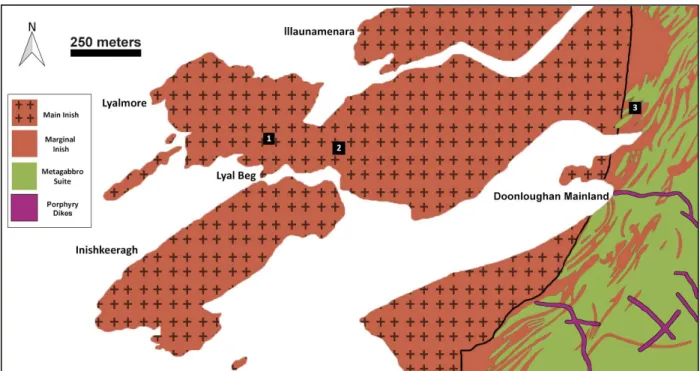
The Galway Granite is a late-Caledonian calc-alkaline batholith thought to have been assembled between about 410 and 380 Ma on the basis of U-Pb and Re-Os molybdenite ages (Figure 1; Feely et al., 2003). It has four plutons surrounding it (Roundstone, Inish, Omey and Letterfrack) that are commonly referred to as “satellite plutons” (Figure 1; Hunt, 2015). The Galway Granite and its satellite plutons are collectively known as the south Connemara Granites (Feely et al., 2003, Feely et al., 2010). Recent model Re-Os molybdenite ages from mineralized zones in the Omey Granite suggest magmatic activity around 423 Ma, therefore extending the assembly of the south Connemara Granites and molybdenite mineralization to 423-380 Ma (Feely et al., 2010). However, the 10 Ma gap between the age of Mo mineralization in the Galway Granite and Omey Granite raise concerns over accepting the model Re-Os as the true age of emplacement. Zircon U-Pb data from two samples of the Inish Granite, one from the main granite and one from the marginal granite are presented here in order to confirm the model Re-Os ages (Figure 1). These data provide a clearer picture of the time span of emplacement of the Galway Granite and its satellite plutons, and help elucidate the significance of the south Connemara Granites for Siluro-Devonian global plate tectonics.
GEOLOGIC SETTING
are a result of the closing of the Iapetus Ocean between Laurentia and Avalonia (Dewey and Strachan, 2003; Leake, 1978). The Shannawona Fault and the Barna Fault divide the Galway Batholith into three blocks, but appear to be of local significance only.
The Galway Granite and the Omey and Roundstone satellite plutons show evidence of disseminated and quartz-vein hosted molybdenite mineralization (Feely et al., 2010). Several studies have dated the molybdenite-bearing veins at Mace Head and Murvey, along the western end of the Galway Granite (Derham, 1986; Derham & Feely, 1988; Max & Talbot, 1986; Gallagher et al. 1992; Fig. 1). The Re-Os ages for Mo mineralization at Mace Head and Murvey, 407 Ma and 410 Ma, respectively, fit well into the age range of the batholith determined by U-Pb zircon geochronology (Feely et al., 2003). Thin quartz veins in the Omey Granite (<5 cm across) host disseminated molybdenite that gives a model Re-Os age of deposition around 422 Ma, which is about 20 Ma older than the established younger Mo mineralization in the Galway Batholith (Feely et al., 2010). These authors speculated that the molybdenite mineralization of the Inish, Letterfrack, and Roundstone satellite plutons occurred around the same time as the Omey Granite. However, due to the 10 Ma difference between the model Re-Os age of the Galway Granite and its satellite pluton as well as the lack of precise U-Pb geochronology to support the model age, it is problematic to take 422 Ma as the true Mo mineralization age of the Omey Granite.
show two different compositions and two possible ages for the main and marginal facies of the Inish Granite (Figure 1).
The Inish Granite intruded the southern limb of the Connemara antiform, causing folding and hornfels-facies contact metamorphism (Townend, 1966, Leake, 1985). Evidence for this comes from several NE trending folds in the metagabbro sheet that are interpreted to have formed during intrusion of the Inish Granite. The Inish granite cuts the Errismore metagabbro sheet, part of the Roundstone-Errismore-Gowla metagabbro intrusion, which crops out to the east of the pluton (Leake, 1986). The numerous sills and quartz-feldspar porphyry dikes in the eastern marginal granite around Doonloughan (Figure 1) that are lacking in the western main granite suggest that the marginal granite intruded, then dikes and sills, followed by the main Inish Granite.
METHODS
Sampling
Two samples of the main Inish granite and one sample from the fringing granite were collected for zircon U-Pb geochronology. Accessibility is limited for this area of Connemara due to the quickly rising tides that cover the exposure of this satellite pluton. Sampling was focused as far away from the mainland as possible for the main granite and close to the shore for the fringing granite. Six to seven samples were cut with a rock saw at each of the three sampling sites.
U-Pb Zircon Geochronology
exchange columns in order to isolate U and Pb. Purified U and Pb were loaded separately in silica gel and run on single Re filaments. Uranium was run as an oxide and Pb was run as a metal. The samples were analyzed in single collector mode using the Daly ion-counting photomultiplier system on the IsotopX Phoenix-X62 thermal ionization mass spectrometer (TIMS) in the Department of Geological Sciences at the University of North Carolina, Chapel Hill.
RESULTS
Zircons from both samples contained many inclusions that were visible in the microscopic view while preparing for U-Pb geochronology. All data from the main granite are concordant within uncertainty (Figure 2; Table 1), whereas all data from the marginal granite are discordant (Figure 3; Table 2).
Main Inish Granite
(423.21 ± 0.30 Ma) is interpreted to be the intrusion age of the main granite.
Marginal Inish Granite
Zircons 2, 3, and 4 of the five zircons from the marginal granite were all discordant. Regression of a line through the three discordant points yields an upper intercept age of 428 +17/-11 Ma. All three zircons are interpreted to have been experienced Pb-loss that was not successfully mitigated by the less aggressive chemical abrasion that was used for this sample. Although there is significant uncertainty in the age, it is permissible that the marginal granite yields an age that is greater than the age of the main granite – consistent with the field relations. DISCUSSION
Relation of the Satellite Plutons to the Galway Granite
center of the suite (Coleman et al., 2004).
Field Relations Between the Galway Batholith and Porphyry Dikes
The quartz-feldspar porphyry dikes that cross-cut the marginal, but not the main, Inish granite were assumed to be associated with the final pulse of the Galway Granite (i.e., < 380 Ma), suggesting that the main Inish granite was emplaced later than the Galway Granite (Leake, 1986). However, U-Pb data show emplacement of the Inish around 423 Ma, at least 10 Ma before emplacement for the Galway Granite (410 Ma-380 Ma). This discrepancy demands that there are multiple generations of porphyry dikes. Thus, caution should be exercised when hypothesizing relative age relations in the region on the basis of the occurrence of the dikes.
Molybdenite Mineralization in the Connemara Granites
The precise U-Pb age of the Inish Granite determined in this study indicate that the model Re-Os age of 422 Ma for the Omey Granite is reasonable. The approximate 10 Ma gap from the late stage Mo mineralization in the Galway Granite (400 Ma) and the Omey Granite (422 Ma) provides evidence of multiple episodes of Mo mineralization in the south Connemara Granites. Although there are no present geochemical analyses to support Mo mineralization in the Inish Granite, the location of the four satellite plutons in relation to the Galway Granite allows for the correlation of U-Pb ages from the Inish Granite with the time of emplacement of the Omey, Roundstone, and Letterfrack plutons.
Paleogeography Considerations
Connemara Granites from this study is identical to that of the Siluro-Devonian plutons and associated volcanic rocks in southeastern New England, USA (Figure 3; Thompson et al, in review). These alkalic plutons were hypothesized to be caused by oblique convergence of Laurentia and Avalonia. Newly determined ages for this suite range from 426 to 378 Ma, with an age of 422.99 ± 0.51 Ma for the Newbury Volcanic Complex of northernmost Massachusetts that formed in the mid-Paleozoic Laurentian margin in southeastern New England. Combining these results with the equivalent ages of the calc-alkaline Inish and Omey granite (423 Ma and 422 Ma, respectively) supports the hypothesis that subduction of West Avalonia underneath Laurentia during the closing of the Iapetus Ocean took place in the mid-to Late Silurian period (Figure 4). This link between intraplate rifting on West Avalonia and long-lived emplacement of south Connemara granites on the overlying plate of Laurentia suggests that both were caused in part by the convergence of the two land masses, and that magmatism ended with the final collision of Laurentia and Avalonia. This suggests that the age for the complete closure of the Iapetus Ocean is around 380 Ma.
CONCLUSIONS
REFERENCES CITED
Cocks, L.R.M., and Torsvik, T.H. 2006. European geography in a global context from the Vendian to the end of the Palaeozoic. European Lithosphere Dynamics, 32, Geological Society, London, Memoirs 83–95.
Coleman, D. S., Gray, W., Glazner, A. F. 2004. Rethinking the emplacement and evolution of zoned plutons: Geochronologic evidence for incremental assembly of the Tuolumne Intrusive Suite, California. Geology 32 (5), 433-436.
Derham, J. M. 1986. Structural control of sulphide mineralization at Mace Head, Co. Galway. Geology and genesis of mineral deposits in Ireland. Irish Association for Economic Geology, 187–93.
Derham, J. M., and Feely, M. 1988. A K-feldspar breccia from the Mo–Cu stockwork deposit in the Galway Granite, west of Ireland. Journal of the Geological Society, London 145, 661–7.
Dewey, J.F. and Strachan, R.A. 2003. Changing Silurian-Devonian relative plate motion in the Caledonides: sinistral transpression to sinistral transtension. Journal of the Geological Society, London 160, 219-229.
Faure, G. and Powell, J. I. 1972. Strontium Isotope Geology, Berlin: Springer.
Feely, M., Coleman, D., Baxter, S., and Miller, B. 2003. U–Pb zircon geochronology of the Galway Granite, Connemara, Ireland: implications for the timing of late Caledonian tectonic and magmatic events and for correlations with Acadian plutonism in New England. Atlantic Geology 39, 175–84.
mineralization at Connemara, western Irish Caledonides. Geological Magazine. 147 (6), 886-894.
Gallagher, V., Feely, M., Högelsberger, H., Jenkin, G. R. T., Fallick, A. E. 1992. Geological, fluid inclusion and stable isotope studies of Mo Mineralization, Galway Granite, Ireland. Mineral. Deposita 27: 314.
Hunt, J. 2015. Field and geochemical studies of the Galway granite batholith - the Kilkieran sector, Connemara, western Ireland PhD, NUI Galway Theses.
Leake, B.E. 1978. Granite emplacement: the granites of Ireland and their origin. Crustal Evolution in Northwest Britain and Adjacent Regions. Geological Journal, Special Issue 10, 221-248.
Leake, B. E. 1985. The geology of Slyne Head, Connemara: geological map of 6 inch (1 : 10,560) sheet 48 Co. Galway. University of Glasgow.
Leake, B. E. 1986. The geology of SW Connemara, Ireland: a fold and thrust Dalradian and metagabbroic-gneiss complex. Journal of the Geological Society, London 143, 221-236. Leake, B.E. 1989. The metagabbros, orthogneisses and paragneisses of the Connemara complex,
western Ireland. Journal of the Geological Society of London 146, 575– 596.
Max, M. D., and Talbot, V. 1986. Molydenum concentrations in the western end of the Galway Granite and their structural setting. Geology and genesis of mineral deposits in Ireland, Irish Association for Economic Geology, 177–85.
Townend, R. 1966. The geology of some granite plutons from western Connemara, Co. Galway. Proceedings of the Royal Irish Academy 65B, 157–202.