Vol. 13, No. 2, pp 225-247
Economic Design of
T
2−
V SSC
Chart Using
Genetic Algorithms
Marzieh Arbabi, Zahra Rezaei Ghahroodi
Statistical Research and Training Center, Tehran, Iran.
Abstract. The principal function of a control chart is to help man-agement distinguish different sources of variation in a process. Control charts are widely used as a graphical tool to monitor a process in or-der to improve the quality of the product. Chen and Hsieh (2007) have
designed a T2 control chart using a Variable Sampling Size and
Con-trol limits (V SSC) scheme. They have shown that using the V SSC
scheme results in charts with more statistical power to detect small to
moderate shifts in the process mean vector than the otherT2 charts. In
this paper, we develop an economic design for the T2−V SSC chart to
help determine the design parameters and then minimize the cost model proposed by Costa and Rahim (2001) using a Genetic Algorithm (GA)
approach. We also compare economic design of the T2−V SSC chart
with theT2−DW L,T2−V SSI andT2−F RS charts so as to choose
the best option and, finally, carry out a sensitivity analysis to investigate the effects of model parameters on the solution of the economic design.
Keywords. Adjusted average time to signal (AAT S), economic de-sign (ED), genetic algorithm (GA), Markov chain, multivariate con-trol charts, sensitivity analysis, variable sample size and concon-trol limits (V SSC).
MSC: 62M99, 62P30.
Marzieh Arbabi( )([email protected]), Zahra Rezaei Ghahroodi(z rezaei @srtc.ac.ir)
Received: March 2012; Accepted: April 2014
1
Introduction
An effective method for improving the quality of productions or ser-vices in companies is Statistical Process Control (SPC). Control charts are the most common tools of SPC for detecting the occurrence of an assignable cause which leads to non-conforming products and hence a change mean and variance values from target values. In some industrial situations, quality control problems may characterize a single charac-teristic which is a normal continuous random variable. When process quality can be described by a single quality characteristic, univariate control charts are used to maintain current control of the process. The most common control chart for monitoring the mean of a single variable
is the ¯X chart. Walter Shewhart created these charts in the 1920s to
monitor processes to detect any large shift in process mean and process variance. However, it is increasingly common today for processes to be characterized by more than one variable which are usually correlated and have a multivariate normal distribution. For example, resistance of an industrial piece (e.g. a wheelwork), its dimensions and its weight have univariate normal distribution, separately; But the correlation be-tween these characteristics is not zero and hence, joint distribution of them is multivariate normal. First time, Hotelling (1947) has developed quality control procedures for several related random variables (or pro-cess characteristics) with normal distribution. Among these procedures,
Hotelling’sT2 control chart is probably the most widely known and
ap-plied in industry. Of course, recently Mason and Young (2002) showed that if correlated quality characteristics have non-normal distribution,
the distribution of T2 will be a function of Beta distribution which is
not studied in this paper.
Generally, the traditional practice for applying a control chart to monitor a process is to obtain samples of fixed size at fixed sampling in-tervals between successive samples. This procedure is called Fixed Ratio
Sampling (F RS). The efficiency ofF RS scheme is good for large shifts
but not for small or even moderate shifts. The use of the ¯X −F RS
control chart requires the user to select three design parameters: the
sample size (n), the sampling interval (h), and the width of the control
limit (k). To improve the efficiency, theF RS policy was modified to a
Variable Ratio Sampling (V RS) policy. One procedure for comparing
the statistical performance of V RS schemes is a Variable Sample Size
(V SS) scheme. In this scheme, the sample size varies and is a
func-tion of prior sample results. The use of the ¯X −V SS control chart
requires the user to select five design parameters: the small and large
sample sizes (n1,n2), the sampling interval (h), the warning limit (w),
and the control limit (k). The statistical design of the V SS scheme
for univariate Shewhart control chart has been studied by Burr (1969), Daudin (1992), Prabhu et al (1993), Costa (1994) and Zimmer et al
(1998). Aparisi (1996) generalizedV SS scheme to the multivariate case
and Faraz and Moghadam (2008) compared the T2 −V SS chart with
the T2−F RS chart. Another procedure is the Variable Sampling
In-terval (V SI) scheme where the sampling interval is a function of prior
sample results. The ¯X−V SI chart was introduced by Reynolds (1988),
Reynolds and Arnold (1989) and Runger and Pignatiellow (1991). Also,
theT2−V SI chart was studied by Aparisi and Haro (2001) and Faraz
et al (2009a). Variable Sample size and Sampling Interval (V SSI) is
another procedure in V RS schemes where both sample size and
sam-pling interval are functions of prior sample results. Prabhu et al (1994)
were the first to study the ¯X−V SSI chart. Costa (1997) obtained
similar results when comparing the V SSI scheme with the V SS, V SI
and F RS schemes. Aparisi and Haro (2003) developed V SSI scheme
to the multivariate case. The Double Warning Line (DW L) scheme
de-signed by Faraz and Parsian (2006) for the multivariate case, is also a
procedure inV RS schemes where there are two warning lines and both,
sample size and sampling interval, are functions of prior sample results. As control charts became ubiquitous in industrial practice, researchers became concerned over the economic consequences of control charts de-sign and control charts which were dede-signed based on statistical criteria and cost parameters in a process became less popular. The method of designing control charts based on economic models is called Economic Design (ED). Based on the ED procedure, the charts are designed in such a way that the overall costs associated with maintaining current control of a process are minimized. Duncan (1956) proposed the first
economic model and used it to ED of the Shewhart ¯X chart. Also,
Lorenzen and Vance (1986) developed a cost model which is appropriate for all kind of control charts. Costa and Rahim (2001), proposing a new
economic model made a comparison between theF RS and Variable
Pa-rameters (VP) schemes in the univariate case. Montgomery and Klatt
(1972) were the first to design a multivariateF RScontrol chart,
econom-ically. Chou et al (2006) studied the ED of the T2−V SI control chart.
Also, Chen (2006, a-b) studied ED ofT2−V SI and T2−V SSI charts.
Faraz et al (2009b) and Faraz et al (2010a) economically designed the
T2−V SS chart using the Costa and Rahim (2001) and Lorenzen and
Vance (1986) economic models. Also, Faraz et al (2010b) studied the
ED of theT2−DW Lchart using the Costa and Rahim (2001) economic model.
Chen and Hsieh (2007) designed a new V RSscheme called Variable
Sample Size and Control limits (V SSC), to improve the power of T2
control charts, statistically. In some industries, economic aspects are more important than statistical aspects. So, in this paper, we investigate
the effect of incorporating the T2−V SSC chart into economic designs
and compare the ED of the T2 −V SSC chart with the other V RS
schemes. Also, for investigating the effects of model parameters on the economic model, sensitivity analysis is used. The paper is organized as
follows: In Section 2, theT2−V SSCchart and a Markov chain approach
to V SSC scheme are briefly reviewed. In Section 3, the cost model proposed by Costa and Rahim (2001) is used to build a model of process
controlled by theT2−V SSCchart. In Section 4, the Genetic Algorithm
(GA) is employed to obtain the optimal values of the parameters. Also, theV SSC scheme is compared with otherV RS schemes. In Section 5, a sensitivity analysis is carried out to investigate the effects of model parameters on the solution of the economic design and finally, section 6 contains a conclusion.
2
T
2−
V SSC
Chart and the Markov Chain
Approach
Consider a process in whichpcorrelated quality characteristics are
mea-sured simultaneously and the distribution of these quality characteristics
is a p-variate normal with mean vectorµµµ and covariance matrix ΣΣΣ. In
practice, the vectorµµµand matrix ΣΣΣ are usually unknown and estimated
using the sample mean vector, ¯X, and the sample variance-covariance
matrix, ¯S. ˆ
µµµ= ¯X= 1
m m
∑
i=1
¯
Xi , X¯i=
1
n n
∑
j=1
Xij ,
ˆ Σ
ΣΣ = ¯S= 1
m m
∑
i=1
( ¯Xi−X¯)( ¯Xi−X¯)′
where Xij is the jth sample in the ith subgroup and ¯Xi is the mean
of the ith subgroup. Moreover, n is the sample size for all subgroups
and m is number of subgroups in the initial sampling from the process.
When the vector µµµ and matrix ΣΣΣ are known, the charting statistic, for
every subgroup, is T2 = n( ¯X−µµµ)′ΣΣΣ−1( ¯X−µµµ) which is plotted on a
control chart. The vectorµµµ′0= (µ01, . . . , µ0p) is the vector of in-control
means for quality characteristics. Assuming to unknownµµµ and ΣΣΣ, the
ith subgroup statistic,Ti2 =n( ¯Xi−X¯)′SSS−1( ¯Xi−X¯) fori= 1,2, . . . , m, is
plotted on a control chart in sequential order. If a value of this statistic
is greater than the Upper Control Limit (U CL), the process will be
considered out of control. Otherwise, the process is in control.
In statistical design methodology, if the process parameters (µµµand ΣΣΣ)
are known, T2 has a chi-square distribution with p degrees of freedom
and so U CL = χ2(p,α). In practical situations, µµµ and ΣΣΣ are unknown
and for each i, the distribution of Ti2 is the Hotelling distribution and
U CL=C(m, n, p)F(p, ν, α), where
C(m, n, p) =
p(m+ 1)(n−1)
m(n−1)−p+ 1 n >1
p(m+ 1)(m−1)
m(m−p) n= 1
and
ν =
m(n−1)−p+ 1 n >1
m−p n= 1
It is usually assumed that the variance-covariance matrix is fixed but unknown and an assignable cause occurs upon a change of the mean
fromµµµ0 toµµµ1. The magnitude of this shift is expressed by Mahalanobis
distance,d2= (µµµ1−µµµ0)′ΣΣΣ−1(µµµ1−µµµ0). If the process is out of control (d̸=
0), the chart statistic will be distributed as a non-central distribution
with non-centrality parameter η=nd2.
In theF RS scheme, the chart parameters (sample size,n0, sampling
interval, h0, and U CL) are fixed. Applying this method is very simple
but its efficiency in detecting the small or moderate shifts is not good
enough and hence,V RSschemes are necessary. OneV RSscheme is the
V SSCscheme in which we have a fixed sampling interval,h, two sample sizes,n1 and n2 (n1< n2), two warning lines,w1 andw2 (w1 > w2) and
two control limits, k1 and k2 (k1 > k2). The sample size and sampling
interval in a subgroup depend totally on the appearance of a prior sample point on the chart. We describe this chart below.
If the sample point falls in the interval [0,wi],i= 1,2, the next
sam-ple size will be n1 and the warning line and control limit for the next
sample will be w1 and k1, respectively. When the sample point falls in
the interval (wi, ki], i = 1,2, the next sample size will be n2 and the
warning line and control limit for the next sample will be w2 and k2,
respectively. Therefore, theT2−V SSC chart is defined as follows:
LCL= 0
U CL=C(m, nj, p)F(p, ν,1−α)
(ni, wi, ki) =
(n1, w1, k1) 0< Ti2−1 ≤wj
(n2, w2, k2) wj < Ti2−1 ≤kj
, j = 1,2
If Ti2−1 > kj, we say the process is out of control. However, if there is
not any assignable cause, then the signal is a false alarm. Note that the sample size at the start of the process is chosen at random.
In this chart, at each sampling stage, one of the six following states may occur according to the status of the process.
State 1: 0< T2≤wi and the process is in control (d= 0).
State 2: wi < T2 ≤ki and the process is in control (d= 0).
State 3: T2> k
i and the process is in control (d= 0).
State 4: 0< T2≤wi and the process is out of control (d̸= 0).
State 5: wi < T2 ≤ki and the process is out of control (d̸= 0).
State 6: T2> k
i and the process is out of control (d̸= 0).
The control chart produces a signal when T2 > ki. If the signal is
genuine, then the process should be stopped and after repair, it starts to work again. The signal in state 3 is a false alarm and the signal in state 6 is a genuine alarm (absorbing state in Markov chain). The transition matrix between states may be written as
P =
p11 p12 p13 p14 p15 p16
p21 p22 p23 p24 p25 p26
p31 p32 p33 p34 p35 p36
0 0 0 p44 p45 p46
0 0 0 p54 p55 p56
0 0 0 0 0 1
wherepij denotes the transition probability from state ito statej. We
have definedpij’s as follows:
p11 = P(0< T2 ≤w1)e−λh=F(
w1
C(m, n1, p)
, p, ν1,0)×e−λh
p12 = P(w1 < T2 ≤k1)e−λh
= [F( k1
C(m, n1, p)
, p, ν1,0)−F(
w1
C(m, n1, p)
, p, ν1,0)]×e−λh
p13 = P(T2 > k1)e−λh= [1−F(
k1
C(m, n1, p)
, p, ν1,0)]×e−λh
p14 = P(0< T2 ≤w1)(1−e−λh)
= F( w1
C(m, n1, p)
, p, ν1,0)×(1−e−λh)
p15 = P(w1 < T2 ≤k1)(1−e−λh)
= [F( k1
C(m, n1, p)
, p, ν1,0)−F(
w1
C(m, n1, p)
, p, ν1,0)]×(1−e−λh)
p16 = P(T2 > k1)(1−e−λh)
= [1−F( k1
C(m, n1, p)
, p, ν1,0)]×(1−e−λh)
p21 = p31=P(0< T2≤w2)e−λh=F(
w2
C(m, n2, p)
, p, ν2,0)×e−λh
p22 = p32=P(w2< T2 ≤k2)e−λh
= [F( k2
C(m, n2, p)
, p, ν2,0)−F(
w2
C(m, n2, p)
, p, ν2,0)]×e−λh
p23 = p33=P(T2> k2)e−λh= [1−F(
k2
C(m, n2, p)
, p, ν2,0)]×e−λh
p24 = p34=P(0< T2≤w2)(1−e−λh)
= F( w2
C(m, n2, p)
, p, ν2,0)×(1−e−λh)
p25 = p35=P(w2< T2 ≤k2)(1−e−λh)
= [F( k2
C(m, n2, p)
, p, ν2,0)−F(
w2
C(m, n2, p)
, p, ν2,0)]×(1−e−λh)
p26 = p36=P(T2> k2)(1−e−λh)
= [1−F( k2
C(m, n2, p)
, p, ν2,0)]×(1−e−λh)
p44 = P(0< T2 ≤w1) =F(
w1
C(m, n1, p)
, p, ν1, η1)
p45 = P(w1 < T2 ≤k1)
= F( k1
C(m, n1, p)
, p, ν1, η1)−F(
w1
C(m, n1, p)
, p, ν1, η1)
p46 = P(T2 > k1) = 1−F(
k1
C(m, n1, p)
, p, ν1, η1)
p54 = P(0< T2 ≤w2) =F(
w2
C(m, n2, p)
, p, ν2, η2)
p55 = P(w2 < T2≤k2)
= F( k2
C(m, n2, p)
, p, ν2, η2)−F(
w2
C(m, n2, p)
, p, ν2, η2)
p56 = P(T2 > k2) = 1−F(
k2
C(m, n2, p)
, p, ν2, η2),
whereF(x, p, νi, ηi) is defined as the cumulative probability distribution
function of a non-central F distribution with p and νi = m(ni −1)−
p+ 1 degrees of freedom and non-centrality parameter ηi = nid2, and
C(m, ni, p) =
p(m+ 1)(ni−1)
m(ni−1)−p+ 1
. When the mean vector and variance-covariance matrix are known, instead of F(x, p, νi, ηi) we useF(x, p, ηi)
which is defined as the cumulative probability distribution function of a
non-centralχ2 distribution withp degrees of freedom and non-centrality
parameterηi.
In the investigations of Costa (1994), Duncan (1956), Lorenzen and Vance (1986), Faraz and Moghadam (2008), Montgomery and Klatte (1972), Chou et al (2006), the most recently used statistical measure to
compare the efficiency of different control schemes, is AAT S, the
aver-age time from the process mean shift until the chart produces a signal. This statistical measure determines the speed with which a control chart detects a process mean shift and is related to the average time of the
cycle (AT C) which is the average time from the start of the production
until the production of first signal after the process shift. If it is assumed that the shift in the process mean occurs at some random time in the future (not at beginning) and that this random time has an
exponen-tially distributed random variable with mean 1
λ, then the time that the
process is in control, has an exponential distribution with parameterλ.
So, the average time before occurrence of assignable cause is 1
λ and the
steady-state AAT S is
AAT S =AT C− 1 λ.
We can compute the average time of the cycle using the Markov chain property (see Cinlar, 1975).
AT C=b′(I −Q)−1h
whereb′ = (p1, p2, p3,0,0) is a vector of initial probabilities with
∑3
i=1pi
= 1, I is the identity matrix of order 5,Q is the 5×5 matrix obtained
fromP by deleting the absorbing row and column andh′ = (h, h, h, h, h).
Alsob′(I−Q)−1provides the expected number of trials needed to reach
the absorbing state. In this paper, we chooseb′ = (0,1,0,0,0) for extra
protection and for preventing problems that may be encountered during start-up.
We may also calculate the expected number of false alarm (AN F),
the expected number of inspected items (AN I) and the expected
num-ber of samples (AN S) as follows:
AN F = b′(I−Q)−1(0,0,1,0,0)′
AN S = b′(I−Q)−1(1,1,1,1,1)′
AN I = b′(I−Q)−1(n1, n2, n2, n1, n2)′
3
The Economic Model and Optimization
In this paper, we apply Costa and Rahim’s cost model (2001) to study
the ED of aT2−V SSC chart. To formulate an economic model for the
design of a control chart, it is necessary to make certain assumptions about the behavior of the process.
Suppose that the p quality characteristics follow ap-variate normal
distribution with mean vector µµµ and variance-covariance matrix ΣΣΣ. At
the beginning the process is in control. In this state, we have µµµ = µµµ0
and only an assignable cause changes the process mean from µµµ = µµµ0
toµµµ =µµµ1 (µµµ1 is known). Also the variance-covariance matrix ΣΣΣ stays
constant. The assignable cause occurs according to a Poisson process
with a mean ofλoccurrences per an hour. So, the time interval that the
process remains in control is an exponential variable with mean 1
λ. Also,
the process is not self-correcting. Hence, the process can be returned to the in-control state from an out-of-control state only by management intervention and appropriate corrective actions. We assume that the quality cycle starts in an in-control state and continues until the process reaches an out-of-control state, when it is repaired. The quality cycle follows a renewal reward process. Note that during the search for an assignable cause, the process is shut down.
According to the model, the production cycle may be divided to four time intervals: An in-control process period, a period of searching for
a false alarm, an out-of-control period and a period for identifying the assignable cause and correcting the process. It is clear that the expected
time the process is in control, is equal to 1
λ. The expected out-of-control
time period is the expected time from the process mean shift until an
out-of-control signal is triggered. This expected time is given byAAT S
andAT C is the average time from the moment of stating process to the
time of chart signal after the process shift. Let T0 be the average time
wasted searching for an assignable cause when the process is in control
and T1 be the average time to find and correct the assignable cause.
Hence, the expected time of a production cycle is given by
E(T) = 1
λ+T0AN F +AAT S+T1
= AT C+T0AN F +T1
The profit from a production cycle includes the average profit while the process is in control as well as where it is out of control. We also incur a cost when searching for false alarms or assignable causes, for repairing the process and for sampling and inspecting items. So, the expected net profit from a production cycle is given by
E(I) =V0
1
λ+V1AAT S−C0AN F −C1−sAN I
where V0 is the average profit per hour earned when the process is in
control, V1 is the average profit per hour earned when the process is
out of control, C0 is the expected cost of searching for false alarms,C1
is the expected cost of searching for an assignable cause and repairing
the process ands is the cost of inspecting an item. Due to the renewal
reward assumption, the expected net profit per hour is E(I)
E(T).
Hence, the loss function,E(L), is given by
E(L) =V0−
E(I)
E(T)
To obtain the ED of a T2−V SSC chart, we must obtain optimal
values for the seven chart parameters (k1, k2, w1, w2, n1, n2, h) of the cost
model, E(L), given the process parameters (p, λ, d, T0, T1) and the cost
parameters (V0, V1, C0, C1, s). Among the seven chart parameters, the
sample sizes are discrete variables (where 1 ≤ n1 < n0 < n2) and the
other variables are continuous (where 0 < w1 < k1, 0 < w2 < k2,
0< w2< w1 and 0< k2 < k1). The maximum value of the parameterh
is considered as the maximum hours available in a work shift, i.e. h≤10.
Therefore, the general optimization problem is defined as follows:
M in E(L)
subject to: 0< w1 < k1
0< w2 < k2
0< w2 < w1
0< k2< k1
0.1≤h≤10
1≤n1 < n0< n2
n1, n2 ∈Z+.
This model is a non-linear function of the chart parameters with mixed continuous-discrete variables and a discontinuous and non-convex solution space. So, linear methods are inefficient for the minimization problem and non-linear programming techniques to search for optimal solution are necessary.
4
A Numerical Comparison between
T
2−
F RS
,
T
2−
V SSI
,
T
2−
DW L
and
T
2−
V SSC
Control
Charts
For a fair comparison of the economic performance of the T2 −V SSC
chart with otherT2control charts (DW L,V SSI andF RS), they should
have the same costs when the process is in control. Two schemes which have the same in-control time, are comparable if and only if they have the same in-control cycle cost i.e. they must have the same expected number of false alarms, the same expected number of inspected items
and the same expected number of samples. On the other hand, AN F,
AN S and AN I values in all of these schemes should be equal during
the in-control period. Here, for the sake of simplicity, we suppose that
the vectorµµµand matrix ΣΣΣ are known. Hence, for theF RS scheme, the
in-control statistical measures are
AN F = αe
−λh0
1−e−λh0 , AN S =
1
1−e−λh0 , AN I =
n0
1−e−λh0
and in theV SSC scheme, these measures are
AN F=BF(w2, p,0)e
−λh+A(1−F(k
2, p,0))e−λh A[1−(1−F(w2, p,0))e−λh]
,
AN S= F(w2, p,0)e −λh
[1−(F(w1, p,0)−F(w2, p,0))e−λh+A] A[1−(1−F(w2, p,0))e−λh]
,
AN I=F(w2, p,0)e −λh{
n1[1−(1−F(w2, p,0))e−λh] +n2[(1−F(w1, p,0))e−λh+A]} A[1−(1−F(w2, p,0))e−λh]
.
where
A = 1−[1−F(w2, p,0) +F(w1, p,0)
−(F(w1, p,0)−F(w2, p,0))e−λh]e−λh
B = e−λh{(1−F(w1, p,0))(1−F(k2, p,0))e−λh
+(1−F(k1, p,0))[1−(1−F(w2, p,0))e−λh]}
Equating the statistical measures in these two schemes, we have h=
h0 and
k2 =F−1(1−K, p,0)
where
K= [1−(1−F(w2, p,0))e
−λh]{αe−λh0A−(1−e−λh0)e−2λhF(w2, p,0)(1−F(k1, p,0))} (1−e−λh0)e−λh[F(w2, p,0)(1−F(w1, p,0))e−2λh+A]
and
n2=n0{A[1−(1−F(w2, p,0))e
−λh]} −n1F(w2, p,0)e−λh[1−(1−F(w2, p,0))e−λh](1−e−λh0)
F(w2, p,0)e−λh[(1−F(w1, p,0))e−λh+A](1−e−λh0)
Note that fori= 1,2,F(x, p, ηi) is defined as the cumulative
proba-bility distribution function of a non-central chi-square distribution with
p degrees of freedom and non-centrality parameterηi=nid2.
Therefore, choosing optimal values of k1, w1, w2 and fixing n1, n0
andh0, we can obtaink2andn2. This optimization problem is a decision
problem with continuous decision variables and a discontinuous and non-convex solution space and may be solved using Meta heuristic methods, such as Genetic Algorithms (GAs)(Goldberg, 1989).
In this paper, for a given parameters (k0,n0,h0), GA finds optimal
values of k1, w1 and w2 and then computes the values of k2 and n2
and, finally, E(L). The initial values of the used GA parameters are the
crossover rate (rC), the population sizes (Npop) and the mutation rate
(rM) were set to Npop = 100, rC = 0.2 and rM = 0.25. The number of
iterations was set to 200.
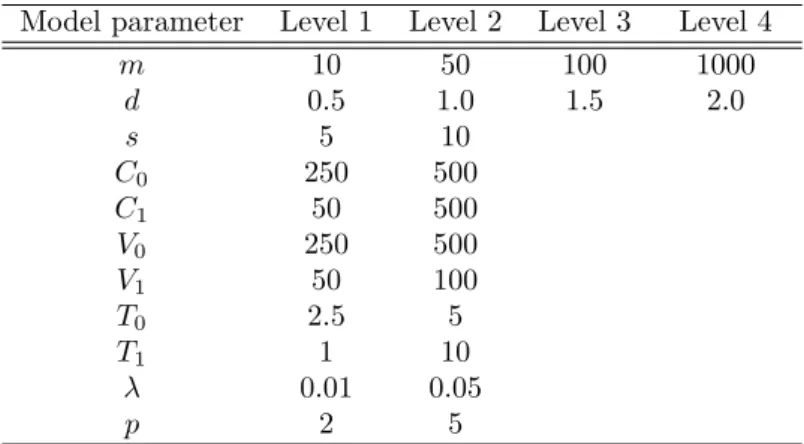
The MATLAB/GA computer program is used to perform a compar-ison between these schemes using a numerical example. Consider a soft drink fabrication process involving two quality characteristics of interest. One of the quality characteristics is the pressure inside the soft drink bottle and the other is the gas volume present in the drink. These qual-ity characteristics directly affect the product qualqual-ity. Difference levels of the parameters were determined based on previous studies investigated which are given in Table 1.
As in Chen (2006a), Table 2 provides a Taguchi orthogonal array
L16(2942) of a mixed 24 levels experimental design for assigning 11
vari-ables to the columns of theL16(2942) orthogonal array. In theL16(2942)
orthogonal array experiment, there are 16 trials (16 different level com-binations of the eleven variables).
To compare the effectiveness of the V SSC and DW L, V SSI and
F RS schemes, we use the first level of the parameters in Table 1 for
d= 0.25(0.25)4 and obtain the optimal values of the design parameters
using GAs. Ford= 0.25(0.25)4, tables 4, 5 and 6 respectively show the
optimal design parameters and the expected hourly loss for the T2 −
V SSC chart together with the outputs of the T2−F RS, T2−DW L
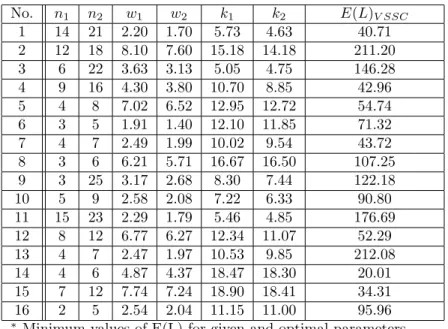
and T2−V SSI control charts. For each trial in Table 2, the optimal solution to the design parameters is obtained by GAs with the objective of minimizing the expected hourly loss. Table 3 displays the optimal
design parameters and the expected hourly loss for the T2 −V SSC
control chart of these 16 trials. All comparisons (V SSC and DW L,
V SSC andV SSI, and V SSC andF RS) are fair. The results indicate
that the expected hourly loss of the V SSC scheme is smaller than the
DW L, V SSI and F RS schemes. In fact, for small to large values of
d (d = 0.25(0.25)4), when compared with the F RS scheme, there an
average hourly saving of approximately 4.05%. Also, a comparison of
V SSC and DW L schemes, shows an average hourly saving of 23.90%
and a comparison ofV SSCandV SSI schemes, an average hourly saving
of 14.45%. For small to moderate shifts (d < 2), these amounts change
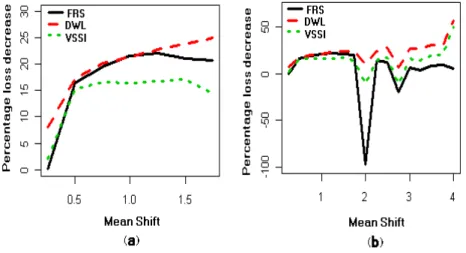
to 17.36%, 19.76% and 14.08% respectively. The results are plotted in
Figure 1. This figure shows that for small to moderate shifts (Figure
1 (a)), the V SSC scheme has a greater economic advantage versus the
DW L, V SSI and F RS schemes. This is not unexpected. Faraz et al
(2010b) concluded that theT2−DW Lcontrol chart is more economical
than theT2−V SSI,T2−V SS,T2−V SI and T2−F RS charts. So,
we can conclude that, specially for small to moderate shifts, theV SSC
scheme is more economical than otherV RS and F RS schemes.
5
Sensitivity Analysis
In this section, we conduct a sensitivity analysis for the above example to study the effects of the model parameters (process parameters and
cost parameters) on the economic design of theT2−V SSC chart. This
study is carried out using experimental design and linear regression anal-ysis. In each linear regression model, given values of process parameters (p, λ, d, T0, T1, m) and given values of cost parameters (V0, V1, C0, C1, s)
are regarded as possible independent variables while the test parameters and the expected total cost are treated as the dependent variables. The eleven model parameters considered in the sensitivity analysis and their corresponding level plans are shown in Table 1. In our plan we have nine parameters with two levels and two parameters with four levels.
To study the effect of the model parameters on the solution of
eco-nomic design of the V SSC scheme based on the data in Table 6, the
statistical software SPSS is used to run the regression analysis for each dependent variable. For each dependent variable, the output of SPSS includes an ANOVA table for regression and a table of regression co-efficients, showing the corresponding information about statistical hy-pothesis testing. Table 7 is the SPSS output for the small sample size
(n1). From the ANOVA in Table 7(a), we conclude that at least one
model parameter significantly affects the value of small sample size. On
examining Table 7(b), we find that both the parameters dand C1
sig-nificantly affect the value of sample size n1. We note that the sign of
the coefficient ofdandC1 is negative which indicates that higher values
of the magnitude of the shift and the expected cost of searching for an
assignable cause reduce the sample sizen1. Table 8 is based on the large
sample size (n2) and shows that the parametersd and V0 significantly
affect the value of sample sizen2. Increasing values of the magnitude of
the shift cause a decrease in the sample size n2 and lower values of the
average profit per hour earned when the process is in control leads to larger values forn2.
Tables 9 and 10 are the SPSS outputs for the warning lines (w1,
w2). From these tables, we see that the only model parameter that
significantly affects the warning lines is p. Higher values of the number
of correlated quality characteristics leads to larger values forw1 andw2.
Tables 11 and 12 which display the results for changing control limits
(k1, k2), show that both parameters d and p significantly affect the
control limits. Higher values of the magnitude of the shift and number
of correlated quality characteristics lead to larger values for k1 and k2.
Table 13 gives the SPSS output for the expected loss value E(L). It is
obvious that the parameters λ, V0, T1,d and m significantly affect the
expected loss. Since a higher penalty cost of defective products leads to a higher total cost, to reduce the total cost, the penalty cost of defective products should be decreased as much as possible.
6
Conclusion
In the present paper, the economic design of the T2 −V SSC chart
is developed based on the cost model proposed by Costa and Rahim (2001). The expected total cost per hour is minimized using GA and
finally, the T2 −V SSC chart and the T2 −DW L, T2 −V SSI and
T2 −F RS control charts are compared from an economic viewpoint.
Also, sensitivity analysis is carried out to investigate the effects of model parameters on the solution of the economic design. The results indicate that among the four possible schemes, the expected hourly loss of the
V SSC scheme is smaller than the DW L, V SSI and F RS schemes, specially for small to moderate shifts. These results are presented on a
graph. Since Faraz et al (2010b) concluded that theT2−DW Lcontrol
chart is more economical when compared with T2−V SSI, T2−V SS,
T2−V SI and T2 −F RS control charts, we conclude that the V SSC
scheme is more economical than the otherV RS and F RS schemes.
Sensitivity analysis shows that C1, s, V1 and T0 have no significant
impact on the optimal solution of the V SSC scheme, while the eight
parametersm,s,d,C0,V0,T1,λandpplay significant role in influencing
the response parameters.
Acknowledgment
The authors are grateful to Professor Mahbanoo Tata for making many helpful comments and suggestions.
Tables
Table 1. Levels for each model parameter
Model parameter Level 1 Level 2 Level 3 Level 4
m 10 50 100 1000
d 0.5 1.0 1.5 2.0
s 5 10
C0 250 500
C1 50 500
V0 250 500
V1 50 100
T0 2.5 5
T1 1 10
λ 0.01 0.05
p 2 5
Table 2. Experimental layout of theL16(2942) array
No. m d s C0 C1 V0 V1 T0 T1 λ p
1 10 0.5 5 250 50 250 50 2.5 1 0.01 2
2 10 1.0 5 250 50 500 100 5 10 0.05 5
3 50 0.5 5 500 500 250 50 5 10 0.05 5
4 50 1.0 5 500 500 500 100 2.5 1 0.01 2
5 50 1.5 10 250 50 250 100 2.5 1 0.05 5
6 50 2.0 10 250 50 500 50 5 10 0.01 2
7 10 1.5 10 500 500 250 100 5 10 0.01 2
8 10 2.0 10 500 500 500 50 2.5 1 0.05 5
9 100 0.5 10 250 500 500 100 2.5 10 0.01 5
10 100 1.0 10 250 500 250 50 5 1 0.05 2
11 1000 0.5 10 500 50 500 100 5 1 0.05 2
12 1000 1.0 10 500 50 250 50 2.5 10 0.01 5
13 1000 1.5 5 250 500 500 50 2.5 10 0.05 2
14 1000 2.0 5 250 500 250 100 5 1 0.01 5
15 100 1.5 5 500 50 500 50 5 1 0.01 5
16 100 2.0 5 500 50 250 100 2.5 10 0.05 2
Table 3. Optimal set of parameters for ED of the T2− V SSCcontrol chart for 16 trails
No. n1 n2 w1 w2 k1 k2 E(L)V SSC
1 14 21 2.20 1.70 5.73 4.63 40.71
2 12 18 8.10 7.60 15.18 14.18 211.20
3 6 22 3.63 3.13 5.05 4.75 146.28
4 9 16 4.30 3.80 10.70 8.85 42.96
5 4 8 7.02 6.52 12.95 12.72 54.74
6 3 5 1.91 1.40 12.10 11.85 71.32
7 4 7 2.49 1.99 10.02 9.54 43.72
8 3 6 6.21 5.71 16.67 16.50 107.25
9 3 25 3.17 2.68 8.30 7.44 122.18
10 5 9 2.58 2.08 7.22 6.33 90.80
11 15 23 2.29 1.79 5.46 4.85 176.69
12 8 12 6.77 6.27 12.34 11.07 52.29
13 4 7 2.47 1.97 10.53 9.85 212.08
14 4 6 4.87 4.37 18.47 18.30 20.01
15 7 12 7.74 7.24 18.90 18.41 34.31
16 2 5 2.54 2.04 11.15 11.00 95.96
∗Minimum values of E(L) for given and optimal parameters
Table 4.Optimal set of parameters for ED ofT2−V SSCandT2−F RS
control charts
d n1 n2 w1 w2 k1 k2 E(L)V SSC k0 h0 n0 E(L)F RS % of improvement 0.25 2 5 1.07 0.57 1.88 1.60 58.34∗ 1.67 10 3 58.43 0.15 0.50 13 23 2.27 1.77 5.65 4.68 40.71∗ 5.21 5.96 16 48.71 16.42 0.75 10 17 2.63 2.13 7.51 6.41 31.02∗ 7.09 4.49 12 38.55 19.53 1.00 7 12 3.57 3.07 8.72 7.38 25.06∗ 8.36 3.65 8 31.98 21.64 1.25 5 10 3.61 3.11 9.51 8.66 21.43∗ 9.32 3.08 8 27.48 22.02 1.50 4 7 2.59 2.09 10.36 9.64 19.14∗ 10.10 2.68 5 24.23 21.01 1.75 3 5 1.89 1.39 11.16 10.37 17.25∗ 10.75 3.37 4 21.76 20.73 2.00 2 4 1.96 1.45 11.40 3.60 39.23 11.31 2.13 3 19.83∗ -97.83 2.25 2 4 1.97 1.46 11.90 10.73 15.66∗ 11.80 1.94 3 18.27 14.29 2.50 2 4 1.97 1.47 12.30 11.34 14.83∗ 12.23 1.78 3 16.98 12.66 2.75 2 59 15.96 4.60 19.39 5.10 19.12 12.83 1.76 3 15.93∗ -20.03 3.00 2 6 3.18 2.65 14.82 11.80 14.10∗ 13.54 1.80 3 15.18 7.11 3.25 2 20 6.62 5.26 15.26 10.20 14.09∗ 14.29 1.83 3 14.65 3.82 3.50 2 4 1.97 1.47 18.40 13.76 13.09∗ 15.08 1.85 3 14.29 8.40 3.75 2 4 1.97 1.46 18.75 14.89 12.75∗ 19.92 1.88 3 14.03 9.12 4.00 2 56 17.95 10.50 17.97 11.00 13.07∗ 16.81 1.88 3 13.87 5.77
∗Minimum values of E(L) for given and optimal parameters
Table 5. Optimal set of parameters for ED of theT2−DW Lcontrol chart
d n1 n2 h1 h2 wN wT k E(L)DW L E(L)V SSC % of improvement
0.25 2 4 10.00 9.00 1.05 1.55 1.67 63.39 58.34∗ 7.97 0.50 13 20 6.09 5.70 1.95 2.45 5.21 49.17 40.71∗ 17.21 0.75 11 18 4.59 3.79 4.45 4.95 7.09 38.85 31.02∗ 20.15 1.00 7 14 3.75 2.86 4.57 5.07 8.36 31.89 25.06∗ 21.42 1.25 5 15 3.18 0.19 5.40 5.90 9.31 27.74 21.43∗ 22.75 1.50 4 9 2.10 2.78 3.67 4.17 10.10 25.11 19.14∗ 23.77 1.75 3 16 2.47 0.89 5.92 6.42 10.76 23.01 17.25∗ 25.03 2.00 2 8 2.23 1.43 3.99 4.49 5.21 43.69 39.23∗ 10.21 2.25 2 16 2.04 0.33 5.96 6.46 11.31 20.73 15.66∗ 24.46 2.50 2 11 1.88 0.72 4.83 5.33 11.83 20.68 14.83∗ 28.29 2.75 2 4 1.88 1.50 1.89 2.39 12.87 20.59 19.12∗ 7.14 3.00 2 13 1.90 0.51 5.31 5.81 13.62 19.40 14.10∗ 27.32 3.25 2 5 1.93 1.49 2.57 3.07 14.26 19.31 14.09∗ 27.03 3.50 2 6 1.95 1.39 3.14 3.64 15.20 19.03 13.09∗ 31.21 3.75 2 12 1.98 0.71 5.10 5.60 16.22 18.58 12.75∗ 31.38 4.00 2 7 1.98 1.30 3.56 4.06 7.03 30.46 13.07∗ 57.09 ∗Minimum values of E(L) for given and optimal parameters
Table 6. Optimal set of parameters for ED of theT2−V SSIcontrol chart
d n1 n2 h1 h2 w k E(L)V SSI E(L)V SSC % of improvement
0.25 2 4 10.00 9.00 0.50 1.67 59.55 58.34∗ 2.03 0.50 11 18 7.60 4.01 1.30 5.21 48.02 40.71∗ 15.22 0.75 8 13 6.57 2.06 1.30 7.09 37.19 31.02∗ 16.59 1.00 4 9 5.80 0.87 1.18 8.36 29.99 25.06∗ 16.44 1.25 2 7 4.65 1.06 1.19 9.31 25.75 21.43∗ 16.78 1.50 2 6 4.07 1.01 1.25 10.10 23.07 19.14∗ 17.03 1.75 2 5 3.96 0.14 1.09 10.76 20.17 17.25∗ 14.48 2.00 2 19 5.03 1.39 3.34 5.21 35.44∗ 39.23 -10.69 2.25 1 4 2.66 1.13 1.30 11.31 18.23 15.66∗ 14.10 2.50 1 4 2.40 1.07 1.29 11.83 17.85 14.83∗ 16.92 2.75 2 5 1.97 1.60 1.72 12.87 17.32∗ 19.12 -10.39 3.00 2 5 2.06 1.60 1.70 13.63 16.87 14.10∗ 16.42 3.25 2 5 2.00 1.70 1.75 14.26 16.54 14.09∗ 14.81 3.50 2 5 2.05 1.70 1.73 15.20 16.30 13.09∗ 19.69 3.75 2 5 2.11 1.70 1.72 16.22 16.13 12.75∗ 20.95 4.00 2 17 3.14 1.65 3.90 7.03 26.61 13.07∗ 50.88
∗ Minimum values of E(L) for given and optimal parameters
Figure 1: Percentage loss decrease of E(L) for the VSSC scheme versus FRS, DWL and VSSI schemes as a function of d.
Table 7(a). ANOVA table for sample sizen1
Source Sum of Squares DF Mean Square F Value P−V alue
Regression∗ 153.675 2 76.837 10.166 0.002 Residual 98.262 13 7.559
Total 251.937 15
∗ Predictors: (Constant),d,C1
Table 7(b). Coefficients table for sample size n1
Model βˆ Std. Error t P−V alue
Constant 14.313 1.882 7.607 0.000
d -4.650 1.230 -3.782 0.002
C1 -0.008 0.003 -2.455 0.029
Table 8(a). ANOVA table for sample sizen2
Source Sum of Squares DF Mean Square F Value P−V alue
Regression∗ 680.050 2 340.025 54.104 0.000 Residual 81.700 13 6.285
Total 761.750 15
∗ Predictors: (Constant),d,V0
Table 8(b). Coefficients table for sample size n2
Model βˆ Std. Error t P−V alue
Constant 22.750 2.427 9.373 0.000
d -11.400 1.121 -10.168 0.000
V0 0.011 0.005 2.194 0.047
Table 9(a). ANOVA table for warning linew1
Source Sum of Squares DF Mean Square F Value P−V alue
Regression∗ 44.656 1 44.656 22.616 0.000 Residual 27.643 14 1.974
Total 72.299 15
∗ Predictors: (Constant),p
Table 9(b). Coefficients table for warning linew1
Model βˆ Std. Error t P−V alue
Constant 0.370 0.899 0.415 0.685
p 1.114 0.234 4.756 0.000
Table 10(a). ANOVA table for warning linew2
Source Sum of Squares DF Mean Square F Value P−V alue
Regression∗ 44.723 1 44.723 22.684 0.000 Residual 27.601 14 1.972
Total 72.324 15
∗ Predictors: (Constant),p
Table 10(b). Coefficients for warning linew2
Model βˆ Std. Error t P−V alue
Constant -0.113 0.891 -0.149 0.884
p 1.115 0.234 4.763 0.000
Table 11(a). ANOVA table for control limitk1
Source Sum of Squares DF Mean Square F Value P−V alue
Regression∗ 223.524 2 111.762 21.870 0.000 Residual 66.433 13 5.110
Total 289.957 15
∗ Predictors: (Constant),d,p
Table 11(b). Coefficients table for control limitk1
Model βˆ Std. Error t P−V alue
Constant -0.581 1.912 -0.304 0.766
d 5.425 1.01 5.367 0.0020
p 1.456 0.377 3.865 0.002
Table 12(a). ANOVA table for control limitk2
Source Sum of Squares DF Mean Square F Value P−V alue
Regression∗ 255.768 2 127.884 30.986 0.000 Residual 53.653 13 4.127
Total 309.421 15
∗ Predictors: (Constant),d,p
Table 12(b). Coefficients table for control limitk2
Model βˆ Std. Error t P−V alue
Constant -2.024 1.718 -1.178 0.260
d 5.892 0.909 6.485 0.000
p 1.511 0.339 4.463 0.001
Table 13(a). ANOVA table forE(L)
Source Sum of Squares DF Mean Square F Value P−V alue
Regression∗ 55889.275 5 11177.855 35.729 0.000 Residual 3128.506 10 312.851
Total 59017.781 15
∗ Predictors: (Constant),λ,V
0,T1,d,m Table 13(b). Coefficients table forE(L)
Model βˆ Std. Error t P−V alue
Constant -47.055 19.397 -2.426 0.036
λ 2085.937 221.095 9.435 0.000
V0 0.217 0.035 6.127 0.000
T1 5.383 0.983 5.478 0.000
d -31.318 7.910 -3.959 0.003
m 0.027 0.011 2.532 0.030
References
Aparisi, F. (1996), Hotelling’s T2 control chart with adaptive
sam-ple sizes. International Journal of Production Research,34 (10),
2853-2862.
Aparisi, F. and Haro, C. L. (2001), Hotellings T2 control chart with variable sampling intervals. International Journal of Production
Research,39(14), 3127-3140.
Aparisi, F. and Haro, C. L. (2003), A comparison of T2 control charts
with variable sampling scheme as opposed to MEWMA chart.
In-ternational Journal of Production Research,41, 2169-2182.
Burr, I. W. (1969), Control charts for measurements with varying
sam-ple sizes. Journal of Quality Technology,1, 163-167.
Chen, Y. K. (2006a), Economic design of variable sampling intervals
T2 control charts- A hybrid Markov Chain approach with genetic
algorithms. Expert System with Applications,33, 683-689.
Chen, Y. K. (2006b), Economic design of T2 control charts with the
V SSIsampling scheme. Quality & Quantity, DOI:10.1007/s11135-007-9101-7.
Chen, Y. K. and Hsieh, K. L. (2007), Hotelling’sT2 control chart with
variable sample size and control limit. European Journal of
Oper-ational Research,182, 1251-1262, DOI:10.1016/j.ejor.2006.09.046.
Chou, C. Y., Chen, C. H., and Chen, C. H. (2006), Economic design
of variable sampling intervalsT2 control charts using genetic
algo-rithms. Expert System with Applications, 30, 233-242.
Cinlar, E. (1975), Introduction to Stochastic Process. Prentice Hall, Englewood Cliffs, NJ.
Costa, A. F. B. (1994), ¯X chart with variable sample sizes. Journal of
Quality Technology,21, 155-163.
Costa, A. F. B. (1997), ¯Xchart with variable sample sizes and sampling
intervals. Journal of Quality Technology,29(2), 197-204.
Costa, A. F. B. and Rahim, M. A. (2001), Economic design of ¯Xcharts
with variable parameters: the Markov Chain approach. Journal of
Applied Statistics,28(7), 875-885.
Duncan, A. J. (1956), The Economic Design of ¯Xcharts used to
Main-tain Current Control of a Process. Journal of American Statistical
association, 51(274), 228-242.
Daudin, J. J. (1992), Double sampling ¯X charts. Journal of Quality
Technology,24, 78-87.
Faraz, A. and Moghadam, M. B. (2008), Hotelling’s T2 control chart
with two adaptive sample sizes. Quality & Quantity, International
Journal of Methodology, 43(6), 903-912.
Faraz, A. and Parsian, A. (2006), Hotelling’s T2 control chart with
double warning lines. Journal of Statistical Papers, 47, 569-593.
Faraz, A., Chalaki, K., and Moghadam, M. B. (2009a), On the
prop-erties of the Hotelling’s T2 control chart with variable sampling
intervals. Quality & Quantity, International Journal of Methodol-ogy, DOI:10.1007/s11135-010-9314-z.
Faraz, A., Kazemzade, R. B., and Saniga E. (2009b), Economic and
economic-statistical design of T2 control chart with two adaptive
sample sizes. Journal of Statistical Computation and Simulation, DOI:10.1080/00949650903062574.
Faraz, A., Kazemzade, R. B., and Moghadam, M. B. (2010a), A study
on the economic propertis of the T2 control chart with adaptive
sample sizes. Technometrics, (Accepted to appear 2010).
Faraz, A., Kazemzade, R. B., Moghadam, M. B., and Parsian, A. (2010b), On the Advantages of Economically Design Variable
Sam-ple Sizes and Sampling IntervalsT2 Control Chart- Double
Warn-ing Line Scheme. Quality & Quantity, Interational Journal of
Methodology, (Accepted to appear 2010).
Goldberg, D. E. (1989), Genetic algorithms in search, optimization, and machine learning reading. Addison-Wesley, MA.
Hotelling, H. (1947), Multivariate quality control illustrated by the air testing of sample bombsights, in Techniques of Statistical Analysis, C. Eisenhart, M.W. Hastay, and W.A. Wallis, eds., MacGraw-Hill, NewYork, 111-184.
Lorenzen, T. J. and Vance, L. C. (1986), The Economic Design of
Control Charts: A Unified Approach. Technometrics,28(1), 3-10.
Mason, R. L. and Young J. C. (2002), Multivariate statistical process control with industrial applications. Society for Industrial
Mathe-matics, Arabian Journal for Science and Engineering,36(7),
1461-1470.
Montgomery, D. C. and Klatt, P. J. (1972), Economic Design of T2
Control Charts to maintain current control of a process.
Manage-ment Science,19(1), 76-89.
Prabhu, S. S., Montgomery, D. C., and Runger, G. C. (1994), A
combined adaptive sample sizes and sampling interval ¯X control
scheme. Journal of Quality Technology,26(3), 164-176.
Prabhu, S. S., Runger, G. C., and Keats, J. B. (1993), ¯X chart with
adaptive sample sizes. International Journal of Production
Re-search,31(12), 2895-2909.
Reynolds Jr, M. R. (1988), Optimal variable sampling interval control
charts. Sequential Analysis,8, 361-379.
Reynolds Jr, M. R. and Arnold, J. C. (1989), Optimal one-side She-whart control chart with variable sampling ntervals. Sequential
Analysis,9, 51-77.
Runger, G. C. and Pignatiellow, J. J. (1991), Adaptive sampling for
process control. Journal of Quality Technology, 23(2), 133-155.
Zimmer, L. S., Mongomery, D. C., and Runger, G. C. (1998),
Evalua-tion of a three-state adaptive sample size ¯X control chart.
Inter-national Journal of Production Research,36(3), 733-743.