Error Estimation and Assessment of an Approximation
in a Wavelet Collocation Method
Marco Schuchmann, Michael Rasguljajew University of Applied Science, Darmstadt, Germany
Email: [email protected]
Received January 17,2013; revised February 25, 2013; accepted March 23, 2013
Copyright © 2013 Marco Schuchmann, Michael Rasguljajew. This is an open access article distributed under the Creative Commons Attribution License, which permits unrestricted use, distribution, and reproduction in any medium, provided the original work is properly cited.
ABSTRACT
This article describes how to assess an approximation in a wavelet collocation method which minimizes the sum of squares of residuals. In a research project several different types of differential equations were approximated with this method. A lot of parameters must be adjusted in the discussed method here. For example one parameter is the number of collocation points. In this article we show how we can detect whether this parameter is too small and how we can assess the error sum of squares of an approximation. In an example we see a correlation between the error sum of squares and a criterion to assess the approximation.
Keywords: ODE; Sinc Collocation; Shannon Wavelet; Wavelet Collocation; Error Estimation
1. Introduction
In the wavelet theory a scaling function is used, which has properties that are defined in the MSA (multi scale analysis). Through the MSA we know, we can con-struct an orthonormal basis of a closed subspace Vj, where Vj belongs to a sequence of subspaces with the following property:
2
1 0 1 ,
V V V L R
j k, t
k Z is an orthonormal basis of Vj with
2
, 2j 2j
j k t t
k
j k
. We use the following approximation function:
max
min
, :
k
j k
k k
y t c t
, with 1
.C R
min
k
t t0, endand
kmax depend on the approximation interval Now we can approximate the solution of an initial value problem.
,
y f y t and y t
0 y0 by mini-mizing the following function ( is the Euklid norm)
2
20 0
1
,
m
j i j i i j
i
Q c y t f y t t y t y
. (1)For m kmaxkmin we get an equivalent problem:
,
j i j i
y t f y t ti , with i1, 2, , m and
0 0 jy t y .
The advantage of calculating by minimizing Q is
that we can choose more collocation points i as shown in the following example. In that case we apply the least squares method to calculate . Many simulations had shown that if min was very small then the approxima-tion yj would be good. An even better criterion for a good approximation
c
t
c Q
j
y is a (see (3)). Moreover, the equations have been ill-conditioned in several examples.
Q
Analogously we could use boundary conditions in- stead of the initial conditions. This method can be even used analogously for PDEs, ODEs of higher order or DAEs, which have the form
, ,
0.F y y t
If y f y t
, is an ODE system, then we use theapproximation function:
max max max
min min min
T
,1 , , ,2 , , , , f ,
j
k k k
k j k k j k k n j k
k k k k k k
y t
c t c t c t
For the i-th component of the solution y, we use the
notation yj as usual. We use for the i-th component of j
with the approximation yj out of Vj, so it will be always distinguished whether the approximation yj
0 or the i-th component of y is used.
We use the collocation points , with ti ti t i h and
end
maxk . 0
t t
m
min
k
h m (2)
Simulations have shown that even with
max min
m k k we getgood approximations.
For the assessment of the approximation we use the value Qa, with
2
20 y0 1
,
a
m
a j i i i j
i
Q y y t
f yj , (3)0
i t i h a
, a and is an integer. For big we should weight with
m a m
a
Q
1
a
a 1a.
Remarks 1: 1) We get
max
0, ,
k
min
,
1 2
max
min
k k
Q Q
for 1 , because of: max max
k k2
k
1 2
max max
min, , max 0 min,
k k
k k k
Q c c 1 Q c 1
max
,c
0 Analogously for smaller min.
2) The sums in (1) and (3) could start with i , too.
3) y tj
0 y0 2 in (1) could also be used as a con- straint if the initial value should be fulfilled. But in all good approximations, y tj
0 y0 2 was very small.In the examples we use the Shannon wavelet. Al- though it has no compact support and no high order, in many examples and simulations we got a much better
approximation than using other wavelets (f.e. Daubechies wavelets of order 5 to 8), even with a small n. The Meyer
wavelet yields good results, too.
We even get a good extrapolation outside the interval
t t0,end
.Example 1:
1) We use the following ODE
, 0 1
y t y y .
The exact solution is
e1 2t2y t .
We approximated the solution on the interval
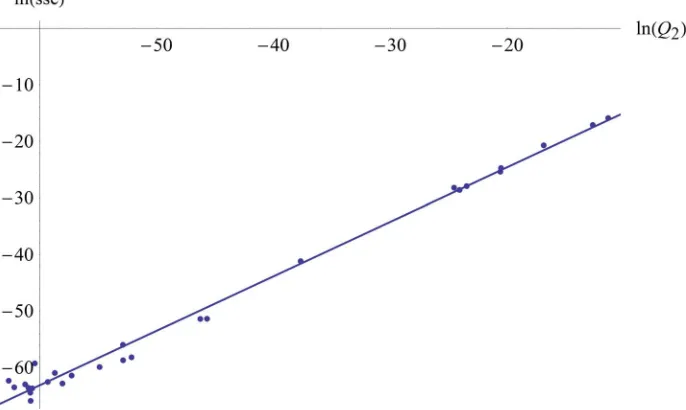
0,1 and chose kmax kmin, like in all examples.With a we could see in all our simulations, if the approximation was good. We got a linear relationship between
Q
Q2ln and ln
sse . In Figure 1 we see the graph of a linear regression (with an R squared of0.991196) of ln
sse against ln
Q2 with the points
ln Q2 ,ln sse
, which have been calculated with dif- ferent j j
0,1,2 ,
kmax kmin
kmax 15, 20, 25
and
max x
with the ODE and I of theexample 1. max , 2k ,3kma
m mk
sse is the mean squared error
100 2
0 i j i
i
sse y t y t
with tii100. Now we see a regression table (Table 1) of ln
sseon ln
Q2 , which shows a linear dependency in ourexample and the graph of the linear regression function. Here is a graph of the regression function and the graphs of the functions yi and j for j = 0, kmax = 15 and
y y
30
m on the approximation interval
0,1 (seeFigures 2 and 3) and on the interval
1, 2
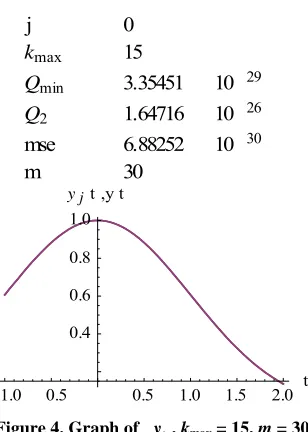
(see Fig- ures 4 and 5). In Figures 4 and 5 we see that we get even a good extrapolation. [image:2.595.127.470.510.715.2]
0.0 0.2 0.4 0.6 0.8 1.0 t
0.7 0.8 0.9 1.0 yj
t
,y
t
j 0
kmax 15
Qmin 3.35451 10 29
Q2 1.64716 10 26 mse 6.88252 10 30
[image:3.595.72.530.52.746.2]m 30
Figure 2. Graph of y0, kmax = 15, m = 30.
0.2 0.4 0.6 0.8 1.0 t
6. 10 15 4. 10 15 2. 10 15 2. 10 15 4. 10 15
yj
t
y
t
j
0
kmax
15
Qmin
3.35451
10 29
Q2
1.64716
10 26 mse
6.88252
10 30
m
30
Figure 3. Graph of y0y, kmax = 15, m = 30.
1.0 0.5 0.5 1.0 1.5 2.0 t
0.4 0.6 0.8 1.0 yj
t
,y
t
j
0
kmax
15
Qmin
3.35451
10 29
Q2
1.64716
10 26 mse
6.88252
10 30 [image:3.595.347.502.85.283.2]
m
30
Figure 4. Graph of y0, kmax = 15, m = 30.
1.0 0.5 0.5 1.0 1.5 2.0 t
5. 10 9 5. 10 9 1. 10 8
yjt y t
j 0
kmax
15
Qmin
3.35451
10 29
Q2
1.64716
10 26 mse
6.88252
10 30 [image:3.595.308.538.331.384.2]
m
30
Figure 5. Graph of y0y, kmax = 15, m = 30.
Table 1. Linear regression table of ln
sse on ln
Q2 .Estimate SE T Stat P Value
Intercept −5.34843 0.882147 −6.06297 2.46251 × 10⁻⁶
Slope 0.962059 0.0181342 53.0523 3.2288 × 10⁻²⁷
2. Error Estimation and Assessment of the
Approximation
In the example we used the Shannon wavelet. For this wavelet we have additional information about the error in the Fourier space from the Shannon theorem. For a good approximation with a small j the behavior of Y
with growing is important, because (if yi is an or- thogonal projection from y on Vjand kmax kmin )
2π
i i
2 π 2 π
i i
2π
1 e d 1 e d
2π 2π
1 1
e d e d .
2π 2π
j
j j
j
j
t t
t t
y t y t
Y Y
Y Y
With the Parseval theorem we get
2
2π
2 2
2π
d d
j
j
j L
y y Y Y ,
so
1 2
1
2π 2 π
2 2
2 π 2 π
d d
j j
j j
j L
d Y Y
With the Riemann-Lebesgue theorem we get:
2
lim 0
[image:3.595.310.514.501.703.2] [image:3.595.95.249.514.730.2]For the approximation error the decay behaviour of the detail coefficients , ,
j
k j
d y k is important:
2
2
, 2
s
j L s k s
s j s j k 2
k
L L
s k s j k
y y d d
d
On the other side: we have got in many simulations with the Shannon wavelet better approximations (with the described collocation method) than with higher order wavelets.
Remarks 2:
1) For a theoretical multi resolution analysis we could consider instead of , because when is in
then 1I is in
1Iy y y
2
L I y L2
R , if we need an ap-proximation on I. Here 1I is the indicator function of
the interval I.
2) For interpolating wavelets there are a number of publications with error estimates and also for the ap- proximation of the solutions of initial value problems and boundary value problems (for ordinary and partial dif- ferential equations) see [1,2], as well as to the sinc col- location method (see [3-5]) with special collocation points (“sinc grid points”, see [5]).
Theorem 1 (for the decay behaviour): The wavelet has the order ,
with and is Lipschitz continu- ous. Then exists a independent from b with
2 ,
p yL R
r
yC R rp
0
c
r
y
3 2, r .
y
W a b c a
y
W is the wavelet transform of y with
1 2
, d
y
t b
W a b a y t t
a
.A proof is in [6]. So we get for the detail coefficients an appraisal because
2 ,
, 2 2
2 , 2
j j
k j k
IR
j j
y
d y y t t k
W k
j dt
and so
2 , 2
2 j r 3 2.j j j
k y
d W k c
Now we saw that the decay of the detail coefficients depends on the order of a wavelet.
From the Gilbert-Strang Theory (see [7]) we know ad- ditionally an upper bound of the approximation error in dependency of the order : if the wavelet is of order then the approximation error has the order
p p
2 j p
O if
2
p
L
y and (if yj is an orthogonal projection from y on V j and kmax kmin )
2 2 2
p jp
j L L
yy C y .
If a wavelet is of order the scaling function p
even has an interpolation property, because then we can construct the functions with over a linear combination of
r
t r0,1, , p1
t k
(see [7]). That’s also a property of the so called interpolating wavelets. For in- terpolating wavelets we find error estimations in [8] and [9].
Remarks 3:
1) Error estimations for the sinc collocation with a transformation can be found in [4] and [5].
2) Although the approximation error is depended on the order of a wavelet in many simulations the Shannon wavelet led to much better approximations than Daube- chies wavelets of higher order, if the approximation function yj was calculated by minimizing the sum of squares of residuals Q. Even when comparing the ex-
trapolations the Shannon wavelet was significantly bet- ter.
The reason is, that we do not calculate an orthogonal projection on Vj like in the appraisal above and the function y is in general case not quadratic integrabel on R
(we consider only a compact interval I).
The following appraisal takes account of the fact that we calculate the approximation function by the minimi-zation of Q. We first need a theorem, which follows from
the Gronwall-Lemma. Theorem 2:
Assumptions: we have a initial value problem
,y f y t with y t
0 y0 and
0 0 ,
,
j
j j
y t y t
y t f y t t M
(4) and
,
,
with 0.
j j
f y t t f y t t L y t y t
L
(5)
Then we get for tt0:
eL t t 0
eL t t 0
jy t y t M L 1
For a proof see [10]. Theorem 3:
With the assumptions from Theorem 2 we get (if
0 0 jy t y ):
2
2
0
21 1
e i 1
L
m m
L t t
j i i
i i
C
sse y t y t M L
So we get the follow inequality for ln
sse , which is
2 2
ln sse ln M ln L ln CL (6) points (we get a approximation function yj) we must not calculate a second minimization for the calculation of
. a
Q
2ln M
depends on yj and onlyon the initial value problem and the collocation points. We write
2ln CL ln L
2ln M instead of 2ln
M because inexample 2 we set ln
2M on the x-axes so we have a
comparison with example 1 where we set ln
Q2 onthe x-axes.
,
j i j i i will be in general (for ) less than M, because we use the collocations points ti and so
y t f y t t i0
,
j i j i i
min
Q
y t f y t t
is very small at these points (see the next graphic). was in many good simula- tions less than 10−16.
Remark 4:
We get with yj
t0 y0
2 2min 1
, .
In many simulation j
i
j
i , i is relative big between to collocation points (or at the edge of I ifwe start with i = 1 in the sum (1)).
y t f y t t
m
j i j i i
i
Q y t f y t t m M
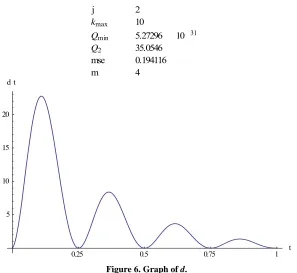
In Figure 6 we see the graph of
2,
j j
d t y t f y t t
If additionally yj
ti f y
j
ti ,ti
M
mfor one (or more) i
1, 2, , we get:in example 1 for j2,kmax 10 a H
re
nd m ere a too
small m sults in a very bad approximation.
4 . min
M Q mM
We see that Qmin could be very small with a too
small m, but 2 is very big here. In the graph we see
that d is very small at the collocation points Q
0.25 i
t i
but between them d is very big. That’s the reason be-
cause we could identify with 2 a worse approximation in any our simulations. On the other hand a big is an indicative of a too small j.
Q
min
Q
This is analogously right for instead if
with a
Q Qmin
21
,
a
m
a j i j i i
i
Q y f y
and i t0 i h a m, a a m and an integer . Qa is an upper bound for min min
1
a
: a
Q Q Q . With a we could
assess in all simulations the quality of an approximation and in linear regressions from
Q
ln
So we can approximate M here with the maximum of
,
j i j i i
sse on ln
Q2 wegot in almost all simulations a (R squared) greater
than 0.99 (see next example). Only if all approximations have been bad, then was less than 0.99 (but we still have a dependency). If
2 R
2 R
j
y is the exact solution, then
. Because we get not only a approximation with 0
a
Q
y f y at the points i t0 i h a
with a2 like we do it in the next example.
Now we want to apply the result from theorem 2. Fur- thermore we will see a correlation between an approxi- mation of ln
2M and ln
sse
2ln Q
in this example like we saw it before between and ln
sse .0.25 0.5 0.75 1 t 5
10 15 20
d
t
j 2
kmax 10
Qmin 5.27296 10 31
Q2 35.0546
mse 0.194116
[image:5.595.151.448.463.736.2]m 4
Example 2:
nitial value problem and the approxima- tio
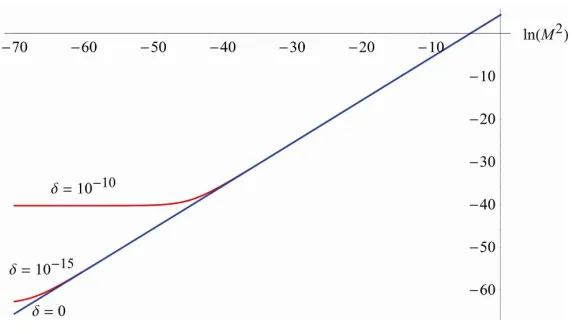
in Figure 8. In most simulations We use the i
ns with the different parameters j, kmax and m of
example 1. If 0 than follows from rem 2 (un- der the assumptions rom this theorem):
theo f
0 0 2
1
:
ln ln e i e i 1
m
L t t L t t
i
O M
sse M L
Here we get (see (6)):
ln
2
2
0 ln ln L
O M M L C
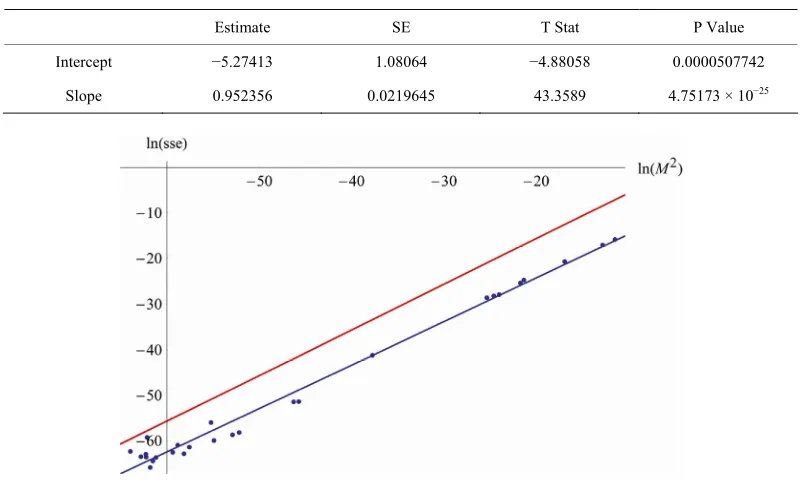
We now apply a linear regression of ln
sse on
ˆ2ln M with the approximation
22
ˆ max , ,
j i j i i
M y f y
from M2 with i t0 i h2,i0,1,2, ,200 (the points ning with
from Q2 begin i0). sse and O have
been calculated with the points tii100 d the summation indices i0,1,2, ,100 ).
Here is the regr
(an ession table (Table 2) (with a R
sq
a graph from (in red), the gr
uared of 0.986877).
In Figure 7 we see O0 ) a
aph of the regression function (in blue nd the regres- sion points
ln
ˆ2 ,ln
M sse . yj
t0 y t0 was notconsidered (this means we set 0) because he graphs of
it was very small.
Here are t O
and 0 was
an use less than 10−16.
Generally we c
22
ˆ max ,
a j i j i
M y f y i ,
0
i t i h a
and 0,1, ,i am
ation of 2 (with an integer
for an ap 1
a ) proxim M . Here we know the
wing relation: follo
2
ˆ
a a
M Q
3. Conclusions
le with which you can evaluate We defined a variab Qa
any
an approximation. In m simulations and in the exam- ples of this article we saw that we get good results with
2
a . A linear relationship between ln
Q2 and
ln sse was shown in example 1. It is also shown that
the approximation can be used to extrapolate outside the approximation interval.
Using Theorem 2 we derive an estimate (see theorem 3). Then it is shown how to detect a too great step size using Q2. In example 2 we show that the deduced esti- mate represents a straight line (in the coordinate system with ln
2M on the x-axes and ln
sse on the y- [image:6.595.97.499.475.717.2]axes), which runs approximately parallel to the regres- sion line (it is approximately parallel because the regres- sion function is an estimation, theoretically it must be parallel because it cannot cross the upper bound line). In a research project we got analogous results in many with 1010, 1015
Table 2. Regression table of on
Mˆ2ln .
sseln
Estimate SE T Stat P Value
Intercept −5.27413 1.08064 −4.88058 0.0000507742 Slope 0.952356 0.0219645 43.3589 4.75173 × 10⁻²⁵
against
Mˆ2ln .
sseO with 1010, 1015 and 0.
Figure 8. Graphs of
mulations, even with system
si s and higher order odes.
It is shown that 2
M (the size of the estimate) can be
approximated via ˆ2
M , and this approximation has Q2 as upper bound. The r gression of the points e
ln Q2 ,ln sse
returns a slightly larger R2 than the regression with the points
ln
ˆ2 ,ln
M sse . As a con-
sequence, Q2 is well suited to assess, especially as you can estimate the approximation of 2
M with Q2 and in
Q2 more information is included. Moreover we can com- pare Q2 with Qmin to assess the approximation (see Fig- ure 6).
REFERENCES
[1] O. V. Vasily Second-Gene
Wavelet Collocev and C. Bowman, “ation Method for the Solution of Partiaration l Differential Equations,” Journal of Computational Phys- ics, Vol. 165, No. 2, 2000, pp. 660-693.
https://wiki.ucar.edu/download/attachments/41484400/va silyev1.pdf
doi:10.1006/jcph.2000.6638 [2] S. Bertoluzza, “Adaptive Wav
the Solution of Burgers Equa
elet Collocation Method for tion,” Transport Theory and Statistical Physics, Vol. 25, No. 3-5, 2006, pp. 339-352.
doi:10.1080/00411459608220705
[3] T. S. Carlson, J. Dockery and J. Lund, “A Sinc-Colloca- tion Method for Initial Value Problems,” Mathematics of Computation, Vol. 66, No. 217, 1997, pp. 215-235.
doi:10.1090/S0025-5718-97-00789-8
wo-Point Boundary
ntial Transformation in the [4] K. Abdella, “Numerical Solution of T
Value Problems Using Sinc Interpolation,” Proceedings of the American Conference on Applied Mathematics, Applied Mathematics in Electrical and Computer Engi- neering, 2012, pp. 157-162.
[5] A. Nurmuhammada, M. Muhammada, M. Moria and M. Sugiharab, “Double Expone
Sinc-Collocation Method for a Boundary Value Problem with Fourth-Order Ordinary Differential Equation,” Jour- nal of Computational and Applied Mathematics, Vol. 162, No. 2, 2005, pp. 32-50. doi:10.1016/j.cam.2004.09.061 [6] C. Blatter, “Wavelets—Eine Einführung,” 2nd Edition,
Vieweg, Wiesbaden, 2003.
[7] G. Strang, “Wavelets and Dilation Equations: A Brief In- troduction,” SIAM Review, Vol. 31, No. 4, 1989, pp. 614- 627. doi:10.1137/1031128
[8] Z. Shi, D. J. Kouri, G. W. Wie and D. K. Hoffman, “Generalized Symmetric Interpolating Wavelets,” Com- puter Physics Communications, Vol. 119, No. 2-3, 1999, pp. 194-218. doi:10.1016/S0010-4655(99)00185-X [9] D. L. Donoho, “Interpolating Wavelet Transforms,” Tech-
nical Report 408, Department of Statistics, Stanford Uni- versity, Stanford, 1992.