TELLING TilE PuBLIC HEALTH STORY: THE NEWS MEDIA AS KEY STAKEHOLDERS
by Amanda Crowe
A master's paper submitted to the faculty of the University of North Carolina at Chapel Hill in partial fulfillment of the requirements for the degree of
Master ofPublic Health
in the School of Public Health (Leadership Program).
Chapel Hill Summer2005
TELLING THE PUBLIC HEALTH STORY: THE NEWS MEDIA AS KEY STAKEHOLDERS
by Amanda Crowe
A master's paper submitted to the faculty of the University ofNorth Carolina at Chapel Hill in partial fulfillment of the requirements for the degree of
Master of Public Health
in the School of Public Health (Leadership Program).
Chapel Hill Summer2005
Approved by:
Advisor
Second Reader
The news media contribute significantly to the public's awareness and
understanding of health and medical issues. Studies reveal Americans rely on
news reports as a primary source of health information (Campion, 2004; Voss,
2003). As such, public health professionals must recognize the news media as an
effective conduit to relay important health messages. Winett and Wallack (1996)
write, "Because the media provide ready-made, regularly attended venues through
which millions of Americans can be accessed at any given moment, they also
provide powerful resources for advancing public health goals."
Recognizing this, the Institute of Medicine (IOM, 2003) has called on the
news media to be actors and partners in public health, citing the "potential of
mass media in assuring population health." Yet, most journalists would argue
their job is not to serve as health educators, but to be impartial and independent
players, and provide balanced news reports to inform their audiences. Such
differing expectations complicate what the American Public Health Association
characterizes as a "natural connection" between public health and journalism. It
is against this backdrop that many national organizations including the American
Medical Association, the Association of Health Care Journalists and
Research!America, among others, are hard at work to provide forums for leaders
communicators and journalists to develop a working understanding of the other
(Schwartz & Woloshin, 2004).
Given the extensive reach and effectiveness of the news media, outreach
to journalists should be incorporated into health education, promotion and policy
work. By developing a keener understanding of the news gathering process,
clinicians, researchers and public health officials will be better equipped to work
collaboratively with journalists to help ensure the accuracy and quality of
information imparted to the public (Stamm et al., 2003). This is particularly
urgent given the shift from the traditional clinical, treatment-oriented paradigm to
one focused on preventive medicine, which typically comprises behavioral
interventions not readily reported in the news (Cabumay et al., 2003). To raise
awareness of such issues, public health officials and researchers will need to
become increasingly media savvy in relaying the story of public health. This
includes messages about early diagnosis, as well as the excess [incidence of]
morbidity and mortality that could be prevented if the public was more aware of
multiple determinants of health and the tools needed to improve their well being.
This paper highlights the pervasiveness of the news media in calling
attention· to health and medical issues, as well as the apparent disconnect that
exists between public health professionals and medical/health journalists.
Existing resources and strategies to reconcile the divergence of these two cultures
will be examined. Also discussed are future challenges and implications for
The ubiquitous nature of the news media
The pervasiveness of the news makes it a readily available source for
health information. In their quest for the latest health education and medical
information, most Americans admit turning to their local newspaper, television
and radio news reports or the Internet as a primary source. The increased demand
for up-to-date health information has been fueled, in part, by the shift to
consumer-driven health care. As Americans have come to play a more active role
in their health care, many news outlets have simultaneously launched health
sections and news segments to meet the growing need.
Morning news shows like NBC's Today and ABC's Good Morning
America have been especially attuned to audience interest in health/medical issues
and frequently air special health series to capitalize on this. The Science Times
features scientific and personal health stories and runs in the Tuesday edition of
the New York Times. The advent of"new media," or the Internet, has only altered
news consumption patterns slightly. A 1999 survey revealed only 17% of the
online news audience have come to depend on Internet news more than broadcast
or print media; nearly 70% say their news habits have not been impacted by their
use of the Internet for news (Kohut, 2000). Kohut, director of the Pew Research
Center for the People and the Press notes, "Despite the growth of the Internet as a
public news source, it still mostly co-exists with traditional news in the lives of
a powerful medium, especially among older Americans. While such audience
trends are important, this would warrant its own analysis in a future paper. For
additional information about American journalism today (e.g., trends, audience
figures, profitability), access the 2005 State of the Media report prepared by the
Project for Excellence in Journalism at
http:/lwv-iw.stateofthemedia.org/2005/execsum.pdf).
News coverage enhances salience of (select) issues facing public health and medicine
The capacity of the news media to lend credibility and legitimacy to public
health issues has been well documented. The third chapter of the World Health
Organization's TB advocacy guide opens with the following: "The media is
probably the most influential advocacy vehicle that we have. It plays a key role in
mobilizing public support and setting the political agenda."
Many scholars echo this sentiment and contend journalists invariably
shape what the public ascribes as the most pressing issues of the day through their
daily selection and presentation of news items - a theory known as agenda-setting
(McCombs, 1997). McCombs writes, " ... the editors of our newspapers and the
news directors of our television stations exert a powerful influence on public
attention to the issues, problems, and opportunities that confront each
community." The reverse is also true. By electing not to cover certain health
stories the media helps keep some topics from public consciousness. Shuchman
quickly diminished once health care reform efforts hit a roadblock in the nation's
Capital.
HIV I AIDS is another frequently cited example of the capacity of the news
media either to bring an issue into the limelight or not. Many scholars argue
HIVIAIDS did not rise to public discourse until the death of Rock Hudson in 1985
at which point the epidemic headlined newspapers across the country (Shilts,
1987). Shilts, author of And the Band Played On, and others contend the flurry of
media attention around Hudson's death ignited the sense of urgency felt by the
public and policymakers. Brodie (2004) writes, "Ultimately, coverage of
HIV I AIDS by mainstream news media serves as one important gauge of how
prominent the issue is on the policy and cultural agenda of the nation .... " By
elevating the salience of health issues on the public agenda, the news media may,
in fact, influence policy development (Walsh-Childers, 1994). According to
McCombs (1997) this agenda-setting function of the news media is part of news
organizations' social responsibility to the public (also referred to as civic
journalism). He further asserts such businesses must ardently uphold this duty
and remain cognizant of the deliberate or inadvertent manner in which they
impact public consensus, as well as the community's view of itself. McCombs
and his colleague, Donald Shaw, are recognized as the founders of agenda-setting
The media as "change agents" (Shuchman, 2002): the influence of health stories
News coverage of health and medical issues has been shown to influence
health policy decisions, the allocation of research funding and patient-physician
communication (Nelkin, 1987; van Trigt eta!., 1995, Benelli, 2003; Wallack et
a!., 1993). Studies also reveal health news reports encourage the adoption of new
health behaviors and opinions (Pellechia, 1997). In fact, more than half (58%) of
those who consult the news say they adopted new behaviors in response to health
information presented in medical news stories, according to a representative
survey by the National Health Council (1997). Larsson and colleagues (2003)
similarly argue the news can "increase or diminish the willingness of individuals
to seek medical care (or participate in clinical trials), may raise expectations
(sometimes falsely), may dash hopes, or may provoke alarm (sometimes
unnecessarily)."
A number of studies have investigated the effect of health news stories on
behaviors and perceptions. In a 30-year retrospective comparison of magazine
stories about smoking and health and reported cessation rates, Pierce and Gilpin
(200 I) found the incidence of successful smoking cessation paralleled news
coverage that highlighted the harmful effects of tobacco. Grilli, Ramsay and
Minozzi (2005) conducted a systematic review of 20 articles related to the mass
media and its impact on the use of health services (authors included both planned
and unplanned media). The analysis- in which five studies specifically examined
mass media communications on the utilization of health care services and
interventions.
The news media have also added to public acceptance of vaccination as a
means to prevent disease, screenings to detect cancers (i.e. Pap smear,
mammography and, more recently, colonoscopy), and interventions to lower the
risk of heart disease (Campion, 2004). Media coverage following the halt of the
Women's Health Initiative trial, which resulted in more than 400 newspaper
stories and 2,500 television-radio pieces during that month, allegedly prompted a
noticeable percentage of women to stop taking hormone replacement therapy
(Haas eta!., 2004; Schwartz and Woloshin, 2004). Yet another example of how
the news can alter health behavior and opinions is the tragic case of Terry
Schiavo. Not only did the unfolding events capture the attention of the media,
policymakers, special interest groups, medical ethicists and the courts, it also
sparked considerable dialogue about end-of-life planning among countless
families across the nation.
Not surprisingly, media messages extend to key decision-makers in the
health industry. As discussed, news coverage of health and medical issues such
as stem cell research and medical liability reform reach policy makers and shape
public opinion, which, in turn, influences health policy alternatives. The
scientific community also pays close attention to medical news in the mainstream
press, especially with regard to information outside their specialty (Schwartz and
"Media messages matter ... [T]hey also help to create the unarticulated
assumptions and fundamental beliefs that underlie personal decisions, public
policies, and clinical practices" (Nelkin, 1996, 1603). The upshot- the media are
key stakeholders in health education and promotion and should be integral to
health planning and leadership activities.
Health care and the media: Two cultures intersect
There are conflicting expectations as to the appropriate "role" of health
news reporting in advancing public health and medicine (Nelkin, 1996). While
the IOM calls on the mass media to be actors and partners in assuring the future of
America's health, journalists argue their job is simply to report the news and
provide a balanced perspective. They do not see themselves as "trumpets for
science" (Nelkin, 1996). "Journalists have other priorities. Their aim is not to
promote science or effective and efficient health-care" (Larsson eta!., 2003). At
the very crux of the issue is the lack of understanding about journalistic practices
and what constitutes "news." As Larsson and colleagues (2003) note, limited
attention has been given to the process of journalism as it relates to health and
health care.
When it comes to the realms of health (broadly referring to science,
treatment, preventive medicine, population health and health care in general) and
the media, many authors describe a clash oftwo cultures (Nelkin, 1996; Larsson
eta!., 2003). Yet, in light of the profound influence of news reports on public
journalism are an essential part of promoting healthier communities. As Nelkin
(1987) writes, "While the two cultures [that of the scientist and journalist] remain
in tension, they are inextricably bound."
Still, there remains an apparent disconnect between those in the health
sciences and journalism, which is perpetuated by a lack of awareness and
appreciation of one for the other. Shuchman and Wilkes (1997) describe it is "a
case of miscommunication." To understand this, it is important to acknowledge
the distinct processes that underlie journalism and the evidence-based research
and practices that direct much of public health and medicine.
The field's reluctance to work with the news media
From the perspective of clinicians, researchers and local/state public
health officials, the news media are uniquely poised to educate the public about
various diseases, disease management, treatment and prevention, as well as
problems with the health care system or related policy (CDC). At the same time,
and as elucidated by Campion in his 2004 editorial, physicians (and by extension
people with public health training) are inherently critical and "apt to recognize
when the medical-news media are overselling, overscaring, and oversimplifYing."
Consequently, they are frequently hesitant to work with the media fearing they
will either be misquoted or be associated with a misleading news report, which
reluctance of medical and public health professionals to work with the news
media stems from the news media's (Larsson eta!., 2003; Schwartz & Woloshin,
2004; Shuchman and Wilkes, 1997):
>-
Affinity for information that is easily hyped or is controversial}> Failure to provide the appropriate context and caveats, which includes the accurate use of statistics
>-
Attraction to preliminary findings>-
Presentation of incomplete information>-
Episodic nature of reporting and lack of follow-up>-
Reliance on anecdotal evidenceCoverage centers on easily hyped and controversial topics
News reporters are charged- often daily- with investigating and
translating complex medical and public health issues into terms the public will
understand. Today's 24-hour news cycle results in increased pressure and
competition to churn out compelling and dramatized news stories, which some
insist has led to sensationalized journalism- stories about the latest
"breakthroughs" and "promising" treatments (Shuchman and Wilkes, 1997).
Many public health professionals are wary ofthe tendency for reporters to "hype"
health stories or focus heavily on controversy and conflict. Shuchman and Wilkes
contend there is an incentive in the news industry to "sound alarms" and "offer
hope." The authors also say the tendency toward the sensational leaves little
room for stories about negative studies. Failure to highlight such inconclusive or
"no effect" studies contribute to inaccuracies in health risk reporting. This is
results of negative studies, which are often deemed unworthy of publication (i.e.
publication bias).
Moreover, as Nelkin (1996) explains, the media's propensity for covering
conflicts in health encourages polarization of issues. A health policy or medical
technology is characterized as either good or bad, and those interviewed typically
represent opposite ends of the spectrum, which often discounts those advocating
the middle ground.
Inadequate context and caveats in news reports
Reporters tend not to place the "latest study" into the broader context and
instead focus on research findings in isolation. Shuchman and Wilkes (1997)
write, "Too often, journalists pursue medical news as if they are reporting on a
hostage crisis. Information is delivered rapidly, but little time is taken to provide
a context for the story." There are two potential misunderstandings. First, what
researchers and health professionals distinguish as a single study - one piece of
the larger scientific puzzle- journalists sometimes recount as definitive in its
findings. Second, while those involved in medicine and public health appreciate
research findings as an incremental step toward a broader consensus within the
existing framework of knowledge, for reporters "established ideas may be 'old
news,' and of far less interest than fresh, though possibly tentative, research"
(Nelkin, 1996, 1600). As Brodie (2004) notes, "the challenge for journalists
covering HIV I AIDS is to find new ways to keep their audience engaged in a story
discussed later, this represents an opportunity for media savvy public health
officials to offer newsworthy story ideas to keep the topic alive.
Another criticism of news reporting is that important qualifiers are often
missing despite the fact that every study has inherent limitations (Schwartz and
Woloshin, 2004). Other caveats that should be disclosed are potential conflicts of
interest, the generalizability of a study, etc.; however, such information is not
always readily shared by news sources. Carter (2002) contends the interpretation
of statistics is one ofthe most problematic issues in health news reporting. Often,
reporters use relative risk reductions and do not specify the absolute magnitude of
differences, which can result in skewed and exaggerated perceptions about the
implications of such information (Schwartz and Woloshin, 2004).
Preliminary findings
Preliminary findings are alluring to reporters because they are perceived as
new and "cutting edge." Journalists are frequently invited to attend medical
meetings to write news reports on new research presented. It is not uncommon
for conference organizers to plan daily press briefings with attention-grabbing
news highlights to attract media attention. While this satisfies the reporter's need
for "breaking news" it can also be dangerous as such preliminary research is
particularly vulnerable to inaccuracies and is far from receiving widespread
acceptance within the health science community. Even though it might be
tempting, Schwartz and Woloshin (2004) urge reporters not to cover preliminary
token, those in public health should do everything possible to reinforce the
preliminary nature of their work when talking to members of the media. In an
earlier examination of news coverage generated from studies presented at major
medical conferences, Schwartz, Woloshin and Baczek (2002) characterized
ensuing media reports as "too much, too soon." They claim, "Results are
frequently presented to the public as scientifically sound evidence rather than
preliminary findings with still uncertain validity. Press coverage at this early
stage may leave the public with a false impression that the data are in fact mature,
methods valid, and the findings widely accepted."
Incomplete infOrmation
News reports do not always provide the full story. Moynihan and
colleagues (2000) analyzed 180 newspaper articles and 27 broadcast reports of
three medications used to prevent major diseases over a 4-year period and found
that the majority of stories failed to provide adequate or complete information
about the benefits, risks and costs of each drug. Anhang et al. (2003) conducted a
content analysis of 111 news stories that appeared in major newspapers or on the
national news regarding the human papillomavirus (HPV) from January 1995
through July 2002. The authors concluded the coverage was not comprehensive,
noting many stories failed to distinguish between low- and high-risk types of
HPV, differing associations with cervical cancer, likely prognosis (i.e.
spontaneous regression), effective prevention and symptoms. While professional
information, only half offered such recommendations. According to the authors,
such incomplete portrayals of HPV contribute to misperceptions in terms of
personal susceptibility and, in tum, heighten anxieties. Such truncated
information is symptomatic of the limited space and time constraints of various
news formats. Newspapers are able to go into greater depth than television news
segments, which typically have to deliver the story in 15 to 90-seconds. Editorial
limitations make it difficult for reporters to exhaustively cover the issue( s ).
Episodic nature of news coverage and lack o(follow up
Those in the health field also find fault with the "episodic" coverage of
important health research and issues. That is, health news reports tend to make a
big splash, and then quickly fade. In their rush to fmd the next big story, reporters
often fail to follow up on health stories they previously covered or exposed.
Shuchman and Wilkes (1997) believe this is symptomatic of reporters' relative
lack of understanding of the scientific process. Furthermore, they contend quality
follow up reporting is hampered by an ongoing cycle whereby reporters seem
disinterested in follow up stories, researchers interpret this to mean they should
not seek media coverage of follow up data/information, so updates on
confirmatory or nonconfirmatory studies are not disseminated to media contacts.
The authors urge members of the health science community to contact reporters
when research emerges that builds on topics previously covered by the news
media. Again, and depending on the issue at hand, stories that chronicle the
McCombs (1997) writes, "Unless there is a constant stream of new information
and new angles to feed the story, even the most important topics can disappear
from the news agenda."
Reliance on anecdotal evidence
Journalists are instinctively attracted to information that lends itself to
storytelling. Nisbet, Brossard and Kroepsch (2003) contend issues that are
dramatic and fit readily into a narrative form receive the greatest media attention.
Their research specifically examines how the news media has framed the stem
cell debate in the recent years. To build the human interest angle, reporters
typically rely on personal accounts and cases, which give a "face" to the issue at
hand (Nelkin, 1996). It is frequently the plight or triumphs of the patient or local
community member that captures the interest and attention of the audience.
However, as Easton (2003) writes, "The human interest story can work
beautifully but it is virtually impossible to find one patient, or even a handful of
patients, who can represent the real spread of experiences of a disease."
Reporters' needs not always met
On the flip side, reporters' needs are not always met, which can diminish
the quality of health reporting. The ultimate goal of health reporting is to convey
new health/medical information to the public in an accurate and timely marmer;
From the reporter's perspective, public health professionals are often not
readily accessible for comment about emerging health and medical issues. Field
experts are frequently 1) unwilling to speak to reporters, 2) slow to respond to
their inquiries or 3) overly concerned about promoting their own interests
(Larsson eta!., 2003). This poses a major hindrance to reporters for two reasons.
First, given the strict time and space constraints of news reporting, reporters need
quality information fast; the reality is they often have limited time to gather and
interpret this information (Larsson eta!, 2003). Many news sources do not fully
appreciate the high stress environment in which journalists operate and file their
stories. As such, if the leading expert on a given issue is unwilling or unavailable
for interview, reporters will scurry to find someone who is accessible and that
person( s) will be the one quoted.
Second, surveys reveal many health reporters feel they lack the training
needed to critically interpret health science information and health policy
implications, perhaps because of the explosion of health information and the
breadth of material covered (Voss, 2003; Larsson eta!., 2003). Unlike other news
beats, science and health reporters rely heavily on experts to assist them in
critically appraising study claims and providing a broader context (i.e. what else is
being done in this area, how this information fits within the existing body of
evidence, etc.). This underscores the need for those in the health care field to be
more responsive to the news media. Rather than feel threatene,d by or
uninterested in media inquiries, such interactions should be regarded as an
efforts (Campion, 2004). Focus groups with 20 British and Swedish journalists
found the lack of time, editorial space and knowledge about medicine and health
to be chief obstacles in their pursuit of quality health news reporting (Larsson and
colleagues, 2003) (See Appendix A for additional barriers mentioned).
Deadlines, the length/duration of the story, and interview specifications all vary
depending on the news format (i.e. television, radio or print).
Reporters' jobs are also made more difficult by the use of complicated
jargon by news sources. In many cases, those interviewed are not adept at
breaking down the issue into the most critical, easily digestible parts. In their
CME offering/article for the American Academy of Family Physicians titled How
to Make the Media Your Public Health Partner, Robertson and Currey (2004) tell
'
potential spokespersons to " ... expect that only one or two sentences will be
quoted ... it's essential to learn how to say exactly what you want as succinctly as
possible." To work well with the media, a source should practice the art of the
message, and know what will lead to printable quotes and useable broadcast
sound bites.
An ongoing challenge faced by reporters is the demand from editors for
stories that will sell (Larsson eta!., 2003). Although available news space and
deadline pressures contribute to editorial decisions, the newsworthiness of the
information at hand is the principal predictor for its use (Turk, 1985). So, in order
to negotiate a specific story idea with their editor or producer, the story must be
inherently newsworthy and resonate with the readers, viewers and listeners
will likely get ink or airtime, public health professionals must be aware of the
types of information and stories journalists seek and find intriguing. In Reaching
Audiences, Y opp and McAdams outline eight "news values," which reporters
frequently consider before pursuing a story. All of the following (listed in no
particular order) contribute to the relative "newsworthiness" of the information,
which can be a deciding factor in whether a story is covered or not.
Important news values are as follows:
>
Timeliness. The information must be timely.>
Prominence. A recent example is the attention given to former President Clinton's heart surgeries. This is also why many healtheducation campaigns enlist the support of celebrities like Michael J.
Fox or Lance Armstrong.
>
Proximity. People are naturally interested in what is occurring close to them - in their neighborhood or region. This is why it is important tolocalize health messages and make it relevant to the specific
intervention community. Stories may also have emotional proximity
whereby readers feel connected to the story (e.g., women with breast
cancer or parents of obese children would pay particular attention to
related stories).
>
Impact. The impact of the information or event on peoples' lives-whether it's for the positive or negative- is also a key consideration.>
Magnitude, which is often closely linked to impact, is the size of theevent. For example, the death toll, number of injuries or extent of
damage in the wake of a hurricane.
>
Conflict. The news media loves conflict or controversy. The recent attention given to the stem cell debate and the enactment of theMedicare prescription drug program are examples of this.
>
Human interest stories. These are the stories that pull at the heart strings of audiences and typically have universal appeal.Of top concern for most journalists is the accuracy of the story. They
genuinely want to get the story right. However, people are people and as one
author writes, "[H]uman nature dictates that the best stories (think of juicy office
gossip) are surprising, unusual, dramatic, or emotive and usually personal- all
key ingredients of stories about, for example, killer bugs, the pill scare, and the
measles, mumps and rubella (MMR) vaccine" (Easton, 2003). When pitching a
story idea to the news media health experts should try to get inside the mind of
reporters and identify the "news peg" - that element ofthe story that will capture
the audience's interest and make it relevant. It is referred to as a "peg" because
the rest of the story hangs on this central angle. Health topics pursued by
reporters typically reflect "the interests of the public, on whose attention the
media themselves depend" (Campion, 2004). At the end of the day, news
organizations are businesses too, and their products must sell.
Where do we go from here?
As consumerism and health advocacy grows, attention to improving the
"informative value" of news reports is critical, especially as such news coverage
clearly impacts the public's well being (Larsson et al.; Voss 2003). In order to
enhance working relationships between public health and journalists, it is
devise ways to better meet reporters' needs (See Appendix B for a list of practical
tips). Most importantly, and as stated previously, public health workers need to
be more responsive to the news media. Avoiding reporters' calls or failing to
include them as key stakeholders in health education and promotion efforts
ultimately represents a disservice to public health. Not working with news media
means missed opportunities to 1) tell the public health story, 2) give a voice or
different perspective to discussions, 3) help frame the debate, and 4) correct the
public misperceptions about important health issues (e.g., immunizations link to
autism, transmission of STDs, etc.). This is especially urgent in light of the
exponential growth of Internet news sites and Web blogs (i.e. online
diaries/commentaries), which are of varying quality and impartiality.
The press core is primed to educate the public about health and "what
medicine can (and carmot) do" (Schwartz and Woloshin, 2004). Health beat
reporters and health professionals share the burden of responsibility for the
accuracy of news stories - one illuminates a given health/medical issue, while the
other interprets this information for public consumption (Stamm eta!, 2003).
Journalists and those working in the public health field both aim to advance the
public's well being. Access to timely, quality information can help the public
make more informed lifestyle choices.
National organizations aim to enhance dialogue
There has been increasing interest among professional groups to improve
Research! America, based in Alexandria, Virginia, has held a series of
media/science forums across the country to spark ongoing dialogne between
members of the media and public health researchers and officials. One of the
more recent sessions, titled "Beyond Breakthroughs: The Press and the Public
Health Profession," aimed to address the challenges of gaining media attention
around prevention and public health topics. Coverage of health issues has
traditionally centered on treatment, and is discussed in greater detail later in the
paper. Other sessions have focused on the role of the news media, ethical issues
and stem cell research, and the prevalence and treatment of pain. "Bridging the
gap between science and the media is a critically essential step in providing fair,
accurate and easy to understand messages about research to the public," say the
organizers. Research!America is an alliance of stakeholders in basic, behavioral,
biotech, clinical, health services, prevention and public health, and therapeutic
research, which is committed to gaining increased funding for health research.
The American Medical Association (AMA) has also been instrumental in
encouraging journalists, health communicators and physician leaders/
spokespersons to share best practices and improve relations between members of
the news media and the sources of news. The annual AMA Medical
Communications and Health Reporting Conference provides useful workshops
Resources to improve the inteiface of public health with the news media
There are a growing number of resources designed to equip public health
and medical officials with the tools and skills needed to proactively and
responsively work with the news media to relay important health information.
Despite the availability of sample press materials to effectively outreach to local
media and garner their attention, many public health departments still do not
actively contact reporters. The news media are not yet a priority stakeholder in
health planning. This was illustrated at the recent annual meeting of the
Association of Health Care Journalists (AHCJ) when reporters asked a public
health official, who was outlining North Carolina's flu pandemic preparedness
plan, how the state was intending to communicate information with media outlets
and capitalize on new organizations' ability to transmit mass messages. The
document, which was in its final stage of development at the time, did not include
a section on how the news media as a key stakeholder could be used to transmit
critical information to the public in the midst of a pandemic. Public health
officials need to begin to think of the news media as an important audience that
can help mobilize readers, listeners or viewers to use the information to improve
health.
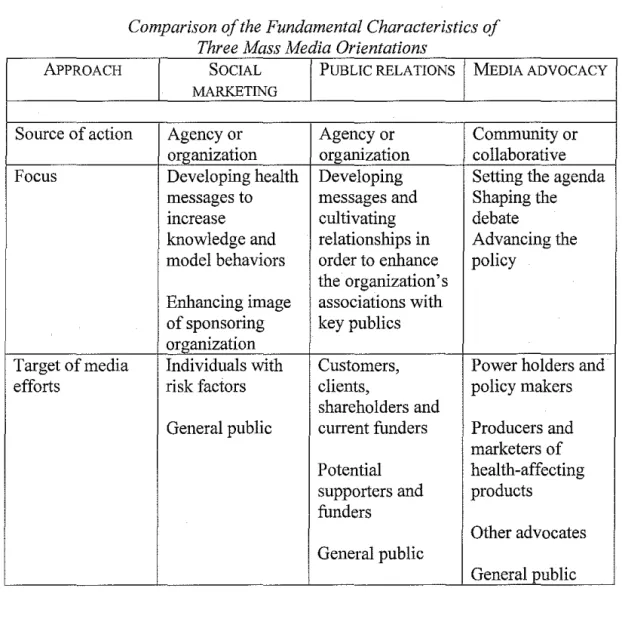
Winett and Wallack (1996) outline tlrree approaches to integrate mass
media into public health approaches to improve community health: social
marketing, public relations and media advocacy. Although the tlrree are similar
(and some would argue overlap to some degree), Winett and Wallack maintain
taken from the Winnet and Wallack article and provides a side-by-side
comparison of the focus and target of media efforts of the three strategies. The
authors view the media as an educator in social marketing initiatives, as affiliator
in public relations efforts and as equalizer when used as part of media advocacy.
A brief description of each of these strategies and useful background material are
outlined below.
Social Marketing
Kotler and Andreasen define social marketing as "differing from other areas of
marketing only with respect to the objectives of the marketer and his or her
organization. Social marketing seeks to influence social behaviors not to benefit
the marketer, but to benefit the target audience and the general society." Winett
and Wallack maintain social marketing practices generally affect individual-level
behaviors and allows for education, increased support for an issue and promotion
of "short-term changes in health-enhancing behaviors."
The following are useful resources for designing social marketing campaigns and
determining when this is the most appropriate approach:
• Kotler, Philip and Eduardo Roberto (1989), Social Marketing: Strategies for Changing Public Behavior. New York: The Free Press.
• Community Tool Box at
http://ctb.ku.edu/tools/en/sub section main 1324.htm.
manual are available online at
http://v.lww.tumingpointprogram.org/Pages/socialmkt.html.
Public Relations
Public relations is another approach that uses the mass media. Overall public
relations entails building awareness, eliciting media attention/exposure and
fostering enduring, mutually beneficial relationships with key constituencies.
Note: publicity is only one manifestation of public relations activities (Levine,
1993).
Useful resources include:
• Public Relations Society of America Health Academy web site, http://www .healthacademy. prsa.org/index.asp ?ident=apr 1 • National Association of Medical Communicators (NAMC)
http://wvv~.ibiblio.org/namc/
• Smith, J. (1995), The New Publicity Kit. New York: John Wiley & Sons, Inc.
• Lamb LF, McKee KB. (2005) Applied Public Relations: Cases in stakeholder management. Mahwah, NJ: Lawrence Erlbaum Associates. • Levine, M. (1993) Guerilla PR How you can wage an effective publicity
campaign without going broke. New York, New York: Harper Business.
Media advocacv
According to Wallack and colleagues (1993), media advocacy approaches public
health from a systems perspective; "media advocates use the force of the mass
media to exert pressure on those few powerholders in a position to advance
specific health-promoting policy initiatives." The Community Toolbox has a
health messages via the news media and provides tools to do so. It states, "As a
media advocate, you will use the media to:
1. Inform the public about what really causes or contributes to public health
problems;
2. Recast health problems as public health concerns that affect everyone, not
just individuals;
3. Encourage community members and other professionals to find out more
about public health problems and to get involved."
Materials are available at http://ctb.ku.edu/tools/en/section 1269.htm (accessed
June 14, 2005). Other useful resources are as follows:
• Wallack L, Dorfman L, Jernigan D, & Themba M. (1993). Media Advocacy and Public Health: Power for Prevention. Newbury Park, CA: SAGE Publications.
o Wallack L, WoodruffK, Dorfman L, Diaz I. (1999) News for a Change:
An advocate's guide to working with the media. Thousand Oaks, CA: SAGE Publications.
Other resources
Many national public health organizations like the American Public Health
Association (APHA) and the Centers for Disease Control and Prevention (CDC)
have developed tools and online resource centers to help public health workers in
the field. As part of its Community Strategies for Health, APHA describes the
community news media as a critical component in the promotion of programs that
aim to improve public health. The APHA writes, the news media can:
o serve as the primary instrument for changing the audience's behaviors;
• provide encouragement for people to use existing programs and services;
or,
• provide other forms of assistance.
The Model Standards Media Relations Guide was developed by APHA to provide
public health professionals with a basic working knowledge of the news gathering
process and how best to work with journalists to convey important public health
messages. The guide is available at
http://www.apha.org/ppp/science/mediarel.htm (accessed June 14, 2005).
The Centers for Disease Control and Prevention (CDC) also devised a
series of communicator resources to enable those in the public health field to
incorporate media relations into planning, which can "extend the effect of
activities beyond the program." See Appendix D for the CDC's Tips for Working
with the Media, National Infant Immunization Week, which can be tailored to
other initiatives. Additional tips and tools are available at
http://www.cdc.gov/communication/index.htrn.
Challenges ahead
Challenges remain for those striving to work alongside journalists in their
efforts to build healthier communities. The first is the news media's persisting
obsession with medical advances, new pharmological treatments and cures
(Cabumay et a!, 2003). Prevention and the "behind-the-scenes" work of public
health are not as "sexy," although the tide is beginning to change as topics like
analysis of news stories about HPV, Anhang and colleagues (2004) found the
bulk highlighted screening tests and reconunendations for treatment, and did not
include information related to prevention and transmission. In a year-long study
of four local newspapers, Caburnay and colleagues (2003) found stories
highlighting health behavior were rare. Only 1,373 stories (1.7%) were about
diet, physical activity or tobacco, few were prominently placed in the paper and
only half highlighted primary prevention. Moreover, the news media generally
pays little attention to rising health care costs, the health care system in general, or
global health issues like malaria and tuberculosis (Campion, 2004).
Public health officials and researchers must take care to relay the story of
public health. Robertson and Currey say conununication with the news media
should 1) demystify medical knowledge, 2) encourage early detection and suggest
ways to adopt health promoting lifestyles and 3) provide skills to inform and
empower audiences to take necessary steps for healthier living. Reporters need to
be told the magnitude of the problem and the critical role of health behaviors and
environmental changes to improve health. For example, two-thirds of all cancers
are preventable, according to the American Cancer Society and other leading
researchers.
The Association of Health Care Journalists (AHCJ), which recently
launched "to improve the quality, accuracy and visibility of health care reporting,
writing and editing" recently published a resource guide for journalists. One of
the chapters highlights chronic disease and the need to turn attention from
http://www. ahcj. umn.edu/qualityguide/chapter3. html#keyfacts ). Appendix E
outlines the full list of AHCJ goals to advance public understanding of health care
issues and offers insight into efforts being made by journalists to better
understand the complexities of public health issues. An important strategy is to
monitor national and local news coverage and find ways to piggy-back onto
breaking news stories.
More work is also needed to ensure health news reports are representative
of those at heightened risk of a given health problem or safety issue. For
example, a recent study by Kaiser Family Foundation found only 3% of
HIV I AIDS stories centered on minorities, even though more than half of those
living with HIV/AIDS are African American. The author stated, "African
Americans account for half of all news infections every year, but they have rarely
been involved in the epidemic's high drama" (Wright, 2004). This has
contributed to a "myopic understanding" of the disease and perpetuates
misconceptions about susceptibility to infection. Information released to the news
media should include details about those at greatest risk, as well as supportive
health services and resources.
Finally, as public health professionals increasingly realize the
effectiveness and efficiency of the news media to transmit information to the
public, there is more room for mistakes. Even some of the most trusted sources
release information or data that later needs to be retracted. The CDC's
overestimation of the national obesity mortality rate is a recent example, which
data published in the April20, 2005 issue of the Journal of the American Medical
Association (JAMA) moved obesity from the second preventable cause of death to
the seventh, according to the Washington Times. Another example is the
controversy surrounding a 1998 study published in the Lancet that linked the
MMR vaccine (measles, mumps and rubella) to autism. This study stirred debate
in the trade and mainstream press and has since been blamed for the drop in
childhood vaccinations and widespread skepticism among parents. In 2004,
several news outlets reported the lead investigator, Dr. Andrew Wakefield,
allegedly failed to disclose the impetus behind the study. According to a United
Press International report, the information used in his research was collected for
lawyers representing parents who believed their child's autism stemmed from the
vaccine. These two case studies illustrate the fine line public health officials and
journalists walk when trying to assure sound and balanced information reaches
the public. Messages about health and medicine should accurately characterize
the best available knowledge/research and professional consensus on health topics
(Grilli, Ramsay and Minozzi, 2005).
Implications for practice
The news media are consistently ranked as the leading source of medical
and health information by Americans in population surveys (Grilli, Ramsay and
Minozzi, 2005). Described as "an important and influential part of the social
environment" by Caburnay and colleagues (2003), the news media can directly or
longitudinal investigation of news stories related to drunk driving and associated
risky behaviors found such coverage had a significant impact on the policy and
regulatory environment, which, in turn, indirectly reduced drunk driving among
young and high-risk drivers. The author concluded, "News coverage not only
increases the likelihood of individual exposure to health messages but is also
likely to influence behavior indirectly by facilitating processes of social and
cultural change" (Y anovitzky, 2002).
Outreach to health reporters should be integrated into community and
national initiatives to help improve public health. To effectively work with
journalists, public health officials should be responsive, but also initiate contact
with reporters and producers covering the medical/health beat to build sustaining
relationships. In doing so, they should always be mindful of reporters' needs,
editorial constraints and the types of stories sought (i.e. relative newsworthiness).
Because reporters work under tight deadlines and sometimes lack the knowledge
to readily interpret medical/health topics, willing public health professionals/
researchers are in a unique position to help reporters identify the most pressing
health issues that should be relayed to audiences. They can also aid reporters by
providing the "big picture" perspective all the while becoming a reliable source of
health news.
The call for the news media to be partners in assuring the public's health
by the IOM and other national public health organizations is not surprising when
one considers the far-reaching impact of health news reports. Nonetheless,
information to the public, they also assume the critical function of watchdog to
uncover health problems (e.g., patient safety, vaccine shortages, inaccurate
prescribing, etc.). Although journalists often do educate the public, this tend to be
a byproduct of their job.
Many pitfalls in health reporting derive from misunderstandings between
two cultures- reporters and public health/medical professionals. For example,
the news business outpaces public health research and planning. That is, news
reporters abide by strict deadlines, whereas public health researchers take
painstaking efforts to arise at the best possible solution, and often do not feel
comfortable cormnenting until they have exhausted the research process. To
benefit the public's interest, people who work in the health sciences need to
develop a greater understanding of the news business. Rather than feel threatened
by media inquiries, such interactions should be regarded as an opportunity to help
interpret and translate the issue and extend health promotion and education efforts
(Campion, 2004). Access to timely, quality information can help the public make
more informed lifestyle choices that may ultimately enhance personal and
Appendix A
Larsson et al. (2003) identified nine barriers to improving the informative value of medical journalism, as elucidated by working journalists in two focus groups. Note: this researcher was with journalists working in Europe, so there may be some differences/limits to generalizability. The barriers discussed are listed in order of agreement starting with lack of time, which garnered the highest level of agreement among participants.
1) Lackoftime 2) Lack of knowledge 3) Lack of space
4) Competition for space 5) Commercialism 6) Terminology 7) Expert sources
8) Competition for audience 9) Editors
In terms of potential solutions, the group indicated they would be very interested or somewhat interested in the following strategies to improve health reporting.
I) Access to background information on the Internet 2) Access to experts in diverse areas
3) Strategies for stories that are both informative and entertaining 4) Strategies for presenting research results
5) Help translating terminology 6) Access to methodological experts 7) Strategies for interviewing experts 8) Critical appraisal workshops
AppendixB
Top 10 Important Lessons for Working with the News Media
The following provides public health leaders with useful tips to build
relationships with health/medical journalists and, in turn, help assure helpful and meaningful information reaches the public. Working well with the news media affords medical and public health professionals the opportunity to help interpret and translate important health issues and, in turn, extend their health promotion and education efforts.
¥' Build and foster relationships with local health/science news reporters and become a trusted, "go to" source. Becoming familiar with the format and audience of their news outlet is essential to this end.
¥' Be accessible, responsive and helpful to journalists pursuing health news stories. Remember they are working within tight deadlines and their work hinges on finding and interviewing informative, knowledgeable news sources. Bottom line: If you don't make yourself available, someone else will.
¥' Be mindful of space and time constraints for each news format- radio, television, newspaper (daily and weekly), magazine, Internet.
¥' Provide the broader context. That is, explain how the new
information/data fits within the existing body of evidence and why it's important. Also offer details about national/regional efforts to address the health issue at hand.
¥' Avoid jargon and acronyms. Keep messages clear and concise, and understandable to the lay audience.
¥' Story ideas should be newsworthy, relevant and compelling. When developing and pitching story ideas remember the all-important "news peg" and the news values often considered by journalists when deciding whether to pursue a story or not. Brainstorm ways to make prevention and health behavior more interesting and engaging for news audiences and take the time to localize the story.
¥' Know what message(s) you want to convey. "Figure out your 'main message '-the one thing you hope they will include in the story out of everything you're about to say. Make it direct, free of jargon, simple and clear. Write it down and practice saying it."-- David Ropeik, director of risk communication at the Harvard Center for Risk Analysis
¥' Support key messages with facts and/or analogies and have someone available to give a "face" to the issue (e.g., a patient, community leader)
¥' Reinforce the preliminary nature of research when applicable.
can "piggyback" on timely news topics to shape the debate, give voice to a different perspective and/or offer a solution(s) to the problem.
Appendix C
Table 2 taken from Winett and Wallack (1996)
Comparison of the Fundamental Characteristics of Three Mass Media Orientations
APPROACH SOCIAL PUBLIC RELATIONS MEDIA ADVOCACY MARKETING
Source of action Agency or Agency or Community or organization organization collaborative Focus Developing health Developing Setting the agenda
messages to messages and Shaping the increase cultivating debate
knowledge and relationships in Advancing the model behaviors order to enhance policy
the organization's Enhancing image associations with of sponsoring key publics organization
Target of media Individuals with Customers, Power holders and efforts risk factors clients, policy makers
shareholders and
General public current funders Producers and marketers of Potential health-affecting supporters and products
funders
Other advocates General public
AppendixD
AppendixE
Association of Health Care Journalists
One of many organizations attempting to improve the reporting of health news
Mission: to improve the quality, accuracy and visibility of health care reporting,
writing and editing.
Goals:
l. To support the highest standards of reporting, writing, editing, and broadcasting in health care journalism for the general public and trade publications.
2. To develop a strong and vibrant community of journalists concerned with all forms of health care journalism.
3. To raise the stature of health care journalism in newsrooms, the industry, and the public, as a whole.
4. To promote understanding between journalists and sources of news about how each can best serve the public.
5. To advocate for the free flow of information to the public.
Bibliography
Americans talk about science and medical news: the National Health Council report; New York: Roper Starch Worldwide, 1997.
Anhang R, Stryker JE, Wright TC, Goldie S. News media coverage of human papillomavirus. Cancer. 2004 Jan 15;100(2):308-14.
Brodie M. AIDS at 21: Media coverage of the HIV epidemic 1981-2002. Columbia Journalism Review. March/April2004 Supp:1-8.
Caburnay CA, Kreuter MW, Luke DA, Logan RA, Jacobsen HA, Reddy VC, Vempaty AR, Zayed HR. The news on health behavior: coverage of diet, activity, and tobacco in local newspapers. Health Educ Behav. 2003 Dec;30(6):709-22.
Campion EW. Medical research and the news media. N Eng! J Med. 2004 Dec 2;351(23):2436-7.
Carter L. Medicine in the media. USA Today (Magazine), Sept. 2002; 131(2688):60-63.
De Semir, V. (1996) What is newsworthy? Lancet, 347:1163-1166.
Easton, G. Reporting risk- that's entertainment. BMJ, 2003;327(7417):756.
Grilli R, Ramsay C, Minozzi S. Mass media interventions: effects on health services utilization (Review); The Cochrane Library 2005, Issue 2.
Haas JS, Kaplan CP, Gerstenberger EP, Kerlikowske, K. Changes in the use of postmenopausal hormone therapy after the publication of clinical trial results. Ann Intern Med. 2004 Feb 3;140(3):184-8.
IOM (Institute ofMedicine). (2003). The Future of the Public's Health in the
21''
Century National Academies Press Washington, DC.
Kohut, A. Internet users are on the rise; but public affairs interest isn't. Columbia Journalism Review. Jan/Feb 2000.
Larsson A, Oxman AD, Carling C, Herrin J. Medical messages in the media--barriers and solutions to improving medical journalism. Health Expect. 2003 Dec;6(4):323-31.
Moynihan, R., Bero, L., Ross-Degran, D. et al. (2000) Coverage by the news media of the benefits and risks of medication. N Engl J Med, 342:1645-50.
Nelkin, D. (1996). An uneasy relationship: the tensions between medicine and the media. Lancet, 347:1600-3.
Nelkin, D. (1987). Selling Science: how the press covers science and technology. New York: Freeman.
Nisbet MC, Brossard D, Kroepsch A. Framing science: The stem cell controversy in an age of press/politics. Harvard International Journal of Press/Politics. 2003 ;8(2):36-70.
Pellechia, M.G. (1997). Trends in science coverage: a content analysis of three U.S. newspapers. Public Underst Sci, 6:49-68.
Pierce Jp Glipin EA. News media coverage of smoking and health is associated with changes in population rates of smoking cessation but not initiation. Tab Control. 2001 Jun;l0(2):145-53.
Renelli, E. (2003). The role of the media in steering public opinion on healthcare issues. Health Policy, 63(2):179-86.
Robertson and Currey (2004) CME for the American Academy of Family Physicians titled How to Make the Media Your Public Health Partner, accessed 7/1/05 at http://www.aafjJ.Org/fpm/20040500/40howt.html.
Schwartz LM, Woloshin S. The media matter: a call for straightforward medical reporting. Ann Intern Med. 2004 Feb 3;140(3):226-8.
Schwartz LM, Woloshin S, Baczek L. Media coverage of scientific meetings: Too much, too soon? JAMA 2002;287(21):2859-63.
Shilts, R. (1987). And the Band Played On: Politics people and the AIDS epidemic. New York: St. Martin's Press.
Shuchman, M. Journalists as change agents in medicine and health care. JAMA. 2002 Feb 13;287(6):776.
Shuchman M, Wilkes MS. (1997). Medical scientists and health news reporting: a case of miscommunication. Annals of Internal Med., 126(12):976-982.
Van Trigt AM, de Jong-van den Berg LT, Voogt LM, Willems J, Tromp TF, Haaijer-Ruskamp FM. (1995). Setting the agenda: does the medical literature set the agenda for articles about medicines in the newspapers? Soc Sci Med., 41:893-899.
Voss M. Why reporters and editors get health coverage wrong: health journalists need and want special training. (Reporting on Health). Nieman Reports Mar 2003.
Wallack L, Dorfman L, Jernigan D, & Themba M. (1993). Media Advocacy and Public Health: Power for Prevention. Newbury Park, CA: SAGE Publications.
Walsh-Childers, K. "A Death in the Family"- A case study of newspaper influence on health policy development. Journalism Quarterly. 1994;71(4):820-829.
Winett LB, Wallack L. Advancing Public Health Goals through the Mass Media.
Journal of Health Communications. 1996; 1:173-196.
World Health Organization (WHO) TB Advocacy- A Practical Guide 1999 Chapter 3 - Working with the Media accessed 7/1105 at
http://www. who .inti docstore/ gtb/publications/TBAdvocacy/ chapter3 .htm.
Wright, K. AIDS: Hiding in plain sight. Columbia Journalism Review. Mar/Apr 2004; 2.
Yanovitzky, I. Effect of news coverage on the prevalence of drink-driving
behavior: evidence from a longitudinal study. Journal of Studies on Alcohol. May 2002:342-351.