November, 2009. 73 pages. Advisor: Diane Kelly.
This study describes a survey of members of the University of North Carolina at Chapel Hill community. Participation was solicited via the UNC-CH Mass Email System. Subjects included students at all levels from undergraduate to postdoctoral, faculty, staff, alumni, and persons with other academic affiliations.
The survey was conducted to establish baseline data describing what people know about handling and storage of optical digital media (CDs and DVDs). The survey also sought to describe the vectors by which participants gained their knowledge of the topic, and to determine the extent to which libraries have played a role in user education.
The data suggest that survey participants’ knowledge about the topic varies widely, with answers to questions ranging from near-unanimously correct to near-unanimously incorrect. Furthermore the data suggest that libraries have played a small role in user education compared to other influences. Benefits of increased library outreach to users are implied.
Headings:
Optical disks / Conservation and restoration Surveys / Optical disks
“A LIFETIME OF ENJOYMENT”: USER KNOWLEDGE OF BEST PRACTICES FOR HANDLING AND STORAGE OF OPTICAL DIGITAL MEDIA
by Dan Koster
A Master's paper submitted to the faculty of the School of Information and Library Science of the University of North Carolina at Chapel Hill
in partial fulfillment of the requirements for the degree of Master of Science in
Library Science.
Chapel Hill, North Carolina November, 2009
Approved by:
Table of Contents
Chapter 1: Introduction 2
Chapter 2: Literature Review 7
Chapter 3: Methodology 20
Chapter 4: Findings and Discussion 22
Chapter 5: Study Limitations 43
Chapter 6: Implications 46
Chapter 7: Conclusion 50
Chapter 8: Works Cited 52
Appendix A: Survey Instrument Including Responses 58
Appendix B: Recruitment Email 66
Appendix C: A Brief, Incomplete History of Care Instructions
Chapter 1: Introduction
In the 1980s and 1990s, respectively, compact discs (CDs) and digital versatile discs (DVDs) were heralded as superior storage media to magnetic analog and digital media such as videotape, audiotape and floppy disks. Magnetic storage media had been shown to be inherently unstable, highly susceptible to atmospheric degradation, and prone to mechanical failure (Van Bogart, 1996). Optical digital media were considered to have solved these problems, with the added bonus of greatly increased storage capacity (Arps, 1993). Consumers adopted the new media and libraries followed suit.
At present, the umbrella term “optical digital media” encompasses: manufactured compact discs (audio CDs (sometimes referred to as CD-DAs) and CD-ROMs);
manufactured digital versatile discs (DVDs and DVD-ROMs); one-time recordable compact discs (CD-Rs); one-time recordable digital versatile discs (DVD-Rs); rewritable compact discs (CD-RWs); rewritable digital versatile discs (DVD-RWs); nascent media such as high-definition compact discs (HDCD) and Blu-Ray; and the obsolete Laserdisc medium as well as minor variants like CD+G, CD-I and MiniDisc that did not establish an enduring presence in the consumer marketplace (Byers, 2003).
label side, are easily and irretrievably damaged by scratches. DVD media, because of their multilayered composition, are especially prone to delamination. All recordable optical digital media, because they use a layer of dye or chemical substrate to record data, are extremely sensitive to light and heat. All of these formats can be damaged by
extremes of temperature, extremes of humidity, and excessive fluctuation of either. These environmental factors, as well as improper storage and handling, can cause discs to warp and crack and their layers to blister or separate completely. Furthermore, once flaws have been introduced to their coatings, discs are susceptible to a variety of forms of
decomposition: polycarbonate layers become clouded with crystallized bisphenol, aluminum layers in manufactured discs oxidize, silver layers in manufactured discs oxidize and tarnish, and dye layers in recordable discs dissipate (Byers, 2003; Youket & Olson, 2007). There have also been documented cases of sulfur content in paper booklets and packaging inserts reacting with silver and aluminum layers (Lehman, 1998), and fungi feeding on polycarbonate and aluminum layers (Romero, et al., 2007). Even the hardiest of these media (manufactured audio CDs), given ideal storage and handling conditions, have an estimated failure rate of 25% within 100 years and 75% within 1000 years (Youket & Olson, 2007); with the exception of phthalocyanine dye-based CD-Rs, the estimated life spans of the other types of discs are considerably shorter (Iraci, 2005).
the layers of discs. In addition to storage and/or use in harmful climactic conditions, methods of improper handling range from the scientific (e.g., storage in chemically harmful enclosures or physically damaging circumstances) to the prosaic (e.g., scratching, stacking, dropping or bending discs; labeling, writing on, or dirtying disc surfaces).
LIS institutions began, relatively early in the history of optical digital media, to educate their staffs about care and handling that would be least harmful to these media (Turner, 1991). Library and information science schools in turn added optical digital media to their preservation curricula (Gracy & Croft, 2006). Many documentations of best practices for handling and preservation of optical digital media have been published by the Library of Congress (LC, 2002), National Institute of Standards and Technology (NIST, 2003), American Library Association (ALA, 2008), National Preservation Office of the British Library (NPO, 2008), and other governmentally affiliated organizations.
It may even be the case that preservation education has gone unstudied due to a perceived obsolescence of optical digital media in the face of digitization and digital preservation. Acting, or rather failing to act, based on such a supposition would actually be more disastrous than a similar abandonment of the preservation of print materials, because while a policy of “benign neglect” is not drastically harmful to print materials, optical digital media naturally decay at a much faster rate without active care. Yet Gracy & Croft, 2006, suggests that even within LIS graduate schools, the issue is not addressed in a significant percentage of academic curricula, leading to a twofold problem: not all LIS graduate students are taught about optical digital media preservation issues; and if they are, it is not clear that they are transmitting this knowledge to the library patrons who borrow and use these media.
The goal of this study is to address the following research questions:
1. What do members of a university community – of whom many are assumed to be library users – know about the proper handling and storage of optical digital media?
2. How did they obtain this knowledge?
The purpose of this study is to gather statistics about (1) user knowledge of issues regarding the handling and storage of digital optical media, and (2) vectors by which that knowledge was obtained. The results of such a survey have not been published in existing LIS literature, so this study aims to provide a baseline for further research.
Chapter 2: Literature Review
The literature review for this study is grouped thematically in four sections: (a) Empirical Research Studies of Optical Digital Media Longevity; (b) Guidelines and Best Practices for Handling, Storage and Preservation; (c) Dissemination of Knowledge of Guidelines and Best Practices in Libraries; and (d) Consumer / Patron Knowledge of Guidelines and Best Practices
Empirical Research Studies of Optical Digital Media Longevity
One of the best studies is Iraci (2005), a quantitative analysis of the relative stabilities of popular optical media. Iraci subjected audio CDs, CD-Rs made with three different types of dyes, CDR-Ws, DVDs, DVD-Rs, and DVD-RWs to accelerated aging tests, selecting a minimum of 4 discs made by up to 10 manufacturers in each category, for a total sample size of 207 discs. With the exception of the audio CDs, which were purchased “as is” from used CD retailers (and thus potentially weakened by
mishandling), the discs were all purchased new, and repeating blocks of data were written to the recordable media until their full capacity was reached.
The samples were aged for 2000 hours (84 days) in the harshest aging conditions described in the ISO 18927 standard (2002): 80°C and 85% RH. Since accelerated aging cannot predict lifespan in years, the importance of the study is what it reveals about the different species of media relative to each other: 72% percent of a certain type of CD-R (phthalocyanine dye) survived the testing process unharmed, for example, while others survived in lesser numbers (38% of audio CDs) or failed catastrophically (0% of single-sided/dual-layer DVDs, azo dye CD-Rs, and DVD-RWs) (p. 146). The difference in performance between the three different dye types used in CD-Rs (likely thought of as “one” singular medium by consumers) is staggering. Accompanying the statistical
analysis are numerous photographs of visibly decomposed sample discs, giving the article educational value for a nonscientific audience as well.
hours (42 days). The results allowed them to extrapolate that on average, 25% of audio CDs will fail due to inherent vice within 100 years, with an addition 50% failing within 1000 years, making audio CDs unsuitable for long-term storage of data.
Failure rates and mechanisms due to inherent vice continue to be a fruitful area of research, with the general focus gravitating towards recordable media, as their popularity with consumers – and in libraries and archives – increases. Empirical research articles published in the past 7 years include: Hartke (2001) (CD-Rs); Hartke (2002) (CD-Rs); Dobrusina, Ganicheva & Tikhonova (2004) (CD-Rs); Slattery, Lu, Zheng, Byers & Tang (2004) (CD-Rs and DVD-Rs); and Dobrusina, Ganicheva, Tikhonova, Velikova & Zavalishin (2008) (DVD±Rs). It is worth noting that some of these studies are more empirically valid than others: the above mentioned 2004 and 2008 papers describe research experiments in full detail, whereas Hartke’s papers only present summaries of results without detailing methodology (and are also published in a journal, Medialine, which is wholly owned by Hartke’s for-profit Media Sciences, Inc.).
Guidelines and Best Practices for Handling, Storage and Preservation
other magnetic media including hard disks and floppy disks; though optical media have a clear advantage in terms of reduced likelihood of damage incurred by playback
mechanisms, they are equally susceptible to damage incurred by improper handling and storage. Also, the tape materials Van Bogart focuses on (chiefly audio tape and video tape cassettes) are analogous to the materials that the current study centers around
(chiefly CDs and DVDs) in that they make up the bulk of portable digital media collected by libraries and borrowed by patrons. Digital data stored in other media is outside the scope of this study, and has been and continues to be better approached in studies of a different focus.
Byers (2003), is the preeminent example of storage and use guidelines for the library and information professional. Published under the auspices of the Council on Library and Information Resources [CLIR] and NIST, his Care and Handling of CDs and DVDs is four times the length of Van Bogart (1997), and significantly more advanced in terms of research, depth, presentation and ease of use. Spiral-bound and meant to be consulted as frequently as necessary, this guide contains a clear table of contents, a thorough glossary, and an excellent bibliography; it is handsomely illustrated with cross-sections of different types of discs, tables of performance data and optimal storage conditions and procedures; and it features prominent sidebars highlighting the major “don’ts” of optical digital media care. It is also freely available online. In short, although its 2003 publication date puts it behind the curve of recent developments like
patron’s home; more likely, its subtitle – A Guide for Librarians and Archivists – has ensured that it is in almost none of them.
Byers’s guide is ripe for repurposing as a patron/consumer document, and indeed NIST has a one-page Dos & Don’ts sheet excerpted from Byers (2003), freely available on its website (NIST (2003)). Many other federal guidelines have been created and made available online (for example, LC (2002), NPO (2008), and ALA (2008)). Though they do not describe their research, as mentioned previously, these institutions are in general agreement with the fundamentals of optical disc care, such as:
-- Scratches to the top (aluminum) side of CD media are much more damaging than scratches to the clear plastic underside, whereas DVDs are less damaged by scratches since their data layer is sandwiched between clear plastic layers. -- Bending optical discs of any type can lead to delamination and cracking. -- Adhesive labels of any type are liable to react chemically with optical discs, disrupt their balance during playback, and (on CD media) tear the data layer off the disc.
-- The only safe place to mark an optical disc is on the clear plastic center region where no data is stored; the only safe marking utensil is a water-based marker. -- Extremes of temperature and humidity, and/or constant atmospheric
fluctuations, will hasten the rate of decomposition due to inherent vice, as with all organic material.
The list goes on. It should be emphasized that this information is freely available and presented in a clear and easily understood manner by numerous agencies.
Dissemination of Knowledge of Guidelines and Best Practices in Libraries, Archives, and
LIS Schools and Institutions
Hedstrom (1998), published one year after Van Bogart’s guidelines for magnetic tape media, is a widely cited clarion call for digital preservation. The author likens benign neglect, a practice sometimes acceptable for printed materials, to a “time bomb” for digital materials (p. 191). She warns of the fragilities of digital media (inherent vice, improper handling and storage, and – a third damage vector – corruptibility of the digital data itself) and the strategies necessary for long-term preservation (maintenance of playback mechanisms, migrations to new generations of hardware/software, conversion to new media). Hedstrom has more questions than solutions, but her summary of the present and future issues for digital preservation is quite thorough for its time, and her paper has been frequently cited and often included in LIS course syllabi.
Patkus (1998), published in the same year, approaches the issue of preservation (of all library materials, not just optical digital media) from a different angle. The author advocates the idea that preservation of library materials is a fundamental part of
possible tools for user education and outreach, including workshops, videos, posters, bookmarks, exhibits, skits and interactive displays and computer programs (p. 83).
Patkus’s suggestions seem feasible and potentially very effective. It is thus
dispiriting to see that five years later, the need for more was still present. Marcum (2003), writing about “research questions for the digital era library,” casually mentions (only once), “Also, we need new research into the preservation of digital resources […]” (641). A symposium held in 2003 by the Association of Research Libraries [ARL] featured as one of its seminar sessions a “Pictorial guide to sound recording media” (Stauderman (2003)), wherein no fewer than 50 distinct sound recording media, from wax cylinders to DVD-RW+s, were discussed; yet a later session on “Risk reduction through preventative care, handling, and storage” (Lewis (2003)), while covering a broad spectrum of library and archives best practices, addressed the issue of library “Personnel” in one brief paragraph.
There is perhaps growing recognition within the LIS profession that storage and handling are as important to media longevity as combating inherent vice. Teper (2005), admits:
Too many unknowns remain to assume that digital imaging provides an improvement in ensuring the longevity of printed information. Media decay, technological obsolescence, and human fallibility continue to render the practice of benign neglect a failure, despite its dubious success with print resources. (p. 33; emphasis mine).
On the other hand, Gracy & Croft (2006) suggests that there may be insufficient awareness of preservation issues regarding digital optical media within the LIS
(of all forms of media) was being taught to graduate students as of 2003. Of the 41 schools surveyed, only 27 offered “introductory” preservation courses, with far fewer offering more advanced courses (p. 281). Only 10 of 41 LIS graduate schools required a preservation course; another 9 “recommended” it (p. 282). Regarding digital optical media specifically, of the schools who did offer preservation courses, 75% covered “magnetic and optical media” in their course instruction (p. 284).
If the data are reliable and valid and can be extrapolated to 2008—if only 66% of LIS graduate schools offer preservation courses, just under 50% make them a degree requirement, and 25% do not teach preservation of optical digital media—the disturbing implication is that despite the availability of institutional literature about optical digital media, a substantial number of LIS graduates may not be exposed to any during their education. It then follows that a significant number of library workers may not be equipped to educate their patrons about the proper care and handling of optical digital media.
2000s. They tabulated various types of physical damage to the books, and circulation data for each title. The results showed, in part, that among this sample of books, nearly half of which had only circulated once in the past 5 years, 11.17% had torn covers, 9.61% had loosened text blocks, and 1.04% had detached boards; thus only 78% of this
at-maximum-40-years-old collection had no structural damage (p. 21). Within the books, the statistics were more alarming: 58% had damaged pages, 47.5% had been marked by students, 36% had stained pages and 6.5% had water damage (p. 22).
The Avery Fisher Center at New York University undertook a similar analysis of their videotape (VHS) collection, documenting damage to a sample size of 634 tapes (De Stefano & Jimenez (2007)). Their results showed much less damage to the collection than Ward and Teper (2005) though the authors admit there are significant mitigating
circumstances: the AFC is a closed collection, the staff observes clear handling and storage standards (p. 67), and statistics on replacements to irreparably damaged tapes were not available.
These two studies are obvious groundwork for similar assessments of optical digital media collections. Such studies would be easy to construct, given the above examples and the availability of “how-to” condition survey guides such as Gregory (2006). However, Ward & Teper claim to have encountered a similar difficulty in finding precedence for their 2005 study (p. 13), indicating that perhaps it is wrong to assume the “obviousness” of such collection surveys. Indeed, they note that “[t]he one topic”
of the current literature review. Two examples of such articles about theft and mutilation of library materials are Trinkaus-Randall (1998) and Curry, Flodin & Matheson (2000).
Consumer / Patron Knowledge of Guidelines and Best Practices
Given the lack of comprehensive knowledge of optical digital media preservation issues within libraries and the LIS field, it is not surprising that little has been written about patron knowledge and/or behavior. Annett (1997) describes one library’s policies and means of educating users in the handling of audiovisual materials, both magnetic tapes and optical digital discs. The policy of the Santa Monica Public Library (Ca.) was to provide a double-sided flyer (similar to the NIST excerpt from Byers (2003)) to new borrowers of AV materials. Additionally, CD cases were stickered with handling
instructions. The library eventually phased out the stickers in favor of posted signs, citing one reason as being that “CDs have been in the marketplace more than a decade, and staff believe that the public no longer needs such basic case instruction as they did when the format was new” (187). This is perplexing, considering that Annett then states,
conversely, “many [patrons] still believe the adage first touted by the recording industry about CDs as a virtually indestructible medium” (ibid.). It is encouraging to encounter a librarian who realizes, to some degree at least, that there is ignorance among their patrons about optical digital media. It is even more disheartening, then, that this article dating from 1997 is perhaps the only academically published paper documenting library
More prevalent are articles in popular literature about disc storage and handling. Many popular consumer products magazines, such as PC Magazine, MacWorld, Stereo
Review and Wired, periodically run “Dos & Don’ts” pieces or advice columns detailing
safe and unsafe cleaning methods and the like. It is tempting to assume that the quality of information in such articles improves over time, but this is not necessarily the case. As recently as 2004, the Associated Press [AP] published an article about “CD rot” wherein, alongside useful and valid storage and handling tips, interview quotes were exaggerated and/or misrepresented to foster the sense of a consumer-vs.-manufacturer war (Svensson (2004)). For example: a consumer claimed that 15-20% of his CD collection had
decomposed to an unplayable degree (a suspiciously high percentage), while a
manufacturing advocate claimed that most disc damage is caused by consumers (it is nice to see handling issues acknowledged, but it is employed in the article to gloss over the issue of inherent vice).
illustration in the manner of Byers—all the more remarkable, considering that the
commissioning publication was USA Today. Given the lack of LIS literature about patron knowledge and behavior, and the lack of evidence of libraries educating patrons, the author of the current study surmises that whatever patrons do know about optical digital media, they may have learned from popular media sources such as the above. Whether the article they encountered was the one in USA Today or the one in Rolling Stone could make the difference between the patron treating library discs with respect or with
abandon.
Amodeo (1997) posits that the vital connecting piece between senior library staff, who presumably have knowledge of proper storage and handling procedures, and library patrons, who presumably do not, is the library support staff. In that author’s library at Loyola Marymount University, the support staff was chiefly student workers; they
handled the incoming and outgoing materials more than either senior staff or patrons, and as he puts it, “most student workers are not hired knowing how to shelve a book” (p. 66). Consequently, he argues, their knowledge of proper book handling and storage had the greatest effect of all constituencies on library books. To help educate the student workers quickly and efficiently, new hires were shown the short video Murder in the Stacks (Columbia University (1987)) and given a 10-minute preservation talk. They were then required to take a brief multiple-choice quiz as a follow-up. Some of the questions asked were:
-- In the following illustration, which books are shelved correctly? -- Which of the following are potentially harmful to books? -- Who teaches library patrons how to handle books?
-- Where is a book especially vulnerable to damage?
--A book retails in stores for $7.95. What does it cost the library to acquire it and make it available for patrons to borrow? (All questions from Amadeo, 1997, pp. 69-70).
The answer to the last question – $35-50 including costs for labeling, binding, cataloging and staff time – surprised most of the students surveyed, and relates to a finding of Hendrick & Murfin (1974) regarding mutilation. In this study of “ripoffs,” or students who admitted to tearing articles out of periodicals, “one of the ripoffs
Chapter 3: Methodology
This was a descriptive study, intended to collect data pertaining to two research questions (Babbie (2007), p.89). The instrument used to collect the data was a survey resembling a quiz, modeled in part on the example given in Amodeo (1997). A survey with multiple choice questions was thought to be appropriate because it could definitively measure subjects’ knowledge about discrete issues related to usage and storage of optical digital media. Given a discrete question, a subject’s response would either be correct, partially correct, or incorrect, showing in turn that they are very knowledgeable, partially knowledgeable, or not at all knowledgeable about the specific issue addressed in that question. The researcher strove to present questions as unambiguously as possible, although, based on the standards suggested that Byers, et al., arrived at following others’ research on the physical properties of digital optical disks, some questions had more than one correct answer and/or no definitively correct answer, (hence the possibility of the subject being “partially correct”).
CH community is subscribed to by default unless they manually opt out. This meant the opportunity to participate in the survey was presented to a broad cross-section of the university community populace, including students of all levels from undergraduate to postdoctoral, faculty and staff, alumni and relatives, and people with other academic affiliations. Participants were free to skip questions and/or stop taking the survey at any time. Two possible rewards, one educational and one financial, were optionally available to every participant in exchange for providing an email address. First, at the conclusion of the study, subjects could choose to receive an email link to a webpage with answers to the survey questions and further information about optical digital media best practices. Second, they could be entered into a random drawing for one of five $20.00 Amazon.com gift certificates as thanks for their participation.
Chapter 4: Findings and Discussion
The Findings and Discussion section of this paper is structured in five sections: (a) Participant Demographics; (b) Participant Library Usage and Optical Digital Media Usage in Libraries; (c) Vectors of Participant Education; (d) Participant Knowledge about Best Practices for Handling and Storage of Optical Digital Media; and (e) Participant Desire for Further Education.
The survey instrument and responses are reprinted in full in Appendix A. All survey questions in the following discussion are referred to with the letter Q and the number indicating their position in the survey as it was administered; e.g., “Q4” refers to the question “4. Where is it safest to write on a CD or DVD?” and its responses. While the researcher structured the survey to begin with questions about handling and storage of optical digital media, then follow up with questions about personal education, behavior, and demographics, this paper will discuss the findings in more-or-less the reverse order.
Participant Demographics
Figure 1: Number of Respondents to Individual Survey Questions 874 845 861 857 852 846850 841 838 837 834 831 804 814 801 812 781 805 796
806 804 805 799 800 760 780 800 820 840 860 880
1 2 3 4 5 6 7 8 9 10 11 12 13 14 15 16 17 18 19 20 21 22 23 24
Survey Questions
Nu m b er of Re spo n de nt s… ….
With a few notable exceptions, the response rate follows a smooth curve, showing a slight decline in participant interest over the duration of the survey. Participants were free to cease taking the survey at any time of their choosing, so it is not surprising to see this slight attrition rate. More worthy of note are the few questions when overall
participation declined below the curve by 8 or more (Q2, Q13, Q15, Q17, and Q19); possible reasons for the reduced participation in these questions will be addressed
individually in the following discussion. It can be said with confidence that 800 subjects participated until the very end of the survey, with slightly reduced participation on three questions (Q17, Q19 and Q23).
or a possible greater propensity for women to participate in online surveys, surveys about entertainment media, or surveys about storage media. It must be stated that none of the above could be elevated beyond pure conjecture without further research into those specific areas.
The minimum age requirement for participation in the survey was 18. This age was chosen mostly to expedite IRB approval, although it can also be said that with the exception of a minority of 17-year-old first-year undergraduate students, one would not expect to find persons under the age of 18 in a university community. The responses to Q22 show a diverse spectrum of age ranges among the survey participants, with people falling roughly equally into five groups of about 20% each: 18-22 (corresponding roughly with undergraduate student status); 23-29; 30-39; 40-49; and 50-64. 1% of all
participants indicated an age of 65 or older.
In answering the question about UNC-CH affiliation (Q20), participants were encouraged to choose “up to 3” applicable categories, so while the number (n) of respondents is 806, the total number of affiliations stated (1170) exceeds this by 45%. The majority of subjects (59%) identify themselves as Staff/Employees of UNC-CH. The next largest category is Students (40% total, stratified into 20% Undergraduate, 13% Graduate and 7% PhD), followed by Chapel Hill/Triangle Area Residents (19%), Alumni (13%) and Faculty (9%).
Participant Library Usage and Optical Digital Media Usage in Libraries
Q19 asked subjects to describe their usage of libraries. They were free to indicate multiple uses, and did so; the total number (n) of 796 respondents described 1963
frequent uses of libraries (1972 responses minus 9 “other” responses indicating “rarely/never”), for an average of 2.47 frequent library uses per respondent. The two overwhelming reasons that participants use libraries are for Personal Reading/Research (69%) and Academic Reading/Research (64%); neither figure is unsurprising in a literate university community. Following these, the most popular reasons for library usage are Internet Access (25%), Group Meetings (24%), Email Access (19%), Other Computer Use (11%), and Business Reading/Research (10%). Only 8% of respondents reported using libraries for Listening to Audio/Watching Video, the type of usage that is most likely to involve optical digital media. It should be noted, however, that the more popularly indicated categories of usage may also involve optical digital media, particularly in the form of CD-ROMs and DVDs. Also of note are 3 individuals who indicated in the “Other” field that they borrow CDs of audio recordings, particularly audio books, from libraries; had this been explicitly presented as an option in the
checklist of usage possibilities, it might have garnered significantly more responses. The researcher finds it difficult to conclude much from the responses to this ambiguously worded question and would choose to revise/refine the question in further studies.
29% report using them once per year or less. Only 22% report using library CDs or DVDs 5 times or more per year. Based on these findings, one might tentatively extrapolate that the majority of people in the UNC-CH community do not use optical digital media in libraries more than 5 times per year, if at all.
Vectors of Participant Education
Only one question (Q17) directly attempted to elicit data about the means by which survey participants learned what they know about handling and storage of optical digital media, yet it produced perhaps the richest findings of all the survey questions. Because of the dramatic and unexpected statistical findings, and because of the
illuminating variety of write-in responses to the “Other” category, the researcher feels it is important to discuss these data before moving on to discussion of participants’ actual, factual knowledge, as they will provide valuable context for the latter.
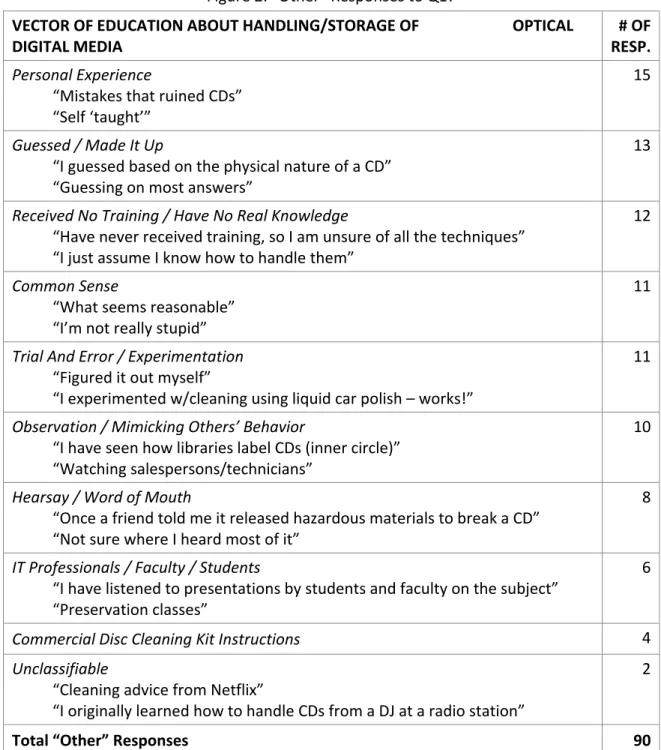
Blogs/Online Forums (8%). Libraries are not a frequent source of optical digital media handling/storage education for the survey sample, comprising at best a combined 10% of participants who were educated by Library Staff, Library Demonstrations, and Library Materials (handouts/flyers/signs); this percentage is probably lower than 10% due to overlap between participants who fall into more than one of these three categories.
Despite the large number of possible responses that could be selected by simply checking a box (11 choices), this question – how people learned what they know about optical digital media handling/storage – received the largest number of write-in “Other” responses (90, or 12% of all participants) of all of the survey questions. Figure 2 (on the following page) is a summary of the “Other” responses, along with direct quotations from the participants.
For the most part, what the above responses have in common is the participants’ lack of any kind of formal training or education in the subject. At best, they have learned how to handle and store digital optical media by observing or hearing advice from others, who may or may not be trustworthy sources of valid information; at worst, they have damaged their discs due to misuse or experimentation, or simply assumed that they know best via “common sense.” As will be demonstrated shortly by the questions and
responses discussed in Section D, common sense is of little help when a user is unaware of basic facts about the physical composition of optical digital media.
Figure 2: “Other” Responses to Q17
VECTOR OF EDUCATION ABOUT HANDLING/STORAGE OF OPTICAL DIGITAL MEDIA
# OF RESP.
Personal Experience
“Mistakes that ruined CDs” “Self ‘taught’”
15
Guessed / Made It Up
“I guessed based on the physical nature of a CD” “Guessing on most answers”
13
Received No Training / Have No Real Knowledge
“Have never received training, so I am unsure of all the techniques” “I just assume I know how to handle them”
12
Common Sense
“What seems reasonable”
“I’m not really stupid”
11
Trial And Error / Experimentation
“Figured it out myself”
“I experimented w/cleaning using liquid car polish – works!”
11
Observation / Mimicking Others’ Behavior
“I have seen how libraries label CDs (inner circle)”
“Watching salespersons/technicians”
10
Hearsay / Word of Mouth
“Once a friend told me it released hazardous materials to break a CD” “Not sure where I heard most of it”
8
IT Professionals / Faculty / Students
“I have listened to presentations by students and faculty on the subject” “Preservation classes”
6
Commercial Disc Cleaning Kit Instructions 4
Unclassifiable
“Cleaning advice from Netflix”
“I originally learned how to handle CDs from a DJ at a radio station”
2
Total “Other” Responses 90
Participant Knowledge about Best Practices for Handling and Storage of Optical
Digital Media
The researcher deliberately began the survey with the question that he suspected participants would have the least knowledge about, and he was not disappointed by the results. Q1 asks which side of a CD is most easily damaged by scratches, the top (label side) or the bottom (without label). 83% of all survey respondents believe that the bottom side is more easily damaged, when in fact the opposite is true. The physical composition of all CDs1, both manufactured and recordable, consists of a thin layer of aluminum substrate on the top side (often covered with a thin layer of lacquer, ink, and/or inkjet-printable surface) and a thicker layer of clear plastic on the bottom (Byers 7-8, Svensson, et al.). It is the aluminum layer on the top side that holds the data, and thus a scratch on the top side that penetrates the aluminum layer causes irreparable damage, whereas a scratch in the clear plastic on the bottom side can often be polished away, filled in, or even left alone due to the efficacy of CD playback devices’ oversampling and correction algorithms. To a person without this knowledge, “common sense” suggests that the bottom side, because it is the side read by the laser in the playback device, must be the more fragile of the two sides. The responses to this question strongly suggest that more user education about the physical makeup of CDs is necessary.
Q2 asks the same question about DVDs. The “correct” answer to this question is not as clear-cut as it is for CDs, due to differing physical compositions of different types of DVDs. DVD-Rs and single-layer manufactured DVDs are similar to CDs in that their
1
data layer sits relatively unprotected on the top side of the disc. Dual-layer DVDs, on the other hand, consist of a data layer sandwiched between two layers of clear plastic, thus protecting the data from scratch damage on both sides. Regardless of whether the survey participants are aware of these varying physical characteristics, the response was nearly identical to that of Q1: 79% of all respondents believe that the bottom side of a DVD is the most easily damaged by scratches, when in fact this is never the case; either the top side is more fragile, or both sides are equally protected.
Q3 and Q4 both elicit participant knowledge about writing (by hand, with a physical writing implement) on CDs. The former question (Q3) asks which writing utensils are safe to use. Best practices guides such as Byers, NIST, et al. generally agree that a permanent felt-tip pen (such as a Sharpie™) is a safe instrument to use, and here the survey results show that 89% of respondents agree. This is heartening news for librarians and others with conservation and preservation of disks in mind. Slightly less encouraging is the data showing that 40% of respondents believe a non-permanent felt-tip pan (such as a Magic Marker™) is also safe to use to write on a disk. While using such an implement is not certain to damage a disk by corroding its outer coating, it is within the realm of possibility due to the variation and lack of industry standards in the
of the possibility of their chemical components reacting with and corroding the disc surface; the latter two are known to be dangerous due to the ease with which their hard sharp points can scratch the data layer of the disc. It is good to see, however, that these users are definitely in the minority compared to those who know that permanent felt-tip markers are the safest for use. It is interesting to note that 7% of respondents believe it is never safe to write on a disc; while they may be exercising unnecessary caution, it is also possible that time will prove them correct, because of course optical digital media have only existed for three decades and any deleterious long-term (i.e., decades ahead) effects of permanent ink on them is yet unknown.
The second of this pair of questions (Q4) asks participants what locations on discs they believe are safe for writing upon. Here again there is a gray area due to the
unknown long-term effects of permanent ink on disc surfaces. While it is generally believed that it is safe to write with permanent ink anywhere on the top surface of a disc, as 82% of respondents agree, experts often say this with fingers crossed. The only area that is guaranteed2 to be safe for writing is the 1.5-inch center ring, which contains no data layer; 14% of respondents concur. However, were this survey a graded quiz, the researcher would give full credit to the 82% who believe it is safe to write anywhere on the top surface of a disc, as this is one of the pieces of advice commonly included in the instructions in the packaging of CDs and DVDs, particularly recordable ones. As
discussed in Section C, packaging instructions are the second most popular means of user education about discs, so it is commendable that such instructions are accurate about the use of safe utensils (Q3) and safe locations (Q4) for writing. It might be noted in
2
conclusion that users may arrive at the latter knowledge through common sense or guessing – they may suspect that writing on the bottom surface would interfere with the reading laser, causing faulty playback – whereas the former (knowledge about utensils) probably must be taught, or learned by hard experience (“[m]istakes that ruined CDs”).
as well as the label itself becoming partially or wholly dislodged from the disc into the playback device.
All in all, it is agreed that adhesive labels are dangerous. The data from the survey, however, show that 69% of respondents believe it is safe to place a label anywhere on the top side of a CD or DVD. The best and hoped-for answer to this question is that it is never safe to place adhesive labels on optical digital media, a fact agreed upon by 20% of respondents. If this survey were a graded quiz, again, partial credit would be given to the 11% who stated that the 1.5-inch center ring of a disc is safe for labeling. This is often how libraries, who must somehow brand their discs to claim ownership and prevent theft, label their CDs and DVDs, and general users cannot be faulted for following this example. If a label must be placed on a disc, this is certainly the safest location to do so.
together (which weaken over time due to stresses from temperature, humidity, bending, and inherent vice), peeling off the adhesive label can pull the data layer right off with it. The use of labels – or rather, the discouragement of their use – is clearly an area where more user education is needed. It is also a topic that is conspicuous by its absence in retail disc packaging instructions, which is perhaps not surprising when one considers that most major disc manufacturers are also sellers of disc labels and labeling kits.
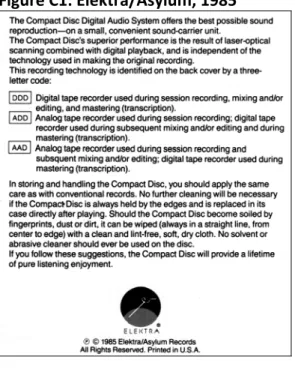
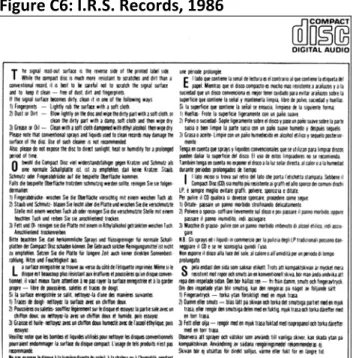
advice disseminated in optical digital media packaging instructions, the only one that has been a part of them from the very first commercially available CD3 is this: “Always wipe in a straight line from center to edge.” One could take this as suggesting that packaging instructions often go unread or unheeded; one should also refer to the finding from Section C that nearly twice as many participants reported learning about optical digital media by word of mouth (Friends/Family) than from printed materials.
Proper storage casing is the subject of Q7, and the survey responses correspond to the advice of experts and best practices guidelines, in that the general consensus is that there is no general consensus. It is agreed by Byers, NIST, et al. that vertical storage in hard plastic cases (called “jewel cases” or “jewel boxes” in the industry) is least likely to cause either scratches or warping, and this option was indeed the one selected by more respondents than any other (74%). Storing discs in jewel cases and stacking them horizontally like books (which 53% of respondents believe is safe) is also thought to cause minimal damage, although over the course of many years (decades), it may lead to gradual warping as gravity pulls the edges of the disc downward. Beyond jewel cases, however, expert opinions vary as to the risk levels of other common types of storage. All of the common storage methods besides jewel cases involve the entire disc surface (not just the 1.5-inch central hub) coming into direct contact with the storage housing, leading to friction and potential abrasion when removing and replacing the disc. The survey results are similarly undecided. (This question had the highest average number of responses per respondent, 2.90 (2470 answers from 850 individuals), of all multiple-answer questions in the survey.) In descending order of popularity, “safe” methods of
3
storage indicated were vertical jewel cases (74%), vertical cloth-backed sleeves (58%), wallets with cloth-backed pages (54%), horizontal jewel cases (53%), and horizontal or paper sleeves (34%). The least popular option among survey participants, stacked on a spindle without individual enclosures (17%) also happens to be decidedly the least safe method of storage, as it easily leads to circular scratches from particles caught between discs. According to experts, the truth of the matter is that apart from jewel cases, the storage enclosure one chooses to use is less important to the well-being of the disc than the care with which one removes and replaces the disc, and the ambient temperature and humidity (which will be discussed shortly).
As mentioned before, ambient conditions of temperature and humidity are of great consequence to the health and longevity of optical digital media. The survey question that most directly confronts this issue (Q11) is another which the vast majority of
respondents answered correctly. As 86% of them attested, discs are safest when stored in a cool and dry climate. 23% also think warm and dry conditions are safe; while not as optimal as cool and dry, warm and dry is indeed safer than cool and humid (4%) or warm and humid (1%). “Store in a cool, dry place” sometimes appears in printed instructions accompanying optical digital media, so participants may have picked up on that. More likely, perhaps, is that this is a facet of storage where common sense indeed prevails, as innumerable other everyday items – buildings, vehicles, books, photographs, clothing, wine, food – have proven to last longest in cool and dry climates, and suffered the most damage in the opposite conditions.
Putting the motives of the researcher aside and focusing on the question at hand, one can observe from the survey data that two-thirds (67%) of respondents believe that both types of disc, pre-recorded and recordable, are easily damaged by exposure to sunlight. This is not the case. While it is not a good idea to leave a pre-recorded disc exposed to direct sunlight repeatedly or for prolonged periods of time (as with so many other common items – books, photographs, clothing, wine, food…), studies do not show conclusive evidence that brief or occasional exposure to sunlight significantly shortens the lifespan of pre-recorded discs. The opposite, however, is true of recordable discs, which are catastrophically damaged by exposure to sunlight due to their chemical makeup. Data is recorded onto recordable discs by a laser burning holes in a light-sensitive layer (in the same location that a pre-recorded disc has the data-bearing aluminum substrate); thus, being light-sensitive, a recordable optical digital disc left sitting in the sun suffers the same fate as a recordable magnetic disc or tape left sitting next to a magnet. The survey responses do suggest that (apart from the 13% who know the risk sunlight presents to recordable disks) participants are unaware of this
fundamental chemical difference between the two types of discs. However, the researcher feels that he might have worded this question more precisely, or split it into more than one question, in order to learn more specifically what people know about the difference between disc types.
before, from this point onward the response rate rises and falls according to the question but generally hovers around 800, which is the exact number of participants who answered questions to the very end.
Q13 sought to discover if participants were aware that there are significant
differences between the various dye colors used in recordable optical digital media. 71% of respondents believe there are no significant differences. In fact, accelerated aging studies by Youket, et al. predict that discs using a phthalocyanide dye layer – those which appear silver, gold, or pale green to the naked eye – will outlast those made with other dyes to a remarkable extent. It is unsurprising that members belonging to a university community, but not bound together by other specific interests, would be unaware of the chemical differences between dye types; the researcher would only have expected to find widespread knowledge of the subject in a specifically focused group (such as
photographers, archivists, or recording manufacturers) whose professional or personal interests required such knowledge.
unhesitatingly say these discs will last more than 50 years). The remaining 50% of respondents are split nearly evenly (26/24) as to whether the average pre-recorded disc will last less than 11 years or more than 50 years. (Those who hold the former belief may have come to that conclusion based on the failure of their own discs, perhaps due to mistreatment of the sorts alluded to in earlier questions; those who hope for an average lifespan of 50 years or more may be either overly optimistic or overly susceptible to persuasion by the same recording industry forces that used to promise “a lifetime of listening enjoyment” in the small print in the liner notes of every CD manufactured in the 1980s., as reprinted in Appendix C.) The responses to Q15 are not quite the same, however: 50% believe the lifespan of recordable CDs to be 10 years or less, while 36% believe they will last 11-50 years, and only 14% hope for 50 years or more. These data show that members of the sample base (and thus perhaps users on the whole) are
generally more skeptical about the longevity of recordable discs than pre-recorded ones. One might conjecture that this is an attitude that can only come from personal experience with recordable disc failure, since the data from earlier questions suggest that participants are unaware of intrinsic differences between recordable and pre-recorded discs.
Q16 is the final question to gather data about participants’ knowledge rather than personal demographic data, but it takes a different tack than previous questions by introducing the subject of libraries for the first time. (Subsequent questions established further information about participants’ usage of libraries, as discussed in Sections B and C, but up until this point, the word “libraries” had not been mentioned in the survey nor in the solicitation email4.) The question supposes that a CD or DVD retails for $15-$20
4
and then asks participants what they believe the cost is for a library to obtain said CD or DVD and make it available for patrons to borrow. The researcher included this question almost as a lark, yet with serious intent: studies have been done about patrons’ valuation and subsequent treatment (or mistreatment) of books and other printed materials in libraries, as discussed in Chapter 2, yet the researcher is unaware of similar studies about patrons’ valuation of optical digital media.
The results from this one question are interesting indeed to anyone in the library profession. The majority of the 812 respondents (41%) believe that the cost to the library
is less than the retail price of the CD or DVD in question. Only 20% of the respondents
realize that truthfully, the cost of the disc itself compounded with the costs of processing it for patron use (e.g., cataloging, labeling, tattle-taping, repackaging/reformatting, etc., plus the labor hours involved) leads to an overall cost to the library of more than $35 for a disc that retails for $15-20. Some might even estimate the cost to the library to be over $50, depending on whether processes are automated and what kinds of labeling and security measures are used. The remaining 39% of respondents realize the cost to the library is not less than retail, but do not believe it to be significantly more than retail either.
Participant Desire for Further Education
they would be emailed the URL of a page with the “correct” answers to all of the
questions asked in the survey (although, as described in Section D, not every question has a singular and/or correct answer), as well as further information and a reading list of resources for further research. Of the ~800 respondents who successfully completed the entire 22-question survey, 55% indicated that they would like to receive this information. This response should be heartening to anyone in the LIS field, and the researcher hopes that those who said “yes” were not merely being polite. They will be directed to a webpage which consists of the information contained here in Chapter 4 (pared down and rewritten for a general audience, of course) as well as a few selected highlights from the bibliography presented in Chapter 8.
Chapter 5: Study Limitations
As with any survey study, limitations are inherent. The chosen population of the University of North Carolina at Chapel Hill community may be unrepresentative of users of optical digital media on the whole. It is probable, for example, that the overall
education level of members of this community, being centered around an esteemed university, is to some degree higher than that of the overall populace; this could have affected the survey results. Members of the UNC-CH community may also be, on
average, more frequent library users than the general populace, which could have affected the results of the questions specifically dealing with library usage. On the other hand, UNC-CH library users could very well use optical digital media in libraries less
frequently than members of the general populace; without a direct study to provide data, this is another unknown.
For the purposes of this study, members of the UNC-CH community were defined as those who are subscribed to the Mass Email System at UNC-CH. While all members of the UNC-CH community are subscribed by default upon entering the community, they may individually choose to opt out for any reason and at any time5; these individuals were thus precluded from receiving the invitation to participate in the study. Other factors such as spam blockers, custom email filters, and personal email reading habits may also have caused some members of the UNC-CH community to fail to receive the survey invitation.
5
As with all surveys, the participant base is to some degree composed of people who are generally disposed to taking surveys, more than those who are generally
disposed not to. The fact that the survey was online, not on paper or in person, is another potentially influential factor. The two rewards offered in the solicitation email – further education in the survey subject (promised) and a $20.00 gift certificate (possible by luck of the draw) – may also have influenced participants’ choosing to complete the survey, for better or for worse.
either standing alone or appended to existing questions, as those that were included provided some very interesting and unexpected insights into participants’ treatment of optical digital media and the vectors by which they came to their knowledge.
Chapter 6: Implications
The first group of questions (Q1-Q16) sought to collect data about participants’ knowledge of best practices for handling and storage of optical digital media. The overall data collected from ~800 members of the UNC-CH community suggest that user knowledge of this subject is of very mixed quality.
The participants’ answers to survey questions are almost entirely correct about certain aspects, such as the optimal climate conditions for storage (Q11), the best way to remove a disc from a stubbornly-gripping storage case (Q10), and writing implements (Q3) and cleaning fluids (Q8) that are safe for use on discs. Conversely, they are almost entirely incorrect about other aspects, such as which side of a disc is more prone to serious damage by scratches (Q1 and Q2), the use and removal of adhesive labels (Q5 and Q6), and the differences between pre-recorded and recordable discs (Q12) and types of recordable discs (Q13). The responses to a third group of questions show a lack of consensus among respondents; in some cases this may be due to the actual absence of a definitive answer, e.g., safe storage enclosures (Q7) and disc longevity (Q 14 and Q15), while in other cases it suggests a lack of user education in areas where experts generally agree on a correct answer, e.g., safe cleaning motions (Q9), safe locations for writing on disc surfaces (Q4) and cost of library acquisition and processing of discs (Q16).
The second group of questions (Q17-Q19) sought to collect data about participants’ usage of optical digital media in libraries and vectors of usage/storage education. The data collected from these questions potentially shed light on the results of the first group of questions. The results from Q18 show that the majority of respondents rarely or never use CDs and DVDs owned by libraries, either by using them in the library or borrowing them for home use. The results from Q19 suggest that these same
respondents overwhelmingly use libraries for personal and academic reading/research, with only 8% indicating usage of audio/video materials in libraries. Together, these data imply that participants, since they are not using optical digital media in libraries, are thus not being presented with educational opportunities about best practices by librarians or library materials.
The researcher found the responses to the question about vectors of user education (Q17) to be the most illuminating and unexpected results of the survey. As discussed in Chapter 2, while a considerable body of academic literature about best practices for handling and storage of optical digital media has been published, this is unlikely to have been read by the general populace. Instead, the researcher suspected that articles in popular media such as Svensson, et al., might have been the primary vector of education for the non-academic populace. The results of the survey show that, to the contrary, print media and writings on the Internet are each named by only 17% of respondents as
(40%). Library staff and/or materials, by comparison, were named by only 10% of respondents at best6 as instrumental in their education.
Finally, it must be acknowledged that a considerable percentage of participants have explicitly or implicitly received no education whatsoever about best practices for handling and storage of optical digital media. As discussed in Chapter 4, Q17 received the lowest response rate of all survey questions, perhaps because no check-box option for “Don’t know” / “Have never received education” was provided. This same question received the largest number of write-in “Other” responses, most of which indicate in one way or another that respondents are “(n)ot sure where [they] heard most of it,” “figured it out [them]self,” “just assume [they] know how to handle them,” or are “(g)uessing on most answers.”
The results from Q17-Q19 imply that users of optical digital media are, on the whole, neither using them in libraries nor being educated about them in libraries. The primary vector of user education is word-of-mouth/hearsay and the secondary vector is instructions included in purchased CDs and DVDs. Taken together with the results from Q1-Q16, which show that user knowledge of best practices is varied and inconsistent, the overall implication is that word-of-mouth/hearsay and commercially available
instructions are not effective means of educating users in best practices.
Since participants in the survey (and by extension, the overall UNC-CH
community) are primarily gaining their knowledge about best practices from friends and family (word-of-mouth/hearsay) and secondarily from printed instructions included in commercially marketed optical digital media, and since libraries are powerless to directly
6
influence either of these vectors, then the implication for libraries is that they must make a concerted effort to expand outreach in patron education, if they wish to increase user knowledge about optical digital media. Even though the survey shows that participants are not using library discs frequently, it is in libraries’ best interest to educate their patrons in the best practices for handling and storage of optical digital media. It can be argued, in fact, that infrequent usage of library discs increases the likelihood of patron mistreatment of these discs, as proper treatment cannot become a habit with infrequent usage.
Furthermore, libraries have an opportunity here to directly benefit their patrons by increasing education in best practices, if not for the libraries’ collections, then for the users’ own collections. Any knowledge that libraries can impart to their patrons will become part of the word-of-mouth/hearsay network that spreads information to everyone in the UNC-CH community. This would eventually benefit all users of optical digital media by helping to offset popular misinformation, eliminate “guessing,” reduce
Chapter 7: Conclusion
In the absence of any known published studies about the general populace’s knowledge of best practices for handling and storage of optical digital media, this study sought to collect data from a representative segment of the general populace in order to establish baseline data for further research. In this regard, the study was successful. The chosen survey, although skewing 2/3 female for unknown reasons, represented a broad range of ages and affiliations with the UNC-CH community. The sample size of ~800 was much larger than anticipated, which only strengthens the statistical data collected.
This study also sought to collect data about particpants’ usage of libraries in general, and specifically their usage of optical digital media owned by libraries. In this regard, the study was a qualified success. While valuable data was gathered, the researcher feels that this area of inquiry was not sufficiently covered by two questions, and thus respondents’ use of optical digital media in libraries is not fully quantified. The results were strong enough, however, to enable implications to be made in combination with the data from questions that preceded and followed them.
Chapter 8: Works Cited
American Library Association [ALA]. (2008, September 11). Guidelines for packaging and shipping magnetic tape recording and optical discs (CD-ROM and CD-R) carrying audio, video, and/or data. ALCTS Website. Retrieved October 24, 2008, from http://www.ala.org/ala/mgrps/divs/alcts/resources/preserv/pstapediscs.cfm. Amodeo, A. J. (1997). Preservation awareness for student workers: Adding a quiz to the
agenda. In Drewes, J. M., and Page, J. A. (Eds.), Promoting preservation awareness in libraries: A sourcebook for academic, public, school, and special
collections (pp. 66-73). Westport, CT: Greenwood Press.
Annett, S. E. (1997). User education in care and handling of audiovisual materials. In Drewes, J. M., and Page, J. A. (Eds.), Promoting preservation awareness in
libraries: A sourcebook for academic, public, school, and special collections (pp.
185-189). Westport, CT: Greenwood Press.
Arps, M. (1993). CD-ROM: Archival considerations. In Mohlhenrich, J. (Ed.),
Preservation of Electronic Formats & Electronic Formats for Preservation. Fort
Atkinson, Wisc.: Highsmith Press.
Babbie, E. (2007). The Practice of Social Research, eleventh edition. Belmont, Ca.: Thomson Wadsworth.
http://www.usatoday.com/money/industries/technology/2004-07-26-longevity_x.htm.
Byers, F. R. (2003). Care and handling of CDs and DVDs: A guide for librarians and
archivists. Washington, DC: Council on Library and Information Resources; and
National Institute of Standards and Technology.
Columbia University Libraries Preservation Committee. (1987). Murder in the stacks [videocassette]. New York, NY: Center for Biomedical Communications, College of Physicians & Surgeons, Columbia University.
Curry, A., Flodin, S., & Matheson, K. (2000). Theft and mutilation of library materials: Coping with biblio-bandits. Library & Archival Security, 15 (2), 9-26.
De Stefano, P. & Jimenez, M. (2007). Commercial video collections: A survey of the
Avery Fisher Center collection at NYU. New York: Avery Fisher Center, New
York University.
Dobrusina, S. A., Ganicheva, S. I., & Tikhonova, I. G. (2004). Preservation of CD-ROM-based data. Restaurator, 25 (2), 141-147.
Dobrusina, S. A., Ganicheva, S. I., Tikhonova, I. G., Velikova, T. D., & Zavalishin, P. E. (2008). Influence of the external factors on the lifetime of information recorded on DVD±R. Restaurator, 28 (1), 29-43.
Elborough, T. (2009). The vinyl countdown: the album from LP to iPod and back again. Berkeley: Soft Skull Press, an imprint of Counterpoint LLC. First published in the United Kingdom by Hodder & Stoughton, a division of the Hachette UK Group,
Gracy, K. F. & Croft, J. A. (2006). Quo vadis, preservation education? A study of current trends and future needs in graduate programs. Library Resources & Technical
Services, 50 (4), 274-294.
Gregory, T. R. (2006). Stacking up: A how-to guide to condition surveys. Collection
Management, 31 (3), 85-100.
Hartke, J. L. (2001, Jul.). Measures of CD-R longevity. Medialine. Retrieved 28 Oct. 2008 from http://www.mscience.com/longev.html.
Hartke, J. L. (2002, Oct.). Why CD-Rs fail. Medialine. Retrieved 28 Oct. 2008 from http://www.mscience.com/cdrfail.html.
Hedstrom, M. (1998). Digital preservation: A time bomb for digital libraries. Computers
and the Humanities [now Language Resources and Evaluation], 31 (3), 189-202.
Hendrick, C. & Murfin, M. E. (1974). Project library ripoff: A study of periodical
mutilation in a university library. College & Research Libraries, 35 (6), 402-411. Iraci, J. (2005). The relative stabilities of optical disc formats. Restaurator, 26 (2),
134-150.
Knopper, S. (2004). Are CDs rotting away? “Indestructible” technology shows its age.
Rolling stone [online serial], posted 25 Jun. 2004. Retrieved 03 Oct. 2008 from
http://www.rollingstone.com/news/story/6209257/are_cds_rotting_away Lehman, M. (1998). CD bronze corrosion attack! American Record Collector,61 (4).
Retrieved 22 Nov. 2008 from
Lewis, A. F. (2003). Risk reduction through preventative care, handling, and storage.
Sound Savings: Preserving Audio Collections, Association of Research Libraries
2003 symposium proceedings, 3rd session.
Library of Congress [LC]. (2002, July). Cylinder, disc and tape care in a nutshell. Library
of Congress Preservation Website. Retrieved 24 Oct. 2008, from
http://www.loc.gov/preserv/care/record.html
Marcum, D. B. (2003). Research questions for the digital era library. Library Trends, 51 (4), 636-651.
McGee, P. B. (2007) Interlibrary loan of media materials – the Tennessee Tech Volpe experience: A model for change. The Southeastern Librarian, 55 (1), 41-45. Milner, G. Perfecting sound forever: an aural history of recorded music. (2009). New
York: Faber and Faber, Inc., an affiliate of Farrar, Straus and Giroux.
National Institute of Standards and Technology [NIST]. Quick reference guide for care
and handling. Excerpted from Byers, F. (2003). Retrieved 30 Oct. 2008 from
www.itl.nist.gov/iad/894.05/docs/onepage.pdf.
National Preservation Office [NPO]. (2008). Caring for CDs and DVDs. Finch, L., and Webster, J., authors. London: National Preservation Office, The British Library. Patkus, B. L. (1998). Collections security: The preservation perspective. Journal of
Library Administration, 25 (1), 67-89.
Slattery, O., Lu, R., Zheng, J., Byers, F. & Tang, X.. (2004). Stability comparison of recordable optical discs: A study of error rates in harsh conditions. Journal of
Research of the National Institute of Standards and Technology, 109 (5), 517-524.
Smith, A., Allen, D. R. & Smith, K.. (2004). Survey of the state of audio collections in
academic libraries. Washington, DC: Council on Library and Information
Resources.
Stauderman, S. (2003). Pictorial guide to sound recording media. Sound Savings:
Preserving Audio Collections, Association of Research Libraries 2003
symposium proceedings, 2nd session.
Svensson, P. (2004, c. May 5). CDs, DVDs not so immortal [AP article]. New York: Associated Press.
Teper, T. H. (2005). Current and emerging challenges for the future of library and archival preservation. Library Resources & Technical Services, 49 (1), 32-39. Trinkaus-Randall, G. (1998). Library and archival security: Policies and procedures to
protect holdings from theft and damage. Journal of Library Administration, 25 (1), 91-112.
Turner, J. (1991). Training for audiovisual archivists and librarians. IFLA Journal, 17 (3), 248-255.
Van Bogart, J. W. C. (1997). What can go wrong with magnetic media? Publishing
Research Quarterly, 12 (4), 65-77.
Youket, M. & Olson, N. (2007, May 21 & 24). Compact disc service life studies by the Library of Congress. Archiving 2007: Final program and proceedings.