Sharif University of Technology
Scientia IranicaTransactions E: Industrial Engineering http://scientiairanica.sharif.edu
Robust and sustainable full-shipload routing and
scheduling problem considering variable speed: A real
case study
M. Rabbani
a;, S. Sadeghsa
a, M. Vaez-Alaei
a, and H. Farrokhi-Asl
b a. School of Industrial Engineering, College of Engineering, University of Tehran, Tehran, Iran. b. School of Industrial Engineering, Iran University of Science & Technology, Tehran, Iran. Received 1 September 2017; received in revised form 26 January 2018; accepted 9 June 2018KEYWORDS Maritime transportation; Speed optimization; Carbon emission; Sustainability; Fuzzy;
Robust optimization.
Abstract. This paper presents a sustainable multi-objective routing and scheduling problem for maritime transportation considering ship's variable speeds under uncertainty. The proposed model is aimed at satisfying three separate dimensions of sustainability including economic, environmental, and social simultaneously while nding the best routes and schedule for each ship. The rst objective is aimed at meeting economic goals by minimizing shipping cost. The second objective concerns the social dimension of sustainability by maximizing job creation and opportunities with respect to the number of intransitive workers in ships and ports. The third one concerns the minimization of CO2
emission to address the environmental issue. Several test problems are applied to validate the proposed model, and sensitivity analysis is used to demonstrate the eects of the model's parameters on the objective function value. Augmented "-constraint is implemented as a solution method to solve the multi-objective mathematical model. This is the rst ship routing and scheduling paper, and it has considered three aspects of sustainability under uncertainty solved by augmented "-constraint. To solve the large-sized model, factual input data from a real case study are considered. Computational results show signicant positive managerial eects.
© 2019 Sharif University of Technology. All rights reserved.
1. Introduction
Maritime transportation is one of the most popular and benecial modes among dierent types of transporta-tion modes in global trade for so many reasons. For example, it is an economical way of transportation for most of the shipments and related industries; maritime
*. Corresponding author. Tel.: +9821-88021067; Fax: +9821-88013102
E-mail addresses: [email protected] (M. Rabbani); [email protected] (S. Sadeghsa);
[email protected] (M. Vaez-Alaei); [email protected] (H. Farrokhi-Asl) doi: 10.24200/sci.2018.5106.1100
transportation is the only way to transport huge or irregular shipment, etc. Ship transportation has highly increased recently as a result of globalization [1]. Ac-cording to recent reports, more than 80% of universal businesses and trades in terms of volume and about 70% of them in terms of value are performed through shipping, and these estimations are even higher in developing countries [2]. There are three kinds of ships for shipping cargoes in the literature: industrial, linear, and tramp [3]. Industrial cargo shipping is a kind of shipping in which the cargo owner plays the main role in transporting his own shipment in order to minimize the cost. Linear shipping is a kind of shipping in which travels are done in a xed sequence frequently, and shipping companies announce these xed routes.
Tramp ships are like taxis; they head towards any port with available shipments. Unlike linear shipping, a ship is able to sail in dierent routes and with variable transportation speeds in tramp shipping in order to maximize benets or minimize the cost.
Signicant improvements in the shipping industry have raised the competitive eld in the global economy. Ocean shipping is a kind of industry with high capital-ization and considerable operation cost; thus, among these features, it is becoming critical to nd ways to maximize the benets of this industry such as changing eet sizing, routing, scheduling, ship network design, etc. [4]. Moreover, due to the importance of the global environment and rapid turning of industries to green industries, some decision-makers and researchers are showing interest in sustainability and green approach in the shipping industry. One of the important concerns is emissions of greenhouse gasses in ship transportation, such as high NOxand CO2 emission, which is a result
of fuel consumption, with a lot of negative inuence on climate and pollutions. According to reliable research studies and datasets, we have faced an 86% increase in CO2 emissions from the shipping industry in 2007
in comparison with 1990. If no actions are taken, these emissions continue to rise by 150%-250% based on expectations [5].
One of the most important factors in controlling emissions of the ship along with fuel consumption and fuel cost is transportation speed. Many studies in the literature have considered the optimization rule of sailing speed in achieving more benets with the highly green shipping industry. For instance, interested readers can refer to [6-8].
Generally, the total cost of ship transportation consists of transportation expenses, consumption ex-penses, operation exex-penses, depreciation, and so forth. In order to consider sustainability and, also, carbon emission in maritime transportation problems, it is necessary to integrate sustainability with shipping cost in a single model [9]. Integrating some of the decisions necessary to address sustainable factors was a critical topic for researchers in the last decades. Jansen [10] introduced three related decisions to develop sustain-ability: structure, culture, and technology. In 2008, Vachon and Mao [11] presented sustainability by in-tegrating environmental and social factors. Cucek et al. [12] published a review paper on three dimensions of sustainability: social, environmental, and economic integration.
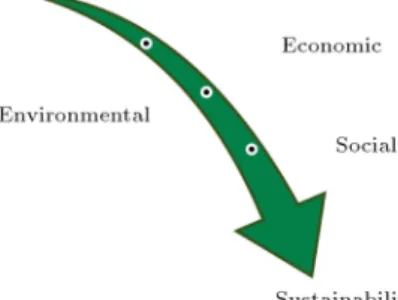
This paper aims to dene a maritime routing and scheduling problem with respect to three dimensions of sustainability (see Figure 1):
1. Economic: To minimize costs in order to increase benets by considering sailing cost, fuel cost, and revenue of sailing shipments;
Figure 1. Schematic view of sustainability dimensions considered in this study.
2. Environment: To minimize the carbon emission of ships by determining proper route and speed of each ship;
3. Social: Every industry including the shipping industry has some social aspects.
In this study, job creation is considered as the social ef-fect of maritime transportation followed by maximizing job opportunities belonging to a number of ships and ports. These three objectives are presented simultane-ously to dene the ship transportation problem. Fuzzy development and robust programming are considered for modeling required in this paper in order to make it closer to the real-world cases. To the best of our knowledge, this is the rst ship routing and scheduling paper, which considers three aspects of sustainability and variable speed in a fuzzy concept.
The remainder of this paper is structured as in the following. Section 2 is dedicated to the literature review of dierent aspects of this paper. Section 3 concerns the description of the problem in order to explain the problem for a better understanding. Sec-tion 4 goes to mathematical modeling and explains notations and problem model in detail. The solution methodolgoy is presented in Section 5, and numerical results and case-study explanation are conducted in Sections 6 and 7, respectively. Managerial insights are shown in Section 8. Finally, concluding remarks and future research directions are provided in Section 9. 2. Literature review
Maritime transportation problems, which form the background of this paper, can be divided into some categories. Some of these studies are mentioned in the following subsections.
2.1. Routing and scheduling
Maritime transportation routing and scheduling can be taken as a whole dierent subject because of how ships operate under various circumstances [13,14]. A review on ship routing and scheduling papers for investigation of theoretical and practical papers associated with this subject was published [15]. Brnmo et al. [16]
proposed a shipping problem with time window and exible cargo sizes and a partitioning approach as a methodology to solve this problem. Results indicated that using exible cargo sizes had economical inuence. Routing and scheduling for a eet of ships and a single product was designed in order to minimize the cost of operations without any time out in ports [17]. A dynamic programming model was developed in routing and scheduling in liner shipping [18]. Bendall and Stent [19] presented a model to obtain an optimal number of vessels and eets in shipping cargoes. In addition, Azaron and Kianfar [20] examined the cli-mate ship routing problem. An ocean transporta-tion inventory routing problem was considered for multiple products, and dierent sections were dened in ships for various products [21]. By proposing split loads, the restriction on carrying shipments with dierent ships was removed, and the ship routing and scheduling problem with split loads was examined by a neighborhood heuristic search [22]. Fagerholt et al. [23] introduced a methodology for strategic routing and scheduling for tramp and industrial ships. A routing and scheduling problem for split loads with time window was presented to maximize the benet and minimize cost together [24]. A continuous and discrete time horizon for ship routing and scheduling with multiple products and dierent fuel consumptions in various ports as a mathematical model is shown in the related literature [25]. Moon et al. [26] resolved an integrated ship routing problem of eet extensions with network design; for this NP-hard problem, a genetic algorithm was suggested.
2.2. Environmental and social consideration Compared to other aspects of maritime transportation, carbon emission has received insignicant attention; hence, due to the importance of environmental issues noticeable these days, CO2 emission has managed
to gain researchers' attention. Some of the related research studies on this subject are mentioned in this subsection.
Corbett and Koehler [27] introduced a method for manufacturing inventories, which are fuel based, and examined its role in ships' emissions. In order to maximize the prot of the shipping industry with an increase in fuel price, optimal speed will decrease; in addition, CO2 emissions of ships will reduce [28,29].
Eyring et al. [30] proposed an emission inventory for the global shipping industry. Endresen et al. [31] studied passengers and cargo ships emission. Corbett et al. [28] concluded that decreasing ships' speed could lead to the reduction of sailing emissions. Considering speed optimization and ships' emissions, Yin et al. [32] proposed a prot-maximizing model to investigate the relationship between slow steaming, fuel consumption, and environmental aspects. A real analysis was
devel-oped to measure carbon emission eects [33]. De et al. [9] indicated a ship routing and scheduling problem for multiple products and various ports by considering CO2 emission and solved the meta-heuristic problem
due to the complexity of the model.
One of the sustainability objectives is to consider social aspects; however, to the best of our knowledge, this is the rst paper that considers the objective of evaluating and maximizing job creation in the shipping industry.
2.3. Variable speeds and fuel consumption The speed of each transporting arc was presented as a decision variable in a tramp ship routing and scheduling problem with speed optimization. Two dierent algo-rithms were proposed to solve this problem, and com-putational results showed improvements in the tramp routing and scheduling problem by considering variable speeds [34]. The degree of the relationship between fuel consumption and ship's speed was illustrated in some papers [6,7]. Gatica and Miranda [35] suggested a full-shipload routing with speed optimization by applying discrete time windows. Wang and Meng [36] studied the sailing speed of ships for each shipping route in liner shipping; in the meantime, routing and transshipment were considered. Psaraftis and Kontovas [37] considered crucial elements in various speeds and optimizations of ships to nd a proper result. In case of an increase in fuel costs, ships' speed should decrease in order to reduce costs and maximize benets. A further decrease in speed reduces fuel emissions of ships [28]. The optimal route and speed are examined in ship routing problems in which routes, originations, and destinations are considered as xed parameters [36]. A novel routing model was suggested for a real-world case study which was solved with a heuristic by considering speed optimization [38]. Wen et al. [8] applied routing and scheduling to full-shipload by considering variable speeds; their computational results showed that optimization of speeds is a practical way to increase the total income up to 16%, and fuel cost is a critical factor in selecting a proper speed rate and obtaining the total prot.
2.4. Uncertainty consideration
Dubois et al. [39] indicated that uncertainty in mathe-matical problems could be divided in two groups:
Uncertainty in input data;
Flexibility in constraints or objectives.
The rst group is the most common one in related literature, and stochastic programming is a useful method to deal with it. The second group is divided into two groups: exibility in objectives as exibility in target and exibility in constraints as a soft limitation. Flexible mathematical programming is a well-known
approach to coping with these kinds of exibility in constraints or objectives [40,41].
Not all input parameters can be dened as exact parameters in real-world cases for so many reasons. First, some input data are innately accidental; second, lack of knowledge and poor datasets lead to stochastic programming [40,42].
There are three principal approaches in the lit-erature to deal with uncertainty in mathematical pro-gramming:
1. Stochastic programming;
2. Fuzzy programming;
3. Robust optimization.
According to problem structure, uncertainty type, and incompleteness in parameters, one of these approaches or a combination of some of them can be used in problems.
The investigation into the literature shows that there are studies on uncertainty in maritime trans-portation. For instance, readers are referenced to the following: container port problem by TOPSIS approach under fuzzy environment [43], a fuzzy genetic approach to ships routing [5], and robust ship routing problem [44] using multiple time windows in ship scheduling [45].
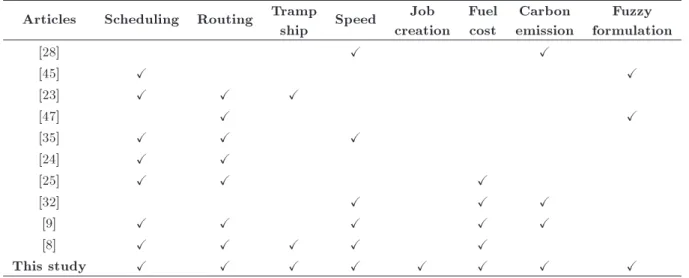
In this paper, according to a lack of reliable datasets, input parameters are not considered exactly herein, and some of the limitations are naturally exible such as time windows; therefore, a mixed exible-probabilistic robust programming is used to cope with uncertainty in the mathematical model [46]. Considering gaps in maritime transportation litera-ture and to the best of our knowledge, this is the rst sustainable ship routing and scheduling paper that considers variable speeds, fuel consumption, and robust-probabilistic formulation. Table 1 shows the
proposed features compared with the closest studies in the literature.
3. Problem description
In this paper, a full-shipload problem is dened to transport shipments between dierent nods. The rout-ing and schedulrout-ing problem determines the best feasible routes within a rational time to transport shipments from loading port to unloading port [8]. Objectives are dened to minimize total cost, to maximize social impact by creating jobs, and to minimize CO2emission
in order to protect the environment, simultaneously. In this problem, a shipping line transports liquid products. To transport liquid, tramp ships in the full-shipload mode are the most popular kind of trans-portation due to their features. Ships have dierent speed performances, fuel cost, CO2emission, size, load
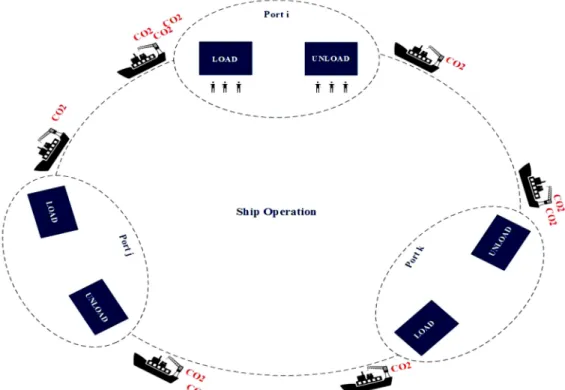
capacity, number of personals, and cost parameters. A ship operator receives shipment orders from dierent pickup and delivery ports. Each order has its specic pickup and delivery ports with a specic time window when each ship must start to load shipments. The proposed model determines whether the operator ac-cepts the order or not, which ship should pick up the order, and at what time/speed/route the ship should sail. A schematic view of this paper problem is shown in Figure 2.
To establish each industry, the most important question is how much the industry is benecial; thus, nding an optimal solution for minimizing cost and maximizing benet is the rst step in evaluating this study problem. Ship cost, fuel cost, worker salary, and transportation incomes are considered to nd the optimal routing and scheduling from an economic point of view.
Manpower plays a critical role in maritime trans-portation for both ships and ports. In this problem,
Table 1. Summary of related literature. Articles Scheduling Routing Tramp
ship Speed
Job creation
Fuel cost
Carbon emission
Fuzzy formulation
[28] X X
[45] X X
[23] X X X
[47] X X
[35] X X X
[24] X X
[25] X X X
[32] X X X
[9] X X X X X
[8] X X X X X
Figure 2. Three ports of the network between which ships travel.
according to the social aspect of sustainability objec-tive, job creation of this routing and scheduling is to be maximized by considering workers in ships and nodes. Moreover, manpower cost is addressed as their salaries. Ship's speed, fuel consumption, and emissions of greenhouse gasses are three dierent concepts in shipping which are closely related to each other. It is proven that ship emissions, such as CO2, can be
reduced by determining an optimal speed [28,48]. It is required to consider that higher speed leads to higher fuel consumption and more emissions per traveling unit; however, it also leads to less transit time. There-fore, nding an optimal trade-o between these two factors is critical to satisfying both environmental and economic objectives of this paper.
Dierent ships have dierent origins and destina-tion ports. The origin and destinadestina-tion are not pre-determined for each ship. Ships have dierent speeds. They can pick shipments and transfer them to their destination at dierent speeds. High speeds save time, yet increase the cost and produce a greater amount of CO2. In addition to ship speed, fuel cost depends on
which ship is loaded (laden) or sails empty (ballast). Each node is considered as an individual port. Each port has dierent platforms for loading and unloading shipments. Ports can be represented as an origin or a destination of each ship or both of them. Each tramp ship should start its travel from its origin port and deliver as much shipment as it can collect from middle ports to its destination port. The port where
a ship should end its journey is not predetermined. Dummy nodes are considered to achieve this aim. The model gives a sequence of ports with shipments to each ship. If the destination port of a shipment is not the origin port of the next shipment in a given sequence, the ship must travel empty. The model tries to minimize such empty trips. Each journey is followed by costs, yet with advantages.
Figure 2 shows a schematic view of the presented problem. This network with three ports shows a small sample for the problem. Ships travel between ports and emit CO2 in their route. The amount of
their emission varies due to dierent speeds and fuel consumption. Ports and ships have a specic number of workers according to the port size and their amount of loading/unloading in ports and number of used ships. 4. Mathematical formulation
In this section, objectives, assumptions, notations, and mathematical model of this problem are presented. In addition, the mixed exible-probabilistic robust programming is proposed at the end of this section. 4.1. Objective functions
The presented routing and scheduling problem is a multi-objective problem, which addresses three di-mensions of sustainability simultaneously. The rst objective function minimizes the total cost including the traveling cost of ships, fuel cost, ship cost, and
workers' salary. In addition, the revenue for transport-ing shipments is considered. Since our problem involves full ship-load mode, the cost of fuel is equal to its maximum amount. Finally, cost of workers corresponds to the salary of workers in ships and workers in the port to transfer shipments in or out of the ship.
The second objective maximizes the total number of workers in order to create job opportunities and maximize social responsibility. Each ship has a dened number of workers, and ports require a number of workers.
Last but not least, the objective considers the environmental eects produced by ship transporta-tions. The objective is realized by minimizing total CO2emitted from ship trips and minimizing transport
hazardous materials (i.e., gas and oil). 4.2. Assumptions
In order to present the mathematical modeling of the stated problem, some assumptions of this problem require to be claried as follows:
Our problem is not a complete graph, meaning that some ports cannot connect to each other directly. For example, it is not feasible to sail directly from port A to port B; some middle ports are necessary due to obstacles in a direct route or some available contracts; some routes are not feasible in the stated problem;
An origin node could be a shipment node and, also, a destination node for dierent ships;
It is not feasible for all ships to serve all shipments;
Time window is only considered for pickup time (began of the service) for the shipments. In addition, it is determined by contracts;
The benets gained from serving each shipment are xed, thus minimizing the total cost and maximizing the total benet.
4.3. Mathematical model
The presented model in this paper is an extension to a routing and scheduling model, which has been pub-lished recently [8]. Only cost objective was considered in the previous study, while two other dimensions of sustainability, namely the environmental (concerning minimization of ships' CO2 emission) and the social
(maximization of job creations), are proposed in this study. In addition, the fuzzy approach is formulated in order to cope with the lack of proper data, considering uncertainty in the model of this study.
All of sets, parameters, and decision variables used in the mathematical formulation are introduces in the following:
Sets:
N Set of all the nodes;
A Set of feasible routes; V Set of speeds;
S Set of ships;
O Set of all origins of the ships; D Set of all destinations of the ships; Parameters:
li Distance between load and unload
ports;
[ai; bi] Time window;
dij Distance between two nodes i and j;
bv
i Income of serve shipment i by ship s
at speed v;
gv Time of traveling one distance unit at
speed v 2 V ; cv
s Fuel cost of ship s traveling one
distance unit at speed v; pi Port service time;
fis 1 is feasible for ship s to serve shipment
i, 0 otherwise;
ns Number of available ship s;
CO2sv CO2 emission from ship s with speed
v;
hi Risk of serving hazardous material;
wss Number of personals working on each
ship s;
Ms Amount of payment for each person
working on each ship s; ev
is Cost of accepting shipment i to serve
with ship s at speed v (including tax and personnel payments);
Variables:
tis Time when ship s starts loading
shipment i;
xijs Time span of ship s arriving at the
loading port of shipment i to that arriving at the loading port of shipment j;
Binary variables zv
ijs 1 if ship s sails from shipment node
i to shipment node j at speed v, 0 otherwise;
wv
is 1 if ship s serves shipment i at speed
v, 0 otherwise.
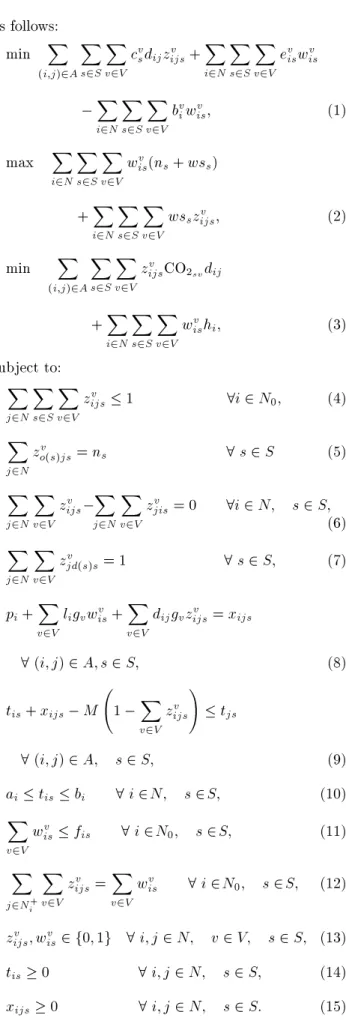
as follows: min X (i;j)2A X s2S X v2V cv
sdijzijsv +
X i2N X s2S X v2V ev iswvis
X i2N X s2S X v2V bv
iwisv; (1)
max X i2N X s2S X v2V wv
is(ns+ wss)
+X i2N X s2S X v2V
wsszvijs; (2)
min X (i;j)2A X s2S X v2V zv
ijsCO2svdij
+X i2N X s2S X v2V wv
ishi; (3)
subject to: X j2N X s2S X v2V zv
ijs 1 8i 2 N0; (4)
X
j2N
zv
o(s)js= ns 8 s 2 S (5)
X j2N X v2V zv ijs X j2N X v2V zv
jis = 0 8i 2 N; s 2 S;
(6) X j2N X v2V zv
jd(s)s= 1 8 s 2 S; (7)
pi+
X
v2V
ligvwvis+
X
v2V
dijgvzijsv = xijs
8 (i; j) 2 A; s 2 S; (8)
tis+ xijs M 1
X v2V zv ijs ! tjs
8 (i; j) 2 A; s 2 S; (9)
ai tis bi 8 i 2N; s 2S; (10)
X
v2V
wv
is fis 8 i 2N0; s 2S; (11)
X j2N+ i X v2V zv ijs= X v2V wv
is 8 i 2N0; s 2S; (12)
zv
ijs; wisv 2 f0; 1g 8 i; j 2 N; v 2 V; s 2 S; (13)
tis 0 8 i; j 2 N; s 2 S; (14)
xijs 0 8 i; j 2 N; s 2 S: (15)
Objective function (1) aims to minimize the total transportation costs and maximize the total benet from shipping the shipments, simultaneously. Objec-tive function (2) considers the social dimension of ship transportation by maximizing the number of workers working in each cargo-ship. Objective function (3) minimizes total CO2 emissions in total trips. Eq. (4)
guarantees that each shipment is served by at most one ship. Eq. (5) ensures that all ships leave the origin port. Eq. (6) forces the ships to leave the ports until the end of the trip. Eq. (7) ensures that each ship nishes the trip at its destination. Eq. (8) calculates the total time span. If xv
ijs = 1, Eq. (9) calculates
the time span of ships that arrive at the loading port of shipment i to those arriving at the loading port of shipment j. M represents a large number. Eq. (10) calculates the time window. If a shipment is served by a ship, it can only be transported at a specic speed (Eq. (11)). Eq. (12) ensures the balance between xv
ijs
and yv
is. Eqs. (13)-(15) represent the binary and
non-negative variables.
5. A mixed probabilistic-exible formulation In the real world, some required data are unclear and vague; thus, they are assumed fuzzy in nature. The tri-angular fuzzy numbers are commonly used for modeling such imprecise parameters. The possibility distribution of the parameters is represented in Figure 3. The imprecise parameters are described in Table 2.
CO2 emission rate is a fuzzy parameter because
data for this parameter are considered optimistically. Therefore, it can increase or decrease by overow or underow loading. A port service time strongly depends on the number of personnel and their ability. It is not xed due to some reasons such as shift changing or hourly workers. The time of traveling one distance unit at speed v 2 V is not a xed parameter due to some unpredictable variables such as climate change, sudden problems on the sea, or ETC. As such, in the model formulation, Constraint (10) needs to be exible, and violation of the time window must have a
Figure 3. Triangular possibility distribution of parameters generated to solve a sample problem.
Table 2. The imprecise parameters.
gv The time of traveling one distance unit at speed v 2 V (gv1; gv2; gv3)
pi A port service time (pi1; pi2; pi3)
CO2sv CO2 emission from each ship with each speed (CO2sv1; CO2sv2; CO2sv3)
penalty cost. Therefore, it is written as Eq. (16): aite isbe i 8 i 2 N; s 2 S: (16)
The fuzzy form of the model formulation is as follows:
min X (i;j)2A X s2S X v2V zv
ijsCO^2svdij
+X i2N X s2S X v2V wv
ishi; (17)
subject to: ~pi+
X
v2V
ligevwisv +
X
v2V
dijgevzijsv = xijs
8 (i; j) 2 A; s 2 S; (18) aite is 8 i 2 N; s 2 S; (19)
tisbe i 8 i 2 N; s 2 S; (20)
and Constraints (1), (4)-(7), and (9)-(15). 5.1. Crisp equivalent of the formulation
Robust fuzzy mathematical programming methods are discussed widely as in [46]; therefore, the suggested robust programming method was used in [49]. The proposed mixed probabilistic-exible formulation is formulated as follows:
min X (i;j)2A X s2S X v2V zv ijs
CO2sv1+ 4CO2sv2+ CO2sv3
6 dij +X i2N X s2S X v2V wv
ishi; (21)
min 2 4 0 @ X (i;j)2A X s2S X v2V zv
ijsCO2sv3dij
1 A X (i;j)2A X s2S X v2V zv ijs
CO2sv1+ 4CO2sv2+ CO2sv3
6 dij 3 7 5 + !
t2+t1+ t3 3
(1 )
+
r2+r1+ r3 3
(1 ")
; (22)
subject to:
(pi1+ 4pi2+ pi3)
6 +
X
v2V
li(gv1+ 4g6v2+ gv3)wisv
+X
v2V
dij(gv1+ 4g6v2+ gv3)zijsv = xijs;
8 (i; j) 2 A; s 2 S; (23) tis ai
t2+t1+ t3 3
(1 )
8 i 2 N; s 2 S; (24)
tis bi+
r2+r1+ r3 3
(1 ")
8 i 2 N; s 2 S; (25)
0 "; 1; (26)
and Constraints (4)-(7), and (9)-(15).
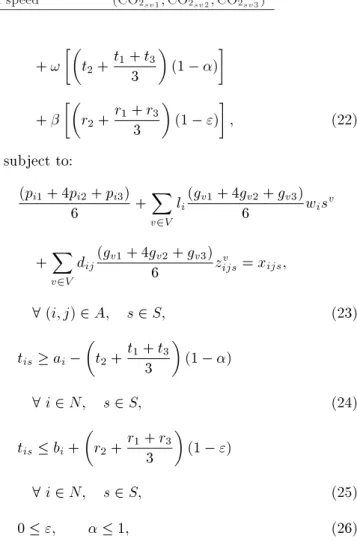
The rst two terms of objective function (20) are associated with CO2 emissions, which are crisped by
the average of CO2. The other terms calculate the total
penalty cost of possible violation of the soft constraints. The penalty costs are considered for violation of the time window via parameters ! and in the proposed model. Notice that and " are the satisfaction levels, and the model optimizes these variables.
6. Solution methodology
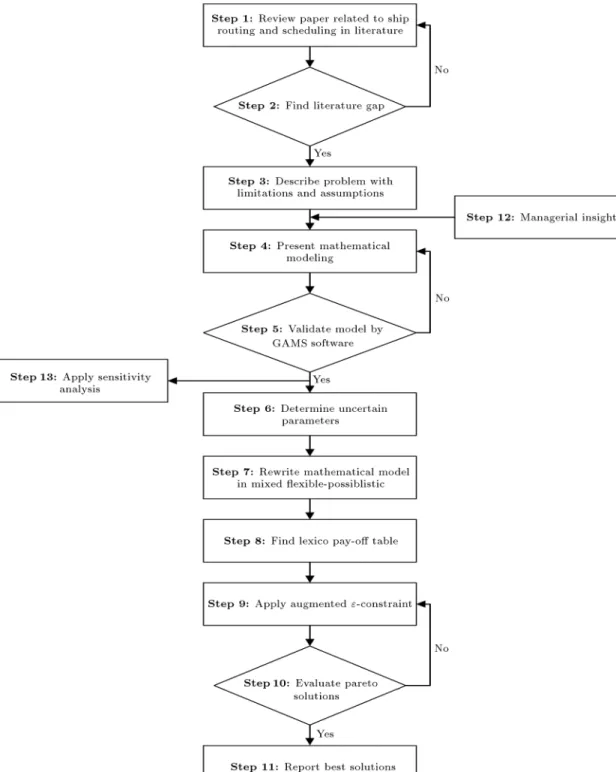
In this section, the methodology to solve the presented problem is demonstrated. Figure 4 describes this paper framework as a owchart. The proposed formulation contains three separate objective functions. We solve our formulation with these three objectives separately, and obtained results show the conict between ob-jectives, as described in Figures 5-7. Therefore, in this problem, there is no single optimal solution, and Pareto-optimal solutions (a set of ecient solutions)
Figure 4. Methodology of the paper to nd the best solutions.
must be explored in our Multi-Objective Problem (MOP). In popular methods, the Decision-Maker (DM) should determine the priority or weight of the objective functions before or after the solution process or inter-actively. It is important to choose a method capable of choosing ecient solutions rather than weak, inecient solutions [50].
One of the most widely used methods to achieve
ecient Pareto-optimal solutions in MOP is the "-constraint method. In the "-"-constraint method, DM should determine the most desirable Pareto solutions after the solution process (the posteriori method). Indeed, the Pareto-optimal solutions are determined by the "-constraint method with dierent " values on the Right-Hand Side (RHS) of the objective functions considered as additional constraints, until the DM is
Figure 5. Optimal solution by considering cost objective function.
Figure 6. Optimal solution by considering the social objective function.
Figure 7. Optimal solution by considering the environmental objective function.
satised (eective implementation of the "-constraint method in multi-objective mathematical programming problems). It is proved that the "-constraint method explores ecient solutions; however, it may also gener-ate infeasible solutions [51]. Therefore, the "-constraint method is extended by an improved version of the augmented e-constraint method (AUGMECON2) to determine the exact Pareto set in multi-objective integer programming problems. In Augmented "-constraint (AUGMECON) method, only the ecient solution is explored. To solve the ship-routing multi-objective optimization problem, a two-stage approach is proposed.
In the rst stage, the uncertainty of parameters in
the objective functions and constraints and exibility of the constraint are recognized, and the crisp equivalent counterpart of the model formulation is provided by the mixed exible-probabilistic approach, as mentioned earlier. In the second stage, lexicographic and aug-mented "-constraint methods are applied to explore ecient Pareto-optimal solutions.
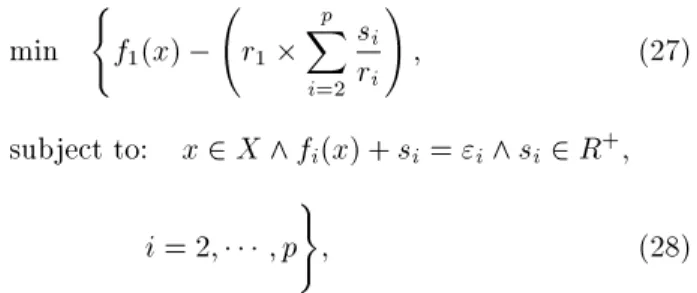
Consider the problem of minimizing P conicting objective functions. The AGMECON optimizes the main objective function (usually, the cost objective is considered as the main objective) through Eq. (27) sub-ject to other obsub-jectives constrained through Eq. (28) and feasible decision space.
min (
f1(x) r1 p
X
i=2
si
ri
!
; (27)
subject to: x 2 X ^ fi(x) + si= "i^ si2 R+;
i = 2; ; p )
; (28)
where f1(x) is the main objective, fi(x) is the ith
objective function, x denotes the decision variable, si
denotes the ith slack or surplus variable, and ri
repre-sents the range of the ith objective function calculated from the pay-o table. The pay-o table is a square table of p rows and columns to nd the positive ideal solutions of the objective functions (fP IS) and negative
ideal solutions of the objective functions (fNIS). Then,
the range of each objective is calculated simply by Eq. (29):
ri = fiNIS fiP IS: (29)
This study applies the lexicographic method as in Eqs. (30)-(38) to calculate fP IS and fNIS from the
pay-o table:
i Model (i = 1; 2; ; p) Optimum solution i = 1 minimization min Z1 _Z1; (30)
S.T. x 2 X; (31)
i = 2 maximization max Z2; (32)
S.T. x 2 X _Z2; (33)
Z1= _Z1; (34)
i = 3 minimization min Z3 _Z3; (35)
S.T. x 2 X; (36)
Z2= _Z2: (38)
Then, "-vector can be calculated via Eq. (39) with m grid points or (m 1) equal intervals.
"i= fiNIS
fNIS
i fiP IS
m
n = 0; 1; 2; ; m: (39) A high number of grid points generates solutions that are more ecient. The problem can be solved by dierent grid points to achieve more ecient solutions until the DM is satised. The proposed solution to the sustainable ship routing and scheduling problem is summarized as follows:
Step 1: Determine the uncertain parameters; Step 2: Convert the model into a mixed exible-probabilistic equivalent;
Step 3: Apply the lexicographic method to build the payo table;
Step 4: Calculate the range of each objective function according to the obtained payo table from Step 3 by Eq. (29);
Step 5: Construct the "-vectors according to the ranges obtained in Step 4 for each objective function; Step 6: Use the augmented "-constraint method to nd ecient solutions from the Pareto-optimal set. If the DM is satised with the acquired ecient solutions, then stop; otherwise, go to Step 5 to nd more ecient solutions.
7. Numerical results
In this section, the computational results of this paper are presented, in which the mathematical model is validated by applying several test problems, and the conict between the three objectives of the model is checked. Then, sensitivity analysis is applied to dier-ent values of decision-makers' satisfaction degrees on both parameters of the solution method and proposed crisp equivalent counterpart of the model.
7.1. Model validation
In order to validate the proposed mathematical model, several random small examples are solved with GAMS
software in a Core i5 ASUS laptop computer. Each objective is solved by GAMS software with model constraints separately to show the conict of objectives. A range of parameters with their common module used to solve sample problems are in Table 3. It should be noted that knots can be a common module for measuring the ship's speed (1 knots = 1.852 km/h). A uniform parameter is a number between its specic ranges with the same possibility for the occurrence of each number in the range. For example, it is common that ships can be available in small ship transportation Companies 1, 2 or 3. In addition, the fuel cost of traveling 1 km by a ship at a speed of 1.85 km/h is usually at least 130 and at most 170.
7.2. Objective conict
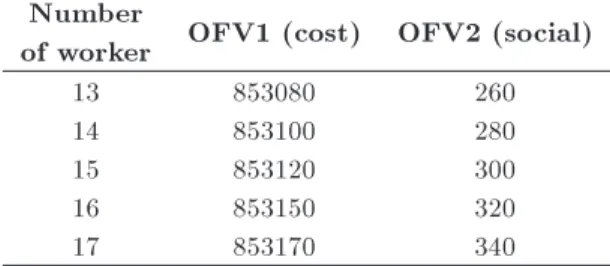
The proposed problem is dened by a multi-objective sustainable mathematical model. This model contains three dimensions of sustainability (i.e., economic, so-cial, and environmental). The rst objective is to minimize the cost of ship operation due to its optimal routing and scheduling. This objective contains ship fuel cost, ship travel taxes, cost of renting each ship, cost of hiring ship and port workers, and reward of transporting shipments. The second objective consid-ers the social aspect of sustainability by maximizing job creations. The number of workers in ports and ships is considered to be maximized in the social dimension. The third objective concerns the minimization of CO2
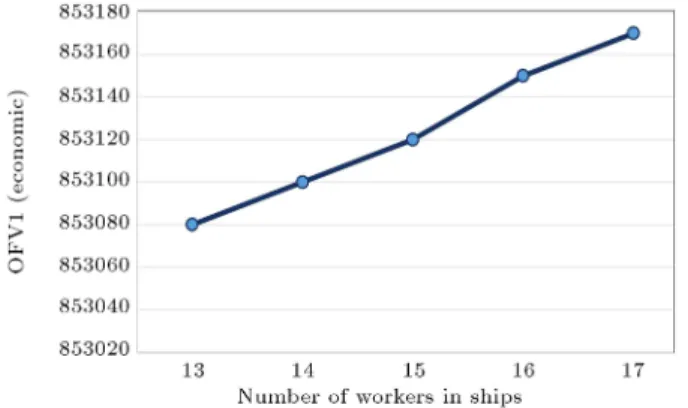
while considering penalty cost or transporting haz-ardous shipments such as gas, oil, etc. Table 4 shows the conict between cost and social objectives, since cost is a minimization objective and social dimension is a maximization one. It is demonstrated that, with an increase in unfavorable cost, job creation maximizes positively. Figures 5-7 show the optimum solution by
Table 4. Conict between cost and social objectives. Number
of worker OFV1 (cost) OFV2 (social)
13 853080 260
14 853100 280
15 853120 300
16 853150 320
17 853170 340
Table 3. Range of parameters value of sample problems.
Parameters Values Parameters Values
ns Uniform(1; 3) [ai; bi] (day) uniform[(0; 5); (10; 20)]
cv
s (dollar/km) Uniform(130; 170) Speeds (knots) Rnd(10,12,14,16)
gv (h/km) Uniform(0:1; 0:9) pi uniform(1; 3)
fis Binary wss uniform(12; 14)
bv
i (dollar) Uniform(4500; 7000) Ms (dollar) 30 per day
ev
is (dollar) 4500 per day CO2sv (g) uniform(10; 40)
considering the cost, social, and environmental objec-tive functions. According to these gures, dierent results have been obtained regarding dierent objective functions. Therefore, there is a conict between the three objective functions.
7.3. Sensitivity analysis
In this section, several test problems are solved with dierent values of the proposed parameters. Sensitivity analysis is applied to the parameters that aect the obtained routes and objective functions, signicantly. The model is solved with a dierent number of workers. Figures 8 and 9 show the eect of the number of workers on cost and social objectives, respectively. According to test problems, (as we could predict it before) by increasing the number of workers, the social objective will possessively increase and cost objective will increase adversely. It is shown that there is an evident conict between these objectives. As shown in Figure 10, the purpose of the paper is to nd solutions for creating a balance between cost and social objectives.
Each ship serves the shipments at dierent speeds. The shipments are transported at a higher speed in a shorter time; however, the amount of CO2
emis-sions increases. Since higher speeds consume more
Figure 8. Cost objective function versus the number of workers.
Figure 9. Social objective function versus the number of workers.
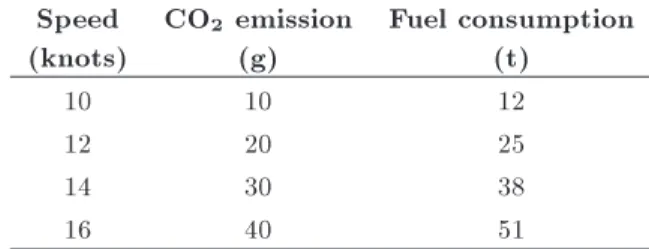
fuel, transportation with higher speeds is costlier (see Figure 11). Environmental objective function changes with an increase in CO2 emissions, as shown in
Fig-ure 12. Test problems are solved with the proposed solution method. Table 5 shows the pay-o table for the objective functions. Moreover, dierent
Pareto-Figure 10. Obtained Pareto solutions for the problem.
Figure 11. Cost and environmental objective functions versus the dierent speed.
Figure 12. Environmental objective function versus CO2
emissions.
Table 5. Payo table for three objectives of sample problems.
Z1 Z2 Z3
Min Z1 934000* 250 180
Max Z2 1660000 310* 155
Table 6. Value of dierent speed levels versus CO2
emission versus fuel consumption. Speed
(knots)
CO2 emission
(g)
Fuel consumption (t)
10 10 12
12 20 25
14 30 38
16 40 51
optimal solutions to the test problem are shown in Figure 10. Dierent values of speed, CO2emission, and
fuel consumption, which are used to solve test problems and our case-study problem, are shown in Table 6. 8. Case study
A company with some activities associated with mar-itime transportation has been selected as a real case study in this paper. This company is a large oil company located in Iran and has several departments in dierent elds related to the oil industry. Its logistic department regularly services some oil platforms that are located in the Persian Gulf. These services are provided with average twelve Anchor Handling Tug Supply (AHTS) ships, which are usually rented by the considered company. Although AHTS can travel with four dierent speed levels (10, 12, 14, and 16 knots),
ships of this company only travel with a minimum speed (10 knots). All ships are of the same kind and have a certain capacity. Moreover, this problem is a full-shipload shipping. There are ten major nodes for this company's shipping problem including ve oil platforms in the Persian Gulf; ve of Iran's ports are located in the south of Iran and one of United Arab Emirate major port is named Sharjah. A schematic view of these nodes along with their detailed names is shown in Figure 13 and Table 7.
The number of laborers working in each ship is between 12 and 14. All other related information used as inputs in this paper includes fuel cost of full and empty ships, transit time, distance between nodes, and ships' technical specications such as variable speeds and CO2emission used from case study database.
8.1. Case study computational result
In this section, the performance of AUGMENTED epsilon constraint method is evaluated by the proposed ship routing and scheduling model. The problem of a maritime transportation company is modeled to show the applicability of the proposed model in real situations.
To solve the proposed model, real data from the stated company are used; 5 oil platforms, 5 ports, and 12 ships with four-speed levels (10, 12, 14, and 16 knots) are considered. Each port has a time
Table 7. Case study nodes' names.
Ports number Name Platforms number Name
1 Kish Island, Iran 6 Oil platform A
2 Bandar Charak, Iran 7 Oil platform B
3 Bandar Lengeh, Iran 8 Oil platform C
4 Qeshm Island, Iran 9 Oil platform D
5 Sharjah, United Arab Emirates 10 Oil platform F Table 8. Results of the case study.
Ship
number Route
Served ports
Travel time
CO2
emission
S1 2!10!8!1 10-8 33 396
S2 1!7!9!2 7-9 34 408
S3 2!9!7!3 2-9-7 34 408
S4 2!10!3 2-10 30 360
S5 5!3 9 12 144
S6 5!6!8!7!4 8-7 39 468
S7 1!2!9!6!3 2-9-6 38 456
S8 5!8!4 8 49 588
S9 4!8!5 8 53 636
S10 1!9!2!7!3 9-2-7 33 396
S11 5!2 7 14 168
S12 4!5 8 28 336
window in which the shipment should start being loaded. Sustainable problem considers three objectives simultaneously. The problem is aimed at minimizing total costs, maximizing the social eect by maximiz-ing job opportunity, minimizmaximiz-ing total environmental damages caused by CO2 emissions from ships, and
decreasing utility of serving hazardous materials such as oil and gas. Uncertainty is considered for some of the model's parameters in order to deal with the lack of data and changing of some parameters in dierent time periods. The mixed exible-probabilistic method is used to convert the model with uncertain parameters to its crisp equivalent. The mathematical model is solved by the augmented epsilon constraint method. Results of ships routing and scheduling are shown in Table 8. Numbers 1 to 12 are assigned to each ship with its name; time windows show the start time of ships' travels (time unit is the day); routes in each time window are available in Table 8. The longest ship travel ends by 3 routes at 31 days.
8.2. Managerial insights into the case study In this section, the proposed mathematical model is extended in order to achieve managerial insights. Ac-cordingly, nsis considered as a variable that determines
the number of ships. Notably, in the stated case, there are a predetermined number of ships. However, this model suggests that the stated company hire the optimum number of ships. In the following model, we are going to determine the optimum number of available ships:
min X
s2S
X
v2V
hv
sns; (40)
max X
s2S
ns; (41)
min X
s2S
X
v2V
CO2svns; (42)
Subject to: min
s ns maxs 8 v 2 V; s 2 S; (43)
ns;v 0; integer 8 v 2 V; s 2 S; (44)
where mins is the minimum number of ships whose
decision-maker thinks are necessary (can be zero), maxs is the maximum number of ships which the
company can aord to rent each year due to company capital, and hv
s indicates the hiring cost of ship s
with speed v. The rst objective minimizes the hiring cost of ships, and the second objective maximizes the number of available ships (it maximizes the social eect by hiring more workers). The third objective minimizes the total CO2produced by ships. Results of
resolving the model by adding the objectives to their corresponding, i.e., Eqs. (1)-(3) and Eqs. (43) and (44), are shown in Table 9. It is important to note that these equations, which are constant, are added to the rst model; hence, we did not consider them in the model. 9. Conclusion
In this study, a fuzzy multi-objective ship routing and scheduling problem was presented to satisfy three sustainable objectives. The proposed problem was aimed at nding the best route and schedule for each ship while minimizing cost and CO2 emission and
Table 9. Dierent results by considering the number of ships as a parameter and the number of ships as a variable.
Pareto iteration
Number of ships as a parameter
Number of ships as variable
n OFV1 OFV2 n OFV1 OFV2
1 12 35660 1782 13 38743 2234 2 12 34454 1824 13 38743 2104 3 12 50675 1657 13 38743 2253 4 12 29875 1755 12 35730 1845 5 12 38368 1647 12 35746 1832 6 12 32567 1501 12 43854 1794 7 12 53435 1657 12 34616 1573 8 12 49278 1747 12 36748 2623 9 12 45473 1583 12 48842 3375 10 12 43536 1784 13 37845 1753 11 12 32478 1582 13 38654 1738 12 12 31245 1584 13 46776 1843
speed levels were considered to nd the optimal speed for each ship considering the correlation of speed with ship's emission and fuel consumption. Uncertainty was added to the model by converting it to the mixed exible-probabilistic robust programming. Several test problems were conducted in order to validate the mathematical model by GAMS software, and eects of dierent parameters on objectives were evaluated by applying sensitivity analysis. The augmented "-constraint was used as a solution methodology to solve the proposed problem. In addition, real input data were considered from a case study to solve the model in large-sized problems. The proposed mathematical model was extended to achieve the optimal number of ships and an optimum speed for each ships. Computa-tional results showed the considerable positive inuence (about 13%) of this study's contributions. Maritime transportation managers and decision-makers can use the numerical results, sensitivity analyses, and manage-rial insights in their decisions obtained in this paper. Moreover, considering dierent kinds of maritime risk in routes and considering variable speeds in the contin-uous form is a possible extent to this paper.
References
1. Agarwal, R. and Ergun, O. \Ship scheduling and network design for cargo routing in liner shipping", Transportation Science, 42(2), pp. 175-196 (2008).
2. UNCTAD. \Review of maritime transport", United Nations Conference on Trade and Development, New York and Geneva, United Nation (2013).
3. Lawrence, S.A., International Sea Transport: The Years Ahead, Lexington Books (1972).
4. Christiansen, M. and Nygreen, B. \Robust inventory
ship routing by column generation", In Column Gen-eration, pp. 197-224. Springer, Boston, MA (2005).
5. Buhaug, ., Corbett, J.J., Endresen, ., Eyring, V., Faber, J., Hanayama, S., Lee, D.S., et al. \Second imo ghg study", International Maritime Organization (IMO), London, UK 24 (2009).
6. Ryder, S.C. and Chappel, D., Optimal Speed and Ship Size for the Liner Trades, University of Liverpool, Marine Transport Centre (1979).
7. Ronen, D. \The eect of oil price on the optimal speed of ships", Journal of the Operational Research Society, 33(11), pp. 1035-1040 (1982).
8. Wen, M., Ropke, S., Petersen, H.L., Larsen, R., and Madsen, O.B. \Full-shipload tramp ship routing and scheduling with variable speeds", Computers & Operations Research, 70, pp. 1-8 (2017).
9. De, A., Mamanduru, V.K.R., Gunasekaran, A., Sub-ramanian, N., and Tiwari, M.K. \Composite particle algorithm for sustainable integrated dynamic ship routing and scheduling optimization", Computers & Industrial Engineering, 96, pp. 201-215 (2016).
10. Jansen, L. \The challenge of sustainable develop-ment", Journal of Cleaner Production, 11(3), pp. 231-245 (2003).
11. Vachon, S. and Mao, Z. \Linking supply chain strength to sustainable development: a country-level analysis", Journal of Cleaner Production, 16(15), pp. 1552-1560 (2008).
12. Cucek, L., Klemes, J.J., and Kravanja, Z. \A review
of footprint analysis tools for monitoring impacts on sustainability", Journal of Cleaner Production, 34, pp. 9-20 (2012).
13. Ronen, D. \Cargo ships routing and scheduling: Sur-vey of models and problems", European Journal of Operational Research, 12(2), pp. 119-126 (1999).
14. Ronen, D. \Marine inventory routing: Shipments plan-ning", Journal of the Operational Research Society, 53(1), pp. 108-114 (2002).
15. Psaraftis, H.N. \Ship routing and scheduling: the cart before the horse conjecture", Maritime Economics & Logistics, 21(1), pp. 1-14 (2017).
16. Brnmo, G., Christiansen, M., and Nygreen, B. \Ship routing and scheduling with exible cargo sizes", Jour-nal of the OperatioJour-nal Research Society, 58(9), pp. 1167-1177 (2007).
17. Christiansen, M. \Decomposition of a combined in-ventory and time constrained ship routing problem", Transportation Science, 33(1), pp. 3-16 (1999).
18. Ting, S.C. and Tzeng, G.H. \Ship scheduling and cost analysis for route planning in liner shipping", Maritime Economics & Logistics, 5(4), pp. 378-392 (2003).
19. Bendall, H.B. and Stent, A.F. \A scheduling model for a high speed containership service: A hub and spoke short-sea application", International Journal of Maritime Economics, 3(3), pp. 262-277 (2001).
20. Azaron, A. and Kianfar, F. \Dynamic shortest path in stochastic dynamic networks: Ship routing problem", European Journal of Operational Research, 144(1), pp. 138-156 (2003).
21. Hwang, S.J. \Inventory constrained maritime routing and scheduling for multi-commodity liquid bulk", PhD dissertation, Georgia Institute of Technology (2005).
22. Korsvik, J.E., Kjetil Fagerholt, K., and Laporte, G. \A large neighbourhood search heuristic for ship routing and scheduling with split loads", Computers & Operations Research, 38(2), pp. 474-483 (2011).
23. Fagerholt, K., Christiansen, M., Hvattum, L.M., Johnsen, T.A., and Vab., T.J. \A decision support methodology for strategic planning in maritime trans-portation", Omega, 38(6), pp. 465-474 (2010a).
24. Stalhane, M., Andersson, H., Christiansen, M., Cordeau, J.F., and Desaulniers, G. \A branch-price-and-cut method for a ship routing and scheduling problem with split loads", Computers & Operations Research, 39(12), pp. 3361-3375 (2012).
25. Agra, A., Christiansen, M., and Delgado, A. \Mixed integer formulations for a short sea fuel oil distribution problem", Transportation Science, 47(1), pp. 108-124 (2013).
26. Moon, I.K., Qiu, Z.B. and Wang, J.H. \A combined tramp ship routing, eet deployment, and network design problem", Maritime Policy & Management, 42(1), pp. 68-91 (2015).
27. Corbett, J.J. and Koehler, H.W. \Updated emissions from ocean shipping", Journal of Geophysical Re-search: Atmospheres., 108(D20) (2003).
28. Corbett, J.J., Haifeng Wang, and Winebrake, J.J. \The eectiveness and costs of speed reductions on emissions from international shipping", Transportation Research Part D: Transport and Environment, 14(8), pp.593-598 (2009).
29. Ronen, D. \The eect of oil price on containership speed and eet size", Journal of the Operational Research Society, 62(1), pp. 211-216 (2011).
30. Eyring, V., Kohler, H.W., Van Aardenne, J., and Lauer, A. \Emissions from international shipping: 1. The last 50 years", Journal of Geophysical Research: Atmospheres, 110, D17 (2005).
31. Endresen, ., Srgard, E., Behrens, H.L., Brett, P.O., and Isaksen, I.S. \A historical reconstruction of ships' fuel consumption and emissions", Journal of Geophysical Research: Atmospheres, 112, D12 (2007).
32. Yin, J., Fan, L. Yang, Z., and Li, K.X. \Slow steaming of liner trade: its economic and environmental im-pacts", Maritime Policy & Management, 41(2), pp. 149-158 (2014).
33. McKinnon, A. \The possible inuence of the shipper on carbon emissions from deep-sea container supply chains: An empirical analysis", Maritime Economics & Logistics, 16(1), pp. 1-19 (2014).
34. Norstad, I., Fagerholt, K., and Laporte, G. \Tramp ship routing and scheduling with speed optimization", Transportation Research Part C: Emerging Technolo-gies, 19(5), pp. 853-865 (2011).
35. Gatica, R.A. and Miranda, P.A. \Special issue on Latin-american research: a time based discretization approach for ship routing and scheduling with variable speed", Networks and Spatial Economics, 11(3), pp. 465-485 (2011).
36. Wang, S. and Meng, Q. \Sailing speed optimization for container ships in a liner shipping network", Trans-portation Research Part E: Logistics and Transporta-tion Review, 48(3), pp. 701-714 (2012).
37. Psaraftis, H.N. and Christos A. Kontovas \Ship speed optimization: Concepts, models and combined speed-routing scenarios", Transportation Research Part C: Emerging Technologies, 44, pp. 52-69 (2014).
38. Andersson, H., Fagerholt, K., and Hobbesland, K. \Integrated maritime eet deployment and speed opti-mization: Case study from RoRo shipping", Comput-ers & Operations Research, 55(5), pp. 233-240 (2015).
39. Dubois, D., Fargier, H., and Fortemps, Ph. \Fuzzy scheduling: Modelling exible constraints vs. coping with incomplete knowledge", European Journal of Operational Research, 147(2), pp. 231-252 (2003).
40. Bellman, R.E. and Zadeh, L.A. \Decision-making in a fuzzy environment", Management Science, 17(4), B-141 (1970).
41. Mula, J., Poler, R., and Garcia, J.P. \MRP with ex-ible constraints: A fuzzy mathematical programming approach", Fuzzy Sets and Systems, 157(1), pp. 74-97 (2007).
42. Pishvaee, M.S. and Torabi, S.A. \A possibilistic programming approach for closed-loop supply chain network design under uncertainty", Fuzzy sets and Systems, 161(20), pp. 2668-2683 (2010).
43. Celik, M., Cebi, S., Kahraman, C., and Er, I.D. \Ap-plication of axiomatic design and TOPSIS methodolo-gies under fuzzy environment for proposing competi-tive strategies on Turkish container ports in maritime transportation network", Expert Systems with Appli-cations, 36(3), pp. 4541-4557 (2009).
44. Christiansen, M. and Fagerholt, K. \Robust ship scheduling with multiple time windows", Naval Re-search Logistics (NRL), 49(6), pp. 611-625 (2002).
45. Christiansen, M., Fagerholt, K., and Ronen, D. \Ship routing and scheduling: Status and perspectives", Transportation Science, 38(1), pp. 1-18 (2004).
46. Pishvaee, M.S. and Fazli Khalaf, M.R. \Novel robust fuzzy mathematical programming methods", Applied Mathematical Modelling, 40(1), pp. 407-418 (2016).
47. Chuang, T.N., Lin, C.T., Kung, J.Y., and Lin, M.D. \Planning the route of container ships: A fuzzy genetic approach", Expert Systems with Applications, 37(4), pp. 2948-2956 (2010).
48. Fagerholt, Kjetil, Laporte, G., and Inge Norstad \Re-ducing fuel emissions by optimizing speed on shipping routes", Journal of the Operational Research Society, 61(3), pp. 523-529 (2010).
49. Pishvaee, M.S., Razmi, J., and Torabi, S.A. \Robust possibilistic programming for socially responsible sup-ply chain network design: A new approach", Fuzzy Sets and Systems, 206, pp. 1-20 (2012).
50. Greco, S., Figueira, J., and Ehrgott, M., Multiple Criteria Decision Analysis, Springer's International Series (2005).
51. Mavrotas, G. \Eective implementation of the "-constraint method in multi-objective mathematical programming problems", Applied mathematics and Computation, 213(2), pp. 455-465 (2009).
Biographies
Masoud Rabbani is a Professor of Industrial En-gineering in the School of Industrial and Systems Engineering at University of Tehran. He has pub-lished more than 80 papers in international journals, such as European Journal of Operational Research, International Journal of Production Research, and International Journal of Production Economics, among others. His research interests include production-planning, design of inventory management systems, applied graph theory in industrial planning, and pro-ductivity management.
Shohre Sadeghsa nished her Pre-university educa-tion in 11 years; then, she nished her Bachelor of Science in Industrial Engineering from University of Tehran, Iran in 2016. She continued her Master's stud-ies at University of Tehran in Optimization eld. She joined the double degree program between University of Tehran, Iran and Ecole Nationale Superieure d'Arts et
Metiersm, France for the rest of her Master's studies. She has worked on nearly 10 conference and journal papers in her rst year of Master's studies. She joined as a Research Assistant to Professor Iranmanesh's research team who is a Professor of the School of Industrial Engineering at University of Tehran. Her interests include blood and pharmacy supply chain, quality management, transportation (maritime trans-portation and public transtrans-portation), resiliency, and optimization algorithms.
Maliheh Vaez Alaei nished her Bachelor of Science in Industrial Engineering from Azad University South Tehran Branch, Iran in 2014. She is continuing her Master's studies at University of Tehran in Optimiza-tion eld, Iran 2016-2017. She joined the double-degree program between University of Tehran, Iran and Ecole Nationale Superieure d'Arts et Metiersm, France for the rest of her Master's studies. She has worked on nearly 6 conference and journal papers in her rst year of Master's studies. Her interests include maritime transportation, routing and scheduling, sustainability, resiliency, and optimization algorithms.
Hamed Farrokhi-Asl nished his Bachelor of Science in Industrial Engineering from University of Khaje-Nasir University of Technology, Iran in 2013. He continued his Master's studies at University of Tehran and graduated in 2014. He has published nearly 60 conference and journal papers. He joined as a Research Assistant to Professor Rabbani's research team who is a Professor of the School of Industrial Engineering at University of Tehran. He started his PhD at Iran University of Science & Technology and has recently started working on a new nature-inspired algorithm. His interests include waste management, green supply chain, and optimization algorithms.