2009. 40 Pages. Advisor: Phillip M. Edwards.
This study examines, from the perspective of writing center staff, the perceptions of current levels of collaboration between academic libraries and campus writing centers and the Triangle Research Libraries Network institutions. Paper surveys were distributed to the staff members at the Writing Center at University of North Carolina at Chapel Hill, the Writing Center at North Carolina Central University, Writing and Speaking Tutorial Services at North Carolina State University, and the Writing Studio at Duke University. The surveys were designed to elicit responses from the writing center employees about their perceptions of the current level of collaboration with academic libraries and recommendations for future collaboration.
Headings:
Academic Libraries Writing Centers Collaboration
by
Katherine Mary Jelen
A Master’s paper submitted to the faculty of the School of Information and Library Science of the University of North Carolina at Chapel Hill
in partial fulfillment of the requirements for the degree of Master of Science in
Library Science.
Chapel Hill, North Carolina April 2009
Approved by
Table of Contents
Introduction ... 2
Triangle Research Libraries Network ... 3
Writing Centers ... 5
Literature Review ... 9
Linking Websites ... 9
Library Instruction ... 10
Changing Locations ... 12
Methodology ... 16
Results ... 18
Table 1: Communication with other writing centers ... 18
Table 2: Communication with libraries ... 19
Table 3: Services offered ... 20
Table 4: Collaboration ... 20
Table 5: Referrals ... 22
Table 6: Library Referrals ... 23
Table 7: Instruction Sessions ... 24
Table 8: Perceptions ... 25
Conclusion ... 27
Current Perceptions: Libraries and Writing Centers ... 27
Role of Libraries ... 28
Bibliography ... 31
Appendix A: Cover Letter Sent With Survey ... 37
Introduction
Writing centers and academic libraries both have a shared goal of assisting students on college campuses. Writing centers and academic libraries, among other goals, both seek to help students who are writing research papers: libraries seek to assist with research and connect patrons with information while writing centers seek to help students with the actual writing of the paper. Though libraries and writing centers have many similar goals, each unit offers very specific services for students. Writing centers focus on helping with style, organization, and syntax; whereas libraries are more helpful in helping students find reliable sources and cite sources correctly. Libraries and writing centers also are both physical places where students can go, yet must increasingly help students by offering online access to helpful resources and web tutorials. Both libraries and writing centers also face similar challenges in advertising their resources,
encouraging students to use their services, and promoting themselves as an important institution on campus. Libraries and writing centers have a great deal in common, so it is in the best interest of both places to collaborate with each other and work towards their shared goals of helping students.
Although these two campus entities have a great deal in common, there does not seem to be a consistent approach on college campuses for how these two units collaborate with one another. Many schools have used different methods of encouraging
centers and libraries, it appears in the best interest of both entities and students that there is some level of collaboration.
This study looks specifically at the ways the writing centers and libraries at the four universities in the Triangle Research Libraries Network (“TRLN”) collaborate with one another. This study seeks to examine the perceptions that writing center employees have about current levels of cooperation with the library, and to show the ways that libraries and writing centers can collaborate. Paper surveys were distributed to
employees of the four writing centers at the TRLN institutions in order to determine what level of collaboration there currently exists between TRLN libraries and the writing centers on their respective campuses.
The four universities in the Triangle Research Libraries Network were chosen because of their close proximity to each other and because the libraries in the area already seem to be interested in collaboration since they do operate in a consortium with each other. The Research Triangle is well-known for being an area with immense educational resources available in a fairly small geographic area. This study examines the four universities in the area, in order to study the ways that writing centers and libraries currently collaborate, and to offer suggestions on how they might strengthen cooperation and increase collaboration in the future. It will benefit the staff members at the writing centers and libraries to collaborate with one another, and that in return will help students who may need help with both research and composition when writing a research paper.
Triangle Research Libraries Network
Central University and Duke University are both located in Durham, NC. North Carolina State University is in Raleigh, NC, and the University of North Carolina at Chapel Hill is located in Chapel Hill, NC. All of these schools are located within 25 miles of each other in the Piedmont region of North Carolina. The close proximity of the four universities led to cooperation between Duke and UNC since 1930s, with NC State joining in the 1950s, and NC Central joining TRLN in 1995 (“TRLN Bibliography”).
According to the TRLN website, the goals of the consortium are to “leverage resources” and:
To extend the scope of information resources and services available to our users through libraries and campus networks. To create new library and information services.
To make information accessible to users among member institutions in a convenient, timely, and equitable manner. To develop and pursue strategic partnerships that enhance our
ability to deliver information and services.
To provide a forum for discussion of cooperative library and information issues.
To seek external funding in support of these goals.
To maintain a leadership role among universities in the provision of collaborative research library services.
(“TRLN Fact Sheet”)
TRLN has far reaching goals that seek to make the libraries in the TRLN a leading consortium with diverse resources. The last goal is about becoming leaders among other universities, but it also important for these libraries to become leaders on their own campuses. One way they could address that goal is by collaborating with other places on campus, such as writing centers.
Search TRLN serves as a one stop place to search across all of the TRLN libraries, which is helpful considering that “71 percent of the titles were unique to a single TRLN
institution, and only 2 percent of collections are duplicated on all four campuses” (“TRLN Launches”). The collection is huge, but the true benefit is the collaboration between the libraries. The Search TRLN interface makes it easy to see what items are available in the area, and it is easy to have those resources delivered to whichever campus the patron chooses. Getting a journal article or monograph from another institution is easier than ever, thus making the resources at all four campuses readily available to any library patrons at those units
Writing Centers
The University of North Carolina at Chapel Hill has The Writing Center which is housed in Suite 0127 of the Student and Academic Services Building. The location is a different part of campus from Davis Library and House Undergraduate Library. The Writing Center is located in a spacious, welcoming environment. There is a kiosk right by the door where someone greets students who walk in. There are work tables and computers. There are also offices for the writing staff to use during consultations. The Writing Center has four full-time staff members, and 16 graduate assistant tutors. The Writing Center at UNC is somewhat unique in who it offers services to because of the way it is funded. According to The Writing Center’s website:
It is funded directly by the College (of Arts and Sciences), rather than by student fees. Its first priority is service to undergraduate students; its second priority is service to the College. The Writing Center's long-term goal is to serve the entire university and engage in community outreach. (“About the Writing Center”)
The funding situation can lead to confusion about services offered by The Writing Center. The website says that all undergraduate students can receive 50 minute face to face consultations. Then graduate students and faculty in the College of Arts and
for appointments has run high, and we have turned people away many hundreds of times each year” (“About the Writing Center”).
North Carolina Central University has a writing center located on the third floor of the Farrison-Newton Communications Building. The Writing Center is located in a medium sized room. There are computers and tables. There is a desk where the staff sits when not helping students, and greets people who enter the center. The center opened in September of 2002, and “is funded with a Title III federal grant, a funding program that assists HBCU and other minority colleges and universities” (Smith). The writing center has a staff of six, but does not appear to be understaffed. The website encourages anyone affiliated with North Carolina Central University to visit the writing center. They can schedule standing appointments, so that a student can come in the same time every week for the whole semester. They will also look at any work, not just those for class
assignments. The website encourages students to come in to discuss, “business letters, applications for law school and medical school, and many other higher-level documents” (“FAQs”).
The Undergraduate Tutorial Center at North Carolina State University runs Writing and Speaking Tutorial Services for all undergraduates. The main location for the Writing and Speaking Tutorial Services is in Ricks Hall, a few blocks down from D.H. Hill Library. There are also drop-in locations at three other areas on campus: Avent Ferry Computer Lab, First Year College Commons, and Lee Hall Classroom. The mission of Writing and Speaking Tutorial Services is, “to support NC State
writing papers, but they can also receive help for upcoming presentations or interviews. The tutors are all students at the university, and they must take a semester long class called Introduction to College Tutoring their first semester working for the
Undergraduate Tutorial Center. There are nine staff members: one full-time staff member, six undergraduates, and two graduate students. They are only able to help undergraduates since they are a part of the Undergraduate Tutorial Center. They have also recently started online consultations to help students who are distance education learners.
Literature Review
The literature on this subject suggests that there are numerous ways in which libraries can collaborate with writing centers. There are differing models that have proven effective in strengthening cooperation between writing centers and libraries. Academic libraries and campus writing centers often benefit from shared space or being located very close to each other. Writing centers can also benefit from a librarian visiting the writing center in order to assist the staff, or having hours in the library.
Linking Websites
One of the most simple collaborations is linking to the library’s website from the writing centers website. In 2008, Jennifer H. Solomon performed a study examining the websites of the 111 libraries in the Association of Research Libraries and the writing centers at their campuses. She found that:
52 (47%) writing centers linked to the institutional library and 60 (54%) libraries linked to institutional writing centers. An additional 15 (13.5%) writing centers also made reference to the library on the website, but did not include direct links. Twenty-three (20%) writing centers were collocated with libraries, 3 (0.27%) provided joint workshops with the library, 35 (31.5%) provided links to specific library resources, and 12 (10.8%) provided descriptions or annotations for the resources they linked to on the library’s website.
(Solomon 17)
a majority when it came to simple collaboration such as linking to the library’s website from the writing center website.
Library Instruction
Katherine Furlong was head of the Mantor Library at the University of Maine at Farmington and Andrew Crawford was a teaching assistant in the library when they started a partnership with the writing center on campus. The library teaching assistant held workshops throughout the semester that were solely for the tutors employed by the nearby writing center. The tutors were paid for the time spent in the workshop, which increased the attendance. The purpose of the workshops was to show the tutors how to “maximize available resources in a minimal amount of time” (Furlong 24). Colloquially, the workshops were called “How to Bail Someone Out in an Hour” (24). The library staff was looking to start a similar partnership with the Placement Center in hopes of helping the staff there use library resources to assist students with job searches. The writing center staff appreciated the help offered by the library, and responded very positively to the workshops. The writing center staff discovered resources they
previously did not know about, but were likely to use in the future when helping a student with a paper. It also helped to foster camaraderie between the writing center staff and library staff. It also gave the library graduate assistants who led the workshops valuable instruction experience.
write papers. A study at the University of Georgia studied the citations included in freshmen’s papers if they had been to a library instruction session and how those sources compared to the references used by students who did not receive any library instruction. They found that students who were comfortable using library resources for first year composition assignments were likely to keep using the library throughout their undergraduate careers. The students who had received library instruction were more likely to find reliable resources, and seemed more likely to use the library for all of their assignments. This shows that collaboration between writing programs and libraries can have very beneficial results for students:
This collaboration between two units deeply involved with issues of student research and writing suggests that the faculty, as a whole, need to engage in a dialogue not only about how best to introduce research in first-year composition but also about how to extend and develop students' understanding of research across the undergraduate curriculum. (Barratt 55)
The study at UGA shows the commonality of the goals of libraries and composition instructors, asking, “How can we help students to use more and better sources in their research papers in order to improve the quality of their written compositions? This question continues to plague both college composition instructors and the librarians who work with them” (Barrat 37). While this study did not look at the writing center, it did focus on the shared goals of libraries and everyone who assists students with college level writing.
resources about citations is not going to help students who have no idea how to work research into a paper and do not see the need to cite anything:
Ideally, students would enter a library workshop with basic composition skills; in reality, this is not always the case. …However, as the skills that library workshops address overlap with those of English composition, it becomes necessary for librarians to either work in cooperation with composition instructors, or tailor their workshops to include some degree of composition instruction.
(Bronshteyn 534)
This article also points out the importance of librarians in the Writing Across the Curriculum movement: “Many colleges and universities are promoting informational literacy as an educational objective across the entire curriculum, not just for English composition” (535) and librarians are a huge part of that because “Writing is the most definitive way to communicate ideas, and librarians are information providers,
information organizers, and information enthusiasts” (535).
Changing Locations
to offer suggestions to aid them in their own personal research, and remained a good reference contact for writing center staff even after she moved back to the library full time. While looking at usage statistics, it did not seem to be a very successful program, but overall it was successful in getting the library staff to realize what was going on at the writing center and for the writing center staff to see what resources the library has to offer and to build contacts between the departments.
The writing center staff member who was sent to the library received more traffic due to the fact that she was in the library in the evenings when the writing center was closed. Students were likely to casually ask questions, not feeling intimidated by any appointment policies that the writing center might have. Students seemingly did not go to the library specifically to speak with the writing center employee, but seemed to just stop by to ask for help since they were already in the library. Both of these programs were helpful in creating “relationships built between the librarian and writing center staff” (177). The writing center staff members liked knowing that librarians were available for questions, and were more likely to seek help from a librarian when they were unsure about something. The library staff also liked knowing what goes on in the writing center, and the unique questions that students ask writing center employees.
While much of the literature on this subject discusses bringing writing center employees into libraries, there is a portion of the literature about satellite areas for
experiment, 205 questions were asked at the reference outpost, with 82% being
directional. While the number of actual reference questions asked was not exceptionally high, the program was helpful in other ways. The main benefit was that “At the outpost facility, the librarians were in a strategic position to have direct contact with students and
communicate to them how libraries could help them achieve their academic goals. The
facility provided a good opportunity for librarians to analyze and evaluate the behavior
and expectations of students with regard to the services of the library” (Kuchi 317).
One of the most ambitious collaborations between libraries and writing centers took place at the University of Louisville in 2000. Hannelore B. Rader discusses in a conference paper and an article that library’s efforts to form partnerships to keep the library relevant and helpful in the twenty first century. The library staff ambitiously sought to form partnerships with individual departments, the hospital, student
for showing what the ultimate collaboration look likes. The program has been successful, with the writing center still located inside Eckstrom Library (“University of Louisville”).
Although it seems like collocation will lead to a lot of collaboration, there have been cases where it is not a good situation. Joan Lippincott notes in “New Library Facilities: Opportunities for Collaboration” that there have been instances where having
the writing center located in the library has led to, “a laissez-faire relationship with the
occupant but, in other cases, there may be tension over the other unit’s occupation of the
library’s space. These kinds ofrelationships are not collaborations” (Lippincott 148). In
“The Disappearing Writing Center Within the Disappearing Academy,” Christina
Murphy and Joe Law stress that writing centers cannot afford to be complacent about
relationships with other department on campus, but must seek to find partners:
“Alliances, however, are chosen and designed by the parties involved who seek mutual
Methodology
This study seeks to examine the ways in which libraries in the Triangle Research Libraries Network currently cooperate with writing centers at their respective institutions, paying particular attention to employees at writing centers and their opinions about library resources, services, and roles. For this study, collaboration means any
communication between the writing centers and libraries such as, discussions or e mails between the library staff and writing centers, linking to each other from their respective websites, or actively referring students to one another.
The four directors of the writing centers being studied were contacted over e mail. They all agreed to distribute the survey amongst the employees who work in the writing center. The survey was given out to determine the current level of cooperation between campus writing centers and academic libraries, while also gauging whether or not the staff would like to see more cooperation. The survey was designed to see how often staff members refer a student to the library, how often they use library resources when
assisting a student, and if they are in contact with anyone in the library, and if they would attend workshops for writing center staff taught by librarians.
Results
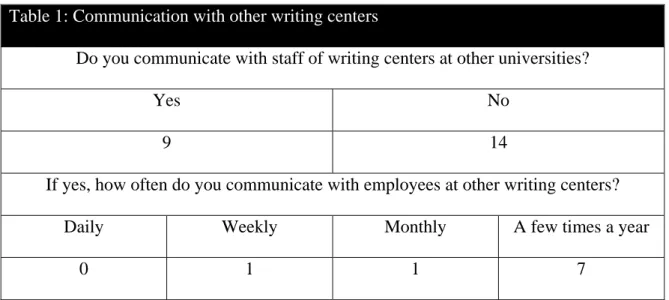
The survey was designed to elicit responses from writing center employees about the ways they view their relationship to the library staff, their role within the university, and current level of collaboration with the library and other writing centers. The first question of the survey was intended to gauge whether or not staff members at writing centers collaborate with other writing centers the way that the TRLN libraries collaborate with each other. When asked “Do you communicate with staff of writing centers at other universities?” nine participants responded yes, and seven of them said they communicate with the staff at other writing centers “a few times a year.” One person answered
“monthly,” and one person answered “weekly.” Fourteen people said they do not communicate with staff members at other writing centers.
Table 1: Communication with other writing centers
Do you communicate with staff of writing centers at other universities?
Yes No 9 14 If yes, how often do you communicate with employees at other writing centers?
Daily Weekly Monthly A few times a year
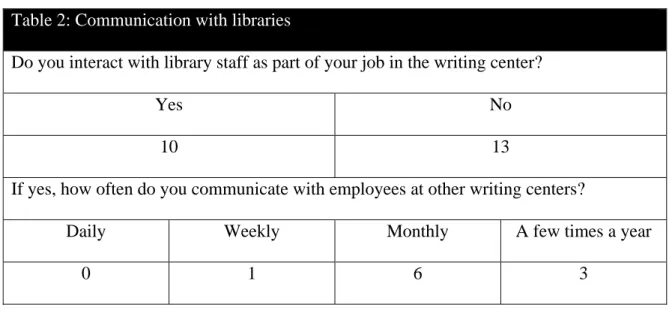
The next question asked how often they directly interact with library staff as part of their job at the writing center. Ten out of twenty-three of the respondents said they do currently communicate with library staff, with six of those ten saying that they
communicate with library staff “monthly,” one saying “weekly,” and three saying they communicate “a few times a year.”
Table 2: Communication with libraries
Do you interact with library staff as part of your job in the writing center?
Yes No 10 13 If yes, how often do you communicate with employees at other writing centers?
Daily Weekly Monthly A few times a year
0 1 6 3
The next question sought to find out if the staff of the writing centers feels they play a similar role in helping patrons who are writing research papers. The question asked, “In terms of assisting students with research papers, how similar do you think the services offered by the writing center are to the services offered by the library?”
Table 3: Services offered
In terms of assisting students with research papers, how similar do you think the services offered by the writing center are to the services offered by the library?
Very Similar Somewhat Similar
Neutral Somewhat Different
Very Different
0 2 1 12 8
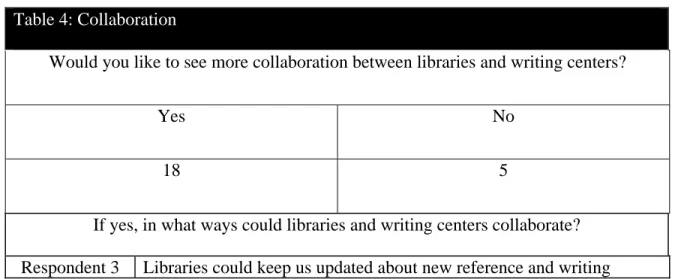
When asked outright if they “Would like to see more collaboration between libraries and writing centers” eighteen said yes, while five said no. The ones who answered yes were asked for their suggestions as to ways the two places could
collaborate. Three responses directly mentioned help with managing citations, which definitely seems to be an important to both writing tutors and librarians. Although few respondents saw similarities between services offered by the writing center and library in an earlier question, for this question they did refer to some commonalities. One
respondent talked about the, “inter-related processes” that go students through when writing a paper, and another mentioned “commonalities.” Another participant would like to see a clarification of the “division of labor,” implying that there are currently some overlapping areas.
Table 4: Collaboration
Would you like to see more collaboration between libraries and writing centers?
Yes No
18 5
development- related websites, literature, Refworks, etc.
Respondent 4
Citation style guides - we refer students to the library if they have questions about citation, but it would be great if we could have a handout describing what resources are available at the library to help students with citations.
Respondent 5 Resource exchange such as books and online search engines Respondent 6
A list of our services could be exchanged with the studio and vice versa so that students are aware of what to expect in both areas.
Respondent 7
Citation materials! We constantly refer students to the librarians for this type of information. Also, collaboration on subject specific research and writing could be useful.
Respondent 8
Clarify division of labor offering joint workshops Collaboration on ESL issues.
Respondent 9
I think that collaboration would be useful in terms of assisting students in developing the supporting points for the arguments they seek to explicate in their papers. Some commonalities, especially for the papers written by younger undergraduates may emerge.
Respondent 10 I think they complement each other well now.
Respondent 11 I think the prewriting stages of composition are heavily influenced by what information students can access thru research. A workshop on the inter-related processes of research, idea-generation, thinking, and writing (all activities we conceptually separate, falsely would be helpful, and interesting).
Respondent 12 I'd like to know more about what libraries offer and do not offer in terms of services to students. Sometimes, I refer students to a librarian without knowing for sure whether it was appropriate
Respondent 13 At the writing center we see students from all disciplines. It is
impossible for a tutor to know databases and research strategies for all disciplines. Personally, I would like a little library training myself (to know all of the resources I can refer students to), and perhaps if we had a library contact person that was familiar with the writing center would be helpful.
Respondent 14 Share results. Trade notes/communicate. The library could have a clearer structure for research assistance so the WC could direct students who don't really need help with "writing" to research assistance.
Respondent 16 Making students understand the importance of knowing what the library offers. Getting students to read books as sources as opposed to depending only on the internet.
Respondent 17 Writing tutors could have an easier way to refer students for reference librarian consultations. Reference librarians could also "pitch" their capabilities to tutors so we could be better advocates for you…to undergraduates.
Respondent 21 It's adequate now, in my opinion.
Respondent 23 Citation help for students - (already happens). Prewriting/research help for students.
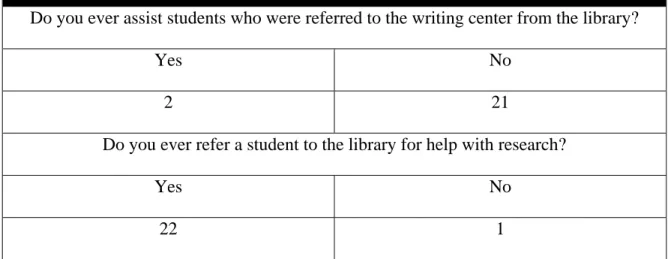
The next set of questions was about referrals between the library and writing center. When asked if they ever assist students who were referred to the writing center from the library, only two people said yes, with nineteen others saying no. Four of the people who answered no also indicated that it was possible it had happened, but they could not say for sure because no student had ever mentioned being referred from the library. Although only two writing center employees had helped students referred from the library for certain, twenty-two out of twenty-three said they had referred a student to the library.
Table 5: Referrals
Do you ever assist students who were referred to the writing center from the library?
Yes No 2 21 Do you ever refer a student to the library for help with research?
Yes No 22 1
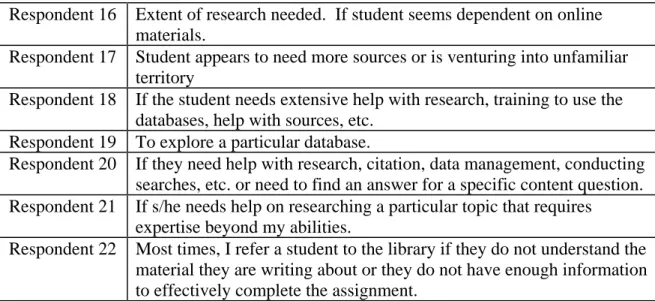
adequate research to support their argument or need more specialized information that a librarian could provide. Only four of the responses mentioned people in the library. Most of the responses talked about referring students to the library to look for resources, not to talk to the librarians. Table 3 gives a complete list of the responses given.
Table 6: Library Referrals
What factors determine whether or not you refer a student to the library?
Respondent 1
Whether or not I am able to assist them using the tools available to me. If their subject is very specific, I'll usually refer them to a library specialist whose expertise is in that field.
Respondent 3 Whether they need literature for papers and/or references info.
Respondent 4
When Librarians have more specialized knowledge - for example, when students need help doing a literature search, or when they need help with citation style.
Respondent 5 How much research student has done/needs to do.
Respondent 6 If I am unable to provide them with ample research links.
Respondent 7
What the students is working on and whether or not the library has more expertise with that subject matter then those of us at the writing center.
Respondent 8 Help with citations, style guides, using library databases.
Respondent 9
If, after reading a student's paper, I want to see more information for a supporting point for an argument. Also, I have them use the Library website quite often.
Respondent 10 If they have a question about sources of how to find information or how to cite. I often use the "chat" option during a session or refer students to the reference desk.
Respondent 11 The clearly need more concrete knowledge of their subject so their writing isn't limited to stating what is obvious and commonly observed about their topic.
Respondent 12 How long they have until final draft is complete (often it's not a long enough time frame for additional research).
Whether they seem to have enough info for their assignment. Whether I think they can find what they need.
Respondent 13 Generally, I refer students to the library for all research concerns-at least I refer them to the website and on-some resources such as citation builders, and live-chat features.
Respondent 14 Whether they needed assistance the library could provide.
Respondent 16 Extent of research needed. If student seems dependent on online materials.
Respondent 17 Student appears to need more sources or is venturing into unfamiliar territory
Respondent 18 If the student needs extensive help with research, training to use the databases, help with sources, etc.
Respondent 19 To explore a particular database.
Respondent 20 If they need help with research, citation, data management, conducting searches, etc. or need to find an answer for a specific content question. Respondent 21 If s/he needs help on researching a particular topic that requires
expertise beyond my abilities.
Respondent 22 Most times, I refer a student to the library if they do not understand the material they are writing about or they do not have enough information to effectively complete the assignment.
The penultimate question was about instruction sessions offered by the library. The survey asked, “How likely would you be to attend a one hour training session about library services?” Six of the twenty-three participants said they would be unlikely to attend a training session offered by the library, but twelve were likely to attend.
Table 7: Instruction Sessions
How likely would you be to attend a one hour training session about library services? Very Likely Somewhat
Likely
Neutral Somewhat Unlikely
Very Unlikely
4 8 5 4 2
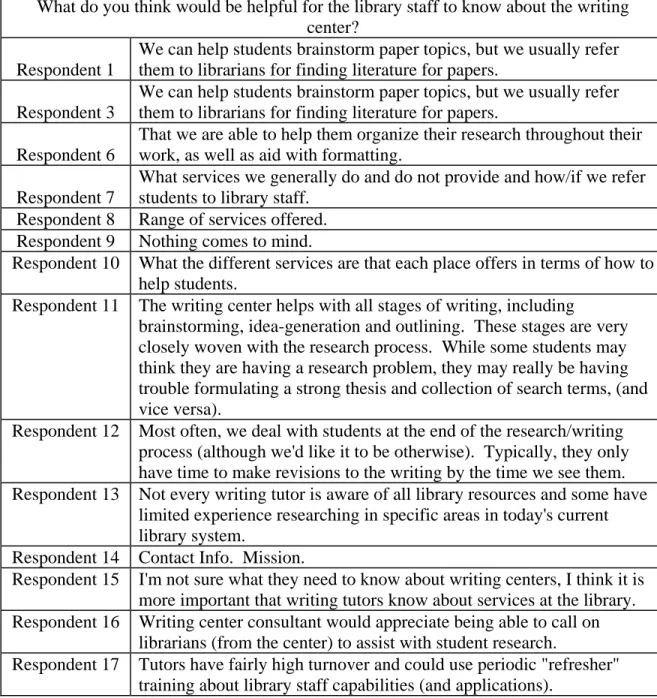
purpose is, and the process they go through when helping students. The complete answers given for this question are listed in Table 8. Their answers ranged from just wanting the library employees to realize the mission of the writing center and services offered. One respondent wanted the library staff to know that s/he refers students to the library chat service.
Table 8: Perceptions
What do you think would be helpful for the library staff to know about the writing center?
Respondent 1
We can help students brainstorm paper topics, but we usually refer them to librarians for finding literature for papers.
Respondent 3
We can help students brainstorm paper topics, but we usually refer them to librarians for finding literature for papers.
Respondent 6
That we are able to help them organize their research throughout their work, as well as aid with formatting.
Respondent 7
What services we generally do and do not provide and how/if we refer students to library staff.
Respondent 8 Range of services offered. Respondent 9 Nothing comes to mind.
Respondent 10 What the different services are that each place offers in terms of how to help students.
Respondent 11 The writing center helps with all stages of writing, including
brainstorming, idea-generation and outlining. These stages are very closely woven with the research process. While some students may think they are having a research problem, they may really be having trouble formulating a strong thesis and collection of search terms, (and vice versa).
Respondent 12 Most often, we deal with students at the end of the research/writing process (although we'd like it to be otherwise). Typically, they only have time to make revisions to the writing by the time we see them. Respondent 13 Not every writing tutor is aware of all library resources and some have
limited experience researching in specific areas in today's current library system.
Respondent 14 Contact Info. Mission.
Respondent 15 I'm not sure what they need to know about writing centers, I think it is more important that writing tutors know about services at the library. Respondent 16 Writing center consultant would appreciate being able to call on
librarians (from the center) to assist with student research.
Respondent 18 All my interactions with library staff have been perfect.
Respondent 19 That we often encounter students working on research papers who are fairly new to researching at the college level.
Respondent 20 That they're welcome to call and propose collaborations, talk about student concerns, etc.
Respondent 21 That tutors can help with basic research skills, esp. databases. Respondent 22 Our most pressing issues when it comes to research availability and
understanding. I most often refer students to the library for research related issues.
Conclusion
Current Perceptions: Libraries and Writing Centers
Overall, the writing center surveys showed that staff members are receptive to further collaboration with their campus libraries, but they also believe they do serve a necessary and separate service on campus. The employees viewed themselves as an entity completely independent of the library that may occasionally have services overlap with the library. Although both writing centers and libraries serve unique purposes, they do seem to have similar goals when it comes to providing service to students. There are ways to collaborate that honor both the differences and similarities between the two campus entities.
Every writing center must find a level of collaboration that works for their specific writing center and the library. There are a lot of different options for writing centers and libraries to collaborate, and writing center directors and librarians should be in communication with each other in order to decide what level of collaboration is the right one for their institution. Throughout the survey responses it seems that writing center employees are receptive to cooperation with the library. They definitely recognize the importance of library resources, and point students in the direction of the library when a student needs help researching. They may not direct students to librarians, but they are still advocating for students to use library resources, be it citation builders like Refworks or Endnote, books, or databases.
Role of Libraries
This survey looked at writing centers and the way writing center employees perceive collaboration with libraries, and it is helpful for librarians to know how their services are perceived by other people on campus. For the most part, the writing center employees would like for librarians to be aware of what they do and the services they offer.
Instruction sessions in libraries are held to introduce students to library resources. Classes come to the library for instruction sessions that also function as library
orientation. While librarians are discussing library resources, it would also be helpful to mention other campus resources such as the writing center. One of the survey
respondents mentioned that they would like to have a handout that discusses library resources that they could give to students. It would also be helpful for the writing center to have a handout listing their services and the ways they can assist students. These handouts could be left at the reference desk or handed out at instruction sessions. This would also foster an understanding between the library and writing center about what each place has to offer, and they could become advocates for each other. If librarians are aware of everything the writing center employees do to assist students, they would be more likely to refer students to the writing center.
It is important for both entities to know about the other and find a level of
collaboration that works for both places. There are levels of cooperation and each library and writing center should find ways to cooperate with each other that work for each place. It is important that libraries and writing centers collaborate because it fosters a welcoming environment on campus. It is helpful for students to know what resources are available to them, and if there is a level of collaboration between writing centers and libraries it benefits everyone.
The TRLN institutions are in a unique situation because of their geographic proximity to each other. The libraries at the TRLN institutions can work closely together to build a large unparalleled collection. There are benefits for each library working within a consortium. Collaborating with a writing center may not provide as many tangible benefits for the libraries. In a strong consortium libraries can build strong collections, while using their collective influence to advocate for projects and funding. Working with a writing center may lead to less concrete results. The benefits may simply be increasing the amount of communication between writing center employees and librarians, or increasing the amount of referrals between the two units. However, it is still important for both places to try to collaborate with each other. The writing center
Bibliography
“About the Writing Center.” 1998. The Writing Center: University of North Carolina at Chapel Hill. 20 March 2009.
<http://www.unc.edu/depts/wcweb/campusservices.html>
Arzt, Judy. “Library and Learning Center Collaborations: Within and Outside the Walls.” Centers for Learning: Writing Centers and Libraries in Collaboration Association of College and Research Libraries: Chicago, 2005.
Barrat, Caroline Cason, et al. “Collaboration is Key: Librarians and Compositions Instructors Analyze Student Research and Writing.” Portal 9.1 (2009): 37-56. Beagle, Donald. “Conceptualizing an Information Commons: New Service Models in
Academic Libraries.” Journal of Academic Librarianship 25.2 (1999): 82-9. Bencich, Carole, et al. "Navigating in Unknown Waters: Proposing, Collecting Data, and
Writing a Qualitative Dissertation." College Composition and Communication 54.2 (2002): 289-306.
Bronshteyn, Karen and Rita Baladad. “Perspectives on Librarians as Writing Instructors: Using Paraphrasing Exercises to Teach Beginning Information Literacy Students.” The Journal of Academic Librarianshi32.5 (2006): 533-536. Byrd, Gary. “The Evolution of a Cooperative Online Network.” Library Journal 110.2
Currie, Lea and Michele Eodice. “Roots Entwined: Growing a Sustainable Collaboration.” Centers for Learning: Writing Centers and Libraries in
Collaboration Association of College and Research Libraries: Chicago, 2005. Davidson, Karen, and Gail Peyton. "Library Outreach to the Freshman Football Recruits
and Athletic Academic Tutors at Mississippi State University." The Reference Librarian 47.1 (2007): 63-77.
Deese-Roberts, Susan, and Kathleen Keating. "Integrating a Library Strategies Peer Tutoring Program." Research Strategies 17.2/3 (2000): 223-9.
Dewey, B. I. “The Embedded Librarian: Strategic Campus Collaborations.” Resource Sharing & Information Networks17.1-4 (2004):5-17. Duke University. Writing Studio. 30 November 2008.
<http://uwp.duke.edu/wstudio/about/index.html>
Elmborg, James K. “Libraries and Writing Centers in Collaboration: A Basis in Theory.” Centers for Learning: Writing Centers and Libraries in Collaboration Association of College and Research Libraries: Chicago, 2005.
“FAQs.” The Writing Studio at North Carolina Central University. 20 March 2009. <http://www.nccu.edu/administration/academicaffairs/writingstudio/faq.cfm> Furlong, Katherine, and Andrew B. Crawford. "Marketing Your Services through Your
Students." Computers in Libraries 19.8 (1999): 22,24,26.
Centers for Learning: Writing Centers and Libraries in Collaboration Association of College and Research Libraries: Chicago, 2005.
Giglio, Michele R. and Constance F. Strickland. “The Wesley College Library and Writing Center: A Case Study in Collaboration.” Centers for Learning: Writing Centers and Libraries in Collaboration Association of College and Research Libraries: Chicago, 2005.
Hook, Sheril. “Teaching Librarians and Writing Center Professionals in Collaboration: Complementary Practices.” Centers for Learning: Writing Centers and Libraries in Collaboration Association of College and Research Libraries: Chicago, 2005. Jackson, L., & Hansen, J. “Creating collaborative partnerships: Building the
Framework.” Reference Services Review34.4 (2006): 575-588. Jackson, S., Hansen, C., & Fowler, L. “Using Selected Assessment Data to
Inform Information Literacy Program Planning with Campus Partners.” Research Strategies. 20.1-2 (2004): 44-56.
Koch, Theodore W. "New Light on Old Libraries." The Library Quarterly 4.2 (1934): 244-52.
Kochen, Manfred. "Directory Design for Networks of Information and Referral Centers." The Library Quarterly 42.1, Proceedings of the Thirty-Fifth Annual Conference of the Graduate Library School, August 2-4, 1971: Operations Research:
Implications for Libraries (1972): 59-83.
Leadley, Sarah and Becky Reed Rosenberg. “Yours, Mine, and Ours: Collaboration among Faculty, Library, and Writing Center.” Centers for Learning: Writing Centers and Libraries in Collaboration Association of College and Research Libraries: Chicago, 2005.
Lippincot, Joan K. “New Library Facilities: Opportunities for Collaboration.” Resource Sharing & Information Networks17.1/2 (2005): 147-157. Mahaffy, Mardi. “Exploring Common Ground: US Wrting Center/Library
Collaboration.” New Library World 109.3/4 (2008): 173-181.
Murphy, Christina and Joe Law. “The Disappearing Writing Center Within the Disappearing Academy.” The Politics of Writing Centers Boynton/Cook Publishers, Portsmouth, NH: 2001.
North Carolina Central University. 5 November 2007: Department of English and Mass Communication. 30 November 2008.
<http://ariel.acc.nccu.edu/artsci/english/english.html>
North Carolina State University. Writing and Speaking Tutorial Services. 30 November 2008. <http://www.ncsu.edu/tutorial_center/writespeak/>
Rabuck, Donna Fontanarose, et al. “Gaining a Scholarly Voice: Intervention, Invention, and Collaboration.” Centers for Learning: Writing Centers and Libraries in Collaboration Association of College and Research Libraries: Chicago, 2005. Rader, Hannelore B. “Cooperative Ventures between the University and the Library.”
--- “A New Academic Library Model: Partnerships for Learning and Teaching.” College and Research Library News 62.4 (2001): 393-96.
Reid, Casey. “From Cross-Referencing to Co-Construction: Contemplating
Collaborative Potentials for Reference and the Writing Center at Southwest Missouri State University.” Centers for Learning: Writing Centers and Libraries in Collaboration Association of College and Research Libraries: Chicago, 2005. Scott, Patrick. "Bibliographical Problems in Research on Composition." College
Composition and Communication 37.2 (1986): 167-77.
Singh-Corcoran, Nathalie and Thomas P. Miller. “Off-Center Collaboration.” Centers for Learning: Writing Centers and Libraries in Collaboration Association of College and Research Libraries: Chicago, 2005.
Smith, Charmelle. “Writing Essays With Ease.” Campus Echo Online 95.9 (2004). <http://web.nccu.edu/campus/echo/archive9-0304/c-writing.html>
Solomon, Jennifer H. “University Writing Center and Library Collaborations: An Analysis of Writing Center and Library Websites at ARL Affiliated Institutions.” Master’s Paper. University of North Carolina at Chapel Hill, 2008.
“TRLN Bibliography.” 2005. Search TRLN. 20 March 2009. <http://www.trln.org/history/trln.htm>
“TRLN Fact Sheet.” 2007. Triangle Research Libraries Network. 20 March 2009. <http://www.trln.org/about/trlnfact.pdf>
University of Louisville. 2004. University Writing Center. 30 November 2008. <http://coldfusion.louisville.edu/webs/a-s/writingcenter/>
University of North Carolina at Chapel Hill. 1998. The Writing Center. 30 November 2008. <http://www.unc.edu/depts/wcweb/about.html>
White, Carolyn and Margaret Pobywajlo. “A Library, a Learning Center, and Classroom Collaboration: A Case Study.” Centers for Learning: Writing Centers and
Libraries in Collaboration Association of College and Research Libraries: Chicago, 2005.
“Writing and Speaking Tutorial Services.” North Carolina State University. 20 March 2009. <http://www.ncsu.edu/tutorial_center/writespeak/index.html>
Appendix A: Cover Letter Sent With Survey
1521 East Franklin Street
Chapel Hill, NC 27514 [email protected]
March 12, 2009 Dear Respondent,
I am a graduate student in the School of Information and Library Science at the University of North Carolina at Chapel Hill. I am conducting a survey on academic libraries and writing centers as part of the research for my master’s paper. I have
enclosed a survey that asks some questions about your opinions on the writing center and academic libraries. I would appreciate if you could answer the survey questions and return it in the stamped self-addressed envelope.
The survey should take you about 10 minutes to complete. I hope you will take the time to complete this questionnaire and return it. Your participation is completely voluntary. If you have any questions or concerns about completing the questionnaire or about being in this study, you may contact me at (919) 259-6891. The Institutional Review Board (IRB) at the University of North Carolina at Chapel Hill has approved this study. If you have any concerns about your rights as a participant in this study you may contact the Office of Human Research Ethics at (919) 966-3113.
Sincerely.
Appendix B
: Survey Distributed to Writing Center Employees
Survey questions for Writing Center Employees1. Do you communicate with staff of writing centers at other universities?
Yes No
If yes, how often do you communicate with employees at other writing centers?
Daily Weekly Monthly A few times a year
2. Do you interact with library staff as part of your job in the writing center?
Yes No
If yes, how often do you interact with library staff?
Daily Weekly Monthly A few times a year
3. In terms of assisting students with research papers, how similar do you think the services offered by the writing center are to the services offered by the library?
Very similar Somewhat similar Neutral Somewhat different Very different
4. Would you like to see more collaboration between libraries and writing centers?
Yes No
If yes, in what ways could the library and writing center collaborate?
5. Do you ever assist students who were referred to the writing center from the library?
Yes No
6. Do you ever refer a student to the library for help with research?
Yes No
If yes, what factors would determine whether or not you refer a student to the library?
7. How likely would you be to attend a one hour training session about library services? Very Likely Somewhat Likely Neutral Somewhat Unlikely Very Unlikely