UNDERSTANDING SOCIAL NORMS AND THEIR INFLUENCE ON SEXUAL BEHAVIOR AS STUDENTS TRANSITION FROM HIGH SCHOOL TO COLLEGE:
A TRAINING MODULE FOR UNDERGRADUATE PEER HEALTH EDUCATORS
by
Molly R. Ruben
A paper presented to the faculty of The University of North Carolina at Chapel Hill in partial fulfillment of the requirements for the
degree of Master of Public Health in the Department of Maternal and Child Health.
Chapel Hill, N.C.
October 30, 2012
Approved by:
First Reader:
_______
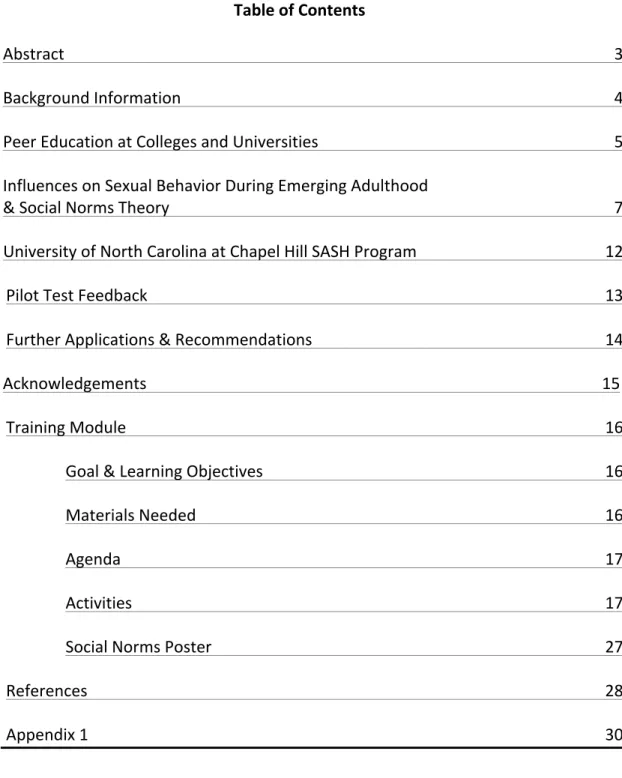
Table of Contents
Abstract 3 Background Information 4 Peer Education at Colleges and Universities 5
Influences on Sexual Behavior During Emerging Adulthood
& Social Norms Theory 7 University of North Carolina at Chapel Hill SASH Program 12 Pilot Test Feedback 13 Further Applications & Recommendations 14 Acknowledgements 15
Training Module 16 Goal & Learning Objectives 16
Materials Needed 16
Agenda 17
Activities 17
Social Norms Poster 27
References 28 Appendix 1 30
Abstract
Background Information
The number of students attending colleges across the United States has risen in the past decade as a result of population growth and increasing enrollment rates. Between 2000 and 2010, the number of 18-‐ to 24-‐year-‐olds in the U.S. grew to 30.7 million, an increase of 12% in this age group. Of these 30 million young adults, 41% were enrolled in college in 2010, compared to 35% in 2000 (U.S. Department of Education, 2012). The increasing number of college students in the United States has profound implications for public health, as this population continues to engage in risky behaviors, such as unsafe sexual activity, that can lead to negative health outcomes. At least 70% of students on college campuses are sexually active and at risk for sexually transmitted infections (STIs) and unplanned pregnancy (American College Health Association [ACHA], 2010). In 2000, an estimated 18.9 million new cases of STIs occurred in the United States. While young adults ages 15-‐24 made up only 25% of the country’s sexually active population that year, they accounted for nearly half (48%) of these new diagnoses (Weinstock, 2004). According to the ACHA National College Health Assessment II conducted in the spring of 2010, only 51% of sexually active college
students reported consistent condom use during vaginal intercourse in the past 30 days. This means that almost half of sexually active students were potentially exposed to an STI or unwanted pregnancy during the month prior to the survey, not taking into
a condom or other protective barrier for anal sex within the past 30 days, showing that the vast majority of sexually active college students are at risk for STIs that can be transmitted through these behaviors (ACHA, 2010).
Unintended pregnancy can have significant consequences for young women in college and their partners; however, many students continue to be at risk. In 2004, an estimated 2.4 million U.S. females below the age of 25 became pregnant. This same year, nearly two-‐thirds of the 199,000 abortions among female adolescents occurred among 18 and 19 year-‐olds (Centers for Disease Control and Prevention [CDC], 2009). As of Spring 2010, 2.2% of sexually active college students had experienced an
unintended pregnancy or gotten someone pregnant in the past year (ACHA, 2010). Additionally, only 56.6% of students having intercourse reported using some form of contraception the last time they had vaginal sex. Of these students, over a quarter (26.3%) reported using the “withdrawal” method as a form of birth control during last intercourse (ACHA, 2010). Given the high proportion of college students who are not using condoms and/or contraception every time they have intercourse and who are using ineffective methods of pregnancy prevention like withdrawal, there is a clear need for colleges and universities in the U.S. to implement effective interventions to help reduce the incidence of STIs and unplanned pregnancies among this growing
population.
Peer Education at Colleges and Universities
Many colleges and universities across the United States implement peer
areas of physical safety and sexual assault/abuse, weight and nutrition, sexual health, alcohol and other drugs, and mental health (White, 2009). According to the Youth Peer Education Network (Y-‐PEER), peer education can be defined as “the process whereby well-‐trained and motivated young people undertake informal or organized educational activities with their peers (those similar to themselves in age, background, or interests).” (2005, p. 13). Additionally, these educational activities are “aimed at developing young people’s knowledge, attitudes, beliefs, and skills and enabling them to be responsible for and to protect their own health” (p. 13).
There are many advantages to utilizing peer educators on a college campus in this capacity. First, peers are a natural source of information for college students, particularly in regards to sensitive topics like sexual health (Y-‐PEER, 2005). By training peer educators to be knowledgeable in areas relevant to student health, colleges can take advantage of peers as trusted resources and ensure that students receive accurate health information and referrals to other resources available in the college community. Secondly, peer education programs can be cost-‐effective for colleges and universities to implement. Peer educators are often student volunteers who take on tasks that a paid staff member would otherwise be required to perform. In return, peer educators receive the benefits of increased health knowledge through trainings and developing leadership and communication skills that may assist them in future employment opportunities (White, 2009; Y-‐PEER, 2005).
(White, 2009). Studies have shown mixed results for the effect of peer education on student outcomes, particularly relating to issues of sexual health and behavior. For example, Richie (1994) found that students randomly assigned to participate in an AIDS Peer Education Program (APEP) during their first year of college were more likely to get tested for HIV and use condoms than those who had not participated. In a longitudinal study of 2,000 University of California, Santa Barbara students from Fall 2003 to Spring 2006, White (2009) found that students who had contact with a peer health educator were more likely over time to engage in healthier behaviors related to alcohol/drug use and weight management than students who did not have contact with a peer educator. White’s analysis of student sexual health outcomes did not show this association; however, it is possible that study design limitations affected these results. Nonetheless, more research needs to be done to determine the most effective peer education
strategies so that colleges can implement evidence-‐based, cost-‐efficient programming that supports and improves student health.
of risky behaviors, including unprotected sexual activity and substance use, peak during this time. Additionally, emerging adults may be able to engage in these activities more easily due to diminished parental monitoring as they move out of their parents’ homes to live in college dorms or other independent living situations (Arnett, 2000).
A variety of factors can influence students’ decisions to initiate and continue sexual activity as they make the transition from high school to college. Qualitative research studies about emerging adults have identified a myriad of personal factors that contribute to this decision-‐making process. Students may choose to delay sexual
activity because they do not want to unintentionally become pregnant or get a partner pregnant, do not want to contract an STD, prefer to wait until they or their partner are on hormonal birth control, or are not ready for sex. On the other hand, students may choose to become sexually active because they want to feel loved, they derive
enjoyment or pleasure from the experience, and/or they are curious about sex and want to know what it is like (Sonnett, 2011; Fantasia, 2011; Patrick, 2007). Often these
personal reasons co-‐occur and can lead to different behavioral outcomes depending on each individual student’s decision-‐making process.
participation in social networks and are communicated passively or inferred through observing the behaviors of others. There may be multiple norms that apply to any given situation and they all have the potential to influence behavior.
College students have a strong motivation to behave according to social norms as a means of obtaining approval from others, including their peers, parents, and other influential adults. However, studies have consistently documented the tendency of college students to overestimate peer participation in high-‐risk activities (Perkins, 2005). Social Norms Theory predicts that these pervasive misperceptions of peer norms
encourage students to engage in unhealthy behaviors in an attempt to conform to the perceived social norms. Importantly, perceptions of social norms are subjective and misperceptions of these norms that reinforce negative behaviors among a particular group can be corrected. Based on Social Norms Theory, changes in perceptions of social norms should lead to changes in behavior by group members as they modify their actions to adhere to the new social standards.
There are two types of social norms: descriptive and injunctive. Descriptive norms reflect what people actually do in a given situation. Individuals often rely on descriptive norms when trying to determine how to act in a novel or unclear
Western United States and found that while most teens assumed the majority of their peers had had sex before leaving high school (descriptive norm), this was in contrast to parental disapproval of sexual activity among teenagers (injunctive norm).
Furthermore, parental disapproval stemmed from either moral/religious concerns or from practical reasons related to avoidance of unintended pregnancy. In another qualitative study of 18-‐22 year olds in the Northeast U.S. recruited from community health clinics, Fantasia (2011) found that some participants considered high school-‐ based sex education to be insufficient because of the underlying assumption that
students were not supposed to have sexual partners until marriage (injunctive norm). In trying to navigate conflicting norms, it is the peer norms (especially those of close
engaging in casual sexual encounters with uncommitted partners, has become an increasingly popular activity on college campuses and can raise the risk for STIs and/or unintended pregnancy (Fantasia, 2011; Reiber & Garcia, 2010; Scholly, 2005). Often colleges and universities can be seen as condoning student sexual activity through comprehensive sexual health programming and providing free condoms on campus. This contrasts greatly with the injunctive norms that high school students usually
perceive from parents, religious groups, and school-‐based sex education that discourage them from having sex.
It is clear that perceptions of peer social norms influence decisions about sexual behavior among emerging adults; however, these perceptions are not always accurate and can lead to increases in potentially risky behavior. Studies have found that an inflated perception of sexual activity among college peers is associated with increased personal likelihood of having sex. In a survey of 725 students enrolled in a required English class at a northwestern public university, Page (2000) revealed that male students who believed that 75% or more of their peers were having sex were 11 times more likely to have been sexually active in the past month than those males who thought less than 25% of their peers were having sex. Females with these same high estimations were about 4 times more likely to have been sexually active in the past month than those females with a more conservative perception. Additionally,
that nearly three-‐quarters (71%) of college students overestimated the number of alcoholic drinks other students consumed at social occasions, which was the strongest predictor of students’ own personal alcohol consumption. As trusted and informative resources for students, peer health educators have the potential to be extremely valuable in helping to correct misperceptions about social norms on college campuses and reduce high-‐risk behaviors among the students based on the constructs of Social Norms Theory.
University of North Carolina at Chapel Hill SASH Program
and their influence on sexual behavior or any discussion of students’ transition from high school to college. The following training module was designed to meet this need in the SASH peer educators’ training curriculum with the intention of increasing members’ awareness of social norms and their ability to relate to all students at UNC so that they can more effectively lead educational activities and promote healthy sexual practices on campus.
Pilot Test Feedback
The following module was pilot tested with current SASH members on October 23, 2012. The group consisted of 6 undergraduates and 1 graduate student and the test lasted approximately 45 minutes. Immediately following the training session, students provided anonymous written feedback (see Appendix 1). All students responded positively when asked if the training session will help them in their role as a peer educator. Students felt the module helped them to “better understand how social norms influence decisions” (female, 3rd year) and “think about how social norms really change when we [students] transition from high school to college” (female, 4th year). Students indicated that they liked how the session “was informative as well as
interactive” (female, 4th year) and responded well to the topic of discussion.
reflections on the influences of social norms during high school and college and how these norms can change as students transition from one to the other. Finally, edits were made to the Social Norms poster based on the confusion some students expressed in understanding the different types of norms. The time constraint on the module may have contributed to this and a suggestion for the future would be to allow at least an hour for the module and spend additional time discussing examples of descriptive and injunctive norms to make the distinction clearer. Overall, the CHECS overseeing the training considered the session to be a success in providing useful information to the peer educators based in health behavior theory.
Further Applications & Recommendations
There are several topics related to social norms of college students’ sexual behavior that could be expanded in this training module or developed into additional curricula for peer educators. For example, it was noted that students often
overestimate peer participation in potentially risky sexual behaviors. In a survey of 312 college students, Chia and Gunther (2006) found that exposure to various types of media contributes to these misperceptions that subsequently affect student behavior. While media was briefly discussed during the pilot test of the training module, it may be beneficial to expand on this topic with peer educators to increase their awareness of media influence on sexual behavior. It would also be useful for colleges and universities to assess the role they play in influencing social norms about sexual behavior on
comprehensive sexual health services to students and unintentionally promoting sexual behavior through campus policies and programming.
In addition, given the strong link between alcohol/substance use and high-‐risk sexual activity, creating a combined curriculum focused on the influence of social norms on both of these sets of behaviors could be extremely valuable for peer health
educators and the general student body at UNC. Based on my formative research and resulting training module, I would recommend a required health education class for all incoming first years focused on common high-‐risk behaviors among this population. Educating students about birth control options, social norms, partner communication strategies, etc. would ensure that they receive accurate and appropriate information related to sexual health and overall well-‐being, regardless of their previous sex
education. Making students aware of the influence of social norms in college could help them identify this in their own lives and potentially decrease misperceptions of peer norms and, therefore, the likelihood that they will engage in risky sexual activity.
Acknowledgements
This project would not have been possible without the enthusiasm and support of Laura Britton, other CHECS staff at UNC Counseling and Wellness Services, and the SASH members who volunteered their time to participate in my training session. I would also like to thank Anita M. Farel, PhD and Marcia S. Roth, MPH as the readers on this paper. Finally, the support of my roommates, friends, family, and coworkers was
UNC SASH Peer Educator Training Curriculum
Module: Understanding Social Norms and Their Influence on Sexual Behavior As Students Transition from High School to College
Goal:
To increase peer educators’ awareness of the changing social norms that students experience as they transition from high school to college and how these norms influence sexual behavior.
Learning objectives:
1. Peer educators will be able to identify at least 3 personal reasons and at least 3 normative reasons that affect students’ decisions to engage (or not engage) in sexual activity.
2. Peer educators will be able to define “social norms” and explain the difference between descriptive and injunctive norms.
3. Peer educators will be able to list 3 social norms that influence students’ sexual decisions during high school and 3 social norms that influence students’ sexual decisions while in college, as well as identify at least 1 difference between these two sets of norms.
4. Peer educators will understand the utility of correcting misperceptions about social norms that reinforce risky sexual behavior among college students.
5. Peer educators will learn the potential impact of following a harm reduction model focused on individual students’ personal health goals.
Materials needed:
-‐ Newsprint paper or large easel pad -‐ Colored markers
-‐ Social Norms poster
Agenda:
1. Introduce training module 2. Establish ground rules
3. Identify and classify college students’ reasons for engaging in or abstaining from sexual activity
4. Define social norms and the difference between descriptive and injunctive norms
5. Conduct group activity on how social norms can change from high school to college
6. Facilitate a discussion among peer educators about the implications of this training module on their interactions with students
7. Wrap Up
Activities: A. Introduction
1. Discuss the important role of peer educators in informing other students about healthy sexual practices and resources on campus
To begin, I would like to thank you all for making the commitment to be a part of [peer education program]. You are obviously passionate about sexual health and play a vital role in educating other students on campus and informing them about the resources they need.
2. Introduce the idea that it is important for peer educators to be able to relate to the students they hope to educate
3. Describe the goal of this training module
This is especially true when it comes to students’ motivations for becoming sexually active. Our goal today is to discuss different
influences that affect students’ decisions to engage (or not engage) in sexual activity. We’ll also be looking at how these influences can change as students transition from high school to college. My hope is that, by the end of today’s session, you will feel like you can relate to the majority of students on campus when it comes to discussing sexual health.
B. Ground Rules
1. Review group ground rules
As you know, it is important for any group to establish ground rules to create a comfortable and safe space for discussion. Let’s review the ground rules you have all agreed upon for these sessions…
2. Ask peer educators if there are any other rules they would like to add for this session
Are there any other ground rules you want to add to this list for today?
Ø Suggestions for additional rules, if not already included: • Be respectful and listen to others
• Use “I” statements to express your opinion
• Keep things discussed in the group confidential
• It is ok not to share personal history or experiences
• Try to keep the conversation on track and moving forward
C. College Students’ Reasons for Engaging in or Abstaining from Sexual Activity 1. Introduce discussion about students’ reasons for engaging in or abstaining
from sexual activity
Ø Discussion prompts:
• What are some positive reasons students may want to have sex? Are there reasons that might make them decide to wait?
• What about how sexual activity would affect their romantic relationship?
• Can friends or family influence students’ decisions to engage in sexual activity or not? How about messages from previous sex education?
2. On a piece of newsprint paper or large easel pad, write out the reasons suggested by peer educators
Ø Responses might include: • Curiosity
• Intimacy with a partner
• Want to make partner happy
• Pleasure
• To become pregnant
• Know their friends are doing it
• Feeling “ready”
• Personal ethics morals, and/or religious beliefs
• Fear
• To avoid unintended pregnancy or STIs
• Previous sex education
• How parents would react
I want to point out a distinction that can be made in the list you all generated. Some of the items on our list can be classified as what I’m going to call “personal reasons,” such as wanting to feel close to a
partner or avoiding sex because of personal religious beliefs. Other items on the list are more “social reasons”. These reasons reflect the influence of other people on students’ decisions regarding sexual behavior.
4. Categorize items in the list generated by the peer educators into “personal reasons” and “social reasons”
So looking at our list, let’s categorize the reasons that you all came up with…
Ø Personal reasons include: intimacy with a partner, want to make partner happy, pleasure, personal ethics, morals, and/or religious beliefs, to become pregnant, to avoid unintended pregnancy or STIs, etc.
Ø Social reasons include: messages from previous sex education, what friends are doing, how parents would react, etc.
D. Social Norms
1. Define social norms
Our focus today is going to be on these “social reasons,” otherwise known as “social norms”. What do you think of when you hear the term “norm”?
Social norms are understood expectations for behavior among a
particular group. While some norms are stated explicitly and enforced through laws, we often infer social norms by observing those around us. They are like unspoken agreements that govern how people should behave in a given situation.
2. Put up Social Norms poster
3. Explain the difference between descriptive and injunctive norms
Individuals often rely on descriptive norms when trying to figure out how they should act in a new situation.
Injunctive norms are your ideas about what others would say is acceptable or morally appropriate in a given situation.
4. Use example of alcohol consumption to illustrate how social norms can influence risky behavior among college students
Let me give you some specific examples to make this clearer. Think about alcohol consumption among high school and college students. Maybe you thought none of your friends drank alcohol while you were in high school and now it seems the majority of your friends drink alcohol in college. These are examples of descriptive norms, because they reflect what you think the majority of your friends are doing when it comes to drinking alcohol.
Now let’s think about injunctive norms for drinking alcohol. According to the law, it is illegal for anyone to drink alcohol under the age of 21, but after that it is ok. Maybe you know your parents (and your friends’ parents) didn’t approve of drinking while you were in high school and still disapprove of it now that you’re in college. Finally, you might think most of your college friends fully support drinking alcohol on a regular basis. These norms reflect your perceptions of what others consider to be appropriate in a given context.
As you can see, several different norms can apply to any given situation and all of them have the potential to influence behavior. Among college students, peer social norms tend to have the biggest influence on
behavior. Any ideas as to why this might be?
norms can be changed. I’d like you to keep this in mind as we go through our next activity.
5. Check for understanding and answer any questions about this section Are there any questions before we move on?
E. Compare/Contrast High School and College 1. Introduce group activity
Now I’d like us to look at specific social norms that can influence students while they are in high school and how these compare to the social norms that exist when students transition to college. Specifically, we are going to look at social norms that can affect students’ decisions regarding sexual behavior. We’re going to break up into four groups for this activity.
2. Break up peer educators into four groups. Provide each group with a piece of newsprint paper or large easel pad and colored marker
Ø Posters should each have one of the following headings: • High School – Descriptive Norms
• High School – Injunctive Norms
• College – Descriptive Norms
• College – Injunctive Norms
3. Give instructions for group activity
Each group has a piece of paper that says High School or College on it and asks you to list descriptive or injunctive norms. As a group, create a list of social norms (either descriptive or injunctive) that could affect a student’s decisions to engage in sexual activity during the stage of life listed on your poster. Remember, social norms reflect the common actions and opinions of a group. They can come from peers, close
appropriate. I will leave the Social Norms poster up for your reference as we go through the activity.
The norms you come up with do not have to be norms that you or your groups members have experienced personally, just ones that might be relevant to someone still in high school or college. It is ok if some of the norms you come up with are repetitive or even contradict each other. As we saw with the example of alcohol consumption, this can often be the case. You will have [number of minutes] to work on your lists and I will circulate around to check in with each group and see how you’re doing. Are there any questions?
4. Circulate around the room to make sure groups are on track. Offer support and suggestions as needed
5. After the groups are done writing, hang the pieces of newsprint paper or large easel pad in the front of the room
6. Have a representative from each group describe the norms that their group listed
7. Ask if there are any other norms peer educators want to add to the lists Are there other social norms that should be added to any of our lists? 8. Introduce discussion to compare and contrast social norms from high
school and college
Now that we’ve gone over our lists, I’d like for us to compare social norms for students in high school and for students in college, and also discuss how these norms may change as students transition from one to the other.
Ø Discussion prompts:
• Is there anything you notice about the social norms students experience in high school? How do the descriptive norms compare to the injunctive norms? Is there anything that is contradictory?
• How do descriptive norms compare from high school to college? Do they change at all?
• How do injunctive norms compare from high school to college? Do they change at all?
• Do you think social norms affect male and female students differently? How so? What about straight and LGBTQ students?
• How do you think students deal with all of these competing norms?
• How do you think students deal with changing norms as they make the transition from high school to college?
Ø Key points for discussion:
• There are often conflicting descriptive and injunctive norms in each of these stages of life. For example, students may think, “everyone is doing it” in high school (descriptive norm) while the understood expectation from parents or religious groups may be “you shouldn’t have sex” (injunctive norm). In college, students may think that the majority of their peers get drunk and have (potentially risky) sex (descriptive norm), which contrasts with the idea that sex should take place within exclusive, monogamous relationships (injunctive norm).
• Descriptive and injunctive norms can change drastically from high school to college. Students may think the majority of their friends refrain from engaging in sexual activity in high school but think that the majority of their friends are sexually active in college
(descriptive norms). Additionally, parents, religious groups, and school-‐based sex education often discourage sex among high school students, whereas colleges and universities seem to condone it through sexual health programming and providing free condoms on campus (injunctive norms).
the same way and can lead to very different outcomes in sexual behavior.
F. Implications
1. Facilitate discussion about the findings from the group activity and what implications these have for peer educators interacting with other students Ok, so now onto the really important question. We’ve had a great
discussion about social norms and how they can change between high school and college. How do we use this information to better relate to students and promote healthy sexual lifestyles on campus?
Ø Discussion prompts:
• Thinking back to the example of drinking alcohol, we know that college students tend to overestimate how often their peers engage in risky behavior. How do you see this relating to sexual health?
• How can we as peer educators address misperceptions of social norms that students might have in regards to potentially risky sexual behaviors?
• If we are successfully able to address misperceptions of peer sexual norms on campus, what affect might this have on students’
behavior?
• How can we use this information to better relate to students who might have experienced different norms than us in high school and now in college?
• How can we use this information to better relate to students who think they are in the minority as far as sexual activity and
preferences go?
• Is there a way to tie in the “personal reasons” that we discussed earlier in today’s session with the influence of social norms on sexual decision-‐making? How might we do this?
Ø Key points for discussion:
• Social norms are a subjective phenomenon, meaning they can be changed if someone is given new information. If students are overestimating how often their peers participate in potentially risky sexual behavior, then we can inform them about actual norms on campus so they have a more accurate idea of what their peers are doing (for example, not every college student is having sex).
• If we correct students’ misperceptions of sexual norms, then we can turn our focus to addressing their personal reasons for engaging in or abstaining from sexual activity and their personal goals. We need to be able to relate to students and deliver
information that is relevant and important to them! Using a harm reduction model for sexual health education allows us to frame our conversations with students and promote healthier sexual
behaviors inside the context of what matters to them.
G. Wrap Up
1. Thank students for participating in today’s training module.
Social Norms:
Understood expectations for behavior among a
particular group; unspoken agreements that govern
how people should behave in a given situation
Types of Social Norms
1. Descriptive Norms:
Your ideas of what the majority of people are doing
in a given context or situation
2. Injunctive Norms:
Your ideas about what others think is acceptable or
morally appropriate in a given situation
References
American College Health Association. (2010). American college health association-‐
national college health assessment II: Reference group executive summary spring
2010. Linthicum, MD: American College Health Association.
Arnett, J. (2000). Emerging adulthood: A theory of development from the late teens
through the twenties. The American Psychologist, 55(5), 469-‐480.
Centers for Disease Control and Prevention. (2009). Sexual and reproductive health of
persons aged 10-‐-‐24 years -‐-‐-‐ united states, 2002-‐-‐2007. (No. 58).
Chia, S. C., & Gunther, A. C. (2006). How media contribute to misperceptions of social norms about sex. Mass Communication & Society, 9(3), 301-‐320.
Cialdini, R. B., & Trost, M. R. (1998). Social influence: Social norms, conformity and
compliance. The handbook of social psychology, volume II (Fourth ed., pp. 151-‐192).
New York, NY: McGraw-‐Hill.
Fantasia, H. C. (2011). Influences of social norms and context on sexual decision making
among adolescent women. Journal of Midwifery & Women's Health, 56(1), 48-‐53.
Page, R. M. (2000). Everybody's not doing it: Misperceptions of college students' sexual
activity. American Journal of Health Behavior, 24(5), 387-‐394.
Patrick, M. E. (2007). Reasons to have sex, personal goals, and sexual behavior during
the transition to college. The Journal of Sex Research, 44(3), 240-‐249.
Perkins, H. (2005). Misperceiving the college drinking norm and related problems: A nationwide study of exposure to prevention information, perceived norms and student alcohol misuse. Journal of Studies on Alcohol and Drugs, 66(4), 470.
Reiber, C., & Garcia, J. R. (2010). Hooking up: Gender differences, evolution, and
pluralistic ignorance. Evolutionary Psychology : An International Journal of
Evolutionary Approaches to Psychology and Behavior, 8(3), 390-‐404.
Richie, N. D. (1994). Did an AIDS peer education program change first-‐year college
students' behaviors? Journal of American College Health, 42(4), 163-‐165.
Scholly, K. (2005). Using social norms theory to explain perceptions and sexual health
behaviors of undergraduate college students: An exploratory study. Journal of
American College Health, 53(4), 159-‐166.
Sennott, C. (2011). College-‐bound teens’ decisions about the transition to sex:
Negotiating competing norms. Advances in Life Course Research, 16(2), 83-‐97.
U.S. Department of Education, National Center for Education Statistics. (2012). Chapter
3. Digest of education statistics, 2011.
Weinstock, H. (2004). Sexually transmitted diseases among american youth: Incidence
and prevalence estimates, 2000. Perspectives on Sexual and Reproductive Health,
36(1), 6-‐10.
White, S. (2009). Longitudinal evaluation of peer health education on a college campus:
Impact on health behaviors. Journal of American College Health, 57(5), 497-‐506.
Youth Peer Education Network. (2005). Youth peer education toolkit: Training of trainers
Thank you for participating in today’s training session! Please take a moment to answer the questions below so that I can improve on what we covered today.
Your feedback is greatly appreciated!
What is your gender?
☐
Male☐
Female☐
Other: ____________________
What is your year in school?
☐
Undergraduate – 1st year☐
Undergraduate – 4th year☐
Undergraduate – 2nd year☐
Graduate student☐
Undergraduate – 3rd year
Do you think today’s session will help you in your role as a peer educator?
☐
Yes☐
No
Why or why not?
What is something new that you learned from today’s session?
What did you like most about this session?
What did you like least about this session?
Do you have any suggestions for how this session could be improved?