LITERACY IN ARTHRITIS
Anita Ashok Bhat
A dissertation submitted to the faculty of the University of North Carolina at Chapel Hill in partial fulfillment of the requirements for the degree of Doctor of
Philosophy in the Department of Health Policy and Administration
Chapel Hill 2008
Approved by: Dr Bruce Fried Dr Leigh Callahan Dr Catherine Zimmer
Dr Darren DeWalt Dr Gary Rozier
ii ABSTRACT
ANITA ASHOK BHAT: Literacy in Arthritis (Under the direction of Bruce J Fried, PhD)
Purpose: To evaluate the association between literacy, measured by Rapid Estimate of Adult Literacy in Medicine (REALM) and arthritis health outcomes in a cross-sectional and longitudinal study. Further, to evaluate the effect of literacy and psychosocial variables on arthritis health outcomes in the longitudinal study.
Methods: REALM was administered to 447 participants at baseline in two
community-based randomized controlled trials of life style interventions designed
for sedentary adults with arthritis, People with Arthritis Can Exercise (PACE) (an
8-week exercise program) and Active Living Every Day (ALED) (a 20-week
physical activity behavioral modification intervention). These studies were sufficiently similar to allow combining the two data sets to examine associations of literacy with health outcomes measured at baseline and at the end of the intervention, the Health Assessment Questionnaire (HAQ), and arthritis
iii
Longitudinal model had 391 participants. Helplessness was measured using the Rheumatology Attitudes Index (RAI) and outcome expectation for exercise (OEE) was measured by OEE.
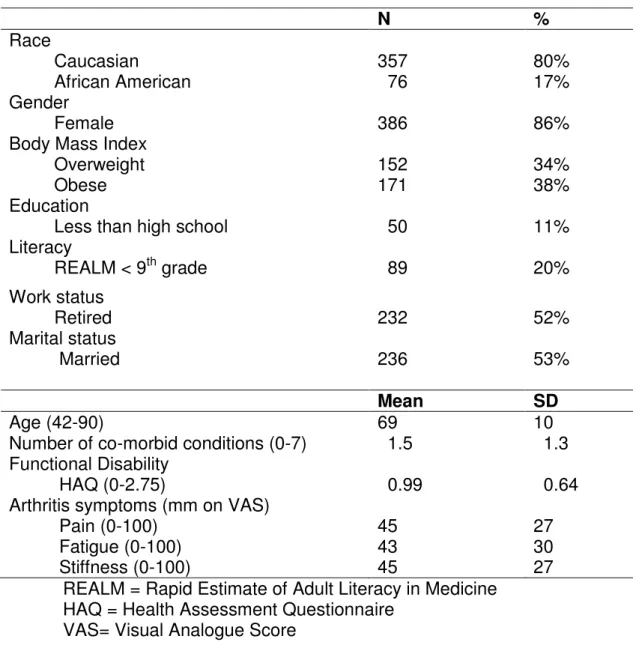
Results: Amid 447 individuals, 89 (20%) had REALM score below 61, which
indicates a reading level of 8th grade or less. Individuals with low literacy did not
have worse arthritis health outcomes than individuals with adequate literacy. Descriptive statistics of the longitudinal model were similar to the cross-sectional model. Disability after intervention was not predicted by helplessness, literacy or OEE in adjusted models. Pain, fatigue and stiffness after the intervention were all significantly predicted by helplessness at various magnitudes in adjusted models, but OEE and literacy were not significant predictors.
iv
ACKNOWLEDGEMENTS
First and foremost, I am thankful to my Creator and this wonderful Universe and the abundance it offers to us all. All we have to do is be open to receive its wonderful gifts. I thank my parents and my spouse for their love, prayers, encouragement and belief in me.
I could not have completed this dissertation without the support of my advisor, Bruce Fried. He was the captain of my ship and constantly encouraged me and always wanted me to progress and do well professionally. Leigh
v
Paul for his support and encouragement. He encouraged me to complete my dissertation in a timely fashion.
I would also like to thank Cynthia Girman for her constant support, encouragement and belief in me. Edward Brooks was always there for me for support, advice and encouragement.
vi
TABLE OF CONTENTS LIST OF TABLES………..ix
LIST OF FIGURES………...x
LIST OF ABBREVIATIONS………...xi
Chapter 1 INTRODUCTION 1.1 Overview of existing research………...1
1.2 Limitations of existing research ……….1
1.3 Purpose of this dissertation……….3
1.4 Policy significance……….6
1.5 Structure of this dissertation………....8
Chapter 2 LITERATURE REVIEW 2.1 Self-Management in chronic disease……….9
2.2 Health Literacy……….12
2.3 Are we well equipped to measure health literacy? ...15
2.4 How do we measure literacy? ………..17
2.5 Literacy and self-management………...19
2.6 Literacy and racial/ethnic disparities: are we missing an important link?...20
2.7 Do interventions improve health outcomes for low literacy patients? ... 22
2.8 Role of helplessness and exercise outcome expectation.………24
2.9 Unanswered questions addressed………..………..……...26
Chapter 3 EXPERIMENTAL DESIGN AND METHODS 3.1 Conceptual model………...29
vii
3.2.1 Research participants………..36
3.2.2 Intervention………37
3.2.3 Procedures………38
3.2.4 Instrumentation……….39
3.2.5 Measures……….……..39
3.3 Human subjects review………...46
3.4 Data analysis………46
3.5 Sample attrition……….54
3.6 Statistical power………...59
Chapter 4 RESULTS 4.1 Descriptive statistics for the cross-sectional model………...62
4.2 Cross-sectional model………64
4.2.1 Bivariate analysis………...64
4.2.2 Specific Aim 1a- multivariate analysis………...68
4.2.3 Correlation between literacy and educational status………..70
4.3 Descriptive statistics for the longitudinal model………70
4.4 Longitudinal model……….73
4.4.1 Bivariate analysis……….73
4.4.2 Specific Aim 1b- multivariate analysis………...76
4.4.3 Specific Aim 2- multivariate analysis………83
4.4.4 Specific Aim 3- correlation……….86
4.4.5 Specific Aim 3- bivariate and multivariate analysis………89
4.4.6 Specific Aim 4- correlation……….95
4.4.7 Specific Aim 4- bivariate and multivariate analysis (first part)………100
viii
Chapter 5 DISCUSSION AND CONCLUSION 5.1 Summary of study………108
5.2 Prevalence of low literacy ……….109
5.3 Literacy and educational status………...111
5.4 Findings from Specific Aim 1………...112
5.5 Findings from Specific Aim 2………...113
5.6 Findings from Specific Aim 3………...115
5.7 Findings from Specific Aim 4………...116
5.8 Implications for future research and practice………..117
5.9 Limitations………...120
5.10 Conclusion………123
REFERENCES………124
ix
LIST OF TABLES Table 3.1: PACE versus ALED- Research design………34
Table 3.2: PACE versus ALED- Measures……….35
Table 3.3: PACE versus ALED- Baseline characteristics (after sample attrition)... 36
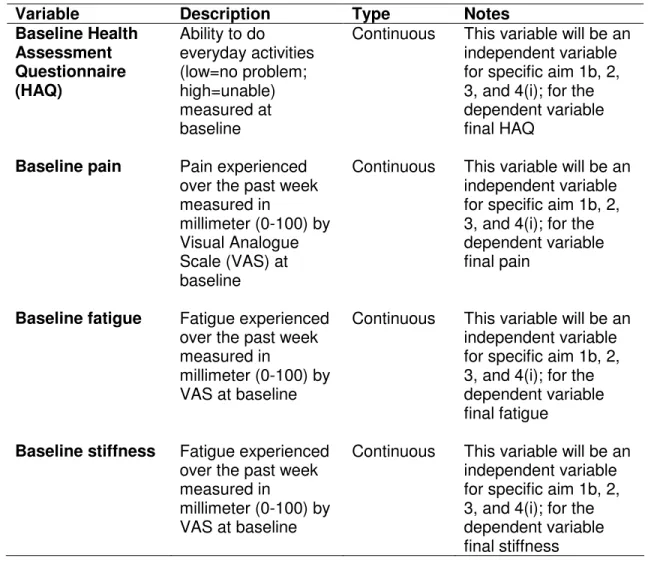
Table 3.4: Description of dependent variables for specific aim 1a…...42
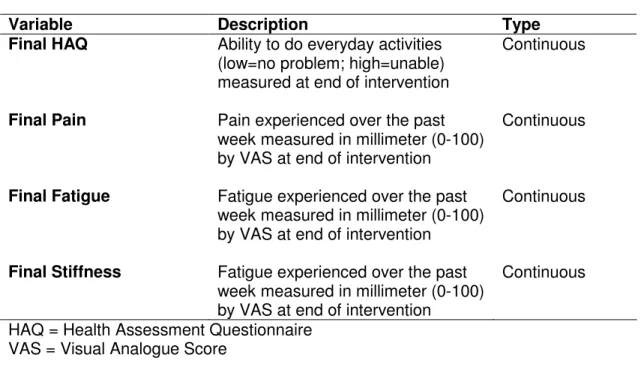
Table 3.5: Description of dependent variables for specific aim 1b, 2, 3 and 4(i)………. 43
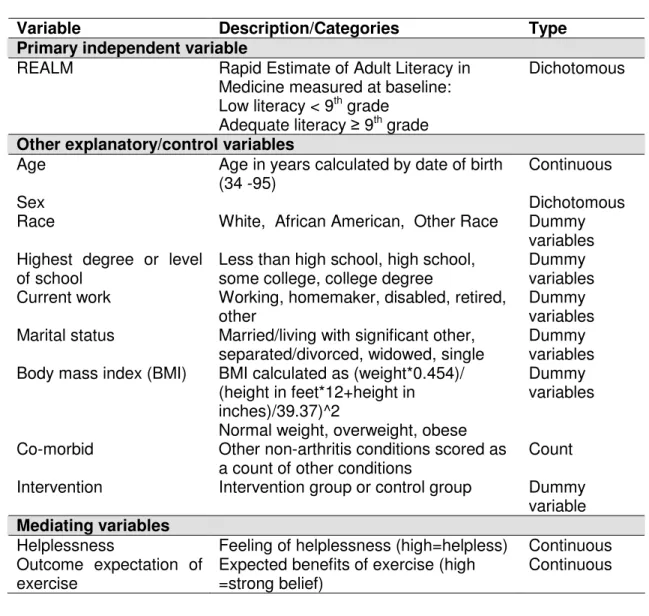
Table 3.6: Description of independent and other study variables………45
Table 3.7: Description of variables………49
Table 3.8: Distribution of participants based on randomization and the actual group attended (n=692)……….………..56
Table 4.1: Cross-sectional sample characteristics……….63
Table 4.2: Relationship of educational status with literacy in the cross- sectional sample………...63
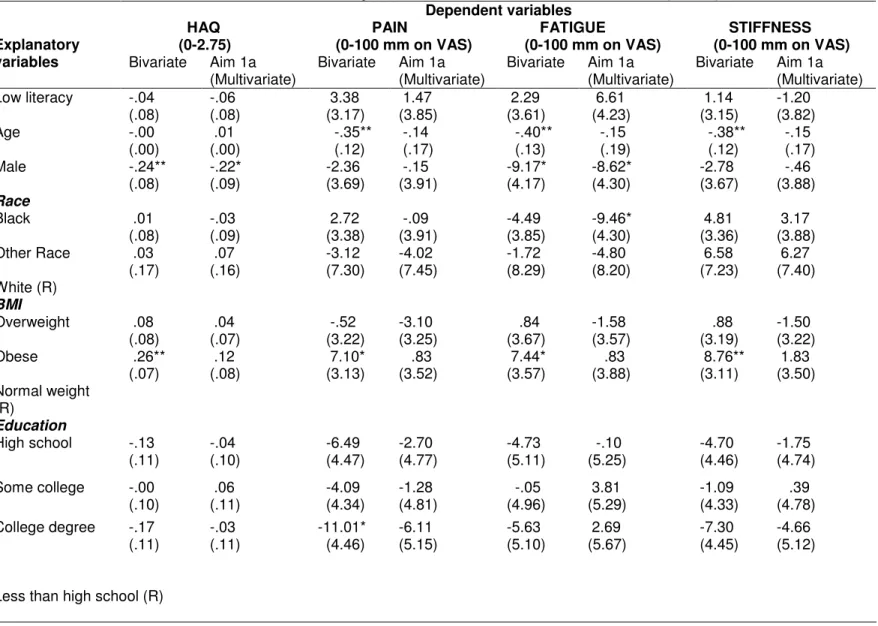
Table 4.3: Cross-sectional analysis of arthritis health status variables………..66
Table 4.4: Longitudinal sample characteristics………...72
Table 4.5: Relationship of educational status with literacy in the longitudinal sample……….………73
Table 4.6: Longitudinal analysis of final Health Assessment Questionnaire………...79
Table 4.7: Longitudinal analysis of final pain………..80
Table 4.8: Longitudinal analysis of final fatigue………...81
Table 4.9: Longitudinal analysis of final stiffness………...82
Table 4.10: Correlation between low literacy, helplessness, outcome expectation and final HAQ, final pain, fatigue and stiffness………..88
Table 4.11: Helplessness as dependent variable...91
Table 4.12: Exercise outcome expectation as dependent variable……….94
x
LIST OF FIGURES Figure 2.3: Conceptual model describing the relationship between individual capacities, health-related print and oral literacy, and health outcomes…….17
Figure 3.1: Conceptual model for People with Arthritis Can Exercise (PACE) and Active Living Every Day (ALED)………31
Figure 3.2: Schematic of PACE and ALED study design………...33
Figure 3.3: Sample attrition for cross-sectional analysis………...57
Figure 3.4: Sample attrition for longitudinal analysis……….58
Figure 4.1: Result for Aim 1a……….70
Figure 4.2: Result for Aim 1b……….78
Figure 4.3: Result for Aim 2………...85
Figure 4.4: Role of helplessness and exercise outcome expectation as a mediator in the relationship between literacy and final health outcomes………87
Figure 4.5: Role of helplessness as a mediator in the relationship between intervention and final health outcomes………...96
Figure 4.6: Role of exercise outcome expectation as a mediator in the relationship between intervention and final health outcomes………...97
Figure 4.7: Result for Aim 4ii………...107
xi
LIST OF ABBREVIATIONS
AA African American
AHRQ Agency for Healthcare Research and Quality
ALED Active Living Every Day
BMI Body Mass Index
HALS Health Activities Literacy Scale
HAQ Health Assessment Questionnaire
IOM Institute of Medicine
IRB Institutional Review Board
MHAQ Modified Health Assessment Questionnaire
MITT Modified Intention to Treat
MODEMS Musculoskeletal Outcomes Data Evaluation & Management System
NALS National Adult Literacy Survey
NAAL National Assessment of Adult Literacy
NVS Newest Vital Sign
PACE People with Arthritis Can Exercise
PAR Program Announcement with Review
RA Rheumatoid Arthritis
RAI Rheumatology Attitudes Index
RCT Randomized Controlled Trial
REALM Rapid Estimate of Adult Literacy in Medicine
TOFHLA Test of Functional Health Literacy in Adults
Chapter 1 Introduction 1.1 Overview of existing research
The relationship of literacy and health in the United States is a topic of growing interest for researchers, policy makers and healthcare providers. First, studies have generally focused on understanding the impact of literacy on health knowledge and behaviors rather than on health outcomes
(Kalichman & Rompa, 2000; Kalichman et al., 2000; Williams et al., 1998; Williams et al., 1998). Most important, however, is the ultimate impact of health interventions on measurable health outcomes in low literacy
individuals. Second, most studies have been cross-sectional, which limits our ability to understand the causal pathways (including mediators) through which literacy influences health (DeWalt et al., 2004). To date, there are only five longitudinal published studies that have examined whether interventions improve health outcomes in chronic diseases; namely diabetes, depression and heart failure (Rothman et al., 2004; Rothman et al., 2004; Weiss et al., 2006; DeWalt et al., 2006; Sisk et al., 2006)
1.2 Limitations of existing research
2
chronic condition in adults (Fried, 2000). Involving patients in their care is critical because managing arthritis generally involves both medications and lifestyle changes, including exercise and diet modifications. Often, clinicians use written materials to educate patients about their arthritis and its
treatments. Arthritis interventions help people with arthritis and other rheumatic conditions to maximize their abilities and reduce pain and other arthritis-related problems (Brady et al., 2003).
The ability to read and comprehend prescription bottles, appointment slips, and other essential health-related material requires adequate literacy (Gordon et al., 2002; Rudd, Rosenfeld and Gall, 2007) Also, we know that the majority of patients older than 60 years perform at the lowest levels of literacy because their reading and comprehension abilities are influenced by their cognition, and their vision and hearing status (Safeer and Keenan,
2005). Hence, arthritis patients in the older age group are even more affected. Individuals with low literacy have several adverse health outcomes (Literacy and health outcomes, 2004).
It is important to assess the impact of low literacy on arthritis outcomes so as to target the vulnerable population with appropriate interventions. Do interventions mitigate the effects of low literacy on arthritis outcomes? The findings will be critical in designing interventions to target the low literacy groups or in advancing the literature to look at other strategies.
3
over time (Evers et al., 2001; DeVellis & Blalock, 1992; Smith et al., 1994). Callahan and colleagues (1996) showed that higher mortality in rheumatoid arthritis patients was associated with both higher helplessness scores and lower levels of formal education. No study has looked at psychological variables like helplessness and exercise outcome expectation and whether they mediate the effect of low literacy on health outcomes.
1.3 Purpose of this dissertation
Larson and Schumacher (1992) found that the Arthritis Foundation literature was at 8th to 13th grade reading level, which may be too difficult for a significant number of their patients. Researchers in rheumatology have
focused on assessments of health related materials as well as the mismatch between the print materials and the reading skills of the arthritis patients (Rudd, Rosenfeld and Gall, 2007), but not on the relationship between literacy and health outcomes. Contributions from rheumatology in this area are much needed. Only one cross-sectional study of 127 patients in a UK tertiary referral center (Gordon et al., 2002) and one abstract by Pincus and
4
Adult Literacy in Medicine (REALM) score had worse modified health assessment questionnaire (MHAQ), pain, and global status scores than
people with higher literacy. This proposed research will be the first of its kind
along three dimensions. First, it will be the largest cross-sectional (n=447) and longitudinal study (n=391) addressing literacy in individuals with arthritis.
Second, unlike previous studies, this study includes sedentary adults from a broad cross-section of the population with any type of arthritis or joint pain. Subjects were recruited from urban and rural areas across North Carolina, which included family practice offices, community centers, senior centers, health departments, healthcare systems, and fitness centers. Participants
were also recruited from advertisements in local newspapers. Third, to our
knowledge, this is the first study in arthritis which will examine whether an intervention can mitigate literacy related disparities in arthritis, and if helplessness and exercise outcome expectation are critical in designing appropriate and effective interventions.
This study will address the important issues mentioned earlier. Empirically, it will focus on the following questions:
1. To evaluate the associations between literacy and arthritis outcomes, specifically (a) arthritis symptoms and (b) self-reported functional status.
2. To determine whether (a) life style interventions have a differential short-term impact on arthritis outcomes for
5
differential impact on arthritis outcomes for those exposed and those not exposed to the intervention.
3. To assess the impact of helplessness and exercise outcome expectation on the relationship between literacy and health outcomes, by mediation.
4. To assess the impact of helplessness and exercise outcome expectation on the effectiveness of the intervention in improving health outcomes, as a mediator. Also, to determine if literacy has differential impact on helplessness and exercise outcome expectation for those exposed to the intervention and those who are not exposed to the intervention.
The results of this dissertation research will be used to develop interventions specifically designed for individuals with arthritis and low literacy. Further, if psychosocial factors like helplessness and exercise outcome expectation impact the relationship between literacy and health outcomes, they could inform the development of these interventions.
Because individuals with low literacy generally have more chronic disease, it is expected that the design elements of such interventions will have
applicability to disease management regimes for other chronic conditions.
Ultimately, such interventions should help us move towards the Healthy
6 1.4 Policy significance
The issue of literacy is at the forefront of much discussion among policy makers and health services researchers. The IOM patient safety
Report (2000) To Err is Human, stresses that literacy is an important aspect
of addressing patient safety and is fundamental to quality care.The 2004
Institute of Medicine (IOM) Report HealthLiteracy: A Prescription to End
Confusion, noted that efforts to improve quality, reduce costs, and reduce disparities cannot succeed without simultaneous improvements in literacy. Several Institutes and Centers of the National Institutes of Health (NIH) and Agency for Healthcare Research and Quality (AHRQ) issued a Program
Announcement with Review (PAR) focusing on “Understanding and
Promoting Health Literacy” in June 2004, which was reissued in April 2007. The PAR encouraged research in areas such as: nature and scope, variation over life course, mediators and moderators of low literacy, impact and
consequences, education and training, interventions, and new technologies. The research is consistent with several IOM reports that identify health literacy as one of twenty priority areas in which quality improvement
could transform healthcare in America (IOM Report Priority Areas for National
7
opportunity to improve quality of care for various priority areas, including arthritis.
This research fits well into this policy agenda, and successful
completion of the proposed research will provide insights about the impact of literacy on outcomes for sedentary adults with arthritis. Moreover, since low literacy leads to worse health outcomes and increased hospitalizations and higher health care costs (Baker et al., 1998), this research may motivate payers to implement interventions for low literacy patients hence narrowing the gap in health disparities.
Health inequalities are among the most critical concerns for the health care system and for the nation as a whole. Eradication of all-encompassing health disparities across race and ethnicity is a major goal of current US health research, practice and policy (Committee on Understanding and
Eliminating Racial and Ethnic Disparities in Health Care, 2003; Lavizzo-Mourey
et al., 2005). Literacy may provide an exceptionally effective area to focus the fight to eliminate health disparities. Interventions as proposed in this research could improve health outcomes among low literacy patients.
Finally, this research may be useful in strengthening health information
knowledge, thereby advancing one of the national goals of Healthy People
8 1.5 Structure of this dissertation
A literature review defining literacy, its measurement, its relation with self management, and the role of literacy in health disparities are presented in Chapter 2. Further, the role of interventions in improving health outcomes for low literacy patients and the role of psychosocial variables i.e. helplessness and exercise outcome expectation are examined. Lastly, unanswered questions are addressed. This literature review is not intended to be
comprehensive, but intended to provide background and justification for the dissertation questions.
The conceptual model that was used in this dissertation is presented in the third chapter, followed by overview and study design. Later the data analysis and sample attrition are discussed.
Chapter 2 Literature review 2.1 Self-Management in chronic disease
Fully half of American adults have a chronic condition, a number that will continue to rise as our population ages and medical advances extend life (Improving Chronic Illness Care, 2007). The 25% of Medicare recipients with > 4 chronic conditions account for 2/3 of Medicare expenditures (Hoffman,
Rice, and Sung, 1996; Wagner, 2001). Because maximizing the quality of life
for patients with chronic disease often involves medications and life style changes (Lubkin, 2002), promoting self-management is essential (Wagner et
al., 2001). Self-management is the ability of the patient to deal with all
aspects of a chronic illness (Barlow et al., 2002). The Institute of Medicine (Crossing the Quality Chasm, 2001) recognized self-management education as an important aspect of quality care. Self-management by patients is not an optional component of care, but inevitable since clinicians are present for only a fraction of the patient’s life and nearly all outcomes are mediated through patient behavior (Glasgow et al., 2003). Hence, patients assume a central
role in their care and well-being (Glasgow et al., 2003).
People who develop feelings of personal helplessness, passive acceptance, and unsuitable coping behaviors (i.e., “loss of control with arthritis”) may less likely embrace healthy or problem-solving behaviors (Nicassio et al., 1985). Nicassio and colleagues (1985) suggested that
10
to adhere to behavior change suggestions. Further, Stein and colleagues (1988) demonstrated a significant correlation between helplessness and levels of adherence with medication, exercise and rest regimens. Similarly, patients with lower helplessness and better perceived control of arthritis were more likely to adhere to joint protection, which is a self-management
technique that enables people with rheumatoid arthritis to reduce pain, inflammation, and joint stress, and reduce risks of deformity (Hammond, Lincoln, and Sutcliffe, 1999). Similar correlations have been found for
management of asthma and diabetes (Emtner, Hedin, and Stalenheim, 1998; Kutner, Delamater, and Santiago, 1990).
Life situations of most asthma patients before a 10 week rehabilitation program were characterized by helplessness at exacerbations, insecurity about medications, and/or concern about future health. The 10 week group rehabilitation program covered physical training, theoretical and practical education in medication, self-management strategies and physiotherapy. After 3 years of the program, nearly all patients’ lives were characterized by improved self-management, increased physical activity and a sense of
security. Almost half of the patients expressed a wish to take responsibility for their asthma (Emtner, Hedin, and Stalenheim, 1998).
Learned helplessness is related to long-term problems with metabolic control in diabetic youth. However, helplessness was not found to be
11
Self-management education interventions consist of organized learning experiences designed to facilitate adoption of health-promoting behaviors (Warsi et al., 2004). Interventions have been studied in such chronic diseases as diabetes, asthma, and arthritis. A review of studies assessing interventions to improve diabetes outcomes in primary care revealed that adding patient-oriented interventions leads to improvements in outcomes such as glycemic control (Renders et al., 2001). In trials focused on adult asthma,
self-management produced greater reductions in nocturnal symptoms,
hospitalizations, and emergency department use than did usual care (Gibson et al., 2002). One meta-analysis suggested that arthritis self-management education programs lead to small but significant reductions in pain and disability (Warsi et al., 2003). A more recent meta-analysis concluded that, whereas self-management programs for diabetes mellitus and hypertension probably produce clinically important benefits, osteoarthritis self-management programs do not appear to have clinically beneficial effects on pain or function (Chodosh et al., 2005). Potential explanations for such disparate conclusions revolve around differences in reading levels, internet access, education levels in the populations studied, and failure to identify the essential elements of any self-management program (Chodosh et al., 2005). Moreover, some
12
interventions are more difficult to define and measure than those of achieving an optimal fasting blood glucose level or blood pressure (Warsi et al., 2004).
In a metaregression for all self-management programs, it was found that interventions involving face-to-face contact were associated with better outcomes; no other trial characteristics were associated with better outcomes (Warsi et al., 2004).
2.2 Health Literacy
Definition of health literacy and its impact
In 1999, the American Medical Association Ad Hoc Committee on Health Literacy defined health literacy as “the constellation of skills, including the ability to perform basic reading and numerical tasks required to function in the health care environment,” including “the ability to read and comprehend prescription bottles, appointment slips, and other essential health-related
material.” In 2000, Healthy People 2010 (US Department of Health and
Human Services)and in 2004 IOM Report HealthLiteracy: A Prescription to
End Confusionused a similar definition to define health literacy: “The degree to which individuals have the capacity to obtain, process, and understand basic health information and services needed to make appropriate health
decisions”. These definitions depict health literacy as a set of individual
13
Taking a view that extends beyond the characteristics of the individual, health literacy may be construed as the ability of an individual to function effectively in a specific health care setting. Taking such a perspective, health literacy is dependent on both individual characteristics and the unique
features of the health care system (Baker, 2006). Uniqueness of the health care system may depend upon the medical problem treated, characteristics of the health care provider, and the systems and processes involved in the
provision of care. Baker (2006)defined health literacy as the dynamic state of
an individual during the health care encounter. If health knowledge is part of health literacy, then health literacy can be defined as an attained level of knowledge or proficiency that depends upon an individual’s capacity and motivation to learn and the resources provided by the health care system (Baker, 2006).
In 1993, the National Adult Literacy Survey (NALS) tested functional literacy in three skill domains—quantitative, prose and document (Kirsch et al., 1993). Though few American adults were completely illiterate, nearly one fourth of American adults (21-23%) scored in Level 1, the lowest literacy level, incapable of doing tasks as underlining the meaning of a term in a passage or locating an intersection on a street map (Kirsch et al., 1993). An additional 25-28% of American adults scored in the second lowest level, not able to perform tasks like writing a brief letter explaining a billing error. Another 31-32%
14
which needed a capability to produce information from long or complicated passages (Kirsh et al., 1993). Barely 5% of respondents scored in the highest level, Level 5, which necessitated contrasting of complicated information and high-level inference (Kirsh et al., 1993).
The NALS was instrumental in bringing to the forefront the national literacy crisis in the United States. Because the NALS did not include health-related items (Ad Hoc Committee on Literacy, 1999), the survey may have understated the number of individuals whose level of literacy inhibited their interactions with the health care system. The 2003 National Assessment of Adult Literacy (NAAL) found essentially the same profile as the NALS of literacy and quantitative skills in the adult population of the United States (Kutner, Greenberg, and Baer, 2006).
Low health literacy is often associated with shame and
embarrassment, which may inhibit patients with low health literacy from disclosing their reading difficulties and seeking needed help (Parikh et al., 1996). The problems of misunderstanding information are aggravated by language and cultural differences. Three percent of non-literate adults in 1992 and two percent of non-literate adults in 2003 could not be tested because of language difficulty by the NALS and NAAL respectively (Kutner, Greenberg, and Baer, 2006).
15
Besides the 1992 NALS, other studies showed higher prevalence of low health literacy in elderly indigent population. Low health literacy is prevalent among patients with chronic medical conditions, including arthritis (Kalichman & Rompa, 2000; Kalichman et al., 2000; Kalichman, Ramachandran, and Catz, 1999; Williams et al., 1998; Williams et al., 1998), especially among those who are indigent and/or receive Medicare (Williams et al., 1995; Gazmararian et al., 1999). In the largest study of functional health literacy in two public hospitals, 81% of English-speaking patients 60 years or older had inadequate or marginal functional literacy than younger patients to function in
the health care system (Williams et al., 1995). Among Medicare enrollees >
65 years with at least one chronic disease, 36% of the patients had inadequate or marginal literacy (Gazmararian et al., 1999).
2.3 Are we well equipped to measure health literacy?
To identify individuals with low health literacy, it is vital to measure health literacy; but the definition of health literacy is not simple. According to the conceptual model presented by Baker (2006), the 2 sub domains of
individual capacity of literacy are reading fluency and prior knowledge (Figure
16
correlated because people acquire their vocabulary through reading (Baker, 2006).
The IOM expert panel divided the domain of health literacy into (1) cultural and conceptual knowledge; (2) oral literacy, including speaking and listening skills; (3) print literacy, including writing and reading skills; and (4) numeracy (IOM Report Health Literacy: A Prescription to End Confusion,
2004). The second domain in Baker’s conceptual model (2006) is health
literacy which is divided into health-related print literacy and health-related oral literacy, as was done in the IOM report mentioned above (IOM Report Literacy: A Prescription to End Confusion, 2004). Though health-related print literacy and health-related oral literacy may not be truly different, they both depend on the individual’s health-related reading fluency and prior
knowledge, taking into consideration the complexity of printed material and spoken messages encountered in the health care system. Besides culture, social norms, health care access and other factors, health literacy is yet another factor that leads to new knowledge, positive attitude and behavior change resulting in better health outcomes.
17
Figure 2.3: Conceptual model describing the relationship between individual capacities, health-related print and oral literacy, and
health outcomes (Baker, 2006).
2.4 How do we measure literacy?
Despite the challenges in measuring literacy, several well-tested measures of individual capacity have been developed. The most widely used measures are Rapid Estimate of Adult Literacy in Medicine (REALM) (Davis
et al., 1993)and the Test of Functional Health Literacy in Adults (TOFHLA)
(Baker et al., 1999; Parker et al., 1995). Neither test comprehensively
Reading Fluency • Prose • Quantitative • Document
Complexity and Difficulty of Printed
Messages
HEALTH-RELATED PRINT LITERACY
Ability to understand written health
information
Prior Knowledge • Vocabulary • Conceptual
knowledge of health and healthcare HEALTH-RELATED ORAL LITERACY
Ability to orally communicate about
health
Complexity and Difficulty of Spoken Messages INDIVIDUAL CAPACITY New Knowledge, Positive Attitudes, Behavior Change Improved Health Outcomes Other factors:
18
measures an individual’s capacity of reading fluency and prior knowledge, but measure different domains of individual capacity. REALM is a word
recognition and pronunciation test that measures vocabulary, while TOFHLA measures reading fluency, i.e., prose literacy and numeracy. Both the tests are highly correlated (correlation coefficient 0.84) (Davis et al., 1998). REALM and TOFHLA are both valid and reliable indicators of patient’s ability to read health-related material (Davis et al., 1993; Parker et al., 1995).
The health-related questions from NALS were compiled to construct The Health Activities Literacy Scale (HALS) (Education Testing Service), which includes prose, quantitative and document items. The HALS considered a number of health-related activities, which included: health promotion, health protection, disease prevention, health care and maintenance, and systems navigation. The full length test takes
approximately an hour to complete, and for the locator test 30-40 minutes are required. The test is new, and its psychometric properties are not known. Though comprehensive, the length of the HALS may prohibit its use in future research.
Recently Weiss and colleagues (2005) developed the Newest Vital Sign (NVS), which purports to measure document and quantitative skills. The 6 questions query about a nutrition label for ice cream. The test requires 3 minutes to complete, and may be more acceptable to patients than word lists.
19
extrapolative value for identifying individuals with a REALM score of ≤ 6th
grade. Similar screening questions could be practical tools to measure literacy in clinical settings.
In conclusion, although REALM and TOFHLA measure different domains of the individual capacity of the Baker’s conceptual model (Figure 2.3); they measure literacy and that is the best that is available at present.
2. 5 Literacy and self management
Inadequate literacy contributes to uncontrolled chronic disease and rising health care costs (Williams et al., 1998). A recent report by the Agency for Healthcare Research and Quality on literacy and health outcomes (2004)
concluded that “low reading skills and poor health are clearly related.”Most
healthcare materials are written at a 10th grade level or higher. However,
47-51% American adults have difficulty using print materials with precision and
consistency (Kirsh et al., 1993).In a study conducted among low-income,
community-dwelling older adults, the mean reading skill was found to be at the fifth grade level, and 25% of respondents reported difficulty understanding
written information from clinicians (Weiss et al., 1992).Patients with low
20
standardized educational programs for diabetes or asthma, those with lower literacy had worse knowledge and self-management skills than patients with
higher literacy levels.Among managed care enrollees, those with inadequate
literacy were more likely to be hospitalized, even after controlling for
differences in demographics and health status (Baker et al., 2002). Thus, care must be taken when designing and communicating self-management
interventions for low literacy individuals with chronic disease. Notably, literacy is recognized as one of the nation’s Healthy People 2010 objectives (US Department of Health and Human Services, 2000).
2.6 Literacy and racial/ethnic disparities: are we missing an important link?
Healthy People 2010 states that “Equitably distributed health communication resources and skills, and a robust communication infrastructure can contribute to the closing of the digital divide and the overarching goal of Healthy People 2010 to eliminate health disparities” (US Department of Health and Human Services, 2000). Literacy may be a vital yet ignored issue in understanding health disparities. A study by Bennett and colleagues (1998) was the first to demonstrate that after adjusting for literacy, race was not a statistically significant predictor of advanced stage of prostate cancer at presentation. A number of studies show that education or number of years of school completed was attenuated, and in some cases eliminated, after accounting for literacy (Williams et al., 1998; Williams et al., 1998;
21
surprising because the number of years of school completed represents
education attempted, whereas literacy is a more valid indicator of educational attainment (i.e., what was actually learned during the years of schooling). In addition to being a more precise measure of educational attainment, literacy may be a marker of one’s ability to obtain new information and accomplish complex tasks, and this may not be captured by years of schooling (Baker et
al., 1998). In sum, literacy has been a more robust predictor of health status,
health-related knowledge, and health-related behaviors than education and race (Williams et al., 1998; Williams et al; Bennett et al., 1998).
Howard, Sentell, and Gazmararian (2006) found that literacy explained a small fraction of the differences in health status, and to a lesser degree, receipt of vaccinations that would normally be attributed to education or race if literacy was not considered. Sentell and Halpin (2006) showed that
22
inequities (Sentell & Halpin, 2006). Nevertheless, the inclusion of literacy reduces the explanatory power of fundamental variables in health disparities research, which should motivate researchers to include literacy as a key factor in health disparities research.
2.7 Do interventions improve health outcomes for low literacy patients? Over the past few years, researchers have studied an array of
interventions to improve the health of patients with low literacy. Some interventions have made simplified educational materials, in an effort to improve knowledge outcomes. Interventions of this type include brochures, videotapes, computerized tools, and oral presentations. It is important to measure whether an intervention had different effects in persons with low versus high literacy. Such information would help us to design and implement interventions which benefit low literacy individuals, thereby improving their outcomes. However, only 5 studies stratified the effect of the intervention by
literacy status (Pignone et al., 2005).Davis and colleagues (1998) performed
a controlled trial comparing the impact of an easy-to-read locally designed pamphlet with instructional graphics which they developed, with materials designed by the Centers for Disease Control. Both were written at or below a
6th grade level. The easy-to-read intervention pamphlet with instructional
graphics was better understood by patients with reading levels below 9th
23
2% of parents given the easy-to-read pamphlet; said they were insulted by the simplified message.
Similarly, Meade and colleagues (1994) found patients’ knowledge of colon cancer increased 23% after reading a booklet written on a fifth-sixth grade reading level and 26% after seeing a videotape. These materials were effective because they targeted specific groups. Michielutte and colleagues (1992) found that poor readers’ comprehension of information improved when they were given a pamphlet with illustrated materials rather than a bulleted text version. There were no differences in comprehension level among patients with higher literacy. However a randomized trial to improve
knowledge of self-care for cancer fatigue symptoms showed greater self-care knowledge in the intervention group, but this was not related to literacy level (Wydra, 2001). Also, Murphy and colleagues (2000) compared patients
watching an instructional videotape about sleep apnea and patients reading a
newly designed brochure written at 12th grade level (which was similar to the
grade level of the video script) and then responding to a written 11-item questionnaire. No net benefit on knowledge was observed for patients with low or high literacy. Based on patient literacy level, interventions to improve health knowledge have thus produced mixed results (Pignone et al., 2005).
24
model had a statistically significant positive impact on arthritis knowledge, self-care behavior, perceived helplessness, and pain. The booklets for the lessons were written at a sixth-grade reading level. Despite pretest
differences in knowledge and pain among groups with different levels of formal education, both the direction and magnitude of changes over time were similar.
However, few studies have looked at interventions to moderate the impact of low literacy on intermediate markers, measures of disease incidence, or use of health services (Pignone et al., 2005).
2.8 Role of helplessness and exercise outcome expectation
Helplessness refers to an attributional style, explaining negative events and its consequences as uncontrollable, unpredictable, and unchangeable (Abramson, Seligman and Teasdale, 1978; Evers et al., 2001). Cross-sectional chronic pain studies showed that helplessness accounts
considerably for the level of pain, disability, and depression (Keefe et al., 1990; Hill, 1993). Helplessness in some children with asthma promotes negative self-focus, which contributes to poor asthma management (Miller
and Wood, 1997).Prospective studies of rheumatoid arthritis patients support
25
scores and lower levels of formal education. However, there are no published studies examining the relationship between low literacy and helplessness.
Social cognitive theory is useful for understanding health behavior because it combines two ideas: cognitive processes are central to behavior change and the idea that performance-based procedures are powerful factors in changing behavior (Bandura, 1977). Most of the research using Bandura’s social cognitive model has emphasized the cognitive internal factors, self-efficacy and outcome expectations. Self-self-efficacy expectation is a central pervasive belief regarding one’s capability to be able to exert control over one’s own behavior. Outcome expectations are beliefs that benefits will follow particular behaviors (Bandura, 1991). The ultimate choices that people make about performing specific behaviors is strongly determined by beliefs about their ability to perform the behavior (self-efficacy), and by beliefs about the probable consequences of performing that behavior (outcome expectation) (Bandura, 1986). Hence, outcome expectations influence behavior by serving as incentives (positive outcomes) or disincentives (negative outcomes)
(Bandura, 1977; Bandura, 1986; Bandura, 1997).
In older adults, both self-efficacy and outcome expectations are crucial to motivating exercise behavior. However, despite one’s sense of self-efficacy for exercise (i.e., a belief that one is able to exercise), if an older adult does not believe exercise will improve health or function, it is unlikely that regular
exercise will be practiced (Resnick, 2003).The literature has shown a
26
behavior (Resnick et al., 2000; Brassington et al., 2002). Although, outcome expectations have received less attention than self-efficacy in the literature, there is strong support for the relationship between outcome expectations and
physical activity (Conn, 1998; Jette et al., 1998; Resnick et al., 2001).
2.9 Unanswered questions to be addressed
Literacy has attracted much attention over the past 15 years, but important gaps in our knowledge persist. First, studies have generally focused on understanding the impact of literacy on health knowledge and behaviors rather than on health outcomes (Kalichman & Rompa, 2000;
Kalichman et al., 2000; Williams et al., 1998; Williams et al., 1998). Most
important, is the ultimate impact of literacy on measurable health outcomes. Second, most studies have been cross-sectional, which limit our ability to understand the causal pathway (including mediators) through which literacy influences health (DeWalt et al., 2004).
27
a). Rothman and colleagues (2004 b) showed that a diabetes disease
management program that addresses literacy level may be particularly beneficial for patients with low literacy. A recent longitudinal randomized controlled trial with one-year follow up showed that depression severity was lower among participants receiving a targeted literacy training intervention in addition to standard treatment than depression severity among participants receiving only standard depression treatment (Weiss et al., 2006). A primary care-based heart failure self-management program designed for patients with low literacy reduced the risk of hospitalizations or death. This difference was larger for patients with low literacy than for those with higher literacy (DeWalt, 2006). The interventions in the above 4 studies were specifically designed to accommodate low literacy patients (Rothman et al., 2004; Rothman et al., 2004; Weiss et al., 2006; DeWalt et al., 2006).
Prospective cohort studies that measure changes in outcome over time will increase our understanding of the relationships between literacy and health outcomes (Literacy and health outcomes, 2004). The evidence report on “Literacy and Health Outcomes” (2004) found poor descriptions of
interventions, and lacked information on how health outcomes were assessed and lack of use of appropriate statistical measures.
28
level of literacy in arthritis patients and its impact on disease severity and function. The study conducted by Gordon and colleagues (2002) reported that low literacy compared to adequate literacy, led to more anxiety and hospital visits, but equal function. The abstract by Pincus and colleagues (2000) estimated literacy in 88 patients attending an academic rheumatology unit and reported that patients with low Rapid Estimate of Adult Literacy in
Medicine (REALM) score had poor modified health assessment questionnaire
(MHAQ), pain, and global status scores which indicated poorer status. No
Chapter 3 Experimental Design and Methods 3.1 Conceptual Model
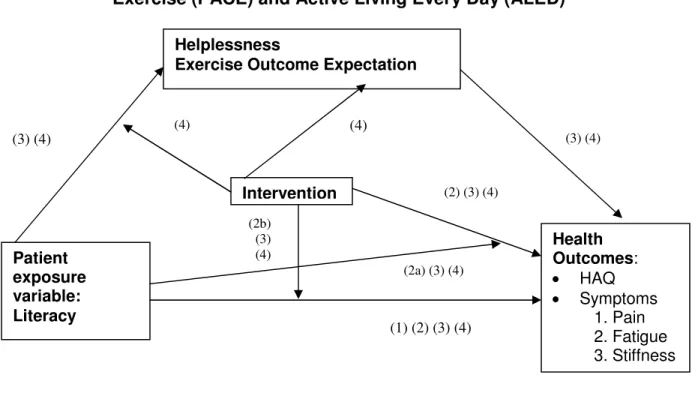
The conceptual model for this study illustrates the elements used to evaluate the following specific aims (Figure 3.1):
1. Evaluate the associations between literacy and arthritis
outcomes, specifically (a) arthritis symptoms, and (b) self-reported functional status. The hypothesis underlying this specific aim is that literacy will have a positive association with arthritis outcomes as measured by functional status and symptoms.
2. Determine whether (a) life style interventions have a differential short-term impact on arthritis outcomes for individuals with low and adequate literacy, and (b) literacy has a differential impact on arthritis outcomes for those exposed and those not exposed to the intervention. The hypotheses here are that: (a) the interventions will improve short-term arthritis outcomes differently for individuals with low and adequate literacy, and (b) For those who receive the intervention, literacy will have a weaker positive effect on the arthritis outcomes. Conversely, for those who do not receive intervention, literacy will have a stronger positive effect on arthritis outcomes.
30
4. Assess the impact of helplessness and exercise outcome expectation as mediators on the relationship between the intervention and health outcomes. Also, to determine if literacy has differential impact on helplessness and exercise outcome expectation for those exposed to the intervention and those who are not exposed to the intervention. The hypotheses here are that: (i) helplessness and exercise outcome expectation mediate the effect of the intervention on health outcomes, and (ii) literacy affects helplessness and exercise outcome expectation differently for individuals exposed to and not exposed to life style interventions.
31
Figure 3.1: Conceptual model for People with Arthritis Can Exercise (PACE) and Active Living Every Day (ALED)
Controlling for: • Age
• Gender
• Race/Ethnicity
• Co morbid conditions (non-MSK conditions)
Note: The numbers in the parenthesis denote the paths involved in specific aims 1 to 4.
3.2 Overview and Study Design
This study was approved by the Medical Institutional Review Board at the University of North Carolina. All participants gave informed consent. To test the hypotheses in the Specific Aims (above), secondary analysis of two completed randomized controlled trials (RCT) of life style interventions was conducted. These two RCT’s were conducted by Callahan and colleagues and were designed to improve health outcomes for sedentary adults with Patient
exposure variable: Literacy
Helplessness
Exercise Outcome Expectation
Health Outcomes: • HAQ • Symptoms 1. Pain 2. Fatigue 3. Stiffness
Intervention
(1) (2) (3) (4) (3) (4)
(4) (4)
(2) (3) (4)
(2b) (3) (4)
(3) (4)
32
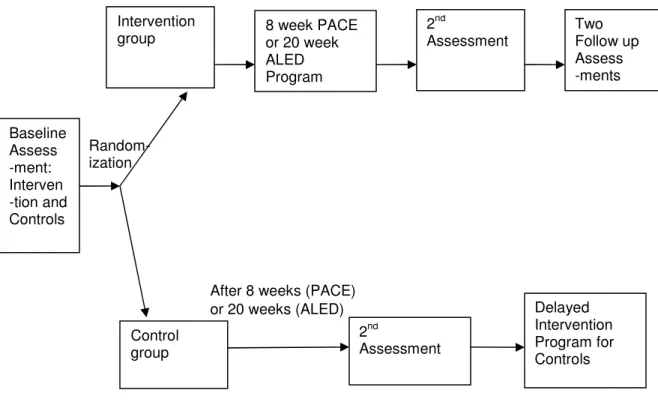
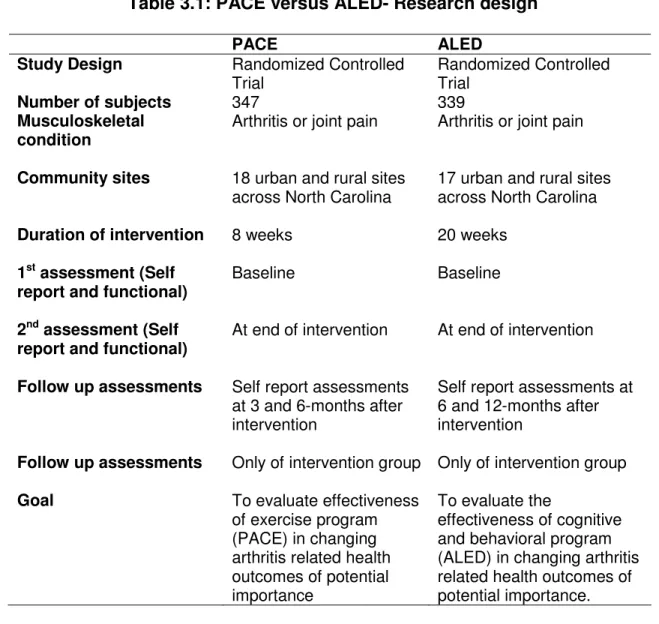
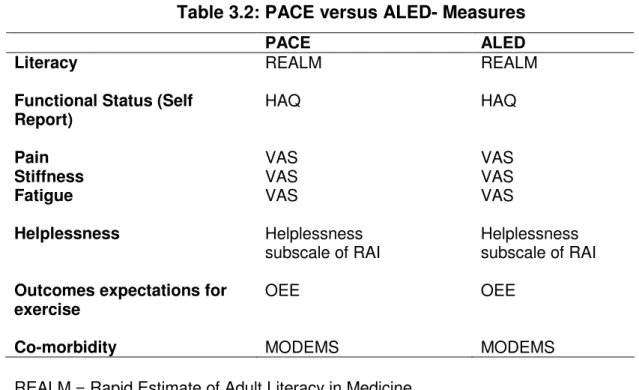
arthritis. People with Arthritis Can Exercise (PACE) evaluated an 8-week exercise program, and Active Living Every Day (ALED) evaluated a 20-week physical activity behavioral modification intervention. The PACE participants met twice a week, resulting in 16 sessions of an hour each, while the ALED participants met once a week, ensuing 20 hourly sessions. A schematic of the PACE and ALED study designs is illustrated in Figure 3.2. Although there are some differences in research design (Table 3.1) and measures (Table 3.2), the studies were sufficiently similar to allow us to combine the two data sets to test the hypotheses (Table 3.3). Continuous variables for the two studies PACE and ALED were compared by t tests, and the categorical variables were compared by chi square tests. Except for pain and fatigue, all other variables were not significantly different by study group. The comparison before and after sample attrition was not different by study group; hence the baseline characteristics of the two groups after sample attrition have been shown in Table 3.3. In PACE and ALED, both groups completed the first
assessment at baseline and the 2nd assessment at the completion of the
intervention which included in both studies’ self-report questionnaires. Only the intervention group completed the self report questionnaires at follow up assessment at 6 months. Manuscript examining the primary trial results of PACE are published (Callahan et al. 2008), while that of ALED are in
33
Figure 3.2: Schematic of PACE and ALED study design
Baseline Assess -ment: Interven -tion and Controls
Intervention group
Control group
8 week PACE or 20 week ALED Program
2nd
Assessment
2nd
Assessment
Two Follow up Assess -ments
Delayed Intervention Program for Controls Random-
ization
After 8 weeks (PACE) or 20 weeks (ALED) 8
34
Table 3.1: PACE versus ALED- Research design
PACE ALED
Study Design Randomized Controlled Trial
Randomized Controlled Trial
Number of subjects 347 339
Musculoskeletal condition
Arthritis or joint pain Arthritis or joint pain
Community sites 18 urban and rural sites across North Carolina
17 urban and rural sites across North Carolina
Duration of intervention 8 weeks 20 weeks
1st assessment (Self report and functional)
Baseline Baseline
2nd assessment (Self report and functional)
At end of intervention At end of intervention
Follow up assessments Self report assessments at 3 and 6-months after intervention
Self report assessments at 6 and 12-months after intervention
Follow up assessments Only of intervention group Only of intervention group
Goal To evaluate effectiveness of exercise program (PACE) in changing arthritis related health outcomes of potential importance
To evaluate the
35
Table 3.2: PACE versus ALED- Measures
PACE ALED
Literacy REALM REALM
Functional Status (Self Report)
HAQ HAQ
Pain VAS VAS
Stiffness VAS VAS
Fatigue VAS VAS
Helplessness Helplessness subscale of RAI
Helplessness subscale of RAI
Outcomes expectations for exercise
OEE OEE
Co-morbidity MODEMS MODEMS
REALM = Rapid Estimate of Adult Literacy in Medicine HAQ = Health Assessment Questionnaire
VAS = Visual Analogue Score RAI = Rheumatology Attitudes Index OEE = Outcome expectation for exercise
36
Table 3.3: PACE versus ALED- Baseline characteristics (after sample attrition)
PACE ALED
REALM 61.3 62.7
REALM < 9th grade 43 (22.5%) 30 (15%)
Age (years) 69.6 68.0
Female 172 (90.1%) 168 (84%)
White 151 (79.1%) 159 (79.5%)
African American 34 (17.8%) 35 (17.5%)
Less than high school 22 (11.5%) 15 (7.5%)
Retired 104 (54.5%) 103 (51.5 %)
Married 93 (48.7%) 117 (58.5%)
BMI 28.6 29.9
Co-morbidity 1.6 1.6
Intervention group 92 (48.2%) 104 (52%)
HAQ 1.1 0.95
Pain* 48.8 42.8
Fatigue* 46.9 39.6
Stiffness 43.6 45.9
Helplessness 2.4 2.5
Outcome expectation for exercise
4.0 4.0
* p< 0.05. There are 391 observations.
REALM = Rapid Estimate of Adult Literacy in Medicine BMI = Body Mass Index
HAQ = Health Assessment Questionnaire
3.2.1 Research participants
37
resulting from arthritis or joint pain; (2) were currently exercising less than 3 times a week for less than 20 minutes; and (3) were mentally competent. No tests for detecting poor vision or cognitive impairment were performed.
3.2.2 Intervention
PACE evaluated the effectiveness of an 8-week exercise program and ALED studied a 20-week physical activity behavioral modification intervention. Both studies used similar approaches to encouraging behavioral change, although ALED was a non-exercise program. However, both studies were not exclusively designed for low literacy participants.
In the PACE program, participants were offered a basic level program, the group met for 1-hour sessions twice a week. Hence it was a 16-lesson course. The PACE program, designed by the National Arthritis Foundation, consists of gentle strengthening, balance, range-of-motion, and endurance exercises at a basic level appropriate for individuals with functional limitations, plus education in proper body mechanics, relaxation techniques, and
behavioral strategies to build self-esteem.
The ALED program was developed jointly by the Cooper Institute, Brown University, and Human Kinetic for the general population (Dunn et al., 1998). The group met for 1-hour sessions once a week for 20 weeks,
38
contains worksheets and assignments. Besides the textbook, participants received a pedometer to be used outside of class for motivation and monitoring of steps. Participants discussed ways to identify and overcome barriers to physical activity. The textbook provided to the participants in ALED was seventh grade. The information in the book was repeated by the instructors when the class met. Anecdotally, research personnel reported that higher socioeconomic status individuals complained that the material they read in the books was repetitive in the class. This way it was ensured that the low literacy individuals benefited from the intervention, even if they were unable to comprehend everything in the book.
In both programs, participants received considerable social support from other adults, and their instructors. The main factors that motivated the participants was the ability to work at their own pace, exercising “bit by bit”; and being able to share and derive support from other participants, as the entire group had arthritis related limitations. All this support and the
behavioral strategies increased their confidence that they could do different kinds of exercise safely.
3.2.3 Procedures
39
tests in both studies. The intervention group took the course immediately and the control group started the course after completion of an assessment in eight weeks (PACE) or 20 weeks (ALED). In ALED, some participants from the intervention moved to the control group, citing disappointment that the intervention was not a physical exercise program. Hence, the final grouping in ALED was a modified intention to treat (MITT).
3.2.4 Instrumentation
Both groups completed the Rapid Estimate of Adult Literacy in Medicine (REALM) questionnaire.
Self-Report Questionnaire: Self-report questionnaire included demographics, health-related quality of life, functional status and co morbid conditions. Demographic measures were age, race/ethnicity, marital status, educational level, gender, body mass index (BMI) and current work status. After
demographic measures, information was taken on health-related quality of life, functional status and co morbid conditions, all described below in the measures section. Further, self report measures of helplessness (subscale of rheumatology attitude index) and outcome expectation for exercise was collected.
3.2.5 Measures
Table 3.2 summarizes the measures used in PACE and ALED.
40
two studies, most measures central to the conceptual model and research goals were identical. Literacy was assessed with the Rapid Estimate of Adult Literacy in Medicine (REALM), a validated and widely-used measure of reading ability (Davis et al., 1993; Davis et al., 1998). This is a word recognition test, in which subjects read from a list of 66 routinely used lay medical items arranged in order of complexity and pronunciation difficulty. Most people with a normal level of literacy will complete the test in 2-3 minutes. It has high criterion validity, correlating 0.88 with the Wide Range Achievement Test-Revised, 0.97 with the Peabody Individual Achievement Test-Revised, and 0.84 with the Test of Functional Health Literacy in Adults (Davis et al., 1998).
REALM scores between 0 to 18 indicate a third-grade reading level or lower, 19 to 44 a fourth to sixth-grade reading level, 45 to 60 a seventh to eight-grade level, and 61 to 66 indicate a high school reading level or above. However, in this study REALM will be dichotomized because of the small sample size of low literacy individuals (<9th grade vs. ≥9th grade; a common cut-point (Gordon et al., 2002)).
Primary dependent variables:
41
difficulty in performing activities of daily living and disease progression. It queries 20 specific functions, grouped into 8 categories: dressing, grooming, arising, eating, walking, personal hygiene, reaching and gripping. The HAQ is scored from 0 to 3, with 0 = no difficulty and 3 = unable to do (Ramey,
Raynauld, and Fries, 1992; Wolfe, 2001; Fries et al., 1980). Performance based measures included timed chair stands, timed 360 degree turns, and walking speed at normal and fast paces (Steffen, Hacker, and Mollinger, 2002; Guralnik et al., 2000). However these outcomes could not be included
as they had a large number of missing values at 2nd assessment. Hence data
including missing values of performance based tests were deleted, and have not been described.
To assess arthritis symptoms, patients completed visual analog scales (VAS) for pain (Burckhardt and Jones, 2003), stiffness and fatigue (Wolfe,
2004). Pain experienced over the past week was assessed using a
100-millimeter (mm) VAS, with 0 indicating “No pain” and 100 indicating “Pain as bad as it could be.” A study of literate and low literate patients with
rheumatoid arthritis showed high reliability of the VAS coefficient (Ferraz et
al., 1990). VAS fatigue is a single item scale. It measures severity of fatigue
42
Table 3.4: Description of dependent variables for specific aim 1a
Variable Description Type Notes Baseline Health
Assessment Questionnaire (HAQ)
Ability to do everyday activities (low=no problem; high=unable) measured at baseline
Continuous This variable will be an independent variable for specific aim 1b, 2, 3, and 4(i); for the dependent variable final HAQ
Baseline pain Pain experienced over the past week measured in
millimeter (0-100) by Visual Analogue Scale (VAS) at baseline
Continuous This variable will be an independent variable for specific aim 1b, 2, 3, and 4(i); for the dependent variable final pain
Baseline fatigue Fatigue experienced over the past week measured in
millimeter (0-100) by VAS at baseline
Continuous This variable will be an independent variable for specific aim 1b, 2, 3, and 4(i); for the dependent variable final fatigue
Baseline stiffness Fatigue experienced over the past week measured in
millimeter (0-100) by VAS at baseline
43
Table 3.5: Description of dependent variables for specific aim1b, 2, 3 and 4(i)
Variable Description Type
Final HAQ Ability to do everyday activities (low=no problem; high=unable) measured at end of intervention
Continuous
Final Pain Pain experienced over the past week measured in millimeter (0-100) by VAS at end of intervention
Continuous
Final Fatigue Fatigue experienced over the past week measured in millimeter (0-100) by VAS at end of intervention
Continuous
Final Stiffness Fatigue experienced over the past week measured in millimeter (0-100) by VAS at end of intervention
Continuous
HAQ = Health Assessment Questionnaire VAS = Visual Analogue Score
Mediating variables
Two variables are hypothesized to mediate the relationship between literacy and health outcomes: helplessness, and outcome expectations for
exercise (Table 3.5). Helplessness was measured using the five-item
subscale of Rheumatology Attitudes Index (RAI) (Brady, 2003; Callahan, Brooks, and Pincus, 1988; DeVellis, and Callahan, 1993) (e.g., “Arthritis is controlling my life.”) Responses are measured using a 5-point Likert scale, with 1= strongly disagree to 5= strongly agree. Total score is a summation of all items. Internal consistency is 0.67-0.70. There is a correlation of 0.79 between full RAI and RAI helplessness scale (Brady, 2003).
44
response and dividing by the number of responses, yielding a range from one to five points. One item, “exercise gives me a sense of personal
accomplishment” was inadvertently omitted from the scale employed in the studies. One indicates low outcome expectation for exercise and 5 is an indication for strong outcome expectations for exercise. There is sufficient evidence for internal consistency of the OEE scale with an alpha coefficient of 0.89-0.93. The test-retest reliability measured at 2-week interval is 0.76
45
Table 3.6: Description of independent and other study variables
Variable Description/Categories Type Primary independent variable
REALM Rapid Estimate of Adult Literacy in
Medicine measured at baseline: Low literacy < 9th grade
Adequate literacy ≥ 9th grade
Dichotomous
Other explanatory/control variables
Age Age in years calculated by date of birth
(34 -95)
Continuous
Sex Dichotomous
Race White, African American, Other Race Dummy
variables Highest degree or level
of school
Less than high school, high school, some college, college degree
Dummy variables Current work Working, homemaker, disabled, retired,
other
Dummy variables Marital status Married/living with significant other,
separated/divorced, widowed, single
Dummy variables Body mass index (BMI) BMI calculated as (weight*0.454)/
(height in feet*12+height in inches)/39.37)^2
Normal weight, overweight, obese
Dummy variables
Co-morbid Other non-arthritis conditions scored as
a count of other conditions
Count
Intervention Intervention group or control group Dummy
variable
Mediating variables
Helplessness Feeling of helplessness (high=helpless) Continuous Outcome expectation of
exercise
Expected benefits of exercise (high =strong belief)
Continuous
Demographic measures
Several demographic variables are utilized as controls and include age (computed by date of birth), race, marital status, educational level, gender, current employment status and body mass index (BMI) in both studies (Table
3.5). BMI was measured in kg/m2 and was computed by height and weight
46
the chronic conditions (Evaluating Outcomes of Total Hip & Total Knee Replacements). Co-morbidity scores range from 0 to 11, which is a
non-weighted count of such non-musculoskeletal conditions as heart disease, lung disease, hypertension, kidney disease, ulcer/stomach disease, stroke or mini-stroke, diabetes, and cancer.
3.3 Human subjects review
The research projects from which these data come were originally submitted and approved by the Institutional Review Board (IRB) at the
University of North Carolina, School of Medicine and East Carolina University in 2002 and 2003. The secondary analysis research project was submitted and approved by the IRB at the School of Public Health, University of North Carolina in 2006.
3.4 Data analysis
The specific aims will involve control and intervention groups at baseline, and at intervention completion, specifically:
• To evaluate the association between literacy and arthritis symptoms and
self-reported functional status (Specific Aim 1), cross-sectional studies will be conducted using the baseline data and a longitudinal study using the intervention completion data.
47
determine whether literacy has a different impact on arthritis outcomes for those exposed and those not exposed to the intervention (Specific Aim 2); differences between control and intervention groups will be examined (both overall and for individuals with low and adequate literacy) using data gathered at baseline and at intervention completion.
• To assess the impact of mediators (helplessness and exercise outcome
expectation) on the relationship between literacy and health outcomes (Specific Aim 3), data collected at baseline and at intervention completion will be used.
• To assess the impact of mediators (helplessness and exercise outcome
expectation) on the relationship between intervention and health outcomes and to determine if literacy has differential impact on mediators
(helplessness and exercise outcome expectation) for those exposed to the intervention and those who are not exposed to the intervention (Specific Aim 4), data collected at baseline and at intervention completion will be used.
The overall goal of data analysis is to examine if life style
48
Aim 1 involves cross-sectional (1a) and longitudinal (1b) analyses of the appended data to identify associations between literacy and arthritis outcomes in this sedentary population. The literacy variable, REALM, will be dichotomized (<9th grade vs. >=9th grade; a common cut-point (Gordon et al., 2002; Davis et al., 1993)), and will serve as the primary independent variable in the linear regression models. Models will be run with each primary
dependent variable (HAQ and arthritis symptoms) at baseline and at
intervention completion. Linear regression models in the 4 specific aims will be controlled for age, gender, race, BMI, marital status, current work status and co-morbid conditions. Literacy and education probably have bidirectional causal relationships (Wolf, Gazmararian, & Baker, 2005), and both may operate in the same causal pathway for arthritis outcomes. Therefore, models will be run with and without educational level to estimate the association. The linear regression models for this aim are:
Aim 1a
Arthritis Health Status at baseline*, bHAQ = βo + β1literacy + β2age +
β3gender +β4race + β5BMI + β6work_status + β7marital_status
+β8education + β9comorbid
Aim 1b
Arthritis Outcome, fHAQ = βo + β1bHAQ+ β2literacy + β3age + β4gender
+β5race + β6BMI+ β7work_status+β8marital_status+ β9education +
β10comorbid