Characteristics and outcomes of older
HIV-infected patients receiving antiretroviral
therapy in Malawi: A retrospective
observation cohort study
Hannock Tweya1,2*, Caryl Feldacker3, Tom Heller2, Salem Gugsa2,3, Wingston Ng’ambi2, Omisher Nthala2, Mike Kalulu2, Jane Chiwoko2,
Rabecca Banda2, Agness Makwinja2, Sam Phiri2,4
1 The International Union Against Tuberculosis and Lung Disease, Paris, France, 2 Lighthouse Trust,
Lilongwe, Malawi, 3 International Training and Education Center for Health, University of Washington, Seattle, Washington, United States of America, 4 Department of Medicine, University of North Carolina School of Medicine, Chapel Hill, North Carolina, United States of America
Abstract
Objective
To estimate patients enrolling on antiretroviral therapy (ART) over time; describe trends in baseline characteristics; and compare immunological response, loss to follow-up (LTFU), and mortality by three age groups (25–39, 40–49 and50 years).
Design
A retrospective observation cohort study.
Methods
This study used routine ART data from two public clinics in Lilongwe, Malawi. All HIV-infected individuals, except pregnant or breastfeeding women, aged25 years at ART initi-ation between 2006 and 2015 were included. Poisson regression models estimated risk of mortality, stratified by age groups.
Results
Of 37,378 ART patients, 3,406 were50 years old. Patients aged50 years initiated ART with more advanced WHO clinical stage and lower CD4 cell count than their younger coun-terparts. Older patients had a significantly slower immunological response to ART in the first 18 months on ART compared to patients aged 25–39 years (p = 0.04). Overall mortality rates were 2.3 (95% confidence Interval (CI) 2.2–2.4), 2.9 (95% CI 2.7–3.2) and 4.6 (95% CI 4.2–5.1) per 100 person-years in patients aged 25–39 years, 40–49 years and 50 years and older, respectively. Overall LTFU rates were 6.3 (95% CI 6.1–6.5), 4.5 (95% CI 4.2–4.7), and 5.6 (95% CI 5.1–6.1) per 100 person years among increasing age cohorts. The propor-tion of patients aged50 years and newly enrolling into ART care remained stable at 9%
a1111111111 a1111111111 a1111111111 a1111111111 a1111111111
OPEN ACCESS
Citation: Tweya H, Feldacker C, Heller T, Gugsa S, Ng’ambi W, Nthala O, et al. (2017) Characteristics and outcomes of older HIV-infected patients receiving antiretroviral therapy in Malawi: A retrospective observation cohort study. PLoS ONE 12(7): e0180232.https://doi.org/10.1371/journal. pone.0180232
Editor: Dimitrios Paraskevis, National and Kapodistrian University of Athens, GREECE
Received: November 20, 2016
Accepted: June 12, 2017
Published: July 7, 2017
Copyright: This is an open access article, free of all copyright, and may be freely reproduced, distributed, transmitted, modified, built upon, or otherwise used by anyone for any lawful purpose. The work is made available under theCreative
Commons CC0public domain dedication.
while the proportion of active ART patients aged50 years increased from 10% in 2006 to 15% in 2015.
Conclusion
Older people had slower immunological response and higher mortality. Malawi appears to be undergoing a demographic shift in people living with HIV. Increased consideration of long-term ART-related problems, drug-drug interactions and age-related non-communicable diseases is warranted.
Introduction
As scale-up of antiretroviral therapy (ART) continues in sub-Saharan Africa (SSA), increasing numbers of older people will start ART and need long-term ART care. By 2040, the number of HIV-infected people aged 50 years or older will nearly triple in SSA from an estimated 3.1 mil-lion in 2011 to 9.1 milmil-lion. These older people will account for 25% of all infections in the region [1].
Previous research in developed countries suggests that older HIV-infected people receiving ART have different characteristics at diagnosis and clinical outcomes compared to younger HIV-infected people. Older HIV-infected people have more advanced AIDS-related condi-tions at diagnosis [2,3], faster HIV progression to AIDS and higher mortality than their young counterparts [4,5]. In addition, older HIV-infected individuals mount slower immunological response to ART and have more frequent ART-related toxicities[6,7]. Despite these findings suggesting the existence of age-related disparities, other studies contradicted these, noting sim-ilar findings of all ages [8–10].
In sub-Saharan Africa, there is a paucity of research on older populations on ART [11,12]. Among the few studies that described baseline characteristics, immunological response and mortality among older patients starting ART, small sample sizes [13,14] and high loss to follow-up (LTFU) [15,16] limit generalizability of the findings. Furthermore, few studies empirically explored the increase in numbers of older HIV-infected cohorts receiving ART in resource-limited settings[15][17]. The evidence base, overall, is sparse and inconclusive. We, therefore, (i) estimated the proportions of HIV-infected patients newly enrolling and active on ART by three age groups (25–39, 40–49 and50 years) over time, (ii) described trends in baseline characteristics and (iii) compared immunological responses, LTFU and mortality across the age groups from a large, ART cohort in Lilongwe, Malawi.
Methods
Study design, population and setting
This retrospective cohort study uses data from routine ART services delivered at Lighthouse Trust’s two public HIV clinics, Lighthouse and Martin Preuss Centre (MPC). Lighthouse and MPC are described in detail elsewhere [18]. In brief, the clinics are high-patient load facilities located in Malawi’s capital, Lilongwe. Both clinics use a real-time, point-of-care, electronic medical record system (EMRs) for patient management where the study data were obtained. Combined, Lighthouse and MPC have 31,311 ART patients, respectively.
Funding: The authors received no specific funding for this work.
All HIV-infected individuals, aged 25 years and older, who initiated ART between January 2006 and December 2015 were included in the study. Pregnant or breastfeeding women were excluded as criteria for ART initiation differed from the other HIV-infected individuals.
Data collection through the EMRs
During the study period, all individuals diagnosed with HIV were registered for ART care in the EMRs. Patients were initiated on ART based on WHO clinical staging (3 or 4) or CD4 cell count if they had WHO clinical stage 1 or 2 conditions [19–21]. ART eligibility based on CD4 cell count changed during the study period: CD4 cell counts200 cells/μl was used before 2008, CD4 cell counts250 cells/μl between 2008 and 2010, CD4 cell counts350 cells/μl between 2011 and 2013 and CD4 cell counts500 cells/μl in 2014 and 2015. Between January 2006 and June 2011, all ART eligible patients were initiated on Stavudine Lamivudine and Nevirapine and from July 2011 onwards on Tenofovir Lamivudine and Efavirenz, as first line regimen. Routine return visits were scheduled monthly during the first six months on ART and every two or three months thereafter if no clinical complications occurred. CD4 cell count monitoring was used between 2006 and 2013, thereafter, virological monitoring was used. CD4 cell counts were performed every 6 months after ART initiation. Some patients had no CD4 counts at specific monitoring milestones due to the unavailability of CD4 count testing services. Deaths were generally updated retrospectively after active tracing of patients who missed their appointments. Patients were classified as LTFU if they did not return to the clinic after 60 days from the day they were expected to run out of ARVs.
Statistical analysis
Patients were categorised into three age groups: 25–39, 40–49 and50 years. Trends in base-line characteristics, mortality and LTFU were compared by age at ART initiation. Age at the beginning of the calendar year was used in determining proportions of active HIV-infected patients on ART each year. For person-time calculation, the analysis period began when patients initiated on ART at the facility. Patients who transferred in on ART from another facility were considered to come under observation when first registered at the study clinics, and their previous time on ART was accounted for. Observation of ‘time at risk’ of mortality or LTFU ended either at the time of death, LTFU or the censoring date (31stDecember 2015). Poisson regression models were used to assess crude and adjusted associations between patients’ characteristics and mortality. To compare risk factors for death, we stratified the models by two age groups at ART initiation: 25–39 and50 years. Gender was included in the multivariable modelsa priori. Significant factors at p<0.05 level in univariable models were included in multivariable models. Analysis was conducted using Stata 12.0.
Ethical approval
The study was approved by the National Health Science Research Committee in Lilongwe, Malawi and the Ethics Advisory Group of the International Union Against Tuberculosis and Lung Disease in Paris, France. The ethics committees waived the need for patient consent because the study used routine program data and did not include any personal identifiers.
Results
because they started lifelong ART for PMTCT and 653 patients had no ARV dispensing visit after registering as transfer-in, leaving 37,378 patients eligible for this analysis.
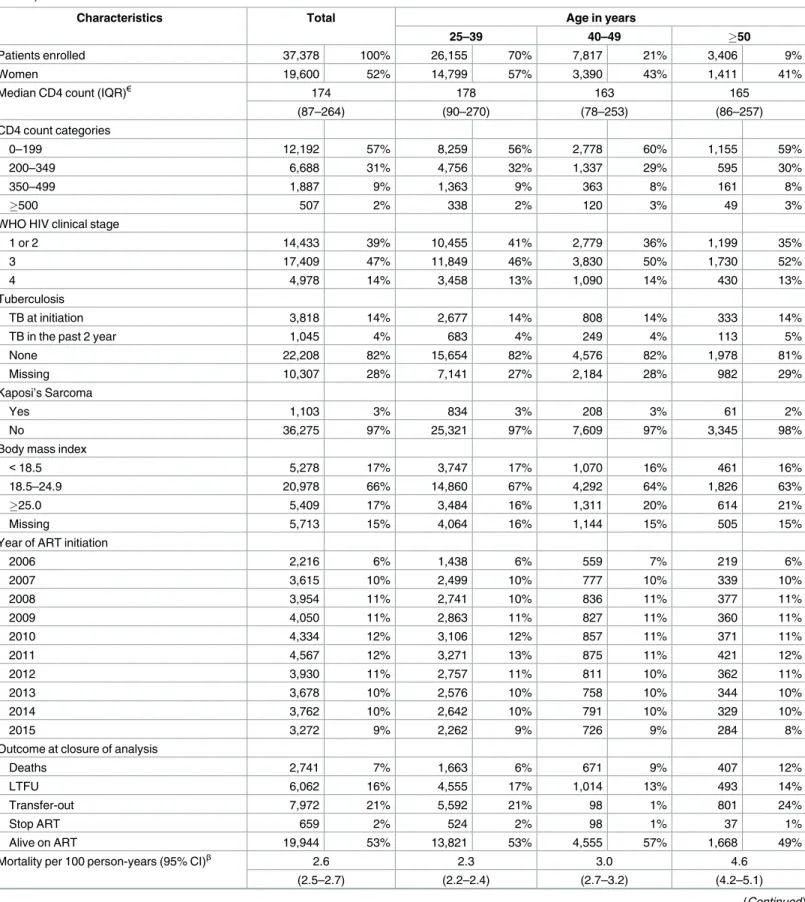
Total follow-up time was 103,559 person-years with a median of 1.83 (Interquartile range (IQR) 0.50–4.49) years. A total of 3,406 patients (9%) initiated ART at age50 years (Table 1). Overall, the cohort was 52% female, the proportion of females initiating ART decreased with age, with females comprising 41% of those aged50 years. Median age at ART initiation was 35 years old (IQR 30–41). Median CD4 cell count at ART initiation was similar in patients aged 40–49 years (163 cells/μl) and50 years (165 cells/μl) (p= 0.16) but lower compared to patients aged 25–39 years (174 cells/μl) (p<0.001). More older patients had WHO clinical stage 3 or 4 conditions than those aged 25–39 years at ART initia-tion (p<0.001). Proportions of patients with body mass index (BMI)<16.0 and tuberculosis (TB) at ART initiation were similar across the age groups.
Proportion of older HIV-infected patients initiating ART with WHO clinical stage 3 or 4, TB and KS decreased in each successive year between 2006 and 2015 (p<0.01 for trend) (Table 2). We noted a similar decline in younger age groups (S1 Table). The proportion of older male patients initiating ART increased in each successive year during the study period, although this trend was not significant (p = 0.146 for trend).
The proportion of older patients initiating ART care remained stable at 9% while the pro-portion of active older ART patients increased from 10% in 2006 to 15% in 2015 (Fig 1).
Immunological response
Given that the Malawi ART program stopped CD4 monitoring in 2013, analysis of CD4 count response was done in ART patients who had ARV visits between Jan, 2006 and Dec, 2012 only. Among those included, CD4 counts were available for 17% (4176 of 23,583), 15% (3012 of 20,039) and 6% (1550 of 19,822) at 6, 12 and 24 months after ART initiation, respectively. Pro-portion of missing CD4 counts were similar in all age groups. The respective median CD4 cell counts at ART initiation among patients aged 25–39, 40–49 and 50 years and older were 163 cells/μl (IQR 81–244), 153 cells/μl (IQR 74–237) and 154 cells/μl (IQR 80–242), not significant statistically (p = 0.13). However, CD4 cell count response was significantly different over time on ART between older and younger patients (Fig 2).
Mortality and loss to follow-up
Higher proportion of patients aged 50 years or older (12%) and patients aged 40–49 years (9%) died during follow-up compared to patients aged 25–39 years (9%). Overall mortality rates were 2.3 (95% confidence Interval (CI) 2.2–2.4), 2.9 (95% CI 2.7–3.2) and 4.6 (95% CI 4.2–5.1) per 100 person-years in patients age 25–39 years, 40–49 years and 50 years and older, respec-tively. At six months on ART, the cumulative probabilities of death were 5%, 6% and 9% while at 24 months, the probabilities of death were 7%, 10% and 14%, among increasing age cohorts, respectively (log-rank test p<0.001).
For mortality comparisons, we compared the factors influencing mortality rates between the youngest and the older age group only. Being male, WHO clinical stage 3 or 4 and BMI
Table 1. Baseline characteristics, loss to follow-up and mortality, by age at ART initiation between 2006 and 2015 at Lighthouse and Martin Preuss clinics, Malawi.
Characteristics Total Age in years
25–39 40–49 50
Patients enrolled 37,378 100% 26,155 70% 7,817 21% 3,406 9%
Women 19,600 52% 14,799 57% 3,390 43% 1,411 41%
Median CD4 count (IQR)€ 174 178 163 165
(87–264) (90–270) (78–253) (86–257)
CD4 count categories
0–199 12,192 57% 8,259 56% 2,778 60% 1,155 59%
200–349 6,688 31% 4,756 32% 1,337 29% 595 30%
350–499 1,887 9% 1,363 9% 363 8% 161 8%
500 507 2% 338 2% 120 3% 49 3%
WHO HIV clinical stage
1 or 2 14,433 39% 10,455 41% 2,779 36% 1,199 35%
3 17,409 47% 11,849 46% 3,830 50% 1,730 52%
4 4,978 14% 3,458 13% 1,090 14% 430 13%
Tuberculosis
TB at initiation 3,818 14% 2,677 14% 808 14% 333 14%
TB in the past 2 year 1,045 4% 683 4% 249 4% 113 5%
None 22,208 82% 15,654 82% 4,576 82% 1,978 81%
Missing 10,307 28% 7,141 27% 2,184 28% 982 29%
Kaposi’s Sarcoma
Yes 1,103 3% 834 3% 208 3% 61 2%
No 36,275 97% 25,321 97% 7,609 97% 3,345 98%
Body mass index
<18.5 5,278 17% 3,747 17% 1,070 16% 461 16%
18.5–24.9 20,978 66% 14,860 67% 4,292 64% 1,826 63%
25.0 5,409 17% 3,484 16% 1,311 20% 614 21%
Missing 5,713 15% 4,064 16% 1,144 15% 505 15%
Year of ART initiation
2006 2,216 6% 1,438 6% 559 7% 219 6%
2007 3,615 10% 2,499 10% 777 10% 339 10%
2008 3,954 11% 2,741 10% 836 11% 377 11%
2009 4,050 11% 2,863 11% 827 11% 360 11%
2010 4,334 12% 3,106 12% 857 11% 371 11%
2011 4,567 12% 3,271 13% 875 11% 421 12%
2012 3,930 11% 2,757 11% 811 10% 362 11%
2013 3,678 10% 2,576 10% 758 10% 344 10%
2014 3,762 10% 2,642 10% 791 10% 329 10%
2015 3,272 9% 2,262 9% 726 9% 284 8%
Outcome at closure of analysis
Deaths 2,741 7% 1,663 6% 671 9% 407 12%
LTFU 6,062 16% 4,555 17% 1,014 13% 493 14%
Transfer-out 7,972 21% 5,592 21% 98 1% 801 24%
Stop ART 659 2% 524 2% 98 1% 37 1%
Alive on ART 19,944 53% 13,821 53% 4,555 57% 1,668 49%
Mortality per 100 person-years (95% CI)β 2.6 2.3 3.0 4.6
(2.5–2.7) (2.2–2.4) (2.7–3.2) (4.2–5.1)
at ART initiation while no statistical differences were observed among those aged 50 years and above. KS at ART initiation was associated with higher risk for death in younger patients only. Overall LTFU rates were 6.3 (95% CI 6.1–6.5), 4.5 (95% CI 4.2–4.7), and 5.6 (95% CI 5.1– 6.1) per 100 person years among increasing age cohorts. The cumulative probabilities of LTFU were 7%, 5% and 7% during the first 6 months on ART, and 18%, 13% and 15% at 24 months on ART among increasing age cohorts (log-rank test p<0.001).
Table 1. (Continued)
Characteristics Total Age in years
25–39 40–49 50
Loss to follow-up (95% CI) 5.9 6.3 4.5 5.6
(5.7–6.0) (6.1–6.5) (4.2–4.7) (5.1–6.1)
Median follow-up time (years) 1.83 1.82 2.00 1.55
ART: antiretroviral therapy; CI: confidence interval;
€CD4 tests were regularly done in patients not eligible based on WHO HIV clinical stage; βp<0.001 for ages 25–39 vs 40–49 and ages 40–49 vs 50 and above;
https://doi.org/10.1371/journal.pone.0180232.t001
Table 2. Baseline characteristics of adult patients (aged50) starting ART, by year of ART initiation.
Baseline characteristics Total (n (%)) Year of ART initiation
2006–2007 2008–2009 2010–2011 2012–2013 2014–2015 p-value*
Total enrolled 3406 9% 558 10% 737 9% 792 9% 706 9% 613 9%
Male sex 1995 59% 313 56% 428 58% 473 60% 406 58% 375 61% 0.146
WHO HIV clinical stage <0.001
1 or 2 1199 36% 84 15% 206 28% 252 32% 308 44% 349 59%
3 1730 52% 381 69% 415 57% 423 54% 300 43% 211 35%
4 430 13% 86 16% 108 15% 111 14% 89 13% 36 6%
Median CD4 count (IQR)€ 165 (86–257) 145 (77–224) 143 (74–220) 139 (70–233) 201(101–282) 260 (131–364)
CD4 count <0.001
0–199 1155 59% 247 68% 324 69% 276 66% 167 50% 141 38%
200 805 41% 117 32% 147 31% 145 34% 167 50% 229 62%
Missing 1446 42% 194 35% 266 36% 371 47% 372 53% 243 40%
Body mass index 0.314
<18.5 461 16% 72 16% 95 16% 130 19% 84 15% 80 14%
18.5 2440 84% 391 84% 495 84% 572 81% 491 85% 491 86%
Missing 505 15% 95 17% 147 20% 90 11% 131 19% 42 7%
Tuberculosis <0.001
Present & past within 2 years 446 18% 94 49% 160 29% 116 18% 45 8% 31 6%
None 1978 82% 98 51% 397 71% 529 82% 492 92% 462 94%
Missing 982 29% 366 66% 180 24% 147 19% 169 24% 120 20%
Kaposi’s Sarcoma 0.008
Yes 61 2% 16 3% 17 2% 13 2% 7 1% 8 1%
No 3345 98% 542 97% 720 98% 779 98% 699 99% 605 99%
*P-value for trend excluding missing category;
€CD4 tests were done in patients who were not ART eligible based on WHO HIV clinical stage
Discussion
This is one of the first empirical studies from Malawi showing an increase in the proportion of patients aged50 years receiving ART and initiating ART with less compromised immune systems over time. Older patients aged50 years had slower immunological response to ART in the first 18 months on ART compared to patients aged 25–39 years. Older patients
aged50 years had double the mortality of younger patients aged 25–39 years. LTFU was lower among those aged50 years when compared to younger patients aged 25–39 years.
Similar to previously published studies[2,3], older HIV-infected patients presented with a higher proportion of advanced WHO clinical stages at ART initiation. For those with baseline CD4 counts available for analysis and with WHO stages 1 or 2, the median CD4 cell count at initiation was lower among patients in the older age group although it was not statistically dif-ferent. Our findings contradict previous Malawian research suggesting that older patients were not sicker than their younger counterparts[16]. Older people living with HIV may access health services less than younger patients [22,23]. As a result, they may be enrolled in HIV care Fig 1. Proportion of older patients (50+years) receiving antiretroviral therapy (ART) at Martin Preuss and Lighthouse clinics between 2006 and 2015.
https://doi.org/10.1371/journal.pone.0180232.g001
Fig 2. Median CD4 count by age at antiretroviral therapy (ART) and duration on ART.
at a more advanced HIV disease stages than younger people. Additionally, healthcare provid-ers may have a lower index of suspicion of HIV infection in older people[24]; therefore, they may be less likely offer HIV tests. Although older people generally tended to present with more advanced HIV disease, we observed a decreasing trend in the proportion of those with advanced WHO clinical stages at ART initiation during the study period. While in 2006 and 2007, 85% of these older patients had WHO clinical stage 3 or 4 conditions at ART initiation, this declined to 41% by 2014 and 2015. Older patients also initiated ART with increasingly higher CD4 counts in later years, therefore, with less compromised immune systems. It is pos-sible that some decline in advanced HIV conditions at ART initiation was due to changes in ART guidelines rather than changes in behavior. Initiating ART with higher CD4 count and/ or less immunocompromised can reduce patient‘s viral load to undetectable levels more swiftly than among patients who initiate treatment late [25]. Healthcare providers should intensify provider-initiated HIV testing and counseling among older people and actively link them to HIV care is warranted.
Patients who were 50 years and older showed a significantly lower immunological response to ART in the first 6 to 18 months compared to patients aged 25–39 years. These findings are in concordance with previously published evidence that older patients mount poorer CD4 cell count response than younger patients[13–14]. There was no significant difference in immuno-logical responses between patients aged 25–39 and those aged 40–49. Independent of HIV infection, age is associated with a reduced production of naive T cells and diminished T cell functionality[26].
Table 3. Univariable and multivariable model of characteristics associated with mortality among adult ART patients aged 25–49 years and those aged50 years.
Univariable analysis Multivariable analysis
Characteristics at ART initiation 25–39 years 50 years 25–39 years 50 yearsŦ
RR (95% CI) P-value RR (95% CI) P-value RR (95% CI) P-value RR (95% CI) P-value
Sex <0.001 <0.001 <0.001 <0.001
Female 1.00 1.00 1.00 1.00
Male 2.13 (1.93–2.34) 1.56 (1.27–1.93) 1.61 (1.43–1.81) 1.34(1.07–1.68)
WHO HIV clinical stage <0.001 <0.001 <0.001 <0.001
1 or 2 1.00 1.00 1.00 1.00
3 2.69 (2.35–3.09) 2.20 (1.70–2.85) 2.99 (2.53–3.55) 1.86 (1.41–2.44)
4 6.47 (5.57–7.50) 3.46 (2.54–4.71) 5.04 (4.15–6.14) 2.61 (1.87–3.64)
Tuberculosis 0.725 0.073 <0.001 0.189
TB at initiation 1.06 (0.92–1.23) 1.34 (1.02–1.77) 0.57 (0.48–0.66) 1.00 (0.74–1.36) TB in the past 2 year 1.02 (0.79–1.32) 0.80 (0.48–1.35) 0.68 (0.52–0.89) 0.62 (0.36–1.08)
None 1.00 1.00 1.00 1.00
Kaposi’s Sarcoma <0.001 0.296 <0.001 0.515
Yes 4.20 (3.60–4.89) 1.38 (0.78–2.45) 1.65 (1.32–2.07) 0.81 (0.42–1.55)
No 1.00 1.00 1.00 1.00
Body mass index <0.001 <0.001 <0.001 <0.001
<16 3.05 (2.73–3.40) 2.35 (1.86–2.98) 2.38 (2.10–2.70) 2.09 (1.64–2.66)
16–18.4 1.00 1.00 1.00 1.00
18.4 0.58 (0.48–0.70) 0.60 (0.44–0.82) 0.80 (0.64–0.99) 0.70 (0.50–0.96)
ART: antiretroviral therapy; CI: confidence interval; P-value for likelihood ratio test;
ŦAdjusted for sex, WHO HIV clinical stage and body mass index
Mortality on ART among the older patients was twice as high as that among younger patients aged 25–39 years. It is important to note that more patients aged50 years started ART with advanced HIV disease. Deaths among these older patients could be related to possi-ble AIDS-related conditions. Similar to another study[13], patients with advanced HIV condi-tions and male patients had increased risk for mortality in both older and younger age group. While in younger patients, KS was associated with higher mortality, this was not seen in the older group. The reduced risk of mortality in patients diagnosed with TB at ART initiation might be due missed diagnosis at baseline assessment. Patients may be classified as non TB cases but subsequently developed TB when they receive ART hence increasing the risk of mor-tality among non TB cases.
In industrialized countries, the use of ART has resulted in markedly improved life expec-tancy in HIV-infected people and a demographic shift in the age compositions of the HIV epi-demic towards older ages [27]. Our study provides early evidence of a similar shift in Malawi‘s HIV program. The proportion of HIV-infected people aged 50 years and older receiving ART increased with each successive year between 2006 and 2015. This increase is because of HIV-infected people living longer as opposed to the increased numbers of older HIV-HIV-infected peo-ple starting ART- as the proportion of those initiating ART at 50 years or above remained sta-ble during the study period. While ageing of the patient population living with HIV is an encouraging indication of effectiveness of ART treatment, it requires a shift in the focus of HIV care. To provide quality care for an ageing population, HIV-related care will need to move away from the traditional management of HIV-related opportunistic infections to increasingly address possible term ART-related problems (organ toxicities and long-standing activation of inflammatory cascades with vascular effects), drug-drug interactions and age-related non-communicable diseases(NCDs)[28–29]. A growing prevalence of NCDs complicates HIV care, requiring administration of multiple drugs (e.g. anti-hypertensive and anti-diabetics) in addition to ARVs. The increased pill burden with its effect on adherence as well as potential drug-drug interaction[30,31] may eventually lead to virological rebound. A holistic approach to HIV care involving integration of NCD and consideration of the impact of long-term ART use may begin to address the complexities of caring for aging patients on ART.
While our results are derived from a large, well-documented ART cohort and likely gener-alizable, the findings need to be interpreted within the context of several limitations. First, CD4 counts were not available for all patients at specific monitoring milestones due to the unavailability of CD4 count testing services. Second, we were unable to report HIV-related mortality as deaths were from all causes. Moreover, we might have underestimated mortality as some deaths may have been classified as LTFU simply because the true status could not be established through tracing. Lastly, we could not adjust mortality and immunological response for non-AIDS diseases as data was not available. Such diseases may be the consequences of poor response to ART.
In conclusion, older patients had advanced HIV conditions at ART initiation, slower immu-nological responses, lower rates of LTFU, and double the mortality of younger patients aged 25–39 years. Essential enhancement of HIV detection in this age group is necessary to ensure early ART initiation. Given trends in increasing proportion of older PLHIV, there is a need to focus ART care on ageing assocciated diseases including NCDs and degenerative diseases.
Supporting information
Acknowledgments
We thank the Department for International Development (DFD), UK, for funding the Global Operational Research Fellowship Programme at the International Union Against Tuberculosis and Lung Disease (The Union), Paris, France in which Dr Hannock Tweya works as a senior operational research fellow.
Author Contributions
Conceptualization: HT STG WN SP.
Data curation: RB JC AM ON MK TH.
Formal analysis: HT.
Funding acquisition: HT.
Methodology: HT STG WN CF SP.
Project administration: HT WN SP.
Supervision: HT SP TH.
Validation: HT.
Visualization: HT CF.
Writing – original draft: HT CF.
Writing – review & editing: HT CF STG WN SP RB JC AM ON MK TH.
References
1. Hontelez JA, de Vlas SJ, Baltussen R, Newell M-L, Bakker R, Tanser F, et al. The impact of antiretrovi-ral treatment on the age composition of the HIV epidemic in sub-Saharan Africa. AIDS. 2012. pp. S19–S30.https://doi.org/10.1097/QAD.0b013e3283558526PMID:22781175
2. Martin CP, Fain MJ, Klotz SA. The older HIV-positive adult: a critical review of the medical literature. Am J Med. 2008; 121: 1032–7.https://doi.org/10.1016/j.amjmed.2008.08.009PMID:19028193
3. Lacerda HR, Kitner D. Mortality of the elderly is still exceedingly high at diagnosis of AIDS despite favourable outcomes after highly active antiretroviral therapy in Recife, Brazil. Int J STD AIDS. 2008; 19: 450–4.https://doi.org/10.1258/ijsa.2008.007317PMID:18574115
4. Schneider MF, Gange SJ, Williams CM, Anastos K, Greenblatt RM, Kingsley L, et al. Patterns of the hazard of death after AIDS through the evolution of antiretroviral therapy: 1984–2004. AIDS. 2005; 19: 2009–18. Available:http://www.ncbi.nlm.nih.gov/pubmed/16260908PMID:16260908
5. Ferro S, Salit IE. HIV infection in patients over 55 years of age. J Acquir Immune Defic Syndr. 1992; 5: 348–53. Available:http://www.ncbi.nlm.nih.gov/pubmed/1548571PMID:1548571
6. Cuzin L, Delpierre C, Gerard S, Massip P, Marchou B. Immunologic and clinical responses to highly active antiretroviral therapy in patients with HIV infection aged>50 years. Clin Infect Dis. 2007; 45: 654–7.https://doi.org/10.1086/520652PMID:17683004
7. Deeks SG, Phillips AN. HIV infection, antiretroviral treatment, ageing, and non-AIDS related morbidity. BMJ. 2009; 338: a3172.https://doi.org/10.1136/bmj.a3172PMID:19171560
8. Perez JL, Moore RD. Greater effect of highly active antiretroviral therapy on survival in people aged>or = 50 years compared with younger people in an urban observational cohort. Clin Infect Dis. 2003; 36: 212–8.https://doi.org/10.1086/345669PMID:12522755
9. Tumbarello M, Rabagliati R, de Gaetano Donati K, Bertagnolio S, Montuori E, Tamburrini E, et al. Older age does not influence CD4 cell recovery in HIV-1 infected patients receiving highly active antiretroviral therapy. BMC Infect Dis. 2004; 4: 46.https://doi.org/10.1186/1471-2334-4-46PMID:15530169 10. Navarro G, Nogueras MM, Segura F, Casabona J, Miro JM, Murillas J, et al. HIV-1 infected patients
11. Negin J, Ba¨rnighausen T, Lundgren JD, Mills EJ. Aging with HIV in Africa: the challenges of living lon-ger. AIDS. 2012; 26 Suppl 1: S1–5. PMID:22713477
12. Aboderin IAG, Beard JR. Older people’s health in sub-Saharan Africa. Lancet (London, England). 2015; 385: e9–e11.https://doi.org/10.1016/S0140-6736(14)61602-0
13. Semeere AS, Lwanga I, Sempa J, Parikh S, Nakasujja N, Cumming R, et al. Mortality and immunologi-cal recovery among older adults on antiretroviral therapy at a large urban HIV clinic in Kampala, Uganda. J Acquir Immune Defic Syndr. 2014; 67: 382–9.https://doi.org/10.1097/QAI. 0000000000000330PMID:25171733
14. Maskew M, Brennan a. T, MacPhail a. P, Sanne IM, Fox MP. Poorer ART Outcomes with Increasing Age at a Large Public Sector HIV Clinic in Johannesburg, South Africa. J Int Assoc Physicians AIDS Care. 2012; 11: 57–65.https://doi.org/10.1177/1545109711421641PMID:21951728
15. Eduardo E, Lamb MR, Kandula S, Howard A, Mugisha V, Kimanga D, et al. Characteristics and out-comes among older HIV-positive adults enrolled in HIV programs in four sub-Saharan African countries. PLoS One. 2014; 9: e103864.https://doi.org/10.1371/journal.pone.0103864PMID:25075743 16. Negin J, van Lettow M, Semba M, Martiniuk A, Chan A, Cumming RG. Anti-retroviral treatment
out-comes among older adults in Zomba district, Malawi. PLoS One. Public Library of Science; 2011; 6: e26546.https://doi.org/10.1371/journal.pone.0026546PMID:22031839
17. Cornell M, Johnson LF, Schomaker M, Tanser F, Maskew M, Wood R, et al. Age in antiretroviral therapy programmes in South Africa: a retrospective, multicentre, observational cohort study. lancet HIV. Else-vier; 2015; 2: e368–75.https://doi.org/10.1016/S2352-3018(15)00113-7PMID:26423550
18. Feldacker C, Johnson D, Hosseinipour M, Phiri S, Tweya H. Who Starts? Factors Associated with Start-ing Antiretroviral Therapy among Eligible Patients in Two, Public HIV Clinics in Lilongwe, Malawi. PLoS One. 2012; 7.
19. Malawi Ministry of Health. Treatment of AIDS: Guidelines for the use of antiretroviral therapy in Malawi. Lilongwe, Malawi; 2008.
20. Malawi Ministry of Health. Clinical Management of HIV in Children and Adults: Malawi integrated guide-lines for providing HIV services. Second Edition. Lilongwe, Malawi; 2014.
21. Malawi Ministry of Health. Clinical Management of HIV in Children and Adults: Malawi integrated guide-lines for providing HIV services. Second Edition. Lilongwe, Malawi; 2014.
22. J. Williams, F.X. Go´mez-Olive´, N. Angotti, C. Kabudula, J. Menken, S. Clark, K. Klipstein-Grobusch ST. HIV risk and recent sexual behaviour of older adults in rural South Africa [Internet]. [cited 11 May 2016].
http://pag.aids2012.org/Abstracts.aspx?AID=12080
23. HIV attitudes, awareness and testing among older adults in Africa.—PubMed—NCBI [Internet]. [cited 11 May 2016].http://www.ncbi.nlm.nih.gov/pubmed/21739287
24. Gaeta TJ, LaPolla C, Melendez E. AIDS in the elderly: New York City vital statistics. J Emerg Med. 14: 19–23. Available:http://www.ncbi.nlm.nih.gov/pubmed/8655933PMID:8655933
25. Cohen MS, Chen YQ, McCauley M, Gamble T, Hosseinipour MC, Kumarasamy N, et al. Prevention of HIV-1 infection with early antiretroviral therapy. N Engl J Med. 2011; 365: 493–505. Available:http:// www.ncbi.nlm.nih.gov/entrez/query.fcgi?cmd=Retrieve&db=PubMed&dopt=Citation&list_uids= 21767103PMID:21767103
26. Nguyen N, Holodniy M. HIV infection in the elderly. Clin Interv Aging. 2008; 3: 453–472.https://doi.org/ 10.1007/s11908-009-0036-0PMID:18982916
27. Center for Disease control and prevention (CDC). HIV Among People Aged 50 and Over [Internet]. 2008 [cited 11 May 2016].http://www.cdc.gov/hiv/group/age/olderamericans/index.html
28. Effros RB, Fletcher C V, Gebo K, Halter JB, Hazzard WR, Horne FM, et al. Aging and infectious dis-eases: workshop on HIV infection and aging: what is known and future research directions. Clin Infect
Dis 2008; 47:542–53.https://doi.org/10.1086/590150PMID:18627268
29. Marzolini C, Elzi L, Gibbons S, Weber R, Fux C, Furrer H, et al. Prevalence of comedications and effect of potential drug-drug interactions in the Swiss HIV Cohort Study. Antivir Ther. 2010; 15: 413–23.
https://doi.org/10.3851/IMP1540PMID:20516560
30. Gebo KA. Epidemiology of HIV and response to antiretroviral therapy in the middle aged and elderly. Aging health. 2008; 4: 615–627.https://doi.org/10.2217/1745509X.4.6.615PMID:19915688 31. Nachega JB, Hsu AJ, Uthman OA, Spinewine A, Pham PA. Antiretroviral therapy adherence and