Advance Access publication 2016 August 19
The Ly
α
luminosity function at
z
=
5.7–6.6 and the steep drop of the faint
end: implications for reionization
S´ergio Santos,
1,2,3‹David Sobral
3,4and Jorryt Matthee
41Instituto de Astrof´ısica e Ciˆencias do Espac¸o, Universidade de Lisboa, OAL, Tapada da Ajuda, P-PT1349-018 Lisboa, Portugal
2Departamento de F´ısica, Faculdade de Ciˆencias, Universidade de Lisboa, Edif´ıcio C8, Campo Grande, P-PT1749-016 Lisbon, Portugal
3Department of Physics, Lancaster University, Lancaster LA1 4YB, UK
4Leiden Observatory, Leiden University, PO Box 9513, NL-2300 RA Leiden, the Netherlands
Accepted 2016 August 16. Received 2016 August 12; in original form 2016 June 23
A B S T R A C T
We present new results from the widest narrow-band survey search for Lyαemitters atz= 5.7, just after reionization. We survey a total of 7 deg2 spread over the COSMOS, UDS and
SA22 fields. We find over 11 000 line emitters, out of which 514 are robust Lyαcandidates atz=5.7 within a volume of 6.3×10⁶Mpc3. Our Lyαemitters span a wide range in Lyα
luminosities, from faint to bright (LLyα ∼1042.5–44erg s−1) and rest-frame equivalent widths
(EW0∼25–1000 Å) in a single, homogeneous data set. By combining all our fields, we find
that the faint end slope of thez=5.7 Lyαluminosity function is very steep, withα= −2.3−+00..43.
We also present an updatedz=6.6 Lyαluminosity function, based on comparable volumes and obtained with the same methods, which we directly compare with that atz=5.7. We find a significant decline of the number density of faint Lyαemitters fromz=5.7 to 6.6 (by 0.5
±0.1 dex), but no evolution at the bright end/no evolution inL∗. Faint Lyαemitters atz= 6.6 show much more extended haloes than those atz=5.7, suggesting that neutral Hydrogen plays an important role, increasing the scattering and leading to observations missing faint Lyα emission within the epoch of reionization. Altogether, our results suggest that we are observing patchy reionization which happens first around the brightest Lyαemitters, allowing the number densities of those sources to remain unaffected by the increase of neutral Hydrogen fraction fromz∼5 to 7.
Key words: galaxies: high-redshift – galaxies: luminosity function, mass function – cosmology: observations – dark ages, reionization, first stars.
1 I N T R O D U C T I O N
During the past two decades, considerable progress has been made in understanding the distant/early Universe (see reviews by e.g. Robertson et al.2010; Dunlop et al.2012; Madau & Dickinson
2014). Currently, the samples ofz >6 candidates are mostly com-posed by rest-frame ultraviolet- (UV) selected galaxies obtained from extremely deep surveys with the Hubble Space Telescope (HST; e.g. Bouwens et al.2015; Finkelstein et al.2015). However, spectroscopy and multiwavelength follow-up [e.g. with Atacama Large Millimeter/submillimeter Array (ALMA); Ouchi et al.2013; Capak et al.2015; Maiolino et al.2015; Watson et al.2015] of these sources still remains very limited as most candidates are too faint for a detailed analysis with current instrumentation (see also Dunlop et al.2016). Alternatively, emission lines can be used to search for high-redshift galaxies to directly select galaxies by their
E-mail:[email protected]
brightest features, including several rest-frame optical and UV lines (e.g. Ouchi et al.2008; Sobral et al.2013; Khostovan et al.2015,
2016), allowing for efficient follow-up strategies.
The Lyman α (Lyα) emission line (rest-frame 1215.67 Å) is emitted by both young star-forming galaxies and active galactic nuclei/quasars, being intrinsically the strongest emission line in the rest-frame optical to UV (e.g. Partridge & Peebles1967; Pritchet
1994). As Lyα is redshifted into optical wavelengths (it can be observed from the ground atz≈2–7), many other strong lines are redshifted out of even the near-infrared (NIR; see e.g. Ly et al.2007,
2011; Hayes, Schaerer & ¨Ostlin2010; Sobral et al.2013), making Lyαone of the only available means of spectroscopic confirmation, along with other weaker high-ionization UV lines (e.g. Sobral et al.
2015; Stark et al.2016).
Several approaches have been used to find and study Lyαemitters (LAEs), including blind spectroscopy (e.g. Martin & Sawicki2004; Stark et al.2007; Rauch et al.2008; Sawicki et al.2008; Bayliss et al.2010; Cassata et al.2011), narrow-band surveys (e.g. Cowie & Hu1998; Rhoads et al.2000,2003; Malhotra & Rhoads2004;
Taniguchi et al.2005; Iye et al.2006; Shimasaku et al.2006; Westra et al.2006; Murayama et al.2007; Nilsson et al.2007; Ouchi et al.
2008,2010; Sobral et al.2009; Hu et al.2010; Kashikawa et al.
2011; Shibuya et al.2012; Konno et al.2014; Matthee et al.2014,
2015) and Integral Field Unit (IFU) observations (e.g. van Breuke-len, Jarvis & Venemans2005; Adams et al.2011; Blanc et al.2011; Bacon et al.2015; Karman et al.2015). Blind spectroscopy and IFU surveys can be very efficient at probing ultra-low luminosity sources at a variety of redshifts, but the current small volumes probed make them unable to reach evenL∗sources, as the rarer (brighter) sources have number densities several times smaller than these studies can reach. Wide narrow-band surveys can be very competitive at effi-ciently probing large volumes at specific look-back times, and can be used to study a much larger luminosity range. For example, one Multi Unit Spectroscopic Explorer (MUSE) pointing (e.g. Bacon et al.2015) probes a volume of∼103Mpc3forz∼ 3–6, while
oneSubaruSuprime-Cam pointing with a typical narrow-band fil-ter probes a volume of∼105Mpc3(Hyper Suprime-Cam covers
a volume∼ 7 times larger per pointing). Typically, narrow-band surveys have targeted a maximum of∼1 deg2areas, corresponding
to maximum volumes of∼106Mpc3(e.g. Ouchi et al.2008,2010),
but the next generation of surveys are now starting to probe much larger volumes (e.g. Matthee et al.2015; Hu et al.2016).
Due to its resonant nature, Lyαphotons are easily scattered by neutral hydrogen (and also easily absorbed by dust; e.g. Hayes et al.
2011). As a consequence, the observability of Lyαcan, in principle, be used as a probe of the neutral state of the intergalactic medium (IGM) during the epoch of reionization (e.g. Fontana et al.2010; Caruana et al.2012; Ono et al.2012; Schenker et al.2012; Caruana et al.2014; Dijkstra2014; Pentericci et al.2014; Schmidt et al.
2016). However, in order to interpret Lyαobservations (such as the distribution of equivalent widths (EW), the fraction of UV-selected galaxies with strong Lyα, or the evolution of the number density of LAEs) as consequences of reionization, one needs to accurately understand the contribution from potentially varying intrinsic inter-stellar medium (ISM) properties such as the Lyαescape fraction (cf. Matthee et al.2016a), overdensities of galaxies (e.g. Castellano et al.2016) or selection biases in UV-selected galaxy samples (cf. Oesch et al.2015; Zitrin et al.2015; Stark et al.2016). Therefore, it is important to have a clear understanding of Lyαwith only little influence from the IGM atz≈ 6, when reionization is close to complete and the fraction of neutral hydrogen becomes extremely low (Fan et al.2006; Becker et al.2015).
Previous studies found that the Lyαluminosity function (LF) seems to have little evolution atz∼3–6 (e.g. Ouchi et al.2008). In contrast, the UV LF of Lyman-break galaxies (LBGs) strongly decreases for higher redshifts (e.g. Bouwens et al.2015; Finkelstein et al.2015). This difference in evolution is likely explained by an evolving escape fraction of Lyα photons, likely due to a lower dust content, younger stellar populations, lower metallicities and/or a combination of related phenomena. This is consistent with the observation that the fraction of LBGs with strong Lyαemission increases up toz=6 (e.g. Stark et al.2010; Cassata et al.2015). Atz >6, the number density of faint LAEs is found to decline with redshift (Ouchi et al.2010; Konno et al.2014), likely due to reionization not being fully completed. However, by using the largest Lyαsurvey atz∼7 (∼5 deg2), Matthee et al. (2015) show
that the strong decrease/evolution in the number density of LAEs happens pre-dominantly at relative faint Lyαluminosities, while the bright end (with luminositiesLLyα>1043erg s−1) may not evolve
at all. Matthee et al. (2015) finds that bright LAEs atz=6.6 are much more common than previously thought, with spectroscopic
confirmation presented in Sobral et al. (2015), and with independent studies finding consistent results (see e.g. Hu et al.2016). However, one strong limitation in interpreting the potential evolution from
z=6.6 to 5.7 is the lack of comparably large∼5–10 deg2, multiple
field surveys that can both trace a large enough number of bright sources and overcome cosmic variance.
In this work, we present the largest Lyαnarrow-band survey at
z=5.7, covering a total of∼7 deg2(∼107Mpc3). Previous studies
have never probed beyond 2 deg2(e.g. Murayama et al.2007; Ouchi
et al.2008; Hu et al.2010), and have mostly focused on specific, single fields. Here, we take advantage of previous data and add further∼4 deg2of unexplored data. We also re-analyse thez=6.6
LF presented in Matthee et al. (2015).
We structure this paper as follows: Section 2 presents the obser-vations and data reduction. Section 3 explains the selection of line emitters and LAEs atz=5.7. In Section 4, we present the method and procedures adopted to construct thez=5.7 and 6.6 LyαLFs. We present our results in Section 5, including a comparison with previous surveys. Section 6 discusses the results in the context of predicted effects from reionization. Finally, Section 7 presents the conclusions of this paper.
Throughout this work, we use acold dark matter cosmology withH0=70 km s−1Mpc−1,M=0.3 and=0.7. All
mag-nitudes in this paper are presented in the AB system. Atz=5.7, 1 arcsec corresponds to 5.9 kpc.
2 O B S E RVAT I O N S A N D DATA R E D U C T I O N
2.1 Observations
We have reduced and analysed raw archival NB816 data in the COSMOS, UDS and SA22 fields. We use these three fields as they are completely independent (preventing any possible bias from probing the same region of the sky) and far enough from the galactic plane (avoiding bright foreground stars and dust). Additionally, the available deep multiwavelength coverage (including optical and NIR) allows a robust selection of candidates and identification of any lower redshift interlopers.
The NB816 filter has a central wavelength of 8150 Å and a full width at half-maximum (FWHM) of 120 Å. NB816 is contained within the red wing of the broad-band filter i(see Fig. 1). All NB816 data were collected with the Suprime-Cam instrument from theSubaru Telescope(Miyazaki et al.2002). Suprime-Cam has 10 2048×4096 CCDs arranged in a 5×2 pattern, with a corresponding field of view of∼0.25 deg2. We use a total of 30 of these pointings.
Suprime-cam images have a pixel scale of 0.20 arcsec pix−1.
We retrieved all publicly available raw NB816 data for the UDS and SA22 fields from the SMOKA Archive.1Fully reduced
COS-MOS NB816 images (original point spread function, PSF) were re-trieved from the COSMOS Archive2(Capak et al.2007; Taniguchi
et al.2007).
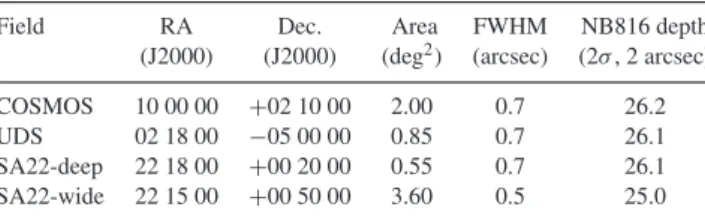
We split SA22 data into two different sub-fields (SA22-deep and SA22-wide), which differ in depth by≈1 mag and in area by a factor of≈6.6. SA22-wide contains the largest area (larger than COSMOS and UDS combined). Narrow-band observations are summarized in Table1.
Previous studies have separately used NB816 data in COSMOS (Murayama et al. 2007), UDS/SXDF (Ouchi et al. 2008) and
1http://smoka.nao.ac.jp/
Figure 1. Normalized filter profiles of the NB816 and thei-band filters used in this study. We note that the showniband is forSubaru’s Suprime-Cam after the upgrade to red sensitive CCDs, such that its peak is slightly shifted towards the red compared to the CFHT MegaCamiband used for SA22. Our NB correction in Section 2.4.1 takes this into account. NB816 is contained slightly red from the centre ofi. The NB816 filter is located in a wavelength region free of strong atmospheric OH lines.
Table 1. Our NB816 data in the COSMOS, UDS and SA22 fields. The SA22 field was separated into two sub-fields, deep and wide, according to its significantly different NB816 depth. RA and Dec. are the central coordinates of the fields. FWHM is the average value for the seeing and is similar across our entire coverage. The NB816 depth is the 2σ depth measured in 2 arcsec apertures. Note that the quoted area already takes into account the removed/masked regions which are not used in this paper.
Field RA Dec. Area FWHM NB816 depth
(J2000) (J2000) (deg2) (arcsec) (2σ, 2 arcsec) COSMOS 10 00 00 +02 10 00 2.00 0.7 26.2
UDS 02 18 00 −05 00 00 0.85 0.7 26.1
SA22-deep 22 18 00 +00 20 00 0.55 0.7 26.1 SA22-wide 22 15 00 +00 50 00 3.60 0.5 25.0
SA22-deep (∼0.4 deg2; Hu et al.2010). We note that while we
explore new data and provide the largest survey of its kind, we are able to reproduce individual results from the literature using our own analysis. A comparison between our findings and previous studies is presented in Section 4.
2.2 Data reduction
We used the Subarudata reduction pipelines (SFRED andSFRED2;
Ouchi et al.2004) to reduce the NB816 data. The data reduction follows the same procedure as detailed in e.g. Matthee et al. (2015) and we refer the reader to that study for more details. Briefly, the reduction steps include: overscan and bias subtraction, flat fielding, PSF homogenization, sky background subtraction and bad pixel masking. After these steps, we apply an astrometric calibration usingSCAMP(Bertin2006) to correct astrometric distortions. The
software matches our images with the 2MASS catalogue in the Jband (Skrutskie et al.2006) and fits polynomial functions that correct for any distortions along the CCD.
We calibrated the photometry in our data by matching relatively bright, un-saturated stars and galaxies to public catalogues for COSMOS (Laigle et al.2016), UDS (Cirasuolo et al.2007) and SA22 (Sobral et al.2013,2015; Matthee et al.2014) usingSTILTS
(Taylor2006). NB816 images were calibrated usingi-band pho-tometry, but a further correction to this calibration was applied in Section 2.4.1. Co-added stacks of NB816 exposures were obtained using theSWARPsoftware (Bertin et al.2002).
We masked low-quality regions, bright haloes around bright stars, diffraction patterns and low-S/N regions due to dithering strategy (particularly important in SA22-wide). We also removed regions with low quality or absenti-band coverage, regardless of the quality of the narrow-band.
We note that our masking is very conservative and, consequently, a relatively large area is removed from our study (hundreds of arcmin2), but that is still only a small fraction of our total area.
After masking low-quality regions, our NB816 coverage contains a total area of 7 deg2(Fig.2), corresponding to a comoving volume
of 6.3×10⁶ Mpc3 atz =5.7. All areas and volumes used and
mentioned in this paper take into account these masks, unless stated otherwise.
Finally, we measure the depth of our images using randomly placed 2 arcsec apertures. In each image, we place 200 000 empty apertures in random positions. The average results per field are given in Table1.
2.3 Multiwavelength imaging
A large collection of multiwavelength data are publicly available for our entire coverage. For the COSMOS field, we use optical BV-grizdata taken with theSubaru/Suprime-Cam (Capak et al.2007; Taniguchi et al.2007), retrieved from the COSMOS Archive and NIRYHJKdata from UltraVISTA DR2 (McCracken et al.2012), taken with VISTA/VIRCAM. For the UDS field, we use optical BVrizdata from SXDF (Furusawa et al.2008) and NIRJHKdata from UKIDSS (Lawrence et al.2007). For the SA22 field, we use op-ticalugrizdata from CFHTLS,3taken with the MegaCam (Boulade
et al.2003) and NIRJKdata from UKIDSS DXS (Warren et al.
2007), taken with UKIRT/WFCAM (Casali et al.2007). All data which were not taken with theSubaru/Suprime-Cam were degraded to a pixel scale of 0.20 arcsec pix−1using
SWARP. A summary of the
available filters for each field and their photometric depth is shown in Table2.
2.4 Nb816 catalogue
The extraction of sources was conducted using SEXTRACTOR(Bertin
& Arnouts1996) in dual extraction mode, using NB816 as the detection image.
2.4.1 Narrow-band magnitude correction
The NB816 filter is located slightly to the red of the Subaru Suprime-camifilter (with red sensitive CCDs) with a separation of≈180 Å between the centre of the two filters. Calibrating the narrow-band magnitude directly to theiband may result in an offset in the magnitudes, particularly for sources with strong colours. We correct the narrow-band magnitudes by summing a small correction factor which is estimated from the colour of the two adjacent broad-bands,iandz. To compute this correction, we use sources withi,z and NB816 magnitudes between 19 and 24 (not saturated and with high enough S/N). The correction has the following expression
NBcorrected=NB+0.4×(i−z), (1)
Figure 2. The spatial distribution of sources in the COSMOS, UDS and SA22 fields. Grey dots indicate all detections and red circles identify ourz=5.7 Lyα emitter candidates. A black line contour identifies SA22-deep, the deepest region in the SA22 field. The figure also highlights the regions masked due to bright stars, bad regions and/or low S/N due to dither strategy. It can be seen that UDS, COSMOS and SA22-deep are the deepest regions with a high concentration of sources and candidate LAEs.
Table 2. Multiwavelength depths (2σ; measured in 2 arcsec empty apertures) for the available broad-band filters across all three fields.
Field Broad-band filters Broad-band depth (2σ, 2 arcsec)
COSMOS BVgrizYJHK 27.6, 27.0, 27.1, 27.0, 26.6, 25.7, 25.3, 24.6, 25.0, 24.7
UDS BVrizJK 27.5, 27.2, 27.0, 26.8, 27.0, 25.3, 24.8
SA22 ugrizJK 26.2, 26.5, 25.9, 25.6, 24.5, 24.3, 23.8
whereNB,iandzare the 2 arcsec magnitudes in the respective bands andNBcorrectedis the corrected NB816 magnitude. We apply
this correction to sources withiandzdetections. For the remaining sources, we apply a median correction of+0.20. As a result of this correction, there is less scatter in the excess diagram (Fig.3). The correction also corrects for the fact that the CFHT MegaCamiband is slightly bluer than Suprime-cam’siband, because this slightly differentiband will result in slightly differenti−zcolours.
Our narrow-band correction is an alternative to the correc-tion applied in Murayama et al. (2007) who used a corrected
broad-band obtained from an iz interpolation. Our narrow-band correction corresponds to aBBcorrected=0.6i+0.4zwhich is fully
consistent with their interpolation.
2.4.2 Removal of sources with non-physical narrow-band detection
Figure 3. Narrow-band excess diagram for COSMOS, UDS and SA22. We plot narrow-band excess (ibroad-band magnitude minus NB816 magnitude) versus narrow-band NB816 magnitude. Grey points represent all detections after masking, removal of sources with non-physical narrow-band and cosmic rays. Green points represent line emitters, obtained by applying the EW andcuts described in Section 3. For visual reference, we collapsed the points with noidetection in the top region of the plots. Theline shown in this figure is the median value from small sub-fields which we created inside each field.
we compute the expectedimagnitude if it only had emission inside NB816. If the measuredimagnitude of a source is fainter than this value and the depth of theiimage is sufficient to detect it, we remove it from our sample. This step mainly removes variable sources (such as supernovae and moving sources) and spurious sources that are detected only in the narrow-band images and sources with boosted narrow-band emission from e.g. diffraction patterns.
2.4.3 Cosmic ray removal
Cosmic rays may become artefacts in images. This problem can be avoided through stacking of several frames. However, in our shallower SA22-wide data, the small number of frames causes a less efficient removal of such artefacts during stacking. We created an automated procedure to identify and remove cosmic rays from our sample.
For each source detected in the NB816 imaging, we measure the standard deviation in boxes of 5×5 pixels around each source. Cosmic rays can be easily identified by their high standard deviation, several times higher than any real source. We apply a cautious cut to make sure we do not lose any real sources. Since we were cautious with this step, we also visually inspect all the final LAE candidates to identify any cosmic ray that was not excluded.
3 S E L E C T I N G N B 8 1 6 L I N E E M I T T E R S
For the selection of line emitters, we apply similar criteria to e.g. Sobral et al. (2013) and Matthee et al. (2015), relying on two
parameters: EW and Sigma (). The EW is the ratio between the flux of an emission line and the continuum flux. It can be expressed as
EWobs=λNB
fNB−fBB fBB−fNB(λNB/λBB)
, (2)
whereλNB and λBB are the FWHM of the narrow-band and
broad-band filters (λNB816=120 Å;λi=1349 Å) andfNBand
fBBare the flux densities measured in the two filters.
The second parameter, Sigma (, e.g. Bunker et al.1995), is used to assure that the excess of the NB816 relative to the broad-band is significantly above the noise. It can be written as (Sobral et al.
2013)
= 1−10−0.4(BB−NB)
10−0.4(ZP−NB)rms2
BB+rms2NB
, (3)
where BB and NB are the broad-band and the corrected narrow-band magnitudes (in this case, NB816 andi), ZP is the zero-point of the image (set to 30) and rms is the root mean square of the background of the respective image.
To select our sample of line emitters, we apply the following selection criteria:
(i)i−NB816>0.8 (ii) >3.
Figure 4. Distribution of photometric redshifts of line emitters selected in COSMOS, UDS and SA22 by using a simple selection criteria ofi− NB186>0.25 and >3. The peaks are consistent with line emission at specific wavelengths. Annotations indicate the redshifts where we expect major emission lines (Hαatz∼0.2, [OIII] at∼0.6, [OII] atz∼1.2 and Lyαatz=5.7).
z=6.6 but slightly lower than e.g. Ouchi et al. (2008) (i−NB816
>1.2) and Taniguchi et al. (2005) (i−NB816>1).
We present the narrow-band excess diagram in Fig.3, highlight-ing our sample of line emitters. With our selection criteria, we identify over 11 000 candidate line emitters.
3.1 Photometric and spectroscopic redshifts
In order to explore the nature of the line emitters, we have used accurate photometric redshifts and a large compilation of spectro-scopic redshifts: Laigle et al. (2016) for COSMOS, Cirasuolo et al. (2007) for UDS and a combination of Kim et al. (2015), Matthee et al. (2014) and Sobral et al. (2015) for SA22. We retrieve∼5000 emitters with either available photometric or spectroscopic redshift. Fig.4presents the distribution of photometric redshifts of our sam-ple of line emitters. Even though our high EW cut is tuned to select LAEs atz=5.7, our initial sample of line emitters reveals a range of strong line emitters. The peaks in the photometric redshifts are consistent with Hαatz∼0.2, [OIII] at∼0.6, [OII] atz∼1.2 and
Lyαatz=5.7. From our spectroscopic redshift, we find a total of 46 LAEs atz=5.7.
As expected, our sample is dominated by lower redshift line emitters, mostly composed by sources up toz∼1.2. In order to isolate LAEs at z=5.7 from our sample, we require additional selection criteria, which we will explore in Section 3.2.
3.2 Selection of LAEs atz=5.7
In order to select LAEs and remove low-redshift interlopers, we use the Lyman-break technique and identify the break at rest frame 912 Å, blueward of the Lyman limit (although, in practice, atz= 5.7, radiation blueward of Lyαis almost fully absorbed by the Lyα forest; e.g. Madau1995). LAEs atz=5.7 should have no strong detection in optical wavelengths below theiband. A weakr-band detection is possible if the IGM is relatively transparent (and there are few Lyαforest lines). To summarize, we apply the following criteria, similar to Ouchi et al. (2008)
B > B2σ∧V > V2σ∧[r > r2σ∨(r < r2σ∧r−i >1.0)], (4)
whereB,V,randiare the 2 arcsec magnitudes in the respective bands and the2σ subscript indicates the 2σ depth for the images
of the respective bands (see Table2). As there are no availableBV data over the full SA22, we apply a small variation of equation (4) where useuginstead:
u > u2σ∧g > g2σ∧[r > r2σ∨(r < r2σ∧r−i >1.0)], (5)
whereu,gare the 2 arcsec magnitudes in the respective bands. This criteria ensures we select sources with no detection in theBVug bands but can have some detection inras long as there is a strong i−rcolour break.
In extreme cases,z∼1 line emitters with a strong Balmer-break could mimic the Lyman-break that we detect. Fortunately, those sources can be identified by their red colours. Similar to Matthee et al. (2015), we reject sources which have significant red colours in the observed NIR bands. Thus, we consider sources withJ− K> 0.5 to be interlopers. This additional NIR criterion is most important in SA22, where the optical data are relatively shallow.
In order to ensure that our candidates are real detections and not spurious sources, we visually inspect each one of the remaining candidates. We first inspect sources in the narrow-band images and reject any fake detections (usually originated by e.g. diffraction patterns from bright sources which were not completely masked). We also visually check that each source does not have an optical detection blueward of the Lyman-break. To do so, we create an optical stack using the available optical bands for each field (BVg for COSMOS,BVfor UDS andugfor SA22), which significantly increases the depth of our images.
To summarize, we select line emitters as Lyαatz=5.7, if;
(i) They have no optical detection blueward of the Lyman-break (equation 4 or 5).
(ii) They satisfyJ−K<0.5, if detected in the NIR.
(iii) They pass visual inspection, which includes both reality of NB excess (and checking for variability and/or moving sources) and no detection in optical bands.
3.3 Comparison with other samples of LAEs atz=5.7 We compare our sample of LAEs with the spectroscopically con-firmed sources atz=5.7 provided by Ouchi et al. (2008) (UDS), Hu et al. (2010) (SA22-deep) and Mallery et al. (2012) (COSMOS). We find that we recover 46 spectroscopically confirmed sources from previous studies which are above our conservative detec-tion threshold (other studies typically only apply an EW cut) and that are not in our conservative masked regions.
3.4 Final sample of LAEs atz=5.7
Across the COSMOS, UDS and SA22 fields we identify a total of 514z=5.7 LAE candidates (currently 46 are spectroscopically con-firmed), spanning a range of Lyαluminosities of 1042.5–1044erg s−1.
We will explore the properties of these sources in the following sec-tions. Table3shows a summary of the number of sources after each selection criterion. The spatial distribution of the LAEs in all fields can be seen in Fig.2.
4 C O M P U T I N G T H E LYαL F
4.1 Completeness correction
Table 3. Number of candidates after each selection step. The visual inspections step includes individually checking each source first in both the narrow-band NB816 and the broad-bandiimages and then for no detection in the deep optical stacks (BVfor UDS,BVg for COSMOS andugfor SA22). Note that due to the shallower broad-band data in SA22, a large amount of sources passed the initial filtering, but are rejected with the much deeperugstacks and our visual checks. # sources COSMOS
>3, EW0>25 Å 2576
No optical detection 396
After visual inspections 192 UDS
>3, EW0>25 981
No optical detection 239
After visual inspections 178 SA22-wide
>3, EW0>25 4692
No optical detection 1264
After visual inspections 56
SA22-deep
>3, EW0>25 2803
No optical detection 541
After visual inspections 88
Total Lyαz=5.7 (zspecconfirmed) 514 (46)
sources to be underestimated. To estimate the line-flux complete-ness, we follow Sobral et al. (2013), adapted for Lyαstudies by Matthee et al. (2015): we construct a sample of high-redshift non-line emitters selected through a simple colour break selection (r− i>1.5) and add non-emitters with photometric or spectroscopic redshift higher than 4. Using these sources, in steps of increasing line-flux, we artificially increase their NB816 andi-band fluxes and then apply our selection criteria on these simulated sources. By determining the fraction that we retrieve as a function of added line-flux, we obtain a completeness estimation for each luminosity bin, which we apply to each bin in our LF. A higher completeness correction is measured for the fainter sources as they are much easier to be missed. The line-flux completeness per luminosity bin for each field is presented in TableA1. The completeness-corrected number counts in the different observed fields as a function of their Lyαluminosity are shown in Fig.5and in TableA3.
4.2 Filter profile correction
The narrow-band filter transmission NB816 has a Gaussian distribu-tion with a lower transmission in the wings (Fig.1). Sources which have a redshift in the borders of the filter will only be observed at a fraction of their Lyαluminosity (see e.g. Hu et al.2010). It is necessary to apply a correction factor that compensates the fact that the filter is not top-hat, otherwise, the number densities of bright LAEs will be systematically underestimated. We apply a correc-tion similar to Matthee et al. (2015). We use the Schechter fit from our data to generate the Lyαluminosity of 1 million sources at a random redshift betweenz=5.65 and 5.75 (corresponding to the edges of NB816). For each luminosity bin, the correction factor is determined from the detection ratio of these fake sources retrieved with the two different filter profiles. The effect of the filter profile correction of our LF is shown in Fig.A1. The correction is higher
Figure 5. The Lyαluminosity function atz=5.7 based on different fields. For visual reference, a small offset in the luminosities (±0.02 dex) was used to minimize overlapping of points in the figure. The arrows indicate the luminosity bins for which each field has an average completeness higher than 25 per cent. We find significant field to field variations of±0.4 dex in number densities, consistent with results from e.g. Ouchi et al. (2008). We also compare our results per field with previous studies, finding them to be consistent with Murayama et al. (2007) and Ouchi et al. (2008). However, by probing larger, multiple volumes, we overcome cosmic variance. for the brightest bins as these LAEs will likely be observed at a fraction of their luminosity due to the filter not being top-hat.
4.3 Aperture corrections
Due to instrumental/observational effects (e.g. seeing/PSF) and mostly due to Lyαphotons easily scattering within haloes, Lyαflux can be significantly extended (e.g. Momose et al.2014; Borisova et al.2016; Matthee et al.2016a; Wisotzki et al.2016). The 2 arc-sec apertures we use are 3–4×the PSF, and thus for point-like sources, we do not expect aperture corrections to be important, but if sources are physically extended, 2, arcsec apertures may lead to missing flux. We investigate this by comparing the NB816 fluxes measured in 2 arcsec with those measured withMAG-AUTOand study any necessary correction as a function of observed 2 arcsec flux. We find little to no dependence up to at least the highest fluxes, and derive a median correction of+0.02 in Lyαluminosity, which we apply (see further discussion in Section 5.3).
4.4 Interloper correction
While in COSMOS and UDS, the available broad-band data allow us to clearly identify and remove interlopers/lower redshift line emitters, in SA22 this is not necessarily the case, particularly for the sources with the faintest continuum. In order to mitigate this, we use our combined COSMOS and UDS with full information, but study the data set assuming the depths of broad-band imaging were the same as SA22-deep and SA22-wide. We find that, as expected, the contamination is higher (10 per cent higher) for SA22-like data sets. We therefore correct all our luminosity bins in SA22 for this expected extra contamination.
4.5 Obtaining a comparison LF atz=6.6
corrections/modifications to derive a new, updatedz=6.6 LF. We use the same methods for completeness and filter profile corrections. We compute the errors per bin by not only taking into account the Poissonian errors, but also by considering systematic errors due to the completeness and filter profile corrections. Furthermore, following our selection criteria, we also carefully check for any variable sources and/or moving sources which can contaminate the bright end. Matthee et al. (2015) applied a statistical correction for these potential contaminants, but we chose to investigate sources one by one, following what we do atz=5.7. We note that such statistical correction works very well for COSMOS and UDS, but is a slight underestimation for SA22, as the number of moving sources in SA22 is significantly higher. None the less, we find that none of the results from Matthee et al. (2016a), which are based on spectroscopic follow-up (Sobral et al.2015), have significantly changed: luminous LAEs (LLyα > 1043.5 erg s−1) atz= 6.6 are
more common (30 times) than previously measured by smaller area studies (e.g. Ouchi et al.2010). We note that we also apply an aperture correction to thez= 6.6 LF of+0.11, unchanged from Matthee et al. (2015).
5 R E S U LT S
5.1 Thez=5.7 LyαLF 5.1.1 Field to field variations
We group our LAEs in luminosity bins according to their Lyα lumi-nosity. The observed number density in each bin is corrected for its corresponding line-flux completeness correction. We only include sources from sub-fields with a completeness higher than 25 per cent. The number density for each luminosity bin is calculated by mul-tiplying the number of counts by the completeness factor, divided by the probed volume and bin width. The errors are Poissonian, but we add 30 per cent of the completeness correction in quadrature to obtain the final error per bin.
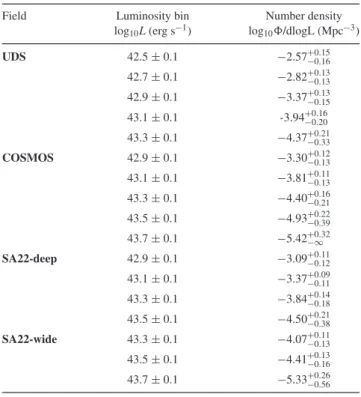
In Fig.5, we show thez=5.7 Lyαluminosity computed per field. We find that there is significant scatter, of the order of±0.4 dex in the number densities, at least for the range of luminosities where we can compare results from all our fields. It may well be that such scatter is reduced for fainter sources, but our sample does not allow us to constrain that as we can only investigate that with a single field (UDS) – see Ouchi et al. (2008). Our results per field are also presented in TableA2. Our results highlight the importance of probing multiple fields and caution the overinterpretation of single field ‘over’ or ‘under’ densities, either in the context of reionization or of structure formation.
5.1.2 Comparison with otherz=5.7 surveys
Several surveys have published LFs ofz=5.7 LAEs, which we compare with our results (see Fig.5). We compare our results with Westra et al. (2006), Murayama et al. (2007) (COSMOS), Ouchi et al. (2008) (UDS) and Hu et al. (2010) (SA22-deep, SSA17, A370 and GOODS-N) in Fig.5. While there are some differences between our selection criteria and the ones applied in these studies, overall we find very good agreement. Moreover, the variance that we see from field to field (see Fig.5) is sufficient to explain any subtle differences between our results per field and those in the literature. For the COSMOS field, Murayama et al. (2007) applies a much more conservativecut (corresponding to roughly >5) which leads to missing fainter LAEs. The differentcut, together with
a different completeness correction (ours is based on line-flux or luminosity, while Murayama et al.2007does a correction based on detection completeness) easily explains why our fainter luminosity bin (log10LLyα=42.9 erg s−1) has a higher number density, which
fully agrees with our UDS and SA22 estimates, along with those presented in Ouchi et al. (2008).
Within the errors, our results are also fully consistent with those by Ouchi et al. (2008), at all luminosities. Our brightest bin (log10LLyα=43.7 erg s−1) is populated only by our COSMOS and
SA22-wide fields, as those have the largest areas (sufficiently large to probe the bright end), but we note that the estimates from COS-MOS and SA22-wide fully agree, while we are also in very good agreement with the results from Hu et al. (2010). SA22-deep is both our smallest contiguous field and also the one with the highest num-ber densities (although generally agreeing within the errors with the other fields, particularly given the variance seen). In the SA22-wide field, we find number densities consistent with Ouchi et al. (2008) up to log10LLyα=43.5 erg s−1and a brighter bin consistent with our
COSMOS number density. The bright end of the LyαLF seems to point towards a deviation from the Schechter fit presented in Ouchi et al. (2008), better explained by a less accentuated exponential drop, or by a single power law.
5.1.3 The combinedz=5.7 LyαLF
We combine our data from the different fields to obtain a combined LyαLF atz=5.7. We show the results in Fig.6and TableA3.
We fit a Schechter function (Schechter1976), defined by three pa-rameters: the power-law slopeα, the characteristic number density
φand the characteristic luminosityL.
In Table4, we present best-fitting parameters of the Schechter function atz=5.7. We find the faint end slopeαto be particularly steep:α= −2.3+−0.40.3. This is in very good agreement with recent results from Dressler et al. (2015) at the same redshift who foundα to be−2.35< α <−1.95 (while we find−2.6< α <−1.9, 1σ). It is therefore clear that the LyαLF is very steep just after reionization and may be steeper than the UV LF at the same redshift (α≈ −1.9; e.g. Bouwens et al.2015). Note that such a steep faint-end slope at
z=5.7 is already preferred by the fit in Ouchi et al. (2008) and is consistent with theoretical expectations (Gronke et al.2015).
We also fit our LF by fixing the faint-end slope toα= −2.0 and−1.5 and allowandLto vary. This allows our results to be directly compared with other studies which fixedαto the same values. The results are presented in Table4.
5.2 Evolution fromz=5.7 toz∼7 and beyond
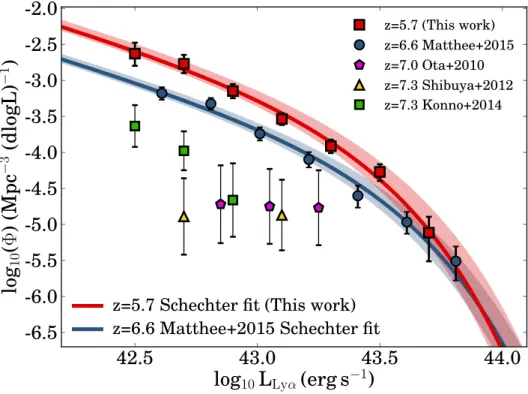
In Section 4.5, we discuss the steps we took to obtain a comparable and updatedz=6.6 LyαLF, based on Matthee et al. (2015). We show the recomputedz=6.6 LyαLF, and a comparison with our
z=5.7 measurement in Fig.6. The recomputedz=6.6 LF is fully presented in TableA3.
We find that bothz=6.6 and 5.7 are best fit with a very steep
Figure 6. Evolution of the LyαLF fromz=5.7 to 6.6. Thez=6.6 LF is our updated version from Matthee et al. (2015), see Section 4.5. The colored regions around the best Schechter fit show the 1σerror inL∗. We observe a strong decrease in the number density of the fainter LAEs as we increase with redshift up toz=6.6 and alsoz >7 (Ota et al.2010; Shibuya et al.2012; Konno et al.2014). This decrease can likely be explained by a more neutral IGM as we go deeper into the reionization epoch. However, there seems to be no evolution for the brighter sources, which can likely be explained by a preferential reionization around the brightest sources. There is currently a lack of comparable surveys atz >7 at the brightest luminosities.
Table 4. Parameters for the best Schechter function fits for the LyαLFs at
z=5.7 and 6.6 (recomputed Matthee et al.2015). We allowαto vary, but we also fixαto−2.0 and−1.5.
Redshift α log10LLyα log10
(erg s−1) (Mpc−3)
z=5.7 −2.3+−00..43 43.42+−00..5022 −4.02+−00..4893 −1.5 (fix) 43.06+−00..0405 −3.25+−00..0910 −2.0 (fix) 43.25+−00..0609 −3.63+−00..1216
z=6.6 −2.3−+00..43 43.45+ 0.35
−0.18 −4.48+ 0.43
−0.68 −1.5 (fix) 43.12+−00..0403 −3.73+
0.07
−0.06 −2.0 (fix) 43.30+−00..0507 −4.13+−00..1010
evolution from z= 5.7 to 6.6, confirming the results suggested in Matthee et al. (2015). We note that while we discuss the LFs in the context of their Schechter fits, the results presented hold if we fit them with e.g. single or double power laws. Atz = 6.6, the spectroscopic confirmation of the sources responsible for these high Lyαluminosities is starting to reveal their uniqueness (e.g. multicomponent, very low metallicities, blue Lyαwings, range of sizes, see e.g. Himiko, MASOSA, CR7, COLA1; Ouchi et al.2013; Sobral et al.2015; Hu et al.2016), providing important hints that may explain how these sources have been able to likely reionize their surroundings already atz∼7. Further observations will be able to confirm a larger, statistical sample atz∼7, but our new sample atz=5.7 is uniquely suited to be directly compared.
Fig.6also presents results from severalz >7 narrow-band sur-veys from the literature, which we compare withz=6.6 and 5.7. The trend that we see fromz=5.7 to 6.6 of significant decrease
in the number density of faint LAEs seems to continue at a fast pace toz∼ 7 and beyond (Ota et al.2010; Shibuya et al.2012; Konno et al.2014). We provide a more detailed discussion about the differential evolution of the Lyαas an imprint of reionization in Section 6. There is currently a lack of comparable surveys atz >7 at the brightest luminosities, so it is not yet possible to test whether the lack of evolution at the bright end still holds atz >7.
5.3 The Lyαsizes and evolution atz=5.7–6.6
Since the Lyα transition is resonant, Lyα photons scatter in a medium with neutral hydrogen. Because of this, Lyαphotons tend to escape over much large radii than their UV and Hαcounterparts, making them observable as Lyα haloes (e.g. Rauch et al.2008; Steidel et al.2011; Momose et al. 2014; Matthee et al. 2016a). Therefore, the aperture that is used to measure Lyαis critical (e.g. Wisotzki et al.2016). Typically, LAE surveys have attempted to take extended Lyαemission into account by usingMAG-AUTO measure-ments (e.g. Ouchi et al.2010; Konno et al.2016) or relatively large apertures (e.g. Murayama et al.2007; Hu et al.2010, who use 3 arc-sec apertures atz=5.7). However, the total measured magnitude withMAG-AUTOdepends on the depth of the narrow-band imaging,
such that a comparison between surveys and redshifts is challeng-ing, particularly as Wisotzki et al. (2016) show that Lyαextends well beyond the typical limiting surface brightness of narrow-band surveys.
Figure 7. The median difference inMAG-AUTOluminosity and luminosity within 2 arcsec apertures in bins of the 2 arcsec aperture Lyαluminosity for LAE samples atz=5.7 and 6.6. The dashed and dash–dotted grey lines indicate the median of all LAEs in the sample, which is obviously dominated by low luminosity sources. At both redshifts, more centrally luminous LAEs also have relatively more flux at larger radii (which is captured byMAG-AUTO). At faint central luminosities, LAEs atz=6.6 appear more extended, which could be due to increased scattering in HIaround galaxies. We note that this may be one of the causes for the apparent evolution in the LyαLF, and may also be important to consider when interpreting the spectroscopic follow-up of UV-selected galaxies with low Lyαluminosities, as slits will recover even less of the total flux.
Matthee et al. (2015) found that 2 arcsec apertures systematically underestimate Lyαluminosities atz=6.6 (compared to theMAG -AUTO) with a median offset of 0.11 dex over the spectroscopically confirmed sample of LAEs (confirmed in Ouchi et al.2010). Here, we extend this analysis to the full sample of sources at bothz= 5.7 and 6.6. We find that the median offset between theMAG-AUTO
luminosity and the 2 arcsec aperture offset atz=6.6 is 0.11 dex, while it is only 0.02 dex atz=5.7; see Fig.7. The latter explains why our 2 arcsec measurements result in very similar number densities as literature studies with larger apertures atz=5.7, see Fig.5.
By splitting the sample of LAEs in bins of Lyαluminosity (in 2 arcsec apertures), we find that atz= 5.7, the offset increases slightly with increasing Lyαluminosity (see Fig.7). Specifically, the most luminous LAEs have larger Lyαhaloes (and more flux at larger radii) than the typical fainter ones. Interestingly, we find a different behaviour atz=6.6. While the brightestz=6.6 Lyαseem to be as extended as those atz=5.7 (these are the ones that may have already been able to fully ionize the surrounding environment), fainter LAEs atz =6.6 are all more extended than comparable sources atz=5.7. Together with the differential evolution of the LyαLF, our results provide strong evidence for reionization effects being much stronger for the faint sources than for the bright ones. We discuss this trend further in Section 6.
A similar but more careful analysis of the extent of Lyα emis-sion atz=5.7–6.6 than our own has been done by Momose et al. (2014), who created stacked narrow-band and broad-band images of the LAEs in UDS from Ouchi et al. (2008,2010). They observed that Lyαis extended, being more extended than their UV counter-part (while also being more extended than the PSF of their images; a similar trend is found for individual LAEs by e.g. Wisotzki et al.
2016). Momose et al. (2014) found evidence of an increase in the scalelength of Lyα from z= 5.7 to 6.6. However, they did not
separate their sample in bins of luminosity and their results are ob-tained with median stacking. This means that the faintest sources dominate (as there are more faint sources than luminous ones) and that these results are more representative of a ‘typical’ LAE, with LLyα ∼ 1042.6 erg s−1. The median evolution in the scalelength
of Lyαhaloes from LAEs estimated in Momose et al. (2014) is thus consistent with the difference betweenMAG-AUTO and 2
arc-sec measurements that we find for relatively faint LAEs between
z=5.7 and 6.6.
6 D I S C U S S I O N : I M P R I N T S F R O M R E I O N I Z AT I O N ?
As noted before, the observed Lyαluminosity at a fixed spatial scale is expected to decrease in the reionization era, as an increasingly neutral IGM scatters Lyαphotons into larger, extended haloes (e.g. Dijkstra 2014). Our results are consistent with witnessing such predictions directly. Here, we discuss the differences we observe in the LyαLF betweenz= 5.7 and 6.6, and also our results on the extent of LAEs atz=5.7 and 6.6. For earlier work, see e.g. Dijkstra, Lidz & Wyithe (2007), Ouchi et al. (2010) and Hu et al. (2010).
We observe strong differential evolution of the LyαLF fromz∼ 6 to 7, with a significant decrease (−0.5 dex) in the number density for Lyαluminosities belowL∗. The drop in the observability of faint LAEs may well be explained by a larger fraction of neutral IGM atz >6 caused by reionization not being completed. The brightest emitters would not suffer from such a decline because their strong Lyαemission is easier to be observed, as previously illustrated by the simple toy model in Matthee et al. (2015). This model assumes that the Lyαluminosity scales with the ionizing output and LAEs are only observed if they are either capable of ionizing the IGM around them, or are strongly clustered. To first order, a stronger ionizing output for brighter LAEs is expected because Lyαis a recombination line (such that at fixed escape fraction, a higher Lyα luminosity scales with the number of ionizing photons). Also, as shown in Matthee et al. (2016b), LAEs atz=2.2 typically produce more ionizing photons per unit UV luminosity than more typical galaxies such as Hα emitters. Furthermore, as hypothesized by Dijkstra & Gronke (2016), ISM conditions which favour the escape of Lyαphotons also likely favour the escape of Lyman continuum (LyC) photons (for example due to a porous ISM), such that in addition to producing more ionizing photons, LAEs could also leak more ionizing photons into the IGM.
Recent evidence from Stark et al. (2016) shows that the fraction of bright UV-selected galaxies (LBGs) with strong Lyαemission is much higher than was previously found (e.g. Pentericci et al.2014; Schenker et al.2014; Schmidt et al.2016) when they are selected on strong nebular lines (e.g. Hβ/[OIII]). This is likely because UV-bright galaxies are in overdense regions and emit copious amount of ionizing radiation (inferred from observed high-ionization UV lines as CIII] and their high-EW optical nebular lines). Such
con-ditions may also favour the production of Lyαphotons and lead to larger ionized bubbles. Therefore, these observations are in princi-ple consistent with the observed evolution of the LyαLF, where we observe reionization completing first around luminous LAEs.
much smaller atz=5.7 than at 6.6. Most interestingly, the major difference is found at the faintest luminosities. Atz=6.6, LAEs which have a low central luminosity have a relatively much larger total luminosity than atz=5.7. This means that at a fixed surface brightness limit (note that the limiting surface brightness atz=6.6 is actually even slightly higher), faint LAEs are more extended at
z=6.6 than atz=5.7. For more luminous LAEs, the difference is much smaller. This effect can easily be explained in the framework of the Matthee et al. (2015) toy-model: faint LAEs are surrounded by a relatively more neutral IGM, such that there is more resonant scattering leading to more extended emission.
The evolution of the LyαLF and the extent of Lyαfor different luminosities may very well be explained by a patchy reionization scenario where the IGM is ionized first around luminous LAEs. However, internal effects from galaxies may also be important. Fur-thermore, studying the clustering of both bright and faint LAEs and how it evolves from e.g.z=5.7 to 6.6 and beyond (e.g. Mesinger
2010; Ouchi et al. 2010) will provide the extra, necessary con-straints. A similar analysis with future larger samples of LAEs (for example, from the Hyper Suprime-Cam survey) will be very useful to confirm the observed trends.
Our results also mean that a careful approach is required in or-der to interpret the observed Lyαfraction for samples of LBGs at different redshifts in terms of a varying neutral fraction due to reionization, because different samples of LBGs show very differ-ent Lyα fractions. Curtis-Lake et al. (2012) found a remarkably high fraction of strong LAEs amongst luminous LBGs, Stark et al. (2016) found a higher Lyαfraction for LBGs selected on strong nebular emission and Erb et al. (2016) found thatz∼2 galaxies with extreme line ratios have high Lyα fractions. Moreover, our results show that typical, faint LAEs become more extended as we go into the reionization epoch, with the same (or even less) flux being spread over larger areas. This is an additional challenge for the traditional slit spectroscopy follow-up, which will struggle to detect any Lyαif the flux is significantly extended.
7 C O N C L U S I O N S
We have constructed the largest Lyαnarrow-band survey atz=5.7, when reionization is close to complete. We have surveyed a total area of 7 deg2and a volume of 6.3×10⁶Mpc3atz=5.7, covering
the COSMOS, UDS and SA22 fields. Here we summarize the main conclusions.
(i) By identifying strong line emitters with a Lyman break, we find 514 LAE candidates atz=5.7 with EW0>25 Å (EW0 ∼
25–1000 Å) and luminosities ranging from 1042.5to1044erg s−1, in
a single, homogeneous data set.
(ii) We find that cosmic variance plays a major role, with varia-tions of±0.4 dex in number densities of LAEs from field to field.
(iii) By combining all our fields and overcoming cosmic vari-ance, we find that the faint-end slope of the z = 5.7 Lyα LF is very steep, with α= −2.3+−0.40.3. If we fixα = −2.0, we find
L=1043.22+0.08−0.05erg s−1and= −3.60+0.12 −0.16Mpc−3.
(iv) We also present an updatedz=6.6 LyαLF, based on com-parable volumes, and obtained with the same methods, which we directly compare with that atz=5.7.
(v) We find significant evolution fromz=5.7 (after reionization) toz=6.6 (within the epoch of reionization) at the faint end. We find that the fainter the luminosity, the stronger the drop in the number density of LAEs. The strong decrease of the number density of faint LAEs continues toz∼7.
(vi) At bright Lyαluminosities (LLyα>1043.5erg s−1), we find no
evolution in the number density of LAEs when we enter the reion-ization era. This is consistent with bright LAEs being preferentially observable because they already are in ionized bubbles even at
z∼7.
(vii) Faint LAEs at z= 6.6 show more extended haloes than those atz=5.7, suggesting that neutral Hydrogen plays a more important role of scattering Lyαphotons atz=6.6.
All together, our results indicate that we are observing patchy reionization happening first around the brightest LAEs, allowing the number densities of those sources to remain unaffected by the increase of neutral Hydrogen fromz∼5 to 7. We observe a pref-erential evolution of the faint end of the LyαLF from z = 5.7 to 6.6. There is a decrease in the faint end, while the bright end shows little to no evolution. We also observe no evolution in the sizes of the brighter emitters, which could be interpreted as showing no evidence of extra scattering around them fromz=5.7 to 6.6, while faint sources show a significant difference, presenting much more flux at larger radii, which could be explained by faint LAEs being located in a more neutral IGM leading to more resonant scat-tering and extended emission. The spectroscopic confirmation of relatively bright LAEs beyondz∼7 and approachingz∼9 (Oesch et al.2015; Zitrin et al.2015) may already be hinting that our results may hold to even higher redshifts.
The nature and diversity of bright Lyαsources atz=6.6, which we find to have essentially the same number density as those at
z=5.7, are starting to be unveiled. Spectroscopic follow-up (e.g. Ouchi et al.2013; Sobral et al.2015; Zabl et al.2015; Hu et al.
2016), detailed modelling (e.g. Hartwig et al.2016; Agarwal et al.
2016; Dijkstra, Gronke & Sobral2016; Smidt, Wiggins & John-son2016; Smith, Bromm & Loeb2016; Visbal, Haiman & Bryan
2016) and other observations withHSTand ALMA (Ouchi et al.
2013; Schaerer et al.2015; Sobral et al.2015; Bowler et al.2016) are revealing a surprising diversity. Current results indicate that these sources may have a range of powering sources (from metal poor populations to multiple stellar populations and also AGN, in-cluding potentially direct collapse black holes). Regardless of their nature, their observability requires the production and emission of the necessary amount of ionizing LyC photons capable of ionizing a large enough local bubble to make them observable as bright Lyα sources already atz=6.6. Thus, even though these sources are not as abundant as the more typical, faint sources, they may well play an important role in cosmic reionization, at least at very early stages, a scenario which would be in agreement with what is seen by Matthee et al. (2016b). Further observations of our sample of bright
z=5.7 sources and of much larger, statistical samples atz∼5–7 will certainly shed light over many of the current open questions, while the availability ofJWSTwill provide a revolutionary window into the physical conditions within these sources.
AC K N OW L E D G E M E N T S
PTDC/FIS-AST/2194/2012. JM acknowledges a Huygens PhD fel-lowship from Leiden University.
Based on observations with the Subaru Telescope (Program IDs: S05B-027, S06A-025, S06B-010, S07A-013, S07B-008, S08B-008, S09A-017, S14A-086). Based on observations made with ESO Telescopes at the La Silla Paranal Observatory under programme ID 294.A-5018. Based on observations obtained with MegaPrime/Megacam, a joint project of CFHT and CEA/IRFU, at the Canada–France–Hawaii Telescope (CFHT) which is operated by the National Research Council (NRC) of Canada, the Institut National des Science de l’Univers of the Centre National de la Recherche Scientifique (CNRS) of France, and the University of Hawaii. This work is based in part on data products produced at
TERAPIXavailable at the Canadian Astronomy Data Centre as part
of the Canada–France–Hawaii Telescope Legacy Survey, a collab-orative project of NRC and CNRS. Based on data products from observations made with ESO Telescopes at the La Silla Paranal Observatory under ESO programme ID 179.A-2005 and on data products produced byTERAPIXand the Cambridge Astronomy
Sur-vey Unit on behalf of the UltraVISTA consortium. We are grateful to the CFHTLS, COSMOS-UltraVISTA, UKIDSS, SXDF and COS-MOS survey teams. Without these legacy surveys, this research would have been impossible.
The authors wish to recognize and acknowledge the very sig-nificant cultural role and reverence that the summit of Mauna Kea has always had within the indigenous Hawaiian community. We are most fortunate to have the opportunity to conduct and explore observations from this mountain.
Finally, the authors acknowledge the unique value of the pub-licly available programming languagePYTHON, including theNUMPY, PYFITS,MATPLOTLIB,SCIPYandASTROPY(Astropy Collaboration et al.
2013) packages.
R E F E R E N C E S
Adams J. J. et al., 2011, ApJS, 192, 5
Agarwal B., Johnson J. L., Zackrisson E., Labbe I., van den Bosch F. C., Natarajan P., Khochfar S., 2016, MNRAS, in press
Astropy Collaboration et al., 2013, A&A, 558, A33 Bacon R. et al., 2015, A&A, 575, A75
Bayliss M. B., Wuyts E., Sharon K., Gladders M. D., Hennawi J. F., Koester B. P., Dahle H., 2010, ApJ, 720, 1559
Becker G. D., Bolton J. S., Madau P., Pettini M., Ryan-Weber E. V., Vene-mans B. P., 2015, MNRAS, 447, 3402
Bertin E., 2006, in Gabriel C., Arviset C., Ponz D., Enrique S., eds, ASP Conf. Ser. Vol. 351, Astronomical Data Analysis Software and Systems XV. Astron. Soc. Pac., San Francisco, p. 112
Bertin E., Arnouts S., 1996, A&AS, 117, 393
Bertin E., Mellier Y., Radovich M., Missonnier G., Didelon P., Morin B., 2002, in Bohlender D. A., Durand D., Handley T. H., eds, ASP Conf. Ser. Vol. 281, Astronomical Data Analysis Software and Systems XI. Astron. Soc. Pac., San Francisco, p. 228
Blanc G. A. et al., 2011, ApJ, 736, 31
Borisova E. et al., 2016, preprint (arXiv:1605.01422)
Boulade O. et al., 2003, in Iye M., Moorwood A. F. M., eds, Proc. SPIEConf. Ser. Vol. 4841, Instrument Design and Performance for Optical/Infrared Ground-based Telescopes. SPIE, Bellingham, p. 72
Bouwens R. J. et al., 2015, ApJ, 803, 34
Bowler R. A. A., Dunlop J. S., McLure R. J., McLeod D. J., 2016, preprint (arXiv:1605.05325)
Bunker A. J., Warren S. J., Hewett P. C., Clements D. L., 1995, MNRAS, 273, 513
Capak P. et al., 2007, ApJS, 172, 99 Capak P. L. et al., 2015, Nature, 522, 455
Caruana J., Bunker A. J., Wilkins S. M., Stanway E. R., Lacy M., Jarvis M. J., Lorenzoni S., Hickey S., 2012, MNRAS, 427, 3055
Caruana J., Bunker A. J., Wilkins S. M., Stanway E. R., Lorenzoni S., Jarvis M. J., Ebert H., 2014, MNRAS, 443, 2831
Casali M. et al., 2007, A&A, 467, 777 Cassata P. et al., 2011, A&A, 525, A143 Cassata P. et al., 2015, A&A, 573, A24 Castellano M. et al., 2016, ApJ, 818, L3 Cirasuolo M. et al., 2007, MNRAS, 380, 585 Cowie L. L., Hu E. M., 1998, AJ, 115, 1319 Curtis-Lake E. et al., 2012, MNRAS, 422, 1425 Dijkstra M., 2014, Publ. Astron. Soc. Aust., 31, e040 Dijkstra M., Gronke M., 2016, preprint (arXiv:1604.08208) Dijkstra M., Loeb A., 2008, MNRAS, 386, 492
Dijkstra M., Lidz A., Wyithe J. S. B., 2007, MNRAS, 377, 1175 Dijkstra M., Gronke M., Sobral D., 2016, ApJ, 823, 74
Dressler A., Henry A., Martin C. L., Sawicki M., McCarthy P., Villaneuva E., 2015, ApJ, 806, 19
Dunlop J. S., McLure R. J., Robertson B. E., Ellis R. S., Stark D. P., Cirasuolo M., de Ravel L., 2012, MNRAS, 420, 901
Dunlop J. S. et al., 2016, preprint (arXiv:1606.00227)
Erb D. K., Pettini M., Steidel C. C., Strom A. L., Rudie G. C., Trainor R. F., Shapley A. E., Reddy N. A., 2016, preprint (arXiv:1605.04919) Fan X. et al., 2006, ApJ, 132, 117
Finkelstein S. L. et al., 2015, ApJ, 810, 71 Fontana A. et al., 2010, ApJ, 725, L205 Furusawa H. et al., 2008, ApJS, 176, 1
Gronke M., Dijkstra M., Trenti M., Wyithe S., 2015, MNRAS, 449, 1284 Hartwig T. et al., 2016, MNRAS, 462, 2184
Hayes M., Schaerer D., ¨Ostlin G., 2010, A&A, 509, L5
Hayes M., Schaerer D., ¨Ostlin G., Mas-Hesse J. M., Atek H., Kunth D., 2011, ApJ, 730, 8
Hu E. M., Cowie L. L., Barger A. J., Capak P., Kakazu Y., Trouille L., 2010, ApJ, 725, 394
Hu E. M., Cowie L. L., Songaila A., Barger A. J., Rosenwasser B., Wold I., 2016, ApJ, 825, L7
Iye M. et al., 2006, Nature, 443, 186 Karman W. et al., 2015, A&A, 574, A11 Kashikawa N. et al., 2011, ApJ, 734, 119
Khostovan A. A., Sobral D., Mobasher B., Best P. N., Smail I., Stott J. P., Hemmati S., Nayyeri H., 2015, MNRAS, 452, 3948
Khostovan A. A., Sobral D., Mobasher B., Smail I., Darvish B., Nayyeri H., Hemmati S., Stott J. P., 2016, preprint (arXiv:1604.02456)
Kim J.-W., Im M., Lee S.-K., Edge A. C., Wake D. A., Merson A. I., Jeon Y., 2015, ApJ, 806, 189
Konno A. et al., 2014, ApJ, 797, 16
Konno A., Ouchi M., Nakajima K., Duval F., Kusakabe H., Ono Y., Shimasaku K., 2016, ApJ, 823, 20
Laigle C. et al., 2016, ApJS, 224, 24 Lawrence A. et al., 2007, MNRAS, 379, 1599 Ly C. et al., 2007, ApJ, 657, 738
Ly C., Lee J. C., Dale D. A., Momcheva I., Salim S., Staudaher S., Moore C. A., Finn R., 2011, ApJ, 726, 109
McCracken H. J. et al., 2012, A&A, 544, A156 Madau P., 1995, ApJ, 441, 18
Madau P., Dickinson M., 2014, ARA&A, 52, 415 Maiolino R. et al., 2015, MNRAS, 452, 54 Malhotra S., Rhoads J. E., 2004, ApJ, 617, L5 Mallery R. P. et al., 2012, ApJ, 760, 128 Martin C. L., Sawicki M., 2004, ApJ, 603, 414 Matthee J. J. A. et al., 2014, MNRAS, 440, 2375
Matthee J., Sobral D., Santos S., R¨ottgering H., Darvish B., Mobasher B., 2015, MNRAS, 451, 400
Matthee J., Sobral D., Oteo I., Best P., Smail I., R¨ottgering H., Paulino-Afonso A., 2016a, MNRAS, in press
Matthee J., Sobral D., Best P., Khostovan A. A., Oteo I., Bouwens R., R¨ottgering H., 2016b, preprint (arXiv:1605.08782)
Miyazaki S. et al., 2002, PASJ, 54, 833 Momose R. et al., 2014, MNRAS, 442, 110 Murayama T. et al., 2007, ApJS, 172, 523 Nilsson K. K. et al., 2007, A&A, 471, 71 Oesch P. A. et al., 2015, ApJ, 804, L30 Ono Y. et al., 2012, ApJ, 744, 83 Ota K. et al., 2010, ApJ, 722, 803 Ouchi M. et al., 2004, ApJ, 611, 660 Ouchi M. et al., 2008, ApJs, 176, 301 Ouchi M. et al., 2010, ApJ, 723, 869 Ouchi M. et al., 2013, ApJ, 778, 102
Partridge R. B., Peebles P. J. E., 1967, ApJ, 147, 868 Pentericci L. et al., 2014, ApJ, 793, 113
Pritchet C. J., 1994, PASP, 106, 1052 Rauch M. et al., 2008, ApJ, 681, 856
Rhoads J. E., Malhotra S., Dey A., Stern D., Spinrad H., Jannuzi B. T., 2000, ApJ, 545, L85
Rhoads J. E. et al., 2003, AJ, 125, 1006
Robertson B. E., Ellis R. S., Dunlop J. S., McLure R. J., Stark D. P., 2010, Nature, 468, 49
Sawicki M. et al., 2008, ApJ, 687, 884
Schaerer D., Boone F., Zamojski M., Staguhn J., Dessauges-Zavadsky M., Finkelstein S., Combes F., 2015, A&A, 574, A19
Schechter P., 1976, ApJ, 203, 297
Schenker M. A., Stark D. P., Ellis R. S., Robertson B. E., Dunlop J. S., McLure R. J., Kneib J.-P., Richard J., 2012, ApJ, 744, 179
Schenker M. A., Ellis R. S., Konidaris N. P., Stark D. P., 2014, ApJ, 795, 20 Schmidt K. B. et al., 2016, ApJ, 818, 38
Shibuya T., Kashikawa N., Ota K., Iye M., Ouchi M., Furusawa H., Shi-masaku K., Hattori T., 2012, ApJ, 752, 114
Shimasaku K. et al., 2006, PASJ, 58, 313 Skrutskie M. F. et al., 2006, AJ, 131, 1163
Smidt J., Wiggins B. K., Johnson J. L., 2016, preprint (arXiv:1603.00888) Smith A., Bromm V., Loeb A., 2016, MNRAS, 460, 3143
Sobral D. et al., 2009, MNRAS, 398, L68
Sobral D., Smail I., Best P. N., Geach J. E., Matsuda Y., Stott J. P., Cirasuolo M., Kurk J., 2013, MNRAS, 428, 1128
Sobral D., Matthee J., Darvish B., Schaerer D., Mobasher B., R¨ottgering H. J. A., Santos S., Hemmati S., 2015, ApJ, 808, 139
Stark D. P., Ellis R. S., Richard J., Kneib J.-P., Smith G. P., Santos M. R., 2007, ApJ, 663, 10
Stark D. P., Ellis R. S., Chiu K., Ouchi M., Bunker A., 2010, MNRAS, 408, 1628
Stark D. P. et al., 2016, preprint (arXiv:1606.01304)
Steidel C. C., Bogosavljevi´c M., Shapley A. E., Kollmeier J. A., Reddy N. A., Erb D. K., Pettini M., 2011, ApJ, 736, 160
Taniguchi Y. et al., 2005, PASJ, 57, 165 Taniguchi Y. et al., 2007, ApJS, 172, 9
Taylor M. B., 2006, in Gabriel C., Arviset C., Ponz D., Enrique S., eds, ASP Conf. Ser. Vol. 351, Astronomical Data Analysis Software and Systems XV. Astron. Soc. Pac., San Francisco, p. 666
van Breukelen C., Jarvis M. J., Venemans B. P., 2005, MNRAS, 359, 895 Visbal E., Haiman Z., Bryan G. L., 2016, MNRAS,460, 59
Warren S. J. et al., 2007, MNRAS, 375, 213
Watson D., Christensen L., Knudsen K. K., Richard J., Gallazzi A., Michałowski M. J., 2015, Nature, 519, 327
Westra E. et al., 2006, A&A, 455, 61 Wisotzki L. et al., 2016, A&A, 587, A98
Zabl J., Nørgaard-Nielsen H. U., Fynbo J. P. U., Laursen P., Ouchi M., Kjærgaard P., 2015, MNRAS, 451, 2050
Zitrin A. et al., 2015, ApJ, 810, L12
A P P E N D I X A : F I LT E R P R O F I L E C O R R E C T I O N S A N D L F S
Fig.A1shows the effect of our filter profile corrections. We show the completeness corrected number densities of LAEs in bins of Lyαluminosity for individual fields atz=5.7 (TableA2) and for the combined coverage atz=5.7 and 6.6 (TableA3).
Figure A1. The number densities in luminosity bins from our survey in the UDS, COSMOS and SA22 fields (red squares) and the bins from Ouchi et al. (2008) in blue triangles. A small luminosity correction of+0.02 was applied to our luminosity bins to correct for extended emission (this correction is discussed in Section 5.3). The Schechter fits to the luminosity bins from our study agree very well with Ouchi et al. (2008). In green, we also show the luminosity bins from this work after we apply a filter profile bias correction (we estimate this correction in Section 4.2) and the corrected LF Schechter fit. The effect of this correction is strongest at the brightest bins.
Table A1. For each field, we present the median line-flux completeness per bin, which we use to correct thez=5.7 number densities. We only consider number densities from sub-fields with a line-flux completeness higher than 25 per cent.
Luminosity bins Line-flux completeness log10L(erg s−1) percentage (per cent)
(UDS) (COSMOS) (SA22-deep) (SA22-wide)
42.5±0.1 27 <25 <25 <25
42.7±0.1 30 <25 <25 <25
42.9±0.1 45 37 36 <25
43.1±0.1 53 54 56 <25
43.3±0.1 61 65 68 51
43.5±0.1 73 73 77 63