First-passage time to clear the way for
receptor-ligand binding in a crowded
environment
Jay Newby
∗Jun Allard
†March 8, 2016
Abstract
Certain biological reactions, such as receptor-ligand binding at cell-cell interfaces and macromolecules binding to biopolymers, require many smaller molecules crowding a reaction site to be cleared. Examples include the T cell interface, a key player in immunological information processing. Diffusion sets a limit for such cavitation to occur spontaneously, thereby defining a timescale below which active mechanisms must take over. We consider N independent diffusing particles in a closed domain, contain-ing a sub-region with N0 particles, on average. We investigate the time
until the sub-region is empty, allowing a subsequent reaction to proceed. The first passage time is computed using an efficient exact simulation algorithm and an asymptotic approximation in the limit that cavitation is rare. In this limit, we find that the mean first passage time is sub-exponential, T ∝eN0/N2
0. For the case of T cell receptors, we find that
stochastic cavitation is exceedingly slow,109seconds at physiological den-sities, however can be accelerated to occur within 5 second with only a four-fold dilution.
Diffusion drives many biological processes, both positively, by delivering cargo to a target, and negatively, by removal of cargo from a region of in-terest (ROI). While the temporal dynamics of diffusional delivery have been extensively studied [5,4,24,12], diffusion-driven removal has been less charac-terized experimentally or theoretically [3]. Removal is of particular interest in the crowded environment of cells, where large biomolecules and cellular struc-tures require the displacement of smaller molecules, a phenomenon we term stochastic cavitation.
A specific example arises in the study of cell-cell interfaces including the T-cell/antigen-presenting-cell interface [22,2,29, 8] (see Fig. 1). A fundamen-tal question for all cell-cell interfaces is how receptors and ligands come into
∗Department of Mathematics, University of North Carolina, Chapel Hill, 329 Phillips Hall,
Chapel Hill, NC 27599
†Department of Mathematics, University of California, Irvine, 340 Rowland Hall, Irvine,
CA 92697
contact, despite being separated by large molecules, the extracellular fluid, and other structures in the glycocalyx. On either cell surface, large molecules such as CD45 and LFA-1 undergo 2D diffusion in the cell membrane with a diffusion coefficient of D∼0.1µm2/s [27,6]. These large molecules impair interactions between smaller pairs of molecules, such as the T cell receptor and its ligand—a key step in immunological information processing and decision-making. It has been estimated that a region of radius ∼100nm, devoid of large molecules, is necessary for spontaneous T cell receptor interaction [2], which is occupied by on average∼ 30 particles at equilibrium. A natural question is whether this empty region can form spontaneously in a biologically relevant time. Under-standing contact formation will address cell-cell interactions in the crowded, heterogeneous environment inside organisms and what machinery is necessary for general cell-cell interactions [15,31].
Examples of diffusional cavitation in biology also arise in other dimension-alities. In 1D, microtubules (inflexible polymers of the protein tubulin) are decorated by hundreds of microtubule-associated proteins [1, 28]. These pro-teins exhibit significant crowding [11] and lateral diffusion along the microtubule lattice [13,17]. Large microtubule-binding molecules may therefore have to wait for a region to be clear before binding. What is the mean time for such clearance, and is it the rate-limiting step in microtubule binding? A similar situation oc-curs for DNA and the myriad of DNA-binding molecules, some of which undergo lateral diffusion across base pairs [16, 25]. A significant waiting-time for large DNA-binding molecules has potential implications for the study of the chemical modification of DNA and RNA, all of which require an enzyme to attach to the polymer.
For some of the above scenarios, it has been hypothesized that clearance of the target region requires an active process [2, 18]. To address the feasibility of passive diffusion-driven cavitation, a theoretical assessment of the timescales involved is needed. In other words, can diffusion-driven cavitation reliably oc-cur on biologically relevant timescales? To address this question, we consider
N independent particles undergoing simple diffusion in either the 1D domain
(−L, L) or the 2D domain (−L, L)2. In each case, we study the first-passage time until a smaller region, a disk of radiusL0, is empty.
The cavitation event can be rare (i.e., the first passage time can be very large compared to the diffusion timescaleL2/D) under certain circumstances. To understand this, consider the 1D domain withN particles. At equilibrium, each particle has a uniformly distributed postion within the domain. In the limit L → ∞ and N → ∞ with the average particle density ϕ = N/(2L)
fixed, the equilibrium probability of finding a region of radiusL0containing no
particles is small, P =e−N0, where N
0 = 2Lϕ. Therefore, when N0 1 we
expect cavitation to be a rare event. Although we might expect the 1D mean first-passage time (MFPT) to scale as1 T ∝P−1∼eN0, we instead we find an
asymptotic scaling ofT ∝eN0/N2
0.
In this Letter, we develop a simulation algorithm to efficiently generate ex-act realizations of the first passage time, based on Green’s function reex-action dynamics [26]. For situations where cavitation is a rare event and computa-tion becomes unfeasible, i.e., whenN is very large or the ROI occupies most of the explorable area, we develop an asymptotic approximation of the mean first passage time.
ConsiderN independent random walkersYn(t), withn= 1,· · ·, N, that are confined to the interval−L < y < L. The ROI is the inner domain centered at the origin with radiusL0< L. The event we wish to characterize is the first time
at which the ROI is empty (i.e.,minn{Yn(t)}=L0). We first nondimensionalize
the problem using the space scaleL and the time scale L2/D, where D is the
diffusion coefficient. We define the nondimensional distances Rn = |Yn|/L,
= 1−L0/L, and l0 = L0/L. Then, a given particle is inside the ROI if
0< Rn < l0.
By formulating a simulation algorithm, we can generate exact samples of the first passage time. We take advantage of explicit formulas for the probability dis-tributions that govern single particle Brownian motion in a closed domain. Note that even though we focus on the 1D and 2D cavitation problem in this letter, exact distributions are also known for 3D Brownian motion [7]. The algorithm proceeds as follows. Given a set of random starting positions {Rn(t0)}1≤n≤N, select a particle that is inside the ROI and closest to the origin. That is, select
Rm = min{Rn} < l0. The first step is to compute the first time τ at which
the selected particle leaves the ROI (i.e., Rm(t0+τ) = l0). Once τ has been
computed, sett0 =t
0+τ. The cavitation event cannot have occurred before
timet0 because we are certain thatRm(t) < l0 for all t0 < t < t0. Therefore,
the position of the other particles between timet0 and time t0 is irrelevant, we
need only generate the random position for each of the remaining particles at timet0. Once all positions have been updated, select a newRm= min{Rn(t0)}. We know that the cavitation event has occurred ifRm≥l0. If Rm < l0, then 1This problem is equivalent to the diffusion of a particle inN Ddimensions (the product
sett0=t0 and repeat the above procedure.
At each step, the jump timesτ can be sampled from the exact distribution
f(τ|r0), obtained from the fundamental solution to the diffusion equation with
a reflecting boundary at r = 0 and an absorbing boundary at r = l0. The
random positions can be sampled from the distribution p(r|r0, τ), satisfying
the diffusion equation with reflecting boundaries at r = 0 and r = 1. An efficient way of sampling from p is to use a rejection method, similar to the one described in [26]. For the jump time sampled from f, we found that the rejection method could not easily be adapted to our situation. Instead, we sample the jump time using a root finding algorithm. Additional details are provided in Supplementary Material. The simulation algorithm is maximally fast in the sense that only the (average) slowest particle determines the next event time, allowing us to efficiently access densities aroundφL0∼13. We find
this is sufficiently high to validate our asymptotic approximations.
To obtain a complete picture of cavitation in the rare event limits, we develop an asymptotic approximation for the MFPT,T¯. The approximation is derived for 1D cavitation, and based on simulations, we observe that in the limitL→ ∞
with a fixed particle density, the approximation is also surprisingly accurate for 2D cavitation. We first state the main results (Eqs.46-37) and then summarize their derivation.
For fixed N, the first term in the asymptotic approximation for0< 1
of the MFPT, averaged over a uniformly distributed initial position for each of theN particles, is given by
¯
T ∼ 2
NA N
(CN)N−2
+O(1), N≥3 (1)
where
AN =
Γ(N2)
2πN2(N−2)
. (2)
The constant CN is the Newtonian capacitance of a hypercube inRN; as
ex-plained below, it determines the far field behavior of certain solutions to Laplace’s equation [32]. An explicit formula for the Newtonian capacitance of a cube for
N >2is unknown. However, a good approximation for N = 3 isC3≈1.3214
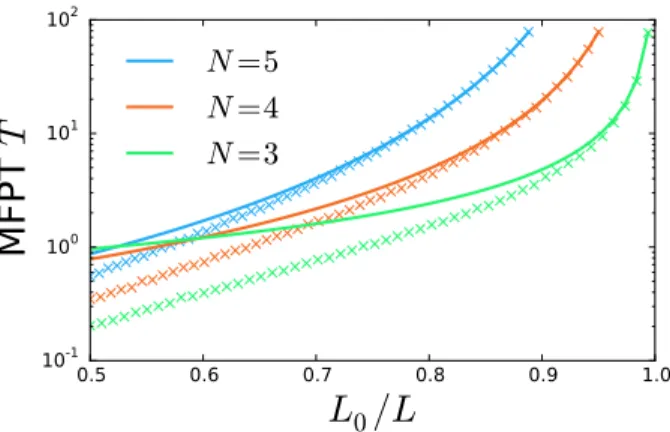
[19]. The1approximation (solid line) is compared to simulations (symbols) in Fig.2. ForN = 3, we find good agreement between simulation and the inde-pendently derived estimate forC3 from [19]. From physical arguments detailed
at the end of this letter, we have determined an expansion of the Newtonian capacitance for largeN given by
CN ∼ r
2N
πe
1 + 3 logN
2N +
α2
N +O(N
−2)
. (3)
The unknown constant in the above expansion is independent of all parame-ters. Using the exact simulation algorithm, we obtain the numerical estimate,
α2 ≈ −1.67. Our MFPT calculation thus provides an approximation for the
0.5 0.6 0.7 0.8 0.9 1.0
L
0
/L
10-1
100
101
102
MF
PT
¯
T
N
=5
N
=4
N
=3
Figure 2: The MFPT (in nondimensional units) as a function ofL0/L= 1−.
The small approximation (solid lines) is compared to simulations (symbols), usingC3= 1.3214,C4= 1.44, andC5= 1.55.
For fixed0< <1, an asymptotic expansion forN 1is given by
¯
T ∼ κ1D
N2N−2, N1, (4)
whereκ1D≈2.2depends only onα2(via Eq. 19). The N1MFPT
approxi-mation is compared to simulations in Fig.3.
5 10 15 20 25 30 35 40 45
N
10-2
10-1
100
101
102
103
MF
PT
¯
T
L
0/L
=0
.
4
L
0/L
=0
.
3
L
0/L
=0
.
2
Figure 3: The largeN MFPT approximation (solid lines) compared to simula-tions (symbols).
Finally, we consider the case the radius of the ROI L0 is fixed andL→ ∞
with a fixed number of particles per unit lengthϕ =N/(2L). Let N0 be the
average number of particles in the ROI. TheL→ ∞MFPT approximation (in dimensional units) is
T∞∼
κ1DL20eN0 N2
0D
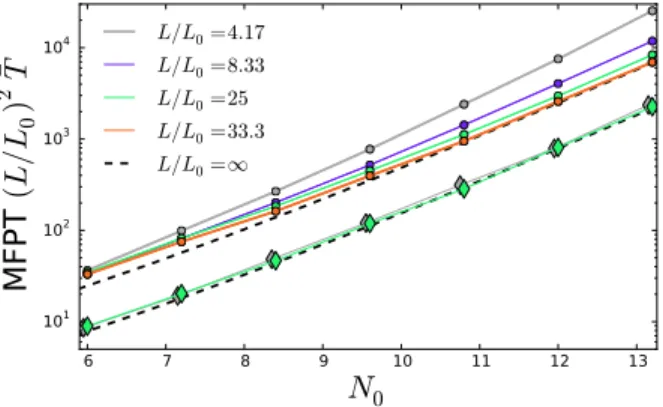
The MFPT is shown in Fig. 4 as functions of N0, for different values of L.
The approximation (37) matches closely with theL/L0 = 33.3 simulations for
6 7 8 9 10 11 12 13
N
0101
102
103
104
MF
PT
(
L
/L
0)
2
¯
T
L/L0=4.17
L/L0=8.33
L/L0=25
L/L0=33.3
L/L0=∞
Figure 4: The MFPT vsN0, the average number of particles in the ROI. The
symbols indicate103averaged simulations; the 1D simulations are shown as
cir-cles and the 2D simulations are shown as diamonds. Also shown is theL→ ∞
approximation (dashed curve) for both 1D and 2D. Note that time is nondimen-sional using theL2
0/Dtimescale.
N0 > 10. Hence, the effect of a small domain size compared to the ROI is
to increase the MFPT, making the cavitation event more rare. This provides a quantitative measure of when the domain size L no longer influences the cavitation event, which is relevant when, for example, considering cavitation on a relatively long strand of DNA compared to a shorter plasmid. Microtubule filaments also vary in length.
Simulations of 2D cavitation are also shown in Fig. 4as diamond symbols. Although the asymptotic approximation (37) is derived for 1D, we find that it is a remarkably good fit to the simulation data after changing a single parameter: the prefactor κ2D ≈ 0.7. We therefore infer that cavitation is roughly three
times faster in 2D than in 1D. Heuristically, this speed-up occurs because the mean time for a random walker to escape a spherical region decreases with dimensionality.
T ≡ hinf{t >0 : min1≤n≤NRn(t) =l0}i; it satisfies
N X n=1
∂2T ∂r2
n
=−1, r∈Ω, (6)
∂ηT(r) = 0, r∈∂Ω, (7)
T(r) = 0, r∈∂Ω. (8)
An approximate solution to (6) can be obtained using the method of matched asymptotics [33,10,30,9,20]. We split the solution into two parts: an inner and outer solution. The inner solution satisfies the absorbing boundary condition on ∂Ω and ignores the reflecting boundary. The outer solution satisfies the reflecting boundary on∂Ωand is singular asr→(1,· · ·,1). The two solutions are then matched to obtain a uniformly accurate approximation using the Van– Dyke matching principle [23].
Define the inner coordinates z= r−rb
, and let z=kzk. The inner solution satisfies
∆zw= 0, w(z∈∂ZN) = 0, (9)
where ZN is the unit hypercube. The exact solution to the inner problem for arbitraryN is unknown. However, from electrostatics [21], for largez, the inner solution has the two term expansion,
w∼BN() h
(z/CN)
2−N
−1i, N ≥3. (10)
where BN is a constant determined by matching to the outer solution. The constantCN, called the Newtonian capacitance, is a boundary dependent term discussed below.
Up to an unknown constantT˜, the outer solution is
Tout∼ −GN(r,rb) + ˜T , (11)
where the Green’s functionGN satisfies, N
X n=1
∂2GN
∂r2
n
= 1−δ(r−r0), r∈Ω, (12)
∂ηGN(r,r0) = 0, r∈∂Ω, (13)
Z
Ω
GN(r,r0)dr= 0. (14)
By integrating (11) over Ω using (36), we find thatT˜ is the MFPT averaged over a uniformly distributed set of initial positions, i.e., T˜ = ¯T. Again from electrostatics [21], in the limit rn → 1 with r0n = 1 and kr−r0k = z, the Green’s function scales like
whereAN is given by (45).
Matching the inner and outer solutions we find that thezdependent terms match provided thatBN() =−2NAN2−N forN≥3. The remaining unknown termT¯ yields the approximation (46).
In order to access the rare event limit where both N 1 and 1, we must find how the Newtonian capacitanceCN scales withN. This problem has no known exact solution forN >2 [19].
If the cuboid boundary ∂Ω were replaced by a spheroid with the same hypervolume, then the Newtonian capacitance is known for generalN,
CN ≈
2
√
πΓ
1 + N
2
1/N
∼
r
2N
πe. (16)
We therefore propose a general expansion ofCN (for the present case of cuboid boundary) having the same form as the large-N expansion of (16),
CN ∼ r
2N
πe
1 +α1logN
N +
α2 N +O(N
−2)
. (17)
Note that (16) and (17) have the same leading-order term.
To elucidate how the unknown constants α1,2 affect the large N MFPT
approximation, we use Stirling’s formula, leading to
2NAN
CNN−2 ∼ κ1D
Nβ, N 1, (18)
where
β=α1+ 1/2, κ1D=
2
√
πeα2+1. (19)
In dimensional units, the MFPT approximation is
T ∼ L
2κ 1D NβD
1−L0
L
2−N
. (20)
We determine the value ofα1by exploiting a physical constraint as follows. As L → ∞ with the density of particles ϕ = N/(2L) held constant, the MFPT must converge to a finite value. SubstitutingL=N/(2ϕ)and N0= 2L0ϕinto
(20) yields
T ∼ N
2−βκ
1D
4ϕ2D
1−N0
N
2−N
. (21)
Since limN→∞ 1−NN0
2−N
= eN0, we must have that β = 2 (and therefore
α1 = 3/2) in order for (44) to converge to a finite, nonzero value in the limit
(L, N)→ ∞. We also find thatβ = 2is supported by numerical simulations (see Supplementary Material). The limiting result is the approximation Eq. (37).
finiteL, the leading order in (46) holds in 2D. A notable feature of our 1D case is that there are no terms in the expansion between the leading order term and theO(1)term, making our 1D approximation converge particularly fast. This feature is lacking in 2D, where there are other terms singular in, therefore we expect this approximation to converge more slowly. In 2D for largeL at con-stant density, a different scaling betweenN and Lprevents the approximation in (44) from converging, necessitating an alternative strategy that will be the subject of future research.
Returning to the specific question of cell-cell contact at T cell interfaces, large diffusing molecules such as CD45 disfavor proximity between receptors and ligands on apposing cells. These molecules have diffusion coefficients of
D≈0.1µm2/s[27] and density such that on average there areN
0= 30molecules
in the 100-nanometer ROI [2]. The approximation (37), using the prefactor
κ2D = 0.7 from the numerical fit to simulations, yields an estimate of T ≈
109 seconds. In contrast, the MFPT for a single particle to escape a circular
domain is T = L20/(4D) = 0.025 seconds. Since T cell receptor triggering occurs within seconds [14], the above calculation predicts that receptor-ligand binding must involve a mechanism faster than passive diffusion. We therefore suggest the alternative hypothesis that an active force drives receptor-ligand proximity [2]. To obtain an empty ROI spontaneously in less than five seconds, we would requireN0≤7, corresponding to a four-fold dilution, which could be
experimentally accessible. The biological system is complicated by interactions of large molecules within and between molecular species, lipid heterogeneity, and transient immobilization, all of which could be exploited to dynamically tune the rate of ligand binding and will be studied by expanding the present framework.
1
Acknowledgments
JN was supported by a NSF-funded postdoctoral fellowship (NSF DMS-1100281, DMS-1462992). JA was supported by a NSF CAREER award (DMS-1454739).
A
Simulation algorithm
The exact simulation algorithm makes use of two solutions to the 1D diffusion equation. Letpa,r(x, x0, t)be solutions to
∂p ∂t =
∂2p
∂x2, 0< x, x0< xa,r (22) ∂p
∂x = 0, x= 0 (23)
p(x, x0,0) =δ(x−x0), (24)
distribution. Letprbe the solution with a reflecting BC atxr= 1. This solution is used to generate the random position of each particle given a jump time. In both cases, the solution is represented as an infinite series. Two different series representations are derived for each solution: one that converges quickly for short times and one for long times.
Let
an =
π l0
(n−1/2), bn =nπ. (25)
For large times, we have
pa(x, x0, t) =
2
l0
∞
X n=1
cos(anx) cos(anx0)e−a
2
nt, (26)
and
pr(x|x0, t) = 1 + 2
∞
X n=1
cos(bnx) cos(bnx0)e−b
2
nt. (27)
For short times we have
pa(x, x0, t) =
1 √ 4πt ∞ X n=0
(−1)n
e−(2l0n+(x+x0 ))
2
4t −e−
(2l0 (n+1)−(x+x0 ))2 4t
+e−(2l0n+4t|x−x0|)2 −e−
(2l0 (n+1)−|x−x0|)2 4t
(28)
and
pr(x, x0, t) =
1 √ 4πt ∞ X n=0
e−(2n+(x+x0 ))
2
4t +e−
(2(n+1)−(x+x0 ))2 4t
+e−(2n+|x4t−x0|)2 +e−
(2(n+1)−|x−x0|)2 4t
(29)
For short times, the first passage time density is
f(t|x0) =− ∂
∂xpa(l0, x0, t)
= 4π
(4πt)3/2
∞
X n=0
(−1)n
(l0(2n+ 1) +x0)e−
(l0 (2n+1)+x0 )2 4t
+(l0(2n+ 1)−x0)e−
(l0 (2n+1)−x0 )2 4t
(30)
with the cumulative distribution,
F(t|x0) = 1 +
∞
X n=0
(−1)n
erf(l0(2n√+ 1) +x0
4t ) + erf(
l0(2n+ 1)−x0
√
4t )
For long times, the first passage time density and cumulative distribution are
f(t|x0) =−
2
l0
∞
X n=1
(−1)nancos(anx0)e−a
2
nt, (32)
F(t|x0) = 1 +
2
l0
∞
X n=1
(−1)ncos(anx0)
e−a2 nt
an
. (33)
The jump time is sampled using a standard root finding algorithm. Given a uniform random variableU, the jump time is the unique solution to
F(t|x0)−U = 0. (34)
The distributionpr can be sampled using a rejection method as follows. A majoring function C(x) must be chosen such that C(x) > p(x | x0, t) for all x∈(0,1). A tentative valueX is sampled from the distribution
P(x) = C(x)
R1
0 C(x)dx
. (35)
A second random variable is drawn according toY =C(X)U, whereU is a unit uniform random variable. IfY > pr(X |x0, t), then the sampleX is rejected.
The procedure is repeated until a sample is accepted.
For the long time expansion (27) we selectXto be a uniform random variable in(0,1)and set
Y = 1 +e
−π2t
1−e−π2t
!
U. (36)
For the short time expansion (29) we selectX to be a normal random variable with meanx0 and variance
√
2t. Note that care must be taken to ensure that
0< X <1. In this case,
Y =e−(X−x0)2/(4t)√U
πt. (37)
A.1
2D simulations
For 2D cavitation, the outer boundary is a square of side length 2L. This geometry allows us to reuse the jump propagator from the 1D algorithm to update positions. The x and y coordinate of each particle are updated from separate samples of the 1D propagatorpr as described in the previous section. The jump times are generated from the 2D distribution of first passage times to the boundary of a circle.
The 2D first passage time problem is
∂
∂tp(r, t|r0) =
1
r ∂ ∂r
r∂p ∂r
, (38)
p(r,0|r0) =
δ(r−r0)
2πr0
, (39)
The solution can be written as an expansion in Bessel functions. The solution is
p(r, t|r0) =
2
l0
∞
X j=1
J0(rβn)J0(r0βn)
J1(l0βn)2
e−βn2t, (41)
whereαn are the roots ofJ0(αn) = 0, andβn=αn/l0. The jump time density
function is
f(t|r0) =− ∂
∂rp(l, t|r0) =
2
l0
∞
X j=1
βnJ0(r0βn)
J1(l0βn)
e−βn2t, (42)
and the cumulative distribution is
F(t|r0) = 1−
2
l0
∞
X j=1
J0(r0βn)
βnJ1(l0βn)
e−β2nt. (43)
We use a root finding method to sample the jump time.
B
Parameter estimation
We use maximum likelihood to estimate parameter values in the largeN expan-sion of the Newtonian capacitance of a hypercube. We exploit the one to one correspondance between α1 and β and between α2 and κ. The parameters β
andκare estimated using realizations of the first passage time. The likelihood function is computed by assuming that the first passage time is an exponentially distributed random variable with mean
¯
T ∼ κ
NβN−2. (44)
This assumption is valid asymptotically asN → ∞when the first passage time is a rare event. The likelihood function forβ andκ from n iid samples {τk},
k= 1,· · ·, nis given by
P({τk} |β, κ) = exp
−n
T
n
¯
Tβ,κ
+ log ¯Tβ,κ
, (45)
where
Tn=
1
n
n X k=1
τk. (46)
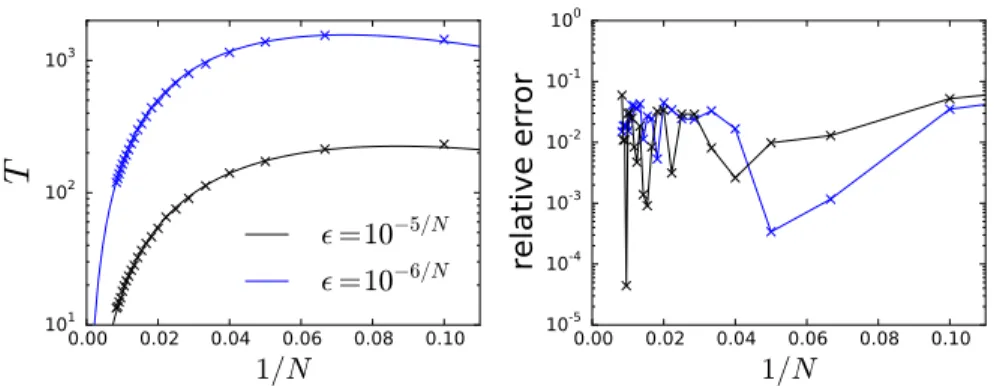
Two data sets were generated forN = 20,25,30,· · · ,115,120 with= 10−5/N and = 10−6/N. A value of T
n was generated for each parameter set using
104 samples of the first passage time from the exact simulation algorithm. We
numerically computed the maximum of the product of the likelihood functions from all parameter values. The likelihood functions were computed on a500×
0.00 0.02 0.04 0.06 0.08 0.10
1
/N
101
102
103
T
²
=10
−5/N²
=10
−6/N0.00 0.02 0.04 0.06 0.08 0.10
1
/N
10-5
10-4
10-3
10-2
10-1
100
relative error
Figure 5: The MFPT approximation compared to Monte Carlo simulation esti-mates. Each symbol shows the sample mean of104 simulations.
β≈2.00andκ≈2.19. As shown in Fig.5,T¯andTnare in good agreement with these parameter values. The corresponding parameter values in the capacitance expansion are α1 ≈ 3/2 and α2 ≈ −1.67. The capacitance approximation is
shown in Fig. 6 compared to numerical estimates. From the expansion, we expect the error (given by the absolute difference divided by√N) to scale like
1/N2 asN → ∞. We find good agreement between the error and15/N2.
20 40 60 80 100 120
N
2.0 2.5 3.0 3.5 4.0 4.5 5.0 5.5 6.0
C
N
asymptotic
numerical
20 40 60 80 100 120
N
10-4
10-3
10-2
10-1
error
15
/N
2Figure 6: The Newtonian capacitance of a hypercube.
References
[1] B Alberts, A Johnson, J Lewis, M Raff, and K Roberts. Molecular Biology of the Cell . Garland, 2014.
[3] E Ben-Naim and P L Krapivsky. First-passage exponents of multiple ran-dom walks. J Phys A, 43(49):495008–17, November 2010.
[4] H C Berg. Random walks in biology. 1993.
[5] Paul Bressloff and Jay Newby. Stochastic models of intracellular transport.
Rev. Mod. Phys., pages 1–69, August 2012.
[6] C W Cairo, R Das, A Albohy, Q J Baca, D Pradhan, J S Morrow, D Coombs, and D E Golan. Dynamic Regulation of CD45 Lateral Mo-bility by the Spectrin-Ankyrin Cytoskeleton of T Cells. J Biol Chem, 285(15):11392–11401, April 2010.
[7] H. S Carslaw and J. C Jaeger. Conduction of heat in solids. Clarendon Press, Oxford, 2nd ed edition, 1959.
[8] Amit K Chattopadhyay and Nigel J Burroughs. Close contact fluctuations: The seeding of signalling domains in the immunological synapse.Euro Phys Lett, 77(4):48003, 2007.
[9] A. F. Cheviakov and M. J. Ward. Optimizing the principal eigenvalue of the laplacian in a sphere with interior traps. Mathematical and Computer Modelling, 53(7-8):1394–1409, 2011.
[10] S. Condamin, O. Bénichou, and M. Moreau. Random walks and brown-ian motion: A method of computation for first-passage times and related quantities in confined geometries. Phys. Rev. E, 75:021111, Feb 2007. [11] Leslie Conway, Derek Wood, Erkan Tuzel, and Jennifer L Ross. Motor
transport of self-assembled cargos in crowded environments. Proc. Natl Acad. Sci, 109(51):20814–20819, December 2012.
[12] Daniel Coombs, Ronny Straube, and Michael Ward. Diffusion on a Sphere with Localized Traps: Mean First Passage Time, Eigenvalue Asymptotics, and Fekete Points. SIAM J Applied Math, 70(1):302–332, January 2009. [13] R Dixit, J L Ross, Y E Goldman, and E L F Holzbaur.
Differen-tial Regulation of Dynein and Kinesin Motor Proteins by Tau. Science, 319(5866):1086–1089, February 2008.
[14] Omer Dushek, Raibatak Das, and Daniel Coombs. A role for rebind-ing in rapid and reliable t cell responses to antigen. PLoS Comput Biol, 5(11):e1000578–e1000578, 2009.
[16] P Hammar, P Leroy, A Mahmutovic, E G Marklund, O G Berg, and J Elf. The lac Repressor Displays Facilitated Diffusion in Living Cells. Science, 336(6088):1595–1598, June 2012.
[17] Jonne Helenius, Gary Brouhard, Yannis Kalaidzidis, Stefan Diez, and Jonathon Howard. The depolymerizing kinesin MCAK uses lattice dif-fusion to rapidly target microtubule ends. Nature, 441(7089):115–119, May 2006.
[18] Frédéric J Hoerndli, Dane A Maxfield, Penelope J Brockie, Jerry E Mellem, Erica Jensen, Rui Wang, David M Madsen, and Andres V Maricq. Kinesin-1 Regulates Synaptic Strength by Mediating the Delivery, Removal, and Redistribution of AMPA Receptors. Neuron, 80(6):1421–1437, December 2013.
[19] Chi-Ok Hwang, Michael Mascagni, and Taeyoung Won. Monte carlo meth-ods for computing the capacitance of the unit cube. Mathematics and Computers in Simulation, 80(6):1089 – 1095, 2010.
[20] Samuel A. Isaacson and Jay Newby. Uniform asymptotic approximation of diffusion to a small target. Phys. Rev. E, 88:012820, Jul 2013.
[21] John David Jackson. Classical Electrodynamics. John Wiley and Sons, 1962.
[22] Yoshihisa Kaizuka, Adam D Douglass, Rajat Varma, Michael L Dustin, and Ronald D Vale. Mechanisms for segregating T cell receptor and adhesion molecules during immunological synapse formation in Jurkat T cells. Proc. Natl Acad. Sci, 104(51):20296–20301, December 2007.
[23] James P Keener.Principles of Applied Mathematics. Perseus Books, Cam-bridge, Mass., 2000.
[24] Konstantin V Klenin, Holger Merlitz, Jörg Langowski, and Chen-Xu Wu. Facilitated Diffusion of DNA-Binding Proteins. Phys. Rev. Lett, 96(1):018104–4, January 2006.
[25] Kristine McKinney, Melissa Mattia, Vanesa Gottifredi, and Carol Prives. p53 Linear Diffusion along DNA Requires Its C Terminus. Molecular Cell, 16(3):413–424, November 2004.
[26] Tomas Oppelstrup, Vasily V. Bulatov, Aleksandar Donev, Malvin H. Kalos, George H. Gilmer, and Babak Sadigh. First-passage kinetic monte carlo method. Phys. Rev. E, 80(6):066701, Dec 2009.
[28] Roman Rouzier, Radhika Rajan, Peter Wagner, Kenneth R Hess, David L Gold, James Stec, Mark Ayers, Jeffrey S Ross, Peter Zhang, Thomas A Buchholz, Henry Kuerer, Marjorie Green, Banu Arun, Gabriel N Horto-bagyi, W Fraser Symmans, and Lajos Pusztai. Microtubule-associated protein tau: a marker of paclitaxel sensitivity in breast cancer. Proc. Natl Acad. Sci, 102(23):8315–8320, June 2005.
[29] B Rozycki, R Lipowsky, and T R Weikl. Segregation of receptor-ligand complexes in cell adhesion zones: phase diagrams and the role of thermal membrane roughness. New J Phys, 12:095003, 2010.
[30] Z. Schuss, A. Singer, and D. Holcman. The narrow escape problem for diffusion in cellular microdomains. Proc. Natl Acad. Sci, 104(41):16098– 16103, OCT 9 2007.
[31] Bhupinder Shergill, Laurence Meloty-Kapella, Abdiwahab A Musse, Gerry Weinmaster, and Elliot Botvinick. Optical tweezers studies on notch: single-molecule interaction strength is independent of ligand endocytosis.
Developmental cell, 22(6):1313–1320, 2012.
[32] Frank Spitzer. Electrostatic capacity, heat flow, and brownian motion.
Probability theory and related fields, 3(2):110–121, 1964.