A Systematic Approach to Multiple Breath
Nitrogen Washout Test Quality
Renee Jensen1☯, Sanja Stanojevic1,2☯*, Michelle Klingel1, Maria Ester Pizarro1,3, Graham L. Hall4,5,6, Kathryn Ramsey4,5,7, Rachel Foong4,5, Clare Saunders8,9, Paul
D. Robinson10,11, Hailey Webster1, Kate Hardaker10, Mica Kane1, Felix Ratjen1,2
1Division of Respiratory Medicine, Hospital for Sick Children, Toronto, Canada,2University of Toronto, Toronto, Canada,3Pontificia Universidad Católica de Chile, Santiago, Chile,4Telethon Kids Institute, Perth, Australia,5Centre for Child Health Research, University of Western Australia, Perth, Australia, 6School of Physiotherapy and Exercise Science, Curtin University, Perth, Australia,7University of North Carolina at Chapel Hill, Chapel Hill, United States of America,8Royal Brompton & Harefield NHS Foundation Trust, London, United Kingdom,9Department of Gene Therapy, Imperial College London, London, United Kingdom,10 Department of Respiratory Medicine, The Children’s Hospital at Westmead, Sydney, Australia,11Discipline of Paediatrics and Child Health, University of Sydney, Sydney, Australia
☯These authors contributed equally to this work. *[email protected]
Abstract
Background
Accurate estimates of multiple breath washout (MBW) outcomes require correct operation of the device, appropriate distraction of the subject to ensure they breathe in a manner represen-tative of their relaxed tidal breathing pattern, and appropriate interpretation of the acquired data. Based on available recommendations for an acceptable MBW test, we aimed to develop a protocol to systematically evaluate MBW measurements based on these criteria.
Methods
50 MBW test occasions were systematically reviewed for technical elements and whether the breathing pattern was representative of relaxed tidal breathing by an experienced MBW opera-tor. The impact of qualitative and quantitative criteria on inter-observer agreement was assessed across eight MBW operators (n = 20 test occasions, compared using a Kappa statistic).
Results
Using qualitative criteria, 46/168 trials were rejected: 16.6% were technically unacceptable and 10.7% were excluded due to inappropriate breathing pattern. Reviewer agreement was good using qualitative criteria and further improved with quantitative criteria from (κ= 0.53– 0.83%) to (κ0.73–0.97%), but at the cost of exclusion of further test occasions in this retro-spective data analysis.
Conclusions
The application of the systematic review improved inter-observer agreement but did not affect reported MBW outcomes.
a11111
OPEN ACCESS
Citation:Jensen R, Stanojevic S, Klingel M, Pizarro ME, Hall GL, Ramsey K, et al. (2016) A Systematic Approach to Multiple Breath Nitrogen Washout Test Quality. PLoS ONE 11(6): e0157523. doi:10.1371/ journal.pone.0157523
Editor:Philipp Latzin, University Children's Hospital Bern, SWITZERLAND
Received:September 9, 2015
Accepted:June 1, 2016
Published:June 15, 2016
Copyright:© 2016 Jensen et al. This is an open access article distributed under the terms of the
Creative Commons Attribution License, which permits unrestricted use, distribution, and reproduction in any medium, provided the original author and source are credited.
Data Availability Statement:Data are available from the Hospital for Sick Children Research Ethics Board (REB) for researchers who meet the criteria for access to confidential data. Data are from the Collaborative Study to Validate a System for Measuring Lung Clearance Index in Children with CF study:[email protected]%20orsanja. [email protected].
Funding:The authors have no support or funding to report.
Competing Interests:The authors have declared
Introduction
The lung clearance index (LCI), derived from the multiple breath inert gas washout (MBW) test, has been shown to be feasible across all ages and to detect early pathologic changes associ-ated with obstructive lung disease.[1,2] The availability of commercial MBW devices provides an opportunity to use the LCI as an outcome measure in multi-center randomized control trial, as well as for the routine assessment of patients in the clinical setting.[3,4] While the MBW test requires minimal cooperation of the subject and is relatively easy to perform, accu-rate estimates of MBW outcomes rely on correct operation of the device, appropriate distrac-tion of the subject to ensure they breathe in a manner representative of their relaxed tidal breathing pattern, and appropriate interpretation of the acquired data.[5]
The 2013 European Respiratory Society/American Thoracic Society (ERS/ATS) consensus statement for inert gas washout measurement provides general recommendations on test pro-cedure and helps to standardize MBW devices and outcomes. The consensus statement out-lines the criteria for a technically acceptable washout test and states that MBW outcomes are to be reported as the average of three technically acceptable washout curves [5]. However, there is little guidance on how to apply these criteria practically to MBW data prospectively at the time of test or as part of a retrospective review. In addition, while it is widely accepted that a subject should breathe in a stable pattern representative of tidal breathing [6,7], the evaluation of breathing pattern is largely subjective and may introduce bias when interpreting outcomes. In this study we aimed to 1) develop a protocol, which systematically evaluates MBW measure-ments for technical elemeasure-ments and stability of the breathing pattern, 2) explore quantitative cri-teria as an additional way to make the protocol more objective, 3) compare inter-reviewer agreement of MBW trials, and 4) assess whether application of the protocol reduces the vari-ability of reported outcomes.
Methods
Study Population
A random number generator was used to select 50 test occasions from a previously published cross-sectional study [8]; 25 healthy children and 25 children with CF between the ages of 6 and 18 years were selected. The original study was approved by the research ethics board (REB) at the Hospital for Sick Children (HSC), Toronto, Canada (REB# 1000019945). Informed written consent was obtained from the parents or guardians of healthy children and children with CF, and written assent was obtained from subjects who were able to understand the proposed research and what was expected of them as research participants.
MBW Measurements
Participants performed multiple breath nitrogen washout (MBN2W) using the Exhalyzer D1
washout device (EcoMedics AG, Duernten, Switzerland), and associated Spiroware software (version 3.1.6) until the operator determined that three good trials were obtained or the subject was unable to continue testing.
Systematic Evaluation of MBW Trials
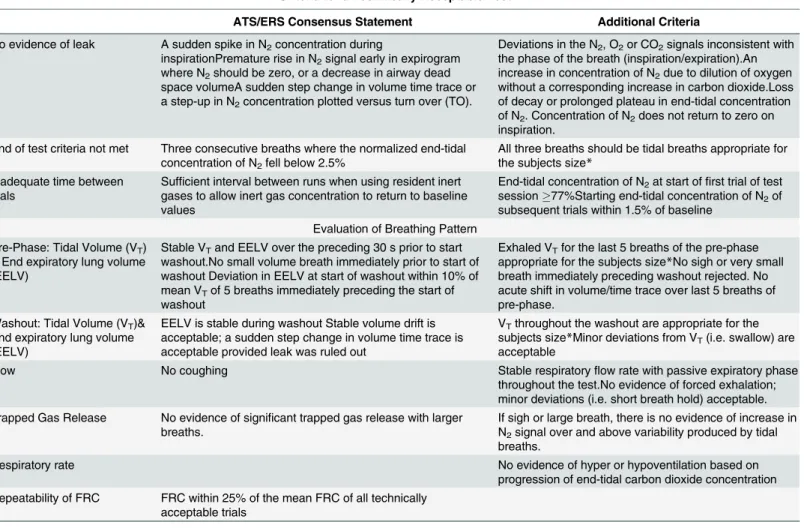
and thus was unlikely to have affected the subsequent interpretation. Each trial was evaluated for technical elements. Trials were deemed technically unacceptable if 1) the tracer gas did not re-equilibrate between trials, 2) there was clear evidence of a leak or 3) the trial did not meet end of test criteria (seeTable 1for further details). The remaining technically acceptable trials were systematically reviewed for appropriate breathing pattern (Table 1, OLS). Technically acceptable trials that did not have a breathing pattern representative of relaxed tidal breathing were deemed unacceptable. The only clinical information available to reviewers was the sub-jects’age, height and weight.
Quantitative Criteria
Data from both healthy children and children with CF were used to develop a quantitative quality control criterion. Variability of VTwas first quantified by calculating the within-trial
coefficient of variation (CV) % of the exhaled VTusing tabular breath by breath data generated
by the Spiroware software. Pre-phase breaths were not included in the calculation, nor were small breaths (tidal volume<3mL/kg). We then used the distribution of the CV VTin
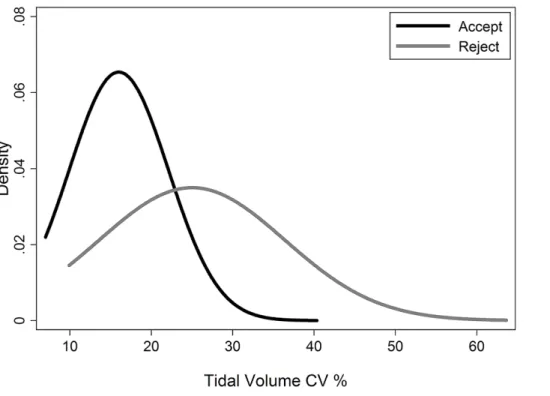
accept-able and unacceptaccept-able trials to determine a cut-off which distinguished between acceptaccept-able and unacceptable data. Trials with values above the cut-off (20%) were deemed unacceptable.
Table 1. Summary of technical and qualitative criteria used to evaluate MBW tracings.
Criteria for a Technically Acceptable Test
ATS/ERS Consensus Statement Additional Criteria
No evidence of leak A sudden spike in N2concentration during
inspirationPremature rise in N2signal early in expirogram
where N2should be zero, or a decrease in airway dead
space volumeA sudden step change in volume time trace or a step-up in N2concentration plotted versus turn over (TO).
Deviations in the N2, O2or CO2signals inconsistent with
the phase of the breath (inspiration/expiration).An increase in concentration of N2due to dilution of oxygen
without a corresponding increase in carbon dioxide.Loss of decay or prolonged plateau in end-tidal concentration of N2. Concentration of N2does not return to zero on
inspiration. End of test criteria not met Three consecutive breaths where the normalized end-tidal
concentration of N2fell below 2.5%
All three breaths should be tidal breaths appropriate for the subjects size*
Inadequate time between trials
Sufficient interval between runs when using resident inert gases to allow inert gas concentration to return to baseline values
End-tidal concentration of N2at start offirst trial of test
session77%Starting end-tidal concentration of N2of
subsequent trials within 1.5% of baseline Evaluation of Breathing Pattern
Pre-Phase: Tidal Volume (VT)
& End expiratory lung volume (EELV)
Stable VTand EELV over the preceding 30 s prior to start
washout.No small volume breath immediately prior to start of washout Deviation in EELV at start of washout within 10% of mean VTof 5 breaths immediately preceding the start of
washout
Exhaled VTfor the last 5 breaths of the pre-phase
appropriate for the subjects size*No sigh or very small breath immediately preceding washout rejected. No acute shift in volume/time trace over last 5 breaths of pre-phase.
Washout: Tidal Volume (VT)&
End expiratory lung volume (EELV)
EELV is stable during washout Stable volume drift is acceptable; a sudden step change in volume time trace is acceptable provided leak was ruled out
VTthroughout the washout are appropriate for the
subjects size*Minor deviations from VT(i.e. swallow) are
acceptable
Flow No coughing Stable respiratoryflow rate with passive expiratory phase
throughout the test.No evidence of forced exhalation; minor deviations (i.e. short breath hold) acceptable. Trapped Gas Release No evidence of significant trapped gas release with larger
breaths.
If sigh or large breath, there is no evidence of increase in N2signal over and above variability produced by tidal
breaths.
Respiratory rate No evidence of hyper or hypoventilation based on
progression of end-tidal carbon dioxide concentration Repeatability of FRC FRC within 25% of the mean FRC of all technically
acceptable trials
*10–15ml/kg of 10th-90th% ideal body weight where ideal body weight was defined using the CDC pediatric growth charts [9]
We determined ideal tidal volume (10–15ml/kg) for each subject assuming an ideal body weight for the subject’s age; ideal body weight was defined as 10th-90thweight-for-age percen-tile using the CDC growth charts as a reference [9]. Thus the range of ideal tidal volume for each subject was calculated as 10mlweight at the 10thcentile-for-age, and 15mlweight at the 90thcentile-for-age. Finally, we calculated repeatability for FRC as recommended by the ATS/ERS consensus statement, whereas for LCI we used the first acceptable trial as a bench mark to calculate the relative difference in LCI for all subsequent trials.
Statistical Analysis
Inter-Reviewer Agreement. To assess the agreement between reviewers a sub-set of 20 test occasions were reviewed by 8 MBW operators from 4 institutions (MP, RF, KR, CS, PR, MK, KH, and HW). Reviewers were asked to independently evaluate each tracing, identifying trials that were technically acceptable with an appropriate breathing pattern using the qualita-tive criteria described inTable 1as well as the check list inS1 File. We compared inter-reviewer agreement for the decision to accept/reject between the primary reviewer (RJ) and each of the 8 reviewers using the Kappa (κ) statistic.
Comparison of Outcomes. To evaluate whether the systematic quality control review improved the precision of the LCI, we compared the within-test coefficient of variation (stan-dard deviation/mean) and the inter-class correlation coefficient (ICC) of LCI from all trials to those classified as acceptable after qualitative review by the primary reviewer (RJ) and after the addition of the quantitative criteria. We also compared the average LCI calculated from all tri-als to the average LCI calculated after qualitative and quantitative review using a paired t-test.
Statistical analyses were done using Stata 13.0 (StataCorp 2013).
Results
Study Population
Demographic characteristics of the study population are described inTable 2. The CF group was slightly older and had elevated LCI compared to the healthy children. A total of 168 complete MBW trials from the 50 test occasions (range of 2–7 trials per test occasion) were reviewed.
Systematic Evaluation of MBW Trials
Of the 168 trials, 28 (16.6%) were technically unacceptable and a further 18 (10.7%) trials were found not to have a breathing pattern representative of a relaxed tidal breathing. Exclusion of these 46 trials led to the exclusion of 16 (32%) test occasions; where a successful test occasion required at least two acceptable trials. None of the 168 trials were outside the FRC exclusion lim-its proposed by the ATS/ERS consensus document (>25% of the mean FRC value). LCI values were more repeatable when acceptable trials were compared; 60% of acceptable trials were within 5% of the first, whereas this was only true for 6% of unacceptable trials. Eighty-five percent of all acceptable trials were within 10% of the first, compared with 22% of unacceptable trials. Eighty-eight percent of acceptable LCI trials were within 1 LCI unit of the first acceptable trial. Using qualitative criteria alone the agreement between the primary reviewer and each of the eight exter-nal reviewers was good (n = 61 trials from a sub-set of 20 test occasions (Table 3)). The kappa sta-tistic was>60%, indicating strong agreement for the majority of results.[10]
Impact of additional Quantitative Criteria
There was a significant difference in tidal volume variability (% CV VT) between acceptable
unacceptable trials; non-parametric t-test p<0.001,Fig 1). The distribution of the VTfor
acceptable trials (Range 7.0; 19.4) was used to define a cut-off of 20% as acceptable. When we applied the 20 CV% VTcut-off to the dataset, an additional 25 trials and 10 test occasions were
excluded. When we independently applied the limits of an appropriate VTfor subjects’size to
the dataset an additional 6 trials and 1 test occasion were excluded. Repeatability of LCI was similar when quantitative criteria were applied to define acceptable tests (data not shown). In all instances, regardless of training and experience, the addition of a quantitative component (either CV VT% or mean VTappropriate for size), improved the agreement between reviewers
(Table 3). The kappa statistic was>80%, indicating almost perfect agreement for the majority of results.[10]
Table 2. Demographics of cross-sectional study population, with results from each step of the quality control criteria applied.
Total (n = 50) Healthy (n = 25) CF (n = 25) ΔCF- HC*
Age: mean (range) 14.2 (7.7, 17.8) 13.4 (7.7, 17.2) 15.1 (9.5, 17.8) 1.7 (0.2, 3.1)
Male subjects: n (%) 20 (40%) 11 (44%) 9 (36%) -8% (-35, 63%)
N trials (Median; Range acceptable trials) 168 (2; 1–5) 80 (2; 1–5) 88 (2; 1–4)
Trials excluded for technical reasons: n (%) 28 (17%) 11 (13%) 17 (21%) 8% (-3, 20%)
Trials excluded for breathing pattern after qualitative review: n (%) 18 (11%) 16 (18%) 2 (3%) -15% (-24, 7%) Trials excluded for breathing pattern using CV VT>20%: n (%) 25 (15%) 14 (16%) 11 (14%) -2% (-13, 9%)
Trials excluded for breathing pattern using VTappropriate for size; n (%) 6 (3.6%) 2 (2.5%) 4 (4.5%) 2% (-7.5%, 3.5)
Trials not meeting 25% FRC criteria: n (%) 0 0 0 n/a
LCI (all n = 50): mean (SD) 9.9 (4.2) 6.8 (0.4) 13.0 (3.8) 6.2 (4.6, 7.7)
LCI (qualitative review n = 34): mean (SD) 10.2 (4.4) 6.9 (0.4) 13.5 (4.0) 6.6 (4.6, 8.6) LCI (excluding CV VT>20%: n = 24): mean (SD) 10.1 (4.5) 6.8 (0.4) 13.4 (4.2) 6.7 (4.1, 9.2)
LCI (excluding VTnot appropriate for size: n = 33): mean (SD) 10.2 (4.5) 6.9 (0.4) 13.8 (4.0) 6.9 (4.9, 8.9)
CF: Cystic Fibrosis LCI: Lung Clearance Index VT: Tidal volume
CV: Coefficient of Variation SD: standard deviation
*bold values indicate results are statistically significant (p<0.05).
doi:10.1371/journal.pone.0157523.t002
Table 3. Inter-Reviewer Agreement after independent review of 20 test-occasions (61 trials).Quantitative limits were applied after qualitative review, however each of the two quantitative limits (%CV VTand VTlimits for size) were applied independently.
Agreement after Qualitative Review Agreement after %CV VTlimits applied Agreement after appropriate VTlimits
applied
Reviewer % Kappa Statistic (95% Confidence Interval)
% Kappa Statistic (95% Confidence Interval)
% Kappa Statistic (95% Confidence Interval)
1 90% 0.75 (0.56, 0.94) 90% 0.80 (0.65, 0.95) 93% 0.87 (0.75, 0.99)
2 85% 0.59 (0.35, 0.83) 87% 0.73 (0.56, 0.91) 92% 0.84 (0.70, 0.97)
3 85% 0.53 (0.27, 0.79) 87% 0.73 (0.56, 0.91) 93% 0.87 (0.75, 0.99)
4 90% 0.75 (0.56, 0.94) 90% 0.80 (0.65, 0.95) 92% 0.84 (0.70, 0.97)
5 92% 0.77 (0.58, 0.96) 92% 0.83 (0.69, 0.97) 92% 0.83 (0.69, 0.97)
6 95% 0.74 (0.54, 0.93) 92% 0.84 (0.70, 0.97) 95% 0.90 (0.79, 1.00)
7 93% 0.81 (0.63, 0.99) 95% 0.90 (0.79, 1.00) 98% 0.97 (0.90, 1.00)
8 95% 0.83 (0.64, 1.00) 96% 0.93 (0.83, 1.00) 98% 0.97 (0.90, 1.00)
Comparison of Outcomes
Application of neither qualitative review nor quantitative criterion for breathing pattern stabil-ity changed the interpretation of group differences between health and disease: The difference in LCI between health and disease using all data was 6.2 (95% CI 4.6; 7.7, n = 50), compared with 6.6 (4.6; 8.6, n = 34) after qualitative review (Table 2). Similar results were observed when each of the two quantitative criterion for breathing pattern stability were applied (Table 2). The average LCI calculated as the mean of all trials (LCI = 9.9 (SD = 4.2), n = 50) was similar to the mean calculated from trials that were deemed acceptable after qualitative review (10.2
(SD = 4.4), n = 34) and when both quantitative criterion were applied (CVVT10.1 (4.5) and VT
size 10.2(4.5)). In a sub-set of subjects that had acceptable and unacceptable trials within the same test occasion, the exclusion of unacceptable changed the LCI between -0.2 units to 0.5 units. The within-subject within-test CV of the LCI for all trials was 5.1% (SD 4.4), and was smaller after qualitative review 3.3% (SD 2.5), and after we applied each of the two quantitative criterion (CV VT4.2% (SD 2.6%), VTsize 3.6% (SD 2.4)). There was no statistical difference
between the LCI if two acceptable trials were reported instead of three [n = 31, mean difference 0.04 (-0.04; 0.11), p = 0.3490]. The systematic evaluation of MBW trials marginally improved the precision of the reported LCI values (ICC 98.6 vs. 95.0).
Discussion
In this study we used the ATS/ERS MBW consensus statement as a basis to further develop a protocol to systematically evaluate MBW trials for technical criteria and appropriate breathing pattern. The systematic evaluation of MBW trials did not affect the reported LCI value on a group level, but it did change individual values. Overall there was good inter-review agreement between multiple reviewers after qualitative review, which was improved with the addition of a quantitative criterion for breathing stability. Systematic review of MBW trials could facilitate
Fig 1. Distribution of CV% VTfor acceptable and unacceptable trials.
improved standardization between groups and consequently improve the reporting and inter-pretation of MBW outcomes.
In addition to correct operation of the device and technical considerations of the MBW test, accurate interpretation of results depends on the subject’s breathing pattern. The MBW test aims to evaluate the evenness of gas mixing within the lungs during normal tidal breathing at resting lung volume. Therefore it is essential that the subject breathes in their‘normal’manner during the test. However, it may be unreasonable to expect subjects to breathe in a perfectly sta-ble and repeatasta-ble breathing pattern during washout and some degree of irregularity must be accepted. We sought to standardize the subjective review of breathing pattern, and developed a threshold for acceptability based on CV VT. Application of this additional criterion led to
improved agreement between observers, albeit at the cost of feasibility. Conversely, excluding trials where the tidal volume was not appropriate for size improved inter-reviewer agreement and did not exclude many test occasions. Verbanck et al., used a fixed volume protocol to stan-dardize tidal volume (and therefore breathing pattern) during MBW, whereby subjects were instructed to breathe at a tidal volume of 1L.[11] While this protocol may stabilize breathing, it is challenging in younger children, and the 1L target is not appropriate. Yammine et al., found that the fixed 1L protocol did minimize the % CV VT, but that restricting paediatric subjects to
breathe at a fixed volume leads to statistical and clinical over-estimation of the LCI and changes in the FRC [12]. In an attempt to add objective assessment of breathing pattern, we chose a dif-ferent approach, which focused on the correct identification of those trials with a stable breath-ing pattern. As this was a retrospective review of an existbreath-ing dataset, where data were collected before the ATS/ERS consensus statement was published, it may not reflect what would happen in a prospective study. Quantitative limits for VTsize and variability built into commercial
soft-ware may provide useful reminders to MBW operators and encourage them to collect addi-tional during which the subject breathes within the suggested limits. In addition all of the reviewers were experienced testers, familiar with respiratory physiology. It has yet to be deter-mined whether the same would apply to less experienced MBW operators.
The ATS/ERS consensus statement includes broad recommendations for a technically acceptable trial, including that any trial with an FRC greater than 25% different from the median should be excluded. In this study, there were no test occasions where the FRC
was25% of the median FRC. Reliance on the FRC criteria alone would have led to inclusion of a significant proportion (16.6%) of trials in which the breathing pattern was deemed not appropriate. LCI repeatability showed that acceptable MBW trials were more repeatable; how-ever, just as is the case for spirometry, repeatability of an outcome should only be considered if the test was technically sound. In our analysis, we did not see changes in the average LCI, sug-gesting that LCI is a robust outcome for use in cross-sectional studies, whereas the differences observed within an individual subject suggest that impact of test quality will be larger within longitudinal studies or when treatment effects are measured using change in LCI.
of the results. The proposed qualitative review and quantitative criterion for breathing pattern stability need to be validated prospectively in a larger and longitudinal dataset.
Limitations
We developed a protocol to systematically evaluate MBW tracings based on available evidence and tested it with knowledgeable MBW operators. Our findings are limited to a single dataset of 50 test occasions collected many years ago at a center and thus require further validation in other MBW outcomes, age groups, disease severities, disease groups, subject MBW testing experience, and testing in interventional studies. Our findings are not directly transferrable to other MBW set-ups (i.e. nitrogen washout by other manufactures or where SF6is used as a
tracer gas).
Conclusions
As the MBW test moves from the research setting into clinical practice, there is a growing need to standardize measurement protocols, as well as interpretation strategies using a similar for-mat to what exists for other pulmonary function tests, such as spirometry. This study provides a tool which can be used to further standardize reporting and interpretation of MBW
outcomes.
Supporting Information
S1 File. Detailed description of qualitative quality control check list with accompanying worksheet.
(PDF)
Author Contributions
Conceived and designed the experiments: SS RJ FR. Performed the experiments: RJ MEP RF KR CS PR KH HW MK. Analyzed the data: SS MK. Wrote the paper: SS RJ FR MEP MK RF KR GH CS PR HW KH MK.
References
1. Aurora P, Stanojevic S, Wade A, Oliver C, Kozlowska W, Lum S, et al. Lung clearance index at 4 years predicts subsequent lung function in children with cystic fibrosis. Am J Respir Crit Care Med. 2011; 183 (6):752–8. Epub 2010/10/12. doi:10.1164/rccm.200911-1646OCPMID:20935113.
2. Gustafsson PM, Aurora P, Lindblad A. Evaluation of ventilation maldistribution as an early indicator of lung disease in children with cystic fibrosis. Eur Respir J. 2003; 22(6):972–9. PMID:14680088. 3. Stahl M, Joachim C, Blessing K, Hammerling S, Sommerburg O, Latzin P, et al. Multiple breath washout
is feasible in the clinical setting and detects abnormal lung function in infants and young children with cystic fibrosis. Respiration. 2014; 87(5):357–63. doi:10.1159/000357075PMID:24434651.
4. Kent L, Reix P, Innes JA, Zielen S, Le Bourgeois M, Braggion C, et al. Lung clearance index: evidence for use in clinical trials in cystic fibrosis. J Cyst Fibros. 2014; 13(2):123–38. doi:10.1016/j.jcf.2013.09. 005PMID:24315208.
5. Robinson PD, Latzin P, Verbanck S, Hall GL, Horsley A, Gappa M, et al. Consensus statement for inert gas washout measurement using multiple- and single- breath tests. Eur Respir J. 2013; 41(3):507–22. doi:10.1183/09031936.00069712PMID:23397305.
6. Larsson A, Jonmarker C, Werner O. Ventilation inhomogeneity during controlled ventilation. Which index should be used? Journal of applied physiology. 1988; 65(5):2030–9. PMID:3062005.
8. Jensen R, Stanojevic S, Gibney K, Salazar JG, Gustafsson P, Subbarao P, et al. Multiple breath nitro-gen washout: a feasible alternative to mass spectrometry. PloS one. 2013; 8(2):e56868. doi:10.1371/ journal.pone.0056868PMID:23457632; PubMed Central PMCID: PMC3574055.
9. Kuczmarski R, Ogden CL, Guo S, Grummer-Strawn L, Flegal KM, Mei Z, et al. CDC Growth Charts. National Center for Health Statistics, 2000.
10. McHugh ML. Interrater reliability: the kappa statistic. Biochem Med (Zagreb). 2012; 22(3):276–82. PMID:23092060; PubMed Central PMCID: PMCPMC3900052.
11. Verbanck S, Schuermans D, Van Muylem A, Paiva M, Noppen M, Vincken W. Ventilation distribution during histamine provocation. Journal of applied physiology. 1997; 83(6):1907–16. PMID:9390962. 12. Yammine S, Singer F, Gustafsson P, Latzin P. Impact of different breathing protocols on multiple-breath
washout outcomes in children. J Cyst Fibros. 2014; 13(2):190–7. doi:10.1016/j.jcf.2013.08.010PMID:
24075581.
13. Summermatter S, Singer F, Latzin P, Yammine S. Impact of Software Settings on Multiple-Breath Washout Outcomes. PloS one. 2015; 10(7):e0132250. doi:10.1371/journal.pone.0132250PMID: