TESTING THE BLOWBACK THESIS
Mark D. Noble
A thesis submitted to the faculty of the University of North Carolina at Chapel Hill in partial fulfillment of the requirements for the degree of Masters in the Department of Sociology.
Chapel Hill 2010
ii ABSTRACT
MARK D. NOBLE: Testing the Blowback Thesis (Under the direction of KEN BOLLEN and CHARLES KURZMAN)
Social scientific analyses of anti-American terrorism primarily seek explanations in the political, economic, and social conditions of states where Americans are attacked. A prominent counter-narrative places the focus on U.S. foreign policies positing that anti-American terrorism is “blowback” for them. The few studies that analyze anti-American terrorism as a potential consequence of U.S. actions abroad do not examine if there are long-term or cumulative effects of U.S. policies and actions. In order to effectively determine if terror events are truly
iii
TABLE OF CONTENTS
LIST OF TABLES v
LIST OF GRAPHS vii
Chapter
I. INTRODUCTION 1
Importance of Topic 1
Research Questions 2
Objectives of Research 3
II. LITERATURE REVIEW 5
III. LONG-TERM OR CUMULATIVE EFFECTS 17
Running Sum Model 18
Distributed Lag (DL) Models-Unrestricted/Restricted and
Infinite/Finite Variations 19
Unrestricted Distributed Lag Model 20
Context of Restricted Distributed Lag Models 20
Arithmetic Distributed Lag (ArDL) Model 21
Polynomial Distributed Lag (PDL) Models 22
Long-Term Interaction Model (LTI) 23
Growth Curve Model (GCM) 24
IV. REPLICATION AND TESTING CUMULATIVE EFFECTS 26
Replication: “Foreign Terrorism on Americans” 26
iv
Dependent Variable: Americans Killed in Terrorist Attacks 34
Replication: “Ideologies of Violence” 39
Dependent Variable: Islamist Attacks 41
Dependent Variable: Leftist Attacks 44
V. DISCUSSION AND CONCLUSION 51
Summary of Substantive Findings 51
Summary of Methodological Findings 52
Implications for Future Research 53
APPENDICES 57
v LIST OF TABLES
Table
1.1. Top 15 Countries that Produce Anti-American Terrorism 1968-2005 15 1.2. Top 15 Countries that Produce Terrorists who Kill Americans 1978-2005 15
3.1. Methodologies Capturing Long-Term Effects 18
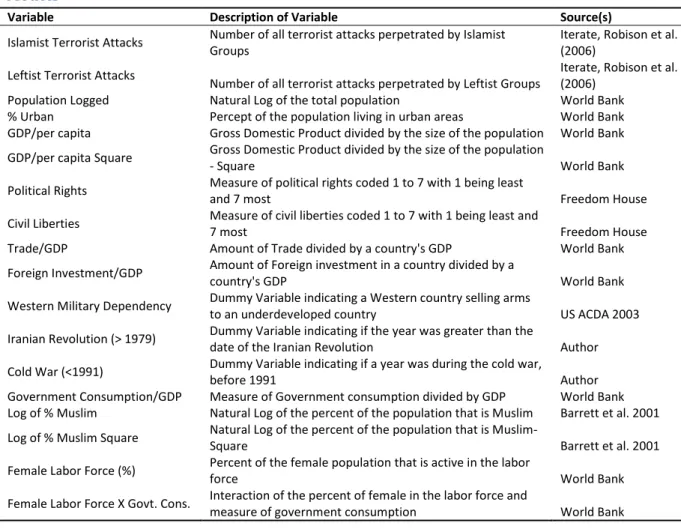
4.01. Description of Variables Used and Sources in Neumayer &
Plümper Replication Models 27
4.02. Descriptive Statistics and Variables in the Replication Model 27 4.03. Neumayer & Plümper NBRM Replication of Anti-American
Terrorist Incidents, 1968-2005 29
4.04. 10-Year ArDL for Anti-American Attacks 31
4.05. Summary Table of Conclusions: Anti-American Terrorist Attacks 33 4.06. Neumayer & Plümper NBRM Replication of Americans Killed in
Terrorist Attacks, 1978-2005 35
4.07. Summary Table of Results Dependent Variable: Americans Killed
by Terrorist Attacks 36
4.08. 20-Year ArDL Models for Americans Killed in Terrorist Attacks 37 4.09. Description of Variables Used and Sources for Robison et al. (2006)
Replication Models 40
4.10. Descriptive Statistics and Variables in the Replication Model 41 4.11. Negative Binomial General Linear Model with AR1 of Military
Dependency for Islamist and Leftist Terrorist Attacks, 1973-2002 42 4.12. Summary Table of Results Dependent Variable: Islamist Terrorist Attacks 45 4.13. Negative Binomial 15-Year PDL2 with AR1 of Military Dependency
for Islamist Terrorist Attacks, 1973-2002 47
4.14. Summary Table of Results Dependent Variable: Leftist Terrorist Attacks 48 4.15. Negative Binomial 15-Year ArDL AR1 of Military Dependency for
Leftist Terrorist Attacks, 1973-2002 50
vi
A.2. Correlation Table from Robison et al. (2006) 57
B.1. Counts of Dependent Variables Used in Analysis by Year 59 C.1. Anti-American Attacks VS. Number of Americans Killed in Terrorist
Attacks, 1978-2006 60
C.2. Islamist Terrorist Attacks VS. Leftist Terrorist Attacks, 1968-2003 60
D.1. Arithmetic DL Beta Coefficient Pattern 61
E.1. Second Degree PDL Beta Coefficient Pattern 62
vii LIST OF GRAPHS
Graphs
3.1. Normalized Time Profile for ArDL Model 22
I. Introduction
Importance of Topic
The causes of terrorism against America and its allies are not accurately understood today. The social scientific literature still lacks an accounting of the most important causes of anti-Western terrorism. All across the Western world, after a foiled or successful attack,
government officials make pronouncements as to the reasons why someone would cause terror, fear, death, and or destruction to their citizens. Commonly, the underlying causes pronounced are that terrorists have a hatred of democratic freedoms and liberties which often come off as disparaging remarks toward others’ cultural characteristics.
These statements are met with forceful critiques that it is Western, especially the United States’ foreign policies and actions abroad that are important precipitating factors on anti-Western terrorism. These critiques attempt to shift the focus from simplistic explanations based on cultural stereotypes to those that look to U.S. actions as part of the justification for why attackers chose to target the U.S. and its allies. Actions identified as potential causes of anti-American terrorism are the historic support for dictatorial heads of state displayed by the U.S.; the financing given to foreign governments for military equipment, training, and
operations; and the stationing of American servicemen in foreign countries. These factors can be summarized in the concept of military dependency (Neumayer & Plümper, 2009).
2
2004, 2007; Scheuer, 2002, 2004), in descriptive analyses in academic journals by critics of U.S. foreign policies (Eland, 2008), and by sometimes by the statements of the terrorists themselves (see statements made by Osama bin Laden in 1996 ). What is lacking is an accumulation of scientific research on the structural determinants of terrorism (some attempts toward this are Neumayer & Plümper, 2009; Robison et al. 2006). This previous research has identified military dependency as a partial predictor of terrorism but these studies only examine its potential short-term effects. My research has built upon the existing research and I have found that there is significant evidence of a cumulative effect of at least 10 years for measures of military
dependency for all outcomes of terrorism under examination here. Furthermore, these results may not always support the findings made by previous analyses examining only the
contemporaneous effects of military dependency on terrorism. In some cases causes that have been previously found to lead to increased terrorism in the short-term do not lead to increased terrorism in the long-term and vise-versa.
Research Questions
3
whether long-term military dependency on the U.S. leads to an increase in “blowback” on Americans. This research question will directly engage research findings by Neumayer & Plümper (2009) in their examination of the effects of contemporaneous measures of U.S. military dependency on anti-American terrorism and infuse it with the concept of blowback made famous by Chalmers Johnson in the book of that title (2000). A second research question motivated by Robison et al. (2006) is if the cumulative impact of military dependency on
terrorism lends itself to a different interpretation as to the similarities found by Robison et al. of the factors that lead to Islamist and Leftist terrorism. A tertiary research question is to evaluate the combined evidence from these two studies in light of my additional analyses of long-term effects of military dependency and come to a conclusion on whether the long-term and short-term effects of military dependency on terrorism are the same or if they diverge.
Objectives of Research
The primary goal of my research is to examine whether existing studies, focused on short-term consequences of military dependency on terrorism, are accurate portrayals of the long-term consequences of military dependency on terrorism. The lack of existing agreed upon methodologies for the measurement of the long-term impacts will require this paper to examine a variety of strategies in search of the best methodology. Therefore, a second purpose of this study will be to identify a methodology appropriate for assessing long-term effects that could be useful in other social science applications. My third purpose in this study is to infuse two related but distinct sub-fields of social science, international relations and the study of social
4
II. Literature Review
The inspiration for my project originates with the work of a Political Scientist, Chalmers Johnson, whose ideas have gained significant prominence in the post-September 11th world. I acknowledge that the main thesis of Johnson (2000) Blowback: The Costs and Consequences of American Empire is much more detailed than the portion on which I focus. In Blowback, Johnson challenges U.S. policy-makers and the public at large to re-evaluate America’s role in a post-Cold War world that operates in a more diffuse manner than the simple polemic template that guided the military policies in the decades after World War II to the early 1990s. Johnson also states that some of the countries that have been recipients of U.S. military aid, grants, arms, and troops are seen by other people in the world as outright or tacit support for the way in which these leaders govern their countries. These various forms of support often can change the balance of domestic political power by the mere appearance that a leader has the full backing of the U.S. government whether real or imaginary. These injections of international support can change the calculations of other members of the government, challengers, and political outsiders. Johnson argues that the potential for anti-American blowback can occur when the resources needed to consolidate the political supremacy come from the U.S. and not from the citizens of the nation-state (Johnson, Chapter 1). I interpret the duration and intensity of
military dependency on the U.S. by another country to be a vital part of Johnson’s analysis and a potential indicator from where anti-American terrorism will originate.
6
processes which are used by politically excluded members of a country’s population beginning with the use of anti-American terrorism as a method to win domestic political power. They frame all anti-American terrorism as a consequence of the unbalanced state of domestic governmental affairs due to the over-ridding effect of a country’s military dependence on the U.S. Therefore, anti-American terrorism is utilized by domestic challengers in the hopes of driving a wedge between the U.S. and their autocratic leaders and bringing support to their cause to unseat the domestic leaders. Success for the terrorists is identified as when the U.S. government restructures its relationship with their domestic government in response to overwhelming public pressure to minimize American causalities or by the U.S. government’s rational calculation of the negative consequences with the status quo relationship. In this scenario, the American public is seen as not having the tolerance for governmental policies that place innocent Americans in the crosshairs of the terrorists. This portrayal of Americans is described by Pape1 as motivation for suicide terrorists today when they are confronting
occupying troops. “…Hezbollah’s prominent success in compelling the United States, France, and Israel to withdraw military forces from territory that the terrorists view as their homeland has played a major role in encouraging today’s most deadly suicide terrorists” (Pape, 2005: p. 129). Eland also states that the deployment of U.S. troops abroad, its support of cruel leaders, and unwavering support of Israel are some of the most frequently heard complaints by those that have and wish to do the U.S. harm. “Retaliation for US interventionism in the Arab-Muslim world is al Qaeda’s primary motive for attacking the United States. Specifically, Osama bin
1
7
Laden’s biggest gripes are with US-that is, non-Muslim-occupation of Muslim lands and meddling in their politics by supporting corrupt dictators and Israel” (Eland, 2008, p. 95).
In the sociological literature of social movements, a phenomenon described as the “Boomerang Pattern” is advanced in the discussion of transnational advocacy by Keck and Sikkink (1998). When democratic channels for claims to be made against a government are obstructed and the government is not responsive to public pressure, organizations may reach out to the international arena seeking an outside benefactor to put pressure on their
unresponsive leaders. “When channels between the state and its domestic actors are blocked, the boomerang pattern of influence characteristic of transnational networks may occur: domestic NGOs bypass their state and directly search out international allies to try to bring pressure on their states from outside” (Keck and Sikkink, 1998, p. 12). In a similar way
challengers’ use of terrorist violence against Americans to pressure the U.S., the most militarily powerful nation in the world, to break the pattern of support to their home government and thereby altering the balance of power within the dependent nation. Although this boomerang pattern has been identified with NGOs as the domestic actors parallels to existing studies on the causes of anti-American terrorism have been identified in the international relations literature.
8
perpetrator(s) and 2-the number of Americans killed by terrorist attacks based on the national origin of the perpetrator(s).
One distinct feature in this study is that Neumayer & Plümper consider the nationality of the terrorists which targeted Americans rather than the location of where the attacks or killings take place. James A. Piazza states that studies which examine the sociopolitical contexts which produce terrorism are thus far, an understudied aspect in terrorism studies. “[W]hat has been curiously understudied by terrorism scholars [is] the general political environment of the country of origin of terrorist perpetrators” (2005: p. 38). He goes on to use the term “supply-side” when examining “the sociopolitical contexts of groups that engage in suicide terrorism” (2008: p. 30). For Neumayer & Plümper, placing the focus on the nationality of the terrorist instead of the location where the terrorist attack occurs allows their theoretical argument, a modified “boomerang pattern”, for why Americans will endure more attacks from foreign nationals who are citizens of a military dependency of the U.S., to be consistent with the measurement of their dependent variables.
Through the use of regression based techniques appropriate for count data, Neumayer & Plümper conclude that there is a positive link between increases in military dependency and anti-American terrorism. For the number of terrorist incidents they find military aid and military troop dependency are statistically significant predictors while arms dependency is not a
significant predictor. When evaluating the predictors for the number of Americans killed by terrorism all three measures are statistically significant predictors and they rank the three measures from highest to lowest as: aid, arms, and troop dependency.
9
goal of Robison et al.’s study is a test as to whether the current “fourth wave” (see Shughart 2006) of Islamist terrorism is similar or distinct from the Leftist terrorism witnessed during the 1960s- 1970s. Regression-based techniques suitable for count data, negative binomial
regression models, were used in this study. The dependent variable was the number of attacks carried out by those with ideologies determined to be either Islamist or Leftist. The resulting coefficients for a variety of key explanatory variables relating to structural conditions theorized to lead to terrorism were compared between these ideologies to determine the amount of and nature of any similarities. Conceptual theories tested came from prior literature and included theories of social disorganization and strain; theories of political order; theories of global order; and theories which focus on competing identities or civilizations. In this study, the concept of Western military dependence is conceptualized as an indicator of the theoretical perspective of global order. Western military dependency is measured with a dummy indicator variable which represents the presence of arms sales from a Western nation to a less-developed nation. While the main emphasis of this study is on the comparison of the structural characteristics of Islamist and Leftist terrorism, they do find that Western military dependency did have a positive and significant effect in all models of Islamist terrorism and in preliminary models of Leftist terrorism.
These two studies represent the closest examples in the social science literature that link the concepts of military dependency and terrorism. Neumayer & Plümper’s focused solely on anti-American terrorist attacks and come closest to the concept of anti-American blowback that Johnson examines in his work. They also use three different measures of military
dependency on the U.S. which relate to dependency on arms imports, military troop
10
cumulative measures of military dependency is mainly used as a robustness check on the results I obtain from the cumulative extensions of Neumayer & Plümper’s study. Robison et al. include a large number of structural theories identified in the current literature that were left out of Neumayer & Plümper’s study.
Both studies base their conclusions solely on the short-term consequences of military dependency and leave unexamined the potential cumulative nature that duration or exposure to military dependency’s structural arrangements may cause. Any extrapolations based on these findings to longer time horizons may bias or misrepresent the true portrayal of the long-term consequences of military dependency. This is potentially dangerous because past studies of terrorism by social scientists have been used as fodder for the political and foreign policy apparatus in the U.S.2 In essence, the danger is that important decisions relating to military policy may be made based on assessments of military dependency that are incomplete and may belie the true nature of the total costs or true consequences of distributing military support to foreign governments. Thus, I intend to take the potential long-term nature of military
dependency into account to test whether short-term and long-term consequences converge and to better represent the concept of blowback used most famously by Johnson which I use as my theoretical guide for my analyses.
If Johnson’s assessment is correct and the U.S. has rung up, in essence, a huge debt of blowback potential of which Americans have only begun to feel the reverberations, then the anachronous foreign military policies of the U.S. lamented by Johnson may need to be altered to decrease the possibility that Americans will be the targets of future blowback. “Throughout the world in the wake of the Cold War, official and unofficial U.S. representatives have been acting,
2
11
often in covert ways to prop up repressive regimes or their militaries and police forces, something’s against significant segments of their own populaces. Such policies are likely to produce future instances of blowback whose origins, on arrival will seem anything but self-evident to the American public”(Johnson, 2000: 65).
The link between America’s arms industry and future potential cases of anti-American blowback explicitly links the work of Neumayer & Plümper and Robison et al. to Johnson’s assessments of potential cause of future blowback. “Arms sales are, in sort, a major cause of a developing blowback world whose price we have yet to begin to pay” (89). While neither of these studies that I am replicating and extending here referenced blowback or Chalmers Johnson I feel that this is an important oversight given that Johnson’s work eloquently
humanizes with historical depth some fascinating and little-known cases (little known in the U.S. that is) that show the consequences of U.S. military policies abroad including those relating to foreign troop deployment3, military aid (including training), and foreign arms sales which are particularly salient for my analysis.
Most of the examples that Johnson discusses in Blowback play out over a much longer time horizon than just one year. One chilling example of blowback used by Johnson (8) is the U.S. government’s military alliance with the Afghan mujahedeen rebels fighting against the Soviet Union in Afghanistan, especially fighters aligned with Osama bin Laden. Although this working relationship was formed in the Cold War of the mid to late 1980s, Johnson cites that one of the unintended consequences of this relationship was an increase in the standing of bin Laden amongst his fellow fighters and ultimately may have contributed to the anti-American terrorist attacks simultaneously at U.S. Embassies in Nairobi, Kenya and Dar es Salaam, Tanzania
3
12
on August 7, 19984. If actions of military support by the U.S. are hypothesized to lead to anti-American terrorist blowback then I would like to attempt to integrate current social science studies of military dependency’s effect on terrorism with the theoretical underpinning of Johnson’s blowback thesis in my study.
However, before going any further in my work I would be remiss if I failed to introduce an important disclaimer and a couple of problems that I wrestle with concerning Johnson’s blowback thesis and the related scholarly work (and my unique contributions that follow). First, although the title of Chalmers Johnson’s first book of three on the imperialist tendencies of the U.S. was entitled Blowback: the Costs and Consequences of American Empire, I fully
acknowledge that Johnson’s thesis and many of his main descriptions and insights went far beyond simply blowback, or the unintended consequences of U.S. actions abroad. It would be a gross simplification and disservice to this fine work if I were to fail to at least make an attempt to acknowledge what I believe to be the main emphasis of this book. If I were to hazard to give a two line summation of this book I would say that it is a sobering warning to all Americans of the potential consequences of an institutionalized American military apparatus which uses
seemingly benign ideology, like the support of democracy and freedom abroad, to support often anachronous Cold War policies. These policies have the potential to lead the U.S. into a situation of imperial overstretch, retaliation from people around the world, and possibly to collapse.
As a Sociologist I feel obligated to point out what astute students of Sociology will no doubly see as a repackaging of a classic sociological debate between the two opposing approaches to dividing human actions: the role that social structures play in constraining and facilitating human behaviors and attitudes and the role that humans have on shaping the social conditions in which they live (Kivisto, 1998: p. 146). I would argue that that Johnson’s blowback
4
13
thesis could be identified as part of the structuralist approach by the way in which military dependency alters for both the power-holders and challengers the political opportunity structure (POS) within a political regime5. In terms of POS I rely on the Tilly and Tarrow’s definition as “features of regimes and institutions that facilitate or inhibit a political actor’s collective action”6 (Tilly and Tarrow, 2007: p. 203). I acknowledge this debate and view the analysis here as but one of many potential factors that lead to human actions. This analysis necessarily neglects, without much discussion, the multitude ways in which the citizens of militarily dependent countries can shape their realities, identities, cultures, and processes such as framing that lie between the structure and the ultimate actions under analysis.
Another issue in this current debate on blowback is one in which I will call the self-prophetic feel that the blowback thesis has in my opinion and is another source of my interest in this work and the topic in general. In essence, an attempted terrorist attack regardless of its success could be construed as evidence for the blowback thesis whether the “true” unknown cause of the attack has anything to do with military dependency. This situation is even further exasperated when there is no specific time horizon given as guidance in theoretical statements on blowback. An extreme example to illustrate my point would be of a terrorist attack against American citizens by Panamanian citizens which takes place today in 2010. Using the idea of the blowback thesis, I could argue that this attack was retribution for the humiliation suffered by the Panamanians for the loss of complete sovereignty to the U.S. of the Panama Canal due to the joint Panama-U.S control over the canal for the two decades proceeding the year 2000. Clearly,
5 According to Tilly and Tarrow, political regimes are defined as “regular relations among governments, established political actors, challengers, and outside political actors including other governments” (2007, p. 203).
6
14
this example may appear ridiculous but it illustrates the difficulty one would have in delineating the boundaries of the blowback thesis. Regardless of these troubling issues, I will proceed with my analyses in much the same way as my predecessors have but I will challenge the reader to keep in mind my objections and to devise clever ways which blowback could be better specified.
As a preliminary step in my analysis, I applied the theoretical insights by Johnson’s blowback thesis to Neumayer & Plümper’s data by re-examining some of the qualitative
descriptions given in the paper. Specifically, I re-ranked the countries examined by Neumayer & Plümper from the perspective of a potential long-term effect of military dependency. First, as can be seen in Table 1.1., I made a list of the countries that had produced anti-American terrorist attacks in all of the years in their original analysis, 1968 to 2005. In this table I also listed where the country ranked in terms of the three key dependent variables in the original analysis. In the table the smaller number in the rank of aid, arms, and troops equates there to be a higher degree of dependency on the U.S. for these variables. In Table 1.2 I show the rankings of the top 15 countries which produced terrorists who killed greater number of Americans in the period 1978-2005 along with the number of attacks produced by that country and the rankings aid, arms, and troops.7 In both of these tables I have indicated with boldface, italicized, boxed numbers, the instances where a country who made the list also had a
corresponding ranking of aid, arms, or troop’s dependency in the top 15.
Initially, this led me to have some different interpretations than those offered in the analysis by Neumayer & Plümper (2009, p. 21). I find that this preliminary evidence does not support the theoretical claims as to why Americans would be the targets of attacks and fatal attacks in the long-term. Similarly, it is not clear to me from Tables 1.1 and 1.2 that there is a clear pattern that suppliers of anti-American terrorism are more militarily dependent than other
7
15
countries. This may be preliminary evidence that the short-term and long-term effects of military dependency on the U.S. are divergent. This initial descriptive analysis provides further
Table 1.1 Top 15 Countries that Produce Anti-American Terrorism 1968-2005
Ran
k Country
# Attack s Rank Aid Rank Arms Rank Troops
1 Colombia 188 35 25 81
2 Philippines 85 18 24 5
3 Greece 59 16 10 22
4 Turkey 58 11 7 31
5 El Salvador 51 37 67 65
5 Lebanon 51 9 19 48
7 Peru 45 74 52 96
8 Iran 43 65 11 73
9 Germany 41 172 69 3
10 Pakistan 39 41 45 107
11 Somalia 34 27 82 93
12 South Korea 32 4 8 8
13 Cuba 29 148 167 23
14 Chile 26 72 55 84
15 Iraq 25 134 124 10
Table 1.2 Top 15 Countries that Produce Terrorists who Kill Americans 1978-2005
Rank Country # Killed (since '78) # Attacks (since ’68) Rank Aid Rank Arms Rank Troops
1 Lebanon 272 51 9 19 48
2 Germany 202 41 172 69 3
3 Saudi Arabia 57 24 71 29 18
4 Iraq 36 25 134 124 10
5 El Salvador 20 51 37 67 65
6 Philippines 19 85 18 24 5
7 Egypt 13 16 5 4 52
8 Colombia 12 188 35 25 81
8 Pakistan 12 39 41 45 107
8 Turkey 12 58 11 7 31
11 Jordan 10 17 8 2 100
12 Iran 9 43 65 11 73
12 Indonesia 9 12 41 53 106
14 India 8 14 97 97 133
15 Afghanistan 7 8 81 . 15
16
evidence, along with theoretical statements, that better identifying the long-term effects of military dependency is an important undertaking to pursue in this paper. Before continuing any further in this endeavor I will next discuss the concept of long-term effects and identify and briefly describe the multiple methodologies I use to attempt to capture these duration effects.
III. Long-Term or Cumulative Effects
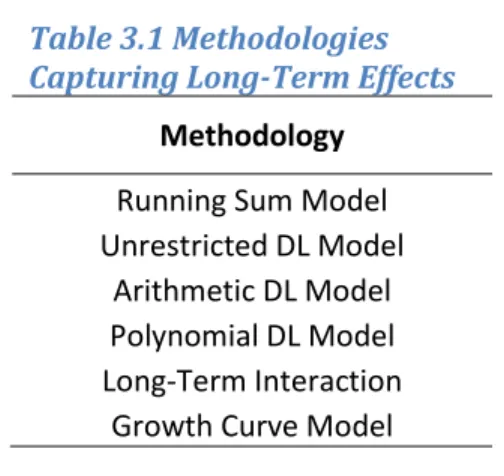
The theoretical literature from Johnson yields the insight of the potential effects of military dependency to differ due to the duration or intensity in which the dependency is experienced. However, the theoretical literature does not hint to any specific type of empirical model which could capture the ideas of duration and intensity of military dependency. To capture these ideas appropriated from Johnson, I will use the six methods shown in Table 3.1 to formulate the long-term nature of the relationship between military dependency and terrorism. I formally define long-term or cumulative effects as a situation where an explanatory variable’s effect is experienced for a duration lasting between 5 and 30 years. Although this definition allows for a large variance in potential duration, I hypothesize that I will find that the largest effects of military dependency to lie between 10 to 20 years. My justification of this range is that there is face validity to the idea that this would be the amount of time it would take a child who could comprehend potential influences of military dependency either directly or from stories by an elder to the time where the adult could act on this stimulus. A time span of shorter than that may not be enough to allow for enough young children to grow up and act on these feelings in numbers large enough to be seen as statistically significant. Similarly, a time span larger than 20 years would reach into one’s late twenties to early thirties when most likely they have adopted a more conservative nature and have responsibilities such as families and careers that may not be desirable to cast aside to act on long-held grievances. Therefore, I would hypothesize that any radical behavior leading to terrorism would have manifested itself before a lag of thirty years. In the sections which follow, I will briefly describe each method I use to capture duration.8
8
18
Table 3.1 Methodologies Capturing Long-Term Effects
Methodology Running Sum Model Unrestricted DL Model
Arithmetic DL Model Polynomial DL Model Long-Term Interaction
Growth Curve Model
Running Sum Model
This method consists of creating a new explanatory variable for each existing measure of military dependency that is a running sum of each of its previous values. These three cumulative variables are essentially a running sum from the first year of data given in the data set. Missing values for a given year were dealt with by carrying forward the value from the previous year9. All other variables in the model are held at the same level as all previous models. This method has the potential drawback in that it does not include measures of military dependency which occurred prior to the first year contained in a dataset. If my theory of cumulating effects is correct, influence from unmeasured prior years will likely influence my estimates in ways that are not known. The following is the equation used for creating the running sum X ’p (i.e., X prime sub-p). Each predictor variable is denoted Xp , the subscript 0 refers to the current value of the predictor variable, k is the number of lags being tested, and
p refers to the number of explanatory variables which are all shown in Equation 1.1. (1.1)
19
Distributed Lag (DL) Models – Unrestricted/Restricted and Infinite/Finite Variations
I will briefly define the term distributed lag (DL) and discuss two general types of divisions that can be imposed on DL models which will lay the foundation for several of the methods used below. Rao and Miller state that “[In a] causal relation-in which the influence of a change in the independent variable is spread over a long stretch of time periods [it] is called the distributed lag effect” (Rao and Miller, 1971: p. 160). DLs are common in the study of econometrics in such evaluations of the link between changes in the money supply and consumer prices, the lag between research and development expenditures and their impact on productivity, in the relationship between the balance of trade among nations and a currency’s depreciation, etc. (Gujarati, 2004: pp. 660-661). One dimension of DL Models can be viewed as the distinction between two types: 1-Unrestricted and 2-Restricted. The term
restricted refers to whether there is any type of shape or pattern that is introduced into the coefficients on the variables being examined. By introducing a pattern into the time profile of the lagged values, the coefficients for each of the values (present and lagged) have to be restricted to a pre-defined value. The unrestricted variants of these models are straight forward and include additional terms of the right-hand side (RHS) of the equation which correspond to past values of the independent variable(s) being
examined. Often in practice, these unrestricted models break down and are generally not practical as the number of lagged variables increases. Another disadvantage of these models is that for each additional lagged value included in the model there is a cost of one degree of freedom that is imposed. As the number of degrees of freedom decrease, the ability to detect the desired effect of the
independent variable decreases. This is equivalent to stating that the statistical power of the test is decreasing with each additional lagged value. An additional problem is of the unrestricted DLs is that the collinearity between lags can often be a source of estimation problems.
20
patterns are possible for two reasons. The X-variables are linearly transformed into Z-variables and the beta coefficients are not directly estimated but indirectly estimated through gamma coefficient of the Z-variables. The number of gamma parameters estimated varies depending on the type of finite DL model being estimated. An advantage of these models is that substantial increases in degrees of freedom can be achieved through the need to estimate only a few gamma parameters from which the beta
parameters can be computed by the functional form of the time profile chosen a priori.
Another way in which DL models can be conceptually categorized is by whether they are finite or infinite. Finite lags refer to the situation where the researcher specifies a priori the number of lagged values to include in the statistical model. Infinite DL models are usually estimated via the Koyck
transformation. My theoretical guidance does not suggest these models may be appropriate so I will not elaborate on them here (see a standard econometric text such as Gujarati, 2004: pp. 665-667, for the exact details of the Koyck transformation).
Unrestricted Distributed Lag Model
The unrestricted distributed lag model is described as an ad hoc estimation practice of DLs (Gujarti, 2004: p. 663). This type of DL model is what is often used by researchers in social sciences, applied econometrics, advertising, environmental studies amongst other disciplines, especially when the suspected lag length is small. One way to employ this method is to use an iterative strategy for the determination of the number of lagged values of the independent variable to include on the RHS of the model. This procedure is discussed further in Appendix B. Equation 2.1 is the general DL regression equation for a single predictor X.
(2.1)
Context of Restricted Distributed Lag Models
21
coefficient pattern linking the time profile to the beta parameters can be used to recover the individual beta coefficient. The Arithmetic DL (ArDL) model requires the estimation of only one gamma coefficient regardless of the number of lagged values included in the model. Higher order functional forms require additional gamma parameters.
Arithmetic Distributed Lag (ArDL) Model
The structure of the lags is linearly decreasing beginning with the current value of the X-variable through the first lag to the kth lag. The estimation of this type of finite lag structure requires that the researcher start with a pre-determined lag length that they would like to explore (k) and from this known value of k only one unknown parameter gamma (γ) is needed to compute the values for all of the betas (β) for each of the lagged X-variables. The intercept term and disturbance are estimated as alpha (α) and epsilon (ε) respectively.
(3.1)
22
Graph 3.1 Normalized Time Profile for ArDL Model
Polynomial Distributed Lag (PDL) Models
The finite restricted DL model known as the Almon or Polynomial Distributed Lag (PDL) models allows for more influence of some past explanatory variables than others. In the PDL models, the coefficients on the lags are still related to each other but in a different way than in the arithmetic lag models which is not uniform. This lag structure is often used when the linearly decreasing structure in the arithmetic lags is too restrictive. The additional second and third gamma parameters are used to estimate the slope of the time profile and the apex, or the lag which has the maximum effect on the current outcome variable. In the visual representation of a PDL2 model shown in Graph 4.1, the distributed lags has a time profile that increases initially and then begins to decrease to 0 producing what can be identified as a hump shape with a maximum at lag one. Equation, 4.1, is solved for the alpha (α) and gamma parameters (γ) in a way which is similar to the ArDL model.
(4.1)
Then, as in the ArDL model, the estimated parameters are used to recover the beta coefficients for each lagged value of the X-variable following Table E.1 in Appendix E as well as the details of a step-by-step example of the bivariate regression case.
0 .5 1 1.5 2 2.5
Be
ta
Va
lu
e
0 1 2 3 4 5 6 7 8 9 10 11
Lag #
with Lag Length 10
23
Graph 4.1 Normalized Time Profile for Second Degree PDL Model
The PDL model can be extended to an even more nuanced function form, the PDL3 model, having four unknown gamma parameters. The additional parameter is used to give an additional bend or change of direction in the time profile of the lagged X-values. The following equation produces the gamma coefficients which can be used to recover the individual beta coefficients following the steps outlined in Appendix F.
(4.2)
Long-Term Interaction (LTI) Model
Another potential method for estimating long-term effects is to include an interaction with a variable that measures long-term military dependency on the U.S. I constructed a dichotomous indicator variable with a value of one when a country hosted 100 or more U.S. servicemen in a given year and zero when it did not. The impetus for using this measure was taken from Johnson’s second book in the Blowback trilogy, Nemesis: The Last Days of the American Republic. In Nemesis, Johnson discusses that the annual BSR prepared by the U.S. DoD lists each domestic and overseas property that the DoD owns or leases each year. These listing by themselves give us only a partial indication as to the size of the U.S. footprint in that country. These records describe in detail the real-estate holdings and list characteristics such as square feet. It does not however, give a real indication as to the American military presence in
0 .5 1 1.5 2 2.5
Be
ta
Va
lu
e
0 1 2 3 4 5 6 7 8 9 10 11
Lag #
with Lag Length 10
24
that country. The installation listed could be just a listening post with one or two personnel working there or a larger military installation. Johnson suggested that looking at installations that house 100 or more troops would give an accurate depiction as to whether that facility represented an American military presence. Since the BSR does list the number of servicemen and women that occupy that facility in any given year I used a data set prepared by a fellow at the Heritage Foundation Timothy Kane. He prepared a data set that takes official DoD records and created time series variable for the number of troops in a country each year. From this data I created a dichotomous indicator variable with a value of one when a country hosted 100 or more U.S. servicemen in a given year and taking a value of zero when the country hosted less than 100.
From this dichotomous indicator variable I then created a variable containing the running sum variable, a variable that holds the value of the number of years since 1968 that there have been 100 or more U.S. troops stationed in country. This variable was then included in the NBRM by itself and also interacted with each of the three military dependency variables, in the first analysis and with the lone measure of military dependency in the second analysis.
Growth Curve Model (GCM)
For this study I will use GCMs in the SEM framework called Latent Curve Models (LCMs) (Bollen and Curran, 2006: p. xi).There are several advantages of LCMs for estimating GCMs: 1-their ability to deal with imperfectly measured variables through the incorporation of measurement models (see Blozis, 2004; Hancock, Kuo, & Lawrence, 2001; McArdle, 1988); 2-their ability to deal with missing data on the outcome and the predictor variables by using direct maximum likelihood (see McArdle, Grimm,
25
IV. Replications and Testing Cumulative Effects
My first task in building on the existing studies indicating that military dependency is a
significant predictor of terrorism is to replicate the two studies that I will be using as a starting point for my original analysis. I will first replicate and discuss Neumayer & Plümper’s (2009), “Foreign Terrorism on Americans”. Next, I will replicate and briefly discuss Robison, Crenshaw, and Jenkins’s (2006), “Ideologies of Violence: The Social Origins of Islamist and Leftist Transnational Terrorism”. Once I have established that my replication analyses produce the exact results by their original authors I will change only one aspect of each of these works, namely, substituting new measures that I will create utilizing the methods outlined above for the existing measures of military dependency. This procedure will be the source of the evidence that I will use to make my conclusions.
Replication: “Foreign Terrorism on Americans”
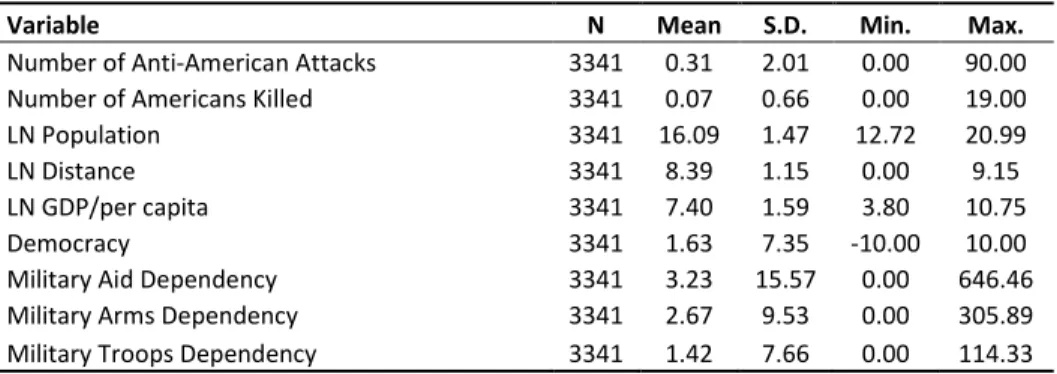
Neumayer & Plümper frame the argument as to why the U.S. is frequently the target of international terrorism as attacks on Americans are strategic actions. This means that a group or network of subjects from a country militarily dependent on the U.S. comes to the conclusion that attacking Americans is of more strategic value than pursuing some other course of action with the goal of obtaining some political power. The real value for the terrorists is in the damage that their attack may ultimately inflict on the nature of the relationship with their dependent government and the U.S. In this study they use the country-level as the unit of analysis. I use in my replication the exact same variables that were used by Neumayer & Plümper in their original work and I present them concisely in Table 4.01 below along with their relevant statistical summaries presented in Table 4.02.10 The dependent variables are the number of attacks on Americans and the number of Americans killed in terrorist incidents
10
27
outside the U.S. The key independent variables are U.S. military aid expressed as a % of total domestic military expenditures, military weaponry purchased from the U.S. expressed as a % of total domestic military expenditures, the ratio of U.S. military troops to domestic military troops. The remainder of the variables in the table population, distance between capital cities, GDP per capita, and level of democracy are used as control variables.
Table 4.01 Description of Variables Used and Sources in Neumayer & Plümper Replication Models
Variable Description of Variable Source(s)
Number of Anti-American
Attacks the # of attacks on Americans outside of the U.S. Iterate
Number of Americans Killed
the # of Americans killed in terrorist incidents outside
the U.S. Iterate
LN Population Natural Log of the size of the population World Bank
LN Distance
Natural Log of the distance between Capital City and
Washington D.C. Bennett & Stam (2005) LN GDP/per capita Natural Log of GDP/per capita World Bank
Democracy Level of Democracy ranging from -10 to 10
Polity IV, Marshall, Jaggers & Gurr (2006)
Military Aid Dependency
U.S. military aid expressed as a % of total military expenditures
USAID Greenbook, COW-Military Capabilities
Military Arms Dependency
Military Weaponry Purchased from the U.S. expressed
as a % of total military expenditures SIPRI, COW-Military Capabilities
Military Troops Dependency
Ratio of U.S. military troops to domestic military troops
Kane, DoD, COW-Military Capabilities
Table 4.02 Descriptive Statistics and Variables in the Replication Model
Variable N Mean S.D. Min. Max.
Number of Anti-American Attacks 3341 0.31 2.01 0.00 90.00 Number of Americans Killed 3341 0.07 0.66 0.00 19.00 LN Population 3341 16.09 1.47 12.72 20.99
LN Distance 3341 8.39 1.15 0.00 9.15
LN GDP/per capita 3341 7.40 1.59 3.80 10.75
Democracy 3341 1.63 7.35 -10.00 10.00
28
Dependent Variable: Anti-American Attacks
The results from my replication models of the number of anti-American terrorist attacks are shown in Table 4.03. Following the original work, four models are estimated with the dependent variable anti-American attacks.11 In the full model with all of the predictors, model 4, only military aid dependency and troop dependency are statistically significant predictors of the number of
anti-American terrorist attacks. Although the variable arms dependency is significant in preliminary model 2, it is not significant in the full model. I will report here both the unstandardized value appearing in the table above with their standard errors in parentheses and the standardized coefficients to be consistent with later models since time profiles of different variables can be compared directly if they are
normalized (Rao and Miller, 1971, p. 163). The coefficient for aid dependency is .038 (.0138) and for troops dependency is 0.027 (0.0058). The standardized coefficient for aid dependency is 1.165 (0.597) the standardized coefficient for arms dependency is 1.615 (1.05) and for troops dependency is 1.48 (0.312). The conclusion is that increases in military aid and troop dependency lead to increases in anti-American attacks. Taking this finding as my starting point, I then proceeded to estimate these same four models but substituting three cumulative, long-term measures of military dependency for the three contemporaneous measures of military dependency in the original models. Listed in Appendix G are the descriptive summary statistics for all of the variables that I created to use in each of the long-term models.
Based on the long-term models that I analyzed I have come to some conclusions based when examining the number of anti-American attacks. These observations are summarized in table 4.05 below. The running sum model presents evidence that appears to be contradictory to the replication model as well as other long-term models. It suggests that only military arms dependency is a significant
29
predictor of the outcome. Due to its contradictory analysis I tend to think that this model does not present an accurate representation of the long-term effects of military dependency. The unrestricted DL model appears to break down when attempting to include only two lagged values of the military
Table 4.03 Neumayer & Plümper NBRM Replication of Anti-American Terrorist Incidents, 1968-2005
(1) (2) (3) (4)
LN Population 0.668*** 0.617*** 0.645*** 0.677*** (5.13) (4.43) (4.52) (5.18) LN Distance -0.103 -0.188 -0.215 -0.058 (-0.23) (-0.32) (-0.35) (-0.17) LN GDP per capita 0.154 0.066 0.076 0.083 (1.48) (0.61) (0.67) (0.75) Democracy -0.001 0.010 0.006 0.002 (-0.06) (0.42) (0.27) (0.08)
Aid 0.044*** 0.038***
(3.26) (2.76)
Arms 0.044*** 0.024
(2.73) (1.54)
Troops 0.027*** 0.027***
(3.15) (4.74) Intercept -12.766*** -10.522** -10.743** -12.899***
(-3.48) (-2.29) (-2.19) (-4.17) Dispersion Parameter 2.219*** 2.269*** 2.269*** 2.178***
(16.98) (17.78) (16.91) (16.03)
N 3360 3360 3483 3341
chi2 47.48*** 40.91*** 38.63*** 84.79*** n2ll 1765.98 1779.53 1802.06 1749.39 * p<0.10, ** p<0.05, *** p<0.01
dependency explanatory variables. I followed the procedures suggested by Gujarti for ad hoc estimation of this model and found the ideal lag length for each explanatory variable independently. However, the full model led to inconsistent results in terms of the coefficients and the sign of the coefficients when two or more lagged values of the military dependency variable were included in the model despite the fact that in individual models a lag length of two was appropriate. This is indeed one of the weaknesses of this methodology and I took it as a suggestion to move forward to restricted lag models.
30
models (ArDL) and began the examination to find the proper length of lagged explanatory variables to include in the model. The analytical procedures call for estimating several lengths of lags and rely on empirical fit statistics to assess a potential length of lag to use. I found this procedure to produce inconclusive results at times and realized quickly some limitations with this approach. Beyond the fact that this felt like exploratory modeling the amount of available data appears to be a major limitation of this approach, as it is for other DL models I examine below. I found that overall fit measures consistently identified 20-years as the most appropriate lag length when the variables were assessed individually. However, when all three explanatory variables were included in the model the 10-year lag lengths led to the outcome that had the largest overall effect on the number of anti-American terrorist attacks. Each of the measures of military dependency was statistically significant and the gamma coefficients were as follows: aid dependency was 0.058, for arms dependency 0.104, and 0.045 for military troop
dependency. To clarify, these gamma coefficients estimated in the model are not directly comparable to typical standardized beta coefficients in regression-based methods which by convention are usually denoted X-variables. These gamma coefficients are for newly created Z-Variables which are linear combinations of the original X-variables based on the lag scheme specific to the method being used here, the ArDL approach for working with DLs. After the model is estimated the resulting gamma coefficients are used to recover the familiar standardized beta coefficients for the X-variables and each of the 10 lagged values used in this model to compute the total effect of the explanatory variable. Once I recovered these standardized beta coefficients using Table D.1 in Appendix D I determined the total effect of each of the military dependency variables over the 10-year period identified as the most appropriate length of lag which were: 3.828 for aid, 6.824 for arms, and 2.97 for military troop dependency. Having found this method to produce the best results they are listed in Table 4.04.
31
dependency. From the procedure described above and outlined explicitly in Appendix D, the resulting exponential of the long-term effects for the significant effects of aid is 45.97, for arms is 957.19, and for troops is 19.49. Military arms dependency was not a significant predictor of anti-American terrorism in
Table 4.04 10-Year ArDL for Anti-American Attacks
(1) (2) (3) (4)
LN Population 0.637*** 0.570*** 0.604*** 0.635***
(4.77) (4.08) (4.12) (4.71)
LN Distance -0.075 -0.127 -0.172 -0.055
(-0.20) (-0.28) (-0.31) (-0.18)
LN GDP per capita 0.124 -0.044 0.071 -0.011
(1.18) (-0.39) (0.64) (-0.10)
Democracy 0.004 0.028 0.008 0.016
(0.15) (1.16) (0.35) (0.62)
10-Year Z for Std. Military
Aid 0.100*** 0.058**
(3.13) (2.17)
10-Year Z for Std. Military
Arms 0.142*** 0.104***
(3.88) (2.95)
10-Year Z for Std. Military
Troops 0.045** 0.045***
(2.51) (4.35)
Intercept -12.347*** -9.718** -10.362** -11.771***
(-3.69) (-2.52) (-2.33) (-3.96) Dispersion Parameter 2.185*** 2.180*** 2.235*** 2.102***
(16.18) (16.39) (16.76) (14.62)
N 2902 2902 3179 2867
chi2 34.63*** 33.16*** 28.76*** 69.71***
n2ll 1633.30 1634.59 1756.09 1606.43
* p<0.10, ** p<0.05, *** p<0.01
the short-term but in the long-term it is a quite strong predictor. Clearly, the long-term effects are divergent from the short-term effects especially considering the long-term effect of military arms dependency. This suggests that a failure to consider the long-term impacts of military dependency would lead to an inaccurate understanding of the causes of anti-American attacks in the long-term.
When I examined the PDL2 or Almon models for anti-American terrorist attacks, the length of lags that appeared to produce the largest effects were those of 5-year lags. However, only the
32
much smaller effect than found in the ArDL model and is not consistent with that model’s findings. The third degree PDL model had 10-year lags as the most appropriate length but again, their effects were smaller than the ArDL models but larger than the PDL2 models. Of the restricted DL models the ArDL model with a 10-year length of lag has the largest effect on the number of anti-American terrorist attacks.
The next model that I evaluated was that of the long-term interaction with a substantial number of U.S. troops stationed in a foreign country. Johnson suggested that looking at installations that house 100 or more troops would give an accurate depiction as to whether that facility represented an
American military presence. From this dichotomous indicator variable I then created a variable containing the running sum variable, a variable that holds the value of the number of years since 1968 that there were a substantial number of U.S. troops stationed in country. The results from these models do have statistically significant effects for aid 0.026, arms 0.034, and troops, 0.028 but they do not show evidence of an interaction effect with the number of years in which there is a substantial number of U.S. troops stationed in a foreign country. Therefore, in my opinion these results are inferior to those found in the 10-Year ArDL models.
I found the growth curve model to be inappropriate when examining the long-term effects of military dependency on anti-American terrorist attacks. This model did not have a statistically significant amount of variation about the mean of the number of attacks and thus had a flat latent trajectory. This conclusion was established by examining the estimated means of the number of attacks in the model and by the lack of significance variance of the mean in the output.
10-33
year ArDL in much the same way that the short-term models have. To summarize, there is evidence of a 10-year cumulative long-term effect which is more pronounced than the short-term effect and found on all three indicators of military dependency than the original replication model using the dependent variable of anti-American attacks.
Table 4.05 Summary Table of Conclusions: Anti-American Terrorist Attacks
Description of model with abbreviation used Best-fitting model description of this type
Results from best-fitting model of this type
Key substantive interpretation from the identified best-fitting model of this type
Replication Model Neumayer & Plümper’s original model specification
There is evidence of an effect of aid and troop military dependency on the outcome.
Military dependent countries are more likely to have citizens which attack Americans using terrorism especially when the ratio of aid and troop dependency increases.
Running Sum Model (RS)
Running Sum Model
There is evidence of an effect of only arms military
dependency on the outcome.
In contrast to the replication model, dependency on military arms is the only significant predictor of the outcome. These results suggest that in the long-term the most important predictor of anti-American attacks is arms and military aid and U.S. troops are not significant predictors of anti-American attacks.
Unrestricted DL
Model (UDL) 2-Year Lags
Inconsistent due to the modeling procedure breaking down.
This method appeared to present inconsistent results in terms of the coefficients and the sign of the coefficients when two or more lagged values of the military dependency variable were included in the model despite the fact that in individual models a lag length of two was appropriate. Suggests moving to restricted lag models. Restricted DL Models Analyzed
Arithmetic Distributed Lag Model (ArDL)
10-Year Lag Length
There is evidence of an effect of all military dependency variables aid,arms, and
troops.
Ranking the measures of military dependency from this method in terms of their largest impact on the outcome, Arms sales, Military Aid, and U.S. troop dependency. The replication model had troops and aid as the two most important predictors while the running sum model had only arms as a predictor, but here arms is by far the largest predictor but not the only statistically significant predictor.
Polynomial DL
Model (PDL) None
Only the 5-year PDL has any statistically significant measures of military dependency and that is aid
34
Polynomial DL 3
Model (PDL3M) Inconsistent
Based on empirical standards, the 10-Year lags appear to be appropriate.
There is a positive effect of aid and troops in the long-term but this effect is smaller than is found in the ArDL models rendering these models to be inferior to those and suggesting that the shape of the impulse response function to not be complex. Other Models Analyzed
Short-Term Interaction Model (STIM) Short-Term Interaction Model
There is evidence of an effect of troops and aid military dependency on the outcome and there is no evidence of an interaction effect with a short-term U.S. military presence.
Consistent with the replication model in that troops and aid are the most important predictors of anti-American attacks. However, arms
dependency is found to have a slightly negative effect on the outcome whereas in the replication model it was not significant. There is not a short-term interaction with having a U.S. military presence and any of our key predictors.
Long-Term Interaction Model (LTIM) Long-Term Interaction Model
There is evidence of an effect of troops and aid on the outcome but no indication of an interaction with having a long-term U.S. military presence.
Consistent with the replication model in that troops and aid are the most important predictors of anti-American attacks. However, arms
dependency is found to have a slightly negative effect on the outcome whereas in the replication model it was not significant.
Growth Curve Model (GCM)
Latent Curve Model
Proved inappropriate for the attack data.
Model is not appropriate for the data at hand due to the non-significant variation around the mean of the number of Americans killed
Dependent Variable: Americans Killed in Terrorist Attacks
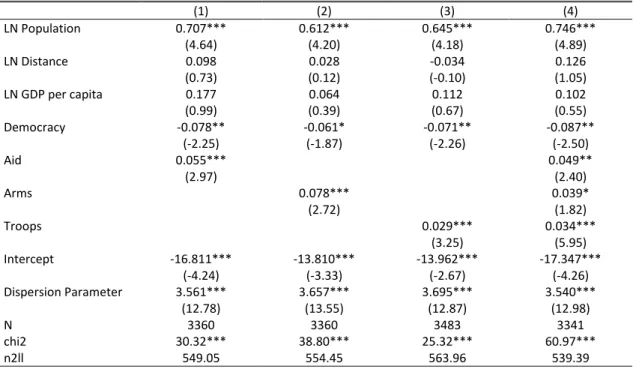
The first step in examining potential long-term effects of military dependency on the number of Americans killed in terrorist attacks was to undertake an exact replication with the exact variables as were used in the original analysis. Notice from Table 4.06 that all three measures of military dependency are statistically significant predictors of the number of American killed in terrorist attacks. Listing these variables with the larger coefficients (along with their standard errors) of military dependency first is aid at 0.049 (0.2303), next is arms at 0.039 (0.0213), and finally troops with an effect of 0.034 (0.0058). I will also include, as I did above, the standardized coefficients which will be used for comparison with the DL models: aid 2.115 (0.8802), arms 2.616 (1.436), and troops 1.855 (0.3120).
35
To cut to the gist of my findings, the running sum model, the unrestricted DL models, the Long-term interaction models and the growth curve models appear to have limitations
Table 4.06 Neumayer & Plümper NBRM Replication of Americans Killed in Terrorist Attacks, 1978-2005
(1) (2) (3) (4)
LN Population 0.707*** 0.612*** 0.645*** 0.746***
(4.64) (4.20) (4.18) (4.89)
LN Distance 0.098 0.028 -0.034 0.126
(0.73) (0.12) (-0.10) (1.05)
LN GDP per capita 0.177 0.064 0.112 0.102
(0.99) (0.39) (0.67) (0.55)
Democracy -0.078** -0.061* -0.071** -0.087**
(-2.25) (-1.87) (-2.26) (-2.50)
Aid 0.055*** 0.049**
(2.97) (2.40)
Arms 0.078*** 0.039*
(2.72) (1.82)
Troops 0.029*** 0.034***
(3.25) (5.95) Intercept -16.811*** -13.810*** -13.962*** -17.347***
(-4.24) (-3.33) (-2.67) (-4.26)
Dispersion Parameter 3.561*** 3.657*** 3.695*** 3.540***
(12.78) (13.55) (12.87) (12.98)
N 3360 3360 3483 3341
chi2 30.32*** 38.80*** 25.32*** 60.97***
n2ll 549.05 554.45 563.96 539.39
* p<0.10, ** p<0.05, *** p<0.01
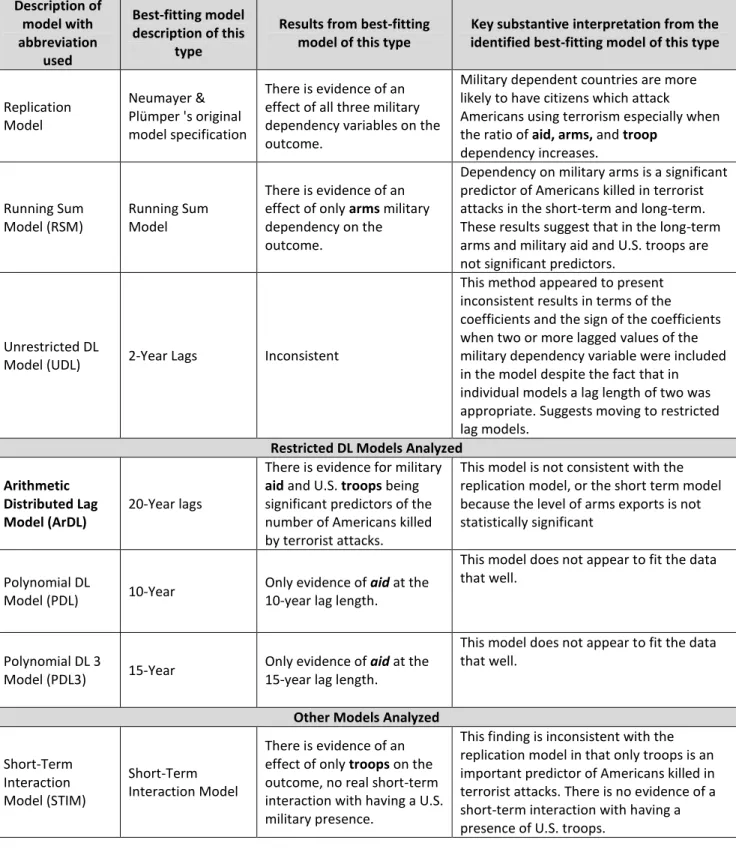
which prevent them from being considered as the best depictions of the long-term effects of military dependency in this circumstance. Also, both the second and third degree PDL models do not appear appropriate for this data. This leaves the analysis with the ArDL model of 20-year lag length which is the most appropriate for modeling the outcome which are presented in Table 4.08. The gamma coefficients for these effects are 0.019 for aid, 0.001 but not significant for arms, and 0.012 for troop dependency. Remember that these are not standardized beta coefficients on the actual variables but gamma
36
Table 4.07 Summary Table of Results Dependent Variable: Americans Killed by Terrorist Attacks
Description of model with abbreviation
used
Best-fitting model description of this
type
Results from best-fitting model of this type
Key substantive interpretation from the identified best-fitting model of this type
Replication Model
Neumayer & Plümper 's original model specification
There is evidence of an effect of all three military dependency variables on the outcome.
Military dependent countries are more likely to have citizens which attack Americans using terrorism especially when the ratio of aid, arms, and troop
dependency increases.
Running Sum Model (RSM)
Running Sum Model
There is evidence of an effect of only arms military dependency on the outcome.
Dependency on military arms is a significant predictor of Americans killed in terrorist attacks in the short-term and long-term. These results suggest that in the long-term arms and military aid and U.S. troops are not significant predictors.
Unrestricted DL
Model (UDL) 2-Year Lags Inconsistent
This method appeared to present inconsistent results in terms of the coefficients and the sign of the coefficients when two or more lagged values of the military dependency variable were included in the model despite the fact that in individual models a lag length of two was appropriate. Suggests moving to restricted lag models.
Restricted DL Models Analyzed Arithmetic
Distributed Lag Model (ArDL)
20-Year lags
There is evidence for military aid and U.S. troops being significant predictors of the number of Americans killed by terrorist attacks.
This model is not consistent with the replication model, or the short term model because the level of arms exports is not statistically significant
Polynomial DL
Model (PDL) 10-Year
Only evidence of aid at the 10-year lag length.
This model does not appear to fit the data that well.
Polynomial DL 3
Model (PDL3) 15-Year
Only evidence of aid at the 15-year lag length.
This model does not appear to fit the data that well.
Other Models Analyzed
Short-Term Interaction Model (STIM)
Short-Term Interaction Model
There is evidence of an effect of only troops on the outcome, no real short-term interaction with having a U.S. military presence.
37 Long-Term Interaction Model (LTIM) Long-Term Interaction Model
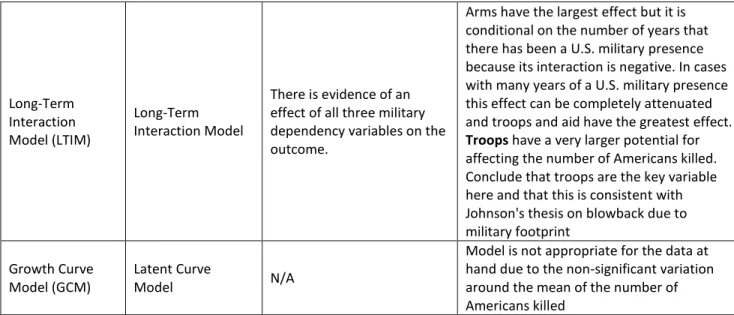
There is evidence of an effect of all three military dependency variables on the outcome.
Arms have the largest effect but it is conditional on the number of years that there has been a U.S. military presence because its interaction is negative. In cases with many years of a U.S. military presence this effect can be completely attenuated and troops and aid have the greatest effect. Troops have a very larger potential for affecting the number of Americans killed. Conclude that troops are the key variable here and that this is consistent with Johnson's thesis on blowback due to military footprint
Growth Curve Model (GCM)
Latent Curve
Model N/A
Model is not appropriate for the data at hand due to the non-significant variation around the mean of the number of Americans killed
Table 4.08 20-Year ArDL Models for Americans Killed in Terrorist Attacks
(1) (2) (3) (4)
LN Population 0.736*** 0.519*** 0.650*** 0.874***
(3.40) (2.81) (3.56) (4.71)
LN Distance 0.287 0.179 0.152 0.374
(1.31) (0.91) (0.66) (1.24)
LN GDP per capita 0.205 -0.084 0.027 0.139
(1.20) (-0.43) (0.13) (0.71)
Democracy -0.119*** -0.091** -0.096** -0.137***
-2.62) (-2.14) (-2.37) (-3.01)
20-Year Std. Military Aid 0.018*** 0.019***
(3.07) (3.11)
20-Year Std. Military Arms 0.043** 0.001
(2.00) (0.05)
20-Year Std. Military Troops 0.010*** 0.012***
(3.49) (4.07)
Intercept 18.647***
-11.944*** -14.829*** -21.197*** (-3.76) (-2.65) (-3.04) (-4.26) Dispersion Parameter 3.572*** 3.723*** 3.769*** 3.521***
11.77) (11.60) (11.39) (11.88)
N 1540 1540 1733 1505
chi2 17.28*** 18.31*** 22.15*** 36.85***
n2ll 270.80 275.21 289.62 266.36
38
When I compare the long-term effects of military dependency from the 20-Year ArDL models to those of the original models I come to the following conclusions. First, the coefficient for aid
dependency is approximately 107.5% larger than its coefficient in the original model (4.389 compared to 2.115). The measure of arms dependency is not a significant predictor of the number of Americans killed in the long-term, but it was a sizeable predictor in the short-term possessing a coefficient of 2.616. The effect of troop dependency, like aid dependency, is larger in the long-term than in the short-term with the long-term standardized coefficient being 49.4% larger (2.772 compared to 1.855). I find that the long-term effects of military dependency on the number of Americans killed by terrorist attacks produced by a military dependency of the U.S. are markedly different than the short-term effects reported previously. While the effects of military arms dependency may increase the likelihood of having Americans killed in terrorist attacks in the short-term they do not have an effect on whether Americans are killed in the long-term. The effect of military aid dependency appears to be much more harmful in the long-term than in the short-term. The effect of U.S. troops dependency is larger in the long-term than in the short-term but it is not as harmful as military aid dependency.