Mesolithic Doggerland,
where the points are small
A functional analysis of the small barbed bone points
Mesolithic Doggerland, where the points are small
A functional analysis of the small barbed bone points
Merel Spithoven (S1208667) Master of Science thesis
Supervisor: Prof. Dr. A.L. van Gijn Specialisation: Material Culture Studies Leiden University, Faculty of Archaeology Leiden, 14-08-2018
3
Index
Index ... 3
Preface ... 7
1. Introduction ... 9
1.1 Terminology ... 10
1.2 Biography of Small Barbed Bone Points from the North Sea ... 11
1.2.1 Bone as Raw Material ... 12
1.2.2 Production: Morphological and Technological Variation ... 12
1.2.3 Use-Life: Function ... 15
1.2.3.1 Arrowheads ... 16
1.2.3.2 Other Interpretations ... 17
1.2.4 Re-use: Curation versus Expediency ... 17
1.2.5 Deposition ... 19
1.3 Stakeholders ... 21
1.4 Research Questions and Thesis Outline ... 22
2. Methodology ... 25
2.1 Microwear Analysis ... 25
2.1.1 History of Microwear Analysis ... 26
2.1.2 Reference Collections... 27
2.1.3 Features of Microwear ... 27
2.1.3.1 Edge-removals ... 28
2.1.3.2 Breakage and fractures ... 28
2.1.3.3 Edge-rounding ... 30
2.1.3.4 Striations ... 30
2.1.3.5 Polish and Residue ... 31
2.1.3.6 Maintenance ... 32
2.1.4 Sampling ... 33
2.2 Experimental Archaeology ... 34
2.2.1 Hypotheses ... 35
2.2.2 Outline of the Experiment ... 36
2.3 Use Wear Analysis ... 38
2.4 Limitations ... 39
4
3.1 The Mesolithic Period in Northwest Europe ... 43
3.2 The Preservation of the Mesolithic Layer of Doggerland ... 45
3.3 A Changing Landscape: Rising Sea Level ... 46
3.3.1 Human Responses to the Submerging Landscape ... 48
3.4 Flora and Fauna ... 49
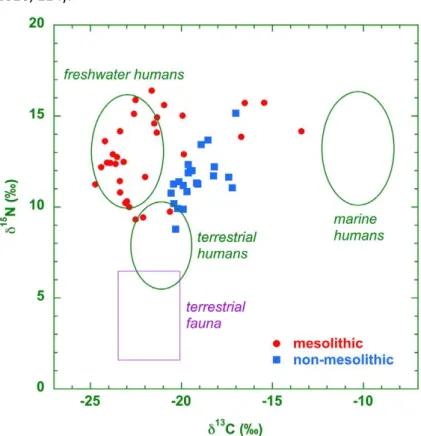
3.4.1 The Mesolithic Diet in Doggerland ... 51
3.5 Non-homogenous Responses to the Changing Landscape ... 53
4. The Shooting Experiment ... 55
4.1 Hunting from a Distance ... 55
4.1.1 The Bow as Hunting Weapon ... 56
4.1.2 Hunting Techniques ... 57
4.1.3 Hunting Grounds ... 58
4.2 Hypotheses ... 59
4.3 Conducting the Experiments ... 60
4.3.1 Experiment 3640 and 3641 ... 62
4.3.2 Experiment 3642 and 3643 ... 63
4.3.3 Experiment 3644 and 3645 ... 65
4.4 Results of Use Wear Analysis on the Experimental Points ... 66
4.4.1 Fish versus Land Mammal ... 67
4.4.2 Degree of Wear Categorization ... 67
5. Use Wear Analysis on Archaeological Material ... 71
5.1 Land Mammal as Target ... 71
5.2 Degree of Wear on the Archaeological Points ... 71
5.3 Morphological and Technological Characteristics ... 75
5.4 Reconstructed Biographies ... 81
5.4.1 General Biographies of the Categories ... 81
5.4.2 Biography of an Individual Point (14.56) ... 83
5.4.2.1 Raw Material and Production ... 83
5.4.2.2 Use-life and Maintenance ... 84
5.4.2.3 Second Use-life and Deposition ... 85
6. Discussion ... 87
6.1 Social Factors Influencing the Deposition of Points ... 87
6.2 Curated versus Expedient Points ... 89
5
6.4 Representativeness of the Research Material ... 90
7. Conclusion ... 93
7.1 Function ... 93
7.2 Subsistence Strategies ... 93
7.3 Review Methodology and Future Research ... 95
Summary ... 97
Samenvatting ... 99
Bibliography ... 101
Websites ... 115
List of Figures and Tables ... 117
Figures ... 117
Tables ... 119
Appendices ... 121
Appendix A: Photos, Drawings and Data of Archaeological Points... 121
Photos and Drawings Archeological Points ... 121
Data Archaeological Points ... 177
7
Preface
Over the past years I have looked at hundreds bone and antler points that were found on the beaches of Zuid-Holland in the Netherlands. In 2016 I finished my Bachelor thesis about these points and I was determined to write my Master thesis about them as well. Now, two years later, I have accomplished the latter. For this thesis I have focussed on the use-life of the small barbed bone points in order to make a reconstruction of their biographies.
I have made six experimental points, which improved my knowledge about the production process of these points. The shooting experiment conducted with these experimental points helped me understand how impact on the target influenced the wear and tear developing on these points. And finally, the use wear analysis under a stereomicroscope revealed very interesting new information about the use-life of the points.
I would like to thank everyone who helped me to finish this thesis. In particular, I would like to thank my friends and my supervisor Prof. Dr. A.L. van Gijn for all debates I could have with them about the thesis and all their feedback. Furthermore, I would like to thank the owners of the archaeological points from this research for lending me their points.
I hope you enjoy reading this thesis.
Merel Spithoven
9
1.
Introduction
Bone and antler points are found all over Mesolithic sites in Europe from Star Carr in England (Elliott 2009) to sites like Zvejnieki in Russia (Zhilin 2015). In the Netherlands about a thousand bone and antler points have been found, which is an exceptionally high number in comparison to other sites in Northwest Europe. All these points are being documented in one Access database made by the author (Spithoven 2016). The database now consists of 846 points made from bone or antler. The data of the first 400 points has been collected by Verhart (1986) and thereafter by the author (Spithoven 2016). The points originate from the North Sea and are mostly found on the beaches: Maasvlakte 1, Rockanje, Hoek van Holland, the Zandmotor and Maasvlakte 2. However, there are also some other find spots in the inland of Zuid-Holland, the most important of which is Pijnacker.
Finds from the coast are numerous because the beaches are being artificially maintained to preserve the Dutch coast. Therefore, a few times a year, new sand including these finds, is dropped on the beaches. This sand originates from certain sand suppletion areas in the North Sea which are appointed to a specific beach or building project on the inland. This makes it possible to track the actual find locations of the points (see Spithoven 2016).
One other find location can be found in the North Sea Basin at the Leman and Ower Bank. At the moment this is the only published artifact from the transitional period of the Last Glacial Maximum to the Mesolithic. It is a uniserially barbed antler point, also known as the Colinda point (fig. 1). In 1931 it was dredged up from the Leman and Ower Bank by a trawler ship named ‘Colinda’. It has a length of 21.6cm, 18 barbs and some parallel incisions on one side of its base, which are suggested to have improved the hafting of the point to a shaft. The Colinda point was 14C-dated to 11,740 ±150 BP (about 9,790 ±150 BC; Gaffney et al. 2009, 14-17). It was possible to dredge up this point because it was stuck in a lump of ‘moorlog’, otherwise it would have probably slipped through the fishing nets, like many other points.
10
Additionally, a lot of other interesting finds from the North Sea have been done as well, including other artefacts made from bone and antler, such as awls and axes. Furthermore, flint is also well represented although the amount in comparison to the artefacts of bone and antler differs per site. Flint artefacts mainly consist of flakes and blades but also scrapers, axes and even some flint points are represented (pers. comm. Niekus 2018). Additionally, some human remains from the Mesolithic period have been found and studied, which provide a lot of important information relevant for this research as well. However, most finds from the North Sea are fossils mainly from the Pleistocene era, such as mammoth, woolly rhinoceros, steppe wisent, deer, hyena and wolf. Smaller animal fossils are also being found more frequently like birds, rodents and fish. The archaeological context of this research will be discussed in chapter 3.
This thesis aims to answer the research question ‘What was the function of the Mesolithic small (<88,5mm) barbed bone points from the North Sea and what does this contribute to our understanding of subsistence strategies of the inhabitants of the North Sea Basin?’ This introduction chapter will build up to the reason why this research question was chosen. Firsty, in section 1.1, the terminology concerning bone points will be discussed followed by section 1.2 which discusses the biography of bone points. Thereafter, there will be a short explanation of the stakeholders of these finds, in section 1.3. This chapter will conclude with the aim of this research and the further outline of the thesis, in section 1.4.
1.1
Terminology
11
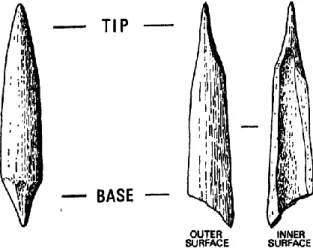
be recognized by the spongy tissue. Concerning the terms of orientation there are different opinions. For this thesis the most recent consensus of terminology will be used. The tip is called the distal end of the point and the base the proximal end. The part in between is called the mesial part. For this research only unilateral points will be discussed, meaning the barbs are only present on one side of the point. A barb can be defined as a ‘laterally positioned piece’(Rots and Plisson 2014, 155).
Figure 2: Terminology of bone points (Newcomer 1974, 141).
1.2
Biography of Small Barbed Bone Points from the North
Sea
12
1.2.1 Bone as Raw Material
The most important aspects of raw material are the properties and the availability. For bone the availability depends on the available animals in the environment. The bones used for the production of the points will (mainly) be from the hunted animals taken to the sites for food. However, different bones have different properties depending on their role in the animal’s skeleton, which differ for each animal as well. Concerning the latter, the age and size of the animal are important factors. Bones from younger animals are generally more porous and thus weaker, which makes them less suitable for point production. Furthermore, the size of the animal also determines the length, thickness, etc. of the bones, which is interwoven with the design of the point. Bones can have different densities depending on the stress which the bone has to endure. Because the anatomy of animal species differs the density of the same sort of bone may be different as well. Moreover, there are different shapes of bones. Long bones – especially metapodials – are mainly preferred for the production of points because of the length of the bones and the fact that they can sustain impact along their long axis. However, these bones will break more easily when pressure is put in a transverse manner. Furthermore, metapodials have a suitable cross-section (rounded, square-shaped or D-shaped) and a groove down in the middle of the bone, which makes it easier to split the bone. Moreover, these bones are hollow inside and bone can be soaked in water to make it easier to work with (Hurcombe 2007, 124). These properties make metapodials well suited for point production. Verhart (1988) has suggested that these metapodials belonged to aurochs, horse, elk, red deer and roe deer.
It should be noted that the factors discussed above are not always seen as the most important factors for choosing a raw material. For example, the reason people chose a certain raw material also depends on their cultural traditions (Hurcombe 2007, 111; Ingold 2007, 12).
1.2.2 Production: Morphological and Technological Variation
13
Tsiopelas there were not many traces visible on these points, but he managed to identify the different production steps which were carried out in order to make the bone points. He suggested that as a first step the ‘metapodial technique’ was used, one of the most common production techniques of the Mesolithic period. This technique was also used to produce awls. The natural groove in the centre of the metapodium was used to make an incision and split the bone. Thereafter the epiphyses were cut off. However, he also suggested that sometimes more opportunistic techniques might have been used, such as pounding on a bone with a hammer stone in order to break it into useful fragments (Tsiopelas 2010, 17).
As the following step in the chaîne opératoire Tsiopelas suggested that the points were ground into shape on a stone and that the barbs were cut with a flint blade. The manufacturing traces are present on the archaeological points in the form of striations which are directed parallel vertical, diagonal and horizontal (Tsiopelas 2010, 24, 47).
The eventual shape of the point and barbs differs and these different types of points from the research area are classified by Verhart (1986; 1988) and the author (Spithoven 2016). For this research the focus will be on the ‘small barbed bone points’ of which three types are identified (Spithoven 2016, 67). The small points have a length of <88,5mm as inferred from morphometrical analysis (Spithoven 2016, 43). At this time there are 787 small barbed points documented in the database of which most are made of bone. The smallest complete small barbed bone point found so far has a length of 28,9mm and was found at the beach of Rockanje (find number 14.56 in appendix A). Of all these small barbed points none has been dated with 14C so far. There have only been six 14C-dating of North Sea bone and antler points in total. Out of the six points that have been dated two are not further defined than ‘point’ and one is a small simple point (without barbs) which was much younger than the other points (Verhart 1988, 178; Hedges et al. 1990, 104-105; pers. comm. Van der Plicht 2016):
Small simple point 6160 ± 135 BP; 5096 ± 165 cal. BC (CalPal) (Ua-643)
Large barbed point 9945 ± 115 BP; 9539 ± 195 cal. BC (CalPal) (Ua-642)
Bi-serially barbed point 9690 ± 125 BP; 9061 ± 184 cal. BC (CalPal) (Ua-644)
Large barbed point, Maasvlakte 2, 8860 ± 55 BP; 8023 ± 184 cal. BC (CalPal) (GrA 59743)
Unknown, Europoort, M-64, bone 8060 ± 250 BP (?) (OxA-1944)
14
On the basis of the results of typochronological research and the few available C14-dates, it was suggested that the points date to the Early Mesolithic period. The dating of the only small point is regarded as contaminated (Verhart 1988, 178).
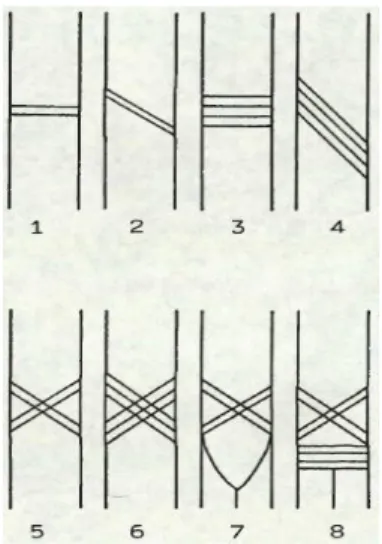
The three types of small barbed points defined by Spithoven (2016, 67) are points with an oval base, with long barbs, and with a square base. The oval base and square base types differ only in base morphology and the barbs were mainly cut with oblique incisions (see figure 3, shape type 2). The points with long barbs are oval in shape like the points with an oval base but the barbs were cut much deeper and with incisions in the shape of crosses (see figure 3, shape 5 and 6).
Figure 3: Shapes of incisions in order to make barbs, according to Verhart (1986, 167).
The shape of the points is important for the next step in the chaîne opératoire: hafting. The base of the points with an oval base as well as the points with long barbs were narrowed which created the oval form. This is common for projectile points and was done in order to reduce the thickness of the joint between the point and the shaft (Guthrie 1983). This led to the mesial part of the point having the maximum width and thickness of the point. This shape was meant to maximise the penetration of the point and avoid drag. The depth of the incisions to make the barbs plays a significant role as well.
15
Ulkestrup-Lyng in Denmark (Andersen 1951 in Verhart 1988, 183) (fig. 5). At the latter site no resin was used for extra fixation in contrast to the former (Verhart 1988, 183). At the time of writing this thesis four North Sea points with (possible) lumps of tar residue have been found and documented in the author’s database.
Figure 4: (left) A reconstruction of the hafting method by Verhart (1988, 183).
Figure 5: (right) A bone point with partly preserved shaft from Ulkestrup Lyng in Denmark (after Andersen et al., 1982: fig. 58 in Verhart 2000, 120).
1.2.3 Use-Life: Function
16
1.2.3.1 Arrowheads
Verhart (1987; 1988; 2000) reflected on the function of Mesolithic bone and antler points. For the hunting strategies he suggested that the animals could have been hunted in groups, but solo operations might have occurred as well. Evidence for hunting in groups consists of some archaeological finds of wounded aurochs in Danish bogs and Germany Vig, Denmark (Noe-Nygaard 1974), Prejlerup in Denmark (Aaris-Sorensery 1954 in Verhart 2000, 121) and Schlaatz in Germany (Gramsch 1987c in Verhart 2000, 121). For example, at the site of Prejlerup aurochs were found with many arrowheads still inside (Aaris Sorensery 1984 in Verhart 2000, 121).
Verhart narrowed the function of the points down to three categories. They were probably used as arrowheads, spearheads and on some occasions, harpoon heads. He suggested that the bow and arrow was used on big terrestrial animals, small terrestrial animals, birds and big fish. Spears were suggested to be used to hunt big terrestrial animals and big fish as well (Verhart 2000, 119-121). Harpoons could also have been used to hunt big fish. Furthermore, small terrestrial animals were probably hunted as well with the use of snares and small fish with the help of nets and traps (Verhart 2000, 121).
Additionally, Langley (2014) has speculated that a long tip on the point, which she calls the distal extremity or ‘taille exceptionnelle’, could have been made for a specific function of the point. She suggests that the raw material might have been bigger than usual which made it possible to create a longer tip. This distal extremity might have served to penetrate the animal deeper in order to damage a vital organ (Langley 2014, 106). The longer tip could also have been made in order to prolong the use-life of the point. When the tip of the point gets damaged it needs to be repaired which decreases the length of the tip. When the tip is longer, it can be repaired more often.
17
lethally wounded big sized animals. Verhart (1988, 185) suggested that the bow and arrow in the Mesolithic Europoort area would have been used to hunt small and fast animals. Especially the hunt of birds is suggested to have been important in this area (Verhart 1988, 189). The specific animals which could have been hunted will be discussed in chapter 3.
1.2.3.2 Other Interpretations
Besides the function of small points as weapon tips they are sometimes interpreted as child’s toys (Politis 1998 in Langley 2014, 113; see Stapert 2007 for a discussion of miniature (flint) tools functioning as children’s toys). Langley studied 732 Late Magdalenian barbed points from 18 different sites through France and Germany. She identified three small points as ‘miniature points’ (fig. 6) and stated: ‘Only around 40 of the miniature points have thus far been recovered from Magdalenian sites and these artefacts appear to have a restricted geographic distribution, being found only in southern France and Cantabrian Spain (Gonzalez-Sainz 1989; Julien and Orliac 2003; Lefebvre 2011 in Langley 2014, 113).’ These ‘miniature points’ seem similar to the small barbed points from the North Sea Basin, especially the type with long barbs. However, these points from the North Sea have been assumed to be from the Mesolithic period.
Langley also suggested that besides the interpretations of weapon tips and child’s toys another function is possible. She suggested that the ‘miniature points’ could also have been examples of ‘artisan virtuoso’ by which she means that they were made in order to demonstrate the superior skills of the craftsperson (Langley 2014, 113).
Figure 6: ‘Miniature points’ from La Madeleine (left) and La Vache (middle and right) (edited figure from Langley 2014, 114, fig. 11).
1.2.4 Re-use: Curation versus Expediency
18
curated and expedient tools is a useful one. The difference between curated tools and expedient tools is said to be the ‘estimated utility for future use’ (Binford 1973, 143). Expedient tools are anticipated to only be used for a short period of time whereas curated tools are anticipated to be used longer and are being kept and transported for future use (Binford 1973, 143). Binford observed the production and discarding of tools by the Nunamiut of Alaska (Binford 1979) and noted that the degree of the conscious stylistic variation is related to how expendable the tool in question is considered to be (Binford 1973, 144). An expedient tool, used and discarded at the same place, was produced with less investment of the craftspeople. This led to expedient tools representing less of the identity of the craftsperson and thus less conscious ‘stylistic’ characteristics of the craftsperson and group. For curated tools this works the other way around which leads Binford to the following statement: ‘Thus I would anticipate that the best material markers of ethnic identity might well be found in items curated and preserved for relatively long periods of utilitarian life within the technological system.’ (Binford 1973, 144). However, because curated tools are mainly used for a longer period of time, they will be less frequently represented in the archaeological record (Binford 1973, 144).
The distinction between expedient and curated tools cannot be made solely on the basis of a difference in technological complexity. Curated tools might as well be made with only a minimum amount of effort but will be maintained for a longer period of time and might even been recycled into a new tool (Binford 1976, 338). After Binford coined the terms in 1973 they have been used in many different interpretations of the terms. Shott (1996) redefined the term ‘curation’ by looking at these different uses. She stated that curation is ‘the degree of use or utility extracted, expressed as a relationship between how much utility a tool starts with – its maxiumum utility – and how much of that utility is realized before discard’ (Shott 1989, 24). This definition implies that the utility of a tool declines when it is used, which results in a certain degree of curation. According to Shott, every used tool is curated but the degree of curation differs. For example, an expedient tool can be seen as a tool with a low curation. Moreover, different contact-materials can result in a different degree of decrease of utility. For example, shooting a bone point in a fish or shooting it in a deer might result in a different degree of wear and thus a different degree of curation as well. This will be tested by conducting a shooting experiment (chapter 4).
19
stand while watching for game. This practice used to be common among the Inuit (Binford 1979, 268). The second example derives from common practices of the Inuit as well. Binford noted that their personal gear was heavily curated (Binford 1977, 33). The personal gear was inspected before leaving camp, which resulted in repairing or replacing tools if needed. Bone points tend to break more easily when not repaired in time, which makes this case-study a good example of how these North Sea points might have been treated by their owners. When the tip of these points were repaired their length would decrease, which means a decrease in utility as well. The reparation of points might at times have resulted in big barbed points – which are assumed to be spearheads – being re-used as small barbed points – which are assumed to be arrowheads, when the utility of the point was at his end (Tsiopelas 2010, 46). As a last example, Zhilin mentions arrows from a Siberian ethnographic context gaining a higher value after they were used to kill an animal (Teploukhov 1880; Serikov 2009 in Zhilin 2015, 50). According to Zhilin these practices are probably applicable to the Early Mesolithic arrowheads as well. The arrows were treated with special care, which can result in better inspection of the arrow in order to repair it in time when needed. As a result, the arrow will gain a higher curation.
In the end it all depends on how people used curated and expedient tools in a specific situation, which is strongly influenced by cultural practices. This will also influence the discarding behaviours, which will be discussed in the following section.
1.2.5 Deposition
Which points will eventually end up in the archaeological record depends on many different factors. First of all, points were discarded intentionally. For example, when they were considered no longer usable. However, as discussed in the previous section the remaining utility of a point depends on the perception of the owner in question. This means that the archaeological record of these points might consist of points curated to a different degree. This results in an assemblage where the most heavily curated points are the least represented and the least curated points are overrepresented. Furthermore, as discussed earlier a big barbed point could be re-used to create a small barbed point. This way, the big barbed point will not enter the archaeological record, which might be an explanation for the overrepresentation of small points being found on the beaches of Zuid-Holland.
20
been taken back to the site for recycling purposes. This means that an assemblage of unusable points does not necessarily correlate to a site or hunting field (Binford 1977b in Torrence 1983, 12-13). These damaged or even unusable points might have been stacked at the camp or at locations in the field.
Groups of points have also been found in water, such as at Friesack in East Germany (Gramsch, 1987a, 1987b in Tsiopelas 2010, 38), in Horne Terp (Mathiassen 1937, 116 in Tsiopelas 2010, 38) and in Loejesmoelle in Denmark (Clark 1936, 114). It has been suggested that this was done in order to protect the points from the gnawing of dogs (Tsiopelas 2010, 38-39). However, the deposition of groups of points in water could also have been unintentional. They might simply be lost during the hunt when the arrow missed the target or the animal fled.
The assemblage of points which were lost in this way can be biased as well because of different functions of points and different values. The latter was explained in the previous section with a case-study about Siberian arrows that killed an animal. The influence of different functions of points is demonstrated by ethnographic research of the Agta of Northeastern Luzon by Griffin (1997, 281-282). He mentions that different types of arrows were meant for different prey species, prey sizes and the condition of the prey. This means that the arrows shot will be related to the hunted game. Furthermore, a distinction is made between the relative qualities of arrows, which influences the choice of the archer to take a shot at the prey or not. For example, a barbed point will not be shot when the chances are low of not being able to retrieve the arrow. This will result in the higher quality arrowhead being underrepresented in the archaeological record.
21
when the carcass is being processed, which occurred in the field or at camp. Afterwards, these pieces could sometimes be used to make a new point if the length of the fragment was deemed long enough. These fragments would then receive a new base produced from its proximal extremity (Langley 2015, 348-349). The breakages described above have been supported by experiments conducted by multiple authors, which will be further discussed in chapter 2.
As a final note on the deposition of points, it should be kept in mind that when points are being deposited they probably look different then when they were produced. The deposition of the points might not have been the fully intended use-life, which the craftsperson had in mind. Thus, the way points look when found ‘only reflect state of abandonment rather than state of design’ (Langley 2014, 110). Furthermore, post-depositional processes have also altered the points over a long period of time, which will be further discussed in chapter 2 and 5.
1.3
Stakeholders
22
1.4
Research Questions and Thesis Outline
The previous sections have been used to describe the method of reconstructing the biographies of the small barbed bone points, which is necessary to understand the research material. Even though the points have been studied by multiple authors (Verhart 1986; 1988; 2000; Tsiopelas 2010; Spithoven 2016) a lot of information is still missing. It is not clear yet why the points are morphologically and technologically different from Mesolithic points in the rest of Europe. This could relate to a difference in function, a cultural choice or a combination of both. The aim of this thesis is to research the function. With this research it is intended to contribute to a better understanding of hunting technology and subsistence strategies of the drowned Mesolithic North Sea Basin. This is important because it will not only give insight into their diet but also into development of social, organizational, planning skills, etc. (Brooks et al. 2006 in O’Driscoll and Thompson 2014, 399). The research question of this thesis is stated as follows: ‘What was the function of the Mesolithic small (<88,5mm) barbed bone points from the North Sea and what does this contribute to our understanding of subsistence strategies of the inhabitants of the North Sea Basin?’
This will be studied through use wear analysis – also referred to as microwear analysis or traceology – in combination with experimental archaeology. With this method it is possible to infer the function of the points based on the use wear present on the archaeological points in comparison to experimental counterparts. Although the Laboratory for Artefact Studies already had several experimentally made points (Tsiopelas 2010), six additional experimental points were made for this research to enlarge the experimental reference base.
23
intended to be shot as many times as possible. With the results an attempt will be made to answer the following question: ‘Is there a relationship between the number of times that the small barbed bone points were used as projectiles and the degree to which wear traces developed?’
25
2.
Methodology
For the further study of the small barbed bone points a functional analysis has been conducted. Microwear analysis as well as experiments have been carried out. In this chapter the method of microwear analysis will be discussed, followed by an explanation why experimental archaeology is an essential component for answering the main research question.
Microwear analysis is a tool which can be used to answer research questions of archaeologists about form and function of implements, and the activities and tasks which have taken place on sites (Van Gijn 1990, 143). This functional data can help identify activity areas and highlight functional differentiation between sites (Van Gijn 1990, 143).
Archaeological experiments are necessary in order to conduct microwear analysis. Firstly, the experiments provide reference material or data in order to test hypotheses. Secondly, the execution of experiments will assist the archaeologist to become acquainted with the traces which occur during the process (Van Gijn 1990, 23). The archaeologist might start thinking of the artefacts in a different way and find new meanings of objects, which results in the archaeologist looking for other signs in the archaeological record. This way, the performing of experiments creates a link between evidence and interpretation (Hurcombe 2007, 65).
2.1
Microwear Analysis
Microwear analysis is the study of microscopic traces such as fractures, pitting, striations and polish. Residue analysis is often incorporated into the study because residue often occurs in association with wear traces (Hurcombe 2007, 87). Most often a stereomicroscope is used in combination with a metallographic microscope. A stereomicroscope uses reflected light with magnifications ranging between 10–160x and a metallographic microscope uses incident light, which allows magnifications of up to 1000x (Van Gijn 2005, 49; 2014, 166). However, most often magnifications of 200-300x at maximum are used. For the comparability of microwear studies it is essential to mention the specific microscope and magnifications that were used (Van Gijn 1990, 12).
26
Furthermore, the registration of the wear traces should be documented in a universal way. The use of symbols, terms and abbreviations should be comparable to other microwear studies.
2.1.1 History of Microwear Analysis
Microwear analysis is a relatively new method within the discipline of archaeology. In 1964 Semenov’s book ‘Prehistoric Technology’ – which was originally written in 1957 in Russian – appeared in English. Semenov was the first researcher to systematically execute experiments and regularly employ a microscope. The first publications outside the former USSR took place in the mid-1970s by Tringham and Keeley (Tringham et al.
1974; Keeley 1974). Tringham mostly studied edge-damage in the form of micro-retouch. This study was done with magnifications of up to 100x and is now commonly referred to as the ‘low-power approach’. Keeley on the other hand, was focussed on other aspects of use-damage, such as polish. For this study magnifications of 100-400x were being used. In the following two decades the first use wear studies on bone tools were conducted (Campana 1980; LeMoine 1994; 1997), and from the second half of the nineties onwards high power approaches were used as well (Griffitts 2001; Griffitts and Bonsall 2001). It had become clear that due to experiments certain traces of wear (polish, rounding, striations, abrasive features and chipping) would appear rapidly on bone and antler tools. However, these traces could be confused with manufacture traces which are very visible as well. Additionally, taphonomic processes could also create or transform traces (Van Gijn 2005, 49).
27
2.1.2 Reference Collections
The study of microwear requires proper reference collections. There are many variables that are of influence on the development of wear traces, such as the characteristics of the raw material, contact-material, motion and skill. These factors all determine the appearance of wear traces. Ideally, the raw material used for the experimental artefacts should come from the same source as the archaeological raw material itself (Van Gijn 1990, 14). The source of the raw material can be determined by the means of reference collections. Reference collections can be published work or physical reference collections (Hurcombe 2007, 76). Use wear analysis mainly makes use of experimental artefacts as a reference.
Generalized experiments – in which variables such as raw material, form of the tools, type and state of the contact-material, intensity and direction of motion are controlled – form the basic reference collection (Van Gijn 1990, 24). For example, when looking at craft activities the motion of a tool is regular, which results in a certain type of use wear. The variation of this use wear can be an indication of intensity of use, which could be used to infer the function of a tool and the contact-material. However, it is possible that the combination of features observed on the artefact is not present on an experimental tool from the reference collection. In this case, new experiments need to be carried out.
In order to come to solid interpretations of the use of an artefact the archaeological context is crucial (Van Gijn 1990, 25). Ethnographic sources can provide a source of inspiration for the possible function of the artefact (Van Gijn 1990, 24). Furthermore, the reference collection needs to include natural samples of the material as well, because of the taphonomic processes which may have affected the tool (Van Gijn 2005, 49).
2.1.3 Features of Microwear
With these reference collections at hand, the archaeological artefacts can be studied under a microscope. When objects are used they can become damaged and develop characteristic features. The object’s biography can then be reconstructed by observing these features and linking them to manufacture, hafting, use, re-use, and post-depositional factors. Sometimes the intensity of use can be inferred as well.
28
used (Van Gijn 1990, 3). It is hard to infer whether a tool was unused because if the tool was only used for a short period of time or worked with very soft materials this might not leave any (recognizable) traces on the tool (Hurcombe 2007, 87). Furthermore, the surface can be affected post-depositional by natural as well as human factors.
When bone points were used for hunting, most use wear can be found on the tip of the point (Frison 1989; Bradfield 2012a; b).These traces include edge-removals (or use-retouch), breakage, fractures, edge-rounding, striations, polish and residue, which will be further discussed below. There are use wear traces which can be used to infer maintenance work as well, which can be associated with the tool being curated. Maintenance traces will be discussed below as well.
2.1.3.1 Edge-removals
Edge-removals are features which are hard to distinguish from damage caused by usage and damage caused by other factors. There are various ways in which this type of fracturing can occur. For example, the usage of the object and retouching of the edge of the object can lead to (unintentional) edge-removals. The micro-chipping of the object is in this case a by-product of the retouching. Furthermore, micro-chipping can also occur when the object is being excavated, sieved, transported or bagged together with other artefacts. Finally, the object can also be fractured by non-intentional factors such as trampling, falling on a hard surface, transport and soil compaction (Olsen and Shipman 1988; Pargeter and Bradfield 2012; Bradfield and Brand 2015). These different factors often result in different types of edge-removals on the object. Bone can also be flaked when the density is sufficient (Hurcombe 2007, 134). Furthermore, as illustrated with flint tools, there is a lot of variability in flake-scar morphology, location and distribution as well, which makes interpretation even more difficult (Van Gijn 1990, 4).
2.1.3.2 Breakage and fractures
As discussed above, breakage and fractures on bone can have many natural causes, which makes it more difficult to interpret use wear. However, by looking at edge-rounding and the preservation state of the surface it is possible to infer if the breakage or fracture occurred pre- or post-depositional (trampling, accidental dropping, etc.) (Pargeter and Bradfield 2012; Bradfield and Brand 2015).
29
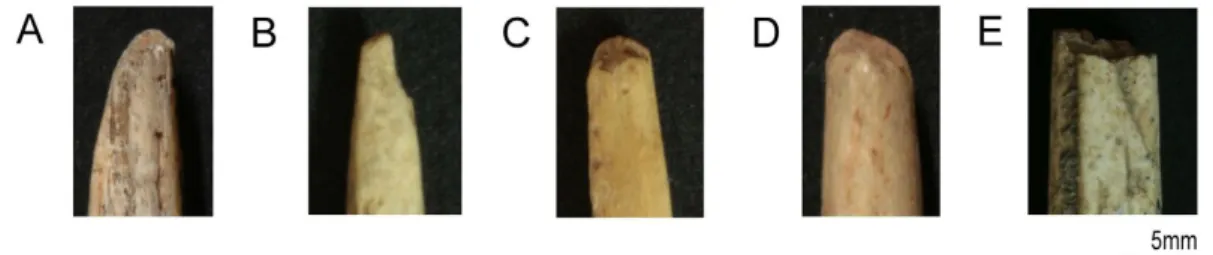
fissures (Lawn and Marshall 1979). The impact on a hard material can cause chipping on the dorsal and ventral surface of the tip of the point, which may eventually lead to the breakage of the tip or the upper barbs.
The type of fractures depends for an important part on the morphology of the point, especially the relative length and shape of the cross section, as was demonstrated for flint points (Bergman and Newcomer 1983, 243) as well as bone points (Bradfield 2016, 74). The type, position and grouping of fractures can be used to infer the function of the point, as was demonstrated for stone points (Bergman and Newcomer 1983; Fischer et al. 1984; Lombard 2005). For example, at the rock-shelter site Ksar Akil in Lebanon 79 bone points have been found where use wear consists solely of breakage and fractures. The use wear on these points consists of traces of splintering on the tips and/or bases (Newcomer 1974, 147). Tyzzer (1936) inferred the function of these traces by conducting a shooting experiment with bone points as arrowheads, which were shot into gravel.At another site, in central Russia, bone arrowheads were found at the Early Mesolithic sites of the Volga-Oka interfluve from the layers Ivanovskoye 7 (layer IV) and Stanovoye 4 (layer IV and layer III, trench 3). The use wear on these points is mainly present on the tips in the form of smashing or chipping and small or larger flat or semi-flat facets running down one or more sides of the point. These traces were also present on the experimental points created for this research, which were shot at a target of peat covered with fresh wild boar skin (Zhilin 2015, 44).
30
Figure 7: Examples of impact and post-depositional fractures to the distal tip of antler projectile points according to Langley: (A) Mushrooming; (B) Chipping; (C) Crushing; (D) Rounding; and (E) Post-depositional fracture (Langley 2014, 108).
2.1.3.3 Edge-rounding
Another feature which develops on the edge of objects due to use is rounding. Edge-rounding is caused by contact-materials with different degrees of wear. The degree of edge-rounding can thus provide an indication of the kind of contact-material on which the object was used. When identifying edge-rounding, hardness categories of contact-material are useful. For example, soft contact-contact-material such as leather causes extensive edge-rounding on bone tools. As illustrated with flint tools, the different degrees of rounding can also indicate which area was the contact surface (Van Gijn 1990, 8). For example, from the previously discussed sites in central Russia – the Volga-Oka interfluve – the majority of bone points with use wear from the layers Ivanovskoye 7 and Stanovoye 4 showed rounding. These traces were also present on the experimental points from Zhilin’s research (Zhilin 2015, 44). Furthermore, it should also be noted that edge-rounding, just like edge-removals, is not always due to use. As illustrated with flint tools, edge-rounding can develop when the object is embedded in a sandy matrix (Van Gijn 1990, 8), which is also the case for the points of this research. Therefore, most of the points from the North Sea are very rounded. Edge-rounding also makes it possible to infer if breaks are pre- or post-depositional, such as the breakage of the tip or barbs.
2.1.3.4 Striations
31
resulted in screw-like traces. On the contrary, when the arrow was not fletched and thus was not rotating when it hit the target, the use wear appeared as straight striations on the point. Nevertheless, there was also a point found with both types of striations present. Screwlike striations overlap straight striations, which was seen by Zhilin as an indication of re-use. He suggests that the point was first used on an unfletched arrow and re-used on a fletched arrow after repair (Zhilin 2015, 49-50). The different types of striations were also present on the experimental points of his research (Zhilin 2015, 44).
Furthermore, on the North Sea points randomly oriented striations are present, which are probably caused by depositional modifications after they had been discarded (Tsiopelas 2010, 24).
2.1.3.5 Polish and Residue
Polish is one of the features which has been the subject of many discussions about its origin. An aspect of polish which everyone seems to agree on is that polish on bone can be recognized as a surface which reflects light. For example, bone can have dense areas which can be polished with a grinding stone, to create a lustrous surface (Hurcombe 2007, 134).
On the bone arrowheads from the sites of the Volga-Oka interfluve in central Russia, use wear was present in the form of ‘hide polish’ on the tip, running down the point and gradually disappearing. This was also replicated on the experimental points, which were shot at a target made of peat covered with fresh wild boar skin (Zhilin 2015, 44). For example, at Ivanovskoye 7 (layer IV) a fragment of a long, needle shaped arrowhead was found with a bright polish, which gradually becomes duller when running down from the tip to the stem of the point. Two types of use wear are visible in the polish: fine striations and coarse grooves. These traces run down at an acute angle from the tip of the point to the axis. It is inferred that the fine striations are the result of multiple hits on soft material covered by fine mineral particles, such as animal skin or clothing. The coarse grooves are inferred to be the result of the point hitting the ground (Zhilin 2015, 44-45). This is indicated by the location of these grooves. To illustrate this, at another point from this layer these grooves did not appear further than two centimeters from the tip. This also means that the point did not penetrate the ground very deeply (Zhilin 2015, 46).
32
macroscopically visible residue. Three of the points have a lump of black residue on the base of the point. The lumps of residue are only present at the inside of the bone. Two of the points with the black residue have been found on the beach of Rockanje and one has been found further inland in Pijnacker where sand from the North Sea was used for construction work. The black residue was assumed to be tar or pitch, which was being used to fasten points to shafts (O’Connor et al. 2014, 115). However, it is also possible that the residue is post-depositional. There is also a point found at the Maasvlakte 2 beach with still cordage and black residue left on the base of the point. These residues have been studied for this research. The results are discussed in section 5.3.
2.1.3.6 Maintenance
The last type of traces of importance when looking at use wear traces on bone points are traces left by retrieval, re-sharpening and rejuvenation of the point. Sometimes points will get stuck in the bones of the animal, which results in accidental ‘nicking’ of the point. This nicking can create short, oblique and isolated incisions which are located on the surfaces of the distal-mesial section of the point. These traces are called ‘retrieval marks’. ‘Haft retrieval marks’ are created in the same way and are created during the process of repairing or retooling when the point is being cut away from the haft (Langley 2015, 346-347).
In order to infer the maintenance of a point different traces can be used. The most important ones for barbed points are traces as a result of re-sharpening or rejuvenation. Re-sharpening of the point means that a (dull) part was being retouched in order to create a fresh, sharp cutting edge at the tip or barbs (Hayden 1987; Towner and Warburton 1990). Rejuvenation on the other hand, means that the (broken) point was reworked into a new point with the same function. Most of the maintenance traces of barbed points are located at the tip of the point. Additionally, maintenance sometimes took place on the mesial part of the point (Langley 2015, 350).
33
expertly repaired points were suggested to be rejuvenated. Additionally, maintenance traces consist of localised facets, uneven surfaces, and a significant axis change (Langley 2015, 350).
Experimental work has shown that even little damage on a bone point can lead to breakage of the entire point. The most dangerous damage on a bone point is impact damage to the tip and fractures on the base section where it is hafted (Tyzzer 1936; Arndt and Newcomer 1986; Bergman 1987; Knecht 1997; Langley 2015). Since the damage to the point makes it more likely to break, it is likely that the users of points would have repaired damaged points in order to decrease the chance of failure (Langley 2015, 346).
Furthermore, barbs were sometimes repaired as well or (partially) removed, sometimes leaving a slightly raised scar. If barbs are repaired more expertly, they remain finely shaped with only a few and/or fine striations. On the contrary, poorer quality repairs will result in coarse and roughly made barbs (Langley 2015, 346-347). It is suggested that damaged barbs were (partially) being removed because of the increased chance of failure of the point. This was inferred from damaged tips of points which caused the point to break more easily, as demonstrated with experiments. However, it was not tested whether damaged barbs have the same effect (Langley 2015, 352).
2.1.4 Sampling
34
wear and if there are any residues present. Therefore, washing and cleaning of the objects with alcohol should take place after the sampling of the objects with the stereomicroscope. Sampling with a stereomicroscope forces the researcher to observe the entire object, which makes it less likely to miss traces. Afterwards, the sampling could continue under higher magnifications for the areas where wear and/or residue is present (Van Gijn 2014, 167). A metallographic microscope can be used to examine polish and microscopic striations (Van Gijn 2005, 49). This high power approach requires a lot of time because the metallographic microscope commonly uses magnifications of up to 300x. In order to examine the entire surface of the object it needs to be positioned exactly at a 90º angle to the source of light for the traces to be visible (Van Gijn 1990, 10).
For the sampling of the assemblage of this research, a first selection was made of small (<88,5mm; Spithoven 2016, 43) barbed bone points that are complete (the distal, mesial and proximal parts are present). Thereafter, the assemblage was filtered on points which have not been treated with any chemical preservative. Finally, the assemblage was filtered on the degree of weathering: deselecting the ones which seemed too weathered for microwear analysis were filtered out. The final assemblage for microwear analysis for this research came down to 29 points.
2.2
Experimental Archaeology
Experimental archaeology is inevitably linked with microwear studies and is a method which tests hypotheses related to specific archaeological problems. If the hypothesis is falsified the hypothesis must be discarded and replaced by a new hypothesis, which will then need to be tested. If the hypothesis turns out to be valid this does not make the hypothesis ‘true’. It means ‘that the principles behind the hypothesis can continue to be used until falsified and replaced by a better set of principles’ (Popper 1959 in Outram 2008, 1). However, experiments can exclude certain possibilities, which will result in less possible interpretations (Van Gijn 1990, 24).
35
construct; processes and function experiment; simulation; eventuality trial; and technological innovation.
For this research an actualistic experiment into the function of the small barbed bone points from the North Sea was carried out, which will be further discussed in the following subsections. The documentation of the experiment is of crucial importance because the experiments must be replicable by the researcher and others as well. Furthermore, the experiment needs to be performed in such a way that the results may be assessed statistically (Reynolds 1999, 158).
2.2.1 Hypotheses
This research started out with three hypotheses, which needed to be studied before the final research question could be answered. The first hypothesis is: Shooting small barbed bone points in fish creates different wear traces than shooting these points into land mammals. This hypothesis will be tested by shooting experimental points at three different targets: salmon, meat covered with deer skin, and meat with fresh bones covered with deer skin. Afterwards, the following question will be answered: ‘Can we distinguish wear traces from shooting fish from those that develop due to hunting land mammals? If so, can we distinguish these two types of traces on the archaeological small barbed bone points?’
36 A. No wear
B. Little wear but still usable C. Little wear and unusable D. Lot of wear but still usable E. Lot of wear and unusable
The third hypothesis states: Mesolithic small barbed bone points from the North Sea Basin can be divided in expedient and curated points based on these five categories of degree of wear. If there are groups of points belonging to a certain category (or multiple categories) then these points can be inferred to be expedient or curated. As a result of testing hypotheses 2 and 3 the following question will be answered: ‘Is there a relationship between the number of times that the small barbed bone points were used as projectiles and the degree to which wear traces developed?’
2.2.2 Outline of the Experiment
In order to test the hypotheses and answer the questions stated above, a shooting experiment was set up. Bone was chosen as type of material for this research because of the larger amount of archaeological points made of bone from the research area. For the experiments one small barbed bone point of the most common type of small points was chosen: small barbed bone point with an oval base (Spithoven 2016, 67). One point of this type was chosen as an example to make the experimental points. The point was found at the beach of Rockanje by Peter Soeters (find number 14.4 in appendix A). The point is 53,1 mm in length, 9,5 mm in width and 4,7 mm in thickness. It has a narrowed barbstrip and the barbs have been made by oblique incisions (the most common shape of incisions (type 2 in fig. 3)). The point was desalted by lying into clean water and not treated with any chemical preservatives. Six experimental replicas – as similar to archaeological poin 14.4 as possible – were made.
37
was necessary at the start of the grinding. The rougher parts of brick made the grinding process quicker and were mostly used. Furthermore, it was necessary to differentiate between the different ways of grinding and holding the point to make it possible to grind for a longer period of time. The thinning of the blank took most of the time. During the shaping some issues occurred. Some points have bone splinters in their structure and not all of them could be ground to a smooth surface. Furthermore, during the shaping process the tip of experimental point 3644 chipped. This was corrected by grinding a new tip.
After the shaping of the points, the part of the point where the barbs were going to be cut was narrowed by grinding it. This was done on the front and back of the point. The grinding of the points required some experience to become more efficient. The first point took about one and a half day to grind and the last one took about four hours. Therefore, it can be inferred that the production speed increases when the person becomes more experienced. Unfortunately, the tips of experimental points 3642-3645 needed to be further sharpened than initially thought – which extended the grinding process – in order to be able to penetrate meat and bone. The tip of experimental point 3642 chipped multiple times resulting in a relatively large loss of length in comparison to the other points (appendix B).
After the shaping of the blanks the barbs were cut with flint flakes and blades. The flint became blunt quite fast but remained sharp enough to continue cutting. It was difficult to keep cutting in precisely the same place, which resulted in damage around the incision in the form of manufacture striations. Another issue was the distance between the barbs. It was hard to locate where to cut the barbs in order to make it the same as the original point, a process which improves when the craftsperson becomes more experiences. Mainly due to the problems discussed above, the experimental points are not all as good a replica of the original point as was hoped.
38
the difficulty of getting the point in a 90 degrees angle with the light from the microscope. This could sometimes be improved by using the program ‘Helicon Focus’ to build an image out of multiple photos.
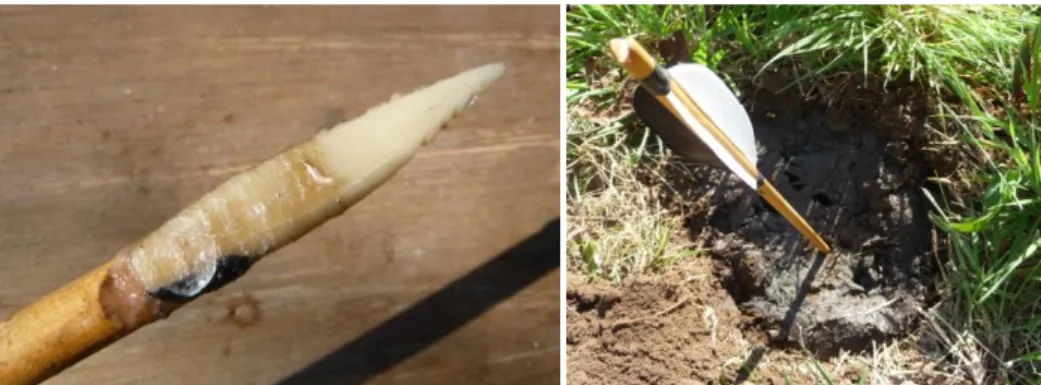
After the documentation was completed, the experimental points were hafted as suggested by Verhart (fig. 4) as tips on pine fletched arrows and shot with a Polderweg-model flatbow (Louwe Kooijmans et al. 2001, 385). Some measurement equipment was necessary for the documentation, including: a thermometer, a ruler for measuring the distance between the target and the archer and the depth of penetration of the arrow into the target, and a geo-triangle to measure the angle of impact. Photos and videos were made of the arrow hitting the target and of the arrow inside the target. Furthermore, a pocket microscope with a magnification of 60x was used to observe use wear traces during the experiment.
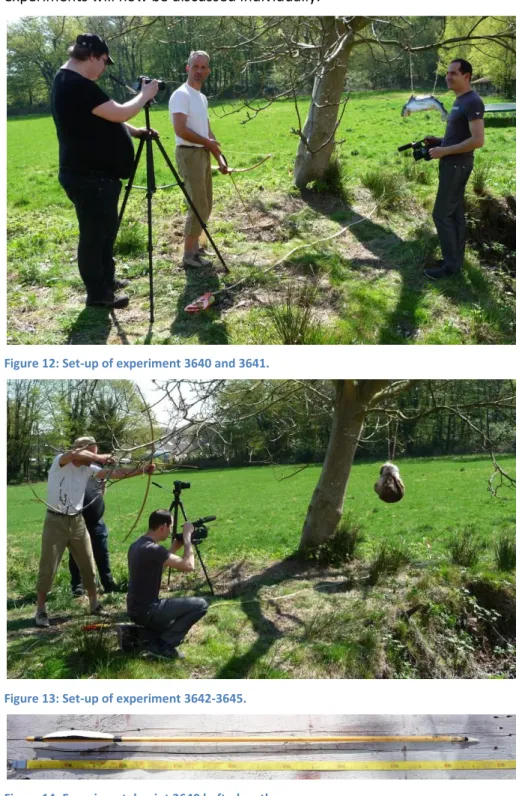
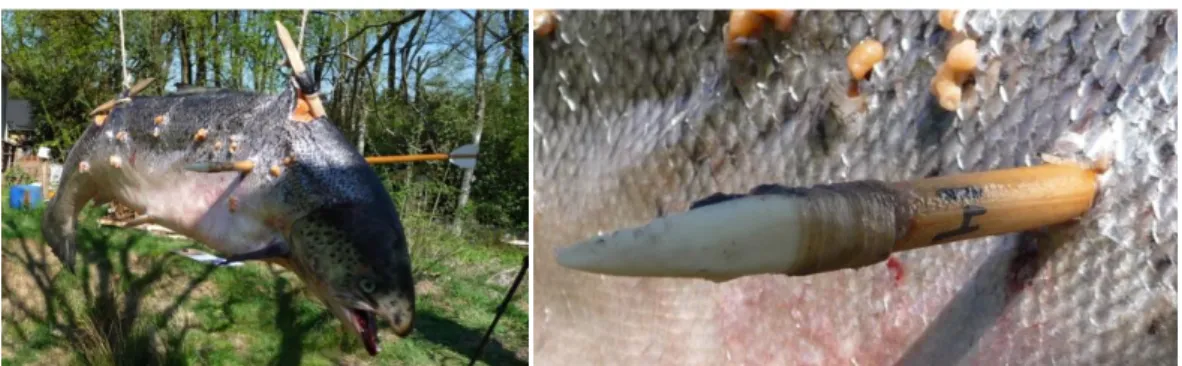
Two types of experiments were conducted on three different types of contact-material. The targets were a complete salmon of about 4,5kg, an artificial target made of pork chops (without bones) covered with deer skin, and an artificial target made of pork chops with fresh cow bones covered with deer skin. For each contact-material, the first experimental point was shot only four times at maximum in contrast to the second experimental point, which was shot as many times as possible. This way, it was attempted to create an expedient point and a curated point.
2.3
Use Wear Analysis
After conducting the shooting experiment, 29 archaeological points were taken to the Laboratory for Artefact Studies of the Faculty of Archaeology in Leiden. All points had already been desalted after they had been found at the beaches of Zuid-Holland. These points have not been treated with any chemicals. Before the use wear analysis, the assemblage was further sampled on the weathering state of each point, as explained in section 2.1.4. Furthermore, some points had to be observed more closely to determine if the raw material was bone or antler. Only the bone points were selected for the final assemblage.
39
The experimental points were also used to infer the degree of wear according to the categories stated in section 2.2.1.
2.4
Limitations
When conducting microwear analysis and experimental archaeology it is important to know the methods their limitations. First of all, as explained in this chapter, both microwear analysis and experimental archaeology are very time consuming methods. With microwear analysis this could result in traces being missed because of the lack of time and because of pre-conceived ideas of where wear will be present.
Secondly, there are many uncertainties in the interpretation of wear traces, which is also limited by the available experimental collection. For example, polish and residue are sometimes difficult to distinguish and post-depositional processes can produce the same wear traces on objects as usage, as was illustrated by experiments conducted with flint tools (Van Gijn 1990, 20; Rots and Plisson 2014, 158).
Thirdly, usage sometimes does not produce (sufficient) wear traces. For example, on bone points spin-off fractures provide an indication of longitudinal impact. This wear can infer the function of the point being used for the hunt. However, this type of wear does not always develop on bone points even though they were used for the hunt. Therefore, it is important to use multiple criteria for inferring the function of an artefact (Bradfield 2016, 76). For example, ethnographic and ethno-historical research can support interpretations and provide new views on possible functions (Van Gijn 2014, 166).
Fourthly, the experimental collection may not be large enough to encompass the variability of wear. The experimental basis could be too weak to support the wear analysis, which could result in false interpretations. Furthermore, within the studied assemblages there are often only a few examples of characteristic impact features even though there are many implications based upon these. Additionally, methods which have not yet been tested are often suggested (Rots and Plisson 2014, 154).
Fifthly, the lack of expertise of the researcher might result in unrealistic traces (Van Gijn 1990, 26).
40
for example, strongly resemble manufacture traces because these activities are carried out with the same tools (Langley 2015, 345).
And finally, the compatibility of microwear analyses also causes limitations. For example, because there is no consensus between microwear analysts on how to clean the experimental tools (Van Gijn 2014, 167).
For projectile points in particular there are some additional problems. There is a great variability of extrinsic and intrinsic techno-functional parameters. The latter is related to the design of the projectile, such as shape, hafting, and weight. Extrinsic parameters are related to the conditions of use, such as projecting mode, target material, target distance and the environment. Furthermore, it is often not possible to create a repetitive motion for a certain amount of time because the projectile can become unusable after only a few shots, as was demonstrated by experiments with stone points (Rots and Plisson 2014, 155-156). This also results in a great variability of wear traces on the point, namely different types, dimensions and combinations of wear (Rots and Plisson 2014, 156). This also means that a series of identical points hafted and shot in the same way show great variation between the individual points. Thus, it is not possible to infer the function of a point from certain wear traces on an individual point (Rots and Plisson 2014, 155). Some bone points may have rounded tips and edges which make it difficult to infer a function (Arndt and Newcomer 1986; Buc 2011). A series of points needs to be studied in order to make proper conclusions about their use (Rots and Plisson 2014, 156). Another important problem concerning use wear analysis on projectile points is the fact that the contact-material and the incidence of the contact are very variable. The contact-material can be soil, rocks, trees, flat bone, curved bone, hide, flesh, etc. and the incidence of the contact can be perpendicular, under an angle or tangential. These factors may all create different wear on the point (Rots and Plisson 2014, 155-156).
41
43
3.
Mesolithic Doggerland
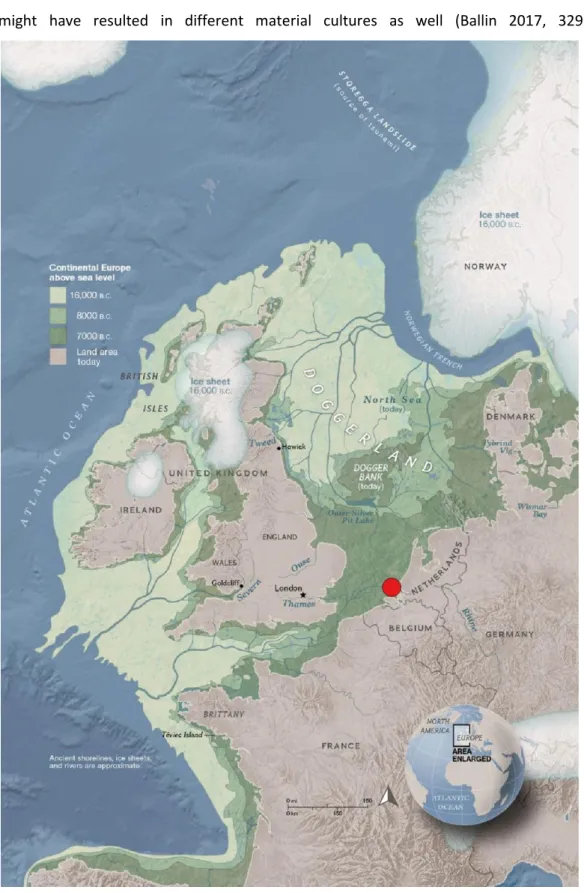
The North Sea Basin was part of Europe in the Mesolithic period and this part of Europe was named Doggerland by Coles (1998 in Coles 2000). This chapter contains background information on Mesolithic Doggerland because the points originate from the North Sea Basin along the coast of Zuid-Holland (fig. 8). Firstly, section 3.1 will discuss the evidence and theories which can generally be applied to the Mesolithic of Northwest Europe. Thereafter, in section 3.2, the focus will be on Doggerland specifically which will start with a section about the preservation of the Mesolithic layer. Thirdly, in section 3.3, the changing landscape during the Mesolithic and how people might have responded to sea level rises will be discussed. Fourthly, in section 3.4, the flora and fauna of the landscape – including the people’s diet – will be outlined. Finally, in section 3.5, the non-homogenous responses of the inhabitants of Mesolithic Doggerland will conclude this chapter.
3.1
The Mesolithic Period in Northwest Europe
The Mesolithic period in Northwest Europe is generally assumed to have taken place from the beginning of the Holocene about 9,600 BC until about 4,000 BC when the Neolithic period starts with the introduction of farming (Milner 2012, 223). At the beginning of the Mesolithic period, humidity and temperatures rose rapidly marking the end of the Last Glacial Maximum. The open grass steppe of the Late Paleolithic changed into an open birch and pine forest with lakes and marshes. The fauna changed as well and a community of warmer temperature species appeared (Amkreutz et al. 2018, 23). The Mesolithic period is characterized by a broad-spectrum exploitation of animal- and vegetable resources, which will be further discussed in section 3.4. There is a great variability in settlement location and site types and a repeated use of specific places (Peeters and Momber 2014, 57). For example, locations next to large lakes and dunes are assumed to have been preferred as either “central places” or “persistent places” (Barton et al. 1995; Crombé et al. 2011, 466). During the Mesolithic period the mobility decreased and the populations seem to have increased because of the improvement of the climate and landscape (Peeters and Momber 2014, 58).
44
as points – can be influenced by a change of flora and fauna, because other type of points might have been needed for the hunt. Furthermore, the changing landscape might also create new barriers resulting in the loss of contact with other groups, which might have resulted in different material cultures as well (Ballin 2017, 329).
45
The Mesolithic period is seen as a transitional period from the cold Paleolithic period to the warm Neolithic period. Additionally, there is a transition from hunter-gatherers to farmers. The changing climate and landscape forced people to adapt during the Mesolithic period (Kitagawa et al. 2018, 193). Some strategies might have changed and others might have continued, such as settlement locations and hunting strategies (Kitagawa 2018, 206).
People living in Mesolithic Doggerland adapted to these changes, which resulted in a change in behavior and material culture. It has been proposed by Clark (1936) that Doggerland might have been the core of the Northwest European Mesolithic and that it probably contains one of the most complete records of the Holocene. In the remaining sections of this chapter theories about the responses of people to the changing landscape are discussed and how this might have resulted in a different hunting strategy. However, the state of preservation of Mesolithic Doggerland will be discussed first, in order to clarify the archaeological value of the research area.
3.2
The Preservation of the Mesolithic Layer of Doggerland
The taphonomical processes which influence the points are still not well understood (Peeters and Cohen 2014, 4). It has long been thought that the finds from Doggerland were all out-of-context finds and thus had a low archaeological value. The reason for this is that the entire North Sea is still being used today and is thus being anthropogenically disturbed, by for example mineral exploitation, infrastructural developments, fishing and the construction of wind farms (Fitch et al. 2007b). However, not all of these disturbances will significantly impact the Mesolithic layer of Doggerland (Ward and Larcombe 2008, 78), which has been proven by Fitch et al. in their research (2007b).
Fitch et al. (2007b) suggested that ‘a large part of the Southern North Sea contains an in-situ prehistoric landscape which never suffered the effects of later agricultural and anthropogenic practices.’ Furthermore, studies along the coastlines of England, Denmark and the Netherlands have shown that prehistoric sites can still be preserved after thousands of years underwater. For example, at the Bouldnor Cliff in England (Peeters and Momber 2014, 66) and at the Yangtze Harbor in the Netherlands (Moree and Sier 2015) well-preserved Mesolithic sites are found in situ.