Patient Prioritization and Resource Allocation
in Mass Casualty Incidents
Alex F. Mills
A dissertation submitted to the faculty of the University of North Carolina at Chapel Hill in partial fulfillment of the requirements for the degree of Doctor of Philosophy in the Department of Statistics and Operations Research.
Chapel Hill 2012
Approved by: Nilay Tanık Argon
Wendell G. Gilland
Kristen Hassmiller Lich
Vidyadhar G. Kulkarni
c
2012
Alex F. Mills
Abstract
ALEX F. MILLS: Patient Prioritization and Resource Allocation in Mass Casualty Incidents.
(Under the direction of Nilay Tanık Argon and Serhan Ziya.)
Mass-casualty incidents, such as multi-car traffic accidents, plane crashes, and terrorist
bombings, create a sudden spike in demand for emergency resources in an area. Providers
of emergency medical services must act quickly to make decisions that will affect the lives
of injured patients. Particularly important is triage, the process of classifying patients and
prioritizing them for transportation from the scene of the incident. The most widely used
standard for mass-casualty triage, START, prescribes a fixed priority ordering among the
different classes of patients, without explicitly accounting for resource limitations. We
de-velop policies to improve the resource allocation phase of START by explicitly incorporating
resource limitations. Next, we develop policies for assigning resources when two or more
incidents occur at the same time and demand the same set of resources. Current standards,
such as START, do not prescribe how to handle such situations—these decisions are most
often made in an ad hoc manner. Finally, we examine the problem of efficiently routing a large number of patients affected by a major disaster, such as a biological, chemical, or
nu-clear incident, to facilities where they can be treated. We provide insight on how resources
can be used effectively to treat patients as quickly as possible. Throughout this work, we
focus on policies that are analytically justified, intuitive, broadly applicable, and easy to
implement. Using numerical results and simulation, we demonstrate that implementing
policies based on quantitative analysis can make a meaningful impact by increasing the
Acknowledgments
A doctoral dissertation is never the product of just one person, and this dissertation is no
exception. I am grateful to the many family members, friends, teachers, and colleagues who
have influenced me, supported me, and encouraged me to excel.
Several individuals deserve special acknowledgement for specific help in the completion
of this dissertation. My advisers, Nilay Tanık Argon and Serhan Ziya, have always given
me excellent advice throughout the time that I have worked with them. I am extremely
grateful for their support and I am proud to have been their student. James E. Winslow
provided perspective from the medical point of view, which greatly improved this work.
Finally, I am grateful for the love and support of all of my family, especially my wife, Alicia
M. Frame, without whom I never would have made it through graduate school.
The National Science Foundation (grant number CMMI 0927607) provided financial
Table of Contents
List of Tables . . . viii
List of Figures . . . ix
1 Introduction . . . 1
2 Literature Review . . . 5
2.1 Emergency Medicine Literature . . . 5
2.2 Operations Research Literature . . . 10
3 Patient Prioritization with Resource-Based START (ReSTART) . . . . 14
3.1 Model Formulation . . . 15
3.2 A Simple Condition for Fixed-Priority Ordering . . . 18
3.3 Priority Decisions for Two Classes of Patients . . . 21
3.3.1 Characterization of the Optimal Policy . . . 22
3.3.2 Determining the Optimal Threshold . . . 23
3.3.3 Sensitivity of the Optimal Policy to the Number of Patients . . . 25
3.4 A New Policy for Patient Triage: ReSTART . . . 26
3.4.1 QuickDynamic-ReSTART (QD-ReSTART) . . . 27
3.4.2 QuickStatic-ReSTART (QS-ReSTART) . . . 30
3.5 Simulation Study . . . 31
3.5.1 Experimental Setup . . . 31
3.5.2 Comparison of QD-ReSTART and QS-ReSTART with START and InvSTART . . . 37
3.6 Adapting ReSTART to Changing Conditions on the Field . . . 43
3.6.1 Adaptive QD-ReSTART and QS-ReSTART . . . 44
3.6.2 Performance of Adaptive ReSTART policies . . . 45
3.7 Discussion . . . 47
4 Resource Allocation in a Multiple Location Mass-Casualty Incident . . 49
4.1 Model Description . . . 50
4.2 Analysis of Two-Incident Problem . . . 53
4.2.1 Upper and lower bounds for t∗ . . . 54
4.2.2 Upper and lower bounds for t∗∗ . . . . 56
4.2.3 Application of Lower and Upper Bounds . . . 58
4.2.4 Decentralized Resource Allocation . . . 59
4.3 Analysis for More than Two Incidents . . . 61
4.4 Heuristic Policies and Simulation Study . . . 63
4.4.1 Policy Descriptions . . . 64
4.4.2 Simulation Method . . . 65
4.4.3 Simulation Results . . . 67
4.5 Discussion . . . 69
5 Dynamic Routing of Casualties in a Mass-Casualty Incident . . . 70
5.1 Dynamic programming formulation . . . 73
5.2 Analytical Results . . . 77
5.3 Heuristic Policies . . . 81
5.3.1 Marginal value approximation . . . 81
5.3.2 Policy improvement heuristics . . . 82
5.4 Numerical Results . . . 86
5.5 Simulation Study . . . 87
Appendix Proofs of Analytical Results . . . 95
List of Tables
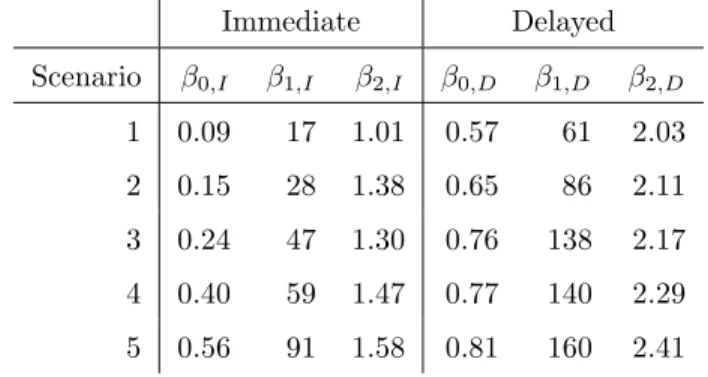
3.1 Fitted parameters for the five survival scenarios. . . 34
3.2 Mean values of φ over 500 instances for the five survival scenarios, excluding instances for which t∗ = 0. All 95% half-widths are less
than 0.01. . . 37
3.3 Mean reduction in the critical mortality rate obtained using
QD-ReSTART instead of START. . . 38
3.4 Mean reduction in the critical mortality rate obtained using
QD-ReSTART instead of InvSTART. . . 39
3.5 Mean reduction in the critical mortality rate obtained using QS-ReSTART as opposed to START, InvSTART, or QD-QS-ReSTART
(negative numbers indicate an increase in critical mortality). . . 41
3.6 Mean reduction in the critical mortality rate obtained using QD-ReSTART(0.5) and QS-QD-ReSTART(0.5) instead of START on
in-stances with perturbed reward function parameters. . . 42
3.7 Mean and 95% half-width for reduction in the critical mortality rate obtained using adaptive ReSTART policies instead of START for
different simulated scenarios. . . 48
4.1 Summary of heuristic policies for two-location and multi-location
MCI response. . . 66
4.2 Mean decrease in critical mortality over 200 instances compared to
Decentralized-Simul-S with fluid optimal resource allocation. . . 68
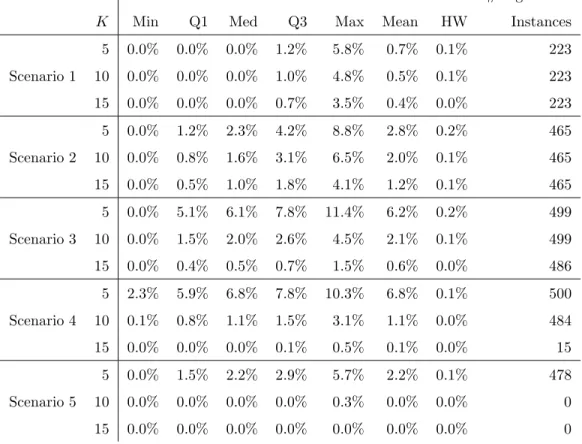
5.1 Heuristic results as a percentage of optimal value. Minimum, quar-tiles, maximum, and mean are calculated across 10,000 randomly
generated instances. . . 85
5.2 Simulation results for m = 3, n = {3,4,5}, p = 50. (*) indicates
List of Figures
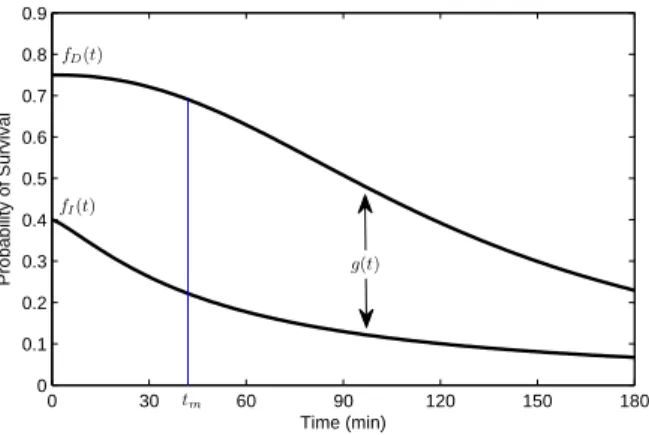
3.1 Example of reward functions satisfying Assumption 3.1. . . 22
3.2 Visualizations of QD-ReSTART(0.5) and QS-ReSTART(0.5). . . 30
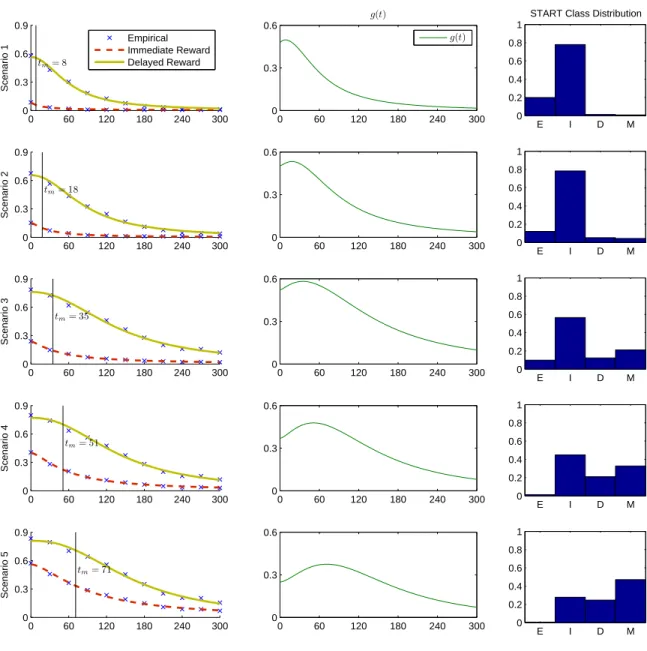
3.3 Survival probability (reward) functions, g(t), and START class
dis-tributions for the five scenarios. . . 35
4.1 Histograms forψ∗ (left) andψ∗∗(right) from the numerical experiment. . . 64
5.1 Evacuation and decontamination of casualties in the aftermath of a
mass-casualty event involving the release of a hazardous substance. . . 73
5.2 Example problem instance with R={1,2} and S ={A, B};
Chapter 1
Introduction
In a mass-casualty incident (MCI), the number of patients is large enough to overwhelm
the emergency response resources in an area, so even critically injured patients may have to
wait to be transported to a hospital. Managing the emergency response in an MCI requires
making many decisions. Depending on the scale of the incident and the severity of the
patients’ injuries, these decisions may include how many resources are needed to respond
to the incident or incidents, how to classify patients, which patients should get priority for
transportation to a hospital, and to which facility each patient should be sent. Because of
the time-sensitive nature of emergency medicine and the chaotic environment present at the
scene of an MCI, these decisions must be made quickly, and often with limited information.
This dissertation analyzes some of the important prioritization and resource allocation
deci-sions that must be made when responding to an MCI. We examine several of these decideci-sions
with the goals of developing policies that are practical and effective, and providing insights
that can guide decision makers in an emergency. We consider improvements to patient
pri-oritization that can be made within the framework of existing triage standards, we examine
how to allocate resources in scenarios not considered by current protocols, and we attempt
to quantify some of the observations that have been made by experts in the medical field.
One of the most important concepts involved in the response to a mass-casualty incident
is triage. Triage is the process of classifying patients according to their medical conditions
and injury characteristics and then determining the order in which they will be treated.
simple way. The triage class of a patient automatically determines the patient’s priority. For
example, START, which stands for Simple Triage and Rapid Transport, is the most widely
adopted mass-casualty triage protocol in the U.S. (Lerner 2008). As a triage tool, START
is primarily geared toward the quick assessment and classification of patients. According to
START, patients are classified into five different classes. Minor patients are those who are capable of walking away from the scene;delayed patients are those for whom treatment may be delayed by some time without risking their lives; immediate patients are those whose conditions will deteriorate most rapidly without care;expectant patients are those who are expected to die no matter what care is given; and finally dead patients. Expectant and dead are often considered to be the same class; we treat them as such in this work. Once
the patients are classified, priorities are determined as follows: resources are allocated first
to patients in the immediate class, then to those in the delayed class. Once the system
is cleared of patients in these time-critical classes, resources may be used for those in the
minor class. Beyond the simple static priority policy, START does not address any other
aspects of the emergency response effort.
There is a clear benefit from adopting a static, predetermined prioritization policy that
depends solely on patients’ triage classes: it is simple and thus easy to implement. However,
there are also drawbacks to this type of simple policy. A number of recent articles in the
emergency response literature have questioned whether START is in fact too simple, mainly
because it completely ignores resource limitations (Garner et al. 2001, Sacco et al. 2005,
Frykberg 2005, Jenkins et al. 2008). The main argument is that patient priorities should
depend on the extent of resource limitation relative to demand. It might not always be
sensible to give priority to patients in the immediate class over those in the delayed class.
For example, there may be so many immediate patients that there is not enough time to
serve the delayed patients within a time frame that will give them a good chance of survival.
In Chapter 3, we study the problem of prioritizing patients during the response to an MCI,
and we propose a policy, ReSTART, that builds on the START classification system by
prioritizing patients based on the level of resource availability.
Policies such as START, which were developed primarily to classify patients, are also
to an MCI. One of these relevant issues is how to dispatch resources, such as ambulances,
to care for patients during an emergency involving more than one mass-casualty incident.
Multiple location mass-casualty incidents are frequently associated with terrorist attacks
(e.g., the London subway bombings of 2005 (Lockey et al. 2005), where casualties were
spread among four subway stations). In addition, catastrophic weather events and other
natural disasters (such as tornadoes or earthquakes) can also strain emergency medical
ser-vices (EMS) systems, causing mass-casualty incidents in more than one location, each of
which contributes demand for the same limited emergency resources. While EMS systems
are able to plan ahead in allocating resources during daily operations, resource allocation
decisions in an MCI are often made in anad hoc manner by emergency response coordina-tors. Some states maintain “strike forces” of ambulances in case additional resources are
requested by a locality due to a major disaster or MCI (State of California EMS Authority
2003), but to our knowledge, analytical results do not exist to assist responders in deciding
when and where to dispatch these resources. Moreover, the decision on where to allocate
resources will be affected by the method used for patient prioritization. In Chapter 4, we
analyze how resources should be allocated to two or more MCIs in conjunction with the
prioritization of patients.
Policies such as START also do not provide guidance on how to coordinate a prolonged
response effort involving primarily patients who do not have life-threatening injuries. Large
scale natural or man-made disasters often result in a very large number of casualties who
do not have life-threatening conditions but nonetheless need to be evacuated and receive
some kind of care. Even though these patients do not need advanced care, they may crowd
and overwhelm emergency rooms and other treatment facilities. For example, casualties in
a biological, chemical, or nuclear disaster must be transported out of the affected area and
then undergo decontamination; casualties from an earthquake, flood, or hurricane must be
moved to a safe place to undergo triage or to receive treatment for injuries. Confusion and
fear may add to the difficulty in performing an efficient evacuation. Emergency responders
may also encounter limited resources and unexpected events, such as infrastructure damage
on the evacuation routes or overcrowding at some of the facilities that are set up to receive
safe and timely treatment of as many casualties as possible. It is therefore important for
emergency responders to be able to make decisions dynamically throughout a prolonged
evacuation to make it as efficient as possible.
In Chapter 5, we study how to make routing decisions dynamically so that the
evacua-tion can be adjusted to allow for the largest possible throughput of patients. While different
types of disasters have different requirements in terms of resources needed or treatment
pro-vided, a common theme is that the dynamic management of the evacuation can improve
outcomes and lessen confusion. In a study of thousands of patients evacuated from an
earth-quake, Tanaka et al. (1998) suggested that to improve evacuation, “disaster officials must
know the capabilities and capacity of each area hospital at all times to select appropriate
triage and mode of transport for each victim”. Hick et al. (2011) suggest that during a
nuclear incident, emergency managers should bypass hospitals that are “completely
over-whelmed”. These studies give qualitative observations about evacuation of casualties in a
disaster; they suggest that dynamic management of casualty evacuation could be helpful,
by incorporating information about the level of congestion at each casualty collection point.
We attempt to provide quantitative insights to this problem in order to assist decision
mak-ers. Specifically, we consider the problem of transporting casualties without life-threatening
injuries from areas affected by a disaster to a set of casualty collection points, where they
receive treatment. This problem is particularly relevant in a biological, chemical, or nuclear
disaster. In these types of disasters, casualties are evacuated from a “hot zone”, where there
is risk of exposure to the agent, to a “warm zone”, where they wait to undergo
decontam-ination, and finally to a “cold zone”, where they are safe to leave the area or proceed to
additional treatment for injuries or illnesses (Boardman et al. 2008).
Throughout this dissertation, we maintain a common theme: development of analytical,
numerical, and simulation results that lead to fundamental insights about the problem and
toward policies that are both effective and practical. In Chapter 2, we review relevant
literature from both the medical community and the operations community. In Chapters
3, 4, and 5, we provide the main results on patient prioritization, resource allocation, and
routing, respectively. Finally, in Chapter 6, we summarize our work and suggest areas for
Chapter 2
Literature Review
The literature review is divided into two parts. In Section 2.1, we review articles by
physicians and emergency medical personnel that examine decision making in mass-casualty
incidents and suggest modifications or improvements. This review covers the work of Sacco
et al. (2005), which proposes a completely new system of triage based on linear
program-ming, and includes a discussion as to why this proposal has been received mostly with
skepticism within the medical community. In Section 2.2, we review recent contributions
within the Operations Research community to problems of patient prioritization, resource
allocation, and routing/evacuation.
2.1
Emergency Medicine Literature
In the emergency medicine literature, there are numerous articles on patient triage and
prioritization in the context of mass-casualty incidents. Some of these articles report
de-tails on emergency response efforts and outcomes in past mass-casualty incidents and daily
emergencies, some provide general discussion on patient triage practices, discuss their
short-comings and point to future research directions, and some propose new triage methods or
modifications to the existing ones (Frykberg 2005, Garner et al. 2001, Bostick et al. 2008,
Jenkins et al. 2008, Hick et al. 2008, Lerner 2008, Kahn et al. 2009, Lerner et al. 2010).
To a large extent, this literature does not utilize mathematical modeling and analysis. The
notable exceptions to this are the articles by Sacco and his co-authors (Sacco et al. 2005 and
2007, Navin et al. 2009) in which the authors describe the Sacco Triage Method (STM) and
A review of the principles of triage by Frykberg (2005) outlines some of the many issues
involved in making decisions about patient care in a mass-casualty incident. Of greatest
relevance to our problem, Frykberg argues that the “main factor” that distinguishes a
mass-casualty incident from daily emergency response is that the supply of resources is
overwhelmed by the demand. He notes that unlike in routine trauma care, the limitation of
available resources in a mass-casualty incident necessitates that some of the most severely
injured patients will be abandoned so that resources may be diverted to those who have a
good chance of survival. Frykberg emphasizes that while this principle may be difficult for
medical providers to accept, it is necessary because the goal of triage in a mass-casualty
incident should be to do the “greatest good for the greatest number.” Furthermore, he notes
that the most difficult decision may be to determine which patients should be denied care,
because this decision depends on many factors, such as the number of patients, severity of
their injuries, and specific resources that are available. Garner et al. (2001) also emphasize
the importance of considering the scale of the incident and the availability of resources in
a mass-casualty incident, noting that current guidelines may sometimes prioritize patients
whose injuries are severe enough that they should instead be considered unsalvageable
based on the scale of the mass-casualty incident: “the decision not to treat certain patients
is dependent on many factors other than just physiologic or anatomic signs of severe injury.”
The authors add that such decisions can only be made with “knowledge of the available
resources.”
As mentioned in the introduction, the de facto triage standard in the United States of America is Simple Triage and Rapid Treatment (START). It is important to realize that
START actually consists of two phases: classification of the patients into triage classes and allocationof the available resources in a fixed-priority manner. Although some modifications to START have been proposed in the emergency response literature, they have generally
been concerned with the classification phase (Jenkins et al. 2008, Lerner 2008). That is,
modifications to START have mostly focused on developing new or revised criteria for
placing patients in the different triage classes, in hopes of reducing classification errors.
mild classification. The notable exception to this generalization is again the work by Sacco
et al., which aims to redefine both phases of triage.
Limited work on statistical analysis of triage protocols has generally focused on
de-termining how well emergency responders are able to accurately classify patients (Garner
et al. 2001) and on how well the triage classifications correspond to the actual severity of
the injury, as determined by emergency physicians (Kahn et al. 2009). One reason for the
scarcity of this type of analysis is that the chaotic environment of an MCI often leads to
poor or insufficient documentation. For example, a retrospective analysis of the Oklahoma
City Bombing determined that “documentation of the process behind the triage decisions
made in Oklahoma City was practically nonexistent” (Hogan et al. 1999). Studies such as
Kahn et al. (2009) used a standardized form to collect detailed triage-related information
about patients in daily emergencies and determine START classification a posteriori, but it is not clear that such a form would be useful for tracking triage decisions in an MCI,
especially because it is impossible to predict the location and timing of an MCI, and hence
the forms would not necessarily be available.
The articles cited in this section highlight the general lack of medical research on
pri-oritization and resource allocation in an MCI. Nonetheless, despite the lack of research in
this area, the need to study resource allocation in mass-casualty triage is clearly expressed
by Frykberg (2005) and other authors, and we pursue this direction in this dissertation.
At the intuitive level, it may not be difficult to see that taking resource limitations into
account could improve patient outcomes. To the best of our knowledge, the only proposed
resource-based method in the emergency response literature is the Sacco Triage Method
(STM) developed by W.J. Sacco and his co-authors (Sacco et al. 2005 and 2007, Navin
et al. 2009). Sacco et al. propose a method that challenges the existing standards in both phases of triage: classification and resource allocation. Sacco Triage Method, or STM,
in-volves solving a linear program to allocate resources to patients in thirteen different triage
classes (Sacco et al. 2005 and 2007, Navin et al. 2009). The authors suggest that the patient
data could be collected quickly and transmitted by the responders in the field to an
emer-gency response center, where the LP would be solved. They further suggest that solving
While the latter seems like an obvious use for STM, critics have argued that it would be
impractical to implement the volume of data collection and transmission that STM would
require in order for it to be useful in the immediate aftermath of a real emergency. In a
response to Sacco et al. (2005), Cone and MacMillan (2005) praised STM for its ability to
incorporate information about the number of patients and resources, noting that no other
existing triage system has been developed and evaluated from a mathematical perspective;
however, the authors devoted much of their response to critiquing operational issues that
could result if STM were implemented in an actual emergency situation. Anecdotal evidence
suggests that the assertions of Cone and MacMillan (2005) may be correct: for example,
in a retrospective analysis of the response to a bridge collapse, Hick et al. (2008) note that
STM “would not have been helpful in this setting because no data on the casualties would
have been entered by the time of transport.”
Part of the resistance to STM could also be due to the fact that it uses a different
scheme for classifying patients from the current practice of START. According to STM,
each patient is assigned an RPM (Respiration, Pulse, and Motor response) score, which is
an integer from 0 to 12, with lower scores being associated with more critical conditions.
Patients are then given priority according to their RPM score as determined by the solution
to the linear program. Thus, implementation of STM requires the emergency responders
to drop a patient classification scheme with which they are already familiar and which has
already received wide acceptance, and switch to another scheme that is largely unknown by
the emergency response community. Furthermore, with this switch, they will need to use
prioritization policies for which they will not have an intuitive feel, because priorities are
determined by the solution to the linear program, which is like a black box for the emergency
response personnel. The thirteen possible RPM scores means that there are potentially
thirteen different priority classes to deal with, and the examples provided in Sacco et al.
(2005) show that the priority policy suggested by STM can be quite complex and difficult
to interpret. For example, in a particular setting in which only six of the thirteen RPM
scores were present, the authors reported that the optimal priority ordering for the RPM
scores was 6, 8, 7, 4, 3, 4, 2, 3 (note that some scores are repeated, because they can obtain
The work of Hick et al. (2008) highlights another potential problem of STM: the training
and comfort level of emergency responders. Although the responders to the bridge collapse
did not use triage tags to identify the patients, paramedics “believed uniformly that they
were rapidly able to sort red [Immediate], yellow [Delayed], and green [Minor] casualties
without use of a triage tool” (Hick et al. 2008). In other words, paramedics relied on their
training and experience in the classification phase of triage. Although there is no
uni-form national standard for mass-casualty triage, START is widely accepted (Lerner 2008).
For example, Mistovich and Karren (2007), a widely used training manual for emergency
medical technicians (EMTs), provides training in START. Introducing a radically different
classification would require significant re-training and pose communication problems across
jurisdictions if not uniformly implemented. Hence, there are good reasons to believe that
for an improved triage system to have a chance of acceptance and implementation, it must
be compatible with or similar to the widely adopted START classification.
Finally, the perceived proprietary nature of STM has hindered its ability to be accepted.
Kahn et al. (2010) notes that “every published article on the Sacco Triage Method has been
funded and written by the principals of ThinkSharp, Inc., the company that sells the Sacco
Triage Method.” We further note that the numerical studies showing the benefit of using
STM were constructed by the authors of the method, and to our knowledge, no systematic
numerical studies or simulations have been used to test the performance of STM.
Notwithstanding the objections noted above, we believe that the promising numerical
results of Sacco et al. (2005 and 2007) support our assertion that more information about
patients and resources may improve the outcome of triage. However, the criticism of STM
highlights the fact that the current research must focus on identifying policies that are
much simpler and easier to implement than STM. In this respect, we diverge from STM.
Rather than attempting to develop a decision support tool that claims to solve the triage
and prioritization problem in real time, we provide general characterizations of the optimal
policy, and we develop simple, practical policies based on those characterizations.
One aspect of the STM formulation that distinguishes it from the models used in papers
from the operations literature is the manner in which criticality is modeled. In STM,
service of a patient means that the system will simply receive a smaller reward from his or
her eventual service. On the other hand, in the papers from the operations literature that
we will review in Section 2.2, the concept of a deadline (for a job) or lifetime (for a patient)
is used. In general, such deadlines or lifetimes may be deterministic or random, and if they
are random, they may be known or unknown to the decision maker at the time when he or
she must make the decision. In such a model, rather than having deterioration continuously
or at several points in time, the amount of reward earned depends only on whether the job
receives service before or after its deadline. The deterioration model simplifies the analysis
somewhat because it does not need to deal with patients leaving the system through means
other than service (i.e., abandonments).
2.2
Operations Research Literature
In the operations literature, interest in patient triage and prioritization in mass-casualty
incidents has been relatively recent. Most of the classical scheduling literature is not directly
applicable to the patient triage problem because it deals with problems over a longer time
scale or with arrivals. Among the few articles in the literature that do apply to the patient
triage problem, the two that are most relevant are Argon et al. (2008) and Jacobson et al.
(2012) because they also deal with identifying effective patient prioritization policies in
the aftermath of mass-casualty incidents. Argon et al. (2008) and Jacobson et al. (2012)
consider models in which there are a finite number of patients at different casualty levels
who are in need of a service that is in limited supply. The objective is to determine the
order in which these patients will be served to maximize the system’s reward. In its simplest
form, the reward is the expected number of survivors. In these two articles, each patient
has a random lifetime whose probability distribution depends on the class of the patient,
with more critical patients having shorter lifetimes in some stochastic sense. If a patient
is not served before his or her lifetime, he or she dies and a reward is not earned. An
alternative way of viewing this class of model is that when the patient dies, the system
incurs the “cost” of delaying response to the patient. If a patient is served before his or her
probability that depends on the class of the patient (in Jacobson et al. 2012). Even though
this type of formulation captures the delay cost in a very direct and realistic way, one implicit
assumption in these models is that the survival probability of a patient does not change
with time. Even with this simplifying assumption, the resulting models turn out to be quite
difficult to analyze. Allowing survival probabilities to be time-dependent would add another
level of complexity to these models and render them analytically intractable. Despite the
difficulty of the analysis, both Argon et al. (2008) and Jacobson et al. (2012) showed that
it is possible to find simple but effective heuristic policies for patient prioritization. In
particular, a threshold policy, where priority depended on the total number of patients,
performed extremely well (Jacobson et al. 2012).
In addition to Argon et al. (2008) and Jacobson et al. (2012), there are three other
articles that consider models in which patients may die, but their survival probabilities are
not time-dependent. The work of Glazebrook et al. (2004), which predates both Argon
et al. (2008) and Jacobson et al. (2012), is not specifically interested in patient triage
and prioritization, but provides one result within a generic job scheduling framework that
is also partially relevant in patient triage context. Specifically, the authors establish the
near-optimality of a state-independent fixed priority ordering policy when lifetimes are
long, which generally is not the case for seriously injured patients. Using a model that is
very similar to that considered in Argon et al. (2008), Li and Glazebrook (2010) develop
a heuristic method by applying a single-step of the policy-improvement algorithm on the
state-independent policy proposed by Glazebrook et al. (2004). Childers and Taaffe (2010)
report the results of a numerical study of a model that is again similar to that of Argon
et al. (2008).
In our work on patient prioritization, we diverge from the recent work in the operations
literature by allowing survival probabilities to be time-dependent, but without explicit
life-times. In other words, we capture the “cost” of delaying service through a reward function
that depends on time.
In contrast to the relative sparsity of research in triage, techniques from operations
research have been applied more extensively in the area of evacuation planning in many
For example, many such articles have dealt with evacuation in advance of a disaster, which is
not relevant to the aftermath of an MCI, and these generally fall into one of two categories:
articles dealing with evacuation of a facility, and articles dealing with vehicle allocation
and/or routing. The latter type is more closely related to our research on routing patients
in the aftermath of an MCI. For example, Tayfur and Taaffe (2009) and Childers and Taaffe
(2010) use optimization to identify staffing and transportation schedules to minimize the
cost of evacuating a hospital within a certain period of time. Bish et al. (2011) consider
the similar problem of evacuating patients from a hospital to a set of receiving hospitals
while minimizing risk.Facility evacuations (and specifically hospital evacuations) can benefit
greatly from advance planning because they are more controlled than the scene of a
mass-casualty event, and are amenable to solution by optimization methods because most of the
parameters are known.
Another area related to our research is vehicle routing, which is a well-studied problem in
the field of operations research (Laporte 2007). Two articles that address vehicle routing and
allocation in a mass-casualty incident are Gong and Batta (2007) and Jotshi et al. (2009).
Gong and Batta (2007) study the problem of determining an initial allocation of ambulances
to groups of casualties in a disaster, using a deterministic model to minimize the makespan,
which in this context is the total amount of time needed to evacuate all the casualties. This
model is most relevant to natural disasters, where the clusters of casualties may be far apart
and hence it is desirable to allocate the resources to the clusters in a predetermined way
or only at certain points in time, rather than dynamically. Jotshi et al. (2009) consider
both dispatching and routing emergency vehicles in a disaster. The model of Jotshi et al.
(2009) is designed to use large amounts of data about medical facilities, casualties, vehicle
locations, and roadways in order to suggest a solution to the vehicle routing problem. While
there are advantages to models that incorporate large amounts of data, the drawback of this
type of model is that the large amount of data that must be collected and entered to solve
the problem in real time, which may hinder its adoption as a practical tool. Nevertheless,
these articles provide a context for our research on casualty routing. Both of these articles
use optimization models, such as network flows and mathematical programming, to find an
time.
In our study of casualty routing, we consider a different component of the evacuation
problem; namely, we assume that the ambulance allocation decision has been made and
we study the queueing of casualties at the collection points and its effect on dynamic
rout-ing decisions. This queuerout-ing is especially relevant in situations where a large number of
casualties all need similar service (such as decontamination) and where the service can be
provided at one of several locations.
Both the medical literature and the operations literature highlight the need for research
to support decision making in mass-casualty incidents. The results demonstrated in the
Chapter 3
Patient Prioritization with
Resource-Based START (ReSTART)
The weak reception of Sacco Triage Method by the medical community, which was
discussed in detail in Section 2.1, suggests that for a resource-based prioritization method
to have some use in practice, it has to be relatively simple and somewhat intuitive, and its
adoption should not necessitate a complete overhaul of the current classification scheme.
These objectives provide the main motivation behind this chapter. Our goal is not to
propose a real-time solution method but rather to carry out mathematical and numerical
analysis to generate insights that would be useful in the design of effective yet simple
prioritization policies. Specifically, we aim to provide answers to some of the questions that
the emergency response community may face in the process of developing resource-based
prioritization policies. For example, is it possible to develop policies that are simple enough
to be implemented in practice yet have substantial benefits over standard policies that do
not consider resource limitations? If so, what are the main characteristics of these policies,
and in what kind of mass-casualty incidents are they likely to be most beneficial?
To answer these questions, we develop a fluid model in which patients do not die and
leave the system. However, their survival probability (more generally, their reward)
de-clines with time and possibly hits zero at some point. This means that according to our
formulation, all patients, even those with zero survival probability, must be transported to
the hospital. Although this may sound unrealistic at first, it does not have any practical
maximize the expected number of survivors (more generally, the total expected reward),
the optimal policy would be always such that patients with zero survival probability (dead
patients) are the last patients to receive service. In other words, the optimal solution will
ig-nore those dead patients as long as there are patients with a positive probability of survival.
Thus, our formulation achieves some mathematical simplicity without sacrificing realism in
any crucial way. The details of our model are provided in Section 3.1.
Before we proceed, it is important to note that the objective that we consider in this
chapter, i.e., the maximization of the expected number of survivors, is consistent with the
widely accepted and practiced emergency response principle of doing the greatest good for the greatest number (Kennedy et al. 1996, Frykberg 2005). However, triage has always been a somewhat contentious practice, because it essentially entails favoring certain individuals
over others. There is a long line of discussion and research on the ethical dimensions of
triage. For more on this issue, which is beyond the scope of this dissertation, we refer the
reader to Winslow (1982), Baker and Strosberg (1992), and references therein.
3.1
Model Formulation
We consider a scenario where there are many injured patients who need to be transported
to a hospital. In particular, we consider the case where ambulances or other transportation
resources are limited in supply so that at least some of the patients will have to wait for
some time before being transported. We assume that at time zero the patients have already
been separated intoN classes based on their injury characteristics and medical conditions,
and moved to a single area of the site where they are given basic treatment and prepared for
loading onto the ambulances. According to our formulation, there will be no new patient
arrivals after time zero. Thus, our model is a better fit for incidents where a significant
percentage of the patients are quickly accounted for and thus the response effort does not
necessitate a time-consuming search and rescue activity. Nevertheless, in Section 3.6.2, we
use a simulation study to consider cases where some of the patients arrive with some delay.
We denote the set of classes by I ={0,1, . . . , N −1} and the number of patients in class
i by ni, where ni > 0. We also assume that all patients need to be transported to the
the transportation time of a patient does not depend on the patient’s class. For simplicity,
we will frequently use the word “service” to refer to the process of transporting a patient
to the hospital.
We approach this problem from the perspective of the emergency response coordinator,
who decides the order in which patients should be transported, with the objective of
maxi-mizing the overall expected reward or gain from the system. To this end, we assume that
each class i has an associated non-negative reward function fi(t), which is the expected
reward earned by the system if a class i patient is served at time t. To capture the fact
that no patient would benefit from a delay in service, we assume that fi(t) is monotone
non-increasing in t for each i ∈ I. For mathematical tractability, we further assume that
the first-order derivative of fi(t) with respect to t exists for each i ∈ I, and is denoted
by fi′(t). The function fi(t) can be interpreted as the probability that a patient of class i
ultimately survives if taken into service at timet. With this interpretation, maximizing the
total expected reward is then equivalent to maximizing the expected number of survivors.
Our goal is to develop a model that captures the essential features of the patient
pri-oritization problem but is simple enough to allow mathematical analysis and development
of easy-to-implement policies that are expected to perform well in practice. Towards that
end, we propose a fluid formulation where different classes of patients in the system
corre-spond to different classes of fluid and service of those patients correcorre-sponds to a flow of the
respective fluid out of the system. Without loss of generality, we assume that the service
rate is one patient per unit time; therefore, when patients of only class iare flowing out of
the system at time t, reward is earned at a rate offi(t).
Define a set of decision functions r(t)≡ {ri(t) : [0,∞)→[0,1], i∈ I}, whereri(t) is the rate at which we choose to serve classipatients or the fraction of the total service capacity
allocated to class i patients at time t ≥ 0. We restrict ourselves to decision functions
that have finitely many discontinuities, which is needed to obtain solutions that switch
optimization problem as follows:
max
r(t),t∈[0,∞)
N−1
X
i=0
Z ∞
0
ri(s)fi(s)ds (3.1)
subject to
N−1
X
i=0
ri(t)≤1, ∀t∈[0,∞)
Z ∞
0
ri(t)dt =ni, i∈ I.
We first note that, as one would expect, it is suboptimal to leave any of the available
capacity unused as long as there is fluid in the system. (The proof is omitted as it
imme-diately follows from the assumptions that the reward functionsfi(t) are non-increasing int
and there are no further arrivals.) The practical implication of this result is that in the rest
of this chapter we do not need to consider solutions that involve idling. Since the service
rate is one patient per unit time, under non-idling policies the fluid will be cleared from the
system, i.e., transportation of the patients will be complete, at time T =P
i∈Ini. Thus,
we can restrict ourselves to the time interval [0, T].
Our fluid formulation allows the total service capacity to be allocated to more than
one patient class at any particular point in time. The practical interpretation of such
an allocation can be problematic because transportation vehicles cannot be allocated in
a continuous manner. This would especially be difficult to deal with when there are few
vehicles to allocate. However, the following proposition resolves this concern. (Proofs of
Proposition 3.1 and all other propositions and theorems are provided in the Appendix.)
Proposition 3.1. There exists an optimal solution to(3.1) where only one class of patient is served at any given time.
Proposition 3.1 implies that we can restrict the set of policies we consider to those which
serve only one patient class at any point in time. For practice, this result suggests that at
any point in time, there is only one highest-priority class and all transportation resources
available should be allocated to that class unless the number of such patients is less than
the number of resources.
is equivalent to but easier to analyze than (3.1). Define the set-valued decision variable
W = {W(i) :i∈ I}, where W(i) is the set of time points during which class i is served.
Then, we can rewrite our optimization problem in the following way:
max
W
N−1
X
i=0
Z
W(i)
fi(t)dt (3.2)
subject to µ(W(i)) =ni, i∈ I, N−1
[
i=0
W(i) = [0, T],
W(i)∩W(j) =∅, ∀i6=j,
whereµ(W(i)) is the total amount of time spent serving classipatients. In the rest of our
analytical work, we will focus on this formulation. For both practical and technical reasons,
we restrict ourselves to solutionsWsuch that for each i∈ I,W(i) consists of finitely many intervals, each of which is closed on the left and open on the right.
3.2
A Simple Condition for Fixed-Priority Ordering
Many triage methods that are used in practice, such as START, assign a fixed priority to
each class of patients. To be more precise, in a fixed-priority method, the triage class of each
patient determines his or her priority level, which does not change with time throughout
the response effort. Although several examples show that in general, the optimal policy to
(3.2) is not a fixed-priority policy (i.e., the optimal policy is such that the priority ordering
of the patient classes changes with time), due to the simplicity of fixed-priority policies, it
is still important to investigate conditions under which the optimality of a such a policy is
guaranteed.
It turns out that one condition that ensures an optimal fixed-priority relationship
be-tween two classes of patients is an ordering bebe-tween the derivatives of their respective reward
functions.
that
fj′(t)≤fi′(t) ∀t∈[0, T]. (3.3)
Given a feasible solution to (3.2), where some class ipatients are served before some class
j patients, there exists another solution where
(i) no class ipatients are served before class j patients, and
(ii) the expected total reward obtained under the new solution is at least as large as the expected total reward obtained under the existing solution.
Proposition 3.2 implies that if class j patients deteriorate at least as fast as class i
patients over [0, T], then there exists an optimal solution where class j has priority over
class i at all times. In order to intuitively understand Proposition 3.2, it helps to think
about the “opportunity cost” of delaying service to each class for a period of time. If the
expected reward function of class j always decreases faster than that of class i, we will
forego more expected reward by delaying the service of class j than we would by delaying
the service of class i, for any arbitrary amount of time. The optimal policy is to delay the
service of the class for which there is less to lose with time.
There are a few important points worth emphasizing regarding Proposition 3.2. First,
the proposition does not assume an ordering between fi(·) and fj(·). This means that the
deterioration rates, not the nominal values of the expected rewards (e.g., survival
probabil-ities), determine dominance. For example, it is possible for class i patients to have lower
survival probabilities than classj patients at all times and yet be assigned a lower priority
than class j patients if their health conditions do not deteriorate as fast. Second, it is
crucial to ensure that the ordering in (3.3) holds for all t∈ [0, T]. One might expect that
if fj′(t) ≤fi′(t)∀t∈ [0, t0] for some t0 < T, then we could at least apply the result of the
proposition for the time period [0, t0]. Nonetheless, we can easily construct examples where
this intuition does not hold. And third, it might seem at first that Condition (3.3) does not
depend on the scale of the mass-casualty incident, i.e., the number of patients of various
classes, transportation capacity, etc. However, recall thatT is the time the response effort
This means that as the scale of the incident gets larger,T becomes larger and as a result it
becomes increasingly less likely for (3.3) to hold.
Proposition 3.2 directly leads to the complete characterization of an optimal policy when
all classes can be ordered according to Condition (3.3):
Corollary 3.1. Suppose that
fN′ −1(t)≤fN′ −2(t)≤ · · · ≤f0′(t) ∀t∈[0, T]. (3.4)
Then there exists an optimal policy under which there is a fixed-priority ordering (N −
1, N −2, . . . ,0) among the patients so that for any i ∈ {N −2, N −3, . . . ,0}, class i+ 1 patients have priority over class i patients.
The policy prescribed by Corollary 3.1 is very simple and practical. Since the priority
ordering is fixed, there is less room for mistakes during implementation. However, the
optimality of the policy is only guaranteed under a relatively strong condition. Therefore,
it is important to investigate what the optimal policy would be like when Condition (3.4)
does not hold.
We pursue this question in the following section where we focus on the case with only
two patient classes. There are two main reasons why we consider this particular scenario.
First, characterization of the optimal policy—except under Condition (3.4)—appears to be
very difficult when there are more than two patient classes. However, more importantly,
the two-class case fits perfectly well with the widely adopted triage classification used in
START. As we described in Section 1, even though START puts patients into four classes,
patients who are in the expectant class have almost no chance to survive and those with minor injuries do not carry a risk of dying from their injuries. Therefore, the success of the response effort depends almost entirely on how priority decisions for patients in the
immediate and delayed classes are handled. Hence, our analysis of the two-class case in the next section will help us explore how START can be expanded to include resource
3.3
Priority Decisions for Two Classes of Patients
Suppose that there are only two patient classes, which we name class I (immediate) and classD(delayed). By lettingg(t)≡fD(t)−fI(t), we can rewrite the optimization problem
(3.2) as
max
W(D)
Z
W(D)
g(t)dt+C (3.5)
subject to µ(W(D)) =nD
W(D)⊆[0, T],
whereC ≡RT
0 fI(t)dt is a constant.
From Proposition 3.2, we know that if patients of class I consistently deteriorate faster
than patients of class D over [0, T], then class I should have priority over class D at all
times. Although this is a possibility in practice, a more likely scenario is one where patients
with very critical conditions, who would be classified as immediate according to START, have rapidly diminishing survival probabilities, which approach zero fairly quickly, while the
survival probability function fordelayed patients would be relatively flat initially and then start to decline rapidly after some point. We formally state this scenario in Assumption 3.1
and present an example pair of reward functions,fI(t) andfD(t) satisfying Assumption 3.1
in Figure 3.1.
Assumption 3.1. There exists tm ∈ [0, T] such that fI′(t) < fD′ (t) < 0 for all t < tm, fI′(tm) = fD′ (tm), and fD′ (t) < fI′(t) < 0 for all t > tm. Equivalently, the reward gap
functiong(t) has a unique maximum at tm∈[0, T], is increasing for t < tm, and decreasing
for t > tm.
We delay a more detailed discussion on the justification of Assumption 3.1 until Section
3.5.1, where we demonstrate that estimates for survival probability functions for immediate
and delayed classes, which are based on data from Sacco et al. (2005), satisfy Assumption
3.1. The remainder of this section is devoted to characterizing the solution to (3.5) under
0 30 60 90 120 150 180 0
0.1 0.2 0.3 0.4 0.5 0.6 0.7 0.8 0.9
Time (min)
Probability of Survival
fD(t)
fI(t)
tm
g(t)
Figure 3.1: Example of reward functions satisfying Assumption 3.1.
analytical results.
3.3.1 Characterization of the Optimal Policy
In this section, we establish a useful structural result for the optimization problem (3.5).
Proposition 3.3. There exists an optimal policy in which W(D) is a single interval.
Proposition 3.3 implies that there is an optimal policy where once the service of delayed
patients starts, it is never interrupted by the service of immediate patients. Hence, the
question of finding the optimal set of time points where delayed patients should be served
is reduced to the question of finding the time at which we should begin serving delayed patients. In other words, under Assumption 3.1, we can describe the optimal policy by a
single time point, or threshold, and hence the optimization problem (3.5) reduces to
max
t∈[0,nI]
v(t), (3.6)
where v(t) ≡Rt+nD
t g(x)dx. Let t∗ denote a solution to problem (3.6). Then, given t∗, an
optimal policy can be described as follows: serve immediate patients over [0, t∗), switch to
delayed patients att∗ and serve all of them over the time interval [t∗, t∗+nD), and finally
switch back to serving immediate patients and serve all the remaining immediate patients
over the interval [t∗+nD, T). This general description encompasses the special case where
all immediate patients are served before all delayed patients. On the other hand, ift∗ = 0, then all delayed patients are served before all immediate patients. Threshold t∗ can be interpreted as the time at which the “cost” of delaying service to delayed patients starts
outweighing the “benefit” of providing service to immediate patients.
3.3.2 Determining the Optimal Threshold
We now investigate how one can obtain a solution to problem (3.6). We first show that the
solution t∗ is unique and it can be determined more easily by first solving a relaxation of (3.6).
Proposition 3.4. (i) There is a unique optimal solution,t˜, to the optimization problem max
t∈[0,∞)v(t), and
˜
t∈[max{0, tm−nD}, tm].
(ii) t∗ = min{˜t, nI}.
(iii) tm∈[t∗, t∗+nD].
Part (i) of Proposition 3.4 partially characterizes ˜t. Note that the difference between
t∗ and ˜t is that while t∗ is restricted to be no greater than nI, ˜t has no such restriction.
Practically, ˜tis the time at which the service of delayed patients should start even if there
are still immediate patients in need of service, which is very likely to be the case when
there are many immediate patients initially. On the other hand, if all immediate patients
are served before ˜t, i.e.,nI <˜t, then service of delayed patients should start atnI, because
idling is suboptimal. Therefore, t∗ is the minimum of ˜t and the time it would take to
serve all immediate patients if they were given priority at all times. This is reflected in the
relationship described in part (ii) of Proposition 3.4. Part (iii) of Proposition 3.4 states
that the optimal service time interval for delayed patients must containtm. Thus, service of
delayed patients should start late enough for the service interval to contain the time point
at which deterioration of delayed patients becomes faster.
The following theorem provides a complete characterization of ˜t, and thus a complete
characterization oft∗, which subsequently leads to an algorithm for findingt∗.
(i) g(0)> g(nD), in which case t∗= ˜t= 0.
(ii) g(˜t) =g(˜t+nD) and g(nI)≤g(T), in which case t∗=nI ≤t.˜
(iii) g(˜t) =g(˜t+nD) and g(nI)> g(T), in which case t∗= ˜t < nI.
Using Theorem 3.1, it is straightforward to show that the following algorithm determines
the optimal thresholdt∗:
1. Ifg(0)> g(nD), returnt∗= 0.
2. Else, ifg(nI)≤g(T), returnt∗ =nI.
3. Else, return the solution ofg(t) =g(t+nD).
Note thatt∗ is readily available if one of the two conditions in the first two steps holds. If
neither holds, then one needs to determine the unique solution tog(t) =g(t+nD).
The first step in the algorithm checks whether g(0)> g(nD). This condition may hold
when delayed patients deteriorate faster than immediate patients starting at either time
zero or soon after, i.e., when tm is close to or equal to zero. In this case, Theorem 3.1
indicates that t∗ = 0, and hence, delayed patients have priority at all times. This policy, which we call Inverted START (InvSTART), is the complete opposite of START because
delayed patients have priority over immediate patients at all times. The same condition
may also hold whennD is very large, suggesting that InvSTART is optimal when there are
sufficiently many delayed patients. If the condition in the first step of the algorithm is not
satisfied, i.e., g(0)≤ g(nD), then Theorem 3.1 states that g(˜t) = g(˜t+nD). In this case,
t∗ is equal to ˜t or nI, depending on whether the inequality g(nI) > g(T) holds or not. If
the algorithm stops in the second step, i.e., t∗ = nI, then the optimal policy is START
since immediate patients are given priority over all delayed patients at all times. This case,
where g(nI)≤g(T), may occur when either tm is sufficiently large or the total number of
patients is sufficiently small. Finally, if the algorithm stops in the third step, i.e., t∗ < nI, then the optimal policy is either InvSTART (whent∗= 0) or time-dependent (i.e., priority will change at time 0< t∗ < n
I). Under a time-dependent policy, the service of immediate
patients is interrupted by the service of delayed patients during [t∗, t∗+n
3.3.3 Sensitivity of the Optimal Policy to the Number of Patients
From Theorem 3.1, it is clear that the optimal prioritization policy depends on the number
of patients in each class, since t∗ is a function of both n
I and nD. In order to better
understand the relationship between the optimal policy and patient counts, we investigate
howt∗ changes withn
I and nD.
By definition, ˜t does not depend on nI. Hence, by part (ii) of Proposition 3.4, t∗
increases withnI fornI <t˜but does not change for nI ≥˜t. This suggests that if there are
few immediate patients and START is optimal (i.e., t∗ =nI), then increasing the number
of immediate patients will not change the policy at first (except for the time when the
service of delayed patients should start), but will eventually change the policy from START
to a dependent one. However, when there are enough immediate patients for a
time-dependent policy or InvSTART to be optimal, then having more immediate patients does
not change the optimal policy.
We next present a proposition that describes how t∗ depends onn
D.
Proposition 3.5. Everything else remaining the same,t∗either decreases or stays the same asnD increases, i.e., having more delayed patients can only decrease the time the service of
delayed patients starts under the optimal policy.
Proposition 3.5 and the discussion above yield the following conclusions:
(i) If the optimal policy is START, having more patients, regardless of their class, may
make the optimal policy time-dependent.
(ii) If the optimal policy is time-dependent, having more immediate patients will not
change the policy, whereas having more delayed patients will push the optimal policy
toward InvSTART.
(iii) If the optimal policy is InvSTART, having more patients will not change the optimal
3.4
A New Policy for Patient Triage: ReSTART
In this section, building on our analytical results from previous sections, we demonstrate
how one could construct a new patient prioritization policy that takes into account resource
limitations, yet is simple enough for practical implementation. More specifically, we carry
the simple solution from Section 3.3 to practical settings where the fluid assumptions are
obviously violated. We call the new policy Resource-based START (ReSTART) to indicate the fact that it builds on START, which is the most widely adopted triage method in U.S.
It is important to emphasize that ReSTART does not propose any new medical criteria
to classify patients. ReSTART uses the START classes, but unlike START, it does not
necessarily give priority to immediate patients at all times. Under ReSTART, delayed
patients can get priority over immediate patients depending on the relative availability of
the transportation vehicles with respect to the number of patients.
Now, let θdenote the expected transportation time for each patient, andK denote the
number of available transportation vehicles. Recall that in Section 3.3, we normalized the
service rate to one, which is the same as assuming that K/θ= 1. Incorporating generality
in service rates, i.e., allowing a general number of vehicles and general transportation times,
simply requires scaling the number of patients byθ/K. The description below is based on
the algorithm given in Section 3.3.2.
Resource-based START (ReSTART):
1. Classify patients according to the START classes.
2. Determine the number of patients classified as immediate (nI) and the number of
patients classified as delayed (nD). Determine θ, the expected round-trip travel time
for each transportation vehicle, and K, the number of vehicles that can be used for
transporting patients to the hospital.
3. Determine priorities among the immediate and delayed patients as follows:
(i) If g(0)> g(nDθ/K), transport all delayed patients first, followed by all
(ii) Ifg(nIθ/K)≤g((nI+nD)θ/K), transport all immediate patients first, followed
by all delayed patients.
(iii) Otherwise, determine t∗ such thatg(t∗) =g(t∗+nDθ/K). Transport immediate
patients until timet∗ or until there are no more remaining immediate patients. Then, start transporting delayed patients and continue until there are none
re-maining. Finally, continue with the transportation of any remaining immediate
patients.
Given the reward functions fI(·) and fD(·), implementation of ReSTART is mostly
straightforward. While in steps 3(i) and 3(ii), one only needs to check whether the given
inequalities hold, in step 3(iii) a solution tog(t∗) =g(t∗+n
Dθ/K) must be found. Because
the right-hand side of the equation depends on nD, θ, and K, t∗ can be computed only
after the incident occurs; in other words, it cannot be computed “off-line.” The
computa-tion of t∗ can be done very quickly using a line-search algorithm, since g(·) is a unimodal
function. Nevertheless, this cannot necessarily be done by hand, which might be a cause
for resistance to any potential implementation of ReSTART. Therefore, we simplify the
policy further by proposing an approximation for t∗ based on our analytical results. In order to distinguish this approximate version of ReSTART from the exact version described
above, we call it Quick-ReSTART (Q-ReSTART). In particular, we propose two different
versions of Quick-ReSTART, which we call QuickDynamic-ReSTART (QD-ReSTART) and
QuickStatic-ReSTART (QS-ReSTART). In the following, we describe these two policies.
3.4.1 QuickDynamic-ReSTART (QD-ReSTART)
QD-ReSTART is essentially the same as ReSTART except that it does not use the exact
value of t∗, but rather an approximation for t∗. From Proposition 3.4, with the proper scaling for the expected travel time and the number of ambulances, we know that ˜t ∈
[tm−nDθ/K, tm]. Therefore, even if we cannot locate ˜texactly, it would be reasonable to
expect that approximating ˜t with a choice from this interval could lead to a policy that
performs well. Now, we know that there exists ˜φ ∈ [0,1] such that ˜t = tm−φn˜ Dθ/K.
τ = tm −φnDθ/K instead of ˜t and set t∗ = min{nI, τ} by part (ii) of Proposition 3.4.
We call the policy that uses this approximation “QD-ReSTART(φ).” Thus, QD-ReSTART
is in fact a family of policies, with each policy being uniquely described by a value of the
parameterφ∈[0,1]. Below is a formal description of QD-ReSTART.
QD-ReSTART(φ):
1. Same as ReSTART.
2. Same as ReSTART.
3. Compute τ = tm−φnDθ/K and prioritize the immediate and delayed patients as
follows:
(i) If τ ≤0, transport all delayed patients first, followed by all immediate patients.
(ii) If τ ≥ nIθ/K, transport all immediate patients first, followed by all delayed patients.
(iii) If 0< τ < nIθ/K, transport immediate patients until timeτ or until there are no
more remaining immediate patients. Then, start transporting delayed patients
(if there are any) and continue until there are no remaining delayed patients.
Finally, continue with the transportation of any remaining immediate patients.
As a result of using τ in place of ˜t, the inequalities in steps 3(i) and 3(ii) of ReSTART
simplify to conditions that are easier to check. As an added benefit, these conditions also
have insightful interpretations. Here, τ can be interpreted as a measure of the availability
of resources relative to the size of the event. It is larger when there are fewer delayed
patients, when transportation times are shorter, and/or when more vehicles are available
for transportation. Thus, lower values ofτ indicate more serious resource limitations.
Although ReSTART is the optimal policy for our fluid model under Assumption 3.1 and
is likely to perform better than QD-ReSTART even under realistic conditions where the
fluid assumption is relaxed, QD-ReSTART is simpler and more practical. Like ReSTART,
it requires estimates for the expected travel time, number of ambulances, and number of