Nephrol Dial Transplant (2016) 31: 1670–1676 doi: 10.1093/ndt/gfw210
Advance Access publication 2 June 2016
Smoking patterns and chronic kidney disease in US Hispanics:
Hispanic Community Health Study/Study of Latinos
Nora Franceschini
1, Yu Deng
2, Michael F. Flessner
3, John H. Eckfeldt
4, Holly J. Kramer
5, James P. Lash
6,
David J. Lee
7, Michal L. Melamed
8, Ashley E. Moncrieft
7, Ana C. Ricardo
6, Sylvia E. Rosas
9, Robert C. Kaplan
8,
Leopoldo Raij
7and Jianwen Cai
21Department of Epidemiology, University of North Carolina, Chapel Hill, NC, USA,2Collaborative Studies Coordinating Center, Department of
Biostatistics, University of North Carolina at Chapel Hill, Chapel Hill, NC, USA,3National Institute of Diabetes, Digestive, and Kidney Disease, Bethesda, MD, USA,4Department of Laboratory Medicine and Pathology, University of Minnesota, Minneapolis, MN, USA,5Division of Nephrology, Loyola University, Maywood, IL, USA,6Department of Medicine, University of Illinois at Chicago, Chicago, IL, USA,
7University of Miami, Miami, FL, USA,8Albert Einstein College of Medicine, New York, NY, USA and9Joslin Diabetes Center,
Harvard University, Boston, MA, USA
Correspondence and offprint requests to: Nora Franceschini; E-mail: [email protected]
A B S T R AC T
Background.Intermittent smoking is prevalent among Hispa-nics, but little is known about whether this smoking pattern associates with increased chronic kidney disease (CKD) risk in this population. The objective of the present study is to identify patterns of exposure associated with CKD in US Hispanics.
Methods.We used cross-sectional data on 15 410 participants of the Hispanics Community Health Study/the Study of Lati-nos, a population-based study of individuals aged 18–74 years, recruited in 2008 to 2011 from four USfield centers (Bronx, NY; Chicago, IL; Miami, FL; San Diego, CA). Smoking exposure was obtained through a questionnaire. CKD was
de-fined by an estimated glomerularfiltration rate of <60 mL/min/ 1.73 m2or a urine albumin-to-creatinine ratio of≥30 mg/g. Results.Approximately 14% of individuals were daily and 7% were intermittent smokers, and 16% were past smokers. There was a significant interaction between smoking status and pack-years of exposure (P = 0.0003). In adjusted models, there was an increased odds of CKD among daily, intermittent and past smokers by pack-years compared with never smokers. The association of intermittent smokers was significant at 10 pack-years [odds ratio (OR) = 1.38, 95% confidence intervals (CI) 1.06, 1.81], whereas for daily smokers this association was observed at 40 pack-years (OR = 1.43, 95% CI 1.09, 1.89). Conclusions.Ourfindings of increased risk of CKD among Hispanics who are intermittent smokers support screening and smoking cessation interventions targeted to this population
for the prevention of CKD. It also suggests novel mechanistic pathways for kidney toxicity that should be further explored in future studies.
Keywords: chronic kidney disease, Hispanics/Latinos, inter-mittent smoking
I NT RO D U C T I O N
Epidemiologic studies have shown that smoking is associated with reduced kidney function [1–3], development of microal-buminuria and clinical proteinuria [4–6], and progression to end-stage kidney disease (ESKD) [7]. Adding to this evidence, a recent study showed an excess of death due to renal disease attributable to current smoking [8]. Among smokers, mortality due to renal failure was increased by 2-fold, and death due to essential hypertension and hypertensive renal disease was increased by 2.4- to 2.6-fold [8]. Smoking is associated with atherosclerotic vascular disease [9–12] and metabolic syndrome [13]; both conditions are also known risk factors for chronic kidney disease (CKD). Experimental evidence suggests that smoking promotes endothelial dysfunction, oxidative stress and inflammation [14–18]. Nicotine has been shown to worsen the severity of kidney injury in animal models of diabetes [19] and acute nephritis [16]. Nicotine promotes mesangial cell pro-liferation and hypertrophy via nonneuronal nicotinic acetylcho-line receptors [20] and podocyte injury in cell culture (L. Raij, personal communication). Overall, the evidence supports bio-logic mechanisms linking smoking to CKD causally.
ORIGINAL
Although smoking prevalence has declined in the US popu-lation [21], the rates of smoking among Hispanics/Latinos are higher compared with national averages, particularly among in-dividuals of Puerto Rican and Cuban backgrounds [22,23]. Hispanics also have a high prevalence of intermittent smoking compared with other racial/ethnic groups [24,25]. Prior studies have shown the association of smoking duration and total smoking exposure on CKD [26–28]. However, these studies have not accounted for the effects of regular versus intermittent exposures on CKD risk or fully characterized the risk among past smokers, which have shown either a reduction or no CKD risk after smoking cessation [26,28,29].
We hypothesized that, among Hispanics, patterns of expos-ure among current smokers, in addition to total smoking exposure, explain the association of smoking with CKD. The characterization of harmful effects of smoking at lower levels of exposure in this population is important as this information could inform public health preventive programs and clinicians in their effort to reduce the burden of CKD. Here, we describe important interactions between smoking status and cumulative smoking exposure in Hispanics/Latino individuals, the largest minority population in the USA, who were part of the Hispa-nics Community Health Study/the Study of Latinos (HCHS/ SOL).
MATE RIALS A ND M E THOD S
Study population
This is a cross-sectional study of the HCHS/SOL, a population-based cohort study of 16 415 self-identified Hispanics/Latino persons aged 18–74 years at the time of screen-ing from four USfield centers (Bronx, NY; Chicago, IL; Miami, FL; San Diego, CA) [30]. The cohort includes participants who self-identified as having Hispanics/Latino background, the largest groups being Central American (n= 1730), Cuban (n= 2348), Dominican (n= 1460), Mexican (n= 6471), Puerto Rican (n= 2728) and South American (n= 1068). The baseline examination during the period of 2008–11 included a clinical visit with comprehensive biological, behavioral and socio-demographic assessments [30]. The sample design and cohort selection have been described previously [31]. Briefly, a stratified two-stage area probability sample of households was selected in each of the fourfield centers. Thefirst sampling stage randomly selected census block groups with stratification based on Hispanics/Latino concentration and proportion of high/low socioeconomic status. The second sampling stage randomly se-lected households, with stratification, from US Postal Service registries that covered the randomly selected census block groups. Both stages oversampled certain strata to increase the likelihood that a selected address yielded a Hispanics/Latino household. After households were sampled, in-person or tele-phone contacts were made to screen eligible households and to roster its members. Lastly, the study oversampled the 45–74 age group (n= 9714, 59.2%) to facilitate examination of target outcomes. This study is based on cross-sectional analysis of baseline visit exposures and outcomes. All data were obtained during a clinical visit, which included a physical exam, collection
of biospecimens (urine, blood) and administration of a ques-tionnaire for lifestyle and clinical measures [30]. The study was approved by the Institutional Review Boards at the coord-inating center and eachfield center where all subjects gave writ-ten consent. Informed consent was obtained for all participants. The study adheres to the principles of the Declaration of Helsinki.
Anthropometrics and blood pressure were obtained using standardized protocols during a clinical visit, in addition to blood and urine samples for bioassays. Creatinine was mea-sured in serum and urine on a Roche Modular P Chemistry Analyzer (Roche Diagnostics Corporation, Indianapolis, IN, USA) using a creatinase enzymatic method (Roche Diagnostics Corporation). Serum and urine creatinine measurements are traceable to isotope dilution mass spectrometry reference meas-urement procedures. Albumin was measured in urine using an immunoturbidimetric method on the ProSpec nephelometric analyzer (Siemens Healthcare Diagnostics, Tarrytown, NY, USA, formerly Dade Behring). Serum cystatin C was measured using a turbidimetric method on the Roche Modular P Chem-istry Analyzer (Gentian AS, Moss, Norway).
Exposures
Self-reported tobacco exposure was defined as current, past or never smoking from information collected through ques-tionnaires based on the following questions:‘Have you ever smoked at least 100 cigarettes in your entire life?’Participants responding ‘yes’ were then asked if they now smoke daily (daily smokers), some days (intermittent smokers) or not at all (former smokers). Tobacco use measures included agefirst started to smoke cigarettes regularly, number of years smoked cigarettes, and, on average, number of cigarettes per day. Life-time pack-years was used as an estimate of long-term exposure of cigarette smoking and calculated based on age at smoking initiation, periods of quitting and average lifetime cigarettes per day, as the average number of packs of cigarettes smoked per day multiplied by the number of years smoked. The repro-ducibility of smoking variables was assessed in a sample of 56 individuals through repeated study visits (kappa = 0.93 for smoking status, reliability coefficients of 0.89, 0.92 and 0.83 for age started smoking, current cigarettes/day and lifetime average cigarettes a day, respectively) [22].
Outcomes
CKD was defined based on a composite outcome that included an estimated glomerularfiltration rate (eGFR) of <60 mL/min/1.73 m2(Stage 3 CKD) or a urine albumin-to-creatinine ratio (UACR) of≥30 mg/g. eGFR was estimated using the equa-tion developed by the Chronic Kidney Disease Epidemiology Collaboration (CKD-EPI) working group, which includes serum creatinine, age, sex and race components [32–34]. We also calculated eGFR using the CKD-EPI equation based on serum creatinine and cystatin C, but results were unchanged. Therefore, we reported CKD based on serum creatinine eGFR. The CKD-EPI equations have recently been shown to more ac-curately estimate ESKD and mortality risk than did the Modifi -cation of Diet in Renal Disease equation [32]; however, these eGFR equations have not been validated in Hispanics.
ORIGINAL
Statistical analysis
For the descriptive analysis, the mean and the 95% confi -dence interval (CI) were generated for quantitative variables with normal distributions. The median and the interquartile range were generated for the continuous variables, which were not normally distributed. For categorical variables, the col-umn percentages and 95% CI were presented. We applied survey logistic regression to study the association between the smoking exposure and a CKD composite outcome. This pro-cedure was used to account for the complex study design as pre-viously reported [30]. We tested the interaction between smoking status and cumulative pack-years, age and sex at the significance level of 0.05. We also tested models using an indi-cator variable for blood pressure lowering medications includ-ing angiotensin-convertinclud-ing enzyme inhibitor and angiotensin II receptor blockers. Thefinal models were adjusted for age, sex, body mass index, history of diabetes, history of prevalent coronary heart disease, systolic blood pressure, history of alco-hol intake, high- and low-density lipoprotein calco-holesterols, hypertension, and cross-classification of center and Hispanics/ Latino background group, and included the interaction between smoking status and cumulative pack-years. Education was not significantly associated with CKD, and it was not included in thefinal models. The adjusted prevalence of CKD was esti-mated based on survey logistic regression estimates using predicted marginal results for the subgroups of current daily smokers, intermittent smokers, past smokers and never smo-kers, adjusting to the distribution of target population of other covariates. We then estimated the odds ratios (OR) of CKD for smokers (current daily, intermittent and past) relative
to never smokers across levels of cumulative smoking in pack-years. All reported measures were weighted to account for the complex sampling design. OR and 95% CI were reported. All analyses were performed using SAS 9.3 software (SAS Institute, Cary, NC, USA) and SUDAAN software release 11 (RTI Inter-national, Research Triangle Park, NC, USA).
R E S U LTS
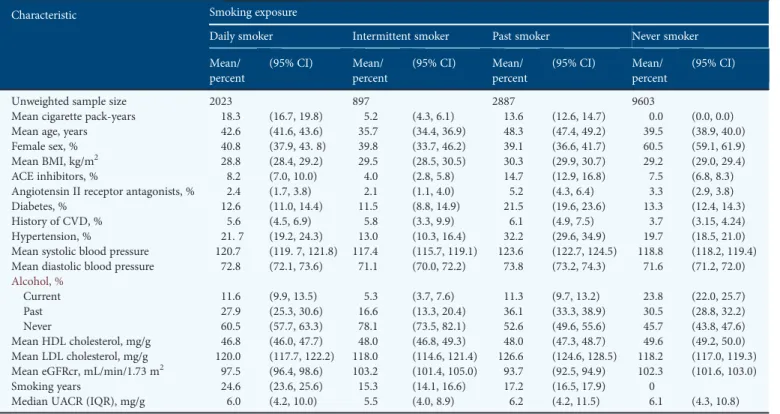
The characteristics of the HCHS/SOL target population by smoking exposure are shown in Table1. Approximately 21% of individuals reported current smoking, of which 14% re-ported daily smoking, and 7% rere-ported intermittent smoking, and 16% were past smokers. Intermittent smokers had lower mean pack-years smoking exposure and smoking years than those reporting daily or past smoking. In addition, they were younger, more often men (except when compared with past smokers) and had a lower prevalence of comorbidities com-pared with never smokers and the other smoker groups, except for history of cardiovascular disease, which was least prevalent among never smokers. The mean eGFR was comparable among intermittent smokers and never smokers, while the median UACR was similar between current daily smokers and never smokers.
Among Hispanics/Latinos meeting our criteria of CKD, 17% had an eGFR of <60 mL/min/1.73 m2, 73% had UACR≥30 mg/g and 10% had both reduced eGFR and increased UACR. CKD prevalences among daily smokers, intermittent smokers, past smokers and never smokers were 10, 9, 13 and 10%, respectively.
Table 1. Descriptive characteristics by smoking exposure: the HCHS/SOL: 2008–11
Characteristic Smoking exposure
Daily smoker Intermittent smoker Past smoker Never smoker
Mean/ percent
(95% CI) Mean/ percent
(95% CI) Mean/ percent
(95% CI) Mean/ percent
(95% CI)
Unweighted sample size 2023 897 2887 9603
Mean cigarette pack-years 18.3 (16.7, 19.8) 5.2 (4.3, 6.1) 13.6 (12.6, 14.7) 0.0 (0.0, 0.0) Mean age, years 42.6 (41.6, 43.6) 35.7 (34.4, 36.9) 48.3 (47.4, 49.2) 39.5 (38.9, 40.0) Female sex, % 40.8 (37.9, 43. 8) 39.8 (33.7, 46.2) 39.1 (36.6, 41.7) 60.5 (59.1, 61.9) Mean BMI, kg/m2 28.8 (28.4, 29.2) 29.5 (28.5, 30.5) 30.3 (29.9, 30.7) 29.2 (29.0, 29.4)
ACE inhibitors, % 8.2 (7.0, 10.0) 4.0 (2.8, 5.8) 14.7 (12.9, 16.8) 7.5 (6.8, 8.3) Angiotensin II receptor antagonists, % 2.4 (1.7, 3.8) 2.1 (1.1, 4.0) 5.2 (4.3, 6.4) 3.3 (2.9, 3.8) Diabetes, % 12.6 (11.0, 14.4) 11.5 (8.8, 14.9) 21.5 (19.6, 23.6) 13.3 (12.4, 14.3) History of CVD, % 5.6 (4.5, 6.9) 5.8 (3.3, 9.9) 6.1 (4.9, 7.5) 3.7 (3.15, 4.24) Hypertension, % 21. 7 (19.2, 24.3) 13.0 (10.3, 16.4) 32.2 (29.6, 34.9) 19.7 (18.5, 21.0) Mean systolic blood pressure 120.7 (119. 7, 121.8) 117.4 (115.7, 119.1) 123.6 (122.7, 124.5) 118.8 (118.2, 119.4) Mean diastolic blood pressure 72.8 (72.1, 73.6) 71.1 (70.0, 72.2) 73.8 (73.2, 74.3) 71.6 (71.2, 72.0)
Alcohol, %
Current 11.6 (9.9, 13.5) 5.3 (3.7, 7.6) 11.3 (9.7, 13.2) 23.8 (22.0, 25.7)
Past 27.9 (25.3, 30.6) 16.6 (13.3, 20.4) 36.1 (33.3, 38.9) 30.5 (28.8, 32.2) Never 60.5 (57.7, 63.3) 78.1 (73.5, 82.1) 52.6 (49.6, 55.6) 45.7 (43.8, 47.6) Mean HDL cholesterol, mg/g 46.8 (46.0, 47.7) 48.0 (46.8, 49.3) 48.0 (47.3, 48.7) 49.6 (49.2, 50.0) Mean LDL cholesterol, mg/g 120.0 (117.7, 122.2) 118.0 (114.6, 121.4) 126.6 (124.6, 128.5) 118.2 (117.0, 119.3) Mean eGFRcr, mL/min/1.73 m2 97.5 (96.4, 98.6) 103.2 (101.4, 105.0) 93.7 (92.5, 94.9) 102.3 (101.6, 103.0)
Smoking years 24.6 (23.6, 25.6) 15.3 (14.1, 16.6) 17.2 (16.5, 17.9) 0
Median UACR (IQR), mg/g 6.0 (4.2, 10.0) 5.5 (4.0, 8.9) 6.2 (4.2, 11.5) 6.1 (4.3, 10.8) BMI, body mass index; ACE, angiotensin-converting enzyme; CVD, cardiovascular disease; HDL, high-density lipoprotein; LDL, low-density lipoprotein; eGFRcr, estimated glomerular filtration rate based on serum creatinine; UACR, urine albumin-to-creatinine ratio; IQR, interquartile range.
ORIGINAL
The survey-adjusted prevalence estimate of CKD by smoking categories was 8% for daily smokers (95% CI 7, 10), 12% for intermittent smokers (9, 15), 11% for past smokers (9, 12) and 10% for never smokers (9, 11).
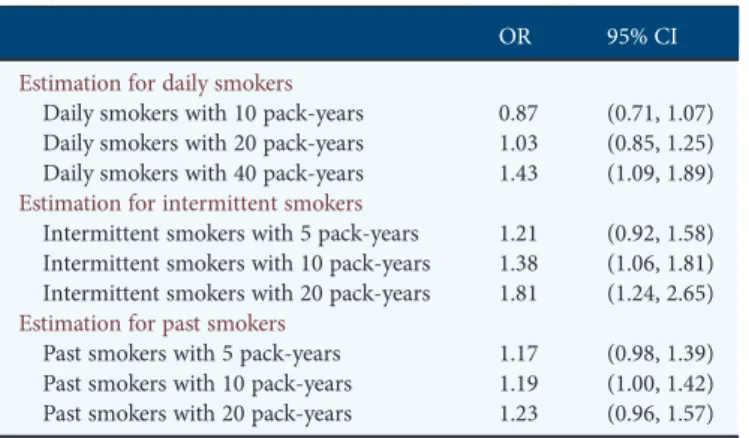
There was a significant interaction between smoking status (daily and intermittent, past compared to never) with pack-years of exposure (P = 0.0003) on CKD risk. Based on the model that accounted for this interaction and adjusted for other CKD risk factors, we calculated the OR associated
with smoking at 10, 20 and 40 pack-years of smoking for daily and past smokers, and at 5, 10 and 20 pack-years for inter-mittent smokers compared with never smokers (Table 2). Lower numbers of pack-years were chosen for intermittent smokers because that group had lower cumulative smoking exposure.
Daily and intermittent smokers showed an increase in the odds of CKD compared with never smokers with increasing pack-years of exposure, but intermittent smokers had a steeper increase (Figure1). For example, with 20 pack-years, intermit-tent smoking was associated with an 80% higher odds of CKD compared with never smokers, whereas daily smokers had a non-significant 3% higher odds of CKD (Table2). In addition, the association for intermittent smoking was statistically signifi -cant at 10 pack-years of smoking, whereas for daily smokers this association was observed only at 40 pack-years.
The OR comparing past smokers with never smokers increased linearly across pack-years of exposure at a very low rate, and it was not significant (Figure1). We also tested the association of time since quitting smoking and CKD among past smokers in models replacing pack-years with this time vari-able, but the association was not significant. In addition, there was no interaction of smoking categories with age (P = 0.06) or sex (P = 0.69) on the risk of CKD.
D I S C U S S I O N
Our mainfindings are the significant interactions among smok-ing status and cumulative pack-year exposure in Hispanics/
Table 2. Adjusted ORaand 95% CI of CKD by smoking categories and
pack-years
OR 95% CI
Estimation for daily smokers
Daily smokers with 10 pack-years 0.87 (0.71, 1.07) Daily smokers with 20 pack-years 1.03 (0.85, 1.25) Daily smokers with 40 pack-years 1.43 (1.09, 1.89)
Estimation for intermittent smokers
Intermittent smokers with 5 pack-years 1.21 (0.92, 1.58) Intermittent smokers with 10 pack-years 1.38 (1.06, 1.81) Intermittent smokers with 20 pack-years 1.81 (1.24, 2.65)
Estimation for past smokers
Past smokers with 5 pack-years 1.17 (0.98, 1.39) Past smokers with 10 pack-years 1.19 (1.00, 1.42) Past smokers with 20 pack-years 1.23 (0.96, 1.57) a
OR of CKD associated with smoking (daily, intermittent and past) compared with never smokers by pack-years of smoking based on models adjusted for age, sex,
cross-classification of center and Hispanics/Latino background, body mass index, history of diabetes, history of prevalent coronary heart disease, systolic blood pressure, history of alcohol intake, high- and low-density lipoprotein cholesterols, hypertension and blood pressure lowering medications including angiotensin-converting enzyme inhibitors and angiotensin II receptor blockers. P-value for interaction of smoking categories with pack-years = 0.0003.
F I G U R E 1 : Distribution of cumulative pack-years by smoker group among Hispanics/Latinos. The histogram shows the percent of cigarette pack-year groups (0–10, 10–20 and so on) by smoker groups (current daily, intermittent and past smokers). Lines are the adjusted OR of CKD by smoker groups (current daily, intermittent and past versus never smokers) (see Table2for covariates). Thex-axis uses the midpoint of the cigarette pack-year group interval.
ORIGINAL
Latino individuals, which have not been previously reported. Current smokers showed increased odds of CKD associated with higher level of cumulative pack-years of exposure com-pared with never smokers, in agreement with prior studies [26–28]. Our newfindings are related to a subset of current smokers who had an intermittent pattern of smoking, which is more common among Hispanics populations [24]. Although these individuals had low mean cumulative pack-years, were younger and had fewer overall risk factors for CKD, their odds of CKD compared with never smokers were higher than daily smokers across various pack-year levels (Table2, Figure1). Thesefindings suggest that intermittent smoking exposure has deleterious effects in the kidneys, the mechanisms of which may differ from those related to daily smoking patterns. Given users of nicotine delivery devices such as e-cigarettes, estimated as 3–7% of the US population, often continue smoking intermittent-ly [35–38], thesefindings could be relevant to this population. However, our study does not have information on e-cigarette use, and this issue will need to be addressed in future studies.
Mechanisms related to CKD in intermittent smokers include transitory increases in blood pressure due to acute vascular effects of smoking [39,40]. Blood pressure variability has been previously associated with kidney organ damage including CKD among hypertensive individuals [41]. In addition to hemo-dynamic changes, intermittent exposure of the kidney to toxic compounds present in cigarettes may also play a role in CKD. Experimental research suggests that nicotine stimulates mesan-gial cell proliferation and hypertrophy [20], inflammation and atherosclerosis [18], and induces oxidative stress pathways, which could promote kidney damage. Cadmium, a pollutant pre-sent in tobacco smoking, accumulates in kidneys and has been associated with hypertension [42]. Chronic smoking exposure induces enzymes related to the metabolism and excretion of nicotine and cadmium, potentially reducing their circulating levels and acute tissue toxicity. Therefore, intermittent smokers could be exposed to a higher level of these toxins acutely, although the exposure may be for a short period. In the HCHS/SOL study, intermittent smokers more often were men of Mexican background [22], although we did notfind significant differences in the observed association between smoking and CKD by sex, and we accounted for Hispanics/Latino background. Future work is needed to identify causal pathways relating inter-mittent smoking patterns to CKD.
The pattern of risk for past smokers was constant across cumulative pack-years, with an ∼20% higher odds of CKD compared with never smokers, regardless of the time since quit-ting. Although not significant, thesefindings suggest a remain-ing residual risk of CKD among individuals who quit smokremain-ing. Ourfindings are in agreement with prior studies that showed a lower risk of CKD among past smokers, but we did not observe a lack of risk among past smokers, which suggests that smoking exposure has a long-lasting harmful effect on kidneys.
This is the largest study of Hispanics/Latinos to examine the relationship of smoking exposure patterns—including daily and intermittent smoking—with CKD risk. Our study is limited to cross-sectional analyses, and therefore no causal inferences should be drawn. We also lack data on secondhand smoke ex-posure and the question of whether intermittent smokers
maintain the smoking habit over their entire life. Ongoing HCHS/SOL follow-up visits will allow the study of these asso-ciations prospectively. Most of the CKD cases in our composite outcome were due to increased albuminuria, which is the most common manifestation of CKD, particularly in a young popu-lation such as the HCHS/SOL target popupopu-lation. Microalbumi-nuria is a strong and independent predictor of ESKD and cardiovascular health outcomes [43,44].
Ourfindings suggest that intermittent smoking exposure is associated with an increased odds of CKD. Thesefindings have important implications for public health, especially for Hispanics who have a high prevalence of intermittent smoking, estimated at 30% in the National Health and Nutrition Examination Survey 1999–2000 and 2001–2 [24]. This intermittent pattern may be unrecognized by healthcare providers, thereby missing oppor-tunities for prevention. Our findings support public health efforts to avoid smoking exposure [45], particularly among young populations such as Hispanics/Latinos. Future studies should examine the relationship of secondhand smoke exposure to CKD risk in addition to the effect of intermittent smoking among e-cigarette users on CKD outcomes.
CO NC LU SI ON S
Our study shows significant associations of current smoking with CKD across increasing cumulative smoking exposure ( pack-years) among Hispanics/Latinos, which was significant among intermittent smokers at lower pack-years of smoking. There was a remaining non-significant risk of CKD among past smokers even years after quitting smoking, which could
re-flect prior damage or continuous exposure through passive smoking. Further work is needed to identify the mechanisms associated with thesefindings and the risk of secondhand and active intermittent smoking exposure on CKD, and in addition to determine the temporal relationship of these associations using longitudinal data. Our research supports efforts to target intermittent smoking exposure among Hispanics/Latinos through public health interventions and extend these current recommendations to CKD outcomes.
AC KN OW L E DG E ME NTS
The HCHS/SOL was carried out as a collaborative study supported by contracts from the National Heart, Lung, and Blood Institute (NHLBI) to the University of North Carolina (N01-HC65233), University of Miami (N01-HC65234), Albert Einstein College of Medicine (N01-HC65235), Northwestern University (N01-HC65236) and San Diego State University (N01-HC65237). The following institutes, centers or offices contribute to the HCHS/SOL through a transfer of funds to the NHLBI: National Center on Minority Health and Health Disparities, the National Institute on Deafness and Other Communications Disorders, the National Institute of Dental and Craniofacial Research, the National Institute of Diabetes and Digestive and Kidney Diseases, the National Institute of Neurological Disorders and Stroke, and the Office of Dietary
ORIGINAL
Supplements. A.C.R. and J.P.L. are funded by the National Institute of Diabetes and Digestive and Kidney Diseases (K23 DK094829, A.C.R.; K24 DK092290, J.P.L.). N.F. and J.C. had full access to the data and take responsibility for the integrity of the data and the accuracy of the data analysis. N.F. is supported by the National Institutes of Health grant R21HL123677-01.
CON F L I C T O F I N T E R E S T S TATE M E N T
None declared. An abstract of this study was presented at the 2015 American Society of Nephrology Renal Week meeting.
(See related article by Plantinga and Gander. Intermittent smoking and chronic kidney disease.Nephrol Dial Transplant 2016; 31: 1558–1560)
R E F E R E N C E S
1. Shankar A, Klein R, Klein BE. The association among smoking, heavy drinking, and chronic kidney disease.Am J Epidemiol2006; 164: 263–271
2. Stengel B, Tarver-Carr ME, Powe NRet al. Lifestyle factors, obesity and the risk of chronic kidney disease.Epidemiology2003; 14: 479–487
3. Fox CS, Larson MG, Leip EPet al. Predictors of new-onset kidney disease in a community-based population.JAMA2004; 291: 844–850
4. Orth SR, Hallan SI. Smoking: a risk factor for progression of chronic kidney disease and for cardiovascular morbidity and mortality in renal patients— absence of evidence or evidence of absence?Clin J Am Soc Nephrol2008; 3: 226–236
5. Yoon HJ, Park M, Yoon Het al. The differential effect of cigarette smoking on glomerularfiltration rate and proteinuria in an apparently healthy popu-lation.Hypertens Res2009; 32: 214–219
6. Bash LD, Astor BC, Coresh J. Risk of incident ESRD: a comprehensive look at cardiovascular risk factors and 17 years of follow-up in the Athero-sclerosis Risk in Communities (ARIC) Study.Am J Kidney Dis2010; 55: 31–41
7. Orth SR, Stockmann A, Conradt Cet al. Smoking as a risk factor for end-stage renal failure in men with primary renal disease.Kidney Int1998; 54: 926–931
8. Carter BD, Abnet CC, Feskanich Det al. Smoking and mortality—beyond established causes.N Engl J Med2015; 372: 631–640
9. Bartecchi CE, MacKenzie TD, Schrier RW. The human costs of tobacco use (1).N Engl J Med1994; 330: 907–912
10. Koh HK, Sebelius KG. Ending the tobacco epidemic.JAMA2012; 308: 767–768
11. Tonelli M, Wiebe N, Culleton Bet al. Chronic kidney disease and mortality risk: a systematic review.J Am Soc Nephrol2006; 17: 2034–2047 12. Teo KK, Ounpuu S, Hawken Set al. Tobacco use and risk of myocardial
infarction in 52 countries in the INTERHEART study: a case-control study.Lancet2006; 368: 647–658
13. Ishizaka N, Ishizaka Y, Toda Eet al. Association between cigarette smoking, metabolic syndrome, and carotid arteriosclerosis in Japanese individuals. Atherosclerosis2005; 181: 381–388
14. Raij L, DeMaster EG, Jaimes EA. Cigarette smoke-induced endothelium dysfunction: role of superoxide anion.J Hypertens2001; 19: 891–897 15. Jaimes EA, DeMaster EG, Tian RXet al. Stable compounds of cigarette
smoke induce endothelial superoxide anion production via NADPH oxidase activation.Arterioscler Thromb Vasc Biol2004; 24: 1031–1036 16. Jaimes EA, Tian RX, Joshi MSet al. Nicotine augments glomerular injury in
a rat model of acute nephritis.Am J Nephrol2009; 29: 319–326
17. Jaimes EA, Tian RX, Raij L. Nicotine: the link between cigarette smoking and the progression of renal injury?Am J Physiol Heart Circ Physiol 2007; 292: H76–H82
18. Zhou MS, Chadipiralla K, Mendez AJ et al. Nicotine potentiates proatherogenic effects of oxLDL by stimulating and upregulating macro-phage CD36 signaling. Am J Physiol Heart Circ Physiol 2013; 305: H563–H574
19. Hua P, Feng W, Ji Set al. Nicotine worsens the severity of nephropathy in diabetic mice: implications for the progression of kidney disease in smokers.Am J Physiol Renal Physiol2010; 299: F732–F739
20. Rezonzew G, Chumley P, Feng Wet al. Nicotine exposure and the progres-sion of chronic kidney disease: role of the alpha7-nicotinic acetylcholine receptor.Am J Physiol Renal Physiol2012; 303: F304–F312
21. Jamal A, Agaku IT, O’Connor Eet al. Current cigarette smoking among adults—United States, 2005–2013.MMWR Morb Mortal Wkly Rep2014; 63: 1108–1112
22. Kaplan RC, Bangdiwala SI, Barnhart JMet al. Smoking among U.S. Hispanic/Latino adults: the Hispanic Community Health Study/Study of Latinos.Am J Prev Med2014; 46: 496–506
23. Daviglus ML, Pirzada A, Talavera GA. Cardiovascular disease risk factors in the Hispanic/Latino population: lessons from the Hispanic Community Health Study/Study of Latinos (HCHS/SOL).Prog Cardiovasc Dis2014; 57: 230–236
24. Everhart J, Ferketich AK, Browning Ket al. Acculturation and misclassifi -cation of tobacco use status among Hispanic men and women in the United States.Nicotine Tob Res2009; 11: 240–247
25. Zhu SH, Pulvers K, Zhuang Yet al. Most Latino smokers in California are low-frequency smokers.Addiction2007; 102 (Suppl 2): 104–111 26. Hallan SI, Orth SR. Smoking is a risk factor in the progression to kidney
failure.Kidney Int2011; 80: 516–523
27. Yamamoto R, Nagasawa Y, Shoji Tet al. Cigarette smoking and progression of IgA nephropathy.Am J Kidney Dis2010; 56: 313–324
28. Jin A, Koh WP, Chow KYet al. Smoking and risk of kidney failure in the Singapore Chinese Health Study.PloS One2013; 8: e62962
29. Maeda I, Hayashi T, Sato KKet al. Cigarette smoking and the association with glomerular hyperfiltration and proteinuria in healthy middle-aged men.Clin J Am Soc Nephrol2011; 6: 2462–2469
30. Lavange LM, Kalsbeek WD, Sorlie PDet al. Sample design and cohort selection in the Hispanic Community Health Study/Study of Latinos. Ann Epidemiol2010; 20: 642–649
31. Sorlie PD, Aviles-Santa LM, Wassertheil-Smoller Set al. Design and implementation of the Hispanic Community Health Study/Study of Latinos.Ann Epidemiol2010; 20: 629–641
32. Levey AS, Stevens LA, Schmid CHet al. A new equation to estimate glom-erularfiltration rate.Ann Intern Med2009; 150: 604–612
33. Inker LA, Schmid CH, Tighiouart Het al. Estimating glomerularfi ltra-tion rate from serum creatinine and cystatin C.N Engl J Med2012; 367: 20–29
34. Levey AS, Stevens LA. Estimating GFR using the CKD Epidemiology Collaboration (CKD-EPI) creatinine equation: more accurate GFR estimates, lower CKD prevalence estimates, and better risk predictions. Am J Kidney Dis2010; 55: 622–627
35. Kralikova E, Kubatova S, Truneckova Ket al. The electronic cigarette: what proportion of smokers have tried it and how many use it regularly? Addiction2012; 107: 1528–1529
36. Kralikova E, Novak J, West Oet al. Do e-cigarettes have the potential to compete with conventional cigarettes?: a survey of conventional cigarette smokers’experiences with e-cigarettes.Chest2013; 144: 1609–1614 37. Zhu SH, Gamst A, Lee Met al. The use and perception of electronic
cigar-ettes and snus among the U.S. population.PloS One2013; 8: e79332 38. Bhatnagar A, Whitsel LP, Ribisl KMet al. Electronic cigarettes: a policy
statement from the American Heart Association.Circulation2014; 130: 1418–1436
39. Zamir Z, Mahmud A, Feely J. Acute haemodynamic effects of cigarette smoking in healthy young subjects.Irish J Med Sc2006; 175: 20–23 40. Omvik P. How smoking affects blood pressure.Blood Pressure1996; 5:
71–77
41. Parati G, Faini A, Valentini M. Blood pressure variability: its measurement and significance in hypertension.Curr Hypertens Rep2006; 8: 199–204
ORIGINAL
42. Staessen JA, Kuznetsova T, Roels HAet al. Exposure to cadmium and con-ventional and ambulatory blood pressures in a prospective population study. Public Health and Environmental Exposure to Cadmium Study Group.Am J Hypertens2000; 13: 146–156
43. Astor BC, Matsushita K, Gansevoort RTet al. Lower estimated glomerular filtration rate and higher albuminuria are associated with mortality and end-stage renal disease. A collaborative meta-analysis of kidney disease population cohorts.Kidney Int2011; 79: 1331–1340
44. van der Velde M, Matsushita K, Coresh Jet al. Lower estimated glomerular filtration rate and higher albuminuria are associated with all-cause and cardiovascular mortality. A collaborative meta-analysis of high-risk popu-lation cohorts.Kidney Int2011; 79: 1341–1352
45. Jha P, Peto R. Global effects of smoking, of quitting, and of taxing tobacco. N Engl J Med2014; 370: 60–68
Received for publication: 15.2.2016; Accepted in revised form: 17.4.2016
Nephrol Dial Transplant (2016) 31: 1676–1686 doi: 10.1093/ndt/gfv374
Advance Access publication 5 November 2015
Micro-RNA analysis of renal biopsies in human lupus nephritis
demonstrates up-regulated miR-422a driving reduction of
kallikrein-related peptidase 4
Eleni Krasoudaki
1, Aggelos Banos
1,2, Elias Stagakis
1, Konstantinos Loupasakis
3, Elias Drakos
4, Vaios Sinatkas
4,
Amalia Zampoulaki
1, Aikaterini Papagianni
5, Dimitrios Iliopoulos
6, Dimitrios T. Boumpas
1,2,7,*
and George K. Bertsias
1,8,*
1Laboratory of Autoimmunity and Inflammation, Institute of Molecular Biology-Biotechnology, FORTH, Iraklio, Greece,2Biomedical Research
Foundation of the Academy of Athens, Iraklio, Greece,3Hospital for Special Surgery, Weill Cornell Medical College, New York, NY, USA, 4Department of Pathology, University of Crete Medical School, Iraklio, Greece,5Department of Nephrology, Aristotle University of Thessaloniki
Medical School, Thessaloniki, Greece,6Center for Systems Biomedicine, Division of Digestive Diseases, David Geffen School of Medicine, University
of California at Los Angeles, Los Angeles, CA, USA,74th Department of Medicine, Attikon University Hospital, University of Athens Medical School,
Athens, Greece and8Rheumatology, Clinical Immunology and Allergy, University of Crete Medical School, Iraklio, Greece
Correspondence and offprint requests to: George K. Bertsias; E-mail: [email protected] *These authors contributed equally.
A B S T R AC T
Background.Aberrancies in gene expression in immune effect-or cells and in end-effect-organs are implicated in lupus pathogenesis. To gain insights into the mechanisms of tissue injury, we
pro-filed the expression of micro-RNAs in inflammatory kidney lesions of human lupus nephritis (LN).
Methods.Kidney specimens were from patients with active proliferative, membranous or mixed LN and unaffected control tissue. Micro-RNAs were quantified by TaqMan Low Density Arrays. Bioinformatics was employed to predict gene targets, gene networks and perturbed signaling pathways. Results were validated by transfection studies (luciferase assay, real-time PCR) and in murine LN. Protein expression was deter-mined by immunoblotting and immunohistochemistry.
Results.Twenty-four micro-RNAs were dysregulated (9 up-regulated, 15 down-regulated) in human LN compared with control renal tissue. Their predicted gene targets participated in pathways associated with TGF-β, kinases, NF-κB, HNF4A, Wnt/β-catenin, STAT3 and IL-4. miR-422a showed the high-est upregulation (17-fold) in active LN and correlated withfi -brinoid necrosis lesions (β= 0.63, P = 0.002). In transfection studies, miR-422a was found to directly target kallikrein-related peptidase 4 (KLK4) mRNA. Concordantly,KLK4mRNA was significantly reduced in the kidneys of human and murine LN and correlated inversely with miR-422a levels. Immunohisto-chemistry confirmed reduced KLK4 protein expression in renal mesangial and tubular epithelial cells in human and mur-ine LN.
Conclusions.KLK4, a serine esterase with putative renoprotec-tive properties, is down-regulated by miR-422a in LN kidney
ORIGINAL