Examination of Several Physiological and Psychosocial Factors
Potentially Associated with Masked Hypertension Among
Low-Risk Adults
Anthony J. Viera, MD, MPH1, Feng-Chang Lin, PhD2, Laura A. Tuttle, MA1, Emily Olsson, BA1, Susan S. Girdler, PhD3, and Alan L. Hinderliter, MD4
1Department of Family Medicine, University of North Carolina at Chapel Hill 2Department of Biostatistics, University of North Carolina at Chapel Hill 3Department of Psychiatry, University of North Carolina at Chapel Hill
4Department of Medicine, Division of Cardiology, University of North Carolina at Chapel Hill
Abstract
We examined the association of factors in addition to prehypertensive office blood pressure (BP) level that might improve detection of masked hypertension (MH, defined as non-elevated office BP with elevated out-of-office BP average) among those otherwise at low-risk. This sample of 340 untreated adults 30 years and older with office BP average <140/90 mmHg all had two sets of paired office BP measurements and 24-hour ambulatory BP monitoring (ABPM) sessions one week apart. Other than BP levels, the only factors that were associated (at P<0.10) with MH at both sets were male sex (75% vs 66%) and working outside the home (72% vs 59% first set; 71% vs 45% second set). Adding these variables to BP level in the model did not appreciably improve detection of MH. We found no demographic, clinical, or psychosocial measures that improved upon prehypertension as a potential predictor of MH in this sample.
Keywords
masked hypertension; ambulatory blood pressure monitoring; prehypertension
Introduction
Masked hypertension (MH), defined as non-elevated office blood pressure (BP) with elevated average out-of-office BP, conveys cardiovascular risk approaching that of sustained hypertension (BP elevated in office and out-of-office).1–5 Studies have demonstrated that MH is a reproducible phenotype and that people with BP in the “high-normal” or upper level prehypertension range are more likely to have MH.6,7 Detection of MH requires either ambulatory BP monitoring (ABPM) or home BP monitoring to acquire data for calculating
Corresponding author: Anthony J. Viera, MD, MPH, Associate Professor, Department of Family Medicine, University of North Carolina at Chapel Hill, 590 Manning Drive, CB 7595, Chapel Hill, NC 27599, Phone (919) 966-0758, [email protected].
HHS Public Access
Author manuscript
J Clin Hypertens (Greenwich)
. Author manuscript; available in PMC 2017 August 01.Published in final edited form as:
J Clin Hypertens (Greenwich). 2016 August ; 18(8): 784–789. doi:10.1111/jch.12761.
A
uthor Man
uscr
ipt
A
uthor Man
uscr
ipt
A
uthor Man
uscr
ipt
A
uthor Man
uscr
out-of-office BP average. Given that either method requires resources including equipment and time, it would be valuable to have a strategy for targeting which patients with a non-elevated office BP ought to have systematically performed out-of-office BP measurements in order to detect MH.
One could posit reasons why BP might be systematically normal inside the office but elevated outside the office. For example, work stress may lead to BP elevations that are actually diminished when one is sitting in a health care provider’s office.8 Home strain, trait-anger, and high stress in general may all act similarly.9–11 Smoking, which transiently raises BP, may contribute to an elevated out-of-office BP average that is not detected in a clinical setting due to the time refraining from a cigarette.12,13 In one Israeli study, MH was associated with younger age, male sex, and higher awake pulse rate.14 Identification of factors consistently associated with MH would help clinicians decide which patients with a non-elevated office BP should be considered for out-of-office BP monitoring.
We previously reported the sensitivity and specificity of prehypertensive office blood pressures for detecting MH.7 In that study, we noted that while an office BP cutoff of >120/82 mm Hg had the best performance as a screening test for identifying possible MH, it unfortunately had a high false positive rate. A risk assessment that uses variables in addition to office BP level might improve prediction and decrease the proportion of people who would be tested by ABPM but found to have normal ambulatory blood pressure. In this study, we examined the association of several candidate variables with MH and whether any associated variables besides prehypertension improved identification of adults with MH who were not taking BP lowering medications.
Methods
Study Recruitment and Setting
We recruited 420 adults via a combination of passive recruitment and active recruitment. For passive recruitment, we posted signs in seven primary care clinics inviting people with a recent office (clinic) BP measurement that was “borderline” or “a little high” to participate. Individuals interested in participating contacted a study coordinator to confirm eligibility and schedule their study visits. For active recruitment, we sent an email about the study to our campus listserv approximately every 3–4 months. Study coordinators also recruited potentially eligible participants via electronic medical records review of vital signs
documented during their most recent primary care clinic visit. To be eligible, a person had to be 30 years of age or older, have a primary care clinician, and be on no BP-lowering
medications. The participant’s most recent clinic visit BP had to be between 120–149 mm Hg systolic or 80–95 mm Hg diastolic with neither greater than 149/95 mm Hg. Exclusion criteria included diabetes, pregnancy, dementia, any condition that would preclude wearing an ambulatory BP monitor, and persistent atrial fibrillation or other arrhythmia. As an incentive, participants were offered $150 for completion of the study. All study procedures took place in a clinical research center.
A
uthor Man
uscr
ipt
A
uthor Man
uscr
ipt
A
uthor Man
uscr
ipt
A
uthor Man
uscr
Office Blood Pressure in the Research Setting
At the 4 study visits (Figure 1), following check-in procedures participants were placed in an exam room within the clinical research center. After at least a 5-minute rest, same arm BP was measured three times by a validated office-type oscillometric device (Welch Allyn Vital Signs15) according to recommended timing and positioning and using the appropriate BP cuff size.16 The three measurements were averaged to determine the participant’s office BP measurement for the visit.
For this analysis, we excluded participants (n=80) with initial research office BP average ≥ 140/90 mm Hg at the first set of measurements as such participants would either have sustained hypertension or white-coat hypertension as opposed to masked hypertension or sustained normotension.
Ambulatory Blood Pressure Monitoring
Participants underwent two 24-hour ABPM sessions one week apart using the Oscar 2 oscillometric monitor (Suntech Medical, Morrisville, NC). The Oscar 2 has been validated for use in adults by both the British Hypertension Society protocol and the International Protocol for the validation of blood pressure measuring devices.17,18 The monitors were programmed to measure BP at 30 minute intervals from 6am to 11pm and at 1 hour intervals from 11pm to 6am. The relaxed intervals were chosen to minimize wearer burden given that we asked participants to wear the BP monitor twice in a short time span. Maximum BP measurement time was limited to less than 140 seconds, and the monitors were set for a maximum pressure of 220 mm Hg. Participants were given verbal instructions on wearing the monitor, including that that they should try to leave the cuff on during the entire monitoring period, that they should try to hold their cuffed arm as still as possible during a measurement to ensure that the monitor would get an accurate reading, that cuff inflation would cause a tight feeling around the arm, and that faulty readings would trigger a repeat measurement. The minimum number of readings we accepted as an adequate ABPM session was 14 for daytime and 6 for nighttime.
Other Variables
Perceived stress was measured using the Perceived Stress Scale.19 Trait anger, trait anxiety, and state anxiety were measured using the Spielberger inventories.20,21 Job strain was measured using the Karasek Job 22, and home life stress was measured using the Home Life Pressure Index.23 Height and weight were measured at the first study visit and used to calculate body mass index (BMI). Arm circumference at mid-biceps was measured at the first study visit and used to guide BP cuff size. Demographics and medical history items were collected by self-administered questionnaire.
Analysis
MH was defined as a preceding research office BP average < 140/90 mm Hg with either a mean 24-hour ambulatory systolic BP ≥ 130 mm Hg or mean 24-hour diastolic BP ≥ 80 mm Hg.24 Normotension was defined as a preceding research office BP average < 140/90 mm Hg with both a mean 24-hour ambulatory systolic BP < 130 mm Hg and mean 24-hour diastolic BP < 80 mm Hg. We examined bivariate associations of several preselected
A
uthor Man
uscr
ipt
A
uthor Man
uscr
ipt
A
uthor Man
uscr
ipt
A
uthor Man
uscr
candidate “predictor” variables with MH separately for each session of paired office and ambulatory BP measurements. We modeled the MH status at the two time points
simultaneously using generalized estimating equations (GEE) method with an exchangeable working matrix to account for dependence between two outcomes. The time factor was not significant in any of the 3 models and hence was dropped from the final models. Using C-statistics with MH based on the first set of measurements as the outcome, we compared a model containing only BP levels to a model containing other variables that were associated with MH at the P<0.10 level at both sessions.
Study Approval
This study was approved by the Office of Human Research Ethics at the University of North Carolina at Chapel Hill.
Results
Participant Characteristics
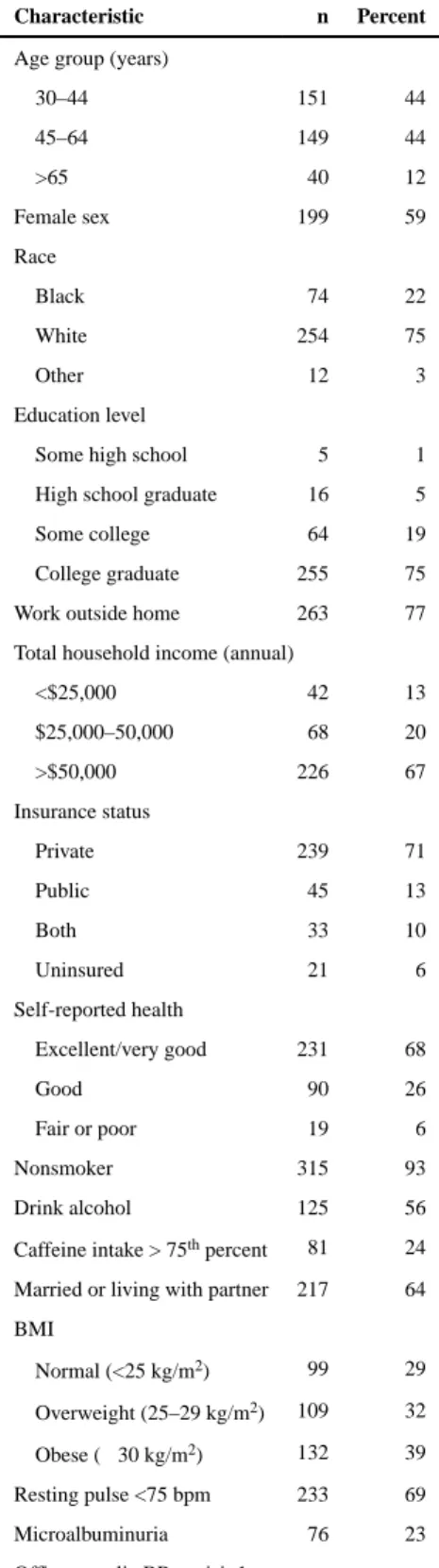
The mean ± standard deviation (±SD) age of the 340 participants included in the analysis was 48 (±12) years. Most participants were between 30 and 44 years (44%) or between 45 and 64 years (44%) (Table 1). A small proportion was older than 65 years (12%). Nearly 60% were female. Three-fourth were white, and 22% were Black. Most were college graduates (64%), and the majority (94%) reported good to excellent health. Most (93%) were also nonsmokers and overweight (32%) or obese (39%). The majority were married or living with a partner. Only 3 participants did not have sufficient daytime ambulatory BP monitor readings at the first session, and 5 did not have sufficient daytime ambulatory BP monitor readings at the second session.
Prevalence of Masked Hypertension in the Study Sample
As previously described, the prevalence of MH in the overall study sample was high.25 This high prevalence may have been the result of our method of recruiting people who had a recent “borderline” office BP measurement. When the sample was restricted to only those with prehypertensive research office visit BP average, the prevalence was especially high. Using the office BP average paired with the immediately following ABPM average, the prevalence of MH based on the first sets of measurements was 69.4% (95% CI 64.1%– 74.7%), and the prevalence based on the second sets of measurements was 65.9% (95% CI 60.5%–71.3%).
Associations with Masked Hypertension
Other than the BP levels, the only factors that were associated (at P<0.10) with MH at both time periods were male sex and working outside the home (Table 2). Using the first set of measurements, 75% of men vs 66% of women had MH, and using the second set, 73% of men vs 61% of women had MH. Among those who worked outside the home, 72% and 71% had MH by first and second set of measurements vs 59% and 45% among those who did not work outside the home. None of the candidate psychosocial measures we examined
appeared to be associated with MH (Table 3). Adding variables to BP level in the model did not appreciably improve detection of MH (Table 4).
A
uthor Man
uscr
ipt
A
uthor Man
uscr
ipt
A
uthor Man
uscr
ipt
A
uthor Man
uscr
Discussion
In this study, we sought to identify factors consistently associated with MH. Identification of such factors would help clinicians decide which patients with a prehypertensive office BP should be considered for out-of-office BP monitoring in order to detect masked
hypertension. We examined several candidate demographic, clinical, and psychosocial variables, but none was strongly associated with MH. The best “predictor” of MH is prehypertensive office BP level.
Other investigators have identified some factors associated with MH. Male sex, high pulse rate and smoking were associated with MH in one Israeli study.14 We did not note high pulse rate or smoking to be associated with MH, but our study had a low prevalence of smokers, and our participants also differed in that they were not actually being seen for a clinical visit We did observe male sex to be associated, but it was not helpful in improving detection of MH. A different study, conducted in Finland, found older age, higher BMI, smoking, and excessive alcohol consumption to be associated with MH.26 Our study did not replicate these findings, but we note that the Finnish study was of a much larger sample size (N=1459), which increased its power to find statistically significant associations. A prior study, also with a much larger sample size, also found job strain (high demand and high decision latitude) to be associated with MH in a sample of male white-collar workers, but not among female white-collar workers.27
In our study, we noted that simply working outside the home was associated with MH. It is important to acknowledge that guidelines recommend that ABPM be performed on a workday. In previous work, we pointed out that home BP monitoring and ABPM are not interchangeable for detecting MH. The obvious limitation is that home BP measurements are typically only made in the morning and in the evening, periods that may miss times when BP is prone to elevation. It is possible that a home BP monitor taken to work and used in the workplace, or used mid-day at home, might be able to identify MH. Such a protocol could be tested in further studies.
Prehypertension increases cardiovascular risk compared to optimal BP, but not enough to justify antihypertensive therapy for most patients. It is possible that much of the risk attributable to office prehypertension is actually a reflection of a population in which a large proportion of people have masked hypertension. We know from multiple studies that the cardiovascular risk of MH approaches that of sustained hypertension. Thus, ambulatory BP monitoring may be useful to risk stratify patients who have prehypertensive office BPs, for whom treatment beyond lifestyle modifications might be considered. It was our hope that additional variables could be used to guide such a strategy, but the BP level itself may indeed be the best clinical harbinger of potential MH. Further studies are still needed to determine whether treatment of MH, guided by out-of-office BP measurements, leads to reduced CVD events. The answer may also depend on the natural history of MH, or the time it takes for such patients to “transition” to sustained hypertension. Patients’ acceptance of treatment of MH—when their office BP is “normal” —also needs to be examined.
A
uthor Man
uscr
ipt
A
uthor Man
uscr
ipt
A
uthor Man
uscr
ipt
A
uthor Man
uscr
Streamlining use of ABPM to identify MH is desired because of the costs and the potential discomfort involved. For patients whose office BP is elevated (i.e. ≥ 140/90 mmHg), ambulatory BP monitoring has been shown to be cost-effective compared to reliance of office BP measurements alone because of its ability to identify white-coat hypertension, which most evidence suggests need not be treated.28 Future analyses could also examine the cost of using ambulatory BP monitoring among patients whose BP is prehypertensive. Assuming treatment of MH reduces the risk of CVD events, such a strategy might be cost-effective compared to relying only on office BP measurements and not treating patients with MH.
Strengths and Limitations
Strengths of our study included its repeated sets of measurements of office and ambulatory BP as well as its measurement of several candidate factors. We also acknowledge several limitations. Our sample may not be representative of a general clinic population, and we did not include diabetics. The sample also had a high prevalence of MH, which may have diminished our ability to identify associated factors. Our sample also had relatively low prevalence of risk factors, such as smoking, that have been found in other studies to be associated with MH. Finally, there may be factors that are associated with MH that we simply did not measure.
Conclusion
Prehypertensive BP levels are associated with MH. The additional factors examined in this study did not significantly improve ability to discriminate between people more vs less likely to have MH. For now, clinicians and researchers interested in using ambulatory BP monitoring to detect MH could consider offering it to patients 30 years and older whose BP is in the prehypertensive range.
Acknowledgments
This study was supported by grant R01 HL098604 from the National Heart Lung and Blood Institute.
References
1. Liu JE, Roman MJ, Pini R, Schwartz JE, Pickering TG, Devereux RB. Cardiac and arterial target organ damage in adults with elevated ambulatory and normal office blood pressure. Ann Intern Med. 1999; 131(8):564–572. [PubMed: 10523216]
2. Sega R, Trocino G, Lanzarotti A, Carugo S, Cesana G, Schiavina R, Valagussa F, Bombelli M, Giannattasio C, Zanchetti A, Mancia G. Alterations of cardiac structure in patients with isolated office, ambulatory, or home hypertension: Data from the general population (Pressione Arteriose Monitorate E Loro Associazioni [PAMELA] Study). Circulation. 2001; 104(12):1385–1392. [PubMed: 11560854]
3. Fagard RH, Cornelissen VA. Incidence of cardiovascular events in white-coat, masked and sustained hypertension versus true normotension: a meta-analysis. J Hypertens. 2007; 25:2193–2198. [PubMed: 17921809]
4. Verberk WJ, Kessesl AG, de Leeuw PW. Prevalence, causes, and consequences of masked hypertension: a meta-analysis. Am J Hypertens. 2008; 21:969–975. [PubMed: 18583985]
A
uthor Man
uscr
ipt
A
uthor Man
uscr
ipt
A
uthor Man
uscr
ipt
A
uthor Man
uscr
5. Pierdomenico SD, Pannarle G, Rabbia F, Lapenna D, Licitra R, Zito M, Campanella M, Gaudio C, Veglio F, Cuccurullo F. Prognostic relevance of masked hypertension in subjects with
prehypertension. Am J Hypertens. 2008; 21:879–883. [PubMed: 18464744]
6. Shimbo D, Newman JD, Schwartz J. Masked hypertension and prehypertension: diagnostic overlap and interrelationships with left ventricular mass: the masked hypertension study. Am J Hypertens. 2012; 25:664–71. [PubMed: 22378035]
7. Viera AJ, Lin FC, Tuttle LA, Shimbo D, Diaz KM, Olsson E, Stankevitz K, Hinderliter AL. Levels of office blood pressure and their operating characteristics for detecting masked hypertension based on ambulatory blood pressure monitoring. Am J Hypertens. 2015 Jan; 28(1):42–9. [PubMed: 24898379]
8. Lindquist TL, Beilin LJ, Knuiman MW. Influence of lifestyle, coping, and job stress on blood pressure in men and women. Hypertension. 1997 Jan; 29(1Pt1):1–7. [PubMed: 9039072]
9. Suls J, Wan CK, Costa PT Jr. Relationship of trait anger to resting blood pressure: a meta-analysis. Health Psychol. 1995; 14(5):444–56. [PubMed: 7498116]
10. Schum JL, Jorgensen RS, Verhaeghen P, Sauro M, Thibodeau R. Trait anger, anger expression, and ambulatory blood pressure: a meta-analytic review. J Behav Med. 2003; 26(5):395–415. [PubMed: 14593850]
11. James GD, Yee LS, Harshfield GA, Blank SG, Pickering TG. The influence of happiness, anger, and anxiety on the blood pressure of borderline hypertensives. Psychosom Med. 1986; 48:502–8. [PubMed: 3763789]
12. Omvik P. How smoking affects blood pressure. Blood Pressure. 1996; 5:71–77. [PubMed: 9162447]
13. Mann SJ, James GD, Wang RS, Pickering TG. Elevation of ambulatory systolic blood pressure in hypertensive smokers. A case-control study. JAMA. 1991; 265:2226–2228. [PubMed: 2013955] 14. Ben-Dov IZ, Ben-Arie L, Mekler J, Bursztyn M. In clinical practice, masked hypertension is as
common as isolated clinic hypertension: predominance of younger men. Am J Hypertens. 2005; 18(5 Pt 1):589–593. [PubMed: 15882539]
15. Jones CR, Taylor K, Poston L, Shennan AH. Validation of the Welch Allyn ‘Vital Signs’
oscillometric blood pressure monitor. J Hum Hypertens. 2001; 15:191–195. [PubMed: 11317204] 16. Pickering TG, Hall JE, Appel LJ, Falkner BE, Graves J, Hill MN, et al. Subcommittee of
Professional and Public Education of the American Heart Association Council on High Blood Pressure Research. Recommendations for blood pressure measurement in humans and experimental animals. Part 1: blood pressure measurement in humans. Hypertension. 2005; 45:142–61. [PubMed: 15611362]
17. Jones SC, Bilous M, Winship S, Finn P, Goodwin J. Validation of the Oscar 2 oscillometric 24-hour ambulatory blood pressure monitor according to the International Protocol for the validation of blood pressure measuring devices. Blood Press Monit. 2004; 9:219–223. [PubMed: 15311149] 18. Goodwin J, Bilous M, Winship S, Finn P, Jones SC. Validation of the Oscar 2 oscillometric
24-hour ambulatory blood pressure monitor according to British Hypertension Society protocol. Blood Press Monit. 2007; 12:113–117. [PubMed: 17353655]
19. Cohen S, Kamarck T, Mermelstein R. A global measure of perceived stress. J Health Soc Behav. 1983; 24(4):385–396. [PubMed: 6668417]
20. Spielberger, CD.; Jacobs, G.; Russel, S.; Crane, R. Assessment of anger: the State-Trait Anger Scale. In: Butcher, JN.; Spielberger, CD., editors. Advances in Personality Assessment. Vol. 2. Hillsdale, NJ: Lawrence Erlbaum Associates; 1983. p. 161-189.
21. Spielberger, CD. Manual for the State-Trait Anxiety Inventory: STAI (Form Y). Palo Alto, CA: Consulting Psychologists Press; 1983.
22. Karasek, R. Job Content Questionnaire and user’s guide. Lowell, MA: University of Massachussetts; 1985.
23. Grewen KM, Girdler SS, Light KC. Relationship quality: effects on ambulatory blood pressure and negative affect in a biracial sample of men and women. Blood Press Monit. 2005; 10(3):117–124. [PubMed: 15923812]
24. O’Brien E, Parati G, Stergiou G. Ambulatory blood pressure measurement: what is the international consensus? Hypertension. 2013; 62:00–00.
A
uthor Man
uscr
ipt
A
uthor Man
uscr
ipt
A
uthor Man
uscr
ipt
A
uthor Man
uscr
25. Viera AJ, Lin FC, Tuttle LA, Olsson E, Stankevitz K, Girdler SS, Klein JL, Hinderliter AL. Reproducibility of masked hypertension among adults 30 years or older. Blood Press Monit. 2014 Aug; 19(4):208–15. [PubMed: 24842491]
26. Hänninen MR, Niiranen TJ, Puukka PJ, Mattila AK, Jula AM. Determinants of masked hypertension in the general population: the Finn-Home study. J Hypertens. 2011 Oct; 29(10): 1880–8. [PubMed: 21841499]
27. Trudel X, Brisson C, Milot A. Job strain and masked hypertension. Psychosom Med. 2010 Oct; 72(8):786–93. [PubMed: 20639388]
28. Lovibond K, Jowett S, Barton P, Caulfield M, Heneghan C, Hobbs FD, Hodgkinson J, Mant J, Martin U, Williams B, Wonderling D, McManus RJ. Cost-effectiveness of options for the diagnosis of high blood pressure in primary care: a modelling study. Lancet. 2011; 378(9798): 1219–30. [PubMed: 21868086]
A
uthor Man
uscr
ipt
A
uthor Man
uscr
ipt
A
uthor Man
uscr
ipt
A
uthor Man
uscr
Figure 1.
Participant Study Flow
A
uthor Man
uscr
ipt
A
uthor Man
uscr
ipt
A
uthor Man
uscr
ipt
A
uthor Man
uscr
A
uthor Man
uscr
ipt
A
uthor Man
uscr
ipt
A
uthor Man
uscr
ipt
A
uthor Man
uscr
ipt
Table 1
Participant Characteristics (N=340)
Characteristic n Percent
Age group (years)
30–44 151 44
45–64 149 44
>65 40 12
Female sex 199 59
Race
Black 74 22
White 254 75
Other 12 3
Education level
Some high school 5 1
High school graduate 16 5
Some college 64 19
College graduate 255 75
Work outside home 263 77
Total household income (annual)
<$25,000 42 13
$25,000–50,000 68 20
>$50,000 226 67
Insurance status
Private 239 71
Public 45 13
Both 33 10
Uninsured 21 6
Self-reported health
Excellent/very good 231 68
Good 90 26
Fair or poor 19 6
Nonsmoker 315 93
Drink alcohol 125 56
Caffeine intake > 75th percent 81 24
Married or living with partner 217 64
BMI
Normal (<25 kg/m2) 99 29
Overweight (25–29 kg/m2) 109 32
Obese (≥ 30 kg/m2) 132 39
Resting pulse <75 bpm 233 69
Microalbuminuria 76 23
A
uthor Man
uscr
ipt
A
uthor Man
uscr
ipt
A
uthor Man
uscr
ipt
A
uthor Man
uscr
ipt
Characteristic n Percent
< 120 mmHg 94 31
120–130 mm Hg 125 41
131–139 mm Hg 87 28
Office diastolic BP at visit 1
<80 mmHg 178 56
80–84 mm Hg 62 20
85–89 mm Hg 77 24
A
uthor Man
uscr
ipt
A
uthor Man
uscr
ipt
A
uthor Man
uscr
ipt
A
uthor Man
uscr
ipt
T ab le 2 Bi variate Associations of P
articipant Characteristics with Mask
ed Hypertension
Characteristic
Category
P
er
cent with MH at visit 1
P-v
alue
P
er
cent with MH at visit 2
P-v
alue
Age group (years)
30–44 71 0.64 74 0.029 45–64 69 61 >65 63 54 Se x Male 75 0.09 73 0.03 Female 66 61 Race Black 70 0.95 62 0.40 White/other 69 67 Education le v el <Colle ge grad 69 0.90 63 0.61 Colle ge graduate 70 67 W
ork outside home
Y es 72 0.04 71 0.0001 No 59 45 T
otal household income (annual)
<$25,000 75 0.45 68 0.91 $25,000–50,000 63 64 >$50,000 69 67 Insurance status Insured (an y) 69 0.41 66 0.64 Uninsured 78 60 Self-reported health Excellent/v ery good 70 0.61 66 0.91 Good 66 64 F
air or poor
78 69 Current smok er Y es 87 0.06 81 0.18 No 68 65 Drink alcohol Y es 74 0.78 65 0.78 No 72 63 Caf feine intak e High 75 0.20 73 0.13 Lo w/moderate 67 64 Relationship
Married / li
ving with partner
69
0.80
65
0.58
Single / not li
ving with partner
70
68
BMI
Normal (<25 kg/m
2)
70
0.94
64
A
uthor Man
uscr
ipt
A
uthor Man
uscr
ipt
A
uthor Man
uscr
ipt
A
uthor Man
uscr
ipt
Characteristic
Category
P
er
cent with MH at visit 1
P-v
alue
P
er
cent with MH at visit 2
P-v
alue
Ov
erweight (25–29 kg/m
2)
70
71
Obese (≥ 30 kg/m
2)
68
63
Resting pulse
<75 bpm
66
0.055
66
0.87
≥75 bpm
77
65
Microalb
uminuria
Y
es
79
0.055
73
0.14
No
66
63
Of
fice systolic BP
<120 mm Hg
47
<0.0001
48
<0.0001
120–130 mm Hg
82
70
131–139 mm Hg
77
83
Of
fice diastolic BP
< 80 mm Hg
60
0.0001
55
<0.0001
80–84 mm Hg
82
73
85–89 mm Hg
83
A
uthor Man
uscr
ipt
A
uthor Man
uscr
ipt
A
uthor Man
uscr
ipt
A
uthor Man
uscr
ipt
T ab le 3 Bi variate Associations of Psychosocial Measures with Mask
ed Hypertension
Characteristic
Quartile
P
er
cent with MH at visit 1
P-v
alue
P
er
cent with MH at visit 2
P-v alue State anxiety 1 71 0.83 70 0.55 2 68 63 3 65 61 4 72 70 T rait anxiety 1 68 0.97 64 0.95 2 71 69 3 68 66 4 70 65 Job strain 1 71 0.77 73 0.29 2 67 68 3 76 64 4 74 79
Home life pressure
A
uthor Man
uscr
ipt
A
uthor Man
uscr
ipt
A
uthor Man
uscr
ipt
A
uthor Man
uscr
ipt
T ab le 4Models with Se
x and W
ork Outside the Home Added to Blood Pressure Le
v els Model 1 Model 2 Model 3 OR 95% CI p-v alue OR 95% CI p-v alue OR 95% CI p-v alue Off
ice systolic BP <120 mm Hg
1.0
1.0
1.0
120–130 mm Hg
2.2 1.4, 3.4 <0.001 2.2 1.4, 3.3 <0.001 2.3 1.5, 3.6 <0.001
131–139 mm Hg
2.3 1.4, 3.7 <0.001 2.2 1.4, 3.5 <0.001 2.4 1.5, 3.8 <0.001 Off
ice diastolic BP < 80 mm Hg
1.0
1.0
1.0
80–84 mm Hg
1.8 1.1, 3.0 0.029 1.7 1.0, 2.9 0.036 1.7 1.0, 2.9 0.049
85–89 mm Hg
2.5 1.4, 4.3 0.001 2.4 1.4, 4.2 0.001 2.4 1.4, 4.2 0.001 Sex Male 1.0 1.0 Female 0.7 0.5, 1.1 0.16 0.8 0.5, 1.2 0.26 W
ork outside home No
1.0 Y es 2.4 1.5, 3.8 <0.001 C-statistic 0.709 0.714 0.78 * 0.736 0.26 † * p-v
alue for model 1 and model 2 comparison;
† p-v