Using semantic properties for real time scheduling
Christian Fotsing, Annie Geniet
LISI, ENSMA
1 Av. Clement Ader BP 40109-86961 Futuroscope Chasseneuil-France
[email protected], [email protected]
Guy Vidal-Naquet
SUPELEC - 3 rue Joliot-Curie
Plateau de Moulon. BP 91192 Gif-Sur-Yvette Cedex-France
[email protected]
Abstract
We consider interacting tasks with conditional state-ments. The classical temporal model associates a single WCET to each task, and considers the union of the real-time primitives that occur in the different branches of con-ditional statements. Thus the model considers only a non realistic worst case, which can lead to erroneous conclu-sions. Furthermore, semantic is never considered. We ex-tend the task model with conditional statements, and the notion of schedule is replaced by the notion of scheduling tree. We then present some examples which illustrate the benefit of taking semantic into account. This lays the ba-sis for a complete model based scheduling analyba-sis which explicitely takes conditional statements and semantic into account.
1
Introduction
We consider real time applications dedicated to process control. They are generally modeled as a set of periodic, possibly interacting tasks. For safety reasons, tasks have to respect firm deadlines. One of the main challenges for system designer is to ensure that all deadlines are met. This is the concern of scheduling. Scheduling theory re-lies on the temporal modeling of tasks. Classically, a task τi <ri, Ci, Di, Pi>is modeled by four temporal
param-eters [LL73]: its first release timeri, its worst case
exe-cution time (WCET)Ci, its relative deadlineDiwhich is
the maximum acceptable delay between release and com-pletion of any instances of the task, and its periodPi. A
task consists in an infinite set of instances (or jobs) re-leased at timesri+k×Pi, where k is a natural integer.
Tasks may also communicate or share critical resources. They may thus use real-time primitives (send or receive messages, lock and unlock resources). In classical ap-proaches, one single WCET is associated to each task. If a task contains conditional statements, its WCET
corre-sponds to the longest execution path of the task. It can be obtained either by simulation or by static syntaxical anal-ysis of the task code [CPRS03]. All real-time primitives are also considered to occur, even if they are in differ-ent branches of conditional statemdiffer-ents. Thus scheduling analysis is performed from a non realistic model. This can lead to erroneous conclusions. Our aim is to illustrate that the classical modeling of tasks must be refined. More-over, we illustrate through some examples that semantic must also be considered, otherwise, again erroneous con-clusions could be drawn.
The paper is organised as follows. First we present our assumptions. Then, we present our task model and the scheduling model: since we consider conditional state-ments, the notion of schedule is no longer suited, and must be replaced by the notion of scheduling tree which describes the different possible effective behaviors of the application. We present the limitations of the classical approach through some examples and we conclude and present our future investigations.
2
Context and classical temporal model
2.1 General context
In this paper, we consider applications composed of interacting periodic tasks. They run on preemptive uniprocessor systems. We consider pre-runtime (off-line) scheduling. This means that we want to obtain, from the modeling of the tasks, a global execution model of the ap-plication. This execution model (a schedule in classical scheduling analysis) can then be implemented within the system.
We assume that tasks consist in [CGGC96, GCG00]
• blocks composed of imperative statements. bi(j)
de-notes theithblock of the tasks, with execution time
equal to j,
• conditional statements: IF condition THEN ... ELSE .... End if,
• Lock(R) and Unlock(R) where R is a resource of the system,
• Send(M) and Receive(M) where M is a message linked to a mailbox.
We assume that real-time primitive processing times are included in the processing times of neighbour blocks. Fur-thermore, execution times of condition evaluation are in-cluded in the execution times of the statements of the branches THEN and ELSE. E.g., for task T1 on Figure
1, the computing time required by the evaluation of the condition is included in the execution times of blocks b2
and b3. Then we model tasks byexecution trees(Figure
1).
Figure 1. Modeling of a task with conditional statement by an execution tree
2.2 From execution trees to classical temporal model of tasks
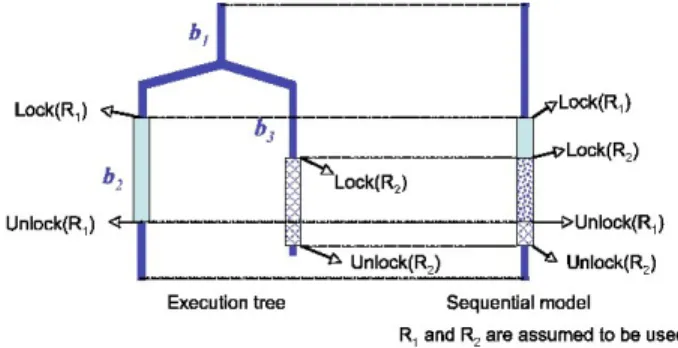
The classical model, called heresequential model, is a sequence of blocks and of real-time primitives.The WCET of each block is computed, and real-time primitives are temporally located. A real-time primitive occurs at time t if there exists a branch of the task in which this primitive occurs at time t [Gro99, Bab96, Nie91]. We present suc-cintly the computation of this sequential model. WCET are computed using classical methods that can be found in the literature [CPRS03, Pua05].
If we were to follow the usual model, the task of Figure 1 would be represented by (see Figure 2):
Figure 2. Usual model for the task of Fig-ure 1
2.2.1 Task without conditional statements
The WCET is an upper bound of the execution time required by the task when it runs alone on the processor. The sequential model is here the effective description of the behavior of the task.
2.2.2 Task with conditional statements
Each branch of the execution tree is associated to its own WCET. The global WCET is then the maximal value of these WCET. Figure 3 illustrates the WCET computa-tion.
Figure 3. Evaluation of WCET for a task with conditional statements
2.2.3 Task with conditional statements and resource utilization
We consider a task with a conditional statement such that:
• The THEN branch has a WCET equal toC1, and uses
resourceR1between execution timest1andt2 • The ELSE branch has a WCET equal toC2, and uses
resourceR2between execution timest01andt02
The sequential model has a WCET equal to max(C1,C2),
and the task is considered to useR1betweent1andt2and
R2betweent01andt02. Figure 4 illustrates this case.
Figure 4. Conditional statement and utiliza-tion of resources
2.2.4 Task with conditional statement and communi-cation primitives
We consider a task with a conditional statement such that:
• The THEN branch has a WCET equal to C1, and
• The ELSE branch has a WCET equal toC2, and
re-ceives a message M2at execution time t’
The sequential model has a WCET equal to max(C1,C2),
and the task is considered to send message M1 at time t
and to receive message M2at time t’. Figure 5 illustrates
this case.
Figure 5. Conditional statement and com-munication
3
Scheduling
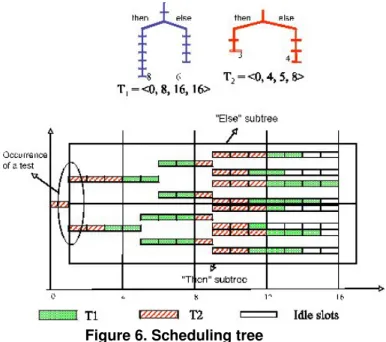
Classical scheduling approaches compute schedules from the WCET. Schedules here completely hide condi-tional behaviours of tasks. Now, if one wants to depicte the actual behaviour of the system, he has to consider the tree modeling of tasks, and he cannot thus produce one single schedule. He must describe every possible paths followed by the application. Thus, we must introduce a new execution model:the scheduling tree, which lets ex-plicitely appear each conditional node. Consider the ap-plication of Figure 6, composed of two synchronous tasks. The behavior of the application must be modeled on the time interval [0, 16] where 16 is the hyperperiod 1, and
it is then iterated. A scheduling tree is given in Figure 6. The application processes T2 for one time unit, then the
conditional statement of T2 is scheduled. There are thus
two subtrees, which correspond to the further behaviour of the application if the “then” respectively “else” branch of T2is chosen. The application can here have 8 different
behaviours on [0, 16]. A scheduling tree is thenvalidif all deadlines are met whatever the different choices made in conditional statements. The scheduling tree of Figure 6 is valid since the first occurrence of T2 completes
ei-ther at time 3 or at time 4, and the second occurrence at times 11 or 12, whatever the followed branch. And task T1 completes between times 12 and 16. So all deadlines
are met. A real-time system is then said to beglobally (or strongly) feasibleif there exists at least one valid schedul-ing tree. We are now interested in the feasibility analysis. We consider pre run-time (off-line) analysis for uniproces-sor systems. When sequential models are used, we have a necessary condition for a system to be feasible:
1the lcm of all periods
Figure 6. Scheduling tree
Property 1 [But97] If a system of n sequential tasks (τ1,τ2,. . . ,τn) is feasible then its utilization factor2is at
most equal to 1
Our aim is now to present some examples which show that considering the sequential models of tasks can lead to erroneous conclusions.
4
Classical analysis versus our analysis
4.1 Utilization of several resources
We consider a system S1 composed of two tasks
T1 <0, 16, 32, 32>andT2 <0, 2, 4, 4>. They share
two resourcesR1andR2.
• T1usesR1between execution time units 3 and 6 • T1usesR2between execution time units 4 and 8 • T2 usesR1 during its first execution time unit and
thenR2during the second.
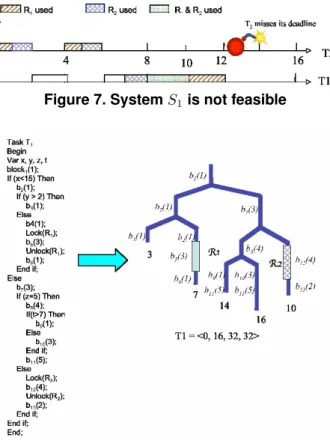
We first use here the sequential model, and conclude that the system is not feasible, because taskT2always miss its
third deadline. Indeed, between times 0 and 8, 2 instances ofT2are processed, for 4 time units.T1is thus processed
for 4 time units within the 8 first time units. Thus at time 8, T2 is released, butR1 is locked by T1, and it cannot
be unlocked before time 10. But thenR2 will be locked
for still 2 more time units, thus won’t be available before time 12. ThusT2 will miss its deadline (see Figure 7).
We now refine our analysis, and consider the pseudo-code of tasks. We assume that the sequential model ofT1has
been deduced from the code given in Figure 8. We can observe that resources R1and R2are never both used by
an instance ofT1. The former analysis thus doen’t hold. 2the utilization factor U is defined asU=
n
P
i=1
Ci
Figure 7. SystemS1is not feasible
Figure 8. Code and execution tree of taskT1
In fact, either T1 uses R1 and thenT2 can be processed
at time 10 even if R2 is still locked, orT1 uses R2, then
T2 can be processed at time 8 before T1 locks R2. We
present in Figure 9 a valid scheduling tree of the appli-cation. The system is thus feasible, despite the negative conclusion when using the classical sequential model.
Figure 9. A scheduling tree ofS1
4.2 Considering semantic
We consider a systemS2 composed of two
communi-cating tasks T1 <0, 5, 9, 9>andT2 <0, 5, 9, 9>. We
assume that:
• T1receives a message M toT2after its1stexecution
time unit
• T1sends a message M’ fromT2 after its4th
execu-tion time unit
• T2receives a message M’ fromT1after its2nd
exe-cution time unit
• T2sends a message M to T1 after its3rdexecution
time unit
This system is not feasible for two reasons:
• it doesn’t respect the necessary condition (prop-erty 1):U =5 9+ 5 9 = 10 9 >1, • deadlock cannot be avoided.
Now, let us assume that this sequential model comes from the pseudo code described in Figure 10. Furthermore,
Figure 10. SystemS2
since x is an input parameter of both tasks, and, since they are always released at the same time, they always consider the same value for x. We can notice that, according to the semantic of tests, eitherT2executes its THEN branch and
T2its ELSE branch, or conversely. Thus either message
M is send and received or message M’. The deadlock thus doesn’t take place. Moreover, the case corresponding to U greater than 1 is impossible, because of the semantic. And the system is feasible in practise. Figure 11 presents a valid scheduling tree. Here again, only the semantically correct branches have been kept.
Figure 11. A scheduling tree ofS2- Missing
5
Conclusion and future work
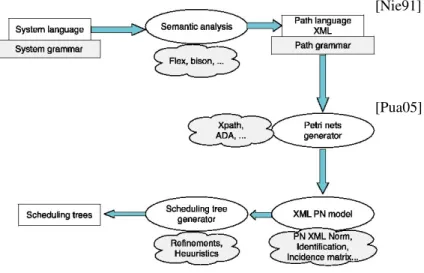
We have laid the basis for future works. We in-tend to develop a complete model based methodology for scheduling analysis. For that purpose, we will extend the Petri nets based methodology proposed in [CGGC96, GCG00]. The former examples prove that the classical sequential model of tasks as well as the notion of sched-ule must be refined. They also prove that it is mandatory to take semantic into account in the feasibility analysis. The general frame of our future investigations is given in Figure 12.
Figure 12. Our methodology
References
[Bab96] J.P. Babau. Etude du comportement tem-porel des applications temps r´eel `a con-traintes strictes bas´ee sur une analyse d’ordonnanc¸abilit´e. PhD thesis, University of Poitiers, France, 1996.
[But97] G.C. Buttazo.Hard real Time computing sys-tems: predictable scheduling algorithms and applications. Kluwer Academic, 1997. [CGGC96] A. Choquet-Geniet, D. Geniet, and F. Cottet.
Exhaustive computation of the scheduled task execution sequences of a real-time applica-tion. InProc. of FTRTFT’96, October 1996. [CPRS03] A. Colin, I. Puaut, C. Rochange, and P.
Sain-rat. Calcul de majorants des pires temps d’ex´ecution : ´etat de l’art. Techniques et Sci-ences Informatiques (TSI), 22(5):651–677, 2003.
[GCG00] E. Grolleau and A. Choquet-Geniet. Off line computation of real time schedules by means of petri nets. In R. Boel and G. Stremersch, editors, Discrete events systems, pages 309– 316. Kluwer Academic Publishers, 2000.
[Gro99] E. Grolleau. Ordonnancement temps r´eel hors-ligne optimal `a l’aide de r´eseaux de Petri en environnement monoprocesseur et multiprocesseur. PhD thesis, ENSMA: Ecole Nationale Sup´erieure de M´ecanique et d’A´erotechnique Ecole Doctorale Sciences Pour l’Ing´enieur, Novembre 1999.
[LL73] C.L. Liu and J.W. Layland. Scheduling al-gorithms for multiprogramming in real-time environnement. Journal of the ACM, 20(1), 1973. pages 46, 61.
[Nie91] E. Niehaus. Program representation and translation for predictable real-time systems. In Proceedings og the 12thIEEE Real-Time Systems Symposium, pages 53–63, San Anto-nio, Texas, 1991.
[Pua05] I. Puaut. Obtention de pires temps d’ex´ecution (wcet, worst case execution times). Technical report, Universit´e de RENNES 1, IRISA, Septembre 2005.