EMPIRICAL ANALYSIS OF SEQUENTIAL TRADE MODELS FOR MARKET MICROSTRUCTURE
Tao Wang
A dissertation submitted to the faculty of the University of North Carolina at Chapel Hill in partial fulfillment of the requirements for the degree of Doctor of Philosophy in the
Department of Statistics and Operations Research.
Chapel Hill 2014
Approved by:
Chuanshu Ji
Amarjit Budhiraja
Vidyadhar Kulkarni
Haipeng Shen
c 2014 Tao Wang
ABSTRACT
TAO WANG: EMPIRICAL ANALYSIS OF SEQUENTIAL TRADE MODELS FOR MARKET MICROSTRUCTURE.
(Under the direction of Chuanshu Ji.)
Market microstructure concerns how different trading mechanisms affect asset price
for-mation. It generalizes the classical asset pricing theory, which only holds under frictionless
perfect market conditions. Most market microstructure models focus on two important
as-pects: (a) asymmetric information shared by different market participants (informed traders,
market makers, liquidity traders, et al.) (b) transaction costs reflected in bid-ask spreads.
The complexity of those models presents significant challenges to empirical studies in such
a research area. In this work, we consider some extensions of the seminal sequential trade
model in Glosten and Milgrom (Journal of Financial Economics, 1985) and perform Bayesian
MCMC inference based on the TAQ (trade and quote) database in Wharton Research Data
Services. Issues in both (a) and (b) are addressed in our study. In particular, the latent process
of fundamental asset value is modeled with GARCH volatilities; the observed and predicted
bid-ask price sequences are related by incorporating parameters for pricing errors and for
ACKNOWLEDGMENTS
First and foremost, I would like to offer my deepest gratitude to my advisor, Professor
Chuanshu Ji. It is my fortune to have Professor Ji as my academic advisor. His ingenious
thoughts and deep insight have inspired me so much and his knowledge of probability,
statis-tics and finance is a huge resource for my resarch. He is always on my back and supports me
whenever needed. Besides research, he is also a personal advisor. He cares about my career
and always gives me advice, from which I will benefit for the rest of my life, whenever I have
difficulties. In a word, I learnt so much from Professor Ji and without him, I would not have
such a wonderful experience as a Tar Heel.
I would also like to show my deep appreciation for other committee members Professor
Amarjit Budhiraja, Professor Vidyadhar G. Kulkarni, Professor Haipeng Shen and Professor
Serhan Ziya. They provide invaluable helps in my graduate study and advice for my
disser-tation. I learnt probablity and stochastic analysis from Professor Budhiraja. Professor Shen
taught me generalized linear models and functional data analysis. In addition, Professor Shen
is in Hong Kong at the time of my dissertation defense and there is a 13-hour time difference,
which is so inconvenient for him. I am extremely grateful to them. Professor Kulkarni and
Professor Ziya read my dissertation carefully and provided numerous useful comments and
feedbacks. I show many thanks to them too.
Lastly and most importantly, I would like to thank my parents as well as my older sister
and nephew. They always love, believe and support me whatever happens and sacrify a lot for
me. I hope to make them pround of me for my accomplishment. I dedicate this dissertation
TABLE OF CONTENTS
LIST OF TABLES . . . vii
LIST OF FIGURES . . . viii
1 INTRODUCTION . . . 1
2 LITERATURE REVIEW . . . 4
2.1 Roll Model . . . 4
2.2 Hasbrouck’s method . . . 6
2.3 Glosten-Milgrom Model . . . 7
2.4 Das’s approach . . . 10
2.4.1 Model . . . 10
2.4.2 Derivation of Bid and Ask Price Equations . . . 11
3 MODEL AND ESTIMATION . . . 13
3.1 Model . . . 13
3.2 Estimation . . . 15
4 SIMULATION STUDY AND MCMC . . . 17
4.1 Gibbs Sampling . . . 18
4.2 Metroplis-Hastings Sampling . . . 19
4.3 Metroplis-Hastings within Gibbs algorithm . . . 19
4.4 MCMC Convergence Diagnostics . . . 20
4.4.2 Geweke Diagnostics . . . 22
4.5 Simulation Results . . . 22
5 EMPIRICAL STUDY . . . 29
5.1 Data . . . 29
5.2 Summary Statistics of Posterior and MCMC Convergence Results . . . 32
5.3 Interpretation . . . 51
6 GARCH VOLATILITY MODEL . . . 59
6.1 Introduction to ARCH/GARCH Volatility Model . . . 59
6.2 Estimation . . . 61
6.3 Simulation Study . . . 62
6.4 Empirical Study . . . 68
6.5 Interpretation . . . 86
APPENDIX A MCMC PROCEDURE FOR THE ORIGINAL MODEL . . . 94
APPENDIX B MCMC PROCEDURE FOR THE GARCH(1,1) MODEL. . . 98
LIST OF TABLES
4.1 Summary statistics of posterior samples using simulated data. . . 23
5.1 Summary statistics of posterior samples using real BAC data. . . 33
5.2 Summary statistics of posterior samples using real MSFT data. . . 33
5.3 Summary statistics of posterior samples using real PFE data. . . 34
5.4 Summary statistics of posterior samples using real XOM data. . . 34
6.1 Summary statistics of posterior samples using simulated data (GARCH). . . . 63
6.2 Summary statistics of posterior samples using real BAC data (GARCH) . . . 68
6.3 Summary statistics of posterior samples using real MSFT data (GARCH) . . 69
6.4 Summary statistics of posterior samples using real PFE data (GARCH) . . . . 69
6.5 Summary statistics of posterior samples using real XOM data (GARCH) . . . 69
LIST OF FIGURES
4.1 Illustration of bid, ask and transction prices using simulated data . . . 24
4.2 Trace plot of posterior samples using simulated data . . . 25
4.3 Autocorrelation plot of posterior samples using simulated data . . . 26
4.4 Gelman-Rubin plot of posterior samples using simulated data. . . 27
4.5 Geweke plot of posterior samples using simulated data. . . 28
5.1 Bid and Ask prices for the real aggregation data . . . 31
5.2 Bid and Ask prices for the real aggregation data (zoomed in) . . . 31
5.3 Trace plot of posterior samples using real BAC data . . . 35
5.4 Autocorrelation plot of posterior samples using real BAC data . . . 36
5.5 Gelman-Rubin plot of posterior samples using real BAC data. . . 37
5.6 Geweke plot of posterior samples using real BAC data. . . 38
5.7 Trace plot of posterior samples using real MSFT data . . . 39
5.8 Autocorrelation plot of posterior samples using real MSFT data . . . 40
5.9 Gelman-Rubin plot of posterior samples using real MSFT data. . . 41
5.10 Geweke plot of posterior samples using real MSFT data. . . 42
5.11 Trace plot of posterior samples using real PFE data . . . 43
5.12 Autocorrelation of posterior samples using real PFE data . . . 44
5.13 Gelman-Rubin plot of posterior samples using real PFE data. . . 45
5.14 Geweke plot of posterior samples using real PFE data. . . 46
5.15 Trace plot of posterior samples using real XOM data . . . 47
5.16 Autocorrelation plot of posterior samples using real XOM data . . . 48
5.17 Gelman-Rubin plot of posterior samples using real XOM data. . . 49
5.18 Geweke plot of posterior samples using real XOM data. . . 50
5.20 The bid-ask spread VS time from the real aggregation data . . . 55
6.1 Trace plot of posterior samples using simulated data (GARCH) . . . 64
6.2 Autocorrelation of posterior samples using simulated data (GARCH) . . . 65
6.3 Gelman-Rubin plot of posterior samples using simulated data (GARCH). . . 66
6.4 Geweke plot of posterior samples using simulated data (GARCH) . . . 67
6.5 Trace plot of the posterior samples from real BAC data (GARCH) . . . 70
6.6 Autocorrelation of the posterior samples from real BAC data (GARCH) . . . 71
6.7 Gelman-Rubin plot of posterior samples using real BAC data (GARCH) . . . 72
6.8 Geweke plot of posterior samples using real BAC data (GARCH) . . . 73
6.9 Trace plot of posterior samples using real MSFT data (GARCH) . . . 74
6.10 Autocorrelation plot of posterior samples using real MSFT data (GARCH) . . 75
6.11 Gelman-Rubin plot of posterior sampels using real MSFT data (GARCH) . . 76
6.12 Geweke plot of posterior samples using real MSFT data (GARCH) . . . 77
6.13 Trace plot of posterior samples using real PFE data (GARCH) . . . 78
6.14 Autocorrelation plot of posterior samples using real PFE data (GARCH) . . . 79
6.15 Gelman-Rubin plot of posterior samples using real PFE data (GARCH) . . . 80
6.16 Geweke plot of posterior samples using real PFE data (GARCH) . . . 81
6.17 Trace plot of posterior samples using real XOM data (GARCH) . . . 82
6.18 Autocorrelation plot of posterior samples using real XOM data (GARCH) . . 83
6.19 Gelman-Rubin plot of posterior samples using real XOM data (GARCH) . . . 84
CHAPTER 1: INTRODUCTION
The research in financial economics becomes more necessary after the financial crisis,
with statistics playing an important role in such studies. Several milestones in modern
fi-nance, such as capital asset pricing model (CAPM), Black-Scholes-Merton derivatives
pric-ing, hold under certain perfect market conditions, i.e. the market is fully efficient with no
taxes, no transaction costs, no bid-ask spreads, unlimited short-selling, and all market
par-ticipants sharing the same information, to name just a few. Those assumptions are clearly
violated in real financial markets, evidenced by many empirical studies. Market
microstruc-ture concerns friction factors, aims to understand how asset price formation is affected by
various trading mechanisms.
In this work, we will focus on two aspects of market microstructure that attract most
atten-tions from financial economists: asymmetric information and bid/ask spreads. We will follow
the model-based approach in the seminal work of Glosten and Milgrom (1985), referred to
as G-M model in what follows. It is a sequential trade model assuming risk neutrality, a
quote-driven protocol. The market maker posts bid and ask prices in every (discrete) time
unit based on which traders place their orders. There are certain informed traders among
other uninformed traders in the market, and the proportion of informed traders is represented
by a parameterα. The information asymmetry induces adverse selection costs that force the
market maker to quote different prices for buying and selling, leading to the bid-ask spread.
The spread is a premium the market maker demands for trading with informed traders. A
special feature in G-M model is to present explicitly how bid and ask prices change over time
and are influenced by different trading orders.
real market data. Due to the complexity of many market microstructure models, such as G-M,
systematic model-based empirical studies are relatively lacking compared to the development
of theoretical models and model-free descriptive data analysis. A noticeable contribution is
Hasbrouck (2009) which considers an extension of Roll model [cf. Roll (1984)] and uses
the Gibbs sampler to estimate the effective trading cost and trading direction. To validate the
method, a high correlation 0.965 is calculated between the Gibbs sampler estimates of the
effective cost and the estimates based on high frequency TAQ data.
The sophisticated hierarchical and dynamic structure in G-M model presents a daunting
challenge to model-based statistical inference using real market data. Little has been done
in this direction. Das (2005) takes a useful step by presenting an algorithm for computing
approximate solutions to the bid/ask prices and runs a simulation study under the modified
G-M model. It helps us learn from the market maker’s perspective, and paves a road for
further studies.
In this work, we consider some extensions of G-M model (including Das’s) and
per-form Bayesian MCMC inference based on the TAQ (trade and quote) database in Wharton
Research Data Services. Both the asymmetric information and bid-ask spread issues are
ad-dressed. To the best of our knowledge, our work is the first attempt at inference on market
microstructure models of G-M type based on intra-day data. In the second part of our work,
we incorporate GARCH(1,1) model for the volatility of asset returns. In the first part, we
assume the volatility of equity returns is a constant over time, however, a common finding
in empirical studies of financial markets is that the variance of the returns has many stylized
facts, such as volatility clustering, leptokurtic distributions, asymmetry and leverage effect.
GARCH models are very popular under this circumstance. For that case, we present the
MCMC algorithm, and to study some properties of posterior distributions for certain
param-eters and the bid-ask spread.
afore-mentioned market microstructure models. Our model and estimation methods are presented
in Chapter 3. Chapter 4 gives a brief introduction to MCMC algorithms and conducts
simula-tion studies. Chapter 5 discusses the empirical studies, including the Wharton Research Data
Services, MCMC convergence results, the estimation results and economic interpretations.
Chapter 6 describes the GARCH(1,1) volatility model and emprical studies based on the new
model. Detailed MCMC procedures for the original and GARCH(1,1) models are provided
CHAPTER 2: LITERATURE REVIEW
There are so much work about market microstructure that we can’t present all of them.
In this Chapter, we present a partial literature review related to our work. As mentioned in
Introduction, Hasbrouck (2009) proposed a Bayesian MCMC approach based on Roll (1984)
model to estimate the effective trading cost and trading direction. As far as we know, it’s the
first work of applying Bayesian MCMC paradigm into market microstructure model. Both
the Roll (1984) model and Hasbrouck’s approach are presented here. Since G-M model is
the main framework we follow, it’s discussed following Hasbrouck’s approach. In addition,
Das (2005), by extending G-M model, develops a model of learning market maker which
explicitly compute the conditional expectation equation. He also discusses the similarities
and differences between his model and real stock market data in terms of distributional and
time series properties of returns. Das’s method can be seen as a calibration of an extended
G-M model.
2.1 Roll Model
Roll (1984) suggests a model of transaction prices which incorporates market dynamics.
This model is fundamental to many market microstructure models in the sense that it’s a
minimal structural model of security price dynamics that incorporates a bid ask spread and
it also illustrates the distinction between price movement due to fundamental security value
and those attribute to market organization and trading mechanism. Although too simple to
capture many realistic features in the market, the Roll model articulates an important aspect
of the bid-ask effect on trading price and serves as a good starting point.
For t=1,2,...,
mt=mt−1+ut, where theutare i.i.d.N(0, σ2) (2.1) wheremt is the efficient price, which means the expected terminal value of the security conditional on all public information. Theutreflect new public information. The bid and ask prices are given as
bt =mt−c
at =mt+c
(2.2)
wherecis the non-negative half-spread. And the transaction price is:
pt=mt+cqt (2.3)
wherept are the transaction price andqt are direction indicators, which take on value 1 (buy) or -1 (sell) with equal probability. The two sequences{qt} and{ut}are assumed to be independent. Note that only{pt}are observed, while{mt}and{qt}are treated as latent variables.
The model implies
∆pt=c∆qt+ut (2.4)
from which it follows
var(∆pt) = σ2+ 2c2
cov(∆pt,∆pt−1) = −c2
(2.5)
∆ptexhibits negative serial correlation as the result of effective cost. The intuition is: If
must be either 0 or−2c. And similarly, if the current price is the bid, then the price change between the next price and the current price must be either 0 or2c.
2.2 Hasbrouck’s method
The Roll model has two parameters, cand σ2, and also the latent variables, {q
t}. Has-brouck (2009) proposed a Bayesian approach based on Roll(1984) model to estimate the
effective trading cost and trading direction. The full posterior over the parameters and latent
variables is summarized by the posterior joint distribution function f(c, σ2, q|p), however, it’s not in the closed form. We could get full conditional posterior distributionf(c|σ2, q, p),
f(σ2|c, q, p), and f(q|c, σ2, p)via multivariate Bayesian methods. This motivates the Gibbs sampling, which constructs full posterior densities by iteratively simulating from full
condi-tional distributions forc,σ2 andq.
The model estimated by Hasbrouck’s approach genralized on the basic Roll model. The
new model is:
∆pt=c∆qt+βmrmt+ut (2.6)
wherermtis the market return on date t. It’s assumed that the market return is independent of∆qt. The sampling procedure is as follows:
• Step 0. Initialize{σ2, q
1, q2,· · · , qT}, then the iterative steps are:
• Step 1. Based on the most recently simulatedσ2 and the the setqt, compute the poste-rior for the regression coefficients(candβm) and make a new draw.
• Step 2. Givenc, βm, and the setqt, compute the impliedut, make a new draw from the updated posterior forσ2.
The trading cost estimated from US stocks are taken from 1926 to 2006 CRSP daily
data. It is also estimated by averaging all the trading costs during this period based on high
frequency trade and quote(TAQ) data. The CRSP/Gibbs estimates are very close to TAQ
estimates (with correlation 0.96), which shows that the daily Gibbs estimates have strong
validity.
Most Market Microstructure models including Roll (1984) model are dynamic over time
and have latent variables. Dynamic latent variable models can be formulated in state-space
form and estimated by maximum likelihood. However, the Bayesian paradigm and MCMC
methods make it more convenient and easy to interpret.
From statistical point, Hasbrouck’s empirical study on Roll (1984) model using MCMC
sheds light on Bayesian type of analysis on market microstructure model. However,
Has-brouck’s method has two limitations. One is that the high frequency data are not directly
used to do empirical inference. He estimates the trading cost by CRSP daily data and
com-pare the results with the estimations from the model free method using TAQ data. The other
one is that he uses the correlation between his model estimation and the model free estimation
to measure the goodness of fit, which is not so convincing.
2.3 Glosten-Milgrom Model
The model we presented here is a simplified version of the original Glosen-Milgrom
(1985) model. We follow the framwork in O’hara (1995) . Consider one security valued at
V ∈ {Vh, Vl}, withP(V =Vh) =p. The value is revealed at the end of the trade. There are three types of market participants: market makers, the informed tradersIand the uninformed
tradersU, the proportion of the informed traders isα. The market maker posts bid and ask
quotes, B and A. A trader is randomly selected from the crowd each time and submit an
market maker doesn’t know the type of the trader. He will set the bid and ask prices such that
A1 =E[V|Buy1] =VhP(Vh|Buy1) +VlP(Vl|Buy1) (2.7)
B1 =E[V|Sell1] =VhP(Vh|Sell1) +VlP(Vl|Sell1) (2.8)
and by Bayesian Formula,
P(Vh|Buy1) =
P(Buy1|Vh)P(Vh)
P(Buy1|Vh)P(Vh) +P(Buy1|Vl)P(Vl)
(2.9)
P(Vh|Sell1) =
P(Sell1|Vh)P(Vh)
P(Sell1|Vh)P(Vh) +P(Sell1|Vl)P(Vl) (2.10) further more,
P(Buy1|Vh) =α+ 1
2(1−α) = 1 +α
2 ,q (2.11)
P(Buy1|Vl) = 1−α
2 = 1−q (2.12)
P(Sell1|Vh) = 1−α
2 = 1−q (2.13)
P(Sell1|Vl) =α+ 1−α
2 =q (2.14)
so
P(Vh|Buy1) =
1+α 2 p 1+α
2 p+ 1−α
2 (1−p)
= qp
qp+ (1−q)(1−p)
and
P(Vl|Buy1) =
(1−q)(1−p)
qp+ (1−q)(1−p) (2.16)
P(Vh|Sell1) = (1−q)p
(1−q)p+q(1−p) (2.17)
P(Vl|Sell1) =
q(1−p)
(1−q)p+q(1−p) (2.18)
Next, we consider a sequence of transactions, let b denote the number of buys and s
denote the number of sells, then similarly by Bayesian formula, we can get
P(Vh|b, s) =
qb(1−q)sp
qb(1−q)sp+ (1−q)bqs(1−p)
P(Vl|b, s) =
(1−q)bqs(1−p)
qb(1−q)sp+ (1−q)bqs(1−p)
(2.19)
It can be shown that given the equations above, the bid and ask prices will converge to
the true fundamental value of the security.
One important economic justification of G-M model is trades update prices, which means
a learning process for the market maker. When the order is a buy order, since the market
maker doesn’t know which type of trader the order is from, in order to protect himself, he will
adjust his belief about the value of the stock by making an upward revision in the conditional
probability of a high outcome. Similar thing happens when it’s a sell order. As the market
maker receives trades, therefore, his expectation of the asset’s values changes, and this, in
turn, causes the bid and ask prices to change.
Another justification is that asymmetric information induces a bid-ask spread. The
asym-metric information in G-M model is the proportion of the informed traders in the population.
Asαincreases, the bid-ask spread will also increase. We will see this later in our simulation
In a word, G-M model lays foundation for the information based sequential trade model.
The limitation of G-M model is that the informed traders are drawn randomly by the
market mechanism. When he is selected, he will trade once at one unit of order but doesn’t
have any trading strategies to maximize his profit. In addition, the assumption that the true
value of the stock has two values is far from realistic.
2.4 Das’s approach
2.4.1 Model
The model is the following:
We assume that there’s only one stock trading in the market. The market maker sets bid
and ask prices at timet(BtandAtrespectively) at which he is willing to buy or sell one unit of the stock.
The stock has a true underlying valueVtat time periodt. At time periodt, a single trader is selected from the crowd and allowed to place either a (market) buy or (market) sell order
for one unit of the stock. There are two types of traders in the market, uninformed traders and
informed traders. An uninformed trader will place a buy or sell order for one unit with equal
probability, or no order with some probability if selected to trade. An informed trader who is
selected to trade knowsVtand will place a buy order ifVt > At, a sell order ifVt < Bt. The true underlying value of the stock can be considered a jump process, which means
that at time t, with probability p, a normal jump compared to the true value at t−1, with mean0, varianceσ2 occurs, namely,V
t =
Vt−1 +N(0, σ2) with probability p
Vt−1 with probability 1−p .
The market-maker attempts to track the true value over time by maintaining a probability
distribution over possible true values and updating the distribution when it receives signals
from the orders that traders place. The market maker will set the bid and ask prices so that
2.4.2 Derivation of Bid and Ask Price Equations
Letα be the proportion of informed traders in the trading crowd, and letη be the
prob-ability that an uninformed trader places a buy (or sell) order. Then the probprob-ability that an
uninformed trader places no order is1−2η.
To explicitly compute those conditional expectations, we discretize the X-axis into
inter-vals and apply Bayes’ formula, we get
E[V|Sell] = Vmax
X
Vi=Vmin
ViP(V =Vi|Sell)
= Vmax
X
Vi=Vmin
ViP(Sell|V =Vi)P(V =Vi)
P(Sell)
(2.20)
where,
P(Sell) = Vmax
X
Vi=Vmin
P(Sell|V =Vi)P(V =Vi)
= Vmax
X
Vi=Vmin
[P(Sell|V =Vi,Informed)P(Informed)
+P(Sell|V =Vi,Uninformed)P(Uninformed)]P(V =Vi) =
B−1
X
Vi=Vmin
[(α+ (1−α)η)P(V =Vi)]
+ Vmax
X
Vi=B
[((1−α)η)P(V =Vi)]
and so the bid price at time periodtis given by:
B =E[V|Sell] =
Vmax X
Vi=Vmin
ViP(Sell|V =Vi)P(V =Vi)
P(Sell
= B−1
X
Vi=Vmin
ViP(Sell|V =Vi)P(V =Vi)
P(Sell)
+ Vmax
X
Vi=B
ViP(Sell|V =Vi)P(V =Vi)
P(Sell)
(2.22)
Similarly as in (2.21), we could get:
B = 1
P(Sell)
B−1
X
Vi=Vmin
((1−α)η+α)ViP(V =Vi) + Vmax
X
Vi=B
((1−α)η)ViP(V =Vi)
!
(2.23)
where,P(Sell)is given by (2.21) , and the ask price is given by:
A = 1
P(Buy) A
X
Vi=Vmin
((1−α)η)ViP(V =Vi) + Vmax
X
Vi=A+1
((1−α)η+α)ViP(V =Vi)
!
(2.24)
whereP(Buy)is given by:
P(Buy) = A
X
Vi=Vmin
[((1−α)η)P(V =Vi)] + Vmax
X
Vi=A+1
[((1−α)η+α)P(V =Vi)] (2.25)
Based on this model, Das used simulation to test the algorithm and compare the time
series and distributional properties of simulated returns with those calculated from real data.
Das’s approach sheds light on how to solve the conditional expectation equations in G-M
model. However, from the statistics point of view, no empirical analysis has been done in
CHAPTER 3: MODEL AND ESTIMATION
Our main contribution is to estimate the parameters in an extended G-M model under
Bayesian MCMC paradigm based on high frequency trade and quote(TAQ) data. In the
following three chapters, we will present our model, estimation methods, simulation results
and empirical study results.
3.1 Model
From now on, the prices we consider are all log prices. We still consider one stock in the
market. The market maker sets bid and ask prices at timet(BtandAtrespectively) at which he is willing to buy or sell one unit of the stock.
Similar to Das(2005), the stock has a true underlying valueVt at time periodt. At each timet, a single trader is selected from the crowd and allowed to place either a (market) buy
or (market) sell order for one unit of the stock. There are two types of traders in the market,
uninformed traders and informed traders. An uninformed trader will place a buy or sell order
for one unit with equal probability, or no order with some probability if selected to trade. An
informed trader who is selected to trade knows Vt and will place a buy order ifVt > At, a sell order ifVt< Bt.
The true underlying value of the stock at timetcan be considered a random walk, which
means that at timet, a normal jump, with mean0, varianceσ2 occurs, namely,Vt = Vt−1 +
N(0, σ2).
Each time, the market maker sets the bid and ask price first, then the traders put their
orders. To sequentially update his belief about the true value, the market maker will set bid
a sell order on timet, andAt=Et[V|Buy], the expectation ofVtconditional on a buy order on timet.
Letαbe the proportion of informed traders in the trading crowd, andηbe the probability
that an uninformed trader places a buy (or sell) order. Then the probability that an uninformed
trader places no order is1−2η.
To explicitly compute those conditional expectations, apply Bayes’ formula, we can get
Et[V|Sell] =
Z
vpt(v|Sell)dv =
Z
vPt(Sell|v)ft(v) Pt(Sell)
dv
(3.1)
whereft(v)is the normal density ofVtandPt(Sell)is the probability of a sell order att.
Pt(Sell) = Pt(Sell|Informed)P(Informed) +Pt(Sell|Uninformed)P(Uninformed) =α
Z Bt
−∞
ft(v)dv+ (1−α)η
(3.2)
Therefore the bid price at time periodtis given by:
Bt=Et[V|Sell]
= 1
Pt(Sell)
Z ∞
−∞
vPt(Sell|v)ft(v)dv
= 1
Pt(Sell)
Z Bt
−∞
(α+ (1−α)η)vft(v)dv+
Z ∞
Bt
(1−α)ηvft(v)dv
= 1
Pt(Sell)
α
Z Bt
−∞
vft(v)dv+ (1−α)ηV0
(3.3)
Similarly, for the ask price, we have
At= 1
Pt(Buy)
α
Z ∞
At
vft(v)dv+ (1−α)ηV0
where,Pt(Buy)is given by:
Pt(Buy) = α
Z ∞
At
ft(v)dv+ (1−α)η (3.5)
3.2 Estimation
In the model, we are interested in the following parametersα: the proportion of informed
traders; η: the buying or selling probability of uninformed traders at each time period; σ2: the volatility of the jump of the underlying asset.
To estimate those parameters, since the true underlying value of the stock is a latent
vari-able, which means we can’t observe it directly, the usual estimation methods, like LSE, MLE,
don’t work here. Bayesian framework implemented with MCMC methods is applied here
since it has several advantages, both methodological and computational. Bayesian framework
offers more flexibility in modelling hierarchical data with structural changes, and are often
more easily interpretable. MCMC methods generate a discrete-time Markov chain whose
stationary distribution is the joint posterior distribution of model parameters and latent
vari-ables, hence samples from the posterior distribution of any marginal are easy to obtain by
selecting elements from the joint series.
Under Bayesian paradigm, we need to specify priors and calculate the posterior through
the likelihood.
Priors
Concerning about priors, forα, since the proportion of informed traders in the crowd
is relatively small and it’s between 0 and 1, a Beta prior with mode close to 0.l is
assigned toα. Forη, it’s also a probability parameter and no prior information about it
is available, and also there’s a constraint2η <1, so we just use a Unif(0,0.5)prior for
will stick to that one. So the priors are as follows:
α∼Beta(αα, βα)
η∼Unif(0,0.5)
σ2 ∼Unif(u1σ, u2σ)
Likelihood
In order to make the connection between the theoretical calculated bid, ask prices and
the real data, we assume that the real bid pricePb
t ∼N(Bt, δ2), and the real ask price
Pa
t ∼N(At, δ2), whereδis a small perturbation volatility term and the prior forδ2 is
δ2 ∼ Unif(u1δ, u2δ). Under these conditions, we can derive the posterior conditional distribution, which will be used in MCMC sampling.
Posterior
Our goal is to simulate samples from the joint posterior distribution. However, due
to the complexity of the model, the hierarchical structure and high dimensionality of
parameters, the joint posterior distribution is not in closed form, we can’t generate
samples directly. Therefore, MCMC is applied here. Basically, MCMC methods
gen-erate a discrete-time Markov chain whose stationary distribution is the joint posterior
distribution of model parameters and latent variables.
The following chapter gives a brief introduction to MCMC approach and the detailed
posterior distribution and MCMC procedure for our specific model are specified in
CHAPTER 4: SIMULATION STUDY AND MCMC
Under Bayesian paradigm, two types of methods are used to get samples from the
poste-rior distributions. If the density has a familiar functional form, such as a member of
exponen-tial families, a conjugate prior is chosen for the parameter, then the posterior distribution is
usually expressed in terms of conjugate probability distributions. In this case, we don’t need
numerical integration to calculate the posterior distribution due to the conjugate priors.
How-ever, the easy calculations of the posterior density comes with a price with the restrictions
imposed on the form of the prior.
A second type of computation strategy is called simulation-based methods. In many
situations, it’s unlikely that the conjugate prior is an adequate representation of the prior
state of knowledge, or the distribution density doesn’t have any conjugate priors, so that
the posterior distribution is not a familiar functional form. In such cases, the numerical
approximation or Monte Carlo simulation methods are needed.
In terms of simulation-based methods, rejection sampling with a suitable choice of
pro-posal density is a general method for simulating from an arbitrary distribution. Importance
sampling is an alternative strategy for calculating integrals and simulating from a general
posterior distribution.
Monte Carlo integration and posterior approximation via rejection sampling or
impor-tance sampling involve direct simulation from a sampling distribution, usually treated as an
approximation to the desired densityf(x). However, when the dimension of the model
be-comes large, both rejection and importance sampling will be difficult to implement as they
require the construction of a suitable proposal density which are hard to require in high
generate samples in high-dimensional problems. The idea of MCMC sampling was first
introduced by Metroplis, Rosenbluth, Teller (1953) and was subsequently generalized by
Hastings (1970). A general and detailed statistical theory of MCMC methods can be found
in Tierney (1994).
The MCMC sampling strategy relies on the construction of a Markov chain with
realiza-tionsx(0), ..., x(i), .... Under appropriate regularity conditions (see Tierney (1994)), asymp-totic results guarantee that asigoes to infinity,x(i)converges in distribution tof(x).
In what follows, we introduce two of the most frequently used Markov Chain Monte Carlo
methods, Gibbs sampling and Metroplis-Hastings sampling, then present a combination of
the two – Metroplis-Hastings within Gibbs algorithm which is used in our Bayesian MCMC
model.
In the following algorithms, our goal is to generate samples from a density functionf(x).
While in the Bayesian paradigm,f(x)becomes the joint posterior distribution of the
param-eterθ,f(θ|data).
4.1 Gibbs Sampling
The Gibbs sampling is an algorithm based on successful generations from the full
condi-tional densities. A basic exploration can be found in Casella and George (1992). We want
to sample fromf(x1, x2, ..., xm)and assume that the full conditional density {f(xi|xj, j 6=
i), i= 1, ..., m}are available for sampling. Then the Gibbs algorithm works as follows:
1. Set the initial valuex(0) = (x(0)1 , ..., x(0)m )0
2. Generate a new value x(n) from x(n−1) through successive generation values: x(n) 1 ∼
f(x1|x (n−1)
6
=1 )x (n)
2 ∼f(x2|x (n) 1 , x
(n−1) 3 , ..., x
(n−1)
m )...x(n)m ∼f(xm|x (n)
6
=m)
As the number of iterations increases, the chain approaches its stationary distribution and
convergence holds approximately.
The Gibbs sampling is the most frequently used MCMC algorithm when it’s easy to write
down the full conditional densities from which we could easily draw samples. When there
are no closed form for the full conditional densities, we might consider rejection sampling or
Metroplis-Hastings algorithm, described in the next section.
4.2 Metroplis-Hastings Sampling
Like Gibbs sampling algorithm, the Metroplis-Hastings algorithm is an iterative MCMC
method. The originator of the algorithm is Metropliset al(1953) and Hastings (1970)
intro-duced this algorithm for statistical problems. We want to generate samples from the density
functionf(x). As in rejection or importance sampling, a proposal densityq(x)from which
we can easily generate samples is required. The Metroplis-Hastings algorithm works as
fol-lows.
1. Set the initial valuex(0)
2. Generate sampley∼q(y|x(n))
3. x(n+1) ={ y with probabilityρ(x (n), y)
x(n) with probability1−ρ(x(n), y)
whereρ(x, y) =min{1,f(y)q(xf(x)q(y||x)y)}
4. Repeat step 2 and 3 until enough samples are generated.
4.3 Metroplis-Hastings within Gibbs algorithm
Metropolis-Hastings(MH) within Gibbs was proposed as a hybrid algorithm that
com-bines Metropolis-Hastings and Gibbs sampling, and was suggested in Tierney (1994). In
the manner of Gibbs, one block of parameters is sampled conditional on the rest. However,
used to generate the draws. Then conditional distributions are obtained by using the fact that
when the data and a block of parameters are held fixed, the conditional density of the
remain-ing parameters is proportional to the likelihood times the prior. Then proposal densities must
be obtained by the specific problem.
For example, suppose there are 4 parameters (x1, x2, x3, x4), an MH within Gibbs may proceed with the following sequence of updates.
1. Update(x(n+1)1 |x2(n), x(n)3 , x(n)4 )using Gibbs.
2. Update(x(n+1)2 , x(n+1)3 |x(n+1)1 , x(n)4 )via Metroplis-Hastings. 3. Update(x(n+1)4 |x1(n+1), x(n+1)2 , x(n+1)3 )with Gibbs step.
Under Bayesian MCMC paradigm, we want to simulate samples from the joint posterior
distribution. In our model, there are four parameters and also a latent variable, the true
underlying value{Vt}of the asset. Using Gibbs sampling, in order to get samples from the joint posterior distribution, we can sample from the full conditional posterior distribution.
The full conditional posterior distribution is proportional to the product of the prior and the
likelihood for the corresponding parameter. If the prior is conjugate, it’s easy to simulate a
sample from the conditional posterior distribution. However, if the prior is not conjugate and
the full conditional posterior distribution is hard to sample from, we implement a
Metroplis-Hastings(M-H) within Gibbs sampling.
Please see Appendix I for the detailed M-H within Gibbs algorithm for our specific
situ-ation.
4.4 MCMC Convergence Diagnostics
A critical issue for users of MCMC methods in applications is how to determine when it
is safe to stop sampling and use the samples to estimate characteristics of the distribution of
4.4.1 Gelman-Rubin Diagnostics
Gelman and Rubin (1992) proposed a convergence diagnostic based onm(m >1)
paral-lel chains, each started from different initial values which are over-dispersed with respect to
the true distribution. Their method is based on a comparison of the within and between chain
variances for each variable. The procedure is as follows:
For each parameter:
1. Runmparallel chains of length2nwith over-dispersed starting value.
2. Disregard the firstnsamples in each chain.
3. Compute the within-chain and between-chain variance.
4. Compute the estimated variance as a weighted mean of within-chain and
between-chain variance.
5. Calculate the shrink factor.
The within-chain variance is given by W = Pm
j=1s2j
m , where s 2 j =
Pn
i=1(xij−x¯j)
n−1 is the sample variance forjth chain andx¯j =
Pn i=1xij
n . The between-chain variance is given by
B = mn−1Pm
j=1(¯xj −x¯¯)
2, where x¯¯ = Pm
j=1x¯j
m . B can be viewed as the variance of chain means multiplied by n. Then the estimated variance isV arˆ (x) = (1− 1
n)W + 1
nB and the shrink factor isRˆ =
q
ˆ V ar(x)
W . Values substantially above 1 indicate lack of convergence. A potential problem with Gelman-Rubin diagnostic is that it may mis-diagnose
conver-gence if the shrink factor happens to be close to 1 by chance. By calculating the shrink factor
at several points in time, gelman.plot in R package CODA shows if the shrink factor has
4.4.2 Geweke Diagnostics
Geweke (1992) proposed a convergence diagnostic for Markov chains based on a test for
equality of the means of the first and last part of a Markov chain (by default the first 10% and
the last 50%). If the samples are drawn from the stationary distribution of the chain, the two
means are equal and Geweke’s statistic has an asymptotically standard normal distribution.
The test statistic is a standard Z-score: the difference between the two sample means
divided by its estimated standard error. The standard error is estimated from the spectral
density at zero and so takes into account any autocorrelation. Hence values of Z which fall
in the extreme tails of a standard normal distribution suggest that the chain was not fully
converged.
If Geweke diagnostic indicates that the first and last part of a sample from a Markov chain
are not drawn from the same distribution, it may be useful to discard the first few iterations to
see if the rest of the chain has ”converged”. The geweke.plot in R package CODA shows what
happens to Geweke’s Z-score when successively larger numbers of iterations are discarded
from the beginning of the chain. To preserve the asymptotic conditions required for Geweke’s
diagnostic, the plot never discards more than half the chain.
The first half of the Markov chain is divided into several segments, then Geweke’s
Z-score is repeatedly calculated. The first Z-Z-score is calculated with all iterations in the chain,
the second after discarding the first segment, the third after discarding the first two segments,
and so on. The last Z-score is calculated using only the samples in the second half of the
chain.
4.5 Simulation Results
In order to test if our MCMC algorithms work well, we do simulation study first. Figure
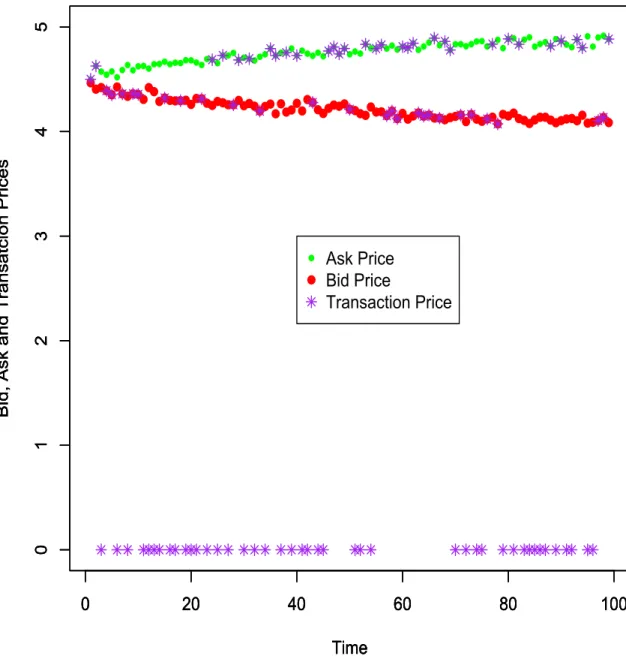
4.1 gives us an illustration of how the bid,ask and transaction prices change over time.
the market model in Section 3.1, we calculated the Bid and Ask prices, and then use these data
to estimate the four parameters in the model by our MCMC algorithms. We run two MCMC
chains, each containing 120,000 samples, and use 20,000 burn in sample.(After the burn in
sample, we use every 10 sample as a new sample) Table 4.1 examines the effectiveness of the
estimation strategy, showing the true value, posterior summary statistics of those parameters.
We could use the posterior mean or posterior median as an estimation of the parameter.
Parameter True Value Min Median Mean Max Standard Error
α 0.2000 0.0030 0.1600 0.2300 0.5100 0.0020
η 0.2500 0.0000 0.2300 0.2500 0.5000 0.0010
σ2 0.0250 0.0021 0.0280 0.0300 0.0450 0.0000
δ2 0.0100 0.0000 0.0100 0.0100 0.0200 0.0000
Table 4.1: Summary statistics of posterior samples using simulated data.
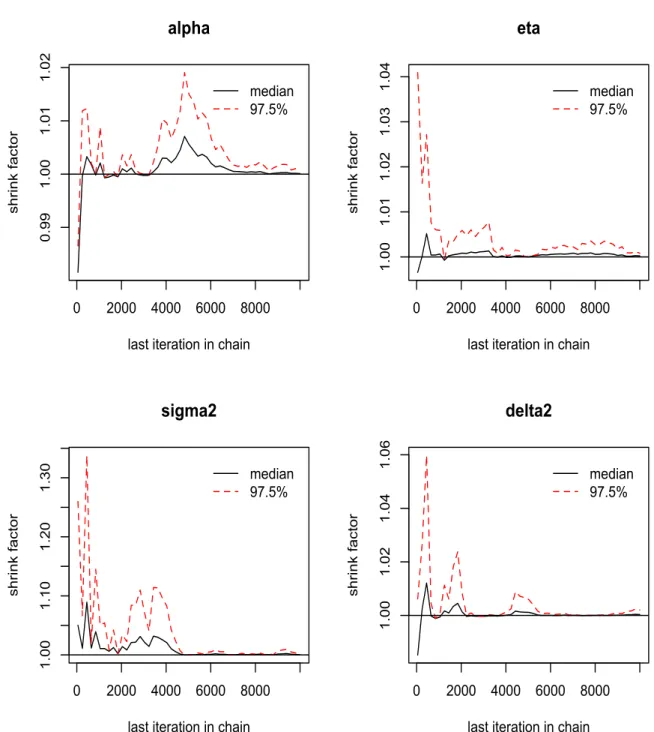
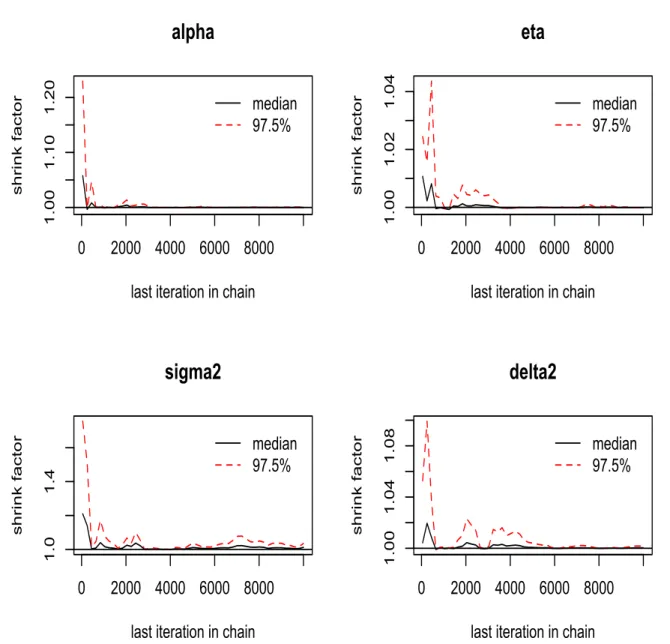
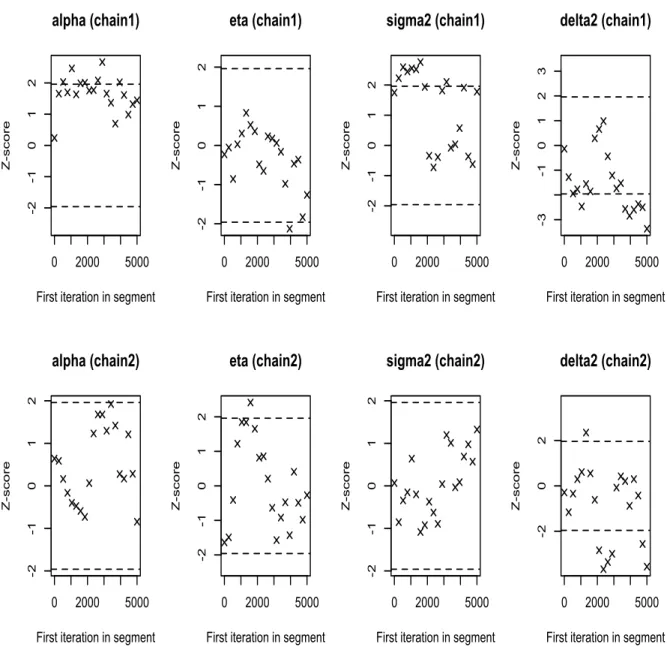
Figures 4.2-4.5 show the related convergence results of the MCMC algorithm.
Trace plots give us a direct insight of what values the posterior samples take at each
iteration.
The autocorrelation plots show us how the autocorrelation changes with the increase of
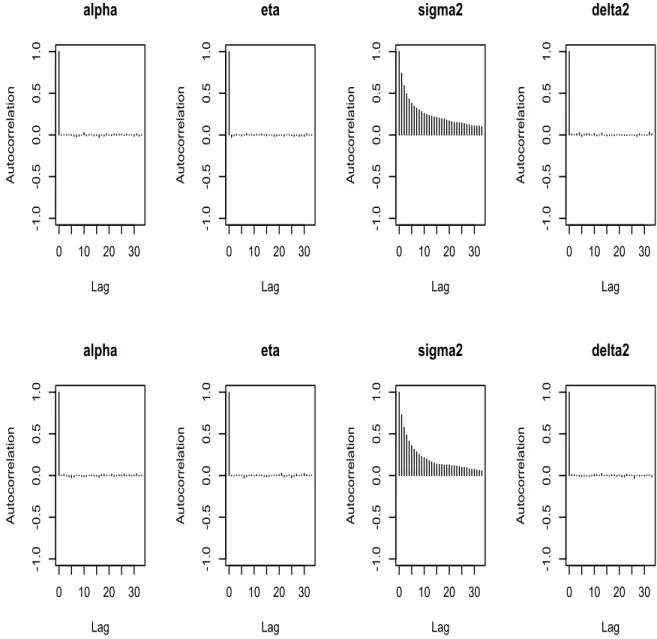
lag. From the autocorrelation plot, we can see exceptδ2, the autocorrelations for the other 3 parameters are almost 0 at any lag. Forσ2, the autocorrelation decreases to 0, as the lag increases.
From Gelman-Rubin plot, we can see that the shrink factors for all four parameters
con-verge to 1 after some iterations. Also, from Geweke plot, most of the Z-scores for all
pa-rameters are between -1.96 and 1.96. Both the Gelman-Rubin and Geweke plot show good
MCMC convergence.
Seeing the similarities between the posterior estimation and the true value of the
pa-rameters and MCMC convergence, we can conclude that our MCMC algorithm works well.
0 20 40 60 80 100
0
1
2
3
4
5
Time
Bi
d
,
Ask
a
n
d
T
ra
n
sa
tci
o
n
Pri
ce
s
0 20 40 60 80 100
0
1
2
3
4
5
Time
Bi
d
,
Ask
a
n
d
T
ra
n
sa
tci
o
n
Pri
ce
s
0 20 40 60 80 100
0
1
2
3
4
5
Time
Bi
d
,
Ask
a
n
d
T
ra
n
sa
tci
o
n
Pri
ce
s
Ask Price Bid Price
Transaction Price
0 2000 4000 6000 8000
0.0
0.2
0.4
0.6
0.8
1.0
Iterations Trace of alpha
0 2000 4000 6000 8000
0.0
0.1
0.2
0.3
0.4
0.5
Iterations
Trace of eta
0 2000 4000 6000 8000
0.01
0.02
0.03
0.04
Iterations
Trace of sigma2
0 2000 4000 6000 8000
0.000
0.010
0.020
Iterations
Trace of delta2
0 10 20 30 -1 .0 -0 .5 0.0 0.5 1.0 Lag Au to co rre la tio n alpha
0 10 20 30
-1 .0 -0 .5 0.0 0.5 1.0 Lag Au to co rre la tio n eta
0 10 20 30
-1 .0 -0 .5 0.0 0.5 1.0 Lag Au to co rre la tio n sigma2
0 10 20 30
-1 .0 -0 .5 0.0 0.5 1.0 Lag Au to co rre la tio n delta2
0 10 20 30
-1 .0 -0 .5 0.0 0.5 1.0 Lag Au to co rre la tio n alpha
0 10 20 30
-1 .0 -0 .5 0.0 0.5 1.0 Lag Au to co rre la tio n eta
0 10 20 30
-1 .0 -0 .5 0.0 0.5 1.0 Lag Au to co rre la tio n sigma2
0 10 20 30
-1 .0 -0 .5 0.0 0.5 1.0 Lag Au to co rre la tio n delta2
0 2000 4000 6000 8000
0.99
1.00
1.01
1.02
last iteration in chain
sh
ri
n
k
fa
ct
o
r
median 97.5% alpha
0 2000 4000 6000 8000
1.00
1.01
1.02
1.03
1.04
last iteration in chain
sh
ri
n
k
fa
ct
o
r
median 97.5% eta
0 2000 4000 6000 8000
1.00
1.10
1.20
1.30
last iteration in chain
sh
ri
n
k
fa
ct
o
r
median
97.5%
sigma2
0 2000 4000 6000 8000
1.00
1.02
1.04
1.06
last iteration in chain
sh
ri
n
k
fa
ct
o
r
median 97.5% delta2
0 2000 4000 -2 -1 0 1 2
First iteration in segment
Z
-sco
re
alpha (chain1)
0 2000 4000
-2
-1
0
1
2
First iteration in segment
Z
-sco
re
eta (chain1)
0 2000 4000
-2
-1
0
1
2
First iteration in segment
Z
-sco
re
sigma2 (chain1)
0 2000 4000
-2
-1
0
1
2
First iteration in segment
Z
-sco
re
delta2 (chain1)
0 2000 4000
-2
-1
0
1
2
First iteration in segment
Z
-sco
re
alpha (chain2)
0 2000 4000
-2
-1
0
1
2
First iteration in segment
Z
-sco
re
eta (chain2)
0 2000 4000
-2
-1
0
1
2
First iteration in segment
Z
-sco
re
sigma2 (chain2)
0 2000 4000
-2
-1
0
1
2
First iteration in segment
Z
-sco
re
delta2 (chain2)
CHAPTER 5: EMPIRICAL STUDY
5.1 Data
The data we used are the bid and ask prices of Microsoft stock on April and May, 2013
from trade and quote (TAQ) database. The Trade and Quote (TAQ) database contains intraday
transactions data (trades and quotes) for all securities listed on the New York Stock Exchange
(NYSE) and American Stock Exchange (AMEX), as well as Nasdaq National Market System
(NMS) and SmallCap issues. We consider four different equties from four different sectors:
Bank of America Corporation (Ticker: BAC), Microsoft Corporation (Ticker: MSFT), Pfizer
Inc. (Ticker: PFE), Exxon Mobile Corporation (Ticker: XOM). We divide the data into
training set and test set. The April data is the training set and the May data is the test set.
Since the data are recorded tick by tick, it’s high frequency and has tons of observations
for one month. For example,the microsoft data in April 2013 has around 28,000,000
obser-vations in total, each day has over 900,000 obserobser-vations and so there are about 13 tradings
at each time spot during each trading day.There are perhaps two major problems if we do
empirical study using the raw bid and ask prices. One is the computational burden. Since the
time horizon we can handle is at most several hundreds considering the computation time,
under the raw data style, the sample size we could use is relatively small. The other one is that
there’s too much noise in the original high frequency data. So in order to do our empirical
study, some data manipulation techniques are applied here.
• Firstly, the missing data are deleted.
• Thirdly, since trading are heavier at the beginning and the end of the trading day, while thinner at lunch time, we participated each day into 5 periods: 9:30 to 10:00, 10:00 to
11:30, 11:30 to 2:30, 2:30 to 3:30, 3:30 to 4:00 and used the mean of the bid and ask
price during each period.
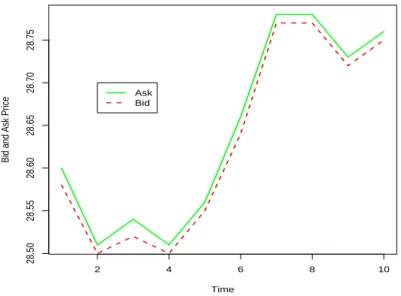
Figure 5.1 shows the bid and ask prices for the cleaned data. From Figure 5.1, it’s hard to
see the difference between the bid and ask prices since the difference is usually 1 or 2 cents,
extremely small compared to the bid and ask prices. So in order to see the difference, we
0 20 40 60 80 100
29
30
31
32
33
Time
Bid and Ask Pr
ice
Ask Bid
Figure 5.1: Bid and Ask prices for the real aggregation data
2 4 6 8 10
28.50
28.55
28.60
28.65
28.70
28.75
Time
Bid and Ask Pr
ice
Ask Bid
5.2 Summary Statistics of Posterior and MCMC Convergence Results
Tables 5.1 to 5.4 show the summary statistics of the posterior samples for all the four
parameters of different equities. Again, we could use posterior mean or posterior median to
estimate those parameters. From Table 5.1 to 5.4, we can see that the posterior estimations of
αandσ2vary from equities to equities, while the estimations ofηandδ2are almost the same for all four equities. Sinceηis the probablity of a buy or sell order of an uninformed trader,
it doesn’t change among different equities, so isδ2, the pertubation between the theoretical and real bid and ask prices. While the proportion of informed traders and the volatility of
returns depend on equities.
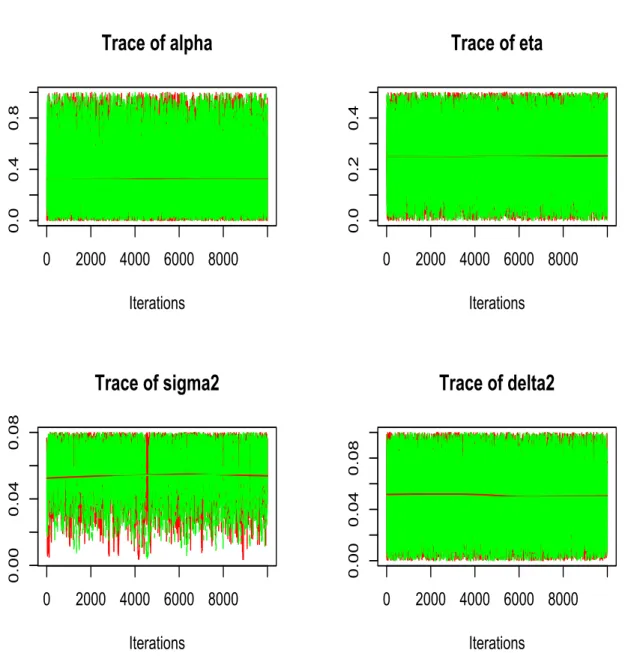
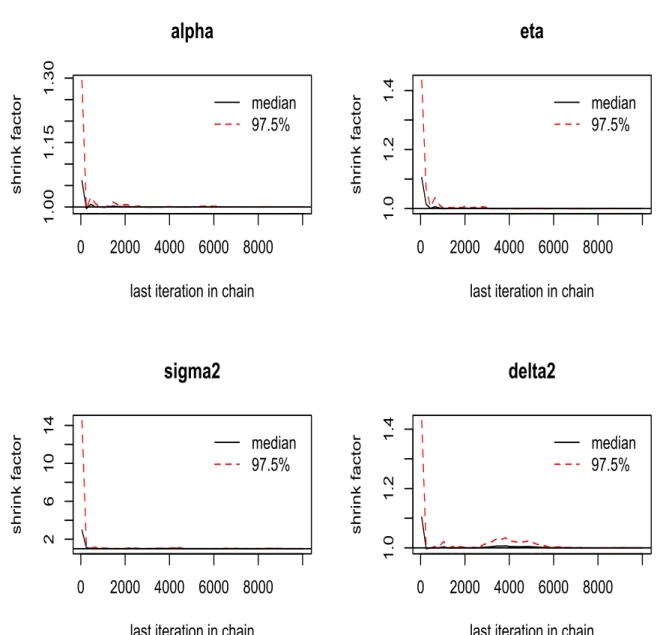
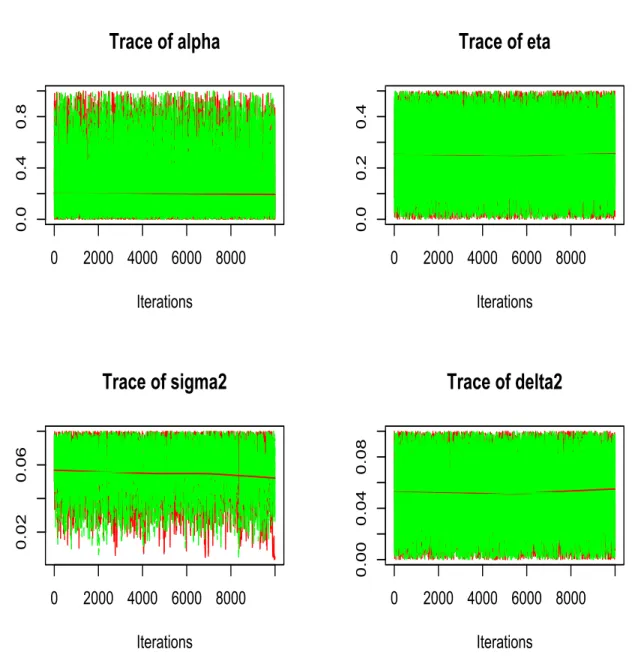
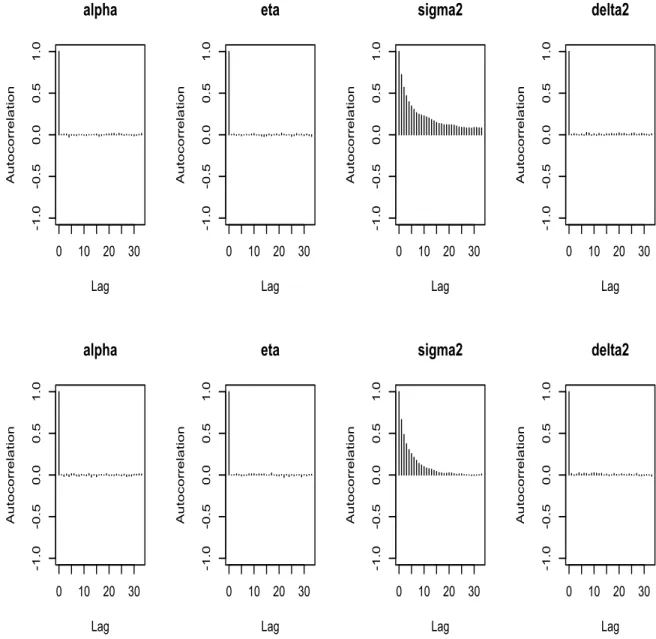
Figures 5.3-5.18 show the convergence results of the MCMC algorithms for all four
eq-uities. Similar to the analysis in the simulation study, we could conclude that the MCMC
algorithms converge. However, although the autocorrelation ofσ2decreases as lag increases, it still exists. This suggests us that the constant volatility model may not be an appropriate
Parameter Min Median Mean Max Standard Error
α 0.0000 0.2871 0.3500 0.9998 0.0019
η 0.0000 0.2502 0.2502 0.5000 0.0010
σ2 0.0028 0.0564 0.0533 0.0800 0.0001
δ2 0.0000 0.0504 0.0503 0.1000 0.0002
Table 5.1: Summary statistics of posterior samples using real BAC data.
Parameter Min Median Mean Max Standard Error
α 0.0000 0.1646 0.2495 1.0000 0.0017
η 0.0000 0.2509 0.2512 0.5000 0.0010
σ2 0.0036 0.0573 0.0544 0.0800 0.0001
δ2 0.0000 0.0526 0.0518 0.1000 0.0002
Parameter Min Median Mean Max Standard Error
α 0.0000 0.2905 0.3533 1.0000 0.0019
η 0.0000 0.2513 0.2507 0.5000 0.0010
σ2 0.0030 0.0358 0.0337 0.0500 0.0000
δ2 0.0000 0.0513 0.0508 0.0100 0.0002
Table 5.3: Summary statistics of posterior samples using real PFE data.
Parameter Min Median Mean Max Standard Error
α 0.0000 0.1644 0.2476 0.9993 0.0017
η 0.0000 0.2517 0.2512 0.5000 0.0010
σ2 0.0024 0.0353 0.0336 0.0499 0.0000
δ2 0.0000 0.0522 0.0516 0.1000 0.0002
0 2000 4000 6000 8000
0.0
0.4
0.8
Iterations
Trace of alpha
0 2000 4000 6000 8000
0.0
0.2
0.4
Iterations
Trace of eta
0 2000 4000 6000 8000
0.00
0.04
0.08
Iterations
Trace of sigma2
0 2000 4000 6000 8000
0.00
0.04
0.08
Iterations
Trace of delta2
0 10 20 30 -1 .0 -0 .5 0.0 0.5 1.0 Lag Au to co rre la ti o n alpha
0 10 20 30
-1 .0 -0 .5 0.0 0.5 1.0 Lag Au to co rre la ti o n eta
0 10 20 30
-1 .0 -0 .5 0.0 0.5 1.0 Lag Au to co rre la ti o n sigma2
0 10 20 30
-1 .0 -0 .5 0.0 0.5 1.0 Lag Au to co rre la ti o n delta2
0 10 20 30
-1 .0 -0 .5 0.0 0.5 1.0 Lag Au to co rre la ti o n alpha
0 10 20 30
-1 .0 -0 .5 0.0 0.5 1.0 Lag Au to co rre la ti o n eta
0 10 20 30
-1 .0 -0 .5 0.0 0.5 1.0 Lag Au to co rre la ti o n sigma2
0 10 20 30
-1 .0 -0 .5 0.0 0.5 1.0 Lag Au to co rre la ti o n delta2
0 2000 4000 6000 8000
1.00
1.15
1.30
last iteration in chain
sh
ri
n
k
fa
ct
o
r median
97.5%
alpha
0 2000 4000 6000 8000
1.0
1.2
1.4
last iteration in chain
sh
ri
n
k
fa
ct
o
r median
97.5%
eta
0 2000 4000 6000 8000
2
6
10
14
last iteration in chain
sh
ri
n
k
fa
ct
o
r median
97.5%
sigma2
0 2000 4000 6000 8000
1.0
1.2
1.4
last iteration in chain
sh
ri
n
k
fa
ct
o
r median
97.5%
delta2
0 2000 5000 -2 -1 0 1 2
First iteration in segment
Z
-sco
re
alpha (chain1)
0 2000 5000
-2
-1
0
1
2
First iteration in segment
Z
-sco
re
eta (chain1)
0 2000 5000
-2
-1
0
1
2
First iteration in segment
Z
-sco
re
sigma2 (chain1)
0 2000 5000
-6 -4 -2 0 2 4 6
First iteration in segment
Z
-sco
re
delta2 (chain1)
0 2000 5000
-2
-1
0
1
2
First iteration in segment
Z
-sco
re
alpha (chain2)
0 2000 5000
-3 -2 -1 0 1 2 3
First iteration in segment
Z
-sco
re
eta (chain2)
0 2000 5000
-2
-1
0
1
2
First iteration in segment
Z
-sco
re
sigma2 (chain2)
0 2000 5000
-2
-1
0
1
2
First iteration in segment
Z
-sco
re
delta2 (chain2)
0 2000 4000 6000 8000
0.0
0.4
0.8
Iterations
Trace of alpha
0 2000 4000 6000 8000
0.0
0.2
0.4
Iterations
Trace of eta
0 2000 4000 6000 8000
0.02
0.06
Iterations
Trace of sigma2
0 2000 4000 6000 8000
0.00
0.04
0.08
Iterations
Trace of delta2
0 10 20 30 -1 .0 -0 .5 0.0 0.5 1.0 Lag Au to co rre la ti o n alpha
0 10 20 30
-1 .0 -0 .5 0.0 0.5 1.0 Lag Au to co rre la ti o n eta
0 10 20 30
-1 .0 -0 .5 0.0 0.5 1.0 Lag Au to co rre la ti o n sigma2
0 10 20 30
-1 .0 -0 .5 0.0 0.5 1.0 Lag Au to co rre la ti o n delta2
0 10 20 30
-1 .0 -0 .5 0.0 0.5 1.0 Lag Au to co rre la ti o n alpha
0 10 20 30
-1 .0 -0 .5 0.0 0.5 1.0 Lag Au to co rre la ti o n eta
0 10 20 30
-1 .0 -0 .5 0.0 0.5 1.0 Lag Au to co rre la ti o n sigma2
0 10 20 30
-1 .0 -0 .5 0.0 0.5 1.0 Lag Au to co rre la ti o n delta2
0 2000 4000 6000 8000
1.00
1.10
1.20
last iteration in chain
sh
ri
n
k
fa
ct
o
r median
97.5%
alpha
0 2000 4000 6000 8000
1.00
1.02
1.04
last iteration in chain
sh
ri
n
k
fa
ct
o
r median
97.5%
eta
0 2000 4000 6000 8000
1.0
1.4
last iteration in chain
sh
ri
n
k
fa
ct
o
r median
97.5%
sigma2
0 2000 4000 6000 8000
1.00
1.04
1.08
last iteration in chain
sh
ri
n
k
fa
ct
o
r median
97.5%
delta2
0 2000 5000 -2 -1 0 1 2
First iteration in segment
Z
-sco
re
alpha (chain1)
0 2000 5000
-2
-1
0
1
2
First iteration in segment
Z
-sco
re
eta (chain1)
0 2000 5000
-2
-1
0
1
2
First iteration in segment
Z
-sco
re
sigma2 (chain1)
0 2000 5000
-3 -1 0 1 2 3
First iteration in segment
Z
-sco
re
delta2 (chain1)
0 2000 5000
-2
-1
0
1
2
First iteration in segment
Z
-sco
re
alpha (chain2)
0 2000 5000
-2
-1
0
1
2
First iteration in segment
Z
-sco
re
eta (chain2)
0 2000 5000
-2
-1
0
1
2
First iteration in segment
Z
-sco
re
sigma2 (chain2)
0 2000 5000
-2
0
2
First iteration in segment
Z
-sco
re
delta2 (chain2)
0 2000 4000 6000 8000
0.0
0.2
0.4
0.6
0.8
1.0
Iterations
Trace of alpha
0 2000 4000 6000 8000
0.0
0.1
0.2
0.3
0.4
0.5
Iterations
Trace of eta
0 2000 4000 6000 8000
0.01
0.02
0.03
0.04
0.05
Iterations Trace of sigma2
0 2000 4000 6000 8000
0.00
0.04
0.08
Iterations Trace of delta2
0 10 20 30 -1 .0 -0 .5 0.0 0.5 1.0 Lag Au to co rre la tio n alpha
0 10 20 30
-1 .0 -0 .5 0.0 0.5 1.0 Lag Au to co rre la tio n eta
0 10 20 30
-1 .0 -0 .5 0.0 0.5 1.0 Lag Au to co rre la tio n sigma2
0 10 20 30
-1 .0 -0 .5 0.0 0.5 1.0 Lag Au to co rre la tio n delta2
0 10 20 30
-1 .0 -0 .5 0.0 0.5 1.0 Lag Au to co rre la tio n alpha
0 10 20 30
-1 .0 -0 .5 0.0 0.5 1.0 Lag Au to co rre la tio n eta
0 10 20 30
-1 .0 -0 .5 0.0 0.5 1.0 Lag Au to co rre la tio n sigma2
0 10 20 30
-1 .0 -0 .5 0.0 0.5 1.0 Lag Au to co rre la tio n delta2
0 2000 4000 6000 8000
0.98
1.00
1.02
1.04
last iteration in chain
sh
rin
k
fa
ct
or
median 97.5% alpha
0 2000 4000 6000 8000
1.00
1.01
1.02
1.03
last iteration in chain
sh
rin
k
fa
ct
or
median 97.5% eta
0 2000 4000 6000 8000
1.00
1.10
1.20
1.30
last iteration in chain
sh
rin
k
fa
ct
or
median 97.5% sigma2
0 2000 4000 6000 8000
1.0
1.2
1.4
1.6
last iteration in chain
sh
rin
k
fa
ct
or
median 97.5% delta2
0 2000 4000 -2 -1 0 1 2
First iteration in segment
Z
-sco
re
alpha (chain1)
0 2000 4000
-2
-1
0
1
2
First iteration in segment
Z
-sco
re
eta (chain1)
0 2000 4000
-2
-1
0
1
2
First iteration in segment
Z
-sco
re
sigma2 (chain1)
0 2000 4000
-3 -2 -1 0 1 2 3
First iteration in segment
Z
-sco
re
delta2 (chain1)
0 2000 4000
-3 -2 -1 0 1 2 3
First iteration in segment
Z
-sco
re
alpha (chain2)
0 2000 4000
-2
-1
0
1
2
First iteration in segment
Z
-sco
re
eta (chain2)
0 2000 4000
-3 -2 -1 0 1 2 3
First iteration in segment
Z
-sco
re
sigma2 (chain2)
0 2000 4000
-4
-2
0
2
4
First iteration in segment
Z
-sco
re
delta2 (chain2)
0 1000 2000 3000 4000 5000
0.0
0.2
0.4
0.6
0.8
1.0
Iterations
Trace of alpha
0 1000 2000 3000 4000 5000
0.0
0.1
0.2
0.3
0.4
0.5
Iterations Trace of eta
0 1000 2000 3000 4000 5000
0.01
0.03
0.05
Iterations Trace of sigma2
0 1000 2000 3000 4000 5000
0.00
0.04
0.08
Iterations Trace of delta2
0 10 20 30 -1 .0 -0 .5 0.0 0.5 1.0 Lag Au to co rre la tio n alpha
0 10 20 30
-1 .0 -0 .5 0.0 0.5 1.0 Lag Au to co rre la tio n eta
0 10 20 30
-1 .0 -0 .5 0.0 0.5 1.0 Lag Au to co rre la tio n sigma2
0 10 20 30
-1 .0 -0 .5 0.0 0.5 1.0 Lag Au to co rre la tio n delta2
0 10 20 30
-1 .0 -0 .5 0.0 0.5 1.0 Lag Au to co rre la tio n alpha
0 10 20 30
-1 .0 -0 .5 0.0 0.5 1.0 Lag Au to co rre la tio n eta
0 10 20 30
-1 .0 -0 .5 0.0 0.5 1.0 Lag Au to co rre la tio n sigma2
0 10 20 30
-1 .0 -0 .5 0.0 0.5 1.0 Lag Au to co rre la tio n delta2
0 1000 2000 3000 4000 5000
1.00
1.02
1.04
1.06
last iteration in chain
sh
rin
k
fa
ct
or
median 97.5% alpha
0 1000 2000 3000 4000 5000
0.98
1.02
1.06
1.10
last iteration in chain
sh
rin
k
fa
ct
or
median
97.5%
eta
0 1000 2000 3000 4000 5000
1.0
1.1
1.2
1.3
last iteration in chain
sh
rin
k
fa
ct
or
median 97.5%
sigma2
0 1000 2000 3000 4000 5000
0.99
1.01
1.03
1.05
last iteration in chain
sh
rin
k
fa
ct
or
median 97.5%
delta2
0 1000 2000 -2 -1 0 1 2
First iteration in segment
Z
-sco
re
alpha (chain1)
0 1000 2000
-2
-1
0
1
2
First iteration in segment
Z
-sco
re
eta (chain1)
0 1000 2000
-2
-1
0
1
2
First iteration in segment
Z
-sco
re
sigma2 (chain1)
0 1000 2000
-3 -2 -1 0 1 2 3
First iteration in segment
Z
-sco
re
delta2 (chain1)
0 1000 2000
-2
-1
0
1
2
First iteration in segment
Z
-sco
re
alpha (chain2)
0 1000 2000
-2
-1
0
1
2
First iteration in segment
Z
-sco
re
eta (chain2)
0 1000 2000
-3 -2 -1 0 1 2 3
First iteration in segment
Z
-sco
re
sigma2 (chain2)
0 1000 2000
-2
-1
0
1
2
First iteration in segment
Z
-sco
re
delta2 (chain2)
5.3 Interpretation
Glosten-Milgrom model captures the notion of asymmetric information, explicitly
char-acterizing the bid-ask spread. The bid-ask spread is the difference between the price at
which liquidity suppliers are willing to buy(ask) and the price at which they are willing to
sell(bid).In the market microstructure theoretical models, there are three sources of bid-ask
spread: First, the adverse selection costs arising with asymmetric information. Second, the
inventory costs, those the market maker must sustain for holding undesired positions. The
third one is the order processing cost, which is associated with the handling of a transaction.
In G-M model, the bid-ask spread is due to the first one. The assumption of asymmetric
information generates adverse selection costs, which oblige market makers to quote different
prices for buying and selling, i.e. to open the bid-ask spread. The spread is the premium that
market makers demand for trading with agents with superior information. The asymmetric
information in G-M model is reflected by α, the proportion of the informed traders in the
crowd. Since asymmetric information determines the bid-ask spread, we could imagine that
the bigger α is, the more informed traders, the larger the bid-ask spread will be. Figure
5.19 shows us how the value of α affects the bid-ask spread in the simulation study. The
conclusion is that with the increase ofα, the bid-ask spread also increases. Proposition 5.3
provides us a theoretical justification of our conclusion.
In order to showAt−Btis an increasing function ofα, we can show that the derivative of
At−Btaboutαis positive for sufficiently smallα. We consider approximating the bid-ask spreadAt−Btas a linear function ofαfor sufficiently smallα >0, i.e. at everyt, we want to write
At−Bt=a0+a1α+o(α) (5.1)