Rants, Reactions, and other Rhetorics: Genres of the YouTube Vlog
Erich Alan Werner
A dissertation submitted to the faculty of the University of North Carolina at Chapel Hill in partial fulfillment of the requirements for the degree of Doctor of Philosophy in the Department of English and Comparative Literature (Rhetoric and Composition).
Chapel Hill 2012
Abstract
ERICH ALAN WERNER: Rants, Reactions, and other Rhetorics: Genres of the YouTube Vlog
(Under the direction of Dr. Jordynn Jack and Dr. Daniel Anderson) Rants, Reactions, and other Rhetorics: Genres of the YouTube Vlog
examines the YouTube vlog or “video blog” as a rhetorical mode of address and a portal to the public sphere. Vlogs are technically simple videos in which a person faces a camera and addresses a public viewership briefly, informally, and more or less intimately. This dissertation explores how and why these largely unrehearsed, unedited, and unorganized videos have nonetheless become one of the internet’s most magnetic and beloved forms. Through case studies of four vlogging genres (the confession video, the reaction video, the rant video, and the witness video), I identify four sources of vlogging’s rhetorical vitality and force: (1) their
performative settings or “ceremonials,” remediation endows those genres with new meanings and movements, and opens up new possibilities for social action. Specifically, three affordances of vlogs differentiate them from speech genres they remediate: vlogging’s reach, replayability, and modularity. As the technology necessary to vlog becomes more and more inexpensive and ubiquitous, rhetors gain new and wide-reaching access to public spheres. Vlogging’s easy modularity makes them open to rapid movements, recontextualizations and the
transformations—all of which may be wanted or unwanted, thrilling or chilling. Overall, this dissertation presents vlogging as a powerful rhetorical act as well as an act of extreme bravery. Within the ceremonial of online video sharing,
vloggers make themselves vulnerable not only by exposing their private thoughts and emotions to public audiences, but also by exposing themselves to the
complex and unpredictable rhetorical ecology of YouTube, by facing the
Table of Contents Chapter
1. Introduction: The Rhetoric of Vlogging...1
Research Aims...2
Defining the Vlog...5
Vlogging and New Media...10
Vlogging, Genre, and Emotion...17
Research Methodology...20
Chapter Overviews...27
2. The Confession Video: Vlogging as Monologue and Dialogue...31
Vlogging as Monologue...37
Vlogging as Dialogue...44
Conclusion: Vlogging as Identification...57
3. The Reaction Video: Vlogging and Emotion Display...66
Vlogging and Emotion...69
Reaction as a Genre...88
Emotion as Intervention: Vlogging about Twilight...94
4. The Witness Video: Vlogging and the Problem of Online Credibility...112
The Witness Video Genre...115
Credibility and Vlogging...120
Distributed Credibility and the Witness Video...132
Limitations of the YouTube Interface for Assessing Credibility...144
5. The Rant Video: Vlogging’s Many Complex Speeds...153
Tracking Speeds Online...157
The Speeds of the Rant...167
Ranting against the Rant...175
From Rant to Ruin: the Afterlife of Vlogging...182
6. Conclusion: The Apology Video: How Vlogging Remediates Expression...187
Vlogging and Remediation...189
Vlogging’s Vital Expressivity...192
Implications for Composition Pedagogy...197
List of Tables
5.1 A Taxonomy of Rhetorical Speeds...162
List of Figures
1.1 The vlog’s characteristic mode of address: casual, close-up, and uncut...8
2.1 A vlogger shares his experiences as an African-American atheist...32
2.2 Another vlogger shares his experiences as an African-American atheist...39
2.3 Another vlogger shares her experiences as an African-American atheist...40
2.4 Another vlogger shares her experiences as an African-American atheist...51
3.1 A vlogger shares her reaction to the trailer for the movie Twilight...66
3.2 A vlogger captures his (lack of) reaction to the Twilight trailer...77
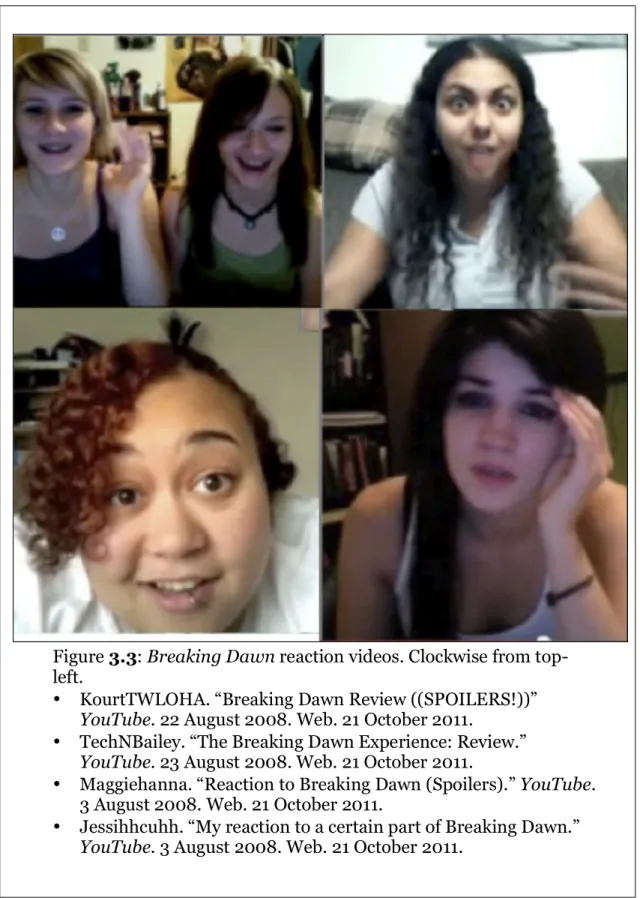
3.3. Breaking Dawn reaction videos...97
4.1 A witness video claiming that it was raining oil due to the Gulf spill...123
4.2 A YouTube user channel...125
4.3 Cleanup worker Jennifer Rexford’s first vlog...134
4.4 A BP-produced witness video...141
4.5 Illustration by Jessica Hagy of Indexed, poking fun at the crudity and incivility of YouTube comments. ...145
4.6 An anti-BP video featuring ad for a BP-sponsored video...148
5.2 Video statement by UCLA Chancellor Gene Block, responding
to Alexandra Wallace’s rant. ...179
Chapter 1
The Rhetoric of Vlogging
Many media commentators have hailed vlogging as a revolutionary mode of address. Vlogs are brief video speeches, composed casually and shared online. Despite their unassuming tone, however, some have ranked vlogs among the most transformative of all new media forms. Media industry player Michael Rosenblum, for example, describes vlogging as a “liberat[ing]” medium,
comparing the spread of vlogging to the history-altering spread of the Gutenberg printing press (qtd. in Betancourt). Striking a similar note, Wired journalist Clive Thompson suggests that vlogging will radically change communication, and maybe cognition too. As video digitizes and democratizes, Thompson claims, we are developing “a new language of video—forms that let us say different things and maybe even think in different ways.” (Thompson). Rumors of a vlogging revolution come not only from media journalists and insiders, but also from scholars. Stressing its psychological effects, anthropologist Michael Wesch suggests that vlogging has the power to “shock” composers “into new forms of self-awareness” (21). Stressing its social effects, communication scholar Michael Strangelove grants online video sharing and vlogging sweeping social and
normative assumptions [ . . . ] subvert the agenda of corporate news, mediate historical traumas [ . . . ] and propagate counternarratives” (24).1
Many believe that prophecies like these, testifying to vlogging’s
transformative, democratizing potential, have already begun to be fulfilled. For proof, many point to the 2011 Arab Spring. Writing in Foreign Policy, David Kenner claims that while social media sites have played key roles in Egyptian and Syrian uprisings, it is vlogs that “provide the best window into what’s happening on the Arab street,” allowing protestors to intercommunicate, to sidestep media censorship, and in general to craft effective, efficient, and emotionally powerful messages. Vlogging, it seems, may be more than a revolutionary medium. According to commentators like these, it may be helping to spark actual social revolutions. Not all media observers, however, agree about vlogging’s
revolutionary potential. There are many media observers who downplay or outright dismiss the role of vlogging and other social media in the Arab spring and other movements, arguing that while these indeed “played a major role in how the Arab Spring transpired,” there is no way to prove whether internet platforms actually caused these movements or effected their outcomes (Carvin). Regardless, the rhetoric of revolution that surrounds vlogging, along with online video sharing more generally, seems to warrant an investigation of vlogging’s rhetoric.
Research Aims
1 Throughout this dissertation, I use bracketed ellipses to indicate where I have
As a rhetorical study, rather than a historical or sociological one, this dissertation can neither definitively prove nor disprove claims about vlogging’s supposedly revolutionary social powers. Instead, this research adopts a more modest aim. Guided by rhetorical genre theory, it documents how YouTube vlogs, in their first few years of existence, have been cultivated and used by rhetors and their audiences. Specifically, the dissertation examines four of vlogging’s
emergent genres: confession videos, reaction videos, witness videos, and rant videos. These genres are recurrent forms that vlog-makers and vlog-watchers have collectively created and curated, and therefore reveal a great deal about vlogging’s growing social currency. From the perspective of rhetorical genre theory, genres are far more than simple templates or blueprints for composing texts. Rather, genres are powerful instruments that allow rhetors to carry out established “social actions.” As theorists like Carolyn R. Miller and Charles
Bazerman have illuminated, genres are customary ways of acting, of doing things with words. As Miller puts it,
What we learn when we learn a genre is not just a pattern of forms. . . . We learn, more importantly, what ends we may have: that we may eulogize, apologize, recommend one person to another, instruct customers on behalf of a manufacturer, take on an official role, account for progress in achieving goals. [ . . . . ] As a recurrent, significant action, a genre embodies an aspect of cultural rationality. (“Genre” 165)
Genres are not just forms. Genres are forms of life, ways of being. They are frames for social action. They are locations within which meaning is constructed. Genres shape the thoughts we form and the communications by which we interact. Genres are the familiar places we go to create intelligible communicative action with each other and the guideposts we use to explore the unfamiliar. (“The Life of Genre” 19)
If we accept that genres represent recurrent social actions and perhaps even “forms of life,” then one fruitful way to study the social impact of vlogging is to examine its genres. By investigating a number of vlogging’s most popular genres, this study offers an (admittedly incomplete and exploratory) report on vlogging’s social applications, a sketch of what people currently use vlogs to say and do.
Extrapolating from these genres, this dissertation identifies a number of rhetorical characteristics distinctive to vlogging as a mode of address. Behind all the claims about vlogging’s revolutionary social powers lies the assumption that vlogs somehow communicate differently than other modes of address, even other electronic modes. This dissertation tests this assumption about vlogging’s
uniqueness by diagramming its idiosyncratic rhetorical workings. It takes a look under the hood, so to speak, in order to examine how vlogging works rhetorically, and how those workings differentiate vlogging from its rhetorical relatives and ancestors: modes of address like television, blogging, social media, and face-to-face conversation.
whom vlogging puts into conversation. Specifically, vlogging encourages extreme candidness and emotionality among strangers and promotes ongoing back-and-forth conversation in much the same way that face-to-face conversation does. In many ways, vlogging is much like communicating verbally with a stranger or strangers (whether at a party, a pub, or anywhere else one might wander into intense but short-lived intimacies). I also suggest, however, that despite the sense of intimacy and cooperation that grows between videomakers and viewers,
vlogging can nevertheless have highly unpredictable outcomes, as videos take on altered and unintended meanings and effects as they circulate among viewers, in extreme cases going “viral” for all the wrong reasons.
Overall, the dissertation presents vlogging as a highly interactive and highly emotional mode of address that resembles and remediates specific genres of face-to-face conversation. However, because of its digital nature, vlogging departs considerably from face-to-face conversation, taking on new affordances that allow video messages to circulate in extreme, unpredictable, and
transformative ways. My hope is that my study of vlogging’s distinctive rhetorical properties can help inform debates about its supposed revolutionary powers, but also contribute to scholarship on new media, on rhetorical genre theory, and on the rhetoric of emotion. Before I discuss what those contributions might be, however, I want to more sharply define my research object.
Defining the Vlog
describes vlogs as “videos of people sitting alone in front of their webcams and just talking to anybody and everybody who cares to click on their video” (21). Vlogs tend to be loose in their tone, loose in their organization, and loose in their orientation. As Wesch points out, vlogs usually “have no specific addressee. They are meant for anybody and everybody, or possibly nobody—not addressed to anyone in particular—or perhaps only vaguely addressed to ‘the YouTube community’” (21).
This looseness, it seems, is part of what attracts videomakers and viewers alike to vlogging. The looseness of vlogging, Burgess and Green recognize, carries with it a vitality, a feeling of “liveness, immediacy, and conversation” (54).
Though they are actually prerecorded, vlogs suggest liveness and immediacy by presenting themselves as spontaneous, unstaged, and unrehearsed. Vloggers tend to ramble and repeat themselves and wander off course. They rarely edit,
preferring instead to leave in all their fumbles, mistakes, and pauses, whether for the sake of convenience or rawness or authenticity.
As Patricia G. Lange has articulated, vlogs tend to possess a sense of intimacy and vulnerability (“Vulnerable”). Like webcam feeds (those continuous online video streams of baby pandas playing or Las Vegas wedding chapels
vloggers to channel that sense of intimacy into more focused, purposeful, and replayable public messages.
Vlogs also feel intimate because they echo face-to-face exchanges. As in a face-to-face conversation, the vlog brings the viewer visually close to the speaker, with his or her face and upper body filling the frame. Furthermore, the always-present possibility of interacting with the vlogger, through comments, personal messages, response videos, and other forms of exchange built into online video sharing platforms, means that vlogging does not merely simulate one-on-one conversation, but actually remediates it, creating a new channel for interpersonal dialogue.
The term vlog, both generally and for the purposes of this study,
encompasses any and all online videos (serial, single, or otherwise) that involve a certain characteristic mode of address: one that is casual, close-up, and
(seemingly) uncut (Figure 1.1). The term “vlog” was originally a sandwiching of “video” and “blog.” This portmanteau is accurate insofar as vlogs share the textual weblog’s informal tone, as well as its fundamental interactivity; vloggers like text-based bloggers tend to interact energetically with their audiences. The comparison between blogs and vlogs, however, only goes so far. Textual blogs are mostly serial, offering or promising a regular sequence of entries, while vlogs often appear singly or in clusters.2 While some of the vloggers discussed in this
dissertation do vlog serially (for instance, the impassioned Twilight fan
2 Granted, there are many vlogs that are serial, including popular vlog series by
NuttyMadam3575 discussed in the third chapter), most (like the African-American atheists discussed in the second chapter) have only uploaded one or two vlogs, rhetorical one-offs that respond to singular exigencies, without any intention of vlogging regularly. In short, while the term vlog seems to have originally designated a “video blog,” it seems more accurate to think of vlogs more expansively, as “videologues,” as speeches or addresses circulated via online video sharing platforms.
Despite, or because of, their haphazard production and highly personal content, vlogs have become fantastically popular, particularly on today’s largest online video sharing site, YouTube, from which this dissertation draws its case studies. Back in 2007, when Jean Burgess and Joshua Green performed a
comprehensive analysis of the site’s most popular content (tracking what videos were most viewed, favorited, discussed, and responded to) they found that the most popular videos, according to these metrics, were not clips created by or cribbed from old media, as they originally expected. Rather, the most popular content on YouTube was generated by the site’s users. Perhaps surprisingly, most magnetic of all were these dashed-off, rambling video speeches, vlogs (42).
address once dismissed as dead-end “personal videos,” are actually what brings many users to the site—and, equally important, vlogs are what bring users back, again and again. While they represent a fraction of the total videos uploaded to YouTube (about five percent by Wesch’s rough count) vlogs nevertheless are YouTube’s most magnetic form. “A thriving community has emerged around such videos,” Wesch observes, “one that some participate in and believe in with almost religious zeal” (21).
My study does not claim to be exhaustive or authoritative, as a study of YouTube, or as a study of vlogging specifically. As anthropologist Patricia G. Lange observes, vlogs are staggeringly diverse in their content and character. While their basic (intimate, conversational) mode of address remains more or less stable, vlogs vary considerably in terms of content. Briefly cataloging the variety of vlogs, Lange explains that they “may be diary-based, artistic,
journalistic, entertainment-based, or they may take any number of other forms” (“Vulnerable”). This dissertation more fully maps the scope and variety of
vlogging by studying four of its most prominent genres: the confession video, the reaction video, the witness video, and the rant video. Each chapter pairs an
analysis of one vlogging genre with a broader theoretical exploration of vlogging’s rhetorical affordances: specifically, its participatory architecture, its capture of emotion displays, its mechanisms for constructing and assessing credibility, and finally its speech and reach.
Vlogging and New Media
tend to focus on digital videos that are overtly political, like those associated with presidential campaigns and debates (Dietel-McLaughlin, Dubisar and Palmeri, Jackson and Wallin). Other rhetorical studies have focused on redactional video content: the remixes, mash-ups, dubs, and other user-generated genres
composed by creatively altering or combining old media materials (Dubisar and Palmeri, Schaffner, Skinnell, Stedman). Though vlogging has been largely overlooked in rhetorical scholarship, it is highly relevant to broader scholarly conversations on interactivity and speed in new media, as well as conversations about emotion and remediation. Because vlogging lies at the intersection of two relatively new and important developments in online rhetoric—namely, the rise of video and the rise of social media—vlogging therefore allows me to further explore these longstanding rhetorical concerns and extend the existing scholarship for new digital and rhetorical moment.
Vlogging, Interactivity, and Participatory Culture
At first glance, vlogging appears to be a unilateral, even solipsistic mode of address. Some media commentators, for example, have accused vlogging of providing a public stage for empty self-expression, for egotistic rambling, blathering, ranting, vociferating, and the like. As this study demonstrates, however, vlogging is (or at least can be) a highly interactive mode of address, leading to constructive, ongoing dialogue among videomakers and viewers, and even potentially creating new social relations, both online and off.
rhetoric online, observing that unlike television, radio, newspapers and other one-way modes of public address, online media tends to allow for meaningful (and instantaneous) exchange between authors and audiences. This interactivity alters the communication substantially; because rhetoric online grants audiences ready access to composers, Gurak observes, audiences become more than passive consumers of messages. Rather, they become active participants in the
communication: “This ability to interact, combined with the encouragement we feel because of the speed and reach of the medium, encourages talking back” (44). More recently, scholars have recognized that much more is possible online than merely “talking back” to authors.
the composition, contextualization, and circulation of online messages.
Specifically, by contributing to comment threads, and by embedding and linking to videos in other online spaces, viewers participate actively in the rhetorical proceeding we call vlogging.
Vlogs also reveal how online interactivity is structured, both
technologically and culturally. While the interactivity of new media may invite audiences to “talk back” and even participate more directly in online
communications, that interactivity is never free or unstructured. The interactivity of online platforms may alter, and sometimes radically transform, the terms on which individuals communicate. However, vlogging shows that online
communications remain deeply structured, possessing their own formal
protocols: constraints, decorums, and etiquettes. These protocols are determined not only by the technological affordances of a given online platform, but also by culture, that is, by the collective and cumulative activity of a platform’s users. Drawing on the genre theory of Anne Freadman (discussed in greater depth below), I use vlogging to illustrate that “We never leave a space of rituals for a space of non-rituals: we choose one ritual instead of another” (61). Specifically, the vlogging “ceremonial” prompts videomakers and viewers to interact in certain ways and not others, strategically positioning its interlocutors, and thereby
participation, in other words, are everywhere structured by rhetorical protocols— rich, complex, and ever-evolving rituals that create and constrain how online rhetors interact with one another.
Vlogging and Speed
This study also extends and complicates understandings of the “speeds” of rhetoric online. For decades, the rapidity or quickness of new media has inspired composers, fueled media journalists and advertisers, and fascinated scholars. Gurak, for instance, declares that the speed of the internet “is certainly changing how we live and what we expect, and it may be changing our mental states as well” (Cyberliteracy 30). Likewise, in the stories told by popular mythmakers
(advertisers, journalists, technology moguls, and the like), online communication is constantly accelerating. Like a sprinter or an experimental racecar, online communication supposedly sets new speed records every year, with every new platform and device transmitting information faster and faster. Ads for internet devices now stress speed in virtually every sentence, leaving copywriters
communication technologies. This is a somewhat accurate, but simplistic portrait that scholars of new media have worked to extend and complicate.
The speed of rhetoric is indeed a complex matter (Jack, Hartley, Mutnick, Schryer), with the speed of online rhetoric being perhaps even more complex (Brown, Gurak, Eichhorn). As Gurak cautions, “Speed does not equal salvation; the speed of the Internet does not necessarily bring us closer to any sort of utopia” (30). Building off the work of Gurak and other scholars, this study of vlogging helps untangle speed from ease, simplicity, and utopianism, dissolving the associative webs woven by advertisers and other mythmakers. Going further, the study illustrates that the internet generally, and vlogging specifically, have many and sometimes conflicting speeds. Popular commonplaces will continue to
celebrate the ever increasing “top speed” of hardware and software, but just as we rarely drive our cars or bicycles at top speed, this study demonstrates that we also rarely communicate at top speed.
paradox can be confirmed by the many unintended composers of “viral” videos, videos that circulate beyond or despite the videomaker’s intentions.
Acknowledging the complexity and unpredictablility of rhetorical speeds online, I suggest that online composers, including would-be vloggers, painstakingly study and imitate the speeds of the genres they hope to compose in. Attending to speeds helps composers understand the risks and rewards inherent in particular online platforms and genres, assessing their many speeds of composition,
publication, and circulation. This may lead composers to realize that on the internet our compositions may take on speeds we never anticipated, desired—or dared to hope for.
Vlogging and Remediation
This study of vlogging also contributes to scholarship on remediation, documenting how new media including vlogs both revolutionize and recycle existing communicative practices. In their book Remediation, Jay David Bolter and Richard Grusin challenge the assumption that new media evoke brand new rhetorical and aesthetic practices. As they use the term, remediation describes the process by which new media composers inevitably borrow from existing media in their forms and functions. Just as the webpage borrows from the book or notebook page, so too does the podcast borrow from the radio program, the vlog from the reality TV confessional, and so on.
specific rhetorical genres. Specifically, vlogging shows that even when a genre’s features appear unchanged, remediation may alter their function and effect dramatically (Bolter and Grusin). I offer the term genre transfer to describe this process of transformative recontextualization. As my second chapter explains, vlogging may remediate existing genres, but it also resituates those genres within a changed environment or “ceremonial,” thereby both perpetuating and radically repurposing forms of expression (Freadman).
This dissertation tracks the movement of genres, especially emotional or pathetic genres, as they transfer from face-to-face settings to the setting of the
vlog, contemplating how this transfer both extends, and alters, these genres’ meanings and applications. For example, a face-to-face confession and a
confession vlog may share many features, but remediation substantially alters the genre. Remediation, of course, alters who witnesses the confession. Equally important, however, remediation alters how the confession is witnessed,
affording different possibilities for uptake, interpretation, and response. In short, remediated or parallel genres may perform very different social actions within different media and different ceremonials.
Vlogging, Genre, and Emotion
most importantly, to seek out identification—to reach out to likeminded but distant and unknown others.
While my study is deeply informed by rhetorical genre theory, I do not identify the vlog itself as a genre. Like Miller and Dawn Shepherd, who in the course of their 2009 study came to realize that the blog was not a single genre, but rather a flexible “medium” accommodating a variety of genres, I too have realized that vlogging is simply too diverse to be considered a genre (Miller and Shepherd, “Questions”). However, vlogging is not exactly a medium, either, since that label seems more appropriately applied to online video sharing more
generally. Vlogging, in my terminology, is a ceremonial, a mode of address that involves a certain medium and a certain, characteristic configuration of
interlocutors, a configuration that comes along with its own norms, decorums, codes of conduct, and so on. Within this ceremonial, many different social actions and therefore many different genres are possible, including those discussed above. Again, to be clear, within the terminology of this study, online video sharing is a medium, vlogging a ceremonial, and within that ceremonial many genres have developed, genres including (but by no means limited to) the ones discussed in the following chapters: confession videos, reaction videos, witness videos, and rants videos.
This dissertation extends rhetorical genre theory by offering an account of genre transfer, describing how remediated genres, despite formal parallels, take
I also propose that the genre concept be expanded to include forms of communication beyond verbal speech and text. Specifically, I propose that emotion, alongside and intertwined with verbal speech and text, likewise adopts recurrent forms and carries recurrent social actions: emotion, in other words, is generic, genre-ic. To emphasize the rhetorical and generic nature of emotion, I propose the concept of pathetic genres.
The pathetic genres concept builds on a growing body of theory and scholarship on emotion and affect within rhetorical studies and related fields. Emotion has been central to rhetorical theory at least since Aristotle articulated the concept of pathos or “emotional appeal.” Recent scholarship on emotion, however, suggests that emotion plays a much more fundamental role in
communication than previously imagined. More than a means to some external end, emotion is present in all rhetoric, and indeed a rhetorical enterprise itself. While emotion is often imagined to be exclusively internal or personal, Edbauer Rice explains that it is also inescapably social. Operating alongside and
private feelings” (3). Like all emotions, anger is an act of orientation, making or re-making or un-making social relations, including relations of power. In short, Gross’s rhetorical understanding of emotion resonates with Kenneth Burke’s suggestion that emotions “[require] an audience” (39).
To be clear, in proposing the concept of pathetic genres, I do not mean to suggest that some genres are emotional, and others unemotional. Rather, I acknowledge that, in a sense, all genres are pathetic genres, that all genres involve emotional expression. Throughout this dissertation, then, the concept of “pathetic genres” is simply meant to emphasize that emotion is one of the
materials out of which utterances and genres, as learned templates for coding and decoding those utterances, are composed.
Research Methodology
My final contribution to rhetorical genre studies is methodological. Specifically, I develop and employ a method of genre research designed for the study of public and online genres. This method employs intertextual rhetorical analysis to track the movement and uptake of genres in online spheres. Because public and online genres are, in a sense, more slippery than genres embedded in particular professions, disciplines, and other social institutions, this intertextual method can more thoroughly and accurately track the social actions that public and online genres carry out, thereby extending the ethnomethodological
traditions of rhetorical genre research, and updating these for a new rhetorical moment.
as “social action,” challenges scholars to adopt quasi-ethnographic methods, as they research not only the form, but also the function and effect, of genres (155). Studying genre as social action must be “ethnomethodological,” in Miller’s words, because while textual analysis can illuminate the “substance or form of discourse,” it cannot shed light on “the action [that discourse] is used to accomplish” (151). To study genre as social action, then, scholars must not only look at, but also look beyond, genres themselves, examining also the social matrix that produces that genre, and which that genre in turn helps to (re)produce.
Earlier forms of genre research within both literary and rhetorical traditions have adopted a deductive method. Aristotle, for example, posited genres based on their orientation to time, the forensic oriented towards the past, the epideictic oriented towards the present, and the political oriented towards the future. According to Miller’s vision, however, genre scholarship should proceed not deductively, but rather inductively. In terms of method, studying genre as social action should lead researchers to identify and situate genres in the environments of their use. Above all else, this inductive, quasi-ethnographic method targets the context of genres. As Bawarshi and Reiff observe,
“understanding contexts (and their performance) is both the starting point of [rhetorical] genre analysis and its goal” (59). While deductive or formal methods illustrate the internal substance or content of genres, Miller-inspired methods instead illustrate how genres are embedded in, and contribute to, larger social and cultural enterprises. Subsequent genre researchers including Bazerman, Catherine F. Schryer, and Carole Blair have taken up Miller’s
only particular genres (from patent applications to insurance rejection letters to memorial quilts) but also, and more importantly, the traditions, rituals,
institutions, and other social establishments that these genres participate in, that produce these genres, and which these genres help to reproduce.
This methodology, however, is not without its limitations. Notably,
rhetorical genre research following Miller has tended to focus on communication that occurs within relatively discrete social establishments, bounded spheres like professions, academic disciplines, corporations, and so on. Bazerman’s body of genre scholarship, for instance, despite its impressive range, rarely strays outside these kinds of limited spheres or “activity systems,” where genres remain fairly stable and where their social roles remain relatively transparent and measurable. Public genres like the vlog, however, pose a serious methodological challenge to rhetorical genre research, since these genres are not produced by or for particular social establishments, and therefore carry social actions that may be far more complex, diffuse, and indeterminate. The social action of a middle school quiz, for example, may be fairly easy to identify, since the genre performs a particular function within a particular social institution. The social action of a YouTube rant video, however, or any other public utterance, for that matter, is
methods, specifically by examining sample letters and interviewing those who produce and receive them. Schryer’s methods prove effective and manageable, however, only because these letters are produced within bounded spheres or activity systems. The social actions of public genres, which have far more
indeterminate audiences and movements and effects, prove far more difficult to track.
viewers, becoming instead a parody of racial ignorance. Methodologically
speaking, because of its multiple and shifting meanings and application, neither a rhetorical analysis of this vlog, nor an interview with its creator, could fully
illuminate its multiple and conflicting social action(s), nor could it explain how the video functions as a genre.
All this is to say that, in online environments, genres and their attendant social actions are fundamentally dispersed, challenging genre research to upgrade its (ethno)methodology. To study rhetoric that is modular and distributed, Warnick suggests that rhetorical research methods become more intertextual, giving less attention to authorial intention and formal matters and giving much greater attention to audience response and uptake (28-30).
Acknowledging the methodological challenges posed by public and online genres, this dissertationadopts intertextual rhetorical analysis as its primary method, closely examining not only individual vlogs but also their con-texts: the surrounding videos, comments, playlists, and other texts (online and off) with which vlogs interact. In other words, I track how they are taken up and
of ignorance and bigotry. Thereby, this account of vlogs offers a richer account of the text, the genre, and the social actions that play out through viewings and responses.
I believe that this intertextual rhetorical method is especially useful for studying genres online, where traces of response and uptake are, after all, easy to come by. I also believe, however, that recognizing genres as fundamentally
intertextual and “intersubjective” phenomena (to borrow Miller’s phrase) can enrich an even wider range of genre research. Whether online or off, whether electronic, print, or spoken, the “genre” that applies to a given utterance is not determined finally or wholly by the author. Indeed, the genre of a given utterance is never fully determined at all, since the utterance can always be reclassified or relabeled, whether by its authors, its audiences, or by genre researchers. As
Karlyn Kohrs Campbell recognizes, all utterances are inherently multigeneric, not only because their form is influenced by many traditions, but also because
utterances can always be interpreted through different genre “frames”:
Campbell here focuses on critical interpretation, explaining how rhetorical critics approaching the same text with different genre frames may produce different interpretations and insights. Genres, however, are heuristic not only for critics, but for authors and audiences as well, who are constantly applying genre labels to utterances, as a natural and necessary literacy practice that informs
understanding and uptake. Often, audiences even reject the genre labels offered to them. A dissatisfied moviegoer, for instance, might write a scathing online review that relabels an action film as a romantic comedy. A spouse might likewise relabel an apology as a patronizing insult. Genre, then, is not fixed by the author or even the critic, but rather emerges intertextually and intersubjectively. Within this dissertation, this is perhaps most obvious in chapter three, where viewers strategically (and mean-spiritedly) relabel a “reaction video” as a “seizure” and an “orgasm.” This sort of (re)labeling, which we might give the more formal name genre attribution, is readily apparent in participatory online platforms like those
of online video sharing. However, as my examples above show, genre attributions and reattributions occur both online and off. An intertextual rhetorical method, like the one that this dissertation experiments with, may help researchers better understand genre as a literacy practice, as an essential part of how we compose and read (and research) utterances.
In short, vlogging reaffirms that genres participate in broader ceremonials, rhetorical proceedings that structure the roles that interlocutors adopt and
we might call genre transfer. Vlogging also shows that emotions, like speech and written text, are composed and read generically. Therefore, we can identify and study pathetic genres or genres of emotion display, in much the same way that we identify other genres. Finally, situating utterances (including emotion displays) within broader ceremonials reveals that “genre” is fluid and socially constructed. During uptake, utterances can be identified with, and interpreted using, any number of genre labels. An intertextual method allows me to account for these multiple and conflicting genre attributions as I track the meanings and movements of individual vlogs.
Chapter Overviews
My second chapter uses the “confession video” genre to explore vlogging’s interrelationships with the rhetorical forms (comment threads, response videos, etc.) that surround and support it. This chapter demonstrates that while vlogging may seem emptily expressive or monologic, most vloggers are actually in intense and ongoing dialogue with their viewer/interlocutors. Through a case study of emotional confession videos uploaded by African-American atheists, young skeptics who feel alienated by their deeply religious families and communities, the chapter reveals that vlogging allows rhetors to connect with distant but likeminded others, and to engage in intense, frank, and often constructive
My third chapter uses the reaction video genre to emphasize the importance of emotion to vlogging, and specifically the importance of bodily emotion displays, including facial, vocal, and gestural expression. To theorize how emotion displays communicate and persuade, I bring together insights into the emotions from rhetorical theorists including Aristotle, M.M. Bakhtin, Burke, Gross, and Edbauer Rice. I test these theoretical insights through a case study of vlogs uploaded by Twilight fans. In 2008, readers of the young adult novel Twilight: Breaking Dawn uploaded a flurry of reaction videos to YouTube. This
vlogging genre allowed discontented fans to circulate public messages about the novel through intense emotion displays, messages that reached hundreds and even thousands of viewers, including the author of Twilight herself, Stephenie Meyer. However, the “reaction video” frame also allowed viewers to dismiss those emotions as impulsive, potentially undermining their effectiveness.
performing close analysis of the video to test it claims, and by contributing context in the form of personal experience or factual information, viewers help create the “distributed credibility” of vlogs.
My fifth chapter uses the rant video genre to chart vlogging’s rhetorical speeds. While the speediness or rapidity of vlogging (and other internet communications) has been widely discussed, this chapter complicates
understandings of vlogging’s speeds, charting its complexities, contradictions, and unpredictabilities. To replace simplistic speed-rubrics, I offer a more detailed and elaborate taxonomy of rhetorical speeds, advising would-be composers to consider vlogging’s many complex speeds, from composition (tempo, pacing, duration), to publication (timing), to circulation (velocity and continuance). To illustrate the value of these concepts, I examine the rant vlog “Asians in the Library” and its global spread, suggesting that while this racially-insensitive vlogger seemed highly attuned to the genre’s composing speeds, she recklessly ignored its potentially unpredictable speeds of circulation, leading to her own viral ruin.
Chapter 2
The Confession Video: Vlogging as Monologue and Dialogue
What’s up, YouTube? This is your boy cpiercej making my first YouTube video about being a black atheist. I decided to come out as a black atheist today after spending like the weekend looking at all the different YouTube videos about the black atheist experience. So I decided to lend my voice to the chorus of voices out there to let other people know that’s it’s okay to come out, that we need to come out, and that we need to form community, since we know that the black church has such a strong hold on our community and our culture. (cpiercej)
As of April 2012, a YouTube search for the terms “black atheist” summons nearly 7,000 videos, many of them powerful “coming out” or “confession” videos like the one transcribed above (see fig. 2.1). By the thousands, African-Americans have uploaded videos in which they declare that they do not believe, that they no longer believe, or that they have never believed in God, creating a “chorus of voices” affirming the possibility of nonbelief for African-Americans, voicing the otherwise silent or shamefaced presence of atheism in their communities
and communities, many African-American atheists have turned to vlogging to declare their nonbelief, reaching out via online video to audiences who might be in some way receptive to their confessions.
As a recent piece in the New York Times attests, the emerging African-American atheist movement has swelled far beyond the bounds of YouTube, giving rise to local meetup groups and national organizations, along with a vibrant presence in other forms of new media (Brennan). Nonetheless, as the confessor above, cpiercej, suggests, YouTube seems to be a particularly magnetic medium for African-American atheists, including those who watch videos, those who make videos, and those like cpiercej who are inspired to cross over, who decide to “come out” themselves, summoned to speak by the confessions of
others. But why YouTube, of all places? What is it about this platform and the vlog (the psuedointimate public webcam video) that compels people to confess things they cannot confess, even or especially to those closest to them? Why turn to vlogging, especially when the unknowable audience on the other side of that webcam might include not only hostile strangers, but also, potentially, the same friends and family from whom the confessor is withholding secrets? YouTube confessor cutemama007 explains, “i tell people I am atheist if they ask. other than that i don’t go broadcasting to people I interact with everyday.” Puzzlingly, though she withholds her atheism in everyday life, the vlogger continues
“broadcasting” it publicly online. Like the engaged young man or woman who blithely and publicly cheats on a nationally broadcast reality show (cf. all 26 seasons of MTV’s The Real World), YouTube confessors like these seem to forget or overlook (or possibly hope?) that their viewers likely include the very same people they betray, denounce, or distance themselves from. What accounts for this seeming cognitive dissonance, this seeming rhetorical buffoonery or bravado?
This chapter suggests that we can much better understand confession vlogs, their power and their seeming contradictions, by widening our lens and examining the contexts in which vlogs are embedded and the rhetorical activities that orbit around them—in this case, by examining the “ceremonial” of the
broader ceremonial or proceeding that we can properly understand vlogging as a rhetorical mode of address, one that is at once monologic and dialogic, at once expressive, rhetorical, and dialectical.
Genre theorist Anne Freadman uses the concept of a “ceremonial” to emphasize, first, the manifest interconnectedness of texts and genres. Not unlike the concepts of the “genre set” (Devitt), “genre system” (Bazerman), or “genre ecology” (Spinuzzi and Zachry), Freadman’s “ceremonial” suggests that genres are inherently relational, taking on meanings and social actions only in relation to other genres. To be fully understood, then, genres must be situated within the larger complex of genres and activities, or the ceremonial, in which they take part. What exactly is a ceremonial? While Freadman keeps the concept fairly fluid, we can safely say that a ceremonial is the broader “place,” “setting,” or perhaps more accurately the proceeding, within with genres are used or put into play.
According to Freadman, for example, the “warm-up, the toss, and at the end, the declaration of the winner and closing down rituals—showers, presentations, or the drink at the bar” are genres within the ceremonial of a tennis match. Likewise, “swearing in” and “cross-examination” are genres within the
ceremonial of court proceedings. While each of these individual genres can be isolated for various purposes, including scholarly study, to do so would be “misleading,” according to Freadman, for it is only within their broader
ceremonial that the meanings and purposes of individual genres becomes clear (59).
to YouTube. Some focus on vids or parodies, others on remixes, still others on comment threads, playlists, tags, and so on. This chapter suggests that
considering texts or genres in isolation (for instance, treating the confession video as a bounded, complete, and finished message) seriously distorts how we understand them. While some scholars and commentators have accused vlogs, including the video confessions of African-American atheists, of being emptily self-expressive, this chapter reveals that vlogs, while monologic in form, can nonetheless be dialogic in both intent and effect. In this chapter, I reveal the dialogism of vlogs by approaching them not as genres, but as ceremonials,
demonstrating how they create a stage or scene for the interplay of many genres, including videos, channels, playlists, tags, and especially comment threads. Understood as a ceremonial (as a proceeding rather than a complete and
bounded text or genre) it becomes much clearer how vloggers including African-American atheists hope and expect to relate to their viewers—or perhaps more accurately, their interlocutors.
In addition to emphasizing the interconnectedness of genres, Freadman’s concept of the ceremonial has the added benefit of clarifying how texts, and especially their contexts, strategically position interlocutors in relation to one another. Again, it might seem odd that an atheist would “come out” to the public on YouTube, when they believe it impossible to come out in an intimate setting with friends and family. However, the concept of the ceremonial, in
foregrounding the importance of “setting” and “place,” sheds light on this seeming contradiction. Freadman proposes that ceremonials determine
delimiting possible roles for participants in any and every exchange (63). The power of the ceremonial is such that even the same individuals may take up
different roles and relations depending on the ceremonial they find themselves in. To illustrate how ceremonials establish roles or positions, Freadman develops the following example:
A discussion between two executives, one slightly superior in the company hierarchy to the other, will work differently, depending on whether the piece of furniture between them is a desk or a lunch table, and depending on whether the desk is the superior’s or his subordinate’s. The piece of furniture together with the other ‘props’ define a space and the ceremonial appropriate to it. It may well be that the participants might try to have ‘the same’ discussion in both places, but the choice of one or another ceremonial alters the
conditions of speech and understanding.
These days, our hypothetical executives might try to have the “same discussion” over e-mail or Skype, but this too would shift interlocutory positions and
possibilities, perhaps subtly, but inevitably. For example, if the setting were a lunch table, or a Skype video call, maybe the subordinate would be more likely to ask for a raise, or complain about his working conditions, than he would during a more formal meeting.
interlocutor within that ceremonial is radically different. Within the ceremonial of the vlog, she becomes another viewer, another possible commenter, another potential troll or hater. What happens the next evening at dinner is another story, but nevertheless the ceremonial of YouTube creates a social and psychological setting, and a corresponding set of interlocutory positions, wherein otherwise impossible confessions become, for the space of a moment, possible.
In the pages that follow, I suggest that confessions and other moments of vulnerability characteristic of YouTube vlogs are made possible by the unique ceremonial in which vlogging is embedded. While vlogs take on the character of soliloquys (monologues addressed to no one) they nonetheless are embedded in, and usually explicitly encourage, ongoing dialogue in the form of comment threads, response videos, and the like. In the first section, “Vlogs as Inner Monologue,” I draw on the work of new media anthropologists Michael Wesch and Patricia G. Lange to explain how the idiosyncratic composing process of vlogging invites an intimate, personal, and frank mode of address, despite the possibility or intention of a vlog’s gaining a wide public audience. Then, borrowing from scholars of online rhetoric, I demonstrate how, seen as a ceremonial, the seemingly solipsistic self-expression of vlogs actually invites vibrant and constructive dialogue—and, most of the time, formally requests that dialogue. By making possible this idiosyncratic, monologue-within-dialogue, the vlogging ceremonial also makes possible the sorts of unexpected disclosures and connections we see happening in and around the confession vlogs of African-American atheists.
I was dating a girl last year. She was pretty much as religious as you can be. [ . . . . ] So she was trying to force Christianity on me, she was trying to get me to go to church, and I just wasn’t feeling it. [ . . . . ] So, I told her no, I’m not going to church, I don’t like it. [ . . . . ] So she told me, John, if you’re not going to church, if you’re not going to go to church, then at least tell me what you believe in. [ . . . . ] It got to the point where I knew I had to end it with her when she told me she would rather date a murderer than an atheist. And she wasn’t goofing off; she was dead serious. And I mean she’s not the only one saying stuff like this; I hear crazy claims like this all the time from Christians. (JohnBeezy3)
Few African-American atheists directly explain, or even claim to fully understand, why they have turned to YouTube and the vlog to publicly declare their nonbelief. Most, however, drop a clue or two along the way. Consider the story told by JohnBeezy3, perhaps the most widely viewed confession of all (fig. 2.2). Here JohnBeezy3 recounts an earlier attempt at a confession. In a conversation with his then-girlfriend, JohnBeezy3 is invited to share what he believes. When he does, the result is breakage. The couple breaks up. Their conversation breaks down. Furthermore, this seems to be only one of many, similarly broken
comments on YouTube. Though he invokes the same genre, the “confession,” in two different settings JohnBeezy3 receives two very different responses.
This story is echoed in video after video, as African-Americans share how intimate confessions of nonbelief have wounded them deeply and alienated them from friends and family. Another atheist, cutemama007, suggests her friends and family have smothered any attempts at an intimate confession (Figure 2.3). Explaining her motivation for making the video, she says, “this is just one of my videos to let other people know in the world that are black, we do not have to be quiet about our nonbeliefs.” Before this bold public confession, however, she suffered years of private suffocation:
And I was [quiet about my nonbelief] for a while. For a long time.3 I
was afraid to say I didn’t believe, and when I hinted, I got those looks. You know those looks black people give you, or other people. I got those side-eyes. “What?!” [imitates side-eyes] I got those. Through words and especially nonverbal cues (those “side-eyes”), cutemama007 received the message that her friends, her family, and her community would react with hostility, or even reject, an intimate confession of nonbelief.
3 Throughout this dissertation, I set aside the convention of noting errors in
spelling, grammar, and so on with [sic]. This is a practical consideration, since the texts I analyze (vlogs, comment threads, and so on) have such a volume of errors that noting them would clutter the page and distract from my discussion. Furthermore, for the purposes of my analysis, I prefer that these so-called “errors” stand without correction, since they reveal something about the character and rhetorical conventions of vlogging.
Both cpiercej and cutemama007 explain that they were motivated to produce their YouTube confessions by watching other YouTube confessions. “I decided to come out as a black atheist today after spending like the weekend looking at all the different YouTube videos about the black atheist experience,” explains cpiercej. Cutemama007, in explaining the motivation behind her video, contrasts the suffocation she experiences in her everyday life with the sense of openness and connection she discovers online:
I decided that I can’t go around muffling or stifling that part of me and so when I got online and I found out there was other groups and other people that looked like me, who were black, and who don’t believe, I got excited! So I’m here to say that I’m one of you black atheists.
Wesch explains the idiosyncratic power of the YouTube confession, and the vlog more generally, by describing the perplexities and paradoxes that
vloggers wrestle with during the composing process. Specifically, he suggests that vloggers wrestle with “context collapse,” as they confront all possible audiences and all possible contexts at once, even as they sit, alone, before a silent blinking webcam:
Now look carefully at a webcam. That’s there. That’s somewhere else. That could be anybody. On the other side of that little glass lens is almost everyone you love, everyone you know, everyone you have ever heard of, and even those you have never heard of. In more specific terms, it is everyone who has or will have access to the Internet—billions of potential viewers, and your future self among them. Some have called it at once the biggest and the smallest stage—the most public space in the world, entered from the privacy of our own homes. [ . . . . ] That seemingly innocuous and
insignificant glass dot is the eyes of the world and the future. (22) Context collapse, described so poetically here by Wesch, paralyzes many would-be vloggers. But for others, context collapse cultivates powerful introspection, self-examination, and reflection, as this universal gaze (“the eyes of the world and the future”) collapses in on itself entropically (22). Faced with the impossible task of “address[ing] anybody, everybody, and maybe even nobody all at once,”
(26). This for Wesch explains the puzzling aspects of the YouTube confessional. Vloggers confess things to YouTube because “context collapse” along with the “perceived privacy of the webcam experience” situate vloggers, psychologically, in a kind of superamplified echo chamber, where, unsure whom to address, they just begin talking to themselves.
Wesch’s concept of context collapse helps explain why some vloggers, who might be reserved in other contexts, become so frank, open, personal and even provocative on YouTube. Equally valuable is Wesch’s analysis of the physical setting in which vlogs are conventionally recorded. Surrounded by family and friends around the dinner table, the vlogger cutemama007 recognizes or
anticipates the “looks” that will suffocate her confession. Alone before a webcam, she can dismiss or at least defer the anxieties of suppression and consequence. While recording, she can tell herself that she won’t upload the video. While uploading, she can tell herself her friends and family will never discover it. She can speak openly and worry about the social consequences later. (Interestingly enough, since I began this research, several confessors have made their videos private or removed them from YouTube).
many African-American atheists on YouTube include in their videos a kind of disclaimer explaining that their vlogs are not intended to persuade. Experience has shown them that arguing about beliefs is futile. Cpiercej seems resigned and a bit tired as he explains,
I don’t really debate with theists anymore because there’s no point to it. I can’t debate your beliefs. Your beliefs are your beliefs. The only thing that I can do is talk about what I believe. My beliefs are based on evidence and my beliefs aren’t based on faith anymore…So it’s really difficult for—and almost impossible—for me to debate with a theist because it pretty much just winds up as a circular argument.
Cutemama007 echoes this sense of resignation, turning explicitly away from the possibility of argumentation, and turning back to self-expression, to the personal:
I’m not going to debate with you on scriptures and debate with you on evolution and debate with you period. My whole simple point is this. It doesn’t have a connection here. [places her hand on her heart]
Though many video confessions and other vlogs are explicitly nonpersuasive, we needn’t conclude with Wesch that they are wholly “unaddressed,” emptily
Vlogging as Dialogue
Patricia G. Lange, another anthropologist of new media, emphasizes the dialogism of vlogging in a 2006 study of women’s video blogs, illustrating how (despite context collapse and the isolation demanded by their composing process) vlogging can promote dynamic and productive exchange. Citing examples of particular vlogs that inspired spirited online discussion, Lange contends that by sharing “intimate moments” and expressing themselves openly before a webcam, vloggers can and do effect “social change,” causing critical self-reflection and productive public discussion of issues. Lange concludes that precisely because vlogs are inherently self-expressive, the mode of address holds an interpersonal and public significance:
The sharing of these intimate moments is not self-indulgent, solipsistic obsession. Rather, it provides a means to connect with others and raise awareness in ways that are less overt than acts such as public marches but are nevertheless quite important.
Lange’s discussion of female vloggers helps explain why the “vulnerability” characteristic of the vlog, the self-expressive intimacy produced by context collapse and the privacy of solo recording can attract and matter to viewers.
Equally important, Lange illustrates that vlogs are, counter to Wesch’s suggestion, inherently addressed. While vlogs themselves may not directly present an
argument, distribute information, or relate happenings of explicit public interest, vloggers do in fact assume and engage with audiences.
direct and ongoing dialogue with their audiences. In other words, one reason that vlogs seem “unaddressed” to Wesch is that his analysis focuses so closely on the original text that he overlooks its contexts, failing to recognize that the vlog, though it might appear to be a monologue, is generally just the first act or event in an ongoing ceremonial, a dance of rhetorical interaction that transpires both onsite (through comment threads, video responses, and so on) as well as offsite (wherever the video might be embedded and discussed).
The addressed and dialogic nature of vlogs is apparent in Lange’s analysis of a vlog by Micki Krimmel about her own atheism. Lange reveals the dialogism of this vlog in two ways. First, Lange chronicles her own personal reactions to Krimmel’s atheism vlog: “I am not an atheist, but what struck me about the video was that it led to a reconsideration of my behavior and attitudes toward atheists.” Second, and perhaps more importantly, Lange reveals the dialogism of the vlog by documenting the online exchanges this vlog inspired:
People who are atheist and agnostic left comments on Micki's blog and on other Web sites thanking her for making the video. They were grateful that it expressed views they had held for a long time. Not all of the comments she received on her blog agreed with her position, but she expressed gratitude that people used the video blog to explore these issues in a frank and public manner. While the composing scene described by Wesch may account for the characteristic vulnerability and intimacy of the vlog genre, it is the vlog’s
other genres and utterances, onsite and , that more fully explains the continuing popularity and relevance of the genre.
The confession vlogs of African-American atheists affirm this. While the vulnerability and frankness of these confessors might suggest that vloggers are talking only to themselves, in Wesch’s superamplified echo chamber, the impression that these confessors are simply soliloquizing is overturned when, near the conclusion of nearly every confession vlog, the confessor explicitly invites viewers to respond. One confessor, decatursbrowneyes, instructs viewers, “If you have any comments, you can leave your comment. Bad ones, good ones. It doesn’t really matter.” Cpiercej closes, “If you have any comments, drop em down. If you don’t, don’t worry about it. Thanks for watching.” Even the somewhat
combative JohnBeezy3 concludes by saying, “Um, I appreciate any comments. Just get at me.” This conventional request for comments, for continuing dialogue, suggests that while confession videos may appear self-expressive, they
nevertheless function dialogically, calling forth and activating other genres within the larger vlogging ceremonial. Indeed, each of the confession vlogs discussed this far has attracted hundreds or even thousands of comments. Furthermore, in nearly all cases, the vlogger responds to commenters with comments of his or her own, continuing to participate in the ensuing dialogue, underscoring that all parties involved seem to understand vlogging not as “uninterrupted introspective inner dialogue” (Wesch), but as dialogue that manages to be at once inner and outer, momentary and ongoing, solipsistic and social.
While not exclusively concerned with vlogs, argumentation theorist Galia Yanoshevsky offers insight into this mode of address (and its productive
paradoxes) in her study of internet activity by presidential campaigns. Revisiting concepts of audience articulated by Chaim Perelman prior to the advent of the internet, Yanoshevsky argues somewhat surprisingly that Perelman’s notion of “argumentation before a single hearer” best explains how rhetors on the internet address their audiences, including by implication vloggers (409). Argumentation before a single hearer, in contrast to ancient oratory or the newspaper opinion piece, must anticipate response and prepare for dialogue. Explaining the concept further, Yanoshevsky writes,
The long, sustained speech to which Rhetoric is typically confined may seem ridiculous and ineffective before a single hearer. Thus, in dealing with a single interlocutor, the rhetorical speech should transform itself into dialogue where the reactions of the
interlocutor are supposed to be taken into consideration by the speaker. (414)
Notably, Perelman seems particularly keen on argumentation before a single hearer, suggesting it produces better results than monologic genres like oratory:
Yanoshevsky is not arguing that internet rhetors literally target one single individual, of course; only that internet address, in some ways, resembles this older, face-to-face mode. Specifically, internet address mimics the single-hearer mode in 1) its virtualization of intimacy or “proximity” and 2) its appeal to audience participation. Yanoshevsky explains that on the internet, and specifically within online presidential campaigns,
Perelman’s concept of ‘‘arguing before a single hearer’’ is thus stretched beyond a dialogue where the candidate reasons before an interlocutor and responds to the latter’s questions and objections. Rather, it becomes a sort of personal plea, where the surfer/voter is asked to participate in an activity with the candidate, an activity that will yield proximity, enabling the potential voter to express his opinions directly to the candidate. (414)
Internet address, then, is like “argumentation before a single hearer” but is probably more accurately described as a “personal plea for participation yielding (virtual) proximity.” The desired outcome of internet address is what
Yanoshevsky calls “connivance,” a sense of psychological connection experienced by the addressee toward the addressor, a Burkean “identification” causing the addressee to believe that they share common interests, values, and goals, and are perhaps even involved in joint projects—in Yanoshevsky’s case study, for example, the project of getting a candidate elected.
She claims that the dialogue inspired on candidates’ websites is weak and “do[es] not allow for a genuine exchange of ideas between the candidate and the voter” (417). In closing, she suggests that these appeals to proximity and participation on the internet are little more than pretense:
We therefore remain with an “as if” conversation, [ . . . ] that is, a mechanism producing a fiction shared by both the candidate and the potential voter using the Internet, concerning their proximity. [ . . . . ] Dialogue in this context is thus merely a technique designed to achieve involvement on the part of the voter in order to induce him to perform tasks for the candidate (417).
These grim conclusions, however, seem more the product of Yanoshevsky’s case study, than of her theories of internet address. Transported from presidential campaigns to confession vlogs, the concepts of proximity, participation, and connivance become not only useful but also enlivening.
Like the videos of presidential candidates who ask YouTube viewers to join them for dinner (416), vloggers appeal to proximity, encouraging viewers to “get closer” by including them within their “intimate sphere.” Like most vlogs, the confessions of African-American atheists have domestic settings—living rooms (cpiercej), bedrooms (MykeSorrel), even bathrooms (cutemama007,
Yanoshevsky’s presidential campaigns, this hardly seems the case in the context of vlogging, since vloggers usually demand or request nothing of their viewers besides a hearing—and maybe a comment.
Furthermore, like Yanoshevsky’s campaign videos, confession vlogs appeal to participation; as we have seen, nearly every vlog ends with an invitation for the viewer to comment. Unlike campaign videos, however, vlogs can and do lead to the “genuine exchange of ideas” as well as emotions. In short, vlogs appeal to a proximity and a participation that may be virtual but is no less real.
In her confession vlog, “why i am not a christian,” missdynasty33 explains how the proximity and participation of one of her viewers inspired her to keep making videos (fig. 2.4):
Hi YouTube. Okay. First, um, before I start the video I want to give a shoutout to…I think his name is Dr. Popery? [ . . . ] He watched my first video that I made saying that I was an atheist. And I got a lot of support from him. And he says he’s an old white man who’s been an atheist for a long time, and he was proud of me for coming out. And he gave me a lot of support. And then I ended up
[ laughter ] deleting the video, and I think he got mad at me for doing—not mad at me, but he was upset that I did that. But I just want to give a shoutout to you, thank you for your support. (missdynasty33)
While vlogger and viewer have never actually met, and while they have
considerable differences (he is an “old white man” and she is a young African-American woman), missdynasty33’s earlier vlog opened up a space for dialogue, empathy, connection, and identification between these two otherwise distant and very distinct people. Like other African-American atheist vloggers,
missdynasty33 explains that any attempt to express her nonbeliefs in her everyday life is inevitably suffocated.