The syntax of emphatic positive polarity in Hungarian: evidence from
ellipsis
Abstract
This paper studies the expression of emphatic positive polarity in Hungarian, providing evidence for an affirmatively specified polarity projection in the left periphery, PolP. The evidence comes from the realm of two ellipsis phenomena: TP-ellipsis flanked by a sentence internal affirmative particle igen and V-stranding ellipsis in polarity contexts, whose syntactic licensor is the head specified for positive polarity. The contexts in which PolP can be diagnosed involve the expression of conversational moves such as affirmative confirmations and reversing reactions given to default assertions and polar questions, and clauses expressing contrasting polarity.
Keywords: positive polarity, affirmative particle, TP-ellipsis, vP-ellipsis, ellipsis licensing, V-stranding, verbal complex
1. Introduction
Recently Farkas and Bruce (2010) put forward the claim that there is significant pragmatic parallelism between reactions to assertions and reactions to polar questions. Farkas and Bruce show that both types can be considered as speech acts that place an issue in the form of a proposition to the discourse space as the question under discussion, and that they can receive reactions such as confirmation or
reversing that can be defined as the same kind of conversational moves in both cases.1 Consider for
illustration (1) and (2), which illustrate reactions to assertions and polar questions from Hungarian.2
(1) A: János 'meg hívta a szomszédokat. assertion J. VM invited the neighbours.A
‘János invited the neighbours.’
B1: Igen, 'meg hívta őket. assertion confirmation yes VM invited they.A
‘Yes, he invited them.’
B2: Nem, 'nem hívta meg őket. assertion reversal no not invited VM they.A
‘No, he did not invite them.’
(2) A: János 'meg hívta a szomszédokat? polar question J. VM invited the neighbours.A
‘Did János invite the neighbours?’
B1: Igen, 'meg hívta őket. polar question confirmation yes VM. invited they.A
‘Yes, he invited them.’
B2: Nem, 'nem hívta meg őket. polar question reversal no not invited VM they.A
‘No, he did not invite them.’
1 Differences between assertions and polar questions boil down to the fact that former but not the latter commit the speaker to the propositional content: thus, in the case of assertions, confirmation amounts to agreement, and reversing amounts to denial. In the case of polar questions, this is not the case.
Farkas and Bruce (2010) mention that the pragmatic parallelism between responses to assertions and polar questions leads to the expectation that there is at least partial overlap in the form of the responding moves reacting to assertions and polar questions as well. As the reader can verify by comparing the identical B1 and B2 utterances in the two contexts, this prediction about form is borne out in a language like Hungarian: the exact same utterances with identical word order and stress patterns can be used in both contexts. What kind of syntax underlies these responses? The syntactic expression of negative polarity in the (1B2), (2B2) sentences has received considerable attention in Hungarian, with various works converging on the view that negation projects a specific projection, NegP in the left periphery (Puskás 2000, Surányi 2003,2006a, Olsvay 2006, Kenesei 2009 to mention just a few studies). The syntactic expression of positive polarity in (1B1, 2B1), in contrast, has not been given explicit attention and is still a terra incognita when it comes to its syntactic particulars.
The purpose of this paper is to show that a polarity phrase is also projected in clauses with affirmative specification in contexts such as the B1 utterances above, which express the conversational moves of confirmation and reversal, polarity being emphatic in these reactions in a sense specified in section 3 below. It will be argued that the presence of a syntactic polarity head coding emphatic affirmative polarity licenses elliptical versions of the utterances in (1B1)/(2B1), or the same replies to negative assertions/questions, involving verb stranding (Goldberg 2005).
(3) A: János 'meg hívta a szomszédokat (?) J. VM invited the neighbours.A
‘János invited the neighbours. / Did János invite the neighbours?’ B: Igen, ' meg hívta.
yes VM invited ‘Yes, he did.’
(4) A: János 'nem hívta meg a szomszédokat (?) J. not invited VM the neighbours.A
‘János did not invite the neighbours. / Did János not invite the neighbours?’ B: De, 'meg hívta.
DE VM invited ‘He did.’
The same type of ellipsis licensing is also attested in contexts of polarity contrasts ― two propositions containing identical predicates but opposite polarity, like (5a). The elliptical version appears in (5b).
(5) a. János 'nem hívta meg a szomszédokat, de Mari 'meg hívta őket. J. not invited VM the neighbours.A DE Mari VM invited they.A
‘János did not invite the neighbours, but Mari did invite them.’
b. János 'nem hívta meg a szomszédokat, de Mari 'meg hívta. J. not invited VM the neighbours.A DE Mari VM invited ‘János did not invite the neighbours, but Mari did.’
This evidences that along with affirmative conversational moves to assertions and polar questions, polarity contrasts also have a syntactically active affirmative polarity specification, a PolP with affirmative content, as in (6).
(6) [PolP [Pol:Aff] [TP … ]]
PolP is thus projected in both affirmative conversational moves and contexts of polarity contrasts, contexts which uniformly will be referred to as ‘polarity contexts’ for the purposes of the paper.
contexts involves vP-ellipsis and strands the verb (and its verbal modifier if it has one) in TP, licensed at a distance by affirmative Pol0.
The other piece of evidence for affirmative PolP will be furnished from the study of another polarity-related ellipsis phenomenon: TP ellipsis stranding the sentence-internal affirmative particle igen, in contexts of polarity contrasts such as (5a/b) above:
(7) János 'nem hívta meg a 'szomszédokat, de Mari 'igen. J. not invited VM the neighbours.A DE Mari AFF
‘János did not invite the neighbours, but Mari did.’
The discussion is structured as follows. Section 2 presents an overview of the clause structure of Hungarian. Section 3 looks at evidence for an affirmatively specified PolP coming from the distribution of clause-internal igen, followed by the evidence presented by verb-stranding ellipsis in polarity contexts in section 4. Section 5 summarizes the results.
As an important proviso, it must be noted at the outset that the paper does not contain discussion about the syntactico-semantic features of polar questions and the source of interrogativity in them. Neither does the reader find description of the syntactic behaviour of confirmatory and reversing response particles, such as igen “yes”, nem “no” and de, the latter being a particle encoding the 'reverse' function that indicates switching to the opposite polarity relative to that of the antecedent see Farkas and Bruce (2010) for the use of these in general and Farkas (2009) specifically for this element in Hungarian.
2. The clause structure of Hungarian: a syntactic overview
Hungarian is a SVO language, which is often described as a free word order language. While it has a configurational VP, the impression of free word order is created by (i) a free scrambling operation that can move arguments around (Surányi 2006b), (ii) the language's discourse configurational nature, which means that Hungarian makes use of an articulated left periphery to which focus and topic as well as quantificational material move (É. Kiss 1995, Szabolcsi 1997 among others), and (iii) the relatively free ordering of postverbal elements in many contexts (É. Kiss 2008). Research on Hungarian syntax traditionally differentiates between neutral and non-neutral clauses, according to which distinction neutral clauses do not contain quantificational and focal material such as negation, focus or question words, while non-neutral clauses do.
The mainstream syntactic analyses agree that neutral clauses minimally contain a TP-layer (including tense, agreement and mood specifications, for the rest of the paper I conflate these into TP), a vP layer, an AspP/PredP layer and a VP. The assumption of AspP or PredP is necessitated by the observation that Hungarian possesses a class of verbal modifiers (VMs) with aspectual/predicative roles. VMs comprise particles, incorporated nominals and PPs of distinct types that occur together with the verb (and often result in idiosyncretic combinations). VMs are syntactically independent of their verbs ― to reflect this, I will not spell VM – V combinations as one word, even though Hungarian orthography does so when the VM precedes the verb. VMs are base-generated in, or move through, a specific projection that corresponds to AspP or PredP. AspP is assumed by those accounts that attribute aspectual functions to VM elements such as Piñón (1992, 1995), Puskás (2000), É. Kiss (2002). PredP is assumed by those that consider VMs to be predicative in nature, such as Csirmaz (2004), É. Kiss (2005, 2006) among others.
In many recent works, VMs are considered to be phrasal constituents (Koopman and Szabolcsi 2000, Den Dikken 2004, Surányi 2009a,b), and their surface position is argued to be Spec,Pred/AspP (É. Kiss 2006, Csirmaz 2004), or Spec,TP (Olsvay 2000, 2004, Surányi 2009a). In this paper, I adopt Surányi’s approach and take VMs to occupy Spec,TP in overt syntax, coupled with the assumption that finite verbs raise to T (Brody 1990b, Kenesei 1998, Surányi 2009a), and that infinitives raise to T, too (Kenesei 2001).
receives pitch accent, indicated here by the ' sign. If a verb has a VM, the VM receives the pitch accent and the verb is stressless.
(8) a. 'János 'meg hívta a 'szomszédokat. neutral clause J. VM invited the neighbours.A
‘János invited the neighbours.’
b. [TP VM verb [vP … [Pred/AspP … [VP ... ]]]
Note that subjects do not raise to Spec,TP in Hungarian (unlike in, for example, English), instead the sentence initial subject in (8) is in a dedicated topic position.
Hungarian non-neutral sentences differ from neutral ones in the presence of an articulated left periphery built on top of the TP node. This left periphery houses specific positions for topics (contrastive and non-contrastive, in iterable TopPs), quantifiers (in iterable DistPs) and contrastive focus and wh-phrases in a unique FocP (cf. É. Kiss 1987, Brody 1995 and Szabolcsi 1997 among many others). These positions are all embedded under complementizers when in subordinated environments.
(9) CP
C0 TopP
topics DistP
univ.quantifiers FocP
wh/focus Foc'
Foc0 TP
V0 Foc0 … (VM) …
Under what came to be the most influential theory, when FocP is projected and houses focal material, the verbal head raises up to Foc0, stranding its verbal modifier behind and creating obligatory
adjacency to the focused item (Brody 1990a). The verb does not raise any further than Foc0, in other words, there is no head movement to Dist0, Top0 or C0 in Hungarian.
Negation projects a specific projection in the left periphery, too, usually referred to as NegP, which contains the negator nem in its specifier (Surányi 2003). When negation is applied to a TP, the negator is adjacent to the verbal head, stranding the preverb in TP-internal position (cf. 10).
(10) János nem hívta meg a szomszédokat. J. not invited VM the neighbours.A
‘János did not invite the neighbours.’
Negation can also apply to a non-neutral clause and appear to the immediate left of contrastive focus constituents, which in turn must be adjacent to the verb triggering obligatory verb-movement to Foc0. Focus can scope over negation as well, and it is possible to have two negations: one below and one above the focus (cf. 11b,c).
(11) a. Nem JÁNOS hívta meg a szomszédokat. neg < FOC not J. invited VM the neighbours.A
‘It was not János who invited the neighbours.’
b. JÁNOS nem hívta meg a szomszédokat. FOC < neg J. not invited VM the neighbours.A
c. Nem JÁNOS nem hívta meg a szomszédokat. neg < FOC < neg not J. not invited VM the neighbours.A
‘It was not János who did not invite the neighbours.’
For the peculiarities of Hungarian negation, see Puskás (2000), Surányi (2006a), Olsvay (2006), and Kenesei (2009) and references cited there.
3. Evidencing emphatic positive polarity I: igen-support
This section begins the exploration of positive polarity emphasis in Hungarian. Our main goal is to find out what the syntax of the positive responses are in (1B1), (2B1), as well as those like (5). At first sight these examples seem to be run-of-the-mill positive assertions without anything special ‘going on’, i.e. ordinary neutral clauses. As this section spells out, however, they are not just ordinary
assertions, rather they are non-neutral clauses in the sense that they activate the projection of a polarity phrase.
To start the discussion, let us consider the initial examples of affirmative confirmations and reversals, the first two of which, repeated from above, are what Farkas (2009) and Farkas and Bruce (2010) call echo assertions: they echo a previous sentence either keeping its polarity or reversing it.
(12) A: János 'meg hívta a szomszédokat. assertion J. VM invited the neighbours.A
‘János invited the neighbours.’
B: Igen, 'meg hívta őket. assertion confirmation yes VM invited they.A
‘Yes, he invited them.’
(13) A: János 'meg hívta a szomszédokat? polar question J. VM invited the neighbours.A
‘Did János invite the neighbours?’
B: Igen, 'meg hívta őket. polar question confirmation yes VM. invited they.A
‘Yes, he invited them.’
The same can be said about assertion reversal in the opposite direction: a positive response to a negative assertion reverses the polarity of the input:
(14) A: János 'nem hívta meg a szomszédokat. assertion J. not invited VM the neighbours.A
‘János did not invite the neighbours.’
B: De, 'meg hívta őket. assertion reversal
DE VM invited they.A
‘That’s not right, he invited them.’
Viewed in terms of focus-background articulation, the echo assertion nature of the B responses in (12), (13) and (14) can be conceived of as focus on the polarity specification of the clause, with the rest of the clause backgrounded:
(15) [focus Pol: AFF ] [background János invited the neighbours]
(16) A: János 'nem hívta meg a szomszédokat. J. not invited VM the neighbours.A
‘János did not invite the neighbours.’ B: Mari 'meg hívta őket.
Mari VM invited they.A
‘Mari invited them.
The expression of polarity can be conceived of as being emphatic in the predicate of the second sentence too, due to the contrast it expresses with respect to the polarity of the first sentence.
Since the focal component of the B utterances (compared to the A sentences) is the expression of positive polarity in (12), (13), (14) and (16), it stands to reason to say that these sentences contain a dedicated projection of polarity in them. Evidence for this particular projection can be provided when considering a variant of (16) containing a polarity particle instead of the verbal predicate, a particle which is homophonous with the positive polarity particle igen ‘yes’ (see also Farkas 2009 for examples of this type).
(17) a. János nem hívta meg a szomszédokat. Mari igen. J. not invited VM the neighbours. A Mari AFF
‘János did not invite the neighbours. Mari did.’
b. Jó lenne Jánost nem meg hívni, de Marit igen. good be.COND J.A not VM invite but M.A AFF
'It would be good not to invite János but to invite Mari.'
The examples in (17) show that instead of repeating the verbal predictate (both in finite and non-finite clauses), one can also use a single word instead, which will be glossed from now on as AFF.3 Since an affirmative particle cannot lexicalize any extended projection of the verb (VP, vP or TP), it seems most straightforward to treat it as the spell-out of an affirmative projection, the affirmative variant of the projection that previous studies refer to as NegP (see section 2). Following the similar treatment of positive polarity particles in Romance languages, I will label this phrase PolP (cf. Laka’s 1990 ΣP and its equivalents in López 1999, 2000, Depiante 2000, Busquets 2006 for Spanish; Martins 1994, this volume for Portuguese; Poletto and Zanuttini, this volume, for Italian, Authier 2011, 2012, for French, although the specifics of these accounts differ in various ways, such as the exact label of the polarity projection and its position in the left periphery)4.
The syntactic behaviour of igen in sentences like (17) is quite complex. First, igen is restricted to elliptical contexts it is in complementary distribution with a non-elided predicate:
(18) János nem hívta meg a szomszédokat. Mari (* igen) meghívta őket. J. not invited PV the neighbours.A Mari AFF invited them ‘János did not invite the neighbours. Mari did invite them.’
Arguably, this complementarity is not due to igen replacing the entire elided predicate (VP or TP), as a kind of pro-form (see for example Lobeck 1995 and vanCraenenbroeck 2010 for instances of clausal pro categories underlying ellipsis sites). The reason why igen cannot correspond to a single proform is that extraction is possible out of the elliptical sites flanked by igen, according to the evidence of sentences like the following, where a relative pronoun, an A-bar constituent, leaves the ellipsis site. This is only possible if the ellipsis site has internal structure, capable of hosting traces.
3 It is clear that these occurrences of igen are different from a sentence-initial answering particle that can be
given as a sole answer to a polar question. The kind of igen in (16) shows up in a relatively low position in the left periphery: it follows the (contrastive) topic Mari, and can be embedded, as (19) below shows. Last, unlike sentence-initial particles, this form is not separated from the rest of the clause via comma intonation.
4
(19) a. Kész vannak a gyerekek? Akii igen [TP ti ], az ki mehet.
ready are the kids REL.who AFF that VM go.POT.3SG
‘Are the kids ready? Those who are, may go out.’
b. Rob többet fogy, amikor nem sportol, mint amikori igen[TP ti ].
R. more.A loose.weight when not does.sport than when AFF
‘Rob loses more weight when he does not do sports, than when he does.’
Another property of igen is that it can only occur in contexts spelling out contrastive positive polarity with respect to another utterance that is explicitely or implicitely available in the discourse.
(20) János meg hívta a szomszédokat. * Mari is igen. J. VM invited the neighbours.A Mari also AFF
‘János invited the neighbours. Mari also did.’
The contrastive nature of igen can also be observed from the fact that igen needs a contrastive topic to its left, situated in a contrastive TopP projection (see Molnár 1998), with which it spells out pairwise contrast. The constituent preceding igen must carry optional stress and (fall)rise intonation on the topic (marked by √), characteristic of contrastive topics, as the following example shows. Igen itself must bear a falling pitch accent (marked as ') and functions as the emphatic constituent that the contrastive topic scopes under (see Gyuris 2002 for the set of emphatic constituents that contrastive topics require).
(21) János nem hívta meg a szomszédokat. √Mari 'igen. J. not invited VM the neighbours.A Mari AFF
‘János did not invite the neighbours. Mari did.’
In this respect, igen behaves just like polarity particles followed by ellipsis in languages such as Spanish (López 1995) or Russian (Kazenin 2006, Laleko 2010)5, where polarity particles are also preceded by contrastive topics and participate in TP ellipsis of the sort that Konietzko and Winkler (2010) term ‘contrastive ellipsis’ (gapping and stripping).
Before spelling out the configuration in which TP ellipsis takes place, a final remark is in order. Although igen is clearly emphatic in nature (if contrast is an emphatic information structural strategy), it is not associated with verum focus, i.e. it is not a verum focus particle. Verum focus is a focus device conveying the speaker's commitment to the truth of a given proposition (see Höhle 1992 and Han and Romero 2004 for a treatment of verum focus as an illocutionary or an epistemic operator respectively). As (17b) has shown, and as (22/23) further illustrate, igen can occur in clauses that lack
5 While in the languages listed above the requirement for a contrastive topic is present with negative and positive particles in elliptical contexts, Hungarian nem is different from igen in that it can be followed by ellipsis in any context including those where there is no contrastive topic to its left. One such context is given in the following: (i) a. Péter vagy el ment, vagy nem.
P. or VM went or not ‘Péter either left or not.’
b. * Péter vagy nem ment el, vagy igen. P. or not went VM or AFF
‘Péter either did not leave, or he did.’
a truth value, such as infinitives or imperatives. Given that these are antiveridical contexts, they cannot involve a verum operator, as that would have no truth value to operate on.6
(22) Képtelenség a főnököt nem meg hívni, de a titkárnőt igen. impossible the boss.A not PRT invite.INF but the secretary.A AFF ‘It’s impossible not to invite the boss, but to invite the secretary.’
(23) Mari ne menjen el, te viszont igen. M. not go.IMP.3SG PRT you C-PRT AFF
‘Mari should not go, but you should.’
Leaving igen’s intimate relationship with contrast for future investigation, its dependency on elliptical contexts can be given the following account. Since igen cannot be the spell-out of the
elliptical site as a whole according to the extraction test applied above (cf. 19), its presence in elliptical contexts can only be due to it being outside the elliptical site, in a dedicated position. Assuming this position is PolP, igen arguably spells out the Pol0 head7, when the latter is specified for positive polarity, and the complement of Pol, TP is elided (see also Farkas 2009 for a comparable suggestion).
(24) PolP
Pol’
→ TP ellipsis
Pol0 TP
meg T’
igen hívta vP
6
That igen is not a verum focus particle is also demonstrated by its inability to combine with overt negation, unlike true verum focus particles – like e.g. Dutch wel, which can be applied to both positive and negative propositions.
(i) A: Marie is niet aangekomen. M. AUX not arrived ‘Marie has not arrived.’
B: Ze is WEL aangekomen. she AUX AFF arrived ‘She HAS arrived.’
A: Nee, Marie is WEL NIET aangekomen. no M. AUX AFF not arrived
‘That’s not right, it is truly the case that she has NOT arrived.’ (ii) A: Géza nem érkezett meg.
G. not arrived PRT
'Géza did not arrive.' B: De, MEG érkezett.
de PRT arrived ‘He DID arrive.’
A: * Géza IGEN NEM érkezett meg. G. AFF not arrived PRT
‘It is truly the case that Géza has NOT arrived.’ 7
I assume that igen is a head. One indication of this comes from the adaptation of the test Merchant (2006) developed for sentential negative markers in a given language. He posits that a negator only occurs in the collocation why not? if it is a phrase, but not if it is a head. According to this test, igen qualifies as a head and
nem a phrase:
(i) a. Miért nem? b. * Miért igen?
why not why AFF
‘Why not?’ ‘Why so?
Igen’s complementarity with a verbal predicate falls in place if one allows for the option that ‘igen-support’ is not the only option that the language possesses to lexicalize Pol0, an idea that originates in Laka (1990). Following Laka’s insight, I posit that next to igen, Pol[Aff] also has another allomorph in
Hungarian: an emphatic affirmative polarity morpheme whose only content is stress. This stress morpheme, [ ' ], needing a phonological host, is realized on the linearly first phonological word that is found to the right of it in the TP. In sentences where the verb has no verbal modifier, stress falls on the verb, in those that contain a particle, stress falls on the particle. (25a,b) describe the two configurations and (25c) provides the lexical insertion rule that governs the distribution of the two allomorphs.
(25) Realization of Pol0
a. stress docks onto VM or V b. igen-support
PolP PolP
Pol' Pol'
Pol[Pol:Aff] TP Pol[Pol:Aff] TP
[ ' ] igen
(VM) V …
Lexical insertion rules [Cat [Pol:Aff] _ TPovert ] → [ ' ]
[Cat [Pol:Aff] _ Ø ] → igen
To recap the discussion so far, a first look at igen as a clause-internal polarity particle reveals that igen occurs in contexts of polarity contrast, in complementary distribution with an overt predicate. This complementarity can be interpreted as empirical evidence for the presence of a polarity projection with affirmative content in Hungarian, whose projection is obligatory in cases where the TP elides, and where affirmative polarity is emphatic. In contexts in which affirmative polarity is non-emphatic, I assume that positive polarity is unmarked (cf. Horn 2001, Farkas 2009).
As far as the place of this PolP in the left periphery is concerned, there is no indication for
assuming that it differs from that of its negative variant, what in the Hungarian generative tradition has come to be called NegP. Just like the standardly assumed NegP, PolP is also capable of selecting a proposition containing lexical focus (cf. 26, 27) and in these contexts, too, igen can appear before the missing (focus-containing) predicate. Compare 10 and 11 above.
Pol < FOC
(26) a. Tegnap nem JÁNOS hívta meg a szomszédokat. Ma igen. yesterday not J. invited VM the neighbours.A today AFF
‘Yesterday it was not János who invited the neighbours. Today it was.’ Pol < FOC < Pol
b. Tegnap nem JÁNOS nem hívta meg a szomszédokat. Ma igen. yesterday not J. not invited VM the neighbours.A today AFF
‘Yesterday it was not János who did not invite the neighbours. Today it was.’
follows it, evidencing that the PolP that is lexicalized by igen can select a FocP complement, just like negation.8
Summarizing, the present section provided evidence for an affirmative polarity projection in Hungarian, from the realm of igen-insertion in this projection in contexts of TP ellipsis. I have labeled the polarity projection PolP. As this section has shown, PolP must be projected (and spelled out either as igen or as stress on the predicate) when affirmativity is contrastive. The next section spells out arguments to the effect that PolP is projected not only in polarity contrasts but in echo assertions, too. The evidence will come from another type of elliptical phenomena.
4. Evidencing emphatic positive polarity II: V-stranding ellipsis in polarity contexts
V-stranding ellipsis is an elliptical phenomenon whereby a verbal projection is elided that does not contain the verb itself, due to verb raising having applied out of the elided constituent. This kind of ellipsis has been known since Doron (1990) on Hebrew and McCloskey (1991) on Irish, but the name itself originates from a specific cross-linguistic study dedicated to it, Goldberg (2005).
Verb-stranding ellipsis occurs in polarity contexts, i.e. in echo assertions and in polarity contrasts in all dialects of Hungarian. As the following examples show, confirmatory or reversing responses given to assertions or polar questions can be reduced such that they only spell out the verb and its VM, when present ― both in matrix and in embedded contexts.
(27) A: János 'meg hívta a szomszédokat (?) J. VM invited the neighbours.A
‘János invited the neighbours.’
B: Igen, (azt hiszem, hogy) 'meg hívta. yes that.A believe COMP VM invited ‘Yes, (I belive) he did.’
(28) A: János 'nem hívta meg a szomszédokat (?) J. not invited VM the neighbours.A
‘János did not invite the neighbours.’
B: De, (azt hiszem, hogy) 'meg hívta.
DE that.A believe COMP VM invited '(I believe) he did.’
The same kind of reduction is also allowed in cases of polarity contrast. The short form ‘meg hívta’ is acceptable here, too.
(29) János 'nem hívta meg a szomszédokat. Mari 'meg hívta. J. not invited VM the neighbours.A Mari VM invited ‘János did not invite the neighbours. Mari did (invite them).’
The above instances of sentence reduction can a priori be the result of two processes. Either the missing material is due to pro-dropped constituents corresponding to individual arguments, or it is
8 Interestingly, there is no way of evidencing positive polarity in the position of the postfocal negation with igen, cf. the second occurrence of nem in (11b) above. The following example, which prompts such a reply in B is ungrammatical.
(i) A: JÁNOS vagy MARI hívta meg a szomszédokat? J. or Mari invited VM the neighbours.A ‘Was it János or Mari who invited the neighbours?’
B: * MARI igen. M. AFF
‘Mari did.’
missing because ellipsis applies to a larger phrase that contains all of these arguments. There are several arguments for treating these reduced forms as cases of ellipsis of the latter type. The following section spells out five arguments to this effect, partly based on Holmberg’s (2001) study of similar phenomena in Finnish and Goldberg’s (2005) cross-linguistic study.
4.1. Arguments for ellipsis of a verbal projection
The first argument comes from the observation that the missing material in these examples can correspond to material that cannot undergo pro-drop according to the grammar of Hungarian. The examples above were constructed such that they contain 3PL objects, which cannot be dropped in Hungarian (unlike definite 3SG objects), as the following example illustrates.
(30) János szereti a szomszédokat. Meg hívta *(őket). J. likes the neighbours.A VM invited them ‘János likes the neighbours. He invited them.’
The same reasoning can be extended to other cases where material is not droppable in the language, such as PPs, consider the following case of V-stranding eliding a házavatóra ‘the housewarming.ONTO’:
(31) A: Meg hívta János a szomszédokat a házavatóra?
VM invited J. the neighbours.A the housewarming.ONTO
‘Did János invite the neighbours to the housewarming?’ B1: Igen, meg hívta.
yes VM invited ‘Yes, he did.’
The second argument for ellipsis comes from the distribution of subjects. Hungarian allows for subject drop in all number and person combinations (reflected in the agreement morphology on the verb). Semantically plural individuals are necessarily referred to by a plural pro, which triggers plural subject agreement on the predicate. In the following situation, where János and Mari are the topic of the conversation, it is only possible to refer back to them using a plural pro form, which necessarily means plural conjugation on the verb:
(32) Talking about János and Mari, you know what happened? a. * Találkozott proSG. b. Találkoztak proPL.
met.3SG met.3PL
‘He/she met.’ ‘They met.’
In polarity contexts, however, it is possible to use a singular verb if the antecedent of the subject is a semantically plural, formally singular nominal. Coordinated singular DP subjects are a case at hand: in postverbal position, they (obligatorily) trigger singular agreement (cf. É. Kiss 2012).
(33) A: Találkozott [&P János és Mari ]?
met.3SG János and Mari ‘Did János and Mari meet?’
B: Találkozott. met.3SG
‘They did.’
(34) A: Tegnap nem találkozott [&P János és Mari ].
yesterday not met.3SG János and Mari ‘János and Mari did not meet.’
B: De, találkozott.
DE met.3SG
The fact that the singular verb forms in the B replies are well-formed, with reference to the plural subject János and Mari, indicates that the non-overt subject in these replies is due to ellipsis applying to the coordinated János és Mari phrase, and not pro-drop. If the response in (33B) and (34B) involved pro-drop, we would expect, upon parallelism with (32) that the singular conjugation on the verb should be ruled out, contrary to facts.
The third argument comes from a distinction in reading between overt and pro-dropped object pronouns vs. the missing argument in polarity contexts, concerning sloppy and strict readings, which is often used in the literature to diagnose ellipsis (but see the limitations of this argument in Hoji 1998 and Goldberg 2005). While overt and pro-dropped pronouns, like those in (35) can only have a strict reading (referring to the same individual as the antecedent DP), polarity contexts with verb stranding also allow a sloppy interpretation of the pronoun, which suggests that the missing object in this case need not correspond to a pro-dropped argument.
(35) Mari látta az anyját. Péter köszöntötte (őt). [strict, *sloppy] M. saw the mother.POSS3SG.A Péter greeted 3SG.A
‘Mari saw her mother. Péter greeted her.’ (= Mari’s mother)
(36) Mari nem látta az anyját, de Péter látta. [strict, sloppy] M. not saw the mother.POSS3SG.A DE Péter saw
‘Mari didn’t see her mother, but Péter did.’ (= see Mari’s mother / see Péter's mother)
The fourth argument for ellipsis and against pro-drop is that the process of reduction has to be necessarily maximal: if one chooses not to spell out the whole clause, the only option is to reduce it all the way, leaving only the verb behind.9 It is not possible to drop only some arguments, and leave others expressed. This phenomenon was observed by Kenesei et al (1998).
(37) A: Meg hívta János a szomszédokat a házavatóra?
VM invited J. the neighbours.A the housewarming.ONTO
‘Did János invite the neighbours to the housewarming?’ B1: * Meg hívta János.
VM invited J.
B2: * Meg hívta a házavatóra.
VM invited the housewarming.ONTO
If the reduction was an instance of constituent pro-drop, this property would be left without an explanation, since the option of dropping one constituent does not depend on dropping others. In case reduction is ellipsis of a larger constituent, this follows immediately: everything inside the elided constituent has to be missing. This reasoning can also be applied to define the size of the elided constituent: it has to contain all arguments, and thus is minimally as big as the verb phrase, vP.
The above four arguments indicate that the missing material in polarity contexts does not correspond to individual null arguments, but to the ellipsis of a constituent containing these arguments.10 The facts derive from an instance of ellipsis that elides a verbal category including
9 In case the verb has a
VM,it is also possible to spell out only the VM,without repeating the verbal head. See Lipták (to appear) for this pattern:
(i) A: János meg hívta a szomszédokat (?) J. VM invited the neighbours.A ‘János invited the neighbours.’
B: Meg.
VM ‘He did.’
arguments of the verb, but moves the verb (and its verbal modifier with it, if it has one) out of that category prior to deletion. The identity of XP and YP will be investigated below:11
(38) [XPVMj Vi [YP ti tj ]]
V-stranding ellipsis has been shown to be operative in many languages in polarity contexts. Irish and Finnish both show similar facts to Hungarian (McCloskey 1991 and Holmberg 2001 respectively). The missing arguments cannot be due to pro-drop in either language: Irish does not have pro-drop of objects, and Finnish does not have pro-drop of 3rd singular pronouns.
(39) A: Ar cheannaigh siad teach?
COMP.INTER bought they house
‘Did they buy the house?’
B: Creidim gur cheannaigh. believe.1SG COMP bought ‘I believe they did.’
(40) A: Onko Liisa kotona? is-Q Liisa at.home ‘Is Liisa at home?’ B: On.
is ‘He is.’
Before closing this section, and moving on to identify the nature of XP and YP in (38), it is important to mention that there is an important property of V-stranding ellipsis, the so-called verbal identity effect cf. Goldberg (2005). This boils down to the fact that the verb that gets stranded via the ellipsis process must correspond to the same lexical item as the antecedent verb.12 Consider the
(i) János nem nézte meg {alaposan / tegnap } a fotókat. Mari meg nézte. J. not viewed VM thoroughly /yesterday the photos.A Mari VM viewed ‘János did not view the photos thoroughly/yesterday. Mari did (=view them thoroughly/yesterday).’ Using adjunct interpretation as a test for ellipsis, however, has one problematic aspect (thanks to István Kenesei for pointing this out): in many contexts adjunct interpretation can carry over in polarity contexts also in cases where there is no ellipsis present in the second utterance.
(ii) János nem nézte meg tegnap a fotókat. Mari meg nézte őket. J. not viewed VM yesterday the photos.A Mari VM viewed them ‘János did not view the photos yesterday. Mari viewed them (yesterday / on a non-specified day).’ This shows that adjunct interpretation cannot be used as a test for ellipsis in polarity contexts.
11 Note that this proposal for V-stranding is likely to be on the right track, as other elements that are standardly assumed to move out of an ellipsis site, such as focus or wh-phrases are also allowed to be stranded in e.g. TP ellipsis. Consider the following case of matrix sluicing.
(i) A: János meg nézett alaposan valamit. B: Mit? J. VM viewed thoroughly something.A what.A
‘János viewed something thoroughly.’ ‘What?’
12
The verbal identity effect observed in V-stranding ellipsis phenomena presents an interesting, not yet fully understood, puzzle for ellipsis research. The puzzle is that while verb movement does observe the above mentioned identity, XP-movement (A- or A-bar extraction) is allowed to take place out of ellipsis sites without having to observe any form of identity. Consider the following case of VP ellipsis with subject movement taking place out of the elliptical VP:
(i) Bill bought a house. [TP Johni did [ VP ti ]], too. Bill ≠ John
following illustration from McCloskey (2005). Irish has two cognates for the verb miss, an Irish word and an English one. If the antecedent clause contains one of the two, the elliptical response needs to contain the same item.
(41) A: Ar mhiss-eáil tú é?
COMP.INTER missed you him
‘Did you miss him?’ B: * Chrothnaigh.
miss.past ‘I did.’
Verbal identity is observed in the Hungarian constructions under study as well: V-stranding ellipsis cannot make use of non-identical predicates, even if they have close enough denotations to be similar or near-identical in their semantics.13
(42) A: Kedveli János a szomszédokat? likes J. the neighbours.A
‘Does János like the neighbours?’ B: * Szereti.
likes ‘He does.’
(43) * János nem kedveli a szomszédokat, de Mari szereti. J. not likes the neighbours.A but Mari likes ‘János does not like the neighbours but Mari does.’
The observed effect of identity then constitutes yet another, fifth, argument for analyzing these data in terms of V-stranding ellipsis.
4.2. The licensing of V-stranding ellipsis in polarity contexts: the role of Pol0
Having proven that V-stranding involves ellipsis of a verbal projection, the next issue to turn to is that of ellipsis licensing. As is known since at least Lobeck (1995), Merchant (2001), Johnson (2001), ellipsis sites need to be formally licensed by a specific head with certain morphosyntactic features in a local relation to the ellipsis site. In the most standardly used framework of Merchant (2001), ellipsis is implemented by means of a syntactic feature, [E], a feature that instructs PF not to pronounce the complement of the syntactic head [E] is found on. Ellipsis licensing in this framework boils down to having a particular head in the syntax that checks a strong syntactic feature of [E], via a local (head-head) featural matching relation. In sluicing, for example, [E] is endowed with (strong) [*wh,*Q] features, which need to be checked by the C0 head of constituent questions in English in a local configuration.
What licenses V-stranding ellipsis in Hungarian polarity contexts? Given that polarity heads are capable of licensing ellipsis of their complements cross-linguistically (cf. Johnson 2001, López 1999, Costa et al 2012 among many others), it is reasonable to assume that ellipsis is licensed by the polarity head, Pol0 in Hungarian, too: the [E] feature of V-stranding in polarity contexts therefore must have an [E][Pol*] specification, to be checked on Pol
0
in overt syntax.
13 The verbal identity effect can be ameliorated when the stranded verb is focused (and interpreted contrastively with respect to an antecedent), even though not all languages allow for such amelioration. Portuguese for example allows for it (Santos 2009), Hebrew on the other hand does not (Goldberg 2005a, Galit Sassoon p.c). Cases in which the stranded verb is focused in Hungarian is considered to be grammatical in Bánréti (2007:25): (i) Én VETTEM drága autót, te meg ELADTÁL.
The most obvious scenario ― to be rejected in section 4.4. and 4.5 below in favor of a slightly different one ― could be (44). Assuming that the verb and its verbal modifier do undergo vacuous movement from T0 to Pol0 and from Spec,TP to Spec,PolP respectively (contrary to what has been proposed in (25)), one can assume that they strand in PolP, followed by ellipsis of the TP.
(44) PolP
VM Pol'
V+T+Pol[E:*Pol] TP
(44) could derive all properties of V-stranding reviewed in the previous section: there is ellipsis of a verbal projection, including arguments of the verb, both internal and external ones. It can also explain why sloppy readings are available (cf. 36) and given that a single constituent elides, partial deletion is ruled out (cf. 37).
Empirical evidence about the key role of the polarity head in licensing V-stranding can be constructed on the basis of microparametric variation in the availability of this phenomenon in polarity contexts and outside of them. As Surányi (2009a) mentions, V-stranding is also possible outside of polarity contexts, in examples like (45):
(45) a. János meg hívta a szomszédokat. Mari is meg hívta. J. VM invited the neighbours.A Mari also VM invited ‘János invited the neighbours. Mari also did.’
b. János meg evett egy banánt. Mari is meg evett. J. VM ate a banana.A Mari also VM evett ‘János ate a banana. Mari also did.’
c. Tegnap találkozott János és Mari. Ma is találkozott. yesterday met.3SG János and Mari today also met.3SG
‘Yesterday János and Mari met. Today they also did.’ (46) ( ... also ) [TP VMj Vi [vP ti tj ]]]
Since these sentences correspond to neutral clauses (at any rate, there is no emphatic polarity phrase projected in them), the licensor of the ellipsis site in these cases evidently cannot be a polarity head, but rather the T0 head, for example.
Importantly, however, V-stranding ellipsis in this construction is heavily restricted to only one dialect of Hungarian. In a small-scale study I have carried out, only 20% of the speakers allow for (45), while all speakers allow for V-stranding in polarity contexts. I will refer to the dialect allowing for both patterns as dialect B, and the majority dialect, which only allows for V-stranding in polarity contexts as dialect A.14 This variation in speaker judgements leads to the conclusion that Hungarian A and B are similar in that they allow V-stranding ellipsis when it occurs in a polarity focus context, but dissimilar when V-stranding ellipsis occurs in a neutral context.15 This in turn shows that the two
14 Due to the admittedly very small-scale nature of my informant work, I cannot provide a precise description of the geographical spread of these two dialects or idiolects, only an indication, whatever it's worth: Hungarian B speakers are from the Budapest area. It might be interesting to mention that the majority dialect, Hungarian A, further splits into two variants: one variant rejects all examples in (45), the other considers (45a) grammatical, and (45b,c) ungrammatical. I leave a detailed investigation of this variation for further study.
15 The same kind of dialectal split has recently been reported to exist between European Portuguese and Capeverdean (a Portuguese-based creole, spoken on Cape Verde islands) in Costa et al (2012). While European Portuguese allows for V-stranding ellipsis in polarity focus contexts and context where the polarity is not focussed (provided the verbs are identical), Capeverdian restricts it solely to polarity focus contexts.
(i) a. Q: Tu compraste um livro ao João? European Portuguese
types of V-stranding ellipsis are distinct in some property. The most straightforward ― and most often resorted to ― analytical option is to say that the two differ in the size of the elided constituent or, that the two differ in their ellipsis licensor. Considering the fact that both Hungarian A and B allows for vP-ellipsis in contexts in which an auxiliary survives, cf. the following example (Bartos 2000, Bánréti 2001, 2007), it seems more reasonable to parametrize the distinction with respect to the ellipsis licensor.
(47) Mari szokott úszni. A/ B
Péter is szokott. Mari habit.2SG swim.INF Péter also habit.3SG
’Mari swims (habitually). Péter does, too.’
Stating this in terms of licensors, Hungarian A then can be said to allow for V-stranding ellipsis licensed by the Pol0 head, while Hungarian B allows for both Pol0 or T0 as licensors, as summarized in Table 1.
Table 1. V-stranding ellipsis in Hungarian
ellipsis licensor Dialect A Dialect B
polarity contexts Pol0
neutral contexts T0 *
This in turn evidences that V-stranding in polarity contexts must be licensed by Pol0, providing an argument for positing a PolP category in affirmative sentences that allow for V-stranding. V-stranding is a useful tool to diagnose the syntax of positive polarity due to the fact that it is restricted to configurations in which a licensing head is present in the structure.
4.3. The precise syntax of V-stranding ellipsis in polarity contexts I: data from verbal complexes With the above result, the discussion pertaining to the reality of an affirmatively specified PolP could end right here: next to igen-insertion, V-stranding in polarity contexts also provides evidence for the presence of a PolP. The reason why the discussion needs to be continued, however, has to do with the proposal in (44): there appear to be a bunch of data that cannot receive a straightforward analysis in terms of it. The present section looks at these data and the next section proposes a slight modification of (44) necessitated by them. The modification will not concern the role PolP plays in licensing the ellipsis, rather it will pertain to the locality of this licensing relationship.
The crucial set of data that receives no explaination in terms of (44) is constituted by examples in which the stranded material involves so-called verbal complexes. Verbal complex formation in Hungarian is a strategy similar to the formation of verbal complexes in West-Germanic languages,
A: (Sim,) comprei. yes bought ‘Yes, I did.’
b. Tu deste-lhe um livro e a Maria também deu. you gave-him a book and the Maria also gave ‘You gave him a book and Mary did too.’
(ii) a. Q: Bu kunpra kel livru li? Capeverdean
you buy that book there ‘Did you buy this book?’
A: (Sin,) N kunpra. (yes) I buy ‘Yes, I did.’
b. * Bu kunpra un livru nobu y Maria tanbé kunpra. you buy one book new and Maria also buy ‘You bought a new book and Mary did too.’
such as German and Dutch (see É. Kiss and van Riemsdijk 2004 for various aspects of this phenomenon). A verbal complex is a string of verbs consisting of one or more auxiliaries or so-called semi-lexical verbs and a lexical verb (see Kenesei 2001 for a definition of auxiliaries). All verbs except for the top one show up in infinitival form. In what came to be called the “straight order” of verbal complexes, the linear order of the verbs corresponds to their selectional relations. Further, in neutral clauses, if the most embedded verb has a verbal modifier, that modifier precedes the first, finite verb or auxiliary, a phenomenon that is called “VM climbing” in the literature. (48) illustrates the case of such a straight order:
(48) János haza fog akarni menni. straight order, V1 < V2 < V3 J. VM will want.INF go.INF
‘János will want to go home.’
A (partially) inverse order of elements is also possible, when the verbal complex is preceded by focus or negation. In this order, the lowest infinitive, together with its verbal modifier, if it has any,
undergoes what is analyzed as leftward phrasal roll-up movement (Koopman and Szabolcsi 2000, Surányi 2009a) or incorporation/compound formation of a complex word (É. Kiss 2002, 2004), cf. the following example:
(49) János nem fog haza menni akarni. roll-up order, V1 < V3 < V2 J. not will VM go.INF want.INF
‘János will not want to go home.’
To start with the straight order, V-stranding in this order of verbal complexes gives rise to a high degree of optionality when it comes to the available patterns. Considering a sequence of three verbs, it is possible to strand the entire verbal complex, and elide only the arguments/adjuncts belonging to the lowest verb (B1). It is also possible to elide the lowest infinitive, but spell out a higher one together with the finite verb (B2), and finally, it is also possible to only spell out the finite verb (B3):
(50) A: János nem fogja akarni meg hívni a szomszédokat. J. not will want.INFVM invite.INF the neighbours.A
‘János will not want to invite the neighbours.’ B1: De, meg fogja akarni hívni.
DE VM will want.INF invite.INF
B2: De, meg fogja akarni.
DE VM will want.INF
B3: De, meg fogja.
DE VM will
‘That’s not right, he will (want to (invite them)).’
The straight order of verbal complexes can also contain non-verbal material between the finite and the infinitival verbs such as arguments and adjuncts belonging to the lowest predicate (see again É. Kiss 2002, 2004 for discussion). When verb-stranding applies to data containing such material, stranding can leave behind various chunks of this non-verbal material in the same order as given in the antecedent. Crucially, however, stranding preferably always “ends” on a verb, be it finite or non-finite. In other words, to the immediate left of the ellipsis site, one must find a verb:
(51) A: Be akarta neked mutatni a szomszédokat János?
VM wanted you.DAT show.INF the neighbours.A J. ‘Did János want to introduce the neighbours to you?
B1: Be akarta nekem mutatni. VM wanted you.DAT show.INF
B2: ?? Be akarta nekem.
VM wanted you.DAT
VM wanted
‘He did (want to (show me)).’
Generalizing over the possible patterns, V-stranding ellipsis in polarity contexts allows for the following options (see Holmberg 2001 for very similar generalizations on Finnish):
(52) (i) V-stranding can strand the finite verb/auxiliary (and the verbal modifier when present) and delete the complement of the head the finite verb/auxiliary raises to.
(ii) V-stranding can strand the finite verb plus any sequence of non-finite verbs (and possible non-verbal material intervening between them), and elide the complement of the head the last non-finite verb raises to.
Returning now to the inverse order of verbal complexes, optionality in V-stranding is limited to only two possible patterns: either the entire verbal complex is stranded or only the finite verb is:
(53) A: János nem fog haza menni akarni J. not will VM go.INF want.INF
‘János will not want to go home.’
B1: De, fog haza menni akarni.
DE will VM go.INF want.INF
B2: * De, fog haza menni.
DE will VM go.INF
B3: De, fog.
DE will
‘That’s not right, he will (want to go home).’
4.4. The precise syntax of V-stranding ellipsis in polarity contexts II: the problematic aspects of movement to PolP
What do the data in the previous section reveal about the syntactic configuration of V-stranding in Hungarian? While the data involving the inverse order do not teach us anything new (see 69/70 below for discussion), the data with straight orders have implications about the analysis of V-stranding, as this kind of data is not compatible with the proposal in (44), repeated here as (54):
V-stranding as TP-ellipsis; (VM and) V in PolP (54) [PolPVMj Vi [TP ti tj ]]
The reason for this has to do with the fact that in the straight order of verbal complexes, the stranded material is not just a verbal modifier and a verbal head, but rather, a verbal modifier and a complex verb phrase, which therefore cannot be posited to occupy a head position.
Is there any way to rescue the configuration in (54)? Possibly there is, if the complex verb phrase can be argued to involve remnant movement of the verbal complex to Spec,PolP. Assuming such a derivational step, however, necessitates a considerable number of other auxiliary assumptions most of which are difficult to find justification for. Let’s review these assumptions.
must be able to raise to Spec,PolP, which is then followed by ellipsis of the complement of Pol0 , namely TP. A sketch of these proposed movements is found in (56) for the example in (55):
(55) A: János nem fogja akarni meg hívni a szomszédokat. J. not will want.INFVM invite.INF the neighbours.A
‘János will not want to invite the neighbours.’
B: De, meg fogja akarni [TP hívni a szomszédokat ].
DE VM will want.INF invite.INF the neighbours.A
‘That’s not right, he will want to.’
(56) PolP
Pol' TP ellipsis
Pol TP1
[TP3 hívni a szomszédokat ] TP1
János TP1
meg TP2
fogja vP2
akarni VP2
tJános t TP3
The derivation as sketched here faces a couple of serious drawbacks, as mentioned above. Next to the fact that the evacuating movements are unmotivated, there is no explanation for the observed set of ‘cut off’ points of stranding: why ellipsis always starts after a verb, and not after a non-verb, cf. (51B2) above. Worst of all disadvantages, in this model there is no way of accounting for the fact that only the lowest segment of the TP can move to Spec,PolP: if ellipsis targets a TP projection, it should be able to target any segment of the TP, thus also segments that contain evacuating phrases adjoined to TP. In other words, it should be possible to find cases of V-stranding that strand only one but not all arguments in postverbal position, contrary to fact.
For these reasons, it is clear that a remnant movement analysis is on the wrong track, and a novel analysis is to be called for. This analysis should explain why ellipsis always starts after the verb and should not hypothesize evacuating movements of the arguments. The following proposal in terms of vP ellipsis has exactly these ingredients.
4.5. The precise syntax of V-stranding ellipsis in polarity contexts III: licensing at a distance
Concerning the position of non-finite verbs, I assume, together with Kenesei (2001), that just like finite verbs, infinitives raise to T0 in Hungarian. Second, I assume (for the purposes of uniformity) that auxiliaries are base-generated in some VP/vP projections and raise to (finite) T0 as well. I will also assume that the finite verb and a climbing verbal modifier when present do not raise to PolP, but stay in TP. The latter assumption also dovetails with the account of igen-insertion presented in section 3, as well as the fact that movement to PolP is not a prerequisite for being stranded (infinitivals can strand but cannot raise to PolP, see the problems involved in 56 again).
(57) A: János nem fogja akarni meg hívni a szomszédokat. J. not will want.INFVM invite.INF the neighbours.A
‘János will not want to invite the neighbours.’
B1: De, meg fogja akarni hívni [a szomszédokat ]. B2: De, meg fogja akarni [hívni a szomszédokat ]. B3: De, meg fogja [akarni hívni a szomszédokat ].
‘That’s not right, he will (want to (invite them)).’
(58) [PolP [TP1(fin)(VM) V1 [vP1 [TP2(inf) V2 [vP2… [TP3(inf) V3 [vP3 tVM tV3 [VP3 … ]]]]]]]]
meg fogja akarni hívni
elided in B1 response
elided in B2 response
elided in B3 response
The ellipsis site thus either corresponds to vP3 (the complement of the lowest non-finite T3), vP2 (the
complement of the second lowest non-finite T2) or vP1 (the complement of finite T1). Looking at the
data this way, the generalization that emerges is that any vP can elide, be it a complement to a finite or non-finite T0. For “ simple” clauses lacking verbal complexes the proposal then boils down to (59):
V-stranding as vP-ellipsis;(VM and) V in TP (59) [PolP [TPVMj Vi [vP ti tj ]]]
The analysis in terms of vP ellipsis eliminates any need for evacuating movements of the arguments. The arguments are elided in situ, explaining why both internal and external arguments of the verb are allowed to be missing and allow for sloppy identity interpretations. It also explains why non-maximal elision is ruled out.
The only issue left to resolve is the precise configuration of licensing: if the elided phrase is a vP and the verbal material strands in TP, how can Pol0 license the ellipsis in a local manner? The previous section has evidenced that V-stranding in polarity contexts is licensed by Pol0 and not by T0, but in (59) it is T0 whose complement is elided. Pol0 is not adjacent to the elided vP, in fact it can be at quite a distance in cases of verbal complexes where various TP/vP/VP projections intervene between PolP and a low vP category (cf. 58 again).
The solution to this apparent problem comes from the recent proposal by Aelbrecht (2010), who shows that the received view that ellipsis licensing is a local relation between a head and its complement is wrong. Aelbrecht identifies various contexts in which licensing happens at a distance, via an Agree relation between a licensor head and the [E] feature. In addition to Dutch modal complement ellipsis, where this has to be the case, non-locality of ellipsis licensing also occurs in English vP ellipsis. The licensor head is finite T, but non-finite auxiliaries can intervene between the licensor (italicized) and the elliptical gap (marked with strikethrough):
(60) A: I hadn’t been thinking about that.
B: Well, you should have been thinking about that!
(61) a. If Ted shouldn’t be prosecuted, then who should (be) prosecuted?
b. Ted should be home by now and Barney should (be) at home by now, too.
Evidence for the claim that non-finite auxiliaries cannot be licensors of vP ellipsis comes from data like (62), where there is no finite auxiliary present and as a result, vP ellipsis is ungrammatical.
(62) a. * I hadn’t been thinking about it, but I recall Morgan having been thinking about that. b. * Sarah hated him having been late for dinner, and I hated him having been late for dinner
Aelbrecht argues that long distance licensing should be implemented by a novel subfeature of [E], an inflectional feature, which can be checked via Agree under c-command by the ellipsis licensing head. Thus, for English vP ellipsis, for example, Aelbrecht proposes that [E] has an inflectional feature that is checked by finite T0,next to a categorial feature that is checked on Voice (see Merchant to appear for arguments to the latter effect).
(63) TP
T'
T0 AspP
CAT [T]
have AspP
been VoiceP
Agree Voice vP
[E [INFL [uT]]
thinking about that
Aelbrecht’s proposal can be straightforwardly carried over to Hungarian V-stranding under polarity, since these contexts also appear to involve long distance licensing between Pol0 and an elided
vP. Applying the specifics of the account to the Hungarian data, [E] must have a categorial feature CAT
[uT], checkable on both finite and non-finite T0 and an inflectional feature INFL [uPOL] which requires
checking by Pol0 under Agree.
To show how this accounts for stranding with verbal complexes, consider the case where ellipsis starts after an infinitival verb, like that in (64). The [E] feature checks its categorial feature on an
infinitivalT0and its inflectional feature agrees with Pol0, cf. (65):
(64) A: János nem fogja akarni meg hívni a szomszédokat. J. not will want.INFPRT invite.INF the neighbours.A
‘János will not want to invite the neighbours.’
B: De, meg fogja akarni [vP2 hívni a szomszédokat ].
DE PRT will want.INF invite.INF the neighbours.A
‘That’s not right, he will want to.’
(65) PolP
Pol'
Pol0 TP1
CAT [POL]
PRT T1'
megi
T0 TP2
fogja
T0 vP2
akarnij
[E [INFL [uPOL]] tj tihívni a szomszédokat
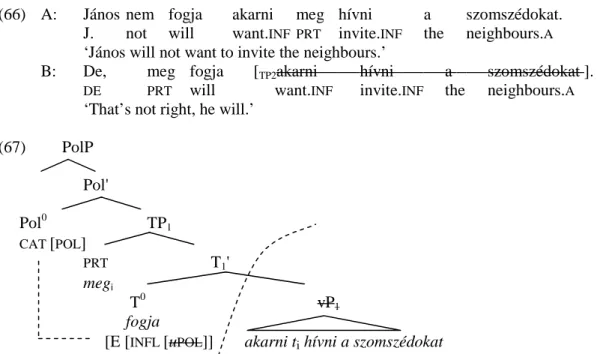
(66) A: János nem fogja akarni meg hívni a szomszédokat. J. not will want.INFPRT invite.INF the neighbours.A
‘János will not want to invite the neighbours.’
B: De, meg fogja [TP2akarni hívni a szomszédokat ].
DE PRT will want.INF invite.INF the neighbours.A
‘That’s not right, he will.’
(67) PolP
Pol'
Pol0 TP1
CAT [POL]
PRT T1'
megi
T0 vP1
fogja
[E [INFL [uPOL]] akarni ti hívni a szomszédokat
This approach neatly explains why the ellipsis site is always flanked by a verbal head and no other material (cf. 51B2): since it is the complement of a T0 head that is elided, there cannot be anything intervening between the verb in the relevant T0 head and the ellipsis site.
An Aelbrecht-type approach therefore offers an account for the long distance nature of ellipsis licensing by Pol0 in Hungarian V-stranding and can derive the observed variation in size of the ellipsis site in verbal complexes, the latter boiling down to [E]’s variable position in the structure. [E] can check its CAT [T]feature on both finite and non-finite T0 in Hungarian. This kind of optionality is in
fact similar to the one found in the English data above involving the non-finite verb be in (61): be is optionally elided, just like Hungarian infinitives in verbal complexes. The comparison between English vP ellipsis and Hungarian V-stranding in polarity contexts is summarized in Table 2.
Table 2:Comparison of Hungarian V-stranding and English VPE
elided constituent licensor “stranded” material
Hungarian V-stranding in polarity contexts vP Pol0 (VM+)Vfin-(Vinf)
English VPE vP T0 Auxfin-(beinf)
Auxfin-Auxinf
With this result, the discussion of the proper analysis of V-stranding can be concluded, and summarized as proposed in (59) above: V-stranding in polarity contexts is vP ellipsis, licensed at a distance by Pol0― an ellipsis process, which at least in the size of its elided material is very similar to English vP ellipsis, in fact.
V-stranding as vP-ellipsis; (VM and) V in TP (68) [PolP [TPVMj Vi [vP ti tj ]]]