Efficacy and Safety of Liraglutide
Added to Capped Insulin
Treatment in Subjects With Type 1
Diabetes: the ADJUNCT TWO
Randomized Trial
DOI: 10.2337/dc16-0690
OBJECTIVE
To investigate the efficacy and safety of liraglutide added to capped insulin doses in subjects with type 1 diabetes.
RESEARCH DESIGN AND METHODS
A 26-week, placebo-controlled, double-blind, parallel-group trial enrolling 835 subjects randomized 3:1 receiving once-daily subcutaneous liraglutide (1.8, 1.2, and 0.6 mg) or placebo added to an individually capped total daily dose of insulin.
RESULTS
Mean baseline glycated hemoglobin (HbA1c) (8.1% [65.0 mmol/mol]) was signif-icantly decreased with liraglutide versus placebo at week 26 (1.8 mg:–0.33% [3.6 mmol/mol]; 1.2 mg:–0.22% [2.4 mmol/mol]; 0.6 mg:–0.23% [2.5 mmol/mol]; placebo: 0.01% [0.1 mmol/mol]). Liraglutide significantly reduced mean body weight (–5.1, –4.0, and –2.5 kg for 1.8, 1.2, and 0.6 mg, respectively) versus placebo (–0.2 kg). Significant reductions in daily insulin dose and increases in quality of life were seen with liraglutide versus placebo. There were higher rates of symptomatic hypoglycemia (21.3 vs. 16.6 events/patient/year;P= 0.03) with liraglutide 1.2 mg vs. placebo and of hyperglycemia with ketosis>1.5 mmol/L with liraglutide 1.8 mg vs. placebo (0.5 vs. 0.1 events/patient/year;P= 0.01).
CONCLUSIONS
In a broad population of subjects with long-standing type 1 diabetes, liraglutide added to capped insulin reduced HbA1c, body weight, and insulin requirements but with higher rates of hypoglycemia for liraglutide 1.2 mg and hyperglycemia with ketosis for liraglutide 1.8 mg.
Most people with type 1 diabetes do not currently reach glycemic targets (1), as both patients and providers are often reluctant to intensify glycemic therapy be-cause of reasons such as concern about hypoglycemia and/or weight gain (2). Moreover, a recent study using electronic health records from the U.S. reported that 47.8% of people with type 1 diabetes are obese (3). Therefore, noninsulin adjunctive treatments with a low intrinsic risk of hypoglycemia and weight gain offer a potential means of complementing intensive insulin therapy in people
1
Lund University, Lund, Sweden
2
University of Washington, Seattle, WA
3
Medical University of Graz, Graz, Austria
4University of Leuven, Leuven, Belgium 5Hospital General de Segovia, Segovia, Spain 6
Aarhus University Hospital, Aarhus, Denmark
7
University of Cape Town Private Academic Hospital, Cape Town, South Africa
8Novo Nordisk A/S, Bagsvaerd, Denmark 9University of North Carolina School of
Medi-cine, Chapel Hill, NC
Corresponding author: Bo Ahr ´en, bo.ahren@ med.lu.se.
Received 30 March 2016 and accepted 26 June 2016.
Clinical trial reg. no. NCT02098395, clinicaltrials .gov.
This article contains Supplementary Data online at http://care.diabetesjournals.org/lookup/ suppl/doi:10.2337/dc16-0690/-/DC1.
© 2016 by the American Diabetes Association. Readers may use this article as long as the work is properly cited, the use is educational and not for profit, and the work is not altered. More infor-mation is available at http://diabetesjournals .org/site/license.
See accompanying article, p. XXX. Bo Ahr ´en,1Irl B. Hirsch,2
Thomas R. Pieber,3Chantal Mathieu,4 Fernando G ´omez-Peralta,5
Troels Krarup Hansen,6Areti Philotheou,7 Sune Birch,8Erik Christiansen,8
Thomas Jon Jensen,8and John B. Buse,9for the ADJUNCT TWO investigators
C
LIN
CA
RE
/E
DU
C
AT
IO
N/
NU
T
RI
TI
ON
/P
SYC
HO
S
OC
IA
L
with type 1 diabetes (4). However, the evidence base for such treatments is limited (5), and only pramlintide, an an-alog of human amylin (6), is currently approved by the U.S. Food and Drug Ad-ministration for use with mealtime in-sulin in people with type 1 diabetes (7). In people with type 2 diabetes, lira-glutide, a glucagon-like peptide-1 re-ceptor agonist (GLP-1RA), is known to stimulate insulin secretion, improve b-cell function, and inhibit glucagon re-lease froma-cells in a glucose-dependent manner (8). Furthermore, liraglutide de-creases food intake (9) and has weight loss benefits in type 2 diabetes (10–14). Whether similar responses exist in people with type 1 diabetes is uncertain. Small, nonrandomized studies in subjects with type 1 diabetes suggest that GLP-1RA treatment results in reduction in fasting and postprandial hyperglycemia, post-prandial glucagon plasma levels, glucose excursions, hypoglycemic events, insulin requirements, and body weight, but these results have not yet been confirmed in larger studies with longer duration (15–23). Recently, two such randomized controlled trials (RCTs) investigating the efficacy and safety of liraglutide added to insulin in subjects with type 1 diabetes have been completed (ADJUNCT ONE [NCT01836523] [24] and ADJUNCT TWO [NCT02098395]). Here we reportfindings from the ADJUNCT TWO trial.
The primary aim of ADJUNCT TWO was to confirm, in a large, multicenter, randomized study, superiority of lira-glutide compared with placebo, both adjunct to capped insulin treatment, on glycemic control, after 26 weeks of treatment in subjects with established type 1 diabetes and inadequate glycemic control.
RESEARCH DESIGN AND METHODS
Trial Design
This was a 26-week, randomized, insulin-capped, placebo-controlled, double-blind, parallel-group, phase 3 trial performed at 59 centers in North America, Europe, and Africa.
After a screening visit (week–2), eligible subjects attended the randomization visit (week 0) and were randomized using a telephone or web-based system (IV/WRS) by Novo Nordisk (Clinical Supplies Coordi-nation) (stratified by glycated hemoglobin [HbA1c] [,8.5%;,69.4 mmol/mol and
$8.5%; $69.4 mmol/mol] and BMI
[#27 and.27 kg/m2]). Subjects were randomized 3:1 to liraglutide 1.8, 1.2, and 0.6 mg, or liraglutide placebo 0.3, 0.2, or 0.1 mL, respectively, as adjunct to insulin treatment for a period of 26 weeks. Treatment with liraglutide (or the corresponding placebo volume) was started at 0.6 mg/day at week 0 and increased by 0.6 mg every 2nd week un-til the randomized dose level was reached. In order to obtain a dose re-sponse, dose reduction of liraglutide was not permitted on randomized dose. To ensure treatment uniformity be-tween the trial sites, as well as to ensure that subjects received treatment ac-cording to the trial protocol, titration algorithms were developed specifying recommended insulin dose adjustments at different plasma glucose levels. Sub-jects were instructed to perform self-monitoring of plasma glucose (SMPG) (4-, 7-, and 9-point profiles) on days be-fore site and phone contacts and after new liraglutide dose escalation. The in-sulin cap was determined for each sub-ject individually prior to randomization and, as it is acknowledged that people with type 1 diabetes can have largefl uc-tuations in insulin dose on a daily basis, was defined as the average of the pre-vious 7 consecutive days’total daily in-sulin dose. No range limit or lower limit for insulin requirement was set. No postprandial glucose targets were set. However, adjustments based on post-prandial glucose within the limits of the insulin cap were at the discretion of the investigator in accordance with local practice/standard of medical care. The total daily prerandomization insu-lin dose was reduced by 25% for at least 1 day when liraglutide or placebo was initiated, and by a further 10% for at least 1 day when liraglutide/placebo doses were escalated. Thereafter, the insulin dose could be adjusted weekly by subjects and at least biweekly by investigators, based on 4-point glucose (premeal) values, toward the insulin cap as defined previously. In case of se-vere deterioration of glycemic control, rescue treatment was to be initiated (Supplementary Fig. 1).
Trial Population
Key inclusion criteria comprised the fol-lowing: type 1 diabetes duration $1 year, age $18 years, BMI$20 kg/m2, treatment with multiple daily injections
(MDI) of insulin or continuous subcuta-neous insulin infusion (CSII) for at least 6 months, and HbA1c7.0–10.0% (53.0–
85.8 mmol/mol) with a stable insulin dose (as judged and documented by the investigator) for at least 3 months. In order to increase applicability of re-sults to clinical practice, “fragile” sub-jects (i.e., subsub-jects with hypoglycemic unawareness, history of severe hypogly-cemia, mildly to severely decreased re-nal function [based on chronic kidney disease definitions] [25], or a recent his-tory of diabetic ketoacidosis) were not excluded. Key exclusion criteria com-prised the following: any prior use of GLP-1RAs or dipeptidyl peptidase-4 in-hibitors, any medication (except insulin) that could interfere with glycemic con-trol or affect a subject’s safety, or an estimated glomerular filtration rate
,30 mL/min/1.73 m2.
Outcome Measures
The primary end point was change from baseline in HbA1cafter 26 weeks of
treat-ment. Secondary end points included change from baseline in body weight, to-tal daily insulin dose, 1,5-anhydroglucitol, fasting plasma glucose, 9-point SMPG (using a self-measured blood glucose device calibrated to report plasma glu-cose), fasting plasma glucagon, plasma C-peptide, and quality of life (treatment-related impact measures-diabetes D], TRIM-hypoglycemia [TRIM-HYPO], and short-form 36 question-naires) and proportions of subjects achieving HbA1c targets (HbA1c,7.0%
[,53.0 mmol/mol]; composite targets [HbA1c,7.0% (,53.0 mmol/mol) and no
severe hypoglycemia; HbA1c reduction .1% (.10.9 mmol/mol) and no severe hy-poglycemia]) after 26 weeks of treatment. Safety end points included incidence of symptomatic hypoglycemic episodes, defined as severe according to the American Diabetes Association (ADA) (26) or by a plasma glucose value of
,3.1 mmol/L (,56 mg/dL) with symp-toms consistent with hypoglycemia (Novo Nordisk definition). Furthermore, documented symptomatic, asymptomatic, severe, and nocturnal (12:01205:59A.M.,
post hoc end point. Hyperglycemic epi-sodes (plasma glucose.16.7 mmol/L [.300 mg/dL]), hyperglycemic epi-sodes with ketosis (plasma ketone
.1.5 mmol/L [based on vendor’s user recommendations for the ketostick]), and adverse events (AEs) were also re-ported. Subjects were advised to mea-sure ketones at each plasma glucose excursion.16.7 mmol/L (.300 mg/dL).
Subgroup Analyses
Analyses were performed to identify po-tential subgroups of subjects with an improved treatment effect. Prespecified analyses included baseline variables such as age, sex, type 1 diabetes dura-tion, method of insulin administration (MDI versus CSII), body weight, BMI, HbA1c, hypoglycemia unawareness
sta-tus, and severe hypoglycemia within the last 12 months. No subgroup analysis was performed related to the prandial insulin-adjusting algorithm, as it was based on clinical judgement. Post hoc analyses included baseline variables such as C-peptide level.
Statistical Analyses
Sample size was determined to detect a difference of 0.4% (4.4 mmol/mol) in HbA1cchange and 2.5 kg in body weight
change after 26 weeks of treatment be-tween the liraglutide 1.8 mg dose and placebo with 90.0 and 99.9% power, re-spectively. Sample size calculation was based on a two-sided Studentttest of 5% and an SD of 1.1% (12.0 mmol/mol) in HbA1cchange after 26 weeks of
treat-ment. The required sample size was 160 subjects per group, assuming no pa-tients withdrew. Adopting an overall 20% dropout rate evenly distributed among treatment groups, the required sample size was 200 subjects per group. With a 50% efficacy retention in the dropouts, a treatment difference of 0.36% was then expected.
Continuous data were analyzed us-ing a mixed model for repeated mea-surements, with treatment, stratification, and country asfixed factors and baseline as a covariate, all nested within visit. Binary data were analyzed by a logistic regression model, with treatment and stratification as factors and HbA1cvalue
at baseline as a covariate. Missing HbA1c data were imputed from the
mixed model for repeated measure-ments used for the analysis of HbA1c.
Numbers of on-treatment hypoglycemic/
hyperglycemic episodes were analyzed using a negative binomial regression model, with a log-link function and the logarithm of the time period in which the episodes were considered treatment emergent as offset, with treatment, strat-ification, and country as factors and the HbA1cvalue at baseline as a covariate.
RESULTS
Subject Disposition
Of the 835 randomized subjects, 832 were exposed to liraglutide or placebo in addition to insulin during the trial (liraglutide 0.6 mg, n = 211; 1.2 mg, n= 209; 1.8 mg,n= 206; placebo,n= 206) and 661 subjects completed week 26 without discontinuation of trial product or use of rescue treatment (in-tensification of usual insulin dose) (lira-glutide 0.6 mg,n= 177; 1.2 mg,n= 157; 1.8 mg,n= 157; placebo,n= 170) (Sup-plementary Fig. 1). Overall, rescue treat-ment was needed in 42 (5.0%) subjects. More subjects in the liraglutide 1.2 mg group required rescue treatment (n = 16, 7.7%) than in the other treatment groups (liraglutide 1.8 mg:n= 8, 3.9%; 0.6 mg: n = 9, 4.2%; placebo: n = 9, 4.3%). In total, 127 (15.2%) subjects with-drew from the trial:n= 42 (20.3%),n= 32 (15.3%), n = 26 (12.3%), and n = 27 (13.0%) in the liraglutide 1.8, 1.2, and 0.6 mg and placebo groups, respectively.
Baseline Characteristics
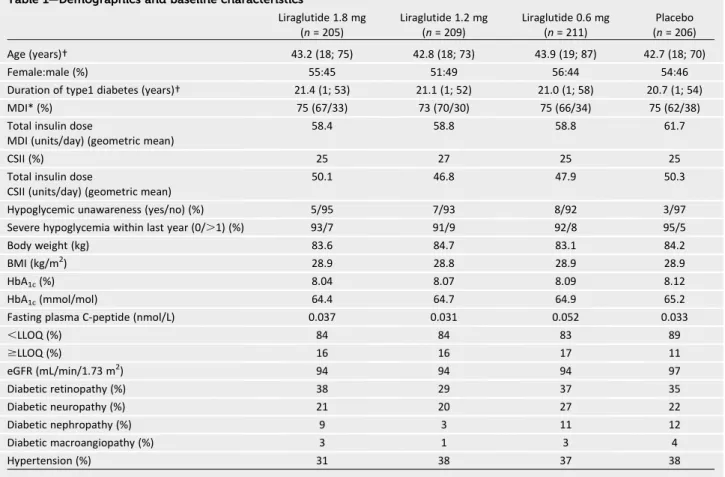
On average, the trial population had longstanding (mean duration 21.1 years) type 1 diabetes with inadequate glycemic control (mean HbA1c 8.1%
[65.0 mmol/mol]) and was moderately overweight (mean body weight 83.9 kg; mean BMI 28.9 kg/m2) (Table 1). In to-tal, 125 (15.2%) subjects had C-peptide levels greater than the lower limit of quantification (.LLOQ: 0.030 nmol/L) (Supplementary Table 1) and 213 (25.6%) subjects were receiving CSII. Overall, mean (geometric) total daily insulin dose was 10.0 units higher in subjects receiving MDI of insulin than in subjects receiving CSII. Almost half of the sub-jects had some symptoms or diagnosis of long-term diabetes complications, 47 (5.7%) subjects had hypoglycemia un-awareness, and 61 (7.3%) had a history of severe hypoglycemia.
Efficacy
HbA1creductions occurred in the first
3 months of the trial, after which HbA1c
levels increased gradually. From base-line to week 26, HbA1 c was
large-ly unchanged with placebo (0.01% [0.1 mmol/mol]), whereas a statistically significant reduction in HbA1cwas seen
for all liraglutide doses versus placebo (estimated treatment difference [ETD]: 1.8 mg,–0.35%/–3.8 mmol/mol [95% CI
–0.50; –0.20], P , 0.0001; 1.2 mg,
–0.23%/–2.5 mmol/mol [95% CI–0.38;
–0.08], P = 0.0021; 0.6 mg, –0.24%/
–2.6 mmol/mol [95% CI–0.39; –0.10], P = 0.0011) (Fig. 1A). The reduction in HbA1creported with liraglutide 1.8 mg
was accompanied by a significantly greater increase in mean 1,5-anhydroglucitol compared with placebo (end-of-trial val-ues: 3.11 mg/mL and 2.68 mg/mL, re-spectively; estimated treatment ratio: 1.16 [95% CI 1.05; 1.28], P = 0.0026) and, with the 9-point SMPG profiles, apparent reductions in postbreak-fast, postlunch, and bedtime glucose (Supplementary Fig. 2). With liraglutide 1.2 and 0.6 mg, there was no significant effect (compared with placebo) on 1,5-anhydroglucitol and no apparent reduc-tions in 9-point SMPG profiles. There were no significant differences between any of the liraglutide doses and placebo for mean fasting plasma glucose, mean fasting plasma glucagon, or mean plasma C-peptide at 26 weeks.
A significant dose-dependent de-crease in mean (geometric) total daily insulin dose was reported with all lira-glutide doses at 26 weeks compared with placebo (estimated treatment ra-tio: 1.8 mg, 0.90 [95% CI 0.86; 0.93], P,0.0001; 1.2 mg, 0.93 [95% CI 0.90; 0.96],P,0.0001; 0.6 mg, 0.95 [95% CI 0.92; 0.99],P = 0.0075) (Fig. 1B). This insulin dose reduction in the liraglutide groups was achieved mainly through a prandial insulin reduction. The mean de-crease of prandial insulin was–4 to–5 units and–3 to –5.5 units in subjects receiving MDI of insulin and CSII, respec-tively, whereas the dose decrease in basal insulin was–0.9 to 0.2 units and
–0.1 to–0.9 units, respectively. A dose-dependent statistically signif-icant decrease in mean body weight from baseline to week 26 was reported with liraglutide (1.8 mg,–5.1 kg; 1.2 mg,
–4.0 kg; 0.6 mg, –2.5 kg; placebo,
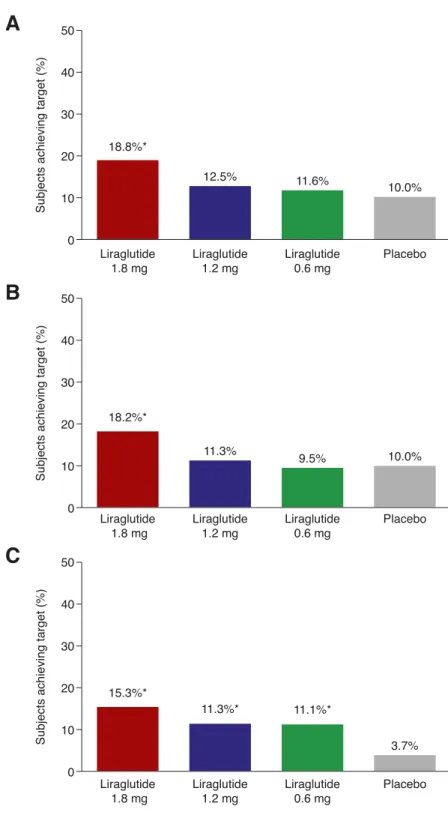
target of HbA1c,7.0% (,53.0 mmol/mol)
(18.8 vs. 10.0%, respectively, odds ra-tio [OR] 2.12 [95% CI 1.11; 4.06],P = 0.0231) (Fig. 2A). There was no signifi -cant effect of liraglutide 1.2 and 0.6 mg compared with placebo on this end point. Significantly more subjects re-ceiving liraglutide 1.8 mg (but not those receiving liraglutide 1.2 or 0.6 mg) ver-sus placebo achieved the composite target of HbA1c,7.0% (,53.0 mmol/mol)
with no severe hypoglycemia (18.2 vs. 10.0%, respectively, OR 2.02 [95% CI 1.05; 3.87],P= 0.0343) (Fig. 2B). Similarly, significantly more subjects receiving liraglu-tide 1.8 mg (15.3%), 1.2 mg (11.3%), and 0.6 mg (11.1%) versus placebo (3.7%) achieved the composite target of HbA1c
reduction.1.0% (.10.9 mmol/mol) and no severe hypoglycemia (1.8 mg: OR 5.36 [95% CI 2.21; 12.96], P = 0.0002; 1.2 mg: OR 3.48 [95% CI 1.41; 8.59], P = 0.0069; 0.6 mg: OR 3.39 [95% CI 1.38; 8.34],P= 0.0078) (Fig. 2C).
Safety
Overall, rates of AEs increased with liraglutide in a dose-dependent manner (11.5, 9.6, and 7.0 events per patient
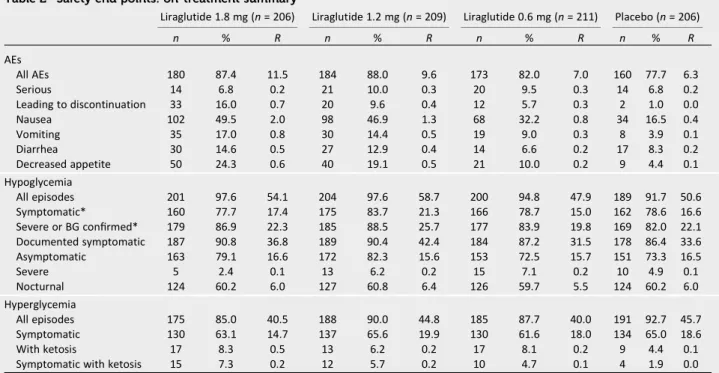
year of exposure [PYE] for liraglutide 1.8, 1.2, and 0.6 mg, respectively, com-pared with 6.3 events per PYE for pla-cebo) (Table 2). However, there was a similar proportion of subjects with seri-ous AEs across the treatment groups (6.8, 10.0, and 9.5% for liraglutide 1.8, 1.2, and 0.6 mg, respectively, compared with 6.8% for placebo). There was a higher rate of study discontinuation due to AEs in the liraglutide group than in the placebo group. Nausea, which increased dose dependently (2.0, 1.3, and 0.8 events per PYE for lira-glutide 1.8, 1.2, and 0.6 mg, respec-tively, and 0.4 events per PYE for placebo), was the most frequently re-ported AE with liraglutide. In all liraglu-tide groups, new-onset nausea tended to occur within thefirst weeks of treat-ment (i.e., during dose initiation and escalation); after this time, the inci-dence of nausea decreased.
Throughout the trial, there were four adjudicated cardiovascular events (three acute coronary syndromes [one with liraglutide 0.6 mg, one with liraglu-tide 1.2 mg, and one with placebo] and one cerebrovascular event [liraglutide
1.8 mg]), four neoplasms (three benign [liraglutide 1.8 mg, liraglutide 1.2 mg, and placebo] and one malignant [lira-glutide 1.8 mg]), and one thyroid event requiring thyroidectomy (C-cell hyper-plasia [liraglutide 1.8 mg]) (Supplementary Material). There was no apparent pattern with regards to treatment dose of lira-glutide. There was a single confirmed case of diabetic ketoacidosis requiring hospitalization with liraglutide 1.2 mg (in a subject who was not compliant with treatment algorithms) and no fatal events in any treatment group. Mean li-pase and amylase levels increased sig-nificantly in all liraglutide treatment groups (Supplementary Table 2). How-ever, the majority of subjects in each treatment group had postbaseline lipase and amylase values within the normal range. There were transient elevations of lipase greater than three times the up-per limit of normal in all liraglutide groups (1.8 mg,n= 4 [1.9%]; 1.2 mg,n= 4 [1.9%]; 0.6 mg,n= 2 [1.0%]). One subject in the placebo group had a transient elevation of amylase greater than three times the upper limit of normal. No cases of pancre-atitis were reported in any treatment Table 1—Demographics and baseline characteristics
Liraglutide 1.8 mg
(n= 205)
Liraglutide 1.2 mg
(n= 209)
Liraglutide 0.6 mg
(n= 211)
Placebo
(n= 206)
Age (years)† 43.2 (18; 75) 42.8 (18; 73) 43.9 (19; 87) 42.7 (18; 70)
Female:male (%) 55:45 51:49 56:44 54:46
Duration of type1 diabetes (years)† 21.4 (1; 53) 21.1 (1; 52) 21.0 (1; 58) 20.7 (1; 54)
MDI* (%) 75 (67/33) 73 (70/30) 75 (66/34) 75 (62/38)
Total insulin dose 58.4 58.8 58.8 61.7
MDI (units/day) (geometric mean)
CSII (%) 25 27 25 25
Total insulin dose 50.1 46.8 47.9 50.3
CSII (units/day) (geometric mean)
Hypoglycemic unawareness (yes/no) (%) 5/95 7/93 8/92 3/97
Severe hypoglycemia within last year (0/.1) (%) 93/7 91/9 92/8 95/5
Body weight (kg) 83.6 84.7 83.1 84.2
BMI (kg/m2) 28.9 28.8 28.9 28.9
HbA1c(%) 8.04 8.07 8.09 8.12
HbA1c(mmol/mol) 64.4 64.7 64.9 65.2
Fasting plasma C-peptide (nmol/L) 0.037 0.031 0.052 0.033
,LLOQ (%) 84 84 83 89
$LLOQ (%) 16 16 17 11
eGFR (mL/min/1.73 m2) 94 94 94 97
Diabetic retinopathy (%) 38 29 37 35
Diabetic neuropathy (%) 21 20 27 22
Diabetic nephropathy (%) 9 3 11 12
Diabetic macroangiopathy (%) 3 1 3 4
Hypertension (%) 31 38 37 38
group. There was no apparent differ-ence between the treatment groups in the proportion of subjects who had cal-citonin categorized as either ,LLOQ or$LLOQ at weeks–2 and 26 as well as for median, minimum, and maximum values (Supplementary Table 2). Mean pulse and systolic blood pressure signif-icantly increased and decreased, re-spectively, in all liraglutide treatment groups (Supplementary Table 2). There was no significant effect on mean dia-stolic blood pressure.
Hypoglycemic Episodes
In total, 92–98% of subjects reported at least one hypoglycemic episode during the trial, and hypoglycemic episodes were uniformly distributed throughout the trial period. For most hypoglycemia end points, the number of episodes was similar across treatment groups (Table 2). There was a higher rate of symp-tomatic (estimated rate ratio [ERR] 1.31 [95% CI 1.03; 1.68],P =0.0289) and documented symptomatic (ERR 1.33 [95% CI 1.07; 1.67],P = 0.0114)
hypoglycemic episodes only with lira-glutide 1.2 mg compared with placebo (21.3 vs. 16.6 events per PYE and 42.4 vs. 33.6 events per PYE, respectively). For all liraglutide doses, there was no signifi -cant difference in rate of severe or noc-turnal hypoglycemic episodes compared with placebo. Rates of asymptomatic hypoglycemic episodes, with plasma glucose ,3.1 mmol/L (,56 mg/dL) (Novo Nordisk definition), were 4.9, 4.4, 4.8, or 5.5 events per PYE on liraglu-tide 1.8, 1.2, or 0.6 mg or placebo, re-spectively. Rates of asymptomatic hypoglycemic episodes, with plasma glucose ,3.9 mmol/L (,70 mg/dL), were also similar between treatment groups (Table 2).
Hyperglycemic Episodes
Overall, there were no differences in the rates of hyperglycemic episodes with liraglutide compared with placebo (40.5, 44.8, and 40.0 events per PYE for liraglu-tide 1.8, 1.2, and 0.6 mg, respectively, compared with 45.7 events per PYE for placebo). Hyperglycemic episodes were uniformly distributed throughout the trial period. There was a higher rate of hyperglycemic episodes with ketosis
.1.5 mmol/L with liraglutide 1.8 mg compared with placebo (42 events in 17 subjects and 10 events in 9 subjects [0.5 vs. 0.1 events per PYE], respectively, ERR 3.96 [95% CI 1.49; 10.55], P = 0.0059). There were higher rates of hy-perglycemic episodes with ketosis re-ported with liraglutide 1.2 and 0.6 mg compared with placebo (20 events in 13 subjects and 23 events in 17 subjects [0.2 and 0.2 vs. 0.1 events per PYE], re-spectively); however, these differences were not statistically significant. Hyper-glycemic episodes with ketosis occurred more frequently in thefirst 8 weeks of the trial.
Subgroup Analyses
With the exception of C-peptide–positive/– negative subjects, the analyses of the previously mentioned subgroups showed comparablefindings to the overall re-sults. In the current trial,;15% of sub-jects (n = 125) had C-peptide levels above the LLOQ, ranging between 0.08 and 0.12 nmol/L. These subjects also differed from the overall population by a slightly higher baseline HbA1cand
shorter type 1 diabetes duration (Supplementary Table 1). These subjects showed an improved treatment effect
Figure 1—A: Mean change in HbA1cby treatment week.B: Mean change in total insulin dose by
treatment week.C: Mean change in body weight by treatment week. Error bars are SEM. BL,
on HbA1c with all liraglutide doses
(1.8 mg: estimated mean placebo-corrected HbA1creduction of–0.77%
[–8 . 4 m m o l / m o l ] c o m p a r e d with
–0.27% [–3.0 mmol/mol] for subjects without measurable C-peptide, treat-ment interactionP = 0.0302; 1.2 mg:
–0.69% [–7.5 mmol/mol] and–0.14% [–1.6 mmol/mol], respectively, P =
0.0140; 0.6 mg:–0.65% [–7.1 mmol/mol] and–0.17% [–1.9 mmol/mol], respec-tively, P = 0.0293). Of note, of all episodes of hyperglycemia with ketosis
.1.5 mmol/L (42, 20, 23, and 10 episodes in the liraglutide 1.8, 1.2, and 0.6 mg and placebo groups, respectively), only one episode occurred in a subject with measurable residual C-peptide (in the
liraglutide 0.6 mg group). Regarding symptomatic hypoglycemia, there were more episodes with liraglutide 1.2 mg only compared with placebo in both the baseline C-peptide groups ($LLOQ 8.5, 14.0, 10.6, and 7.4 events per PYE and
,LLOQ 19.2, 22.6, 16.1, and 17.8 events per PYE for liraglutide 1.8, 1.2, and 0.6 mg and placebo, respectively).
Quality of Life
Mean TRIM-D management score was reduced from baseline with placebo (–1.48), which reflects a reduced quality of life. However, with all liraglutide doses, mean TRIM-D management score was increased from baseline (1.8 mg: 7.46, 1.2 mg: 4.15, and 0.6 mg: 3.55), reflecting improved quality of life. In-creases in TRIM-D management score were significantly greater with all liraglu-tide doses than with placebo (1.8 mg: ETD 8.94 [95% CI 4.33; 13.55], P = 0.0002; 1.2 mg: ETD 5.64 [1.01; 10.26], P= 0.0170; 0.6 mg: ETD 5.04 [0.54; 9.54], P= 0.0282), reflecting improved quality of life. At 26 weeks and compared with placebo, an increase in mean TRIM-D to-tal score (driven by the corresponding increase in mean TRIM-D management score) was reported with liraglutide 1.8 mg (3.42 vs. 5.93, respectively, ETD 2.51 [95% CI 0.29; 4.73],P = 0.0269). There was no significant effect of liraglu-tide 1.2 and 0.6 mg on TRIM-D total score compared with placebo. There was no overall effect of any dose of liraglutide on TRIM-HYPO total three do-mains score or short-form 36 overall physical or mental scores compared with placebo.
CONCLUSIONS
ADJUNCT TWO is thefirst large-scale RCT designed to investigate the efficacy and safety of adding liraglutide to an individually capped insulin dose in sub-jects with type 1 diabetes and inade-quate glycemic control. The current trial demonstrates that liraglutide (1.8, 1.2, and 0.6 mg) added to capped insulin treatment results in greater mean reduc-tions in HbA1c, body weight, and insulin
dose but higher rates of hypoglycemia (1.2 mg) and hyperglycemia with keto-sis (1.8 mg) compared with placebo. These findings are largely in agree-ment with those from ADJUNCT ONE, a 52-week randomized, placebo-controlled, double-blind, parallel-group, treat-to-target,
Figure 2—Subjects achieving targets at week 26.A: HbA1c,7.0% (,53.0 mmol/mol).B:
HbA1c,7.0% (,53.0 mmol/mol) and no severe hypoglycemia.C: HbA1creduction.1%
phase 3 trial carried out at 177 centers in 17 countries (24).
Considering efficacy, the mean re-duction in HbA1creported with
liraglu-tide 1.8 mg in the current trial was modest (despite the greatest decrease in pretrial insulin) but comparable to that achieved with pramlintide (–0.5% [–5.5 mmol/mol]) (27). Subgroup anal-ysis in the current study indicates that in C-peptide–positive subjects, the mean placebo-corrected reduction in HbA1c
with liraglutide 1.8 mg is significantly greater than in C-peptide–negative sub-jects (i.e.,–0.8 vs.–0.3%). In the overall analysis, with liraglutide 1.8 mg, there was an increase in mean 1,5-anhydroglucitol as well as nonsignificant (compared with placebo) reductions in postbreakfast, postlunch, and bedtime SMPG measure-ments that, together, suggest improve-ments in both overall and postprandial glycemic control. HbA1c reductions
that occurred were more pronounced within thefirst 3 months of the trial, after which HbA1c levels steadily
in-creased toward placebo levels. This sug-gests that insulin dose increases could have been more aggressive. Whether
expected insulin-associated weight gain could have impacted the decision to intensify insulin treatment fur-ther throughout the trial remains speculative.
In the current trial, the insulin cap was imposed to reflect the added effect on glycemic control in people who, in clin-ical practice, may be reluctant to inten-sify insulin treatment. Despite the HbA1c
reduction obtained, the mean total daily insulin dose did not return to the mean cap, and mean total daily insulin doses were;10–15% below baseline values at week 26. It is noteworthy that most, if not all, of the reduction in total daily insulin dose was due to prandial insulin. A recent study re-ports a reduction in carbohydrate intake, associated with appetite sup-pression, and a reduction in postprandial glucagon in subjects with type 1 dia-betes being treated with liraglutide (28). It could, therefore, be speculated that in the current study, liraglutide may have inhibited energy intake and postprandial glucagon secretion, theby limiting the exogenous insulin re-quirement. However, i n A DJUNCT
TWO, neither possibility was specifically investigated.
Weight loss and improvements in qual-ity of life were additional benefits of lira-glutide treatment in the current trial. Liraglutide 1.8 mg resulted in a mean reduction in body weight of–5.1 kg, and this is comparable with findings from a recent RCT involving a popula-tion with type 1 diabetes and obesity (–6.8 kg) (22). Intensive insulin treat-ment in people with type 1 diabetes is often associated with an increased prevalence of overweight and obesity over time (29). In the DCCT study after 6 years of treatment, for example, 4.75 kg more weight gain than convention-ally treated counterparts was observed (30). Furthermore, both overweight and obesity are associated with insulin resis-tance, dyslipidemia, increased blood pres-sure, and atherosclerosis in a population with type 1 diabetes (31). The improve-ment in quality of life as evidenced by the increased mean TRIM-D total score and the mean TRIM-D management score suggests that adjunctive liraglutide treat-ment may improve adherence with poten-tial longer-term benefits (32–34). Table 2—Safety end points: on-treatment summary
Liraglutide 1.8 mg (n= 206) Liraglutide 1.2 mg (n= 209) Liraglutide 0.6 mg (n= 211) Placebo (n= 206)
n % R n % R n % R n % R
AEs
All AEs 180 87.4 11.5 184 88.0 9.6 173 82.0 7.0 160 77.7 6.3
Serious 14 6.8 0.2 21 10.0 0.3 20 9.5 0.3 14 6.8 0.2
Leading to discontinuation 33 16.0 0.7 20 9.6 0.4 12 5.7 0.3 2 1.0 0.0
Nausea 102 49.5 2.0 98 46.9 1.3 68 32.2 0.8 34 16.5 0.4
Vomiting 35 17.0 0.8 30 14.4 0.5 19 9.0 0.3 8 3.9 0.1
Diarrhea 30 14.6 0.5 27 12.9 0.4 14 6.6 0.2 17 8.3 0.2
Decreased appetite 50 24.3 0.6 40 19.1 0.5 21 10.0 0.2 9 4.4 0.1
Hypoglycemia
All episodes 201 97.6 54.1 204 97.6 58.7 200 94.8 47.9 189 91.7 50.6
Symptomatic* 160 77.7 17.4 175 83.7 21.3 166 78.7 15.0 162 78.6 16.6
Severe or BG confirmed* 179 86.9 22.3 185 88.5 25.7 177 83.9 19.8 169 82.0 22.1
Documented symptomatic 187 90.8 36.8 189 90.4 42.4 184 87.2 31.5 178 86.4 33.6
Asymptomatic 163 79.1 16.6 172 82.3 15.6 153 72.5 15.7 151 73.3 16.5
Severe 5 2.4 0.1 13 6.2 0.2 15 7.1 0.2 10 4.9 0.1
Nocturnal 124 60.2 6.0 127 60.8 6.4 126 59.7 5.5 124 60.2 6.0
Hyperglycemia
All episodes 175 85.0 40.5 188 90.0 44.8 185 87.7 40.0 191 92.7 45.7
Symptomatic 130 63.1 14.7 137 65.6 19.9 130 61.6 18.0 134 65.0 18.6
With ketosis 17 8.3 0.5 13 6.2 0.2 17 8.1 0.2 9 4.4 0.1
Symptomatic with ketosis 15 7.3 0.2 12 5.7 0.2 10 4.7 0.1 4 1.9 0.0
Symptomatic, severe according to the ADA classification (25) or a plasma glucose value of,3.1 mmol/L (,56 mg/dL), with symptoms consistent
with hypoglycemia; severe or BG confirmed, hypoglycemic episodes that are either severe according to ADA or a plasma BG value of,3.1 mmol/L
(,56 mg/dL); documented symptomatic, typical symptoms of hypoglycemia accompanied by a measured plasma glucose concentration
#3.9 mmol/L (#70 mg/dL); asymptomatic, no typical symptoms of hypoglycemia, but with a measured plasma glucose concentration#3.9 mmol/L
(#70 mg/dL); severe, see symptomatic; nocturnal, onset was between 12:01 and 05.59A.M., both included; hyperglycemia, plasma glucose
values.16.7 mmol/L (.300 mg/dL); ketosis, plasma ketone values.1.5 mmol/L. BG, blood glucose;n, number of subjects experiencing at least one
Considering safety, higher numbers of symptomatic hypoglycemia were seen with liraglutide (1.2 mg) than with placebo (21.3 vs. 16.6 events per PYE, respectively). An explanation as to why only one of the liraglutide doses showed higher rates remains unclear. It has been considered that this may re-late to the insulin dose titration, nausea, satiety, or misjudged food intake. How-ever, currently no specific reason is di-rectly supported by collected data. Whether this is an intrinsic problem with the use of GLP-1RAs in type 1 di-abetes or if it could be mitigated by patient selection, dosing, continuous glucose monitoring, or education re-mains speculative. It is of note that liraglutide added to insulin treatment does not affect the counter-regulatory hormone responses during hypoglyce-mia or glycemic recovery from hypogly-cemia in subjects with type 1 diabetes (21,35); consequently, the higher inci-dence of hypoglycemia with liraglutide is probably not dependent on defective counter-regulation. Increased hypergly-cemia with ketosis was also observed with liraglutide compared with placebo. In the liraglutide group, the reduction in daily total insulin dose may have contrib-uted to this observation. Interestingly, whereas there were.80 events of hy-perglycemia with ketosis in the C-peptide–negative population on lira-glutide, there was only one event in the C-peptide–positive population. The in-creases in mean amylase, lipase, and pulse and reductions in mean systolic blood pressure reported in the liraglutide groups are of unknown clinical signifi -cance. Furthermore, these observations are similar to those seen in type 2 diabetes– focused trials involving this drug class (36–38).
Considering trial limitations, the re-sults may have benefited from the as-sessment of food intake; moreover, the use of continuous glucose monitor-ing, absent from this trial, would have gathered more comprehensive data on glycemic variability, postprandial excur-sions, and time in glycemic objectives. The lack of standardization between test centers in insulin titration methodol-ogy could also be considered a limitation. Furthermore, the capped insulin dose is rarely used in clinical trials in subjects with type 1 diabetes, making compari-sons with other trials a challenge.
In summary, the ADJUNCT TWO trial demonstrated benefits of liraglutide as an adjunct to insulin treatment in sub-jects with type 1 diabetes with a capped insulin dose with respect to glycemic control, insulin dose, weight, and qual-ity of life. The higher number of hypo-glycemia and of hyperhypo-glycemia with ketosis in some of the liraglutide groups emphasizes the need for proper insulin titration and may ultimately limit the clinical utility of GLP-1RAs in a less well-supervised population with type 1 diabetes.
Acknowledgments.Medical writing and sub-mission support were provided by Karl Gledhill and Izabel James (Watermeadow Medical, an
Ashfield Company, part of UDG Healthcare plc,
funded by Novo Nordisk).
Funding and Duality of Interest. Novo Nordisk provided funding for this study (NN9211-4083). B.A. has received honoraria for lecturing and/or consultancy from Merck,
Novartis, Novo Nordisk, and Sanofi. I.B.H. has
received research grants from Novo Nordisk and has served on an advisory panel for Abbott Diabetes Care, Roche, and Becton Dickinson. T.R.P. has received research support from AstraZeneca and Novo Nordisk and has received honoraria for lecturing and/or consulting from AstraZeneca, Eli Lilly and Company, and Novo Nordisk. C.M. has served on advisory panels and has been a speaker or received re-search support from AstraZeneca, Boehringer Ingelheim, Bristol-Myers Squibb, Eli Lilly and Company, Hanmi, Janssen, Merck, Novartis, Novo
Nordisk, Pfizer, Roche, and Sanofi. F.G.-P. has
acted as an advisor for Sanofiand Novo Nordisk
(advisory panel) and as a speaker for Sanofi,
Novo Nordisk, Boehringer Ingelheim, AstraZeneca, Bristol-Myers Squibb, and Eli Lilly and Com-pany. T.K.H. is a member of advisory panels and/or has received payments for lectures from AstraZeneca, Bristol-Myers Squibb, Merck,
Sanofi, Novo Nordisk, Abbott, and Takeda. A.P.
has served on advisory panels and received re-search support from Novo Nordisk. S.B., E.C., and T.J.J. are employees of Novo Nordisk. J.B.B. re-ports fees, travel/meals/lodging, and stock options from PhaseBio as well as grants, fees, and travel/meals/lodging for contracted activi-ties between his employer and AstraZeneca, Boehringer-Ingelheim, Bristol-Myers Squibb, Dance Biopharm, Elcelyx, Eli Lilly and Company, GlaxoSmithKline, GI Dynamics, Intarcia Thera-peutics, Johnson & Johnson, Lexicon, Medtronic, Merck, Metavention, Novo Nordisk, Orexigen, Scion NeuroStim, and vTv Therapeutics. No
other potential conflicts of interest relevant
to this article were reported.
The sponsor (Novo Nordisk) was involved in the study design and protocol development,
reviewed the manuscript for scientific accuracy,
and provided statistical support.
Author Contributions.B.A., E.C., and J.B.B. contributed to study design, study contact/data collection, and data analysis. I.B.H., T.R.P., F.G.-P.,
A.P., and T.J.J. contributed to study contact/data collection and data analysis. C.M. contributed to study design and study contact/data collection. T.K.H. contributed to study contact/data collec-tion. S.B. contributed to data analysis. All authors were involved in writing the manuscript and
approved thefinal version. B.A. is the guarantor
of this work and, as such, had full access to all the data in the study and takes responsibility for the integrity of the data and the accuracy of the data analysis.
Prior Presentation.An abstract for this study was accepted for poster presentation at the 25th
Annual Scientific and Clinical Congress of the
American Association of Clinical
Endocrinolo-gists, Orlando, FL, 25–29 May 2016.
References
1. Miller KM, Foster NC, Beck RW, et al.; T1D Exchange Clinic Network. Current state of type 1 diabetes treatment in the U.S.: updated data from the T1D Exchange clinic registry. Diabetes
Care 2015;38:971–978
2. Davies M. The reality of glycaemic control in
insulin treated diabetes: defining the clinical
challenges. Int J Obes Relat Metab Disord
2004;28(Suppl. 2):S14–S22
3. Bae JP, Lage MJ, Mo D, Nelson DR, Hoogwerf BJ. Obesity and glycemic control in patients with diabetes mellitus: analysis of physician electronic health records in the US from 2009-2011. J
Di-abetes Complications 2016;30:212–220
4. George P, McCrimmon RJ. Potential role of non-insulin adjunct therapy in type 1 diabetes.
Diabet Med 2013;30:179–188
5. Bode BW, Garg SK. The emerging role of ad-junctive noninsulin antihyperglycemic therapy in the management of type 1 diabetes. Endocr
Pract 2016;22:220–230
6. Colburn WA, Gottlieb AB, Koda J, Kolterman OG. Pharmacokinetics and pharmacodynamics of AC137 (25,28,29 tripro-amylin, human) after intravenous bolus and infusion doses in patients with insulin-dependent diabetes. J Clin
Pharma-col 1996;36:13–24
7. FDA. New diabetes drug. FDA Consum 2005; 39:3
8. Godoy-Matos AF. The role of glucagon on type 2 diabetes at a glance. Diabetol Metab Syndr 2014;6:91
9. van Can J, Sloth B, Jensen CB, Flint A, Blaak EE, Saris WH. Effects of the once-daily GLP-1 analog liraglutide on gastric emptying, glycemic parameters, appetite and energy metabolism in obese, non-diabetic adults. Int J Obes 2014;38:
784–793
10. Nauck M, Frid A, Hermansen K, et al.; LEAD-2
Study Group. Efficacy and safety comparison of
liraglutide, glimepiride, and placebo, all in com-bination with metformin, in type 2 diabetes: the LEAD (liraglutide effect and action in diabetes)-2
study. Diabetes Care 2009;32:84–90
11. Garber A, Henry R, Ratner R, et al.; LEAD-3 (Mono) Study Group. Liraglutide versus glime-piride monotherapy for type 2 diabetes (LEAD-3 Mono): a randomised, 52-week, phase III, double-blind, parallel-treatment trial. Lancet 2009;373:
473–481
12. Zinman B, Gerich J, Buse JB, et al.; LEAD-4
Study Investigators. Efficacy and safety of the
in patients with type 2 diabetes (LEAD-4 Met+TZD).
Diabetes Care 2009;32:1224–1230
13. Russell-Jones D, Vaag A, Schmitz O, et al.; Liraglutide Effect and Action in Diabetes 5 (LEAD-5) met+SU Study Group. Liraglutide vs insulin glargine and placebo in combination with metformin and sulfonylurea therapy in type 2 diabetes mellitus (LEAD-5 met+SU): a randomised controlled trial. Diabetologia 2009;
52:2046–2055
14. Buse JB, Rosenstock J, Sesti G, et al.; LEAD-6 Study Group. Liraglutide once a day versus ex-enatide twice a day for type 2 diabetes: a 26-week randomised, parallel-group, multina-tional, open-label trial (LEAD-6). Lancet 2009;
374:39–47
15. Harrison LB, Mora PF, Clark GO, Lingvay I. Type 1 diabetes treatment beyond insulin: role
of GLP-1 analogs. J Investig Med 2013;61:40–44
16. Kielgast U, Krarup T, Holst JJ, Madsbad S. Four weeks of treatment with liraglutide re-duces insulin dose without loss of glycemic con-trol in type 1 diabetic patients with and without residual beta-cell function. Diabetes Care 2011;
34:1463–1468
17. Kielgast U, Holst JJ, Madsbad S. Antidiabetic actions of endogenous and exogenous GLP-1 in type 1 diabetic patients with and without
resid-ualb-cell function. Diabetes 2011;60:1599–
1607
18. Kuhadiya ND, Malik R, Bellini NJ, et al. Liraglutide as additional treatment to insulin in obese patients with type 1 diabetes mellitus.
Endocr Pract 2013;19:963–967
19. Traina AN, Lull ME, Hui AC, Zahorian TM, Lyons-Patterson J. Once-weekly exenatide as adjunct treatment of type 1 diabetes mellitus in patients receiving continuous subcutaneous insulin infusion therapy. Can J Diabetes 2014;
38:269–272
20. Varanasi A, Bellini N, Rawal D, et al. Liraglu-tide as additional treatment for type 1 diabetes.
Eur J Endocrinol 2011;165:77–84
21. Pieber TR, Deller S, Korsatko S, et al. Counter-regulatory hormone responses to hypoglycaemia in people with type 1 diabetes after 4 weeks of treatment with liraglutide adjunct to insulin: a randomized, placebo-controlled, double-blind,
crossover trial. Diabetes Obes Metab 2015;17:
742–750
22. Dejgaard TF, Frandsen CS, Hansen TS, et al.
Efficacy and safety of liraglutide for overweight
adult patients with type 1 diabetes and insuffi
-cient glycaemic control (Lira-1): a randomised, double-blind, placebo-controlled trial. Lancet
Diabetes Endocrinol 2016;4:221–232
23. Fra ndsen CS, Dejgaard TF, Holst J J, Andersen HU, Thorsteinsson B, Madsbad S. Twelve-week treatment with liraglutide as ad-d-on to insulin in normal-weight patients with poorly controlled type 1 diabetes: a randomized, placebo-controlled, double-blind parallel study.
Diabetes Care 2015;38:2250–2257
24. Mathieu C, Zinman B, Udd ´en Hemmingsson
J, et al. Efficacy and safety of liraglutide added
to insulin treatment in type 1 diabetes, the ADJUNCT ONE treat-to-target randomized trial (Abstract). Endocr Pract 2016;22(Suppl. 2):A291
25. Chapter 1: definition and classification of
CKD. Kidney Int Suppl (2011) 2013;3:19–62
26. Seaquist ER, Anderson J, Childs B, et al. Hy-poglycemia and diabetes: a report of a work-group of the American Diabetes Association and the Endocrine Society. Diabetes Care
2013;36:1384–1395
27. Edelman S, Garg S, Frias J, et al. A double-blind, placebo-controlled trial assessing pramlintide treatment in the setting of intensive insulin therapy in type 1 diabetes. Diabetes Care
2006;29:2189–2195
28. Kuhadiya ND, Dhindsa S, Ghanim H, et al. Addition of liraglutide to insulin in patients with type 1 diabetes: a randomized placebo-controlled clinical trial of 12 weeks. Diabetes
Care 2016;39:1027–1035
29. Conway B, Miller RG, Costacou T, et al. Tem-poral patterns in overweight and obesity in
Type 1 diabetes. Diabet Med 2010;27:398–404
30. The Diabetes Control And Complications
Trial Research Group. Influence of intensive
di-abetes treatment on body weight and composi-tion of adults with type 1 diabetes in the Diabetes Control and Complications Trial.
Dia-betes Care 2001;24:1711–1721
31. Purnell JQ, Zinman B, Brunzell JD; DCCT/ EDIC Research Group. The effect of excess
weight gain with intensive diabetes mellitus treatment on cardiovascular disease risk fac-tors and atherosclerosis in type 1 diabetes mellitus: results from the Diabetes Control and Complications Trial/Epidemiology of Dia-betes Interventions and Complications Study (DCCT/EDIC) study. Circulation 2013;127:
180–187
32. Hendrychova T, Vytrisalova M, Smahelova A, Vlcek J, Kubena AA. Adherence in adults with type 1 diabetes mellitus correlates with treat-ment satisfaction but not with adverse events.
Patient Prefer Adherence 2013;7:867–876
33. Bradley C, Lewis KS. Measures of psycho-logical well-being and treatment satisfaction developed from the responses of people with tablet-treated diabetes. Diabet Med 1990;7:
445–451
34. Redekop WK, Koopmanschap MA, Stolk RP, Rutten GE, Wolffenbuttel BH, Niessen LW. Health-related quality of life and treatment sat-isfaction in Dutch patients with type 2 diabetes.
Diabetes Care 2002;25:458–463
35. Østergaard L, Dejgaard TF, Holst JJ, Andersen HU, Thorsteinsson B, Madsbad S. Ef-fects of liraglutide as add-on to insulin on counter-regulatory hormone responses, gas-tric emptying and glycaemic recovery during hypoglycaemia (Abstract). Diabetologia 2015; 58(Suppl. 1):A963
36. Emoto M, Terauchi Y, Ozeki A, Oura T, Takeuchi M, Imaoka T. A 1-year safety study of dulaglutide in Japanese patients with type 2 di-abetes on a single oral hypoglycemic agent: an open-label, nonrandomized, phase 3 trial.
En-docr J 2015;62:1101–1114
37. Sun F, Wu S, Guo S, et al. Impact of GLP-1 receptor agonists on blood pressure, heart rate and hypertension among patients with type 2 diabetes: a systematic review and network meta-analysis. Diabetes Res Clin Pract 2015;
110:26–37
38. Kapitza C, Nosek L, Jensen L, Hartvig H, Jensen CB, Flint A. Semaglutide, a once-weekly human GLP-1 analog, does not reduce the bio-availability of the combined oral contraceptive, ethinylestradiol/levonorgestrel. J Clin