MBoC
|
ARTICLE
Tension on JAM-A activates RhoA via GEF-H1
and p115 RhoGEF
ABSTRACT Junctional adhesion molecule A (JAM-A) is a broadly expressed adhesion mole-cule that regulates cell–cell contacts and facilitates leukocyte transendothelial migration. The latter occurs through interactions with the integrin LFA-1. Although we understand much about JAM-A, little is known regarding the protein’s role in mechanotransduction or as a modulator of RhoA signaling. We found that tension imposed on JAM-A activates RhoA, which leads to increased cell stiffness. Activation of RhoA in this system depends on PI3K-mediated activation of GEF-H1 and p115 RhoGEF. These two GEFs are further regulated by FAK/ERK and Src family kinases, respectively. Finally, we show that phosphorylation of JAM-A at Ser-284 is required for RhoA activation in response to tension. These data demonstrate a direct role of JAM-A in mechanosignaling and control of RhoA and implicate Src family ki-nases in the regulation of p115 RhoGEF.
INTRODUCTION
Adhesion molecules on the surface of endothelial cells serve as li-gands for circulating leukocytes. Interactions between these adhe-sion molecules and their corresponding receptors facilitate transen-dothelial migration of the leukocytes to regions of inflammation. As the leukocyte crawls atop the endothelial cell, mechanical forces are imposed on the endothelial cell, resulting in activation of the small GTPase RhoA and an increase in cell stiffness (Liu et al., 2010; Stroka and Aranda-Espinoza, 2011; Heemskerk et al., 2014; Lessey-Morillon et al., 2014; Schaefer and Hordijk, 2015). In a similar man-ner, homodimerization of adhesion molecules at cell–cell contacts regulates zone-specific contractility through regulation of RhoA (Nelson et al., 2004; Bazellieres et al., 2015; Priya et al., 2015).
RhoA, like other small GTPases, cycles between a GTP-bound, active state and a GDP-bound, inactive state. Addition of GTP is regulated by guanine nucleotide exchange factors (GEFs), whereas hydrolysis of GTP to GDP, which inactivates the protein, is promoted by GTPase-activating proteins (GAPs; Marjoram et al., 2014). When activated, RhoA promotes actomyosin-based contractility, thus reg-ulating cytoskeletal organization (Chrzanowska-Wodnicka and Burridge, 1996). Recent work has demonstrated that mechanical force, in the form of tension, imposed on individual adhesion mol-ecules is sufficient to activate RhoA (Zhao et al., 2007; Guilluy et al., 2011b; Collins et al., 2012; Lessey-Morillon et al., 2014; Schaefer
et al., 2014; Barry et al., 2015; Bazellieres et al., 2015). Of interest, the kinetics of RhoA activation and its associated GEFs is unique for individual adhesion molecules, implying pathway specificity and a spatiotemporal response.
Junctional adhesion molecule A (JAM-A) belongs to the immu-noglobulin (Ig) superfamily of adhesion molecules. Originally de-scribed as a platelet receptor (Naik et al., 1995), the protein is also expressed on endothelial and epithelial cells, as well as in most leu-kocyte subsets (Martin-Padura et al., 1998). JAM-A participates in a number of cellular functions, including formation and maintenance of cell–cell contacts (Martin-Padura et al., 1998; Aurrand-Lions et al., 2001b), is a reovirus receptor (Barton et al., 2001; Campbell et al., 2005), and is a ligand for the leukocyte-expressed LFA-1integrin di-mer (Ostermann et al., 2002). At cell–cell contacts, JAM-A forms cis- and trans-homodimers (Severson et al., 2008; Monteiro et al., 2014),
Monitoring Editor Alpha Yap
University of Queensland
Received: Dec 15, 2015 Revised: Mar 9, 2016 Accepted: Mar 10, 2016
This article was published online ahead of print in MBoC in Press (http://www .molbiolcell.org/cgi/doi/10.1091/mbc.E15-12-0833) on March 16, 2016.
†Present address: Cellular Signaling and Cytoskeletal Function, Francis Crick
Institute, Lincoln’s Inn Fields Laboratories, London WC2A 3LY, United Kingdom. *Address correspondence to: David W. Scott ([email protected]).
© 2016 Scott et al. This article is distributed by The American Society for Cell Biol-ogy under license from the author(s). Two months after publication it is available to the public under an Attribution–Noncommercial–Share Alike 3.0 Unported Creative Commons License (http://creativecommons.org/licenses/by-nc-sa/3.0). “ASCB®,” “The American Society for Cell Biology®,” and “Molecular Biology of
the Cell®” are registered trademarks of The American Society for Cell Biology.
Abbreviations used: FAK, focal adhesion kinase; GEF, guanine nucleotide ex-change factor; HUVEC, human umbilical vein endothelial cell; JAM-A, junctional adhesion molecule-A; PI3K, phosphoinositide 3-kinase; ROCK, Rho-associated protein kinase/Rho-associated, coiled-coil–containing protein kinase; SFK, Src family kinase.
David W. Scotta,*, Caitlin E. Tolberta,†, and Keith Burridgea,b
aDepartment of Cell Biology and Physiology and Lineberger Comprehensive Cancer Center and bMcAllister Heart
interactions with LFA-1, JAM-A is recognized as a critical regulator of leukocyte transendothelial migration, and mice lacking endothelial expression of JAM-A display impaired immune responses (Woodfin
et al., 2009; Lakshmi et al., 2012; Schmitt et al., 2014). It is unknown whether tension on JAM-A, such as that found at cell–cell contacts or imposed by a crawling leukocyte, can be mechanically transmit-ted to support RhoA activation.
The work described here shows that tension on JAM-A activates RhoA, which results in increased cell stiffness. Activation of RhoA is mediated by GEF-H1 and p115 RhoGEF in a phosphoinositide 3-ki-nase (PI3K)–dependent manner. Tension on JAM-A activates focal adhesion kinase (FAK) and extracellular signal-regulated kinase (ERK) to control GEF-H1, whereas p115 RhoGEF is regulated by Src family kinases (SFKs). Finally, activation of RhoA in response to ten-sion on JAM-A requires phosphorylation of S284 on the protein’s C-terminus. These data demonstrate that JAM-A supports tension-induced outside-in signaling to control RhoA and increase cellular stiffness.
RESULTS
Tension imposed on JAM-A activates RhoA via P13K
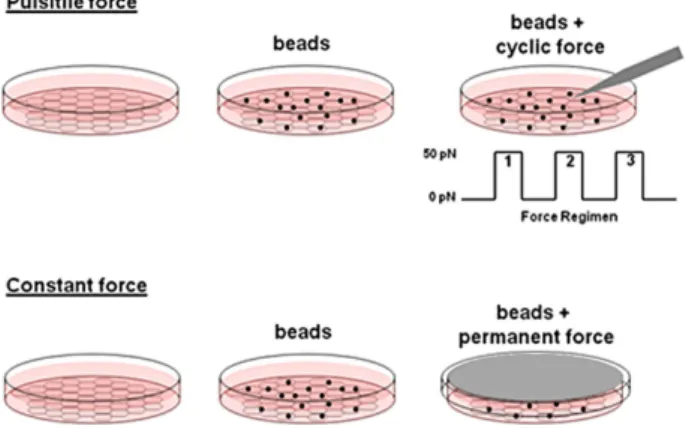
Tension imposed on cell surface receptors regulates cellular stiffness through activation of RhoA (Matthews et al., 2006; Guilluy et al., 2011b; Collins et al., 2012; Lessey-Morillon et al., 2014). To deter-mine whether JAM-A could support similar signaling responses, we used models of continuous and pulsatile force as outlined in Figure 1. Paramagnetic beads coated with a monoclonal antibody that recognizes the first Ig-like domain of JAM-A (Mandell et al., 2004) were added to cells, and pulsatile forces were applied using magnetic tweezers. Cell stiffening was determined by measuring bead displacement using single-particle analysis between successive pulling events. Alternatively, continuous force was gener-ated on JAM-A by suspending a magnet in parallel to the cells and followed by bio-chemical analysis.
We first wanted to determine whether forces through JAM-A activated RhoA. Ten-sion on anti–JAM-A coated beads increased RhoA activity, whereas addition of beads alone had no effect (Figure 2A). As a control, tension on poly-l-lysine (PLL)–coated beads did not activate RhoA (Figure 2B). Quantifi-cation of RhoA activation in response to ten-sion on JAM-A or PLL is shown in Figure 2, C and D, respectively. Previous reports also showed that tension on PLL does not acti-vate RhoA (Collins et al., 2012) or increase cell stiffness in response to force (Collins
et al., 2012; Barry et al., 2015). Because ten-sion on JAM-A increased RhoA activity, we determined the effect on cell stiffness. Ten-sion imposed on JAM-A increased cell stiff-ness, as evidenced by decreased bead dis-placement between pulse 1 and subsequent pulses (Figure 2E). As seen in Figure 2, F and G, inhibition of RhoA or Rho-associated protein kinase (Rho-associated, coiled-coil– containing protein kinase [ROCK]) pre-vented the decrease in bead displacement. These data indicate that tension on JAM-A activates RhoA to regulate cell stiffness. which have been implicated in supporting tension between cells
(Bazellieres et al., 2015; Tornavaca et al., 2015). These signaling events require the protein’s short C-terminus, which contains a PDZ-binding domain and at least two phosphorylation sites (Severson and Parkos, 2009; Iden et al., 2012; Naik et al., 2014). Through its
FIGURE 1: Overview of tension models. Cells were grown on fibronectin-coated substratum, and anti-JAM-A–coated paramagnetic beads were added at approximately a 3:1 bead-to-cell ratio. For application of pulsatile forces, the pole tip of a magnetic tweezers was lowered to 25 μm above the bead and force applied using a defined regimen. Bead displacement was imaged at 30 frames/s, and bead movement was tracked using custom software as described in
Materials and Methods. For application of continuous force, a magnet was suspended parallel to the apical surface of the cells for the determined time. Cells were then lysed and processed for biochemical analysis as needed.
data demonstrate that force on JAM-A acti-vates RhoA in a PI3K-dependent manner.
Tension imposed on JAM-A activates GEF-H1 and p115 RhoGEF to regulate RhoA activity
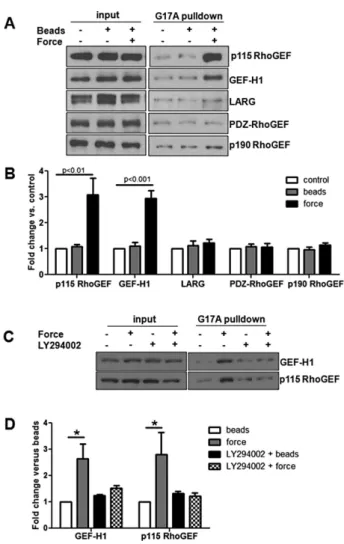
Rho family GTPases are regulated by the activity of GEFs and GAPs (Schmidt and Hall, 2002; Lessey et al., 2012). To deter-mine which GEFs were activated in re-sponse to tension imposed on JAM-A, we used a nucleotide-free RhoA pull-down as-say (Garcia-Mata et al., 2006; Guilluy et al., 2011a). As seen in Figure 4, A and B, ten-sion imposed on JAM-A increased the ac-tivity of GEF-H1 (ARHGEF2) and p115 Rho-GEF (ARHRho-GEF1) but not that of LARG, p190 RhoGEF, or PDZ RhoGEF. To deter-mine whether GEF-H1 and p115 RhoGEF were responsible for RhoA activation in re-sponse to tension on JAM-A, we knocked down the expression of these GEFs indi-vidually or together. As seen in Figure 5, A and B, small interfering RNA (siRNA)–medi-ated knockdown of GEF-H1 and p115 Rho-GEF individually did not prevent RhoA acti-vation in response to tension on JAM-A. However, knockdown of both GEFs con-comitantly prevented RhoA activation in this system. Of importance, knockdown of GEF-H1 and/or p115 RhoGEF did not alter JAM-A expression levels.
Because inhibition of PI3K blocked acti-vation of RhoA downstream of tension on JAM-A, we next investigated the protein’s role in the activation of GEF-H1 and p115 RhoGEF. As seen in Figure 5, C and D, inhi-bition of Akt with the inhibitor LY294002 pre-vented activation of the two GEFs. These data demonstrate that tension on JAM-A activates GEF-H1 and p115 RhoGEF, both of which are required for RhoA activation, all of which occur downstream of PI3K activation.
Tension imposed on JAM-A activates GEF-H1 through FAK/ ERK and p115 RhoGEF through Src family kinases
We next wanted to determine what pathways were leading to GEF-H1 and p115 RhoGEF activation downstream of tension on JAM-A. Previous reports showed that GEF-H1 can be activated downstream of FAK/ERK signaling in response to mechanical forces (Fujishiro
et al., 2008; Guilluy et al., 2011b; Collins et al., 2012). To determine whether a similar pathway was operating in our system, we exam-ined phosphorylation of FAK and ERK in response to tension on JAM-A and found increased phosphorylation of both proteins (Figure 6A). As shown in Figure 6B, the upstream inhibitor of ERK, U0126 (mitogen-activated protein kinase kinase [MEK] inhibitor), and FAK inhibitor 14 both inhibited GEF-H1 but had no effect on p115 RhoGEF activation. These results are quantified in Figure 6, C (GEF-H1) and D (p115 RhoGEF).
It was reported that p115 RhoGEF can be activated down-stream of JAK2 and protein kinase Cα (PKCα; Guilluy et al., 2010; Peng et al., 2011), and so we examined the involvement of these Previous studies showed that tension imposed on some
ad-hesion molecules activates RhoA via phosphoinositide 3 kinase (PI3K; Collins et al., 2012), and recent reports indicate that JAM-A regulates PI3K signaling (Nava et al., 2011; Tuncay et al., 2015). To determine whether PI3K participated in signaling in response to tension on JAM-A, we assessed colocalization be-tween beads and the PI3K sensor green fluorescent protein (GFP)–Akt-PH in the presence or absence of force. Tension im-posed on JAM-A recruited GFP-Akt-PH but not GFP alone to the beads, indicating activation of PI3K (Figure 3, A and B). No re-cruitment of GFP-Akt-PH occurred around PLL beads in the pres-ence or abspres-ence of force. To confirm that PI3K was activated in response to force on JAM-A, we examined phosphorylation of Akt. As seen in Figure 3C, tension imposed on JAM-A rapidly increased phosphorylation of Akt. We next wanted to see whether PI3K signaling was required for activation of RhoA. As seen in Figure 3, D and E, the PI3K inhibitor LY294002 prevented RhoA activation downstream of force on JAM-A. Together these
JAM-A phosphorylation is regulated by direct and global mechanical forces
JAM-A is phosphorylated at S285 in mice (S284 in humans) when the protein is localized to tight junctions (Iden et al., 2012). Be-cause tight junctions are regions of high RhoA activity (Priya et al., 2015), we hypothesized that increased tension on JAM-A homodi-mers within these zones could regulate this phosphorylation event. To test this hypothesis, we examined JAM-A phosphoryla-tion in response to tension on anti-JAM-A beads. Phosphorylaphosphoryla-tion of JAM-A S284 increases rapidly in response to tension on JAM-A (Figure 8A). We next tested to see whether this response was spe-cific to tension on JAM-A or was a general response to mechanical forces. With fluid shear stress as a model, JAM-A S284 phosphory-lation rapidly increased before returning to levels at or below baseline within 30 min of shear stress onset (Figure 8B). These data demonstrate that JAM-A phosphorylation is stimulated by mechanical forces.
JAM-A phosphorylation controls RhoA activation in response to tension
To determine whether S284 phosphorylation is required for RhoA activation in response to force on JAM-A, we generated a phos-phodeficient S284A mutant and expressed it along with empty vec-tor and wild-type A in CHO cells that lack endogenous JAM-A. Wild-type human JAM-A expressed in CHO-K1 cells is phosphorylated at S284 (Figure 9A), indicating that the necessary molecular components to control this modification are present. Further, expression of wild-type but not S284A JAM-A increased kinases in the activation of p115 RhoGEF in response to tension on
JAM-A. As seen in Figure 7A, neither inhibition of JAK2 with AG 490 nor inhibition of PKCα with Gö6976 prevented p115 RhoGEF activation in response to tension on JAM-A. To further confirm that PKCα was not required for p115 RhoGEF activation in response to tension on JAM-A, we used siRNA to knock down expression of the protein. As seen in Supplemental Figure S1, knockdown of PKCα did not prevent p115 RhoGEF activation in response to ten-sion on JAM-A. Other candidates for activating p115 RhoGEF are the SFKs, which are known to be activated by mechanical tension (Kostic and Sheetz, 2006; Guilluy et al., 2011b). Inhibition of SFKs with Su6656 caused a significant reduction in p115 RhoGEF activa-tion in response to tension on JAM-A (Figure 7, A and B). These data demonstrate that tension on JAM-A regulates GEF-H1 via FAK/ERK and p115 RhoGEF via SFKs.
FIGURE 4: Tension on JAM-A activates GEF-H1 and p115 RhoGEF via PI3K. HUVECs were exposed to anti-JAM-A–coated beads, and tension was imposed with a permanent magnet for 3 min. Activation of RhoA GEFs was determined using the GST-RhoAG17A pull-down
assay. (A) Representative Western blots. (B) Means ± SEM from at least three experiments. White bars are untreated control, gray bars are bead only, and black bars are beads plus 3 min of tension. To test for a role of PI3K in activation of GEFs, some cells were treated with LY294002 (10 μM, 30 min) before addition of beads. GEF activity was assessed using GST-RhoAG17A pull-down assay as described as methods (C). (D) White bars are bead only, gray bars are beads plus 3 min of tension, black bars are LY294002 plus beads, and checkered bars are LY29004 plus beads with tension for 3 min. Statistical analysis was conducted by t test.
JAM-A is phosphorylated at S284 through the actions of PKCζ (Iden et al., 2012). Previ-ous reports showed that PKCζ is regulated by mechanical forces (Disatnik et al., 2002; Suzuma et al., 2002; Heo et al., 2011), is regulated via PI3K (Mas et al., 2003; Sarkar
et al., 2006), and controls RhoA activity in some systems (Dovas et al., 2006). Therefore we investigated a role for PKCζ in activation of RhoA downstream of tension on JAM-A. As seen in Figure 10A, tension imposed on JAM-A increased phosphorylation of PKCζ. To test for a role in RhoA activation, we used a short-peptide inhibitor of PKCζ to block downstream signaling. As seen in Figure 10B, inhibition of PKCζ prevented RhoA acti-vation in response to force on JAM-A. Simi-larly, inhibition of PKCζ prevents cell stiffen-ing in response to force on JAM-A.
DISCUSSION
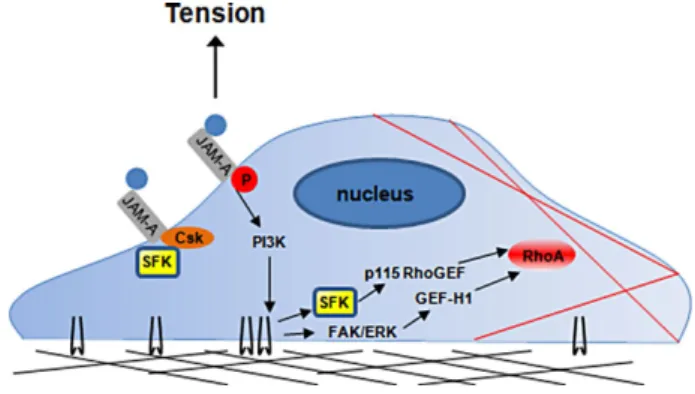
Before this study, a role for JAM-A in mecha-nosignaling was unknown. As diagrammed in Figure 11, we have shown that tension on JAM-A activates RhoA to control cell stiff-ness (Figure 2). Activation of RhoA in this system requires PI3K (Figure 3) and the combined activities of GEF-H1 and p115 RhoGEF (Figures 4 and 5). Activation of GEF-H1 depends on FAK/ERK (Figure 6), whereas activation of p115 RhoGEF de-pends on SFKs (Figure 7). Tension imposed on JAM-A or exposure to shear stress in-creases phosphorylation of JAM-A at S284 (Figure 8). Phosphorylation of JAM-A at S284 is required for activation of RhoA and increased cell stiffness in response to ten-sion on the protein (Figure 9). Finally, PKCζ
is required for activation of RhoA in re-sponse to force on JAM-A (Figure 10). Together these results identify JAM-A as a direct transducer of mechanical force, which activates RhoA to regulate cell stiffness. JAM-A exists in cells as monomers and cis- and trans -homodi-mers. At cell–cell junctions, JAM-A homodimers control barrier dy-namics (Aurrand-Lions et al., 2001a; Severson et al., 2008; Monteiro
et al., 2014). Regulation of barrier function requires interactions be-tween JAM-A’s extracellular domain as well as binding partner inter-actions mediated by the protein’s C-terminal PDZ-binding domain (Monteiro and Parkos, 2012). As a monomer, JAM-A has been shown to inhibit integrin signaling (Peddibhotla et al., 2013; Naik
et al., 2014), a function that is lost when the protein dimerizes. A possible explanation for the observations described here is that a monomeric form of JAM-A binds to the anti–JAM-A magnetic beads. Once placed under tension, the protein behaves as a ho-modimer similar to those found at cell–cell junctions. When local-ized within tight junctions, which are under high levels of tension (Priya et al., 2015), JAM-A is phosphorylated (Iden et al., 2012). Similarly, in our system, JAM-A S284 phosphorylation is rapidly in-creased by force imposed on the protein.
Monomeric JAM-A inhibits integrin signaling through interaction with CD9. Peddibhotla et al. (2013) reported that induction of barrier function in CHO cells (Figure 9B), as previously reported
(Iden et al., 2012), indicating functional differences between the mutant and wild-type protein. We first tested to see whether RhoA activation occurred in the JAM-A S284A mutant. Tension imposed on wild-type JAM-A but not on JAM-A S284A resulted in increased RhoA activity (Figure 9, C and D). As a control, anti-JAM-A beads were added to empty vector–transfected CHO cells, with no RhoA activation observed. Force imposed on wild-type JAM-A resulted in cell stiffening, whereas force imposed on cells expressing the S284A mutant did not (Figure 9, E and F). Attempts were made to measure bead displacement in empty vector–transfected cells, but this measurement was not possible because the beads did not at-tach to the cell surface and were drawn to the magnetic tweezers instantly. Similar to what was observed in human umbilical vein en-dothelial cells (HUVECs), cell stiffening in CHO cells could be inhib-ited by C3-transferase and Y-27632 (Figure 9, F and G, respec-tively), indicating that RhoA was responsible. These data demonstrate that JAM-A S284 phosphorylation is required for RhoA activation in response to tension on the protein.
FIGURE 6: GEF-H1 is activated downstream of FAK/ERK in response to tension on JAM-A. (A) HUVECs were incubated with anti-JAM-A–coated magnetic beads, and tension was applied for 0–5 min. Cells were lysed and analyzed for ERK and FAK phosphorylation by Western blot analysis. (B) HUVECs were incubated with anti-JAM-A–coated magnetic beads, and some cells were pretreated with the MEK inhibitor U0126 (25 μM) or FAK inhibitor 14 (2 μM) for 30 min before addition of beads, with some samples experiencing 3 min of force. RhoA GEF activity was assessed by GST-RhoAG17A pull-down assay. (C, D) Activation of GEF-H1 and p115 RhoGEF,
networks due to loss of monomer-associated signaling inhibition. Indeed, Tornavaca et al. (2015) showed that focal adhesions are more abundant in cells in which JAM-A has been knocked down. We observed a decrease in phosphorylation of Src at Y527, the site regulated by Csk, and an increase in FAK phosphorylation (Y397) in HUVECs in which JAM-A had been knocked down (Supplemental Figure S2). Increases in FAK phosphorylation in response to JAM-A knockdown could indicate increased RhoA activity or a disruption in focal adhesion turnover by regulating integrin recycling. With re-gard to this possibility, knockdown of JAM-A could lead to activa-tion of RhoA through activaactiva-tion of p115 RhoGEF. This raises the possibility that distinct pools of JAM-A exist to control spatiotempo-ral control of cellular contractility. Thus loss of JAM-A–mediated suppression of SFKs would result in increased RhoA activity or at least redistribution of active RhoA. Knockdown of JAM-A could also lead to increased FAK phosphorylation through decreased integrin recycling. Indeed, previous work showed a deficiency in β1 integrin recycling in JAM-A–null neutrophils, resulting in impaired chemo-taxis (Cera et al., 2009).
Previous reports demonstrated that cis- (Severson et al., 2008; Peddibhotla et al., 2013) and trans-dimerization (Monteiro et al., 2014) mutants of JAM-A control the protein’s function. In our model, JAM-A was engaged using an antibody that recognizes the first Ig-like domain, the region involved in dimerization. Alternatively, LFA-1 binds JAM-A in the protein’s second Ig-like domain. Binding of LFA-1 to JAM-A has been shown to destabilize homophilic interac-tions, possibly due to the fact that LFA-1/JAM-A binding can sup-port more tension than JAM-A dimers (Wojcikiewicz et al., 2009). Future studies using cis- and trans-dimerization mutants engaged with JAM-A/fc–coupled beads, anti–JAM-A–coupled beads, and LFA-1 I-domain beads engaged to the same proteins would provide further insight into the modes of mechanical forces supported by JAM-A.
The data in Figure 6 demonstrate that SFKs control p115 Rho-GEF activity. This is not surprising, because SFKs are known to be regulated by mechanical forces. SFK family members Fyn (Kostic and Sheetz, 2006; Chiu et al., 2008; Guilluy et al., 2011b; Fiore
et al., 2015), Src (Chaturvedi et al., 2007; Wijetunge and Hughes, 2007), Yes (Niediek et al., 2012), and Lyn (Alessandri-Haber et al., 2008; Hughan et al., 2014) are all activated in response to mechani-cal forces. Because SFKs are activated by force and Su6656 inhibits multiple SFKs (Blake et al., 2000), it is difficult to determine which kinase(s) are involved without extensive investigation. Fyn has been associated with activation of the RhoGEF LARG in response to force on integrins (Guilluy et al., 2011b). In our system, LARG was not activated in response to tension on JAM-A, but this does not neces-sarily rule out a role for Fyn in the activation of p115 RhoGEF, as the ligand and cell type used were different between these studies. Pre-vious work showed that p115 RhoGEF is activated in response to integrin engagement to fibronectin (Dubash et al., 2007), a process that likely involves a force component. Although this earlier study demonstrated that p115 RhoGEF was required for cell spreading onto fibronectin, it did not elucidate the mechanism of activation. Determining whether SFKs are responsible for p115 RhoGEF activa-tion after integrin engagement will be pursued in future work.
The present findings may be relevant for several physiological processes. When expressed on endothelial cells, JAM-A participates in leukocyte transendothelial migration by binding to LFA-1. It is known that crawling leukocytes impose forces on endothelial cells, resulting in regional stiffening responses (Schaefer and Hordijk, 2015). The present work demonstrates that forces imposed on JAM-A activate RhoA to elevate cell stiffness. This suggests that JAM-A dimers results in a disruption of a JAM-A/CD9/αvβ3
com-plex, leading to increased cell migration. Previous work also showed that activation of platelets results in increased JAM-A dimerization and phosphorylation, as well as decreased interaction with CD9 and
αIIbβ3 (Sobocka et al., 2004). Recently Naik et al. (2014) found that
JAM-A inhibits αIIbβ3 by suppressing SFK signaling. In this model,
monomeric JAM-A forms a complex with c Src-kinase (Csk) to inhibit integrin-Src complexes. Csk negatively regulates SFK family mem-bers via phosphorylation of a conserved tyrosine residue in the pro-tein’s C-terminus (Chong et al., 2005). In the context of the present work, tension on JAM-A would increase SFK signaling through dis-sociation of Csk and integrins. From another perspective, decreas-ing JAM-A expression should therefore increase similar signaldecreas-ing
FIGURE 7: Src family kinases activate p115 RhoGEF in response to tension on JAM-A. (A) HUVECs were incubated with inhibitors against JAK2 (AG 490, 25 μM), PKCα (Gö6976, 10 μM), or Src family kinases (su6656, 5 μM) for 30 min, followed by addition of anti-JAM-A– coated magnetic beads. Some cells also experienced force for 3 min. p115 RhoGEF activity was determined by RhoAG17A pull-down assay.
(B) Means ± SEM of at least three separate experiments *p < 0.05 vs. no-force control for each condition by t test.
JAM-A also plays a critical role when ex-pressed at cell–cell junctions, as absence of the protein affects the mechanical proper-ties of the cell (Hughan et al., 2014; Tornavaca et al., 2015). Breast cancer pro-vides an intriguing model for the present work. There are conflicting reports on a role for JAM-A in breast cancer. Whereas several studies demonstrated that elevated JAM-A expression is a predictive marker for invasive cellular behavior and poor clinical outcomes, other studies reached opposite conclusions (Naik et al., 2008; McSherry et al., 2009; Murakami et al., 2011; Huang et al., 2014). These studies focused exclusively on total JAM-A expression and did not examine posttranslational modifications such as S284 phosphorylation. Ebnet’s group discovered that JAM-A S284 phosphorylation is regu-lated by PKCζ and PP2A (Iden et al., 2012), which are often dysregulated in cancer (Switzer et al., 2011; Seshacharyulu et al., 2013; Yin et al., 2014). Thus cells expressing normal levels of JAM-A but that cannot reg-ulate phosphorylation of the protein would behave similarly to cells lacking JAM-A ex-pression. Investigating the levels of JAM-A phosphorylation and correlating these with cell behavior and clinical outcomes are fur-ther warranted.
This article has demonstrated that ten-sion on JAM-A activates RhoA to regulate cell stiffness. Activation of RhoA requires GEF-H1 and p115 RhoGEF, as well as phos-phorylation of JAM-A at S284. SFKs have been identified as novel regulators of p115 RhoGEF activation. It will be interesting to determine whether changes in JAM-A phos-phorylation occur during diseases in vivo, such as in cancers of epithelial origin and in vascular disease. Further studies are needed to identify the SFKs required for p115 Rho-GEF activation and to determine whether SFKs activate this GEF in other situations in which it is responsible for activating RhoA.
MATERIALS AND METHODS Cell lines and reagents
HUVECs were cultured in EBM2+ BulletKit (cells and media from Lonza, Rockville, MD). CHO-K1 cells were obtained from the Ameri-can Type Culture Collection (Manassas, VA) and grown in high-glucose DMEM supple-mented with 10% fetal bovine serum and antibiotic–antimycotic solu-tion (all from Life Technologies/ThermoFisher Scientific, Grand Island, NY). Y-27632 (ROCK inhibitor) was purchased from Millipore (Billerica, MA). Cell-permeable C3 (RhoA inhibitor) transferase was purchased from Cytoskeleton (Denver, CO). U0126 (MEK inhibitor), LY294002 (PI3K inhibitor), Su6656 (Src family kinase inhibitor), AG 490 (JAK2 inhibitor), Gö6976 (PKCα inhibitor), FAK inhibitor 14, and PKCζ pseu-dosubstrate were from Tocris (Minneapolis, MN). All other reagents were from Sigma-Aldrich (St. Louis, MO) unless otherwise noted. LFA-1/JAM-A interactions would elicit RhoA activation and promote
leukocyte migration. A similar pathway was demonstrated for ICAM-1, which also increases RhoA activity and cell stiffening in response to tension (Lessey et al., 2012). It is therefore not surprising that en-dothelial JAM-A is required for normal leukocyte trafficking to re-gions of inflammation (Woodfin et al., 2009; Lakshmi et al., 2012; Schmitt et al., 2014). Thus JAM-A and its downstream signaling net-work could represent a novel therapeutic target for controlling in-flammatory responses.
(sc-17430-R) was from Santa Cruz Biotechnology (Dallas, TX). Anti-bodies against LARG and PDZ-RhoGEF were custom produced by Pocono Rabbit Farms and Laboratories (Canadenesis, PA) and were previously described (Guilluy et al., 2011b). Anti-p190 RhoGEF was a generous gift of David Schlaepfer (University of California at San Diego, La Jolla, CA).
Application of continuous force
Magnetic beads were prepared as previously described (Lessey-Morillon et al., 2014). Briefly, anti–JAM-A clone J10.4 (sc-53623; Santa Cruz Biotechnology) was conjugated to 4.5-μm tosyl-acti-vated Dynabeads (ThermoFisher Scientific) in 0.1 M borate buffer, pH 9.5, according to the manufacturer’s protocol. After overnight incubation at 37°C with rotation, free sites were quenched by incu-bation with 0.1% fatty acid–free bovine serum albumin (BSA) for 1 h. For biochemical experiments, a continuous force calculated at
∼10 pN was applied to beads using a permanent ceramic magnetic (K&J Magnetics, Jamison, PA) as previously described (Guilluy et al., 2011b).
Detection of cellular stiffening
The same beads used for the application of continuous force were added to cells 10 min before being engaged using the University of North Carolina three-dimensional force microscope. The magnetic tweezers pole tip was positioned 25 μm above the monolayer, and a force regimen of 3 s of 50-pN force followed by 4 s of no force was applied for repeated cycles. Bead movement was captured using a 40× objective (Olympus UplanLN 40×/0.75) on an Olympus IX81-ZDC2 inverted microscope (Olympus, Waltham, MA) equipped with a high-speed Rolera EM-C2 camera (QImaging, Surrey, BC, Canada), using MetaMorph software at 30 frames/s. Bead movements were tracked by Video Spot Tracker (http://cismm.cs.unc.edu). From 11 to 27 beads per condition were tracked from at least two separate experiments. Data are presented as mean ± SEM relative to the first pull for each condition tested.
Shear stress
HUVECs were subjected to shear stress as previously described (Dardik et al., 2005). Briefly, cells were grown in six-well plates to siRNA, DNA constructs, and transfections
All cells were transfected using Lipofectamine 2000 (ThermoFisher Scientific) according to the manufacturer’s protocol. Human JAM-A expressed in pCDNA3.1 was previously described (Naik et al., 2001), and GFP-PH-Akt was a gift from Tamas Balla (Addgene plasmid 51465). Point mutagenesis to generate S284A used the following primers: forward, 5′ -AGAAGGTGATTTACAGCCAGCCTGCTGCCC-GAAGTGA-3′, and reverse, 5′ -TCACTTCGGGCAGCAGGCTGGCT-GTAAATCACCTTCT-3′. siRNA target sequences are as follows: GEF-H1 duplex 1 sense, 5′-UUUAAGAGAUCGUAGGCAA-3′; GEF-H1 duplex 2 sense, 5′-AGACAGAGGAUGAGGCUUA-3′; p115 RhoGEF duplex 1 sense, 5′-GGGCUGAGGAUGAGGAUUU-3′; p115 RhoGEF duplex 2 sense, 5′-CCACAGAACGGGAGAAAGU-3′; JAM-A duplex 1 sense, 5′CGAGUAAGAAGGUGAUUUA-3′; JAM-A duplex 2 sense, 5′-AGGCGCAAGUCGAGAGGAA-3′; PKCα duplex, 5′ -AAGAAG-AAGGUGAGUACUA-3′; and control sense, 5′ -UAAGGCUAUG-AAGAGAUAC-3′.
Antibodies
The following antibodies were used for Western blot analysis: anti– GEF-H1 (4076), anti-p115RhoGEF (3669), anti-RhoA (2117), anti– phospho-FAK (3283), anti–phospho-Erk1/2 (4370), phospho-Akt (2965), FAK (3285), and ERK (9102) were purchased from Cell Sig-naling (Danvers, MA), anti-JAM-A (612120) was from BD Transduc-tion Laboratories (Forest Lakes, NJ), and anti–phospho-JAM-A
FIGURE 10: Force on JAM-A regulates PKCζ to activate RhoA. HUVECs were incubated with anti–JAM-A beads in the presence or absence of forces, and PKCζ phosphorylation was determined by Western blot (A). HUVECs were incubated with anti-JAM-A–coated magnetic beads, and some cells were exposed to force for 3 min. Some cells had been pretreated with PKCζ inhibitory peptide. RhoA activity was determined by the RBD pull-down assay (B). Cell stiffness was determined in HUVECs after tension was imposed on anti-JAM-A–coated beads in the presence of PKCζ inhibitor as described in Materials and Methods (C).
Student’s t test between beads only and beads plus force was calcu-lated for each construct or ligand. In all instances, p < 0.05 was considered significant, and all calculations were conducted in GraphPad Prism 5.1.
confluence, switched to 3 ml of serum-free medium for 2 h, and then rotated at 210 rpm for the indicated times. Lysates were col-lected for Western blot analysis.
RhoA activity assay
Cells were lysed for analysis of RhoA (10 mM MgCl2, 500 mM NaCl, 50 mM Tris, pH 7.6, 1% Triton X-100, 0.1% SDS, 0.5% deoxycholate, 1 mM phenylmethylsulfonyl fluoride [PMSF], and 10 μg/ml aprotinin and leupeptin) and cleared at 14,000 ×g for 5 min. Lysates were incubated with 50 μg of glutathione-Sepharose–bound glutathione
S-transferase (GST)–RBD (Rhotekin-binding domain) for 30 min at 4°C with gentle rocking. Beads were then washed three times in 50 mM Tris, pH 7.6, 10 mM MgCl2, 150 mM NaCl, 1% Triton X-100,
1 mM PMSF, and 10 μg/ml aprotinin and leupeptin. Released pro-teins and reserved input control were subjected to Western blot analysis as described later.
GEF activity assay
Active RhoA GEFs were assayed using GST-RhoA G17A as de-scribed previously (Guilluy et al., 2011a). Cells were lysed in 150 mM NaCl, 20 mM 4-(2-hydroxyethyl)-1-piperazineethanesulfonic acid, pH 7.6, 10 mM MgCl2, 1% Triton X-100, 1 mM PMSF, and 10 μg/ml aprotinin and leupeptin and incubated with 50 μg/ml glutathione-Sepharose–bound GST-RhoAG17A for 60 min at 4°C and washed in
the lysis buffer. Samples were then analyzed by Western blotting as described later.
Barrier function analysis
Cells were seeded (5 × 10⁴ cells/well) onto fibronectin-coated
(10 μg/ml) 0.4-μm polycarbonate Transwell membranes (Corning). Forty-eight hours after plating, fluorescein isothiocyanate (FITC)– dextran (10 kDa; Sigma-Aldrich) at a final concentration of 1 mg/ml was added to the upper chamber. After 2 h of incubation, medium from the bottom chamber was collected. Medium was transferred to a black-walled 96-well microtiter plate (Corning), and fluorescence intensity was analyzed using a plate reader (excitation 485 nm, emis-sion 520 nm; Tecan).
Western blotting
Samples were resolved on 12% (RhoA) or 8% (all other proteins) poly-acrylamide gels (Sambrook and Russell, 2001) in the presence of SDS. Resolved gels were transferred onto nitrocellulose membranes, blocked with 5% BSA in Tris-buffered saline (25 mM Tris, pH 7.6, 150 mM NaCl) plus 0.1% Tween-20 (TBST) and incubated with pri-mary antibody overnight at 4°C with gentle rocking. Blots were washed extensively in TBST before being incubated with species-appropriate horseradish peroxidase–conjugated secondary antibody (Jackson Laboratories) for 1 h at room temperature. Blots were again washed in TBST, and fluorescence was detected using enhanced chemiluminescent reagent (ThermoFisher Scientific) and x-ray film.
PI3K activation
Two days after transfection, cells were plated on fibronectin-coated (10 μg/ml) glass coverslips for 6 h before being incubated with beads. Some cells experienced force for 1 min. Cells were fixed in 4% paraformaldehyde, and images were captured on a Zeiss Axio-vert 200 M microscope equipped with a Hamamatsu ORCA-ERAG digital camera.
Statistical analysis
For analysis of cell stiffness, Student’s t test between pulse 1 and each subsequent pulse was calculated. For GFP-PH localization,
ACKNOWLEDGMENTS
We thank Richard Superfine and Timothy O’Brien, III for access and assistance with magnetic tweezers experiments. This work was sup-ported by American Heart Association Postdoctoral Fellowship 15POST24470070 to D.W.S. and National Institutes of Health Grants GM029860, GM103723, and HL114388 to K.B.
REFERENCES
Alessandri-Haber N, Dina OA, Joseph EK, Reichling DB, Levine JD (2008). Interaction of transient receptor potential vanilloid 4, integrin, and SRC tyrosine kinase in mechanical hyperalgesia. J Neurosci 28, 1046–1057. Aurrand-Lions M, Duncan L, Ballestrem C, Imhof BA (2001a). JAM-2, a novel
immunoglobulin superfamily molecule, expressed by endothelial and lymphatic cells. J Biol Chem 276, 2733–2741.
Aurrand-Lions M, Johnson-Leger C, Wong C, Du Pasquier L, Imhof BA (2001b). Heterogeneity of endothelial junctions is reflected by differen-tial expression and specific subcellular localization of the three JAM fam-ily members. Blood 98, 3699–3707.
Barry AK, Wang N, Leckband DE (2015). Local VE-cadherin mechanotrans-duction triggers long-ranged remodeling of endothelial monolayers. J Cell Sci 128, 1341–1351.
Barton ES, Forrest JC, Connolly JL, Chappell JD, Liu Y, Schnell FJ, Nusrat A, Parkos CA, Dermody TS (2001). Junction adhesion molecule is a recep-tor for reovirus. Cell 104, 441–451.
Bazellieres E, Conte V, Elosegui-Artola A, Serra-Picamal X, Bintanel-Morcillo M, Roca-Cusachs P, Munoz JJ, Sales-Pardo M, Guimera R, Trepat X (2015). Control of cell-cell forces and collective cell dynamics by the intercellular adhesome. Nat Cell Biol 17, 409–420.
Blake RA, Broome MA, Liu X, Wu J, Gishizky M, Sun L, Courtneidge SA (2000). SU6656, a selective src family kinase inhibitor, used to probe growth factor signaling. Mol Cell Biol 20, 9018–9027.
Campbell JA, Schelling P, Wetzel JD, Johnson EM, Forrest JC, Wilson GA, Aurrand-Lions M, Imhof BA, Stehle T, Dermody TS (2005). Junctional adhesion molecule a serves as a receptor for prototype and field-isolate strains of mammalian reovirus. J Virol 79, 7967–7978.
Cera MR, Fabbri M, Molendini C, Corada M, Orsenigo F, Rehberg M, Reichel CA, Krombach F, Pardi R, Dejana E (2009). JAM-A promotes neutrophil chemotaxis by controlling integrin internalization and recy-cling. J Cell Sci 122, 268–277.
Chaturvedi LS, Marsh HM, Basson MD (2007). Src and focal adhesion kinase mediate mechanical strain-induced proliferation and ERK1/2 phos-phorylation in human H441 pulmonary epithelial cells. Am J Physiol Cell Physiol 292, C1701–C1713.
Chiu YJ, McBeath E, Fujiwara K (2008). Mechanotransduction in an extracted cell model: Fyn drives stretch- and flow-elicited PECAM-1 phosphorylation. J Cell Biol 182, 753–763.
Chong YP, Mulhern TD, Cheng HC (2005). C-terminal Src kinase (CSK) and CSK-homologous kinase (CHK)–endogenous negative regulators of Src-family protein kinases. Growth Factors 23, 233–244.
Chrzanowska-Wodnicka M, Burridge K (1996). Rho-stimulated contractility drives the formation of stress fibers and focal adhesions. J Cell Biol 133, 1403–1415.
Collins C, Guilluy C, Welch C, O’Brien ET, Hahn K, Superfine R, Burridge K, Tzima E (2012). Localized tensional forces on PECAM-1 elicit a global mechanotransduction response via the integrin-RhoA pathway. Curr Biol 22, 2087–2094.
Dardik A, Chen L, Frattini J, Asada H, Aziz F, Kudo FA, Sumpio BE (2005). Differential effects of orbital and laminar shear stress on endothelial cells. Eur J Vasc Surg 41, 869–880.
Disatnik MH, Boutet SC, Lee CH, Mochly-Rosen D, Rando TA (2002). Sequential activation of individual PKC isozymes in integrin-mediated muscle cell spreading: a role for MARCKS in an integrin signaling path-way. J Cell Sci 115, 2151–2163.
McSherry EA, McGee SF, Jirstrom K, Doyle EM, Brennan DJ, Landberg G, Dervan PA, Hopkins AM, Gallagher WM (2009). JAM-A expression positively correlates with poor prognosis in breast cancer patients. Int J Cancer 125, 1343–1351.
Monteiro AC, Luissint AC, Sumagin R, Lai C, Vielmuth F, Wolf MF, Laur O, Reiss K, Spindler V, Stehle T, et al. (2014). Trans-dimerization of JAM-A regulates Rap2 and is mediated by a domain that is distinct from the cis-dimerization interface. Mol Biol Cell 25, 1574–1585.
Monteiro AC, Parkos CA (2012). Intracellular mediators of JAM-A-depen-dent epithelial barrier function. Ann NY Acad Sci 1257, 115–124. Murakami M, Giampietro C, Giannotta M, Corada M, Torselli I, Orsenigo F,
Cocito A, d’Ario G, Mazzarol G, Confalonieri S, et al. (2011). Abrogation of junctional adhesion molecule-A expression induces cell apoptosis and reduces breast cancer progression. PloS One 6, e21242.
Naik MU, Caplan JL, Naik UP (2014). Junctional adhesion molecule-A sup-presses platelet integrin alphaIIbbeta3 signaling by recruiting Csk to the integrin-c-Src complex. Blood 123, 1393–1402.
Naik UP, Ehrlich YH, Kornecki E (1995). Mechanisms of platelet activation by a stimulatory antibody: cross-linking of a novel platelet receptor for monoclonal antibody F11 with the Fc gamma RII receptor. Biochem J 310, 155–162.
Naik UP, Naik MU, Eckfeld K, Martin-DeLeon P, Spychala J (2001). Charac-terization and chromosomal localization of JAM-1, a platelet receptor for a stimulatory monoclonal antibody. J Cell Sci 114, 539–547.
Naik MU, Naik TU, Suckow AT, Duncan MK, Naik UP (2008). Attenuation of junctional adhesion molecule-A is a contributing factor for breast cancer cell invasion. Cancer Res 68, 2194–2203.
Nava P, Capaldo CT, Koch S, Kolegraff K, Rankin CR, Farkas AE, Feasel ME, Li L, Addis C, Parkos CA, et al. (2011). JAM-A regulates epithe-lial proliferation through Akt/beta-catenin signalling. EMBO Rep 12, 314–320.
Nelson CM, Pirone DM, Tan JL, Chen CS (2004). Vascular endothelial-cad-herin regulates cytoskeletal tension, cell spreading, and focal adhesions by stimulating RhoA. Mol Biol Cell 15, 2943–2953.
Niediek V, Born S, Hampe N, Kirchgessner N, Merkel R, Hoffmann B (2012). Cyclic stretch induces reorientation of cells in a Src family kinase- and p130Cas-dependent manner. Eur J Cell Biol 91, 118–128.
Ostermann G, Weber KS, Zernecke A, Schroder A, Weber C (2002). JAM-1 is a ligand of the beta(2) integrin LFA-1 involved in transendothelial migration of leukocytes. Nat Immunol 3, 151–158.
Peddibhotla SS, Brinkmann BF, Kummer D, Tuncay H, Nakayama M, Adams RH, Gerke V, Ebnet K (2013). Tetraspanin CD9 links junctional adhesion molecule-A to alphavbeta3 integrin to mediate basic fibroblast growth factor-specific angiogenic signaling. Mol Biol Cell 24, 933–944. Peng J, He F, Zhang C, Deng X, Yin F (2011). Protein kinase C-alpha signals
P115RhoGEF phosphorylation and RhoA activation in TNF-alpha-induced mouse brain microvascular endothelial cell barrier dysfunction. J Neuroinflammation 8, 28.
Priya R, Gomez GA, Budnar S, Verma S, Cox HL, Hamilton NA, Yap AS (2015). Feedback regulation through myosin II confers robustness on RhoA signalling at E-cadherin junctions. Nat Cell Biol 17, 1282–1293. Sambrook J, Russell DW (2001). Molecular Cloning: A Laboratory Manual,
Cold Spring Harbor, NY: Cold Spring Harbor Laboratory Press. Sarkar S, Bananis E, Nath S, Anwer MS, Wolkoff AW, Murray JW (2006).
PKCzeta is required for microtubule-based motility of vesicles containing the ntcp transporter. Traffic 7, 1078–1091.
Schaefer A, Hordijk PL (2015). Cell-stiffness-induced mechanosignaling— a key driver of leukocyte transendothelial migration. J Cell Sci 128, 2221–2230.
Schaefer A, Te Riet J, Ritz K, Hoogenboezem M, Anthony EC, Mul FP, de Vries CJ, Daemen MJ, Figdor CG, van Buul JD, et al. (2014). Actin-binding proteins differentially regulate endothelial cell stiffness, ICAM-1 function and neutrophil transmigration. J Cell Sci 127, 4470–4482. Schmidt A, Hall A (2002). Guanine nucleotide exchange factors for Rho
GTPases: turning on the switch. Genes Dev 16, 1587–1609. Schmitt MM, Megens RT, Zernecke A, Bidzhekov K, van den Akker NM,
Rademakers T, van Zandvoort MA, Hackeng TM, Koenen RR, Weber C (2014). Endothelial junctional adhesion molecule-a guides monocytes into flow-dependent predilection sites of atherosclerosis. Circulation 129, 66–76.
Seshacharyulu P, Pandey P, Datta K, Batra SK (2013). Phosphatase: PP2A structural importance, regulation and its aberrant expression in cancer. Cancer Lett 335, 9–18.
Severson EA, Jiang L, Ivanov AI, Mandell KJ, Nusrat A, Parkos CA (2008). Cis-dimerization mediates function of junctional adhesion molecule A. Mol Biol Cell 19, 1862–1872.
Dubash AD, Wennerberg K, Garcia-Mata R, Menold MM, Arthur WT, Burridge K (2007). A novel role for Lsc/p115 RhoGEF and LARG in regulating RhoA activity downstream of adhesion to fibronectin. J Cell Sci 120, 3989–3998.
Fiore VF, Strane PW, Bryksin AV, White ES, Hagood JS, Barker TH (2015). Conformational coupling of integrin and Thy-1 regulates Fyn priming and fibroblast mechanotransduction. J Cell Biol 211, 173–190. Fujishiro SH, Tanimura S, Mure S, Kashimoto Y, Watanabe K, Kohno M
(2008). ERK1/2 phosphorylate GEF-H1 to enhance its guanine nucleo-tide exchange activity toward RhoA. Bioche Biophys Res Commun 368, 162–167.
Garcia-Mata R, Wennerberg K, Arthur WT, Noren NK, Ellerbroek SM, Burridge K (2006). Analysis of activated GAPs and GEFs in cell lysates. Methods Enzymol 406, 425–437.
Guilluy C, Bregeon J, Toumaniantz G, Rolli-Derkinderen M, Retailleau K, Loufrani L, Henrion D, Scalbert E, Bril A, Torres RM, et al. (2010). The Rho exchange factor Arhgef1 mediates the effects of angiotensin II on vascular tone and blood pressure. Nat Med 16, 183–190.
Guilluy C, Dubash AD, Garcia-Mata R (2011a). Analysis of RhoA and Rho GEF activity in whole cells and the cell nucleus. Nat Protoc 6, 2050–2060. Guilluy C, Swaminathan V, Garcia-Mata R, O’Brien ET, Superfine R, Burridge
K (2011b). The Rho GEFs LARG and GEF-H1 regulate the mechanical response to force on integrins. Nat Cell Biol 13, 722–727.
Heemskerk N, van Rijssel J, van Buul JD (2014). Rho-GTPase signaling in leukocyte extravasation: an endothelial point of view. Cell Adh Migr 8, 67–75.
Heo KS, Lee H, Nigro P, Thomas T, Le NT, Chang E, McClain C, Reinhart-King CA, Reinhart-King MR, Berk BC, et al. (2011). PKCzeta mediates disturbed flow-induced endothelial apoptosis via p53 SUMOylation. J Cell Biol 193, 867–884.
Huang JY, Xu YY, Sun Z, Wang ZN, Zhu Z, Song YX, Luo Y, Zhang X, Xu HM (2014). Low junctional adhesion molecule A expression correlates with poor prognosis in gastric cancer. J Surg Res 192, 494–502.
Hughan SC, Spring CM, Schoenwaelder SM, Sturgeon S, Alwis I, Yuan Y, McFadyen JD, Westein E, Goddard D, Ono A, et al. (2014). Dok-2 adap-tor protein regulates the shear-dependent adhesive function of platelet integrin alphaIIbbeta3 in mice. J Biol Chem 289, 5051–5060.
Iden S, Misselwitz S, Peddibhotla SS, Tuncay H, Rehder D, Gerke V, Robenek H, Suzuki A, Ebnet K (2012). aPKC phosphorylates JAM-A at Ser285 to promote cell contact maturation and tight junction formation. J Cell Biol 196, 623–639.
Kostic A, Sheetz MP (2006). Fibronectin rigidity response through Fyn and p130Cas recruitment to the leading edge. Mol Biol Cell 17, 2684–2695.
Lakshmi SP, Reddy AT, Naik MU, Naik UP, Reddy RC (2012). Effects of JAM-A deficiency or blocking antibodies on neutrophil migration and lung injury in a murine model of ALI. Am J Physiol Lung Cell Mol Physiol 303, L758–L766.
Lessey EC, Guilluy C, Burridge K (2012). From mechanical force to RhoA activation. Biochemistry 51, 7420–7432.
Lessey-Morillon EC, Osborne LD, Monaghan-Benson E, Guilluy C, O’Brien ET, Superfine R, Burridge K (2014). The RhoA guanine nucleotide exchange factor, LARG, mediates ICAM-1-dependent mechanotrans-duction in endothelial cells to stimulate transendothelial migration. J Immunol 192, 3390–3398.
Liu Z, Sniadecki NJ, Chen CS (2010). Mechanical forces in endothelial cells during firm adhesion and early transmigration of human monocytes. Cell Mol Bioeng 3, 50–59.
Mandell KJ, McCall IC, Parkos CA (2004). Involvement of the junctional adhesion molecule-1 (JAM1) homodimer interface in regulation of epi-thelial barrier function. J Biol Chem 279, 16254–16262.
Marjoram RJ, Lessey EC, Burridge K (2014). Regulation of RhoA activity by adhesion molecules and mechanotransduction. Curr Mol Med 14, 199–208.
Martin-Padura I, Lostaglio S, Schneemann M, Williams L, Romano M, Fruscella P, Panzeri C, Stoppacciaro A, Ruco L, Villa A, et al. (1998). Junctional adhesion molecule, a novel member of the immunoglobulin superfamily that distributes at intercellular junctions and modulates monocyte transmigration. J Cell Biol 142, 117–127.
Mas VM, Hernandez H, Plo I, Bezombes C, Maestre N, Quillet-Mary A, Filomenko R, Demur C, Jaffrezou JP, Laurent G (2003). Protein kinase Czeta mediated Raf-1/extracellular-regulated kinase activation by dau-norubicin. Blood 101, 1543–1550.
adherens junctions, cell-cell tension, angiogenesis, and barrier forma-tion. J Cell Biol 208, 821–838.
Tuncay H, Brinkmann BF, Steinbacher T, Schurmann A, Gerke V, Iden S, Ebnet K (2015). JAM-A regulates cortical dynein localization through Cdc42 to control planar spindle orientation during mitosis. Nat Commun 6, 8128. Wijetunge S, Hughes AD (2007). Src family tyrosine kinases mediate
con-traction of rat isolated tail arteries in response to a hyposmotic stimulus. J Hypertens 25, 1871–1878.
Wojcikiewicz EP, Koenen RR, Fraemohs L, Minkiewicz J, Azad H, Weber C, Moy VT (2009). LFA-1 binding destabilizes the JAM-A homophilic interaction during leukocyte transmigration. Trends Pharmacol Sci 96, 285–293.
Woodfin A, Voisin MB, Imhof BA, Dejana E, Engelhardt B, Nourshargh S (2009). Endothelial cell activation leads to neutrophil transmigration as supported by the sequential roles of ICAM-2, JAM-A, and PECAM-1. Blood 113, 6246–6257.
Yin J, Liu Z, Li H, Sun J, Chang X, Liu J, He S, Li B (2014). Association of PKCzeta expression with clinicopathological characteristics of breast cancer. PloS One 9, e90811.
Zhao XH, Laschinger C, Arora P, Szaszi K, Kapus A, McCulloch CA (2007). Force activates smooth muscle alpha-actin promoter activity through the Rho signaling pathway. J Cell Sci 120, 1801–1809.
Severson EA, Parkos CA (2009). Mechanisms of outside-in signaling at the tight junction by junctional adhesion molecule A. Ann NY Acad Sci 1165, 10–18.
Sobocka MB, Sobocki T, Babinska A, Hartwig JH, Li M, Ehrlich YH, Kornecki E (2004). Signaling pathways of the F11 receptor (F11R; a.k.a. JAM-1, JAM-A) in human platelets: F11R dimerization, phosphorylation and complex formation with the integrin GPIIIa. J Recept Signal Transduct Res 24, 85–105.
Stroka KM, Aranda-Espinoza H (2011). Endothelial cell substrate stiffness influences neutrophil transmigration via myosin light chain kinase-de-pendent cell contraction. Blood 118, 1632–1640.
Suzuma I, Suzuma K, Ueki K, Hata Y, Feener EP, King GL, Aiello LP (2002). Stretch-induced retinal vascular endothelial growth factor expression is mediated by phosphatidylinositol 3-kinase and protein kinase C (PKC)-zeta but not by stretch-induced ERK1/2, Akt, Ras, or classical/novel PKC pathways. J Biol Chem 277, 1047–1057.
Switzer CH, Glynn SA, Ridnour LA, Cheng RY, Vitek MP, Ambs S, Wink DA (2011). Nitric oxide and protein phosphatase 2A provide novel thera-peutic opportunities in ER-negative breast cancer. Trends Pharmacol Sci 32, 644–651.