Proposed Approach to Build Semantic Learner Model
in Adaptive E-Learning
Khaled M. Fouad
Computer Science Dept., Community College, Taif University, Kingdom of Saudi
Arabia (KSA).
ABSTRACT
In the context of E-learning, adaptive systems are more specialized and focus on the adaptation of learning content and the presentation of this content. The adaptive E-learning system focuses on how the profile data is learned by the learner and pays attention to learning activities, cognitive structures and the context of the learning material. The system controls the process of collecting data about the learner, the process of acquiring the learner profile and during the adaptation process.
The Semantic Web adds structured meaning and organization to the navigational data of the current web, based on formalized ontologies and controlled vocabularies with semantic links to each other. The semantic web-based educational systems need to interoperate, collaborate and exchange content or re-use functionality.
In this paper, the proposed approach aims at improving representation of a learner model during acquiring leaner profile, which is based on learner interest and learning style, in content-based approaches by performing the next steps. First step is domain concept filtering in which concepts and items of interests are compared to the domain ontology to check the relevant items to the selected learning domain using ontology based semantic similarity. Second step is incorporating semantic content into the term vectors. Term definitions and relations are used, provided by WordNet ontology, to perform domain-specific concepts as category labels for the semantic learner models. The Learning style of the learner can be acquired by using the learner behavior during utilizing the E-learning system.
General Terms
Semantic Web, WordNet. E-Learning.
Keywords
Learner Model, Learner Interest, Learning Style, Ontology, Domain Concept Filtering, Semantic Similarity, Semantic Learner Model.
1.
INTRODUCTION
Learning environment allows learners to access electronic course contents through the network and study them in virtual classrooms. It brings many benefits in comparison with conventional learning paradigm, e.g. learning can be taken at any time and at any place. However, with the rapid increase of learning content on the Web, it will be time-consuming for learners to find contents they really want to and need to study. The challenge in an information-rich world is not only to make information available to people at any time, at any place, and in any form, but to offer the right thing to the right person in the right way [1].
[image:1.595.330.528.345.434.2]In the context of e-learning [2], adaptive systems are more specialized and focus on the adaptation of learning content and the presentation of this content. According to [3], an adaptive system focuses on how the profile data is learned by the learner and pays attention to learning activities, cognitive structures and the context of the learning material. In Figure 1, the structure of an adaptive system [4] is shown. The system intervenes at three stages during the process of adaptation. It controls the process of collecting data about the learner, the process of building up the learner model (user modeling) and during the adaptation process.
Figure 1: The Structure of an Adaptive System [4].
An advanced e-learning system has to comply with the following requirements [5]:
Personalization: This requirement suggests that the learning process needs to take into account the user‟s preferences and personal needs. This implies either that the user is in a position to specify explicitly these preferences or that the system has the ability to infer them through a monitoring process. The latter is far more convenient for the end-user and constitutes a highly desirable feature.
Adaptivity: The user‟s preferences change over time and the system must be able to track them and properly adjust to them. By „properly‟, it is implied that the whole history of the user‟s learning behavior must be taken into consideration, and not just the user‟s latest (most recent) actions.
Extensibility: An e-learning system has to be extensible in terms of the learning material it provides. The incorporation of new courses and resources must be an easy to accomplish the task.
Interoperability: An e-learning system must be able to both access content from and provide content to digital libraries and other e-learning systems. In this way, the provision of enriched and updated content is feasible.
The semantic web [6] is a space understandable and navigable by both human and software agents. It adds structured meaning and organization to the navigational data of the current web, based on formalized ontologies and controlled vocabularies with semantic links to each other. From the
E-Data about User
User Model
System User Modeling
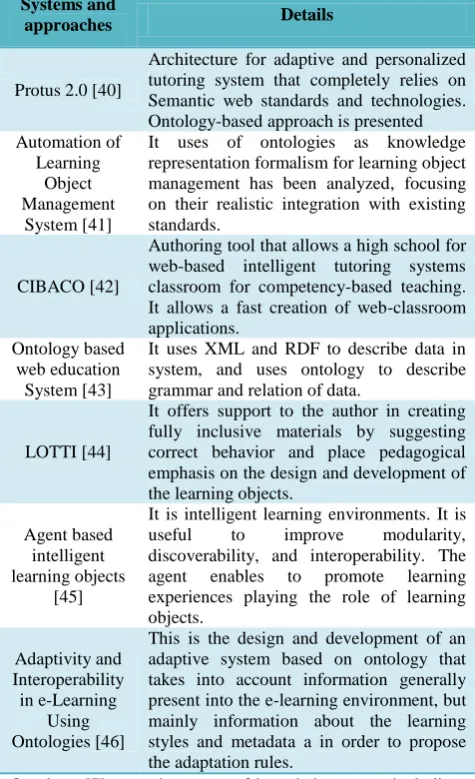
Learning perspective, it aids learners in locating, accessing, querying, processing, and assessing learning resources across a distributed heterogeneous network; it also aids instructors in creating, locating, using, reusing, sharing and exchanging learning objects (data and components). The semantic web-based educational systems need to interoperate, collaborate and exchange content or re-use functionality. Table 1 shows the comparative study of existing approaches of the proposed scheme.
Table 1. Comparative study of number of existing systems and approaches
Systems and
approaches Details
Protus 2.0 [40]
Architecture for adaptive and personalized tutoring system that completely relies on Semantic web standards and technologies. Ontology-based approach is presented Automation of
Learning Object Management
System [41]
It uses of ontologies as knowledge representation formalism for learning object management has been analyzed, focusing on their realistic integration with existing standards.
CIBACO [42]
Authoring tool that allows a high school for web-based intelligent tutoring systems classroom for competency-based teaching. It allows a fast creation of web-classroom applications.
Ontology based web education System [43]
It uses XML and RDF to describe data in system, and uses ontology to describe grammar and relation of data.
LOTTI [44]
It offers support to the author in creating fully inclusive materials by suggesting correct behavior and place pedagogical emphasis on the design and development of the learning objects.
Agent based intelligent learning objects
[45]
It is intelligent learning environments. It is useful to improve modularity, discoverability, and interoperability. The agent enables to promote learning experiences playing the role of learning objects.
Adaptivity and Interoperability in e-Learning
Using Ontologies [46]
This is the design and development of an adaptive system based on ontology that takes into account information generally present into the e-learning environment, but mainly information about the learning styles and metadata a in order to propose the adaptation rules.
Ontology [7] comprises a set of knowledge terms, including the vocabulary, the semantic interconnections, and some simple rules of inference and logic for some particular topic. Ontologies applied to the Web are creating the Semantic Web. Ontologies [8] facilitate knowledge sharing and reuse, i.e. a common understanding of various contents that reach across people and applications. Using ontology in learning environments aims to provide mechanisms to enhance the process of searching and finding learning resources and have the capability to organize and display information that make it easier for learners to draw connections, for instance, by visualizing relationships among concepts and ideas.
This paper aims at proposing an approach to improve the representation of a learner model; that is based on learner interest and learning style of the learner, during acquiring leaner profile by performing the next steps. First step is the domain concept filtering in which concepts and items of
interests are compared to the domain ontology to check the relevant items to the learning domain using ontology based semantic similarity. Second step is incorporating semantic content into the term vectors. Term definitions and relations are used, provided by WordNet, to perform domain-specific concepts as category labels for the semantically enhanced learner models. The Learning style of the learner can be acquired by using the learner behavior during utilizing the E-learning system.
2.
RELATED WORKS
The authors in [9] proposed an ontological approach for semantic-aware learning object retrieval. The proposed ontological approach has two significant novelties: a fully automatic ontology query expansion algorithm for inferring and aggregating user intentions based on their short queries.
The personalized e-learning method was proposed in [10]. The e-learning method is based on hybrid filtering. Two-level user profiles direct the recommendation process. Group profile reflects the users whose similar learning needs are similar with the current user. Topic profile describes the user‟s interests with topics that the user has learned. Group profile and topic profile are bases of collaborative filtering recommendation and content-based filtering recommendation respectively.
Reformat and Koosha in [11] introduced a method for learning and updating a user profile automatically. The proposed method belongs to implicit techniques – it processes and analyzes behavioral patterns of user activities on the web, and modifies a user profile based on extracted information from user‟s logs. The method relies on analysis of web-logs for discovering concepts and items representing user‟s current and new interests. Those found concepts and items are compared with items from a user profile, and the most relevant ones are added to this profile. The mechanism used for identifying relevant items is built based on a newly introduced concept of ontology-based semantic similarity.
In [12], authors illustrated a novel design and development of an agent and ontology based service discovery and personalization framework. In particular, ontological user profiling was applied to capture users‟ possibly changing information/service requirements, and probabilistic language modeling was exploited to develop an effective mechanism for user query contextualization based on both current and past search history. As user queries are usually short e.g., only 2.x words long on average, query personalization and contextualization is essential for effective Web service discovery. Their initial experiments had shown that the proposed ontological user profiling and probabilistic language modeling mechanisms were promising. Users interact with their agents who will in-turn looking up the most relevant Web services from the external service registries on behalf of their users.
3.
THE ARCHITECTURE OF
PROPOSED APPROACH
The proposed approach can provide adaptive learning support according to the learner's individual differences, promote learners to study initiatively, and achieve the knowledge construction. It can provide the adaptive learning content based on the learner's interest and learning style.
approach is mainly composed of three basic processes: acquiring Learner Interest, semantic learner interest representation, and acquiring learning style of the learner based on learner behavior in the system. The basic functionality of the proposed approach will be explained in the next sections.
Figure 2: The architecture of the proposed approach
3.1
Learner interest acquiring
[image:3.595.53.280.141.271.2]In this system, learner interest model‟s knowledge expression uses the thought which is based on the space vector model‟s expression method and the domain ontology [13]. The figure 3 shows certain steps to acquire learner interest.
Figure 3: Acquiring E-learners interest Steps
3.1.1
User's Web Log Analysis
Web usage mining [37], the process of discovering patterns from web data using data mining methods, strives to find learner preferences based on the web-logs that reside on servers. Web log [38] records each transaction, which was executed by the browser at each web access. Each line in the log represents a record with the IP address, time and date of the visit, accessed object and referenced object. In such data we follow sequences in visiting individual pages by the learner, who is, under certain condition, identified by the IP address. In sequences we can look for learners behavior patterns.
The data from Web logs, in its raw form, is not suitable for the application of usage mining algorithms. The data needs to be cleaned and preprocessed. To perform log data analysis the data pre-processing process must be accomplished. The data pre-processing is the process of cleaning and transforming raw data sets into a form suitable for web mining. The task of the data pre-processing module is therefore to obtain usable datasets from raw web log files, which, in most cases, contain a considerable amount of incomplete and irrelevant information.
[image:3.595.59.289.362.459.2]The overall data preparation process [39] is briefly described in figure 4.
Figure 4: Data preparation process for web log
Data Cleaning: to remove accesses to irrelevant items (such as button images), accesses by Web crawlers (i.e. non-human accesses), and failed requests.
Learner Identification: Because web logs are recorded in a sequential manner as they arrive, therefore, records for a specific learner are not necessary recorded in consecutive order rather they could be separated by records from other learners.
Session Identification: To divide pages accessed by each learner into individual sessions. A session is a sequence of pages visited by a learner. We also call it as a usage sequence.
Path Completion: To determine if there are important accesses which are not recorded in the access log due to caching on several levels.
Formatting: Format the data to be readable by data mining systems.
Once web logs are preprocessed, useful web usage patterns may be generated by applying data mining techniques.
3.1.2
Document Representation
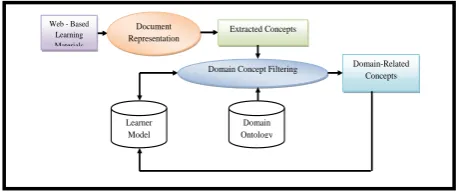
The data from Web logs, in its raw form, is not suitable for the application of usage mining algorithms. The data needs to be cleaned and preprocessed. To perform log data analysis the data pre-processing process must be accomplished. The data pre-processing is the process of cleaning and transforming raw data sets into a form suitable for web mining. The task of the data pre-processing module is therefore to obtain usable datasets from raw web log files, which, in most cases, contain a considerable amount of incomplete and irrelevant information [14].
The Vector Space Model [15, 16, 17] is adapted in the proposed approach to achieve effective representations of documents. Each document is identified by n-dimensional feature vector where each dimension corresponds to a distinct term. Each term in a given document vector has an associated weight. The weight is a function of the term frequency, collection frequency and normalization factors. Different weighting approaches may be applied by varying this function. Hence, a document j is represented by the document vector dj:
dj= (w1j, w2j, … . , wnj) Where, wkj is the weight of the kth
term in the document j.
The term frequency reflects the importance of term k within a particular document j. The weighting factor may be global or local. The global weighting factor takes into account the importance of a term k within the entire collection of documents, whereas a local weighting factor considers the given document only. Document keywords were extracted by using a term-frequency-inverse-document-frequency (tf-idf) calculation [16; 17], which is a well-established technique in
Document Representation
Domain-Related Concepts Domain Concept Filtering
Web - Based Learning Materials
Extracted Concepts
Domain Ontology Learner
information retrieval. The weight of term k in document j is represented as:
wkj= tfkj× (log2n− log2dfk+ 1)
Where: tfkj is the term k frequency in document j, dfk is
number of documents in which term k occurs, n = total number of documents in collection.
The main purpose of this step [14] is to extract interested items in the web page, then get term frequency that reflects the importance of term, finally get the weight of terms in the selected page. The output of this step is the weight of terms in selected page that can be used to build learner interest profile.
3.1.3
Domain Concept Filtering
This process [14, 18] discovers concepts which represent the learner‟s interests. These concepts and items are compared to the domain ontology to check the relevant items to the learner profile. The most relevant ones update the learner profile. The items relevance is based on ontology-based semantic similarity where browsed items by a learner on the web are compared to the items from a domain ontology and learner profile. The importance is combined with the semantic similarity to obtain a level of relevance. The page items are processed to identify domain-related words to be added to the learner profile. A bag of browsed items is obtained via a simple word indexing of the page visited by the learner. The irrelevant words are filtered out using the list of concepts extracted from domain ontology. Once domain-related items are identified, their relevance is evaluated to learner‟s interests. The selected method was used in [11, 19] to compute semantic similarity function (S) based on a domain ontology. The similarity is estimated for each pair of items where one item is taken from a learner profile, while the other one from a set of browsed items. The functions Sw is the
similarity between synonym sets, Su is the similarity between
features, and Sn is the similarity between semantic
neighborhoods between entity classes of ontology p and b of ontology q, and Ww,Wu and Wn are the respective weights of
the similarity of each specification component.
S ap, bq = W
w× Sw(ap, bq)+Wu × Su ap, bq + Wn ×
Sn ap, bq For
w
w; uw
;
w
n ≥ 0 :Weights assigned to Sw, Su, and Sn depends on the
characteristics of the ontologies.
The similarity measures are defined in terms of a matching process [11, 19]:
S(a, b) = A∩B + α a,b A/B + (1−α(a,b)) B/A A∩B
where A and B are description sets of classes a and b, i.e., synonym sets, sets of distinguishing features and a set of classes in semantic neighborhood; (A∩B) and (A/B) represent intersection and difference respectively, || is the cardinality of a set; and α is a function that defines relative importance of non-common characteristics. A set of browsed items that are similar to items from the learner profile is considered as a set of items that can be added to this profile.
3.2
Semantic learner interest
representation
To overcome these weaknesses of term-based representations, an ontology-based representation [20, 21, 22] using WordNet [23] will be performed. Moreover, by defining an ontology base, which is a set of independent concepts that covers the
whole ontology, an ontology-based representation allows the system to use fixed-size document vectors, consisting of one component per base concept.
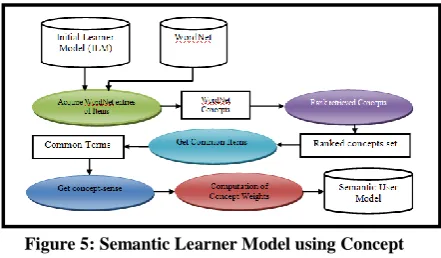
In the proposed system, the method based on WordNet [23] is used to improve traditional vector space model. WordNet is ontology of cross-lexical references whose design was inspired by the current theories of human linguistic memory. English names, verbs, adjectives and adverbs are organized in sets of synonyms (synsets), representing the underlying lexical concepts. Sets of synonyms are connected by relations. The basic semantic relation between the words in WordNet is synonymy [24]. Synsets are linked by relations such as specific/generic or hypernym /hyponym (is-a), and meronym/holonym (part-whole). The principal semantic relations supported by WordNet is synonymy: the synset (synonym set), represents a set of words which are interchangeable in a specific context. WordNet [24] consists of over 115,000 concepts (synsets in WordNet) and about 150,000 lexical entries (words in WordNet). This representation requires two more stages: a) the “mapping” of terms into concepts and the choice of the “merging” strategy, and b) the application of a disambiguation strategy.
The purpose of this step is to identify WordNet concepts that correspond to document words [25]. Concept identification is based on the overlap of the local context of the analyzed word with every corresponding WordNet entry. The entry which maximizes the overlap is selected as a possible sense of the analyzed word. The concept identification architecture for the terms in the initial learner model is given in figure 5.
[image:4.595.321.542.508.637.2]WordNet categories [26] are used to map all the stemmed words in all documents into their lexical categories. For example, the word “dog” and “cat” both belong to the same category “noun.animal”. Some words also has multiple categories like word “Washington” has 3 categories (noun.location, noun.group, noun.person) because it can be the name of the American president, the city place, or a group in the concept of capital. Some word disambiguation techniques are used to remove the resulting noise added by multiple categories mapping which are: disambiguation by context and concept map.
Figure 5: Semantic Learner Model using Concept Mapping
3.2.1
Concept Weight Computation
The concepts in documents are identified as a set of terms that have identified or synonym relationships, i.e., synsets in the Wordnet ontology. Then, the concept frequencies Cfc are
calculated based on term frequency tftm as follows: Cfc= tm ∈r c tftm ;
is that the term is related to the concept in standard English language. More common term meanings are listed before less common ones. The authors in [20, 21] have showed that using the first synset as the identified concept for a term can improve the clustering performance more than that of using all the synsets to calculate concept frequencies.
Hypernyms of concepts can represent such concepts up to a certain level of generality. The concept frequencies are updated as follows:
hfc= b∈H c,r Cfb ;
where H c, r is the set of concepts CH , which are all the
concepts within r levels of hypernym concepts of c.
In WordNet, it is obtained by gathering all the synsets that are hypernym concepts of synset c within r levels. In particular,
H c, ∞ returns all the hypernym concepts of c and H c, 0 returns just c.
The weight of each concept c in document d is computed as follows:
whc= hfc × idfc ;
idfc is the inverted document frequency of concept c by
counting how many documents in which concept c appears as the weight of each term t in the document d.
3.3
Learning style acquiring
There are five popular and useful features when is viewing the learner as an individual, these are: the learner‟s knowledge, interests, goals, background, and individual traits [27].
[image:5.595.309.548.145.431.2]The learner profile based on the learning style can be acquired by analyzing the learner behaviors during utilizing the system. Learning styles are typically defined as the way people prefer to learn. It can be represented the learning style in stereotype model according to the Felder-Silverman‟s learning style categories. From the perception, input processing and understanding four dimensions, the Felder-Silverman‟s learning style categories are shown in table 2 [28, 29].
Table 2. Categories of Felder-Silverman’s learning style
Learning Style
Category Description
Sensing vs. Intuitive
It represents the abstraction level of the learning material the learner prefers. A sensing learner likes learning facts and needs more practical case studies. An intuitive learner usually prefers innovation and dislikes repetition. Visual vs.
Verbal
It indicates whether the learner prefers auditory (textual) or visual documents.
Active vs. Reflective
It indicates how the learner prefers to process information: actively (through engagement in activities or discussions) or reflectively (through introspection)
Sequential vs. Global
It indicates how the learner progresses toward understanding. Sequential learners prefer sequential explanations while global learners usually prefer an initial overview of the involved topics which possibly shows them the most important steps and relations they are going to study
The learner actions can be used to identify learner cognitive traits in the learning systems. Learner behaviors can enable to
acquire the learning style. Number of these actions is shown in [30, 31]. Example of the actions that can enable to acquire learning styles based on Felder-Silverman model (FSLSM) is found in table 3.
Table 3. Relationship between Learner Actions And (FSLSM) category
Parameter Value FSLSM
Category
No. of visits/postings in
forum/chat High
Active, Verbal No. of visits and time spent on
exercises High
Active, Intuitive Amount of time dealt with
reading material High Reflective
Performance on questions
regarding theories High Intuitive
Performance on questions
regarding facts High Sensing
Amount of time spent on a Test High Sensing No. of revisions before handing
in a test High Sensing
No. of performed tests High Sensing No. of visits and time spent on
examples High Sensing
Amount of time spent on
contents with graphics High Visual Performance in questions
related to graphics High Visual
Performance on questions related to overview of concepts and connections between concepts
High Global
The Actions that are found in [32], are considered as the number of rules to describe learner learning style by recording the learner behavior in the system as found in figure 6.
Figure 6: Example of rules used to adjust learning style of the learner
These actions can be used to acquire the learning style as shown in table 3 and figure 6.
3.4
Domain Ontology
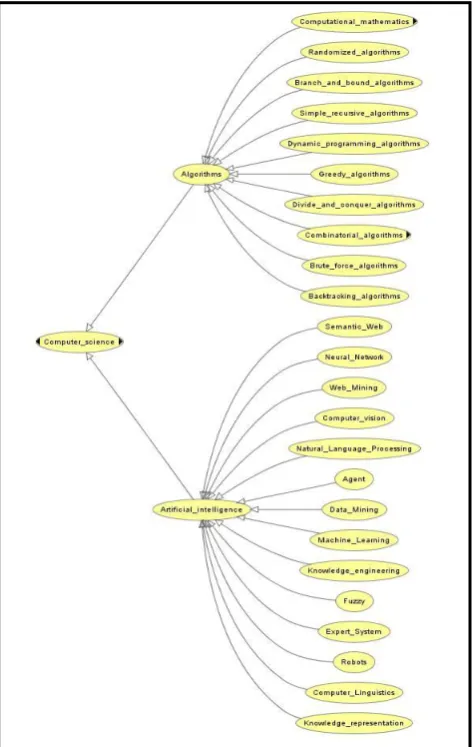
The main reason for ontology [33] is to enable communication between computer systems in a way that is independent of the individual system technologies, information architectures and application domain. Ontology includes rich relationships between terms and each specific knowledge domain and organization will structure its own ontology which will be organized into mapped ontology. The domain of the learning content and the ontology that have been developed within proposed system is that of computer science. The ontology covers topics like artificial intelligence, communications; computational theory, computer graphics, data structures, database, programming, etc. It is used mainly
IF learner does not know the answer; THEN Show learner image/diagram;
………
IF learner shown image/diagram AND learner gives correct answer; THEN Increase VISUAL;
………
IF answer is given in the explanation text AND learner does not know the answer; THEN
[image:5.595.52.284.507.741.2]to index the relevant learning objects and to facilitate semantic search and re-usability of learning objects.
[image:6.595.50.287.135.267.2]The knowledge engineering approach was proposed in [34] to build domain ontology. Figure 7 shows main steps of the ontology development process.
Figure 7: Main steps of the ontology development process
The ontology editor protégée [35, 36] is used to build the domain ontology in the proposed approach. Since protégée is an open source ontology editor, developed by Stanford Center for Biomedical Informatics Research and coded by JAVA. Protégé interface style is similar to Windows applications‟ general style, so it is easy to learn and use. Figure 8 shows part of the implemented domain ontology.
Figure 8: Part of domain ontology
4.
SUGGESTIONS AND
RECOMMENDATIONS
The user profiles can maintain sophisticated representations of personal interest profiles. These representations can be utilized for effective information retrieval. Fuzzy clustering allows an entity to belong to more than one cluster with different degrees of accuracy, while hard clustering assigns each entity exactly to one of the clusters. Thus, fuzzy clustering is suitable in constructing the learner profiles representations such as (learner ontology). Such representation of learner profiles is useful because some information is not forced to fully belong to any one of the user profiles. Fuzzy clustering methods may allow some information to belong to several learner profiles simultaneously with different degrees of accuracy.
The proposed approach depends on using semantic web to extract the learner model. Fuzzy technique is used to cluster the extracted data of learner model to classifying the learners for their interests. Classifying the interests of learners enables learning systems to handle learner as groups to recommend them what they must teach corresponding to their interests in the learner profile clusters.
Using the clustering of learner profiles in e-learning system is useful, so it is recommended to represent the cluster of profiles on learner ontology to express sophisticated user profiles in order that a user may own several interests. A user profile may correspond to the several ontologies. Ontology-based learner profiles typically maintain sophisticated representations of personal interest profiles. These representations can be utilized for effective information retrieval in the e-learning systems.
5.
CONCLUSION
The adaptive e-learning system provides support to the learner according to the individual characteristic. It can provide a learner view adapt to learner personalization characteristic, which not only includes personalized resources, but also includes the personalized learning process and strategy. So the learner model should be established for each learner, containing the information such as state-of-art of learner, the goal and interest and so on. The system reduces the information spaces for learner browsing according to the learner model in the application, and presents the most interesting information to the learner.
This work presented a technical solution to an approach and methodology to enhance acquiring learner model and representation of the learner profile based on WordNet.
In this work, the most interesting information to the learner matched with the learning style is presented. To do so, we have used the Felder-Silverman Learning Style Model along with the IEEE LOM standard, a combination that, extending former works, in different fields of learning, and consistently reflecting the intrinsic style of the learners.
6.
REFERENCES
[1] Yu, Z., Nakamura, Y., Jang, S., Kajita, S., & Mase, K. (2007), Ontology-Based Semantic Recommendation for Context-Aware E-Learning, UIC 2007, LNCS 4611, pp. 898–907, 2007, Springer-Verlag Berlin Heidelberg.
[image:6.595.48.286.374.748.2][3] Modritscher, F. (2004). Victor Manuel Garcia-Barrios, and Christian G¨utl. The Past, the Present and the future of adaptive E-Learning. In Proceedings of the International Conference Interactive Computer Aided
Learning (ICL2004), 2004.
http://www.iicm.edu/iicm_papers/icl2004/adaptive_e-learning/adaptiv_e-learning.pdf.
[4] Brusilovsky, P. & Maybury, M. (2002). From Adaptive Hypermedia to the Adaptive Web. Communications of the ACM, Volume 45 Issue 5.
[5] Kritikou,Y., Demestichas, P., Adamopoulou. E., Demestichas, K., Theologou, M. & Paradia, M. (2008). User Profile Modeling in the context of web-based learning management systems. Journal of Network and Computer Applications 31 (2008) 603–627. Elsevier Ltd.
[6] Dicheva, D. (2008). Ontologies and Semantic Web for E-Learning, In : "Handbook on Information Technologies for Education and Training", 978-3-540-74155-8, Springer Berlin Heidelberg.
[7] Ghaleb, F., Daoud, S., Hasna, A., ALJa‟am, J., El-Seoud, S. & El-Sofany, H. (2006). E-Learning Model Based On Semantic Web Technology, International Journal of Computing &Information Sciences Vol. 4, No. 2, August 2006, On-Line. Pages 63 – 71.
[8] Zschocke, T. & deLeon, J. (2010). Towards an Ontology for the Description of Learning Resources on Disaster Risk Reduction. WSKS 2010, Part I, CCIS 111, pp. 60– 74, Springer-Verlag Berlin Heidelberg.
[9] Lee, M., Tsai, K. & Wang, T. (2008). A practical ontology query expansion algorithm for semantic-aware learning objects retrieval. Computers & Education 50 (2008) 1240–1257. Elsevier Ltd.
[10]Ding, L., Liu, B. & Tao, Q. (2010). Hybrid Filtering Recommendation in E-Learning Environment. 2010 Second International Workshop on Education Technology and Computer Science. 978-0-7695-3987-4/10, IEEE.
[11]Reformat, M. & Koosha, S. (2009), Updating User Profile using Ontology-based Semantic Similarity, FUZZ_IEEE 2009, Korea, August 20-24, 978-1-4244-3597-5, IEEE.
[12]So, C. Lai, C., & Lau, R. (2009). Ontological User Profiling and Language Modeling for Personalized Information Services, 2009 IEEE International Conference on e-Business Engineering, 978-0-7695-3842-6/09, IEEE.
[13]Harb, H. & Fouad. Kh. (2010). Semantic web based Approach to learn and update Learner Profile in Adaptive E-Learning . Al-Azhar Engineering Eleventh International Conference, December PP: 23-26.
[14]Fouad, K., Harb, H. & Nagdy, N. (2011). Semantic Web supporting Adaptive E-Learning to build and represent Learner Model. The Second International Conference of E-learning and Distance Education (eLi 2011) – Riyadh.
[15]Baishuang, Q. & Wei, Z. (2009). Student Model in Adaptive Learning System based on Semantic Web, 2009 First International Workshop on Education Technology and Computer Science, 978-0-7695-3557-9/09, IEEE, DOI 10.1109/ETCS,466.
[16]Pan, J., Zhang, B., Wang, S., Wu, G., & Wei, D. (2007). Ontology Based User Profiling in Personalized Information Service Agent, Seventh International Conference on Computer and Information Technology, 0-7695-2983-6/07, IEEE.
[17]Pan, J., Zhang, B., Wang, S. & Wu, G. (2007), A Personalized Semantic Search Method for Intelligent e-Learning, 2007 International Conference on Intelligent Pervasive Computing, 0-7695-3006-0/07, IEEE , DOI 10.1109/IPC.2007.48.
[18]Fouad, K., Hogo, M., Gamalel-Din, S. & Nagdy, N. (2010). Adaptive E-Learning System based on Semantic Web and Fuzzy Clustering. (IJCSIS) International Journal of Computer Science and Information Security, Vol. 8, No. 9, December 2010.
[19]Rodrıguez, M. & Egenhofer, M. (2003), Determining Semantic Similarity among Entity Classes from Different Ontologies, IEEE TRANSACTIONS ON KNOWLEDGE AND DATA ENGINEERING, VOL. 15, NO. 2, MARCH/APRIL, 1041-4347/03, IEEE.
[20]Dragoni, M., Pereira, C. & Tettamanzi, A. (2010). An Ontological Representation of Documents and Queries for Information Retrieval Systems, IEA/AIE 2010, Part II, LNAI 6097, pp. 555–564, Springer-Verlag Berlin Heidelberg.
[21]Pereira, C. & Tettamanzi, A. (2006). An Ontology-Based Method for User Model Acquisition. In: Ma, Z. (ed.) Soft computing in ontologies and semantic Web. Studies in fuzziness and soft computing, pp. 211–227., Springer-Verlag Berlin Heidelberg.
[22]Nada, Y. & Fouad, K. (2011). An Approach to improve the Representation of the User Modelin the Web-Based Systems. (IJACSA) International Journal of Advanced Computer Science and Applications, Vol. 2, No. 12, P: 152 – 160, 2011.
[23]Fellbaum, C. (2010). WordNet. In R. Poli et al. Theory and Applications of Ontology: Computer Applications, (pp. 231-243). 231-243, DOI: 10.1007/978-90-481-8847-5_10, Springer Science+Business Media B.V.
[24]Amine, A., Elberrichi, Z., & Simonet, M. (2010). Evaluation of Text Clustering Methods Using WordNet. The International Arab Journal of Information Technology, Vol. 7, No. 4.
[25]Boubekeur, F., Boughanem, M., Tamine, L., Daoud, M. (2010). Using WordNet for Concept-Based Document Indexing in Information Retrieval, SEMAPRO: The Fourth International Conference on Advances in Semantic Processing, Pages: 151 to 157, IARIA.
[26]AMINE, A., ELBERRICHI, Z., SIMONET, M. & MALKI, M. (2008). WordNet-based and N-Grams-based Document Clustering: A Comparative Study, Third International Conference on Broadband Communications, Information Technology & Biomedical Applications, 978-0-7695-3453-4/08, IEEE.
[27]Brusilovsky, P. & Millán, E. (2007). User Models for Adaptive Hypermedia and Adaptive Educational Systems. The Adaptive Web, LNCS 4321, pp. 3 – 53, Springer-Verlag Berlin Heidelberg.
Architecture Solutions for E-Learning Systems. IGI Publishing.
[29]Chen, S. & Zhang, J. (2008). The Adaptive Learning System based on Learning Style and Cognitive State. 2008 International Symposium on Knowledge Acquisition and Modeling. 978-0-7695-3488-6/08, IEEE.
[30]Popescu, E., Trigano, P. & Badica, C. (2007). Adaptive Educational Hypermedia Systems: A Focus on Learning Styles. EUROCON 2007 The International Conference on “Computer as a Tool”. 1-4244-0813-X/07, IEEE.
[31]Fouad, K. (2012). Semantic Retrieval and Recommendation in Adaptive E-Learning System. 1st Taibah University International Conference on Computing and Information Technology Madinah Al-Munawwarah, Saudi Arabia, 19-21 Rabi II 1433 Hijri (12-14 March 2012) (ICCIT 2012).
[32]Latham, A., Crockett, K., McLean, D. Edmonds, B. & O‟Shea, K. (2010). Oscar: An Intelligent Conversational Agent Tutor to Estimate Learning Styles. 978-1-4244-8126-2/10, IEEE.
[33]Using, S., Ahmad, R., Taib, S. (2010). Ontology of Programming Resources for Semantic Searching of Programming Related Materials on the Web. 978-1-4244-6716-7110, IEEE.
[34]Hong-yan, Y., Jian-liang, X., Mo-ji, W. & Jing, X. (2009). Development of Domain Ontology for E-learning Course, 978-1-4244-3930-0/09, IEEE.
[35]Noy N., Sintek, M., Decker, S., Crubézy, M., Fergerson, R. & Musen, M. (2001). Creating Semantic Web Contents with Protégé-2000, IEEE INTELLIGENT SYSTEMS, 1094-7167/01, IEEE.
[36]Hogeboom, M., Lin, F., Esmahi, L. & Yang, C. (2005). Constructing Knowledge Bases for E-Learning Using Protégé 2000 and Web Services, Proceedings of the 19th International Conference on Advanced Information Networking and Applications (AINA‟05), 1550-445X/05, IEEE.
[37]G. PAOLO, F. SILVIA. (2009). Applied Data Mining for Business and Industry Second Edition, Chapter 6: Describing website visitors, ISBN: 978-0-470-05887-9 (Pbk), John Wiley.
[38]http://www.w3.org/TR/WD-logfile.html.
[39]K. Natheer, C. Chien-Chung. (2005). Web Usage Mining Using Rough Sets, NAFIPS 2005 - 2005 Annual Meeting of the North American Fuzzy Information Processing Society, 0-7803-9187-X/05, IEEE.
[40]Vesin, B., Ivanovi, M., Klašnja-Milicevic, A. & Budimac,Z. (2012). Protus 2.0: Ontology-based semantic recommendation in programming tutoring system. Expert Systems with Applications 39 (2012) 12229–12246. Elsevier Ltd.
[41]Sánchez-Alonso, S., Sicilia, M. & García-Barriocanal, E. (2006). Ontologies and Contracts in the Automation of Learning Object Management Systems. In: Web-Based Intelligent E-Learning Systems: Technologies and Applications, 216-234 pp, DOI: 10.4018/978-1-59140-729-4.ch011, IGI Global.
[42]Zatarain-Cabada, R., Barrón-Estrada, M., Zepeda-Sanchez, L. & Vega-Juárez, F. (2008). Authoring Learning Objects for Web-Based Intelligent Tutoring Systems. ICWL 2007, LNCS 4823, pp. 66 – 77, Springer-Verlag Berlin Heidelberg.
[43]Wu, H. (2008). Research of Internet Education System Based on Ontology. Fifth International Conference on Fuzzy Systems and Knowledge Discovery. 978-0-7695-3305-6/08, IEEE.
[44]Gkatzidou, V. & Gkatzidou, E. (2010). Exploring the development of adaptable learning objects. A practical approach. 10th IEEE International Conference on Advanced Learning Technologies. 978-0-7695-4055-9/10, IEEE.
[45]Silveira, R. & Silva, J. (2008). Building Intelligent Learning Environments Using Intelligent Learning Objects. In: Agent-Based Tutoring Systems by Cognitive and Affective Modeling. 19-42 pp, DOI: 10.4018/978-1-59904-768-3.ch002. IGI Global.
![Figure 1: The Structure of an Adaptive System [4].](https://thumb-us.123doks.com/thumbv2/123dok_us/8097793.786715/1.595.330.528.345.434/figure-structure-adaptive.webp)