A systematic review of psychometric properties of health-related
quality of life and symptom instruments in adult acute leukemia
survivors
Ashley Leak Bryant, PhD, RN-BC, OCN, AnnMarie Walton, PhD, MPH, RN, OCN, CHES, Julia Shaw-Kokot, RN, MSLS, AHIP, Deborah K. Mayer, PhD, RN, AOCN, FAAN, and Bryce B. Reeve, PhD
School of Nursing and Lineberger Comprehensive Cancer Center (Drs. Bryant, Walton, and Mayer) School of Nursing (Ms. Shaw-Kokot), Department of Health Policy and Management and Lineberger Comprehensive Cancer Center (Dr. Reeve)
Abstract
Background—Acute leukemia represents 4% of cancer cases in the United States (US) annually. There are over 302,000 people living with acute and chronic leukemia in the US. Treatment has been shown to have both positive and negative effects on health-related quality of life (HRQOL).
Objective—Examine psychometric properties of symptom and HRQOL instruments and to provide implications for the assessment in adults with acute leukemia relevant to clinical practice and future research.
Methods—Systematic literature search was conducted from 1990-2014 using electronic databases and manual searches. Psychometric studies were considered eligible for inclusion if 1) the psychometric paper was published using at least one HRQOL or symptom instrument and 2) adults with acute leukemia were included in the sample. Studies were excluded if the age groups were not adults, or if the instrument was in a language other than English.
Results—Review identified a total of 7 instruments (1 cancer generic HRQOL, 2 symptom-related, 3 HRQOL combined with symptom questions, and 1 disease- specific). The most
commonly used instrument was the European Organization for Research and Treatment of Cancer (EORTC QLQ-C30), followed by the Functional Assessment of Cancer Therapy-Fatigue (FACT-F).
Conclusions—An acute leukemia diagnosis can have a significant impact on HRQOL. Our recommendations include using both a HRQOL and symptom instrument to capture patient experiences during and after treatment.
Implications for Practice—The availability of comprehensive, valid and reliable HRQOL and symptom instruments to capture the experiences of adults with acute leukemia during and posttreatment is limited.
HHS Public Access
Author manuscript
Cancer Nurs
. Author manuscript; available in PMC 2017 September 01.Published in final edited form as:
Cancer Nurs. 2016 ; 39(5): 375–382. doi:10.1097/NCC.0000000000000327.
A
uthor Man
uscr
ipt
A
uthor Man
uscr
ipt
A
uthor Man
uscr
ipt
A
uthor Man
uscr
Keywords
Acute leukemia; acute leukemia survivors; health related quality of life; symptoms; instruments; psychometrics; cancer-related fatigue
Introduction
It is estimated that 54, 270 individuals in the Unites States (US) will be diagnosed with
leukemia in 2015 and an estimated 24,450 will die from the disease.1 Of these new cases,
27,080 have acute lymphoblastic leukemia or acute myeloid leukemia, and 11, 910 will die
with the disease, with the remaining being chronic leukemias1. Acute leukemia has a 5-year
survival rate of 56% in the US.2 Newly diagnosed acute leukemia is usually treated in a
specialized care center with an average stay of 4-6 weeks. It is common for patients to have fluctuating symptoms associated with the disease and its treatment such as
myelosuppression, stomatitis, and nausea throughout their hospitalization.3,4
There is the potential to advance acute leukemia science by systematically reviewing symptoms that occur, solely or concurrently, during and after treatment to determine how health-related quality of life (HRQOL) changes over time. It is important to understand patient-reported symptoms and HRQOL of adults with acute leukemia to better address their
physical and psychosocial needs. In Bryant et al,4 cancer related fatigue (CRF), depression,
and anxiety were found to be the most prominent symptoms that interfered with HRQOL and activities of daily living. In that review, we found that acute leukemia and its treatment have a significant impact in all QOL domains; we concluded that there was a need for future
studies focused on longitudinal research and increased minority representation4.
One common way of assessing symptoms and HRQOL is through self-reported instruments, measuring the outcomes at one or more points. These instruments vary in the symptoms and HRQOL domains measured, the length of the questionnaire, the wording of questions and their response options, the reference or recall period, and the level of psychometric evidence in support of the validity and reliability of the measure.
The majority of the measures are not leukemia specific, except for the Functional Assessment of Cancer Therapy-Leukemia (FACT-Leu), which was recently developed in
2002.5
This review examined the psychometric properties of instruments used in acute leukemia research, and provides clinical and research relevant implications of symptom and HRQOL instruments used in adults with acute leukemia.
Methods
Search strategy
Following the Preferred Reporting Items for Systematic Reviews and Meta-Analyses
(PRISMA) guidelines6, a systematic literature search was conducted by the first (ALB) and
third (JSK) authors. The search was completed in August 2014. The electronic databases
A
uthor Man
uscr
ipt
A
uthor Man
uscr
ipt
A
uthor Man
uscr
ipt
A
uthor Man
uscr
PubMed, PsychInfo, EMBASE, CINAHL, and HAPI were searched using the following text words and their combinations: leukemia or leukaemia and each individual instrument included in this study. In a previous acute leukemia literature review conducted by Bryant et
al4, 20 instruments were identified: Brief Fatigue Inventory (BFI), Center for Epidemiologic
Studies Depression Scale (CES-D), Distress Thermometer, Edmonton Symptom Assessment Scale (ESAS), European Organization for Research and Treatment of Cancer (EORTC QLQ-C30), Fatigue Visual Analog Scale (F-VAS), Functional Assessment of Cancer Therapy-Fatigue (FACT-F), Functional Assessment of Cancer Therapy-General (FACT-G), Functional Assessment of Cancer Therapy-Spiritual (FACT-Sp), Functional Living Index-Cancer (FLIC), Geriatric Depression Scale (GDS), Hospital and Anxiety Scale (HADS), Life Ingredient Profile (LIP), Mental Adjustment to Cancer (MAC), the M.D. Anderson Symptom Inventory (MDASI), Psychosocial Adjustment to Illness Scale-Self report (PAIS-SR), Perceived Quality of Life (PQOL), Revised Piper Fatigue Scale (RPFS), Schedule for the Evaluation of Individual Quality of Life (SEIQOL), and Short-Form-36 (SF-36). Fifteen instruments were removed from the initial review of 20 instruments due to not being clearly defined as a symptom or HRQOL domain, lack of testing to determine psychometric properties, or the sample did not specifically include adults with acute leukemia. The five
remaining instruments were BFI7, FACT-F8, FACT-G9, MDASI10, and EORTC QLQ-C3011.
Two additional instruments were added based on the search strategy: Functional Assessment
of Cancer Therapy-Anemia (FACT-An)8 and Functional Assessment of Cancer
Therapy-Leukemia (FACT-Leu).5 The final analysis included 7 instruments.
Inclusion and Exclusion Criteria
Studies were considered eligible for inclusion if 1) the psychometric paper was published using at least one HRQOL or symptom instrument and 2) adults with acute leukemia were included in the sample. Studies were excluded if the age groups were not adults, or if the instrument was in a language other than English. Other exclusions included case reviews, summary reports, clinical reviews, and literature and systematic reviews.
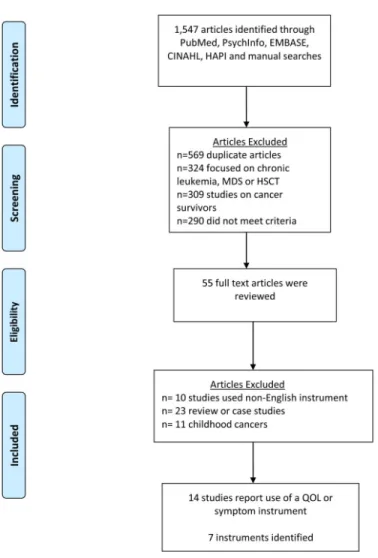
A total of 1,547 articles were identified through the 5 electronic databases and manual searches. Five hundred sixty-nine were duplicates articles, 324 were chronic leukemia, myelodysplastic syndrome (MDS), or hematopoietic stem cell transplant (HSCT), 309 were about cancer survivors and not acute leukemia, and 290 did not meet the criteria and were removed after initial review. Fifty-five full text articles were assessed for eligibility, and 10 of those were excluded because the studies used non-English instruments, 23 were review or case studies, and 11 focused on childhood cancers. Fourteen studies reported use of a
HRQOL and/or symptom instrument 7,12-24 (Figure 1). Seven instruments were identified
based on inclusion criteria: 1) Brief Fatigue Inventory (BFI)7, 2) European Organization for
Research and Treatment of Cancer (EORTC QLQ-C30)11, 3) Functional Assessment of
Cancer Therapy-Anemia (FACT-An)8, 4) Functional Assessment of Cancer Therapy-Fatigue
(FACT-F)8, 5) Functional Assessment of Cancer Therapy-General (FACT-G)9, 6) Functional
Assessment of Cancer Therapy-Leukemia (FACT-Leu)5, and 7) M.D. Anderson Symptom
Inventory (MDASI)10.
A
uthor Man
uscr
ipt
A
uthor Man
uscr
ipt
A
uthor Man
uscr
ipt
A
uthor Man
uscr
Data Extraction
Both generic and disease-specific HRQOL aspects of leukemia were identified in this review. In addition, the review also yielded symptom instruments which were either solely symptom focused or multidimensional with HRQOL domains. The psychometric properties, reliability and validity, of each instrument were extracted using the Scientific Advisory
Committee of the Medical Outcomes Trust criteria.6 Reliability is “the degree to which an
instrument is free from error” and validity is the “degree to which the instrument measures
what it purports to measure”6(pg. 3).
Data Synthesis
The findings from the review are in narrative and table form. The different measures identified in this review and their complete description such as number of items, scoring, domains, scaling, reliability, validity, and numbers of studies are provided in Table 1. The number of items and measured domains of all instruments ranged from 10-47 and 5-15, respectively. Four instruments measured both symptom and HRQOL domains (FACT-An, FACT-F, FACT-Leu and EORTC QLQ-C30). The 14 studies identified in the review are described in Table 2.
Validated HRQOL measures used in Adults with Acute Leukemia
A total of 7 instruments (1 cancer generic HRQOL, 2 symptom-related, 3 HRQOL combined with symptom questions, and 1 disease-specific) were identified and included in
this review. The cancer generic HRQOL instrument was the FACT-G.9 The two
symptom-related instruments included the BFI7 and MDASI10. The three HRQOL instruments with
symptom questions included FACT-An8, FACT-F8, and EORTC-QLQ-C3011. The
FACT-Leu was the only disease-specific instrument.5
Description of Symptom and HRQOL Instruments and their Psychometric Properties
The psychometric properties of the fourteen studies and their use of symptom and HRQOL instruments are presented in the Table 2. The symptom measure with the highest number of
items was MDASI.10 The most commonly used HRQOL measure was the
EORTC-QLQ-C30 measures (physical, role, social and emotional function, cognitive, financial impact, and global QOL).
The number of items and domains in the symptom instruments ranged from 1-13 and 1-6.
The BFI recall period was in the “past 24 hours,”7 MDASI recall period was the “last 24
hours,”10 and FACT instruments were in the “last 7 days”5,8-9. All the HRQOL instruments
reviewed in this study report overall internal consistency reliability in the range of .54-.96 and test-retest reliability ranging from .77-96. Content and convergent validity were reported for all measures.
Description of Identified Studies
The fourteen studies included in this review were of several types: one was a prospective, cross-sectional study, two were tool validation studies, two were prospective observational studies, four were exercise interventions, and five were prospective longitudinal studies. Ten
A
uthor Man
uscr
ipt
A
uthor Man
uscr
ipt
A
uthor Man
uscr
ipt
A
uthor Man
uscr
of the studies included only patients with acute leukemia, one included patients with acute and chronic leukemia and the other three studies included patients of various cancer types. (Table 2). Stage of cancer treatment was not included because of the variety of cancer types and treatments patients were undergoing. The average number of patients in each of these studies was 104 (range 10-595). All studies were published between 1998-2012.
Discussion
This study reviewed the published psychometric literature and described 7 instruments that measured symptoms or HRQOL in adults with acute leukemia. There is no universally accepted definition of QOL/HRQOL, but various organizations and researchers have defined
it as multidimensional in nature. In 2005, the World Health Organization (WHO)25 defined
QOL as “an individual's perception of their position in life, in the context of the culture and value systems in their life, and in relation to their goals, expectations, standards and
concerns.”25 Cella's26 definition of HRQOL refers to the extent to which one's usual or
expected physical, emotional, and social well-being are affected by a medical condition or
its treatment, whereas Ferrell's QOL framework27 includes physical, psychological, social,
and spiritual domains. Consideration of these QOL domains is necessary in understanding the impact of an acute leukemia treatment and the long term and late effects that accompany this diagnosis.
While using the Scientific Advisory Committee of the Medical Outcomes Trust guidelines28,
we assessed the HRQOL instruments using the attributes and criteria that focus on reliability, validity, cultural and language adaptations. We did assess cultural and language adaptations and noted many of these instruments had been translated and adapted in several languages. One challenge faced by researchers and clinicians is use of reliable and valid measures during and after treatment are responsive to clinical changes. Measures that can capture change over time (i.e., an instruments “responsiveness” to change) are ideal and allows for comparisons between time points. There are two types of HRQOL measures used in this analysis. First, the generic cancer HRQOL measure, FACT-G, is able to measure these domains across different cancers. Few instruments are available that measure HRQOL domains specific to acute leukemia survivors, with one exception, the FACT-Leu.
Surprisingly, the FACT-F measure was used more often in these studies than FACT-G or FACT-Leu. This may be associated with emerging data on the impact that cancer related
fatigue (CRF) has on adults with acute leukemia during inpatient treatment12-15,17-18,29-30,
and CRF being a persistent symptom during and after treatment.3-4,31 The FACT-G and
EORTC-QLQ-C30 have been validated in a number of cancer groups with a variety of translations, compared to the FACT-Leu, which was only recently developed and validated.
Limitations of this review include focus on adults with acute leukemia without searching grey literature for additional studies such as dissertation abstracts and letters to the editors. We did not focus on chronic leukemias or other hematological cancers, which limits our generalizability to other cancers. However, a systematic methodologic approach using PRISMA was a strength of this review.
A
uthor Man
uscr
ipt
A
uthor Man
uscr
ipt
A
uthor Man
uscr
ipt
A
uthor Man
uscr
Conclusions
Acute leukemia researchers, clinicians, and oncology nurses need to have comprehensive data to explore clinical changes in their patients' symptom or HRQOL responses. Oncology nurses are at the frontline of caring for these patients and it is essential for them to be aware of instruments and tools used in acute leukemia research. Their use of these instruments will allow for early recognition and identification of common symptoms and/or HRQOL changes in these adults. There are certain domains of HRQOL that may be more prominent in acute
leukemia survivors, such as increased symptoms and decreased functionality.4 To the
authors' knowledge, this is the first review to explore the psychometric properties of instruments used with the acute leukemia adult population.
Our recommendations for clinical use and research are based on this review including a using both a HRQOL and symptom instrument to capture patient experiences during and after treatment. There are sound, reliable instruments that have been used in this population and we believe there are instruments that could adequately measure the patient's symptom and HRQOL experience throughout their illness trajectory. However, we question if these measures will be relevant over time with longer term survivors? The majority of measures have been tested in patients within 2 years of treatment; researchers lack data to support use of these measures in longer term survivors (>5 years or longer). Survivorship needs of these patients may need to be re-evaluated after 2 years since the late and long term effects may differ in each cancer population.
The HRQOL instruments vary in domains but the FACT-Leu has both general and specific leukemia questions. None of the current studies identified used the Patient-Reported Outcomes Measurement Information System (PROMIS), a promising new system designed to validly and reliably measure HRQOL domains in multiple populations; however no studies to date have examined the psychometric properties of PROMIS measures in acute adult leukemia. This review provides an overall synopsis of previous symptom and HRQOL literature in the acute leukemia population.
Acknowledgments
Support has been provided from the Cancer Care Quality Training Program Postdoctoral Fellowship
(5R25CA116339) and NCI 5K12CA120780-07 (Bryant) and Doctoral Scholarship in Cancer Nursing Renewal (DSCNR-13-276-03) from the American Cancer Society, the National Institute of Nursing Research of the National Institutes of Health under Award Number T32NR013456 and the Jonas Nurse Leaders Scholar Program (Walton).
References
1. American Cancer Society. Cancer Facts and Figures 2015. 2015. Retrieved February 23, 2015 at http://www.cancer.org/research/cancerfactsstatistics/allcancerfactsfigures/index
2. National Cancer Institute. SEER Stat Facts Sheets: Leukemia. 2015. Retrieved February 23, 2015 from http://seer.cancer.gov/statfacts/html/leuks.html
3. Albrecht T. Physiologic and psychological symptoms experienced by adults with acute leukemia: an integrative literature review. Oncol Nurs Forum. 2014; 41(3):286–95. [PubMed: 24769593] 4. Bryant AL, Walton AM, Shaw-Kokot J, et al. Patient Reported Symptoms and Quality of Life in
Adult Survivors of Acute Leukemia: A Systematic Review. Oncol Nurs Forum. 2015; :E91– E101.doi: 10.1188/15 [PubMed: 25806895]
A
uthor Man
uscr
ipt
A
uthor Man
uscr
ipt
A
uthor Man
uscr
ipt
A
uthor Man
uscr
5. Webster K, Chivington K, Shonk C, et al. Measuring quality of life (QOL) among patients with leukemia: The Functional Assessment of Cancer-Therapy-Leukemia (FACT-Leu). Quality of Life Research. 2002; 11(7):678.
6. Moher D, Liberati A, Tetzlaff J, Altman DG. for the PRISMA Group. Preferred Reporting Items for Systematic Reviews and Meta- Analyses: the PRIMSA statement criteria. BMJ. 2009; 339:b2535. [Accessed on July 13, 2014] from http://www.prisma-statement.org/. [PubMed: 19622551] 7. Mendoza T, Wang XS, Cleeland CS, Morrissey M, Johnson BA, Wendt JK, Huber SL. The rapid
assessment of fatigue severity in cancer patients: use of the Brief Fatigue Inventory. Cancer. 1999; 85(5):1186–1196. [PubMed: 10091805]
8. Yellen SB, Cella DF, Wesbster K, et al. Measuring fatigue and anemia-related symptoms with the Functional Assessment of Cancer Therapy (FACT) measurement system. J Pain Symptom Management. 1997; 13(2):63–74.
9. Cella DF, Tulsky DS, Gray G, et al. The Functional Assessment of Cancer Therapy Scale:
development and validation of the general measure. Journal of Clinical Oncology. 1993; 11(3):570– 579. [PubMed: 8445433]
10. Cleeland CS, Mendoza TR, Wang XS, et al. Assessing symptom distress in cancer: The M. D. Anderson Symptom. Inventory Cancer. 2000; 89(7):1634–1646. [PubMed: 11013380] 11. Aaronson N, Ahmedzai S, Bergman B, et al. The European Organization for Research and
Treatment of Cancer QLQ-C30: A Quality-of-Life Instrument for Use in International Clinical Trials in Oncology. Journal of the National Cancer Institute. 1993; 85(5):365–376. [PubMed: 8433390]
12. Alibhai S, O'Neill S, Fisher-Schlombs K, et al. A clinical trial of supervised exercise for adult inpatients with acute myeloid leukemia (AML) undergoing induction chemotherapy. Leukemia Research. 2012; 36(10):1255–1261. [PubMed: 22726923]
13. Alibhai S, Leach M, Kermalli H, et al. The impact of acute myeloid leukemia (AML) and its treatment on quality of life and functional status in older adults. Critical Reviews in Oncology/ Hematology. 2007; 64(1):19–30. [PubMed: 17765568]
14. Alibhai S, Leach M, Kowiger ME, et al. Fatigue in older adults with acute myeloid leukemia: predictors and associations with quality of life and functional status. Leukemia. 2007; 21(4):845– 848. [PubMed: 17287855]
15. Battaglini CB, Hackney AC, Garcia R, et al. The effects of an exercise program in leukemia patients. Integrative Cancer Therapies. 2009; 8(2):130–138. [PubMed: 19679621]
16. Efficace F, Cartoni C, Niscola P, et al. Predicting survival in advanced hematologic malignancies: do patient-reported symptoms matter? European Journal of Haematology. 2012; 89(5):410–416. [PubMed: 22985353]
17. Jarden M, Adamsen L, Kjeldsen L, et al. The emerging role of exercise and health counseling in patients with acute leukemia undergoing chemotherapy during outpatient management. Leukemia Research. 2013; 37(2):155–161. [PubMed: 23021021]
18. Shabbir M, O'Neill S, Fisher-Schlombs K, et al. A clinical trial of supervised exercise for adult inpatient with acute myeloid leukemia (AML) undergoing induction chemotherapy. Leukemia Research. 2012; 36(10):1255–1261. [PubMed: 22726923]
19. Mohamedali H, Breunis H, Timilshina, et al. Older age is associated with similar quality of life and physical function compared to younger age during intensive chemotherapy for acute myeloid leukemia. Leukemia Research. 2012; 36(10):1241–1248. [PubMed: 22727251]
20. Oliva E, Nobile F, Alimena G, et al. Quality of life in elderly patients with acute myeloid leukemia: patients may be more accurate than physicians. Haematologica. 2011; 96(5):696–702. [PubMed: 21330327]
21. Pearce M, Coan A, Herndon J III, et al. Unmet spiritual care needs impact emotional and spiritual well-being in advanced cancer patients. Supportive Care Cancer. 2012; 20(10):2269–2276. 22. Persson L, Larsson G, Ohlsson O, et al. Acute leukaemia or highly malignant lymphoma patients'
quality of life over two years: A pilot study. European Journal of Cancer Care. 2001; 10(1):36–47. [PubMed: 11827266]
A
uthor Man
uscr
ipt
A
uthor Man
uscr
ipt
A
uthor Man
uscr
ipt
A
uthor Man
uscr
23. Schumacher A, Kessler T, Buchner T, et al. Quality of life in adult patients with acute myeloid leukemia receiving intensive and prolonged chemotherapy—A longitudinal study. Leukemia. 1998; 12(4):586–592. [PubMed: 9557618]
24. Cella D, Jensen SE, Webster K, et al. Measuring health-related quality of life in leukemia: the Functional Assessment of Cancer Therapy--Leukemia (FACT-Leu) questionnaire. Value Health. 2012; 15(8):1051–1058. [PubMed: 23244807]
25. The WHOQOL Group. The World Health Organization Quality of Life assessment (WHOQOL): Position paper from the World Health Organization. Social Science and Medicine. 1995; 41(10): 1403–1409. [PubMed: 8560308]
26. Cella D. Measuring quality of life in palliative care. Seminars in Oncology. 1995; 22(2 Suppl 3): 73–81. [PubMed: 7537908]
27. Ferrell BR, Hassey Dow K, Grant M. Measurement of the QOL in cancer survivors. Quality of Life Research. 1995; 4(6):523–531. [PubMed: 8556012]
28. Scientific Advisory Committee of the Medical Outcomes Trust. Assessing health status and quality-of-life instruments: Attributes and review criteria. Quality of Life Research. 2002; 11(3): 193–205. [PubMed: 12074258]
29. Chang PH, Lai YH, Shun SC, et al. Effects of a walking intervention on fatigue-experiences of hospitalized acute myelogenous leukemia patients undergoing chemotherapy: A randomized controlled trial. Journal of Pain and Symptom Management. 2008; 35(5):524–534. [PubMed: 18280104]
30. Klepin H, Danhauer S, Tooze J, et al. Exericse for older adult inpatients with acute myelogenous leukemia: A pilot study. Journal of Geriatric Oncology. 2011; 2(1):11–17. [PubMed: 23843929] 31. Bryant AL, Walton AM, Phillips B. Cancer-Related Fatigue: Scientific Progress has been made in
40 Years. Clinical Journal of Oncology Nursing. 2015; 19(2):137–139. [PubMed: 25840376]
A
uthor Man
uscr
ipt
A
uthor Man
uscr
ipt
A
uthor Man
uscr
ipt
A
uthor Man
uscr
Figure 1. PRISMA Flow Diagram
From: Moher D, Liberati A, Tetzlaff J, Altman DG, The PRISMA Group (2009). Preferred Reporting Items for Systematic Reviews and Meta-Analyses: The PRISMA Statement. PLoS Med 6(6): e1000097. doi:10.1371/journal.pmed1000097
A
uthor Man
uscr
ipt
A
uthor Man
uscr
ipt
A
uthor Man
uscr
ipt
A
uthor Man
uscr
A
uthor Man
uscr
ipt
A
uthor Man
uscr
ipt
A
uthor Man
uscr
ipt
A
uthor Man
uscr
ipt
T ab le 1Characteristics of Instruments Used to Measur
e Symptoms and HRQOL in Adults with Acute Leuk
emia
Instrument
# of items
Domains Measur ed Scale Recall P eriod W er e acute leuk emia patients
included in sample?
Reliability
V
alidity
Language/Cultural Adaptations
Brief Fatigue Inv
entory
(BFI)
7
10 items Higher score, more fatigue (intensity/ interference) patients percei
v ed F atigue Intensity A v erage f atigue
intensity Worst le
v
el of
fatigue Least le
v
el of
fatigue Fatigue interference with daily life (past week)
0-11 Lik
ert
0=no f
atigue
(or no interference) at all to 10=w
orst
fatigue (or interference) one can imagine
P
ast 24 hours
Y
es
n=17 (51%) acute leuk
emia
IC: 0.96 Test-retest: Nor reported in original study Content Criterion related: concurrent Construct: Di
v
er
gent
Psychometrically and linguistically v
alidated in 8
languages Chinese (simplif
ied and
traditional) English Filipino German Greek Japanese Korean Russian
European Or
g
anization
for Research and Treatment of Cancer (EOR
TC
QLQ-C30)
11
30 items Higher score poorer QOL
F
atigue
Nausea Pain Dyspnea Sleep Disturbance Appetite Loss Constipation Diarrhea Ph
ysical function
Role function Social function Emotional function Cogniti
v
e
Financial Impact Global QOL
0-4 Lik
ert
0=not at all to 4=v
ery much P ast W eek Y es
n=113 (100%) acute leuk
emia
Cronbach alpha: 0.54-0.89 Test-retest: Not reported in original study Content Criterion related: Concurrent Predicti
v e Construct: Con v er gent Di v er gent Kno wn group 79 languages
Functional Assessment of Cancer Therap
y-
Anemia (FA
CT
-An)
8
47 items Higher the number
,
greater anemia symptoms
Ph ysical W ell-being Social W ell-being Emotional W
ell-being Functional W
ell-being Anemia related questions
0-4 Lik
ert
0=not at all to 4=v
ery
much
P
ast 7 days
Y
es
n=3 (6%) acute leuk
emia
IC: .96 Test retest: .96 Content Criterion-related: Concurrent Construct: Con
v er gent Di v er gent Kno
wn group v
alidity
60 languages
Functional Assessment of Cancer Therap
y-F atigue (F A CT -F) 8
40 items Higher the number
,
increased fatigue
Ph ysical W ell-being Social W ell-being Emotional W
ell-being Functional W
ell-being Fatigue related questions
0-4 Lik
ert
0=not at all to 4=v
ery
much
P
ast 7 days
Y
es
n=3 (6%) acute leuk
emia
IC: .93-.95 Test retest: .90 Content Criterion-related Concurrent Construct Con
v er gent Di v er gent Kno
wn group v
alidity
A
uthor Man
uscr
ipt
A
uthor Man
uscr
ipt
A
uthor Man
uscr
ipt
A
uthor Man
uscr
# of items
Domains Measur ed Scale Recall P eriod W er e acute leuk emia patients
included in sample?
Reliability V alidity Language/Cultural Adaptations y- CT -G) 9
27 items Higher the number
, poorer QOL Ph ysical W ell-being Social/F amily W
ell-being Emotional W
ell-being Functional W
ell-being
0-4 Lik
ert
0=not at all to 4=v
ery
much
P
ast 7 days
Y es N=8% leuk emia Internal consistenc y
.69-.82 Test-retest reliability .82-.92 Content Criterion-related: Concurrent Construct: Con
v er gent Di v er gent Kno
wn group v
alidity 60 languages y- emia CT -5
42 items Higher the number
,
greater leuk
emia symptoms Ph ysical W ell-being Social W ell-being Emotional W
ell-being Functional W
ell-being Leuk emia related questions 0-4 Lik ert
0=not at all to 4=v
ery
much
P
ast 7 days
Y
es
N=35 (44%) acute leuk
emia
Internal consistenc
y
.75-.96 Test-retest reliability .765-.890 Content Criterion-related: Concurrent Construct: Con
v er gent Di v er gent Kno
wn Group V
alidity
46 languages
entory ASI)
10
13 items Higher the number
,
increase symptom distress
General acti
vity
Mood Work Relations with others, Walking Enjo
yment of life
Symptom Se
v
erity
0=Not present to 10=As Bad as you can Imagine Symptom Interference 0=Did not interfere and 10=interfered completely
Last 24 hours
Y
es
n=29 acute leuk
emia
IC: 0.82-0.94 Test-retest: 0.83-0.84 Content Criterion-related: Concurrent Predicti
v e Construct: Con v er gent Kno wn group v alidity
Psychometrically and linguistically v
alidated in 9
languages Arabic Chinese (Simplif
ied and
traditional) English Filipino French Greek Japanese K
orean
A
uthor Man
uscr
ipt
A
uthor Man
uscr
ipt
A
uthor Man
uscr
ipt
A
uthor Man
uscr
ipt
Table 2
Summary of the Studies using Symptoms and HRQOL Instruments in Adults with Acute Leukemia (n=14)
Author Purpose
Study Design Sample Characteristics
Alibhai, Leach et al14 Prospective, longitudinal Total n=65; n=65 acute leukemia
Alibhai, Leach, Kermalli et al13
Prospective, longitudinal Total n=65; n=65 acute leukemia
Alibhai et al12 Non-randomized, prospective exercise
intervention
Total n=35; n=35 acute leukemia
Battaglini et al15 Non-randomized exercise intervention Total n=10; n=10 acute leukemia
Cella et al24 Tool validation Total n=29 (item generation), 79 (validation); acute and
chronic leukemia
Efficace et al16 Prospective, observational Total n=119; mixed cancers
Jarden et al17 Prospective exercise and health counseling trial Total n=17; n=17 acute leukemia
Oliva et al20 Prospective, observational Total n=113; n=113 acute leukemia
Mendoza et al7 Tool validation Total n=595; n=68 acute leukemia
Mohamedali et al19 Prospective, longitudinal cohort Total n=103; n=103 acute leukemia
Pearce et al21 Prospective, cross-sectional Total n=150; mixed cancers
Persson et al22 Prospective, longitudinal Total n=16; mixed cancers
Shabbir et al18 Non-randomized prospective exercise intervention Total n=35; n=35 acute leukemia