Cardiac structure and function in adolescent Sherpa; effect of habitual altitude 1
and developmental stage. 2
Mike Stembridge1; Philip N. Ainslie2; Joseph Donnelly3; Nicholas T. McLeod4; Suchita
3
Joshi5; Michael G. Hughes1; Kami Sherpa6 and Rob Shave1.
4
1Cardiff School of Sport, Cardiff Metropolitan University, Cardiff, UK. 2Centre for Heart,
5
Lung and Vascular Health, School of Health and Exercise Sciences, University of British 6
Columbia Okanagan Campus, Kelowna, Canada. 3Department of Clinical Neurosciences,
7
University of Cambridge, Cambridge, UK. 4University of North Carolina, Chapel Hill, NC
8
USA. 5 Patan Academy of Health Sciences, Nepal. 6Khunde Hospital, Khunde, Nepal.
9
10
Running head: Cardiac structure and function in adolescent Sherpa 11
Correspondence to: 12
Mike Stembridge, Cardiff Metropolitan University, School of Sport, Cyncoed Road, 13
Cardiff, CF23 6XD, UK. Tel: +44 2920 416593 14
Email: [email protected] 15
Word Count: 3382 16
17
Articles in PresS. Am J Physiol Heart Circ Physiol (January 22, 2016). doi:10.1152/ajpheart.00938.2015
Abstract 18
The purpose of this study was to examine ventricular structure and function in Sherpa 19
adolescents to determine whether age-specific differences in oxygen saturation and 20
pulmonary artery systolic pressure (PASP) influence cardiac adaptation to chronic 21
hypoxia early in life. Two-dimensional, Doppler and speckle-tracking echocardiography 22
were performed on adolescent (9-16 years) highland Sherpa (HLS; 3840 m; n=26) and 23
compared with age-matched lowland Sherpa (LLS; 1400 m; n=10) and lowland 24
Caucasian controls (LLC; sea level; n=30). The HLS were subdivided into pre- and post-25
adolescence; SpO2 was also recorded. Only HLS exhibited a smaller relative LV EDV;
26
however, both HLS and LLS demonstrated a lower peak LV untwisting velocity in 27
comparison to LLC (92±26 and 100±45 vs. 130±43 ˚/s, P<0.05). Although SpO2 was
28
similar between groups, PASP was higher in post- vs. pre-adolescent HLS (30±5 vs. 25±5 29
mmHg, P<0.05) which negatively correlated with RV strain rate (r=0.50, P<0.01). Much 30
like their adult counterparts, HLS and LLS adolescents exhibit slower LV diastolic 31
relaxation despite residing at different altitudes. These findings suggest fundamental 32
differences exist in the diastolic function of Sherpa that are present at an early age and 33
may be retained after migration to lower altitudes. The higher PASP in post-adolescent 34
Sherpa is in contrast to previous reports of lowland children at HA and unlike 35
lowlanders, was not explained by differences in SpO2; thus, different regulatory
36
mechanisms seem to exist between these two distinct populations. 37
Abstract word count: 235 38
Key words: Hypoxia; High Altitude; Diastolic Function; Untwist Velocity; Left 39
ventricular mechanics. 40
41
New & Noteworthy 42
43
Slower diastolic relaxation is evident from an early age in high altitude Sherpa, even in 44
in those who have since migrated to lower altitudes. Furthermore, in direct contrast to 45
lowland children at high altitude, pulmonary pressure is greater in post-adolescent 46
Sherpa; a difference that was not explained by oxygen saturation. 47
Introduction 49
High altitude (HA) natives exhibit different left ventricular (LV) diastolic function (12, 50
33) in comparison to sea level inhabitants that is characterized in adult Sherpa by lower 51
early trans-mitral filling, slower LV diastolic relaxation and ultimately a smaller LV end-52
diastolic volume (EDV). At sea level, this cardiac phenotype is associated with a number 53
of clinical conditions involving hypoxia (e.g. obstructive sleep apnea and chronic 54
obstructive pulmonary disease) (11, 15). Whilst the hypoxemia experienced by HA 55
natives is not pathologic in nature, it is unknown whether hypoxia has a life-long effect 56
on LV diastolic function, or whether differences develop in adulthood subsequent to 57
prolonged hypoxic exposure. 58
Sherpa residing at HA experience a chronic hypoxemia throughout their lifetime that 59
has a broad effect on the fundamental physiology of HA natives in comparison to life at 60
sea level (26, 32, 35, 42). Interestingly, the severity of this hypoxemia is less during 61
adolescence compared to adulthood (8). The greater oxygen saturation during 62
adolescence has been attributed to developmental changes that occur during infancy 63
and childhood and result in oxygen saturation peaking during adolescence, before a 64
gradual decline with ageing. Accordingly, during adolescence, Sherpa experience a lesser 65
degree of hypoxia-related stress than at any other point throughout their lifetime. It is 66
therefore possible that if the differential LV diastolic function previously observed in 67
Sherpa adults is secondary to hypoxemia, then such differences may be less severe or 68
not present in Sherpa children due to the shorter time of HA exposure and lower degree 69
of hypoxemia. Moreover, if LV diastolic function is modifiable, Sherpa children who have 70
relocated to lower altitudes should exhibit comparable diastolic function to their sea 71
level counterparts. 72
Vasoconstriction of the pulmonary artery (26) in response to oxygen desaturation is a 73
well-documented response to HA. Above 3000m pulmonary artery pressure is inversely 74
related to oxygen saturation such that the greater the level of desaturation, the higher 75
the pulmonary artery systolic pressure (PASP) (17). This elevation in pulmonary 76
pressure has been suggested to dictate the developmental pattern of ventricular 77
structure in children native to high altitude (28); however, little is known regarding the 78
impact on diastolic function. Increased pulmonary artery pressure in hypoxia has been 79
shown to negatively impact left ventricular diastolic filling in lowland adults after rapid 80
ascent (<24 hours) to 4559 m (2). The higher arterial oxygen saturation in HA 81
(HPV) thereby improving diastolic function. HPV is, however, known to be higher in pre- 83
vs. post-adolescent lowlanders at high altitude (3), but it is unknown whether this age-84
related difference is also evident in high altitude natives, and whether there is a 85
subsequent effect on LV diastolic function. 86
Accordingly, the aims of the current study were to (i) investigate whether the 87
differential diastolic function observed previously in adult Sherpa is present during 88
adolescence at high and low altitude and (ii) assess the age-related differences in HPV 89
and the consequences for LV filling. It was hypothesized that (i) diastolic function in 90
Sherpa adolescents at both high and low altitude would be comparable to lowland 91
controls and (ii) pulmonary artery pressure would be higher in pre-adolescent highland 92
Sherpa compared to their older counterparts. 93
Methods 95
96
Study population
97
A total of 72 male adolescents volunteered for the study consisting of 42 high-altitude 98
natives originating from the Khumbu Valley of Nepal and 30 Caucasian lowlanders 99
recruited locally in the United Kingdom. Criteria for inclusion in the study were: age 100
between 10-16 years, absence of cardiorespiratory disease and ability to provide 101
written informed consent. The study was approved by the Human Ethics Committee of 102
the University of British Columbia and the Nepal Health Medical Research Council, and 103
conformed with the Declaration of Helsinki. The high altitude native cohort all self-104
identified to be of Sherpa ethnicity and all participants were divided into three groups 105
depending on their current altitude and ethnicity as defined below. Of the 72 106
participants, four were omitted from the high altitude group post-hoc due to recent 107
travel to lower altitudes and two participants were removed from the lowland Sherpa as 108
they were born at low altitude. 109
110
(i) Highland Sherpa (HLS) 111
Twenty-six high altitude Sherpa (13.1 ± 2.0 years) were studied at Khunde Hospital 112
(3840 m) and recruited via word of mouth. All participants were born in the Khumbu 113
valley above an altitude of 2900 m and currently residing in either Khumjung (3970 m) 114
or Khunde (3840 m). To examine age-related changes in hypoxic pulmonary 115
vasoconstriction, HLS were subdivided into pre and post adolescence groups (10-12 116
years, n=12 and 14-15 years, n=14, respectively). Maturational stage was assessed by 117
estimating peak height velocity (i.e. the stage at which height changes at the greatest 118
rate) from anthropometric measurements as previously described (24) 119
120 121 122
(ii) Lowland Sherpa (LLS) 123
Ten age-matched low altitude Sherpa (11.8 ± 2.3 years) were recruited via their local 124
school in Kathmandu (1400 m). All participants were born at high altitude (Khumbu 125
Valley) but had been residing at low altitude for at least five years. None had visited an 126
elevation above 1400 m in the previous six months. 127
(iii) Lowland Caucasian (LLC) 130
Thirty age-matched lowland controls (13.1 ± 1.8 years) were recruited through a local 131
school in the United Kingdom and self-identified as Caucasian ethnicity. None of the 132
lowlanders had previously resided at high altitude. Unlike HLS, the LLC controls were 133
not subdivided into pre- and post-adolescence groups. The purpose of this subdivision 134
was to examine age-related differences in HPV, and because LLC were only assessed at 135
sea level this was not possible. 136
137
Experimental Protocol
138
Stature and body mass were recorded prior to 10 minutes of supine rest. From these 139
data, body mass index (BMI) (5) and body surface area (BSA) were calculated (7). Blood 140
pressure (sphygmomanometer and stethoscope), arterial oxygen saturation (pulse 141
oximetry; Nonin Onyx Oximeter, Plymouth, MN) and heart rate (3-lead ECG; Vivid q, GE 142
Medical Systems, Israel Ltd) were all recorded after the rest period and repeated at the 143
end of a transthoracic echocardiogram. 144
145
Transthoracic Echocardiography
146
A comprehensive left and right ventricular echocardiographic examination was 147
completed by the same sonographer using a commercially available ultrasound system 148
(Vivid q, GE Medical Systems, Israel Ltd). A 1.5-4 MHz phased array transducer was used 149
to collect echocardiographic images in the parasternal long-axis, short-axis and apical 150
four- and two-chamber views with three consecutive cardiac cycles recorded for offline 151
analysis (Echopac, GE Medical, Horton, Norway). 152
153
Ventricular Structure
154
Left ventricular internal diameter and septal and posterior wall thicknesses were 155
assessed from a two-dimensional parasternal long-axis view and used to calculate 156
relative wall thickness and LV mass in accordance with the European Society of 157
Echocardiography guidelines (19). Left ventricular diastolic volume (EDV) and end-158
systolic volume (ESV) were measured from planar tracings of the endocardial border in 159
both the apical four- and two-chamber view using Simpsons biplane method. Right 160
ventricular (RV) end-diastolic area (EDA) and end-systolic area (ESA) were assessed 161
from a modified apical four-chamber. Appropriate visualization to determine areas of 162
the RV was possible in all participants apart from one participant from the LLS group, 163
who was subsequently removed from all RV analysis. 164
Scaling of Structural Parameters
166
LV mass was scaled relative to BSA (25) as this is the most appropriate method in a 167
pediatric population (14). Ventricular volumes and areas were allometrically scaled for 168
height through the calculation of a common scaling exponent for the study population, 169
as previously described (6, 33, 40). 170
171
Conventional Ventricular Function
172
LV ejection fraction and stroke volume were calculated from LV EDV and ESV, and 173
cardiac output calculated by multiplying stroke volume by heart rate (19). RV fractional 174
area change (FAC) was calculated as [EDA-ESA/EDA x 100] (29). Transmitral early (E) 175
and late (A) diastolic filling were assessed using pulsed-wave Doppler recordings and 176
the isovolumic relaxation time (IVRT) was measured as previously described (1) using 177
tissue Doppler imaging. The peak systolic right ventricular-right atrial pressure gradient 178
(∆Pmax) was determined by continuous-wave Doppler assessment of tricuspid 179
regurgitation using the simplified Bernoulli equation. Right atrial pressure was 180
estimated using collapsibility index of the inferior vena cava and added to ∆Pmax for the 181
estimation of pulmonary artery systolic pressure (PASP) (4, 30). 182
183
Ventricular Mechanics
184
Three cardiac cycles were exported for speckle-tracking analysis using commercially 185
available software (Echopac, GE Medical, Horten, Norway, version 110.1.1). Right 186
ventricular longitudinal strain and strain rate were assessed from a modified apical 187
four-chamber view using the global RV myocardial method (20). RV strain was 188
successfully assessed in all HLS and LLC, but only 55% of LLS. Left ventricular 189
longitudinal strain and strain rate were measured from an apical four-chamber view, 190
and LV circumferential strain, rotation and their time derivatives were assessed in 191
parasternal short-axis views of the LV base and apex as previously described (33). 192
Short-axis apical data were subtracted from basal data to calculate LV twist, twist 193
velocity and untwist velocity (44). Cubic spline interpolation was completed on frame-194
by-frame data using custom-made software (2D Strain Analysis Tool, Stuttgart, 195
Germany) in order to time-align data and allow calculation of relative event timings (33, 196
36). The coefficient of variation of key measurements performed by the sonographer in 197
this study have been published previously (34). 198
199
Statistical Analysis
Results are presented as means ± SD. Comparison of high altitude Sherpa, low altitude 201
Sherpa and Caucasian controls were analyzed using a one-way analysis of variance with 202
alpha set a priori to 0.05 (IBM SPSS for Windows, V20, Armonk, NY). Relationships were 203
analyzed using linear regression in GraphPad Prism (GraphPad Prism for Windows, 204
Version 5.0.1, San Diego, California, USA) and independent t-tests were conducted to 205
determine differences between pre- and post-adolescent HLS. 206
Results 209
210
Clinical, hemodynamic and anthropometric characteristics of the study population
211
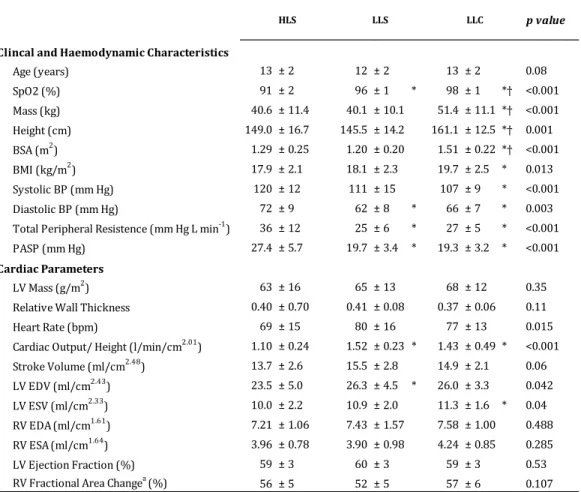
Both HLS and LLS had a lower body mass, height and body surface area than LLC, but all 212
three groups were classified as ‘healthy weight’ for age-specific BMI (Table 1). Systolic 213
and diastolic blood pressures were slightly higher in HLS compared to LLC (120 ± 12 vs. 214
107 ± 9 mmHg and 72 ± 9 vs. 66 ± 7, respectively), but there were no differences in 215
heart rate, LV mass, relative wall thickness or LV ejection fraction between groups 216
(Table 1). The PASP was higher in HLS, but only three participants were classified as 217
hypertensive (as defined as a PASP >35 mm Hg). 218
219
Left ventricular function
220
The HLS exhibited a smaller LV EDV compared to LLS (p=0.036) and LLC (p=0.067; 221
Table 1) when normalized for body height. Despite the lower LV EDV, there was no 222
difference in transmitral early to late filling ratio (E/A) between groups. Both HLS and 223
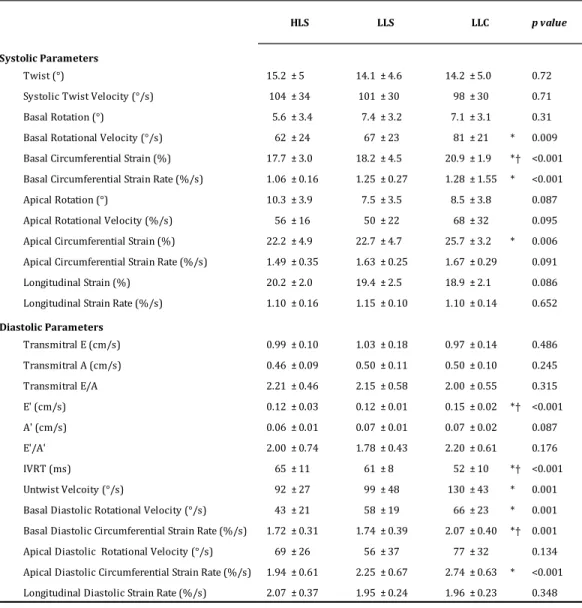
LLS did, however, demonstrate slower diastolic relaxation characterized by lower E’, 224
longer IVRT and lower peak untwisting velocity (Table 2, Figure 1). As discussed above, 225
ejection fraction was not different between groups, nor was LV twist, rotation or 226
longitudinal strain. 227
228
Right ventricular function
229
In contrast to the LV, there were no significant differences in RV EDA between groups. 230
RV longitudinal strain and strain rate were lower in HLS compared to LLS (23.3 ± 3.2 vs. 231
27.1 ± 2.5%, p=0.008 and 1.28 ± 0.23 vs. 1.58 ± 0.25 %/s, p=0.01; n=6 in LLS), with no 232
difference between HLS and LLC. 233
234
Age-related changes in HLS
235
Pre-adolescent Sherpa were estimated to be 0.8 years before and post-adolescent 236
Sherpa 1.9 years post the point at which height changes at the greatest rate (P<0.001).. 237
SpO2 (90.8 ± 2.9 vs. 91.1 ± 1.9%, P= 0.75) and MAP (90 ± 8 vs. 86 ± 6 mmHg, P= 0.18) did
238
not differ between age groups, nor were there significant differences in LV EDV (scaled 239
for height), transmitral filling ratio, IVRT or untwist velocity. In contrast, PASP was 240
higher in post-adolescent HLS (Figure 2a) and RV strain rate was lower (1.15 ± 0.20 vs. 241
1.40 ± 0.20, p=0.01). When the age groups were combined, PASP was negatively 242
correlated with RV strain rate (Figure 2b; r=0.496 p<0.01). 243
Discussion 245
246
For the first time this study examined cardiovascular structure and function in 247
adolescent Sherpa. There were three novel findings. (i) In comparison to lowland 248
controls, adolescent Sherpa residing at high altitude demonstrate a smaller LV EDV that 249
is accompanied by slower LV diastolic relaxation. (ii) Slower diastolic relaxation was 250
also evident in age-matched Sherpa residing at low altitude. Lastly, (iii) post-adolescent 251
Sherpa exhibit a higher pulmonary artery pressure that was associated with a lower RV 252
longitudinal function in comparison to their pre-adolescent counterparts. 253
254
LV diastolic function
255 256
The smaller LV EDV relative to body size is in agreement with recent reports of LV 257
structure in adult Sherpa and historical evidence in Andeans (31, 33). The smaller 258
ventricular volumes were accompanied by a slower LV relaxation compared to lowland 259
controls, as assessed by lower early myocardial velocity, longer IVRT and slower 260
untwisting velocity. At sea level, rapid untwisting is associated with positive diastolic 261
function, and is known to be reduced in systemic hypertension (37), pathologic LV 262
hypertrophy (38) and to decline with healthy ageing (41). The rapid relaxation resulting 263
from the release of potential energy generated during systole facilitates LV pressure 264
decay and aids passive transmitral filling (27, 41). The absence of rapid untwisting leads 265
to less efficient filling of the LV and ultimately elevated atrial pressure (10, 13). Data in 266
the present study suggest this alteration to diastolic function is a life-long feature of high 267
altitude natives, but the underlying cause and long-term consequences are yet to be 268
determined. Perhaps most surprising is the presence of decreased untwisting velocity in 269
LLS residing at 1400 m despite maintained oxygen saturation (96%). Recently, 270
Dedobbeleer and coworkers (12) reported slower LV untwisting in high altitude 271
Andeans ruling out the possibility that this feature of diastolic function is unique to 272
Sherpa. The lower untwist velocity may be partially explained by arterio-ventricular 273
coupling, as HLS exhibited higher systolic and diastolic blood pressure compared to LLC. 274
Previously, high-normal blood pressure has been shown to result in lower untwist 275
velocity (37). However, intriguingly LLS presented with slower untwisting velocity 276
despite comparable blood pressure to LLC. This would suggest than an alternative 277
mechanism other than systemic blood pressure is responsible for the slower diastolic 278
relaxation observed. 279
As a potential explanation, we speculate that the slower LV relaxation observed in both 281
adult and adolescent highlanders may be a consequence of high altitude exposure early 282
in fetal development or life, which is retained even after migration to lower altitudes. A 283
potential mechanism is discussed in the following section. 284
285 286
Slower diastolic relaxation in Sherpa; potential role of titin
287 288
Hypoxic exposure during critical stages of development has the potential to result in 289
permanent physiological differences, and has therefore led to the development of a 290
concept termed ‘programming’ (16, 21). For example, chronic hypoxemia in utero has a 291
profound effect on the relaxation of the peripheral vasculature in the offspring during 292
adulthood (16, 39). Whether such differences exist in cardiac relaxation is yet to be 293
established. In the mammalian heart, energy generated during contraction is stored 294
within the extracelluar collagen matrix (43) and in a large protein called titin, which 295
forms a dynamic intrasarcomeric filament that acts as a ‘spring’ within the 296
cardiomyocyte (18). Titin is therefore actively involved in the rapid relaxation of the 297
ventricle during early diastole (27), and its gene activation is regulated exclusively by 298
hypoxic-inducible factors (HIF) during embryogenesis.. Therefore, HIF1α provides a 299
possible mechanistic basis for oxygen signaling and the regulation of key components of 300
myofibrillogenesis in utero. In comparison with adults, at this stage of development titin 301
is expressed as a more compliant isoform of the protein termed ‘fetal titin’ (N2BA). 302
N2BA develops a lower passive tension than the adult N2B isoform, and the higher 303
compliance results in a slower relaxation of the ventricle. In the first week of life, there 304
is a gradual shift from the N2BA isoform towards the stiffer adult N2B isoform (18). This 305
change coincides with an increase in the early transmitral blood flow velocity that is 306
likely a consequence of faster LV relaxation and recoil (18, 45). Considering the integral 307
role titin plays in the restoring forces of the myocardium and its control via HIF 308
pathways, it is tempting to speculate that modification to this molecular spring may play 309
a role in the slower relaxation observed in the current study through cardiac 310
‘programming’. Divergent postnatal development of RV-LV structure and geometry has 311
already been observed between high altitude Andeans and lowland controls (28), and 312
changes in molecular components likely underpin gross structural changes. 313
314
We have confirmed the presence of slower diastolic relaxation in adolescent Sherpa in 315
currently unknown and require further attention to determine whether difference sin 317
LV diastolic function become more apparent with ageing. A greater understanding of the 318
unusual vascular phenotype previously reported in this unique adult population (9) is 319
also required. In contrast to adults, the slower early diastolic untwisting does not 320
appear to affect the ratio of early to atrial transmitral filling, as both were preserved in 321
HLS and LLS. In this context, a lower untwisting velocity despite the absence of disease 322
and traditional cardiovascular risk factors is intriguing, but further work is required to 323
establish the long-term cardiovascular consequences in older generations. 324
325
Age-related changes in hypoxic pulmonary vasoconstriction
326 327
In addition to changes in LV relaxation, HPV has also previously been implicated in 328
diastolic dysfunction secondary to the hypoxemia. It has been proposed that greater RV 329
afterload leading to lower RV ejection and consequently under filling of the LV could 330
explain the modified LV filling observed (2). In the current study, the primary 331
differences between HLS and LLS in this regard were the absence of HPV, higher RV 332
longitudinal systolic function and larger LV EDV in LLS. Therefore, as previously 333
suggested, HPV may increase RV afterload, decrease RV function and lower LV filling in 334
high altitude natives, and we propose this effect may be present at an early stage of life. 335
336
Previously, the hypoxia-mediated increase in PASP has been shown to be nearly two-337
fold higher in younger (6-9 years) versus older (14-16 years) lowland adolescents after 338
ascent to 3450 m (3). The authors speculated this differential response maybe due to to 339
higher sympathetic activity in the younger population, as determined by heart rate 340
variability. The higher sympathetic activity was assumed to have had a direct effect on 341
HPV thus elevating PASP. This was an important finding as increased PASP is related to 342
high altitude pulmonary edema and chronic mountain sickness (22, 23), and could 343
render younger children more susceptible to these illnesses. In addition to the negative 344
correlation between pulmonary artery pressure and age (r=-0.33; P<0.001), the authors 345
also reported arterial oxygen saturation to be inversely related to pulmonary artery 346
pressure (r= -0.32; p<0.001). The age-related differences in pulmonary artery pressure 347
may therefore not be a direct effect of sympathetic activity as suggested by the authors, 348
and be a consequence of greater desaturation in the younger children instead. The 349
pulmonary pressure response we present in HLS is in direct contrast with the previous 350
findings in lowlanders. In HLS, PASP was greater in pre- verses post-adolescents. The RV 351
to the higher PASP suggesting an impact on fundamental RV systolic function. There 353
was, however, no difference in oxygen saturation or MAP between groups, leading us to 354
speculate that unlike lowlanders, the difference was not related to greater levels of 355
oxygen desaturation or a systemic effect on the vasculature. In summary, it would 356
appear age-related differences in HPV are not the same in lowlanders during short-term 357
exposure and life-long residents of high altitude, nor are they controlled via the same 358
mechanism. 359
360 361
Limitations and future directions
362 363
Comparison between different ethnicities is an ever-present issue with high altitude 364
research. We attempted to control for this by recruiting Sherpa from lower altitudes. As 365
Kathmandu is not traditionally inhabited by Sherpa, it was difficult to recruit large 366
numbers in the LLS group. As stated in the discussion, the HPV response to high altitude 367
varies greatly between individuals. Therefore, caution must be exerted when drawing 368
conclusions from comparisons of relatively low numbers. Future research should aim to 369
investigate the effects of chronic hypoxemia on myocardial development at a molecular 370
level, and establish the consequences of impaired diastolic relaxation with ageing in 371
Sherpa. In addition, attention should also be played to the role autonomic control in 372
relation to the pulmonary vascular responses and ventricular function. 373
374
Conclusions
375 376
In conclusion, this study demonstrated that slower diastolic relaxation is present during 377
adolescence in Sherpa, irrespective of high or low altitude residence. Such differences in 378
diastolic function may be a consequence of hypoxic exposure in utero or early in life that 379
has resulted in permanent fundamental changes in cardiac physiology. In contrast to 380
previous reports of lowland children during short-term high altitude exposure, post-381
adolescent Sherpa demonstrate greater pulmonary artery pressure compared to their 382
pre-adolescent counterparts. This highlights the importance of ethnicity and duration of 383
exposure when considering the cardiovascular responses to hypoxia in a pediatric 384
population. Collectively these findings further our understanding of the effects of 385
chronic hypoxemia on cardiac structure and function. Such knowledge is applicable to 386
an increasing population of high altitude dwellers (>140 million people) and to a myriad 387
389
Acknowledgements
390
This study was carried out within the framework of the Ev-K2-CNR Project in 391
collaboration with the Nepal Academy of Science and Technology as foreseen by the 392
Memorandum of Understanding between Nepal and Italy, and thanks to contributions 393
from the Italian National Research Council. This study was supported in part by the 394
Natural Sciences and Engineering Research Council of Canada and a Canada Research 395
Chair to PNA. The authors are grateful to the other members of this international 396
research expedition for assistance with the organization of this project. 397
Competing Interests
398
No conflicts of interest are declared by the authors. 399
400
403
1. Alam M, Wardell J, Andersson E, Samad BA, and Nordlander R. 404
Characteristics of mitral and tricuspid annular velocities determined by pulsed wave 405
Doppler tissue imaging in healthy subjects. J Am Soc Echocardiogr 12: 618-628, 1999. 406
2. Allemann Y, Rotter M, Hutter D, Lipp E, Sartori C, Scherrer U, and Seiler C. 407
Impact of acute hypoxic pulmonary hypertension on LV diastolic function in healthy 408
mountaineers at high altitude. Am J Physiol Heart Circ Physiol 286: H856-862, 2004. 409
3. Allemann Y, Stuber T, de Marchi SF, Rexhaj E, Sartori C, Scherrer U, and 410
Rimoldi SF. Pulmonary artery pressure and cardiac function in children and 411
adolescents after rapid ascent to 3,450 m. Am J Physiol Heart Circ Physiol 302: H2646-412
2653, 2012. 413
4. Balanos GM, Talbot NP, Robbins PA, and Dorrington KL. Separating the 414
direct effect of hypoxia from the indirect effect of changes in cardiac output on the 415
maximum pressure difference across the tricuspid valve in healthy humans. Pflugers
416
Arch 450: 372-380, 2005. 417
5. Barlow SE. Expert committee recommendations regarding the prevention, 418
assessment, and treatment of child and adolescent overweight and obesity: summary 419
report. Pediatrics 120 Suppl 4: S164-192, 2007. 420
6. Batterham AM, George KP, and Mullineaux DR. Allometric scaling of left 421
ventricular mass by body dimensions in males and females. Med Sci Sports Exerc 29: 422
181-186, 1997. 423
7. Batterham AM, George KP, Whyte G, Sharma S, and McKenna W. Scaling 424
cardiac structural data by body dimensions: a review of theory, practice, and problems. 425
Int J Sports Med 20: 495-502, 1999. 426
8. Beall CM. Oxygen saturation increases during childhood and decreases during 427
adulthood among high altitude native Tibetians residing at 3,800-4,200m. High Alt Med
428
Biol 1: 25-32, 2000. 429
9. Bruno RM, Cogo A, Ghiadoni L, Duo E, Pomidori L, Sharma R, Thapa GB, 430
Basnyat B, Bartesaghi M, Picano E, Sicari R, Taddei S, and Pratali L. Cardiovascular 431
function in healthy Himalayan high-altitude dwellers. Atherosclerosis 236: 47-53, 2014. 432
10. Burns AT, La Gerche A, Prior DL, and MacIsaac AI. Reduced and delayed 433
untwisting of the left ventricle in patients with hypertension and left ventricular 434
hypertrophy: a study using two-dimensional speckle tracking imaging. Eur Heart J 29: 435
825; author reply 825-826, 2008. 436
11. Danica LP, Krotin M, Zdravkovic M, Soldatovic I, Zdravkovic D, Brajkovic M, 437
Gardijan V, Saric J, Pokrajac R, Lovic D, Stevanovic P, Gajic MT, and Vukcevic M. 438
Early left ventricular systolic and diastolic dysfunction in patients with newly diagnosed 439
obstructive sleep apnoea and normal left ventricular ejection fraction. 440
ScientificWorldJournal 2014: 898746, 2014. 441
12. Dedobbeleer C, Hadefi A, Pichon A, Villafuerte F, Naeije R, and Unger P. Left 442
ventricular adaptation to high altitude: speckle tracking echocardiography in 443
lowlanders, healthy highlanders and highlanders with chronic mountain sickness. Int J
444
Cardiovasc Imaging 2015. 445
13. Firstenberg MS, Greenberg NL, Garcia MJ, and Thomas JD. Relationship 446
Between Ventricular Contractility and Early Diastolic Intraventricular Pressure 447
Gradients: A Diastolic Link to Systolic Function. J Am Soc Echocardiogr 21: 501-506, 448
2008. 449
14. Foster BJ, Gao T, Mackie AS, Zemel BS, Ali H, Platt RW, and Colan SD. 450
Limitations of Expressing Left Ventricular Mass Relative to Height and to Body Surface 451
Area in Children. J Am Soc Echocardiogr 2012. 452
15. Funk GC, Lang I, Schenk P, Valipour A, Hartl S, and Burghuber OC. Left 453
ventricular diastolic dysfunction in patients with COPD in the presence and absence of 454
16. Giussani DA, Camm EJ, Niu Y, Richter HG, Blanco CE, Gottschalk R, Blake EZ, 456
Horder KA, Thakor AS, Hansell JA, Kane AD, Wooding FB, Cross CM, and Herrera 457
EA. Developmental programming of cardiovascular dysfunction by prenatal hypoxia and 458
oxidative stress. PLoS One 7: e31017, 2012. 459
17. Groves BM, Droma T, Sutton JR, McCullough RG, McCullough RE, Zhuang J, 460
Rapmund G, Sun S, Janes C, and Moore LG. Minimal hypoxic pulmonary hypertension 461
in normal Tibetans at 3,658 m. J Appl Physiol 74: 312-318, 1993. 462
18. Lahmers S, Wu Y, Call DR, Labeit S, and Granzier H. Developmental control of 463
titin isoform expression and passive stiffness in fetal and neonatal myocardium. Circ Res
464
94: 505-513, 2004. 465
19. Lang RM, Badano LP, Mor-Avi V, Afilalo J, Armstrong A, Ernande L, 466
Flachskampf FA, Foster E, Goldstein SA, Kuznetsova T, Lancellotti P, Muraru D, 467
Picard MH, Rietzschel ER, Rudski L, Spencer KT, Tsang W, and Voigt JU. 468
Recommendations for cardiac chamber quantification by echocardiography in adults: an 469
update from the american society of echocardiography and the European association of 470
cardiovascular imaging. J Am Soc Echocardiogr 28: 1-39 e14, 2015. 471
20. Levy PT, Sanchez Mejia AA, Machefsky A, Fowler S, Holland MR, and Singh 472
GK. Normal Ranges of Right Ventricular Systolic and Diastolic Strain Measures in 473
Children: A Systematic Review and Meta-Analysis. J Am Soc Echocardiogr 2014. 474
21. Lucas A. Programming by early nutrition in man. Ciba Found Symp 156: 38-50; 475
discussion 50-35, 1991. 476
22. Maggiorini M, Melot C, Pierre S, Pfeiffer F, Greve I, Sartori C, Lepori M, 477
Hauser M, Scherrer U, and Naeije R. High-altitude pulmonary edema is initially caused 478
by an increase in capillary pressure. Circulation 103: 2078-2083, 2001. 479
23. Maignan M, Rivera-Ch M, Privat C, Leon-Velarde F, Richalet JP, and Pham I. 480
Pulmonary pressure and cardiac function in chronic mountain sickness patients. Chest
481
135: 499-504, 2009. 482
24. Mirwald RL, Baxter-Jones AD, Bailey DA, and Beunen GP. An assessment of 483
maturity from anthropometric measurements. Med Sci Sports Exerc 34: 689-694, 2002. 484
25. Mosteller RD. Simplified calculation of body-surface area. N Engl J Med 317: 485
1098, 1987. 486
26. Naeije R. Physiological adaptation of the cardiovascular system to high altitude. 487
Prog Cardiovasc Dis 52: 456-466, 2010. 488
27. Notomi Y, Popovic ZB, Yamada H, Wallick DW, Martin MG, Oryszak SJ, 489
Shiota T, Greenberg NL, and Thomas JD. Ventricular untwisting: a temporal link 490
between left ventricular relaxation and suction. Am J Physiol Heart Circ Physiol 294: 491
H505-513, 2008. 492
28. Penaloza D, and Arias-Stella J. The heart and pulmonary circulation at high 493
altitudes: healthy highlanders and chronic mountain sickness. Circulation 115: 1132-494
1146, 2007. 495
29. Rudski LG, and Afilalo J. The blind men of Indostan and the elephant in the 496
echo lab. J Am Soc Echocardiogr 25: 714-717, 2012. 497
30. Rudski LG, Lai WW, Afilalo J, Hua L, Handschumacher MD, Chandrasekaran 498
K, Solomon SD, Louie EK, and Schiller NB. Guidelines for the echocardiographic 499
assessment of the right heart in adults: a report from the American Society of 500
Echocardiography endorsed by the European Association of Echocardiography, a 501
registered branch of the European Society of Cardiology, and the Canadian Society of 502
Echocardiography. J Am Soc Echocardiogr 23: 685-713; quiz 786-688, 2010. 503
31. Sime F, Penaloza D, and Ruiz L. Bradycardia, increased cardiac output, and 504
reversal of pulmonary hypertension in altitude natives living at sea level. Br Heart J 33: 505
647-657, 1971. 506
32. Simonson TS, Wei G, Wagner HE, Wuren T, Qin G, Yan M, Wagner PD, and Ge 507
RL. Low haemoglobin concentration in Tibetan males is associated with greater high-508
33. Stembridge M, Ainslie PN, Hughes MG, Stohr EJ, Cotter JD, Nio AQ, and 510
Shave R. Ventricular structure, function and mechanics at high altitude: chronic 511
remodelling in Sherpa verses short-term lowlander adaptation. J Appl Physiol (1985)
512
2014. 513
34. Stembridge M, Ainslie PN, Hughes MG, Stohr EJ, Cotter JD, Tymko MM, Day 514
TA, Bakker A, and Shave RE. Impaired myocardial function does not explain reduced 515
left ventricular filling and stroke volume at rest or during exercise at high altitude. J Appl
516
Physiol (1985) jap 00995 02014, 2015. 517
35. Stembridge M, Ainslie PN, and Shave R. Short-term adaptation and chronic 518
cardiac remodelling to high altitude in lowlander natives and Himalayan Sherpa. Exp
519
Physiol 2014. 520
36. Stohr EJ, Gonzalez-Alonso J, Pearson J, Low DA, Ali L, Barker H, and Shave R. 521
Dehydration reduces left ventricular filling at rest and during exercise independent of 522
twist mechanics. J Appl Physiol 111: 891-897, 2011. 523
37. Tadic M, Majstorovic A, Pencic B, Ivanovic B, Neskovic A, Badano L, 524
Stanisavljevic D, Scepanovic R, Stevanovic P, and Celic V. The impact of high-normal 525
blood pressure on left ventricular mechanics: a three-dimensional and speckle tracking 526
echocardiography study. Int J Cardiovasc Imaging 30: 699-711, 2014. 527
38. Takeuchi M, Borden WB, Nakai H, Nishikage T, Kokumai M, Nagakura T, 528
Otani S, and Lang RM. Reduced and delayed untwisting of the left ventricle in patients 529
with hypertension and left ventricular hypertrophy: a study using two-dimensional 530
speckle tracking imaging. Eur Heart J 28: 2756-2762, 2007. 531
39. Tang J, Zhu Z, Xia S, Li N, Chen N, Gao Q, Li L, Zhou X, Li D, Zhu X, Tu Q, Li W, 532
Wu C, Li J, Zhong Y, Li X, Mao C, and Xu Z. Chronic hypoxia in pregnancy affected 533
vascular tone of renal interlobar arteries in the offspring. Sci Rep 5: 9723, 2015. 534
40. Tanner JM. Fallacy of per-weight and per-surface area standards, and their 535
relation to spurious correlation. J Appl Physiol 2: 1-15, 1949. 536
41. van Dalen BM, Soliman OI, Kauer F, Vletter WB, Zwaan HB, Cate FJ, and 537
Geleijnse ML. Alterations in left ventricular untwisting with ageing. Circ J 74: 101-108, 538
2010. 539
42. Wagner PD, Simonson TS, Wei G, Wagner HE, Wuren T, Qin G, Yan M, and Ge 540
RL. Sea-level haemoglobin concentration is associated with greater exercise capacity in 541
Tibetan males at 4200 m. Exp Physiol 100: 1256-1262, 2015. 542
43. Waldman LK, Nosan D, Villarreal F, and Covell JW. Relation between 543
transmural deformation and local myofiber direction in canine left ventricle. Circ Res 63: 544
550-562, 1988. 545
44. Zhou W, Benharash P, Ho J, Ko Y, Patel NA, and Mahajan A. Left ventricular 546
twist and untwist rate provide reliable measures of ventricular function in myocardial 547
ischemia and a wide range of hemodynamic states. Physiol Rep 1: e00110, 2013. 548
45. Zhou YQ, Foster FS, Parkes R, and Adamson SL. Developmental changes in left 549
and right ventricular diastolic filling patterns in mice. Am J Physiol Heart Circ Physiol
550
285: H1563-1575, 2003. 551
552
553
Table 1. Clinical and hemodynamic characteristics of HLS, LLS and LLC. 555
556
SpO2, oxygen saturation; BSA, body surface area; BMI, body mass index; BP, blood
557
pressure; PASP, pulmonary artery systolic pressure; LV, left ventricle; EDV, end-diastolic 558
volume; ESV, end-systolic volume; EDA, end-diastolic area; ESA, end-systolic area. * p < 559
0.05 vs. HLS and † p < 0.05 vs. LLS. a Data available on six LLS.
560
561
562
563
Age (years) 13 ± 2 12 ± 2 13 ± 2 0.08
SpO2 (%) 91 ± 2 96 ± 1 * 98 ± 1 *† <0.001
Mass (kg) 40.6 ± 11.4 40.1 ± 10.1 51.4 ± 11.1 *† <0.001
Height (cm) 149.0 ± 16.7 145.5 ± 14.2 161.1 ± 12.5 *† 0.001
BSA (m2) 1.29 ± 0.25 1.20 ± 0.20 1.51 ± 0.22 *† <0.001
BMI (kg/m2) 17.9 ± 2.1 18.1 ± 2.3 19.7 ± 2.5 * 0.013
Systolic BP (mm Hg) 120 ± 12 111 ± 15 107 ± 9 * <0.001
Diastolic BP (mm Hg) 72 ± 9 62 ± 8 * 66 ± 7 * 0.003
Total Peripheral Resistence (mm Hg L min-1) 36 ± 12 25 ± 6 * 27 ± 5 * <0.001
PASP (mm Hg) 27.4 ± 5.7 19.7 ± 3.4 * 19.3 ± 3.2 * <0.001
LV Mass (g/m2) 63 ± 16 65 ± 13 68 ± 12 0.35
Relative Wall Thickness 0.40 ± 0.70 0.41 ± 0.08 0.37 ± 0.06 0.11
Heart Rate (bpm) 69 ± 15 80 ± 16 77 ± 13 0.015
Cardiac Output/ Height (l/min/cm2.01) 1.10 ± 0.24 1.52 ± 0.23 * 1.43 ± 0.49 * <0.001
Stroke Volume (ml/cm2.48) 13.7 ± 2.6 15.5 ± 2.8 14.9 ± 2.1 0.06
LV EDV (ml/cm2.43) 23.5 ± 5.0 26.3 ± 4.5 * 26.0 ± 3.3 0.042
LV ESV (ml/cm2.33) 10.0 ± 2.2 10.9 ± 2.0 11.3 ± 1.6 * 0.04
RV EDA(ml/cm1.61) 7.21 ± 1.06 7.43 ± 1.57 7.58 ± 1.00 0.488
RV ESA(ml/cm1.64) 3.96 ± 0.78 3.90 ± 0.98 4.24 ± 0.85 0.285
LV Ejection Fraction (%) 59 ± 3 60 ± 3 59 ± 3 0.53
RV Fractional Area Changea (%) 56 ± 5 52 ± 5 57 ± 6 0.107
Cardiac Parameters
HLS LLS LLC p value
Table 2. Left ventricular systolic and diastolic function in HLS, LLS and LLC. 564
565
E, early; A, atrial; E’, early velocity; A’, atrial velocity; IVRT, isvolumic relaxation time. * p 566
< 0.05 vs. HLS and † p < 0.05 vs. LLS. 567
Systolic Parameters
Twist (°) 15.2 ± 5 14.1 ± 4.6 14.2 ± 5.0 0.72 Systolic Twist Velocity (°/s) 104 ± 34 101 ± 30 98 ± 30 0.71 Basal Rotation (°) 5.6 ± 3.4 7.4 ± 3.2 7.1 ± 3.1 0.31 Basal Rotational Velocity (°/s) 62 ± 24 67 ± 23 81 ± 21 * 0.009 Basal Circumferential Strain (%) 17.7 ± 3.0 18.2 ± 4.5 20.9 ± 1.9 *† <0.001 Basal Circumferential Strain Rate (%/s) 1.06 ± 0.16 1.25 ± 0.27 1.28 ± 1.55 * <0.001 Apical Rotation (°) 10.3 ± 3.9 7.5 ± 3.5 8.5 ± 3.8 0.087 Apical Rotational Velocity (%/s) 56 ± 16 50 ± 22 68 ± 32 0.095 Apical Circumferential Strain (%) 22.2 ± 4.9 22.7 ± 4.7 25.7 ± 3.2 * 0.006 Apical Circumferential Strain Rate (%/s) 1.49 ± 0.35 1.63 ± 0.25 1.67 ± 0.29 0.091 Longitudinal Strain (%) 20.2 ± 2.0 19.4 ± 2.5 18.9 ± 2.1 0.086 Longitudinal Strain Rate (%/s) 1.10 ± 0.16 1.15 ± 0.10 1.10 ± 0.14 0.652
Diastolic Parameters
Transmitral E (cm/s) 0.99 ± 0.10 1.03 ± 0.18 0.97 ± 0.14 0.486 Transmitral A (cm/s) 0.46 ± 0.09 0.50 ± 0.11 0.50 ± 0.10 0.245 Transmitral E/A 2.21 ± 0.46 2.15 ± 0.58 2.00 ± 0.55 0.315 E' (cm/s) 0.12 ± 0.03 0.12 ± 0.01 0.15 ± 0.02 *† <0.001 A' (cm/s) 0.06 ± 0.01 0.07 ± 0.01 0.07 ± 0.02 0.087 E'/A' 2.00 ± 0.74 1.78 ± 0.43 2.20 ± 0.61 0.176 IVRT (ms) 65 ± 11 61 ± 8 52 ± 10 *† <0.001 Untwist Velcoity (°/s) 92 ± 27 99 ± 48 130 ± 43 * 0.001 Basal Diastolic Rotational Velocity (°/s) 43 ± 21 58 ± 19 66 ± 23 * 0.001 Basal Diastolic Circumferential Strain Rate (%/s) 1.72 ± 0.31 1.74 ± 0.39 2.07 ± 0.40 *† 0.001 Apical Diastolic Rotational Velocity (°/s) 69 ± 26 56 ± 37 77 ± 32 0.134 Apical Diastolic Circumferential Strain Rate (%/s) 1.94 ± 0.61 2.25 ± 0.67 2.74 ± 0.63 * <0.001 Longitudinal Diastolic Strain Rate (%/s) 2.07 ± 0.37 1.95 ± 0.24 1.96 ± 0.23 0.348
Figure 1. Mean twist and untwist velocity curves for HLS, LLS and LLC over the 568
entire cardiac cycle. Despite comparable systolic twist velocity, diastolic untwisting 569
was slower in both Sherpa groups, and the isovolumic relaxation time prolonged. AVC= 570
aortic valve closure; MVO= mitral valve opening. Please note, statistical differences are 571
presented in Table 2. 572
573 574
Figure 2. Individual pulmonary artery systolic pressure data plots and subsequent 575
relationship with right ventricular function in pre- and post-adolescent highland 576
Sherpa. PASP was higher in the post-adolescent group compared to pre-adolescents 577
and PASP was negatively correlated with RV longitudinal strain rate. PASP= pulmonary 578
-150
-100
-50
0
50
100
150
Twi
s
t
V
el
o
cit
y
(°/
s)
LLCHLS LLS
MVO LLC MVO HLS MVO LLS
AVC
Lower peak untwisting
velocity in both Sherpa
Longer IVRT in both Sherpa
HLS Pre-Ad
HLS Post-Ad
0
10
20
30
40
50
PASP
(mm
H
g)
*
10
20
30
40
50
0.0
0.5
1.0
1.5
2.0
PASP (mmHg)
RV
S
tr
a
in
Ra
te
(%
/s
)
HLS Pre-Ad
HLS Post-Ad