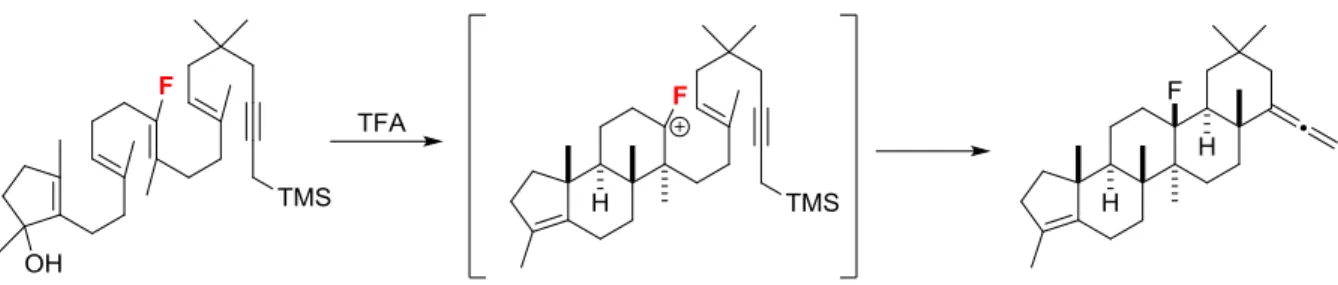
NEW MECHANISMS FOR TURNOVER AND FUNCTIONALIZATION IN THE PLATINUM INITIATED CYCLIZATION OF POLYENES
Michael J. Geier
A dissertation submitted to the faculty at the University at the North Carolina at Chapel Hill in partial fulfillment of the requirements for the degree of Doctor of Philosophy in the
Department of Chemistry.
Chapel Hill 2014
iii ABSTRACT
Michael J. Geier: New Mechanisms for Turnover and Functionalization in the Platinum Initiated Cyclization of Polyenes
(Under the direction of Michel Gagné)
The replication of nature’s ability to convert acyclic polyenes to polycycles has long
been the target of synthetic chemists. Progress has been made through manipulation of both substrate and initiator to achieve products of increasing complexity. While significant advances have been made, the abilities of the synthetic chemist pale in comparison to that of nature.
In an effort to bridge this gap, several areas have been explored. Current synthetic methods for the synthesis of C3-oxygenated polycycles rely upon pre-installation of the oxygen functionality. Development of a catalytic scheme for the generation of several C3-oxygenated polycycles using molecular oxygen as the oxygen source has been achieved. This scheme proceeds through a unique Pt(III) intermediate which undergoes homolytic cleavage of the Pt-C bond before interception of the alkyl radical.
Application of a (CNC)Pt2+ pincer complex to the cyclization of polyene substrates has resulted in a remarkably efficient cycloisomerization. Where phosphine ligated Pt complexes have proven remarkably stable toward oxidation, rapid Pt-alkyl
iv
Extension of this cycloisomerization methodology to substrates which proceed through secondary carbocations has allowed for a unique opportunity to study the nature of polycyclization reactions experimentally. Through selective substrate demethylation, a concerted yet highly asynchronous process was uncovered, revealing a process highly dependent on the stability of the A ring.
v
ACKOWLEDGEMENTS
First and foremost I’d like to thank Mike for giving me the opportunity to work in his lab. The freedom to explore new ideas (both good and bad) is something I’ll always appreciate. Knowing that Mike’s door was always open and having support when I needed it has made
these 5 years much easier.
I’d also like to thank Steve Westcott (Mount Allison University) for pointing me in
this direction and continuing to provide guidance along the way.
I’d like to thank Gagné group members both past and present. In particular, Joe
vi
TABLE OF CONTENTS
TABLE OF CONTENTS ... VI
LIST OF TABLES ... VIII
LIST OF FIGURES ... IX
LIST OF ABBREVIATIONS ... XIV
CHAPTER 1: INTRODUCTION ... 1
ENZYME CATALYZED TERPENE CYCLIZATION ... 1
BIOMIMETIC APPROACHES TO CASCADE CYCLIZATION ... 7
BIOMIMETIC CYCLIZATION OF POLYENES ... 16
SECONDARY CARBOCATIONS IN BIOMIMETIC CYCLIZATION REACTIONS ... 19
ELECTROPHILIC PT-INITIATED CYCLIZATION OF POLYENES ... 23
OXIDATIVE FUNCTIONALIZATION OF M-CBONDS ... 28
RESEARCH OBJECTIVES ... 36
REFERENCES ... 38
CHAPTER 2: STOICHIOMETRIC HALOGENATION OF PT-C BONDS ... 45
INTRODUCTION ... 45
RESULTS ... 46
DISCUSSION ... 55
EXPERIMENTAL SECTION ... 58
vii
CHAPTER 3: ONE ELECTRON OXIDATION OF PT-ALKYL COMPOUNDS ... 64
INTRODUCTION ... 64
STOICHIOMETRIC REACTIONS... 66
CATALYTIC STUDIES ... 71
OXIDANT SCREEN ... 76
EXPERIMENTAL SECTION ... 78
REFERENCES ... 83
CHAPTER 4: POLYENE CYCLOISOMERIZATION REACTIONS ... 85
INTRODUCTION ... 85
INITIAL RESULTS ... 87
ALKENE TERMINATING SUBSTRATES ... 89
EXPERIMENTAL SECTION ... 95
REFERENCES ... 118
CHAPTER 5: SECONDARY CARBOCATION IN POLYCYCLIZATIONS ... 119
INTRODUCTION ... 119
SUBSTRATES ... 121
CYCLIZATION ... 123
COMPETITION EXPERIMENTS ... 126
DISCUSSION ... 129
EXPERIMENTAL SECTION ... 132
REFERENCES ... 157
APPENDIX A: NEW CYCLIZATION INITIATORS ... 158
REFERENCES ... 161
APPENDIX B: ADDITIONAL SUBSTRATES ... 162
viii
LIST OF TABLES
Table 2.1: Fluorination in the presence of TBAOAc ... 50
Table 2.2: Fluorination in the presence of TBAB... 52
Table 2.3: Bromination in the presence of TBAB ... 54
Table 3.1: Additive effect in photochemical oxygenation reactions ... 67
Table 3.2: Halogenation of Pt-alkyl with CuX2 ... 68
Table 3.3: Optimization of oxygenation of Pt-alkyl ... 71
Table 3.4: Solvent effect on oxygenation of Pt-alkyl ... 72
Table 3.5: Additive effect on oxygenation of Pt-alkyl ... 73
Table 3.6: Re-oxidation of Cu(OTf)2 ... 74
Table 3.7: Substrate scope ... 76
Table 3.8: Oxidant screen ... 77
Table 4.1: Optimization of proton shuttle loading ... 89
ix
LIST OF FIGURES
Figure 1.1: Enzymatic cyclization of squalene ... 2
Figure 1.2: A stepwise illustration of the conversion of squalene to hopene ... 3
Figure 1.3: Comparison of conformation in squalene and oxidosqualene... 3
Figure 1.4: Intermediates in squalene cyclization ... 5
Figure 1.5: Intermediates in the formation of lanosterol ... 6
Figure 1.6: Concerted C ring expansion and D ring formation ... 7
Figure 1.7: Humulyl cation intermediate in the formation of pentalenene ... 7
Figure 1.8: Stork-Eschenmoser postulate ... 8
Figure 1.9: Johnson’s pentacyclization reaction ... 9
Figure 1.10: Johnson’s synthesis of 11α-hydroxyprogesterone ... 9
Figure 1.11: Initiation by chiral acetal opening ... 10
Figure 1.12: Yamamoto’s chiral Brønsted Lewis Acid cyclization ... 10
Figure 1.13: Corey’s chiral Brønsted Lews acid cyclization ... 11
Figure 1.14: Corey’s synthesis of dehydroabietic acid ... 11
Figure 1.15: Corey’s synthesis of 4-epipodocarpic acid ... 11
Figure 1.16: Halonium induced polycyclization ... 12
Figure 1.17: Carreira’s total synthesis of asperolide C ... 13
Figure 1.18: Toste’s gold catalyzed polycyclization ... 13
Figure 1.19: Products derived from 2,3-oxidosqualene ... 14
Figure 1.20: Biomimetic cyclization of 2,3-oxidosqualene ... 15
Figure 1.21: van Tamelen’s synthesis of allopregnolone ... 15
x
Figure 1.23: Cyclization of propargylic alcohol substrate ... 16
Figure 1.24: Mercury initiated cyclization... 17
Figure 1.25: Bi(OTf)3 catalyzed bicyclization and rearrangement ... 18
Figure 1.26: Formation of multiple products in Bi(OTf)3 catalyzed cylization ... 18
Figure 1.27: Cyclization of secondary alkene containing substrates ... 20
Figure 1.28: Tetracyclization of secondary alkene containing substrate ... 20
Figure 1.29: Vinyl and isopropenyl terminating substrates ... 21
Figure 1.30: Step-wise vs. concerted tetracyclization ... 22
Figure 1.31: Fluorine stabilization of 6-membered C-ring ... 23
Figure 1.32: Metal activation of alkenes... 23
Figure 1.33: Palladium catalyzed cyclization ... 24
Figure 1.34: Platinum pincer mediated cyclization ... 24
Figure 1.35: Formation of enantiomerically enriched bicyclopropanes ... 25
Figure 1.36: Catalytic polycyclization via β-hydride elimination ... 26
Figure 1.37: Catalytic cyclization/fluorination ... 27
Figure 1.38: Stoichiometric polyene cyclization ... 28
Figure 1.39: Wagner-Meerwein rearrangement of 5-exo terminating substrate ... 28
Figure 1.40: Catalytic polyene cyclization ... 28
Figure 1.41: Shilov cycle ... 29
Figure 1.42: Redutive elimination of ethane from 5 coordinate intermediate ... 30
Figure 1.43: Reductive elimination pathways ... 30
Figure 1.44: Stereoretentive C-F reductive elimination ... 31
xi
Figure 1.46: Stereoretentive C-I reductive elimination from Rh(III) ... 32
Figure 1.47: Bromination of Pd and Hg-bonds ... 33
Figure 1.48: Donor effects on the oxidation of Pt(II) compounds ... 34
Figure 1.49: Inner and outer sphere one electron oxidation of organostannanes ... 34
Figure 1.50: Single electron oxidation of Pd pincer complex ... 36
Figure 2.1: Possible C-X reductive elimination pathways... 46
Figure 2.2: Stereoretentive C-X bond forming reductive elimination ... 47
Figure 2.3: Mechanism of stereoretentive C-X bond formation ... 48
Figure 2.4: Possible reductive elimination pathways with XeF2 and TBAOAc ... 51
Figure 2.5: Possible reductive elimination pathways with XeF2 and TBAB ... 53
Figure 2.6: Possible reductive elimination pathways with NBS and TBAB ... 55
Figure 2.7: Reductive elimination from 5-coordinate complex ... 56
Figure 2.8: Sanford’s C-F reductive elimination from Pd(IV) ... 56
Figure 2.9: Possible paths to stereoinvertive reductive elimination ... 57
Figure 2.10: Comparison of possible interemediates ... 58
Figure 3.1: Insertion of singlet oxygen to Pt-Me bond ... 65
Figure 3.2: Goldberg’s insertion of O2 into Pd-Me bond ... 66
Figure 3.3: Proposed mechanism for halogenation of 3.1 with CuX2 reagents ... 68
Figure 3.4: Mechanism of oxygenation of Pt-C bond ... 69
Figure 3.5: Russell disproportionation of alkyl radical ... 70
Figure 3.6: Oxygenation catalytic cycle ... 75
Figure 4.1: Desired ligand framework ... 86
xii
Figure 4.3: Reaction of 4.1 with 4.2 ... 87
Figure 4.4: Polyene cycloisomerization mechanism ... 88
Figure 4.5: Isomerization of trisubstituted alkene to tetrasubstituted alkene ... 91
Figure 4.6: Abnormal Claisen rearrangement of aryl ether ... 92
Figure 4.7: Rearrangement of substrate 4.16 ... 93
Figure 4.8: Wagner-Meerwein rearrangements of 4.20 and oxidosqualene ... 94
Figure 5.1: Concerted formation of rings A, B and C of hopene... 119
Figure 5.2: Tetracyclization of 1 ... 120
Figure 5.3: 2,3-oxidosqualene and analogs... 120
Figure 5.4: Synthesis of 5.1 ... 121
Figure 5.5: Attempted synthesis of secondary alkene ... 122
Figure 5.6: One pot vinylation/Claisen rearrangement ... 122
Figure 5.7: Library of penta-ene substrates ... 123
Figure 5.8: Cyclization of 5.4 ... 124
Figure 5.9: Cyclization of 5.3 ... 125
Figure 5.10: Cyclization of 5.5 ... 126
Figure 5.11: Relative rates for concerted, synchronous cyclization ... 126
Figure 5.12: Reaction coordinate for a concerted, synchronous reaction ... 127
Figure 5.13: Relative rates for step-wise cyclization ... 128
Figure 5.14: Reaction coordinate diagram from concerted, asynchronous reaction ... 131
Figure A.1: Cyclization by (terpy)Pt2+ ... 158
Figure A.2: Cyclization by P3PPt2+ ... 159
xiii
xiv
LIST OF ABBREVIATIONS
˚C degrees Celsius
α alpha
aq aqueous
atm atmospheres
β beta
BF4 tetrafluoroborate
nBuLi n-butyllithium
BLA Brønsted Lews acid
bpy bipyridine
br broad
δ delta – change from standard value
CD2Cl2 deuterated dichloromethane
CDCl3 deuterated chloroform
CD3CN deuterated acetonitrile
CD3NO2 deuterated nitromethane
d doublet
DMSO dimethylsulfoxide
dr diastereomeric ratio
ee enantiomeric excess
endo endocyclic
eq equivalent
xv
EtOAc ethyl acetate
g gram
GC gas chromatography
GCMS gas chromatography/mass spectroscopy
HRMS high resolution mass spectroscopy
Hz hertz
J three bond H-H coupling constant
Kcal kilocalorie
L liter
LDA lithium diisopropylamide
M molarity
mg milligram
MHz megahertz
mL milliliter
mM millimole
m multiplet
mes mesityl
Me methyl
mol % mole percent
m/z mass to charge
NBS n-bromosuccinimide
NCS n-chlorosuccinimide
xvi
OTf triflate
Ph phenyl
PF6 hexafluorophosphate
ppm parts per million
PPP bis(2-diphenylphosphinoethyl)phenylphosphine
PTFE polytetrafluoroethylene
q quartet
rt room temperature
s singlet
t triplet
THF tetrahydrofuran
tol toluene
triphos bis(2-diphenylphosphinoethyl)phenylphosphine
1
CHAPTER 1: INTRODUCTION
Enzyme Catalyzed Terpene Cyclization
Nature’s ability to mediate the formation of a variety of complex products is
unmatched by current synthetic methods. This remarkable capacity for chemical manipulation is perhaps best exemplified in the enzyme catalyzed terpene cyclization
reactions.1 These reactions provide complex polycyclic products with full stereocontrol from simple achiral polyene substrates.
A number of these polycyclic compounds are the products of multiple enzyme catalyzed reactions, ultimately derived from the substrate squalene.2 In bacteria, squalene is converted to hopene by squalene-hopene cyclase, while plants, animals and fungi first
2 Figure 1.1: Enzymatic cyclization of squalene
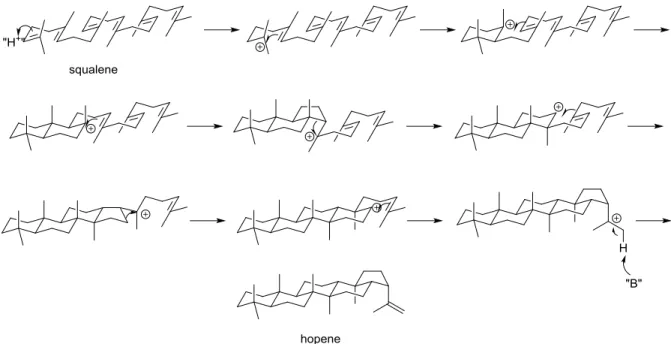
The fundamental chemical process that underpins terpene cyclization chemistry is the cation-olefin reaction, where transiently generated carbocations4 rapidly react with alkenes which have been pre-organized within the enzyme to make a C-C bond and regenerate the carbocation. This process, which converts long chain polyenes to predominantly saturated polycyclic compounds is thermodynamically favorable due to the conversion of C-C double bonds to C-C single bonds, all while converting double bonds to rings.5
3
Figure 1.2: A stepwise illustration of the conversion of squalene to hopene
The oxidosqualene cyclases are believed to have evolved from the squalene hopene cyclase.1c While squalene hopene cyclase is able to accommodate several different
substrates, the oxidosqualene cyclases are more substrate selective, and possess the ability to distinguish between (3S) and (3R)-2,3-oxidosqualene. In contrast to the all chair
conformation of squalene enforced by squalene cyclase, 2,3-oxidosqualene cyclase induces a
chair-boat-chair conformation (Figure 1.3), resulting in significant alteration of the
framework.1d Cyclization of 2,3-oxidosqualene is initiated by protonation of the epoxide. A series of cation olefin reactions and skeletal rearrangements generates a tertiary carbocation at the junction of rings B and C which eliminates to the tetrasubstituted alkene product.1d
4
The concerted nature of the enzyme mediated polycyclization of triterpene substrates has long been debated,1d with several studies suggesting stepwise processes involving formation of discrete carbocationic intermediates6 while others have suggested a more concerted process with several transformations occurring without the formation of intermediates.7
Much of the theoretical work in this area has benefited from the report of Schulz in which an X-ray structure of 2-azasqualene was obtained within the hopene cyclase enzyme.8 The conformation in which the squalene derivative was held within the enzyme provided a starting point for many of the calculations used to assess the nature of the cyclization.
Several computational investigations by Hess on a variety of truncated squalene models revealed the concerted but highly asynchronous formation of the A,B and C rings of hopene. It was shown that full closure of the A ring is observed prior to significant
engagement of the B and C rings.9 While the A and B rings form via a cation-olefin reaction that generates the most favorable 3˚ carbocations (6-endo ring closures), the C-ring closes by
5 Figure 1.4: Intermediates in squalene cyclization
The enzymatic cyclization of oxidosqualene to lanosterol is believed to proceed in a similar fashion with concerted formation of the A, B and C rings, proceeding by an
alternative chair-boat-chair conformation (Figure 1.5).11 Recent calculations have shown the process to be highly asynchronous, with nearly full closure of the A ring prior to any
6
Figure 1.5: Intermediates in the formation of lanosterol
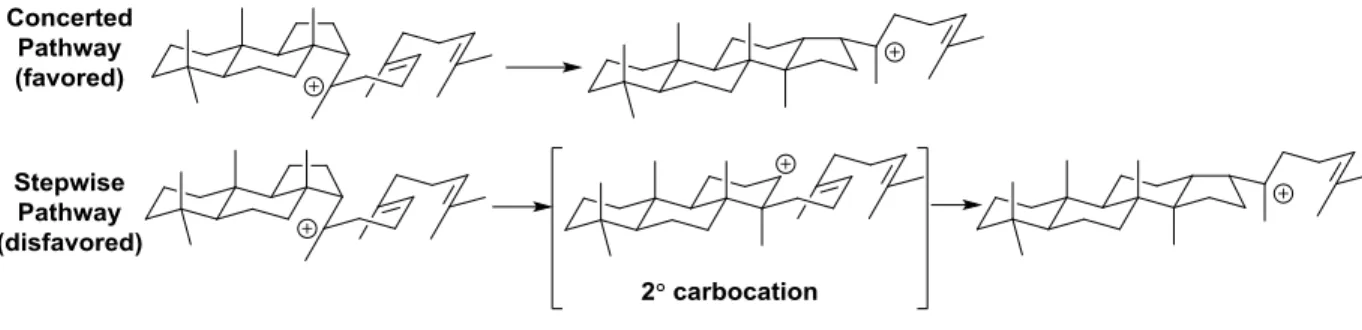
The cyclizations of squalene and oxidosqualene have been calculated to proceed strictly through tertiary carbocation intermediates.1d These calculations have shown that the intermediacy of high energy secondary carbocations along the reaction path can be avoided by allowing several transformations to occur in concert. In both cyclizations, initial
7
Figure 1.6: Concerted C ring expansion and D ring formation
Nature’s aversion to the formation of secondary carbocationic intermediates is not
ubiquitous. Several calculations have revealed that secondary carbocations can exist as intermediates,13 their structures, however, are highly stabilized within the enzyme.14 The enzymatic stabilization of these secondary carbocations has allowed for anti-Markovnikov selectivity to be observed in the biosynthesis of several several natural products. The humulyl cation has been shown by computational methods to be an intermediate in the conversion of farnesyl diphosphate to pentalenene (Figure 1.7).13a
Figure 1.7: Humulyl cation intermediate in the formation of pentalenene
Biomimetic Approaches to Cascade Cyclization
8
necessitates nucleophilic terminating groups and can result in incomplete cyclization and a lack of selectivity.
Figure 1.8: Stork-Eschenmoser postulate
Vital to synthetic approaches to replicate these reactions is the Stork-Eschenmoser postulate. Stork and Eschenmoser postulated a relationship between the alkene geometry of the acyclic substrate and the geometry of the ring junction in systems related to terpene cyclization. The hypothesis states that a cis ring junction is formed from the cyclization of Z alkenes, while a trans ring junction is formed by cyclization of E alkenes (Figure 1.8).1c,16 This hypothesis allows for stereochemical control of ring junctions based upon the alkene geometry of the starting material, and explicitly requires some degree of concertedness in the cyclizations.
A variety of approaches has been devised to synthesize bio-like polycyclic
frameworks. Many of these methods rely upon Brønsted or Lewis acids to mimic enzymatic substrate protonation, while some more recent approaches have turned to electrophilic halonium sources and transition metal catalysis to initiate cyclization.1c
9
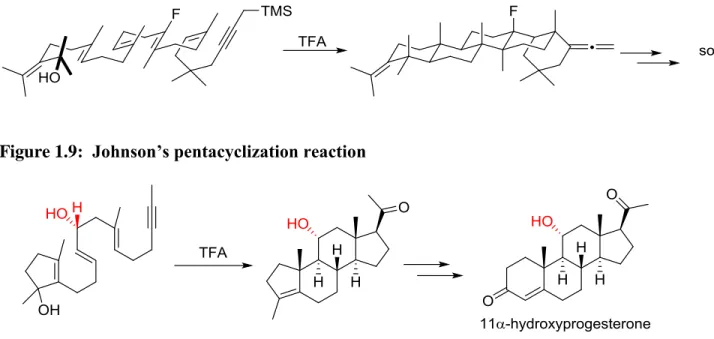
acids to initiate the cascade. Early work began with the generation of simple mono and bicyclic products in formic acid solution,18 confirming the Stork-Eschenmoser postulate. Much later, he would become the first to report a non-enzymatic pentacyclization reaction toward the total synthesis of sophoradiol (Figure 1.9).19 Johnson’s contributions to
selectivity in polyene cyclizations have also been remarkable. In his total synthesis of 11α-hydroxyprogesterone, he reported that the inclusion of a chiral centre in the polyene substrate led to diastereoselectivity in the cyclized product (Figure 1.10).20 His later use of chiral acetal opening to initiate cyclization resulted in a remarkably selective tetracyclization, making use of a cation stabilizing fluorine atom to assist in the cyclization (Figure 1.11).21
Figure 1.9: Johnson’s pentacyclization reaction
10 Figure 1.11: Initiation by chiral acetal opening
More recent work from Yamamoto has made use of chiral Brønsted Lewis Acids which were able to initiate an enantioselective cascade cyclization. These initiators were able to deliver a proton in an enantioselective fashion as a result of the enhanced acidity of the BINOL from complexation of the Lewis acidic tin tetrachloride (Figure 1.12).22 While diastereoselectivities were high, enantioselectivites were moderate. These reactions also suffered from the requirement of an excess of chiral initiator, nucleophilic terminating groups, and were plagued by premature termination of the cascade in the case of aryl terminating groups, requiring additional steps and reagents to achieve full cyclization.
Figure 1.12: Yamamoto’s chiral Brønsted Lewis Acid cyclization
11
derivative allowed for a more active and enantioselective cyclization initiator when compared to that of Yamamoto, reporting enantiomeric excesses of up to 92% (Figure
1.13).24 More recently, this approach has been extended to the selective activation of internal olefins for predictably controlled cyclizations. This method was applied to these substrates en route to the synthesis of dehydroabietic acid (Figure 1.14) and 4-epipodocarpic acid (Figure 1.15).25
Figure 1.13: Corey’s chiral Brønsted Lews acid cyclization
Figure 1.14: Corey’s synthesis of dehydroabietic acid
12
Notably, Ishihara has disclosed an enantioselective halocyclization of polyprenoids by delivering I+ or Br+ from a chiral phosphoramidite to form the C3-halogenated product with high enantioselectivity.26 Enantiomeric excesses of up 99% were reported with moderate yields. These reactions generated unique C3-functionalized products, however, they too were plagued by premature termination of the cyclization, requiring additional steps to form polycyclic products (Figure 1.16). More recently, a catalytic variant was reported in which the stoichiometric chiral phosporamidite was replaced with a catalytic amount of a phosphate-urea catalyst, unfortunately, this catalytic variant was unable to provide the same enantioselectivity, resulting in only a 2% ee.27
Figure 1.16: Halonium induced polycyclization
Carreira has reported a highly enantioselective cyclization in which an allylic alcohol moiety can be activated by the combination of a Lewis acid and a chiral iridium catalyst with both aryl and heteroaryl terminating groups being tolerated.28 Yields of up to 93% and enantiomeric excesses of >99.5% were reported in several cases. This system was effective at initiating bicyclization reactions, however, tricyclization reactions resulted in a
13
Figure 1.17: Carreira’s total synthesis of asperolide C
Figure 1.18: Toste’s gold catalyzed polycyclization
14
Figure 1.19: Products derived from 2,3-oxidosqualene
15
Figure 1.20: Biomimetic cyclization of 2,3-oxidosqualene
Formation of the desired 6,6,6,5 sterol skeleton in biomimetic reactions has proved challenging due to the preferential formation of 5-membered C-rings arising from 5-exo Markovnikov ring closure to form the more favorable tertiary carbocation.33 This problem was overcome by design of an alkyne terminating substrate by van Tamelen in which methyl group placement allowed for Lewis acid initiated tetracyclization, forming the sterol
allopregnanolone with the desired 6,6,6,5 framework (Figure 1.21).34
Figure 1.21: van Tamelen’s synthesis of allopregnolone
Figure 1.22: Corey’s Al mediated bicyclization
16
materials has allowed for the stereocontrolled total synthesis of a remarkable number of C3 oxygenated natural products including β-amyrin,36 oleanolic acid,36 erythodiol,36 lanosterol,37 dammarenediol,38 serratenediol,39 onocerin40 and germanicol.41 Recent work has involved the indium catalyzed cyclization of a series of chiral propargylic alcohols and silyl ethers to form polycylic structures in good yield and enantioselectivity. In these cases, activation was achieved by coordination of the indium catalyst to a terminal alkyne, while enantiomeric excesses in the 90’s resulted from pre-installation of the chiral propargyl alcohol or silyl
ether (Figure 1.23).42
Figure 1.23: Cyclization of propargylic alcohol substrate
Biomimetic Cyclization of Polyenes
A second, much less explored area of the biomimetic cascade cyclization reactions are those that utilize strictly polyene containing substrates. In contrast to those methods which benefit from the enhanced nucleophilicity of heteroatom terminating substrates, or those that are aided by cation-pi stabilization in the case of arene terminating substrates, alkene terminating groups provide a significantly more challenging target. Alkene
17
Early work in the cyclization of polyene substrates employed mercury salts as
initiators. These proved effective at activating alkenes, however they suffered from a lack of selectivity, as mercury is unselective in its alkene preference.43 These methods also required a stoichiometric amount of mercury. More recently, Nishizawa has reported the cyclization of a number of substrates including several alkene terminating substrates. These substrates resulted in several different products, including those arising from incomplete cyclization (Figure 1.24); stoichiometric mercury is still required.44
Figure 1.24: Mercury initiated cyclization
More recent work from the Dunach group has focused on the use of Bi(OTf)3 to promote cyclization of polyene substrates. While Bi(OTf)3 was added as the catalyst, it has been proposed that a Lewis acid assisted Brønsted acid type of activation may be responsible for the activation, further supported by the ability of triflic acid to promote reactivity.
18
Figure 1.25: Bi(OTf)3 catalyzed bicyclization and rearrangement
Computation and further experimental studies allowed for the identification of several possible intermediates. Lowering of the temperature from 100˚C to 0˚C allowed for
formation of two previously unobserved products. While the Wagner-Meerwein rearranged product remained the predominant species at room temperature, a product arising from elimination from the initially formed tertiary cabocation as well as a mixture of
monocyclized products appeared in the reaction mixture (Figure 1.26). Subjecting these products to initial cyclization conditions resulted in formation of the Wagner-Meerwein rearranged product.47
19
Secondary Carbocations in Biomimetic Cyclization Reactions
The synthetic viability of secondary carbocations in catalytic biomimetic cyclization reactions has remained relatively unexplored. Substrates currently employed in these reactions have been carefully crafted, controlling ring size and termination geometry by strategic positioning of methyl groups within the substrate. This approach has allowed for predictable cyclization reactions, however, it has left an important area of biomimetic cyclization reactions relatively untouched.
The majority of recent efforts to study the involvement of secondary carbocations in such cyclizations have been calculations on the enzyme mediated transformations.14a Early experimental work from W.S. Johnson has reported several reactions containing secondary alkenes,15b while some of his later work has detailed the stabilization of secondary
carbocations in polyene cyclization reactions.48
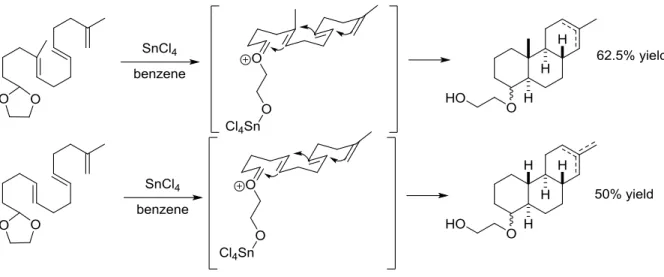
Johnson and others have reported several different approaches to initiate polyene cyclizations under substrate control. The addition of a stoichiometric amount of stannic chloride to induce acetal opening has proven to be effective for the tricyclization of
20
Figure 1.27: Cyclization of secondary alkene containing substrates
Extension of this protocol to tetracyclization reactions also proved effective, with stannic chloride in pentane furnishing the tetracyclic product, setting 7 stereocenters, providing only 2 of a possible 64 stereoisomers (Figure 1.28).
Figure 1.28: Tetracyclization of secondary alkene containing substrate
The generation of allylic carbocations through several means has also been effective in initiating cyclizations that proceed through disubstituted alkenes. Formation of
cyclohexenyl,51 cyclopentenyl52 and tetramethylallylic53 cations have been used to induce cyclization. Particularly noteworthy are several examples in which direct comparisons between secondary and tertiatry carbocations can be drawn. Cyclization of vinyl terminating and isopropenyl terminating substrates were compared, noting a larger proportion of
21
enhanced nucleophilicity arising from the stability of the terminal carbocation (Figure 1.29).54
Figure 1.29: Vinyl and isopropenyl terminating substrates
22
Figure 1.30: Step-wise vs. concerted tetracyclization
Johnson has also reported the application of fluorine to stabilize secondary carbocations that ensue during the course of a cascade cyclization.56 This approach has enabled the previously mentioned pentacyclization19 reaction and the total synthesis of several natural products.21,57 The use of fluorine has also overcome the regiospecificity problem during biomimetic C-ring formation. The anti-Markovnikov C-ring closure observed in the enzyme mediated cyclization (ie lanosterol, hopene) has been difficult to replicate due to the preference for formation of tertiary over secondary carbocations and the aversion to C-ring expansion.32 This results in 5-exo C-ring closure followed by elimination to form tricyclic products. Strategic positioning of the fluorine atom to stabilize the
23
Figure 1.31: Fluorine stabilization of 6-membered C-ring
Electrophilic Pt-initiated Cyclization of Polyenes
The use of transition metals to activate unsaturation has long been exploited in catalysis. Coordination of an alkene to a metal centre generates an electrophilic carbon centre, prone to nucleophilic attack (Figure 1.32). In the case of polyunsatured compounds, Pt and Pd will preferentially coordinate the least substituted alkene, allowing for selective activation.59
Figure 1.32: Metal activation of alkenes
This unique tendency of Pd and Pt has been used in the Gagné lab for the cyclization of polyene substrates by selective placement of a monosubstituted alkene at the terminus of the polyene. This assures that the catalyst will initiate at the desired position and start the cation-olefin cascade at the position favored by enzymes. Initial studies employing a Pd catalyst and an oxidant allowed for catalytic cyclization of polyene substrates with
24 Figure 1.33: Palladium catalyzed cyclization
A more selective variant of these cyclization reactions employed tridentate ligands on both Pd and Pt initiators. The tridentate ligand creates a coordinatively saturated
organometallic species upon cyclization, which prevented β-hydride elimination, resulting in a series of remarkably stable Pt-alkyl compounds. As a result of the bulk of the group 10 metal initiators, these reactions provided excellent diastereoselectivity due to the metal’s
preference for equatorial disposition (Figure 1.34).61
Figure 1.34: Platinum pincer mediated cyclization
Application of the (triphos)Pt catalyst to 1,6 and 1,7 diene systems produced a
catalytic cycloisomerization reaction that initiates with a cation-olefin reaction but turns over through rearrangement that forms bicyclopropane products.62 Deconstruction of the
25
Figure 1.35: Formation of enantiomerically enriched bicyclopropanes
The cyclization of polyenes with tridentate and deconstructed tridentate phosphine ligands was effective in stoichiometric reactions, forming stable Pt organometallics, however, these complexes proved remarkably stable toward acid, undergoing protonolysis only under strongly acidic conditions. The triphos ligands proved significantly more vulnerable to protodemetallation than their P2P counterparts, an observation rationalized by the relief of torsional strain created by the tridentate ligand.65 While protonolysis was accelerated by increasing the electron density on the triphos ligand, this significantly shifted the equilibrium constant toward the uncyclized starting material.66
While tridentate phosphine ligands made for effective initiators, their stability to β-hydride elimination prevented catalytic turnover. This situation stimulated development of several new turnover mechanisms. In lieu of the previously used tridentate ligands, Pt catalysts with bidentate phosphine ligands provide Pt-R intermediates with a vacant
coordination site. Activation and cyclization thus leads to an organometallic species which was prone to β-hydride elimination. This led to a 2,3-unsaturated polycyclic product and a
26
Figure 1.36: Catalytic polycyclization via β-hydride elimination
27 Figure 1.37: Catalytic cyclization/fluorination
Heteroatom terminating substrates were efficiently cyclized in both stoichiometric and catalytic schemes, however, the more challenging alkene terminating substrates remained untested. Stoichiometric cyclization of these substrates proved significantly more
challenging, long reactions times were observed despite optimized conditions that required two equivalents of substrate and multiple equivalents of base. Under these conditions, a variety of substrates would be cyclized, including those that terminate in both a 6-endo and a 6-exo fashion (Figure 1.38). In the 5-exo terminating case, a Wagner-Meerwein rearranged product was observed, the result of a hydride and methyl shift to form a more
28 Figure 1.38: Stoichiometric polyene cyclization
Figure 1.39: Wagner-Meerwein rearrangement of 5-exo terminating substrate
Attempts to shift these polyene substrates into a catalytic manifold proved
challenging as slow and incomplete reactions were the norm. Optimization of conditions produced reactions which consumed starting material, but formed multiple isomers of products resulting in low isolated yields (Figure 1.40).70
Figure 1.40: Catalytic polyene cyclization
Oxidative Functionalization of M-C Bonds
29
higher oxidation species remains one of the most common and effective method for
derivatizing M-C bonds.71 While oxidative addition has been the subject of intense study and generally proceeds via an SN2 mechanism, the reductive elimination of C-X bonds proceeds by the microscopic reverse, involving dissociation from an 18 electron species prior to SN 2-type attack to reduce the metal and liberate the product. 72
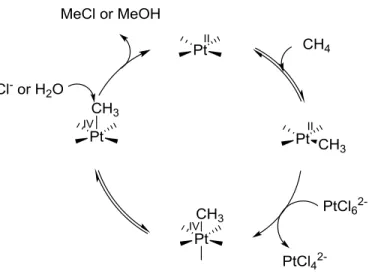
Figure 1.41: Shilov cycle
Much of the mechanistic work on reductive elimination has been performed on Pt complexes as their slow rates of ligand exchange simplify mechanistic study. Early work involved study of the Shilov73 cycle in which both C-O and C-Cl bond forming reductive elimination from Pt(IV) are possible (Figure 1.41).74 In a thorough mechanistic study, Bercaw reported that both the formation of methanol and methyl chloride are the result of SN2 type attack upon the methyl group. This was shown experimentally as C-Cl reductive elimination from Pt-alkyl model compounds led to an inversion of configuration at carbon.75
30
to C-C reductive elimination from the 5-coordinate complex (Figure 1.42). While addition of excess iodide had no effect, addition of phosphine significantly slowed the reaction.
Figure 1.42: Redutive elimination of ethane from 5 coordinate intermediate
Seminal work on the reductive elimination of C-X bonds from Pt(IV) was performed by Goldberg in the mid 90’s.77
Replacement of the monodentate phosphines with bidentate dppe, yielded a vastly different system. In this case, phosphine dissociation was limited by the chelate effect, allowing for competitive dissociation of iodine, which could subsequently attack a methyl group, resulting in MeI formation. The reverse reaction, oxidative addition of MeI to (dppe)PtMeI was possible, thus setting up an equilibrium. The reversible nature of the reductive elimination of MeI was verified by the addition of NaI, which inhibited the formation of ethane. Over time, the Pt(IV) species was converted to (dppe)PtMeI, the result of the reductive elimination of ethane from the same 5-coordinate intermediate (Figure 1.43).77a
31
The majority of studies have supported the SN2 type reductive elimination from 5-coordinate complexes, however, notable exceptions have been observed with Rh78 and Pt. We have recently reported the C-F bond forming reductive elimination from Pt
organometallic compounds. Oxidation of the Pt(II) alkyl species with XeF2 resulted in formation of a Pt(II)-F and the stereoretentive fluorinated product, likely the result of a direct reductive elimination from a Pt(IV)-F (Figure 1.44).68 While no Pt(IV) intermediates were observed in these reactions, several similar Pt(IV) fluorides have been isolated.79
Figure 1.44: Stereoretentive C-F reductive elimination
The direct reductive elimination of C-Cl from Pt(IV) has also been observed. Oxidation of the doubly cyclometalated Pt(II) complex formed a mixture of cis and trans isomers of the Pt(IV) complex. While the trans isomer proved relatively stable, warming a solution of the cis isomer resulted in the formation of a new Pt(II) species. This proved to be the result of the reductive elimination of C-Cl which then datively bonds to the Pt centre. Once again, the reaction rate proved independent of additional chloride, suggesting a direct reductive elimination (Figure 1.45).80
Figure 1.45: Stereoretentive C-Cl reductive elimination
In the case of Rh, oxidative addition of methyl iodide to a Rh(I) pincer complex resulted in formation of a stable, five coordinate Rh(III)-alkyl complex. Placing this
32
phosphine groups contained isopropyl substituents, addition of CO formed a pair of six coordinate Rh(III) complexes. However, when the isopropyl substituents were replaced with t-butyl groups, addition of CO resulted in reductive elimination of methyl iodide and
formation of the Rh(I) carbonyl complex (Figure 1.46). Addition of tetrabutylammonium iodide to the reaction left the reaction rate unchanged, making an SN2-type mechanism unlikely.78
Figure 1.46: Stereoretentive C-I reductive elimination from Rh(III)
Functionalization of metal carbon bonds via 2-electron oxidation mechanisms has been well studied and applied across a broad range of metals. Much less common, is the functionalization of metal carbon bonds which occurs by a single electron oxidation of the metal. While reports of this type have varied in both metal and ligand selection, single electron oxidation has often resulted in the formation of a carbon centered radical which can undergo further reaction to form halogenated, oxygenated or further reduced organic species depending on the choice of oxidant and atmosphere.
33
alkyl bond in all cases. The involvement of a radical mechanism was confirmed by the stereochemical scrambling observed in the formation of the alkyl bromide, a result of the reaction of the free radical with copper (II) bromide (Figure 1.47).81
Figure 1.47: Bromination of Pd and Hg-bonds
In the case of Pt(II) organometallic compounds, an in depth study revealed an
34
Figure 1.48: Donor effects on the oxidation of Pt(II) compounds
Later studies on the single electron oxidation of lead, tin and mercury compounds focused on the oxidation event itself. The oxidation was probed using a series
trisphenanthroline iron(III) complexes which varied in reduction potential according to their substitution. Oxidation of the lead, tin and mercury organometallic complexes with these coordination complexes of iron revealed a second order rate constant which was linearly dependent upon the reduction potential of the oxidant, showing no deviation for steric effects. These data suggested a strictly outer-sphere oxidation process. In contrast to the iron(III) oxidants, application of hexachloroiridate as the oxidant in the same reactions, revealed significantly faster oxidations than those predicted solely based upon their reduction potential. Oxidations with the hexachloroiridate also proved sensitive to steric effects, pointing toward an inner sphere electron transfer process. While the iron complexes also served to oxidize the subsequently formed radical, the hexachloroiridate provided the alkyl chloride product (Figure 1.49).83
35
Baird has also studied the single electron oxidation of both iron84 and ruthenium85 complexes. In the case of iron, two possible reaction pathways could be followed. Oxidation with copper (II) halides resulted in formation of an ion paired complex, the fate of which was dependent upon the alkyl group. In the case of methyl and benzyl substituents, single
electron oxidation with a copper (II) halide resulted in the breakdown of the ion pair via an SN2 type attack of halide upon the alpha carbon, generating MeX or PhCH2X with inversion of configuration. When the alkyl group was n-Bu or Me3CCH2CH2 the ion pair broke down via homolytic cleavage of the iron carbon bond, the alkyl radical then reacts with the copper (II) halide to form the alkyl halide.84
Oxidation of ruthenium organometallics with copper (II) halides provided the organic radical which was once again halogenated with excess copper halide. Electrochemical studies revealed that the ruthenium complexes were more challenging to oxidize and reacted accordingly. Reaction of the ruthenium complexes with mercury (II) halides resulted in a transmetallation reaction, forming the organomercury complexes in quantitative yield.85
36
Figure 1.50: Single electron oxidation of Pd pincer complex
Research Objectives
Biomimetic approaches to the cyclization in acyclic polyene substrates have struggled to replicate the complexity observed in their enzyme mediated counterparts. These reactions have long suffered from a lack of selectivity, premature termination and an inability to duplicate the structural rearrangements observed in nature. This gap between nature and synthetic approaches has prompted the design of elaborate systems to overcome the inherent problems observed in the laboratory.
Of particular interest is the synthesis of C3-oxygenated polycycles. This structural motif is commonly observed in nature and has as its source the oxygen of oxidosqualene. While effective methods exist for their synthesis, installation of the oxygen moiety has occurred exclusively prior to cyclization, generally in the form of an epoxide. This has necessitated the synthesis of chiral substrates in to achieve selectivity in the products, making catalyst controlled cyclization and subsequent installation of the C3-oxygen an attractive alternative.
Our previous efforts in the cyclization of polyene substrates have proven effective for the stoichiometric synthesis of C3 platinated organometallic complexes from both
37
38 References
(1) (a) Biellmann, J.-F. Chem. Rev. 2003, 103, 2019(b) Wendt, K. U.; Schulz, G. E.; Corey, E. J.; Liu, D. R. Angew. Chem. Int. Ed. 2000, 39, 2812(c) Yoder, R. A.; Johnston, J. N. Chem. Rev. 2005, 105, 4730(d) Tantillo, D. J. Nat. Prod. Rep. 2011, 28, 1035(e) Wendt, K. U. Angew. Chem. Int. Ed. 2005, 44, 3966.
(2) Abe, I.; Rohmer, M.; Prestwich, G. D. Chem. Rev. 1993, 93, 2189.
(3) Nes, W. D. Chem. Rev. 2011, 111, 6423.
(4) Naredla, R. R.; Klumpp, D. A. Chem. Rev. 2013.
(5) Jenson, C.; Jorgensen, W. L. J. Am. Chem. Soc. 1997, 119, 10846.
(6) (a) Hoshino, T.; Sato, T. Chem. Commun. 2002, 291(b) Morikubo, N.; Fukuda, Y.; Ohtake, K.; Shinya, N.; Kiga, D.; Sakamoto, K.; Asanuma, M.; Hirota, H.;
Yokoyama, S.; Hoshino, T. J. Am. Chem. Soc. 2006, 128, 13184.
(7) (a) Hess, B. A. J. Am. Chem. Soc. 2002, 124, 10286(b) Hess, B. A.; Smentek, L. Org. Lett. 2004, 6, 1717.
(8) Reinert, D. J.; Balliano, G.; Schulz, G. E. Chem. Biol. 2004, 11, 121.
(9) Smentek, L.; Hess, B. A. J. Am. Chem. Soc. 2010, 132, 17111.
(10) Matsuda, S. P. T.; Wilson, W. K.; Xiong, Q. Org. Biomol. Chem. 2006, 4, 530.
(11) Hess, B. A. Org. Lett. 2003, 5, 165.
(12) Hess, B. A.; Smentek, L. Angew. Chem. Int. Ed. 2013, 52, 11029.
(13) (a) Gutta, P.; Tantillo, D. J. J. Am. Chem. Soc. 2006, 128, 6172(b) Lodewyk, M. W.; Gutta, P.; Tantillo, D. J. J. Org. Chem. 2008, 73, 6570(c) Wang, S. C.; Tantillo, D. J.
39
(14) (a) Tantillo, D. J. Chem. Soc. Rev. 2010, 39, 2847(b) Ueberbacher, B. T.; Hall, M.; Faber, K. Nat. Prod. Rep. 2012, 29, 337.
(15) (a) Kotora, M.; Hessler, F.; Eignerová, B. Eur. J. Org. Chem. 2012, 29(b) Johnson, W. S. Bioorg. Chem. 1976, 5, 51.
(16) (a) Eschenmoser, A.; Ruzicka, L.; Jeger, O.; Arigoni, D. Helvet. Chim. Acta 1955, 38, 1890(b) Stork, G.; Burgstahler, A. W. J. Am. Chem. Soc. 1955, 77, 5068.
(17) (a) Johnson, W. S. Acc. Chem. Res. 1968, 1, 1(b) Johnson, W. S. Angew. Chem. Int. Ed. 1976, 15, 9.
(18) Johnson, W. S.; Crandall, J. K. J. Org. Chem. 1965, 30, 1785.
(19) Fish, P. V.; Johnson, W. S. J. Org. Chem. 1994, 59, 2324.
(20) Johnson, W. S.; Brinkmeyer, R. S.; Kapoor, V. M.; Yarnell, T. M. J. Am. Chem. Soc. 1977, 99, 8341.
(21) Johnson, W. S.; Fletcher, V. R.; Chenera, B.; Bartlett, W. R.; Tham, F. S.; Kullnig, R.
K. J. Am. Chem. Soc. 1993, 115, 497.
(22) (a) Ishibashi, H.; Ishihara, K.; Yamamoto, H. J. Am. Chem. Soc. 2004, 126, 11122(b) Nakamura, S.; Ishihara, K.; Yamamoto, H. J. Am. Chem. Soc. 2000, 122, 8131(c) Ishihara, K.; Ishibashi, H.; Yamamoto, H. J. Am. Chem. Soc. 2002, 124, 3647.
(23) Corey, E. J.; Luo, G.; Lin, L. S. J. Am. Chem. Soc. 1997, 119, 9927.
(24) Surendra, K.; Corey, E. J. J. Am. Chem. Soc. 2012, 134, 11992.
(25) Surendra, K.; Rajendar, G.; Corey, E. J. J. Am. Chem. Soc. 2013, 136, 642.
(26) Sakakura, A.; Ukai, A.; Ishihara, K. Nature 2007, 445, 900.
40
(28) Schafroth, M. A.; Sarlah, D.; Krautwald, S.; Carreira, E. M. J. Am. Chem. Soc. 2012, 134, 20276.
(29) Jeker, O. F.; Kravina, A. G.; Carreira, E. M. Angew. Chem. Int. Ed. 2013, 12166.
(30) Sethofer, S. G.; Mayer, T.; Toste, F. D. J. Am. Chem. Soc. 2010, 132, 8276.
(31) Van Tamelen, E. E. Acc. Chem. Res. 1975, 8, 152.
(32) van Tamelen, E. E.; Willet, J.; Schwartz, M.; Nadeau, R. J. Am. Chem. Soc. 1966, 88, 5937.
(33) Nishizawa, M.; Iwamoto, Y.; Takao, H.; Imagawa, H.; Sugihara, T. Org. Lett. 2000, 2, 1685.
(34) Van Tamelen, E. E.; Leiden, T. M. J. Am. Chem. Soc. 1982, 104, 2061.
(35) Corey, E. J.; Sodeoka, M. Tetrahedron Lett. 1991, 32, 7005.
(36) Corey, E. J.; Lee, J. J. Am. Chem. Soc. 1993, 115, 8873.
(37) Corey, E. J.; Lee, J.; Liu, D. R. Tetrahedron Lett. 1994, 35, 9149.
(38) Corey, E. J.; Lin, S. J. Am. Chem. Soc. 1996, 118, 8765.
(39) Zhang, J.; Corey, E. J. Org. Lett. 2001, 3, 3215.
(40) Mi, Y.; Schreiber, J. V.; Corey, E. J. J. Am. Chem. Soc. 2002, 124, 11290.
(41) Surendra, K.; Corey, E. J. J. Am. Chem. Soc. 2008, 130, 8865.
(42) Surendra, K.; Qiu, W.; Corey, E. J. J. Am. Chem. Soc. 2011, 133, 9724.
41
(44) Takao, H.; Wakabayashi, A.; Takahashi, K.; Imagawa, H.; Sugihara, T.; Nishizawa,
M. Tetrahedron Lett. 2004, 45, 1079.
(45) Godeau, J. Olivero, S. Antoniotti, S. u ach, E. Org. Lett. 2011, 13, 3320.
(46) Hanson, J. R. In Comp. Org. Synth.; Trost, B. M., Fleming, I., Eds.; Pergamon: Oxford, 1991.
(47) Godeau, J.; Fontaine-Vive, F.; Antoniotti, S.; Duñach, E. Chem. Eur. J. 2012, 18, 16815.
(48) Johnson, W. S.; Telfer, S. J.; Cheng, S.; Schubert, U. J. Am. Chem. Soc. 1987, 109, 2517.
(49) Abrams, G. D.; Bartlett, W. R.; Fung, V. A.; Johnson, W. S. Bioorg. Chem. 1971, 1, 243.
(50) Johnson, W. S.; Kinnel, R. B. J. Am. Chem. Soc. 1966, 88, 3861.
(51) (a) Johnson, W. S.; Jensen, N. P.; Hooz, J. J. Am. Chem. Soc. 1966, 88, 3859(b) Johnson, W. S.; Jensen, N. P.; Hooz, J.; Leopold, E. J. J. Am. Chem. Soc. 1968, 90, 5872.
(52) (a) Johnson, W. S.; Semmelhack, M. F.; Sultanbawa, M. U. S.; Dolak, L. A. J. Am.
Chem. Soc. 1968, 90, 2994(b) Johnson, W. S.; Li, T.-T.; Harbert, C. A.; Bartlett, W.
R.; Herrin, T. R.; Staskun, B.; Rich, D. H. J. Am. Chem. Soc. 1970, 92, 4461.
(53) Prestwich, G. D.; Labovitz, J. N. J. Am. Chem. Soc. 1974, 96, 7103.
(54) Bartlett, W. R.; Johnson, W. S. Bioorg. Chem. 1975, 4, 342.
(55) Harding, K. E.; Leopold, E. J.; Hudrlik, A. M.; Johnson, W. S. J. Am. Chem. Soc. 1974, 96, 2540.
42
(57) Johnson, W. S.; Plummer, M. S.; Reddy, S. P.; Bartlett, W. R. J. Am. Chem. Soc. 1993, 115, 515.
(58) Johnson, W. S.; Buchanan, R. A.; Bartlett, W. R.; Tham, F. S.; Kullnig, R. K. J. Am.
Chem. Soc. 1993, 115, 504.
(59) (a) Chianese, A. R.; Lee, S. J.; Gagné, M. R. Angew. Chem. Int. Ed. 2007, 46, 4042(b) McDonald, R. I.; Liu, G.; Stahl, S. S. Chemical Reviews 2011, 111, 2981.
(60) Koh, J. H.; Mascarenhas, C.; Gagné, M. R. Tetrahedron 2004, 60, 7405.
(61) Koh, J. H.; Gagné, M. R. Angew. Chem. Int. Ed. 2004, 43, 3459.
(62) (a) Kerber, W. D.; Gagné, M. R. Org. Lett. 2005, 7, 3379(b) Kerber, W. D.; Koh, J. H.; Gagné, M. R. Org. Lett. 2004, 6, 3013.
(63) Feducia, J. A.; Campbell, A. N.; Doherty, M. Q.; Gagné, M. R. J. Am. Chem. Soc. 2006, 128, 13290.
(64) Sokol, J. G.; Korapala, C. S.; White, P. S.; Becker, J. J.; Gagné, M. R. Angew. Chem. Int. Ed. 2011, 50, 5658.
(65) Feducia, J. A.; Campbell, A. N.; Anthis, J. W.; Gagné, M. R. Organometallics 2006, 25, 3114.
(66) Feducia, J. A.; Gagné, M. R. J. Am. Chem. Soc. 2008, 130, 592.
(67) Mullen, C. A.; Gagné, M. R. J. Am. Chem. Soc. 2007, 129, 11880.
(68) hao, S.-B. Becker, J. J. Gagné, M. R. Organometallics 2011, 30, 3926.
(69) Cochrane, N. A.; Nguyen, H.; Gagne, M. R. J. Am. Chem. Soc. 2013, 135, 628.
43
(71) (a) Vigalok, A. Chem. Eur. J. 2008, 14, 5102(b) Vedernikov, A. In C-X Bond
Formation; Vigalok, A., Ed.; Springer Berlin Heidelberg, 2010; Vol. 31(c) Racowski,
J.; Sanford, M. In Higher Oxidation State Organopalladium and Platinum Chemistry; Canty, A. J., Ed.; Springer Berlin Heidelberg, 2011; Vol. 35.
(72) (a) Williams, B. S.; Holland, A. W.; Goldberg, K. I. J. Am. Chem. Soc. 1999, 121, 252(b) Williams, B. S.; Goldberg, K. I. J. Am. Chem. Soc. 2001, 123, 2576.
(73) Labinger, J.; Bercaw, J. In Higher Oxidation State Organopalladium and Platinum
Chemistry; Canty, A. J., Ed.; Springer Berlin Heidelberg, 2011; Vol. 35.
(74) Vigalok, A.; Kaspi, A. Top. Organomet. Chem. 2010, 31, 19.
(75) Luinstra, G. A.; Wang, L.; Stahl, S. S.; Labinger, J. A.; Bercaw, J. E. J. Organomet.
Chem. 1995, 504, 75.
(76) Brown, M. P.; Puddephatt, R. J.; Upton, C. E. E. J. Chem. Soc., Dalton Trans. 1974, 2457.
(77) (a) Goldberg, K. I.; Yan, J. Y.; Winter, E. L. J. Am. Chem. Soc. 1994, 116, 1573(b) Goldberg, K. I.; Yan, J.; Breitung, E. M. J. Am. Chem. Soc. 1995, 117, 6889.
(78) Frech, C. M.; Milstein, D. J. Am. Chem. Soc. 2006, 128, 12434.
(79) Zhao, S.-B.; Wang, R.-Y.; Nguyen, H.; Becker, J. J.; Gagné, M. R. Chem. Commun. 2012, 48, 443.
(80) Crosby, S. H.; Thomas, H. R.; Clarkson, G. J.; Rourke, J. P. Chem. Commun. 2012, 48, 5775.
(81) Budnik, R. A.; Kochi, J. K. J. Organomet. Chem. 1976, 116, C3.
(82) Chen, J. Y.; Kochi, J. K. J. Am. Chem. Soc. 1977, 99, 1450.
(83) Wong, C. L.; Kochi, J. K. J. Am. Chem. Soc. 1979, 101, 5593.
44
(85) Joseph, M. F.; Page, J. A.; Baird, M. C. Organometallics 1984, 3, 1749.
45
CHAPTER 2: STOICHIOMETRIC HALOGENATION OF PT-C BONDS*
Introduction
When considering the reductive elimination of C-X bonds from high valent metal centres, two modes of reactions are possible: stereoretentive reductive elimination in which configuration is retained, and SN2 type reductive elimination in which an inversion of configuration is observed. The majority of studies on C-X bond forming reductive elimination have involved formation Me-X bonds, a process in which the stereochemical information is lost since both retentive and SN2-type reductive elimination mechanisms form the same identical product.
The stability of (triphos)Pt-R+ complexes toward acid has allowed for the isolation of unique Pt alkyl compounds where the alkyl is a complex multicyclic structure. Formation of the diastereomerically pure Pt-alkyl compounds generated from a polyene cyclization, provide ideal subjects for study of C-X bond forming reductive elimination. In contrast to the reductive elimination of MeX bonds, the stereogenicity of the carbon center and the diastereomeric purity of this compound allows for the generation of two different and distinguishable diastereomeric products depending upon the mechanism of reductive elimination (Figure 2.1).
46
Figure 2.1: Possible C-X reductive elimination pathways
We have previously reported the first stereoretentive C-F bond forming reductive elimination from a proposed Pt(IV) intermediate.1 While this stereochemical outcome was surprising, as C-X reductive elimination generally proceeds in a step-wise stereoinvertive fashion,2 the poor nucleophilicity of fluoride was thought to perhaps contribute to this phenomenon.
The successful fluorination1 and β-hydride elimination3 reactions of polycyclic Pt-alkyl compounds led us to the explore the possibility of developing new Pt-C bond functionalizing reactions and turnover mechanisms through mechanistic studies on pre-isolated Pt-alkyl intermediates. With this long-term goal in mind, further exploration of the reductive elimination from the Pt-alkyl complex was undertaken.
Results
47
and 58% for the bromide, diastereoselectivity of the reaction was good, producing the products in greater than 10:1 dr. In the case of iodine (I2), oxidation proceeded in less than five minutes, producing the stereoretentive iodide in 89% yield with greater than 10:1 dr (Figure 2.2). Despite convenient monitoring by 31P NMR spectroscopy, no intermediates were observed, suggesting slow oxidation of Pt(II) to Pt(IV) followed by rapid reductive elimination from the proposed Pt(IV) intermediate. In each case, the Pt-product was
determined to be (triphos)Pt-X+ (X = Cl, Br, I) as determined from 31P NMR spectroscopy. In each case, the coupling constant of the phosphine trans to the halide was ~3 000 Hz, characteristic of a (triphos)PtX+ complex.
Figure 2.2: Stereoretentive C-X bond forming reductive elimination
48
vacant or occupied by solvent. This complex is likely to be highly unstable as the soft
phosphine donor ligands struggle to stabilize hard, high-oxidation state metal complexes such as Pt(IV).4 As a consequence of its high reactivity, this complex will then undergo rapid, metal-based reductive elimination, resulting in the observed stereoretentive products (Figure 2.3). Given the electron deficient nature of a dicationic Pt(IV) complex it is perhaps not so surprising that X- loss (to a tricationic, formally four coordinate Pt(IV) species) and re-addition is not a competitive mechanism of reductive elimination. In most cases where the invertive/SN2 mechanism is invoked for R-X reductive elimination the charge on the metal is such that the overall charge on the putative intermediate is not nearly so high.
While the aversion of F- to behave as a nucleophile in an SN2-type reaction could explain the stereoretentive fluorination, the larger halides (Br-, I-) are known to be sufficiently nucleophilic to engage in such reactivity,5 making their C-X bond forming, stereoretentive reductive elimination that much more surprising. While stereoretentive C-Cl bond forming reductive elimination has recently been reported,6 these represent the first cases of stereoretentive C-Br and C-I bond forming reductive elimination from Pt(IV).
Figure 2.3: Mechanism of stereoretentive C-X bond formation
The use of halonium reagents as two electron oxidants proved effective for converting Pt(II) to Pt(IV) resulting in formation of the C3-halogenated products, however, we became interested in C3-oxygenated compounds, a structural motif found in numerous natural
49
reductive elimination.8 Recent organometallic chemistry of high valent Pt and Pd complexes with electrophilic fluorinating reagents has proven to be quite complex,9 often involving competing reductive elimination processes.10 The significant kinetic barrier to C-F bond forming reductive elimination has made electrophilic fluorinating reagents an attractive by-standing oxidant, wherein F+ serves as the oxidant but does not participate in bond forming reductive elimination, an approach that has shown the ability to promote a variety of alternative reductive elimination processes.11
We envisioned a process through which Pt oxidation with an electrophilic
fluorinating reagent would produce a transient Pt(IV) complex, which, in the presence of a suitable oxygen nucleophile could undergo an SN2 type C-O bond forming reaction. Attempts to use XeF2 in the role of by-standing oxidant to achieve selective C-O bond forming reductive elimination produced unexpected results. Addition of 3 eq. of XeF2 to a solution of 2.1 and 10 eq. tetrabutylammonium acetate (TBAOAc) in acetonitrile consumed the starting material, however, the desired C3-acetate was not observed. In place of the acetate, we discovered that the invertive C3-fluorinated product was now the preferred product (Table 2.1). To better determine the role of acetate, its concentration was varied, at a single equivalent of TBAOAc, a slight preference for the stereoretentive product was
50
Table 2.1: Fluorination in the presence of TBAOAc
In the presence of acetate, the previously reported direct reductive elimination pathway1 from the five coordinate Pt(IV)-fluoride could be nearly shut off. Oxidation of the Pt(II)-alkyl complex by XeF2 results in formation of the five coordinate Pt(IV) fluoride, however, in the presence of acetate, we surmised that the five coordinate Pt(IV)-fluoride can be quickly trapped (more effectively at high TBAOAc concentrations) to form a
51
52
To further investigate this unexpected switch in reductive elimination mechanism, several similar processes were examined. Addition of tetrabutylammonium bromide in place of the tetrabutylammonium acetate allowed for formation of C3-brominated products. At one equivalent of tetrabutylammonium bromide, the stereoretentive C3-fluoride remained the major product at a 51% yield. At 2 equivalents TBAB, 32% of the retentive fluoride, 19% of the invertive bromide and 4% of the retentive bromide formed. At 5 equivalents TBAB 31% of the retentive fluoride, 31% of the invertive bromide and 21% of the retentive bromide formed. This data provide a clear indication that brominated products are preferred at higher loadings of TBAB.
Table 2.2: Fluorination in the presence of TBAB
53
stereoretentive bromide could occur through two different mechanisms: from dissociation of fluoride from the 6-coordinate complex, which could then undergo stereoretentive C-Br reductive elimination, akin the reaction of 2.1 with NBS (Figure 2.5), or conversion of Br- to Br+ through reaction with XeF2.
54
The kinetic barrier to C-F bond forming reductive elimination is known to allow competing processes to occur with electrophilic fluorinating reagents.9,11 With this in mind, we explored the use of NBS as oxidant to ascertain if this mechanistic switch occurred exclusively with electrophilic fluorinating reagents. Use of N-bromosuccinimide as oxidant and tetrabutylammonium bromide (TBAB) as the nucleophile also produced a mixture of invertive and retentive bromides. At 1 equivalent of TBAB, equal amounts of invertive and retentive bromide were formed at 19% a piece. At 2 equivalents 2 TBAB, the ratio remained similar, however, both were formed in greater yield, 33% of the retentive and 27% of the invertive. At 5 equivalents of TBAB, the invertive product was favored by nearly a 2:1 ratio at 23% to 12%. While the variations in yield were unexpected, the increasing amounts of the invertive product suggest a link between formation of the invertive and the concentration of TBAB.
Table 2.3: Bromination in the presence of TBAB
55
While a 6-coordinate complex is likely to be favored at higher bromide concentrations, these data do not provide sufficient evidence for a 5 vs. 6 coordinate mechanism.
Figure 2.6: Possible reductive elimination pathways with NBS and TBAB
Discussion
56
14 electron, 4-coordinate, tricationic Pt(IV) complex (Figure 2.6). The instability of such a putative intermediate would seem to reduce the likelihood of proceeding in this fashion.
Figure 2.7: Reductive elimination from 5-coordinate complex
A mechanistically relevant process has recently been reported by Sanford et. al in which C-F bond forming reductive elimination from Pd(IV) produces an alkyl fluoride. The authors concluded that ligand (pyridine) dissociation from a 6 coordinate complex takes place prior to reductive elimination from a similar 5 coordinate complex. While the authors were unable to differentiate between invertive and retentive reductive elimination, they favored the retentive pathway due to the poor nucleophilicity of F- and unlikely dissociation of F- from the 5 coordinate complex.13 The observation of invertive F- reductive elimination pathways in the present suggests that this possibility may indeed be feasible.
57
In the case of the stereoinvertive reductive eliminations, two different pathways are possible in each case: 1) nucleophilic attack on a 5 coordinate complex, or 2) nucleophilic attack on a 6 coordinate complex (Figure 2.9). While either or both processes may be operative, previous work by Goldberg, Puddephatt and others would suggest that reductive elimination proceeds by nucleophilic attack uponthe 5 coordinate complex.2a,b,9,14
Figure 2.9: Possible paths to stereoinvertive reductive elimination
58 Figure 2.10: Comparison of possible intermediates
The ability to manipulate the mechanism of reductive elimination from Pt(IV) has provided a means through which to control the diastereoselectivity of the halogenated product. This unexpected deviation from standard SN2-type behavior has provided evidence that this process may be more complicated than previously believed. While we have been unable to determine the nature of the coordination sphere from which these reductive elimination mechanisms take place, study of their role in this process will provide valuable insight. While we have previously reported catalytic, stereoretentive cyclization/fluorination of polyenes,15 we have thus far been unable to translate this to catalytic manifold, selectively proving the other fluoride diastereomer.
Experimental Section
All air and moisture sensitive procedures were performed using an MBraun glovebox or
standard Schlenk line techniques. Commercially available reagents were used without
59
Bruker 600 MHz Avance spectrometer and referenced to residual solvent peaks. Compounds
2.1,162.51 and 2.717 have been reported. HRMS was performed by Dr. Mee-Kyung Chung at
the University of North Carolina at Chapel Hill.
General Procedure for Oxidation Reactions
The oxidant of choice was added to a stirring solution of 2.1 (8 mg, 0.04 mmol) in CD3CN
(0.7 mL). For reactions involving tetrabutylammonium salts, the salt was added prior to the
oxidant. NMR yields were determined in reference to an internal standard by 1H or 19F NMR
(4-methylanisole for reactions with TBAB and 1-fluoro-3,5-dimethoxybenzene for reactions
with TBAOAc)
Compound 2.2:
2.2: 1H NMR (600 MHz, CDCl3): δ 7.12 (m, 1H), 7.06 (m, 1H), 6.86 (m, 1H), 6.80 (m, 1H),
3.99 (m, 1H), 2.63 (m, 1H), 2.53 (m, 1H), 2.29 (br, 2H), 2.05 (m, 1H), 1.92 (m, 1H), 1.86 (m,
1H), 1.75 (m, 1H), 1.59 (m, 1H), 1.22 (s, 3H) ppm. 13C NMR (152 MHz, CDCl3): 153.4,
129.6, 127.7, 121.3, 120.2, 117.5, 75.7, 57.7, 40.1, 39.4, 38.9, 34.3, 28.9, 16.6 ppm. HRMS
(ESI) C14H17ClO [M+H]+/z calc. 237.1041, found 237.1045.
60
2.3: 1H NMR (600 MHz, CDCl3): δ 7.10 (m, 1H), 7.02 (m, 1H), 6.84 (m, 1H), 6.78 (m, 1H),
4.08 (m, 1H), 2.60 (m, 1H), 2.50 (m, 1H), 2.36 (br, 2H), 2.00 (m, 2H), 1.90 (m, 1H), 1.60 (m,
2H) 1.21 (s, 3H) ppm. 13C NMR (152 MHz, CDCl3): 153.4, 129.6, 127.7, 121.3, 120.2,
117.5, 75.6, 48.9, 41.0, 40.5 40.0, 35.2, 28.8, 16.6 ppm. HRMS (ESI) C14H17BrO [M+H]+/z
calc. 281.0536, found 281.0534.
Compound 2.4:
2.4: 1H NMR (600 MHz, CDCl3): δ 7.10 (m, 1H), 7.02 (m, 1H), 6.83 (m, 1H), 6.77 (m, 1H),
4.17 (m, 1H), 2.59 (br, 1H), 2.40-2.52 (m, 3H), 2.17 (m, 1H), 1.82-1.91 (m, 3H), 1.71 (m,
1H), 1.21 (s, 3H) ppm. 13C NMR (152 MHz, CDCl3): δ 153.3, 129.6, 127.7, 121.3, 120.16,
117.5, 75.6, 43.4, 42.1, 41.5, 37.6, 28.6, 25.5, 16.6 ppm. HRMS (ESI) C14H17IO [M+H]+/z
calc. 329.0397, found 329.0395.
61
62 References
(1) hao, S.-B. Becker, J. J. Gagné, M. R. Organometallics 2011, 30, 3926.
(2) (a) Goldberg, K. I.; Yan, J. Y.; Winter, E. L. J. Am. Chem. Soc. 1994, 116, 1573(b) Goldberg, K. I.; Yan, J.; Breitung, E. M. J. Am. Chem. Soc. 1995, 117, 6889(c) Vigalok, A.; Kaspi, A. Top. Organomet. Chem. 2010, 31, 19.
(3) (a) Mullen, C. A.; Gagné, M. R. J. Am. Chem. Soc. 2007, 129, 11880(b) Sokol, J. G.; Cochrane, N. A.; Becker, J. J.; Gagné, M. R. Chem. Commun. 2013, 49, 5046.
(4) Rendina, L. M.; Puddephatt, R. J. Chem. Rev. 1997, 97, 1735.
(5) Vigalok, A.; Kaspi, A. In C-X Bond Formation; Vigalok, A., Ed.; Springer Berlin Heidelberg, 2010; Vol. 31.
(6) Crosby, S. H.; Thomas, H. R.; Clarkson, G. J.; Rourke, J. P. Chem. Commun. 2012, 48, 5775.
(7) Yoder, R. A.; Johnston, J. N. Chem. Rev. 2005, 105, 4730.
(8) Vedernikov, A. In C-X Bond Formation; Vigalok, A., Ed.; Springer Berlin Heidelberg, 2010; Vol. 31.
(9) Vigalok, A. Organometallics 2011, 30, 4802.
(10) (a) Kaspi, A. W.; Goldberg, I.; Vigalok, A. J. Am. Chem. Soc. 2010, 132, 10626(b) Liskin, D. V.; Sibbald, P. A.; Rosewall, C. F.; Michael, F. E. J. Org. Chem. 2010, 75, 6294(c) Rosewall, C. F.; Sibbald, P. A.; Liskin, D. V.; Michael, F. E. J. Am. Chem. Soc. 2009, 131, 9488.
(11) Engle, K. M.; Mei, T.-S.; Wang, X.; Yu, J.-Q. Angew. Chem. Int. Ed. 2011, 50, 1478.
(12) Yahav, A.; Goldberg, I.; Vigalok, A. Inorg. Chem. 2005, 44, 1547.